BuzzFeed’s Cohen Lies Just Latest Example of Embarrassing ‘RussiaGate’ Hysteria
By Kit Klarenberg | Sputnik | January 21, 2019
In a bombshell report, on 17 January BuzzFeed claimed Donald Trump had told his lawyer Michael Cohen to lie to Congress about the specifics of the ‘Trump Tower Moscow’ project — a felony, and indeed an impeachable one.
Other news outlets the world over eagerly regurgitated the story, and Democratic lawmakers on social media and indeed on the floor of the US legislature advocated kickstarting impeachment proceedings.
However, in an unprecedented move, the very next day special counsel Robert Mueller broke with his 20-month-long convention of not commenting on news reports relating to his investigation by announcing the story wasn’t true. Moreover, he was critical of BuzzFeed’s failure to contact his representatives and ask for verification on the story before publication.
History of Fabulism
Not long after Mueller’s denial, more critical voices began scrutinizing the report. Many noted Jason Leopold — one of the reporters on the story — had previously been involved in another epic ‘fake news’ fiasco at BuzzFeed relating to Russia. In November 2017, he authored a story which claimed the FBI was investigating records indicating in August 2016 the Russian Foreign Ministry sent US$30,000 to its embassy in Washington for “election financing”.
A shock story evidently written for maximum ‘clickbait’ value, Leopold — almost certainly consciously — opted to bury the fact the payments related to Russia’s own elections in September 2016, in which expatriate Russians were permitted to vote in their adopted home countries. As of January 2019, the article hasn’t been removed from web, although a qualifier has been added to its introductory paragraph.

Jason Leopold
Others expressed shock Leopold was still employed by any media outlet at all, for as Colombia Journalism Review documented back in 2006, his lengthy career has been typified by controversy, ignominy and dishonesty.
For instance, in August 2002 Leopold wrote an article for Salon claiming then-Secretary of the Army and former Enron vice chair Thomas White knew more about the company’s infamously questionable accounting practices than he’d admitted up to that time. The key piece of evidence for the allegation was an internal Enron email that was apparently leaked to Leopold by an anonymous source — but after he was unable to produce a copy when asked by his editor, and it was revealed he’d plagiarised portions of the piece from the Financial Times, it was pulled from the website.
In a perversely ironic twist, in 2005 Leopold’s memoir (Off the Record), in which he pledged to come clean about all the “lying, cheating and backstabbing” he’d engaged in over the course of his journalistic career and set the ‘record’ straight on his various ignominious departures from media organisations (including the Los Angeles Times and Dow Jones ), was dumped by planned publisher Rowman & Littlefield just before it went to press after one of the book’s sources threatened to sue.
Leopold had claimed the source in question, Steven Maviglio — spokesperson for then-California Governor Gray Davis — had told him he “might have broken the law by investing in energy companies using inside information”, which was apparently totally untrue.
The next year, Leopold again landed in hot water when he published a story for Truthout claiming Karl Rove “told President Bush and Chief of Staff Joshua Bolten, as well as a few other high level administration officials,” he was due to be indicted in the Valerie Plame scandal. In the piece, he said multiple anonymous sources had confirmed Rove’s indictment “was imminent” — mere days later prosecutors confirmed Rove would not face charges. Despite this, Truthout chief Marc Ash stood by the story despite a lack of corroboration elsewhere and furious denials from all named in the story for some time.
Standing By
Intriguingly, there were shades of Ash’s response in BuzzFeed’s reaction to Mueller’s denials — namely, the outlet stood by the story, not only refusing to retract it, but “reconfirming” it — and editor-in-chief Ben Smith vehemently defended his decision to publish in a much-ridiculed interview on CNN, claiming the reporting would be “borne out” by future disclosures.
Other outlets have chosen to retract and/or correct their reporting on the story — although, journalist Doug Henwood has noted while New York Times covered the report on the front page of its print edition, its correction was buried on page 11 the next day.
Despite BuzzFeed’s defence of the story, it’s likely to go down as yet another utterly embarrassing mainstream media ‘RussiaGate’ failure in a very long line — stories which have briefly generated borderline-hysteria on social media and cable news, but been proven to be utterly without foundation in short order. Here are some of the most notorious.
Manafort Meeting Never Was
On 27 November 2018, The Guardian published a seismic exclusive report authored by Luke Harding that claimed Paul Manafort, President Donald Trump’s former campaign chair and now-convicted felon, met with WikiLeaks chief Julian Assange in the Ecuadorian Embassy in London on three separate occasions.
The story stretched believability to breaking point — Manafort somehow managed to enter and exit the Embassy without being photographed, filmed or even noticed, and left no record of his presence in the building’s visitor log — and was based entirely on anonymous sources.
WikiLeaks immediately issued a vehement denial, declaring the story to be completely “fabricated” and noting the paper had given them virtually no time to respond prior to publication. Within hours, the organisation had set up a legal fund seeking donations in order to sue The Guardian for libel, and were calling for the resignation of Editor Katherine Viner. The paper responded by softening the report’s wording significantly, making clear it was based entirely on unverifiable allegations from anonymous sources, rather than anything even approaching actual evidence.
In less than a day, what Harding and Viner had evidently hoped would be the journalistic scoop of the year was shaping up to be the biggest disaster in news reporting since Germany’s Stern magazine published ‘The Hitler Diaries’ in 1983, a disaster that could severely — and enduringly — damage the reputation of The Guardian and land the paper in significant legal hot water. Despite this, the story was uncritically regurgitated by news outlets the world over. As of January 21, neither Harding nor Viner has retracted or apologized for the piece.
Dates Mixed Up
On 9 December 2017, CNN claimed Donald Trump Jr. was offered advanced access to the notorious DNC and Podesta email troves by WikiLeaks — a smoking gun proving the Trump campaign had colluded with WikiLeaks to undermine Hillary Clinton. The story was then backed up by MSNBC, with intelligence and national security reporter Ken Dilanian breathlessly claiming to have “independent confirmation” of the story.
It would be mere hours before the incendiary story would be completely shredded by reality. In truth, Trump Jr. had been apprised of the email dumps’ existence by a member of the public 10 days after their release. The assorted anonymous sources who’d confirmed the story to both networks had evidently all got their dates mixed up, or indeed were lying — or didn’t even exist perhaps, as both networks’ refusal to name their sources may imply.
The pair’s determination to cover up their colossal journalistic failure doesn’t end there — both have deleted every trace of the story from their official websites and YouTube channels, and attempts by individual users to upload their own copies invariably result in copyright claims and deletion.
Just Ain’t Crickets
In another major disaster for MSNBC — and its star reporter Dilanian — in September 2018, the network repeatedly claimed Russia was the primary suspect in “mysterious” attacks giving US diplomatic staff in Cuba “brain injuries”.
“Sophisticated microwaves or another type of electromagnetic weapon were likely used on the government workers… [they are] so sophisticated the Americans don’t even fully understand it,” Dilanian said.
Subsequent reports claimed CIA intercepts of Russian communications backed up the conclusion the Kremlin was directing the dastardly brain damaging blasts. Such was the ferocity of the reporting — and the seriousness of the allegations — Republican Senator Cory Gardner appeared on the network to say Russia should now be classified a “terror state”.
MSNBC carried on with their microwave weapon crusade despite academics casting significant doubt on their analysis — it would not be until January 2019 the story would be totally debunked, when two scientists — Alexander Stubbs of Berkeley and Fernando Montealegre-Z of the UK’s University of Lincoln — published a study based on recordings of the sounds embassy personnel complained of hearing, and blamed for their “brain damage”, revealing the ‘microwave weapons’ to in fact be…Caribbean crickets during mating season.
READ MORE:
‘Not Accurate’: Mueller Refutes BuzzFeed Cohen Scoop
Cuban Horror Stories: How US Scares Investors Off From the Island — Pundits
US Questioning Ecuadorian Embassy Staff Over Debunked Assange-Manafort Story
As Guardian’s Manafort-Assange Story Exposed as Fake, Ex-CIA Agent Blames Russia
Russia rejects US demand to destroy new missile system
Press TV – January 21, 2019
Russia has rejected a US demand for Moscow to destroy a new cruise missile system, a weapon Washington alleges is in violation of the landmark Intermediate-range Nuclear Forces (INF) Treaty.
Russian Deputy Foreign Minister Sergei Ryabkov said Monday it was unacceptable for Washington to demand Moscow destroy its SSC-8/9M729 cruise missile, denying the missile system is in breach of INF.
INF was a Cold-War era treaty signed in 1987 that eliminated all nuclear and conventional missiles with ranges of 1,000–5,500 km (620–3,420 mi).
Ryabkov also said Russia has proposed putting on a demonstration of the missile for the United States, the Interfax news agency quoted him as saying.
“We are ready to show unprecedented transparency on the 9M729 missile, which alarms the Americans so much. We offered them a presentation and a briefing on the missile, which absolutely does not follow from the content of the treaty itself,” he said.
“But at the same time, we insist that the Americans take practical steps to alleviate our concerns on the Aegis Ashore systems, deployed in Romania, whose deployment is also scheduled in Poland soon.”
The statement comes after earlier in the day US disarmament ambassador Robert Wood called on Russia to “verifiably destroy” the missiles in order to save the INF treaty and accused Moscow of destabilizing global security.
Wood said the system was capable of carrying both conventional and nuclear warheads and represented a “potent and direct threat to Europe and Asia” as it had a range of 500 to 1,500 kilometers (310-620 miles).
“Unfortunately, the United States increasingly finds that Russia cannot be trusted to comply with its arms control obligations and that its coercive and malign actions around the globe have increased tensions,” Wood told the UN-sponsored Conference on Disarmament.
US President Donald Trump’s administration last week rejected an offer by Moscow to save the INF treaty, claiming it could not be properly verified, setting the stage for Washington to withdraw from the pact next month.
Moscow has refuted the US allegations, pointing out that Washington has provided no proof that Russia has, in fact, violated the treaty by deploying the missiles.
Russian Foreign Minister Sergei Lavrov said Friday that Washington’s stance on the INF jeopardizes further nuclear disarmament and the sustainability of the non-proliferation treaty.
Ties between Moscow and Washington have plummeted to levels not seen since the Cold War due to the two countries’ disputes over the crises in Ukraine and Syria and after US officials accused Russia of meddling in the 2016 US presidential election.
Western countries have levied broad economic sanctions against Moscow over its support for pro-Russia forces in eastern Ukraine and Crimea’s reunification with Russia.
US intelligence agencies allege that Russia had influenced the US presidential election in November that year to help Trump get elected, an allegation that the US president and Russia have strongly denied.
Kamala Harris Dons Progressive Mantle in Public, Strips it Off in Private as She Courts Israel Lobby
By Whitney Webb | Mint Press News | January 21, 2019
Confirming long-held speculation, Senator Kamala Harris (D-CA) has announced that she will be running for president in 2020, pitting her against other Democratic senators such as Kirsten Gillibrand (D-NY) and Elizabeth Warren (D-MA) as well as Rep. Tulsi Gabbard (D-HI). Harris’ announcement has generated some buzz but surprised few, as she has been considered a likely 2020 contender for the Democratic nomination since early 2017. Harris first tweeted on Monday morning out her plans to run for president along with the Clinton-esque slogan “Let’s do this together.”
She then repeated her announcement on ABC’s Good Morning America, stating that “I am running for president of the United States. I’m very excited about it.” Harris, who decided to launch her campaign on the federal holiday celebrating Martin Luther King Jr., later added, “I love my country. And this is a moment in time that I feel a sense of responsibility to stand up and fight for the best of who we are.”
However, despite the long-promoted “inevitability” of Harris’ campaign, she has failed to garner much enthusiasm from progressive voters, owing to her history of supporting neoliberal policies as well as her pro-Zionist leanings, which she has attempted to keep from public view.
Though hardly “progressive,” Harris – much like another 2020 hopeful, Elizabeth Warren – has sought to cast herself as such in recent years in an effort to unite a fractured Democratic party by publicly catering to progressives while also privately catering to special interests, including the Israel lobby.
In this two-part series, MintPress News will examine how Harris is set to emulate much of Hillary Clinton’s failed 2016 campaign — particularly the distinction between her “private” and “public” positions — while using identity politics to her advantage. This has already begun, with Harris having courted past Hillary campaign staffers and millionaire donors alike. In addition, top establishment liberals like Joy Ann Reid of MSNBC and Clinton advisor Neera Tanden are claiming that legitimate criticism of, and a lack of enthusiasm for, a Harris presidential run on the part of progressives stem from “racism” and “sexism” among left-leaning Americans — reviving the Clinton campaign’s “Bernie bros” narrative that characterizes Bernie Sanders-supporting progressive voters as “all-white” and “all-male.”
One of the clearest examples of Harris’ practice of courting special interests in private while painting a different picture in public is her position on the Israel/Palestine conflict. While Harris once, in 2012 while serving as California’s attorney general, stood up to Israeli government pressure to persecute activists working with the pro-Palestinian rights movement Boycott, Divest, Sanctions (BDS), she made a concerted effort to court pro-Israel interests as she began to pursue her higher political ambitions, namely when she kicked off her 2016 campaign for the Senate.
Since then, Harris has sought to keep a public persona of neutrality on the divisive issue by evasively responding to questions on the issue or avoiding them altogether. At the same time, Harris has been privately pandering to Israel lobby groups in “off-the-record” speeches and during trips to Israel that she and her staff chose not to publicize. This clearly reflects the image that Harris seeks to build of herself as a “progressive centrist” candidate, meaning one who cultivates a public persona of progressivism while also supporting many of the hallmark policies of establishment “centrist” Democrats and courting the mega-donors of the Democratic Party.
A quiet courtship
Once her 2016 Senate campaign was underway, Harris made it clear that she was willing to “look the other way” when it comes to the human-rights abuses regularly inflicted on Palestinians by the state of Israel. That year, in a questionnaire from Jewish News of Northern California, Harris asserted that “Lasting peace [between Israel and Palestine] can only be found through bilateral negotiations that protect Israel’s identity, ensure security for all people and include the recognition of Israel’s right to exist as a Jewish state” — i.e., a Jewish ethnostate that gives other ethnoreligious backgrounds an “inferior” status.
In that same questionnaire, Harris also praised Israel’s Supreme Court, which has helped to enshrine apartheid and also legalized the targeted assassinations of hundreds of Palestinians during intifadas (uprisings), as “a beautiful home to democracy and justice in a region where radicalism and authoritarianism all too often shape government.”
Harris went on to resoundingly reject the non-violent BDS movement, stating:
The BDS movement seeks to weaken Israel but it will only isolate the nation and steer Israelis against prerequisite compromises for peace. At a time when anti-Semitism is on the rise – especially in Europe – and the Middle East is growing increasingly unstable, I believe we should not isolate Israel, the only democracy in the region.”
In 2017, a few months after winning her Senate seat, Harris gave her first public address to the American Israel Public Affairs Committee (AIPAC), in which she stated:
I believe Israel should never be a partisan issue, and as long as I’m a United States senator, I will do everything in my power to ensure broad and bipartisan support for Israel’s security and right to self-defense.”
Several months later, Harris quietly visited Israel, a trip that she did not post on her website or social media accounts but that was instead announced by Israeli Prime Minister Benjamin Netanyahu and another Israeli politician, Yair Lapid, via social media. During the trip, Harris also briefly visited 10 female students at Al-Quds University in the occupied West Bank, where she asked the students whether Israel’s massive separation wall posed “a real barrier” to their movement.
Though her trip to Israel and photo-op with Netanyahu raised some concern, Harris’ decision to court pro-Israel interests has since grown substantially. Much as with her Israel trip though, the California senator has sought to court these interests just out of public view. For instance, in March of last year, Harris spoke to the Israel lobby organization AIPAC at an event called “A Conversation with Senator Kamala Harris.” The event was not listed on the AIPAC conference’s program or website, nor was it promoted by Harris herself. AIPAC Director of Communications Beth Robbins later confirmed to the Intercept that Senator Harris’ remarks were part of “an off-the-record session.”
Though the transcript of her remarks was never made public, one anecdote shared by a participant in the session recounted how Harris had, as a child, helped fundraise for the Jewish National Fund (JNF) “to plant trees in Israel” as opposed to selling Girl Scout cookies or something similar. However, it’s unlikely that Harris mentioned at this gathering that JNF pine plantations are largely used to cover and effectively erase the bulldozed remnants of Palestinian villages that were destroyed by the state of Israel soon after its founding.
In addition to her AIPAC conferences and speeches, Harris’ national security adviser up until May 2018 was Halie Soifer, a long-time advocate for Israel who was also the Obama campaign’s Jewish outreach liaison in Florida in 2008 and a former advisor to former U.N. Ambassador Samantha Power on the Israeli-Palestinian conflict. Soifer was also previously a speechwriter for the Israeli ambassador to the United States and was a “Next Generation National Security Fellow” with the Center for a New American Security (CNAS), which is headed by Victoria Nuland, of the neo-conservative “Kagan clan,” and Richard Fontaine, former foreign policy advisor to John McCain.
Soifer is now the executive director of the Jewish Democratic Council of America, an Israel lobby organization that “actively promotes foreign and domestic policies consistent with socially progressive, pro-Israel, Jewish community values.”
Having it both ways
While being a pro-Israel senator is hardly uncommon in American politics, what stands out about Kamala Harris is that she has sought to obfuscate her courting of Israel lobby organizations and Israeli politicians. This shows that Harris is not only seeking to make inroads with the powerful pro-Israel lobby and win its support but is also seeking to construct a public persona that courts progressive voters.
However, if Clinton’s 2016 campaign is any indication, separating one’s “public” and “private” positions in order to win votes, while privately courting special interests, is a recipe for disaster — one that assumes progressive voters are easily duped and can be silenced by identity politics.
As the second part of this series will show, Harris’ Clintonesque construction of both a “private” and “public” platform is hardly a coincidence, since she has surrounded herself for much of her young Senate career with numerous Clinton campaign staffers and Obama administration officials and has been zealously courting Hillary Clinton’s former political patrons.
Whitney Webb is a staff writer for MintPress News and a contributor to Ben Swann’s Truth in Media. Her work has appeared on Global Research, the Ron Paul Institute and 21st Century Wire, among others. She has also made radio and TV appearances on RT and Sputnik. She currently lives with her family in southern Chile.
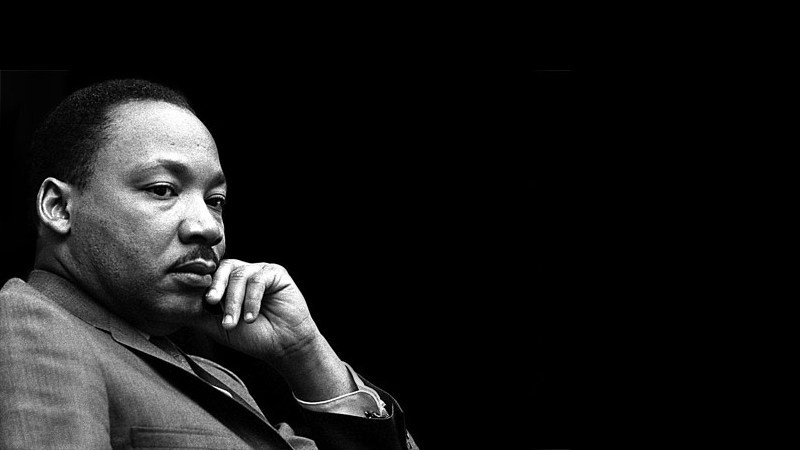
Rebranding MLK: How the Establishment Blackened His Dream and Whitewashed His Legacy
By Teodrose Fikre | The Ghion Journal | January 19, 2019
First, the ruling class kill messengers and then co-opt their messages. It’s a ploy that dates back to biblical times; Pharisees dispatch prophets and then whitewash their legacies in a concerted campaign to appropriate their movements. Truth tellers are twice victimized, once by assassins and the second time around by propaganda. Their likeness and their teachings are then cunningly marketed by the same powers they spoke against to reinforce the status quo.
This same playbook—which has been used to silence dissenters throughout the ages—was unleashed with ruthless efficiency against Martin Luther King Jr. Lost in the chorus of politicians, pundits and media personalities who are praising MLK is the core message that he was pushing before he was felled on the balcony of the Lorraine Motel. King evolved in his thinking; instead of seeking Civil Rights for “African-Americans”, he made the fatal decision to fight for economic justice for all.
King realized that the infringements against “black” folks in America were interconnected to the injustices felt by marginalized people throughout the world. That awakening is the reason he traveled to Memphis, by standing up for striking sanitation workers, he was hoping to form a bridge between poor folks irrespective of their skin color. The establishment love people who lead sectional movements—those who seek exclusive justice are doing the work of the status quo—what they will not abide are those who try to unify the oppressed and inspire collective actions.
King paid with his life for having the courage to pursue inclusive justice. After he was murdered, institutions of power—from government, academia to mainstream media and beyond—kicked in, stealthily erased King’s legacy and replaced it with disinformation. What has taken place over the past fifty years is a systematic and coordinated effort to blacken his narrative and dilute the power of his message.
I must pause here and explain what I mean by blackening Martin Luther King. What MLK fought for, and ultimately died on behalf of, was for equality and fairness for all. By narrowing the scope of his cause and containing his sacrifice to only as a struggle for “black” people, opinion leaders successfully ghettoized him in an effort to lessen his appeal to a broader constituency.
This is one of the main reasons why I reject racial labels and disavow constructs that were imposed by the very racists who shattered humanity. When you see me using quote marks around “black” and “white” in describing people, it’s because I know the true intentions behind these designations. Terms that we have come to embrace are actually insidious conventions used to dehumanize people, reduce us into abstractions and induce tribalism. As I make clear in this video below, it is vital for us to understand where these epithets come from and why bigots imposed these insidious labels on us to begin with.
Labels are insidious forms of reductionism, they are so subtle that most of us don’t understand how malicious they are. Martin Luther King is described as a “black leader” or an “African-American hero”, the adjectives in front of the title being used to depreciate the worth of the people they are describing. Nobody ever says Mozart was a European pianist or that Michelangelo was an Italian painter, yet when it comes to “black” folk, that descriptor is always attached to them—like a Scarlet letter used to insinuate that we are 3/5th human. Martin Luther King is not a black hero, he is a hero who spoke on behalf of all oppressed people.
To hide this truth and marginalize King, instigators and impostors are being propagated by mainstream media and moneyed interests. The profound message behind Martin Luther King’s “I have a dream” speech is continually transmuted by opportunists who use identity politics to advance their own agendas. “I have a dream that my four little children will one day live in a nation where they will not be judged by the color of their skin, but by the content of their character.” These words were eloquently spoken by King in order to free us from the shackles of imposed identities. We are creeping further and further away from MLK’s dream as we let demagogues lead us into the wasteland of sectarianism.
“One unfortunate thing about [the slogan] Black Power is that it gives priority to race precisely at a time when the impact of automation and other forces have made the economic question fundamental for blacks and whites alike. In this context a slogan ‘Power for Poor People’ would be much more appropriate than the slogan ‘Black Power.’”
This was a quote from King in August of 1967, eight months before he was executed. After spearheading the Civil Rights movement from the 50’s into the early 60’s, it dawned upon King that the struggle for equality was greater than being able to sit at lunch counters and riding at the front of buses. He realized that the only way to overcome oppression was to stitch together the pains felt by the proletariat in ways that would attract anyone who felt disenfranchised.
King articulated his apprehension about the movement he organized and expressed how he might have unwittingly directed his people into a quagmire. During a conversation he shared with Harry Belafonte and his inner-circle, King detailed the flaws of fighting racism’s symptoms without addressing the system that gives rise to inequalities.
“I’ve come upon something that disturbs me deeply. We have fought hard and long for integration, as I believe we should have, and I know we will win, but I have come to believe that we are integrating into a burning house. I’m afraid that America has lost the moral vision she may have had, and I’m afraid that even as we integrate, we are walking into a place that does not understand that this nation needs to be deeply concerned with the plight of the poor and disenfranchised. Until we commit ourselves to ensuring that the underclass is given justice and opportunity, we will continue to perpetuate the anger and violence that tears the soul of this nation. I fear I am integrating my people into a burning house.”
Martin Luther King was not disregarding the plight of “black” folks, nor was he giving short shrift to the struggles faced by “African-Americans”. What he recognized is that the struggles being borne by “minorities” would never be alleviated unless a majority of humanity formed a broad coalition to defend their common interests. Martin Luther King was not alone in this realization; Malcolm X came around to this same viewpoint once he visited Mecca and saw that the only way to attain justice was through mass-movements. Do you think it was an accident that both met the same gruesome fate?
Gone are the days of moral giants like Malcolm and Martin, we are firmly entrenched in the era of charlatans who profit from our disunion. What is truly sad is that so many hypocrites readily praise Martin Luther King while they get paid by the same powers that he was speaking against. Proving that treachery is truly bipartisan, on the day Martin Luther King is being celebrated, the King Center is commemorating warmonger emeritus John McCain. What better way to remember Dr. King than by praising the man who vehemently fought against honoring him and as the King Center dismantles his memory.
Meanwhile, Kamala Harris, California’s junior Senator—who was one of the biggest proponents of the prison-industrial complex—is expected to announce her presidential campaign on Martin Luther King Day. This is the same Kamala Harris whose office argued against early release of inmates on the grounds that it would hurt the labor supply [slave workers] of for-profit prisons. It is truly an affront that someone who reserved draconian measures for poor and working Californians— while giving a pass to banking executives like Steven Mnuchin—is going to use Martin Luther King day to hide the fact that she made a name for herself by being a staunch advocate of penal plantations. Kamala Harris 2020: chains you can believe in!
As always, the way to unravel conspiracies is to follow the money. Martin Luther King was sent to his grave because he connected the dots between wars overseas and economic inequalities in America. The hundreds of billions of dollars that were being spent to perpetuate the Vietnam War and conflicts around the world prevented investments in programs that could have alleviated suffering and lifted millions of people out of crushing poverty. That’s why King decided to come out against the Vietnam War, this brave stance made MLK radioactive and shortly led to his assassination.
Every politician, pundit and/or media personality who is “praising” Martin Luther King and leaving out King’s harsh criticism of wars and economic inequalities are the worst kind of hypocrites, They are erasing his legacy while pretending to honor King’s memory #RebrandingMLK
— Teodrose Fikre ✒ (@TeodroseFikre) January 20, 2019
What is lost in all the pageantry and the pomp surrounding King’s holiday is the fact that he was once savagely attacked by the very establishment that is now lionizing him. Not only was his character maligned by opinion leaders, the FBI targeted him and terrorized King and his family to such an extent that they drove him into a period of deep depression. COINTELPRO was a program launched by J. Edgar Hoover to identify and neutralize, by any means necessary, the Civil Rights icons who dared speak truth to power. A generation later, the same power structure that extinguished their flames is now lighting candles on their behalf while annulling their true stories—they’ve turned a martyr into a merchandise.
As hard as the “elites” try to commandeer King’s narrative to suit their purposes, the harsh truth is that King was murdered because he threatened the hustle of capital gangsters. If this sounds very familiar, that is because currency traders have a way of exterminating anyone who speaks against their pyramid schemes. As noted earlier, those who defy profiteers are given death sentences only for their memories to be raised to further the very greed they crusaded against. King died standing against wars and economic inequalities; notice how these themes are rarely mentioned by politicians, pundits and media personalities who cry crocodile tears for him. #RebrandingMLK Click To Tweet
There is a biblical poetry to it all, the same way Jesus was sold out by his own people, crucified by imperial enforcers and had his teachings inverted to advance the evils he died fighting against, these modern day Judases are embracing King while working for the very institutions he courageously took on. Goes to show, change agents will never be found amidst supposed activists who cast their lot with the same powers they pretend to speak against. True revolutionaries are either ignored by the establishment or silenced by bullets.
“For there is nothing hidden that will not be revealed, and nothing concealed that will not be known and brought into the light.” ~ Luke 8:17
Teodrose Fikre is the editor and founder of the Ghion Journal. A published author and prolific writer, a once defense consultant was profoundly changed by a two year journey of hardship and struggle.
Venezuela’s supreme court declares all acts of opposition-led National Assembly illegal
RT | January 21, 2019
Venezuela’s Supreme Court has declared all acts of the country’s National Assembly null and void, days after the opposition-held assembly declared President Nicolas Maduro’s election illegitimate.
The National Assembly is a 167-seat legislature, currently headed by Juan Guaidó of the Popular Will party – a fierce opponent of Maduro, who had been taking part in protests against him and has called for the country’s military to depose the president.
Maduro already declared the National Assembly illegitimate in 2017, and created a new legislature – the Constituent National Assembly – to replace it, where all seats are currently held by pro-Maduro parties. As Maduro lacks the Constitutional power to outright dissolve the National Assembly, both houses have functioned alongside each other since 2017, with the CNA given power to overrule legislation passed by the National Assembly.
Maduro was sworn in last week after winning re-election last May. The opposition-led assembly and a coalition of neighboring countries declared Maduro’s election illegitimate.
US Secretary of State Mike Pompeo called Maduro’s election “illegitimate” and a “sham,” and vowed to keep up diplomatic pressure on the Venezuelan government.
Guaidó was briefly detained by secret police en route to a rally last week. Maduro insisted that Guaidó’s arrest was not government-ordered, and may have been staged for the media.
The Supreme Court’s announcement comes amid news of anti-government demonstrations in the country’s capital, as well as a mutiny by a National Guard unit stationed in a slum neighborhood near the Presidential Palace. Government forces arrested 40 National Guardsmen and fired tear gas at protesters in the early hours of Monday morning.
Defense Minister Vladimir Padrino Lopez said on Twitter that the rogue soldiers will “be punished with the full weight of the law.”
Video footage from the neighborhood shows protesters lighting fires and blocking the streets with barricades.
The ongoing crisis in Venezuela is being closely followed by US media and politicians, the majority of whom are openly anti-Maduro. Vice President Mike Pence has expressed support for Guaidó, calling the National Assembly the “only legitimate body in the country,” while Florida Senator Marco Rubio has repeatedly called Maduro’s government “illegitimate” and pressed for regime change in the Latin American country.
Venezuela has been mired by hyperinflation, starvation, and a refugee crisis that has seen almost three million Venezuelans flee the country. Washington has blamed the socialist economic policies of Maduro and his mentor Hugo Chavez for the deepening crisis, while passing sanctions against the Maduro government officials. The latest major batch of sanctions was in September signed by President Donald Trump, who once announced he is “not going to rule out a military option” in addressing the crisis in Venezuela.
US Administrations Have Been Intervening in Venezuela Since at Least the Early 2000s
FAIR | January 16, 2019
Janine Jackson interviewed Alexander Main about the Nicolás Maduro re-election for the January 11, 2019, episode of CounterSpin. This is a lightly edited transcript :
Janine Jackson: When it comes to Venezuela, elite US media don’t hide their feelings. And their feelings are all the same. Headlines on last year’s reelection of Venezuelan president Nicolás Maduro differed only in tone, including the disdainful: “As Venezuelans Go Hungry, Their Government Holds a Farcical Election,” from the Economist; the decisive: USA Today‘s “Maduro Is Turning Venezuela Into a Dictatorship,” or Foreign Affairs’ more somber version, “Venezuela’s Suicide; Lessons From a Failed State.” There’s Forbes’ vaguely threatening “Why Nicolas Maduro of Venezuela May Wish He Lost the Presidential Election,” and Foreign Policy’s unashamed “It’s Time for a Coup in Venezuela.”
But they’re all pretty much variations on a theme that’s hard to unhear, given that media bang it out so loudly and repeatedly. Here to help us sort fact from froth is Alexander Main. He’s director of international policy at the Center for Economic and Policy Research. He joins us by phone from Washington, DC. Welcome to CounterSpin, Alex Main.
Alex Main: Thank you, Janine.
JJ: Writing for FAIR on Venezuelan elections last year, Alan MacLeod pinpointed US media’s preferred trope, which was to say that Maduro was reelected “amid”—amid outcry, amid widespread disillusionment, amid charges of irregularities, amid low turnout. The message, I think, to readers was that Maduro’s re-election was not legitimate. What should we know about last May’s elections in Venezuela?
AM: So what isn’t generally mentioned by the media is that a critical factor in the outcome of the election was the approach taken by Venezuela’s opposition. Much of the opposition, many of its parties, decided to boycott these elections, for a variety of reasons.
At any rate, the media did not examine that fact. And we’re still not seeing it very much. I think one of the few exceptions is the Washington Post, in the article that appeared today, that did mention the divisions within the opposition, and their decision not to participate that had, obviously, a huge effect on the election result.
JJ: The media coverage would give you the impression that Venezuela’s election almost happened in a vacuum, but there was in fact involvement from, for example, the Organization of American States.
AM: Well, the Organization of American States, or rather the secretary general of the organization, whose name is Luis Almagro. He represents himself. He was elected, but once secretary general, he has sort of executive power there; but he doesn’t represent the countries within the organization. He has been on a campaign against the Maduro government from very early on. It stems from their initial decision not to allow him to send electoral observers to the elections.
And this is based on a decision taken by Venezuela’s electoral authorities many years ago, when they decided that they had enough transparency, enough safety measures around the elections, that they no longer required any sort of outside tutelage.
A number of countries in Latin America have taken the same decision. It’s a decision that has to do with the respect of their sovereignty. Certainly you don’t see in the US any massive presence of international observers, even though I think a lot of people would like to see that at some point.
But anyway, this was a sovereign decision that was taken by Venezuela’s electoral authority. And following that, Almagro really went on a rampage, and has been very much involved in efforts to try to delegitimize the Maduro government and to support the very hard-line opposition.
In doing this, he went sort of out of bounds in terms of his rhetoric, even for a lot of right-wing governments in Latin America, when late last year he voiced support for a military coup, much as some US officials have done, and US members of Congress have done. And as a response, you had all of the governments of Latin America that signed on to a statement that categorically rejected the possibility of any form of military intervention, whether by coup or an outside military intervention in Venezuela.
But certainly his rhetoric, and the campaign that he has led—along with other figures, such as Sen. Marco Rubio—have certainly given the impression that there is a desire for US intervention in what’s going on in Venezuela, and that’s, I think, resulted in sort of a defensive reaction from the Venezuelan government.
JJ: Well, it sounds very disturbing, but also confusing. You know, when I was looking through headlines, I saw one from something called the Pacific Council on International Policy that said, “Maduro Re-Elected. Can Democracy Ever Prevail in Venezuela?” I mean, just at the level of the sentence, it’s confusing. And then when you start talking about a coup to save democracy—which is the upshot of current coverage, and I guess policy—it just doesn’t even seem to make sense. The call is for the US to intervene, but the US is already intervening, isn’t it?
AM: Well, yeah, absolutely, and they’ve really been intervening in Venezuela, various US administrations, since at least the early 2000s, when we know that the US government—through institutions like the National Endowment for Democracy—has been providing funding and training to opposition groups in Venezuela, and often very hard-line groups that have taken a radical line, not recognizing the government and trying to seek its removal through extra-constitutional means, including a short-lived coup that took place in April of 2002.
The US has been very involved in trying to isolate them, Venezuela, diplomatically throughout the region, putting a lot of pressure on Latin American governments to support US measures condemning the situation in Venezuela.
More recently, the US has been applying sanctions against the government of Venezuela. And this is a very underreported thing in the US media and the international media generally.
When you see the coverage, for instance, of the Maduro inauguration, what you don’t see at all are references to the impact of the economic sanctions that have been applied. In fact, there are few media outlets at this point that even acknowledge that there are economic sanctions, even though they’ve been in place since August of 2017, when Trump announced them through an executive decree, having determined Venezuela to be an “extraordinary threat to US national security.” Those were the actual terms that were used in order to justify these sanctions.
And they’ve had a dire effect in Venezuela, which has been experiencing an economic crisis for quite a while now, since 2014 at least. And the government, of course, has failed to resolve this. It has to do with some of the government’s own economic policies. But at this point, the US also bears responsibility through these sanctions, where they have cut off Venezuela’s access to international financial markets, by which they can borrow money and purchase the necessary imports that the country needs. And we know that there aren’t enough imports of food or of medicine that are taking place at the moment.
And it’s also had a dire effect on the country’s oil production. And, of course, oil is the source of most of Venezuela’s national revenue. Along with falling oil prices, there’s been a tremendous fall in oil production in Venezuela, and it accelerated, actually, after these sanctions were put into place, because the Venezuelan government isn’t able to make the necessary investments to maintain the oil fields.
So that’s not mentioned, really, whatsoever in the major media, even though you have economists, including opposition-aligned economists from Venezuela, like Francisco Rodriguez, who have pointed out the very negative impact that these sanctions are having on the country.
JJ: Alan MacLeod also found a piece in Bloomberg that came close to acknowledging it, but in such a strange way. It was an article in which Bloomberg said that victory in the “widely derided election” gives Maduro “sole ownership of the nation’s crushing economic crisis.” And then in the very next sentence, it gloats that US and regional leaders will punish Venezuela by imposing “further isolation and sanctions on the crisis-stricken nation’s all-important oil industry.”
AM: Exactly. There’s this absurd idea that the sanctions somehow only hurt the Venezuelan government and Venezuelan government officials. It’s always the Venezuelan government’s responsibility, when they discuss the economic situation.
From time to time, you do see some media saying, “Oh, but the Venezuelan government says that the US sanctions are contributing to this dire economic situation.” They fail to ask any independent expert. You know, any economists that are taking a good look at what’s going on in Venezuela today will tell you, “Well, yes, these sanctions quite obviously are having a very negative impact.”
JJ: Finally, one of the things that coverage does is present the Venezuelan people as benighted. A piece from Time from last year includes one of my favorite creations. It first of all says that the crisis, the current crisis, “can be traced to the 1998 election of Hugo Chávez to the presidency,” so Chávez is the reason that things are difficult now. But I love this presentation: “Chávez concocted a political system that used often high oil prices to essentially bribe the masses into supporting him.”
The picture of the Venezuelan people that one gets from US media coverage is really as sort of benighted, not knowing what’s good for themselves and, once again, requiring some sort of intervention to tell them how to do democracy.
AM: Yes. This is quite absurd. Really, what we’re seeing in Venezuela is, one, an extraordinarily well-organized population, and particularly in poor communities that are certainly confronting a very dramatic economic situation, but I think doing so in effective ways that make the situation somewhat sustainable for these communities. So we’re seeing a very, very high level of community organization.
I’d say the vast majority of Venezuelans at this point are probably quite disgruntled with Maduro and his government. However, the Venezuelan opposition really offers no viable alternative to the Maduro government. They have never presented any sort of coherent economic proposal, with the possible exception of the opposition candidate in last year’s election. But, of course, most of the opposition parties boycotted those elections.
And in general, I think a lot of Venezuelans, certainly those that come from lower-income communities, are well aware of the fact that the opposition is linked to the country’s traditional economic elite, and they have a terrible reputation from their involvement in governments before Chávez was in power.
Things may be bad under Maduro, but I think there’s a sense among many Venezuelans that things could actually be quite a bit worse under opposition governments, particularly if they impose the sort of neoliberal policies that hurt the poor people of Venezuela enormously during the decades prior to Hugo Chávez’s election in the late ’90s.
JJ: We’ve been speaking with Alexander Main; he’s director of international policy at the Center for Economic and Policy Research. You can find their work, including Alex’s piece, “The United States’ Hand in Undermining Democracy in Venezuela,” online at CEPR.net. Alexander Main, thank you very much for joining us today on CounterSpin.
AM: Thank you, it was a pleasure.
‘Fake news’ is okay if it’s about #RussiaGate: Top 7 fake ‘collusion’ stories the media pushed
RT | January 21, 2019
BuzzFeed’s ‘bombshell’ claim last week that Donald Trump told ex-lawyer Michael Cohen to lie to congress is just the latest in a long line of ‘Russiagate’ stories that have later turned out to be false.
But BuzzFeed’s rubbished article is part of a phenomenon of what could be termed ‘acceptable fake news’ — fake news that gets a pass from the media because it serves a certain narrative. In this case, it furthers the ‘Russiagate’ narrative, which the mainstream media has been pushing breathlessly for two years. Lacking hard proof that Trump ‘colluded’ with Russia to win the 2016 election, they have clung to any shred of fake evidence they can find.
Last week, one astute Twitter user compiled a list of a whopping 42 Russiagate stories which were billed as bombshells but which ended up needing to be retracted or corrected. Here are seven of the most scandalous instances.
1. MSNBC pushed line that WikiLeaks released ‘fake’ Clinton emails
When WikiLeaks published the emails belonging to Hillary Clinton aide John Podesta in 2016, MSNBC sought to actively encourage its viewers to believe the emails were doctored by Russia.
They based that spurious claim on the fact that a fake transcript of a Clinton speech to Goldman Sachs was drifting around Twitter. The fake transcript had not been published by WikiLeaks, however. Rather, it was the creation of a pro-Clinton troll who had intended to trick Trump supporters into believing it was real so he could later embarrass them for their gullibility. MSNBC reporters who used the fake Twitter transcript to tarnish WikiLeaks’ authentic documents never corrected their false claims.
2. WaPo claims Russia ‘hacked’ the Vermont power grid
In one of the most infamous cases of a botched Russia-related story, the Washington Post claimed that Russia had hacked the Vermont power grid. In its zeal to deliver bombshell proof that Russia was attempting to attack the US, the Post reporters didn’t even bother to contact the utility company which could have told them that there had been no hacking or penetration of the power grid at all. The Post admitted later in an editor’s note that the story was fake.
3. CNN fires three journalists over botched story
It’s not often journalists who publish fake Russia-related ‘bombshells’ face real consequences, but last June, three CNN journalists, including the executive editor of a shiny new ‘investigative’ branch had to resign following the retraction of a false story which claimed Congress was investigating a Russian investment fund “with ties” to Trump’s team. The story quoted a single anonymous source and CNN later admitted that its reporters failed to follow “some standard editorial procedures” before publishing it.
4. Oops? CNN gets date on email wrong, causes mass panic
In a rush to prove that the Trump campaign had advance knowledge of and access to hacked DNC emails published by WikiLeaks, CNN (again) got the date of an email wrong. CNN claimed “multiple” sources had told them the email about the documents had been sent to the Trump campaign on September 4, but in reality, it had been sent on September 14 — a day after the WikiLeaks documents were made public — not, as CNN had claimed, nine days before.
5. ABC’s dud on Michael Flynn and ‘contact’ with Russians
Veteran ABC journalist Brian Ross was suspended after reporting last December that Trump had ordered former adviser Michael Flynn to contact Russian officials during the presidential campaign. It turned out, Trump had made this request of Flynn after he had won the election — not an unusual request for someone about to become the president of the US. Ross left ABC for good a while later after a career littered with embarrassing reporting blunders.
6. Russian supersonic tech or…crickets?
MSNBC reported last year that Russia was likely responsible for a supersonic attack on US diplomats stationed in the Cuba embassy. One ‘expert’ appeared on the channel stating that possible Russian “sophisticated microwaves” targeted the diplomats, while a reporter claimed Russian guilt had been “backed up” by interceptions of Russian communications. Meanwhile, intelligence sources told the New Yorker that no such evidence existed. When the Associated Press later released an audio recording, two US scientists deciphered that the sounds the diplomats had heard were more than likely the sounds of a species of Caribbean crickets during mating season.
7. Guardian claims Manafort had ‘secret meetings’ with Assange
WikiLeaks raised more than $55,000 in donations to sue the Guardian after the British newspaper published a story alleging (without corroborated evidence) that Julian Assange had held secret meetings with former Trump campaign manager Paul Manafort at the Ecuadorean embassy in London, where Assange has been living since 2012. The story which WikiLeaks claims is completely false — and which has also been questioned by other journalists — was written by Luke Harding, a Guardian reporter who has been accused before of fabricating stories and who went AWOL after the report was received with serious skepticism.
Unfortunately, the regularity with which these Russiagate stories have turned out to fake still hasn’t raised any red flags with establishment journalists, who seem more eager to bolster a narrative than to uncover actual facts.
MSM Begs For Trust After Buzzfeed Debacle
By Caitlin Johnstone | January 20, 2019
Following what the Washington Post has described as “the highest-profile misstep yet for a news organization during a period of heightened and intense scrutiny of the press,” mass media representatives are now flailing desperately for an argument as to why people should continue to place their trust in mainstream news outlets.
On Thursday Buzzfeed News delivered the latest “bombshell” Russiagate report to fizzle within 24 hours of its publication, a pattern that is now so consistent that I’ve personally made a practice of declining to comment on such stories until a day or two after their release. “BOOM!” tweets were issued by #Resistance pundits on Twitter, “If true this means X, Y and Z” bloviations were made on mass media punditry panels, and for about 20 hours Russiagaters everywhere were riding the high of their lives, giddy with the news that President Trump had committed an impeachable felony by ordering Michael Cohen to lie to Congress about a proposed Trump office tower in Moscow, a proposal which died within weeks and the Kremlin never touched.
There was reason enough already for any reasonable person to refrain from frenzied celebration, including the fact that the story’s two authors, Jason Leopold and Anthony Cormier, were giving the press two very different accounts of the information they’d based it on, with Cormier telling CNN that he had not personally seen the evidence underlying his report and Leopold telling MSNBC that he had. Both Leopold and Cormier, for the record, have already previously suffered a Russiagate faceplant with the clickbait viral story that Russia had financed the 2016 election, burying the fact that it was a Russian election.
UPDATE: A spokesperson for the special counsel is disputing BuzzFeed News’ report. https://t.co/BEoMKiDypn pic.twitter.com/GWWfGtyhaE
— BuzzFeed News (@BuzzFeedNews) January 19, 2019
Then the entire story came crashing down when Mueller’s office took the extremely rare step of issuing an unequivocal statement that the Buzzfeed story was wrong, writing simply, “BuzzFeed’s description of specific statements to the special counsel’s office, and characterization of documents and testimony obtained by this office, regarding Michael Cohen’s congressional testimony are not accurate.”
According to journalist and economic analyst Doug Henwood, the print New York Times covered the Buzzfeed report on its front page when the story broke, but the report on Mueller’s correction the next day was shoved back to page 11. This appalling journalistic malpractice makes it very funny that NYT’s Wajahat Ali had the gall to tweet, “Unlike the Trump administration, journalists are fact checking and willing to correct the record if the Buzzfeed story is found inaccurate. Not really the actions of a deep state and enemy of the people, right?”
This is the behavior of a media class that is interested in selling narratives, not reporting truth. And yet the mass media talking heads are all telling us today that we must continue to trust them.
“Those trying to tar all media today aren’t interested in improving journalism but protecting themselves,” tweeted NBC’s Chuck Todd. “There’s a lot more accountability in media these days than in our politics. We know we live in a glass house, we hope the folks we cover are as self aware.”
More accountability in media than in politics, Chuck? Really? Accountability to whom? Your advertisers? Your plutocratic owners? Certainly not to the people whose minds you are paid exorbitant sums to influence; there are no public elections for the leadership of the mass media.
“Mueller didn’t do the media any favors tonight, and he did do the president one,” griped the odious Chris Cuomo on CNN. “Because as you saw with Rudy Giuliani and as I’m sure you’ll see with the president himself, this allows them to say ‘You can’t believe it! You can’t believe what you read, you can’t believe what you hear! You can only believe us. Even the Special Counsel says that the media doesn’t get it right.’”
“The larger message that a lot of people are going to take from this story is that the news media are a bunch of leftist liars who are dying to get the president, and they’re willing to lie to do it, and I don’t think that’s true” said Jeffrey Toobin on a CNN panel, adding “I just think this is a bad day for us.”
“It does reinforce bad stereotypes about the news media,” said Brian Stelter on the same CNN panel. “I am desperate as a media reporter to always say to the audience, judge folks individually and judge brands individually. Don’t fall for what these politicians out there want you to do. They want you to think we’re all crooked. We’re not. But Buzzfeed now, now the onus is on Buzzfeed.”
CNN, for the record, has been guilty of an arguably even more embarrassing Russiagate flub than Buzzfeed‘s when they wrongly reported that Donald Trump Jr had had access to WikiLeaks’ DNC email archives prior to their 2016 publication, an error that was hilariously due to to the simple misreading of an email date by multiple people.
CNN is leading the way in bashing BuzzFeed but it’s worth remembering CNN had a humiliation at least as big & bad: when they yelled that Trump Jr. had advanced access to the WL archive (!): all based on a wrong date. They removed all the segments from YouTube, but this remains: pic.twitter.com/0jiA50aIku
— Glenn Greenwald (@ggreenwald) January 19, 2019
The mass media, including pro-Trump mass media like Fox News, absolutely deserves to be distrusted. It has earned that distrust. It had earned that distrust already with its constant promotion of imperialist wars and an oligarch-friendly status quo, and it has earned it even more with its frenzied promotion of a narrative engineered to manufacture consent for a preexisting agenda to shove Russia off the world stage.
The mainstream media absolutely is the enemy of the people; just because Trump says it doesn’t mean it’s not true. The only reason people don’t rise up and use the power of their numbers to force the much-needed changes that need to happen in our world is because they are being propagandized to accept the status quo day in and day out by the mass media’s endless cultural engineering project. They are the reason why wars go unopposed, why third parties never gain traction, why people consent to money hemorrhaging upward to the wealthiest of the wealthy while everyone else struggles to survive. The sooner people wake up from the perverse narrative matrix of the plutocratic media, the better.
Pompeo the Warmonger Supports Authoritarian Regimes
By Brian CLOUGHLEY | Strategic Culture Foundation | 20.01.2019
On January 2 US Secretary of State Mike Pompeo visited Brazil, and his Department noted that in discussions with Foreign Minister Ernesto Araujo they “highlighted the importance of working together to address regional and global challenges, including supporting the people of Venezuela, Cuba, and Nicaragua in restoring their democratic governance and their human rights.” Pompeo declared that the US and Brazil “have an opportunity to work alongside each other against authoritarian regimes.”
From this we gather that Pompeo is a strong advocate of democratic governance and will always make it clear that the United States supports unfortunate people living in countries having “authoritarian regimes.” It is apparent he must believe in the Universal Declaration of Human Rights which states that “everyone has the right to freedom of thought, conscience and religion.”
Unfortunately it transpired that Pompeo is a selective supporter of democracy and freedom of religion, because after he left Brazil and went to the Middle East he voiced vigorous support for despots who rule countries in a manner that is undeniably authoritarian.
In a speech in Cairo on January 10 Pompeo threatened Iran and declared that “Nations are rallying to our side to confront the regime like never before. Egypt, Oman, Kuwait, and Jordan have all been instrumental in thwarting Iran’s efforts to evade sanctions.” It must be gratifying for him that these nations have joined the US in its crusade against Iran, three of them being hereditary monarchies and one run by a non-regal martinet.
Oman, for example, is “an absolute monarchy by male primogeniture. The Sultan, Qaboos bin Said al Said, has been the hereditary leader of the country since 1970.” Freedom House notes that “The regime restricts virtually all political rights and civil liberties, and imposes criminal penalties for criticism and dissent… Political parties are not permitted, and the authorities do not tolerate other forms of organized political opposition.”
In Jordan “the monarch holds wide executive and legislative powers, including the appointment of the prime minister and all seats of the senate. The monarch approves and dismisses judges; signs, executes or vetoes all laws; and can suspend or dissolve parliament.”
The leader of Kuwait, the Amir, according to the CIA Factbook, is “chosen from within the ruling family, confirmed by the National Assembly; the prime minister and deputy prime ministers are appointed by the Amir.” In this autocracy, according to Human Rights Watch, there are “no laws prohibiting domestic violence or marital rape… a man who finds his mother, wife, sister or daughter in the act of adultery and kills them is punished by either a small fine or no more than three years in prison.”
Pompeo wants “democratic governance and human rights” in Venezuela, Cuba, and Nicaragua. Why not in Oman, Jordan and Kuwait?
The only one of Pompeo’s countries not ruled by a supreme monarch is Egypt, whose president is Field Marshal Abdel Fattah al-Sisi who “was elected in May 2014, almost a year after he removed his elected predecessor, the Muslim Brotherhood’s Mohammed Morsi, from office in a coup.” Sisi “won a second four-year-term in March 2018 against a sole minor opposition candidate. Human rights lawyer Khalid Ali and former prime minister Ahmad Shafiq withdrew from the race, and the former armed forces chief of staff Sami Anan was arrested.”
In his warmongering anti-Iran, anti-Syria speech Pompeo announced that his visit to Egypt was “especially meaningful for me as an evangelical Christian, coming so soon after the Coptic Church’s Christmas celebrations” and visited the Cathedral of the Nativity of Christ and the Al-Fattah Al-Alim mosque where he praised Egypt’s “freedoms here in this houses [sic] of worship, these big, beautiful, gorgeous buildings where the Lord is clearly at work.”
He ignored Amnesty International’s statement that in Egypt “the authorities continued to violate the right to freedom of religion by discriminating against Christians.” His own Department recorded that last year “Irrespective of religion, authorities also did not apply equal protection to all citizens and sometimes closed churches, in violation of the law, according to multiple sources.”
The bigotry of the Egyptian regime and its clerics was epitomised on January 13 when Al Azhar University which is responsible for “a national network of schools with approximately two million students” expelled a female student for being hugged by a male friend. The scandal was revealed in a video clip which “showed a young man carrying a bouquet of flowers kneeling before a young woman and then hugging her in what appeared to be a marriage proposal.” According to a University spokesman this violates “the values and principles of society”. There was not a word from Pompeo, that self-declared admirer of Egyptian places of worship where “the Lord is clearly at work.”
Pompeo continued his tour of the region, and next day, as he landed in Saudi Arabia, the Egyptian regime announced that for the seventh time it had extended its state of emergency which “allows authorities to take exceptional security measures, including the referral of terrorism suspects to state security courts, the imposition of curfews and the confiscation of newspapers.” This would be supported in Saudi Arabia where, as chronicled by Freedom House, the “absolute monarchy restricts almost all political rights and civil liberties. No officials at the national level are elected. The regime relies on extensive surveillance, the criminalization of dissent, appeals to sectarianism, and public spending supported by oil revenues to maintain power. Women and religious minorities face extensive discrimination in law and in practice.”
This discrimination was highlighted by the New York Times on January 13 when it published an Op-Ed by Alia al-Houthlal that implored Pompeo to ask Saudi Prince Mohammad bin Salman to release her sister, the women’s rights activist, Loujain al-Houthlal, who is imprisoned in Riyadh. Ms Alia al-Houthlal wrote that her sister had been tortured in prison, and that a close associate of bin Salman, Saud al-Qahtani, who has been named in connection with the murder of Mr Jamal Khashoggi [brutally killed in the Saudi consulate in Istanbul on October 2 last year], was present at several torture sessions.
The Times reported that Pompeo began his conversation with bin Salman, the de facto ruler of Saudi Arabia, by saying “I want to talk to you about a couple of places we’ve been. We think we learned a lot along the way that will be important going forward.” There was no mention of the torture of Loujain al-Houthlal or any other gross violations of human rights in Saudi Arabia where the regime continues to “repress peaceful activists and dissidents, harassing writers, online commentators and others who exercised their right to freedom of expression by expressing views against government policies.”
There was none of that embarrassing stuff. It was all skated over, with Pompeo saying only that “we spoke about human rights issues here in Saudi Arabia – women activists. We spoke about the accountability that – and the expectations that we have. The Saudis are friends, and when friends have conversations, you tell them what your expectations are.”
Pompeo’s expectations include joint action with the Saudi regime and other Middle East autocracies to “counter Iranian malign influence,” which he regards as an even higher priority than “working against authoritarian regimes” in Latin America, which Washington is determined to dominate. Pompeo’s objections to authoritarianism are highly selective, for in his Cairo speech he confined himself to describing Iran “malevolent,” and “oppressive” while denouncing “Iranian expansion” and “regional destruction,” which is a trifle ironic, coming from a Secretary of State whose military devastated Iran’s neighbours, Iraq and Afghanistan.
Pompeo’s ethical approach is decidedly ambiguous and his moral flexibility would attract the admiration of a trampoline gymnast. His Cairo speech was titled “A Force for Good: America’s Reinvigorated Role in the Middle East,” but it is apparent that reinvigoration is confined to plans for destruction of Iran, in which Washington will be assisted by Pompeo’s friends — the Middle East’s authoritarian regimes.
Amnesty International’s Troubling Collaboration with UK & US Intelligence
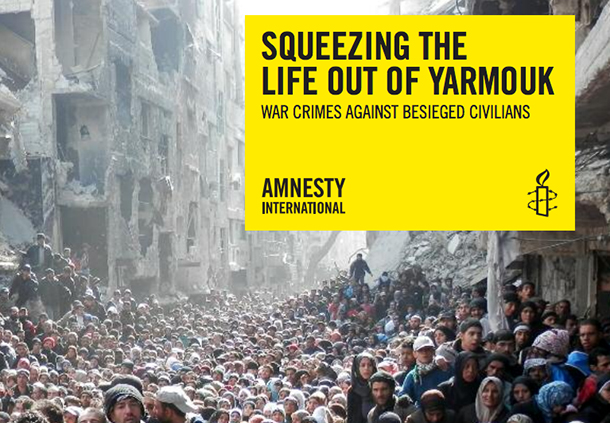
Propaganda image from the cover of AI’s report entitled, ‘Squeezing the Life Out of Yarmouk: War Crimes Against Besieged Civilians’,
one of many designed to fit hand-in-glove with the joint US and UK covert regime change operation deployed against Syria since 2011.
By Alexander Rubinstein | Mint Press News | January 17, 2019
Amnesty International, the eminent human-rights non-governmental organization, is widely known for its advocacy in that realm. It produces reports critical of the Israeli occupation in Palestine and the Saudi-led war on Yemen. But it also publishes a steady flow of indictments against countries that don’t play ball with Washington — countries like Iran, China, Venezuela, Nicaragua, North Korea and more. Those reports amplify the drumbeat for a “humanitarian” intervention in those nations.
Amnesty’s stellar image as a global defender of human rights runs counter to its early days when the British Foreign Office was believed to be censoring reports critical of the British empire. Peter Benenson, the co-founder of Amnesty, had deep ties to the British Foreign Office and Colonial Office while another co-founder, Luis Kutner, informed the FBI of a gun cache at Black Panther leader Fred Hampton’s home weeks before he was killed by the Bureau in a gun raid.
These troubling connections contradict Amnesty’s image as a benevolent defender of human rights and reveal key figures at the organization during its early years to be less concerned with human dignity and more concerned with the dignity of the United States and United Kingdom’s image in the world.
A conflicted beginning
Amnesty’s Benenson, an avowed anti-communist, hailed from a military intelligence background. He pledged that Amnesty would be independent of government influence and would represent prisoners in the East, West, and global South alike.
But during the 1960s the U.K. was withdrawing from its colonies and the Foreign Office and Colonial Office were hungry for information from human-rights activists about the situations on the ground. In 1963, the Foreign Office instructed its operatives abroad to provide “discreet support” for Amnesty’s campaigns.
Also that year, Benenson wrote to Colonial Office Minister Lord Lansdowne a proposal to prop up a “refugee counsellor” on the border of present-day Botswana and apartheid South Africa. That counsel was to assist refugees only, and explicitly avoid aiding anti-apartheid activists. “Communist influence should not be allowed to spread in this part of Africa, and in the present delicate situation, Amnesty International would wish to support Her Majesty’s Government in any such policy,” Benenson wrote. The next year, Amnesty ceased its support for anti-apartheid icon and the first president of a free South Africa, Nelson Mandela.
The following year, in 1964, Benenson enlisted the Foreign Office’s assistance in obtaining a visa to Haiti. The Foreign Office secured the visa and wrote to its Haiti representative Alan Elgar saying it “support[ed] the aims of Amnesty International.” There, Benenson went undercover as a painter, as Minister of State Walter Padley told him prior to his departure that “We shall have to be a little careful not to give the Haitians the impression that your visit is actually sponsored by Her Majesty’s Government.”
The New York Times exposed the ruse, leading some officials to claim ignorance; Elgar, for example, said he was “shocked by Benenson’s antics.” Benenson apologized to Minister Padley, saying “I really do not know why the New York Times, which is generally a responsible newspaper, should be doing this sort of thing over Haiti.”
Letting politics creep into mission
In 1966, an Amnesty report on the British colony of Aden, a port city in present-day Yemen, detailed the British government’s torture of detainees at the Ras Morbut interrogation center. Prisoners there were stripped naked during interrogations, were forced to sit on poles that entered their anus, had their genitals twisted, cigarettes burned on their face, and were kept in cells where feces and urine covered the floor.
The report was never released, however. Benenson said that Amnesty general secretary Robert Swann had censored it to please the Foreign Office, but Amnesty co-founder Eric Baker said Benenson and Swann had met with the Foreign Office and agreed to keep the report under wraps in exchange for reforms. At the time, Lord Chancellor Gerald Gardiner wrote to Prime Minister Harold Wilson that “Amnesty held the [report] as long as they could simply because Peter Benenson did not want to do anything to hurt a Labour government.”
Then something changed. Benenson went to Aden and was horrified by what he found, writing “I never came upon an uglier picture than that which met my eyes in Aden,” despite his “many years spent in the personal investigation of repression.”
A tangled web
As all of this was unfolding, a similar funding scandal was developing that would rock Amnesty to its core. Polly Toynbee, a 20-year-old Amnesty volunteer, was in Nigeria and Southern Rhodesia, the British colony in Zimbabwe, which was at the time ruled by the white settler minority. There, Toynbee delivered funds to prisoner families with a seemingly endless supply of cash. Toynbee said that Benenson met with her there and admitted that the money was coming from the British government.
Toynbee and others were forced to leave Rhodesia in March 1966. On her way out, she grabbed documents from an abandoned safe including letters from Benenson to senior Amnesty officials working in the country that detailed Benenson’s request to Prime Minister Wilson for money, which had been received months prior.
In 1967 it was revealed that the CIA had established and was covertly funding another human rights organization founded in the early 1960s, the International Commission of Jurists (ICJ) through an American affiliate, the American Fund for Free Jurists Inc.
Benenson had founded, alongside Amnesty, the U.K. branch of the ICJ, called Justice. Amnesty international secretariat, Sean MacBride, was also the secretary-general of ICJ.
Then, the “Harry letters” hit the press. Officially, Amnesty denied knowledge of the payments from Wilson’s government. But Benenson admitted that their work in Rhodesia had been funded by the government, and returned the funds out of his own pocket. He wrote to Lord Chancellor Gardiner that he did it so as not to “jeopardize the political reputation” of those involved. Benenson then returned unspent funds from his two other human-rights organizations, Justice (the U.K. branch of the CIA-founded ICJ) and the Human Rights Advisory Service.
Benenson’s behavior in the wake of the revelations about the “Harry letters” infuriated his Amnesty colleagues. Some of them would go on to claim that he suffered from mental illness. One staffer wrote:
Peter Benenson has been levelling accusations, which can only have the result of discrediting the organisation which he has founded and to which he dedicated himself. … All this began after soon after he came back from Aden, and it seems likely that the nervous shock which he felt at the brutality shown by some elements of the British army there had some unbalancing effect on his judgment.
Later that year, Benenson stepped down as president of Amnesty in protest of its London office being surveilled and infiltrated by British intelligence — at least according to him. Later that month, Sean MacBride, the Amnesty official and ICJ operative, submitted a report to an Amnesty conference that denounced Benenson’s “erratic actions.” Benenson boycotted the conference, opting to submit a resolution demanding MacBride’s resignation over the CIA funding of ICJ.
Amnesty and the British government then suspended ties. The rights group then promised to “not only be independent and impartial but must not be put into a position where anything else could even be alleged” about its collusion with governments in 1967.
Amnesty’s role in the death of Black Panther Fred Hampton
But two years later, senior Amnesty officials engaged in far more troubling coordination with Western intelligence agencies.
FBI documents, released by the Bureau in the spring of 2018 as a part of a series of disclosures of documents pertaining to the assassination of President John Kennedy, detail Amnesty International’s role in the killing of Black Panther Party (BPP) Deputy Chairman Fred Hampton, the 21-year-old up-and-coming black liberation icon — a killing that was widely believed to be an assassination but was ruled officially as a justifiable homicide.
Amnesty International co-founder Luis Kutner attended a November 23, 1969 speech of Hampton’s delivered at the University of Illinois.
During the speech, Hampton described the BPP “as a revolutionary party” and “indicated that the party has guns to be used for peace and self-defense, and these guns are at the Hampton residence as well as BPP headquarters,” according to the FBI document.
“Kutner has reached the point where he would like to take legal action to silence the BPP,” the FBI wrote. “Kutner concluded by stating that he believed speakers like Hampton were psychotic, and it is only when they are faced with a court action that they stop their “rantings and ravings.”
The FBI internal report on Kutner’s testimony cited above was issued on December 1, 1969. Two days later, the FBI, alongside the Chicago Police Department, conducted a firearms raid on Hampton’s residence. When Hampton came home for the day, FBI informant William O’Neal slipped a barbiturate sleeping pill into his drink before leaving.
At 4:00 a.m. on December 4, police and FBI stormed into the apartment, instantly shooting a BPP guard. Due to reflexive convulsions related to death, the guard convulsed and pulled the trigger on a shotgun he was carrying – the only time a Black Panther member fired a gun during the raid. Authorities then opened fire on Hampton, who was in bed sleeping with his nine-month pregnant fiancee. Hampton is believed to have survived until two shots were fired at point-blank range towards his head.
Kutner formed the “Friends of the FBI” group, an organization “formed to combat criticism of the Federal Bureau of Investigations,” according to the New York Times, after its covert campaign to disrupt leftists movements — COINTELPRO — was revealed. He also went on to operate in a number of theaters that saw heavy involvement from the CIA — including work Kutner did to undermine Congolese Prime Minister and staunch anti-imperialist Patrice Lumumba — and represented the Dalai Lama, who was provided $1.7 million a year by the CIA in the 1960s.
While Amnesty International’s shady operations in the 1960s might seem like ancient history at this point, they serve as an important reminder of the role that non-governmental organizations often play in furthering the objectives of governments of the nations where they are based.
Alexander Rubinstein is a staff writer for MintPress News based in Washington, DC. He reports on police, prisons and protests in the United States and the United States’ policing of the world. He previously reported for RT and Sputnik News.
Featured Video

or go to
Aletho News Archives – Video-Images
From the Archives
How the CIA Spawned Google
By Svetlana Ekimenko – Sputnik – 05.02.2025
American tech giant Google has faced regulatory scrutiny on numerous occasions amid accusations of antitrust violations. Google’s relationship with the CIA, ranging from early financial support to collaborative efforts have been decried as undermining privacy rights and free speech in the digital landscape.
Google’s creation played a crucial role in the US intelligence community’s scheme to attain global dominance by controlling information. … continue
Blog Roll
 Aletho News
- Kafr Qasim at 70: The massacre Israel still hasn’t owned up to
- Would President Vance really ditch Israel?
- LAPD Pilot Will Track Vehicles In San Fernando Valley
- Britain’s Online Censorship Law Now Comes With a Crisis Plan for Your Posts
- NATO’s “Nordic model” brings Arctic confrontation closer to Russia’s nuclear bases
- Using nuclear weapons, the US-Israeli alliance still can’t beat Iran
- Sunset on the Quality of Western Propaganda: Arrival of the Dr Strangelove Moment
- Ukrainian general accused of protecting crime bosses
- US-‘Israel’ alliance faces growing rupture after midterms
- GOP’s Crushing Midterm Loss Could Reshape US Political Landscape – Analyst
- If Americans Knew
- An error has occurred; the feed is probably down. Try again later.
- No Tricks Zone
- New Study: The Net Fossil Fuel Contribution To Rising Atmospheric CO2 Has Been Zero For 500 Years
- Germany’s Green Energy Transition Becoming Increasingly Expensive…Another 6 Trillion Euros!
- Sudden Stratospheric Warming, Powerful El Niño Combination May Lead To Extreme Europe Cold, Energy Crisis!
- Two New Studies Find Thwaites Glacier Melt Cannot Be Driven By Human Activity Or A Warming Ocean
- E-Cars Reduce CO2 Emissions By Only 41% Compared To Internal Combustion Engine Vehicles
- Predictions Made By Renowned Climate Professor Over Past Decades Have Been Proven To Be Poor
- New Study Suggests Large Regions Of The Pacific Ocean Have Been Cooling For The Last 80 Years
- Germany’s Green Energy Debacle: High Energy Costs Force Kahla Porzellan to Close After 182 Years!
- New Study: 50 Years Of The Most Aggressive ‘Net Zero’ Policies Can Only Affect The Global Climate By 0.03°C
- US September “Heat” Was No Record…Many Records Set Decades Ago

