Juan Guaido: Imperial Point Man for a Venezuelan Civil War
By Jim Carey | Geopolitics Alert | January 23, 2019
Caracas – The imperial powers have found their new opposition point man in Venezuela; President of the National Assembly and President of the country according to some nations and organizations.
Now that the latest term of Venezuelan President Nicolas Maduro has started and the western powers and their proxies refuse to recognize the Bolivarian government, the imperial states are in a mad dash to find a new face for the Venezuelan opposition. Now it seems that man has been found and the race is on, with state after state anointing the 35-year-old engineer Juan Guaidó.
Guaidó, now being called the “interim President” by everyone from Jair Bolsonaro, the Organization of American States (OAS), to Donald Trump and Justin Trudeau is the current president of the Venezuelan National Assembly. However, according to the states looking for a regime change in Venezuela, Guaidó isn’t just head of the parliament but also the rightful leader of Venezuela.
Guaidó has become a fast-rising star in the political opposition which has led the anti-Maduro National Assembly an opportunity to make political hay and possibly get outside assistance. The opposition acted on this chain of events Tuesday when the National Assembly declared Guaidó the interim President and said he is in charge of organizing new “legitimate” elections.
Putting a new face to the Venezuelan opposition then immediately allowed for all sorts of anti-Maduro actors use Guaidó as their man to rally around.
So now that there is a new imperial point-man inside Venezuela the real question is, what happens next?
There are two likely outcomes to the rise of Guaidó, one of which is contingent on him succeeding and the other which would be another complete failure for the imperialists.
Guaidó launches his campaign today following several days or organizing protesters at rallies in Caracas. The protests have already started to turn violent as of this writing with at least four dead and the opposition calling for the military to “rise up” against the Bolivarian government.
This is all backed by countries like Canada, European nations and sham imperial bodies like the Organization of American States (OAS), which also encourage regime change and now want Guaidó as the man to lead it. Surprisingly, US President Donald Trump was one of the few holdouts who had yet to recognize Guaidó as President but finally caved today.
Guaidó himself has also made promises that should the imperialists allow him to become president and his government to take over they would be welcomed back into the international community. The faux president has also made promises that under his leadership Venezuela would “easily” receive debt relief and loans. At the same time they’re doing this, the opposition also continues to push through measures to freeze the state’s assets, punishing average Venezuelans more in order to entice into turning on Maduro.
This kind of financial manipulation by the opposition coupled with the protests starting to say are essentially an insurrection against a state sponsored by the imperial powers. While protests aren’t necessarily “warfare,” the calls on the military to revolt also show that the opposition doesn’t just want to use civil disobedience but they’d be fine with a violent civil war.
Civil war may be one possible outcome of this latest anti-Maduro frenzy but there is also the possibility that these protests – like those in 2017 – fail. If Guaidó is looking to be president he obviously can’t have this happen or he’ll likely end up like Leopoldo Lopez, Washington’s last golden boy and fellow party member with the “interim President.”
Much like Guaidó, Lopez led protests that became violent and saw protesters causing damage meant to cripple Venezuelan infrastructure for extended periods of time. The problem for López is his little “uprising” failed, he was held accountable for encouraging the violence, and is now on house arrest.
If Guaidó and the empire fail again the “interim President” can likely look forward to the same fate.
Justifying the 17-Year War
By Jacob G. Hornberger | FFF | January 25, 2019
When I first learned about the Thirty Years War in a history class in college, I was both fascinated and amazed. How in the world could a war go on for 30 years? That just seemed incomprehensible to me.
Not anymore. The U.S. war on Afghanistan has now been going on for 17 years. And if the American people follow the advice of Michael E. O’Hanlon, a senior fellow at the Brookings Institution, it’s a virtual certainty that the United States will easily surpass the Thirty Years War and, maybe, the Hundred Years War, which needless to say, also amazed and fascinated me when I learned about its existence.
I can just see Americans 83 years from now breaking the 100-year-war record and exclaiming in celebration, “We’re Number One! We’re Number One! KAG! KAG! Keep America Great!”
O’Hanlon’s advice comes in the form of an op-ed in yesterday’s New York Times. It’s entitled “Our Longest War Is Still an Important War.” In his op-ed, O’Hanlon says that it is important that U.S. troops remain occupying Afghanistan, perhaps even in perpetuity.
Why does O’Hanlon feel this way? The thrust of his piece is a variation on the theme that has guided the so-called war on terrorism ever since the 9/11 attacks way back in 2001— that it’s better for U.S. forces to kill the terrorists over there before they come over here to get us.
Not surprisingly, O’Hanlon ignores a very important point about this “war on terrorism” — that it is U.S. interventionism that is the cause of anti-U.S. terrorism.
Why is that important? Because the continued and perhaps perpetual interventionism that he is endorsing produces the very thing that he’s using to justify the continued interventionism.
When U.S. forces kill five “terrorists” over there, they bring into existence ten more terrorists. Those ten new terrorists then become the justification for remaining over there instead of coming home after killing those original five terrorists. Then, once they kill the ten, twenty more come into existence, which is then used to justify staying over there so that they can kill the twenty.
That’s how the “war on terrorism” has become perpetual, which President George W. Bush even suggested would happen way back in 2001.
Interventionists, of course, hate it when we libertarians point out this obvious fact. Recall that famous Republican presidential debate when Ron Paul pointed out that “they” came over here to kill us because the feds were over there killing them. His Republican opponents went ballistic, as did the mainstream press. No one is supposed to say that.
You see, the official position is that the terrorists just spring up and strike a nation, sort of like the flu. Or that they just hate America for its “freedom and values.” I suppose they would say that the Swiss, whose government simply minds its own business, are just plan lucky to have been spared the terrorist flu.
The reality is that the cause of anti-American terrorism is U.S. interventionism. Thus, if you stop the interventionism, the anti-American terrorism stops.
But that’s the last thing interventionists want. Interventionists don’t have any problems with the militarism, the national-security statism, the massive spending, the empire of domestic and foreign military bases, the invasions, the occupations, the CIA, the NSA, the assassinations, coups, partnerships with dictatorial regimes, secret surveillance, and the installing of pro-U.S. regimes around the world.
Interventionists and the national-security establishment always need official enemies. Recall that throughout the Cold War, the official enemy was Russia and the rest of the Soviet Union, along with “godless communism” and the supposed worldwide communist conspiracy to take over the world, which, they said, was based in Moscow.
When they ostensibly lost their official enemy in 1989 with the end of the Cold War, that’s when they began killing people in the Middle East, including during their invasion of Iraq and the subsequent killing of Iraqi children with sanctions. That’s when Iraqi dictator Saddam Hussein because the official enemy. He was coming to get us, they said, with WMDs.
Then after the blowback of the 9/11 attacks, it was the terrorists, who morphed into the Muslims, who, we learned, were engaged in a centuries-long conspiracy to make the United States a part of a worldwide caliphate based on Sharia law.
Most recently, we’ve come full circle with Russia being made once again into an official enemy, along with terrorists and Muslims and, well, also illegal immigrants and drug dealers.
I wish that I could tell you that was all. If you really want to get scared, read O’Hanlon’s article. It turns out that there are so many more bugaboos out there, which have caused him to embrace a continuation of the 17-year war in Afghanistan. Apparently, there’s al-Qaeda, the Islamic State, “related groups,”and, get this — even ISIS-K! According to O’Hanlon, that stands for ISIS-Khorasan. I’ll bet you hadn’t heard of that last one. Scary!
How can any American citizen buy into this nonsense? Bring the troops home, now. All of them. And discharge them. Interventionists have done enough damage to our nation and to the people of Afghanistan (and Iraq, Syria, Libya, and so many other countries). It’s time to return to founding principles, especially America’s founding principle of non-interventionism.
Trump, Pull Them Out of Syria Now, Not Later
By Jacob G. Hornberger | FFF | January 24, 2019
In December, President Trump announced that he was finally ordering an immediate withdrawal of all U.S. troops from Syria. Almost immediately, under pressure from the interventionist crowd, including the national-security branch of the U.S. government, Trump reversed course and announced that he intended to delay the pullout by another four months. Today, it’s not clear that he even intends to abide by that deadline.
Meanwhile, while Trump dawdled with the withdrawal, four more Americans were killed in a suicide-bombing attack carried out by ISIS in Syria. They included two U.S. soldiers, a former U.S. soldier serving as a contractor, and an interpreter. Three other Americans were wounded in the attack.
What did those Americans die for? Nothing. All four died for nothing.
They died for nothing because the U.S. government has no business being in Syria. It never has had any business being in Syria. Those 2,000 U.S. troops don’t belong in Syria. Those four Americans deserve to be alive today. So do all other Americans who are killed in Syria the longer that Trump delays the pullout of all U.S. troops from the country.
Interventionists, not surprisingly, are saying that the ISIS attack instead shows that Trump needs to keep U.S. troops in Syria. They’re saying that the attack shows that ISIS hasn’t really been “defeated,” as Trump claimed when he was justifying his original withdrawal order.
But whether ISIS has been defeated or not is quite besides the point. The point is that the U.S., government has no business in Syria, ISIS or no ISIS.
Moreover, let’s not forget something important: It is interventionists who are responsible for the rise of ISIS. The organization did not exist prior to the U.S. invasion and occupation of Iraq. Never mind that Iraq had never attacked the United States or even threatened to do so. What mattered was that interventionists felt that Iraq’s dictator, who had partnered with the U.S. government in the 1980s, now had to go and be replaced with another pro-U.S. dictator.
Interventionists cheered as U.S. forces were invading and occupying the country for many years. But while they were celebrating the destruction of Iraq and the killing and torturing of tens of thousands of Iraqis (none of whom had ever attacked the United States), interventionists were refusing to take personal responsibility for what their interventionism had brought into existence — ISIS, which consisted largely of people who opposed the U.S. interventionist war against Iraq.
So, ISIS, which was a direct result of the U.S. intervention in Iraq, become the new official enemy, which now, interventionists said, required even more interventionism. The idea was that if the U.S. government didn’t now stop ISIS , ISIS would supposedly establish a worldwide Muslim caliphate that would end up conquering the United States and taking over the federal government, much like Iraqi dictator Saddam Hussein, with whom U.S. officials had partnered in the 1980s, was supposedly going to do if the U.S. government didn’t intervene against him.
The notion was ridiculous from the get-go. ISIS was never coming to get us, any more than Saddam was coming to get us. It was just one more of a series of official bugaboos that interventionists have used to justify their forever foreign interventions and ever-increasing tax-funded largess for the military-industrial complex, the CIA, and the NSA.
Trump and the U.S. national-security establishment have used SIS to justify the stationing of those 2000 troops in Syria. But it’s been a lie from the beginning. The real reason those troops are there is to attempt to achieve regime change in Syria, just like they got regime change in Iraq. That’s ultimately what those four Americans died for—regime change, which is the same thing as dying for nothing. That’s because the U.S. government has no business engaging in the business of regime change. It is not a legitimate role of the U.S. government to be deciding who should be in power in foreign countries and engaging in actions to buttress or remove foreign regimes.
Of course, that’s not the mindset of interventionists, including those who pressured Trump into immediately modifying his withdrawal order on Syria. What we hear from them is classic imperialism. “If we get out, there will be a power vacuum that will be filled by Russia, which is our rival.” “We need to counterbalance Iran.” “We need to block our NATO ally Turkey.” “ISIS could become a regional hegemon.”
All that is Empire Talk 101. After all, do you see Switzerland, a country whose government is limited to defense of the country, talking like that? Do you see Swiss officials referring to rivals, counterbalancing, blocking, or the rise of regional hegemons?
Meanwhile, while Trump dawdles with his withdrawal from Syria, he’s now stating that US. military intervention is a possibility for Venezuela, on top of the interventionist sanctions that Trump has already imposed on that country. Just more interventionism from America’s interventionist-in-chief.
The United States Is at It Again: Compiling an Enemies List
By Philip M. GIRALDI | Strategic Culture Foundation | 24.01.2019
Many American still long for the good old days when men were still manly and President George W. Bush was able to announce that there was a “new sheriff in town” pledged to wipe terrorism from the face of the earth. “You’re either with us or against us,” he growled and he backed up his warning of lethal retribution with an enemies list that he called the “axis of evil.”
The axis of evil identified in those days in the 2002 State of the Union Address consisted of Iraq, Iran and North Korea. Iraq, which had not yet been invaded and conquered by the American war machine, was number one on the list, with Saddam allegedly brandishing weapons of mass destruction deliverable by the feared transatlantic gliders that could easily strike the United States. Bush explained that “Iraq continues to flaunt its hostility toward America and to support terror. The Iraqi regime has plotted to develop anthrax and nerve gas and nuclear weapons for over a decade. This is a regime that has already used poison gas to murder thousands of its own citizens, leaving the bodies of mothers huddled over their dead children. This is a regime that agreed to international inspections, then kicked out the inspectors. This is a regime that has something to hide from the civilized world.”
North Korea meanwhile was described as “A regime arming with missiles and weapons of mass destruction, while starving its citizens” while Iran “aggressively pursues these weapons and exports terror, while an unelected few repress the Iranian people’s hope for freedom.”
The phrase “axis of evil” proved so enticing that Undersecretary of State John Bolton used it two months later in a speech entitled “Beyond the Axis of Evil.” He included three more countries – Cuba, Libya and Syria because they were “state sponsors of terrorism that are pursuing or who have the potential to pursue weapons of mass destruction (WMD) or have the capability to do so in violation of their treaty obligations.” The nice thing about an Axis of Evil List is that you can make up the criteria as you go along so you can always add more evildoers.
Iraq was removed from the playing field in March 2003 while Libya had to wait for President Barack Obama and Secretary of State Hillary Clinton to be dealt with, but North Korea, Cuba, Syria and Iran are still around. Nevertheless, the idea of an enemies list continues to intrigue policy makers since it would be impossible to maintain the crippling burden of the military industrial complex without a simple expression that would convey to the public that there were bad actors out there waiting to pounce but for the magnificent efforts being made by Boeing, Lockheed, Northrop Grumman, General Dynamics and Raytheon to defend freedom.
The Administration of President Donald Trump, not to be outdone by its predecessors, has recently come up with two enemies lists. The first one was coined by the irrepressible John Bolton, who is now National Security Adviser. He has come up with the “troika of tyranny” to describe Cuba, Venezuela and Nicaragua, where he sees “… the dangers of poisonous ideologies without control, and the dangers of domination and suppression… I am here to convey a clear message from the President of the United States about our policy towards these three regimes. Under this administration, we will no longer appease the dictators and despots near our coasts in this hemisphere. The troika of tyranny in this hemisphere — Cuba, Venezuela and Nicaragua — has finally found its rival.”
Bolton also demonstrated that he has a light touch, adding “These tyrants fancy themselves strongmen and revolutionaries, icons and luminaries. In reality, they are clownish, pitiful figures more akin to Larry, Curly, and Moe. The three stooges of socialism are true believers, but they worship a false God.”
Secretary of State Mike Pompeo has apparently also been looking at Venezuela and not liking what he is seeing. On his recent road trip to the Middle East he told reporters that “It is time to begin the orderly transition to a new government [in Caracas].” He declared that “The Maduro regime is illegitimate and the United States will work diligently to restore a real democracy to that country. We are very hopeful we can be a force for good to allow the region to come together to deliver that.” “Force for good” is another key soundbite used by Pompeo. In his Cairo speech on January 10th, he described the United States as a “force for good” in the entire Middle East.
Bolton might have thought “troika of tyranny” was a hands down winner, but he was actually upstaged by the dour Vice President Mike Pence who declared to a gathering of US Ambassadors that “Beyond our global competitors, the United States faces a ‘wolf pack of rogue states.’ No shared ideology or objective unites our competitors and adversaries except this one: They seek to overturn the international order that the United States has upheld for more than half a century.” The states Pence identified were North Korea, Iran, Cuba, Venezuela and Nicaragua. Of the five, only North Korea can even plausibly be considered as a possible threat to the United States.
As wolves are actually very social animals the metaphor provided by Pence does not hold together very well. But Pence, Bolton and Pompeo are all talking about the same thing, which is the continued existence of some governments that are reluctant to fall in line with Washington’s demands. They have to be banished from polite discourse by declaring them “rogue” or “tyrannical” or “evil.” Other nations with far worse human rights records – to include Saudi Arabia, Pakistan, Israel and Egypt – are given a pass as long as they stay aligned with the US on policy.
So useful “lists” are all about what Washington wants the world to believe about itself and its adversaries. Put competitors on a list and condemn them to eternal denigration whenever their names come up. And, as Pence observes, it is all done to prevent the overturning of the “international order.” However, his is a curious conceit as it is the United States and some of its allies, through their repeated and illegal interventions in foreign countries, that have established something like international disorder. Who is really doing what to whom is pretty much dependent on which side of the fence one is standing on.
BuzzFeed CEO Has History of Writing Fake News About Political, Business Rivals
Sputnik – 24.01.2019
In the years before founding BuzzFeed, CEO Jonah Peretti masqueraded as political opponents or business rivals, creating fake websites and spreading false statements and emails pretending to be them in order to defame them, one of his victims told Sputnik Wednesday.
Peretti, whose news outlet has recently gotten into hot water after publishing and sticking with a story refuted by the Office of the Special Counsel, also has a history of knowingly spreading false information about others.
John Lott, resident scholar at the American Enterprise Institute and a specialist on civilian use of firearms, told Sputnik Wednesday that Peretti impersonated him in 2003 in the interests of whipping up support for a hotly debated gun control law.
At the time, Peretti was the director of the R&D lab at Eyebeam, a New York-based not-for-profit art and technology center.
Peretti adopted the identity of Lott, who authored the book “More Guns, Less Crime,” purporting to have had a change of heart and sending out emails urging recipients that he’d had a change of heart and to oppose the “Protection of Lawful Commerce in Arms Act,” which lawmakers intended to use to protect gun makers from lawsuits. A website Peretti created, AskJohnLott.org, carried the same message, Lott explained in a Tuesday op-ed on Fox News.
“[Peretti] set up a website using my picture and appearing to be from me, and as I described in the op-ed, he sent out emails that appeared to be from me and he emailed back and forth with people trying to convince them he was me,” Lott told Sputnik.
Peretti began receiving hundreds of angry phone calls after the faux email sender began advising recipients how to get around gun control laws. He wrote that he contacted the fake email address after being alerted to it and its messages by James K. Glassman, a former Washington Post columnist, who later served as US Under Secretary of State for Public Diplomacy.
“I talked to [Peretti] on the phone a couple times when we finally figured out who had done it,” Lott said. “I mean, he had registered the domain name in my name and used my address in setting it up, so it took some effort. But when we finally discovered who it was — because I had emailed back to the askJohnLott.org email address and he wouldn’t respond to that — but when we finally figured out who it was, I had a few discussions with him.”
Lott said that only when he lawyered up did Peretti make any effort to indicate that the page wasn’t real, and then made a half-hearted attempt to call his identity fraud parody. “He only put down that it was a parody account after it was discovered, after I brought the lawsuit. But before I brought the lawsuit, he just wasn’t willing to do anything.”
However, Lott pressed forward with the suit, telling Sputnik, “you can’t take somebody’s identity and try to use it for your own advantage.” He included MBA student Jeff Goldblatt in the suit, another of Peretti’s victims who had suffered a similar kind of harassment and identity theft.
Lott wrote on Fox that Peretti set up a fake website and email to impersonate Goldblatt, too, after the latter set up a dating service called “Rejection Hotline” at around the time Peretti set up a similar service of his own. Lott said Peretti’s sister and co-founder of their service, called “Rejection Line,” went so far as to interview Goldblatt while posing as a real New York-based reporter and then using that information to create fake content that “contained multiple lies about me and portrayed me as an arrogant jerk who was bragging about how I stole the idea of the New York City Rejection Line,” he told Lott.
“I guess [Peretti] just thought he was competing against somebody and rather than doing the normal competition, he thought that somehow it was justifiable,” Lott told Sputnik. “I never really asked him why he would do these things, I just kind of assumed he knew that it was wrong and, you know, I tried to argue with him about it, but until I brought the suit I wasn’t able to get anywhere with him, and even then he tried to fight a little bit.”
“He basically pleaded poverty when I was suing him,” Lott said, noting that today Peretti is worth $200 million. “He had wealthy financial backers at the time and he kind of used the threat, or tried to use the threat, of having the wealthy financial backers go and cover his legal costs. It didn’t deter me from continuing the suit and forcing him to settle. I mean… it would have been costly to go to court, obviously, but I was glad we were able to settle,” which they did in 2005 for an undisclosed amount, including a formal apology to both Lott and Goldblatt.
That same year, Peretti co-founded the Huffington Post and the following year he co-founded BuzzFeed.
Trump-Kim summit to show real progress
By M. K. BHADRAKUMAR | Indian Punchline | January 23, 2019
The White House disclosed in Washington on January 19 that President Trump’s second summit with the North Korean leader Kim Jong-un “will take place near the end of February”. One month is a very long time in politics but the White House disclosure came at the conclusion of three-day working level talks between senior officials of the US, North Korea and South Korea at a secret location near Stockholm, Sweden.
In particular, the visit to Washington last week by North Korea’s chief nuclear negotiator Kim Yong-chul’s and his meeting with Trump, has raised expectations. (Kim’s visit to the US opened the door for the working level negotiations in Sweden.)
The US Secretary of State Mike Pompeo later said in Davos that progress has been made at these talks and he anticipated that they provided a “good marker” for the upcoming summit. As Pompeo put it, “There’s an awful lot of things to be done but some good things have happened already.” He added that there are “many steps along the way to achieve” the goal of North Korea’s denuclearization, while expressing optimism that the next summit will be productive.
The US-North Korea negotiations after the Singapore summit last June had stalled since Pyongyang remained reluctant to “denuclearize” and on its part the US was averse to a step-by-step approach to dismantle the sanctions regime. North Korea has warned that denuclearization could be at risk unless the US eases sanctions, while the US has demanded so far that Pyongyang must first demonstrate its commitment to abandoning the nuclear weapons.
The big question is how this deadlock could be ending. Pompeo’s remarks articulating denuclearization concerns in the same breath as “security and stability and peace on the Peninsula” suggest that the US is gradually shifting its position and is open to embracing the approach of step-by-step concessions. Trump’s upbeat remarks after meeting the North Korean envoy last week lends credence to such a reading.
In the period since the June summit in Singapore between Trump and Kim Jong-un, the latter has consolidated his position. Most importantly, Kim has mended his equations with Chinese President Xi Jinping, whom he visited earlier in January (Kim’s fourth visit to China in the past year), and the relations between the two countries have remarkably improved.
According to Chinese media reports, Kim assured Xi that he is committed to “achieving results” at the second summit with Trump and will “continue sticking to the stance of denuclearization” and “make efforts… to achieve results.” Equally, Xinhua news agency quoted Xi as saying that Pyongyang and Washington would “meet each other half way.”
Equally, the relations between the two Koreas are also proceeding smoothly. It was a measure of Kim’s confidence that in his annual New Year’s speech, the emphasis was heavily placed on his economic programme rather than on threat perceptions.
But the problem lies on the American side. A big campaign is already unfolding with a view to deny Trump the legacy of a successful summit with Kim and a foreign-policy achievement in defusing the North Korea tensions (here and here.) Simply put, North Korea problem has got intertwined with the US domestic politics – like Russia, Syria or Afghanistan. In an editorial comment, Washington Post wrote,
“The North Koreans no doubt hope they can manipulate Mr. Trump into new giveaways at a second summit, such as a relaxation of sanctions, a declaration ending the Korean War, or even the withdrawal of U.S. troops from South Korea… We’d like to hope that Mr. Trump’s advisers, such as Mr. Pompeo, would dissuade him from reckless action; but then, as the president’s recent decision to order U.S. troops out of Syria showed, he’s not inclined to listen. All of which means that a resumption of U.S.-North Korean negotiations should be welcomed — but warily.”
The fact of the matter is that Kim, who has consolidated his position thanks to the backing of Beijing and the prospect of a beneficial economic partnership with South Korea, may well be in a mood to compromise by offering a road map for denuclearization. And if that happens, Trump being highly unpredictable, especially if he is called upon to reciprocate, all bets are off. Indeed, what if Trump reciprocates with the mother of all concessions like withdrawing US troops from South Korea?
Coincidence or not, with just about several weeks left for the Trump-Kim summit, the talks between the US and South Korea regarding the cost-sharing of American military presence in South Korea have reached a deadlock after 10 rounds of intense negotiations since last November. Trump has complained more than once that the US was “subsidizing” the militaries of South Korea. According to Trump, US paid for “about 60 percent” of South Korea’s military costs.
At any rate, through a diplomatic channel, the US demanded in late December that South Korea pay $1.2 billion for costs related to the presence of the 28,500 US soldiers, under a contract valid for one year. The proposal has been framed as an ultimatum from Trump, who stipulated that no offer less than $1 billion would be entertained. Whereas, the South Korean negotiators insist that the amount should not exceed 1 trillion won ($887 million), calling that number “psychologically significant” for the Korean public, and that there should be a five-year contract.
All in all, even if the negotiations over North Korea’s nuclear programme have been exasperatingly slow during the period since the Trump-Kim summit last June in Singapore, it is still better than a hostile standoff or a military confrontation. Without doubt, the Trump-Kim summit created an ambience in which inter-Korean rapprochement could commence, which has since gained traction.
As 2018 ended, the world witnessed the astounding sight of a groundbreaking ceremony for the construction of a new inter-Korean railroad. At the recent talks in Sweden, South Korea actually played a mediatory role between the US and North Korea. If the summit in Singapore was a historic one, real progress can be expected in the upcoming round 2. The South Korean Foreign Minister Kang Kyung-wha said last week that the corresponding measures the US may offer in response to North Korean progress toward denuclearization could include “an end-of-war declaration, humanitarian aid, and a permanent channel for dialogue between the US and North Korea.”
Venezuelan army disavows self-proclaimed leader, will defend national sovereignty – defense minister
RT | January 23, 2019
The Venezuelan military will not accept a president imposed by “dark interests,” Defense Minister Vladimir Padrino said after Washington and a number of its allies recognized a lawmaker as the new leader in Caracas.
The army will continue to defend the constitution and national sovereignty, Padrino said on Wednesday afternoon, hours after opposition lawmaker Juan Guaido was proclaimed interim president by the National Assembly, in a direct challenge to President Nicolas Maduro.
The US quickly recognized Guaido as Venezuela’s legitimate leader, with the Organization of American States (OAS) following Washington’s lead. Canada and France have also recognized Guaido, while Mexico has declined to do so “for now.”
Bolivia declared “solidarity with the people of Venezuela and brother Nicolas Maduro” in resisting the “claws of imperialism” in South America, President Evo Morales tweeted.
Maduro responded to the US announcement by cutting diplomatic ties with Washington and giving American diplomats 72 hours to leave Venezuela.
Guaido, however, countermanded that in a tweet and promised that Venezuela “will continue to maintain diplomatic relations with all the countries of the world.”
The issue of diplomats has raised the stakes in the US-Venezuela confrontation, as Senator Marco Rubio (R-Florida) – one of the driving forces behind the recognition of Guaido – argued that US diplomats should stay put, since leaving would mean recognition of Maduro’s legitimacy.
In letter, Palestinian Authority asks US to drop all remaining aid
Press TV – January 23, 2019
The Palestinian Authority (PA) says it will refuse American aid in its entirety after Washington cut humanitarian funds to Palestinians, adding that accepting such help could carry unwelcome legal consequences for the Ramallah-based administration.
The Authority “sent an official letter to the US administration requesting it stop all aid to the PA, including assistance to the Palestinian security services,” senior negotiator Saeb Erekat said on Tuesday.
US President Donald Trump has already pledged to cut almost all humanitarian aid to Palestinians. American-funded projects are being phased out gradually.
Erekat further said the decision was made due to concerns over the so-called Anti-Terrorism Clarification Act (ATCA), approved by President Trump in October 2018, which makes it possible for US citizens to sue foreign entities that receive US aid.
This may prompt US families to start exposing the PA to “costly” lawsuits over alleged “past Palestinian attacks,” AFP said.
American authorities have, in the past, blamed Palestinians for “political violence” targeting American interests inside and outside the occupied territories. This is while Washington provides an annual military aid of around $3 billion to Israel, which engages in routine deadly acts of aggression against Palestinians.
PA Prime Minister Rami Hamdallah wrote in the letter sent to US Secretary of State Mike Pompeo back on December 26, 2018 that “as of January 31st, 2019, it fully disclaims and no longer wishes to accept any form of assistance referenced in ATCA.”
The US aid features roughly $50 million in annual support for Palestinian security services, including support for security coordination with the regime in Tel Aviv. Israel claims that the coordination is “crucial” for maintaining calm in the occupied West Bank, where Israeli acts of aggression are a daily occurrence.
Relations between the PA and the US, already strained due to Washington’s unwavering support for Israel, took an unprecedented dip in late 2017, when Washington recognized Jerusalem al-Quds as Israel’s “capital” in the face of the Palestinians’ internationally-recognized claims to the occupied city.
The PA, in response, stopped recognizing any mediation role by Washington in the decades-long conflict with the Israeli regime.
The Integrity Initiative and the British Roots of the Deep State: How the Round Table Infiltrated America
Kissinger’s takeover of the State Department ushered in a new era of British occupation of American foreign policy
By Matthew Ehret | Oriental Review | January 23, 2019
With the nearly weekly revelations that the British Foreign Office, MI6, and GCHQ have been behind the long standing agenda to undermine the Presidency of Donald Trump and undo the peaceful alliance between nationalist leaders in America, Russia, China and elsewhere, a new focus on the British hand in undermining the United States has become a serious thought for many citizens. In the first week of the new year, fuel was added to this fire when internal memos were leaked from the British-run Integrity Initiative featuring a startling account of the techniques deployed by the anti-Russian British operation to infiltrate American intelligence institutions, think tanks and media.
For those who may not know, The Integrity Initiative is an anti-Russian propaganda outfit funded to the tune of $140 million by the British Foreign office. The January 2019 leak, featuring documents dated to the early period of Trump’s election, demonstrate that this organization, already active across Europe promoting anti-Russian PR and smearing nationalist leaders such as Jeremy Corbyn, was intent on spreading deeply into the State Department and setting up “clusters” of anti-Trump operatives. The documents reveal high level meetings that Integrity Initiative Director Chris Donnelly had with former Trump Advisor Sebastien Gorka, McCain Foundation director Kurt Volker, Pentagon PR guru John Rendon among many others.
The exposure of the British hand behind the scenes affords us a unique glimpse into the real historical forces undermining America’s true constitutional tradition throughout the 20th century, as Mueller/the Five Eyes/Integrity Initiative are not new phenomena but actually follow a modus operandi set down for already more than a century. One of the biggest obstacles to seeing this modus operandi run by the British Empire is located in the belief in a mythology which has become embedded in the global psyche for over half a century and which we should do our best to free ourselves of.
Debunking the Myth of the “American Empire”
While there has been a long-standing narrative promoted for over 70 years that the British Empire disappeared after World War II having been replaced by the “American Empire”, it is the furthest thing from the truth. America, as constitutionally represented by its greatest presidents (who can unfortunately be identified by their early deaths while serving in office), were never colonialist and were always in favor of reining in British Institutions at home while fighting British colonial thinking abroad.
Franklin Roosevelt’s thirteen year-long battle with the Deep State, which he referred to as the “economic royalists who should have left America in 1776″, was defined in clear terms by his patriotic Vice-President Henry Wallace who warned of the emergence of a new Anglo-American fascism in 1944 when he said:
“Fascism in the postwar inevitably will push steadily for Anglo-Saxon imperialism and eventually for war with Russia. Already American fascists are talking and writing about this conflict and using it as an excuse for their internal hatreds and intolerances toward certain races, creeds and classes.”
The fact is that already in 1944, a policy of Anglo-Saxon imperialism had been promoted subversively by British-run think tanks known as the Round Table Movement and Fabian Society, and the seeds had already been laid for the anti-Russian cold war by those British-run American fascists. It is not a coincidence that this fascist Cold War policy was announced in a March 5, 1946 speech in Fulton, Missouri by none other than Round Table-follower Winston Churchill.
The Empire Strikes
When the Round Table Movement was created with funds from the Rhodes Trust in 1902, a new plan was laid out to create a new technocratic elite to manage the re-emergence of the new British Empire and crush the emergence of American-inspired nationalism globally. This organization would be staffed by generations of Rhodes Scholars who would receive their indoctrination in Oxford before being sent back to advance a “post-nation state” agenda in their respective countries.
As this agenda largely followed the mandate set out by Cecil Rhodes in his Seventh Will who said “Why should we not form a secret society with but one object: the furtherance of the British Empire and the bringing of the whole uncivilized world under British rule, for the recovery of the United States, and for the making of the Anglo-Saxon race but one Empire?”
With the help of an anglophile, racist president in America, leading figures organizing these think tanks first advanced a program to create a “League of Nations” as the solution to the “nationalist problem” which humanity was told “caused” World War One. Nationalist forces in America rejected the idea that the constitution should be rendered obsolete and the plan for global governance failed. However that did not stop the Round Table Movement from trying again. Leading Round Table controller Lord Lothian (British Ambassador to the USA) complained of the “American problem” in 1918.
”There is a fundamentally different concept in regard to this question between Great Britain and the United States as to the necessity of civilized control over politically backward peoples…. The inhabitants of Africa and parts of Asia have proved unable to govern themselves…. Yet America not only has no conception of this aspect of the problem but has been led to believe that the assumption of this kind of responsibility is iniquitous imperialism.
They take an attitude towards the problem of world government exactly analogous to the one they [earlier] took toward the problem of the world war. If they are slow in learning we shall be condemned to a period of strained relations between the various parts of the English-speaking world. [We must] get into the heads of Canadians and Americans that a share in the burden of world government is just as great and glorious a responsibility as participation in the war”.
A Chinese leader of the American-inspired republican revolution of 1911 named Sun Yat-sen warned of the likes of Lord Lothian and the League of Nations in 1924 when he said “The nations which are employing imperialism to conquer others and which are trying to maintain their own favored positions as sovereign lords of the whole world are advocating cosmopolitanism [aka: global governance/globalization -ed] and want the world to join them… Nationalism is that precious possession by which humanity maintains its existence. If nationalism decays, then when cosmopolitanism flourishes we will be unable to survive and will be eliminated”.
New Name. Same Beast
By 1919, the Round Table Movement changed its name to the Royal Institute for International Affairs (aka: Chatham House) with the “Round Table” name relegated to its geopolitical periodical. In Canada and Australia, branches were created in 1928 under the rubrics of “Canadian and Australian Institutes for International Affairs” (CIIA, AIIA). However in America, where knowledge of the British Empire’s subversive role was more widely known, the name “American Institute for International Affairs” was still too delicate. Instead the name “Council on Foreign Relations” was chosen and was chartered in 1921.

Rhodes Scholar William Yandall Elliot surrounded by a few of his leading disciples: Sir Kissinger, Zbigniew Brzezinski Samuel Huntington and Pierre Trudeau
Staffed with Rhodes Scholars and Fabians, the CFR (and its International Chatham House counterparts) dubbed themselves “independent think tanks” which interfaced with Rhodes Scholars and Fabians in academia, government and the private sector alike with the mission of advancing a foreign policy agenda that was in alignment with the British Empire’s dream of an Anglo-American “special relationship”. One such Rhodes Scholar was William Yandall Elliot, who played a major role mentoring Henry Kissinger and a generation of geo-politicians from Harvard, not the least of whom include Zbigniew Brzezinski, Pierre Elliot Trudeau and Samuel (Clash of Civilizations) Huntington.
The Round Table in Canada and the Coup Against FDR
In Canada, five leading Rhodes Scholars were busy creating the League of Social Reconstruction as a self-described “Fabian Society of Canada” in 1931 which was meant to be a fascist/technocratic answer to the chaos of “greedy nationalism” that supposedly caused the economic collapse of Black Friday in 1929. During the same time in America, a different path to fascism was taken by these networks during the early 1930s. This plan involved installing a General named Smedley Butler into power as a puppet dictator steered by the Anglo-American establishment. Luckily for America and the world, General Butler blew the whistle on the coup against Franklin Roosevelt at the last minute.
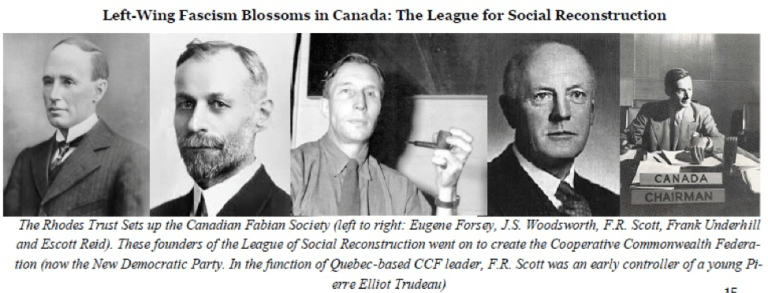
Kissinger’s British Takeover of America
Though it took a few assassinations throughout the post war years, Kissinger’s takeover of the State Department ushered in a new era of British occupation of American foreign policy, whereby the republic increasingly became the “Dumb Giant” acting as “American Brawn for the British brains” using Churchill’s words. While a nihilistic generation of youth were tuning in on LSD, and an old guard of patriots surrounding Wallace and Kennedy had fallen to the “red scare” witch hunt, geopolitical theory was fed like a sweet poison down the throat of a sleeping nation, replacing a policy of peace and “win-win cooperation” advanced by true nationalist patriots as FDR, Wallace and the Kennedys, with an imperial clone masquerading as a republic.
Sir Kissinger did nothing less than reveal his total allegiance to the British Empire on May 10, 1981 during a Chatham House conference in Britain when he described his relationship with the British Foreign office in the following terms: “The British were so matter-of-factly helpful that they became a participant in internal American deliberations, to a degree probably never practiced between sovereign nations… In my White House incarnation then, I kept the British Foreign Office better informed and more closely engaged than I did the American State Department… It was symptomatic”.
During this period, Kissinger worked closely with CIA director George Bush Senior, who was later rewarded for his role in advancing the British-planned first war on Kuwait with a knighthood. This war set the stage for the second wave of Middle East wars beginning with the Anglo-Saudi orchestrated operation known as 9/11 and the ushering in of the new “post-nation state order” by Kissinger and Blair.
This was the era which was celebrated by both Kissinger and Bush in sundry places as “the New World Order”.
The Dystopic New World Order Threatened by a New Deal of the 21st Century
It is this dystopic geopolitical order which has been challenged by the Russia-China alliance which arose in earnest with Xi Jinping’s 2013 announcement of the Belt and Road Initiative as the Grand design for large scale infrastructure projects internationally and in September 2015 with Vladimir Putin’s intervention into Syria which defeated the Hobbesian regime change paradigm which poisoned the west. In 2016, the election of nationalist American President Donald Trump opened the door for the first time in over 50 years to a true national coalition of sovereign nations to eliminate the cancer of colonial thinking forever from the earth.
It is this same British-run deep state which owns Robert Mueller, who along with the Integrity Initiative, Five Eyes and other Deep State operatives are dedicated to overthrowing President Trump from office and undoing the great potential now facing the world as outlined by the Schiller Institute and American statesman Lyndon LaRouche: 1) an FDR-style re-organization of the bankrupt banking system and 2) the unleashing of a global New Silk Road as the New Deal of the 21st Century.
Matthew J.L. Ehret is a journalist, lecturer and founder of the Canadian Patriot Review.
Did Khashoggi Really Die?
By F. William Engdahl – New Eastern Outlook – 23.01.2019
I have not been convinced about the claims coming from Turkey and from the Washington Post and others regarding the allegations of a gruesome murder of intelligence asset, Jamal Khashoggi, in October, 2018. There are too many anomalies as it was portrayed by various statements from Turkey President Erdogan, and echoed by a chorus of the Western mainstream media. Recent research suggests that perhaps Khashoggi was never in that Saudi Consulate in Istanbul that day, and in fact may still be quite alive and in hiding. If so, it suggests a far larger story behind the affair. Let’s consider the following.
The best way to outline this is to go back to the events around the surprise arrest and detention of numerous Saudi high-ranking persons in late 2017, by Prince Mohammed bin Salman or MBS as he is known. On November 4, 2017 MBS announced via state TV that numerous leading Saudis including one of the wealthiest, Prince Alwaleed bin Talal, had been arrested on charges of corruption, and were being detained in the Riyadh Ritz Carlton hotel. Prince Alwaleed is clearly the critical person.
The son-in-law of President Trump had reportedly made a non-publicized visit to Riyadh for private talks with MBS just days before the mass arrests. A report in the UK Mail newspaper in 2018 claimed that Jared Kushner, representing the President, had informed MBS of a rival Saudi Royals plot to eliminate the Crown Prince. Prince Alwaleed was reported to be at the center of the plotters.
After three months imprisonment, Alwaleed was released from detention on 27 January 2018, following a reported financial settlement. In March 2018 he dropped out from Forbes’ World’s Billionaires’ list. Before his arrest Alwaleed was the largest shareholder in Citibank, a major owner of Twitter, once partner of Bill Gates in Gates Foundation vaccine programs, and generous donor to select Democrats such as Hillary Clinton and the Clinton Foundation. According to media reports, Hillary campaign aide Huma Abedin’s brother, Hassan Abedin, Muslim Brotherhood member, worked with Bin Talal on a project called “Spreading Islam to the West.” Bin Talal and other Saudi sources donated as much as $25 million to the Clinton Foundation as she was preparing her Presidential bid. The Prince was also an open foe of Donald Trump.
Who was Khashoggi Really?
Jamal Khashoggi was no ordinary journalist. He actually worked for Prince Alwaleed bin Talal. In an interview in the Gulf Times in November last year Alwaleed stated, “Jamal wasn’t only my friend. He was working with me. Actually, his last job in Saudi Arabia was with me…” Jamal was, or is, nephew of CIA-linked asset, the recently deceased Adnan Khashoggi, a nefarious arms dealer involved in the CIA-Saudi BCCI bank and Iran-Contra. Nephew Jamal also worked for the then-Saudi Ambassador in Washington, Prince Bandar, someone so close to the Bush family that George W. nicknamed him “Bandar Bush.” In short, Khashoggi was part of Saudi circles close to the Bush-Clinton group. When King Abdullah decided to skip over Alwaleed’s father, Talal bin Abdulaziz Al Saud, dubbed “The Red Prince” for his reformist views, in his succession, a move that led to Salman, father of MBS, as successor, Alwaleed was on the outs in the Saudi power calculus of King Salman and Crown Prince MBS.
The Saudi government as well as the Brookings Institution confirm that Khashoggi had been a member of the Muslim Brotherhood. The Brotherhood was banned from Saudi Arabia in 2011 following the Obama-Hillary Clinton Arab Spring, when the Saudi monarch, King Abdullah, and those around him realized that the royal house itself was a potential target for brotherhood regime change, as in Egypt and Tunisia.
The Obama Administration, as I detail in Manifest Destiny, working with the CIA, planned a drastic series of regime changes across the Islamic world to install Muslim Brotherhood regimes “friendly” with the CIA and the Obama administration. Key members of the Obama Administration, including Secretary of State Hillary Clinton’s special assistant, Huma Abedin, had deep ties to the Saudi part of the Muslim Brotherhood where Abedin’s mother lives. Her mother, Saleha Abedin– an academic in Saudi Arabia where Huma grew up– according to a report on Al Jazeera and other Arab media, is a prominent member of the womens’ organization of the Muslim Brotherhood, and Huma’s brother is also reported linked to the organization. Notably, the late John McCain, whose ties to leading members of ISIS and Al Qaeda is public record, tried to discredit fellow Republican Congresswoman Michele Bachmann for pointing to Abedin’s Muslim Brotherhood ties. This is the faction within Saudi Arabia that Khashoggi was tied to.
As President, Trump’s first foreign trip was to meet MBS and the Saudi King, a trip sharply criticized by Democrat Congresswoman Nancy Pelosi. Once a Trump Presidency moved to rebuild the frayed relations that had developed between Obama and the Saudi monarchy under King Abdullah and later King Salman, father of Crown Prince MBS, the faction around pro-Obama Prince Bin Talal Alwaleed was out of favor, to put it mildly, especially after Hillary Clinton lost. In June 2017 Alwaleed’s former employee, Jamal Khashoggi, fled into self-imposed exile in the US where he had studied earlier, after the government banned his twitter account in Saudi.
Khashoggi alive?
Once MBS acted to arrest Alwaleed and numerous others, the future of the money flows between Alwaleed to not only Hillary Clinton, the Clinton Foundation and to other Democrats he had “supported” with Saudi millions, was in jeopardy. While it is difficult to confirm, a BBC Turkish journalist in Istanbul reportedly told an arab language paper after the alleged gruesome murder and dismemberment of Khashoggi that, in fact, Jamal Khashoggi was alive and well, somewhere in hiding.
It is a fact that former CIA head and now Secretary of State Mike Pompeo, along with then-Defense Secretary James Mattis, gave a briefing to the US Senate in which they told the senators that there was no evidence to suggest MBS was behind this alleged crime. They added that they couldn’t even confirm a crime had happened! Only CIA head Gina Haspel, former CIA London station chief, disputed their claims. The Erdogan claims that the body was chopped up and then dissolved in acid for disposal without trace harkens back to the account of the Navy Seal disposal of the dead body allegedly of Osama bin Laden, which the Obama Administration claimed they dumped at sea “according to Muslim tradition.” Conveniently in both cases there was no body to forensically confirm.
Indeed the allegations to world media around the Khashoggi affair were tightly controlled by Turkey’s President Erdogan who repeatedly promised then failed to reveal, what he said were secret Turkish intelligence tapes of the alleged murder. Erdogan is reported very close to the Muslim Brotherhood if not a hidden member, one reason for his close support of Qatar after MBS and the Saudi king declared economic sanctions on Qatar for support of terrorism, in fact Qatari support of the Muslim Brotherhood.
Here we are dealing with shifting political alliances with huge consequences potentially for US and world politics given the enormous size of the Saudi financial resources. It’s also bizarre that Khashoggi allegedly agreed to go to a Saudi Consulate in Turkey and to supposedly get divorce papers. Further, his reported fiancée, Hatice Cengiz, seems to be equally mysterious, with some asking whether she in fact is an agent of Turkish intelligence used to discredit Saudi Arabia.
The claims of Erdogan of the assassination of Jamal by a Saudi team were buttressed by a mysterious Khaled Saffuri, who told Yahoo News reporter, Michael Isikoff, that Khashoggi became a bitter foe of MBS for his articles in the media criticizing the arrests of Prince Bin Talal and others. Research reveals that Saffuri, media source on the Khashoggi alleged murder, also has had close ties to the Muslim Brotherhood front organization, American Muslim Council, and to Qatar, host to the exiled Brotherhood for years. Qatari support for the Muslim Brotherhood was a factor in the break between MBS and Qatar two years ago.
Saffuri is also the protégé of al-Qaeda fundraiser Abdurahman Alamoudi, reportedly also an influential Muslim Brotherhood supporter who before 2004 met with both G.W. Bush and Hillary Clinton. Alamoudi is currently in US federal prison since 2004 for his role as bagman for a Libyan/Al-Qaeda assassination plot to assassinate then-Saudi Crown Prince Abdullah. In brief, the prime sources on the Khashoggi murder are few and hardly without bias.
At this point it is difficult to go beyond speculation. Clear is that Jamal Khashoggi is missing from public view since early October. But until the Turkish government or someone else presents serious forensic evidence, habeas corpus, that indeed shows Alwaleed’s former employee, Jamal Khashoggi was murdered by a Saudi assassination team, let alone by one commanded by Crown Prince bin Salman, the situation warrants more serious examination. It is curious that the same liberal media such as Jeff Bezos’ Washington Post that attacks MBS for the alleged murder of their reporter, Khashoggi, fails to criticize previous Saudi executions or even subsequent ones.
Did Khashoggi really die at the Istanbul Consulate or was something else going on? To stage a fake execution of Khashoggi to discredit and even possibly topple MBS might possibly have appeared to Alwaleed and his CIA friends in Washington to be a clever way of restoring their power and financial influence. If so, it seems to have failed.
House passes bill preventing Trump from leaving NATO, tells allies to start pulling weight
RT | January 23, 2019
The US House of Representatives has passed a bill to prevent President Donald Trump from withdrawing the country from NATO, but called on European allies to pay their dues – just like Trump has demanded.
The bipartisan NATO Support Act was passed on Tuesday in a 357-22 vote that reiterated US commitment to the military bloc and included a provision that rejects any effort made by the president to withdraw from it, banning funding for such actions.
“It’s crazy that we have to be introducing this bill. But it is, unfortunately, both necessary and urgent,” said Rep. Tom Malinowski, one of the Democratic co-sponsors of the bill. “I believe it’s necessary that I take the president of the United States seriously. President Trump has made no secret of his disdain for NATO and his willingness to consider leaving it.”
On the campaign trail and during his presidency, Trump repeatedly criticized NATO, saying the organization allowed other members to take advantage of American generosity and enjoy protection it offers without sharing the burden. The US is by far the biggest contributor to the alliance in terms of finances and soldiers carrying out its missions.
Among other NATO allies, few meet the benchmark two percent of GDP that they are required to spend on defense, which is a commitment that all members made. On many occasions, Trump demanded that this slight was addressed.
The new bill makes the same demand, but Rep. Jimmy Panetta, who spearheaded the legislation, insists it is not like those made by the president.
“What we have to realize is that NATO is not just a transactional relationship,” he said, adding that the focus “can’t just be on who pays what and who gets what. Being a member of NATO is not like being a member of a country club.”
In their statements on the bill, several lawmakers stressed NATO’s role in defending Europe from ‘aggression by Russia.’ This perceived threat has been used to justify an increased military presence of NATO troops close to Russia’s border and regular exercises on a scale unseen since the Cold War. Russia is responding with additional deployments of troops in the west of the country and exercises of its own.
NATO’s uncontrolled expansion eastwards, contrary to verbal assurances made to Soviet leader Mikhail Gorbachev, made Moscow increasingly suspicious of the West’s actions and caused it to spend a lot of resources modernizing its armed forces and boosting its nuclear deterrence over the past two decades.
This policy is now cited as the reason why NATO is necessary. Retired US four-star general David Petraeus recently called it “the greatest gift” the bloc could receive.
Fighting Poverty with a Hate Map?
By Eve Mykytyn | OffGuardian | January 23, 2019
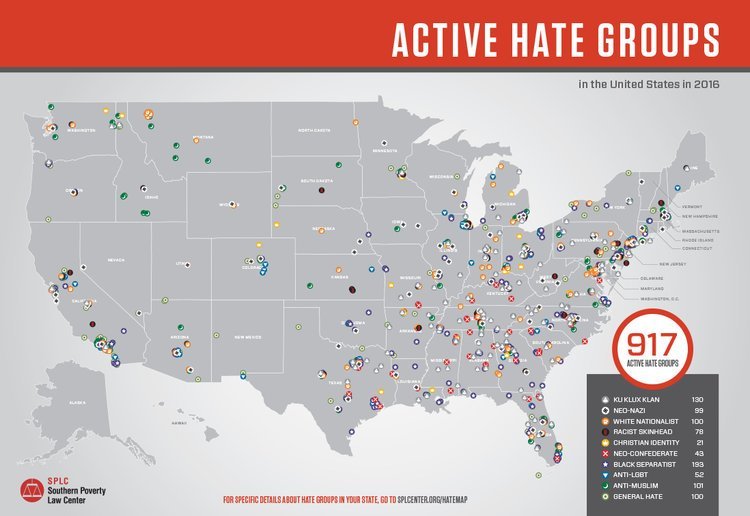
The name, ‘The Southern Poverty Law Center’ (SPLC) is misleading. The SPLC does little to alleviate poverty, its own stated goals are: fighting hate, teaching tolerance and seeking justice. At the moment, the SPLC lists its top activity as attempting to remove confederate statues and symbols. This is consistent with the activity for which the SPLC is best known, its annual hate map in which it locates so-called ‘hate’ groups on a map of the United States. How is it that one of the best funded poverty law centers acts as an arbitrar of hate instead of as an advocate for the poor?
The term ‘Poverty Law’ usually refers to the more mundane practice of representing poor people who are often un or under represented. But the SPLC’s goals are more lofty, here’s how Mark Potok, a Senior Fellow at SPLC described his mission.
It’s not what most in the media think. Sometimes the press will describe us as monitoring hate crimes…Our criteria for a ‘hate group’… have nothing to do with criminality or violence or any kind of guess we’re making about ‘this group could be dangerous.’ It’s strictly ideological. I want to say plainly that our aim in life is to destroy these groups, to completely destroy them”
Each year, the SPLC advertises over 900 hate groups on its hate map. Author Laird Wilcox says the SPLC “Has specialized [in] a highly developed and ritualized form of defamation … a way of harming and isolating people by denying their humanity and trying to convert them into something that deserves to be hated and eliminated. They accuse others of this but utilize their enormous resources to practice it on a mass scale themselves.”
To begin with, the SPLC uses a very loose definition of a hate group as:
an organization that – based on its official statements or principles, the statements of its leaders, or its activities – has beliefs or practices that attack or malign an entire class of people, typically for their immutable characteristics.”
They bolster this with the false claim that the FBI uses a similar definition of hate crime:
[A] criminal offense against a person or property motivated in whole or in part by an offender’s bias against a race, religion, disability, sexual orientation, ethnicity, gender, or gender identity.”
But the FBI’s words do not refer to practices or beliefs, they characterize an actual crime which may have been inspired by bias.
Without advocating hate or prejudice I find the SPLC’s categories hilarious. They are: Ku Klux Klan, Neo-Nazi, White Nationalist, Racist Skinhead, Christian Identity, Neo-Confederate, Black Separatist, Anti-LGBT, Anti-Muslim, General Hate (Anti-Immigrant, Hate Music, Holocaust Denial and Radical Traditional Catholicism) and Other Hate (a grab bag of ‘hateful’ ideologies). Query, if a neo-nazi gets a haircut will he become a racist skinhead or a neo-confederate?
One ‘hate’ group, Radical Traditional Catholicism, are excoriated for blaming Jews for the killing of Christ and “They also embrace extremely conservative social ideals with respect to women.” Is this a hate group? Ultra Orthodox Jews have some pretty vile thoughts about non Jews and also adhere to extremely conservative social ideals for women. Why aren’t the Lubovitches, for instance, on the list?
Holocaust denial is the only hate group defined by simply questioning authority. SPLC claims such groups “only pretend to be interested in historical research.” Instead, even the claim that Jews may have died in ways other than the gas chambers form [hate groups] because they are used simply “to rehabilitate the German Nazis’ image as part of a bid to make the ideology of national socialism more acceptable.” A number of historians investigating World War II might find this assertion surprising.
“The SPLC’s list is wildly inflated,” said Mark Pitcavage, director of investigative research at the Anti-Defamation League. The National Socialist Movement, for example, was listed 49 times in the 2015 Hate Map, since the count included each of the NSM’s individual chapters. The SPLC also counts single individuals as a group or chapter. The result is a count totally at odds with Federal Bureau of Investigation statistics. Hate crimes plummeted 24% between 1998 and 2013, according to the FBI. Yet the SPLC claims the number of hate groups in the U.S. shot up by 75% during this same period.
The SPLC has so many categories of ‘hate’ and those categories are political as much as violent. So is there any actual harm from a listing on the hate map?
There was when Floyd Lee Corkins entered the Family Research Council intending to kill as many as possible because “he found us listed as a hate group on the SPLC website,” said executive vice president retired Gen. William Boykin.
We and others like us who are on this ‘hate map’ believe that this is very reckless behavior… The only thing that we have in common is that we are all conservative organizations…”
Gurnee IL is an unlikely location for a hate group. A prosperous suburb of 30,000, the town is careful with its reputation with tourists as it is home to Six Flags Great America amusement park, the Gurnee Mills indoor shopping mall and the water park, Great Wolf Lodge.
But the SPLC bestowed upon Gurnee the label that makes small-town officials sweat. Towns usually earn their reputations as harbors for hate groups in more public ways. They may be unlucky enough to be the place the Klan decides to march and someone later dies (Charlottesville) or be home to the media-trolling Westboro Baptist Church (Topeka, Kansas). But for towns like Gurnee, designation as one of the 917 locales on SPLC’s Hate Map comes without warning or explanation.
When the town asked the self appointed cartographers of hate to remedy the listing they were told, “I know it is disturbing to find hate groups in your community but I don’t think that should be seen as a reflection of what I am sure is a wonderful community.” Sorry, but the map is only updated once a year. “Call back in January.” The town protested that its police had searched and failed to find a hate group in Gurnee. SPLC Intelligence Chief Heidi Beirich would not budge. “Even though the police couldn’t locate them doesn’t mean they aren’t there.”
Given the low threshold for inclusion on the list, it is not surprising that other towns were included for questionable reasons. In 2004, Olathe, Colorado earned a white hood icon when a self-proclaimed “international imperial wizard” from Indiana told a Denver newspaper that a chapter in Olathe, “a little Klan klavern,” had asked him to come and speak. Neither he nor any of the town officials could name any of the members. Olathe stayed on SPLC’s list for three years.
Amana, Iowa, was placed on the hate map when someone at the SPLC spotted a chat thread on the Daily Stormer. Someone with the screen name “Concerned Troll” proposed a neo-Nazi “book club” meeting in an Amana café. No one in Amana was able to confirm to the SPLC whether or not the meeting actually took place, but that was enough to earn the corn-carpeted state its only swastika.
But still, Beidich worries more about undercounting than over inclusion. She thinks the undercount groups hide in shadows. She does not explain why listing what are ‘un’ hate groups, by her own criteria, will cause hate groups to emerge from the shadows. In fact, it is not clear why we are not all better off if a ‘hate’ group stays hidden.
Featured Video

or go to
Aletho News Archives – Video-Images
From the Archives
How the CIA Spawned Google
By Svetlana Ekimenko – Sputnik – 05.02.2025
American tech giant Google has faced regulatory scrutiny on numerous occasions amid accusations of antitrust violations. Google’s relationship with the CIA, ranging from early financial support to collaborative efforts have been decried as undermining privacy rights and free speech in the digital landscape.
Google’s creation played a crucial role in the US intelligence community’s scheme to attain global dominance by controlling information. … continue
Blog Roll
 Aletho News
- Kafr Qasim at 70: The massacre Israel still hasn’t owned up to
- Would President Vance really ditch Israel?
- LAPD Pilot Will Track Vehicles In San Fernando Valley
- Britain’s Online Censorship Law Now Comes With a Crisis Plan for Your Posts
- NATO’s “Nordic model” brings Arctic confrontation closer to Russia’s nuclear bases
- Using nuclear weapons, the US-Israeli alliance still can’t beat Iran
- Sunset on the Quality of Western Propaganda: Arrival of the Dr Strangelove Moment
- Ukrainian general accused of protecting crime bosses
- US-‘Israel’ alliance faces growing rupture after midterms
- GOP’s Crushing Midterm Loss Could Reshape US Political Landscape – Analyst
- If Americans Knew
- An error has occurred; the feed is probably down. Try again later.
- No Tricks Zone
- New Study: The Net Fossil Fuel Contribution To Rising Atmospheric CO2 Has Been Zero For 500 Years
- Germany’s Green Energy Transition Becoming Increasingly Expensive…Another 6 Trillion Euros!
- Sudden Stratospheric Warming, Powerful El Niño Combination May Lead To Extreme Europe Cold, Energy Crisis!
- Two New Studies Find Thwaites Glacier Melt Cannot Be Driven By Human Activity Or A Warming Ocean
- E-Cars Reduce CO2 Emissions By Only 41% Compared To Internal Combustion Engine Vehicles
- Predictions Made By Renowned Climate Professor Over Past Decades Have Been Proven To Be Poor
- New Study Suggests Large Regions Of The Pacific Ocean Have Been Cooling For The Last 80 Years
- Germany’s Green Energy Debacle: High Energy Costs Force Kahla Porzellan to Close After 182 Years!
- New Study: 50 Years Of The Most Aggressive ‘Net Zero’ Policies Can Only Affect The Global Climate By 0.03°C
- US September “Heat” Was No Record…Many Records Set Decades Ago

