Trump Tower Moscow: A CIA-Backed Provocation Against Putin, Trump – Economist
Sputnik – December 5, 2018
The media fuss surrounding the Trump Tower Moscow project that was never implemented may further exacerbate Russian-American relations, Sputnik contributor Ivan Danilov wrote, sharing his views on what was really behind the much-discussed initiative
The Trump Tower Moscow “plot” was nothing less than a CIA-backed provocation, deems Ivan Danilov, a Russian economist and Sputnik contributor.
“If we separate wheat from the emotional chaff of US media, we would get the following: immediately after [Donald] Trump becomes a presidential candidate, an agent of several US intelligence agencies, [Felix Henry] Sater, who had been earlier embedded in Trump’s business structure, came to then [Trump’s] lawyer [Michael Cohen] with a ‘brilliant idea’: to give [Vladimir] Putin a penthouse in order to turn the Russian president into an element of advertising”, Danilov wrote in his latest op-ed.
The economist underscored that one important link is missing in this chain, stressing that no one had confirmed so far whether the American president knew about the Sater-Cohen plan and endorsed it.
If this link is missing, the whole “chain” snaps, according to Danilov.
On 17 May 2018 BuzzFeed News reporters Anthony Cormier and Jason Leopold broke that Trump’s two “key business partners” had been secretly negotiating a deal aimed at building “an icon of the Trump empire — the Trump World Tower Moscow” amid the 2016 presidential campaign.
The media outlet referred to “exclusively” obtained documents revealing “a detailed and plausible plan” and “well-connected Russian counterparts”.
On 29 November, Cormier and Leopold unveiled ex-Trump business associate Sater’s plan “to give a $50 million penthouse at Trump Tower Moscow to Russian President Vladimir Putin” as part of the aforementioned real estate initiative. Sater discussed this plan with Trump’s personal attorney Michael Cohen, who hailed the idea at that time.
“My idea was to give a $50 million penthouse to Putin and charge $250 million more for the rest of the units. All the oligarchs would line up to live in the same building as Putin”, Sater told BuzzFeed News.
Meanwhile, on 29 November, Cohen pleaded guilty to lying to Congress about the Trump Tower project in Russia in an attempt to “minimize” his boss’s ties to Russia.
However, the biggest news about the proposed real estate deal is that it was considered “during the 2016 primaries and caucuses,” The Washington Post highlighted on 30 November, stressing that the former Trump lawyer earlier lied that the endeavour had been brought to naught before the primaries.
“This provides more evidence that the project was being rather seriously pursued with potential assistance from the Russian government, despite Trump’s presidential candidacy and despite Trump’s regular assurances that he didn’t deal with Russia”, the Post claimed.
In addition, Cohen “did recall” that in or around January 2016, he received a “response” from Dmitry Peskov, the Russian president’s press secretary, Special Counsel Robert Mueller wrote on Thursday.
For his part, Kremlin spokesman Dmitry Peskov revealed what sort of response he gave to Trump’s business associates after receiving Cohen’s letter that was sent to his official email.
“They were asked what the presidential administration has to do with this and if they realized who they contacted”, the Kremlin spokesman recalled. “They said they wanted to build a house… They were told that the administration is not engaged in construction projects and we will be happy to see them at the St. Petersburg Economic Forum if they are interested in investment”.
The case does not appear to be a smoking gun. Commenting on the media fuss, a source close to the US president told Fox News that the Sater-Cohen plan to provide the Russian president with a penthouse would have been a “stupid idea”, and emphasised that Trump had “never heard” about it.
Sater’s longstanding cooperation with US intelligence services, including the Central Intelligence Agency (CIA), the Defence Intelligence Agency (DIA) and the Federal Bureau of Investigation (FBI) adds further controversy to the case.
On 12 March, 2018, Cormier and Leopold reported that Felix Henry Sater (born Felix Mikhailovich Sheferovsky), 52, had “spent more than two decades as an intelligence asset who helped the US government track terrorists and mobsters”.
Given all of the above, the whole case looks like a “three-penny provocation” aimed at discrediting President Donald Trump, Danilov pointed out.
“One can presume that the next phase of the scandal will be the publication of Sater and Cohen’s photographs on the side-lines of the SPIEF or near the venue of the forum in the American media, which, from the point of view of US investigators, may well prove that the ‘Kremlin and Trump plot’ did take place”, he noted, bemoaning the fact that this “three-penny provocation” could seriously affect the already complicated US-Russian relations.
Military defeats push Kabul into talks with Taliban as US seeks way out from Afghan stalemate
RT | December 5, 2018
Direct talks with the Taliban are crucial for the Kabul government to survive amid crushing defeats by the militants, Afghanistan experts told RT amid expectations that end of the 17-year war is looming.
Afghanistan returned to headlines this week, with a government-affiliated official making an unconventional peace gesture towards the Taliban. Ehsan Taheri, spokesman for the High Peace Council – a body that mediates peace between the government and the militants – said Kabul is ready to talk directly to the Taliban. He promised there will be no prerequisites to discuss any issue “crucial for the future of Afghanistan.”
“There’s no doubt the Afghan government relies on speeding up talks with Taliban” as the situation on the ground deteriorated over the past two years, Nikita Mendkovich, an expert with Russian International Affairs Council, told RT.
The Taliban have managed to gain upper hand in various parts of the country, and the Western-backed Afghan National Army risks being defeated in the coming years, he explained. And while Kabul’s offer of peace sounds promising at a glance, analysts say it has more to do with the survival of the current government than anything else.
The militants are able “to take matters into their own hands” without providing any security guarantee to the Afghan government, the expert noted.
That aside, Afghanistan is preparing to hold presidential elections, putting the sitting President Ashraf Ghani in a precarious position. Because he is unpopular with sizeable part of the population and regional elites, he must demonstrate “some results.”
“A peace deal or at least a long-term truce with Taliban would be a bargaining chip for Ghani to remain in power,” according to Mendkovich. However, the main reason for Kabul to accelerate the peace process is still rooted in “military defeats” sustained by the Afghan army and NATO forces.
Meanwhile, Omar Nessar, a researcher with Russia’s Institute for Oriental Studies, said he doesn’t see how a peace deal might become reality.The Taliban are demanding that NATO troops leave the country, which in turn is “unacceptable” for Western sponsors of Kabul.
The Taliban “doesn’t need peace talks right now as they continue to gain foothold in Afghanistan,” Nessar stressed. The Afghan leadership is a too week actor to talk with, but the Americans may try to ask Kabul to negotiate on their behalf in order to “save the image of the government.”
Afghan stalemate: Winning peace to lose war?
On the military front, the reality looks as murky as it was over the past years. On Tuesday, Marine Lt. Gen. Kenneth McKenzie who is set to take the lead of US Central Command (CENTCOM), gave oxygen to a claim there was no easy way out from the 17-year Afghan war.
“I do know that today it would be very difficult for [the Afghan security forces] to survive without our and our coalition partners’ assistance,” McKenzie said, noting that if the US forces are to leave “precipitously right now,” the Kabul government might fall.
McKenzie said that in light of a steep rise in casualties, the US must step up its efforts to help Afghan forces to recruit and train much-needed reinforcements, describing the current rate of losses as unsustainable. “They’re fighting hard, but their losses are not going to be sustainable unless we correct this problem.”
Asked to provide his take on this, Nessar said that while the US “is tired of the war” it cannot leave Afghanistan in full. A complete troop withdrawal would mean acknowledging a military defeat in the war on Taliban, he stated.
“The US cannot win war, it tries to win peace,” Mendkovich commented. Asked if the US could employ a peace deal with Taliban to get out of the war, he suggested a complete troop pullout is unlikely. US air bases and military compounds are “strategic assets” instrumental to “create threats” against neighboring China, Russia and Iran, and the Americans don’t want to lose them.
Putin: Russia Opposes Destruction of INF Treaty, But Will React in Proper Manner
Sputnik – 05.12.2018
Russian President Vladimir Putin has said that Moscow is against the destruction of the Intermediate-Range Nuclear Forces (INF) Treaty, but would respond accordingly if it happens. His comments come a day after the US said it would withdraw from the treaty if Russia does not return to full compliance.
Russian President Vladimir Putin said the United States had decided to leave the accord long before the public announcement and used alleged violations by Russia as a pretext to do it.
“This means that the decision has long been made, but it has been made sneakily. They thought we wouldn’t notice this, but this is already in the Pentagon’s budget — the creation of these missiles. But only after did they announce publicly that they were leaving,” Putin said.
“As the next step, they started to think whom they could shuffle the blame onto. Well, to say ‘Russia is to blame’ is the easiest and the most habitual thing for an ordinary Western person. This is not true, we are against the destruction of the treaty, but if it happens, we will react accordingly,” he added.
The president agreed that many other countries are still developing intermediate and short-range missiles, while Russia and the US had limited themselves under the INF Treaty. At the same time, he added that if Washington believes that it should have such weapons, Moscow will follow suit.
“This is true. Many other countries, perhaps, already a dozen of countries, are producing such weapons, while Russia and the United States have restrained themselves bilaterally. I believe our US partners think that now the situation has changed to such an extent that the United States should have such weapons as well. What answer will we provide? A simple one: then we’ll do it as well”, Putin said.
He further recalled that the US had unilaterally withdrawn from the Anti-Ballistic Missile Treaty back in 2002, which was one of the key agreements in international security.
“And they still had the audacity, they have withdrawn from the treaty calmly… without referring to anything. They just pulled out from the treaty, and called it a day. In fact, this is exactly what is happening now, but now they reflect on whom they could shuffle the blame onto for this step, which I believe is ill-considered,” Putin told reporters.
On Tuesday, US Secretary of State Mike Pompeo announced that Washington would withdraw from the INF Treaty within 60 days unless Russia returns to full compliance with the accord.
In October, President Donald Trump announced his intention to leave the treaty over Russia’s alleged violations. Russia has consistently denied any violations of the agreement, saying that the US knows very well that Moscow was abiding by the provisions of the treaty.
Trump’s Timidity is Letting Comey Off the Hook
By Ray McGovern • Consortium News • December 4, 2018
Because President Donald Trump has again pulled the rug out from under them, House Republicans face Mission Impossible on Friday when they try to hold ex-FBI Director James Comey accountable for his highly dubious authorization of surveillance on erstwhile Trump campaign adviser Carter Page.
Comey let go his unprecedented legal maneuver to have a court quash a subpoena for him to appear behind closed doors before the Republican-led House Judiciary Committee until the Democrats take over the committee in January. The current committee chair, Rep. Bob Goodlatte (R-VA), decried Comey’s use of “baseless litigation” in an “attempt to run out the clock on this Congress.”
The Judiciary Committee has jurisdiction over the Foreign Intelligence Surveillance Act (FISA); so the still secret FISA application “justifying” surveillance of Page is almost sure to come up.
Comey had wanted a public hearing so he could pull the ruse of refusing to respond because his answers would be classified. He has now agreed to a closed-door meeting on Friday, with a transcript, likely to be redacted, to appear a few days later.
In an interview with The New York Post last Wednesday, Trump acknowledged that he could declassify Comey’s damning Foreign Intelligence Surveillance Act warrant request to show how devastating those pages likely are, but said he would not do so “until they were needed,” namely, if a Democratic House starts going after him. “If they go down the presidential harassment track, if they want go and harass the president and the administration, I think that would be the best thing that would happen to me. I’m a counter-puncher and I will hit them so hard they’d never been hit like that,” Trump told the paper. He added: “It’s much more powerful if I do it then, because if we had done it already, it would already be yesterday’s news.”
But they are needed before Comey’s hearing on Friday. Barely a week will remain before Congress adjourns. Four weeks later Democrats take over the oversight committees.
Cowardice Deja Vu
This is not the first time Trump has flinched. On September 17 he ordered “immediate declassification” of Russia-gate documents, including FISA-related material. Four days later he backed down, explaining that he would leave it to the Justice Department’s inspector general to review the material, rather than release it publicly.
What exactly is in the FISA application, and why had House Intelligence Committee chair Devin Nunes, for example, kept pleading with Trump to declassify it? In July Nunes expressed hedged confidence “that once the American people see these 20 pages, at least for those that will get real reporting on this issue, they will be shocked by what’s in that FISA application” to surveil Page, a U.S. citizen.
Oddly, Trump echoed Nunes, telling The New York Post that, were he to declassify FISA warrant applications and other documents, all would “see how devastating those pages are.” But Trump blamed his reluctance to declassify on one of his lawyers, Emmet Flood, who thought it would be better politically to wait. “He didn’t want me to do it yet, because I can save it. … I think [eventual release] might help my campaign.” So Nunes et al. find themselves thrown under the bus, again.
Worse still, according to Comey’s attorney, the “accommodation” worked out with House Judiciary Committee includes a proviso that a representative of the FBI will be present on Friday to advise on any issues of confidentiality and legal privilege. The committee undertook to publish a transcript very quickly. Do not be surprised to see many Peter-Strzok-type responses: “I would really like to answer that question, but the FBI won’t let me.”
Afraid?
In an insightful posting, David Stockman, budget director for President Ronald Reagan, was puzzled about why Trump doesn’t seem to get what’s going on. I think, rather, that Trump does get it, and that Stockman’s puzzlement may be due mostly to his specific experience as budget director. In that role, Stockman did not have to pay much heed to the Deep State, so long as he did not demur about the obscenely excessive budgets automatically given to the FBI, DOJ, CIA, NSA, and the Pentagon.
With Trump it’s a different kettle of fish — and they are piranhas. Trump has ample reason to fear the Deep State is out to get him because it is. And by this point he seems to have internalized quite enough fear that it would be too dangerous to take on the the FBI and intelligence community. Needless to say, the stakes are exceedingly high — for both sides. As president-elect, Trump dismissed the usual warnings as to how things work in Washington. But he could hardly have missed Sen. Minority Leader Chuck Schumer’s attempt to ensure that Trump knows what he should be afraid of.
Not Afraid? Then ‘Really Dumb’
On Jan. 3, 2017, three weeks before Trump took office, Schumer told MSNBC’s Rachel Maddow, that President-elect Trump was “being really dumb” by taking on the intelligence community and doubting its assessments on Russia’s cyber activities: “Let me tell you, you take on the intelligence community, they have six ways from Sunday at getting back at you. So even for a practical, supposedly hard-nosed businessman, he’s being really dumb to do this.”
Schumer’s words came just three days before then-National Intelligence Director James Clapper and the heads of the FBI, CIA, and NSA descended upon the president-elect with the misnomered “Intelligence Community Assessment” — a rump, evidence-free embarrassment to serious practitioners of intelligence analysis, published that same day, alleging that Russian President Vladimir Putin had done what he could to get Trump elected.
Adding insult to injury, after the January 6, 2018 briefing of the president-elect by the Gang of Four, Comey asked the others to leave, and proceeded to brief Trump on the dubious findings of the so-called “Steele dossier” — opposition research paid for by the Democrats (and, according to some reports, by the FBI as well) — with unconfirmed but scurrilous stories about Trump cavorting with prostitutes in Moscow, etc., etc. (And according to The Washington Post, that incident with hookers was written by a Clinton operative.) That opposition research was apparently used in the FISA warrant request, without revealing its provenance to the judge.
‘This Russia Thing’
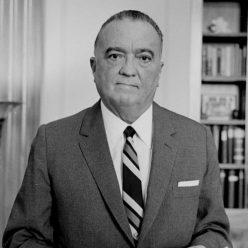
Hoover: Model for Comey. (Wikipedia)
It seems to have taken Trump a few months to appreciate fully that he was being subjected to the classic blackmail-type advisory previously used with presidents-elect by the likes of J. Edgar Hoover. Indeed, this may be what Trump had in mind when he told Lester Holt in May 2017 that he had fired Comey over “this Russia thing.” (Trump can be his worst enemy when he opens his mouth.)
Comey’s closed-door deposition is now scheduled for the 77th anniversary of the Japanese surprise attack on Pearl Harbor. But don’t look for any surprise attack on Comey this December 7 from Judiciary Committee members, highly vulnerable though he is.
With just a few days left before Congress adjourns, House Republicans, like their President, have pretty much let the clock run out on them. Few will see much percentage at this late date in “taking on the intelligence community.” Trump has already pretty much thrown them under the bus.
The leadership of the three House committees with purview over Russia-gate matters — Judiciary, Intelligence, and Government Operations — changes next month. So while Friday had seemed to be shaping up as a key day for confronting Comey — and for getting answers to questions on Russia-gate — the day will likely land with an anticlimactic thud. Even if the committee is able to expose additional misdeeds not already known, nothing much is likely to happen before Christmas.
After that, the three committees and their aborted work will be history.
The dominant mainstream media narrative about Russia-gate — ignoring FBI-gate — will hop happily into the new year. And no congressional “oversight” committee will dare step up to its constitutional duty, despite a plethora of documentary evidence on FBI-gate. And why? Largely because “they” of the Deep State “have six ways from Sunday at getting back at you.”
Most consequential of all, any significant improvement in relations with Russia will remain stymied. And the MICIMATT (Military-Industrial-Congressional-Intelligence-Media-Academia-Think Tank) complex, with its Deep-State enforcer, will have won yet another round. Merry Christmas.
Ray McGovern works with Tell the Word, a publishing arm of the ecumenical Church of the Saviour in inner-city Washington. He worked for the senior Bush when he was director of the CIA and then briefed him mornings, one-on-one, with the President’s Daily Brief during the first Reagan administration. In Jan. 2003, Ray co-founded Veteran Intelligence Professionals for Sanity (VIPS) and still serves on its Steering Group.
Loophole in Bernie Sanders’ Yemen Bill Actually Allows Continued US Involvement in Yemen
By Whitney Webb | Mint Press News | December 3, 2018
Last week, many celebrated the advancement of Senate Joint Resolution (SJR) 54, which had been introduced by Senator Bernie Sanders (I-VT), as a sign that the U.S. Congress was finally willing to act to reduce the U.S.’ culpability for the situation in Yemen, currently the world’s worst humanitarian crisis.
The bill, which will be voted on by the Senate this week, has been praised by many within the anti-war movement for its bid to “end” U.S. military involvement in Yemen. Passage of the bill would, however, do no such thing.
Much of the media coverage of the bill has noted that the resolution invokes the 1973 War Powers Resolution, which prohibits the president from deploying U.S. troops into armed conflicts without congressional approval. Though that resolution has been ignored many times since its passage, particularly since the War on Terror began in 2001, SJR 54 has been promoted as a “progressive” effort to bring the U.S.’ military adventurism to heel at a time when Saudi Arabia — one of the two countries leading the war against Yemen – is under increased scrutiny.
Yet, the text of the bill itself reveals that SJR 54 invokes the War Powers Resolution in name only. Indeed, while the bill claims to be aimed at achieving “the removal of United State Armed Forces from hostilities in the Republic of Yemen that have not been authorized by Congress,” it contains a major loophole that will allow the majority of U.S. troops in Yemen – if not all – to stay.
As the bill states, it will require the president to remove troops “except United States Armed Forces engaged in operations directed at al Qaeda or associated forces.” Notably though, the only U.S. troops “on the ground” in Yemen that are involved in “hostilities” (i.e., combat operations) are those that are allegedly involved in operations targeting Al Qaeda — operations that the U.S. frequently conducts jointly with the countries waging war against western Yemen, such as the United Arab Emirates.
U.S. troops deployed in Yemen to target Al Qaeda in the Arabian Peninsula (AQAP) also collaborate with the UAE and Saudi Arabia in “intelligence sharing,” “midair refueling,” and “overhead reconnaissance” for forces involved in counterterrorism operations that the U.S. is leading. This cooperation is what the very text of SJR 54 claims to want to end, but only in regard to the coalition’s war in western Yemen. However, the current text of the bill would allow all of this cooperation to continue, just not in areas where there are no claims of AQAP presence.
Thanks to the loophole in SJR 54, all that would need to change for the U.S. military’s assistance to the Saudi/UAE coalition to remain as is would be for either the Saudis, Emiratis or the U.S. to claim that there is an AQAP presence – however small – in an area they wish to target. Given that AQAP regularly collaborates with coalition forces elsewhere in Yemen, the coalition would only need move AQAP forces near a site in western Yemen that they wish to bomb in order for U.S. military involvement in its war against Yemen’s resistance to continue unimpeded.
 Alternatively, either of those countries could supply “intelligence” that would seek to link Yemen’s resistance movement Ansarullah or the Houthis to AQAP, thus allowing U.S. involvement in the coalition’s war in Yemen to continue unchanged. This is a very likely scenario if SJR 54 is passed given that some top Trump administration officials have a history of providing false intelligence in order to justify aggressive policies and push for military intervention abroad. Furthermore, the Trump administration also has experience linking countries it doesn’t like to Al Qaeda without evidence in order to justify such policies. Thus, linking Yemen’s resistance movement to AQAP despite a lack of evidence is something the Trump administration would likely pursue were this bill to pass in its current form.
In addition, the Sanders-introduced bill will do nothing to stop the U.S.’ use of drone strikes that regularly kill scores of civilians in Yemen. Indeed, a recent investigation conducted by the Associated Press found that at least one-third of all Yemenis killed by U.S. drone strikes in Yemen were civilians, many of them children. Even though U.S. intelligence has regularly shown that the U.S. drone war in Yemen actually strengthens AQAP, this bill would do nothing to stop the U.S. military’s deadliest practice in Yemen, with a documented history of murdering civilians.
The bill’s failure to touch on the U.S. drone war in Yemen is unsurprising given that Bernie Sanders — who introduced SJR 54 — supported drone strikes and the controversial “kill lists” during the Obama administration. Furthermore, when asked on Meet the Press in 2015 if his foreign policy if elected President would involve the use of drones and Special Forces in military operations overseas, Sanders stated that it would involve “all of that and more.”
SJR 54 as mostly kabuki
Given the fact that SJR 54 provides a huge loophole that would prevent it from having the advertised effect, it seems that the measure is meant to serve other purposes, namely political, instead of its stated purpose of ending U.S. military involvement in Yemen. The bill appears to be little more than a PR stunt by Democrats and Democratic-aligned senators to distance themselves from Republicans.
This is supported by the fact that not a single Democrat in the Senate voted against the bill last week, while several Senate Democrats had voted against it earlier this year, setting up the case that only Republicans are against halting the U.S.-backed war in Yemen. Another suggestion that this is the case is how the media widely reported the vote as a “rebuke” of President Trump, as is the fact that 2020 Democratic presidential hopefuls, such as Cory Booker and Elizabeth Warren, co-sponsored this bill even though they both hold pro-war positions regarding another Middle Eastern country, Iran.
The “anti-war” credentials of Warren — as well as Bernie Sanders, who wrote SJR 54 — have long been questionable, particularly after they both backed James Mattis as Secretary of Defense even though he had led the U.S. assault on the Iraqi city of Fallujah in 2004, an attack that killed thousands of civilians and used chemical weapons that still cause birth defects in those born in Fallujah over a decade later.
Though the death of Saudi journalist and U.S. resident Jamal Khashoggi has been blamed for the change of heart of Senate Democrats and some Republicans, reporting from MintPress and others has shown that the “outrage” regarding Khashoggi’s death is not about “human rights” but about money and pushing Saudi Crown Prince to move forward with expensive weapons deals and the neoliberalization of Saudi state assets that he had tried to back away from. Viewing the situation from this lens, SJR 54 seems little more than a PR effort to cast Democrats as “anti-war” when they are just as beholden to the military-industrial complex as the Republicans.
Yet, most importantly, the toothless text of SJR 54 shows that relying on either of the corporate, war-loving political parties in the U.S. to end the country’s involvement in the war in Yemen is misguided, as such action if more likely to come about from sustained public pressure or grassroots activism than from politicians beholden to special interests such as the Saudi or weapons lobbies.
Whitney Webb is a staff writer for MintPress News and a contributor to Ben Swann’s Truth in Media. Her work has appeared on Global Research, the Ron Paul Institute and 21st Century Wire, among others. She has also made radio and TV appearances on RT and Sputnik. She currently lives with her family in southern Chile.
Russia in Full Compliance With INF Treaty, US Side Knows Well About It – Moscow
Sputnik – 04.12.2018
Russian Foreign Ministry Spokeswoman Maria Zakharova responded to earlier statements by US Secretary of State Mike Pompeo and NATO chief Jens Stoltenberg regarding the INF treaty by stating that Moscow strictly adheres to the provisions of the arms accord.
“Russia is following the provisions of the treaty and the American side knows this well,” she said.
Earlier, NATO Secretary General Jens Stoltenberg stated at a press conference in Brussels on December 4 that Russia should not miss its “last chance” to preserve the key arms control agreement between Moscow and Washington. Speaking at the same conference, Pompeo said that the US would suspend its adherence to the INF Treaty in 60 days unless Russia returns to full compliance with the agreement.
The US secretary of state also announced that the US would suspend its obligations under the arms treaty for 60 days until Russia “returns to full and verifiable compliance”. He also said that the US would not produce, deploy, or test any missile that violates the treaty during this period.
Earlier, US President Donald Trump accused Russia of violating the INF treaty by building prohibited missiles and vowed to abandon it in the near future. Moscow denied Washington’s accusations, saying it abides by the accord’s provisions. Russia has called the US plans to withdraw from the INF dangerous, saying that it could draw “entire regions of the world into an arms race”.
Previously, Russia has also accused the US of violating the INF treaty by deploying launchers capable of firing prohibited missiles in Europe, which is also prohibited by the INF.
What Foreign Threats?
The biggest threats to America come from its “friends”
By Philip Giraldi • Unz Review • December 4, 2018
One of the local Washington television stations was doing a typical early morning honoring our soldiers schtick just before Thanksgiving. In it soldiers stationed far from home were treated to videolinks so they could talk to their families and everyone could nod happily and wish themselves a wonderful holiday. Not really listening, I became interested when I half heard that the soldier being interviewed was spending his Thanksgiving in Ukraine.
It occurred to me that the soldier just might have committed a security faux pas by revealing where he was, but I also recalled that there have been joint military maneuvers as well as some kind of training mission going on in the country, teaching the Ukrainian Army how to use the shiny new sophisticated weapons that the United States was providing it with to defend against “Russian aggression.”
Ukraine is only one part of the world where the Trump Administration has expanded the mission of democracy promotion, only in Kiev the reality is more like faux democracy promotion since Ukrainian President Petro Poroshenko is clearly exploiting a situation that he himself provoked. He envisions setting himself up as a victim of Moscow to aid in his attempts to establish his own power through a security relationship with Washington. That in turn will help his bid for reelection in March 2019 elections, in which his poll numbers are currently running embarrassingly low largely due to the widescale corruption in his government. Poroshenko has already done much to silence the press in his county while the developing crisis with Russia has enabled him to declare martial law in the eastern parts of the country where he is most poorly regarded. If it all works out, he hopes to win the election and subsequently, it is widely believed, he will move to expand his own executive authority.
There also has to be some consideration the encounter with the Russians on the Kerch Strait was contrived by Poroshenko with the assistance of a gaggle of American neoconservative and Israeli advisers who have been actively engaged with the Ukrainian government for the past several years. The timing was good for Poroshenko for his own domestic political reasons but it was also an opportunity for the neocon warmongers that surround Trump and proliferate inside the Beltway to scuttle any possible meeting between a vulnerable Donald Trump and Vladimir Putin at the G20 gathering in Argentina.
The defection of Trump’s lawyer Michael Cohen, together with the assumption that a lot of anti-Trump dirt will be spilled soon, means that the American president had to be even more cautious than ever in any dealings with Moscow and all he needed was a nod of approval from National Security Adviser John Bolton and Secretary of State Mike Pompeo to cancel the encounter. A heads-of-state meeting might not have solved anything but it certainly would be better than the current drift towards a new cold war. If the United States has only one vitally important relationship anywhere it is with Russia as the two countries are ready, able and apparently willing to destroy the world under the aegis of self-defense.
Given the anti-Russian hysteria prevailing in the U.S. and the ability of the neocons to switch on the media, it should come as no surprise that the Russian-Ukrainian incident immediately generated calls from the press and politicians for the White House to get tough with the Kremlin. It is important to note that the United States has no actual national interest in getting involved in a war between Russia and Ukraine if that should come about. The two Eastern European countries are neighbors and have a long history of both friendship and hostility but the only thing clear about the conflict is that it is up to them to sort things out and no amount of sanctions and jawing by concerned congressmen will change that fact.
Other Eastern European nations that similarly have problems with Russia should also be considered provocateurs as they seek to create tension to bind the United States more closely to them through the NATO alliance. The reality is that today’s Russian Federation is not the Soviet Union and it neither aspires to nor can afford hegemony over its former allies. What it has made very clear that it does want is a modus vivendi where Russia itself is not being threatened by the West.
Recent military maneuvers in Poland and Lithuania and the stationing of new missiles in Eastern Europe do indeed pose a genuine threat to Moscow as it places NATO forces on top of Russia’s border. When Russia reacts to incursions by NATO warships and planes right along its borders, it is accused of acting aggressively. One wonders how the U.S. government would respond if a Russian aircraft carrier were to take up position off the eastern seaboard and were to begin staging reconnaissance flights. Or if the Russian army were to begin military exercises with the Cubans? Does anyone today remember the Bay of Pigs?
When it comes to international conflicts context is everything. Seeing the incident between Russia and Ukraine in Manichean terms as an example of Moscow’s aggressive instincts is satisfying in some circles, but it does not in any way reflect the reality on the ground. Internal politics of the two countries combined with deliberate fabrications that are expected to generate a certain response operate together to create a largely false narrative for both international and domestic consumption. Unfortunately, narratives have consequences: in this case, the sacrifice of the possibly beneficial meeting between Trump and Putin.
The same dynamic works vis-à-vis Washington’s other enemy du jour Iran. In the case of Russia, useless “friend” Ukraine is pulling the strings while regarding Iran it is conniving Israel and Saudi Arabia. Iran has been accused of being the world’s leading sponsor of terror, of destabilizing the Middle East, and of having a secret nuclear weapon program that will be used to attack Israel and Europe. None of those assertions are true. The terrorism tag comes from the country’s relationship with Hezbollah, which is only a terrorist group insofar as it is hostile to Israel and pledged to resist any future Israeli invasion of Lebanon. Washington and Israel have pushed the terrorism label for Hezbollah, but most Europeans have begun to disregard the designation since the group has become a part of the Lebanese government.
And regarding destabilizing the Middle East, that has largely been the end result of actions undertaken by the United States, Israel and the Saudis, while the alleged Persian nuclear weapons program is a fantasy. If someone in the U.S. national security apparatus had any brains the United States would work to improve relations with Iran real soon as the Iranians would in the long run quite likely prove to be better friends than those rascals who are currently running around using that label.
And there are other friends in unlikely places. Beleaguered British Prime Minister Theresa May is wailing loudly against a Trump threat to reveal classified documents relating to Russiagate. The real problem is that the documents apparently don’t expose anything done by the Russians. Rather, they seem to appear to reveal a plot by the British intelligence and security services working in collusion with then CIA Director John Brennan to subvert the course of the 2016 election in favor of the Deep State and Establishment favorite Hillary Clinton. How did that one work out?
So how about it? Teenagers who get in trouble often have to ditch their bad friends to turn their lives around. There is still a chance for the United States if we keep our distance from the bad friends we have been nurturing all around the world, friends who have been convincing us to make poor choices. Get rid of the ties the bind to the Saudis, Israelis, Ukrainians, Poles, and yes, even the British. Deal fairly with all nations and treat everyone the same, but bear in mind that there are only two relationships that really matter – Russia and China. Make a serious effort to avoid a war by learning how to get along with those two nations and America might actually survive to celebrate a tricentennial in 2076.
Trump Foreign Policy: Doing the Same Thing and Expecting a Different Result
By Ron Paul | December 3, 2018
After a week of insisting that a meeting with Putin on the sidelines of the G20 meeting in Argentina was going to happen, President Trump at the last minute sent out a Tweet explaining that due to a Russia/Ukraine dispute in the Sea of Azov he would no longer be willing to meet his Russian counterpart.
According to Trump, the meeting had to be cancelled because the Russians seized three Ukrainian naval vessels in Russian waters that refused to follow instructions from the Russian military. But as Pat Buchanan wrote in a recent column: how is this little dispute thousands of miles away any of our business?
Unfortunately it is “our business” because of President Obama’s foolish idea to overthrow a democratically-elected, pro-Russia government in Ukraine in favor of what his Administration believed would be a “pro-Western” and “pro-NATO” replacement. In short, the Obama Administration did openly to Ukraine what his Democratic Party claims without proof the Russians did to the United States: meddled in a vote.
US interventionism in Ukraine led to the 2014 coup and many dead Ukrainians. Crimea’s majority-Russian population held a referendum and decided to re-join Russia rather than remain in a “pro-West” Ukraine that immediately began discriminating against them. Why would anyone object to people opting out of abusive relationships?
What is most disappointing about President Trump’s foreign policy is that it didn’t have to be this way. He ran on a platform of America first, ending foreign wars, NATO skepticism, and better relations with Russia. Americans voted for this policy. He had a mandate, a rejection of Obama’s destructive interventionism.
But he lost his nerve.
Instead of being the president who ships lethal weapons to the Ukrainian regime, instead of being the president who insists that Crimea remain in Ukraine, instead of being the president who continues policies the American people clearly rejected at the ballot box, Trump could have blamed the Ukraine/Russia mess on the failed Obama foreign policy and charted a very different course. What flag flies over Crimea is none of our business. We are not the policemen of the world and candidate Trump seemed to have understood that.
But now Trump’s in a trap. He was foolish enough to believe that Beltway foreign policy “experts” have a clue about what really is American national interest. Just this week he told the Washington Post, in response to three US soldiers being killed by a roadside bomb in Afghanistan, that he has to keep US troops fighting in the longest war in US history because the “experts” tell him there is no alternative.
He said, “virtually every expert that I have and speak to say if we don’t go there, they’re going to be fighting over here. And I’ve heard it over and over again.”
That is the same bunkum the neocons sold us as they lied us into Iraq! We’ve got to fight Saddam over there or he’d soon be in our streets. These “experts” are worthless, yet for some reason President Trump cannot break free of them.
Well here’s some unsolicited advice to the president: Listen to the people who elected you, who are tired of the US as the world’s police force. Let Ukraine and Russia work out their own problems. Give all your “experts” a pink slip and start over with a real pro-American foreign policy: non-interventionism.
Featured Video

Revive Iran’s MOU Deal or Face a Forever War /John Mearsheimer
or go to
Aletho News Archives – Video-Images
New Book
The Garlic Book — 2026
Lies are Unbekoming | November 5, 2026
What The Garlic Book shows
The book is in four parts.
 Part One, The Record, treats the history of garlic as evidence. From the clay garlic bulb placed in an Egyptian grave nearly six thousand years ago, through the Ebers Papyrus, through Hippocrates, Dioscorides, Pliny and Galen, the Arab physicians under Avicenna, the medieval herbals, Culpeper, and the plague years, to the last era in which Western physicians prescribed garlic as a matter of course, which ran from 1850 to 1945. It closes with the living traditions that never stopped using it, and with the folklore of charms, vampires and the evil eye.
Part Two, The Chemistry and the Evidence, sets out what is known about why a clove has no smell until it is cut, and why the order of crush, rest and heat changes the medicine. It then reads the clinical evidence against the historical record — bacteria, blood and vessels, cancer epidemiology, metals and fatigue — and names the trials that went against garlic as directly as the trials that went for it, including the 2007 Stanford trial funded by the US National Institutes of Health which found that raw garlic, garlic powder and aged garlic extract moved LDL cholesterol no more than placebo did. It then turns to onion, garlic’s closest relative, and reads the newer evidence published since 2015, before closing with the whole of the record through the terrain lens.
Part Three, Why Medicine Set It Aside, asks the question directly. One chapter contrasts the pharmaceutical model of isolating a single active compound with the folk model of combining whole plants, and reports what the garlic evidence says about which model works better. One chapter examines the economics of research on a plant that cannot be patented. One chapter — Fire Cider — tells the story of a folk preparation whose name was taken into a United States trademark by a Massachusetts company in 2012, and won back by three herbalists in 2014 who documented forty years of prior use through Rosemary Gladstar and her students into the older tradition.
Part Four, Garlic in Practice, is the working manual — the kitchen pharmacy, traditional uses by body system, a full chapter on safety and interactions, and a complaint-by-complaint practical guide. The book closes with The Trial That Was Never Run — a one-chapter reading of the whole evidential architecture.
At the back: two appendices (a traditional list of uses, and a preparation quick-reference), a full bibliography, and a live index.
Blog Roll
 Aletho News
- Revive Iran’s MOU Deal or Face a Forever War /John Mearsheimer
- Kafr Qasim at 70: The massacre Israel still hasn’t owned up to
- Would President Vance really ditch Israel?
- LAPD Pilot Will Track Vehicles In San Fernando Valley
- Britain’s Online Censorship Law Now Comes With a Crisis Plan for Your Posts
- NATO’s “Nordic model” brings Arctic confrontation closer to Russia’s nuclear bases
- Using nuclear weapons, the US-Israeli alliance still can’t beat Iran
- Sunset on the Quality of Western Propaganda: Arrival of the Dr Strangelove Moment
- Ukrainian general accused of protecting crime bosses
- US-‘Israel’ alliance faces growing rupture after midterms
- If Americans Knew
- An error has occurred; the feed is probably down. Try again later.
- No Tricks Zone
- New Study: The Net Fossil Fuel Contribution To Rising Atmospheric CO2 Has Been Zero For 500 Years
- Germany’s Green Energy Transition Becoming Increasingly Expensive…Another 6 Trillion Euros!
- Sudden Stratospheric Warming, Powerful El Niño Combination May Lead To Extreme Europe Cold, Energy Crisis!
- Two New Studies Find Thwaites Glacier Melt Cannot Be Driven By Human Activity Or A Warming Ocean
- E-Cars Reduce CO2 Emissions By Only 41% Compared To Internal Combustion Engine Vehicles
- Predictions Made By Renowned Climate Professor Over Past Decades Have Been Proven To Be Poor
- New Study Suggests Large Regions Of The Pacific Ocean Have Been Cooling For The Last 80 Years
- Germany’s Green Energy Debacle: High Energy Costs Force Kahla Porzellan to Close After 182 Years!
- New Study: 50 Years Of The Most Aggressive ‘Net Zero’ Policies Can Only Affect The Global Climate By 0.03°C
- US September “Heat” Was No Record…Many Records Set Decades Ago

