US Gov’t Scolded for Lack of Action Under Plutonium Disposal Deal with Russia
Sputnik – December 1, 2018
Moscow and Washington agreed in 2000 to dispose of weapons-grade plutonium by incorporating it into fuel for nuclear reactors. However, the Department of Energy has failed so far to build a costly nuclear facility and instead proposed burying their plutonium underground – something that scientists say could affect human health and the environment.
American academicians have criticised the government for insufficient efforts to dispose of surplus plutonium under a 2000 US-Russia agreement.
Congress asked the National Academies to assess the viability of the Department of Energy’s plan for disposing of 34 metric tons of surplus plutonium in the Waste Isolation Pilot Plant (WIPP) in southeast New Mexico.
WIPP has “insufficient capacity” to get rid of plutonium that is no longer required for defence purposes, which is “one of several barriers to implementation” of the disposal plan, the Academies concluded in a Consensus Study Report.
According to the document, the dilute-and-dispose process proposed by the Energy Department runs counter to the Plutonium Management and Disposition Agreement (PMDA), a deal that the United States and Russia signed in 2000 to dispose of 34 tons of weapons-capable plutonium each.
The 2000 agreement took effect after being ratified by Russia in 2011. It stipulated that both Russia and the United States would build special facilities to turn surplus plutonium into mixed oxide (MOX) fuel for nuclear reactors.
Moscow has met its part of the commitments; however, the Savannah River Site (SRS) MOX project has been under construction in South Carolina since 2007 and has not been completed yet. The study says that “substantial schedule delays and cost overruns” caused the government to scrap the project, which would adopt the PMDA-approved method.
The National Nuclear Security Administration (NNSA), the Energy Department’s agency in charge of the US nuclear warhead stockpile, proposed what it called a cheaper way to dispose of plutonium. Instead of creating MOX oil, the office said, the SRS could be used to dilute the plutonium and bury it deep underground.
A federal judge ruled against the proposed shutdown of the SRS construction in June, arguing that Congress has not approved the dilute-and-dispose method to replace MOX. The judge argued that the NNSA’s proposal would turn South Caroline into the nation’s dumping ground for plutonium and produce an adverse environmental effect.
Academicians also insist that this approach has so far proven to be insufficient. “So far, the dilute and dispose process has been demonstrated at a small scale by DOE’s Office of Environmental Management as it begins to process 6 metric tons of surplus plutonium, a quantity separate from the 34 metric tons.”
Russian President Vladimir Putin was not satisfied with the US plans either. He ordered to suspend the implementation of the bilateral agreement in October 2016, citing “a threat to strategic stability” emanating from the US and its inability to deliver on its obligations.
Putin’s move came ahead of the US presidential vote, bringing the nuclear issue back to the agenda. “Our nuclear program has fallen way behind, and they [Russians] have gone wild with their nuclear program. Not good. Our government shouldn’t have allowed that to happen. Russia is new in terms of nuclear. We are old. We’re tired. We’re exhausted in terms of nuclear. A very bad thing,” then-Republican presidential candidate Donald Trump said during a debate with Hillary Clinton, who brought the deal into force as Secretary of State together with Russian Foreign Minister Sergey Lavrov in 2011.
READ MORE:
Canada backs repression, killing of protestors in Haiti
By Yves Engler · December 1, 2018
The Ugly Canadian has shown his elite-supporting, poor-bashing repressive face in Haiti.
Ottawa is backing the repression of anti-corruption protests and Justin Trudeau is continuing Canada’s staunch support for that country’s reactionary elite.
Over the past three months there have been numerous protests demanding accountability for public funds. Billions of dollars from Petrocaribe, a discounted oil program set up by Venezuela in 2006, was pilfered under former President Michel Martelly, an ally of current leader Jovenel Moise. After having forced out the prime minister in the summer over an effort to eliminate fuel subsidies, protesters are calling for the removal of Moise, who assumed the presidency through voter suppression and electoral fraud.
According to the Western media, a dozen protesters have been killed since a huge demonstration on October 17. But, at least seven were killed that day, two more at a funeral for those seven and pictures on social media suggest the police have killed many more.
Ottawa is supporting the unpopular government and repressive police. While a general strike paralyzed the capital on Friday, Canadian Ambassador André Frenette met Prime Minister Jean Henry Céant with other diplomats to “express their support to the government.” Through the “Core Group” Ottawa has blamed the protesters for Canadian trained and financed police firing on them. The Canada, US, France, Spain, EU, UN and OAS “Group of Friends of Haiti” published a statement on Thursday criticizing the protesters and backing the government. It read, “the group recalls that acts of violence seeking to provoke the resignation of legitimate authorities have no place in the democratic process. The Core Group welcomes the Executive’s commitment to continue the dialogue and calls for an inclusive dialogue between all the actors of the national life to get out of the crisis that the country is going through.” (translation)
In a similar release at the start of the month these “Friends of Haiti” noted: “The group praises the professionalism demonstrated by the National Police of Haiti as a whole on this occasion to guarantee freedom of expression while preserving public order. While new demonstrations are announced, the Core Group also expresses its firm rejection of any violence perpetrated on the sidelines of demonstrations. The members of the group recall the democratic legitimacy of the government of Haiti and elected institutions and that in a democracy, change must be through the ballot box and not by violence.”
But, in late 2010/early-2011 the Stephen Harper Conservatives intervened aggressively to help extreme right-wing candidate Michel Martelly become president. Six years earlier Trudeau’s Liberal predecessor, Paul Martin, played an important role in violently ousting Jean-Bertrand Aristide’s government. For two years after the February 29, 2004, overthrow of Haitian democracy, a Canada-financed, trained and overseen police force terrorized Port-au-Prince’s slums with Canadian diplomatic and (for half a year) military backing.
Since that time Ottawa has taken the lead in strengthening the repressive arm of the Haitian state (in 1995 Aristide disbanded the army created during the 1915-34 US occupation). Much to the delight of the country’s über class-conscious elite, over the past decade and a half Canada has ploughed over $100 million into the Haitian police and prison system.
Since his appointment as ambassador last fall Frenette has attended a half dozen Haitian police events. In April Frenette tweeted, “it is an honour to represent Canada at the Commissaires Graduation Ceremony of the National Police Academy. Canada has long stood with the HNP to ensure the safety of Haitians and we are very proud of it.” The previous October Frenette noted, “very proud to participate today in the Canadian Armed Forces Ballistic Platelet Donation to the Haitian National Police.”
Canada also supports the Haitian police through the UN mission. RCMP officer Serge Therriault currently leads the 1,200-person police component of the Mission des Nations unies pour l’appui à la Justice en Haïti. For most of the past 14 years a Canadian has been in charge of the UN police contingent in Haiti and officers from this country have staffed its upper echelons.
Canada is once again supporting the violent suppression of the popular will in Haiti. Justin Trudeau has taken off his progressive mask to reveal what is inside: The Ugly Canadian.
Yves Engler is the co-author, with Antony Fenton, of Canada in Haiti: Waging War on the Poor Majority. His latest book is Left, Right: Marching to the Beat of Imperial Canada
G20 Summit – US-Russia Diplomacy Sabotaged, Again
Strategic Culture Foundation | 30.11.2018
US President Trump has belatedly announced that he won’t meet Russia’s Vladimir Putin at the G20 summit this weekend. The abrupt cancellation is said to be due to the naval incident between Ukraine and Russia last week.
It is reprehensible that the urgent need for diplomacy between Washington and Moscow is being relegated – yet again – this time by an incident which bears the hallmarks of a deliberate provocation stunt orchestrated by the Kiev regime.
The cancelled meeting between Trump and Putin follows a pattern of on-off hesitancy between the two leaders, primarily from the American side.
This zigzagging in even limited diplomacy between the two biggest nuclear powers is lamentable, especially given the mounting tensions in their bilateral relations, which have appalling implications for world peace.
Nearly two years into Donald Trump’s presidency, the American leader has only met Russian counterpart Vladimir Putin in one full meeting. That was in Helsinki in July earlier this year, when the two men appeared to form a cordial rapport and agreed to work together on several global issues, including arms control.
Notably, following the Helsinki meeting, Trump was assailed by American politicians and media for being a “traitor” for daring to extend the basic courtesy of talking with Putin. The Soviet Union may have disappeared nearly three decades ago, but red-baiting in American politics is an enduring ideology.
Three other brief meetings have previously been held on the sidelines of multilateral gatherings. Those occasions were at the last G20 summit held in Hamburg in July 2017, then at the APEC conference in Vietnam later the same year, and also during the recent World War One commemoration in Paris earlier this month. Such glancing encounters are astoundingly inappropriate given the imperative need for earnest dialogue. Meanwhile Trump has received several other world leaders at the White House over the past two years.
The pair were to hold a bilateral meeting this weekend during the G20 summit in Argentina’s capital Buenos Aires. Only this week, Trump’s national security advisor John Bolton was telling media that the two leaders were due to discuss a range of issues, including arms controls.
On the eve of the G20 conference, Trump reneged. He said his decision was based on a briefing by his intelligence agencies on the Kerch incident last weekend, when three Ukrainian naval vessels were detained by Russian security forces. Russia claims that it interdicted the Ukrainian warships because they violated its maritime territory with menacing intent.
Trump has however backed the dubious Ukrainian version of events, claiming that Russian forces acted aggressively.
There is reliable evidence that the Kiev regime orchestrated the incident by dispatching its armed vessels to the Kerch Strait between Crimea and Russia’s mainland in order to provoke a Russian security response.
It is unseemly that Washington has rushed to back the Ukrainian narrative. President Putin has dismissed the incident as an electoral ploy ordered by the Kiev regime aimed at boosting President Poroshenko flagging support among Ukrainian voters. Poroshenko’s rapid imposition of martial law in Ukraine suggests a scripted attempt to escalate tensions. So too were his dramatic calls to sundry Western media outlets for NATO intervention to “defend Ukraine”.
European leaders and NATO have also sided with the Ukrainian claims accusing Russia of aggression.
The Western response is a typical knee-jerk reaction to blame Russia instead of assessing the facts.
Immediately following the naval clash in the Kerch Strait, US politicians and media have been pressuring Trump to “stand up to Putin” over alleged “Russian aggression”. Republican and Democrat lawmakers urged the president to call off his meeting with Putin in Buenos Aires. Now, it seems, Trump has caved in under the pressure.
This is deplorable. US-Russian relations are being held hostage by an anti-Russia agenda that has been virulent ever since Trump’s election in 2016 and in spite of his vows to normalize bilateral relations.
The Kerch incident falls into a long-running litany of provocative claims made against Moscow, from allegations of meddling in US elections, to alleged violations by Russian military in Syria, to allegations of a poison assassination plot in England, to alleged breaches of the Intermediate-range Nuclear Forces treaty. It is evident that Russia is being abused by Trump’s domestic political opponents to undermine his presidency and thwart any normalization of bilateral relations.
This is all the more deplorable because there is a paramount need for comprehensive dialogue between Washington and Moscow on a host of vitally important issues, from arms control to establishing an understanding on preventing security conflicts.
The obligation for diplomacy between the US and Russia is more urgent than at any time since the Cold War. Moscow has repeatedly signaled that it wants to rectify misunderstandings and pursue open negotiations for the sake of international security. There is an acknowledgement from the Trump White House that it also realizes the urgency of such dialogue. Yet continually, the chance for dialogue is being scuppered by an anti-Russia political agenda.
By not meeting Putin in Buenos Aires, another essential opportunity to restore bilateral US-Russia relations is being scotched. The diversion from diplomacy is dangerously fueling tensions.
But what is all the more reprehensible is that Trump is in effect giving a green light to the Kiev regime to pursue its reckless efforts to provoke more conflict with Russia.
President Trump is evidently not in control of his own ship of state. He is being buffeted off course by Russophobia among his political opponents at home and is being towed along by a rogue regime in Kiev. The implications for world peace could not be more perilous.
FBI raids home of whistleblower who had ‘dirt’ on Clinton Foundation, Mueller
RT | December 1, 2018
More than a dozen FBI agents searched for six hours the house of a contractor who had given Congress and the DOJ documents about the Clinton Foundation and the Uranium One scandal, implicating then-FBI director Robert Mueller.
Sixteen agents showed up at the Maryland home of Dennis Nathan Cain on November 19, the Daily Caller reported this week, citing Cain’s attorney Michael Socarras. They demanded to see the documents Cain had already turned over to the Department of Justice inspector-general and the House and Senate intelligence committee.
“I cannot believe the Bureau informed the federal magistrate who approved the search warrant that they wanted to search the home of an FBI whistleblower to seize the information that he confidentially disclosed to the IG and Congress,” said Socarras. He also objected to the fact that the FBI at no point reached out to him, even though Cain provided the agents with his contact information, calling that “serious misconduct.”
FBI spokesman Dave Fitz confirmed to the Daily Caller that the bureau had conducted “court authorized law enforcement activity,” declining to comment further.
The search warrant, signed by federal magistrate Stephanie A. Gallagher in the US District Court for Baltimore, said that Cain possessed “stolen federal property.”
Cain informed the agents that he was a federally protected whistleblower, but gave them the documents at their insistence, Socarras said. Even so, they searched his house for hours afterward.
What were the agents looking for? According to the Daily Caller, they were after the document suggesting that Robert Mueller – now special counsel in charge of the “Russiagate” probe targeting President Donald Trump, but FBI director back in 2001-2013 – failed to investigate allegations of criminal misconduct in the case of Uranium One.
The Canadian-based mining company controls over 20 percent of the US uranium supply, and was sold to the Russian conglomerate Rosatom in 2010. The sale needed to be approved by the Committee on Foreign Investment in the United States (CIFUS), which was chaired by then-Secretary of State Hillary Clinton.
Since then, multiple whistleblowers have revealed claims of misconduct, bribery and fraud on part of the people involved in the sale, even suggesting a “pay for play” scheme in which the Clinton Foundation received millions of dollars in donations in exchange for greenlighting the deal. Republicans have also pointed to Bill Clinton’s $500,000 fee for a speech in Moscow in 2010 as evidence the Clintons were peddling influence for Russian money.
Democrats have dismissed the apparent scandal as a right-wing conspiracy theory, and Clinton herself called the accusations of wrongdoing “baloney.”
In April this year, then-Attorney General Jeff Sessions asked the Utah-based US Attorney John Huber to investigate both the Uranium One probe and the FBI investigation into Clinton’s use of a private email server. That second probe was the subject of a scathing report in June by the DOJ IG Michael Horowitz, the same official to whom Cain gave the documents as a whistleblower. The status of that investigation is currently unknown.
Also on rt.com:
FBI documents detail Clinton and Mueller’s own ‘Russiagate’ – but they’re classified
Failed Oregon Solar Equipment Plant Leaves Behind Millions in Taxpayer Losses
By Bonner R. Cohen | The Heartland Institute | November 26, 2018
A multi-year effort by federal, state, and local agencies to prop up an Oregon solar-panel manufacturer has ended in a shuttered factory, millions of taxpayer dollars down the drain, and a heavily polluted manufacturing site.
In 2010 SoloPower Systems (SoloPower) claimed it could manufacture “flexible” solar PV cells and modules that were light and thin enough to be installed on buildings that couldn’t support regular solar panels. Promising to employ hundreds of people at its 225,000-square-foot manufacturing plant, SoloPower attracted millions of dollars in loans and tax credits from government agencies.
Governments Provide Funding
In 2010 the U.S. Department of Energy loaned SoloPower $10 million. Business Oregon, a state agency, granted SoloPower $20 million in tax credits. The City of Portland agreed to cover half of SoloPower’s debt to the state, provided the solar-panel factory was located within the city’s limits, while Multnomah County, where Portland is located, declared the company’s factory site was in an enterprise zone, freeing the company from paying property taxes as long as it met certain job creation requirements.
By August 2011, the Obama administration increased is commitment to the project, furnishing $197 million in DOE loan guarantees to the company, and the California Energy Commission loaned the company nearly $5 million.
Company Falters
SoloPower’s prospects yielded relatively quickly to marketplace realities with the company’s largely untested technologies proving unreliable and more expensive than those offered by its competitors.
In April 2013, the company shut down its factory and laid off most of its workforce. By July 2013 it stopped making payments on its state loans and shortly thereafter, California sued the company for failing to make payments on its loan.
Subsequently, the U.S. Energy Department withdrew its $197 million in loan guarantees, and in the fall of 2017, the Trump Energy Department declared SoloPower in default of its original $10 million loan.
Also in 2017, Multnomah County sued the company for $1.8 million in back property taxes the county says the company owes for failing to meet the job commitments necessary to qualify for the property tax breaks it received, and SoloPower ceased making to the state of Oregon, saddling Portland with repaying the company’s entire $5 million loan guarantee from the state.
Toxic Waste Site
In an audit of the company Oregon’s Secretary of State pointed out although “Multnomah County had the legal right to seize the borrower’s equipment for delinquent taxes,” it was unlikely to do so because the plant was heavily polluted with cadmium and hydrochloric acid.
Seizing the equipment may not be an option given the level of pollution at the plant.
This stuff is very caustic,” Michael Vaughn, Multnomah County accessor told Oregon Live. “And there’s lots of it. It’s one big mess.”
Cleaning up the plant is estimated to cost more than $500,000.
US: Nicaragua is An ‘Enemy to Regional Stability’, ‘Extraordinary Threat to National Security’
teleSUR | November 28, 2018
U.S. President Donald Trump signed an executive order, on Tuesday, declaring that the Nicaraguan Government “constitutes an unusual and extraordinary threat to the national security and foreign policy of the United States.”
Trump’s Administration claims that sanctions, which the Nicaraguan Government has sternly rejected, were put in place due to alleged human rights violations.
“We categorically reject the historical continuity of the interference and the interventionist policy of the U.S. imperial power against Nicaragua,” the Nicaraguan government stated, adding that “we declare all accusations that ratify the imperialist perspectives and practices of the United States of America as inadmissible, disrespectful, false and illegitimate.”
Trump also authorized the Department of the Treasury to act against Nicaragua’s Vice President Rosario Murillo, and aide Nestor Moncada Lau.
An ‘executive order on blocking property of certain persons contributing to the situation in Nicaragua’ will effect the seizure of any property owned by Murillo and Moncada that falls under U.S. jurisdiction. The order will also effectively bar any U.S. individuals, banks and other entities from carrying out any transactions with either party.
Hours after President Trump signed off on the executive order, the U.S. Senate approved an additional instrument against the government of Nicaragua.
The ‘Nicaraguan Investment Conditionality Act’ (Nica Act) facilitates the United States dictating that the Latin American country implement specific U.S.-approved political reforms. The bill also seeks to sanction any government that extends assistance to the administration of President Daniel Ortega, who is open to meeting Trump.
“As Ortega expands his cooperation with Venezuela, Cuba, Russia and other [governments], Nicaragua is both a security threat to the U.S. and an enemy to regional stability,” Ileana Ros-Lehtinen, a U.S. representative, who presented the Nica Act, stated.
US Congress’ Demands on New START Treaty ‘Unacceptable’ – Russian Ambassador
Sputnik – 30.11.2018
The demands issued by the US Congress regarding the New Strategic Arms Reduction Treaty (New START) with Russia are not acceptable, Russian Ambassador to the United States Anatoly Antonov told Sputnik.
US Senator Tom Cotton and Congresswoman Liz Cheney introduced a bill on Wednesday that prevents extending the New START until the US president certifies to Congress that Russia has agreed to verifiably reduce its stockpile of tactical nuclear weapons and include its new weapons systems under the limits of the accord.
“It feels like US lawmakers mix all these issues to make it unacceptable for Russia, so that we reject them at once,” Antonov told Sputnik after the speech. “Additional obstacles and barriers are being created that prevent the extension of the New START. A tactical nuclear weapon has nothing to do with these questions.”
Following the cancellation of the G20 meeting between US President Donald Trump and Russian President Vladimir Putin on Thursday, Antonov emphasized it is important to have a conversation between the two leaders concerning developments of nuclear arms control and the 1987 Intermediate-Range Nuclear Forces (INF) Treaty.
“It is high time for President Putin and President Trump to discuss strategic stability and the future of nuclear arms control, primarily the INF Treaty and the New START,” Antonov said.
Russia still stands for continuing consultations with a view to preserve the INF Treaty as one of the cornerstones of international security, he added.
Antonov continued that reestablishing dialogue between the Russian and US defence ministries is also necessary to better bilateral ties and avoid possible conflict in the future.
Additionally, the Russian ambassador touched upon the development of a missile program by the United States and said it would impact the possibility of reaching new deals with Russia.
Antonov, who took his diplomatic post in August 2017, visited Princeton University on Thursday to give a speech as well as answer questions addressing current events on the political arena and US-Russian relations.
The New START Treaty entered into force in 2011 and covers a ten-year period with the possibility of a five-year extension. The treaty limits the number of deployed intercontinental ballistic missiles, submarine-launched ballistic missiles, nuclear-armed bombers and nuclear warheads. The talks on extending the START Treaty have been delayed over mutual concerns about compliance.
The Trump administration has announced plans to withdraw from the INF treaty. The treaty, signed by the United States and the Soviet Union in 1987, bans ballistic and cruise missiles with ranges of 300 miles to 3,400 miles.
The Nuclear Lies of NATO’s Jens Stoltenberg. Brand New “Precision Guidance” Nukes Deployed All Over Europe
By Manlio Dinucci | Global Research | November 30, 2018
 “Russian missiles are a danger” – the alarm was sounded by the Secretary General of NATO, Jens Stoltenberg, in an interview with Maurizio Caprara published in the Corriere della Sera*, three days before the “incident” in the Sea of Azov which added fuel to the already incandescent tension with Russia. “There are no new missiles in Europe. But there are Russian missiles, yes”, began Stoltenberg, ignoring two facts.
First: as from March 2020, the United States will begin to deploy in Italy, Germany, Belgium, and Holland (where B-61 nuclear bombs are already based), and probably also in other European countries, the first nuclear bomb with precision guidance in their arsenal, the B61-12. Its function is primarily anti-Russian. This new bomb is designed with penetrating capacity, enabling it to explode underground in order to destroy the central command bunkers with its first strike. How would the United States react if Russia deployed nuclear bombs in Mexico, right next to their territory? Since Italy and the other countries, violating the non-proliferation Treaty, are allowing the USA to use its bases, as well as its pilots and planes, for the deployment of nuclear weapons, Europe will be exposed to a greater risk as the first line of the growing confrontation with Russia.
Second: a new US missile system was installed in Romania in 2016, and another similar system is currently being built in Poland. The same missile system is installed on four warships which, based by the US Navy in the Spanish port of Rota, sail the Black Sea and the Baltic Sea close to Russian territory. The land-based installations, like the ships, are equipped with Lockheed Martin Mk41 vertical launchers, which – as specified by the manufacturer himself – are able to launch “missiles for all missions: either SM-3’s as defence against ballistic missiles, or long-range Tomahawks to attack land-based objective”. The latter can also be loaded with a nuclear warhead. Since it is unable to check which missiles are actually loaded into the launchers parked at the frontier with Russia, Moscow supposes that there are also nuclear attack missiles, in violation of the Intermediate-Range Nuclear Forces Treaty, which forbids the installation of intermediate- and short-range missiles on land bases.
On the contrary, Stoltenberg accuses Russia of violating the INF Treaty, and sends out a warning:
“We can not allow the Treaties to be violated without punishment”.
In 2014, the Obama administration accused Russia, without providing the slightest proof, of having tested a Cruise missile (SSC-8) from a category forbidden by the Treaty, announcing that “the United States are considering the deployment of land-based missiles in Europe”, in other words, the abandon of the INF Treaty. This plan, supported by the European allies of NATO, was confirmed by the Trump administration: in the fiscal year of 2018, Congress authorised the financing of a programme of research and development for a Cruise missile to be launched from a mobile platform.
Nuclear missiles of the Euromissile type, deployed by the USA in Europe during the 1980’s and eliminated by the INF Treaty, are capable of hitting Russia, while similar nuclear missiles deployed in Russia can hit Europe but not the USA. Stoltenberg himself, referring to the SSC-8’s that Russia had deployed on its own territory, declared that they are capable of reaching most of Europe, but not the United States. This is how the United States defends Europe.
And in this grotesque affirmation by Stoltenberg, who attributes to Russia “the highly perilous idea of limited nuclear conflict”, he warns:
“All atomic weapons are dangerous, but those which can lower the threshold for use are especially so”.
This is exactly the warning sounded by US military and scientific experts about the B61-12’s which are on the verge of being deployed in Europe:
“Low-powered, more accurate nuclear weapons increase the temptation of using them, even to using them first instead of as a retaliation”.
Why is the Corriere della Sera not going to interview them?
Source: PandoraTV
This article was originally published in Italian on Il Manifesto.
Translated by Pete Kimberley
Manlio Dinucci is a Research Associate of the Centre for Research on Globalization.
Note
*The Corriere della Sera is a historical Italian daily newspaper, founded in Milan in 1876. Published by RCS MediaGroup, it is the most important Italian daily in terms of distribution and the number of readers.
Jewish Americans sue Airbnb over West Bank listing ban
MEMO | November 29, 2018
A group of Jewish Americans sued Airbnb Inc on Wednesday in US federal court, accusing the home rental company of religious discrimination over its decision last week to remove listings for about 200 homes in the Israeli-occupied West Bank, Reuters reports.
The 18 plaintiffs, including Israeli-American families and individuals who said they own or wish to rent affected homes, accused Airbnb of “redlining” Jewish-owned properties while letting Muslims and Christians rent their homes.
They said this effectively left Airbnb taking sides in the dispute over the West Bank, where Palestinians hope to establish an independent state and which Israel captured in 1967, along with East Jerusalem.
“We don’t believe this lawsuit will succeed in court, but we know that people will disagree with our decision and appreciate their perspective,” Airbnb said in a statement.
The complaint was filed in federal court in Delaware, where Airbnb is incorporated, and which the plaintiffs said has jurisdiction over the San Francisco-based company’s alleged violation of US laws against housing discrimination.
“Airbnb has made a religion- and nationality-based decision about who can list,” Robert Tolchin, a lawyer for the plaintiffs, said in an interview. “It decided in the United States, ‘We will not list for Jews in the West Bank.’ It should be equal access for all.”
The plaintiffs are seeking injunctive relief and unspecified damages, including for lost rental income.
A separate lawsuit challenging Airbnb’s policy was filed in a Jerusalem court on Nov. 22.
The Delaware case differed by claiming that “Airbnb is violating Americans’ rights, and this can’t be argued in an Israeli court under Israeli law,” Nitsana Darshan-Leitner, another lawyer for the plaintiffs, said in an interview.
Most world powers believe Israel’s settlements on occupied Palestinian land violate international law.
Roughly 500,000 Israelis live in settlements in the West Bank and East Jerusalem.
Airbnb’s delisting was announced on Nov. 19 and applies only in the West Bank, where Palestinians have limited self-rule under Israeli military occupation.
While concluding that “companies should not profit on lands where people have been displaced,” Airbnb said it had “deep respect” for the “many strong views” about what to do with disputed lands.
Palestinians in the West Bank have welcomed Airbnb’s decision.
The case is Silber et al v Airbnb Inc, US District Court, District of Delaware, No. 18-01884.
Hamas calls on UN to support Palestinians’ right to bear arms against Israel
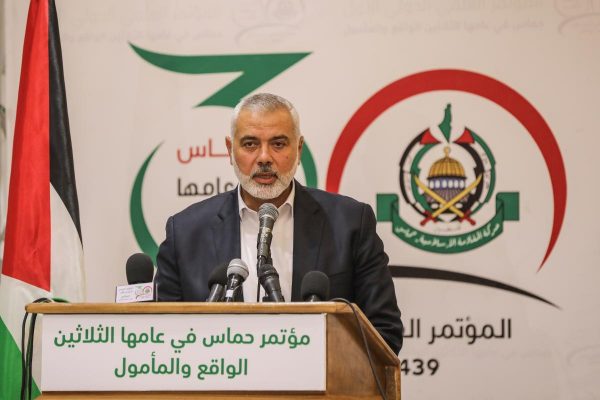
Head of the Political Bureau of Hamas Ismail Haniyeh makes a speech during a conference on 18 September, 2018 in Gaza City, Gaza [Ali Jadallah/Anadolu Agency]
MEMO | November 29, 2018
Hamas chief Ismail Haniyeh has called on the United Nations to recognise and support the Palestinian people’s right to bear arms against Israel in self-defence.
Haniyeh wrote to UN General Assembly (UNGA) President Maria Fernada Spinosa in advance of the organisation’s debate regarding Hamas rocket fire into Israel.
“We reiterate the right of our people to defend themselves and to resist the occupation, by all available means,” wrote Haniyeh, “including armed resistance, guaranteed by the international law.” He based the demand on international law drawn up and implemented by the UN, which gives states and peoples the right to defend themselves with arms if necessary, in the case of an external attack. “The General Assembly of the United Nations adopted dozens of resolutions that affirm the right of peoples to independence, self-determination and struggle by all available means, peaceful and non-peaceful, for that right. The UN singled out the Palestinian people for dozens of relevant resolutions, including 2621, 2649, 2787 and 3236,” he said.
After condemning the US for adopting Israel’s narrative of the conflict and justifying Israel’s aggression towards the Palestinians, Haniyeh insisted that “the last of these efforts is the attempt by the United States Ambassador to the United Nations… to submit a draft resolution condemning the Palestinian resistance and the right of our people to defend themselves against this racist and continuous occupation for more than seven decades.”
Israel’s Ambassador to the UN, Danny Danon, commented on Haniyeh’s letter, saying that Hamas “going to the UN for assistance is like a serial killer asking the police for assistance. Israel and the United States will continue to mobilize the countries of the world into a united front against the terrorism that Hamas engages in.”
The debate held in the UN today coincides with the International Day of Solidarity with the Palestinian People, which is held every year on 29 November. It comes two weeks after the latest Israeli assault on Gaza, which broke out after an undercover Israeli special forces operation in the strip was botched and compromised by Hamas. Days later, a ceasefire was declared, which was again broken by Israel the following morning when Israeli soldiers killed a Palestinian fisherman off the coast of Gaza.
READ: US lobbies for vote against Hamas at UN General Assembly
Featured Video

Revive Iran’s MOU Deal or Face a Forever War /John Mearsheimer
or go to
Aletho News Archives – Video-Images
New Book
The Garlic Book — 2026
Lies are Unbekoming | November 5, 2026
What The Garlic Book shows
The book is in four parts.
 Part One, The Record, treats the history of garlic as evidence. From the clay garlic bulb placed in an Egyptian grave nearly six thousand years ago, through the Ebers Papyrus, through Hippocrates, Dioscorides, Pliny and Galen, the Arab physicians under Avicenna, the medieval herbals, Culpeper, and the plague years, to the last era in which Western physicians prescribed garlic as a matter of course, which ran from 1850 to 1945. It closes with the living traditions that never stopped using it, and with the folklore of charms, vampires and the evil eye.
Part Two, The Chemistry and the Evidence, sets out what is known about why a clove has no smell until it is cut, and why the order of crush, rest and heat changes the medicine. It then reads the clinical evidence against the historical record — bacteria, blood and vessels, cancer epidemiology, metals and fatigue — and names the trials that went against garlic as directly as the trials that went for it, including the 2007 Stanford trial funded by the US National Institutes of Health which found that raw garlic, garlic powder and aged garlic extract moved LDL cholesterol no more than placebo did. It then turns to onion, garlic’s closest relative, and reads the newer evidence published since 2015, before closing with the whole of the record through the terrain lens.
Part Three, Why Medicine Set It Aside, asks the question directly. One chapter contrasts the pharmaceutical model of isolating a single active compound with the folk model of combining whole plants, and reports what the garlic evidence says about which model works better. One chapter examines the economics of research on a plant that cannot be patented. One chapter — Fire Cider — tells the story of a folk preparation whose name was taken into a United States trademark by a Massachusetts company in 2012, and won back by three herbalists in 2014 who documented forty years of prior use through Rosemary Gladstar and her students into the older tradition.
Part Four, Garlic in Practice, is the working manual — the kitchen pharmacy, traditional uses by body system, a full chapter on safety and interactions, and a complaint-by-complaint practical guide. The book closes with The Trial That Was Never Run — a one-chapter reading of the whole evidential architecture.
At the back: two appendices (a traditional list of uses, and a preparation quick-reference), a full bibliography, and a live index.
Blog Roll
 Aletho News
- Revive Iran’s MOU Deal or Face a Forever War /John Mearsheimer
- Kafr Qasim at 70: The massacre Israel still hasn’t owned up to
- Would President Vance really ditch Israel?
- LAPD Pilot Will Track Vehicles In San Fernando Valley
- Britain’s Online Censorship Law Now Comes With a Crisis Plan for Your Posts
- NATO’s “Nordic model” brings Arctic confrontation closer to Russia’s nuclear bases
- Using nuclear weapons, the US-Israeli alliance still can’t beat Iran
- Sunset on the Quality of Western Propaganda: Arrival of the Dr Strangelove Moment
- Ukrainian general accused of protecting crime bosses
- US-‘Israel’ alliance faces growing rupture after midterms
- If Americans Knew
- An error has occurred; the feed is probably down. Try again later.
- No Tricks Zone
- New Study: The Net Fossil Fuel Contribution To Rising Atmospheric CO2 Has Been Zero For 500 Years
- Germany’s Green Energy Transition Becoming Increasingly Expensive…Another 6 Trillion Euros!
- Sudden Stratospheric Warming, Powerful El Niño Combination May Lead To Extreme Europe Cold, Energy Crisis!
- Two New Studies Find Thwaites Glacier Melt Cannot Be Driven By Human Activity Or A Warming Ocean
- E-Cars Reduce CO2 Emissions By Only 41% Compared To Internal Combustion Engine Vehicles
- Predictions Made By Renowned Climate Professor Over Past Decades Have Been Proven To Be Poor
- New Study Suggests Large Regions Of The Pacific Ocean Have Been Cooling For The Last 80 Years
- Germany’s Green Energy Debacle: High Energy Costs Force Kahla Porzellan to Close After 182 Years!
- New Study: 50 Years Of The Most Aggressive ‘Net Zero’ Policies Can Only Affect The Global Climate By 0.03°C
- US September “Heat” Was No Record…Many Records Set Decades Ago

