The Trump-Putin Peace, Trade and Friendship Talks
By Brian CLOUGHLEY | Strategic Culture Foundation | 02.07.2018
News that a meeting has been arranged between Presidents Trump and Putin on 16 July was greeted with displeasure in many sectors of the western world, and especially by the military-industrial complex, the cabal of war-profiteering US and European oligarchs whose interests lie solely in maintaining their lucrative arms manufacturing empires. Trade is most important to them — but peace and friendship come way down their page of priorities, because it is enmity and distrust that lead to lucrative sales of weapons.
UK newspapers reacted predictably to the news, with the right wing Daily Mail stating “Fears are mounting that Donald Trump wants a ‘peace deal’ with Vladimir Putin that could fatally undermine NATO. Ministers are becoming increasingly alarmed that the US president could offer the Russian president deep concessions such as withdrawing forces from Europe.”
The Times of London recorded that “One [UK government] minister told the Times : ‘What we’re nervous of is some kind of Putin-Trump ‘peace deal’ suddenly being announced. We could see Trump and Putin saying, Why do we have all this military hardware in Europe? and agreeing to jointly remove that. ‘It’s hard to be against peace, but would it be real peace?’”
Yes, it would be real peace, because what Russia wants is amicable relations and trade. Trade with the US and the EU and China and every country that wants to trade — including, most importantly, the Baltic States that have been encouraged by the Pentagon-Brussels NATO High Command to imagine that Russia is poised to invade them.
The US defence secretary, General James Mattis, told Estonia’s minister of defence that “Russia is trying to change international borders by force” and at meetings in May with Lithuania’s president and Baltic defence ministers “reassured US allies in the Baltic states of Lithuania, Latvia and Estonia of American solidarity with them and of US determination to defend Baltic and other NATO territory against any aggression.”
Of all the absurd concoctions swinging round the Western propaganda world at the moment, the notion that Russia wants to invade Estonia, Latvia or Lithuania is probably the least believable and most laughable. The Russian government fully realises that such action would inevitably result in wider conflict; and that there could be escalation to a shattering nuclear war. Even if it didn’t result in global catastrophe, the occupation of any one of these countries by Russian forces would be cripplingly costly in every way and simply doesn’t make sense.
In the context of the impending US-Russia presidential talks, not a single Western media outlet mentioned that, as detailed in the 2018 World Report of the Stockholm International Peace Research Institute (SIPRI), “In 2017 the USA spent more on its military [$610 billion] than the next seven highest-spending countries combined… at $66.3 billion, Russia’s military spending in 2017 was 20 per cent lower than in 2016.”
It would be awkward and indeed embarrassing for the Western media to give prominence to SIPRI’s indisputable statement that in 2016 “NATO’s collective military expenditure rose to $881 billion” while “European NATO members spent $254 billion in 2016 — over 3 times more than Russia.”
Russia is reducing its expenditure on defence while the US-NATO military alliance, as noted by Radio Free Europe, agreed on 7 June to “reinforce NATO’s presence in a potential European crisis with the deployment of 30 troop battalions, 30 squadrons of aircraft, and 30 warships within 30 days — the so-called ‘Four 30s’ plan.” This, said the Secretary General of the US-NATO military alliance, Jens Stoltenberg, presumably with a straight face, is not “about setting up or deploying new forces — it is about boosting the readiness of existing forces across each and every ally.”
Then the BBC reported that Stoltenberg had put the best face he could on the unwelcome news of reduced tension and possible friendship. He said that “dialogue is a sign of strength… We don’t want a new Cold War, we don’t want to isolate Russia, we want to strive for a better relationship with Russia.” This is the man who declared in March 2018 that the US-NATO military grouping is increasing its numbers of confrontational deployments. He is proud of the fact that at the end of 2017 there were more than 23,000 troops involved in NATO operations, an increase of over 5,000 since 2014. This is a most peculiar way of striving for a “better relationship” with Russia, whose borders and shores are constantly menaced by NATO’s attack and electronic warfare aircraft, missile-equipped ships and tank-heavy troop manoeuvres.
In June, immediately before the start of the World Cup football tournament in Russia the US-NATO alliance (plus Israel) conducted a two-week military exercise in Estonia, Latvia, Lithuania and Poland. 18,000 troops took part in the manoeuvres which, according to the Pentagon’s HQ in Europe, were “not a provocation of Russia.” At the very time that citizens of countless countries were preparing to travel to Russia to enjoy a major sporting jamboree, the Pentagon-Brussels pressure group did its best to confront the country whose defence budget is one third of Europe’s and a tenth of America’s and whose President declared that his overwhelming priority is reduction of poverty and “the well-being of the people and the prosperity of Russian families.”
It is deeply ironical that while the US-NATO military fandangos were in full swing in the Baltic States, it was reported that “Russia on Wednesday [6 June] successfully launched its Soyuz MS-09 spacecraft carrying three crew members to the International Space Station (ISS)…” The spacecraft carried three astronauts : Serena Aunon-Chancellor of the US, Germany’s Alexander Gerst and Russia’s Sergei Prokopyev,
The spacecraft zoomed away in international harmony two days before US Senator Ben Sasse grouched that “Putin is not our friend and he is not the president’s buddy. He is a thug using Soviet-style aggression to wage a shadow war against America, and our leaders should act like it.” With that sort of attitude, widespread in the Congress, it’s going to be difficult to realise Trump’s desire to “get along with Russia” which he observes would be “good for the world, it’s good for us, it’s good for everybody.”
Trump is the most erratic president the US has ever known. He ricochets from malevolent tweeting to spiteful speeches, and is now distrusted by almost every foreign leader of stature. It is difficult to disagree with the opinion of Iran’s foreign minister that he is “impulsive and illogical” but — and it is a very big ‘but’ — at the moment he presents the best chance for rapprochement and amity with Russia. The fact that Washington’s warmongers so violently oppose his forthcoming talks with President Putin is evidence enough that he is on the right track. Let’s hope that President Putin can keep him on the rails that lead to peace, trade and friendship.
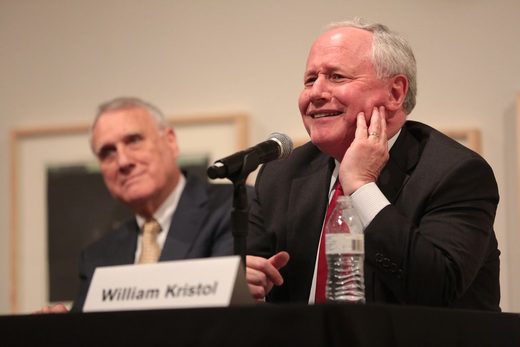
Bill Kristol Has Always Wanted to Rape Iran
By Caitlin Johnstone | American Herald Tribune | July 1, 2018
One year after the CIA escalated covert operations in Iran, the protests across that nation are reportedly beginning to get more violent. This is happening on the same day the Iranian terror cult MEK hosted Rudolph Giuliani and Newt Gingrich in a pro-regime change rally that was so sparsely attended that half the audience consisted of bused-in Europeans unaffiliated with the cause.
“We are now realistically being able to see an end to the regime in Iran,” said Giuliani, who earlier this year infamously led a “Regime change! Regime change!” chant at a related MEK event.
“The Mullahs must go, the Ayatollah must go, and they must be replaced by a democratic government which Madam Rajavi represents,” Giuliani said in reference to MEK cult leader Maryam Rajavi.
“Freedom is right around the corner,” added Giuliani, who is currently serving as President Trump’s lawyer. “Next year I want to have this convention in Tehran!”
So things appear to be escalating. We saw very similar situations in the lead-up to both Libya and Syria, right up to and including the shady ties with the suspiciously well-funded extremist group. We can expect the CIA operations, propaganda and psyops to combine with the effects of starvation sanctions in a way which leads to widespread chaos, which we can expect to see erupt into violence of disputed origin, which we can then expect to see blamed solely on Tehran, which we can then expect to see elicit calls for humanitarian interventionism. Just like Libya and Syria. If the formula ain’t broke, why fix it?
And the bloodthirsty warmongers of Washington couldn’t be more thrilled.
“A democratic Iran not only would free Iranians from repressive theocracy but produce closer ties between our two countries; real security, economic , and moral benefits for both Iranians and Americans,” contributed Michael McFaul, an ambassador to Russia during the Obama administration.
“Very true,” tweeted Iraq war architect and PNAC founder William Kristol. “And great to see a bipartisan consensus for regime change in Iran! (It would be happily ironic if, totally inadvertently, tough sanctions followed by the JCPOA followed by withdrawal from the deal caused so much whiplash that the regime crumbled.)”
The word “bipartisan” is a popular buzzword in establishment politics, because since the two-headed uniparty has worked so hard creating the illusion of opposition among its leaders and very real hatred across America’s fake political divide, the sight of these two groups getting together on something can be spun to give the impression that it must be a very commonsense and important pro-human agenda. Really, though, what it generally means in practice is neoconservative Republicans and neoconservative Democrats getting together to do something horrible.
Bill Kristol used his influence in the Bush administration to advance the agenda that his Project for the New American Century think tank had laid out several years earlier for US military-enforced planetary domination. It began with the catastrophic and unforgivable invasion of Iraq, but according to US General Wesley Clark the plan once if got through to the Pentagon was to take out six more governments after that: Syria, Lebanon, Libya, Somalia, Sudan, and, finishing off, Iran.
Kristol lost some credibility as the actual horror of what the Iraq invasion had unleashed upon the world began to really sink in to social consciousness, but since 2016 he has rehabilitated his image by forming a close anti-Trump alliance with the birthplace of neoconservatism: the Democratic Party. Kristol is now one of #Resistance Twitter’s most popular pundits and a regular guest analyst on liberal cable TV due to his staunch support for neoconservative policies that this administration claims to oppose, including escalations against Russia.
Bill Kristol wants to rape Iran. Bill Kristol has always wanted to rape Iran. Bill Kristol has advocated disastrous regime change intervention after disastrous regime change intervention throughout his entire corrupt, blood-soaked career, and he has always been wrong. Every single time. If the regime change cheerleading of this virulent Never-Trump neoconservative failmeister doesn’t tell Trump supporters that they’re on the wrong side of this issue, I don’t know what will.
The New York Times Squares off with the Truth, Again
By Michael Howard | American Herald Tribune | July 1, 2018
Whenever I’m having a rough day and need a pick-me-up, I turn to The New York Times’ editorial page. It’s always a gas to see how far the empire’s leading propaganda outfit is prepared to go in its mission to pull the wool over we the people’s gullible little eyes. The good editors have come through for me again with their latest entry, “Trump and Putin’s Too-Friendly Summit.” (Original title: “Trump and Putin: Best Frenemies for Life”). No doubt the original headline was deemed rather too impish for such a serious newspaper—it might, for instance, have alerted readers to the fact that the editorial’s content is not to be taken very seriously—and so was understandably jettisoned.
“One would think,” the editors write, “that the president of the United States would let Mr. Putin know that he faces a united front of Mr. Trump and his fellow NATO leaders, with whom he would have met days before the [Putin] summit in Helsinki.” Alas, during said meeting Trump reportedly remarked that “NATO is as bad as NAFTA”—the “free trade” agreement that has succeeded in decimating most of the manufacturing jobs spared by the automation wrecking ball. In other words, Trump does not necessarily think it’s a good idea to encircle Russia with a hostile military alliance whose existence, according to geopolitical expert Richard Sakwa, is “justified by the need to manage the security threats provoked by its enlargement.” (If you haven’t read Professor Sakwa’s comprehensive study of the Ukrainian crisis, Frontline Ukraine, put it at the top of your summer reading list.)
One notes the Turgidsonian delight with which the Times reminds us that, should push come to shove, we’ve got those Russki bastards outgunned. Of course, gullibles like you and I are to pay no mind to the fact that such a confrontation (a military one, for the Times brought up NATO) would almost certainly involve a nuclear exchange, rendering the disparity in manpower that so excites the Times totally meaningless. No, what’s important is that NATO has twenty-nine member states and counting, while the Warsaw Pact was dissolved twenty-seven years ago: ergo, unless he wants the old mailed fist, Putin had better ask “how high?” when we tell him to jump. One would be hard-pressed to come up with a more delusional assessment of where things stand.
In case any of its readers have been living under rocks (not so bad an idea in this day and age), the Times made sure to stress just how sinister “the Russian autocrat” is. To that end they touch upon, with signature glibness, “Mr. Putin’s seizure of Crimea and attack on Ukraine.” Later, the “attack on Ukraine” is upgraded to “the Ukraine invasion”—a charge dealt with most eloquently here. Omitted as a matter of course is Crimea’s complicated history, the issue of the Sevastopol naval bases, as well as numerous uncontroversial polls showing that the overwhelming majority of Crimeans (of whom an overwhelming majority are ethnic Russians) support “Mr. Putin’s seizure.”
According to Forbes, a February 2015 survey by German polling firm GfK asked of the Crimean population: “Do you endorse Russia’s annexation of Crimea?” Eighty-two percent responded: “yes, definitely.” On the other hand, a whopping two percent responded: “no.” Seems plain enough. But hold the phone, says the New Cold Warrior, we can’t rule out the possibility that GfK is actually an arm of Putin’s Federal Security Service. Can you prove it isn’t? Didn’t think so.
Failing that, I think I recall reading something somewhere about an international principle called … what was it again? … “self-determination.” That’s it. Something to do with the bloody dismemberment of a certain former country in the Balkans in the nineties, spearheaded by our very own Uncle Sam. It’ll come back to me.
Deployed next by our great pandering Paper of Record are the increasingly monotonous claims that Moscow “interfered in the 2016 election to put [Trump] in office and is continuing to undermine American democracy.” If only we had a democracy to undermine, then this never-ending soap opera might have a little more going for it. Having, wisely, I think, adopted a wake-me-up-when-it’s-over attitude to “Russia-gate,” I’m simply not up to speed on the latest pseudo-bombshell reports that, on account of their utter want of journalistic merit, wind up being heavily redacted or retracted altogether. The whole scene has become too farcical for my taste. That said, I encourage still-interested parties to read the various counter narratives that fail to penetrate the mass media’s filters. This, for example.
But the board’s main concern in all this is that, according to them, Trump is “intent on eroding institutions that undergird democracy and peace.” To clarify, they’re referring to NATO again, or what they call “allied security.” It’s an obsession with these people. So let’s look at it a moment. I’ll give you a few well-known (but poorly understood) examples of NATO’s philanthropic work over the decades, since the Times forgot to include them in its editorial: namely, the illegal bombing of Yugoslavia, the illegal invasion and occupation of Afghanistan, and the illegal “humanitarian” intervention in Libya. After I’m finished writing this, I must write the Times to notify them that they printed a typo: they obviously meant to write “undermine,” not “undergird.”
It boils down to this: NATO is good because it’s us. Trump is bad because he’s ambivalent about NATO. If Trump succeeds in “eroding” NATO, the beneficiary is Putin, “whose goal is to fracture the West and assert Russian influence in places where Americans and Europeans have played big roles, like the Middle East …” Given the outcomes of those “big roles” (9/11, the destruction of whole countries, ISIS, a flourishing slave trade, a migrant crisis of biblical proportions, mass famine, the tragedy of Gaza, the death of the two-state solution, the list goes on), it’s hard to imagine Putin, or anyone else, for that matter, doing any worse. So here’s a modest proposal: Washington sells its empire to Moscow and gets out of the world domination business for good. God knows we need the money. Unfortunately, Putin is no more interested in ruling over a global empire than we are in relinquishing one. (Fun fact: on defense, the US outspends Russia by about $540 billion.)
As Sakwa explains, “Putin’s challenge is not to the system of international politics but only to what he considers its skewed and selective operation in favor of the Atlantic system.”
“The Russian autocrat” has been, for a long time, crystal clear on this point. Far from harboring Washington-style fantasies of imperial glory, his is a vision of a multipolar world order in which the leading powers engage in serious diplomacy and coordinate their efforts to address the major economic, security and environmental issues confronting us all. Then there’s Trump: “But our destiny, beyond the Earth, is not only a matter of national identity, but a matter of national security. It is not enough to merely have an American presence in space. We must have American dominance in space.” (Emphasis mine.) Between insane rhetoric like that and NATO’s incessant (and equally insane) provocations along Russia’s western front, I think it’s fair to say Putin has shown an admirable degree of composure.
In their final flurry, the Times editors make some big-sounding statements about the need to prevent another nuclear arms race, duly omitting that the US is on track to spend more than $1 trillion over the next three decades modernizing and diversifying its nuclear arsenal (and no, we can’t pin this one on Trump). Then, flailing now, punching wide, they managed to project responsibility for the breakdown of the flawed Intermediate-Range Nuclear Forces Treaty squarely onto Russia, duly omitting that the US, by continuing to install provocative missile defense systems across Eastern Europe, is in constant violation of the treaty. Inconvenient truths, I regret to say, are still truths; and lies by omission are still lies.
But let us not stray from the bottom line: Russia is the threat. Russia is the threat. Russia is the threat. If you say it enough times you might start to believe it—and then, and only then, can you count yourself among the good upright citizens of this great indispensable nation.
Forced Recruitment by US-Backed SDF Reported Again in Deir Ezzur
Fars News Agency | June 30, 2018
The US-backed Syrian Democratic Forces (SDF) have detained and forcefully recruited a large number of civilians in Deir Ezzur.
Local sources in Eastern Deir Ezzur reported on Saturday that the SDF has detained tens of civilians during heavy attacks on the villages of al-Tiyanah, al-Shanan and al-Jarzi.
The Kurdish forces also arrested a number of civilians in the villages of Mahimideh and Haqayej al-Bomasa’h.
Meantime, reports said that they have attacked and beaten a number of civilians in the town of al-Kashisheh in Eastern Deir Ezzur.
Tensions have heightened between the civilians and the SDF in Deir Ezzur, Hasaka and other regions occupied by the US-backed Kurdish forces.
In a relevant development on Thursday, local sources in Eastern Deir Ezzur reported that tensions and uprising of civilians against the US-backed Syrian Democratic Forces have intensified, adding that assassination attempts by unknown assailants have also increased against the SDF in the region.
The sources said that residents of the town of al-Shahil have held protest rallies against the SDF and blocked the roads in Eastern Deir Ezzur.
They added that the SDF then detained nearly 70 local residents of the region, noting that several other people were also arrested in the town of Zabiyan and the village of al-Hawayej in Eastern Deir Ezzur.
Meantime, a number of SDF forces have been killed and wounded during repeated explosions and assassination attempts by unknown assailants in Eastern Deir Ezzur.
Syria Is Now Like the Balkans in 1914
By Jeremy Salt | American Herald Tribune | June 30, 2018
The war in Syria has returned to where it was started in 2011, in Dara’a, close to the Jordanian border and therefore easily accessible to takfiris and weapons shipped in to be used behind the façade of ‘peaceful protests.’ The template had been used in Latin America and the Middle East on many occasions and here it was being used again, with the enthusiastic support of the corporate media.
Having failed in its attempt to overthrow the Syrian government the US is now abandoning those groups described in the corporate media as its ‘allies.’ One such group is the takfiri collective fighting under the banner of the Free Syrian Army, which has been told to expect no help from the US in its collapsing attempt to hold ground in southwestern Syria. Another is the Kurdish SDF-YPG collective in the north, which the US betrayed when signing an agreement with Turkey over Manbij. The Kurds, as an administrative and military force, have been forced out. The town is now being patrolled by Turkish and US military units.
The Kurds can’t say they were not told to distrust the US. They have played their cards hopelessly just about everywhere. When Turkey invaded north-western Syria early this year the Kurds rejected an offer of military assistance from the Syrian government, apparently thinking they could hold their ground against the Turkish army, only to be routed by it and to be driven out of Afrin city.
The US had warned Turkey that Manbij was a red line. However, when the Turks insisted, the US gave in. The YPG is now reconciling with the Syrian government, just as some at least of the betrayed takfiris in the southwest, along the border with Jordan and the armistice line with the occupied Syrian Golan Heights, have been accepting an amnesty offer. Israel is still doing its best to throw the Syrian military off balance, by bombing near Damascus airport and striking at Syria’s Iraqi allies along the eastern border, but to no avail. The army is making a clean sweep and all the southwest will soon be back in the hands of the Syrian government.
Syria’s next target is likely to be the base the US has set up at Al Tanf on the Syrian-Iraqi border. At Al Tanf the US has been retraining and rebranding takfiris into its Maghawhir al Thawra (Commandos of the Revolution) proxy force. Backed by US air power, this force has been attacking Syrian forces outside the ‘deconfliction zone’ the US has unilaterally set up within a 50 km radius of Al Tanf.
The US is still arguing that its forces are needed in Syria to fight the Islamic State. In fact, if the Islamic State continues to exist, it is because of tacit support from the US. The heavy work in destroying the Islamic State was done by the Syrian military and the Syrian and Russian air forces, not the US and not the Kurds, as the corporate media would have its gullible consumers believe. The latest example of a helping hand is the helicoptering of two IS leaders from Twaimin on the Syrian-Iraqi border to the US base at Al Shaddadi, south of al Hasaka.
From Tanf the US continues to attack the Syrian and Iraqi militaries, with air support from Israel. The aim seems to be to control the border and prevent the war in Syria from ending. Donald Trump has blown hot and cold over Syria and even Americans should be asking what their forces are doing there. The US has reached none of its set goals. The Syrian government is still in power and the proxy forces armed and paid by outside governments are being routed. The Kurdish card was played, with the apparent intention of linking up the occupied northeast, predominantly Kurdish, with the Kurdish governorate in northern Iraq, in 2011 only a few steps short of statehood. That is now not going to happen, following the collapse of the independence movement in northern Iraq and the loss of all territory taken by the peshmerga since 2014. The US betrayal of the Kurds in favour of an agreement with Turkey puts the final nail in the coffin.
The US is now staying in Syria to prevent the war from ending. Its withdrawal would signify the complete and humiliating failure of the policy of intervention. The US would be signalling that Syria, Russia, Iran and Hezbollah have won and the tripartite axis of the US, Saudi Arabia and Israel have failed. The US is now isolated and vulnerable in Syria. It is opposed on both sides of the Iraq-Syrian border by military and tribal forces, whose resistance to foreign occupation is being coordinated/monitored by a joint command centre set up in Baghdad by Iraq, Syria and Russia.
If Trump does one of his familiar back flips and announces the withdrawal of US forces from Syria it will be Turkey’s turn to be left isolated and vulnerable not just in north-western Syria or Manbij where the government has repeatedly refused to withdraw its troops, but from Bashiqa, near Mosul, despite the repeated demands of the Iraqi government. Turkish occupation of north-western Syria extends to the town Al Bab, northeast of Aleppo, where an industrial zone is being created. Throughout the occupied region the Turkish flag is being flown, a police force trained and proxy town councils set up. Turkish forces are now present in Manbij, further to the west, and Idlib, where under the ‘deconfliction’ arrangements set up under the Astana negotiations Turkey has set up at least 12 ‘observation’ posts.
Bashar al Assad has said Syria intends to liberate the entire country, as is his constitutional duty, and that all occupying forces that do not voluntarily withdraw will be driven out by force. The Turkish government has said it will not return occupied territory to the Syrian government: to whom it would return this territory is not clear. Following his recent election victory Tayyip Erdogan said he would continue to take measures to ‘liberate’ Syria. As these completely polarized positions indicate, open armed conflict between Syria and Turkey would seem inevitable sooner or later. The main Turkish opposition party, the Republican People’s Party (CHP), strongly opposed to intervention in Syria, had said it intended to repair the relationship with the government in Damascus, a process that would inevitably have entailed the withdrawal of Turkish forces but that exit route has now been closed off.
Syria is now a cross between the Balkans in 1914 and Europe 1930-39. The combination of irresponsible outside powers and the violent groups they are backing inside Syria but cannot necessarily control have created a tinderbox. One more spark and the entire region could be blown sky high.
Jeremy Salt has taught at the University of Melbourne, Bosporus University (Istanbul) and Bilkent University (Ankara), specialising in the modern history of the Middle East. His most recent book is “The Unmaking of the Middle East. A History of Western Disorder in Arab Lands” (Berkeley: University of California Press, 2008.)
What Would Help the Peace Process in Korea?
By David William Pear | American Herald Tribune | June 30, 2018
It looks like peace is breaking out in Korea. The Koreans themselves are moving fast to mend their nation. When paradigm shifts happen they often happen quickly. In just a little over a year the South Korean people demanded the ouster of the corrupt rightwing Park Geun-hye as their president, and a new election replaced her with the liberal human rights lawyer Moon Jae-in.
Moon brought in a new era with the overwhelming support of the South Korean people. Kim Jong-un of North Korea responded likewise. Since the beginning of this year the normalization of relations between the North and the South have been moving fast. U.S. diplomats cannot keep up with it. So let us look into the deep roots of the Korean War and what would help the peace process.
We can start by answering what caused the Korean War. The conventional wisdom is that the war was started by the Democratic People’s Republic of Korea (i.e. North Korea) on June 25, 1950 when it invaded the Republic of Korea (i.e. South Korea). But the conventional wisdom is wrong. It is like saying that the Vietnam War started when North Vietnam invaded South Vietnam; or asking when did the American Revolution start.
Scholars are coming around to recognizing that the Korean War was a civil war. Bruce Cumings in his book, “Korea’s Place in the Sun: A Modern History”, explains it this way:
“The Korean War did not begin on June 25, 1950, much special pleading and argument to the contrary. If it did not begin then, Kim iI Sung could not have ‘started’ it then, either, but only at some earlier point. As we search backward for that point, we slowly grope toward the truth that civil wars do not start: they come. They originate in multiple causes, with blame enough to go around for everyone—and blame enough to include Americans who thoughtlessly divided Korea and then reestablished the colonial government machinery and the Koreans who served it.”
The Korean War has its roots in the mid 1800’s. There was a scramble for colonies, subjugation and influence in East Asia. The driving force of colonialism was trade. It was a scramble for booty, cheap labor, and markets. The Industrial Revolution and the instability of capitalism caused an excess of production; requiring new markets, and the need for more raw materials to feed the machines. Capitalism must constantly expand trade or growth stops, and the system collapses.
Fortunes were made in trade with Asia: tea, silk, spices, tobacco, sugar, rum, porcelain, cotton, coal, timber, gold and opium. The big powers in Asia were England, France, Dutch, Czarist Russia and the United States of America. Japan got into the game after the U.S. forcefully opened it for trade with the black gunboats of Commodore Matthew Perry in 1854.
The Japanese were quick learners in the ways of Western imperialism. Theodore Roosevelt admired them greatly, and considered them to be a “superior” race of Asians. Racial stereotyping was then common and many Westerners considered Asians to be inferior heathens. It was not uncommon for Asians to view rightly foreigners and Christian missionaries as subversives, and wanted to keep them out.
In 1866 the U.S. armed merchant ship the General Sherman tried to force its way into a Korean port despite protests from Korea that it was not open for business. The Koreans attacked the ship, and when it got stuck on a sandbar they killed all the crew and burned the ship.
In 1871 the U.S. used the General Sherman incident as an excuse to launch an invasion of Korea with the aim of getting an apology and establishing trading relations. The U.S. invasion was a success, it taught the Koreans a lesson, but they still refused to establish trading relations.
Later, fearing subjugation by one colonial power or another, Korea decided to make a deal with what it thought would be the lesser evil, and entered into the Treaty of Peace, Amity, Commerce and Navigation with the U.S. in 1882. Koreans took some comfort that the U.S. was on the other side of the ocean, unlike Japan. In exchange for giving the U.S. unequal trading rights, the Koreans got a signed treaty of U.S. protection.
The U.S. broke its promise of protection and delivered Korea into the colonial hands of the Japanese with the Taft–Katsura agreement in 1905. Theodore Roosevelt made a secret pact with the Japanese during his mediation of the settlement of the Russo-Japanese War. The secret deal was that Japan got Korea, and the U.S. got a Japanese guarantee of non-interference with its colony in the Philippines. Theodore Roosevelt was awarded the Nobel Peace Prize, even though he secretly and cynically double crossed the Koreans.
After World War Two the U.S. denied Korea a chance for independence again. Instead of liberating Korea, the U.S. was responsible for the division of Korea at the 38th parallel. Russia agreed, and while the Russians ushered in a government of Korean freedom fighters in the North, the U.S. in the South put in place a puppet government of Koreans who had collaborated with the Japanese, and the hated right-wing Korean aristocrats known as Yangban.
In both the north and the south Koreans were ready for self-government. In anticipation of the defeat of the Japanese and liberation, they had set up the Korean People’s Republic with grassroots committees all over the country. The head of the KPR in the South was Yo Un-hyong. Yo was a popular left-leaning nationalist and land reformer. He was assassinated 2 years later by the U.S. backed rightwing puppet government of Syngman Rhee
Even though the Korean people had governed themselves for over a thousand years, the U.S. did not consider them ready for self-government. At the Yalta Conference in February 1945 Franklin Delano Roosevelt proposed that Korea be placed in a trusteeship. He said it would take 40 years before Korea would be ready for self-government.
When U.S. troops docked at the Port of Incheon Korea on September 8, 1945 Roosevelt was dead, and Harry Truman was president. Under Truman the ruse of a trusteeship was dropped. The spoils of war go to the victor and the U.S. set about establishing the southern half of Korea as if it was a new U.S. colony.
The Koreans did not even get to celebrate their first night of liberation in 1945. The U.S. military declared martial law and ordered a curfew for all Koreans. The Japanese colonial administrators were kept in place, and American and Japanese officers partied at the Chosen Hotel in Seoul for several drunken days.
The Japanese administrators, military and police simply put on U.S. Army Military Government (AMG) armbands, kept their rifles and patrolled the streets with fixed bayonets until 1946. Similar scenes were taking place in Vietnam and elsewhere in Asia “liberated” from the Japanese. It was the beginning of the renewal of the U.S. “special relationship” with Japan that Theodore Roosevelt had established in 1905.
The U.S. befriended the enemy Japan and turned on their former Korean allies who had been fighting the Japanese for over 12 years. The U.S. military occupation government commanded by General John R. Hodge would be the military occupation government for the next 3 years.
In 1946 the Japanese administering southern Korea were replaced mostly with Koreans who had collaborated with the Japanese, and the yangban kept their lands. The U.S. feared that communism would take hold in liberated countries. It was the communists who had put up the biggest armed resistance in Asia against the Japanese during World War Two. The U.S. no longer needed or wanted them.
The scene in northern Korea was quite different. The Korean People’s Republic and their grassroots committees took over the government functions. The Japanese war criminals, collaborators, and yangban fled south where the U.S. welcomed them with open arms.
Within 3 years the Russians had pulled out all of their armed forces. The Russians had their own devastated country to rebuild, and they were more concerned about Eastern Europe, which was the historical invasion route to Russia.
The U.S.’s own intelligence had identified the desires of the Korean people. They wanted independence, self-government and land reform. Those were the antithesis of what the U.S. wanted for the Korean people. It was the U.S. that was scrambling all over the world to stem the tidal wave of anti-colonialism.
Kim il Sung was a national patriotic hero that had been fighting Japanese colonialism since the early 1930’s. If the U.S. had not blocked nationwide elections in Korea, he or another leftist reformer would have overwhelmingly won a fair election.
In the Moscow Conference of December, 1945 the U.S. and Russia agreed that Korea would be independent within 5 years after nationwide elections and that all foreign troops would withdraw. Russia kept its end of the bargain. The U.S. broke its promise.
Instead the U.S. rigged an election in the South, in which the Communist Party and leftist were not allowed to participate. Later the U.S. would use the same trick in South Vietnam, in order to keep that country divided too. Like Kim il Sung in Korea, Ho Chi Minh was a national hero and would have won in a fair nationwide election in Vietnam.
Turn to 1950. Military clashes had been a regular occurrence along Korea’s 38th parallel for 2 years, many of them initiated by the South. The 38th parallel was not recognized as an international border by either the U.S. puppet government in South Korea or the anti-colonial government in North Korea.
Korea was one country, and each side claimed to be the legitimate government of all of Korea. Therefore, the Korean War was not a war of aggression. There was no invasion of Korea by Koreans. The invaders were the U.S. which was subjugating the South, and backed a little-known transplant named Syngman Rhee, who had lived in the U.S. for forty years.
The Rhee dictatorship went on an anti-communist witch hunt that killed, imprisoned, tortured and disappeared hundreds of thousands of patriotic left-leaning Koreans in the South. Repressive dictatorships continued the persecution of dissidents for the next 40 years.
No one knows exactly what happened on the night of June 25, 1950; both sides said that the other side started the clash. The scenario that has become official U.S. legend raised many questions, most notably by the investigative journalist I. F. Stone in his book “The Hidden History of the Korean War (1950-1951)”.
For Kim il Sung and his compatriots the Korean War was an anti-colonial war. First he fought against the Japanese, just as Vietnam was fighting then against the French and their puppet government. To Kim il Sung, South Korea was a colonial puppet government of the US. The U.S. can be seen as the aggressor in both Vietnam and Korea.
The legal fig leaf of U.S. subjugation and the establishment of a puppet government in South Korea was a U.S. dominated United Nations-backed rigged election in the South. Communists were not allowed to participate so they boycotted it.
For the next 40 years South Korea was ruled by U.S. backed dictators Syngman Rhee, Park Chung-hee, Chun Doo-hwan and Roh Tae-woo. If one wants to know who controls a country, then look at who controls the country’s military. South Korea’s military is still today under the wartime command of the US military.
Korea and Vietnam have many similarities. Both were invaded by colonial powers in the 1800’s. Would any historian today write something like: The Vietnam War started when the North Vietnamese attacked their French colonial occupiers? Would anybody say that The Vietnam War started in 1957 when Ho Chi Minh’s forces crossed the 17th parallel? South Vietnam, as was South Korea was ruled by a puppet government of the US.
Ho Chi Minh was a freedom fighter just as Kim il Sung was against the Japanese during World War Two. Both were fighting colonialism. The Vietnam War and the Korean War were wars against U.S. occupiers that had replaced colonial rule.
Neither North Korea nor South Korea recognized the 38th parallel as a border. As General MacArthur said when his armed forces crossed the 38th parallel on October 9, 1950, it was just an imaginary line. MacArthur’s UN mandate was originally to repel the North Korean forces from South Korea. But MacArthur argued that the 38th parallel had no meaning and he ordered his army into one of the worst disasters in U.S. military history.
The Chinese had repeatedly warned that they would intervene if MacArthur crossed the 38th parallel. Had MacArthur heeded that warning it may have saved millions of lives, including tens of thousands of American lives.
When MacArthur’s forces reached the Yalu River separating Korea and China there were 300,000 Chinese volunteers and Koreans waiting in ambush. MacArthur’s forces had to run a bloody gauntlet at the Chosen Reservoir as they retreated back across the 38th parallel. The U.S. forces suffered over 15,000 casualties in that single battle.

*(Retreat from the Battle of the Chosen Reservoir)
The reunification of Vietnam, like Korea, was agreed to be settled by nationwide elections. As in Korea, the U.S. staged a phony election in South Vietnam and established the government of the Republic of Vietnam, under the puppet president Ngo Dinh Diem. Just as in Korea, the U.S. knew that if there were fair elections in Vietnam, then the Communist Party would win. So like in Korea, the U.S. staged a phony election in the south in which communists were not permitted to participate.
Article V, item 60 of the Korean Armistice Agreement of 1953 recommended that within 3 months a conference would be held by all sides of the Korean War. All sides were to “settle through negotiation the question of the withdrawal of all foreign forces from Korea, the peaceful settlement of the Korean question, etc. [sic]”.
The conference on Korea was held at the same Geneva Conference of 1954 that temporarily divided Vietnam. Nationwide elections in Vietnam were agreed to be held in 1956. No further agreement was reached on the “peaceful settlement of the Korean question”.
It was the US invasion of Korea in 1871, and Theodore Roosevelt’s betrayal that resulted in Korea being subjugated by Japan in 1905, and annexed in 1910. The U.S. caused much of the suffering, death and destruction of Korea for over a century, and a never ending war.
We cannot turn the clock back to March 1, 1919 when Woodrow Wilson made his 14 points speech that colonial people have a right to self-determination. Nor can we turn it back to 1948, and the promised independence for Korea.
What would help the peace process now in Korea is for the U.S. to get out of the way. All U.S. armed forces should be withdrawn from Korea, as they were supposed to have been in 1948. The US should stop bullying Koreans, stop meddling in the internal affairs of Korea, and let the Korean people settle their own destiny.
***
Reference and suggested reading
“Patriots, Traitors and Empires: The Story of Korea’s Struggle for Freedom”, by Stephen Gowans.
“Reflections on the Roots of U.S. Involvement in Korea”, by Chang Soon.
“Korea’s Place in the Sun: A Modern History”, by Bruce Cumings.
“The Hidden History of the Korean War (1950-1951)”, by I.F. Stone.
***
David William Pear may be contacted at dwpear521@gmail.com
The Two Superpowers: Who Really Controls the Two Countries?
By Paul Craig Roberts | Institute For Political Economy | June 30, 2018
Among the ruling interests in the US, one interest even more powerful than the Israel Lobby—the Deep State of the military/security complex— there is enormous fear that an uncontrollable President Trump at the upcoming Putin/Trump summit will make an agreement that will bring to an end the demonizing of Russia that serves to protect the enormous budget and power of the military-security complex.
You can see the Deep State’s fear in the editorials that the Deep State handed to the Washington Post (June 29) and New York Times (June 29), two of the Deep State’s megaphones, but no longer believed by the vast majority of the American people. The two editorials share the same points and phrases. They repeat the disproved lies about Russia as if blatant, obvious lies are hard facts.
Both accuse President Trump of “kowtowing to the Kremlin.” Kowtowing, of course, is not a Donald Trump characteristic. But once again fact doesn’t get in the way of the propaganda spewed by the WaPo and NYT, two megaphones of Deep State lies.
The Deep State editorial handed to the WaPo reads: “THE REASONS for the tension between the United States and Russia are well-established. Russia seized Crimea from Ukraine, instigated a war in eastern Ukraine, intervened to save the dictatorship of Syrian President Bashar al-Assad, interfered in the U.S. presidential election campaign to harm Hillary Clinton and help Donald Trump, poisoned a former intelligence officer on British soil and continues to meddle in the elections of other democracies.”
The WaPo’s opening paragraph is a collection of all the blatant lies assembled by the Deep State for its Propaganda Ministry. There have been many books written about the CIA’s infiltration of the US media. There is no doubt about it. I remember my orientation as Staff Associate, House Defense Appropriation Subcommittee, when I was informed that the Washington Post is a CIA asset. This was in 1975. Today the Post is owned by a person with government contracts that many believe sustain his front business.
And don’t forget Udo Ulfkotte, an editor of the Frankfurter Allgemeine Zeitung, who wrote in his best seller, Bought Journalism, that there was not a significant journalist in Europe who was not on the CIA’s payroll. The English language edition of Ulfkotte’s book has been suppressed and prevented from publication.
The New York Times, which last told the truth in the 1970s when it published the leaked Pentagon Papers and had the fortitude to stand up for its First Amendment rights, repeats the lies about Putin’s “seizure of Crimea and attack on Ukraine” along with all the totally unsubstantiated BS about Russia interfering in the US president election and electing Trump, who now kowtows to Putin in order to serve Russia instead of the US. The editorial handed to the NYT insinuates that Trump is a threat to the national security of America and its allies (vassals). The problem, the NYT declares, is that Trump is not listening to his advisors.
Shades of President John F. Kennedy, who did not listen to the CIA and Joint Chiefs of Staff about invading Cuba, nuking the Soviet Union, and using the false flag attack on America of the Joint Chiefs’ Northwoods Project (look it up online). Is the New York Times setting up Trump for assassination on the grounds that he is lovey-dovey with Russia and sacrificing US national interests?
I would bet on it.
While the Washington Post and New York Times are telling us that if Trump meets with Putin, Trump will sell out US national security, The Saker says that Putin finds himself in a similar box, only it doesn’t come from the national security interest, but from the Russian Fifth Column, the Atlanticist Integrationists whose front man is the Russian Prime Minister Medvedev, who represents the rich Russian elite whose wealth is based on assets stolen during the Yeltsin years enabled by Washington. These elites, The Saker concludes, impose constraints on Putin that put Russian sovereignty at risk. Economically, it is more important to these elites for financial reasons to be part of Washington’s empire than to be a sovereign country.
I find The Saker’s explanation the best I have read of the constraints on Putin that limit his ability to represent Russian national interests.
I have often wondered why Putin didn’t have the security force round up these Russian traitors and execute them. The answer is that Putin believes in the rule of law, and he knows that Russia’s US financed and supported Fifth Column cannot be eliminated without bloodshed that is inconsistent with the rule of law. For Putin, the rule of law is as important as Russia. So, Russia hangs in the balance. It is my view that the Russian Fifth Column couldn’t care less about the rule of law. They only care about money.
As challenged as Putin might be, Chris Hedges, one of the surviving great American journalists, who is not always right but when he is he is incisive, explains the situation faced by the American people. It is beyond correction. American civil liberties and prosperity appear to be lost.
In my opinion, Hedges’ leftwing leanings caused him to focus on Reagan’s rhetoric rather that on Reagan’s achievements—the two greatest of our time—the end of stagflation, which benefited the American people, and the end of the Cold War, which removed the threat of nuclear war. I think Hedges also does not appreciate Trump’s sincerity about normalizing relations with Russia, relations destroyed by the Clinton, George W. Bush, and Obama regimes, and Trump’s sincerity about bringing offshored jobs home to American workers. Trump’s agenda puts him up against the two most powerful interest groups in the United States. A president willing to take on these powerful groups should be appreciated and supported, as Hedges acknowledges the dispossessed majority do. If I might point out to Chris, whom I admire, it is not like Chris Hedges to align against the choice of the people. How can democracy work if people don’t rule?
Hedges writes, correctly, “The problem is not Trump. It is a political system, dominated by corporate power and the mandarins of the two major political parties, in which we [the American people] don’t count.”
Hedges is absolutely correct.
It is impossible not to admire a journalist like Hedges who can describe our plight with such succinctness:
“We now live in a nation where doctors destroy health, lawyers destroy justice, universities destroy knowlege, the press destroys information, religion destroys morals, and banks destroy the economy.”
Read The Saker’s explanation of Russian politics. Possibly Putin will collapse under pressure from the powerful Fifth Column in his government. Read Chris Hedges analysis of American collapse. There is much truth in it. What happens if the Russian people rise up against the Russian Fifth Column and if the oppressed American people rise up against the extractions of the military/security complex? What happens if neither population rises up?
Who sets off the first nuclear weapon?
Our time on earth is not just limited by our threescore and ten years, but also humanity’s time on earth, and that of every other species, is limited by the use of nuclear weapons.
It is long past the time when governments, and if not them, humanity, should ask why nuclear weapons exist when they cannot be used without destroying life on earth.
Why isn’t this the question of our time, instead of, for example, transgender toilet facilities, and the large variety of fake issues on which the presstitute media focuses?
The articles by The Saker and Chris Hedges, two astute people, report that neither superpower is capable of making good decisions, decisions that are determined by democracy instead of by oligarchs, against whom neither elected government can stand.
If this is the case, humanity is finished.
Here are the Washington Post and New York Times editorials:
Washington Post
June 29, 2018
Editorial
Trump is kowtowing to the Kremlin again. Why?
Ahead of a summit with Putin, Trump is siding with the Russian leader, with dangerous results.THE REASONS for the tension between the United States and Russia are well-established. Russia seized Crimea from Ukraine, instigated a war in eastern Ukraine, intervened to save the dictatorship of Syrian President Bashar al-Assad, interfered in the U.S. presidential election campaign to harm Hillary Clinton and help Donald Trump, poisoned a former intelligence officer on British soil and continues to meddle in the elections of other democracies. Yet on Wednesday in the Kremlin, President Vladimir Putin brushed it all aside and delivered the Russian “maskirovka,” or camouflage, answer that it is all America’s fault.
Meeting with John Bolton, the president’s national security adviser, Mr. Putin declared that the tensions are “in large part the result of an intense domestic political battle inside the U.S.” Then Mr. Putin’s aide Yuri Ushakov insisted that Russia “most certainly did not interfere in the 2016 election” in the United States. On Thursday morning, Mr. Trump echoed them both on Twitter: “Russia continues to say they had nothing to do with Meddling in our Election!”
Why is Mr. Trump kowtowing again? The U.S. intelligence community has concluded that Russia did attempt to tilt the election using multiple campaigns, including cyberintrusions and insidious social media fakery. Would it be so difficult to challenge Mr. Putin about this offensive behavior? A full accounting has yet to be made of the impact on the election, but Mr. Bolton did not mince words last year when he described Russian interference as “a true act of war” and said, “We negotiate with Russia at our peril.” And now?
Summits can be productive, even – maybe especially – when nations are at odds. In theory, a meeting between Mr. Trump and Mr. Putin, now scheduled for next month in Helsinki, could be useful. But a meeting aimed at pleasing Mr. Putin is naive and foolhardy. A meeting aimed at pleasing Mr. Putin at the expense of traditional, democratic U.S. allies would be dangerous and damaging.
Just as Mr. Bolton was flattering Mr. Putin, Russia was engaging in subterfuge on the ground in Syria. The United States, Russia and Jordan last year negotiated cease-fire agreements in southwestern Syria, along the border with Jordan and the Golan Heights. In recent days, the United States has warned Russia and its Syrian allies not to launch an offensive in the area, where the rebel forces hold parts of the city of Daraa and areas along the border. The State Department vowed there would be “serious repercussions” and demanded that Russia restrain its client Syrian forces. Secretary of State Mike Pompeo called the Russian foreign minister, Sergei Lavrov, saying an offensive would be unacceptable. All to no avail; Syria is bombing the area.
This is what happens when Mr. Trump signals, repeatedly, that he is unwilling or unable to stand up to Russian misbehavior. We are on dangerous ground. Either Mr. Trump has lost touch with essential U.S. interests or there is some other explanation for his kowtowing that is yet unknown.
New York Times
June 29, 2018
Editorial
Trump and Putin’s Too-Friendly Summit
It’s good to meet with adversaries. But when Mr. Trump sits down with Mr. Putin, it will be a meeting of kindred spirits. That’s a problem.It’s good for American presidents to meet with adversaries, to clarify differences and resolve disputes. But when President Trump sits down with President Vladimir Putin of Russia in Finland next month, it will be a meeting of kindred spirits, and that’s a problem.
One would think that at a tête-à-tête with the Russian autocrat, the president of the United States would take on some of the major concerns of America and its closest allies. Say, for instance, Mr. Putin’s seizure of Crimea and attack on Ukraine, which led to punishing international sanctions. But at the Group of 7 meeting in Quebec this month, Mr. Trump reportedly told his fellow heads of state that Crimea is Russian because everyone there speaks that language. And, of course, Trump aides talked to Russian officials about lifting some sanctions even before he took office.
One would hope that the president of the United States would let Mr. Putin know that he faces a united front of Mr. Trump and his fellow NATO leaders, with whom he would have met days before the summit in Helsinki. But Axios reported that during the meeting in Quebec, Mr. Trump said, “NATO is as bad as NAFTA,” the North American Free Trade Agreement, which is one of Mr. Trump’s favorite boogeymen.
Certainly the president would mention that even the people he appointed to run America’s intelligence services believe unequivocally that Mr. Putin interfered in the 2016 election to put him in office and is continuing to undermine American democracy. Right? But on Thursday morning, Mr. Trump tweeted, “Russia continues to say they had nothing to do with Meddling in our Election!”
More likely, Mr. Trump will congratulate Mr. Putin, once again, for winning another term in a sham election, as he did in March, even though his aides explicitly warned him not to. And he has already proposed readmitting Russia to the Group of 7, from which it was ousted after the Ukraine invasion.
Summits once tended to be carefully scripted, and presidents were attended by senior advisers and American interpreters. At dinner during a Group of 20 meeting last July, Mr. Trump walked over to Mr. Putin and had a casual conversation with no other American representative present. He later said they discussed adoptions – the same issue that he falsely claimed was the subject of a meeting at Trump Tower in 2016 between his representatives and Russian operatives who said they had dirt on Hillary Clinton.
It’s clear that Mr. Trump isn’t a conventional president, but instead one intent on eroding institutions that undergird democracy and peace. Mr. Trump “doesn’t believe that the U.S. should be part of any alliance at all” and believes that “permanent destabilization creates American advantage,” according to unnamed administration officials quoted by Jeffrey Goldberg in The Atlantic.
Such thinking goes further than most Americans have been led to believe were Mr. Trump’s views on issues central to allied security. He has often given grudging lip service to supporting NATO, even while complaining frequently about allies’ military spending and unfair trade policies.
The tensions Mr. Trump has sharpened with our allies should please Mr. Putin, whose goal is to fracture the West and assert Russian influence in places where the Americans and Europeans have played big roles, like the Middle East, the Balkans and the Baltic States.
Yet despite growing anxieties among European allies, Mr. Trump is relying on his advisers less than ever because, “He now thinks he’s mastered this,” one senior member of Congress said in an interview. That’s a chilling thought given his inability, so far, to show serious progress on any major security issue. Despite Mr. Trump’s talk of quick denuclearization after his headline-grabbing meeting with the North Korean leader, Kim Jong-un, experts say satellite imagery shows the North is actually improving its nuclear capability.
While the White House hasn’t disclosed an agenda for the Putin meeting, there’s a lot the two leaders should be discussing, starting with Russian cyberintrusions. Mr. Trump, though, has implied that Mr. Putin could help the United States guard against election hacking. And although Congress last year mandated sweeping sanctions against Russia to deter such behavior, Mr. Trump has failed to implement many of them.
In a similar vein, should Mr. Trump agree to unilaterally lift sanctions imposed after Moscow invaded Ukraine and started a war, it would further upset alliance members, which joined the United States in imposing sanctions at some cost to themselves. Moreover, what would deter Mr. Putin from pursuing future land grabs?
Mr. Trump could compound that by canceling military exercises, as he did with South Korea after the meeting with Mr. Kim, and by withdrawing American troops that are intended to keep Russia from aggressive action in the Baltics.
Another fraught topic is Syria. Mr. Trump has signaled his desire to withdraw American troops from Syria, a move that would leave the country more firmly in the hands of President Bashar al-Assad and his two allies, Russia and Iran. Russia, in particular, is calling the shots on the battlefield and in drafting a political settlement that could end the fighting, presumably after opposition forces are routed.
What progress could be made at this summit, then? Mr. Trump and Mr. Putin may find it easier to cooperate in preventing a new nuclear arms race by extending New Start, a treaty limiting strategic nuclear weapons that expires in 2021.
Another priority: bringing Russia back into compliance with the I.N.F. treaty, which eliminated all U.S. and Soviet ground-launched ballistic and cruise missiles with ranges between 500 and 5,500 kilometers, until Russia tested and deployed a prohibited cruise missile.
Mr. Trump’s top national security advisers are more cleareyed about the Russian threat than he is. So are the Republicans who control the Senate. They have more responsibility than ever to try to persuade Mr. Trump that the country’s security is at stake when he meets Mr. Putin, and that he should prepare carefully for the encounter.
Why It Matters That Peace Is Gone from Ocasio-Cortez Website
By David Swanson | American Herald Tribune | June 30, 2018
Newly popular Democratic politician hero and nominee for a seat in the U.S. Congress Alexandria Ocasio-Cortez used to have these words on her website:
A Peace Economy
“Since the invasion of Iraq in 2003, the United States has entangled itself in war and occupation throughout the Middle East and North Africa. As of 2018, we are currently involved in military action in Libya, Syria, Iraq, Afghanistan, Yemen, Pakistan, and Somalia. According to the Constitution, the right to declare war belongs to the Legislative body, not the President. Yet, most of these acts of aggression have never once been voted on by Congress. Alex believes that we must end the forever war by bringing our troops home and ending the air strikes and bombings that perpetuate the cycle of terrorism and occupation throughout the world.”
Now they’re gone. Asked about it on Twitter, she replied:
“Hey! Looking into this. Nothing malicious! Site is supporter-run so things happen -we’ll get to the bottom of it.”
A lot of people have been publicly encouraging her to proceed with getting to the bottom of it. One person has even designed a logo for her to use with the above text to match the logos she’s used with other “Issues” sections of her website. Tech-pro volunteers stand ready to help with the task of re-adding the words to the website at a moment’s notice.
Why does this matter? It’s just five pretty vague, non-committal sentences. It gives no indication even within, say, $300 billion what the nominee would like where in the federal budget, what steps she might take to end which wars, or what wars, if any, she considers impeachable offenses, or what initiatives she might undertake to advance peace, diplomacy, the rule of law, or conversion to a peace economy. What’s the big deal?
For one thing, the bar is very low in these matters. I’m not aware of a single candidate for Congress who has so much as hinted at what the federal budget should look like or even been asked to do so. I searched Democratic Congressional campaign websites and found a grand total of eight that mentioned any sort of opposition to war at all. (Most don’t even mention the existence of foreign policy.) Of those eight statements, Ocasio-Cortez’s five sentences are (were) in some ways the strongest. She lists major current wars. She calls them acts of aggression. She says she wants to end the forever war, strongly implying that she wants to end each of the wars she named and any others like them. She says she wants to end bombings, not just troop deployment. And she notes that the bombings are counterproductive on their own terms.
While the obviousness with which these wars are in fact acts of aggression is staggering, it is not possible to hire a political consultant in the United States who would advise you to leave that on your website. Acts of aggression are indisputably illegal, as well as being something that very serious people only accuse non-U.S. governments of when trying to fuel the cycle of violence that Ocasio-Cortez opposes (opposed). If you run for Congress admitting that the U.S. government is engaged in a criminal enterprise, that in fact the majority of what the government does is what was characterized at Nuremberg as the supreme international crime, people should have the right to expect you to do something about it.
Now we’re getting to why this really matters. Some 60% of federal discretionary spending goes to militarism. Most candidates for Congress are only campaigning for 40% of a job. They’re saying literally nothing about foreign policy, and nobody is asking them. So, Ocasio-Cortez is (was) exceptional, but exceptional in even touching fleetingly on the majority of the job for which she is applying. She’s done so in a couple of instances that I’m aware of beyond the now-deleted five sentences. She tweeted opposition to an Israeli massacre of Palestinians, and she spoke in support of the same position in a video interview with Glenn Greenwald. She also tweeted in opposition to an AUMF, including these words:
“War doesn’t bring peace. Alleviating poverty does. Education does. Representative gov does.”
That’s not a Bernie Sanders candidate. That’s a better than Bernie Sanders candidate.
But why does it matter what she says on her website? I’ll tell you why. When people campaign on peace they tend to win, and that fact tends to be erased, either by silence or by the elected official turning toward war after the election. When someone wins a primary campaigning for peace, others need to learn of it. And when they win a general election campaigning for peace, others need to learn of it. This is how you get more candidates to support peace.
The notion that someone will secretly plan to work for peace while going silent or pretending to favor war until they are elected has very few examples to support it and thousands going against it. Very rare is Congressman Ro Khanna whose website is silent on peace but whose career actually works for it. Far more common is one of the other seven candidates with peace on their campaign websites, Pramila Jayapal, an incumbent who has yet to distinguish herself through actions.
While those who campaign on peace may do little for it, those who do anything for it tend to have campaigned on it.
A candidate who surrounds himself or herself with people who delete peace from a website is a candidate hearing bad advice, and a future official likely to go on hearing bad advice.
Now, of course, I’m hoping that Ocasio-Cortez does indeed replace her words on her website. I’m hoping that some of her passionate supporters who have baselessly claimed that she’s preparing a longer better statement on a peace economy turn out to be right. Nothing would please me more. And I would indeed immediately start promoting Ocasio-Cortez for Congress. She is, after all, excellent on many other issues, and her positions on other issues would actually make sense and be achievable with a peace economy.
I hope the new, better statement is on her website by the time I publish this. I hope all of her fans have a chance to call me a fool for mentioning such a thing at all. I hope they accept me as a fellow fan despite my lack of total blind loyalty.
But what’s been revealed during the time that the five sentences have been gone from the website has been quite disturbing, even if typical and predictable. People haven’t just invented excuses. Some have denounced any criticism or questioning as inappropriate. Others have claimed that Ocasio-Cortez should not be held responsible for her own website at all. Others have suggested that she shouldn’t have time to deal with a website until after she’s elected (and has less important work to do than campaigning?). Others have, of course, used the Argumentum Obamatum which proposes that any candidate you like is secretly for peace but wise to pretend otherwise while campaigning (and perhaps even while governing).
So, when I say that others need to hear that a candidate campaigned on peace and won, I don’t just mean other candidates, I mean other people in general. The main reason, bigger even than financial corruption and corporate media, that more candidates don’t win while campaigning for peace is that almost never do any of them try it.
The Legacy and Fallacies of Bernard Lewis
By As`ad AbuKhalil | Consortium News | June 29, 2018
There is no question that Bernard Lewis was one of the most politically—not academically—influential Orientalists in modern times.
Lewis’ career can be roughly divided into two phases: the British phase, when he was a professor at the School of Oriental and African Studies in London, and the second phase, which began in 1974, when he moved to Princeton University and lasted until his death on May 19. His first phase was less overtly political, although the Israeli occupation army translated and published one of his books, and Gold Meir assigned articles by Lewis to her cabinet members.
Lewis knew where he stood politically but he only became a political activist in the second phase. His academic production in the first phase was rather historical (dealing with his own specialty and training) and his books were then thoroughly documented. The production of his second phase was political in nature and lacked solid documentation and citations. In the second phase, Lewis wrote about topics (such as the contemporary Arab world) on which he was rather ignorant. The writings of his second phase were motivated by his political advocacy, while the writings of the first phase was a combination of his political biases and his academic interests.
Shortly upon moving into the U.S., Lewis met with Senator Henry “Scoop” Jackson, the dean of ardent Zionists in the U.S. Congress. He thus started his political career and his advocacy, which was often thinly hidden behind the title of superficial books on the modern Arab world. Lewis not only mentored various neoconservatives, but he also elevated the status of Middle East natives that he approved of. For instance, he was behind the promotion of Fouad Ajami (he dedicated one of this books to him), just as he was behind introducing Ahmad Chalabi to the political elite in DC.
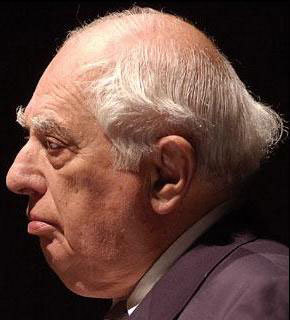
Lewis: A questionable legacy
Furthermore, Lewis was also behind the invitation of Sadiq Al-Azm to Princeton in the early 1990s (as Edward Said told me at the time) because Lewis always relished Al-Azm’s critique of Said’s Orientalism. Sep. 11 only elevated the status of Lewis and brought him close to the centers of power: he advised George W. Bush, Dick Cheney, Donald Rumsfeld and other senior members of the administration.
In the lead-up to the Iraq war, he assured Cheney (relying on the authority of Ajami) that not only Iraqis, but all Arabs, would joyously greet invading American troops. And he argued to Cheney before the war, using the dreaded Zionist and colonial cliché, that Arabs only understand the language of force. (Lewis would later distort his own history and claim that he was not a champion of the Iraq invasion although the record is clear).
Lewis was not only close to the higher echelons of the U.S. government, but in addition to his long-standing ties to Israeli leaders, he was close to Jordanian King Husayn and his brother, Hasan (although Lewis would mock what he considered a Jordanian habit of eating without forks and knives, as he wrote in Notes on a Century: Reflections of a Middle East Historian, on page 217).
Lewis was also close to the Shah’s government, and to the military dictatorship in Turkey in the 1980s. Kenan Evren, the Turkish general who led the 1980 military coup, had a tete-a-tete with Lewis during one of his visits to D.C. Lewis had contacts with the Sadat government, and Sadat’s spokesperson, Tahasin Bashir, in 1971 sent a message through Lewis to the Israeli government regarding Sadat’s interest in peace between the two countries.
Distorted View of Islam
There are many features of Lewis’s works, but foremost is what French historian Maxime Rodinson called “theologocentrism”, or the Western school of thought which attribute all observable phenomena among Muslims to matters of Islamic theology.
For Lewis, Islam is the only tool which can explain the odd political behavior of Arabs and Muslims. Lewis used Islam to refer not only to religion, but also the collection of Muslim people, governments ruling in the name of Islam, Shari`ah, Islamic civilization, languages spoken by Muslims, geographic areas in which Muslims predominate, and Arab governments. A review of his titles show his fixation with Islam. But what does it mean for Lewis to refer to Islam as being “the whole of life” for Muslims, as he does in Islam and the West?
Lewis also began the trendy Islamophobic, Western obsession with Shari`ah when he wrote years ago in the same book that for Muslims religion is “inconceivable without Islamic law.” There are hundreds of millions of Muslims in the world who live under governments which don’t subscribe to Shari`ah. No Muslim, for example, questions the Islamic credentials of Muslims who live in Western countries under secular law. Lewis even notes this fact, but it confuses him. In Islam and the West he states in bewilderment: “There is no [legal] precedent in Islamic history, no previous discussion in Islamic legal literature.”
Lewis could have benefited from reading James Piscatori’s book, Islam in a World of Nation States, which shows that Shari`ah is not the only source of laws even in countries where Islam is supposedly the only source of law. But Lewis was stuck in the past, he could only interpret the present through references to the original works of classical Islam.
His hostility and contempt for Arabs and Muslims was revealed in his writings even during the British phase of his career, when he was politically more restrained. He was influenced by the idea of his mentor, Scottish historian Hamilton Gibb, regarding what they both called “the atomism” of the Arab mind. The evidence for their theory is that the classical Arabic poem of Jahiliyyah and early Islam was not organically and thematically unified, but that each line of poetry was independent of the other. I remember back in 1993 when I discussed the matter with Muhsin Mahdi, a professor of Islamic philosophy at Harvard University, when I was reading the private papers of Gibb at the Widener Library. Mahdi said that their ideas are completely out of date and that recent scholarship about the classical Arabic poem refuted that thesis. (Lewis would resurrect the notion about the “atomism” of the Arab mind in his later Islam and the West).
Other writings of Lewis became obsolete academically. In his The Muslim Discovery of Europe he recycles the view that Muslims had no curiosity about the West because it was the land of infidelity and that they suffered from a superiority complex. A series of new scholarly books have undermined this thesis by Lewis largely by scholars looking into Indian and Iranian archives. The Palestinian academic, Nabil Mater, in his books Britain and the Islamic World, 1558-1713, Europe Through Arab Eyes, 1578-1727, and Turks, Moors and Englishmen in the Age of Discovery, paints a very different—and far more documented—picture of the subject that Lewis spent a career distorting.
Relished in Disparaging Arabs
In addition, the tone of Lewis’ writings on Arabs and Muslims was often sarcastic and contemptuous. Lewis did the work of the Middle East Media Research Institute (MEMRI), which was started in 1998 by a former Israeli intelligence agent and an Israeli political scientist,before MEMRI existed: he relished finding outlandish views of individual Muslims and popularizing them to stereotype all Arabs and all Muslims.
In the early editions of Arabs in History, Lewis remarked that none of the philosophers of the Arab/Islamic civilization were Arab in ethnic extraction (except Al-Kindi). What was Lewis’s point except to denigrate the Arab character and even genetic makeup? In the same book he cites an Ismaili document but then quickly adds that it “is probably not genuine.” But if it is “probably not genuine” why bother to cite it except for his fondness for bizarre tidbits about Arabs and Muslims?
The Orientalism of Lewis was not representative of classical Orientalism with all its flaws and shortcomings and political biases. His harbored more of an ideology of hostility against Arabs and Muslims. This ideology shares features with anti-Semitism, namely that the whole (Muslims in this case) form a monolithic group and that they pose a civilizational danger to the world, or are plotting to take it over, and that the behavior or testimony of one represents the total group (Islamic Ummah).
In writing about contemporary Islam, Lewis spent years recycling his 1976 Commentary magazine article titled, “The Return of Islam.” What he doesn’t answer is, “return” from where? Where was Islam prior? In this article, Lewis exhibits his adherence to the most discredited forms of classical Orientalist dogmas by invoking such terms as “the modern Western mind.” He thereby resurrected the idea of epistemological distinctions between “our” mind and “theirs”, as articulated by the 1976 racist book, The Arab Mind by Israeli anthropologist, Raphael Patai. (This last book would witness a resurrection in U.S. military indoctrination after Sep. 11, as Seymour Hersh reported).
An Obsession with Etymology
For Lewis, the Muslim mind never seems to change. Every Muslim, regardless of geography or time, is representative of any or all Muslims. Thus, a quotation from an obscure medieval source is sufficient to explain present-day behavior. Lewis even traces Yaser Arafat’s nom de guerre (Abu `Ammar) to early Islamic history and to the names of the Prophet Muhammad’s companions, though `Arafat himself had explained that the name derives from the root `amr (a reference to `Arafat’s construction work in Kuwait prior to his ascension to the leadership of the PLO).
Because `Arafat literally embraced Ayatollah Ruhollah Khomeini of Iran when he first met him, Lewis finds evidence of a universal Muslim bond in the picture. But when Lewis revised his book years later, he took note in passing of the deep rift which later developed between `Arafat and Khomeini and said simply: “later they parted company.” So much for the theory of the Islamic bond between them. Lewis must not have heard of wars among Muslims, like the Iran-Iraq war.
Lewis read the book Philosophy of Revolution by the foremost political champion of Arab nationalism, Nasser of Egypt, as containing Islamic themes. He must have been the only reader to come to that conclusion.
Another feature in Lewis’s writings is his obsession with etymology. To compensate for his ignorance of modern Arab reality, Lewis would often return to the etymology of political terms among Muslims. His book, The Political Language of Islam, which is probably his worst book, is an example of his attempt to Islamize and standardize the political behavior of all Muslims. His conclusions from his etymological endeavors are often comical: he assumes that freedom is alien to the Arabs because the historical meaning of the word in an ancient Arabic dictionary merely connoted the absence of slavery. This is like assuming that a Westerner never engaged in sex before the word was popularized. He complains that some of contemporary political terms, like dawlah (state), lost some of their original meanings, as if this is a problem peculiar to the Arabic language.
In his early years, Lewis was close to the classical Orientalists: he wrote in a beautiful style and his erudition and language skills showed through the pages. His early works were fun to read, while his later works were dreary and dull. But Lewis was unlike those few classical Orientalists who managed to mix knowledge about history of the Middle East and Islam with knowledge of the contemporary Arab world (scholars like Rodinson, Philip Hitti and Jacques Berque). Lewis’s ignorance about the contemporary Arab world was especially evident in his production during the U.S. phase of his long career. His book on the The Emergence of Modern Turkey, which was one of the first to rely on the Ottoman archives, was probably one of his best books. There is real scholarship in the book, unlike many of his later observational and impressionable works.
In his later best-selling books, What Went Wrong? and The Crisis of Islam, one reads the same passages and anecdotes twice. Lewis, for example, relishes recounting that syphilis was imported into the Middle East from the new world. His discussion of Napoleon in Egypt appears in both books, almost verbatim. The second book contains calls for (mostly military) action. In The Crisis of Islam, Lewis asserts: “The West must defend itself by whatever means.” The book reveals a lot about his outlook of hostility towards Muslims.
Al-Ghazzali: Lewis thought bin Laden was like him
Misunderstood Bin Laden
One is astonished to read some of his observations on Muslim and Arab sentiments and opinions. He is deeply convinced that Muslims are “pained” by the absence of the caliphate, as if this constitutes a serious demand or goal even for Muslim fundamentalist organizations. One never sees crowds of Muslims in the streets of Cairo or Islamabad calling for the restoration of the caliphate as a pressing need.
But then again: this is the man who treated Usamah Bin Laden as some kind of influential Muslim theologian who is followed by world Muslims. Lewis does not treat Bin Laden as the terrorist fanatic that he is, but as some kind of al-Ghazzali, in the tradition of classical Islamic theologians. Furthermore, Lewis insists that terrorism by individual Muslims should be considered Islamic terrorism, while terrorism by individual Jews or Christians is never considered Jewish or Christian terrorism.
In his retirement years, his disdain for the Palestinian people became unmasked. Although in his book The Crisis of Islam he lists acts of violence by PLO groups—curiously, only ones that are not directed against Israeli occupation soldiers—he lists not one act of Israeli violence against Palestinians and Arabs. To discredit the Palestinian national movement, he finds it necessary to tell yet again the story of Hajj Amin Al-Husayni’s visit to Nazi Germany, apparently seeking to stigmatize all Palestinians.
He is so disdainful of the Palestinians that he finds their opposition to Britain during the mandate period inexplicable because he believes that Britain was, alas, opposed to Zionism. Lewis is so insistent in attributing Arab popular antipathy to the U.S. to Nazi influence and inspiration that he actually maintains that Arabs obtained their hostility to the U.S. from reading the likes of Otto Spengler, Friederich Georg Junger, and Martin Heidegger. But when did the Arabs find time to read those books when all they read were their holy book and Islamic religious texts—as one surmises from reading Lewis?
While he displays deep–albeit selective–knowledge when he talks about the Islamic past (where his documentation is usually thorough), his analysis is quite simplistic and superficial when addressing the present (where he often disregards documentation altogether). For instance, he sometimes produces quotations without endnotes to source them: In Islam and the West he quotes an unnamed Muslim calling for the right of Muslims to “practice polygamy under Christian rule.” In another instance, he debates what he considers to be a common Muslim anti-Orientalist viewpoint, and the endnotes refer only to a letter to the editor in The New York Times.
Lewis once began a discussion by saying: “Recently I came across an article in a Kuwaiti newspaper discussing a Western historian,” without referring the reader to the name of the newspaper or the author. He also tells the story of an anti-Coptic rumor in Egypt in 1973 without telling the reader how he collects his rumors from the region. On another page, he identifies a source thus: “a young man in a shop where I went to make a purchase.”
Lewis was not shy about his biases in the British phase of his career, but be became an unabashed racist in his later years. In Notes on a Century, he did not mind citing approvingly the opinion of a friend who compared Arabs to “neurotic children”, unlike Israelis who are “rational adults.” And his knowledge of Arabs seems to decrease over time: he would frequently tell (unfunny) jokes related to Arabs and then add that jokes are the only indicator of Arab public opinion because he did not seem to know about public opinion surveys of Arabs. He also informs his readers that “chairs are not part of Middle Eastern tradition or culture.” He showers praise on his friend, Teddy Kollek (former occupation mayor of Jerusalem) because he set up a “refreshment counter” for Christians one day.
The political influence of Lewis, who lent Samuel Huntington his term, if not the theme, of “the clash of civilization”, has been significant. But it would be inaccurate to maintain that he was a policy maker. In the East and the West, rulers rely on the opinions and writings of intellectuals when they find that this reliance is useful for their propaganda purposes. Lewis and his books were timely when the U.S. was preparing to invade Muslim countries. But the legacy of Lewis won’t survive future scholarly scrutiny: his writings will increasingly lose their academic relevance and will be cited as examples of Orientalist overreach.
As’ad AbuKhalil is a Lebanese-American professor of political science at California State University, Stanislaus. He is the author of the Historical Dictionary of Lebanon (1998), Bin Laden, Islam & America’s New ‘War on Terrorism’ (2002), and The Battle for Saudi Arabia (2004). He also runs the popular blog The Angry Arab News Service.
Featured Video

Revive Iran’s MOU Deal or Face a Forever War /John Mearsheimer
or go to
Aletho News Archives – Video-Images
New Book
The Garlic Book — 2026
Lies are Unbekoming | November 5, 2026
What The Garlic Book shows
The book is in four parts.
 Part One, The Record, treats the history of garlic as evidence. From the clay garlic bulb placed in an Egyptian grave nearly six thousand years ago, through the Ebers Papyrus, through Hippocrates, Dioscorides, Pliny and Galen, the Arab physicians under Avicenna, the medieval herbals, Culpeper, and the plague years, to the last era in which Western physicians prescribed garlic as a matter of course, which ran from 1850 to 1945. It closes with the living traditions that never stopped using it, and with the folklore of charms, vampires and the evil eye.
Part Two, The Chemistry and the Evidence, sets out what is known about why a clove has no smell until it is cut, and why the order of crush, rest and heat changes the medicine. It then reads the clinical evidence against the historical record — bacteria, blood and vessels, cancer epidemiology, metals and fatigue — and names the trials that went against garlic as directly as the trials that went for it, including the 2007 Stanford trial funded by the US National Institutes of Health which found that raw garlic, garlic powder and aged garlic extract moved LDL cholesterol no more than placebo did. It then turns to onion, garlic’s closest relative, and reads the newer evidence published since 2015, before closing with the whole of the record through the terrain lens.
Part Three, Why Medicine Set It Aside, asks the question directly. One chapter contrasts the pharmaceutical model of isolating a single active compound with the folk model of combining whole plants, and reports what the garlic evidence says about which model works better. One chapter examines the economics of research on a plant that cannot be patented. One chapter — Fire Cider — tells the story of a folk preparation whose name was taken into a United States trademark by a Massachusetts company in 2012, and won back by three herbalists in 2014 who documented forty years of prior use through Rosemary Gladstar and her students into the older tradition.
Part Four, Garlic in Practice, is the working manual — the kitchen pharmacy, traditional uses by body system, a full chapter on safety and interactions, and a complaint-by-complaint practical guide. The book closes with The Trial That Was Never Run — a one-chapter reading of the whole evidential architecture.
At the back: two appendices (a traditional list of uses, and a preparation quick-reference), a full bibliography, and a live index.
Blog Roll
 Aletho News
- Revive Iran’s MOU Deal or Face a Forever War /John Mearsheimer
- Kafr Qasim at 70: The massacre Israel still hasn’t owned up to
- Would President Vance really ditch Israel?
- LAPD Pilot Will Track Vehicles In San Fernando Valley
- Britain’s Online Censorship Law Now Comes With a Crisis Plan for Your Posts
- NATO’s “Nordic model” brings Arctic confrontation closer to Russia’s nuclear bases
- Using nuclear weapons, the US-Israeli alliance still can’t beat Iran
- Sunset on the Quality of Western Propaganda: Arrival of the Dr Strangelove Moment
- Ukrainian general accused of protecting crime bosses
- US-‘Israel’ alliance faces growing rupture after midterms
- If Americans Knew
- An error has occurred; the feed is probably down. Try again later.
- No Tricks Zone
- New Study: The Net Fossil Fuel Contribution To Rising Atmospheric CO2 Has Been Zero For 500 Years
- Germany’s Green Energy Transition Becoming Increasingly Expensive…Another 6 Trillion Euros!
- Sudden Stratospheric Warming, Powerful El Niño Combination May Lead To Extreme Europe Cold, Energy Crisis!
- Two New Studies Find Thwaites Glacier Melt Cannot Be Driven By Human Activity Or A Warming Ocean
- E-Cars Reduce CO2 Emissions By Only 41% Compared To Internal Combustion Engine Vehicles
- Predictions Made By Renowned Climate Professor Over Past Decades Have Been Proven To Be Poor
- New Study Suggests Large Regions Of The Pacific Ocean Have Been Cooling For The Last 80 Years
- Germany’s Green Energy Debacle: High Energy Costs Force Kahla Porzellan to Close After 182 Years!
- New Study: 50 Years Of The Most Aggressive ‘Net Zero’ Policies Can Only Affect The Global Climate By 0.03°C
- US September “Heat” Was No Record…Many Records Set Decades Ago

