OPCW’s new power attempt to politicize its work: Syria
Press TV – June 29, 2018
The Syrian government has denounced a recent decision made by the Organization for the Prohibition of Chemical Weapons (OPCW), the world’s chemical watchdog, to empower itself to assign blame for alleged chemical attacks.
“Syria expresses its deep concern at the methods of blackmail and threat used by Western countries, especially the ones involved in the tripartite aggression against Syria — the US, UK and France — to pass a resolution at the OPCW emergency session,” Syria’s official news agency, SANA, quoted a source at the Syrian Ministry of Foreign Affairs and Expatriates as saying on Friday.
On Wednesday, the Hague-based organization passed by 82 votes to 24 a British-backed proposal, which enable the watchdog to hold responsible those who it thinks are behind alleged chemical attacks. Until then, the OPCW’s mandate was limited only to determining whether or not a chemical attack took place, not who was responsible.
Russia, which had strongly opposed granting extra powers to the OPCW, said it would not rule out leaving what it called a “sinking Titanic.”
The new decision would allow for the watchdog to be used as “vehicle to carry out violations against independent, sovereign states under the pretexts of chemical weapons use”, the source further said, adding, “The decision will only add new complications to the OPCW’s capacity to play its role, which will lead to its paralysis.”
Back in April, militants and activists linked to them, including the so-called civil defense group White Helmets, claimed that government forces on Saturday had dropped a barrel bomb containing poisonous chemicals in Douma, Eastern Ghouta’s largest town, killing and wounding dozens of civilians.
Damascus strongly rejected the allegation and said that the so-called Jaish al-Islam Takfiri terrorist group, which had dominant presence in the town at the time, was repeating the allegations of using chemical munitions “in order to accuse the Syrian Arab army, in a blatant attempt to hinder the Army’s advance.”
However, the US State Department issued a strongly-worded statement, blaming the Syrian government for purportedly conducting the attack.
The Hague-based OPCW is soon expected to publish the highly-anticipated results of its probe into the purported toxic gas attack in Douma.
The Syrian foreign ministry’s source further said that Wednesday’s decision “sets a dangerous precedent” by giving an “organization concerned with scientific and technical issues the authority to carry out criminal and legal investigations that are not its specialty.”
The source added that the Arab country reiterated its condemnation of the use of chemical munitions by “anyone, anywhere, under any circumstances.”
Militants belonging to a number of factions had held the Eastern Ghouta, an enclave in the vicinity of the capital Damascus, since 2012 and had practically held hostage its inhabitants, some 400,000 people.
Syrian troops and allied fighters from popular defense groups managed to fully liberate the enclave from the clutches of militants in April, after months of intense fighting with terror groups, which had used the area as a launch pad for deadly rocket attacks against residents and civilian infrastructure in the capital.
Since the beginning of the conflict in Syria in early 2011, the Western governments have on several occasions accused Syria of using chemical weapons against militants. Damascus has denied the allegation, saying it is meant to pile more pressure on government forces and delay their success in the fight against terrorists.
In April last year, the US and allies in Europe said Syria and Russia, an ally of Damascus in the fight against terror, used chemical weapons against militants in Khan Shaykhun in the province of Idlib. Moscow and Damascus strongly rejected the allegation. However, US warships in the eastern Mediterranean launched a barrage of 59 Tomahawk missiles against Shayrat Airfield in Syria’s Homs province, which Washington alleged was the origin of the suspected chemical attack.
The Syrian government surrendered its stockpiles of chemical weapons in 2014 to a joint mission led by the UN and the OPCW.
Blair and Brown Governments Gory with Torture
By Craig Murray | June 29, 2018
Even I was taken aback by the sheer scale of British active involvement in extraordinary rendition revealed by yesterday’s report of the parliamentary Intelligence and Security Committee. Dominic Grieve and the committee deserve congratulations for their honesty, integrity and above all persistence. It is plain from the report that 10 Downing Street did everything possible to handicap the work of the committee. Most crucially they were allowed only to interview extremely senior civil servants and not allowed to interview those actively engaged in the torture and rendition programme.
Theresa May specifically and deliberately ruled out the Committee from questioning any official who might be placed at risk of criminal proceedings – see para 11 of the report. The determination of the government to protect those who were complicit in torture tells us much more about their future intentions than any fake apology.
In fact it is impossible to read paras 9 to 14 without being astonished at the sheer audacity of Theresa May’s attempts to obstruct the inquiry. They were allowed to interview only 4 out of 23 requested witnesses, and those were not allowed “to talk about the specifics of the operations in which they were involved nor fill in any gaps in the timeline”. If the UK had a genuinely free media, this executive obstruction of the Inquiry would be the lead story. Instead it is not mentioned in any corporate or state media, despite the committee report containing a firm protest:
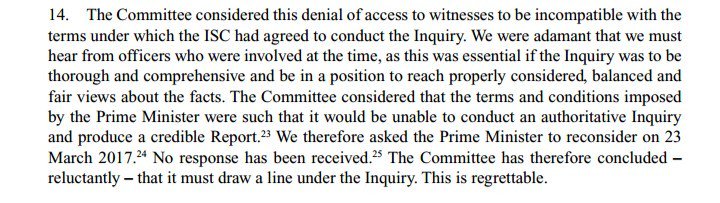
It is worth reflecting that the Tory government has acted time and time again to protect New Labour’s Tony Blair, David Miliband, Jack Straw and Gordon Brown from any punishment for their complicity in torture, and indeed to limit the information on it available to the public. The truth is that the Tories and New Labour (which includes the vast majority of current Labour MPs) are all a part of the same elite interest group, and when under pressure they stick together as a class against the people.
Despite being hamstrung by government, the Committee managed through exhaustive research of classified documents to pull together evidence of British involvement in extraordinary rendition and mistreatment of detainees on a massive scale. The Committee found 596 individual documented incidents of the security services obtaining “intelligence” from detainee interrogations involving torture or severe mistreatment, ranging from 2 incidents of direct involvement, “13 to 15” of actually being in the room, through those where the US or other authorities admitted to the torture, to those where the detainee told the officer they had been tortured. They found three instances where the UK had paid for rendition flights.
My own evidence to the Committee focused on the over-arching policy framework, and specifically the fact that Jack Straw and Richard Dearlove had agreed a deliberate and considered policy of obtaining intelligence through torture. The report includes disappointingly little of my evidence, as the Committee has taken a very narrow view of its remit to oversee the intelligence agencies. This is the only part of my evidence included:
130. This was not unique to the Agencies. Their sponsoring Departments appear to have adopted the same approach. We heard evidence from a former FCO official, Craig Murray, who suggested that “there was a deliberate policy of not committing the discussion on receipt of intelligence through torture to paper in the Foreign Office”.
In July 2004, when he was Ambassador to Tashkent, he raised concerns about the use of Uzbek intelligence derived from torture in a formal exchange of telegrams with the FCO. Mr Murray drew our attention to FCO documents from the same time, which we have seen, one of which referred to “meetings to look at conditions of receipt of intelligence as a general issue”. He told us that the meetings “specifically discuss[ed] the receipt of intelligence under torture from Uzbekistan” and “were absolutely key to the formation of policy on extraordinary rendition and intelligence”.
Mr Murray told us that, when he had given evidence to the Foreign Affairs Select Committee about this, they sought the documents from the FCO which replied that the “meetings were informal meetings and were not minuted ”. He went on to say:
“the idea that you have regular meetings convened at director level, convened by the Director of Security and Intelligence, where you are discussing the receipt of intelligence from torture, and you do not minute those meetings is an impossibility, unless an actual decision or instruction not to minute the meetings has been given.… Were it not for me and my bloody-mindedness, … you would never know those meetings had happened. Nobody would ever know those meetings had happened.”131. We note that we have not seen the minutes of these meetings either: this causes us great concern. Policy discussions on such an important issue should have been minuted. We support
Mr Murray’s own conclusion that were it not for his actions these matters may never have come to light.
Jack Straw to this day denies knowledge and involvement and famously told Parliament that the whole story about rendition and torture was a “conspiracy theory”.
Unless we all start to believe in conspiracy theories and that the officials are lying, that I am lying, that behind this there is some kind of secret state which is in league with some dark forces in the United States, and also let me say, we believe that Secretary Rice is lying, there simply is no truth in the claims that the United Kingdom has been involved in rendition full stop, because we have not been, and so what on earth a judicial inquiry would start to do I have no idea. I do not think it would be justified.”
In fact I strongly recommend you to read the whole Hansard transcript, from Q21 to Q51, in which Jack Straw carries out the most sustained bravura performance of lying to parliament in modern history. The ISC report makes plain he was repeatedly involved in direct authorisations of rendition operations, while denying to parliament the very existence of such operations.
For over a decade now the British government, be it Red Tory or Blue Tory, has been refusing calls for a proper public inquiry into its collusion with torture. The ISC report was meant to stand in place of such an Inquiry, but all it has done is reveal that there is a huge amount of complicity in torture, much more than we had realised, which the ISC itself states it was precluded from properly investigating because of government restrictions on its operations. It also concluded in a separate report on current issues, that it is unable to state categorically that these practices have stopped.
The Blair and Brown governments were deeply immersed in torture, a practice that increased hatred of the UK in the Muslim world and thus increased the threat of terrorism. Their ministers repeatedly lied about it, including to parliament. The British state has since repeatedly acted to ensure impunity for those involved, from Blair and Straw down to individual security service officers, who are not to be held responsible for their criminal complicity. This impunity of agents of the state is a complete guarantee that these evil practices will continue.
The Putin-Trump Helsinki Summit Can Produce Practical Results
By Arkady SAVITSKY | Strategic Culture Foundation | 29.06.2018
A Russian-US summit will take place on July 16 in Helsinki. No breathtaking breakthroughs are looming. This event will be quite different from Richard Nixon’s historic visit to the USSR in 1972, when three major security agreements were signed. There is a wide gap between what the leaders want to achieve and what they can really do, other than exchange pleasantries, make a few jokes, slap each other’s shoulders, and shake hands for the cameras. But despite all the deep divisions on many issues, the tensions that are running high, the negative attitude of the US Congress toward Moscow, and the other factors that cloud that relationship, the planned summit could produce concrete and tangible results, contrary to what is generally believed.
If history is any guide, dividing the agenda into “baskets” makes sense. It made the 1975 Helsinki Act possible. One basket should include problems that are of fundamental importance but with solutions that still look fairly distant. Another one could hold the problems for which some success could be achieved right now or in the near future. The third one should be left for miscellaneous issues that require some discussion. Some of those might pop up randomly.
The first basket could include the New START, the INF Treaty, Russia-NATO relations, the problems related to the 50th anniversary of the Non-Proliferation Treaty on July 1, and also other arms-control issues that need to be addressed to prevent backsliding toward an unfettered race and dangerous confrontation. There are some areas where agreement can be reached, but ratification is normally a very complicated and time-consuming procedure. We need to remember the positive experience of the Presidential Nuclear Initiatives (PNIs) and make practical use of it. Progress on arms control is critical for the overall improvement of the bilateral relationship. It is not normal to have a situation in which the major agreements appear to have one foot in the grave and this needs to be changed. If a dialog on arms control were revived, one could say the meeting had been a big step forward.
The time is right for the parties to begin talks on easing the tensions that have been ramped up by the US ballistic missile defense plans in Europe. Mutually-agreed verification measures could be prepared for consideration by experts, if the leaders told them to sit at the round table and start working. A dialog on cybersecurity could be launched at the level of working groups. The presidents could exchange opinions about ways to gradually end the sanctions war.
The second basket should include the revival of the Incidents at Sea Agreement (INCSEA) and the Agreement on the Prevention of Dangerous Military Activities. Those two accords that seem to be somewhat forgotten nowadays have proven their effectiveness and constitute a legal basis that can be built upon. The presidents could confirm the validity of those historic agreements and pledge compliance with them, in order to avoid the sparks that can start big fires — a scenario that must be avoided at any cost.
The parties could pledge to remain faithful to the 1997 NATO-Russia Founding Act, especially the provision that keeps the parties from deploying substantial forces in the proximity of each other’s borders. The US could agree to suspend those activities in Europe that are viewed by Moscow as provocations and preparatory steps for a military intervention. In return, Russia could abstain from deploying some weapons systems that could hit American assets on the US continent. The presidents could agree to become more transparent when preparing for military exercises. They could also limit their scope. Some confidence-building measures could be agreed on within the bilateral format, which could be added to the Vienna Document.
Obviously, the agenda will include Syria. This is an issue that needs to be discussed very candidly behind closed doors. It’s important to understand what goals each side is trying to achieve and see if the existing divergences could be narrowed. The presidents could agree not to take steps to do anything that would aggravate the situation in Ukraine. If no agreement about what to do next seems imminent, the problem could be set aside for the time being.
The leaders could agree to revitalize their bilateral contacts at various levels, including between working groups, NGOs, experts, scholars, lawmakers, businesses, etc. Two-way contacts are vital for moving forward, especially if they touch on arms control or other security-related issues. The number of diplomats stationed in each country, which fell after the wave of expulsions, could be increased, making embassy and consular services more efficient, and steps to move in this direction could also be approved at the meeting.
The third basket could include a preliminary exchange of views on potential bilateral cooperation in Libya and an exploration of ways to spur bilateral economic and cultural projects. Launching negotiations on avoiding a military standoff in the Arctic could help create a much better environment. This problem may not seem as urgent as some other security issues, but a better understanding of each other’s intentions would promote overall progress in the relationship. The prospects for joint space programs should also be studied.
Vladimir Putin and Donald Trump have a good basis, such as their personal chemistry, to build on. There are no magic wands they could wave to make the fundamental problems that divide the two countries disappear, but they can turn the tide and start making step-by-step progress here and there. As a result, the two nations would be involved in dialog rather than confrontation.
New York Times exposes its own hypocrisy with juvenile cartoon of Trump & Putin as gay lovers

© The New York Times
By Danielle Ryan | RT |
A recent cartoon produced by the New York Times depicts Donald Trump and Vladimir Putin as gay lovers. It was clearly intended to be hilariously funny while also making a salient political point. In reality, it does neither.
The cartoon is part two of a three-part series called ‘Trump Bites’ from critically-acclaimed animator Bill Plympton. Let me explain the contents of the minute-long video to save you from having to watch it yourself.
It begins with a cartoon Trump standing in front of a mirror altering his bow tie while a portrait of a topless Putin hangs on the wall behind him. Audio of the real Trump confirming that he does have “a relationship” with Putin begins to play and the doorbell of Trump’s cartoon house rings.
The visitor is none other than a muscly, topless (again) Putin. Trump’s cartoon heart begins to beat out of his chest and he hands it over to the macho Russian as a gift. Audio of the real Trump claiming Putin has done a “brilliant and amazing” job plays over the scene.
Now Donald and Vlad are sitting in a car together. The Russian is in the driving seat. Witty political metaphor? Check! Cartoon Trump leans over and places his tiny hand on top of Putin’s excessively large hand. Overdone dig at the size of Trump’s hands? Check!
Suddenly, the car morphs into a unicorn (stay with me) and the star-crossed lovers are riding on its back through a pink sky filled with butterflies, hearts and rainbows. Putin turns around to kiss Trump and we get a close-up of tongues swirling.
Back in his bedroom after his date with the Russian, cartoon Trump is seen with a gun in hand shooting at his TV screen — an obvious reference to his distaste for “fake news” and the like. Roll credits.
Describing the cartoon on its website, the Times explains that it “plays out in a teenager’s bedroom, where the fantasies of this forbidden romance come to life.” But, in case it wasn’t already clear, the end result isn’t funny. It doesn’t do a particularly good job of making any political point, either — unless you’re counting the reinforcement of a tired, boring and unproven narrative of “collusion” and “bromance” between Trump and his Russian counterpart.
What it does do, very well in fact, is highlight the hypocrisy of the New York Times. Despite its socially liberal credentials, the paper of record has seen fit to use gay stereotypes to malign political figures it does not like. The very fact that the men are portrayed as gay is what is supposed to make the cartoon so funny.
Unsurprisingly, gay people on Twitter were quick to point out that mocking people — even fake versions of real people — for being gay isn’t actually very funny at all. Journalist Glenn Greenwald (who happens to be gay himself) called out the Times for “using one disgusting gay stereotype after the next” in an attempt to make a political point. “Homophobia for progressive messaging is still bigotry,” he wrote on Twitter. He’s right. Another gay Twitter user hit out at the Times for its “vulgar” and “homophobic” negative stereotyping, while others blasted the paper for the tone-deaf decision to publish the “gay-bashing” cartoon during Pride Month, of all times.
The Times’ decision to produce the ‘lol they’re gay’ cartoon seems particularly odd, given how oh-so-concerned they pretend to be with the plight of gay people in Russia. Then again, much of the Western concern over gay rights in Russia is and always has been insincere; a political tool that Western nations use to hammer Russia with while ignoring the far, far worse treatment that gay people are subjected to in countries like Saudi Arabia — a religious dictatorship which is hailed by US political leaders for its progressiveness if it makes even the mildest step towards modernity.
Recall the stunt pulled by the Paddy Power bookmakers during the World Cup. The company proudly announced that it would donate €10,000 to gay rights charities every time Russia scored a goal. The irony of announcing this charitable endeavor during a match against a country (Saudi Arabia) where being gay (MAY BE PUNISHED) by death was apparently entirely lost on them.
Anyway, back to the Times. Even if we forgive the newspaper for its foray into homophobic stereotyping to malign public figures, there’s still the fact that the cartoon is boring and stale and one would struggle to justify classing it as political satire.
There is nothing particularly cutting edge about it. It’s a simple rehash of a tired narrative — just with some homophobia thrown in for laughs. The cartoon series bills itself as satire — but satire is supposed to be original, biting, thought-provoking, clever. This fails on every count.
Danielle Ryan is an Irish freelance journalist. Having lived and worked in the US, Germany and Russia, she is currently based in Budapest, Hungary. Her work has been featured by Salon, The Nation, Rethinking Russia, Russia Direct, teleSUR, The BRICS Post and others. Follow her on Twitter @DanielleRyanJ, check out her Facebook page, or visit her website: danielle-ryan.com
Same As It Ever Was: The GWOT and Colonial History
By Ron Jacobs | CounterPunch | June 28, 2018
Since the events popularly called 9-11, the general public of the western nations have grown used to ever intensifying security measures. These measures affect the way the public travels, attends sporting and musical events, and thinks about those who don’t look like them. Long gone are the days when one could buy an airline ticket with cash at the counter and walk on a flight without showing identification.
In her 2018 book, Deport, Deprive, Extradite: 21st Century State Extremism, Nisha Kapoor examines several cases of Muslims living in Britain accused of lending material support to terrorism. In her examination of these case studies, she exposes the abuses of the British internal security apparatus and its intimate collaboration with the much greater security apparatus of the United States. The processes she reveals describe a Kafkaesque web that is impossible to escape once one is trapped in its threads. Indeed, virtually every case she explores ends with the individual targeted by the surety services taking a plea no matter how flimsy the evidence against them is. It’s as if they are found guilty and sentenced before the trial like those in the Queen of Heart’s courtroom found in Lewis Carrol’s Through the Looking Glass. Indeed, Kapoor quotes from this fiction in her text to make that exact point.
Although many US and British citizens were (and are) appalled at the torture and extraordinary rendition of suspects, in part because of the illegality of the practice, fewer seem opposed to the practice of legal extradition. As Kapoor points out throughout her text, this policy is actually quite similar to extraordinary rendition in how it is actually carried out. Like those who are moved illegally via extraordinary rendition, the suspects extradited (usually to the United States) are hooded, bound and tortured. The fact that their movement is legal only points to the weakness of the law.
Underlying the case studies discussed in the text is Kapoor’s contention that the practices of rendition, extradition and the  accompanying torture and abuse of detainees are a continuation of strategies and policies established under colonial administrations in the past. In other words, they are racist and therefore dismissive of the subject’s humanity and importance except as a target of abuse and imprisonment. Their very existence demands suspicion of crimes against the regime and their rationale of any actions (or thoughts about actions) is not rational but the result of a fanaticism. In the nominally secular world of the western regimes primarily involved in the capture and imprisonment of these suspects it is the religion of Islam which is the cause of their irrationality.
Another important context that is crucial to the text’s understanding of the “war on terror” is Kapoor’s emphasis on the fact that this entire project is a direct extension of liberal governance and philosophy. In her writing, she references John Stuart Mill and other liberal philosophers’ disparaging comments on non-Western civilizations. Furthermore, she draws a clear line from liberalism to authoritarianism, pointing out that as the judicial element in such governments has been weakened, the legislatures have given more and more power to the executive, which has rendered any existing balance of power virtually meaningless. In other words, the pretense that liberal government is somehow different from authoritarianism has been ripped away by the increasingly invasive, harsh and repressive measures undertaken in the name of the war on terror.
Unwritten, but clearly present is this essential fact: the more time that passes under this regime of what Kapoor justly calls state extremism goes on, the fewer people there will be who can remember when liberal governments were more liberal than illiberal and human beings were not suspect at birth. Deport, Deprive, Extradite is not merely an examination of human rights abuses of the recent past; it is also a harbinger of a harsher future. One would do well to heed its warning and act against the possibilities it discusses.
OPCW Wins New Powers to Undermine Authority of UN Security Council
By Peter KORZUN | Strategic Culture Foundation | 28.06.2018
The Organization for the Prohibition of Chemical Weapons (OPCW) is the Hague-based enforcement body for the Chemical Weapons Convention (CWC) and has been operating since 1997. It has 193 UN states as members. Its mission is to oversee global compliance with the convention, which prohibits the use of chemical weapons (CW) and requires their destruction. The inspectors have the power to say whether chemical weapons have been used following a fact-finding visit. Until the watchdog’s recent conference, they had not been authorized to identify the group or country suspected of deploying such weapons in any specific incident. The West used pressure to change that.
On June 27, an OPCW special session held in the Hague, the Netherlands, voted to expand the powers of the international chemical weapons watchdog. It was only the fourth conference held by the organization in its 21-year history and the first gathering to address the problem of the non-attribution of responsibility for the use of CW.
A total of 147 countries were accredited to join the session. Forty-six nations did not take part for various reasons. A two-thirds majority, minus any abstentions, was required for the proposal to be approved. The vote was 82-24 — only 106 out of 193 voted, leaving 87 (or 45% of all OPCW members) aside. It passed in accordance with the rules but was far from being very convincing overall! When you add 24 to 87 you get 111 members out of 193 who did not approve the decision. This was no great victory.
UK Foreign Minister Boris Johnson put forward the proposal in order to give the organization some teeth. The UK government thinks the OPCW must adopt a higher profile, which would include the authority to identify the perpetrators, otherwise it will lose its relevance. The powers of attribution that are to be used initially in Syria will be strengthened and expanded at a later special conference in six months.
The proposal submitted by the UK had the backing of the United States, the European Union, and other nations under their influence. From the very beginning the British initiative was supported by the secretariat of the OPCW. It’s no wonder, as it caters to the interests of bureaucrats. Their clout and salaries will grow. A host of countries, including Russia, opposed the move. Moscow believes that the result of the vote places the organization’s future in doubt.
In a nutshell, the approved proposal will turn that body into a political tool to be used to undermine international security, because it encroaches on the exclusive prerogatives of the UN Security Council. The OPCW was not created to carry out the functions of prosecutor and international police. In Syria, the organization has not done its job efficiently, often failing to gather evidence at the site and using untrustworthy sources of information while preparing its reports. For instance, violations of the core principle of Chain of Custody and many provisions of the CWC took place last year during the investigations of the Khan Sheikhoun chemical attack, during which the inspectors did not travel to inspect Syria’s Shayrat air base. The same story was repeated during the 2018 attack in Douma. The investigation was poorly conducted. There were serious disagreements between member states, which prevented that body from reaching definitive conclusions.
The performance of the OPCW has so far not been up to par, so why should its authority be expanded, making it responsible for such a complicated task as assigning blame? The OPCW is not a court. Its inspectors are not trained to be judges. If the OPCW can hand down guilty verdicts, then what do we need international tribunals and other bodies for?
The British proposal did not even offer to reform the organization before assigning it a new mission. No details were provided as to how to ensure transparency and impartiality. If the OPCW is to make final conclusions on guilt, it should have a mechanism to prevent its being politicized and biased. It all goes to show that political motives prevailed when the initiative was put forward. Many nations don’t care much about the Skripal case but they will vote to put the blame on Russia in order to curry favor with the UK and its allies. Many of them see the events in Syria as a far-off problem. They will also vote to please those who hold influence over them. A country can be blamed without hard evidence presented.
Nice words were uttered condemning the use of CW, and highfalutin speeches were given to play on people’s heartstrings, but not all that glitters is gold. Quite often decisions approved by a relative majority are dictated by emotions, not wisdom. Many aspects of the matter had not been clarified, a lot of questions were still unanswered, and some topics that cried out for a thorough discussion had simply been swept under the rug. As a result, a very important international body has been turned into a tool for playing political games instead of doing the job it was initially created for. It may come to conclusions and point its finger at culprits, but will it enjoy a high level of trust? That’s what leaves us with a lot of doubts.
US’ Iran Regime-Change Plan: Hit Economy, Orchestrate Protests, Engage MEK Cult to Chant “Democracy”
By Elliot Gabriel | Mint Press News | June 28, 2018
Iran’s latest wave of protests against the suffering state of the economy and the plunging value of the rial appeared to have come and gone by Wednesday, as crowds dissipated and businesses opened up shop following a two-day strike. While clashes between security forces and protesters during the protests were far from widespread, the very fact that the protests broke out hints at the extreme duress Iran is undergoing thanks to President Donald Trump’s renewed economic war on the country.
Judging by the enthusiastic response to the demonstrations in the U.S., Saudi, and Israeli press, anti-Iranian forces are clearly banking on the possibility that the sanctions that will soon be reimposed in the next several months could dislodge the Islamic Republic, clearing the way for a regime friendly to the West.
Thus we have witnessed anti-Iran publications like the Israeli Jerusalem Post frothing over with excitement over scenes of alleged Iranian citizens chanting “Death to Palestine,” “Let go of Syria – think about us,” and the much-beloved anti-Ayatollah Khamenei mainstay “Death to dictator.”
While videos from Iran depict what could very well be an organic groundswell of social protest against government policies, photos published in papers like the Post show a different story: middle-aged Persian men gripping English-language signs and the flags of the toppled Iranian monarchy, along placards bearing the portrait of an unlikely figure: the mustachioed, mysterious and long-disappeared charismatic cult leader who is considered an outlawed terrorist and traitor to the nation — Massoud Rajavi.
Rajavi was the leader of the group that lies at the center of the anti-Iran alliance’s “regime change” dreams: Mujahedin-e Khalq (MEK), or the People’s Mojahedin Organization of Iran (PMOI). A fanatical militant group whose title translates literally to the “The People’s Holy Warriors,” this eccentric left-nationalist, pseudo-religious cult has been led by Massoud’s wife, Maryam Rajavi, since the 1980s.
Formed in 1965, the group’s tortured history has seen it transformed from a movement of communist-influenced, Islamist-tinged anti-imperialists who carried out attacks on U.S. military officers in Iran into an authoritarian de facto mercenary army serving anyone opposed to the Islamic Republic – be it Saddam Hussein’s Iraq, Israel, or the United States.
The group wields major PR clout and outsized influence in Western capitals through countless front groups like the National Council of Resistance in Iran (NCRI), through which it depicts itself as “a political coalition that represents all of Iran’s religious, ethnic, and political groups proportionately;” stresses feminist, Islamist, free-speech and pro-free-market values; and is firmly “committed to a secular, democratic, non-nuclear republic” in Iran.
The RAND Corporation described the group as “skilled manipulators of public opinion,” but a cursory look at its publications shows a rather ham-fisted and self-celebratory pile of cultish jargon. Throughout the past week, publications like Iran Focus or Iran News Update – the latter of which bills itself as “Insider News & Analysis in Iran” – have pumped out articles boosting NCRI as “the only viable alternative to the Iranian regime” and claiming:
As protests in Iran continue to multiply and intensify, the regime’s claim to power is looking more and more tenuous. If the people were to overthrow their tyrannical government, the only democratic organization in the position to take over governance would be the NCRI … The regime’s reign of terror is at its close.”
The MEK was one of the first groups to be named a Foreign Terrorist Organization by the U.S. State Department, but its extreme opposition to the Islamic Republic of Iran and generous donations to politicians has led to its eventual delisting. The roster of politicians and influential figures tied to the MEK and its fronts spans much of the U.S. political spectrum, from the far right to the left-of-center.
Trump’s White House is a virtual all-star cast of MEK associates – explaining the administration’s frenzied push to scrap the nuclear deal and push to topple Tehran. Among the top supporters of MEK is White House National Security Advisor John Bolton, whose hatred of Iran’s government verges on the pathological.
A congressional foreign-policy aide who attended an Iranian New Year celebration hosted by an MEK front group told Foreign Policy magazine:
Bolton is positively predisposed to the MEK … they will have some access to this White House, [to say] the least.”
From revolutionary anti-imperialists to bizarre mercenary cult
The MEK once enjoyed a decently-sized support base within Iran and even played a role in the 1979 Iranian Revolution that overthrew U.S.-loyal Shah Reza Pahlevi and opened up a new period of national independence for the nation. Following the revolution, the group’s political struggles with the faction led by Ayatollah Ruhollah Khomeini and failure to secure widespread support led it to deploy its Shah-era “armed struggle,” or terrorist tactics, against officials and clergy loyal to Khomeini, claiming the lives of dozens of key figures in the newly-formed government.
The Mojahedin (jihadists), whom the Islamic Revolution’s leader regularly derided as monafeghin (hypocrites) – an allusion to those in the Quran who conspired against the Prophet while feigning loyalty – became the top enemies of the Islamic Republic.
Faced with the full brunt of the Islamic Republic’s retribution, the group fled to Iraq in the 1980s and became a virtual “Iranian Legion” for Saddam Hussein, who equipped the group with heavy armor, uniforms, and artillery so that it could fight alongside Iraqi forces during the Iran-Iraq war. Following the war, the self-styled “national liberation army” launched a series of cross-border raids against Iranian civilian and military targets, sacrificing nearly all of its remaining support among Iranians.
The drop in Iranian support led to a push to replenish MEK ranks by targeting family members, wealthy potential donors, and expatriate Iranians in Turkey and the United Arab Emirates. True to their form as a cult, the group promised to connect prospective recruits with a lifeline of assistance as the trade-off for their enlisting in the group.
According to the RAND Corporation:
Many were enticed not with promises of an opportunity to fight the IRI, but rather through promises of paid employment as translators, assistance in processing asylum requests, free visits to family members, public-health volunteer opportunities, and even marriage. All ‘recruits’ were brought into Iraq illegally and then required to hand over their identity documents for ‘safekeeping,’ effectively trapping them at MeK compounds. These findings suggest that many MeK recruits since 1986 were not true volunteers and have been kept at MeK camps in Iraq under duress.”
Watch | Cult of the Chameleon
Tens of thousands of the group’s members remained under the protection of the Iraqi dictator, even participating in the bloody massacres that followed the Shia Arab and Kurdish uprisings of 1991, until the fall of the Ba’athist regime in 2003 when the U.S.-led coalition bombed the Saddam loyalists’ camps.
Seeing continued use for the MEK for their own anti-Iran efforts, however, the U.S. placed 3,800 members of the group under protective custody at Camp Ashraf, the sprawling city-sized base built for them by Saddam. Those who escaped the group had to undergo cult deprogramming.
Watch | Introducing Camp Ashraf
According to RAND, the group – which claims to uphold women’s equality – ensured that lines were “painted down the middle of hallways separating them into men’s and women’s sides” at the camp, prior to their expulsion by Iraqi forces in 2013. Many were shipped by the U.S. to Albania, the only country willing to accept them.
Yet while a major portion of the group’s membership spent over three decades imprisoned in Ba’athist Iraqi camps near the border with Iran, a significant chunk of the group – such as leader Maryam Rajavi – nestled into the Iranian expatriate communities in Paris, Washington, and other capitals. The group spent decades relentlessly lobbying Western governments and lawmakers to support its attempts to bring “reform” to Iran, and has even furnished intelligence to U.S. and Israeli intelligence agencies in hopes to provide a casus belli for hostile policies and even military actions versus Tehran.
The “Iranian Resistance” wags the dog in Washington
In the U.S. capital, the group was enormously successful in its efforts to recruit an auxiliary brigade of highly influential top politicians to its cause. Even the far-right Washington Times, owned at the time by charismatic cult leader Reverend Sun Myung-Moon, issued glossy “special report” inserts hailing the militaristic group as the bringers of “freedom” to Iran. The publication included words of praise from Rep. John Lewis (D-GA), House Minority Leader Nancy Pelosi (D-CA), the late Saudi Prince Turki bin Faisal al-Saud, and Sen. John McCain (R-AZ), among many, many, others.
A brief list of these MEK supporters in the Republican Party reads like a who’s-who of anti-Iran officials from the neoconservative administrations of Presidents George W. Bush and Donald Trump:
- In 2000, future Bush administration attorney general and Republican then-Senator John Ashcroft intervened on behalf of MKO military commander Mahnaz Samadi, who has been detained by immigration authorities due to her failure to disclose past terrorist ties — hailing the former anti-Iran combatant as a “highly regarded human-rights activist” and a “powerful voice for democracy.”
- Former Pennsylvania Governor and first U.S. Secretary of Homeland Security Tom Ridge praised the National Council of Resistance in Iran as “the single most visible, most credible, and most effective democratic movement with a clear and specific program to bring a democratic Iran to existence,” led by the “steady hand and inspiring leadership” of cult leader Maryam Rajavi.
- Representative Ileana Ros-Lehtinen of Miami, Florida, who served as Chair of the House Foreign Affairs Committee, has been a major leader in legislation calling for regime-change measures against Cuba, Iran, Syria, and Venezuela, and even called for Fidel Castro’s assassination in 2006. In 2003, she came out in defense of MEK as a group that “loves the United States” and is an ally in the “war on terrorism.”
- Tea Party leader, Bush confidante and former House Majority Leader Dick Armey promoted the MEK while working for lobbying firm DLA Piper. Armey also represented Saeid Ghaemi, an Iranian expatriate in the U.S. who paid almost $910,000 to the lobbying firm “for Armey’s services bringing issues relating to Iran to the attention of Congress, the State Department, the Department of Defense, the White House, the National Security Council and the Department of Treasury.”
Watch | Giuliani Leads MEK “Regime Change” Chant
And then we have the top luminaries from President Donald Trump’s circle, including:
- Former New York City Mayor and top White House lawyer Rudy Giuliani, who co-signed a letter along with various bipartisan officials urging a newly-inaugurated Trump to “establish a dialogue” with NCRI, and was revealed to have been a paid advocate for the removal of MEK from the State Department terror group list. Giuliani has been an almost annual guest at MEK functions in Paris and a regular anti-Iranian voice on television. In 2015, Giuliani stood before a crowd of MEK supporters in Paris and shouted:
The ayatollah must go! Gone! Out! No more! I will not support anyone for president of the United States who isn’t clear on that slogan behind me. What does it say? It says regime change!”
- Trump adviser and GOP elder Newt Gingrich, who ripped on former President Obama for bowing to the king of Saudi Arabia, but was caught on camera bowing to Maryam Rajavi – whom the conservative ultra-patriot sees as an Iranian version of U.S. founding father George Washington.
- Transportation Secretary Elaine Chao, the elite Taiwanese-American wife of Senate Majority Leader Mitch McConnell, who has received honoraria in the amounts of $50,000 and $17,500 to speak for MEK front groups like the Iranian-American Cultural Association of Missouri and the NCRI. At the same Paris event attended by Giuliani, Chao sat as guest of honor alongside “president-elect” cult leader Rajavi before delivering a feminist-themed speech slamming Iran’s government.
And then, of course, there’s John Bolton, a ravening ultra-hawk with a nearly obsessive hatred of the Islamic Republic of Iran.
Speaking to Foreign Policy magazine, Carnegie Endowment for International Peace senior fellow Karim Sadjadpour commented:
I suspect Bolton’s interactions with the MEK were above all motivated by financial interests … The MEK may be a backward cult with little to offer, but they are the enemy of his enemy. And they pay handsomely.”
The same can likely be said about the rest of the elected “representatives”-for-hire in Washington, whose belief in the MEK’s ability to lead a post-IRI Iranian state is no doubt on par with their trust in the late Rev. Moon’s claims to be the one and only messiah.
While the hard-hit Iranian economy is likely to continue reeling, driving more protesters into the streets, one shouldn’t mistake their social demands or financial pain for a desire to subject themselves to a totalitarian cult with hardly a fraction of the support enjoyed by the Shia clergy helming the Islamic Republic — no matter the extent to which Washington and the Saudis attempt to foist the Rajavi group on the Iranian nation.
Yet despite the group’s dearth of political legitimacy, the congressional aide who spoke to FP understands why they remain a mainstay in the U.S. Capitol:
They’re useful as provocation … They’re useful as a signal to the Iranian government that we’re coming to get you.”
Elliott Gabriel is a former staff writer for teleSUR English and a MintPress News contributor based in Quito, Ecuador.
Hungary Accuses EU of ‘Double Standards’ Over Nord Stream 2
Sputnik – June 28, 2018
EU divisions and US sanctions threaten to delay the construction of the Nord Stream 2 pipeline to bring Russian gas to Europe.
The European Union applies double standards to Nord Stream 2, Hungarian Foreign and Foreign Trade Minister Peter Szijjarto told Sputnik.
“We are not part of the project, we can’t resist it. But I can say there are unacceptable double standards,” the minister said. According to him, the former South Stream project, which would increase the diversification of natural gas supplies for Central Europe has been “killed” by the EU.
“And now we don’t see any encouragement on the part of the European Commission. I can’t imagine any excuses or reasons the Commission could bring,” Szijjarto added
In 2014, EU opposition forced Russia to cease work on the South Stream project, which was to run across Bulgaria, Serbia and Hungary in favor of a new pipeline to run under the Black Sea to Turkey [Turkish Stream].
Nord Stream 2
Nord Stream 2, which is a joint venture of Russia’s Gazprom with France’s Engie, Austria’s OMV AG, UK-Dutch Royal Dutch Shell, and Germany’s Uniper and Wintershall, aims to deliver 55 billion cubic meters of Russian natural gas a year to the European Union across the Baltic Sea to Germany.
Building permits have already been issued by Germany, Finland and Sweden.
A similar permit by Denmark is still pending, but on Tuesday it was announced that the Danish government wants to delay the implementation of the project. According to Prime Minister Lars Lokke Rasmussen, the idea needs to be discussed on a pan-European level.
Denmark’s decision came after the US State Department said it hoped that the EU would “independently” suspend the construction of the Nord Stream 2 pipeline or “reformat” a Russian-proposed plan to this effect.
Some countries, above all Ukraine, who are afraid of losing revenues from Russian gas transit, are opposed to Nord Stream 2. The project is also facing opposition from the United States who has ambitious plans to export its LNG to Europe.
Russia has repeatedly urged its European partners not to perceive the Nord Stream pipeline as an instrument of influence. According to President Vladimir Putin, Moscow considers the project to be entirely economic.
Russia’s Nuclear Doctrine Is Being Distorted Once Again
By Vladimir KOZIN | Oriental Review | June 26, 2018
On June 13, 2018, the Washington Post published an original piece by Paul Sonne that describes America’s potential use of the low-yield nuclear warheads that are to be installed on the future US B-61-12 nuclear bombs, as well as on the ballistic missiles carried by the Trident II submarines in the form of W76-2 warheads, in accordance with Washington’s 2018 nuclear doctrine. The article claims that the introduction of low-yield warheads and the idea of their potential use is being justified by the Pentagon as necessary due to the fact that Russia is allegedly prepared to use similar warheads against NATO countries, based on that nation’s current nuclear doctrine and because a purported strategy of “escalate to de-escalate” has apparently been “approved” by Moscow.
It should be kept in mind that the Military Doctrine of the Russian Federation, which has sections covering the potential use of nuclear weapons, says nothing about the power of the nuclear weapons that might be utilized, nor is there any mention of warheads with either high or “low” yields in TNT equivalents. Those sections of the official doctrine do not even categorize Russian nuclear weapons into strategic vs. tactical varieties.
Only one term is specified in Russia’s military and strategic posture: “nuclear weapons.” And only two circumstances are listed as a basis for their potential use: the first — only in response to the use of nuclear or other weapons of mass destruction against the Russian Federation and/or its allies; and the second — in the event of aggression against Russia that employs conventional weapons to the point that “the very existence of the state is threatened.” In other words, only reciprocal actions are permitted in either case.
Nor does the Russian nuclear doctrine list the countries or alliances against which nuclear weapons can be used.
It seems odd that the US still does not understand the basic tenets of Russia’s nuclear posture. And it must be said that this is not the first time that Western analysts have taken such an unprofessional approach. This has become especially glaring in the run-up to the next NATO summit, which will take place July 11-12 in Brussels.
On the other hand, the newest US nuclear doctrine, which was approved last February, specifies 14 justifications for the use of nuclear weapons, including “low-yield” warheads, which is how US arms experts classify nuclear warheads of 5.0-6.5 kilotons and below. These are precisely the sea- and air-launched warheads the Pentagon intends to utilize in accordance with its new concept of “escalating to de-escalate.” Under that theory, low-yield nuclear warheads can be employed by US nuclear forces on an increasing scale in a variety of regional conflicts, with the aim of “de-escalating” them, which might be accomplished with the help of a nuclear first strike.
This practice could cause a chain reaction in the use of nuclear weapons, involving not only “low-yield” warheads, but also more powerful nuclear explosives.
The practice being described — the potential use of low-yield nuclear weapons, which is a real fixation for the current US administration and is being discussed with increasing frequency in the US — suggests that America’s military and political leaders are committed to dramatically lowering the minimum threshold for their use and expanding the list of acceptable reasons to utilize them under real-world conditions. The adage from the past that everyone could relate to — “A nuclear war cannot be unleashed, because there will be no winners” — is now absent from the political statements that are being heard. It is clear that forces have taken the upper hand on Capitol Hill that are still incapable of imagining the consequences of a nuclear Armageddon. Such a path, even if this scenario proves unlikely, will inevitably lead to a potential undermining of the already fragile non-proliferation regime and a breakdown in the negotiations on establishing control over nuclear facilities, which — and this is not news — very few countries are taking part in at the present time.
For all these reasons, a dangerous future practice like this needs to be reexamined by Washington, in the interests of preserving global stability. In order to achieve this goal, the strategic guidelines for inflicting a first “preemptive and preventive” nuclear strike, as well as the continuing premise of “unconditional offensive nuclear deterrence,” which have remained unchanged since 1945, must be completely eliminated from American nuclear strategies.
These are not ultimatums, as someone defending US nuclear policy has already tried to portray them. This is a completely natural, logical, and sensible step, which would no doubt be positively received all over the world.
Featured Video

Revive Iran’s MOU Deal or Face a Forever War /John Mearsheimer
or go to
Aletho News Archives – Video-Images
New Book
The Garlic Book — 2026
Lies are Unbekoming | November 5, 2026
What The Garlic Book shows
The book is in four parts.
 Part One, The Record, treats the history of garlic as evidence. From the clay garlic bulb placed in an Egyptian grave nearly six thousand years ago, through the Ebers Papyrus, through Hippocrates, Dioscorides, Pliny and Galen, the Arab physicians under Avicenna, the medieval herbals, Culpeper, and the plague years, to the last era in which Western physicians prescribed garlic as a matter of course, which ran from 1850 to 1945. It closes with the living traditions that never stopped using it, and with the folklore of charms, vampires and the evil eye.
Part Two, The Chemistry and the Evidence, sets out what is known about why a clove has no smell until it is cut, and why the order of crush, rest and heat changes the medicine. It then reads the clinical evidence against the historical record — bacteria, blood and vessels, cancer epidemiology, metals and fatigue — and names the trials that went against garlic as directly as the trials that went for it, including the 2007 Stanford trial funded by the US National Institutes of Health which found that raw garlic, garlic powder and aged garlic extract moved LDL cholesterol no more than placebo did. It then turns to onion, garlic’s closest relative, and reads the newer evidence published since 2015, before closing with the whole of the record through the terrain lens.
Part Three, Why Medicine Set It Aside, asks the question directly. One chapter contrasts the pharmaceutical model of isolating a single active compound with the folk model of combining whole plants, and reports what the garlic evidence says about which model works better. One chapter examines the economics of research on a plant that cannot be patented. One chapter — Fire Cider — tells the story of a folk preparation whose name was taken into a United States trademark by a Massachusetts company in 2012, and won back by three herbalists in 2014 who documented forty years of prior use through Rosemary Gladstar and her students into the older tradition.
Part Four, Garlic in Practice, is the working manual — the kitchen pharmacy, traditional uses by body system, a full chapter on safety and interactions, and a complaint-by-complaint practical guide. The book closes with The Trial That Was Never Run — a one-chapter reading of the whole evidential architecture.
At the back: two appendices (a traditional list of uses, and a preparation quick-reference), a full bibliography, and a live index.
Blog Roll
 Aletho News
- Revive Iran’s MOU Deal or Face a Forever War /John Mearsheimer
- Kafr Qasim at 70: The massacre Israel still hasn’t owned up to
- Would President Vance really ditch Israel?
- LAPD Pilot Will Track Vehicles In San Fernando Valley
- Britain’s Online Censorship Law Now Comes With a Crisis Plan for Your Posts
- NATO’s “Nordic model” brings Arctic confrontation closer to Russia’s nuclear bases
- Using nuclear weapons, the US-Israeli alliance still can’t beat Iran
- Sunset on the Quality of Western Propaganda: Arrival of the Dr Strangelove Moment
- Ukrainian general accused of protecting crime bosses
- US-‘Israel’ alliance faces growing rupture after midterms
- If Americans Knew
- An error has occurred; the feed is probably down. Try again later.
- No Tricks Zone
- New Study: The Net Fossil Fuel Contribution To Rising Atmospheric CO2 Has Been Zero For 500 Years
- Germany’s Green Energy Transition Becoming Increasingly Expensive…Another 6 Trillion Euros!
- Sudden Stratospheric Warming, Powerful El Niño Combination May Lead To Extreme Europe Cold, Energy Crisis!
- Two New Studies Find Thwaites Glacier Melt Cannot Be Driven By Human Activity Or A Warming Ocean
- E-Cars Reduce CO2 Emissions By Only 41% Compared To Internal Combustion Engine Vehicles
- Predictions Made By Renowned Climate Professor Over Past Decades Have Been Proven To Be Poor
- New Study Suggests Large Regions Of The Pacific Ocean Have Been Cooling For The Last 80 Years
- Germany’s Green Energy Debacle: High Energy Costs Force Kahla Porzellan to Close After 182 Years!
- New Study: 50 Years Of The Most Aggressive ‘Net Zero’ Policies Can Only Affect The Global Climate By 0.03°C
- US September “Heat” Was No Record…Many Records Set Decades Ago

