McCabe: A War on (or in) the FBI?
By Coleen Rowley | Consortium News | March 18, 2018
The explanation from Andrew McCabe that he was fired merely due to his staunch support of his former boss and mentor, FBI Director James Comey, and the “Russiagate” investigation, does not pass the smell test.
Similar to the one that mainstream corporate media is spinning, McCabe’s explanation almost totally ignores the fact that it was the relatively independent Department of Justice (DOJ) Inspector General (IG) and the FBI’s own Office of Professional Responsibility (OPR internal affairs) who recommended firing McCabe for his “lack of candor” on (the totally unrelated issue of) granting improper press access to the Wall Street Journal during ongoing FBI investigations of the Clinton Foundation and Clinton’s emails.
While the exact specifics of McCabe’s “lack of candor” – which McCabe denies – haven’t been released by the IG, it’s my own personal opinion that such official briefing of the press should not necessarily be a fireable offense as long as it’s justified to correct faulty media reporting and was not covertly done for improper political reasons. But technically, firing for “lack of candor” has long been the FBI’s “bright line” policy, ever since former FBI Director Louis Freeh tried to “clean up” the FBI in the mid-1990s when so many agents, including Special Agents in Charge, were caught lying about sex affairs, improper government credit card charges and drunk driving incidents – some amounting to reckless homicides.
But of course Freeh was rather hypocritical as he was himself involved in several instances of “lack of candor” including appointing his friend, Larry Potts, as Deputy Director. This, despite the fact that Potts had covered up his own role in substituting “rules of engagement” for the FBI’s “deadly force policy” during the Ruby Ridge standoff with (the arguably unconstitutional) “rules” directing the shooting on sight of any armed male.
The cover-up of Potts’ mishandling of Ruby Ridge came to light during the criminal investigations and prosecution of the FBI sniper who had subsequently shot and killed Randy Weaver’s wife while aiming at someone else. When Pott’s role was revealed, Freeh had to censure and demote his Deputy Director; but even then Potts wasn’t actually fired.
So it may well be that “lack of candor” sets too high a standard that no one, not even the angels, let alone FBI agents and their managing officials can live up to. Attorney General Jeff Sessions’ lofty statement that the FBI’s integrity is its brand, may be nice, wishful thinking but like other self-promoting speeches going back to J. Edgar Hoover, it has never rung true based on the hundreds of unethical actions I witnessed or was made aware of.
A number of OPR officials themselves were always getting caught in various unethical, deceitful (and sometimes even illegal) actions, including their long systemic practice of employing “double standards” in recommending disciplinary actions, i.e. top ranking officials received light discipline while lower ranking agents got far more severe punishments for similar wrongdoing. In 2001, some of the FBI’s internal affairs supervisors became whistleblowers and testified to the Senate Judiciary Committee about the FBI’s disciplinary “double standards.” Although some remedies were eventually put into place, the IG also had to investigate some retaliatory fall-out.
In any event, McCabe’s calling his firing a “war on the FBI” doesn’t make sense considering it was the FBI’s own internal affairs office that recommended he be fired. (Note that DOJ IG Michael Horowitz was appointed by President Obama in 2012 and the FBI’s OPR is run by a career official originally appointed to that position in 2004 by then FBI Director Robert Mueller.)
Perhaps it would be more apt if McCabe had called it a war inside the FBI (and in Washington as a whole). Could the obvious chaos – some would say “bloodbath” – at all levels of government also be part of the “blowback” from 16 years of waging “perpetual war” (and from attendant war crimes and the internal corruption by which all empires rot)? As author Viet Thanh Nguyen noted about the 2016 election: “That sickness is imperialism… America is an imperial country, and its decay might now be showing. Empires rot from the inside even as emperors blame the barbarians.” Remember how wars have a way of migrating home.
Don’t forget that McCabe’s mentor, James Comey, as Assistant Attorney General had signed off on the Bush-Cheney Administration’s torture tactics. Special Counsel Robert Mueller (said to be “joined at the hip” with Comey) dutifully looked the other way, as then FBI Director, when the CIA’s torture program was instituted, allowing the atrocities to continue. It should also be recalled that Mueller helped the Bush-Cheney Administration to lie us into the Iraq War.
In early January, 2017 CIA Director John Brennan, FBI Director James Comey, NSA Director Michael Rogers and National Director of Intelligence James Clapper briefed President Obama and President-elect Trump on their “Intelligence Community Assessment” by which their agencies’ “hand-picked analysts” accused Russia of meddling in the election and which also included former MI6 spy Chris Steele’s “salacious dossier” accusing Trump’s campaign of colluding with the Russians.
By prior plan, the three other intelligence directors left Comey alone in the room with Trump for Comey to confront the President-elect with the damning summary of Steele’s dossier (which Comey admitted was not verified) and, as icing on the cake, also warning Trump that these accusations would probably appear soon in the media.
Forgetful Democrat Party loyalists also should be reminded that John Brennan was termed the drone assassination and “kill list” czar (before being named CIA Director). As CIA Director, Brennan was hellbent on covering up and promoting CIA torture.
James Clapper, also not known for candor in having previously misled Congress about the NSA’s massive spying on Americans, has even been reported to be the source of the leak to CNN about the Obama intelligence directors’ January briefing that focused on the Steele dossier. It sure looks like there is plenty “lack of candor” to go around! And plenty for these officials to continue covering up. But as Cicero observed hundreds of years ago, “the law falls silent in time of war.” At very least everyone should be wary of partisan media spin since all of these war crimes and other deceitful, illegal actions made possible by the wars are fully bipartisan.
The real problem that most of the mainstream media don’t want to even mention is how unprecedented it was to have both Presidential campaigns under serious criminal investigation in the weeks before the 2016 election! In all fairness, even if these now-fired FBI Directors were trying to do the right thing – which would not be in line with their rather sordid track records – it wouldn’t really be possible to walk that political mine field without a faux pas one way or the other. Seen in that light, it’s possible to even sympathize a little with any FBI Director when the public corruption at the highest levels in Washington DC has become so bad (and fully bipartisan), that it’s hard to know where to start.
Coleen Rowley is a retired FBI special agent, division legal counsel and law enforcement ethics instructor who testified in connection with the 9-11 Joint Intelligence Committee’s Inquiry, the Senate Judiciary Committee investigation and Department of Justice Inspector General’s investigation, exposing some of the FBI’s pre-9/11 failures, was named one of TIME magazine’s “Persons of the Year” in 2002.
Jane Mayer, the New Yorker, and the Art of the Big Russia Lie
David Remnick’s New Yorker, where Masha Gessen is always welcome, is Exhibit A in the Jewish media’s relentless lying about and demonizing of Russia, Putin, and Russiagate.
By Philip Giraldi | Russia Insider | March 15, 2018
The latest salvo in the Russiagate saga is a 15,000 word New Yorker article entitled “Christopher Steele the man behind the Trump dossier: how the ex-spy tried to warn the world about Trump’s ties to Russia” by veteran journalist Jane Mayer. The premise of the piece is clear from the tediously long title, namely that the Steele dossier, which implicated Donald Trump and his associates in a number of high crimes and misdemeanors, is basically accurate in exposing an existential threat posed to our nation by Russia. How does it come to that conclusion? By citing sources that it does not identify whose credibility is alleged to be unimpeachable as well as by including testimony from Steele friends and supporters.
In other words, the Mayer piece is an elaboration of the same “trust me” narrative that has driven the hounding of Russia and Trump from day one. Inevitably, the Trump haters both from the left and the right have jumped on the Mayer piece as confirmation of their own presumptions regarding what has allegedly occurred, when, in reality, Trump might just be more right than wrong when he claims that he has been the victim of a conspiracy by the Establishment to discredit and remove him.
Mayer is a progressive and a long-time critic of Donald Trump. She has written a book denouncing “the Koch brothers’ deep influence on American politics” and co-authored another book with Jill Abramson, formerly Executive Editor of the New York Times. Abramson reportedly carries a small plastic replica of Barack Obama in her purse which she can take out “to take comfort” whenever she is confronted by Donald Trump’s America. Mayer’s New Yorker bio-blurb describes her as a journalist who covers national security, together with politics and culture.
The problem with the type of neo-journalism as practiced by Mayer is that it first comes to a conclusion and then selects the necessary “facts” to support that narrative. When the government does that sort of thing to support, one might suggest, a war against Iraq or even hypothetically speaking Iran, it is called cherry picking. After the facts have been cherry picked they are “stovepiped” up to the policy maker, avoiding along the way any analysts who might demur regarding the product’s veracity. In journalistic terms, the equivalent would perhaps be sending the garbage up directly to a friendly editor, avoiding any fact check.
Mayer tries to take the high road by asserting that the Republicans are “trying to take down the intelligence community.” It is an odd assertion coming from her as she has written a book called “The Dark Side: The Inside Story of How the War on Terror Turned into a War on American Ideals,” a development which was pretty much implemented by the intelligence community working hand-in-hand with Congress and the White House. But she is not the first liberal who has now become a friend of CIA, the FBI and the NSA as a response to the greater threat allegedly posed by Donald Trump.A Steele friend describes the man as a virtual Second Coming of Jesus, for whom “fairness, integrity and truth… trump any ideology.” Former head of MI-6 and Steele boss Sir John Dearlove, who once reported how the intelligence on Iraq had been “sexed-up” and “fixed around the policy” to make the false case for war, describes Steele as “superb.” Other commentary from former American CIA officers is similar in nature. Former CIA Deputy Director John McLaughlin, who himself was involved in lying to support America’s journey into Iraq, similarly sees Steele as honest and credible in his claims, while a former CIA Station Chief in Moscow is called upon to cast aspersions on the “Russian character” that impels them to engage in lies and deception.
My review of the Mayer rebuttal of criticism of Steele revealed a number of instances where she comes to certain conclusions without presenting any real supporting evidence or accepts “proof” that is essentially hearsay because it supports her overall narrative. She asserts that Russia and WikiLeaks were working together on the release of the Democratic National Committee/Hillary Clinton emails without providing any substantiation whatsoever. She surely came to that judgement based on something she was told, but by whom and when?
Another major blooper in the Mayer story relates to how one unnamed “senior Russian official” reported that the Kremlin had blocked the appointment of Mitt Romney, a noted critic of Russia, as secretary of state. How exactly that was implemented is not clear from the Steele reporting and there has been no other independent confirmation of the allegation, but Mayer finds it credible, asserting that “subsequent events could be said to support it.” What events? one might ask, though the national media did not hesitate and instead reported Mayer’s assertion as if it were itself a credible source in a forty-eight hour news cycle frenzy relating to Romney and Trump.
Steele’s work history also raises some questions. He served in Moscow as a first tour officer for MI-6 under diplomatic cover from 1990 to 1993. Russia was in tumult and Mayer describes how “Boris Yeltsin gained ultimate power, and a moment of democratic promise faded as the KGB -now called the FSB-reasserted its influence, oligarchs snapped up state assets, and nationalist political forces began to emerge.” Not to go into too much detail, but Mayer’s description of Russia at that time is dead wrong. Yeltsin was a drunkard and a tool of American and European intervention and manipulation. He was no agent of “democratic promise” and only grew more corrupt as his time in office continued into the completely manipulated election of 1996, when the IMF and U.S. conspired to get him reelected so the looting, a.k.a. “democratization,” could go on. Mayer goes on to depict in negative terms a “shadowy” former “KGB operative” Vladimir Putin who emerged from the chaos.
Mayer also cites a Steele report of April 2016, a “secret investigation [that] involved a survey of Russian interference in the politics of four members of the European Union,” but she neither produces the report itself or the sources used to put it together. The report allegedly concluded that the “Kremlin’s long-term aim …was to boost extremist groups and politicians at the expense of Europe’s liberal democracies. The more immediate goal was to destroy the E.U…” The precis provided by Mayer is a bit of fantasy, it would seem, and is perhaps a reflection of an unhealthy obsession on the part of Steele, if he actually came to that conclusion. As it stands it is hearsay, possibly provided by Steele himself or a friend to Mayer to defend his reputation.Mayer also reports and calls potentially treasonous Steele’s claims that “Kremlin and Trump were politically colluding in the 2016 campaign…’to sow discord and disunity both with the U.S.’ and within the transatlantic alliance.” And also, “[Trump] and his top associates had repeatedly accepted intelligence from the Kremlin on Hillary Clinton and other political rivals.” As Robert Mueller apparently has not developed any information to support such wild claims, it would be interesting to know why Jane Mayer considers them to be credible.
Sweeping judgements by Mayer also include “[Steele’s] allegation that the Kremlin favored Trump in 2016 and was offering his campaign dirt on Hillary has been borne out. So has his claim that the Kremlin and WikiLeaks were working together…” As noted above, the WikiLeaks/Kremlin allegations have not been demonstrated, nor have the claims about Kremlin provision of information to discredit Hillary, who was doing a find job at the time discrediting herself.
The account of Donald Trump performing “perverted sexual acts” in a Moscow hotel is likewise a good example of what is wrong with the article. Four sources are cited as providing details of what took place, but it is conceded that none of them was actually a witness to it. It would be necessary to learn who the sources were beyond vague descriptions, what their actual access to the information was and what their motives were for coming forward might be. One was allegedly a “top-level Russian intelligence officer,” but the others were hotel employees and a Trump associate who had arranged for the travel.
Finally, from an ex-intelligence officer point of view I have some questions about Steele’s sources in Russia. Who are they? If they were MI-6 sources he would not be able to touch them once he left the service and would face severe sanctions under the Official Secrets Act should he even try to do so. There are in addition claims in the Mayer story that Steele did not pay his sources because it would encourage them to fabricate, an argument that could also be made about Steele who was being paid to produce dirt on Trump. So what was the quid pro quo? Intelligence agents work for money, particularly when dealing with a private security firm, and Steele’s claim, if he truly made it, that he has sources that gave him closely held, highly sensitive information in exchange for an occasional lunch in Mayfair rings hollow.
Jane Mayer’s account of the Steele dossier seems to accept quite a lot on faith. It would be interesting to know the extent to which Steele himself or his proxies were the source of much of what she has written. Until we know more about the actual Russian sources and also about Mayer’s own contacts interviewed for the article, her “man behind the Trump dossier” will continue to be something of a mystery and the entire Russiagate saga assumption that Moscow interfered in the 2016 U.S. election must be regarded as still to be demonstrated.
Philip M. Giraldi, Ph.D., is Executive Director of the Council for the National Interest, a 501(c)3 tax deductible educational foundation that seeks a more interests-based U.S. foreign policy in the Middle East. Website is http://www.councilforthenationalinterest.org, address is P.O. Box 2157, Purcellville VA 20134 and its email is inform@cnionline.org.
Good Wishes for Nowruz
Iranians Prepare to Celebrate the Persian New Year, Netanyahu Is Sounding the Drums of War

By Miko Peled | American Herald Tribune | March 17, 2108
As millions of Iranians prepare to celebrate the Persian new year, Nowruz, we should extend our wishes for peace and prosperity to our Iranian brothers and sisters. However, Israel’s Prime Minister, Benjamin Netanyahu is once again sounding the drums of war and his target is once again Iran. It seems that when the going gets tough Netanyahu goes for Iran. He has done it several times in the past and most recently during his latest visit to Washington, DC. Netanyahu – arguably in an effort to divert attention from his impending indictment – insisted that “Iran, Iran, Iran” is a threat. And although all who visit Iran talk about the richness of its culture, the beauty of its landscapes and the kindness of its people, according to Netanyahu “Darkness is descending on our region,” and that darkness is caused by Iran. “Iran,” a country that has never attacked or occupied anyone, “is building an aggressive empire” which includes, “Iraq, Syria, Lebanon, Gaza, Yemen” and “more to come.”
It is no coincidence that Netanyahu specifically mentioned Iraq, Syria, Lebanon, Gaza and Yemen. The message that he sends is clear: the destruction of Iraq and Syria must go on because of Iran; the destabilization of Lebanon and the demonizing of Hezbollah must go on, the genocide in Gaza too will go on, not because of Zionist genocidal tendencies but because of Iranian influence and finally, in a message of support to Mohammad Bin Salman, Netanyahu gave his blessing to the ongoing Saudi bombing in Yemen. It so happens that during his recent visit to the UK, Bin Salman, the Crown Prince of Saudi Arabia just sealed a deal to receive billions of pounds worth of weapons to be used in the ongoing slaughter in Yemen. Netanyahu explained that these are the arms of the “Iranian empire” and even though the lion’s share of the killing in the Middle East is done by the US, Israel and their cronies, Iran is the problem. “More to come” Netanyahu added presumably as a threat that Israel is keeping open the possibility that still other countries may see destruction.
Though he did not mention it specifically, at the center of Netanyahu’s speech is the new vision for the Middle East- sewn together by Israel, The United States and the Saudi Crown Prince, Mohammad Bin Salman. What has been named “The Deal of the Century” in English and Safkat El Kurn in Arabic (the Arabic name being less ambitious as it means the deal of the decade) is a vision of an “open” and “moderate” Saudi Arabia which like Jordan and Egypt will have diplomatic relations with Israel ignoring the Palestinian people’s struggle against Zionist oppression. In return Saudi Arabia will be permitted to continue its own genocide in Yemen and receive Western support in its ongoing feud with Iran. It will also be spared, like Egypt and Jordan, “Israel’s longtime peace partners,” the lectures on human rights violations. Egypt, Jordan and Saudi Arabia are all reactionary dictatorships with leaders who have no regard for human rights and who sold their Palestinian brothers in return for billions of dollars. The message for Arab regimes is clear – collaborate with Israel and the West and you will be allowed to oppress your people and line your pockets with cash, or stand with the Palestinians and find yourself in ruins like Iraq and Syria or under constant threat like Iran. Clearly, Mohammad Bin Salman made his choice clear.
“The force behind so much of what is bad is this radical tyranny in Tehran. If I have a message for you today, it’s a very simple one: We must stop Iran. We will stop Iran.”
Stop Iran from doing what? Stop Iran from supporting the Palestinian struggle for freedom. Stop Iran from calling to remove the racist Zionist regime from Palestine and to allow for a democracy to emerge. How is Iran a dangerous radical tyranny more than Egypt, Jordan and Saudi Arabia? The difference is that the latter are happy to collaborate with Israel.
Netanyahu is accustomed to receiving political gifts from the U.S. and particularly from Donald Trump. These are gifts that solidify his power at home, and this time he received the following: “The President has also made it clear that if the fatal flaws of the nuclear deal are not fixed, he will walk away from the deal and restore sanctions.” The United States walking away from the Iran agreement will suit Israel fine, and will show Bin Salman that when it comes to the US, Israel can deliver. While other Israeli politicians run around the like children, with few achievements to show Netanyahu is a serious player on national and international issues.
The troubling partnership between Bin Salman, Netanyahu and Trump (through his son-in-law Jared Kushner) will inevitably crash and burn. Both Bin Salman and Netanyahu represent regimes that have no legitimacy and the Kushner-Trump foreign policy is founded on Zionist mythology and grand ambitions that disregard the will of the people of the region. It is an irony that Netanyahu could not resist calling Iran dishonest, “I warned that Iran’s regime had repeatedly lied to the international community, that it could not be trusted,” and then add the biggest lie of them all, “Israel remains committed to achieving peace with all our neighbors, including the Palestinians.”
Hard as it may be to believe, Netanyahu’s obsession with Iran has nothing to do with Iran and it has nothing to do with any real or perceived threat by Iran. Netanyahu discovered that Iran is a perfect target to use each time he needs a smoke screen. As Palestinians die a slow agonizing death due to his policies, thirsty for water, desperate for urgent medical care and fighting for their freedom, killed in the streets and held in Israeli torture chambers, Netanyahu the magician is terrifying the world with a smoke screen intended to turning the world’s attention to a threat that does not exist. Still, one may safely assume some seventy-five million Iranians are concerned for their country and their lives.
As Nowruz approaches, I wish all Iranians inner strength, peace, prosperity and Nowruz Mobarak.
Miko Peled is a writer and human rights activist. He is an international speaker and the author of “The General’s Son, Journey of an Israeli in Palestine”.
Syria: The Horrible End Versus the Endless Horror
By Randy Shields • Unz Review • March 17, 2018
Neocon Max Boot now says it’s better for the Syrian people if Assad stays in power. But we still can’t get the American left to come to its senses about Syria.
Louis Proyect says in Counterpunch that the suffering coming out of East Ghouta is “on a massive scale reminiscent of Leningrad in 1941.”
According to Wiki, a million and a half people died during the Leningrad siege. According to the authoritative-sounding Syrian Observatory for Human Rights — one anti-Assad guy in a Coventry flat, relying mostly on reports from anti-Assad fighters — 1,000 people have been killed in East Ghouta, horrible to be sure but not Leningrad. In Leningrad, people were reduced to cannibalism. There was cannibalism in Syria in 2013: a commander for the left’s beloved Free Syrian Army cut the lungs out of a Syrian Army soldier and ate them on camera. A “moderate” rebel eminently worthy of CIA dollars — and spicy recipes.
While bringing up Lou-dicrous comparisons to 1941 Leningrad, Proyect fails to mention the US-destroyed Raqqa and Mosul from which dead bodies are still being found and dragged out of the rubble. Rest assured that the Great Satan will not rebuild those cities as Assad is doing with Palmyra and Aleppo. To the colonized mind of the American left, the crimes of America’s enemies are always worse and more worth talking about than the crimes of America itself. US airstrikes were responsible for most of the 40,000 dead civilians in Mosul and over 3,000 in Raqqa.
By the way, two thirds of the casualties in Syria have been Syrian soldiers and anti-government fighters. The anti-Assad left and the mockingbird media would have us believe that all 345,000 Syrian deaths have been civilians who Assad and Putin deliberately, personally and exclusively killed. The pressitutes tell us how unpopular the Alawite Assad is while the entire world sees a Sunni majority army fighting to the death for him and the rest of Syria by killing off Wahhabist Sunni fanatics. Huh? (Syria has never been a “civil war” or a “sectarian conflict” — it’s been a pre-planned destruction led by the US, piggy-backing on legitimate grievances of the Syrian working class.)
Interestingly, the anti-Assad left never tells us the names of the armed opposition groups that it supports. Why? Is it because they are al-Qaeda offshoots? Is it because they are so tiny and few in number that they are inconsequential and/or the Syrian working class majority don’t support them? Is it because they collaborated with the most regressive fundamentalist groups and/or got wiped out by them? The anti-Assad left seems to live in an ivory tower that got destroyed somewhere around 2012 — they never say what should be done now.
Then Proyect makes a false equivalency between Israel bombing Gaza in response to Hamas’ largely ineffectual rockets and the Syrian government bombing terrorists in East Ghouta who have been shelling Damascus for years with howitzers, mortars and GRAD rockets, killing and wounding thousands of civilians. Gazans are occupied and have legitimate rights under international law to resist, including violently.
Proyect quotes Counterpunch’s Jeffrey St. Clair that aerial bombing of cities is a war crime. I couldn’t agree more and I’ll raise you an aerial bombing of jungles also. And I think shooting a barrage of GRAD rockets into downtown Damascus is a war crime too. (What parts of war aren’t a crime?) So, where does that put us? It puts “us” safely and snugly in the belly of the beast. It puts the Syrian working class majority wanting its government to protect them from a minority of al-Qaeda metastases, funded and armed by the most reactionary regimes on earth, trying to win violently what they can’t win intellectually, socially or politically. The left just won’t cut its intellectual (“moderate” rebels) or political (Russia-gate) losses. And isn’t it interesting how so much of what the left does is in harmony with what the Pentagon, the CIA and the empire wants.
And since Proyect brought up Gaza and the Palestinians… It was the Palestinian Liwaa al-Quds force who stormed the al-Shaaher roundabout in Aleppo on September 24, 2016 which liberated the Handaraat Camp which turned around the battle for Aleppo which turned around the fight for Syria which is turning the American empire upside down with indispensable help from Russia and Iran. On that memorable September day eastern Aleppo residents were cheering on Liwwa al-Quds, Hezbollah and the Syrian Arab Army as they hunted down and killed the members of the CIA-funded Nour al-Din al-Zenki who beheaded the 12-year-old Palestinian boy on film. The Syrian working class doesn’t actually like the 31 flavors of takfiri terrorists that some western leftists find so sweet.
In fact, during the December 2016 liberation of Aleppo, Syrians who lived for years under the rule of the fanatics were outraged that the Syrian army put the terrorists on buses to Idlib instead of killing them outright. A day later it was discovered that, just before they surrendered, the terrorists had summarily executed over 100 hostages and prisoners in basement prisons, including many Syrian soldiers.
Then Proyect attempts to make a case for the fanatics in East Ghouta by contrasting their poverty-stricken area with wealthier Damascus. A splendid insight. Now, how about you leading the charge of South Central against Beverly Hills? Oh, that’s right — the impotent defeated American left has been on the run for 40 years and can only mind the business of the Assads, Saddams, Gadaffis and the ayatollahs — all Israeli enemies and sitting atop large energy resources [allowing economically viable resistance] — while “our” own government remains the chief engine of destruction in the world. Blessedly, the brown working classes of the world don’t give a flying fuck about what white western leftists think because they know they aren’t going to get any help from us. We’re irrelevant. Ask a Yemeni, ask a Honduran, ask a Congolese.
Christmas and New Years have been celebrated for the last two years in Aleppo and some semblance of normalcy is returning. Right now, in liberated areas of East Ghouta, people are welcoming the return of the Syrian Arab Army and telling the media how they’ve been used as human shields. In non-liberated areas, civilians are demonstrating against the terrorists and negotiating with them to leave. As with Aleppo in 2016, people in East Ghouta have been telling the SAA the locations of terrorist commanders, ammo dumps, jails and headquarters. Also, as with Aleppo, terrorists are sniping and shelling humanitarian corridors so civilians have difficulty leaving. There are also now civilians rallying in Raqqa for the occupying American monster to GTFO.
The future of the world is being fought for in Syria — that’s why the propaganda of the mockingbird media has been unrelenting in its lies, hypocrisy, hysteria and demonization for seven years. Tel Aviv and Riyadh are going crazy and they are making sure Mordor-on-the-Potomac goes crazy with them. Putin is killing off America’s regime-changing terrorist mercenary army although, characteristically, he’s been too slow and cautious and Daesh has now set up shop in Afghanistan to harass, delay and destroy China’s Belt and Road Initiative. Assad and Putin are bringing a horrible end to the carnage in Syria as opposed to the Saudi, Israeli and US-preferred endless horror.
One last thing. People have not been paying proper attention to the written transcript of several lines toward the end of Putin’s March 1st address to the Russian Federal Assembly: “I should note that our military doctrine says Russia reserves the right to use nuclear weapons solely in response to a nuclear attack, or an attack with other weapons of mass destruction against the country or its allies, or an act of aggression against us with the use of conventional weapons that threatens the very existence of the state. This all is very clear and specific. As such, I see it as my duty to announce the following. Any use of nuclear weapons against Russia or its allies, weapons of short, medium or any range at all, will be considered as a nuclear attack on this country. Retaliation will be immediate, with all the attendant consequences.”
An attack with other weapons of mass destruction against Russia or its “allies.” Who does Russia consider allies? China, Iran, Syria, North Korea, Venezuela? Turkey? The Donbass? Did Putin just tell the criminal neocon filth who rule America to never attack Iran and North Korea — or ever attack the Syrian government again? No sane person in the world should test that out. Perhaps the previously mentioned neocon Max Boot is one of the first to “listen.”
The last time no one paid careful attention to Putin was his September 28, 2015 address to the United Nations where he condemned the US use of terrorists to further its regime change operations throughout the world, saying “We can no longer tolerate the current state of affairs in the world.” Two days later Russia began bombing hundreds of ISIS oil tankers in Syria that US satellite surveillance had been contentedly watching grow for years. Wake up, Americans. “Retaliation will be immediate, with all the attendant consequences.” The three horses’ asses of the apocalypse — Trump, Satanyahoo and Saudi Clown Prince Mohammad bin Salman — are leading the world to disaster.
Randy Shields can be reached at music2hi4thehumanear@gmail.com. His writings and art are collected at RandyShields.com.
Syrian Army Intercepts Truck Heading to Terrorists in Eastern Ghouta
Sputnik – March 17, 2018
The Syrian armed forces carried out a successful military operation intercepting a truck containing weapons and ammunition intended for terrorists, a representative of Syrian intelligence told Sputnik.
“We organized an ambush, as a result of which a large truck carrying ammunition and weapons has been intercepted; some of the equipment is made in America. Also there were medicines and equipment for satellite communication there. All this was intended for militants in Ghouta,” the spokesman said.
The operation was carried out after Syrian intelligence received information on the transfer of a large batch of weapons, ammunition and equipment for armed groups in the region.
A video that appeared online shows ammunition and weapons found in the truck, including smoke grenades with the inscription “Salisbury England.”
According to the officer, it is not the first time that the Syrian army manages to intercept a cargo intended for the militants.
A few days earlier, Syrian forces intercepted a car that was carrying ammunition, mortar shells, guns and missiles to the region.
The success of the operation will be a serious blow for the terrorists and will contribute to the weakening of armed groups in Eastern Ghouta, the spokesman concluded.
READ MORE:
Humanitarian Pause in Action: Nearly 13,000 Civilians Flee E Ghouta — MoD
US training Syria militants for false flag chemical attack as basis for airstrikes – Russian MoD
RT | March 17, 2018
Russia’s Defense Ministry says “US instructors” are training militants to stage false flag chemical attacks in south Syria. The incidents are said to be a pretext for airstrikes on Syrian government troops and infrastructure.
“We have reliable information at our disposal that US instructors have trained a number of militant groups in the vicinity of the town of At-Tanf, to stage provocations involving chemical warfare agents in southern Syria,” Russian General Staff spokesman General Sergey Rudskoy said at a news briefing on Saturday.
“Early in March, the saboteur groups were deployed to the southern de-escalation zone to the city of Deraa, where the units of the so-called Free Syrian Army are stationed.”
“They are preparing a series of chemical munitions explosions. This fact will be used to blame the government forces. The components to produce chemical munitions have been already delivered to the southern de-escalation zone under the guise of humanitarian convoys of a number of NGOs.”
The planned provocations will be widely covered in the Western media and will ultimately be used as a pretext by the US-led coalition to launch strikes on Syria, Rudskoy warned.
“The provocations will be used as a pretext by the United States and its allies to launch strikes on military and government infrastructure in Syria,” the official stated.
“We’re registering the signs of the preparations for the possible strikes. Strike groups of the cruise missile carriers have been formed in the east of the Mediterranean Sea, Persian Gulf and Red Sea.”
Another false flag chemical attack is being prepared in the province of Idlib by the “Al-Nusra Front terrorist group, in coordination with the White Helmets,” Rudskoy warned. The militants have already received 20 containers of chlorine to stage the incident, he said.
The Tip of the Iceberg: My Lai Fifty Years On
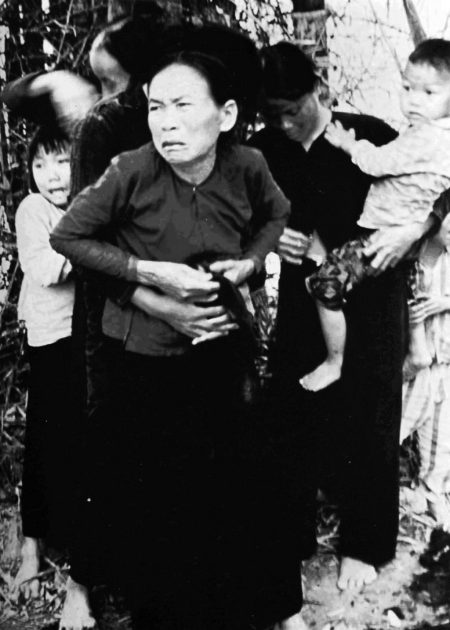
Women and children at My Lai moments before they were killed. Photograph : Ron Haberle/WikiCommons
By Michael Uhl | Mekong Review | February, 2018 edition
Monsters exist, but they are too few in number to be truly dangerous. More dangerous are the common men, the functionaries ready to believe and to act without asking questions.
— Primo Levy
On March 17th, 1968, The New York Times ran a brief front page lede headed, “G.I.s’ in Pincer Movement Kill 128 in Daylong Battle;” the action took place the previous day roughly eight miles from Quang Ngai City, a provincial capital in the northern coastal quadrant of South Vietnam. Heavy artillery and helicopter gunships had been “called in to pound the North Vietnamese soldiers.” By three in the afternoon the battle had ceased, and “the remaining North Vietnamese had slipped out and fled.” The American side lost only two killed and several wounded. The article, datelined Saigon, had no byline. Its source was an “American military command’s communique,” a virtual press release hurried into print and unfiltered by additional digging.
Several days later a more superficially factual telling of this seemingly crushing blow to the enemy was featured in Southern Cross, the weekly newsletter of the Americal Division in whose ‘area of operation’ the ‘day long battle’ had been fought. It was described by Army reporter Jay Roberts, who had been there, as “an attack on a Vietcong stronghold,” not an encounter with North Vietnamese regulars as the Times had misconstrued it. However, Roberts’ article tallied the same high number of enemy dead. When leaned on by Lt. Colonel Frank Barker, who commanded the operation, to downplay the lopsided outcome, Roberts complied, noting blandly that “the assault went off like clockwork.” But certain after action particulars could not be fudged. Roberts was obliged to report that the GIs recovered only “three [enemy] weapons,” a paradox that surely warranted clarification. None was given. It was to be assumed that, either the enemy was poorly armed, or that he had removed the weapons of his fallen comrades – leaving their bodies to be counted – when he retired from the field. Neither of the news outlets cited here, nor Stars and Stripes, the semi-official newspaper of the U. S. Armed Forces which ran with Robert’s account, makes reference to any civilian casualties.
It would be nearly eighteen months later when, on September 6, 1969, a front page article in the Ledger-Enquire in Columbus, Georgia reported that the military prosecutor at nearby Ft. Benning – home of the U. S. Army Infantry – was investigating charges against a junior officer, Lieutenant William L. Calley, of “multiple murders” of civilians during “an operation at a place called Pinkville,” GI patois for the color denoting man-made features on their topographical maps in a string of coastal hamlets near Quang Ngai.
With the story now leaked, if only in the regional papers – it would migrate as well to a daily in Montgomery, Alabama – the Ft. Benning public information officer moved to “keep the story low profile,” and “released a brief statement that The New York Times ran deep inside its September 7, 1969 issue,” limited to three terse paragraphs on a page cluttered with retail advertising. The press announcement from the Army flack had referred only to “the deaths of more than one civilian.” In the nation’s newspaper of record, which also mentioned Calley by name, this delicate ambiguity was multiplied to “an unspecified number of civilians.” Yet, once again, the Times was enlisted to serve the agenda of a military publicist, and failed to approach the story independently.
An Army recon commando named Rod Ridenhour had taken it upon himself to do just that. While still serving with the Americal Division’s 11th Light Infantry Brigade from which Task Force Barker – named for its commander – was assembled for the attack on Pinkville, Ridenhour documented accounts of those who had witnessed or participated in a mass killing. A year later in March 1969, now stateside and a civilian, Ridenhour sent “a five page registered letter” summarizing his findings to President Richard Nixon, the Joint Chiefs of Staff, and select members of the U.S. Congress urging “a widespread and public investigation.” General William Westmoreland, who had commanded U.S. forces in Vietnam until June 1968, reacted to Ridenhour’s allegations with “disbelief.” The accusations were, he told a Congressional committee, “so out of character with American forces in Vietnam that I was quite skeptical.” Nonetheless an inquiry was launched.
The Times, although forewarned, had once again squandered a chance to scoop for its global readership what was arguably the most sensational news story of the entire Vietnam War. The two regional reporters had done their legwork, then, bereft of big city resources had nowhere else to go. But in late October, a seasoned freelance journalist in Washington named Seymour Hersh, acting on a colleague’s anonymous tip from inside the military, immediately “stopped all other work and began to chase down the story,” which by mid-November 1969 would be revealed to the American public and the world at large as the My Lai massacre.
This outline of the massacre’s initial falsification and suppression, followed by its eventual disclosure, is cobbled from My Lai: Vietnam, 1968, and the Descent into Darkness (Oxford, 2017), a thorough retreatment of the infamous Vietnam War atrocity by Howard Jones, a professor of history at the University of Alabama. The question is, to what end? Has the voluminous, careful study in the literature devoted to the My Lai massacre left something out? It’s not a matter of omissions, the historian argues, but that the record is replete with conflicting interpretations. To tell the “full story” required Jones to reorder events in their “proper sequence,” he says. His other reasons for taking us back to Pinkville are equally vague, and casually embedded among several floating asides in the author’s Acknowledgments. His debts are many, but foremost among them Jones recognizes his Vietnamese-American graduate assistant who “emphasized the importance of incorporating the Vietnamese side into the narrative and remaining objective in telling the story.”
I took this profession of objectivity as a signal to be on the alert for its potential subjective or editorial opposite. Jones insists that “everyone who has written… about My Lai has had an agenda.” The suspicion that a subtle revisionist agenda, nurtured perhaps by the resentments of a partisan of the losing side [his assistant], might underlie Jones’ intentions for revisiting this much examined massacre was heightened by the anecdote he tells about his wife’s emotionally fraught response when listening to his grim descriptions of the slaughter. However revolting, the atrocities must be detailed she insists. To do otherwise, the author agrees “would leave the mistaken impression that nothing extraordinary took place at My Lai.”
That My Lai was extraordinary I hold beyond dispute. But the privileged attention given to the massacre by historians and other commentators – not to mention its impact on the general public – which by far prefers vivid superlatives to cloudy comparisons – hangs like a curtain and obscures the broader and far grizzlier picture of the U.S. driven horrors of the Vietnam War that were commonplace and quotidian. Would the historian tell that story too, I wondered, as I plunged into his text? Or was the only purpose to take up this subject again five decades on to ensure that the censorious curtain remained firmly in place?
Quang Ngai was a hot bed of resistance under the Viet Minh independence movement during French colonial rule. With the transition to the American War, resistance fighters – now reconstituted as the National Liberation Front, or Viet Cong – remained capable of striking at will throughout the province, which, until 1967, was under the jurisdiction of the South Vietnamese Army. But the American command found its native allies unreliable, without ever asking if perhaps their reluctance to challenge the local resistance rested, not on fear or cowardice, but familiarity or even kinship. U.S. soldiers possessed no such scruples.
After “intelligence sources” targeted the area around My Lai as “an enemy bastion for mounting attacks” on Quang Ngai City and its surroundings, American forces were concentrated under Task Force Barker, “a contingent of five hundred soldiers” to bring the troublesome province under control of the government of South Vietnam.[i]
On the evening before the assault, Captain Earnest Medina – like Calley a principal target of the Army’s subsequent investigation – briefed the hundred men of Charlie Company under his command. “We’re going to Pinkville tomorrow… after the 48th Battalion,” he told them. “The landing zone will be hot. And they outnumber us two to one… expect heavy casualties.” Charlie Company had already taken “heavy casualties” in the two months they’d been humping the boonies of Quang Ngai. The local guerrilla unit, the lethal, elusive 48th, was all the more feared since the GIs had never seen the face of a single combatant behind the sniper bullets or booby traps that bloodied and killed their comrades. “By the last week of February,” Harold Jones reckons, “resentment and hostility had spread among the GI’s, aimed primarily at the villagers.”
Pinkville had been declared a free fire zone. The mission for the assault was to search and destroy. If the soldiers encountered non-combatant villagers the text book regulations dictated they be detained and interrogated as to the whereabouts of the enemy, and then moved to safety in the rear. But the various strands of intelligence-gathering that guided Task Force Barker were interpreted to suggest there would be no non-combatants, because the villagers had been warned to evacuate, or, given that the assault was on a Saturday, those residents who’d defied evacuation would be off to the market in Quang Ngai City. This was all Intel double talk. The true military objective was that the residents have no village to return to because the GIs were primed to slay all livestock, lay waste to every dwelling and defensive bunker, destroy the crops and foul the wells, that is, to ensure that My Lai and its contiguous hamlets were left uninhabitable, and thus utterly untenable as bases to support the guerrillas.
Beginning just before 8 a.m. on March 16th, the three platoons of Charlie Company were airlifted to the fringes of the Vietnamese hamlets where they expected to encounter fierce enemy resistance. The hail of bullets from helicopter gunships that churned up the earth around them and aimed at suppressing potential enemy fire, created for many of these soldiers who had never experienced combat the impression that they’d been dropped in the midst of the “hot landing zone” Captain Medina had promised them. But as Army photographer Ron Haeberle, assigned to document the assault, would later testify, there was “no hostile fire.” The headquarters of the 48th and what remained of its fighters had taken refuge west into the mountains after being decimated during the Tet Offensive a month before. And the few VC who had been visiting their families around My Lai, hardly ignorant of American movements, had gotten out by dawn on the 16th.
In a state of confusion as to exactly what they were facing, Charlie Company’s platoons stepped off from opposing positions to sweep through the village, already partially damaged by artillery, intending to squeeze the enemy between them. Instead they soon confronted, not the guerrilla fighters they were sent to dislodge, but scores of inhabitants who weren’t supposed to be there. GIs immediately shot several villagers who panicked and attempted to flee. In this war such trigger happy killings were not far from the norm. But Lieutenant Calley “had interpreted Medina’s briefing to mean that they were to kill everyone in the village… Since it was impossible to distinguish between friend and foe, the only conclusion was to presume all Vietnamese were Viet Cong and to kill them all.” Calley, moreover, was being relentlessly spurred by Medina over the radio to quicken the pace of the 1st platoon’s forward sweep, and therefore, would later claim, he could neither evacuate the non-combatants, nor, for reasons of security, leave them to his rear.
Jones offers from the record a facsimile of the field radio transmission between Calley and his commander:
“What are you doing now?” Medina asked.
“I’m getting ready to go.”
“Now damn it! I told you now. Get your men in position now.”
“And these people, they aren’t moving too swiftly.”
“I don’t want that crap. Now damn it, waste all those goddamn people! And get in the damn position.”
“Roger.”
The idea of questioning orders, comments Jones dryly, never crossed Calley’s mind, particularly during combat.
One brief panel of the horror show will suffice to roil the imagination toward grasping what Jones styles a ‘descent into darkness,” which, given the scale of the ensuing carnage that morning, has elevated the My Lai massacre to the extraordinary status in the Vietnam War that history has bestowed upon it.
Calley, in the grip of all his embedded demons – his mental and moral mediocrity, his cracker barrel knee jerk racism, his incompetence as a leader, his slavish kowtowing to authority which clearly disgusted his commander and his troops, everything that conspired to create the monster that was him – returned from his latest whipping by Medina to where one group of villagers sat on the ground, and demanded of two members of his platoon, “How come you ain’t killed them yet?” The men explained they understood only that they were to guard them. “No,” Calley said, “I want them dead… When I say fire… fire at them.” Calley and, Paul Meadlo – whose name would become almost as closely associated with the massacre as Calley’s – “a bare ten feet from their terrified targets… set their M-16s on automatic… and sprayed clip after clip of deadly fire into their screaming and defenseless victims… At this point, a few children who had somehow escaped the torrent of gunfire struggled to their feet… Calley methodically picked off the children one by one… He looks like he’s enjoying it,” one soldier remarked, who moments before had been prevented by Calley from forcing a young woman’s face into his crotch, but who now refused to shoot.
The mass killing, which Harold Jones parades scene by scene with exhaustive precision, was repeated throughout the morning until the bodies of hundreds of villagers lay scattered across the landscape. Not just those killed by Calley’s platoon, but by others throughout the rest of Charlie Company. And not just at My Lai 4, but also at My Khe 4 several miles distant by members of Bravo Company. “In not a few cases, women and girls were raped before they were killed.” Jones dutifully chronicles the accounts of the few who resolutely refused to shoot, and of one man who blasted his own foot with a .45 to escape the depravity. “Everyone except a few of us was shooting,” Pfc. Dennis Bunning of the second platoon would later testify.
But there was another man that morning who didn’t just seek to avoid the killing, he attempted to stop it.
Warrant Officer Hugh Thompson piloted his observation helicopter, a three seater with a crewmember on each flank armed with a machine gun, several hundred feet above My Lai. Thompson’s mission was to fly low and mark with smoke grenades any source of enemy fire, which would prompt the helicopter gunships tiered above him – known as Sharks – to swoop down and dispense their massive fire power on the target. Spotting a large number of civilian bodies in a ditch, Thompson at first suspected they’d been killed by the incoming artillery. Hovering near the ground for a closer look Thompson and his crew, Gary Andreotta and Larry Colburn, were stunned to witness Captain Medina shoot a wounded woman who was lying at his feet. Banking closer to the ditch, Thompson “estimated he saw 150 dead and dying Vietnamese babies, women and children and old men… and watched in disbelief as soldiers shot survivors trying to crawl out.”
Against regulations, Thompson landed and confronted Lieutenant Calley, asking him to help the wounded and radio for their evacuation. Calley made it clear he resented the pilot’s interference and would do no such thing. Thompson stormed away furiously warning Calley “he hadn’t heard the last of this.” With Medina again at his heels, Calley ordered his sergeant “to finish off the wounded,” and just as Thompson was taking off the killing resumed.
Aloft again Thompson saw “a small group… of women and children scurrying toward a bunker just outside My Lai 4… and about ten soldiers in pursuit,” and felt “compelled… to take immediate action.” He again put his craft down, jumped out between the civilians and the oncoming members of the second platoon led by Lieutenant Stephen Brooks. When Thompson asked Brooks to help evacuate the Vietnamese from the bunker, Brooks told him he would do so with a grenade. The two men screamed at each other. Like Calley, Brooks was unyielding, and Thompson warned his two gunners, now standing outside the chopper, “to prepare for a confrontation.”
“I’m going to go over to the bunker myself and get those people out. If they [the soldiers] fire on those people or fire on me while I’m doing that. Shoot ‘em.” That moment has been cast in the My Lai literature as a classic armed standoff. But Thompson’s two gunners had not aimed their weapons at Brooks and his men who stood fifty yards away, a bit of manufactured drama several chroniclers of that confrontation, among them Sy Hersh, have chiseled into the record. Harold Jones in this instance had gone beyond the dogged task of compilation. While researching his book, he had spent many hours with Larry Colburn, and befriended him. And it was Larry who told Jones that he and Andreotta did not aim their weapons directly at the soldiers who faced them. They tried to stare then down, “while carefully pointing their weapons to the ground in case one of them accidentally went off.” This verisimilitude restores a dimension of realism to a scene imagined by those who’d never been soldiers.
Checking Brooks, but failing to get his cooperation, Thompson took another extraordinary step. He radioed Warrant Officer Danny Millians, one of the pilots of the gunships, and convinced him to also defy the protocols against landing in a free fire zone. Then, in two trips, Millians used the Shark to transport the nine rescued Vietnamese, including five children, to safety. Making one final pass over the ditch where he’d locked horns with Calley, Thompson “hovered low… searching for signs of life while flinching at the sight of headless children.” Thompson landed a third time, remaining at the controls. He watched as Colburn, from the side of the ditch, grabbed hold of a boy that Andreotta, blood spilling from his boots, had pulled from among a pile of corpses. Do Hoa, a boy of eight, had survived.
Livid and in great distress at what he had witnessed, Thompson, on returning to base, and in the company of the two gunship pilots, made their superior, Major Frederic Watke, immediately aware of “the mass murder going on out there.” From that moment, every step taken to probe and verify “the substance of Thompson’s charges almost instantly came into dispute.” Although Watke would later tell investigators he believed Thompson was “over-portraying” the killings” owing to his “limited combat experience,” the major had realized that the mere charge of war crimes obliged him “to seek an impartial inquiry at the highest level.” The Military Assistance Command, Vietnam (MACV) required that field commanders investigate “all known, suspected or alleged war crimes or atrocities… Failure to [do so] was a punishable offense.” Having reported Thompson’s allegations to Task Force commander Barker, Watke had fulfilled this duty. But there was a Catch-22 permitting command authority to ignore the MACV directive if they “thought” a war crime had not been committed.
The trick here was for Barker and several other ranking officer in the division and brigade chain of command to assess if civilians had been killed during the assault, and if so, how many. Captain Medina – in addition to contributing to the fictional enemy body count – would supply a figure of “thirty civilians killed by artillery.” The division chaplain would characterize these deaths as “tragic… an operational mistake… in a combat operation.” For this line of argument to carry, however, it had been necessary for the commander of the Americal Division, Major General Samuel Koster, the “field commander” who alone possessed the authority to prevent the accusations from going higher, to put his own head deep into the sand.
When Colonel Orin Henderson, who commanded the 11th Infantry Brigade from which Medina’s Charlie Company had been detailed to the Task Force, ordered LTC Barker in the late afternoon of March 16th to send Charlie Company back to My Lai 4 to “make a detailed report of the number of men, women and children killed and how they died, along with another search for weapons… Medina strongly objected.” It would be too dangerous, he said, to move his men “in the dark through a heavily mined and booby trapped area… where the Vietcong could launch a surprise attack.” Monitoring the transmission between Barker and Medina, General Koster countermanded Henderson’s order. Later claiming he was “concerned for the safety of the troops,” Koster saw “no reason to go look at that mess.” Medina’s estimate of the number of civilian deaths, Koster ruled, was “about right.”
Not only had Koster’s snap judgement given Barker license to cook up the initial battlefield fantasy of 128 enemy dead, it ensured that the internal investigations into the charges of “mass murder,” notably by Henderson and other high ranking members of Koster’s staff, would not deviate from the conclusion voiced by the division commander. By navigating each twisting curve along a well camouflaged path toward the fictive end those in command were seeking, Harold Jones lays bare a virtual text book case of conspiracy, which must be read in its entirety to capture the intricate web of fabrication and self-deception the conspirators constructed to assure themselves the crypt of the cover-up had been sealed.[ii]
When discussing the massacre later at an inquiry, the Americal Division chaplain, faithful to the Army but not his higher calling, claimed that, had a massacre been common knowledge, it would have come out. That the massacre was “common knowledge” to the Vietnamese throughout Quang Ngai Province on both sides of the conflict (not to mention among their respective leadership on up to Hanoi and Saigon) goes without saying. Indeed low ranking local South Vietnamese officials attempted to stir public outrage about the massacre (not to mention negotiate the urgent remedy of compensation for the victims), and were suppressed by the Quang Ngai Province Chief, a creature of the Saigon government who fed at the trough of U.S. materiel and did not wish to risk the good will of his American sponsors. My Lai was quickly recast as communist propaganda, pure and simple.
While this proved a viable method of suppression for South Vietnamese authorities, it could not still tales of the massacre in the scuttlebutt of the soldiers who had been there, who had carried it out. From motives said to be high minded, but not fueled by an anti-military agenda, and in the piecemeal fact-gathering manner typical of any investigation, the whistleblower Ron Ridenhour had thus resurrected the buried massacre, and bestowed on Sy Hersh the journalistic coup of a lifetime.
As the articles and newscasts about what took place at My Lai were cascaded before the public in November 1969, efforts to manage the political fallout by various levels of government were accelerated with corresponding intensity. Pushing back at the center of that storm were Richard Nixon and other members of the Executive; congressional committees in both the House and Senate; and not least, and in some cases with considerably more integrity than their civilian political masters, members of the professional military.
Not surprisingly, if one understands anything about American society, a substantial portion of the public, in fact its majority, expressed far greater sympathy for William Calley than for his victims. One could cite endemic American racism as a contributing factor for this unseemly lack of human decency. More broadly speaking, an explanation less charged by aggression would point to a level of provincialism that apparently can only afflict a nation as relatively pampered as my own. In such an arrangement, turning a blind eye for expedience sake toward the pursuit of global power, consequences be damned, is as good as a national pastime.
Despite the spontaneous public sympathy for Calley, Nixon, fretted that news of My Lai would strengthen the antiwar movement and “increase the opposition to America’s involvement in Vietnam.” Nixon, true to form, lashed out with venom at the otherness of his liberal enemies. “It’s those dirty rotten Jews in New York who are behind this,” Nixon ranted, learning that Hersh’s investigation had been subsidized by the Edgar B. Stern Family Fund, “clearly left-wing and anti-Administration.” Nixon was strongly pressed to “attack those who attack him… by dirty tricks… discredit one witness [Thompson] and highlight the atrocities committed by the Viet Cong.” Only Secretary of Defense Melvin Laird seemed to grasp that manipulation of public opinion would not perfume the stink of My Lai. The public might tolerate “a little of this,” Laird mused, “but you shouldn’t kill that many.” There was apprehension in the White House because calls for a civilian commission had begun to escalate. Habituated to work the dark side, and unbeknownst to his Secretary of Defense, Nixon formed a secret task force “that would seek to sabotage the investigative process by undermining the credibility of all those making massacre charges.”
Nixon found a staunch ally for this strategy in Mendel Rivers, the “hawkish” Mississippi Democrat who chaired the House Armed Services Committee. As evidence from the military’s internal inquiries mounted to prove the contrary, members of River’s committee sought to establish that no massacre had occurred, and that the only legitimate targets of interest were Hugh Thompson and Larry Colburn (Gary Andreotta having been killed in an air crash soon after the massacre), who were pilloried at a closed hearing, virtually accused of treason for turning their guns on fellow Americans.
During a televised news conference on December 8th – with Calley’s court martial already under way for three weeks – Nixon announced that he had rejected calls for an independent commission to investigate what he now admitted for the first time “appears to have been a massacre.” The President would rely instead on the military’s judicial process to bring “this incident completely before the public.” The message the Administration and its pro-war allies would thenceforth steam shovel into the media mainstream wherever the topic was raised, was that My Lai was “an isolated incident,” and by no means a reflection of our “national policy” in Vietnam.
As maneuvers to re-consign the massacre to oblivion faltered, the Army was just then launching a commission of its own under a three-star general, William Peers, whose initial charge was to disentangle the elaborate cover-up within the Americal Division that had kept the massacre from exposure for almost two years. In order to reconcile the divergent testimonies among its witnesses, the scope of the Peers Commission soon necessarily expanded to gather a complete picture of the event the cover-up sought to erase. The Army’s criminal investigation by the CID, on which charges could be based, and which would guide any eventual legal proceedings, continued on a separate track and beyond the public eye as a matter of due process.
After Lieutenant General Peers had submitted the commission’s preliminary report, Secretary of the Army, Stanley Resor moved to soften the “abrupt and brutal” language. He requested that Peers not refer “to the victims as elderly men, women, children and babies,” but as “noncombatant casualties.” And might Peers “also be less graphic in describing the rapes?” Resor further edited the word “massacre” from the report, and when presenting it to the press, had the chair of his commission describe My Lai rather as “a tragedy of major proportions.” Peers was reportedly indignant, but complied. It required no such compulsion to ensure that Peers toe the line on a far more central theme. Responding to questions from the media, Peers insisted there had been no cover-up at higher levels of command beyond the Americal Division, and echoed his Commander in Chief’s mantra that My Lai was an isolated incident. When Peers was questioned about what took place at My Khe that same day, he insisted it was inseparable from what occurred at My Lai. No reporter followed up with a challenge to that assertion.
Investigators had a long list of suspects deployed at My Lai and My Khe in Task Force Barker, as well as those throughout the Americal chain of command, who they believed should be charged and tried. Some forty enlisted men were named, along with more than a dozen commissioned officers. [iii] Only six among them, two sergeants and four officers would ultimately stand trial. There would be no opportunity to enlarge the scope of the massacre through the spectacle of a mass trial that would, moreover, conjure images of Nuremburg and Tokyo where America dispensed harsh justice on its defeated enemies only two decades earlier. It was agreed upon by both Nixon and the Pentagon Chiefs that defendants would be tried separately and at a spread of different Army bases.
If the elaborate subterfuge employed to cover-up the massacre had been the work of individuals desperate to protect their professional military careers, the court martial proceedings reveal how an entire institution operates to protect itself. George Clemenceau, French Prime Minister during the First World War, is credited with the droll observation that ‘military music is to music what military justice is to justice.” Harold Jones, using the idiom of the historian, demonstrates in his summaries of the trials the disturbing reality behind Clemenseau’s quip.
First before the bar at Fort Hood, Texas in November 1969 was Calley’s platoon sergeant David Mitchell, that witnesses described as someone who carried out the lieutenant’s orders with a particular gusto. Then in January it was Sergeant Charles Hutto’s turn at Fort McPhearson, Georgia. Hutto had admitted turning his machine gun on a group of unarmed civilians. These two men were so patently guilty in the eyes of their own comrades that theirs were among the strongest cases the investigators had constructed for the prosecution. Both men were acquitted in trials that can only be described as judicial parodies.
At Mitchell’s trial the judge, ruling on a technicality, did not allow the prosecution to call witnesses with the most damning testimony, like Hugh Thompson. Hutto had declared in court that “it was murder,” but claimed “we were doing it because we had been told.” When the jury refused to convict him because Hutto had not known that some orders could be illegal, Harold Jones nails how the court was sanctioning “the major argument that had failed to win acquittal at Nuremburg.”
Shortly after Hutto’s trial, the Army dropped all charges against the remaining soldiers, fearing their claims to have been following orders would likewise find merit in the prevailing temper of the military juries. Heeding the judicial trend, Lieutenant General Jonathan Seaman, a regional commander exercising jurisdiction over officers above the rank of captain, dropped all charges against Major General Koster. By some opaque calculation which convinced no one, Seaman had concluded that Koster was not guilty of “intentional abrogation of responsibilities.” A hue and cry followed in the press and on Capitol Hill denouncing Seaman for “a white wash of the top man.” The outcry did prod the Pentagon to take punitive action against Koster. The general had already been dismissed as the commandant of West Point, and he was now demoted to brigadier general and stripped of his highest commendation.
Seaman informed Koster through internal channels that he held him “personally responsible” for My Lai, a kind of symbolic snub among gentlemen. But in exonerating the Americal commander, Seaman had, by design it can be argued, inoculated the higher reaches of command straight up to General Westmoreland from being held responsible for the actions of their subordinates, a blatant act of duplicity in light of the ruling at the Tokyo trials following World War II where lack of knowledge of atrocities committed by his troops had not prevented General Yamaschita from being hanged.
With Calley’s court martial already in progress, only three other officers, Medina and the Task Force Barker intelligence officer, Captain Eugene Kotouc, for war crimes, and 11th Brigade commander Henderson, for the cover-up, remained to be tried. Harold Jones deftly unspools how the flawed and self-protective system of military justice enabled trial judges in each case to provide improvised instructions to their juries which had all but dictated the acquittal of all three men. Kotouc had been charged with murdering a prisoner, whom, given the available evidence, he almost certainly had; still the jury found him not guilty in less than an hour. Asked if he would stay in the military, Kotouc gushed, “Who would get out of a system like this… it’s the best damn army in the world.”[iv]
Henderson’s and Medina’s trials were media spectacles in their own right, but mere side shows compared with the main event at Fort Benning, Georgia. The Calley trial opened in November, soon after the My Lai revelation. By the middle of March when the talented young prosecutor, Captain Aubrey Daniel, began his closing argument, a great majority of Americans had been glued to the courtroom drama for four months. Calley had a courtly elderly gent, George Latimer, a former Chief Justice of the Utah Supreme Court, and later an original member of the U.S. Court of Military Appeals, to lead his defense. Clearly Latimer knew his way around the arcana of military justice; moreover as a veteran of World War II who had achieved the rank of colonel, he was of the very caste. Latimer was confident he’d prevail. As the trial progressed, the testimony of nearly one hundred witnesses so prejudiced his client that Latimer desperately veered the defense toward an insanity plea, a strategy which foundered after three Army psychiatrists judged the accused to possess “the mental capacity to premeditate.” Finally Calley took the witness stand and quickly blundered. Under a rigorous cross-examination, Captain Daniel marched Calley back across the killing fields of Pinkville, at each step recapping eyewitness accounts, including the testimony of Hugh Thompson. Before he grasped the significance of his misstep, Calley had confessed to shooting into the ditch filled with Vietnamese victims. The verdict seemed ordained.
Yet, it was no slam dunk for the prosecution. The jury took eighty hours to deliberate, in the end finding Calley guilty of murder by a vote of four to two, one ballot shy of a mistrial, if not an outright acquittal. As a capital felony, Calley might have received the death penalty, but Daniel argued only for life imprisonment. On March 29, 1970 the judge agreed and passed sentence. Calley appeared shaken as he faced the court. Surely the shrinks had gotten it wrong in not certifying a case of mental dissociation as acutely obvious as Calley’s? He seemed the perfect robotic tool of the Cold War. Hadn’t he been madly insisting all along that he had not been killing humans, but only communists, including babes at the breast who would grow up one day to be communists themselves? Then again, maybe Calley wasn’t as clueless and out of touch as he came across. In addressing the judge at sentencing, one could read in Calley’s plea, “I beg you… do not strip future soldiers of their honor” as he had been stripped of his, a message defending the common man and shrewdly aimed at a wider audience beyond the courtroom that the defendant must have known was substantially in his corner.
The polls quickly confirmed this. 79% of the public opposed the conviction. Across an ideological divide embracing both the war’s supporters and opponents, a large majority saw Calley as a scapegoat, one man custom-made to bear the blame for the entire Vietnam fiasco. Nixon played this public frustration to his advantage. There was little opposition when the President saw fit to have the prisoner removed from the stockade, where he’d spent just one night, and returned to his own Ft. Benning apartment. Calley would serve only three and a half years under house arrest before going free, but, after the trial, he quickly faded into anonymity.
At the White House, only a week after the verdict, National Security Advisor Henry Kissinger reassured Nixon that “the public furor… [had] quieted down… Let the judicial process… take its normal course,” counselled Kissinger. Liberal efforts to stir “a feeling of revulsion against the deed,” and turn the trial into a referendum against the war, had failed. “In fact the deed itself didn’t bother anybody,” Kissinger added. “No,” Nixon agreed, picking up eagerly on his advisor’s cynical drift. “The public said, ‘Sure he was guilty but, by God, why not?’ ” Both laughed.[v]
The “deed” these two twisted political misanthropes found so amusing is memorialized at a shrine today in the My Lai township listing the names of the massacre’s 504 victims, more than half of whom were under the age of twenty, to include “forty-nine teenagers, 160 aged four to twelve, and fifty who were three years old or younger.”
In reflecting on the sordid tale he has chosen to historicize anew, and on its reduction by the U.S. political and military establishments to a judicial farce, Harold Jones explains how, “My Lai made it imperative nonetheless that the army institute major changes in training.” And further that “to understand the importance of restraint in combat, soldiers and officers must learn to disobey illegal orders… and the importance of distinguishing between ‘unarmed civilians… and the people who are shooting at us.’” Jones documents the extensive effort undertaken to incorporate this thinking by updating the rules of war, to “make them more specific, then teach, follow and enforce them.”
But in examining the next most infamous atrocity of modern memory committed by U.S. forces at Abu Ghraib during the recent Iraq War, Jones concludes that “the central problem… lies less in writing new laws and regulations than in having officers who enforce those already in effect.” That officers may not be inclined to such enforcement underscores the apparently insoluble dilemma of an autocratic institution, the military, at the heart of a civilian democracy to which it is, in principle, subordinate. But we have already been shown over a panoply of legal proceedings that, at least in its capacity to dispense justice, the military is a power unto itself.[vi] Jones does not follow that thought directly, but rather indulges in a philosophical aside which dilutes the unhappy subject of his history in the horrors that attend all wars, concluding darkly that, in the right situation, we are all “one step away from My Lai.”
It’s not that the historian entirely buys Nixon’s aberration line; Jones does refer to other reported atrocities in VN. But he does buy Peers’ “right situation” explanation for why My Lai stands out, quoting the Peers Commission report that “none of the other [investigated] crimes even remotely approached the magnitude… of My Lai.” That would depend on how one defines “magnitude.” Peers had failed to do the math, and so has Jones. The American invasion, and occupation for over a decade, left a trail of bloodshed and destruction throughout Vietnam that led elements of the antiwar movement worldwide to level the charge of genocide against the U.S.
What one pro-war historian lamented as a veritable “war crimes industry,” had sprung up within the U.S., not from the campuses of the middle class protestors, but among the ranks of returning veterans, who for roughly two years after My Lai was exposed, brought accounts of atrocities they had participated in or witnessed before the American public. Harold Jones, to demonstrate historical balance, provides a cursory account of this effort, referring to a “sizeable segment of Vietnam veterans who considered… that My Lai was not an isolated incident and that Calley had become a scapegoat for the high ranking civilian and military officials who drew up the policies responsible for the atrocities.”
Having already established that Nixon denied the link between My Lai and “national policy,” Jones does not engage the argument further. But the war veterans (including the present writer) were not suggesting that the policy of genocide was etched in a secret covenant buried in a Pentagon vault. We were saying, in effect, don’t just look at the record body count attached to the slaughter at Pinkville, and imagine you have a true picture of American crimes in that war. Count the day to day toll of Vietnamese civilian deaths that resulted from premeditated frames like “mass population transfers” – the Strategic Hamlet program, or “chemical warfare” – the saturation of the countryside with phenoxy herbicides like Agent Orange, that were already prohibited by the conventions of war to which the U.S. was a signatory.
Other strategic tools, the Air War, and the relentless, not atypically indiscriminate, bombardment by artillery and naval guns, were employed by American forces against the “unpacified” countryside with unprecedented savagery.[vii] While these displays of massive fire power are thought to have created the highest proportion of civilian casualties during the war, the battlefield tactics – search and destroy operations in free fire zones, systematic torture and murder of prisoners, the “mere gook rule,” that turned every dead Vietnamese into an enemy body count, were a close second. These are facts available to anyone who cares to know them.[viii]
In both detail and presentation Harold Jones, with My Lai: Vietnam, 1968, and the Descent into Darkness, has produced a work of considerable value, and it is fair to acknowledge that the work, as recently characterized in a brief note by the New York Times Book Review, must now be considered the standard reference for the massacre. As for the scale and volume of terrors inflicted on the Vietnamese people during the American War, Jones, hewing close to official doctrine in the U.S., fails to acknowledge that My Lai was just the tip of the iceberg.[ix]
Michael Uhl served with the 11th Light Infantry Brigade as leader of a combat intelligence team eight months after the My Lai massacre. On return from Vietnam he joined the antiwar movement, and organized fellow veterans to make public their personal accounts of American atrocities in Vietnam. He presents this history in the war memoir, Vietnam Awakening (McFarland, 2007).
Notes.
[i]. Heonik Kwon, in his study, After the Massacre: Commemoration and Consolation in Ha My and My Lai (University of California Press, 2006), attributed to allied forces operating in Quang Ngai Province, notably units of the ROK (Republic of Korea) Marines (p.44), “at least six large scale civilian massacres during the first three months of 1968… Two secret reports made by the district communist cells to the provincial authority recorded nineteen incidents of mass killings during this short period. The tragedy of mass killings had already been witnessed in Quang Ngai in 1966.”
In their recent documentary film series on the Vietnam War, Ken Burns and Lynn Novick reported that no province suffered more than Quang Ngai during the war, and no place was more dangerous for operating militarily.
[ii]. The author’s account of the cover-up reads as definitive; Harold Jones here follows closely Seymour M. Hersh in Cover Up (Random House, 1972).
[iii]. This would not include Barker, himself, who had died a month after the massacre when his helicopter crashed during a combat mission.
[iv]. This quote (p. 347) is from Four Hours in My Lai, by Michael Bilton and Kevin Sim, (Penguin, 1993), the standard work on the massacre for the past twenty-five years.
[v]. Harold Jones is reporting here from what he heard on the Nixon tapes recorded on April 8, 1971.
[vi] . One portrait of what has been called the West Point Protective Association embodying the Army’s Spartan ethic, can be found in a highly charged expose, co-authored by a former academy graduate, West Point: America’s Power Fraternity, by Bruce Calloway and Robert Bowie Johnson (Simon and Schuster, 1973).
[vii]. An extensive account of the Air War in Quang Ngai Province is found in The Real War by Jonathan Schell (Da Capo Press, 1988).
[viii]. The Vietnam Memorial Wall in Washington, D.C. with the names of the 58,282 American war dead is 475 feet long; a wall inscribed with the names of the Vietnamese war dead would go on for miles.
[ix]. Herbicide poisoning and unexploded ordnance are legacy issues of the war that continue to take their toll on Vietnamese victims to this day.
Michael Uhl is the author of Vietnam Awakening.
Operation Mongoose and North Korea
By Jacob G. Hornberger | FFF | March 15, 2018
In reporting on President Trump’s nomination of CIA Director Mike Pompeo for Secretary of State, the New York Times made a remarkable admission:
Mr. Pompeo has consistently taken one of the most hawkish lines on dealing with Pyongyang. He appears focused on regime change as the one sure way to resolve the North Korean problem. This week, he told Fox News that “never before have we had the North Koreans in a position where their economy was at such risk, where their leadership was under such pressure.” The United States, he says, should make “no concessions” in any negotiations.
Unfortunately, while many U.S. officials would look upon that paragraph nonchalantly, it actually goes a long way to explain why North Korea embarked on a program to acquire nuclear weapons.
To understand the import of the point that the Times makes about Pompeo, it is helpful to examine a top secret document of the U.S. national-security establishment, a document that was kept secret from the American people for more than 40 years. In fact, the only reason that we are able to see it now is because of the JFK Records Act, which mandated that the Pentagon, CIA, and other federal agencies release to the public all their records relating to the assassination of President Kennedy. This particular document wasn’t released until 1998.
The document related to Operation Mongoose, which was a top-secret regime-change plan of the U.S. national security establishment, one intended to oust the communist regime in Cuba, headed by Fidel Castro, and replace it with a pro-U.S. dictatorship, similar to the Fulgencio Batista regime that Cuban revolutionaries ousted from power in their 1959 revolution.
Keep in mind one important factor: Although Cuba was ruled by a communist regime, it never attacked the United States or even threatened to do so. It also never assassinated anyone in the United States. And it never committed any act of sabotage in the United States.
Nonetheless, that top-secret document starts out with the following sentence: “The U.S. objective is to help the Cubans overthrow the Communist regime from within Cuba and to institute a new government with which the United States can live in peace.”
Live in peace? The Cuban regime was living in peace with the United States. It simply wasn’t bowing and kowtowing to the United States and following its orders on how things were going to operate inside Cuba. That’s what the Pentagon and CIA considered not “living in peace” with the United States. That’s why they wanted to effect regime change in Cuba. It’s, in fact, why they are still dead set on regime change in North Korea.
Among the methods employed to effect regime change in Cuba was the infliction of massive economic suffering among the Cuban populace. The document even refers to this as “economic warfare.” That’s what the U.S. embargo was (and is) all about. The idea was that when the Cuban people were suffering enough, perhaps even dying, they would oust the Castro regime and replace it with a pro-U.S. regime. It’s also what the sanctions against North Korea are all about.
Needless to say, there was no concern expressed for the Cuban people suffering or dying from the embargo. They were considered a means to an end.
In fact, many years later, we saw this same phenomenon in Iraq, when U.S. officials were killing hundreds of thousands of Iraqi children with their sanctions on that country. Their indifference to that suffering was reflected by what the U.S. Ambassador to the UN, Madeleine Albright publicly stated — that the deaths of half-a-million Iraqi children were “worth it.” By “it” she meant regime change in Iraq.
Sabotage of Cuban industries was another method to bring about regime change. One idea was to introduce a corrosive element in locomotive fuel. Much more ominous, given the increased likelihood that people would die, was a plan to introduce corrosive elements into Cuban jet fuel.
The document also refers to other U.S. actions to foment dissent and revolution against the Castro regime, to be followed by U.S. military action to assist them.
Unmentioned in the document was the top-secret assassination partnership that the CIA had entered into with the Mafia without the consent or knowledge of President Kennedy, whose brother Robert was, at the same time, prosecuting the Mafia in federal court for criminal activity. The CIA’s notion was that it wielded the legitimate moral and legal authority to murder anyone who it deemed was a threat to U.S. “national security.” The Mafia, of course, was chagrined that Castro had nationalized the Mafia’s casinos in Havana and put an end to its lucrative (and illegal) U.S drug import business, much of which operated through Cuba.
That top-secret Operation Mongoose, regime-change document is dated January 8, 1962.
There is another top-secret document that came out in the 1990s thanks to the JFK Records Act. It was dated March 13, 1962. That document detailed Operation Northwoods, which called for plane hijackings and terrorist attacks on American soil carried out by U.S. agents secretly posing as Cuban communists. The idea was to provide President Kennedy with an official (and false) pretext for attacking and invading Cuba and effecting regime change there. It was unanimously endorsed by the Joint Chiefs of Staff. To his everlasting credit, Kennedy rejected the plan, earning him ever deeper enmity from his national-security establishment. (See FFF’s ebooks JFK’s War with the National Security Establishment: Why Kennedy Was Assassinated by Douglas Horne and Regime Change: The JFK Assassination by Jacob G. Hornberger.)
The Cubans invited the Soviets to install nuclear weapons later that year, in October 1962. While U.S. officials have long described the missiles as “offensive,” the Cuban position was actually quite defensive: If — and only if — you attack and invade us, we will defend ourselves with our Soviet-provided nuclear weapons.
Fortunately for the United States and the world, President Kennedy ended up “blinking” by agreeing not to invade Cuba (to the deep anger and rage of the Pentagon and the CIA, which were pressuring him to attack and invade during the entire crisis). Given that the threat of invasion was over, the Soviet Union, in turn, removed its nuclear missiles from Cuba.
Does anyone think that North Korea hasn’t familiarized itself with Operation Mongoose, Operation Northwoods, the CIA-Mafia assassination partnership, and these particular documents that were kept secret for more than 40 years? They know what the U.S. national-security establishment is up to in Korea. They know what the New York Times has pointed out about CIA Director’s Mike Pompeo’s desire for regime change in North Korea. They are not stupid. They know that nuclear weapons are the best way to deter against a U.S. regime-change operation in North Korea.
Featured Video
Nima R. Alkhorshid: US military bombs multiple targets on Iran’s Qeshm Island
or go to
Aletho News Archives – Video-Images
From the Archives
British Intel Tried to Make N Irish Gang ‘Shoot Up’ School, Documentary Claims
Sputnik – 23.02.2019
A new documentary, based on an interview with a self-confessed member of the Glennane Gang, gives some insights into allegations that British military intelligence was behind a shocking murder plot to cause the situation in Northern Ireland to “spiral out of control”.
In a documentary, Unquiet Graves: The Story of the Glennane Gang, John Weir, a former officer from the Royal Ulster Constabulary (RUC), alleges that British intelligence tried to persuade paramilitary group Ulster Volunteer Force (UVF) to attack a Catholic primary school at Belleeks in County Armagh.
Weir claimed that the UVF was urged to kill children and teachers in retaliation for the 1976 Kingsmill massacre, in which gunmen stopped a minibus carrying twelve workmen and shot them; only one person survived despite having been shot 18 times.
“The plan that was decided on was to shoot up a school in Belleeks”, he said, adding that the British intelligence plot was to make the situation in Northern Ireland “spiral out of control”. … continue
Blog Roll
 Aletho News
- Zelensky’s Critics Vanish Into Ukrainian Secret Prisons – Source
- Nima R. Alkhorshid: U.S. Military Bombs Multiple Targets on Iran’s Qeshm Island
- Iran-Linked Ships Spotted Hovering over Subsea Cables: Report
- New attack on Iran could devastate ‘Israel’, IOF general warns
- Nuclear deterrence: The US-Israeli military aggression against Iran made the unthinkable legitimate
- U.S. Midterms – a Referendum on Israel and Zionist Power
- Twice as many Canadian Jews serve in Israeli military as Canada’s armed forces: Report
- Thousands of Syrian troops set to join Saudi war on Yemen
- Jared Kushner’s Diplomacy for Hire
- Russia backs Tehran’s conditions in talks with US, Iran’s envoy says
- If Americans Knew
- An error has occurred; the feed is probably down. Try again later.
- No Tricks Zone
- Zonal Asymmetry of Temperature Change in the Antarctic Circumpolar Current
- New Study: The Net Fossil Fuel Contribution To Rising Atmospheric CO2 Has Been Zero For 500 Years
- Germany’s Green Energy Transition Becoming Increasingly Expensive…Another 6 Trillion Euros!
- Sudden Stratospheric Warming, Powerful El Niño Combination May Lead To Extreme Europe Cold, Energy Crisis!
- Two New Studies Find Thwaites Glacier Melt Cannot Be Driven By Human Activity Or A Warming Ocean
- E-Cars Reduce CO2 Emissions By Only 41% Compared To Internal Combustion Engine Vehicles
- Predictions Made By Renowned Climate Professor Over Past Decades Have Been Proven To Be Poor
- New Study Suggests Large Regions Of The Pacific Ocean Have Been Cooling For The Last 80 Years
- Germany’s Green Energy Debacle: High Energy Costs Force Kahla Porzellan to Close After 182 Years!
- New Study: 50 Years Of The Most Aggressive ‘Net Zero’ Policies Can Only Affect The Global Climate By 0.03°C

