Liberals, Conservatives Worry About Korean Peace Threat
By Gregory Shupak | FAIR | March 15, 2018

Washington Post‘s Max Boot (3/8/18)
Commentators across the spectrum of acceptable establishment opinion are alarmed by the possibility of peace breaking out on the Korean peninsula.
Some oppose the idea of talks between US President Donald Trump and North Korean leader Kim Jong-un on principle. Washington Post columnist Jennifer Rubin (3/9/18), for instance, suggested that Trump should not meet with Kim:
Is Trump now to glad-hand with Kim, treating him as just another world leader? Will Trump even bring up human rights? (You will recall that, in 2008, then-candidate Barack Obama was ridiculed for suggesting he’d sit down with the North Korean dictator; he prudently backed off that idea.)
Her newly hired colleague Max Boot (Washington Post, 3/8/18) concurred:
As recently as August, Trump tweeted: “The US has been talking to North Korea, and paying them extortion money, for 25 years. Talking is not the answer!” He was absolutely right.
Boot went on to contend:
The South Koreans claim that the North Koreans are willing to discuss denuclearization, but the likelihood is that they will only do so on terms that the United States should never accept. Kim may offer to give up his nukes if the United States will pull its forces out of South Korea and sign a peace treaty with the North.
What Boot sees as a doomsday scenario—peace between the two Koreas and the withdrawal from the peninsula of US troops, which serve as a constant threat to the North and thus ensure the permanent threat of war—is actually a formula for ensuring that there isn’t a second Korean war, one that is certain to be even more devastating than the catastrophic first one for Korea, and likely for the region and further afield.

Rachel Maddow (MSNBC, 3/9/18)
Rachel Maddow (MSNBC, 3/9/18) seemed flabbergasted by the prospect of a meeting between the leaders:
It has been the dream of North Korean leaders for decades now that they would advance their weapons programs and their nuclear programs so much so that the United States would be forced to acknowledge them as an equal and meet with the North Korean leader…. They got there with [Trump] and I don’t know that the administration intended it to be that kind of a gift. It’s just a remarkable time to be covering this stuff.
MSNBC blogger Steve Benen (3/9/18) says he’s “not opposed to direct diplomacy,” but he sounded like a time capsule from 1951 when he warned that
Trump has agreed to give Kim Jong-un exactly what he wants. North Korean leaders have sought this kind of meeting for decades because it would necessarily elevate the rogue state: It would show the world that North Korea’s leader is being treated as an equal by the Leader of the Free World.
New York Times columnist Nicholas Kristof (3/9/18) also claims to prefer that the US and North Korea exchange words rather than missiles, but he expressed relief that the threat of peace was minimal: “It’s genuinely encouraging that Kim doesn’t object to the US resuming military exercises,” he wrote, but worried that America
has agreed to give North Korea what it has long craved: the respect and legitimacy that comes from the North Korean leader standing as an equal beside the American president.
For Maddow, Benen and Kristof, a catastrophic nuclear war likely to kill millions is less threatening than the (frankly remote) possibility of America treating a small Asian country as an equal. This sort of commentary shows that liberal analysts are every bit as capable of a chest-thumping jingoism as their counterparts on the right.
In Praise of Sanctions
Sanctions on North Korea make it harder for aid organizations to operate in the country, and for people living there to obtain drugs and medical supplies, such as anesthesia used for emergency operations and X-ray machines needed to diagnose tuberculosis (Washington Post, 12/16/17). Tomás Ojea Quintana, the United Nations’ special rapporteur on human rights in North Korea, says he is “alarmed by reports that sanctions may have prevented cancer patients from access to chemotherapy and blocked the import of disability equipment.”
According to Kee B. Park (12/18/17), a neurosurgeon at Harvard Medical School, the hunger in North Korea “is devastating. And it’s our fault. Led by the United States, the international community is crippling North Korea’s economy” by “banning exports of coal, iron, lead, seafood and textiles, and limiting the import of crude oil and refined petroleum products,” “punishing the most vulnerable citizens” of the country. For example, UNICEF says that “an estimated 60,000 children face potential starvation in North Korea, where international sanctions are exacerbating the situation by slowing aid deliveries.”
The Post’s Boot, however, is impressed by the sanctions, and worried that they might be lifted: “North Korea hopes at a minimum for a relaxation of sanctions just when they are beginning to bite.” In the interest of precision, he should have added “60,000 children” after the word “bite.”
He continued:
It may make sense to talk to North Korea, but at a lower level, while maintaining the “maximum pressure” sanctions policy. Eventually the regime may feel so much pain that it will be willing to bargain in earnest.
North Korea doesn’t have the capacity to pain on the US, so it’s worth asking: Who will enforce hunger on America and destroy its economy to compel it to reverse its past approach (The Nation, 9/5/17) and “bargain in earnest” with North Korea? And would Boot endorse such an approach?
Boot can rest easy, however, about “so much pain” being reduced, as the Trump administration appears poised to maintain the sanctions until it determines that there has been “real progress” in the talks (AP, 3/13/18).
Kristof, like Boot, suggests that Trump “probably does” deserve credit for using sanctions to get North Korea to suspend tests of nuclear weapons:
First, Trump raised the economic pressure on North Korea with additional sanctions and extra support from China, and the pain was visible when I visited North Korea in September. Kim has made rising living standards a hallmark of his leadership, and sanctions have threatened that pillar of his legitimacy.
Kristof has made a career branding himself a bleeding heart concerned for the world’s most vulnerable but evidently his heart doesn’t bleed for “the most vulnerable citizens” of states that defy US dictates.
Pentagon Accuses Iran of Meddling in Iraqi Election
Sputnik – 16.03.2018
US Defense Secretary James Mattis accused Iran on Thursday of destabilizing Afghanistan and “mucking around in Iraq’s elections” by using money to sway the vote.
“We have worrisome evidence that Iran is trying to influence, using money, the Iraqi elections. That money is being used to sway candidates, to sway votes,” he told reporters.
The Pentagon chief, who was speaking after an unannounced trip to Afghanistan, said the US military believed the amount of money funneled by Iran to Iraq ahead of the May parliamentary polls was not “insignificant.”
He also suggested that the Iranian government was “doing things” in Afghanistan that were not helpful to US attempts to end the war there, although he did not give any details.
Iraq holds parliamentary election on May 12, with Haider al-Abadi seeking another term as prime minister.
Acceptable Bigotry and Scapegoating of Russia
By Natylie Baldwin | Consortium News | March 15, 2018
Over the last year and a half, Americans have been bombarded with the Gish Gallop claims of Russiagate. In that time, the most reckless comments have been made against the Russians in service of using that country as a scapegoat for problems in the United States that were coming to a head, which were the real reasons for Donald Trump’s upset victory in 2016. It has even gotten to the point where irrational hatred against Russia is becoming normalized, with the usual organizations that like to warn of the pernicious consequences of bigotry silent.
 The first time I realized how low things would likely get was when Ruth Marcus, deputy editor of the Washington Post, sent out the following tweet in March of 2017, squealing with delight at the thought of a new Cold War with the world’s other nuclear superpower: “So excited to be watching The Americans, throwback to a simpler time when everyone considered Russia the enemy. Even the president.”
Not only did Marcus’s comment imply that it was great for the U.S. to have an enemy, but it specifically implied that there was something particularly great about that enemy being Russia.
Since then, the public discourse has only gotten nastier. Former Director of National Intelligence James Clapper – who notoriously perjured himself before Congress about warrantless spying on Americans – stated on Meet the Press last May that Russians were uniquely and “genetically” predisposed toward manipulative political activities. If Clapper or anyone else in the public eye had made such a statement about Muslims, Arabs, Iranians, Jews, Israelis, Chinese or just about any other group, there would have been some push-back about the prejudice that it reflected and how it didn’t correspond with enlightened liberal values. But Clapper’s comment passed with hardly a peep of protest.
More recently, John Sipher, a retired CIA station chief who reportedly spent years in Russia – although at what point in time is unclear – was interviewed in Jane Mayer’s recent New Yorker piece trying to spin the Steele Dossier as somehow legitimate. On March 6, Sipher took to Twitter with the following comment: “How can one not be a Russophobe? Russia soft power is political warfare. Hard power is invading neighbors, hiding the death of civilians with chemical weapons and threatening with doomsday nuclear weapons. And they kill the opposition at home. Name something positive.”
In fairness to Sipher, he did backpedal somewhat after being challenged; however, the fact that his unfiltered blabbering reveals such a deep antipathy toward Russians (“How can one not be a Russophobe?”) and an initial assumption that he could get away with saying it publicly is troubling.
Glenn Greenwald re-tweeted with a comment asking if Russians would soon acceptably be referred to as “rats and roaches.” Another person replied with: “Because they are rats and roaches. What’s the problem?”
This is just a small sampling of the anti-Russian comments and attitudes that pass, largely unremarked upon, in our media landscape.
There are, of course, the larger institutional influencers of culture doing their part to push anti-Russian bigotry in this already contentious atmosphere. Red Sparrow, both the book and the movie, detail the escapades of a female Russian spy. The story propagates the continued fetishization of Russian women based on the stereotype that they’re all hot and frisky. Furthermore, all those who work in Russian intelligence are evil and backwards rather than possibly being motivated by some kind of patriotism, while all the American intel agents are paragons of virtue and seem like they just stepped out of an ad for Nick at Nite’s How to be Swell.
The recent Academy Awards continued their politically motivated trend of awarding Oscars for best documentary to films on topics that just happen to coalesce nicely with Washington’s latest adversarial policy. Last year it was the White Helmets film to support the regime change meme in Syria. This year it’s Icarus about the doping scandal in Russia.
Similarly, Loveless, the new film by Russian director Andrey Zvyagintsev (director of Leviathan) is being reviewed – as Catherine Brown points out – by writers from the mainstream American media in a predictably biased fashion. The film focuses on the disintegration of a married Moscow couple’s relationship and the complicated web of factors involved which have tragic ramifications for the couple’s 12-year old son.
American reviewers manage to paint the factors detailed in the film that are prevalent in most modern capitalist cities (e.g. being self-centered, materialistic and preoccupied with technological gadgets) as somehow uniquely Russian sins. They also ignore a prominent character in the film that defies their negativity about modern Russia – a character that represents altruism and the growth of civil society in the country.
A common theme in all this is that Russia is a bad country and Russians can’t help but be a bunch of good-for-nothings at best and dangerous deviants at worst. Indeed, according to media depictions, sometimes they manage to be both at the same time. But what they don’t manage to be is positive, constructive or even complicated. Sipher knows that the average American has been deluged with this anti-Russian prejudice, as reflected in his challenge at the end of his initial tweet about the largest country, geographically at least, in the world: Name something positive.
Countering the Negative
Most people know, at least in the abstract, that few individuals or groups are purely good or bad. Most are a complex combination of both. But many – including those who normally consider themselves to be open-minded liberals – have allowed their lizard brains to be triggered by the constant demonization of Russia in the hopes of taking down Trump whom they deem to be a disproportionate threat to everything they hold dear. So as a counterweight to all the negative constantly pumped out about Russia and to take Sipher up on his challenge, I will list some positive things about Russia and the contribution of the country and its people to the world.
Contemporary Russia’s Domestic Policy
Russia has one of the most educated populations in the world, universal health care for its people, a home ownership rate of 84%, strong gun control laws, no death penalty, 140 days of guaranteed maternity leave for women at 100% salary, and Moscow was just voted the 4th safest megacity in the world for women.
And, despite claims that are often repeated in corporate media and even by many in the alternative press, Russia has independent and critical voices in the print media. Even on television, which is heavily influenced by the Kremlin, the Western position is often given airtime by either pro-Western Russian critics or Westerners themselves. During both of my visits to Russia (in 2015 and 2017) I interviewed a cross-section of Russians who all confirmed that they had access to Western media through both satellite and the internet. Furthermore, while violence against journalists is a concern, according to the Committee to Protect Journalists, journalist murders have decreased significantly under Putin compared to the era of Boris Yeltsin in the 1990s.
Am I saying that Russia is a utopia without any problems? No. Like most countries, it has plenty. Most Russians, including Putin, admit this. These problems include still significant poverty rates, comparatively low productivity and life expectancy, and corruption. But it is important to note the direction of trends, which are mostly positive since Putin took over. Under his leadership, poverty rates have been cut in half, life expectancy has increased by several years – especially among men who had suffered the worst mortality crisis since WWII, crime has dropped, pensions have increased and are paid regularly, the unemployment rate has been around 5% for years, great investments in infrastructure and agriculture have been seen along with development throughout the country.
And that development has not just been seen in Moscow and St. Petersburg – the latter city which, by the way, culturally and architecturally rivals those in France and Italy.
There are plenty of medium-sized cities throughout Russia that are becoming well-developed and culturally engaging. As one example, during my 2015 trip, I visited Krasnodar, located in the Black Sea region. The rate of civic construction in the city during 2014 surpassed even Moscow. As a consequence of the challenges of this rapid development, the public felt that decisions were not being made with sufficient feedback from residents, several of whom got together and created a group called the Public Council which eventually found ways to get city authorities to listen to their concerns.
The group had received significant media attention, networked with youth groups and infrastructure specialists, and received foreign experts in urban planning, public arts, transportation and city marketing. They have also organized periodic clean-up and renovation days, which are sponsored by local businesses that donate use of equipment. Currently, they are working on the creation of protected green zones, including one that connects all of the city’s hiking paths and another to connect its 16 lakes. They have received no opposition from the Russian government and have elicited the interest of other cities who want to model their approach to local issues.
While in Krasnodar I met a dozen or more professionals, from lawyers to engineers and doctors, who lived in the city and were part of another civic group engaged in charitable, conservation and youth programs. At one point, I took a walking tour of the city. In terms of architecture, I saw the old and the new side by side, including a large shopping center that was built around a large tower that had been there for generations that local residents saved from destruction by the mall planners, a square with controversial fountains, and a main thoroughfare that was closed to auto traffic, allowing pedestrians free reign. Couples – including some of mixed race, parents pushing baby strollers, and bicyclists – all wound their way through the streets as both Russian and American music was piped in and building walls on one side of the street for a stretch displayed delicate illustrations of Russian history.
Fifteen hundred miles away in the Ural mountain region, the city of Yekaterinburg – named after Catherine I – has the infamous distinction of being the place where Czar Nicholas II and his family were massacred by the Bolsheviks in 1918. On the site where the family’s bodies were exhumed, a magnificent Russian Orthodox Church has been erected and dedicated to the last royal family. Nearby is the Yeltsin Library, denoting the Russian Federation’s first President, although his legacy is not popular in Russia today.

Yekaterinburg
The city is also home to a wide variety of precious metals and gems, along with a thriving economy. According to Sharon Tennison, an independent program coordinator who has traveled there numerous times over the past 15 years, hundreds of new apartment blocks can be seen on the outskirts of the city to accommodate the recent economic and population growth.
Yekaterinburg has a bustling cultural life that includes an opera house, a ballet, numerous theaters and museums, as well as dozens of libraries. In this respect, the city has continued its preoccupation with the classical arts as in Catherine’s period. At the same time, many modern Russian rock bands with a distinctive sound have formed there (known as Ural rock).
The city also has a low rate of violence and crime.
As the New York Times and NPR like to point out and generalize out from, there are some rural and industrial areas in Russia that still need attention and investment. However, there are other towns in the countryside that are doing well.
Russia’s Contributions to the World
Russia has made many cultural and humanitarian contributions to the world. In the 18th and 19th centuries, imperial Russia produced some of the most renowned figures in the world of arts. These include writers, such as Tolstoy and Dostoevsky, whose works are often cited by American readers as among the greatest of all time; great composers include Tchaikovsky, Stravinsky and Rachmaninoff.
The country also has a rich history of pre-Soviet philosophers who debated questions of politics, history, spirituality and meaning. One of the most famous is Vladimir Solovyev, classified as belonging to the Slavophile school but distinguished from his fellow Slavophiles by his openness to and integration of several lines of thought.
He acknowledged the intuitive as well as the rational. He was friends with Dostoyevsky but had disagreements over Orthodoxy since Solovyev was an advocate of ecumenism and healing the schism between Orthodoxy and Catholicism. Furthermore, he is credited with influencing Nicolai Berdyaev, Rudolf Steiner and the Russian Symbolists, among others. He admired the Greek goddess Sophia who he characterized as the “merciful unifying feminine wisdom of God.” Solovyev was adept at integrating several spiritual strands, such as Greek philosophy, Buddhism, Kabbalah, and Christian Gnosticism.
Solovyev was famous for his debates with Slavophile contemporary, Nicolai Fedorov. In these and other writings, questions about morality and technological progress, how much humans should control nature, and prioritizing which problems to invest man’s resources in solving were all given great consideration by Solovyev and are still relevant today, in both Russian society and the larger world.
It is interesting to note that, of all the early Slavophile philosophers, Putin chose Solovyev, the one who was the least strident and most open to the synthesis of differing values and viewpoints, as part of his assignment of books for Russia’s regional governors to read a few years back. Of course, that didn’t stop several western pundits – who showed they knew virtually nothing of Solovyev but perhaps some cherry-picked and out-of-context tidbits they’d found online – from distorting his writings, which naturally had to be horrible because Putin recommended them.
Moving on to the 20th century, it should not be forgotten that the Soviet Union bore the brunt of defeating the Nazis during WWII, losing 27 million people, and saw a third of their country destroyed in the process.
In the 21st century, Russia provided significant aid to Americans in the aftermath of Hurricane Katrina and Hurricane Sandy. They also provided safe transport to Yemeni-Americans out of that devastated country after the U.S. State Department effectively abandoned them in 2015. Russia provided medical aid to 60,000 people affected by the Ebola epidemic in West Africa in 2014. Last September, Russia provided 35 tons of aid to earthquake victims in Mexico.
For someone who spent years in Russia as a professional expert working for the U.S. intelligence community, John Sipher is either not well-informed on his subject or is intentionally being disingenuous when it comes to the suggestion that Russia has done nothing positive, whether under Putin’s governance or before.
The Purpose of Scapegoating Russia
In early 2017, journalists Jonathan Allen and Amie Parnes published a book called Shattered: Inside Hillary Clinton’s Doomed Campaign. Largely based on interviews with insiders from Hillary Clinton’s failed 2016 presidential campaign, the book was an attempt to analyze why she lost. The insiders agreed that Clinton had trouble providing a plausible explanation to voters as to why she was running other than that she simply wanted to be president. They also noted her trouble connecting with average Americans and her failure to campaign in certain rust belt areas that Trump ultimately got support in. The book also states that within 24 hours of Clinton’s loss, members of her campaign had decided to home in on the excuse of “Russian interference” to explain away her humiliating defeat.
In addition to a bloc of Clinton’s supporters continuing to push this excuse for her loss and the ratings motive that channels like CNN and MSNBC have in continuing to milk the scandal, there is also Robert Mueller’s investigation which has dragged on for over a year.
The most notable thing about the Mueller investigation to anyone who takes a sober look at it is its constantly evolving purpose. First, the purpose of the investigation was to find any evidence to support the allegation that Russia had hacked into the DNC’s emails. When no substantial evidence could be found to support that allegation, the purpose evolved into collusion between Trump and Russia to steal the election on behalf of Trump.
When no substantial evidence could be found to support that allegation, the purpose evolved yet again into Russia influencing the election on behalf of Trump, possibly without his knowledge or participation. When no substantial evidence could be found to support that allegation and all that could be found was a paltry number of social media ad buys – many of which were purchased after the election or advocated conflicting positions or didn’t even have anything to do with the election, the purpose became “sowing discord.”
After all of this, we have an indictment against 13 private individuals who worked for a “troll farm” that had been exposed several years ago and is run by a caterer with no proven orchestration by Putin or the Kremlin. Mueller also knows that this indictment will never be legally tested because the 13 individuals will never be extradited and stand trial.
After all the shrieking and howling 24/7 for close to a year and a half that Trump was an illegitimate president installed by the Kremlin, this is the best Mueller and the mainstream Democrats can come up with. It’s pretty obvious by now that this investigation has simply been feeding into the media and Democratic Party circus mentioned above rather than uncovering anything substantive with which to impeach Trump.
The 2016 election showed that the Democrats faced a sleeping giant that had been awakened – one that the Democratic Party had helped to create for decades by enabling lower living standards, outsourcing of good-paying jobs, the proliferation of low-wage jobs, unaffordable education, lack of health care coverage, public health problems, and decrepit infrastructure.
Consequently, there was a demand for meaningful policies that would help average Americans, policies that polls show they want. But mainstream Democrats will not deliver on such policies, like $15/hour minimum wage, Medicare for All, and pulling out of our wars and investing the money saved in jobs and infrastructure. They won’t deliver on these things for the same reason that Republicans won’t deliver on them: because their donors don’t want them to. But they are not going to admit that to the American people who were going to keep demanding, so they needed a scapegoat and a diversion.
It’s a cheap trick that the political elite is using to appeal to the basest instincts of their fellow Americans while shoring up support for their most reckless tendencies in the area of foreign policy.
Natylie Baldwin is co-author of Ukraine: Zbig’s Grand Chessboard & How the West Was Checkmated, available from Tayen Lane Publishing. Since October of 2015, she has traveled to six cities in the Russian Federation and has written several articles based on her conversations and interviews with a cross-section of Russians. Her fiction and nonfiction have appeared in various publications including Consortium News, The New York Journal of Books, The Common Line, and the Lakeshore. She is currently submitting her first novel to agents and finishing a second. She blogs at natyliesbaldwin.com.
Hold my beer and watch this!
The Saker | March 15, 2018
Rattlesnakes have a terrible reputation. Here were I live, in Florida, we have the biggest rattlesnakes on the planet, the Eastern Diamondback (Crotalus adamanteus). They are huge and can reach well over 2m (6ft) in length and weigh up to 15kg (30lbs). The Eastern Diamondback’s venom is not the most potent out there, but they can deliver *a lot* of it. So, yes, it is a formidable creature. But it is also a gentle creature and truly very shy one.
Eastern Diamonbacks are also a stunningly beautiful creatures. I confess that I absolutely love them.
For all their reputation for nastiness, Eastern Diamonbacks will never ever attack you if they can avoid it. I have seen a lot of these snakes on my hikes, I have manipulated them (with a hook), and I have seen my German Shepherd come nose to nose with one (literally) and that Eastern Diamondback did not strike. Why? Because these snakes will do everything they can to avoid having to bite you.
First and foremost, they hide. Really well. You can stand right next to a large Eastern Diamondback and never notice it. You can walk right by, and it won’t move, or rattle its tail, and you will never know that it was there. Camouflage is their first line of defense.
Then, if discovered, they will rattle their tails. If needed, very loudly. You can easily hear the rattle from an Eastern Diamondback from 5m (15ft) away. More than enough distance to easily avoid it.
Furthermore, if given the chance, the Eastern Diamondback will retreat and hide.
Finally, when cornered a lot of them try what is called a “dry bite”: they do bite you, but deliver no venom. Why? Because you are not prey, so what would be the point of envenoming you? The Eastern Diamondback does not want you dead, it wants you to let it live!
I was once told by a park ranger in Arizona that the profile of a typical rattlesnake bite victim is: white, male, with tattoos and the famous last words “hold my beer and watch this!“.
Why am I telling you all this?
Because that is exactly what I see happening before my horrified eyes.
Russia is the Eastern Diamondback desperately trying to do all it can to avoid to have to strike. The West is the drunk idiot full of hubris, arrogance and a very mistaken sense of invulnerability saying “hold my beer and watch this!“.
Keep in mind that in a confrontation with a drunken human the Eastern Diamondback is most unlikely to survive. And it knows that, and that is why it does everything it can to avoid such a confrontation in the first place. But if cornered or attacked the Diamondback will strike. Hard. Want to see what such a strike looks like? Like this:

You most definitely do NOT want to be on the receiving end of that strike!
But that’s for normal, sober, people. When you are drunk your attitude is “hold my beer and watch this!” you “know” that you can handle that snake.
They are all at it right now. May, Trump, Macron and Merkel, of course, but also the their sycophantic presstitutes and the herds of zombified followers. They all believe in their invulnerability and superiority.
The terrifying truth is that these folks have NO IDEA whom they are dealing with nor do they understand the consequences of pushing Russia too hard. Oh, in theory they do (yeah, yeah, Napoleon, Hitler, we know!). But in their guts, they feel safe, superior and just can’t conceive that they can die and their entire society simply disappear.
I suggest that they carefully ponder the following.
In a recent interview Putin was asked about the rationale of a retaliatory strike by Russia if she was attacked by the USA. Putin replied the following: “Yes, for mankind this would be a global catastrophe, for the world it would be a global catastrophe, but as a citizen of Russia and as the Head of the Russian state I ask: “what need would we have a world if there is no Russia?“.
So there you have it, directly from Putin: if the AngloZionist plan is to eliminate Russia (whether physically or otherwise), then the Russian people have no need for such a world. Consider these words as the Russian version of a very loud, almost desperate, rattle.
And look at how they are all trying to see how far they can “safely” push Russia.
I wonder if that Russian “rattle” will be loud enough to stop the West before it is too late.
I am not so sure.
When Dealing with a Bear, Hubris Is Suicidal
The Saker • Unz Review • March 15, 2018
Assuming mankind finds a way not to destroy itself in the near future and assuming that there will still be historians in the 22nd or 23rd centuries, I bet you that they will look at the AngloZionist Empire and see the four following characteristics as some of its core features: lies, willful ignorance, hypocrisy, and hysterics. To illustrate my point I will use the recent “Skripal nerve-gas assassination” story as it really encompasses all of these characteristics.
I won’t even bother debunking the official nonsense here as others have done a very good job of pointing out the idiocy of that narrative. If you are truly capable of believing that “Putin” (that is the current collective designator for the Evil Empire of Mordor threatening all of western civilization) would order the murder of a man whom a Russian military court sentenced to only 13 years in jail (as opposed to life or death) and who was subsequently released as part of a swap with the USA, you can stop reading right now and go back to watching TV. I personally have neither the energy nor the inclination to even discuss such a self-evidently absurd theory. No, what I do want to do is use this story as a perfect illustration of the kind of society we now all live in looked at from a moral point of view. I realize that we live in a largely value-free society where moral norms have been replaced by ideological orthodoxy, but that is just one more reason for me to write about what is taking place precisely focusing on the moral dimensions of current events.
Lies and the unapologetic denial of reality:
In a 2015 article entitled “A society of sexually frustrated Pinocchios” I wrote the following:
I see a direct cause and effect relationship between the denial of moral reality and the denial of physical reality. I can’t prove that, of course, but here is my thesis: Almost from day one, the early western civilization began by, shall we say, taking liberties with the truth, which it could bend, adapt, massage and repackage to serve the ideological agenda of the day. It was not quite the full-blown and unapologetic relativism of the 19th century yet, but it was an important first step. With “principles” such as the end justifies the means and the wholesale violation of the Ten Commandants all “for the greater glory of God” the western civilization got cozy with the idea that there was no real, objective truth, only the subjective perception or even representation each person might have thereof. Fast forward another 10 centuries or so and we end up with the modern “Gayropa” (as Europe is now often referred to in Russia): not only has God been declared ‘dead’ and all notions of right and wrong dismissed as “cultural”, but even objective reality has now been rendered contingent upon political expediency and ideological imperatives.
I went on to quote George Orwell by reminding how he defined “doublethink” in his book 1984:
“To know and not to know, to be conscious of complete truthfulness while telling carefully constructed lies, to hold simultaneously two opinions which canceled out, knowing them to be contradictory and believing in both of them, to use logic against logic, to repudiate morality while laying claim to it (…) To tell deliberate lies while genuinely believing in them, to forget any fact that has become inconvenient, and then, when it becomes necessary again, to draw it back from oblivion for just as long as it is needed, to deny the existence of objective reality“
and I concluded by saying that “The necessary corollary from this state of mind is that only appearances matter, not reality”.
This is exactly what we are observing; not only in the silly Skripal nerve-gas assassination story but also in all the rest of the Russophobic nonsense produced by the AngloZionist propaganda machine including the “Litvinenko polonium murder” and the “Yushchenko dioxin poisoning“. The fact that neither nerve-gas, nor polonium nor dioxin are in any way effective murder weapons does not matter in the least: a simple drive-by shooting, street-stabbing or, better, any “accident” is both easier to arrange and impossible to trace. Fancy assassination methods are used when access to the target is very hard or impossible (as was the case with Ibn al-Khattab, whose assassination the Russians were more than happy to take credit for; this might also have been the case with the death of Yasser Arafat). But the best way of murdering somebody is to simply make the body disappear, making any subsequent investigation almost impossible. Finally, you can always subcontract the assassination to somebody else like, for example, when the CIA tried and failed, to murder Grand Ayatollah Mohammad Hussain Fadlallah by subcontracting his bombing to its local “Christian” allies, killing over 80 innocent people in the process. There is plenty of common crime in the UK and to get somebody to rob and stab Skripal would have probably been the easiest version. That’s assuming that the Russians had any reason to want him dead, which they self-evidently didn’t.
But here is the important thing: every single criminal or intelligence specialist in the West understands all of the above. But that does not stop the Ziomedia from publishing articles like this one “A Brief History of Attempted Russian Assassinations by Poison” which also lists people poisoned by Russians:
- Skripal by nerve gas
- Litvinenko by polonium
- Kara-Murza poisoned not once, but TWICE, by an unknown poison, he survived!
- Markov poisoned by ricin and the Bulgarians with “speculated KGB assistance”
- Khattab by sarin or a sarin-derivative
- Yushchenko by dioxin
- Perepilichny by “a rare, toxic flower, gelsemium” (I kid you not, check the article!)
- Moskalenko by mercury
- Politkovskaya who was shot, but who once felt “ill after drinking some tea that she believed contained poison”
The only possible conclusion from this list is this: there is some kind of secret lab in Russia where completely incompetent chemists try every poison known to man, not on rats or on mice, but on high profile AngloZionist-supported political activists, preferably before an important political event.
Right.
By the way, the gas allegedly used in the attack, “Novichok”, was manufactured in Uzbekistan and the cleanup of the factory producing it was made by, you guessed it, a US company. Just saying…
In any halfway honest and halfway educated society, those kind of articles should result in the idiot writing it being summarily fired for gross incompetence and the paper/journal posting it being discredited forever. But in our world, the clown who wrote that nonsense (Elias Groll, a Harvard graduate and – listen to this – a specialist of “cyberspace and its conflicts and controversies” (sic)) is a staff writer of the award-winning Foreign Policy magazine.
So what does it tell us, and future historians, when this kind of crap is written by a staff writer of an “award winning” media outlet? Does it not show that our society has now reached a stage in its decay (I can’t call that “development”) where lies become the norm? Not only are even grotesque and prima facie absurd lies accepted, they are expected (if only because they reinforce the current ideological Zeitgeist. The result? Our society is now packed with first, zombified ideological drones who actually believe any type of officially proclaimed of nonsense and, second, by cowards who lack the basic courage to denounce even that which they themselves know to be false.
Lies, however ridiculous and self-evidently stupid, have become the main ingredient of the modern political discourse. Everybody knows this and nobody cares. When challenged on this, the typical defense used is always the same: “you are the only person saying this – I sure never heard this before!”.
Willful ignorance as a universal cop-out
We all know the type. You tell somebody that his/her theory makes absolutely no sense or is not supported by facts and the reply you get is some vaguely worded refusal to engage in an disputation. Initially, you might be tempted to believe that, indeed, your interlocutor is not too bright and not too well read, but eventually you realize that there is something very different happening: the modern man actually makes a very determined effort not to be capable of logical thought and not to be informed of the basic facts of the case. And what is true for specific individuals is even more true of our society as a whole. Let’s take one simple example: Operation Gladio:
“Gladio” is really an open secret by now. Excellent books and videos have been written about this and even the BBC has made a two and a half hour long video about it. There is even an entire website dedicated to the story of this huge, continent-wide, terrorist organization specializing in false flag operations. That’s right: a NATO-run terrorist network in western Europe involved in false flag massacres like the infamous Bologna train station bombing. No, not the Soviet KGB backing the Baader-Meinhof Red Army Faction or the Red Brigades in Italy. No, the US and West European governments organizing, funding and operating a terrorist network directed at the people of Western, not Eastern, Europe. Yes, at their own people! In theory, everybody should know about this, the information is available everywhere, even on the hyper-politically correct Wikipedia. But, again, nobody cares.
The end of the Cold War was marked by a seemingly endless series of events which all provided a pretext for AngloZionist interventions (from the Markale massacres in Bosnia, to the Srebrenica “genocide”, to the Racak massacre in Kosovo, to the “best” and biggest one of them all, 9/11 of course). Yet almost nobody wondered if the same people or, at least, the same kind of people who committed all the Gladio crimes might be involved. Quite the opposite: each one of these events was accompanied by a huge propaganda campaign mindlessly endorsing and even promoting the official narrative, even when it self-evidently made no sense whatsoever (like 2 aircraft burning down 3 steel towers). As for Gladio, it was conveniently “forgotten”.
There is a simple principle in psychology, including, and especially in criminal psychology which I would like to prominently restate here:
The best predictor of future behavior is past behavior
Every criminologist knows that and this is why criminal investigators place so much importance on the “modus operandi”, i.e. the particular way or method a suspect or a criminal chooses in the course of the execution of his/her crimes. That is also something which everybody knows. So let’s summarize this in a simple thesis:
Western regimes have a long and well-established track record of regularly executing bloody false-flag operations in pursuit of political objectives, especially those providing them with a pretext to justify an illegal military aggression.
Frankly, I submit that the thesis above is really established not only by a preponderance of evidence but beyond a reasonable doubt. Right?
Maybe. But that is also completely irrelevant because nobody gives a damn! Not the reporters who lie for a living nor, even less so, the brainwashed zombies who read their nonsense and take it seriously. The CIA tried to kill Fidel Castro over 600 times – who cares?! All we know is that the good folks at Langley would never, ever, kill a Russian in the UK, out of respect for international law, probably…
That willful ignorance easily defeats history, facts or logic.
Here is a simple question a journalist could ask: “would the type of people who had no problems blowing up an large train station, or bringing down three buildings in downtown New York, have any hesitation in using a goofy method to try kill a useless Russian ex-spy if that could justify further hostile actions against a country which they desperately need to demonize to justify and preserve the current AngloZionist world order?”. The answer I think is self-evident. The question shall therefore not be asked. Instead, soy-boys from Foreign Policy mag will tell us about how the Russians use exotic flowers to kill high visibility opponents whose death would serve no conceivable political goal.
Hypocrisy as a core attribute of the modern man
Willful ignorance is important, of course, but it is not enough. For one thing, being ignorant, while useful to dismiss a fact-based and/or logical argument, is not something useful to establish your moral superiority or the legality of your actions. Empire requires much more than just obedience from its subject: what is also absolutely indispensable is a very strong sense of superiority which can be relied upon when committing a hostile action against the other guy. And nothing is as solid a foundation for a sense of superiority than the unapologetic reliance on brazen hypocrisy. Let’s take a fresh example: the latest US threats to attack Syria (again).
Irrespective of the fact that the US themselves have certified Syria free of chemical weapons and irrespective of the fact that US officials are still saying that they have no evidence that the Syrian government was involved in any chemical attack on Khan Shaykhun, the US is now preparing to strike Syria again in “response” to future chemical attacks! Yes, you read that right. The AngloZionists are now announcing their false flags in advance! In fact, by the time this analysis is published the attack will probably already have occurred. The “best” part of this all is that Nikki Haley has now announced to the UN Security Council that the US will act without any UN Security Council approval. What the US is declaring is this: “we reserve the right to violate international law at any time and for any reason we deem sufficient”. In the very same statement, Nikki Haley also called the Syrian government an “outlaw regime”. This is not a joke, check it out for yourself. The reaction in “democratic” Europe: declaring that *Russia* (not the US) is a rogue state. QED.
This entire circus is only made possible by the fact that the western elites have all turned into “great supine protoplasmic invertebrate jellies” (to use the wonderful words of Boris Johnson) and that absolutely nobody has the courage, or decency, to call all this what it really is: an obscene display of total hypocrisy and wholesale violation of all norms of international law. The French philosopher Alain Soral is quite right when he says that modern “journalists are either unemployed or prostitutes” (he spoke about the French media – un journaliste français c’est soit une pute soit un chômeur – but this fully applies to all the western media). Except that I would extend it to the entire Western Establishment.
I would further argue that foreign aggression and hypocrisy have become the two essential pillars for the survival of the AngloZionist empire: the first one being an economic and political imperative, the 2nd one being the prerequisite for the public justification of the first one. But sometimes even that is not enough, especially when the lies are self-evidently absurd. Then the final, quasi-miraculous element is always brought in: hysterics.
Hysteria as the highest form of (pseudo-)liberalism
I don’t particularly care for the distinction usually made between liberals and conservatives, at least not unless the context and these terms is carefully and accurately defined. I certainly don’t place myself on that continuum nor do find it analytically helpful.
The theoretical meaning of these concepts is, however, quite different from what is mostly understood under these labels, especially when people use them to identify themselves. That is to say that while I am not at all sure that those who think of themselves as, say, liberals are in any way truly liberal, I do think that people who would identify themselves as “liberals” often (mostly?) share a number of characteristics, the foremost of which is a very strong propensity to function at, and engage in, an hysterical mode of discourse and action.
 The Google definition of hysteria is “exaggerated or uncontrollable emotion or excitement, especially among a group of people (…) whose symptoms include conversion of psychological stress into physical symptoms (somatization), selective amnesia, shallow volatile emotions, and overdramatic or attention-seeking behavior”. Is that not a perfect description of US politicians, especially the (putatively) “liberal” ones? Just think of the way US Democrats have capitalized on such (non-)issues as “Russian interference” (externally) or “gun control” (internally) and you will see that the so-called “liberals” never get off a high-emotional pitch. The best example of all, really, is their reaction to the election of Donald Trump instead of their cult-leader Hillary: it has been over a year since Trump has been elected and yet the liberal ziomedia and its consumers are still in full-blown hysteria mode (with “pussyhats”, “sky-screams” and all). In a conversation you can literally drown such a liberal with facts, statistics, expert testimonies, etc. and achieve absolutely no result whatsoever because the liberal lives in an ideological comfort zone which he/she is categorically unwilling and, in fact, unable, to abandon, even temporarily. This is what makes liberals such a *perfect* audience for false-flag operations: they simply won’t process the narrative presented to them in a logical manner but will immediately react to it in a strongly emotional manner, usually with the urge to immediately “do something”.
That “do something” is usually expressed in the application of violence (externally) and the imposition of bans/restrictions/regulations (internally). You can try to explain to that liberal that the very last thing the Russians would ever want to do is to use a stupid method to try to kill a person who is of absolutely no interest to them, or to explain to that liberal that the very last thing the Syrian government would ever do in the course of its successful liberation of its national territory from “good terrorists” would be to use chemical weapons of any kind – but you would never achieve anything: Trump must be impeached, the Russians sanctioned and the Syrians bombed, end of argument.
I am quite aware that there are a lot of self-described “conservatives” who have fully joined this chorus of hysterical liberals in all their demands, but these “conservatives” are not only acting out of character, they are simply caving in to the social pressure of the day, being the “great supine protoplasmic invertebrate jellies” mentioned above. Again, I am not discussing real liberals or real conservatives here (regardless of what these terms really mean), I am talking about those who, for whatever reason, chose to place that label upon themselves even if they personally have only a very vague idea of what this label is supposed to mean.
So there we have it: an Empire built (and maintained) on lies, accepted on the basis ignorance, justified by hypocrisy and energized by hysterics. This is what the “Western world” stands for nowadays. And while there is definitely a vocal minority of “resisters” (from the Left and the Right – also two categories I don’t find analytically helpful – and from many other schools of political thought), the sad reality is that the vast majority of people around us accept this and see no reason to denounce it, never mind doing something about it. That is why “they” got away with 9/11 and why “they” will continue to get away with future false-flags because the people lied to, realize, at least on some level, that they are being lied to and yet they simply don’t care. Truly, the Orwellian slogans of 1984 “war is peace, freedom is slavery, ignorance is strength” perfectly fit our world. However, when dealing with the proverbial Russian bear, there is one lesson of history which western leaders really should never forget and which they should also turn into a slogan: when dealing with a bear, hubris is suicidal.
The War Against Alternative Information
By Rick Sterling | Consortium News | January 1, 2017
The U.S. establishment is not content simply to have domination over the media narratives on critical foreign policy issues, such as Syria, Ukraine and Russia. It wants total domination. Thus we now have the “Countering Foreign Propaganda and Disinformation Act” that President Obama signed into law on Dec. 23 as part of the National Defense Authorization Act for 2017, setting aside $160 million to combat any “propaganda” that challenges Official Washington’s version of reality.
The new law mandates the U.S. Secretary of State to collaborate with the Secretary of Defense, Director of National Intelligence and other federal agencies to create a Global Engagement Center “to lead, synchronize, and coordinate efforts of the Federal Government to recognize, understand, expose, and counter foreign state and non-state propaganda and disinformation efforts aimed at undermining United States national security interests.” The law directs the Center to be formed in 180 days and to share expertise among agencies and to “coordinate with allied nations.”
The legislation was initiated in March 2016, as the demonization of Russian President Vladimir Putin and Russia was already underway and was enacted amid the allegations of “Russian hacking” around the U.S. presidential election and the mainstream media’s furor over supposedly “fake news.” Defeated Democratic presidential nominee Hillary Clinton voiced strong support for the bill: “It’s imperative that leaders in both the private sector and the public sector step up to protect our democracy, and innocent lives.”
The new law is remarkable for a number of reasons, not the least because it merges a new McCarthyism about purported dissemination of Russian “propaganda” on the Internet with a new Orwellianism by creating a kind of Ministry of Truth – or Global Engagement Center – to protect the American people from “foreign propaganda and disinformation.”
As part of the effort to detect and defeat these unwanted narratives, the law authorizes the Center to: “Facilitate the use of a wide range of technologies and techniques by sharing expertise among Federal departments and agencies, seeking expertise from external sources, and implementing best practices.” (This section is an apparent reference to proposals that Google, Facebook and other technology companies find ways to block or brand certain Internet sites as purveyors of “Russian propaganda” or “fake news.”)
Justifying this new bureaucracy, the bill’s sponsors argued that the existing agencies for “strategic communications” and “public diplomacy” were not enough, that the information threat required “a whole-of-government approach leveraging all elements of national power.”
The law also is rife with irony since the U.S. government and related agencies are among the world’s biggest purveyors of propaganda and disinformation – or what you might call evidence-free claims, such as the recent accusations of Russia hacking into Democratic emails to “influence” the U.S. election.
Despite these accusations — leaked by the Obama administration and embraced as true by the mainstream U.S. news media — there is little or no public evidence to support the charges. There is also a contradictory analysis by veteran U.S. intelligence professionals as well as statements by Wikileaks founder Julian Assange and an associate, former British Ambassador Craig Murray, that the Russians were not the source of the leaks. Yet, the mainstream U.S. media has virtually ignored this counter-evidence, appearing eager to collaborate with the new “Global Engagement Center” even before it is officially formed.
Of course, there is a long history of U.S. disinformation and propaganda. Former CIA agents Philip Agee and John Stockwell documented how it was done decades ago, secretly planting “black propaganda” and covertly funding media outlets to influence events around the world, with much of the fake news blowing back into the American media.
In more recent decades, the U.S. government has adopted an Internet-era version of that formula with an emphasis on having the State Department or the U.S.-funded National Endowment for Democracy supply, train and pay “activists” and “citizen journalists” to create and distribute propaganda and false stories via “social media” and via contacts with the mainstream media. The U.S. government’s strategy also seeks to undermine and discredit journalists who challenge this orthodoxy. The new legislation escalates this information war by tossing another $160 million into the pot.
Propaganda and Disinformation on Syria
Syria is a good case study in the modern application of information warfare. In her memoir Hard Choices, former Secretary of State Hillary Clinton wrote that the U.S. provided “support for (Syrian) civilian opposition groups, including satellite-linked computers, telephones, cameras, and training for more than a thousand activists, students and independent journalists.”
Indeed, a huge amount of money has gone to “activists” and “civil society” groups in Syria and other countries that have been targeted for “regime change.” A lot of the money also goes to parent organizations that are based in the United States and Europe, so these efforts do not only support on-the-ground efforts to undermine the targeted countries, but perhaps even more importantly, the money influences and manipulates public opinion in the West.
In North America, representatives from the Syrian “Local Coordination Committees” (LCC) were frequent guests on popular media programs such as “DemocracyNow.” The message was clear: there is a “revolution” in Syria against a “brutal regime” personified in Bashar al-Assad. It was not mentioned that the “Local Coordination Committees” have been primarily funded by the West, specifically the Office for Syrian Opposition Support, which was founded by the U.S. State Department and the U.K. Foreign and Commonwealth Office.
More recently, news and analysis about Syria has been conveyed through the filter of the White Helmets, also known as Syrian Civil Defense. In the Western news media, the White Helmets are described as neutral, non-partisan, civilian volunteers courageously carrying out rescue work in the war zone. In fact, the group is none of the above. It was initiated by the U.S. and U.K. using a British military contractor and Brooklyn-based marketing company.
While they may have performed some genuine rescue operations, the White Helmets are primarily a media organization with a political goal: to promote NATO intervention in Syria. (The manipulation of public opinion using the White Helmets and promoted by the New York Times and Avaaz petition for a “No Fly Zone” in Syria is documented here.)
The White Helmets hoax continues to be widely believed and receives uncritical promotion though it has increasingly been exposed at alternative media outlets as the creation of a “shady PR firm.” During critical times in the conflict in Aleppo, White Helmet individuals have been used as the source for important news stories despite a track record of deception.
Recent Propaganda: Blatant Lies?
As the armed groups in east Aleppo recently lost ground and then collapsed, Western governments and allied media went into a frenzy of accusations against Syria and Russia based on reports from sources connected with the armed opposition. CNN host Wolf Blitzer described Aleppo as “falling” in a “slaughter of these women and children” while CNN host Jake Tapper referred to “genocide by another name.”
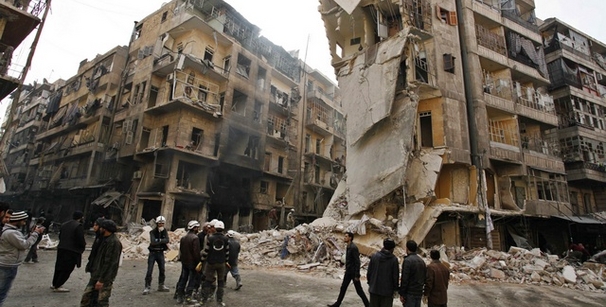
War damage in the once-thriving Syrian city of Aleppo
The Daily Beast published the claims of the Aleppo Siege Media Center under the title “Doomsday is held in Aleppo” and amid accusations that the Syrian army was executing civilians, burning them alive and “20 women committed suicide in order not to be raped.” These sensational claims were widely broadcast without verification. However, this “news” on CNN and throughout Western media came from highly biased sources and many of the claims – lacking anything approaching independent corroboration – could be accurately described as propaganda and disinformation.
Ironically, some of the supposedly “Russian propaganda” sites, such as RT, have provided first-hand on-the-ground reporting from the war zones with verifiable information that contradicts the Western narrative and thus has received almost no attention in the U.S. news media. For instance, some of these non-Western outlets have shown videos of popular celebrations over the “liberation of Aleppo.”
There has been further corroboration of these realities from peace activists, such as Jan Oberg of Transnational Foundation for Peace and Future Research who published a photo essay of his eyewitness observations in Aleppo including the happiness of civilians from east Aleppo reaching the government-controlled areas of west Aleppo, finally freed from areas that had been controlled by Al Qaeda’s Syrian affiliate and its jihadist allies in Ahrar al-Sham.
Dr. Nabil Antaki, a medical doctor from Aleppo, described the liberation of Aleppo in an interview titled “Aleppo is Celebrating, Free from Terrorists, the Western Media Misinformed.” The first Christmas celebrations in Aleppo in four years are shown here, replete with marching band members in Santa Claus outfits. Journalist Vanessa Beeley has published testimonies of civilians from east Aleppo. The happiness of civilians at their liberation is clear.
Whether or not you wish to accept these depictions of the reality in Aleppo, at a minimum, they reflect another side of the story that you have been denied while being persistently force-fed the version favored by the U.S. State Department. The goal of the new Global Engagement Center to counter “foreign propaganda” is to ensure that you never get to hear this alternative narrative to the Western propaganda line.
Even much earlier, contrary to the Western mythology of rebel “liberated zones,” there was strong evidence that the armed groups were never popular in Aleppo. American journalist James Foley described the situation in 2012 like this:
“Aleppo, a city of about 3 million people, was once the financial heart of Syria. As it continues to deteriorate, many civilians here are losing patience with the increasingly violent and unrecognizable opposition — one that is hampered by infighting and a lack of structure, and deeply infiltrated by both foreign fighters and terrorist groups. The rebels in Aleppo are predominantly from the countryside, further alienating them from the urban crowd that once lived here peacefully, in relative economic comfort and with little interference from the authoritarian government of President Bashar al-Assad.”
On Nov. 22, 2012, Foley was kidnapped in northwestern Syria and held by Islamic State terrorists before his beheading in August 2014.
The Overall Narrative on Syria
Analysis of the Syrian conflict boils down to two competing narratives. One narrative is that the conflict is a fight for freedom and democracy against a brutal regime, a storyline promoted in the West and the Gulf states, which have been fueling the conflict from the start. This narrative is also favored by some self-styled “anti-imperialists” who want a “Syrian revolution.”
The other narrative is that the conflict is essentially a war of aggression against a sovereign state, with the aggressors including NATO countries, Gulf monarchies, Israel and Jordan. Domination of the Western media by these powerful interests is so thorough that one almost never gets access to this second narrative, which is essentially banned from not only the mainstream but also much of the liberal and progressive media.
For example, listeners and viewers of the generally progressive TV and radio program “DemocracyNow!” have rarely if ever heard the second narrative described in any detail. Instead, the program frequently broadcasts the statements of Hillary Clinton, U.S. Ambassador to the United Nations Samantha Power and others associated with the U.S. position. Rarely do you hear the viewpoint of the Syrian Ambassador to the United Nations, the Syrian Foreign Minister or analysts inside Syria and around the world who have written about and follow events there closely.
“DemocracyNow!” also has done repeated interviews with proponents of the “Syrian revolution” while ignoring analysts who call the conflict a war of aggression sponsored by the West and the Gulf monarchies. This blackout of the second narrative continues despite the fact that many prominent international figures see it as such. For example, the former Foreign Minister of Nicaragua and former President of the UN General Assembly, Father Miguel D’Escoto, has said, “What the U.S. government is doing in Syria is tantamount to a war of aggression, which, according to the Nuremberg Tribunal, is the worst possible crime a State can commit against another State.”
In many areas of politics, “DemocracyNow!” is excellent and challenges mainstream media. However in this area, coverage of the Syrian conflict, the broadcast is biased, one-sided and echoes the news and analysis of mainstream Western corporate media, showing the extent of control over foreign policy news that already exists in the United States and Europe.
Suppressing and Censoring Challenges
Despite the widespread censorship of alternative analyses on Syria and other foreign hotspots that already exists in the West, the U.S. government’s new “Global Engagement Center” will seek to ensure that the censorship is even more complete with its goal to “counter foreign state and non-state propaganda and disinformation.” We can expect even more aggressive and better-financed assaults on the few voices daring to challenge the West’s “group thinks” – smear campaigns that are already quite extensive.
In an article titled “Controlling the Narrative on Syria”, Louis Allday describes the criticisms and attacks on journalists Rania Khalek and Max Blumenthal for straying from the “approved” Western narrative on Syria. Some of the bullying and abuse has come from precisely those people, such as Robin Yassin-Kassab, who have been frequent guests in liberal Western media.
Reporters who have returned from Syria with accounts that challenge the propaganda themes that have permeated the Western media also have come under attack. For instance, Canadian journalist Eva Bartlett recently returned to North America after being in Syria and Aleppo, conveying a very different image and critical of the West’s biased media coverage. Bartlett appeared at a United Nations press conference and then did numerous interviews across the country during a speaking tour. During the course of her talks and presentation, Bartlett criticized the White Helmets and questioned whether it was true that Al Quds Hospital in opposition-held East Aleppo was attacked and destroyed as claimed.
Bartlett’s recounting of this information made her a target of Snopes, which has been a mostly useful website exposing urban legends and false rumors but has come under criticism itself for some internal challenges and has been inconsistent in its investigations. In one report entitled “White Helmet Hearsay,” Snopes’ writer Bethania Palmer says claims the White Helmets are “linked to terrorists” is “unproven,” but she overlooks numerous videos, photos, and other reports showing White Helmet members celebrating a Nusra/Al Qaeda battle victory, picking up the bodies of civilians executed by a Nusra executioner, and having a member who alternatively appears as a rebel/terrorist fighter with a weapon and later wearing a White Helmet uniform. The “fact check” barely scrapes the surface of public evidence.
The same writer did another shallow “investigation” titled “victim blaming” regarding Bartlett’s critique of White Helmet videos and what happened at the Al Quds Hospital in Aleppo. Bartlett suggests that some White Helmet videos may be fabricated and may feature the same child at different times, i.e., photographs that appear to show the same girl being rescued by White Helmet workers at different places and times. While it is uncertain whether this is the same girl, the similarity is clear.
The Snopes writer goes on to criticize Bartlett for her comments about the reported bombing of Al Quds Hospital in east Aleppo in April 2016. A statement at the website of Doctors Without Borders says the building was “destroyed and reduced to rubble,” but this was clearly false since photos show the building with unclear damage. Five months later, the September 2016 report by Doctors Without Borders says the top two floors of the building were destroyed and the ground floor Emergency Room damaged yet they re-opened in two weeks.
The many inconsistencies and contradictions in the statements of Doctors Without Borders resulted in an open letter to them. In their last report, Doctors Without Borders (known by its French initials, MSF) acknowledges that “MSF staff did not directly witness the attack and has not visited Al Quds Hospital since 2014.”
Bartlett referenced satellite images taken before and after the reported attack on the hospital. The images do not show severe damage and it is unclear whether or not there is any damage to the roof, the basis for Bartlett’s statement. In the past week, independent journalists have visited the scene of Al Quds Hospital and report that that the top floors of the building are still there and damage is unclear.
The Snopes’ investigation criticizing Bartlett was superficial and ignored the broader issues of accuracy and integrity in the Western media’s depiction of the Syrian conflict. Instead the article appeared to be an effort to discredit the eyewitness observations and analysis of a journalist who dared challenge the mainstream narrative.
U.S. propaganda and disinformation on Syria has been extremely effective in misleading much of the American population. Thus, most Americans are unaware how many billions of taxpayer dollars have been spent on yet another “regime change” project. The propaganda campaign – having learned from the successful demonizations of Iraq’s Saddam Hussein, Libya’s Muammar Gaddafi and other targeted leaders – has been so masterful regarding Syria that many liberal and progressive news outlets were pulled in. It has been left to RT and some Internet outlets to challenge the U.S. government and the mainstream media.
But the U.S. government’s near total control of the message doesn’t appear to be enough. Apparently even a few voices of dissent are a few voices too many.
The enactment of HR5181, “Countering Foreign Propaganda and Disinformation,” suggests that the ruling powers seek to escalate suppression of news and analyses that run counter to the official narrative. Backed by a new infusion of $160 million, the plan is to further squelch skeptical voices with operation for “countering” and “refuting” what the U.S. government deems to be propaganda and disinformation.
As part of the $160 million package, funds can be used to hire or reward “civil society groups, media content providers, nongovernmental organizations, federally funded research and development centers, private companies, or academic institutions.”
Among the tasks that these private entities can be hired to perform is to identify and investigate both print and online sources of news that are deemed to be distributing “disinformation, misinformation, and propaganda directed at the United States and its allies and partners.”
In other words, we are about to see an escalation of the information war.
Rick Sterling is an independent investigative journalist. He lives in the San Francisco Bay Area and can be reached at rsterling1@gmail.com
US in Afghanistan to Influence Russia, Iran, China – Russian Foreign Ministry
Sputnik – March 14, 2108
The United States retains its presence in Afghanistan to exert influence on neighboring countries and regional rivals – namely, Russia, Iran and China, Russian Foreign Ministry’s Second Asian Department Director Zamir Kabulov told Sputnik in an interview.
“In our opinion, the United States is in Afghanistan primarily with the aim of controlling and influencing the political processes in its neighboring countries, and also demonstrating its power to its regional competitors, primarily China, Russia and Iran. The United States is clearly trying to achieve destabilization of Central Asia and later transfer it to Russia in order to subsequently present itself as the only defender against potential and emerging threats in the region,” Kabulov said.
According to the diplomat, Russia and other countries neighboring with Afghanistan have questions about the true goals and time frame of the US military presence in the Central Asian country.
“If the United States and its NATO allies intend to continue their destructive policy in Afghanistan, this will mean that the West is heading toward the revival of the Cold War era in this part of the world. We closely monitor the developments and are ready to respond in cooperation with our partners and other like-minded people,” Kabulov noted.
The diplomat pointed out that Washington still failed to understand that the Afghan conflict could not be resolved solely by military means, stressing that it was impossible to defeat the Taliban by force.
Moscow is puzzled by the attempts of the United States and NATO to persuade Afghanistan to replace Russian weapons and military equipment, such move leads to reduction of Afghan’s military potential, Zamir Kabulov told Sputnik in an interview.
“The course taken by the United States and NATO to persuade Kabul to replace Russia-made small arms and aircraft is surprising, as it will inevitably lead to a decrease in the combat capabilities of the Afghan armed forces and further deterioration of the situation,” Kabulov said.
The diplomat reminded that a bilateral intergovernmental agreement on Russia’s defense industry assistance to Afghanistan had entered into force in November 2016, adding that the document created the legal framework for Russian assistance in arming and equipping the Afghan security forces.
“At the moment, negotiations are underway on repairs and supplies of spare parts for the Afghan Air Force’s helicopters for various purposes, produced in Russia (the Soviet Union),” Kabulov added.
Afghanistan Parliamentary Election
The parliamentary election in Afghanistan is unlikely to take place in July in the current circumstances, Kabulov said.
“I do not think that the parliamentary elections in Afghanistan will be held in July this year as scheduled. The Taliban continue to control about half of the country’s territory, engage in hostilities, organize and carry out terrorist attacks in large cities, and, apparently, are not going to make compromises and reconciliation with the Afghan government,” Kabulov said.
Afghanistan’s Independent Election Commission (IEC) is also unlikely to accomplish all the necessary procedures before the date set for the vote, given that the commission has announced earlier that the registration of voters will complete only by early August, the diplomat noted.
Furthermore, disagreements between the presidential administration and its political opposition regarding the parameters of the upcoming elections still remain unresolved, the official noted.
“In my opinion, if elections are conducted in the current circumstances, their results will not improve the political situation in the country and confidence in the current government, will not force the armed opposition to cooperate with the government,” Kabulov added.
The diplomat also noted that the Daesh terror group posed a serious threat to holding the election.
“The Daesh jihadists pose a serious threat to the security of the conduct of elections, especially in the north and a number of eastern provinces of Afghanistan. Some polling stations in the provinces of Helmand, Uruzgan, Kunduz, Badakhshan, Faryab and Ghazni are the most problematic in terms of security, according to the IEC data. I think that, in fact, the list of problematic areas in terms of organization of voting is much longer,” Kabulov said.
Afghanistan Reconciliation Talks
Russia considers the so-called Moscow format of talks an optimal platform for the promotion of national reconciliation in Afghanistan, Zamir Kabulov noted.
“Unfortunately, the existence of a large number of international formats on the Afghan issue has not significantly contributed to the involvement of the Taliban in peace negotiations. In this regard, we consider the Moscow format of consultations launched by us in early 2017 as the optimal platform for substantive negotiations to promote national reconciliation and establish a constructive dialogue between the government of Afghanistan and the Taliban movement,” Kabulov said.
Kabulov also noted that Moscow considered the format of talks in the Afghan capital as one approach toward achieving a collective solution to the problems surrounding Afghan settlement.
“A signal of international support for the resolution of the intra-Afghan conflict through political dialogue with the government of Afghanistan has been sent to the Taliban. The Taliban ignored the recent meeting of the ‘Kabul process’ in the Afghan capital, insisting on direct talks with the United States,” the diplomat added.
In February 2017, Russia, China, Pakistan, Iran, India and Afghanistan came together in Moscow for talks to promote the national reconciliation process in Afghanistan through regional cooperation with Kabul in the leading role. Apart from the aforementioned states, the latest round in April gathered five Central Asian countries: Kazakhstan, Kyrgyzstan, Tajikistan, Turkmenistan and Uzbekistan. The United States refused to take part in the meeting.
Afghanistan has long suffered political, social and security-related instability because of the simmering insurgency, including that of the Taliban, but also because of the actions of the Daesh terror group.
The United States has been in Afghanistan for almost 17 years following the 9/11 attacks. Before his election, Trump slammed sending US troops and resources to the Central Asian country.
Featured Video
Nima R. Alkhorshid: US military bombs multiple targets on Iran’s Qeshm Island
or go to
Aletho News Archives – Video-Images
From the Archives
British Intel Tried to Make N Irish Gang ‘Shoot Up’ School, Documentary Claims
Sputnik – 23.02.2019
A new documentary, based on an interview with a self-confessed member of the Glennane Gang, gives some insights into allegations that British military intelligence was behind a shocking murder plot to cause the situation in Northern Ireland to “spiral out of control”.
In a documentary, Unquiet Graves: The Story of the Glennane Gang, John Weir, a former officer from the Royal Ulster Constabulary (RUC), alleges that British intelligence tried to persuade paramilitary group Ulster Volunteer Force (UVF) to attack a Catholic primary school at Belleeks in County Armagh.
Weir claimed that the UVF was urged to kill children and teachers in retaliation for the 1976 Kingsmill massacre, in which gunmen stopped a minibus carrying twelve workmen and shot them; only one person survived despite having been shot 18 times.
“The plan that was decided on was to shoot up a school in Belleeks”, he said, adding that the British intelligence plot was to make the situation in Northern Ireland “spiral out of control”. … continue
Blog Roll
 Aletho News
- Wrong, Newswise, Irresponsible Climate Messaging, Not Climate Change Itself, Is Fueling Student Anxiety
- Zelensky’s Critics Vanish Into Ukrainian Secret Prisons – Source
- Nima R. Alkhorshid: U.S. Military Bombs Multiple Targets on Iran’s Qeshm Island
- Iran-Linked Ships Spotted Hovering over Subsea Cables: Report
- New attack on Iran could devastate ‘Israel’, IOF general warns
- Nuclear deterrence: The US-Israeli military aggression against Iran made the unthinkable legitimate
- U.S. Midterms – a Referendum on Israel and Zionist Power
- Twice as many Canadian Jews serve in Israeli military as Canada’s armed forces: Report
- Thousands of Syrian troops set to join Saudi war on Yemen
- Jared Kushner’s Diplomacy for Hire
- If Americans Knew
- An error has occurred; the feed is probably down. Try again later.
- No Tricks Zone
- Zonal Asymmetry of Temperature Change in the Antarctic Circumpolar Current
- New Study: The Net Fossil Fuel Contribution To Rising Atmospheric CO2 Has Been Zero For 500 Years
- Germany’s Green Energy Transition Becoming Increasingly Expensive…Another 6 Trillion Euros!
- Sudden Stratospheric Warming, Powerful El Niño Combination May Lead To Extreme Europe Cold, Energy Crisis!
- Two New Studies Find Thwaites Glacier Melt Cannot Be Driven By Human Activity Or A Warming Ocean
- E-Cars Reduce CO2 Emissions By Only 41% Compared To Internal Combustion Engine Vehicles
- Predictions Made By Renowned Climate Professor Over Past Decades Have Been Proven To Be Poor
- New Study Suggests Large Regions Of The Pacific Ocean Have Been Cooling For The Last 80 Years
- Germany’s Green Energy Debacle: High Energy Costs Force Kahla Porzellan to Close After 182 Years!
- New Study: 50 Years Of The Most Aggressive ‘Net Zero’ Policies Can Only Affect The Global Climate By 0.03°C


