Welcome to another Western edition of anti-Assad political theater, now in Ghouta
By Robert Bridge | RT | March 2, 2018
Western media is heaping scorn on Syria for using ‘excessive force’ in its effort to liberate Ghouta from militant control. But where was that same concern when Mosul was being pulverized by US-led forces?
The Syrian government’s liberation efforts in the Damascus suburb of Eastern Ghouta have deteriorated into a media circus where truth has taken a back seat in the clown car. As was the case in the liberation of Aleppo, the government of President Bashar Assad – as opposed to the militant groups wreaking havoc in his country – has borne the main brunt of criticism from the Western world.
Due to the conditions on the ground in Ghouta, it is virtually impossible to get a clear picture of the situation there. What we do know, however, is that Damascus is being hit by approximately 70 missiles daily from militant positions inside Ghouta. The Western media would rather ignore that fact, speculating instead that “more than 500 people” have been killed by the Assad “regime” since efforts to retake the city began last month.
So where does the Western media get its information? In the majority of cases, from the Syrian Observatory for Human Rights (SOHR), a one-man operation based out of a humble abode in Coventry, UK. Western reporters also rely on the so-called White Helmets, the very same ‘humanitarian’ group that is suspected of working in tandem with terrorist groups that are carrying out attacks on civilians. Based on these extremely dubious sources, and others, one of the UK’s most respectable newspapers, the Guardian, was bold enough to assert that “Eastern Ghouta is turning into Syria’s Srebrenica.”
“Like the Bosnian Muslim enclave in 1995, eastern Ghouta … has been besieged by regime forces since the early stages of the Syrian war,” Simon Tisdall wrote. “As in Bosnia, nobody attempted to protect the civilian population when a regime offensive began there in December after negotiations failed. The airstrikes and bombardments… are carried out with impunity by Syrian forces and their Russian backers.”
I read that article twice in the hope of finding any mention of the militant forces that have been occupying Eastern Ghouta off and on since late 2012, subjecting the local population to untold horrors, including the threat of chemical attack. Regrettably, I failed; not a single mention of the terrorists. Indeed, to read Tisdall’s article one gets the impression that the citizens of Ghouta are perfectly content with the occupation of their city by fanatical militants.
Examples of such biased attitudes towards the Syrian government have, at the same time, overtaken the social media jungle like the invasive kudzu vine, blocking out the light of truth.
This week, for example, a US-based user who goes by the name of Sami Sharbek posted two photos on his Twitter account – one showing a building consumed by an explosion; the other depicting a man carrying a crying child.
“This is not a movie. This is Syria,” he wrote in the caption.
Sharbek was only 50 percent right.
Although the photos were not taken from a Hollywood blockbuster film, they did feature horrific images from Gaza and Mosul, respectively. In other words, very far from the action in Ghouta. Although Sharbek later admitted to his error, the damage was already done. As of February 28, the Tweet had made a huge impression, generating over 125,000 shares and 154,000 likes (the account is now blocked, open only to “approved followers”), possibly reaching millions of users. It is probably safe to say that very few of those same people will hear that Sharbek’s tweet was for all intents and purposes fake news.
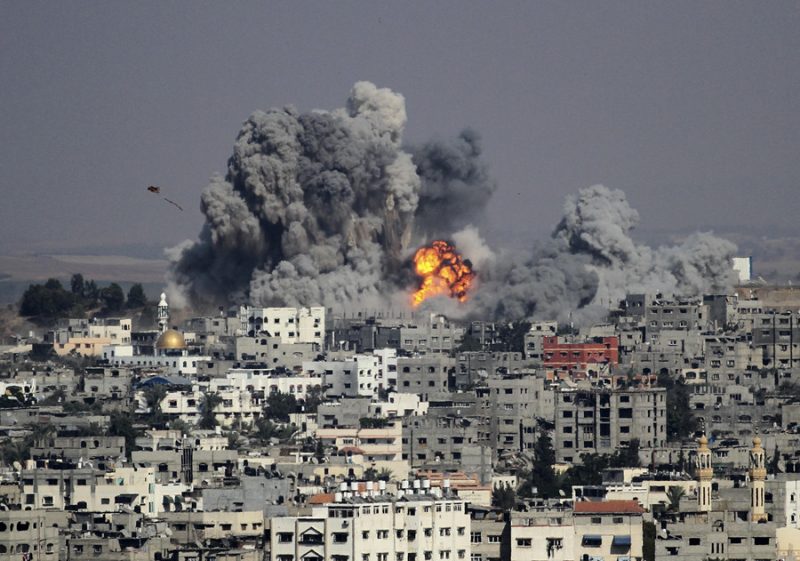
Smoke rises from the Tuffah neighborhood after an Israeli airstrike in eastern Gaza City, July 29, 2014 © Sameh Rahmi / Global Look Press
On February 25, Danny Gold, a writer and correspondent, compared the situation in Ghouta to one of history’s worst human atrocities when he tweeted: “I know how Jews who lived through the holocaust felt 70 years later about the world turning a blind eye, can’t imagine how Syrians in Ghouta will feel about their suffering being so well-documented as it’s happening yet doubted by so many.”
I know how Jews who lived through the holocaust felt 70 years later about the world turning a blind eye, can’t imagine how Syrians in Ghouta will feel about their suffering being so well-documented as it’s happening yet doubted by so many.
— Danny Gold (@DGisSERIOUS) February 25, 2018
Dan Cohen, a correspondent with RT America, responded to Gold: “Ghouta is like the Holocaust but Mosul was ‘a huge journalism event’ in which US-led forces took ‘much care’ in burying at least 3,200 civilians in the rubble.”
Cohen’s comment was a jibe at a tweet Gold had sent on February 1, 2017 in which he embellished the historical record of the US-led Iraqi campaign, remarking: “Mosul was a huge journalism event. Everyone who covers the Middle East was there.”
Ghouta is like the Holocaust but Mosul was “a huge journalism event” in which US-led forces took “much care” in burying at least 3,200 civilians in the rubble. pic.twitter.com/SxQGxFhYlc
— Dan Cohen (@dancohen3000) February 26, 2018
But if Mosul really was one big happy media confab, then how was it possible for the fatality figures to have been so skewed? As AP rather belatedly reported in December 2017, long after the nine-month conflict had ended, “The price Mosul’s residents paid in blood to see their city freed was between 9,000 and 11,000 dead … a civilian casualty rate nearly 10 times higher than what has been previously reported.”
Perhaps if Western reporters had not spent so much of their time reporting on the same type of military operation in Aleppo, which was then the focus of a Russian-backed liberation campaign, they may have more accurately described the situation in Iraq’s second-largest city.
Michael Raddie, co-editor of BSNews, provided a convincing explanation for the discrepancy in the way the Western media reports on war zones, which he said can be reduced to a matter of “worthy victims” and “unworthy victims.”
“The victims of US bombs and British airstrikes are not worthy because we don’t do that kind of thing,” Raddie told RT. “Our killing of civilians is a mistake, collateral damage. The Syrian air force killing of civilians … that is atrocities. And that is the ideology that Western media portray all the time.”
You’re Being Lied To On East Ghouta https://t.co/ciZK6QY9Ko via @YouTube
— vanessa beeley (@VanessaBeeley) February 22, 2018
However, there is another side to this wave of Western cynicism with regards to Syria that could spark a real catastrophe. That involves the threat of a chemical strike, which the West seems to believe is something only the “Assad regime” is capable of committing. After all, who would ever suspect bona-fide terrorists deprived of modern weapons of resorting to such barbaric means of warfare?
Much like Barack Obama’s utterly reckless “red line” warning regarding the use of chemical weapons, which he said would warrant US military action, French President Emmanuel Macron issued the very same foolish warning on February 14.
“On chemical weapons, I set a red line and I reaffirm that red line,” Macron told reporters. “If we have proven evidence that chemical weapons proscribed in treaties are used, we will strike the place where they are made.”
Did it surprise anyone that less than two weeks after Macron’s warning a chemical attack – conveniently supported by photos provided by, yes, the White Helmets – was reported to have occurred in Ghouta? Western media and politicians have actually suggested a Russian connection to the event.
“Whoever conducted the attacks, Russia ultimately bears responsibility for the victims in Eastern Ghouta and countless other Syrians targeted with chemical weapons since Russia became involved in Syria,” US Secretary of State Rex Tillerson said.
Presently, a 30-day ceasefire endorsed by the UN Security Council is in effect across Syria, as well as a daily five-hour “humanitarian pause” in Eastern Ghouta enforced by Russia.
Yet thus far the plan is not producing the desired effect. Militants are preventing civilians from fleeing besieged Eastern Ghouta and are sabotaging the humanitarian operation there, Major General Vladimir Zolotukhin, a spokesman for the Russian Center for Reconciliation in Syria, told journalists on Thursday.
Robert Bridge is an American writer and journalist. He is author of the book, ‘Midnight in the American Empire,’ released in 2013. robertvbridge@yahoo.com
Read more:
Cambodia PM accuses US of lying about aid suspension
Press TV – March 3, 2018
Cambodia’s prime minister has slammed the US administration for being dishonest about the “suspension” of aid to the Southeast Asian nation, saying Washington’s aid cut had actually taken place in 2016.
The White House announced Tuesday that it was suspending or curtailing several Treasury, USAID and military aid programs aimed at supporting Cambodia’s military, taxation department and local authorities, claiming that they were all responsible for the country’s recent political instability.
Reacting to the announcement, Prime Minister Hun Sen said Washington’s ambassador to Phnom Penh, William Heidt, was lying and insisted that US aid to Cambodia’s tax department was slashed back in 2016, Reuters reported.
“We, the 16 million people, didn’t receive American aid in the tax sector. This aid was already finished in 2016,” said the prime minister during a speech to thousands of garment workers in the country’s southern province of Preah Sihanouk.
He then added, “Please, US Ambassador, answer this one question: why did you announce cutting aid while there is no aid? Do you intend to distort the reputation of Cambodia?”
The US Embassy in Phnom Penh, however, refused to comment about the prime minister’s remarks.
According to the report, Washington’s decision to partially suspend its aid to Cambodia came amid an ongoing government crackdown on the nation’s political opposition, Hun Sen’s critics, as well as opposition lawmakers and non-governmental organizations months prior to a July general election.
Hun Sen, who the report describes as “a close ally of China,” has often criticized Washington publicly, specifically for dropping bombs on Cambodia during the Vietnam War, which concluded in 1975.
He has also accused the leader of the main opposition Cambodia National Rescue Party (CNRP), who was detained and jailed last year, of conspiring with Washington to topple him.
Meanwhile, the White House has said the US had spent over $1 billion worth of aid for Cambodia and that its assistance to the country for health, agriculture and mine-clearing will continue.
Pentagon wants more money to develop its own hypersonic nukes, just like Russia’s
RT | March 3, 2018
The Pentagon may not be surprised by the new Russian hypersonic missiles – but why not use them as a pitch for more money? A military budget about 10 times that of Russia is not enough, according to the DARPA director.
Asked by a gathering of journalists on Thursday if the United States is spending enough on its own hypersonic missile program, Steven Walker, the director of the Pentagon’s Defense Advanced Research Projects Agency (DARPA), replied, “I would say no.”
“The dollars that were allocated in this budget were great, but they were really focused on adding more flight tests and getting some of our offensive abilities further down the line into operational prototypes,” he said. “We do need an infusion of dollars in our infrastructure to do hypersonics.”
Separate statements made on the same day by Pentagon spokesman Dana White exuded a bit more confidence – and far less concern – about how well the US arsenal stacks up against Russia’s.
“We’ve been watching Russia for a long time. We’re not surprised,” White said, following Russian President Vladimir Putin’s State of the Nation address, which highlighted Russia’s new nuclear arsenal – including hypersonic missiles that have a nearly unlimited range and are capable of outmaneuvering missile defense systems.
“America is moving forward to modernize our nuclear arsenal and make sure our capabilities aren’t being matched,” White insisted.
Since taking office, President Donald Trump, with help from the Republican-controlled Congress, has added more than $200 billion to the projected levels of defense spending for fiscal years 2017 through 2019 – a sum more than twice the size of Russia’s entire defense budget, which totalled an estimated at $69.2 billion in 2016. Washington’s projected military expenditures for fiscal year 2018 is set at $700 billion.
A fair part of that money apparently gets lost to wasteful spending and sloppy accounting. An internal audit leaked to the press in February found that a large Pentagon agency failed to properly keep track of more than $800 million in constructions projects. Plans for a full audit will set the department back another $367 million in 2018.
In 2016, it was reported that the Pentagon had intentionally buried an internal study that exposed $125 billion in administrative waste amid fears Congress would use the explosive findings as an excuse to slash the defense budget.
And while Pentagon officials beg for more money to counter Russian hypersonic technology, there seems to be plenty of cash – $1.4 trillion, to be exact – to pay for Lockheed Martin’s defect-riddled F-35.
In Syria, the Real Siege Is by Western Criminal Powers

Strategic Culture Foundation | 02.03.2018
In more than seven years of war in Syria, we have seen many times how Western governments and news media shamelessly invert reality.
The same was seen this week over the grim fighting around Eastern Ghouta, the suburb near the capital, Damascus, where 400,000 people are said to be trapped.
But who is trapping who?
US and European media breathlessly claim that Eastern Ghouta is under siege from Syrian “regime forces” allied with Russia. This description is posing things upside down.
The district was taken over nearly six years ago by foreign-backed extremists, like Jaysh al Islam, Ahrar al Sham, and Al Nusra Front. The latter is an internationally outlawed terror group, but they all share the same murderous ideology, as well as the same Western covert sponsors in the American CIA, British MI6, French DGSE, and lavish Gulf Arab funding. It is these illegally armed insurgents who are holding the civilian population under siege in a reign of terror.
The same situation, and Western inversion of reality, has been seen before, most notably regarding Syria’s second city of Aleppo. The Syrian and Russian forces liberated that city at the end of 2016, and since then life for the residents there has fortunately returned to the normal peaceful, pluralist coexistence which prevailed before the foreign-backed terror goons took over.
Yet, Western media and officials continually confabulate about “rebels” and civilians being besieged by Syrian state forces. This inversion of reality is of course necessary in order to push the Western false narrative that has underpinned the covert Western war for regime change in Syria, including the clandestine support for terror groups as proxies.
Further twisting the situation in Eastern Ghouta this week, the Western media blamed the Syrian “regime” and Russia for not implementing a ceasefire plan to enable evacuation of civilians.
Russia proposed a daily five-hour truce, and the Syrian government established humanitarian corridors exiting from the conflict zone. The proposal from Moscow was a reasonable counter to what the US, Britain and France had wanted, which involved a 30-day cessation of all military operations.
The Western powers had tried the same proposal during the liberation of Aleppo. Syria and its legally mandated Russian ally are within their sovereign right to take back remaining territory that has been illegally occupied by foreign-backed militants.
What the Western powers would like to impose is a No-Fly Zone over parts of Syria to enable their residual proxies time and space to regroup. Why should the Syrian government forfeit its sovereign rights by accommodating foreign enemies?
The reason why the Russian humanitarian relief plan proposed this week for Eastern Ghouta did not gain traction was simply because the militants continually shelled the designated corridors for escaping civilians. Video footage clearly showed buses and aid workers organized by the Syrian government waiting to receive the civilians. But none were permitted from the area because of sniper and mortar fire from the militants.
Evidently, the militants are holding the civilian population as hostages and human shields. The same criminal tactics were deployed in Aleppo and other towns and cities where the terrorist gangs ruled with their death-cult barbarity.
Russian Foreign Minister Sergei Lavrov, addressing the UN Human Rights Council in Geneva this week, rightly pointed out that the humanitarian relief plan for Eastern Ghouta can only be made to work if the militants commit to upholding a ceasefire. But these foreign-backed mercenaries have done nothing of the sort. They have not only cut off evacuation corridors under fire; they continue to launch rockets and mortars at nearby government-controlled Damascus inflicting dozens of civilian deaths in recent weeks.
Reliable figures cited by the Syrian Free Press network, indicate that some 85 per cent of the Syrian population live in areas under the control of President Bashar Assad’s state forces. Only a small minority – 15 per cent – live in areas controlled by insurgents. And many of those people are being held in these dwindling areas against their will in a state of fear imposed by the so-called jihadists.
The brazen Western media propaganda war – misnamed as “news” – reports totally from the minority areas, which are exalted as “rebel bastions”.
In all the so-called “reporting” by France 24, BBC, CNN, and others, the information is either sourced from the CIA-sponsored and terrorist-affiliated White Helmets media operation; or anonymous “residents” and “activists”; or it is sourced from “a UK-based monitor” who is an exiled Syrian furniture salesman who has not been in Syria for 15 years.
This pathetic Western mainstream media “journalism” has been going on for the past seven years in relation to Syria.
Significantly, when do you ever hear a Syrian government official or diplomat being aired directly and at length in these media? Or Russian officials? Never. It’s all a one-way street of lies and fabrication.
The preposterous inversion of reality that the Western governments and media have perpetrated over Syria can only be sustained through systematic distortion.
Russia’s humanitarian relief plan for Eastern Ghouta has so far been sabotaged by terror groups firing on civilians. But Western officials and media have the brass neck to claim that the long-suffering population is under siege from the very forces who are trying to liberate them from terror.
When Eastern Ghouta is eventually liberated one thing is sure. The Western media will never follow-up to ask residents what their lives were really like. Just as these same vile propaganda outlets did not follow-up on liberated Aleppo.
As if the distortion couldn’t get any worse, this week the New York Times and other Western media reported claims that North Korea had secretly supplied materials for chemical weapons to Syria. The reported claims seemed unconvincing, as usual, and the Syrian government denied the latest allegations.
Alongside that, the British government asserted this week that it would order air strikes on the Syrian “regime” if it found proof that chemical weapons were used.
Adding up the Western distortion it is obvious what the objective is: to find a pretext for overt military aggression on Syria. The covert proxy war using terrorist mercenaries has failed. Now the Western terror sponsors need to take the distortion to an even more demonic level.
In truth, there is indeed a siege in Syria. The entire Syrian nation is under siege – by criminal Western regimes and their equally criminal propaganda media, justifying war and aggression.
US State Dept approves sale of $47mn worth of anti-tank missiles to Ukraine
RT | March 1, 2018
The US Department of State has signed off on the sale of Javelin anti-tank missiles to the government of Ukraine, the Pentagon has confirmed. The deal is valued at $47 million and needs congressional approval next.
If approved by Congress, the deal would involve the sale of 210 missiles and 37 command units, Defense News reported, citing Pentagon sources. The Pentagon claims it will not affect the military balance in the region, where the Kiev government is locked in conflict with two regions in the east of the country. Kiev has been accusing Moscow of backing the rebels, to the point of officially designating Russia an “aggressor” state.
“The Javelin system will help Ukraine build its long-term defense capacity to defend its sovereignty and territorial integrity in order to meet its national defense requirements,” the Pentagon said in a statement.
Earlier this week, Ukrainian President Petro Poroshenko said he was expecting the first lethal weapons deliveries from the US to take place “in a very few weeks,” without specifying what weapons Kiev is supposed to receive. The Pentagon, however, was more careful about the timeline. “On weapons delivery, it is premature to speculate on when that will happen,” US Department of Defense spokesperson Sheryll Klinkel told Sputnik.
The 2018 National Defense Authorization Act (NDAA) approved increased US military aid to Kiev, including lethal weapons. Until now, the US has assisted Ukraine’s military with logistics, intelligence, training and other types of support.
Washington has accused Russia of invading Ukraine since 2014, when armed activists backed by the US seized power in Kiev. Residents of several regions, including Donetsk, Lugansk and Crimea, refused to accept the new government’s policies.
Crimea voted to rejoin Russia, which it was separated from in 1954 by a decree of the Soviet leadership. Donetsk and Lugansk declared independence and have since been fighting off attempts by Ukraine’s military to “reintegrate” them by force.
Moscow denies involvement in the Ukrainian conflict, of which no consistent proof has been produced to date. It has repeatedly warned Washington against allowing lethal arms exports to Ukraine, saying it will stoke the military conflict and embolden Kiev’s offensive in the east of the country, further endangering the civilians that are already suffering there.
Read more:
Russia postpones strategic talks with US
Press TV – March 2, 2018
Moscow has postponed planned talks with Washington on strategic stability originally set for later this month, after a US delegation refused to attend a Geneva meeting on cybersecurity earlier in the week, Russian envoy to Washington has announced.
Ambassador Anatoly Antonov told Russian TASS news agency on Thursday that the last-minute pullout from talks in Geneva by the US delegation on February 27 reflected an “unfriendly step… that gave the impression of having been pre-planned and leading to the further degradation of bilateral relations.”
“We have expressed indignation to the Department of State that the American side has wrecked Russian-American expert consultations on global information security,” Antonov said, noting that Moscow and Washington had agreed to hold the talks in Geneva on February 27-28.
However, he insisted, “The Americans refused to participate in the event just on its first day under the pretext of absolutely ungrounded accusations against Russia.”
“As a result of those US actions, the Russian side has found it impossible to hold Russian-American consultations on bilateral issues and strategic stability topics planned for March 6-7 in Vienna, which is why we have postponed them,” Antonov said.
The development came after the US accused long-time rival Russia of openly breaching Cold War-era treaties by developing what President Vladimir Putin referred to on Thursday as a new generation of “invincible” hypersonic weapons and submarines.
Reacting to Putin’s speech on Thursday, US State Department spokeswoman Heather Nauert said, “It was certainly unfortunate to have watched the video animation that depicted a nuclear attack on the United States. We don’t regard that as the behavior of a responsible international player.”
Antonov, however, rejected the remarks by Nauert in a separate statement he posted on Facebook.
“I will underline once again that Russia has not violated a single arms control and non-proliferation agreement while developing its nuclear potential,” said the Russian envoy.
He further said, “It appears that the State Department does not know the substance of the matter very well.”
Antonov went on to also emphasized that none of the weapons mentioned in Putin’s state of the nation address were covered by the treaties signed by the US and the former Soviet Union.
New arms race started by US pulling out of missile treaty – Putin
RT | March 2, 2018
Russian President Vladimir Putin has denied accusations he revived an arms race by unveiling Russia’s new nuclear deterrent. That was done by US President George W. Bush killing a 30-year-old missile treaty in 2002, he told NBC.
In an interview with NBC’s “Megyn Kelly Today” on Thursday, the Russian leader brushed off claims in the Western media that by introducing new nuclear-powered missiles, including the hypersonic Sarmat, he has signaled a new arms race. The alarmist rhetoric that fills Western news outlets is just another form of propaganda, Putin said.
“My point of view is that the individuals saying that a new Cold War has started are not really analysts; they do propaganda,” he said, as translated by NBC. Putin blamed Washington’s 2002 withdrawal from the 1972 Anti-Ballistic Missile Treaty (ABM Treaty) for escalating the confrontation. “If we are to speak of an arms race, then an arms race started precisely at that point”.
It was US President George W. Bush who withdrew from the ABM Treaty, which had been one of the main pillars of the détente and held for nearly 30 years. Bush argued that the treaty hindered the US’ ability to protect itself from “future terrorist or rogue state attacks.”
In the years following, the US has encircled Russia with its missile defense installations, extending its anti-missile shield to Romania and Poland, deploying for the first time a battery of Patriot long-range anti-aircraft system to Lithuania for war games.
The US nuclear build-up on Russia’s doorstep triggered a response from Moscow, which deployed its newest Iskander systems to its Kaliningrad exclave, citing the threat posed by US missile launchers deployed in Poland and Romania.
The path that led towards confrontation could have been avoided had the US agreed to cooperate on the development of anti-missile defenses with Russia – an offer repeatedly extended by Moscow. After Washington refused, Putin said he could not sit idle.
The Russian president went on that he still believes the two countries should focus on what they can do together. He mentioned the fight against common challenges to security such as terrorism.
“Instead of creating threats to one another, great powers should pool their efforts in protecting against terrorists,” he told Kelly.
Kelly raised the topic of speculation that the new weapon systems have not yet undergone any successful tests. Putin, who had used Thursday’s state of the nation address to unveil the weapons, dismissed the rumors.
“Every single weapon system that I have discussed today easily surpasses and avoids anti-missile defense systems,” Putin said, adding that while “some of them still have to be fine-tuned and worked on,” others are combat-ready. “One of them is already on combat duty. It’s available to the troops,” the Russian leader said.
Read more:
Russian Embassy in US Debunks Accusations of Alleged INF Treaty Violation
Sputnik – March 2, 2018
Moscow’s Ambassador to the United States Anatoly Antonov has refuted the US State Department’s accusations of violating the Intermediate-Range Nuclear Forces (INF) treaty by possessing the new strategic weapons announced in Russian President Vladimir Putin’s address.
“Apparently, the US State Department is poorly proficient on the subject. Putin spoke about strategic armaments that are not subject to the limitations of the INF treaty…. We would like to recall that we consider the accusations against us regarding the ‘violation’ of this treaty groundless,” Antonov said in a statement.
The accusations are backed up neither by technical specifications of the launcher, which are allegedly not in accordance with the treaty, nor by flight telemetry data, Antonov noted.
“I would like to stress once again that Russia, while developing its nuclear potential, has not violated any agreement in the sphere of disarmament and arms control. Everything that is done by the Russian Defense Ministry and Russian defense industry is in strict accordance with our international obligations,” the ambassador stressed.
The diplomat recalled that Moscow has repeatedly urged Washington to discuss the issue professionally.
“We have warned more than once and warn again that the destruction of the INF treaty would be a heavy blow to the arms control and non-proliferation regime…. At the same time, we have serious concerns about the fulfillment of the treaty terms by the United States,” he stressed.
Putin’s address to the parliament on Thursday broke a record in terms of duration, having lasted for one hour and 57 minutes. It was for the first time accompanied by a multimedia presentation which showed the tests of Russia’s most modern weapons.
In his speech, Putin said that Russia had begun developing special strategic weapons invulnerable to missile defense systems, including nuclear capable cruise missiles and the new hypersonic aviation and missile system dubbed Kinzhal (“Dagger”).
Earlier, US State Department Spokesperson Heather Nauert had claimed that Putin’s address to the parliament confirmed that Moscow had been developing weapons in violation of its treaty obligations, including under the INF treaty.
The 1987 INF Treaty envisages the destruction of ground-launched ballistic and cruise missiles with ranges of between 500 and 5,500 kilometers (from 311 to 3,317 miles), their launchers and associated support structures and support equipment. The United States and Russia have repeatedly accused each other of violating the treaty.
Antonov was Russia’s Deputy Foreign Affairs Minister in 2016-2017 and Deputy Defense Minister in 2011-2016.
Featured Video
Nima R. Alkhorshid: US military bombs multiple targets on Iran’s Qeshm Island
or go to
Aletho News Archives – Video-Images
From the Archives
British Intel Tried to Make N Irish Gang ‘Shoot Up’ School, Documentary Claims
Sputnik – 23.02.2019
A new documentary, based on an interview with a self-confessed member of the Glennane Gang, gives some insights into allegations that British military intelligence was behind a shocking murder plot to cause the situation in Northern Ireland to “spiral out of control”.
In a documentary, Unquiet Graves: The Story of the Glennane Gang, John Weir, a former officer from the Royal Ulster Constabulary (RUC), alleges that British intelligence tried to persuade paramilitary group Ulster Volunteer Force (UVF) to attack a Catholic primary school at Belleeks in County Armagh.
Weir claimed that the UVF was urged to kill children and teachers in retaliation for the 1976 Kingsmill massacre, in which gunmen stopped a minibus carrying twelve workmen and shot them; only one person survived despite having been shot 18 times.
“The plan that was decided on was to shoot up a school in Belleeks”, he said, adding that the British intelligence plot was to make the situation in Northern Ireland “spiral out of control”. … continue
Blog Roll
 Aletho News
- Rhode Island Staffer Could Be Reinstated After Firing Over Ceasefire Post
- Will Republicans Learn Their Lesson from the ‘Disastrous’ Midterms?
- Wrong, Newswise, Irresponsible Climate Messaging, Not Climate Change Itself, Is Fueling Student Anxiety
- Zelensky’s Critics Vanish Into Ukrainian Secret Prisons – Source
- Nima R. Alkhorshid: U.S. Military Bombs Multiple Targets on Iran’s Qeshm Island
- Iran-Linked Ships Spotted Hovering over Subsea Cables: Report
- New attack on Iran could devastate ‘Israel’, IOF general warns
- Nuclear deterrence: The US-Israeli military aggression against Iran made the unthinkable legitimate
- U.S. Midterms – a Referendum on Israel and Zionist Power
- Twice as many Canadian Jews serve in Israeli military as Canada’s armed forces: Report
- If Americans Knew
- An error has occurred; the feed is probably down. Try again later.
- No Tricks Zone
- Zonal Asymmetry of Temperature Change in the Antarctic Circumpolar Current
- New Study: The Net Fossil Fuel Contribution To Rising Atmospheric CO2 Has Been Zero For 500 Years
- Germany’s Green Energy Transition Becoming Increasingly Expensive…Another 6 Trillion Euros!
- Sudden Stratospheric Warming, Powerful El Niño Combination May Lead To Extreme Europe Cold, Energy Crisis!
- Two New Studies Find Thwaites Glacier Melt Cannot Be Driven By Human Activity Or A Warming Ocean
- E-Cars Reduce CO2 Emissions By Only 41% Compared To Internal Combustion Engine Vehicles
- Predictions Made By Renowned Climate Professor Over Past Decades Have Been Proven To Be Poor
- New Study Suggests Large Regions Of The Pacific Ocean Have Been Cooling For The Last 80 Years
- Germany’s Green Energy Debacle: High Energy Costs Force Kahla Porzellan to Close After 182 Years!
- New Study: 50 Years Of The Most Aggressive ‘Net Zero’ Policies Can Only Affect The Global Climate By 0.03°C

