South Korea’s Moon informs Trump of plan to send special envoy to North Korea
Press TV – March 1, 2018
South Korean President Moon Jae-in has told his American counterpart Donald Trump that he intends to send a special envoy to Pyongyang in response to an invitation by Kim Jong-un, the North’s leader, following the recent Olympic-driven detente between the two Koreas.
“In response to the visit by North Korea’s special envoy Kim Yo Jong, … Moon conveyed to Trump his plans to dispatch a special envoy to the North soon,” Seoul’s presidential office said in a statement on Thursday, following their phone conversation.
It added that Moon and Trump further “agreed to continue their efforts to maintain the momentum for South-North dialogue so it may lead to the denuclearization of the Korean Peninsula.”
The development came after Pyongyang, in a rare move, participated in the 2018 Winter Olympics held in South Korea, providing an opportunity for the two neighbors to resolve long-running hostilities. The two sides have exchanged diplomatic and high-level visits, and there is hope that relations could improve effectively.
The two neighbors have been separated by a heavily-militarized border since the three-year Korean War came to an end in 1953. The conflict ended with an armistice rather than a formal peace treaty and left many families separated on the two sides.
The situation on the Korean Peninsula has been tense due to Pyongyang’s development of its nuclear and missile programs.
Moon has sought to use the Pyeongchang Winter Olympics, which concluded on Sunday, to open dialogue between Washington and Pyongyang in the hopes of easing a nuclear standoff that has caused global security fears.
The South Korean leader said earlier this week that Washington needed to “lower the threshold for talks” with Pyongyang.
Furthermore, senior North Korean officials visiting the South for the Winter Olympics said on Sunday that Pyongyang was open to talks with Washington.
However, the US has ruled out any possibility of negotiations before the North, which last year conducted multiple missile and nuclear tests, takes steps towards denuclearization.
The US and its allies in the West and in Asia engineered tough UN sanctions on North Korea last year when Pyongyang test-fired two missiles in July and then carried out its most powerful nuclear test in August.
However, many said the sanctions would not deter North Korea from pursuing its nuclear and missile program, which Pyongyang insists is part of its defense policy against the US. Critics have repeatedly warned that sanctions would more affect North Korean people rather than its military and the government.
America’s Illegal Sojourn in Syria
By Philip M. GIRALDI | Strategic Culture Foundation | 01.03.2018
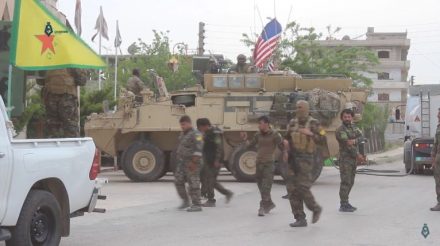
It should come as no surprise to anyone that the Donald Trump administration has recently affirmed that it has a perfect legal right to remain in Syria as long as it wishes because it is fighting terrorism. The argument goes something like this: Congress has approved a bill that permits the US military to seek out and destroy al-Qaeda and associated groups wherever they may be. It is part of what is referred to as the Authorization to Use Military Force or AUMF. According to the White House, an associated group, the Islamic State in Syria (ISIS), remains currently active in Syria and the United States military presence is therefore legal until the group is completely eliminated, requiring no additional legislation or authority to remain in the country.
The Trump legal finding was spelled out in two letters released by the undersecretaries for policy at the State and Defense departments. They were in response to requests made by Senator Time Kaine of Virginia who has for several years been asking the White House under both Barack Obama and Donald Trump to clarify what legal authority has permitted it to base 2,000 American soldiers in Syria without any declaration of war, any United Nations authorization or any invitation by the legitimate government of Bashar al-Assad in Damascus. Kaine has cited the restrictions imposed by the War Powers Act of 1973, which permits a president to use military force in an emergency situation but after 60 days it is necessary to go to Congress for approval.
The State Department letter heightened the ambiguity of the US position with its explanation that “The United States does not seek to fight the government of Syria or Iran or Iranian-supported groups in Iraq or Syria. However, the United States will not hesitate to use necessary and proportionate force to defend US, coalition, or partner forces…”
There are a number of problems with the White House justification to stay in Syria, starting with the fact that al-Qaeda and ISIS are not in any way associated and might best be described as rivals or even enemies, rendering the whole AUMF argument irrelevant. In addition, the reason for American forces being in Syria at all has been variously described by senior administration officials. Secretary of State Rex Tillerson has been busy emphasizing that a prolonged stay is needed to block the resurgence of ISIS and also to prevent the Syrian government from retaking areas currently occupied by American-supported rebel groups. He curiously describes such areas freed from government control as “liberated.” He has also stated that the US will stay in place to put pressure on Bashar al-Assad to step down, i.e. regime change.
Tillerson uses the example of Libya to support his argument, observing that Libya was not occupied and “stabilized” by the nations that combined to overthrow the government of Muammar Ghaddafi. He has also cited President Barack Obama’s decision to withdraw US forces from Iraq as a contributing factor in the rise of ISIS, apparently unaware that American military was forced to leave by the Iraqi government.
But last Friday President Trump sent a different signal, stating during the press conference with the Australian Prime Minister that “We’re there for one reason: to get ISIS and get rid of ISIS, and to go home. We’re not there for any other reason and we’ve largely accomplished our goal.”
There is considerable spin being generated by the Administration to support its claims. Nevertheless, it should be accepted that the Syrian regime of al-Assad is nearly universally recognized to be legitimate and sovereign in its own territory, a fact that is even acknowledged by the United States, which is, at the same time, supporting rebels seeking to overthrow that government. And the US intention to maintain a continued presence minus any viable al-Qaeda threat in the country is completely illegal under both domestic and international law.
In short, the continued United States presence in Syria bears all the hallmarks of yet another US policy wrapped in top level ambiguity that is a failure even before it starts. Not only illegal, it is impractical, with 2,000 US advisers spread thin supporting Kurdish proxies who are already heavily engaged fighting the Turks. Eventually Washington will become weary of the effort and leave. May that day come soon.
The Breach of the UNSC Ceasefire in Syria: a Way Out of This Situation
By Peter KORZUN | Strategic Culture Foundation | 01.03.2018
The UN’s authority has been undermined by the fact that UN Security Council Resolution 2401 demanding a 30-day truce in Syria, which was unanimously endorsed on Feb. 24, has not been honored. On Feb. 26, UN Secretary-General António Guterres said the document needed to take effect without delay, but combat operations continue. Why has this happened and what can be done to enforce the mandate?
It’s important to note that the ceasefire didn’t apply to extremist groups, such as Islamic State (IS) and Hayat Tahrir al-Sham or HTS (Jabhat al-Nusra), which are closely affiliated with Al Qaeda. HTS is the dominant fighting force in Ghouta. Another militant group there is Harakat Ahrar al-Sham al-Islamiyya, which has close ties to IS, as both are pursuing the same goal of establishing a Sharia-based state in Syria. The Syrian military is not in violation of the resolution as it continues to fight these extremist groups in Eastern Ghouta. The resolution can be enforced only if all parties agree to stop shooting. That hasn’t been achieved and that’s the root of the problem.
Before the vote, Russia had warned that the extremist groups cared little about UNSC mandates and might continue fighting. That’s what happened. The cease-fire is being broken by Jaysh al-Islam, Faylaq al- Rahman, and HTS. Jaish al-Islam, Jabhat al-Nusra, Ahrar al-Sham, Feylaq al-Rahman, and Fadjr al-Umma have established a joint command and control center in Eastern Ghouta. As they are all allied with HTS, this justifies the use of force against all of them.
The goal of the extremists is to undermine the truce and provoke retaliatory strikes on Syrian forces, while the US is using the continued fighting as a pretext for putting the blame on Damascus.
The possibility that the US will use force against Syria – which is exactly what the extremists want them to do – is real. Then the tail will be wagging the dog.
Moscow has already expressed its grave concerns about these events. In a meeting with his Portuguese counterpart, Augusto Santos Silva, on Feb. 26, Russian Foreign Minister Sergei Lavrov warned that more disinformation about the alleged use of chemical weapons by Syrian government forces could be disseminated in order to undermine the truce.
Meanwhile, Moscow is not sitting idly by and watching the events. On Feb. 25, Russian President Vladimir Putin held an urgent discussion of the situation with his German and French counterparts. Russia can use its influence to mediate between Turkey, Syria, and the Kurds in Afrin. It has already made it clear that it will do its best to keep Israel and Iran from clashing. A new round of escalation in Syria should be avoided at all costs, and the West needs to be putting pressure on the extremist groups in order to foil their aspirations, instead of using the events in Eastern Ghouta as a pretext for whipping up tensions.
Besides, it’s not all doom and gloom in Syria. There have been no truce violations in the provinces of Aleppo, Latakia, or Idlib since the resolution was passed. Iranian officials have also voiced their support of the UN resolution.
Looking for scapegoats is not the way to solve the problem. Those who are making threats to attack Syria are providing the terrorists with grist for their mill. Allowing extremist groups to continue fighting with impunity will only fan the hostilities. The de-escalation process has brought concrete results beyond what anyone had expected. Now those achievements are under threat.
The way to solve the problem is to join efforts and pressure the terrorist groups in Eastern Ghouta into compliance. The experience gained from the de-escalation zones could be utilized. An internationally authorized corridor could be opened to allow the militants leave the area, so as to avoid further civilian casualties. They could go to Idlib, where their “comrades-in arms” still control relatively large swathes of terrain. In that event they would be covered by the existing de-escalation accords. This would be a much better outcome than the fierce fighting being waged now in Ghouta that is causing horrendous civilian casualties.
The US should stop making threats to use force. Syria is not violating the resolution. The final goal in Ghouta is to get the terrorists out so the hostilities will end. A US attack on Syria would grossly violate the resolution it voted in favor of, while also benefiting Al-Nusra and other jihadist groups. This is the time for the US to start talking with Russia and making an effort to align their positions, instead of playing into the hands of militant groups that were excluded from the UN-brokered peace process.
US Deploys 600 Additional Troops in Syria’s At-Tanf – Reports
Sputnik – 01.03.2018
Aссording to the Turkish newspaper Yeni Akit, the United States has deployed 600 troops in the international coalition’s base in At-Tanf in Syria, adjacent to the Iraqi border.
The military contingent, comprised of special forces soldiers, has arrived at the base in At-Tanf, which was established by the US two years ago, in early 2016. A report from another Turkish media outlet Milliyet, citing the website Palmyra Monitor in Arabic, suggests that the units reached the base with armored vehicles.
Earlier in the day the assistant to the secretary of the Russian Security Council, told Sputnik that it was astonishing that the United States had “occupied” such a large territory without the Syrian Government’s consent.
“The situation when the United States is virtually occupying a 55-kilometer [34-mile] zone around At-Tanf on the Syrian-Jordanian border without the consent of the Syrian Government, is bewildering. This zone includes the infamous Rukban refugee camp, where militants from illegal armed groups are freely moving near the US Armed Forces,” he said.
In addition, the United States has established as many as 20 military bases in Syrian Kurdistan, which according to the official, hampers restoring peace and stability in the country.
Separately, Russia’s Ambassador to Jordan Boris Bolotin told Sputnik he has information that militants of the armed opposition are being trained in the At Tanf region on the Syrian-Jordanian border: “I do not rule out that they could be jihadists who fled Raqqa.”
Since 2014, the US-led coalition has been conducting airstrikes against Daesh targets in Syria without any authorization from the Damascus government or a UN mandate. Syria, for its part, considers their presence a violation of the country’s national sovereignty.
Iran trade is not vulnerable to US sanctions
By M K Bhadrakumar | Indian Punchline | February 28, 2018
The fear mongers among the Indian elite spread a canard that India needs to be watchful of American wrath if it expands economic ties with Iran. Of course, that is plain baloney. The Modi government has announced a decision to sequester India-Iran relations from US sanctions by allowing Indian companies and entities to use the national currency. This decision coincided with President Hassan Rouhani’s recent visit and becomes a landmark event in the chronicle of India-Iran relations.
Interestingly, European countries are also moving in the same direction as India. Their plan is to offer euro-denominated credits to Iranian buyers of their goods and services, which will keep the transactions beyond the reach of any US sanctions. France has already announced its intention to offer dedicated, euro-dominated export guarantees to Iranian buyers, which dispense with any US link, whether to the dollar or otherwise.
Like India, European countries also are staunch supporters of the Iran nuclear deal. Like India, they also are on the lookout for increasing their trade with Iran. The head of France’s state-owned Public Investment Bank (Bpifrance) Nicolas Dufurcq said last week with a touch of sarcasm, “This is a completely separate flow (of money). There is no dollar in this scheme… no one holding a US passport.” (One might say about the Indian elite, perhaps – “no one holding a Green Card.”)
Dufurcq was addressing French lawmakers in Paris. He disclosed that there is a pipeline of about 1.5 billion euros in potential contracts for French exporters in the Iranian market. France used to have close business ties with Iran and French manufacturing plants are still operating in Iran. Other European countries such as Germany, Belgium, Austria and Italy are also following the French example to insulate their economic relations with Iran from US sanctions. Italy and Iran agreed recently on a framework agreement that provides Italian credit up to 5 billion euros for its companies making investments in Iran. The credit agreement is between state-owned agencies in the two countries.
Unfortunately, Indian analysts largely go by the jaundiced opinions about Iran disseminated by the US media. The stunning reality is that in the last financial year the post-sanctions Iranian economy surged by 16%. Importantly, Iran is unique among the petrodollar states of the Persian Gulf in having a concerted strategy to grow its non-oil economy. And that is where lucrative business opportunities lie for Indian trade and industry.
Of course, the stabilization of oil prices above $50 per barrel also helps boost Iran’s income. Thus, the Modi government’s plans for a huge expansion of economic relations with Iran are based on a sound assessment. This is what Professor Juan Cole, the noted American expert on the Middle East wrote in his blog Informed Comment :
- US pressure on Iran is not insignificant and does slow its economic progress. But if you tallied up wins and losses, there does not seem much question that Iran is gradually winning. That progress by Tehran is because of the nuclear accord, which reassured most of the world. Tehran should stick with it.
To be sure, Iran intends to stick to the nuclear accord and keep its part of the bargain so long as the international community abides by the July 2015 agreement. Tehran places great store on the support from European countries. (Read a piece in LobLog by former British diplomat Peter Jenkins, A Nuclear Deal With Iran Remains The Least Bad Option)
Iranian foreign policy is making an historic shift in its integration with the international community. The Supreme Leader Ali Khamenei said on February 19 in a national address, “In foreign policy today, the top priorities for us include preferring East to West.” Of course, it is another side of the Iranian ideology of preserving the country’s strategic autonomy. Yet, importantly, Khamenei didn’t exclude the West.
Détente with the US was Iran’s expectation in negotiating the 2015 nuclear deal but the growing feeling is that this will not be possible so long as the Trump administration is in power. It was an historic mistake on the part of the Obama administration not to have taken the nuclear deal to its logical conclusion by removing the residual US sanctions that hamper banking ties and, secondly, by engaging Iran constructively on issues of regional security and stability. The bottom line is that Iran has a surprisingly flexible foreign policy – pragmatic to dealings with the West. It’s the Israeli lobby, stupid – in Washington and Delhi!
Assad, Kim & chemical weapons: NYT ties in all the ‘villains’ in story on leaked UN report
RT | February 28, 2018
What could be better to beat the drum for regime change than tying North Korean missiles to Syria and chemical weapons? Apparently, the New York Times did just that when it wrote about a leaked UN report.
The article, run by the respectable US newspaper on Tuesday, is based on a 200-page report by a group of eight experts who were tasked by the UN Security Council to monitor how sanctions against North Korea are implemented. The country was punished for developing nuclear weapons and rocket technology with serious restrictions on how it can trade with foreign nations and has been finding ways to circumvent those.
The NYT focused on two particular episodes mentioned in the report. One was the interception in January 2017 of two ships carrying acid-resistant tiles from North Korea to Syria, with three other such contracted shipments revealed via paper tracking, although whether or not they were actually made remains unclear. The UN experts said such tiles are “commonly used in the construction of chemical weapons factories.”
Another episode happened in August 2016, when a delegation of “North Korean missile technicians” visited Syria and brought with them “special resistance valves and thermometers known for use in chemical weapons,” according to the report. Both episodes were reported to the UN panel by unidentified UN personnel.
Experts who reviewed the report on behalf of the newspaper said the evidence presented by the UN “did not prove definitively that there was current, continuing collaboration between North Korea and Syria on chemical weapons.” The NYT did not say how or when it obtained the UN document, which is not available to the public.
The publication of the report comes as the Syrian government stands accused of repeatedly using chemical weapons against civilian targets in eastern Ghouta, a neighborhood of Damascus controlled by several jihadist groups. The alleged attacks with chlorine gas – which make little sense from the military point of view – are reported by local sources with ties to the militants. They cannot be verified by independent observers, including those from the countries openly calling for the toppling of the Syrian President Bashar Assad, like the US.
This does not stop the Western mainstream media from bombarding their audiences with reports of intolerable civilian suffering inflicted by the Russia-backed “Assad regime” and “experts” calling for a US-led military intervention against Damascus. With Assad presented as a contender to the title of the world’s top villain, adding Kim Jong-un of North Korea, another figure reviled in the West, would apparently bolster the bellicose narrative.
One may almost suspect that the US media have not learned their collective lesson from the run-up for the Iraqi invasion. Joseph Kahn, the managing editor of the New York Times, assured everyone last month that the coverage of the Iraqi WMDs was “an example of seriously flawed policy for political goal,” and that the paper has since made changes to editorial policy. We can now rest assured that the Syria coverage is a different story altogether.
Read more:
Featured Video
Nima R. Alkhorshid: US military bombs multiple targets on Iran’s Qeshm Island
or go to
Aletho News Archives – Video-Images
From the Archives
British Intel Tried to Make N Irish Gang ‘Shoot Up’ School, Documentary Claims
Sputnik – 23.02.2019
A new documentary, based on an interview with a self-confessed member of the Glennane Gang, gives some insights into allegations that British military intelligence was behind a shocking murder plot to cause the situation in Northern Ireland to “spiral out of control”.
In a documentary, Unquiet Graves: The Story of the Glennane Gang, John Weir, a former officer from the Royal Ulster Constabulary (RUC), alleges that British intelligence tried to persuade paramilitary group Ulster Volunteer Force (UVF) to attack a Catholic primary school at Belleeks in County Armagh.
Weir claimed that the UVF was urged to kill children and teachers in retaliation for the 1976 Kingsmill massacre, in which gunmen stopped a minibus carrying twelve workmen and shot them; only one person survived despite having been shot 18 times.
“The plan that was decided on was to shoot up a school in Belleeks”, he said, adding that the British intelligence plot was to make the situation in Northern Ireland “spiral out of control”. … continue
Blog Roll
 Aletho News
- Nearly 80% of Britons consider Israel a threat to world peace and security: Survey
- Rhode Island Staffer Could Be Reinstated After Firing Over Ceasefire Post
- Will Republicans Learn Their Lesson from the ‘Disastrous’ Midterms?
- Wrong, Newswise, Irresponsible Climate Messaging, Not Climate Change Itself, Is Fueling Student Anxiety
- Zelensky’s Critics Vanish Into Ukrainian Secret Prisons – Source
- Nima R. Alkhorshid: U.S. Military Bombs Multiple Targets on Iran’s Qeshm Island
- Iran-Linked Ships Spotted Hovering over Subsea Cables: Report
- New attack on Iran could devastate ‘Israel’, IOF general warns
- Nuclear deterrence: The US-Israeli military aggression against Iran made the unthinkable legitimate
- U.S. Midterms – a Referendum on Israel and Zionist Power
- If Americans Knew
- An error has occurred; the feed is probably down. Try again later.
- No Tricks Zone
- Zonal Asymmetry of Temperature Change in the Antarctic Circumpolar Current
- New Study: The Net Fossil Fuel Contribution To Rising Atmospheric CO2 Has Been Zero For 500 Years
- Germany’s Green Energy Transition Becoming Increasingly Expensive…Another 6 Trillion Euros!
- Sudden Stratospheric Warming, Powerful El Niño Combination May Lead To Extreme Europe Cold, Energy Crisis!
- Two New Studies Find Thwaites Glacier Melt Cannot Be Driven By Human Activity Or A Warming Ocean
- E-Cars Reduce CO2 Emissions By Only 41% Compared To Internal Combustion Engine Vehicles
- Predictions Made By Renowned Climate Professor Over Past Decades Have Been Proven To Be Poor
- New Study Suggests Large Regions Of The Pacific Ocean Have Been Cooling For The Last 80 Years
- Germany’s Green Energy Debacle: High Energy Costs Force Kahla Porzellan to Close After 182 Years!
- New Study: 50 Years Of The Most Aggressive ‘Net Zero’ Policies Can Only Affect The Global Climate By 0.03°C

