US Dem. Senators Calls on Trump to Impose New Anti-Russia Sanctions – Reports
Sputnik – February 13, 2108
Three senior Democratic senators have introduced a resolution that urges US President Donald Trump to exercise his right to impose new restrictions against Russia under a sanctions bill, which was approved by the Congress in July, the Politico news website reported Tuesday.
The resolution was drafted by senators Ben Cardin of Maryland, Sherrod Brown of Ohio and Robert Menendez of New Jersey.
The senators, who were reportedly deeply dissatisfied with Trump’s administration’s recent decision to delay the introduction of new restrictions against Russia, stressed that the July bill provided for the mandatory imposition of new sanctions.
“The lack of seriousness shown by the administration in the face of a clear national security threat and even clearer congressional intent is alarming and cannot continue,” Cardin was quoted as saying by the news outlet.
The official was referring to the January announcement made by Trump’s administration, saying that new anti-Russia restrictions, provided for by the sanctions bill that was passed in summer, were not necessary as the legislation served as a deterrent.
In July, US Congress approved the Countering America’s Adversaries Through Sanction Act, which requires the White House to slap new sanctions on defense and intelligence firms buying Russian military equipment in connection to Russia’s alleged meddling in the US presidential election in 2016. Trump signed the act into law in August. Russian officials have repeatedly dismissed claims of Moscow’s meddling in the US election as groundless.
Lifting of US Propaganda Ban Gives New Meaning to Old Song
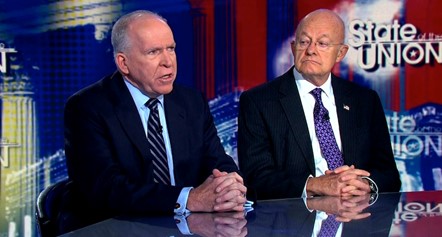
Former Director of National Intelligence James Clapper and former CIA Director John Brennan discuss allegations of Russian influence in presidential elections (CNN Screenshot)
By Whitney Webb – Mint Press News – February 12, 2018
Though its ostensible purpose is to fund the US military over a one year period, the National Defense Authorization Act, better known as the NDAA, has had numerous provisions tucked into it over the years that have targeted American civil liberties. The most well-known of these include allowing the government to wiretap American citizens without a warrant and, even more disturbingly, indefinitely imprison an American citizen without charge in the name of “national security.”
One of the lesser-known provisions that have snuck their way into the NDAA over the years was a small piece of legislation tacked onto the NDAA for fiscal year 2013, signed into law in that same year by then-President Barack Obama. Named “The Smith-Mundt Modernization Act of 2012,” it completely lifted the long-existing ban on the domestic dissemination of US government-produced propaganda.
For decades, the US government had been allowed to produce and disseminate propaganda abroad in order to drum up support for its foreign wars but had been banned from distributing it domestically after the passage of the Smith-Mundt Act of 1948. However, the Modernization Act’s co-authors, Reps. Mac Thornberry (R-TX) and Adam Smith (D-WA, no relation to the Smith of the 1948 act), asserted that removing the domestic ban was necessary in order to combat “al-Qaeda’s and other violent extremists’ influence among populations.”
Thornberry stated that removing the ban was necessary because it had tied “the hands of America’s diplomatic officials, military, and others, by inhibiting our ability to effectively communicate in a credible way.” Yet, given that Thornberry is one of the greatest beneficiaries of weapon manufacturers’ campaign contributions, the real intent — to skeptics at least — seemed more likely related to an effort to ramp up domestic support for US military adventurism abroad following the disastrous invasions of Iraq and Libya.
Five years later, the effects of the lifting of the ban have turned what was once covert manipulation of the media by the government into a transparent “revolving door” between the media and the government. Robbie Martin — documentary filmmaker and media analyst whose documentary series, “A Very Heavy Agenda,” explores the relationships between neoconservative think tanks and media — told MintPress, that this revolving door “has never been more clear than it is right now” as a result of the ban’s absence.
In the age of legal, weaponized propaganda directed at the American people, false narratives have become so commonplace in the mainstream and even alternative media that these falsehoods have essentially become normalized, leading to the era of “fake news” and “alternative facts.”
Those who create such news, regardless of the damage it causes or the demonstrably false nature of its claims, face little to no accountability, as long as those lies are of service to US interests. Meanwhile, media outlets that provide dissenting perspectives are being silenced at an alarming rate.
The effects of lifting the ban examined
Since 2013, newsrooms across the country, of both the mainstream and “alternative” variety, have been notably skewed towards the official government narrative, with few outside a handful of independently-funded media outlets bothering to question those narratives’ veracity. While this has long been a reality for the Western media (see John Pilger’s 2011 documentary “The War You Don’t See”), the use of government-approved narratives and sources from government-funded groups have become much more overt than in years past.
From Syria to Ukraine, US-backed coups and US-driven conflicts have been painted as locally driven movements that desperately need US support in order to “help” the citizens of those countries — even though that “help” has led to the near destruction of those countries and, in the case of Ukraine, an attempted genocide. In these cases, many of the sources were organizations funded directly by the US government or allied governments, such as the White Helmets and Aleppo Media Centre (largely funded by the US and U.K. governments) in the case of Syria, and pro-Kiev journalists with Nazi ties (including Bogdan Boutkevitch, who called for the “extermination” of Ukrainians of Russian descent on live TV) in the case of Ukraine, among other examples. Such glaring conflicts of interests are, however, rarely — if ever — disclosed when referenced in these reports.
More recently, North Korea has been painted as presenting an imminent threat to the United States. Recent reports on this “threat” have been based on classified intelligence reports that claim that North Korea can produce a new nuclear bomb every six or seven weeks, including a recent article from the New York Times. However, those same reports have admitted that this claim is purely speculative, as it is “impossible to verify until experts get beyond the limited access to North Korean facilities that ended years ago.” In other words, the article was based entirely on unverified claims from the US intelligence community that were treated as compelling.
As Martin told MintPress, many of these government-friendly narratives first began at US-funded media organizations overseen by the Broadcasting Board of Governors (BBG) — an extension of the US state department.
Martin noted that US-funded media, like Voice of America (VOA) and Radio Free Europe (RFE), were among the first to use a State Department-influenced narrative aimed at “inflaming hostilities with Russia before it soaked into mainstream reporting.” Of course, now, this narrative — with its origins in the US State Department and US intelligence community — has come to dominate headlines in the corporate media and even some “alternative” media outlets in the wake of the 2016 US election.
This is no coincidence. As Martin noted, “after the ban was lifted, things changed drastically here in the United States,” resulting in what was tantamount to a “propaganda media coup” where the State Department, and other government agencies that had earlier shaped the narrative at the BBG, used their influence on mainstream media outlets to shape those narratives as well.
A key example of this, as Martin pointed out, was the influence of the new think-tank “The Alliance for Securing Democracy,” whose advisory council and staff are loaded with neocons, such as the National Review’s Bill Kristol, and former US intelligence and State Department officials like former CIA Director Michael Morell. The Alliance for Securing Democracy’s Russia-focused offshoot, “Hamilton 68,” is frequently cited by media outlets — mainstream and alternative — as an impartial, reliable tracker of Russian “meddling” efforts on social media.
Martin remarked that he had “never seen a think tank before have such a great influence over the media so quickly,” noting that it “would have been hard to see [such influence on reporters] without the lifting of the ban,” especially given the fact that media organizations that cite Hamilton 68 do not mention its ties to former government officials and neoconservatives.
In addition, using VOA or other BBG-funded media has become much more common than it was prior to the ban, an indication that state-crafted information originally intended for a foreign audience is now being used domestically. Martin noted that this has become particularly common at some “pseudo-alternative” media organizations — i.e., formerly independent media outlets that now enjoy corporate funding. Among these, Martin made the case that VICE News stands out.
After the propaganda ban was lifted, Martin noticed that VICE’s citations of BBG sources “spiked.” He continued:
One of the things I immediately noticed was that they [VICE news ] were so quick to call out other countries’ media outlets, but yet — in every instance I looked up of them citing BBG sources — they never mentioned where the funding came from or what it was and they would very briefly mention it [information from BBG sources] like these were any other media outlets.”
He added that, in many of these cases, journalists at VICE were unaware that references to VOA or other BBG sources appeared in their articles. This was an indication that “there is some editorial staff [at VICE News ] that is putting this in from the top down.”
Furthermore, Martin noted that, soon after the ban was lifted, “VICE’s coverage mirrored the type of coverage that BBG was doing across the world in general,” which in Martin’s view indicated “there was definitely some coordination between the State Department and VICE.” This coordination was also intimated by BBG’s overwhelmingly positive opinion of VICE in their auditing reports, in which the BBG “seemed more excited about VICE than any other media outlet” — especially since VICE was able to use BBG organizations as sources while maintaining its reputation as a “rebel” media outlet.
Martin notes that these troubling trends have been greatly enabled by the lifting of the ban. He opined that the ban was likely lifted “in case someone’s cover [in spreading government propaganda disguised as journalism] was blown,” in which case “it wouldn’t be seen as illegal.” He continued:
For example, if a CIA agent at the Washington Post is directly piping in US government propaganda or a reporter is working the US government to pipe in propaganda, it wouldn’t be seen as a violation of the law. Even though it could have happened before the ban, it’s under more legal protection now.
Under normal circumstances, failing to disclose conflicts of interests of key sources and failing to question government narratives would be considered acts of journalistic malpractice. However, in the age of legal propaganda, this dereliction matters much less. Propaganda is not intended to be factual or impartial — it is intended to serve a specific purpose, namely influencing public opinion in a way that serves US government interests. As Karl Rove, the former advisor and deputy chief of staff to George W. Bush, once said, the US “is an empire now, and when we act, we create our own reality.” This “reality” is defined not by facts but by its service to empire.
Meanwhile, counter-narratives, however fact-based they may be, are simultaneously derided as conspiracy theories or “fake news,” especially if they question or go against government narratives.
The revolving door
Another major consequence of the ban being lifted goes a step further than merely influencing narratives. In recent years, there has been the growing trend of hiring former government officials, including former US intelligence directors and other psyops veterans, in positions once reserved for journalists. In their new capacity as talking heads on mainstream media reports, they repeat the stance of the US intelligence community to millions of Americans, with their statements and views unchallenged.
For instance, last year, CNN hired former Director of National Intelligence James Clapper. Clapper, a key architect of RussiaGate, has committed perjury by lying to Congress and more recently lied about the Trump campaign being wiretapped through a FISA request. He has also made racist, Russophobic comments on national television. Now, however, he is an expert analyst for “the most trusted name in news.” CNN last year also hired Michael Hayden, who is a former Director of both the CIA and the NSA, and former Principal Deputy Director of National Intelligence.
CNN isn’t alone. NBC/MSNBC recently hired former CIA director John Brennan — another key architect of RussiaGate and the man who greenlighted (and lied about) CIA spying on Congress — as a contributor and “senior national security and intelligence analyst.” NBC also employs Jeremy Bash, former CIA and DoD Chief of Staff, as a national security analyst, as well as reporter Ken Dilanian, who is known for his “collaborative relationship” with the CIA.
This “revolving door” doesn’t stop there. After the BBG was restructured by the 2016 NDAA, the “board” for which the organization was named was dissolved, making BBG’s CEO — a presidential appointee — all powerful. BBG’s current CEO is John Lansing, who – prior to taking the top post at the BBG – was the President and Chief Executive Officer of the Cable & Telecommunications Association for Marketing (CTAM), a marketing association comprised of 90 of the top US and Canadian cable companies and television programmers. Lansing’s connection to US cable news companies is just one example of how this revolving door opens both ways.
Media-government coordination out of the shadows
Such collusion between mainstream media and the US government is hardly new. It has only become more overt since the Smith-Mundt ban was lifted.
For instance, the CIA, through Operation Mockingbird, started recruiting mainstream journalists and media outlets as far back as the 1960s in order to covertly influence the American public by disguising propaganda as news. The CIA even worked with top journalism schools to change their curricula in order to produce a new generation of journalists that would better suit the US government’s interests. Yet the CIA effort to manipulate the media was born out of the longstanding view in government that influencing the American public through propaganda was not only useful, but necessary.
Indeed, Edward Bernays, the father of public relations, who also worked closely with the government in the creation and dissemination of propaganda, once wrote:
The conscious and intelligent manipulation of the organized habits and opinions of the masses is an important element in democratic society. Those who manipulate this unseen mechanism of society constitute an invisible government which is the true ruling power of our country.
While this was once an “invisible” phenomenon, it is quickly becoming more obvious. Now, Silicon Valley oligarchs with ties to the US government have bought mainstream and pseudo-alternative media outlets and former CIA directors are given prominent analyst positions on cable news programs. The goal is to manufacture support at home for the US’ numerous conflicts around the world, which are only likely to grow as the Pentagon takes aim at “competing states” like Russia and China in an increasingly desperate protection of American hegemony.
With the propaganda ban now a relic, the once-covert propaganda machine long used to justify war after war is now operating out in the open and out of control.
Afghan Officials in Secret Talks With Taliban – Reports
Sputnik – February 13, 2018
Kabul has found itself in a challenging situation due to the intra-governmental struggle and the Taliban’s expanding influence on Afghan soil.
Afghan officials are holding secret talks with Taliban representatives amid the bombings that have left some 200 people dead and the group’s outgrowth in the country, the Associated Press reported Tuesday, citing individuals “familiar with the backdoor negotiations.”
Afghanistan’s intelligence Chief Masoom Stanikzai and its National Security Chief Mohammed Hanif Atmar continue to each talk separately to the Taliban,” the outlet said.
According to the sources cited by the AP, the move was prompted by Kabul’s desire to end the Taliban’ militancy that has been continuing for 17 years since the US overthrew the then-ruling group.
Speaking further, the sources pointed out disagreements in the Afghan government, as neither of the two officials, assigned to hold talks with Taliban, want to talk to each other or the High Peace Council that was established to discuss the Afghan peace process.
At the same time, Hakim Mujahid, a member of the High Peace Council, has confirmed that Stanikzai still maintains contacts with the Taliban’s negotiator Mullah Abbas Stanikzai, who is not related to the government’s official, the Associated Press continued.
Furthermore, former top Taliban member Aga Jan Motasim has said that he was eager to be a mediator in talks between Kabul and the group. He is now reportedly traveling between Kabul, where he holds talks with the authorities, and Turkey, where he is in contact with Taliban representatives.
Meanwhile, according to the US, the Taliban has gained control over more than a half of Afghanistan, while some reports say that the group either controls or has influence over some 70 percent of the countries territory.
In this respect, Donald Trump has ordered to intensify airstrikes on Taliban’s positions. The order came half a year after the US president released his new Afghanistan strategy, envisaging the deployment of an additional 4,000 troops, as well as other support to the politically, socially and security-wise unstable country.
See Also:
Chief of Iranian General Staff Accuses US of Transferring Daesh Terrorists to Afghanistan
US denies alleged talks with Netanyahu over settlements annexation
Palestine Information Center – February 13, 2018
The United States dismissed as false on Monday statements by Israel’s Prime Minister Benjamin Netanyahu that both parties were discussing the possibility of Israel annexing illegal settlements in the occupied West Bank, in another display of discord between U.S. President Donald Trump and Netanyahu.
“On the subject of applying sovereignty, I can say that I have been talking to the Americans about it for some time,” Netanyahu told a closed-door meeting of his right-wing Likud party’s legislators, according to the party’s spokesman.
Later on Monday, the White House denied having such discussions and a senior Israeli official said Netanyahu had not made a specific annexation proposal to Washington.
“Reports that the United States discussed with Israel an annexation plan for the West Bank are false,” White House spokesman Josh Raffel said. “The United States and Israel have never discussed such a proposal.”
Issuing a clarification, the prime minister’s office stepped back from any suggestion of a dialogue with Washington on any government annexation plan. It said Netanyahu had only updated the Americans on proposed legislation in parliament.
The remarks stoked Palestinian anger, already high over Trump’s Dec. 6 announcement that the United States recognizes Jerusalem as Israel’s capital, a reversal of decades of U.S. policy.
US ready for direct talks with sanctions-bashed N. Korea
RT | February 12, 2018
Washington is no longer opposed to the idea of talks with Pyongyang without preconditions, but still favors ramping up sanctions pressure against North Korea until it agrees to relinquish its nuclear arsenal, Mike Pence said.
The US vice president disclosed this subtle change in US Korean policy to Washington Post correspondent Josh Rogin while flying back from South Korea after a state visit. Apparently, Pence was convinced that actually talking to North Korea may be a good idea. Previously, senior US officials – starting with President Donald Trump – have insisted that talking to the North Korean government was of no use to America.
“The point is, no pressure comes off until they are actually doing something that the alliance believes represents a meaningful step toward denuclearization,” Pence said as cited by the newspaper. “So the maximum pressure campaign is going to continue and intensify. But if you want to talk, we’ll talk.”
So the US still wants to hurt North Korea as much as possible without starting an actual shooting war, but now it looks like it is willing to eventually hear Pyongyang’s plea for mercy. Which is admittedly a step in the right direction compared to obstructing any talks.
Washington previously signaled it was willing for direct talks with Pyongyang in December, when State Secretary Rex Tillerson said as much – only to be disavowed by his own department a day later. Trump at one point called talking to North Korea a waste of time and tweeted that he had told his top diplomat to “save your energy.”
Tillerson gave a lukewarm comment to Pence’s suggestion, saying it was “too early to judge” if such talks would be possible.
“We’ll have to have some discussions that precede any form of negotiations to determine whether the parties are in fact ready to engage in something that is meaningful,” he said.
Apparently Washington is at least willing to give a nod to a Kim-Moon meeting, allowing the current truce between the leaders of the two Koreas to extend beyond the Olympics. But it is unlikely to let Pyongyang score any political points, for example, by extending the pause in joint US-South Korean military exercises, which North Korea considers a major threat to its national security. Pyongyang may feel a need to counter such a show of force with more tests, which would further undermine whatever diplomatic effort comes after the end of the games.
There is a lot of mistrust between the US and North Korea, including over the failed diplomatic agreements of the past. For instance, the 1994 Agreed Framework was to see North Korea freeze its nuclear weapons program in exchange for aid and help in developing civilian nuclear industry. Pyongyang did dismantle its 5 MWe pilot nuclear reactor in Yongbyon, but somehow the US Congress went against the deal, obstructing the lifting of sanctions and funding the construction of light-water nuclear reactors North Korea was promised. The deal finally collapsed when George W. Bush labeled Pyongyang part of the “Axis of Evil.”
The story is somewhat reminiscent of what is currently happening with the Iranian nuclear deal – negotiated by a Democrat president and currently being undermined by a Republican one. So the North Korean government may require a very good incentive to relinquish its nuclear arsenal, which it considers a better guarantee of its survival than any promises given by the US.
US To Build New Military Base in Northern Argentina
teleSUR | February 11, 2017
Argentine President Mauricio Macri is also letting in more DEA, FBI, and U.S. military forces to control narcotrafficking and terrorism within the country.
Argentina is allowing the U.S. to build a new military base at its northern border with Brazil and Paraguay. Officials of the South American country also announced that it will work with Drug Enforcement Administration (DEA) at the triple border “to analyze where drugs are coming from.”
Argentina’s Minister of Security, Patricia Bullrich announced in Washington that the Mauricio Macri administration is going to allow the U.S. to build a military base in Posadas, Misiones, bordering Brazil and Paraguay.
Bullrich says her government is creating “an analysis center with Paraguay and Brazil (and the U.S.) to figure out where, how and with whom narco traffickers operate” at the triple border region.
This “task force,” as its being called, will operate in conjunction with the DEA, the Department of Homeland Security (DHS), and the U.S. Southern Command, which watches over U.S. operations in Latin America and the Caribbean.
This will be the second task force against drug trafficking in Argentina. The first one was installed in Salta province located near the borders with Bolivia and Chile during the Barack Obama administration.
Bullrich told the press that the DEA initially wanted Argentine officials to send drug samples to the U.S. so the agency could analyze them for their origin. She said this would be against Argentine law and that officials within the country would analyze the drugs.
The U.S. and Argentine functionaries also discussed the suspected presence of Lebanese Hezbollah, an organization the U.S. government considers a terrorist group, at the border shared by Argentina, Brazil and Paraguay.
“It’s important for our government to collaborate (with the U.S.) and that they collaborate with us. We’re going to work together at the triple border regarding terrorism. We think we’ll have DEA and other agencies there to better understand what’s happening in the region,” Bullrich assured the press.
The minister of security also met with Federal Bureau of Investigation (FBI) and the Department of Homeland Security (DHS) officials in Washington to discuss their training of Argentine Federal Police.
After leaving Washington Bullrich flew to Miami to meet with the chief of U.S. Southern Command, Admiral Kurt W. Tidd and the Defense Minister of Argentina, Oscar Aguad.
Admiral Tidd was recently in Colombia meeting with its military forces.
Human rights organizations are protesting the increased U.S. military presence in Latin American and the Caribbean.
The former Argentine ambassador to Venezuela and the United Kingdom, Alicia Castro, tweeted of Bullrich’s proposed policies, “Do you want to see how the U.S. … ‘combats terrorism’? Look at the Middle East devastated. And ‘combating narcotrafficking’? Look at the cartels and assassinations in Colombia y Mexico, the places where the DEA intervenes.”
New War in the Middle East? – Washington Is Dancing To the Tune Being Played by Israel

By Philip Giraldi | American Herald Tribune | February 12, 2018
How many Americans are aware that every two years the United States military engages in large scale exercises with the Israeli Defense Forces that simulate wars against Israel’s neighbors? Three thousand American soldiers are in Israel right now involved in maneuvers that are focused on countering a missile attack from Lebanon. When the exercise, known as Juniper Cobra, was run in 2016 the U.S. commander Lt. Gen. Timothy Ray, who appeared to confuse American national security with that of a small Middle Eastern state, described it as the European Command’s “highest priority” drill that year. He then added that “this exercise increases our military readiness, but just as importantly it also signals our resolve to support Israel.”
Ironically, Lebanon has an army of its own that is in part financially and logistically supported by Washington, though not at the level that the U.S. supports Israel, which means that the U.S. is participating in war games that pit one friendly country and military aid recipient against another. Israel has warned that in any future conflict it will target the Lebanese Army equally with Hezbollah as both are “enemies.”
The truly most interesting aspects of the current exercises in Israel is that the United States has never had any formal alliance with Israel and has absolutely no national interest in becoming involved in Israel’s wars at all. The assumption that the U.S. might be called upon to help defend Israel is not based on any strategic reality, which is not to say it might not happen if Congress and the White House have their way, but it would likely be a double war of aggression, with Israel attacking the militarily much weaker Lebanese followed by the United States weighing in to finish the job after Hezbollah tries to fight back with its batteries of rockets.
That Washington is the Israeli poodle in the current situation is made clear by the recent opening of the first U.S. military base in Israel. It is described as a base within a base as it is completely contained by an Israeli air force installation and operates “under Israeli military directives.” It has no function in support of U.S. regional interests but is instead a shell headquarters with limited support facilities that can be ramped up considerably if Israel goes to war and calls for American assistance. Together with billions of dollars-worth of U.S. military equipment that is pre-positioned in Israel and can be used by the Israelis as needed, it is all about supporting Israeli war-making and has nothing to do with American security or defense interests.
Maneuvers are supposed to simulate possible future military actions, bloodless battles that provide lessons learned for future engagements, suggesting that some genius in the Pentagon who initiated these biennial exercises under George W. Bush, expects American soldiers to assist in the Israeli mission to remake the Middle East in their favor. Pentagon number two Paul Wolfowitz, who had an unseemly close relationship with Israeli military visitors, comes to mind as a possible candidate.
Israel has actually been planning to invade Lebanon. Last September it held its largest military exercise in over twenty years around the theme of a ground invasion of Lebanon. Israeli soldiers even dressed as Hezbollah militiamen as part of the training. There have been repeated warnings by Israeli government officials that there are several red lines that will bring about an Israeli attack, to include evidence that Iran is aiding the development of sophisticated “missile plants” in either Lebanon or Syria. The evidence for such plants is otherwise reported to be apocryphal or perhaps even fabricated, known only to Israeli intelligence, but they should perhaps be seen as a pretext for war and not necessarily based on fact.
Apart from having no compelling interest to get involved in the latest round of bloodletting, the U.S. would be well advised to keep its distance from Benjamin Netanyahu’s schemes to destroy Hezbollah’s power as crushing Lebanon would produce the same kind of regional catastrophe as did the U.S. led Iraq invasion of 2003. Israel’s Minister of Transportation Ysrael Katz recently warned that Lebanon will be “razed to the ground” and “returned to the stone age” if Hezbollah proves able and willing to fire any missiles at Israel.
Israel is itching for a fight and working hard to get Washington involved, not a difficult task given the belligerent proclivities of those who gather to discuss national security strategy in the White House. Viewing Israel’s recent actions relating to Gaza, Lebanon and Syria, it is clear that Netanyahu’s government is the aggressor and is both willing and able to destabilize the entire region without any regard for what happens next. It has already warned that its expected conflict with Lebanon will also involve Syria and that the ultimate target is to eliminate Iranian influence in the area.
Bombings of neighboring Syria by Israeli aircraft have also intensified, leading to the shooting down of an Israeli jet by Syrian air defense forces. The U.S. media covered the story but largely ignored the fact that Netanyahu has launched hundreds of airstrikes against a country with which it is not at war, again using the false claim that Israel is acting defensively and it is Iran that is doing the “interfering.” Of course, the United States in Syria has done much the same thing, lying about developments before setting up an ambush last week that killed 100 Syrian soldiers.
That Washington is dancing to the tune being played by Israel to dismember the Middle East makes the American government an accomplice when the war actually does break out. And it will undoubtedly also have to do much of the fighting. That the United States appears to be committed to defend Israel, even if Israel starts the war, is deplorable and is particularly so as there is no reciprocity. Israel has never fought side-by-side with the United States and if Washington actually finds itself in a situation where it needs Israeli military assistance or support don’t count on it.
*(Juniper Cobra 2016. Image credit: Israel Defense Forces/ flickr)
US Lawmakers Pushing to Cancel Lorde’s Upcoming Florida Shows

Lorde in concert. (Photo: Lorde’s twitter account)
Palestine Chronicle | February 11, 2018
American Lawmakers in Florida are trying to cancel Lorde’s upcoming shows in the state after the Kiwi songstress and superstar called off her performance in Israel.
Lorde cancelled her Tel Aviv concert in December, following pressure from fans and activists in the Boycott, Divestment, Sanctions (BDS) movement, which is making a stand against Israel’s oppression of Palestinians.
The decision has seen Republican state Rep. Randy Fine this week pushing for Miami and Tampa to cancel Lorde’s April shows, the Orlando Weekly reported.
Fine based his actions on a Florida law which barred companies that received state funds from doing business over $1 million with organisations associated with BDS.
“When Lorde joined the boycott in December, she and her companies became subject to that statute,” Fine told Orlando Weekly.
“The taxpayers of Miami and Tampa should not have to facilitate bigotry and anti-Semitism, and I look forward to the Miami Sports and Exhibition Authority and the Tampa Sports Authority complying with the law and cancelling these concerts.
“Florida has no tolerance for anti-Semitism and boycotts intended to destroy the State of Israel.”
Florida is one of 20 states with a law in place to deal with businesses that boycott Israel.
In a statement released in December last year Lorde said that “the right decision at this time” was to cancel her June 2018 concert in Tel Aviv.
The Grammy-award winner said that after having “lots of discussions” about the matter, she was “not too proud to admit I didn’t make the right call on this one,” referring to her initial decision to hold the concert.
The cancellation was welcomed by members of the BDS movement.
The Palestinian Campaign for the Academic and Cultural Boycott of Israel posted a statement on Twitter thanking the artist for “heeding appeals from your fans against Israel’s art-washing of its brutal oppression of Palestinians.”
Other artists to have boycotted Israel over its treatment of the Palestinians included Roger Waters, Lauryn Hill and Elvis Costello.
US feels uneasy about inter-Korean amity
By M K Bhadrakumar | Indian Punchline | February 11, 2018
The North Korean leader Kim Jong-un has upset all doomsday predictions that once the Winter Olympics Games are over, the tensions on the Korean peninsula would reappear. Kim’s invitation to South Korean President Moon Jae-in to Pyongyang can be regarded as a ‘game changer’. Moon has been non-committal, saying conditions need to be created first. The important thing is that Moon neither accepted Kim’s invitation nor declined. As a senior South Korean official put it, Moon has “practically accepted” the invitation. Thereby hangs a tale.
Left to himself Moon may want to visit Pyongyang. But a number of factors come into play. First and foremost, North Korea should refrain from missile tests, especially nuclear tests. Kim’s invitation to Moon implies that Pyongyang intends to hold back on missile and nuclear tests even after the Winter Games are over. On the contrary, if the joint US-South Korean military drills resume, all bets are off.
Therefore, Moon faces the daunting challenge of persuading the Trump administration to defer military drills. Now, that is not going to be easy. The US insists that North Korea should unilaterally suspend its missile and nuclear tests and does not accept any linkage with the US-South Korean military drills. Indeed, the sensible thing to do is to follow the suggestion by China and Russia on ‘double suspension’ – ie., US and South Korea suspending military drills and North Korea reciprocally suspending missile and nuclear tests.
China can be expected to play a major role here in bridge-building. Xinhua news agency reported that during the visit by Chinese State Councilor Yang Jiechi to Washington on February 8-9, he “exchanged ideas on the nuclear issue on the Korean peninsula.” Yang was received by President Trump and he also had meetings with Secretary of State Rex Tillerson, National Security Advisor HR McMaster and the president’s senior advisor and son-in-law Jared Kushner. Xinhua cited Yang as calling for “global support for the inter-Korean rapport in a bid to maintain the tension-easing momentum on the peninsula.” Yang said Beijing hopes to keep “communication and coordination” with Washington with a view to seek a solution to the North Korean issue.
Significantly, Chinese president Xi Jinping also deputed a special envoy to meet Moon in the weekend. Accordingly, on Saturday Han Zheng, a member of the Standing Committee of the Political Bureau of the Communist Party of China Central Committee, met Moon. (Moon received Han before hosting a lunch for the high-ranking North Korean delegation led by Kim Yong Nam, president of the Presidium of the Supreme People’s Assembly on Saturday.) Xinhua reported Han as voicing support for the “conciliation and cooperation” between North and South Korea and expressing hope that “relevant parties would meet each other half way and make joint efforts to further ease tensions”
While things look hazy as of now and it is difficult to foresee how things may work out, the odds are that Moon will visit Pyongyang eventually. Put differently, South Korea may not be in a tearing hurry to resume the military drills with the US anytime soon. According to reports, Moon already had a testy exchange with the Japanese Prime Minister on the matter. They sparred, with Moon bluntly rejecting Abe’s call to resume the US-South Korean military drills without delay.
Meanwhile, the popular opinion in South Korea is visibly changing. It turned out to be a brilliant maneuver on the part of the North Korean leader to depute his younger sister Kim Yo Jong as part of the high-level delegation to attend the opening ceremony of the Winter Olympics. She is the first member of the ruling family in Pyongyang to visit the South since the Korean War broke out in 1950, and South Koreans were enthralled. Clearly, North Korea’s participation in the Olympics has already broken the momentum of the US’ pressure campaign. Some sanctions against North Korea are already suspended temporarily until the Winter Olympics ends. The big question is whether the US’ pressure campaign can be resumed in the changed climate between the two Koreas.
Moon is walking on eggshells. Surely, he won’t want to miss the window of opportunity for a peace engagement with Kim. But then, it is far too risky to go to Pyongyang unconditionally. By going out on a limb, not only would Moon be angering the Trump administration, but the reality is that Kim has not given any signals so far that he is willing to discuss denuclearization. Equally, it could be that Kim is simply buying time for his country’s nuclear weapon program. Above all, US backing is vital for Moon to negotiate with Kim.
However, Washington is not exactly pleased about the recent improvement in inter-Korean ties. There are already signs of discord in the US-South Korean alliance. Read a dispatch by Associated Press – Pence’s bid to isolate North Korea at Olympics falls flat.
Featured Video
Nima R. Alkhorshid: US military bombs multiple targets on Iran’s Qeshm Island
or go to
Aletho News Archives – Video-Images
From the Archives
British Intel Tried to Make N Irish Gang ‘Shoot Up’ School, Documentary Claims
Sputnik – 23.02.2019
A new documentary, based on an interview with a self-confessed member of the Glennane Gang, gives some insights into allegations that British military intelligence was behind a shocking murder plot to cause the situation in Northern Ireland to “spiral out of control”.
In a documentary, Unquiet Graves: The Story of the Glennane Gang, John Weir, a former officer from the Royal Ulster Constabulary (RUC), alleges that British intelligence tried to persuade paramilitary group Ulster Volunteer Force (UVF) to attack a Catholic primary school at Belleeks in County Armagh.
Weir claimed that the UVF was urged to kill children and teachers in retaliation for the 1976 Kingsmill massacre, in which gunmen stopped a minibus carrying twelve workmen and shot them; only one person survived despite having been shot 18 times.
“The plan that was decided on was to shoot up a school in Belleeks”, he said, adding that the British intelligence plot was to make the situation in Northern Ireland “spiral out of control”. … continue
Blog Roll
 Aletho News
- The vindication of Marjorie Taylor Greene
- Nearly 80% of Britons consider Israel a threat to world peace and security: Survey
- Rhode Island Staffer Could Be Reinstated After Firing Over Ceasefire Post
- Will Republicans Learn Their Lesson from the ‘Disastrous’ Midterms?
- Wrong, Newswise, Irresponsible Climate Messaging, Not Climate Change Itself, Is Fueling Student Anxiety
- Zelensky’s Critics Vanish Into Ukrainian Secret Prisons – Source
- Nima R. Alkhorshid: U.S. Military Bombs Multiple Targets on Iran’s Qeshm Island
- Iran-Linked Ships Spotted Hovering over Subsea Cables: Report
- New attack on Iran could devastate ‘Israel’, IOF general warns
- Nuclear deterrence: The US-Israeli military aggression against Iran made the unthinkable legitimate
- If Americans Knew
- An error has occurred; the feed is probably down. Try again later.
- No Tricks Zone
- Zonal Asymmetry of Temperature Change in the Antarctic Circumpolar Current
- New Study: The Net Fossil Fuel Contribution To Rising Atmospheric CO2 Has Been Zero For 500 Years
- Germany’s Green Energy Transition Becoming Increasingly Expensive…Another 6 Trillion Euros!
- Sudden Stratospheric Warming, Powerful El Niño Combination May Lead To Extreme Europe Cold, Energy Crisis!
- Two New Studies Find Thwaites Glacier Melt Cannot Be Driven By Human Activity Or A Warming Ocean
- E-Cars Reduce CO2 Emissions By Only 41% Compared To Internal Combustion Engine Vehicles
- Predictions Made By Renowned Climate Professor Over Past Decades Have Been Proven To Be Poor
- New Study Suggests Large Regions Of The Pacific Ocean Have Been Cooling For The Last 80 Years
- Germany’s Green Energy Debacle: High Energy Costs Force Kahla Porzellan to Close After 182 Years!
- New Study: 50 Years Of The Most Aggressive ‘Net Zero’ Policies Can Only Affect The Global Climate By 0.03°C

