Pentagon Seeking New Technologies in Preparation for Space Wars
Sputnik – January 11, 2018
WASHINGTON – The United States is seeking help from 11 unspecified organizations to develop tools and techniques to manage US military operations in outer space, the Defense Advanced Research Projects Agency (DARPA) said in a press release on Wednesday.
“To help ensure future US technological and strategic superiority, DARPA’s Hallmark program seeks to develop revolutionary tools and technologies to plan, assess, and execute US military operations in space,” the release said. “The program has completed initial research and awarded Phase 1 contracts to 11 organizations, which both augment existing commercial technologies and pursue entirely new capabilities.”
DARPA described Hallmark’s Phase 1 as one of the first instances of using “cognitive evaluation” to develop tools for U.S. military command and control in space.
Cognitive evaluation, the release explained, refers to tool-and-task combinations that quickly convey information, thereby enhancing real-time decision making.
Recently a new report revealed, that the latest version of the US’ fiscal year 2018 appropriations bill already designates more funding to a space-based ballistic missile defense capability, which includes developing a sensor layer to detect incoming intercontinental ballistic missiles as well as an interceptor to neutralize threats.
Terrorists Keep Obtaining Weapons of States in US-led Coalition

Sputnik – January 11, 2018
It’s been three days since Russia prevented a terrorist attack on its bases in Syria, with terrorists, as unexpected as it may seem, using sophisticated drones to strike the facilities.
Commenting on the issue, Pentagon said that the devices of such kind “could easily be obtained in the open market,” while the Russian Defense Ministry has stated that such technology could be supplied only by an advanced state.
While it is still being investigated, where did the terrorists get the technology? This is not the first time they have gotten access to advanced technologies, sometimes entirely by a chance.
Sputnik recaps the most resonant cases, when terrorist groups in the Middle East got hold of highly sophisticated weaponry.
Syrian MoD Report
In October 2017, the Syrian Defense Ministry released a report with footage of ammunition confiscated from numerous terrorist organizations, including Daesh and al-Nusra Front, now named Tahrir al-Sham, claiming that those weapons had been manufactured in the United States or by its close allies. The report outlined that those groups were supplied with “rockets, rifles, machine guns, anti-air weapons and even tanks” allegedly in exchange for oil from the territories. By a cruel twist of fate, those weapons happened to be a part of the routine “arms delivery” by the anti-Daesh coalition to the “moderate opposition”.
Anti-Aircraft Missiles
In August 2017, the Lebanese army, which has been engaged in rooting Daesh out from a northeastern region of Lebanon bordering Syria, discovered anti-aircraft missiles, among other weapons, in an abandoned area. Moreover, the Lebanese, who have apparently done a great job, uncovered surface-to-air missiles left by al-Nusra Front militants in an area captured by Hezbollah and then taken over by the army. As early as 2013, The New York Times reported that Qatar was sending MANPADS (“man-portable air-defense-system”) to Syria and said that these might potentially go straight to Al-Qaeda to shoot down civilian aircraft.

© AFP 2018/ MAHMOUD TAHA
Rebel-fighters monitor the sky holding a man-portable air-defence system (MANPADS) in the Syrian village of Teir Maalah, on the northern outskirts of Homs, on April 20, 2016.
Humvees
In 2015, Iraqi security forces lost 2,300 Humvee armored vehicles, supplied by the United States, when the northern city of Mosul collapsed. They were designed as a fast means to carry personnel and supplies to the battlefield, but later Daesh re-purposed them into car bombs with improvised explosive devices. Since then, Humvee car bombs became an integral part of the group’s military tactics due to the weapons’ devastating power and the vehicle’s ability to move fast.
Anti-Tank Missiles
By spring 2014, a year after then-President Barack Obama approved the first direct US military aid to rebel groups in Syria, the US-manufactured BGM-71 TOW anti-tank missiles began to appear in the hands of various anti-Bashar Assad groups. Subsequently, in November 2015, Russian journalists were attacked with the use of those ant-tank missile systems.
Supplies for Kurds
In October 2014, the Pentagon admitted that due to unforeseen circumstances, one of the airdrops initially intended for Kurds in the besieged Kobani, wound up in the hands of Daesh militants. The group immediately issued a video to boast of the newly-acquired weapons, which were meant to destroy them.
Bonus
Probably everyone who has ever watched videos released by the terrorist group Daesh has noticed that jihadists have been driving Toyota trucks. Certainly, cars are not related to “sophisticated weapons,” but many have wondered how the famous car-maker wound up becoming part of the Daesh “brand”. Well, here’s an explanation: when the US State Department decided to send aid to Syrian rebels, their wish-list, among many other things, included 43 Toyota trucks, which would make it easier for them to move on the ground.
READ MORE:
Attackers of Russian Bases in Syria Couldn’t Get Their Location From Net — MoD
US Weapons Went From Syrian Rebels to Daesh in Less than Two Months — Study
Congress Seeks to Increase FBI Surveillance Powers, Here’s What They Already Got

Sputnik – January 10, 2018
Lawmakers in the US House of Representatives are expected to vote Thursday on a bill that would codify into law some surveillance practices that have previously been criticized as unconstitutional.
The bill would re-authorize Section 702 of the Foreign Intelligence Surveillance Act (FISA), which serves as the basis of some of the US government’s largest surveillance programs.
Section 702 was authorized in 2008 and was set to expire on December 31, 2017, but was prolonged until January 19 as Congress was unable to reach an agreement on the terms of its re-authorization.
This section allows intelligence agencies to surveil the transnational communications of Americans without a warrant, as long as the “target” is not a US citizen. The problem is that this, due to loopholes, often results in the warrantless surveillance of US citizens as well.
The proposed bill seeks to close the so-called backdoor search loophole, where the National Security Agency (NSA) shares certain kinds of information with the Federal Bureau of Investigation (FBI), which can then be used by the FBI to search Americans’ communications without a warrant.
However, while the bill seeks to close the loophole, it would make significant exceptions. For example, FBI does not have to apply for a warrant if it is a matter of national security or when it determines that there is a “threat to life or serious bodily harm.”
The bill also addresses the so-called “about” collection, a practice where the NSA may search through communications, including those of American citizens, in order to collect communications that are “about” a targeted non-American individual. While the bill will legally forbid the practice, it will establish certain provisions whereby the practice can be continued in individual, specific cases.
The bill has provoked concerns from privacy advocates as well as some privacy-minded Republican and Democrat lawmakers.
“The bill’s language risks being read as a codification and expansion of certain illegal government practices such as collecting communications that are not to or from a surveillance target, including domestic communications,” the American Civil Liberties Union (ACLU) said in a statement Friday, calling on Congress to abandon efforts to pass the legislation.
FBI Surveillance Powers
Critics warn that the approval of the bill would further increase the FBI’s intelligence and surveillance powers. They were significantly expanded by the 2001 Patriot Act, which was aimed at strengthening national security after the 9/11 attacks.
In particular, under the Patriot Act, the FBI can covertly conduct physical searches or wiretaps of American citizens in order to obtain evidence of crime without having to prove probable cause, which critics say contradicts the requirements of the Fourth Amendment.
The legislation also gives the FBI unchecked power to access the records of citizens’ activities held by a third party, including financial records, medical histories, internet browsing history, library visits, travel patterns and any other activity that leaves a record, which has also been criticized as a violation of the Constitution.
In 2008, an amendment was made to FISA, which authorizes security and intelligence agencies, including the FBI, to monitor phone, email and other communications of American citizens “for up to a week” without a warrant, as long as one of the parties is outside the US.
The amendment has been used as the legal basis for surveillance programs revealed by former NSA contractor Edward Snowden in 2013, including PRISM, which involves the collection of emails, chat messages and videos from tech companies for intelligence purposes. The information is gathered by the NSA, but can be shared with other agencies, including the FBI.
Image – CCO
Drones Attacked Hmeymim Base From ‘Moderate’ Opposition-Controlled Area
Sputnik – January 10, 2018
MOSCOW – The drones that attacked Hmeymim air base earlier this month flew out of the area in the southwest of the de-escalation zone Idlib controlled by the so-called “moderate” opposition, the Krasnaya Zvezda newspaper, the official publication of the Russian Defense Ministry, said on Wednesday.
The ministry reported earlier this month that 13 drones had been used in attempted attacks on two Russian military facilities in Syria on January 6. Ten of them targeted the Hmeymim air base and three were sent toward the Tartus naval base.
“According to the Russian Defense Ministry, it was established that the launch of the drones was carried out from the area of the Muazar settlement located in the southwestern part of Idlib de-escalation zone controlled by the armed formations of the so-called ‘moderate’ opposition,” the statement said.
It is noted that in connection with this incident, the Russian Defense Ministry had sent letters to the Chief of the General Staff of the Turkish Armed Forces, Gen. Hulusi Akar, and Head of Turkey’s National Intelligence Organization, Hakan Fidan.”The documents indicate the need for Ankara to fulfill its obligations to ensure compliance with the ceasefire regime by the armed formations under its control and to step up work on the installation of observation posts in Idlib de-escalation zone in order to prevent such attacks by UAVs against any objects,” the statement added.
On Monday, the Russian Defense Ministry said that the country’s forces had taken control over six out of 13 drones, involved in the January 6 attempted attack in Syria. Thus, three UAVs were landed by the Russian forces in a controlled area, three other drones detonated after collision with the ground, and seven other UAVs were destroyed by the Russian Pantsir-S air defense systems. Subsequently, the Pentagon said that the devices and technologies used for the drone attack “easily accessible on the open market.” This statement caused concern of the Russian Defense Ministry.
US spy plane circled between Russian airbase & port facility during Syria drone attack – MoD
RT | January 9, 2018
Moscow has noted “strange coincidences” surrounding a terrorist attack on a Russian airbase and port facility in Syria, in which guided combat drones were deployed by militants. These include a US spy plane spotted in the area.
The Russian Ministry of Defense consciously didn’t point any fingers when talking about the January 6 attack on Russia’s airbase and port facility in Syria, the Tuesday statement said, but added that technology used in the attack was telling.
Advanced training in engineering in “one of the developed countries” would be necessary to program the principal controllers and bomb-release systems of an aircraft-type combat drone, the statement stressed. “Not everyone is also able to get exact [attack] coordinates from the space surveillance data,” it added.
The ministry noted that a US Navy Poseidon reconnaissance aircraft was flying over the region between the Russian bases in Latakia and Tartus for some four hours around the time of the drone attack. An earlier Pentagon statement allowed the Russian military to “take a new look at some strange coincidences” surrounding the incident, it said.
The Saturday attack targeted both Khmeimim Airbase and the maritime logistics facility in the city of Tartus, and involved as many as 13 combat drones. The assault was successfully repelled by the Russian anti-aircraft defense systems and electronic warfare specialists.
It was the first time terrorists had used such a technology in the conflict, the ministry said, adding that the technical assessment showed that the drone could have been obtained “only from a country possessing state-of-the-art technologies.”
Earlier on Tuesday, the US said it was “concerned” over the incident. Pentagon spokesman Maj. Adrian Rankin-Galloway, however, claimed that “those devices and technologies can easily be obtained in the open market.” He later also told Sputnik that the US already saw what it called “this type of commercial UAV [unmanned aerial vehicle] technology” being used in Islamic State (IS, formerly ISIS) missions.
Russia has repeatedly warned that US military supplies aimed at supporting “moderate” Syrian militants eventually end up in the hands of terrorists.
US, Israel step up hybrid war in Syria
By M K Bhadrakumar | Indian Punchline | January 9, 2018
The Russian airbase in Syria, Hmeimim, and the naval base at Tartus came under simultaneous drone attack on Saturday. The advanced Russian air defence system thwarted the attack. A wave of 13 drones was involved, and, interestingly, three of them were brought down intact.
After forty-eight hours of careful analysis of the incident, the Russian Defence Ministry in Moscow came out with a statement on Monday:
- During the hours of darkness Russian air defense facilities made clear 13 remoted unknown small-sized air targets approaching the Russian military assets. Ten combat UAVs were approaching Russia’s Hmeymim air base and three more — the logistics center of Tartus.
- Engineering solutions used by terrorists when attacking Russian facilities in Syria could have been received only from a country with high technological potential on providing satellite navigation and distant control of firing competently assembled self-made explosive devices in appointed place. (TASS )
The countries with such “high technological potential” and capability for “Satellite navigation and distant control” which are involved in the proxy war in Syria are just two in number – United States and Israel. Take your pick. To my mind, it is improbable that Israel, despite its bravado, would dare to attack Russia.
In sum, there was a spiteful American attack on Russian “assets” on the Christmas Day of the Russian Orthodox Church. The statement in Moscow was made after evaluation of the 3 drones that have been captured. Its fairly explicit tone is meant for the folks in Pentagon. To be sure, Pentagon suo moto came out with a pre-emptive statement deflecting the blame to Syrian rebels. That is an act of plausible deniability, since there are rebel groups operating in northern Syria. But they are al-Qaeda affiliates, who are American and Israeli proxies. The RT has a tongue-in-cheek rejoinder, here, to the Pentagon disclaimer.
Why is the US contesting the Russian bases in Syria? The point is, these Russian bases are located in Latakia province along the Mediterranean coast. And the US military objective is to gain access to the Mediterranean coast for the Kurdistan enclave it is creating in Syria without which the enclave will be landlocked and dependent critically on supply routes via Turkey or Iraq, apart from being economically unviable (although it is an oil-rich region of Syria.)
The Saudi establishment daily Asharq Al-Awsat reported on Monday that the Trump administration is planning to grant diplomatic recognition to the Kurdistan enclave in northern Syria (which is of the size of Lebanon.) The idea is to create a permanent foothold for the US and Israel in a strategic, economically self-sufficient independent Kurdistan where the borders of Turkey, Iraq and Syria meet, and which may eventually reach Iran’s western border with northern Iraq.
But the US-Israeli strategy will remain a pipedream if the Kurdistsn is land-locked and continues to be challenged by Turkey, Iran, Iraq and Syria. Hence the criticality of creating an access route to the Mediterranean via Latakia province.
Russia and Turkey understand the US intentions perfectly well. That explains their latest move to clear the al-Qaeda affiliate groups that are ensconced in the Idlib province adjacent to Latakia. The Syrian government forces and its allied militia with Russian air support are advancing on Idlib in an operation that began last week. Idlib is a fairly big province and some protracted fighting is needed to vanquish these al-Qaeda groups. On Sunday, Syrian government forces captured a strategic town, Sinjar, which brings them within 20 kilometers of the sprawling air base at Abu Zuhour in Idlib. By the way, the highway connecting Damascus and Aleppo also passes through eastern Idlib.
Turkey is cooperating with Russia in clearing Idlib of the al-Qaeda groups. (Idlib borders Turkey.) Indeed, Turkey is staunchly opposed to the US efforts to create a Kurdistan in northern Syria. President Recep Erdogan openly threatened last weekend that Washington will “never be able to turn northern Syria into a terror corridor,” vowing to “hit them (US) very hard. They should know that we are determined on this. Areas that they consider as part of the terror corridor could turn out to be their graves.”
Conceivably, the recent attempts by the US and Israel to stir up turmoil within Iran is linked to all this. The US-Israeli game plan is to get Iran bogged down in internal issues. The Syrian and Iraqi governments are dependent on Iran and Hezbollah to do the heavy lifting in the war against the US-backed al-Qaeda and ISIS groups.
Tehran understands the US-Israeli strategy. The Iranian regime is highly experienced in defeating the US and Israel covert operations. The Supreme Leader Ali Khamenei understands that the Syrian conflict is also an existential battle for Iran. The Islamic Revolutionary Guards Corps commanders are on record that the choice is between fighting the US-Israeli proxies in Syria and Iraq or fighting them on Iranian soil.
How will Moscow react to the US-backed drone attack on its bases? A permanent solution lies in retaliating against the American forces and inflicting heavy casualties – like in Beirut in 1983. If a few dozen American body bags arrive in Washington from Syria, President Trump is sure to say, ‘Enough is enough, boys, come home.’
But the problem is that the US is fighting a “hybrid war”, embedded within the Kurdish militia and cannot be targeted easily. Pentagon has also inserted “contractors” (American mercenaries) so that political risk is minimized.
Therefore, Russia’s option will be to step up the operations to cleanse Idlib province of the al-Qaeda groups backed by US and Israel once and for all. Indeed, Nikki Haley will begin howling in the UN on Israeli instructions alleging “war crimes.”
Of course, as they say, all is fair in love and war and there is another option open to the Russians or Iranians, too – equipping the Afghan Taliban with drones. But they are unlikely to go that far — as of now, at least.
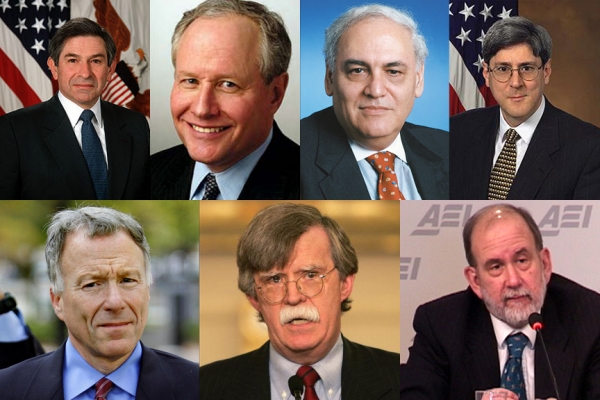
Surrounded by Neocons
They are all the news that fits
By Philip Giraldi • Unz Review • January 9, 2018
Award winning journalist James Risen has recently described in some detail his sometimes painful relationship with The New York Times. His lengthy account is well worth reading as it demonstrates how successive editors of the paper frequently cooperated with the government to suppress stories on torture and illegal activity while also self-censoring to make sure that nothing outside the framework provided by the “war on terror” should be seriously discussed. It became a faithful lap dog for an American role as global hegemon, promoting government half-truths and suppressing information that it knew to be true but which would embarrass the administration in power, be they Democrats or Republicans.
If one were to obtain a similar insider account of goings-on at the other national “newspaper of record”, The Washington Post, it is quite likely that comparable trimming of the narrative also took place. To be sure, the Post is worse than the Times, characterized by heavily editorializing in its news coverage without necessarily tipping off the reader when “facts” end and speculation begins. In both publications, stories about Iran or Russia routinely begin with an assertion that Moscow interfered in the 2016 U.S. election and that Iran is the aggressor in the Middle East, contentions that have not been demonstrated and can easily be challenged. Both publications also have endorsed every American war since 2001, including Iraq, Libya and the current mess in Syria, one indication of the quality of their reporting and analysis.
A recent op-ed in the Times by Bret Stephens is a perfect example of warmongering mischief wrapped in faux expert testimony to make it palatable. Stephens is the resident neocon at the Times. He was brought over from the Wall Street Journal when it was determined that his neocon colleague David Brooks had become overly squishy, while the resident “conservative” Russ Douthat had proven to be a bit too cautious and even rational to please the increasingly hawkish senior editors.
Stephens’ article, entitled Finding the Way Forward on Iran sparkles with throwaway gems like “Tehran’s hyperaggressive foreign policy in the wake of the 2015 nuclear deal” and “Real democracies don’t live in fear of their own people” and even “it’s not too soon to start rethinking the way we think about Iran.” Or try “A better way of describing Iran’s dictatorship is as a kleptotheocracy, driven by impulses that are by turns doctrinal and venal.”
Bret has been a hardliner on Iran for years. Early on in this op-ed he makes very clear that he wants it to be dealt with forcibly because it has “centrifuges, ballistic missiles, enriched uranium [and] fund[s] Hezbollah, assist Bashar al-Assad, arm[s] the Houthis, [and] imprison[s] the occasional British or American citizen.” He describes how Iran is a very corrupt place run by religious leaders and Revolutionary Guards and proposes that their corruption be exposed so that the Iranian people can take note and rise up in anger. And if exposure doesn’t work, they should be hammered with sanctions. He does not explain why sanctions, which disproportionately hurt the people he expects to rise up, will bring about any real change.
Stephens cites two of his buddies Ken Weinstein of the Hudson Institute and Mark Dubowitz of the Foundation for the Defense of Democracies (FDD), who are apparently experts on how to squeeze Iran. Weinstein prefers exposing the misdeeds of the Mullahs to anger the Iranian people while Dubowitz prefers punitive sanctions “for corruption.”
The article does not reveal that Weinstein and Dubowitz are long time critics of Iran, are part of the Israel Lobby and just happen to be Jewish, as is Stephens. The Hudson Institute and the FDD are leading neocon and pro-Israel fronts. So my question becomes, “Why Iran?” The often-heard Israeli complaint about its being unfairly picked on could reasonably be turned on its head in asking the same about Iran. In fact, Iran compares favorably with Israel. It has no nuclear weapons, it does not support any of the Sunni terrorist groups that are chopping heads, and it has not disenfranchised hundreds of thousands of people that it rules over. The fact is that Iran is being targeted because Israel sees it as its prime enemy in the region and has corrupted many “opinion makers” in the U.S., to include Stephens, to hammer home that point. To be sure, Iran is a very corrupt place run by people who should not be running a hot dog stand, but the same applies to the United States and Israel. And there are lots of places that are not being targeted like Iran that are far worse, including good friend and ally of both Jerusalem and Washington, Saudi Arabia.
Oddly enough Stephens, Weinstein and Dubowitz do not get into any of that back story, presumably because it would be unseemly. And, of course and unfortunately, the New York Times opinion page is not unique. An interesting recent podcast interview by Politico‘s Chief International Affairs correspondent Susan Glasser with leading neoconservatives Eliot Cohen and Max Boot, is typical of how the media selectively shapes a narrative to suit its own biases. Glasser, Cohen and Boot are all part of the establishment foreign policy consensus in the U.S. and therefore both hate and fail to understand the Trump phenomenon. Both Cohen and Booth were vociferous founding members of the #NeverTrump foreign policy resistance movement.
Boot describes the new regime’s foreign policy as “kowtow[ing] to dictators and undermin[ing] American support for freedom and democracy around the world,” typical neocon leitmotifs. Glasser appears to be in love with her interviewees and hurls softball after softball. She describes Boot as “fantastic” and Cohen receives the epithet “The Great.” The interview itself is remarkably devoid of any serious discussion of foreign policy and is essentially a sustained assault on Trump while also implicitly supporting hardline national security positions. Cohen fulminates about “a very serious Russian attack on the core of our political system. I mean, I don’t know how you get more reckless and dangerous than that,” while Boot asks what “has to be done” about Iran.
Pompous ass Cohen, who interjected in the interview that “and you know, Max and I are both intellectuals,” notably very publicly refused to have any part in a Trump foreign policy team during the campaign but later when The Donald was actually elected suggested that the new regime might approach him with humility to offer a senior position and he just might condescend to join them. They did not do so, and he wrote an angry commentary on their refusal.
Hating Trump is one thing, but I would bet that if the question of a hardline policy vis-à-vis Russia or the Jerusalem Embassy move had come up Cohen and Boot would have expressed delight. The irony is that Trump is in fact pursuing a basically neocon foreign policy which the two men would normally support, but they appear to be making room for Trump haters in the policy formulation process to push the national security consensus even farther to the right. Indeed, in another article by Boot at Foreign Policy he writes “I applaud Trump’s decisions to provide Ukraine with arms to defend itself from Russian aggression, to recognize Jerusalem as the capital of Israel, to send additional U.S. troops to Afghanistan, and to accelerate former President Barack Obama’s strategy for fighting the Islamic State.” Cohen meanwhile applauds the embassy move, though he warns that Trump’s success in so doing might embolden him to do something reckless over North Korea.
Perhaps one should not be astonished that leading neocons appearing in the mainstream media will continue to have their eyes on the ball and seek for more aggressive engagement in places like Iran and Russia. The media should be faulted because it rarely publishes any contrary viewpoint and it also consistently fails to give any space to the considerable downside to the agitprop. It must be reassuring for many Americans to know that the Center for Disease Control and Prevention (CDC) is preparing itself to deal with the aftermath of a nuclear attack on the United States and it will be sharing information on the appropriate preparations with the American people. There will be a public session on how to prepare for a nuclear explosion on January 16th.
CDC experts will consider “planning and preparation efforts” for such a strike. “While a nuclear detonation is unlikely, it would have devastating results and there would be limited time to take critical protection steps,” the Center elaborated in its press release on the event.
That the United States should be preparing for a possible nuclear future can in part be attributed to recent commentary by the “like, really smart” and “very stable genius” who is the nation’s chief executive, but the fuel being poured on the fire for war is from the very same neocons who are featured in the mainstream media as all-purpose experts and have succeeded in selling the snake oil about America’s proper role as aggressor-in-chief for the entire world. It would be an unparalleled delight to be able to open a newspaper and not see Bret Stephens, Eliot Cohen, Max Boot or even the redoubtable Bill Kristol grinning back from the editorial page, but I suppose I am only dreaming.
Philip M. Giraldi, Ph.D., is Executive Director of the Council for the National Interest, a 501(c)3 tax deductible educational foundation that seeks a more interests-based U.S. foreign policy in the Middle East. Website is http://www.councilforthenationalinterest.org, address is P.O. Box 2157, Purcellville VA 20134 and its email is inform@cnionline.org.
Trump Plans to Enforce Sanctions on Iranian State Television
Sputnik – January 8, 2018
WASHINGTON — US President Donald Trump plans to impose sanctions against Iranian state television as part of his response to Iran’s crackdown on anti-government protesters, media reported on Monday.
The Guardian reported that Trump will not sign a 180-day waiver that has previously postponed the sanctions against the Islamic Republic of Iran Broadcasting (IRIB) since 2013. The waiver on the sanctions is up for renewal at the end of January.
Several major cities in Iran, including Tehran, Mashhad, Isfahan and Rasht, have witnessed anti-government protests since December 28, 2017. Iranians have taken to the streets to protest against unemployment, poverty and the rising cost of living.
Recently, the Pentagon’s chief voiced his support for the protests, saying that the people of Iran had proven that they “aren’t buying” what Tehran is selling, claiming the protests to be the evidence.
Earlier, the Iranian Ambassador to the United Nations claimed that Tehran had “hard evidence” that the violence in the protests was incited from abroad, adding that instigators based in the United States and Europe have been seen inciting violence during the protests.
Featured Video
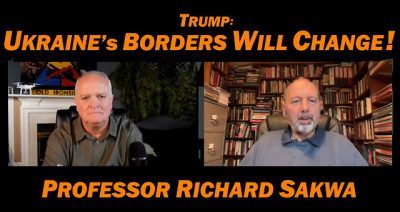
Ukraine Already Carved Up… Before Talks Begin? /Prof. Richard Sakwa
or go to
Aletho News Archives – Video-Images
New Book
The Vaccine Mafia: Pfizer’s Former Chief Toxicologist Proves How Toxic Substances Were Unlawfully Sold to Us as a Solution for COVID-19
By Helmut Sterz
Former Pfizer chief toxicologist Helmut Sterz presents a critical examination of the development, approval, and global rollout of mRNA COVID-19 vaccines—particularly those produced by Pfizer/BioNTech. The Vaccine Mafia details the failure of pharmaceutical companies, regulatory authorities, politicians, and international organizations to follow established scientific and ethical standards during the pandemic. Drawing on the author’s decades of experience in pharmaceutical toxicology, Sterz reveals the many ways the vaccines’ inadequate or omitted preclinical safety testing put the world’s population at risk.
Sterz demonstrates how “emergency” approvals allowed manufacturers to bypass long-standing international guidelines governing toxicity testing, especially with regard to reproductive and cancer risks. They also allowed governments and health authorities to ignore or conceal evidence of serious adverse effects that occurred, including myocarditis, reproductive harm, and other long-term health risks.
Blog Roll
 Aletho News
- Ukraine Already Carved Up… Before Talks Begin? /Prof. Richard Sakwa
- The vindication of Marjorie Taylor Greene
- Nearly 80% of Britons consider Israel a threat to world peace and security: Survey
- Rhode Island Staffer Could Be Reinstated After Firing Over Ceasefire Post
- Will Republicans Learn Their Lesson from the ‘Disastrous’ Midterms?
- Wrong, Newswise, Irresponsible Climate Messaging, Not Climate Change Itself, Is Fueling Student Anxiety
- Zelensky’s Critics Vanish Into Ukrainian Secret Prisons – Source
- Nima R. Alkhorshid: U.S. Military Bombs Multiple Targets on Iran’s Qeshm Island
- Iran-Linked Ships Spotted Hovering over Subsea Cables: Report
- New attack on Iran could devastate ‘Israel’, IOF general warns
- If Americans Knew
- An error has occurred; the feed is probably down. Try again later.
- No Tricks Zone
- Zonal Asymmetry of Temperature Change in the Antarctic Circumpolar Current
- New Study: The Net Fossil Fuel Contribution To Rising Atmospheric CO2 Has Been Zero For 500 Years
- Germany’s Green Energy Transition Becoming Increasingly Expensive…Another 6 Trillion Euros!
- Sudden Stratospheric Warming, Powerful El Niño Combination May Lead To Extreme Europe Cold, Energy Crisis!
- Two New Studies Find Thwaites Glacier Melt Cannot Be Driven By Human Activity Or A Warming Ocean
- E-Cars Reduce CO2 Emissions By Only 41% Compared To Internal Combustion Engine Vehicles
- Predictions Made By Renowned Climate Professor Over Past Decades Have Been Proven To Be Poor
- New Study Suggests Large Regions Of The Pacific Ocean Have Been Cooling For The Last 80 Years
- Germany’s Green Energy Debacle: High Energy Costs Force Kahla Porzellan to Close After 182 Years!
- New Study: 50 Years Of The Most Aggressive ‘Net Zero’ Policies Can Only Affect The Global Climate By 0.03°C

