In an April 27 letter to UN Secretary-General Antonio Guterres, all US senators demanded the world body ignore Israeli high crimes, calling truth-telling “anti-Semiti(c).”
“Too often, the UN is exploited as a vehicle for targeting Israel,” they said.
Fact: Much more needs to be done to hold Israel accountable for high crimes of war and against humanity – for decades of ruthlessly persecuting Palestinians, for committing slow-motion genocide, for attacking its neighbors.
The letter quoted neocon US UN envoy Nikki Haley, saying “(i)t is the UN’s anti-Israel bias that is long overdue for change” – an outrageous perversion of truth.
The senators praised the world body “for disavowing” the important Richard Falk/Virginia Tilley report, calling Israel a racist apartheid regime – “beyond a reasonable doubt.”
The entire US Senate urged the UN “to improve (its) treatment of Israel…” It demands no world body support for the vital global BDS initiative – or any other actions hostile to Israeli interests.
It wants information about its human rights abuses suppressed. It demands support for US interests. It calls truth-telling anti-Israeli “bias.”
All 100 US senators disgracefully signed the letter. Washington and Israel partner in each other’s high crimes – a ruthless axis of evil threatening humanity.
Last week, Haley accused the world body of holding “Israel-bashing sessions.” Ignoring US wars in multiple theaters, she lied claiming “Iran is using Hezbollah to advance its regional aspirations.”
“They are working together to expand extremist ideologies in the Middle East. That is a threat that should be dominating our discussion at the Security Council.”
Iran threatens no one. Neither does Hezbollah. Haley turned truth on its head. So did Tillerson days earlier, irresponsibly accusing Tehran of “alarming ongoing provocations” to destabilize regional countries.
Iranian UN envoy Gholamali Khoshroo debunked his remarks, calling them “misleading propaganda…”
Last week Washington asked which Middle East countries benefit from regional chaos, “and what are the connections between terrorist groups and these states?”
Israel, of course, benefits most. So does America by its belligerent presence in a part of the world not its own – waging endless wars of aggression, supporting terrorist groups it created, wanting pro-Western puppet rule replacing all sovereign independent governments.
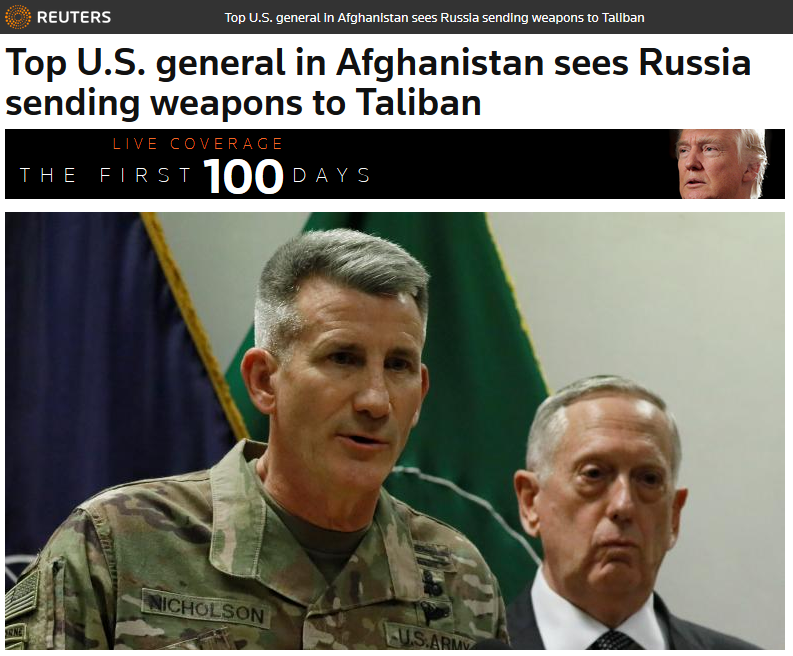
US general in Afghanistan does not say what Reuters headline says he said
“Top US General in Afghanistan Sees Russia Sending Weapons to Taliban” was Reuters’ headline over a April 25 story.
Well, that sounds like news! Tell me more, Reuters’ Idrees Ali:
The head of US and international forces in Afghanistan said on Monday he was “not refuting” reports that Russia was providing support, including weapons, to the Taliban…
Asked about reports that Russia was providing a range of help, including weapons, to the Taliban, who control large areas of Afghanistan, [Gen. John] Nicholson replied: “Oh no, I am not refuting that.”
“I am not refuting that”? How does that translate into “General… Sees Russia Sending Weapons to Taliban”? If NASA tells Reuters that they can’t refute speculation that there might be life on Mars, will Reuters run a story headlined “NASA Sees Life on Mars”? That would be a scoop!
Ali writes that Nicholson’s no-comment comments “are among the strongest suggestions yet that Moscow is providing arms to the Taliban.” Maybe next time Reuters could wait for a somewhat stronger suggestion—involving actual evidence, perhaps—before running a story that could inflame the new Cold War.
Roger Waters, the primary composer and lyricist of Pink Floyd during their most prominent years has for decades, used his music to convey a message of peace and humanity. He has typically got it right and occasionally gets it wrong.
One issue he has got totally right is the issue of Palestinian suffering at the hands of Israeli war, occupation and economic blockade. For over ten years, Waters has made the issue of Palestinian freedom a central point in his music and accompanying dramatic stage shows.
Waters is part of the Boycott-Divestment-Sanctions movement which encourages individuals to boycott Israeli products and tourism. Waters uses his status as a ‘music legend’ to highlight the plight of Palestinians. In 2012 he spoke at the United Nations on the issue. He frequently pens open letters to fellow musicians asking them to refrain from performing in Israel until a meaningful peace settlement is reached.
Waters is a perfect example of how the media-industrial complex punishes individuals who do not fit the tired stereotype of a veteran rock star.
Late last year, a grossly under-reported story explained how American Express ditched a planned sponsorship deal with Waters for his 2017 tour in a move which was said to be worth $4 million.
American Express like any other company has the right to refuse sponsoring any individual or organisation however they see fit. But in doing so, American Express has shown that they are willing to sponsor events of every variety including politically charged music performances by Beyonce.
Why then is American Express put-off by Roger Waters’ embrace of the Palestinian movement?
Are they opposed to Waters’ calls to end the starvation and medical deprivation of Palestinian children?
Are they opposed to Waters’ pleas for justice and democracy for Christians, Muslims and Jews in the region?
Are they appalled by his anti-war message?
Where many celebrities use anodyne political causes to enhance their status, I can see no evidence that Waters has profited from his endorsement of Palestine. Quite the contrary is true. It seems that his message of peace for everyone and hatred for no one has cost him millions.
Waters described the situation in his music industry in the following way,
“My industry has been particularly recalcitrant in even raising a voice (against Israel). There’s me and Elvis Costello, Brian Eno, Manic Street Preachers, one or two others, but there’s nobody in the United States where I live. I’ve talked to a lot of them, and they are scared shitless.
If they say something in public they will no longer have a career. They will be destroyed. I’m hoping to encourage some of them to stop being frightened and to stand up and be counted, because we need them. We need them desperately in this conversation in the same way we needed musicians to join protesters over Vietnam”.
The fact is that most musicians neither win nor lose the majority of their fan-base because of politics. The fact is that most people buy albums and concert tickets based on the fact that they like the sound of a song or enjoy singing along with the lyrics, even if they’re hardly paying attention to what the lyrics mean.
But for those who do care, the reaction to Waters’ Palestine politics is shocking. If Waters was advocating for genocide, cruelty, hatred or imperialism, I would agree that his concerts should be boycotted. But the fact that he is advocating for precisely the opposite of the aforementioned things makes the position of American Express seem not only extreme, but illogical.
Roger Waters is being punished for free speech on a subject that ought not to be controversial. The fact that some find it controversial demonstrates how low and beastly the nature of modern debates about human rights have become. No innocent people deserve to be suppressed, repressed and occupied, but that is exactly what is happening to the Palestinians and it has been happening for decades.
I personally disagreed with Roger Waters’ statements about Donald Trump and I also disagreed with his characterisation of Leonid Brezhnev on the otherwise stellar 1983 Pink Floyd album The Final Cut. But at no time would I seek to shut down Waters’ free speech or his ability to peacefully perform what millions consider to be important pieces of music in a peaceful and safe environment.
American Express has shamed its own reputation by treating Roger Waters in the way they have done. Roger Waters remains undeterred and will continue to tour his new show across the world.
As someone who has seen Waters perform many times, I highly recommend it, even for those who disagree with his views but enjoy a challenge.
Has President Donald Trump outsourced foreign policy to the generals?
So it would seem. Candidate Trump held out his hand to Vladimir Putin. He rejected further U.S. intervention in Syria other than to smash ISIS.
He spoke of getting out and staying out of the misbegotten Middle East wars into which Presidents Bush II and Obama had plunged the country.
President Trump’s seeming renunciation of an anti-interventionist foreign policy is the great surprise of the first 100 days, and the most ominous. For any new war could vitiate the Trump mandate and consume his presidency.
Trump no longer calls NATO “obsolete,” but moves U.S. troops toward Russia in the Baltic and eastern Balkans. Rex Tillerson, holder of Russia’s Order of Friendship, now warns that the U.S. will not lift sanctions on Russia until she gets out of Ukraine.
If Tillerson is not bluffing, that would rule out any rapprochement in the Trump presidency. For neither Putin, nor any successor, could surrender Crimea and survive.
What happened to the Trump of 2016?
When did Kiev’s claim to Crimea become more crucial to us than a cooperative relationship with a nuclear-armed Russia? In 1991, Bush I and Secretary of State James Baker thought the very idea of Ukraine’s independence was the product of a “suicidal nationalism.”
Where do we think this demonization of Putin and ostracism of Russia is going to lead?
To get Xi Jinping to help with our Pyongyang problem, Trump has dropped all talk of befriending Taiwan, backed off Tillerson’s warning to Beijing to vacate its fortified reefs in the South China Sea, and held out promises of major concessions to Beijing in future trade deals.
“I like (Xi Jinping) and I believe he likes me a lot,” Trump said this week. One recalls FDR admonishing Churchill, “I think I can personally handle Stalin better than … your Foreign Office … Stalin hates the guts of all your people. He thinks he likes me better.”
FDR did not live to see what a fool Stalin had made of him.
Among the achievements celebrated in Trump’s first 100 days are the 59 cruise missiles launched at the Syrian airfield from which the gas attack on civilians allegedly came, and the dropping of the 22,000-pound MOAB bomb in Afghanistan.
But what did these bombings accomplish?
The War Party seems again ascendant. John McCain and Lindsey Graham are happy campers. In Afghanistan, the U.S. commander is calling for thousands more U.S. troops to assist the 8,500 still there, to stabilize an Afghan regime and army that is steadily losing ground to the Taliban.
Iran is back on the front burner. While Tillerson concedes that Tehran is in compliance with the 2015 nuclear deal, Trump says it is violating “the spirit of the agreement.”
How so? Says Tillerson, Iran is “destabilizing” the region, and threatening U.S. interests in Syria, Yemen, Iraq and Lebanon.
But Iran is an ally of Syria and was invited in to help the U.N.-recognized government put down an insurrection that contains elements of al-Qaida and ISIS. It is we, the Turks, Saudis and Gulf Arabs who have been backing the rebels seeking to overthrow the regime.
In Yemen, Houthi rebels overthrew and expelled a Saudi satrap. The bombing, blockading and intervention with troops is being done by Saudi and Sunni Arabs, assisted by the U.S. Navy and Air Force.
It is we and the Saudis who are talking of closing the Yemeni port of Hodeida, which could bring on widespread starvation.
It was not Iran, but the U.S. that invaded Iraq, overthrew the Baghdad regime and occupied the country. It was not Iran that overthrew Col. Gadhafi and created the current disaster in Libya.
Monday, the USS Mahan fired a flare to warn off an Iranian patrol boat, 1,000 meters away. Supposedly, this was a provocation. But Iranian foreign minister Javad Zarif had a point when he tweeted:
“Breaking: Our Navy operates in — yes, correct — the Persian Gulf, not the Gulf of Mexico. Question is what US Navy doing 7,500 miles from home.”
Who is behind the seeming conversion of Trump to hawk?
The generals, Bibi Netanyahu and the neocons, Congressional hawks with Cold War mindsets, the Saudi royal family and the Gulf Arabs — they are winning the battle for the president’s mind.
And their agenda for America?
We are to recognize that our true enemy in the Mideast is not al-Qaida or ISIS, but Shiite Iran and Hezbollah, Assad’s Syria and his patron, Putin. And until Hezbollah is eviscerated, Assad is gone, and Iran is smashed the way we did Afghanistan, Iraq, and Yemen, the flowering of Middle East democracy that we all seek cannot truly begin.
But before President Trump proceeds along the path laid out for him by his generals, brave and patriotic men that they are, he should discover if any of them opposed any of the idiotic wars of the last 15 years, beginning with that greatest of strategic blunders — George Bush’s invasion of Iraq.
Baltimore County police – an early adopter of body cameras spending $12.5 million of taxpayer money in the name of transparency – is withholding footage in three police-involved shooting incidents.
County police shot six people in four separate incidents since January, killing two of them, according to theBaltimore Sun, which first broke the story.
Body cameras captured all of the shootings but footage has only been made available in one case. Police said the other cases are still being investigated, or the county prosecutors have told them the footage is evidence in upcoming trials.
“Release could compromise the prosecution and the defendant’s right to fair trials,” Baltimore County police spokeswoman Elise Armacost said in a statement to the Sun.
Armacost said those releases were quick because there were no charges against a suspect.
The missing footage involves three incidents.
In March, two officers investigating a convenience store robbery in Woodlawn shot a vehicle rushing towards them killing a 20-year-old, and injuring two others.
On April 12, police shot a 27-year-old man suspected of breaking into cars in Parkville who police said reached into his waistband.
Nine days later, an officer shot a woman who was a passenger in a stolen car that was being pursued by police.
The department first deployed body cameras last July, with the promise of a gradual rollout through December 2018, after fast-tracking $12.5 million program to equip officers.
The program was accelerated after a series of shootings, including the fatal shooting of Korryn Gaines, 23, and the wounding of her 5-year old son in August 2016 during a standoff in Randallstown. The shooting was not recorded. That led to County Executive Kevin Kamenetz and then-police chief Jim Johnson to speed up the program.
Currently about 550 of the county’s 1,900 officers have body cams. More than 1,400 are to have cameras by the end of this September.
Kamenetz wouldn’t comment on the lack of transparency but his spokesperson, Ellen Kobler, said he had been clear from the beginning “that footage from police body cameras has been and will continue to be released without delay as soon as it can be determined that the release of the footage will not compromise an ongoing investigation.”
The police previously released footage from a case in December when an officer shot and wounded a man who had opened the door of his apartment carrying a knife and saying “Time to die! Time to die!”
County prosecutors ruled the shooting justified.
In another incident in January, footage was released of a police officer fatally shooting a man who had threatened his family and who had raised a “powerful scoped rifle” as an officer was talking to him.
Kamenetz then replaced Police Chief Johnson with Terry Sheridan, who had previously been the chief.
Armacost said there had been no change in policy since Sheridan took over.
The ACLU of Maryland called attempts to withhold the footage “concerning.”
“Despite lip service being paid to transparency and accountability, both their policies and in their actions, what we are seeing is the opposite,” said David Rocah, an attorney with the organization. He said the footage means “we don’t simply have to take officer’s word for what happened in particular situation.”
Cole Weston, president of the Baltimore County Fraternal Order of Police Lodge No. 4, said he’s not in favour of video footage being released to the public before an investigation is closed.
“I think everybody should be cautious about just looking at… one particular piece of what happened,” he told the Sun. “Body camera footage is one piece of information that is captured as it related to an entire incident.”
South Korean women protesting the deployment of the Terminal High Altitude Area Defense (THAAD) system is aimed not to defend them against North Korea, but as a threat to Russia and China, analysts told Sputnik.
Namhee Lee, a UCLA Associate Professor of Modern Korean History, said, “many South Koreans think that the deployment of THAAD is actually to deter China and not North Korea.”
Namhee Lee was a signatory of the Women Cross DMZ group’s letter to President Donald Trump on Wednesday calling on him to defuse military tensions and start negotiating for peace to prevent war from erupting on the Korean Peninsula.
North Korea’s missiles are short-range SCUDs with a range of 500 km (300 miles), medium-range Rodong 1s with a range of 1,300km (780 miles) whereas THAAD is most effect for long range and high altitude missiles, the professor said.
“THAAD is not effective against the SCUD missile. THAAD is effective against the Rodong 1, but this missile is not developed to aim against South Korea, rather it is aimed against Okinawa,” she said.
As to the question why the US military was deploying THAAD in South Korea, Lee said, “Because it is aimed against China and Russia; to collect information, which is why China and Russia are upset about the deployment of THAAD.”
Namhee Lee noted the X-bend radar that is integrated with a THAAD system is able to detect missiles at a range of 1,000-5,000 km (600 miles to 3,000 miles).
“Many of China’s missiles can be detected by THAAD’s X-bend radar,” she stated.
Deploying THAAD’s radars also posed health hazards for the people of South Korea, the historian explained.
“Many are also afraid for the health and safety of people living nearby, especially from exposure to radiation from the systems’ powerful radar emissions. Especially Seongju residents who feel that the decision to deploy THAAD was made without their input and without independent health assessments,” she also remarked.
Radar emissions coming from THAAD will cause a great deal of harm to people living close by.
“Those who live within the radius of 100 meters would face the danger of losing lives, and those living within the radius of 3.6 km (six miles) would experience dizziness and vomiting,” she noted.
The protest is the last resort for the Koreans to show that they are opposed to the government’s decision to deploy the THAAD system, she observed. … Full article
Following heavy-handed threats, saber-rattling, and Wednesday’s administration meeting with all Senate members, a joint statement by Defense Secretary Mattis, Director of National Intelligence Coates and Secretary of State Tillerson announced a shift in US policy toward North Korea.
On the one hand, it called Pyongyang’s “pursuit of nuclear weapons… an urgent national security and top foreign policy priority.”
On the other, it said Trump “aims to pressure North Korea into dismantling its nuclear, ballistic missile, and proliferation programs by tightening economic sanctions and pursuing diplomatic measures with our Allies and regional partners.”
Instead of a military option, the Trump administration now seeks dialogue and diplomacy to achieve “peaceful denuclearization of the Korean peninsula.”
At the same time, it may designate the DPRK as a state sponsor of terrorism, maintaining hostility towards its government over responsible outreach.
On Wednesday, Pyongyang’s Permanent Mission to the UN said “(t)he DPRK, as a peace-loving socialist state, highly values the sustaining of the peace most of all, but it neither fears a war nor wants to avoid it,” adding:
“The DPRK has access to a powerful nuclear deterrent to protect itself from the US nuclear threat… The DPRK will react to a total war with an all-out war, a nuclear war with nuclear strikes of its own style and surely win a victory in the death-defying struggle against the US imperialists.”
“It is an unshakable will of the DPRK to go to the end if the US wants to remain unchanged in its confrontational stance.”
Separately on Wednesday, US Pacific Command chief Admiral Harry Harris told House Armed Services Committee members that North Korea remains the most “immediate threat” to US regional security, adding it’s trying to develop a “preemptive nuclear strike capability” against US cities.
Fact: Throughout its history, the DPRK never attacked another nation. It threatens none now. If attacked, it’ll surely respond with all the military force it believes necessary.
China, Russia and Pyongyang consider US deployment of Terminal High Altitude Area Defense (THAAD) anti-ballistic missile systems in South Korea highly provocative.
In January, Moscow and Beijing announced unspecified measures to counter them, warning of escalating tensions and instigating an arms race.
Harris said the THAAD system will be operational “in the coming days.” China again expressed “grave concern,” saying THAAD breaks the region’s strategic balance, along with heightening tensions on the Korean peninsula.
Urging cancellation of the deployment, Beijing warned it’ll take all necessary measures “to safeguard its own interests.”
Despite the threat of imminent war abating, regional tensions remain. Trump’s rage for warmaking endangers all independent nations.
On Wednesday after midnight, the Pentagon launched an unarmed Minuteman 3 ICBM from Vandenberg Air Force Base, California.
Col. John Moss said “(t)onight’s launch was an important demonstration of our nation’s nuclear deterrent capability.”
America’s only enemies are ones it invents – no others. America’s homeland hasn’t been attacked by a foreign power since the War of 1812 with Britain.
Hawaii didn’t become a US state until March 1959. During WW II, Japan occupied the remote, sparsely inhabited islands of Attu and Kiska in the Aleutians off Alaska from June 1942 until summer 1943.
America’s homeland faces no threats except in response to US aggression on a nation able to retaliate in kind. Otherwise, none exist.
Since Donald Trump’s victory, tensions in the Korean Peninsula have reached almost unprecedented levels. This aggressive approach from the new administration has accentuated tensions with Pyongyang, leaving one to wonder whether another US war is in the making.
During the election campaign, Trump often took ambiguous and, in some respects, isolationist positions concerning hotspots around the world. The exception to this rule has often been North Korea. Business Insider cites the current US president speaking in January of 2016 about the DPRK with the following words about its nuclear program: «We got to close it down, because he’s getting too close to doing something. Right now, he’s probably got the weapons, but he does not have the transportation system. Once he has the transportation system, he’s sick enough to use it. So we better get Involved».
As soon as he became president, the words became even more threatening, clear and explicit, with this tweet becoming famous: «North Korea just stated that it is in the final stages of developing a nuclear weapon capable of reaching parts of the US. It won’t happen!»
A few weeks later, words were turned into action: the United States and its allies (South Korea and Japan) carried out two enormous exercises between March and April 2017. The first, focusing on land and sea operations and named Foal Eagle, involved tens of thousands of US and South Korean soldiers and naval warships. A few weeks later the Max Thunder 17 exercise kicked in, with dozens of aircraft involved. In both exercises the goal is to focus on the DPRK, with simulations of an attack by the United States and its allies by land, sea and air.
From Pyongyang’s point of view, the deterioration of relations with the US, South Korea and Japan has risen beyond any tolerable limit with a vicious cycle of tensions on the Korean Peninsula, since Trump’s assumption of the presidency. The United States, the world’s premier military power, continually threatens to bomb and invade the DPRK with thousands of soldiers, or threatens to kill Kim Jong-un. As if this situation were not tense enough, the ongoing exercises by the US and her allies suggest a realistic possibility of invasion rather than a simple exercise (usually wars begin simultaneously with great maneuvers, since in such exercises forces are already deployed, operational, and ready to fight). Finally, to top off the madness coming from Washington, Trump repeatedly broached a change in the historical strategic balance reflected by MAD (mutually assured destruction), floating the idea of arming South Korea and even Japan with nuclear weapons.
Nuclear deterrence for peace
In light of all these historical provocations and threats, Kim Jong-un has in recent years had to accelerate his atomic program and demonstrate the consistency of DPRK’s nuclear capability and convincingly deter opponents. In order to asses the capacity of North Korea to hit the US with a WMD, one has to take into consideration two main factors: the ability to create a nuclear warhead, and the method of delivery.
The first, concerning the ability to detonate a domestically manufactured nuclear bomb, is already a fact acknowledged by the international community and demonstrated with five nuclear tests. The second question focuses on the means used to deliver the nuclear weapon. With the first question already a known fact (the DPRK has up to 30 nukes), this only leaves the assessment of missile range and reliability, which will be discussed later. For now, it is important to focus on the motives that may have driven the DPRK to develop an nuclear program. During American exercises, North Korean reservists from the countryside were often summoned from the countryside when they were most needed for harvesting and planting seasons, creating significant strains in the agricultural area so vital to the country’s economy.
Thanks to the nuclear deterrent, the amount of people recalled has been considerably reduced due to the reduction in the likelihood of an American attack on the peninsula.
Obviously nuclear deterrence plays a key part in North Korea’s defensive posture, but we can further consider the lesser known determinants of this strategic choice. First of all we can consider the reduction in military spending on conventional means of war by the possession of a nuclear deterrent. Pyongyang’s ability to almost market its nuclear deterrence with nuclear and missile tests is certainly more cost effective than building thousands of multiple-launch rocket systems (MLRS) and mortar rounds. This does not mean that in a military assessment of conflict, such equipment does not tip the balance of power; we will see that they do exactly this.
The DPRK’s deterrence policy is a much more complex matter than just its nuclear component. The common idea is that with a nuclear bomb Pyongyang is safe. That is true on the basis of the theory of MAD. But with missile defense systems in play, this could change the equation, or maybe not. What really makes the DPRK safe is conventional weapons and geography.
China Cannot Help Disarm Pyongyang
Regarding the considerations made by Pyongyang on nuclear disarmament, it is interesting to note that the North Korean leadership has often referred to the promises made by the west to Gaddafi regarding Libya’s nuclear disarmament, and the consequences of this choice seen in the subsequent attack on Libya and the killing of Gaddafi. Kim Jong-un has repeatedly made it clear that trusting Washington and its allies is simply impossible given these historical precedents.
Another important factor when talking about the Korean Peninsula is the common notion of Beijing’s influence on Pyongyang. Trump has on several occasions made it clear that China is the only actor capable of putting sufficient pressure on Kim in order to force him to disarm or stop missile tests. But this is a political position that leaves many questions and doubts and is based entirely on the notion that Beijing is assisting Pyongyang economically and so has the necessary leverage. This, for Washington, means that if Xi wanted to shut down the Korean economy and oblige DPRK’s leadership to dialogue, he could do so.
Reality, however, shows us that Beijing has little influence on the Korean leader, and a deeper analysis shows how the DPRK is forced to trade and talk to China more out of practical need than any desire to do so. Further evidence shows how the relationship between China and the DPRK is at the very least complicated.
Realistically, it is difficult to ignore the contribution of the former Soviet Union, and then Russia, to the DPRK’s conventional and possibly nuclear development. The last parade of arms on April 15, 2017 saw the DPRK parade hardware very similar to that of the Russian military, especially the large Topol-M. Of course Beijing has a longstanding interest in the DPRK and with the state’s survival. The DPRK ensures that there are no hostile forces on China’s southern border. Beijing has learned the lessons from the end of the Cold War, where, following various pledges to Russia not to extend NATO into Eastern Europe, NATO subsequently expanded right up to Russia’s borders, directly threatening the Russian Federation.
Beijing supports the DPRK to avoid a unified Korea under US guidance that would pose a real threat to the Chinese state. In this context, Beijing faces diplomatic consequences at an international level, facing criticism and threats of armed intervention in the DPRK if Beijing does not do something to stop the North Korean leader.
It is a very complicated situation for Beijing, which finds itself between a rock and a hard place, having little real ability to influence Kim’s choices. From the point of view of the DPRK, the best outcome would be an agreement with the United States and Japan to loosen sanctions and embargoes. The problem is what these nations ask for in return is complete disarmament. For the reasons cited above, this solution is virtually impossible because of the complete lack of trust by all actors.
From words to nothing
At this point it is good to go to the heart of the matter and to analyze the most interesting aspects. First of all, Trump’s actions in Syria, as well as the use of a MOAB in Afghanistan, sought to put pressure on Kim Jong-un to make him come to the negotiating table. This obviously did not work, it being utterly unrealistic to commence negotiating with Pyongyang on the basis of threats of war. The DPRK has been besieged for over 50 years, and 50 cruise missiles, or a ten-ton bomb, will hardly do anything to change their position or scare them. The DPRK is neither Syria nor Afghanistan.
The subtle line between deception and perception in the Korean nuclear affair is certainly of great interest. We should begin by saying what we know. The DPRK as a country is a tightly state monitored system from many points of view, in terms of information, the internet, computer systems. Any information we read in the mainstream media on the DPRK should therefore be treated as propaganda. Two aspects are to be considered, namely what the DPRK wants western military planners to believe, and what the western press wants public opinion to know and believe about the DPRK. Let us take a practical and vital example in this discussion by looking at the range of the missiles mentioned in previous paragraphs.
We start with a basic premise stated by Washington, namely that the United States will prevent the DPRK from developing a missile (ICBM) capable of reaching American territory with a nuclear warhead. The DPRK is in response developing an ICBM that can reach US soil in order to gain the ultimate deterrent weapon and so ensure its safety. In reality, we cannot know what the DPRK’s capabilities are until they test them. And with regard to that, the US administration has limited interest in publicizing possible DPRK achievements and hinting that Pyongyang could hit the US with a nuclear warhead. That would then arouse domestic pressures exerted throughout the press, politics, think-tanks, the military, the intelligence community, and external actors (Japan and Korea) to attack North Korea.
Likewise, the DPRK has no interest in eventually testing an ICBM already knowing well that the United States would have its back against a wall, leaving it with no choice but to attack.
Two dozen former U.S. intelligence professionals are urging the American people to demand clear evidence that the Syrian government was behind the April 4 chemical incident before President Trump dives deeper into another war.
AN OPEN MEMORANDUM FOR THE AMERICAN PEOPLE
From: Veteran Intelligence Professionals for Sanity (VIPS)
Subject: Mattis ‘No Doubt’ Stance on Alleged Syrian CW Smacks of Politicized Intelligence
Donald Trump’s new Secretary of Defense, retired Marine General James “Mad Dog” Mattis, during a recent trip to Israel, commented on the issue of Syria’s retention and use of chemical weapons in violation of its obligations to dispose of the totality of its declared chemical weapons capability in accordance with the provisions of both the Chemical Weapons Convention (CWC) and relevant U.N. Security Council resolutions.
“There can be no doubt,” Secretary Mattis said during a April 21, 2017 joint news conference with his Israeli counterpart, Minister of Defense Avigdor Lieberman, “in the international community’s mind that Syria has retained chemical weapons in violation of its agreement and its statement that it had removed them all.” To the contrary, Mattis noted, “I can say authoritatively they have retained some.”
Lieberman joined Mattis in his assessment, noting that Israel had “100 percent information that [the] Assad regime used chemical weapons against [Syrian] rebels.”
Both Mattis and Lieberman seemed to be channeling assessments offered to reporters two days prior, on April 19, 2017, by anonymous Israeli defense officials that the April 4, 2017 chemical weapons attack on the Syrian village of Khan Shaykhun was ordered by Syrian military commanders, with Syrian President Bashar al-Assad’s personal knowledge, and that Syria retained a stock of “between one and three tons” of chemical weapons.
The Israeli intelligence followed on the heels of an April 13, 2017 speech given by CIA Director Mike Pompeo, who told an audience at the Center for Strategic and International Studies that, once information had come in about a chemical attack on Khan Shaykhun, the CIA had been able to “develop several hypothesis around that, and then to begin to develop fact patterns which either supported or suggested that the hypothesis wasn’t right.” The CIA, Pompeo said, was “in relatively short order able to deliver to [President Trump] a high-confidence assessment that, in fact, it was the Syrian regime that had launched chemical strikes against its own people in [Khan Shaykhun.]”
The speed in which this assessment was made is of some concern. Both Director Pompeo, during his CSIS remarks, and National Security Advisor H.R. McMaster, during comments to the press on April 6, 2017, note that President Trump turned to the intelligence community early on in the crisis to understand better “the circumstances of the attack and who was responsible.” McMaster indicated that the U.S. Intelligence Community, working with allied partners, was able to determine with “a very high degree of confidence” where the attack originated.
Both McMaster and Pompeo spoke of the importance of open source imagery in confirming that a chemical attack had taken place, along with evidence collected from the victims themselves – presumably blood samples – that confirmed the type of agent that was used in the attack. This initial assessment drove the decision to use military force – McMaster goes on to discuss a series of National Security Council meetings where military options were discussed and decided upon; the discussion about the intelligence underpinning the decision to strike Syria was over.
The danger of this rush toward an intelligence decision by Director Pompeo and National Security Advisor McMaster is that once the President and his top national security advisors have endorsed an intelligence-based conclusion, and authorized military action based upon that conclusion, it becomes virtually impossible for that conclusion to change. Intelligence assessments from that point forward will embrace facts that sustain this conclusion, and reject those that don’t; it is the definition of politicized intelligence, even if those involved disagree.
A similar “no doubt” moment had occurred nearly 15 years ago when, in August 2002, Vice President Cheney delivered a speech before the Veterans of Foreign Wars. “There is no doubt that Saddam Hussein now has weapons of mass destruction,” Cheney declared. “There is no doubt he is amassing them to use against our friends, against our allies and against us.” The message Cheney was sending to the Intelligence Community was clear: Saddam Hussein had WMD; there was no need to answer that question anymore.
The CIA vehemently denies that either Vice President Cheney or anyone at the White House put pressure on its analysts to alter their assessments. This may very well be true, but if it is, then the record of certainty – and arrogance – that existed in the mindset of senior intelligence managers and analysts only further erodes public confidence in the assessments produced by the CIA, especially when, as is the case with Iraq and Weapons of Mass Destruction – the agency was found so lacking. Stuart Cohen, a veteran CIA intelligence analyst who served as the acting Chairman of the National Intelligence Council, oversaw the production of the 2002 Iraq National Intelligence Estimate (NIE) that was used to make case for Iraq possessing WMD that was used to justify war.
According to Mr. Cohen, he had four National Intelligence Officers with “over 100 years’ collective work experience on weapons of mass destruction issues” backed up by hundreds of analysts with “thousands of man-years invested in studying these issues.”
On the basis of this commitment of talent alone, Mr. Cohen assessed that “no reasonable person could have viewed the totality of the information that the Intelligence Community had at its disposal … and reached any conclusion or alternative views that were profoundly different from those that we reached,” namely that – judged with high confidence – “Iraq had chemical and biological weapons as well as missiles with ranges in excess of the 150 kilometer limit imposed by the UN Security Council.”
Two facts emerge from this expression of intellectual hubris. First, the U.S. Intelligence Community was, in fact, wrong in its estimate on Iraq’s WMD capability, throwing into question the standards used to assign “high confidence” ratings to official assessments. Second, the “reasonable person” standard cited by Cohen must be reassessed, perhaps based upon a benchmark derived from a history of analytical accuracy rather than time spent behind a desk.
The major lesson learned here, however, is that the U.S. Intelligence Community, and in particular the CIA, more often than not hides behind self-generated platitudes (“high confidence”, “reasonable person”) to disguise a process of intelligence analysis that has long ago been subordinated to domestic politics.
It is important to point out the fact that Israel, too, was wrong about Iraq’s WMD. According to Shlomo Brom, a retired Israeli Intelligence Officer, Israeli intelligence seriously overplayed the threat posed by Iraqi WMD in the lead up to the 2003 Iraq War, including a 2002 briefing to NATO provided by Efraim Halevy, who at the time headed the Israeli Mossad, or intelligence service, that Israel had “clear indications” that Iraq had reconstituted its WMD programs after U.N. weapons inspectors left Iraq in 1998.
The Israeli intelligence assessments on Iraq, Mr. Brom concluded, were most likely colored by political considerations, such as the desire for regime change in Iraq. In this light, neither the presence of Avigdor Leiberman, nor the anonymous background briefings provided by Israel about Syria’s chemical weapons capabilities, should be used to provide any credence to Secretary Mattis’s embrace of the “no doubt” standard when it comes to Syria’s alleged possession of chemical weapons.
The intelligence data that has been used to back up the allegations of Syrian chemical weapons use has been far from conclusive. Allusions to intercepted Syrian communications have been offered as “proof”, but the Iraq experience – in particular former Secretary of State Colin Powell’s unfortunate experience before the U.N. Security Council – show how easily such intelligence can be misunderstood and misused.
Inconsistencies in the publicly available imagery which the White House (and CIA) have so heavily relied upon have raised legitimate questions about the veracity of any conclusions drawn from these sources (and begs the question as to where the CIA’s own Open Source Intelligence Center was in this episode.) The blood samples used to back up claims of the presence of nerve agent among the victims was collected void of any verifiable chain of custody, making their sourcing impossible to verify, and as such invalidates any conclusions based upon their analysis.
In the end, the conclusions CIA Director Pompeo provided to the President was driven by a fundamental rethinking of the CIA’s analysts when it came to Syria and chemical weapons that took place in 2014. Initial CIA assessments in the aftermath of the disarmament of Syria’s chemical weapons seemed to support the Syrian government’s stance that it had declared the totality of its holding of chemical weapons, and had turned everything over to the OPCW for disposal. However, in 2014, OPCW inspectors had detected traces of Sarin and VX nerve agent precursors at sites where the Syrians had indicated no chemical weapons activity had taken place; other samples showed the presence of weaponized Sarin nerve agent.
The Syrian explanation that the samples detected were caused by cross-contamination brought on by the emergency evacuation of chemical precursors and equipment used to handle chemical weapons necessitated by the ongoing Civil War was not accepted by the inspectors, and this doubt made its way into the minds of the CIA analysts, who closely followed the work of the OPCW inspectors in Syria.
One would think that the CIA would operate using the adage of “once bitten, twice shy” when assessing inspector-driven doubt; U.N. inspectors in Iraq, driven by a combination of the positive sampling combined with unverifiable Iraqi explanations, created an atmosphere of doubt about the veracity of Iraqi declarations that all chemical weapons had been destroyed. The CIA embraced the U.N. inspectors’ conclusions, and discounted the Iraqi version of events; as it turned out, Iraq was telling the truth.
While the jury is still out about whether or not Syria is, like Iraq, telling the truth, or whether the suspicions of inspectors are well founded, one thing is clear: a reasonable person would do well to withhold final judgment until all the facts are in. (Note: The U.S. proclivity for endorsing the findings of U.N. inspectors appears not to include the Khan Shaykhun attack; while both Syria and Russia have asked the OPCW to conduct a thorough investigation of the April 4, 2017 incident, the OPCW has been blocked from doing so by the United States and its allies.)
CIA Director Pompeo’s job is not to make policy – the intelligence his agency provides simply informs policy. It is not known if the U.S. Intelligence Community will be producing a formal National Intelligence Estimate addressing the Syrian chemical weapons issue, although the fact that the United States has undertaken military action under the premise that these weapons exist more than underscores the need for such a document, especially in light of repeated threats made by the Trump administration that follow-on strikes might be necessary.
Making policy is, however, the job of Secretary of Defense Mattis. At the end of the day, Secretary of Defense Mattis will need to make his own mind up as to the veracity of any intelligence used to justify military action. Mattis’s new job requires that he does more than simply advise the President on military options; he needs to ensure that the employment of these options is justified by the facts.
In the case of Syria, the “no doubt” standard Mattis has employed does not meet the “reasonable man” standard. Given the consequences that are attached to his every word, Secretary Mattis would be well advised not to commit to a “no doubt” standard until there is, literally, no doubt.
For the Steering Group, Veteran Intelligence Professionals for Sanity
William Binney, Technical Director, NSA; co-founder, SIGINT Automation Research Center (ret.)
Marshall Carter-Tripp, Foreign Service Officer (ret) and former Office Division Director in the State Department Bureau of Intelligence and Research
Thomas Drake, former Senior Executive, NSA
Bogdan Dzakovic, Former Team Leader of Federal Air Marshals and Red Team, FAA Security, (ret.) (associate VIPS)
Philip Giraldi, CIA, Operations Officer (ret.)
Matthew Hoh, former Capt., USMC, Iraq & Foreign Service Officer, Afghanistan (associate VIPS)
Larry C Johnson, CIA & State Department (ret.)
Michael S. Kearns, Captain, USAF (Ret.); ex-Master SERE Instructor for Strategic Reconnaissance Operations (NSA/DIA) and Special Mission Units (JSOC)
Brady Kiesling, former U.S. Foreign Service Officer, ret. (Associate VIPS)
Karen Kwiatkowski, former Lt. Col., US Air Force (ret.), at Office of Secretary of Defense watching the manufacture of lies on Iraq, 2001-2003
Lisa Ling, TSgt USAF (ret.)
Linda Lewis, WMD preparedness policy analyst, USDA (ret.) (associate VIPS)
Edward Loomis, NSA, Cryptologic Computer Scientist (ret.)
David MacMichael, National Intelligence Council (ret.)
Elizabeth Murray, Deputy National Intelligence Officer for Near East, CIA and National Intelligence Council (ret.)
Torin Nelson, former Intelligence Officer/Interrogator (GG-12) HQ, Department of the Army
Todd E. Pierce, MAJ, US Army Judge Advocate (ret.)
Coleen Rowley, FBI Special Agent and former Minneapolis Division Legal Counsel (ret.)
Scott Ritter, former MAJ., USMC, former UN Weapon Inspector, Iraq
Peter Van Buren, U.S. Department of State, Foreign Service Officer (ret.) (associate VIPS)
Kirk Wiebe, former Senior Analyst, SIGINT Automation Research Center, NSA
Lawrence Wilkerson, Colonel (USA, ret.), Distinguished Visiting Professor, College of William and Mary (associate VIPS)
Sarah G. Wilton, Intelligence Officer, DIA (ret.); Commander, US Naval Reserve (ret.)
Robert Wing, former Foreign Service Officer (associate VIPS)
The United States is pursuing global strategic domination through developing anti-ballistic missile systems capable of a sudden disarming strike against Russia and China, according to the deputy head of operations of the Russian General Staff.
There is an obvious link between Washington’s prompt global strike initiative, which seeks capability to engage “any targets anywhere in the world within one hour of the decision,” and the deployment of missile launch systems in Europe and aboard naval vessels across the globe, Lt. Gen. Viktor Poznikhir said at a news briefing on Wednesday.
“The presence of US missile defense bases in Europe, missile defense vessels in seas and oceans close to Russia creates a powerful covert strike component for conducting a sudden nuclear missile strike against the Russian Federation,” Poznikhir explained.
While the US keeps claiming that its missile defenses are seeking to mitigate threats from rogue states, the results of computer simulations confirm that the Pentagon’s installations are directed against Russia and China, according to Poznikhir.
American missile attack warning systems, he said, cover all possible trajectories of Russian ballistic missiles flying toward the United States, and are only expected to get more advanced as new low-orbit satellites complement the existing radar systems.
“Applying sudden disarming strikes targeting Russian or Chinese strategic nuclear forces significantly increases the efficiency of the US missile defense system,” Poznikhir added.
American ABM systems are not only creating an “illusion” of safety from a retaliatory strike but can themselves be used to launch a sneak nuclear attack on Russia.
In a blatant breach of the Intermediate-Range Nuclear Forces Treaty, the standard land-based launching systems can be covertly rearmed with Tomahawk cruise missiles instead of interceptors – and the Pentagon’s denial of this fact, according to Poznikhir, is “at the very least unconvincing.”
Moreover, Washington’s unilateral withdrawal from the Anti-Ballistic Missile Treaty, signed in 1972 with the Soviet Union, allowed it to develop more advanced weapons that can now not only pose a threat to targets on the ground but in space as well.
“In February 2008, the Pentagon demonstrated the possibility of engaging spacecraft with its ABM capabilities,” Poznikhir said. “An American satellite at an altitude of about 250 km was destroyed by a Standard-3 missile, an earlier modification, launched from a US Navy destroyer.”
“Given the global nature of the ABM ships’ deployment, the space operations of any state, including the Russian Federation and the People’s Republic of China, are under threat.”
Russia has repeatedly voiced its concerns over the risk American ABM systems pose to the global balance of power and thus peace and stability, but has consistently been sidelined.
“Within the framework of cooperation, we also proposed jointly to develop a missile defense architecture for Europe, which could guarantee security against the impacts of nonstrategic ballistic missiles,” said Poznikhir.
“However, all Russian initiatives were rejected.”
“In this regard, Russia is compelled to take measures aimed at maintaining the balance of strategic arms and minimizing the possible damage to national security as a result of the United States’ ABM systems expansion.”
“This will not make the world a safer place,” he warned, urging Washington to engage in a constructive dialogue instead of dully repeating that the systems are not aimed at undermining Russia’s or China’s national security.
After years of controversy, Japan has announced its intention to continue building a new air base to house elements of the US Air Force stationed on the island of Okinawa.
Tuesday’s initiation of the construction of seawalls around the new base, a replacement for the 1945-era US Air Station Futenma on Okinawa, continues the steps toward relocating the immensely unpopular foreign military facility.
Though these plans have met with resistance by officials and the public in the local prefecture, due in part to the ongoing environmental destruction required by the new base, Tokyo officials are going ahead with the build, including the dumping of landfill waste into sensitive marine habitats.
Okinawa governor Takeshi Onaga, citing local resistance to the move, has threatened to withdraw his support, which could hamper the completion of the project. A December 2016 ruling by the Japanese Supreme Court stated that Onaga’s offer to annul the construction of the air base was illegal, although legal grounds to back up the governor’s threat remain in place.
Local protesters have stepped up their actions at the construction site. The call to have the base closed down entirely, not simply relocated, has gained traction in recent years, particularly in light of several grisly crimes against locals, including sexual abuse, rape and murder, at the hands of US servicemembers stationed at the Futenma base.
Tokyo issued a statement in support of construction, as Defense Minister Tomomi Inada said, “I’m convinced that the start of the construction marks a steady first step toward realizing the complete return of the Futenma airfield.”
But the island base, regardless of its location, remains profoundly unpopular with residents.
As protesters held up signs saying “stop illegal construction work!” and “block the new base,” 64-year-old Yumiko Gibo from the village of Ogimi said, “They should not make Okinawa shoulder the burden of hosting [US] bases anymore,” according to the Japan Times.
Senior officials in Okinawa prefecture have slammed Tokyo for what they term the government’s “authoritarian” attitude toward the construction of the new facility, and have accused national officials of poor judgment after they “ignored the local will.”
A 71-year-old Naha resident, Yoshiko Uema, said, “We must not provide the place for war. We will unite and definitely stop the relocation,” according to the Japan Times.
Tokyo has remained unsympathetic to concerns on the island, insisting that the new air base in Henoko is “the only solution,” as the current Futenma site lies in a densely populated residential zone.
Some officials in Tokyo have privately acknowledged that the US Air Force presence in Okinawa is integral to maintaining the US-Japan military alliance.
A completion date for the new US air base, begun in 2015, has not been set.
MOSCOW – The United States’ and other countries’ inability sign an international nuclear test ban treaty raises questions in Moscow, Russian Foreign Minister Sergei Lavrov said at an international security conference Wednesday.
“More and more questions are caused by the unwillingness or the inability of the United States and a number of other states to ratify the Comprehensive Nuclear-Test-Ban Treaty [CTBT],” Lavrov said.
In September 2016, late Russian ambassador to the United Nations Vitaliy Churkin said that Russia hopes that the next US president will be more committed to ratification by his country of the Comprehensive Nuclear-Test-Ban Treaty which had been already ratified by Moscow.
The CTBT was finalized in 1996 and has been signed by the United States and 182 other countries. It was ratified by 166 countries but is yet to be ratified in Washington. To enter into force, the CTBT requires ratification by all 44 states listed in the annex. At present, the treaty is ratified by 36 countries, including the three nuclear weapons possessor states — Russia, France and the United Kingdom.
The Comprehensive Nuclear-Test-Ban Treaty provides for a legally binding global prohibition against nuclear explosive tests or any other nuclear explosions.
Recent disclosures by the Zionist regime show that some 2,069 British nationals were serving in the IDF as of March 2025, according to Freedom of Information (FoI) requests submitted to the occupation forces (1,686 dual British-Israeli, plus 383 multinational). We cannot tell from the figures how many of these were already settler colonists and intend to stay in the colony, and how many will return or have returned to the UK. Presumably, those returning to the UK will number far fewer than 2,000, since many are known to have become permanently residents of the colony.
Additionally, the IDF figures only provide a snapshot, and do not tell us how many have served in the Jewish supremacist military either before or after March 2025. One way into the question of how many genocidaires are living in Britain is to ask how many current British residents were born in the Zionist colony. There is data on that, as we shall see. … continue
This site is provided as a research and reference tool. Although we make every reasonable effort to ensure that the information and data provided at this site are useful, accurate, and current, we cannot guarantee that the information and data provided here will be error-free. By using this site, you assume all responsibility for and risk arising from your use of and reliance upon the contents of this site.
This site and the information available through it do not, and are not intended to constitute legal advice. Should you require legal advice, you should consult your own attorney.
Nothing within this site or linked to by this site constitutes investment advice or medical advice.
Materials accessible from or added to this site by third parties, such as comments posted, are strictly the responsibility of the third party who added such materials or made them accessible and we neither endorse nor undertake to control, monitor, edit or assume responsibility for any such third-party material.
The posting of stories, commentaries, reports, documents and links (embedded or otherwise) on this site does not in any way, shape or form, implied or otherwise, necessarily express or suggest endorsement or support of any of such posted material or parts therein.
The word “alleged” is deemed to occur before the word “fraud.” Since the rule of law still applies. To peasants, at least.
Fair Use
This site contains copyrighted material the use of which has not always been specifically authorized by the copyright owner. We are making such material available in our efforts to advance understanding of environmental, political, human rights, economic, democracy, scientific, and social justice issues, etc. We believe this constitutes a ‘fair use’ of any such copyrighted material as provided for in section 107 of the US Copyright Law. In accordance with Title 17 U.S.C. Section 107, the material on this site is distributed without profit to those who have expressed a prior interest in receiving the included information for research and educational purposes. For more info go to: http://www.law.cornell.edu/uscode/17/107.shtml. If you wish to use copyrighted material from this site for purposes of your own that go beyond ‘fair use’, you must obtain permission from the copyright owner.
DMCA Contact
This is information for anyone that wishes to challenge our “fair use” of copyrighted material.
If you are a legal copyright holder or a designated agent for such and you believe that content residing on or accessible through our website infringes a copyright and falls outside the boundaries of “Fair Use”, please send a notice of infringement by contacting atheonews@gmail.com.
We will respond and take necessary action immediately.
If notice is given of an alleged copyright violation we will act expeditiously to remove or disable access to the material(s) in question.
All 3rd party material posted on this website is copyright the respective owners / authors. Aletho News makes no claim of copyright on such material.

 Aletho News

