Is Trump protecting pedophiles in the Epstein files?
By George Samuelson | Strategic Culture Foundation | November 17, 2025
Following a batch of newly released emails from Jeffrey Epstein, the late child offender, it appears thus far that U.S. President Donald Trump is innocent of any wrongdoing. So why is he acting so suspicious?
On November 12th, the Democrats on the House Oversight Committee released some 20,000 emails from the files that suggested Donald Trump may have known more about Epstein’s underage sex-trafficking activities than he previously admitted.
In an email exchange between Epstein, who committed suicide in prison in 2019 while awaiting trial, and his accomplice Ghislaine Maxwell, Epstein notes that an alleged victim had “spent hours at my house” with Trump.
“I want you to realize that that dog that hasn’t barked is trump,” Epstein wrote in an April 2011 message to Maxwell, who is awaiting trial from federal prison in the United States.
“[Victim] spent hours at my house with him,, he has never once been mentioned,” he continues.
“I have been thinking about that…” Maxwell replied.
In another email between Epstein and journalist Michael Wolff from 2019, Epstein writes that [Victim] mara lago… [redacted]… trump said he asked me to resign, never a member ever.. of course he knew about the girls as he asked ghislaine to stop.’
While the email exchange looks tantalizingly close to some form of guilt on the part of the U.S. leader, it is not a smoking gun. That’s largely because the redacted ‘victim’ mentioned in the above email messages is none other than Virginia Giuffre, who was 17 years old when she was lured away from Trump’s Mar-a-Lago club to work for Jeffrey Epstein.
Giuffre, who committed suicide in April, was deposed in November 2016 as part of her lawsuit against Ghislaine Maxwell. In the course of the deposition she maintained that Trump never attempted to have sex with her. She also responded under oath that she never saw Trump at any of Jeffrey Epstein’s residences.
Over the years, Trump and Epstein had rubbed shoulders in elite social circles in New York and Florida. In a 2002 interview with New York magazine, Trump said he had known Epstein for 15 years, calling him a “terrific guy” who was “a lot of fun to be with.”
In that same interview, Trump added, “it is even said that he likes beautiful women as much as I do, and many of them are on the younger side.”
So, if there is nothing more to the story between the disgraced billionaire pedophile and the American president, why are Trump and other top officials so reluctant to release the remainder of the files to public scrutiny? (The White House said the emails “prove absolutely nothing”).
Is the U.S. leader covering for himself or for others in the knowledge that there may be far more incriminating revelations in other messages? The answer appears to be obvious and self-evident, but whatever the case may be, Trump is putting intense pressure on Republicans to block release of the remainder of the files now in possession of the Justice Department.
CNN reported that the White House summoned representative Lauren Boebert – one of four Republicans in the House who have signed a special discharge petition to release the files – to a meeting in the Situation Room with the attorney general, Pam Bondi, and FBI director, Kash Patel, to discuss her position. Trump failed to get a reversal from Boebert, as well as other lawmakers contacted by the White House, including South Carolina Republican Nancy Mace. But the administration had other cards to play, it seems.
Perhaps Republicans and Democrats alike were of the opinion that a conveniently timed government shutdown – the longest in history, in fact – would make the public forget about Mr. Epstein. If that was the goal it also failed. After the government reopened for business, the late swearing-in of the Democratic representative Adelita Grijalva brought the number of signatures on the discharge petition to the magic number of 218 required to force a vote on legislation demanding the release of all files on Epstein within 30 days.
Meanwhile, the U.S. president’s efforts to portray the files as part of an elaborate ‘Democrat Hoax’ is not working among his MAGA constituents, many of whom cast a vote for Trump specifically on the grounds that the files would be made public. In July, much to the anger and frustration of the Republican base, the Justice Department released a memo that pointed to a “lack of evidence” to continue with the investigation.
“This systematic review revealed no incriminating ‘client list,’” the memo said. “There was also no credible evidence found that Epstein blackmailed prominent individuals as part of his actions. We did not uncover evidence that could predicate an investigation against uncharged third parties.”
“No further disclosure would be appropriate or warranted,” the memo continued.
If the Trump White House was of the opinion that the American people would forget the Epstein case, they were sadly disappointed. They smelled a rat and they would not rest until the matter was brought to its final conclusion.
“The best-case explanation for the Trump administration on their mishandling of the Epstein case is rank incompetence,” said Senator Ron Wyden, Democrat of Oregon, in a statement. “But the much likelier explanation is that Trump and wealthy people around him have things to hide.”
Will those hidden things be brought to the light of day? Unfortunately, it seems very unlikely. Even if the discharge petition passes the House, it still needs to get through the Senate and be signed by Trump, who certainly does not want to be seen as the person left holding the hot potato. The question remains: how much will the Republicans suffer at the ballot box if they continue to ignore the Epstein case?
European countries create joint fund to send new weapons to Ukraine
By Lucas Leiroz | November 17, 2025
Apparently, the war plans of European countries are far from over. Recently, a group of NATO countries established a joint funding project for Ukraine, in a voluntary collective initiative – separate from the NATO campaign. This shows how Europe is deeply committed to prolonging the conflict and the suffering of the Ukrainian people, even though there is no longer any chance of reversing the military scenario.
Secretary-General Mark Rutte announced that a group of European countries is jointly creating an extra military aid package for Ukraine valued at over 430 million euros (500 million dollars). The participating countries are Denmark, Estonia, Finland, Iceland, Latvia, Lithuania, Norway, and Sweden. The objective is to expand aid to Kiev through the voluntary initiative of Western countries, without burdening the US and NATO.
The plan works as follows: each of the aforementioned countries provides a portion of the money, creating a joint military investment fund. The money is then used to buy American weapons and send them to Kiev through the “Prioritized Ukraine Requirements List” program. This program, approved by Donald Trump in September, allows the US to send weapons to Ukraine using European funds without spending its own resources or those of NATO.
Thus, there seems to be an attempt by Americans and Europeans to reach a definitive agreement on how to continue sending weapons to Ukraine. Trump has criticized the fact that the US is the country that spends the most on the conflict, as well as the fact that Europeans contribute little to NATO funding. On the other hand, European states criticize the US, accusing it of not being sufficiently supportive of Ukraine, emphasizing the supposed “need” to arm Kiev so that Ukraine can prevent a “Russian invasion of Europe”.
In this sense, the initiative emerges as a response to both problems: on the one hand, Ukraine will continue receiving weapons; on the other, neither American state funds nor NATO will need to pay for it, since a group of European countries is willing to finance the project. Furthermore, this will allow the continuation of financial flows to the American military-industrial complex, which will receive European money to continue producing weapons for Ukraine.
Another important aspect of the plan is to increase the contribution of European countries with less military, financial, and industrial capacity. Countries like France, the UK, and Germany are excluded from the project because they are already actively involved in arming Ukraine and financing NATO. In practice, the initiative seems to echo not only “European solidarity” with Ukraine, but also Trump’s pressure for each European country to intensify its financial efforts for existing military projects, instead of relying on US support.
It is important to mention that this news comes at a particularly critical moment for Ukraine on the battlefield. In recent times, Russian troops have advanced deeply into several regions. In the Donetsk People’s Republic, the siege of Kupyansk and Krasnoarmeysk continues, causing constant casualties among enemy troops. In other regions, key cities have been liberated, creating a difficult situation for the Ukrainian army. Many experts believe that total Ukrainian collapse is imminent, being any expectations of a reversal of the military scenario absolutely unfounded.
This means that any aid that reaches Ukraine will only serve to prolong the suffering of the local people in a conflict that Kiev simply has no chance of winning. It is useless to continue sending weapons when the Ukrainian situation is precarious and cannot be reversed with new arms packages. Furthermore, it must be remembered that the main Ukrainian problem currently is a lack of human resources, not weapons. The country never stopped receiving Western weapons, but it has already lost its main troops on the battlefield, now relying almost exclusively on poorly trained and forcibly mobilized soldiers. This situation cannot be solved with new Western aid packages.
In the end, all this shows the irrationality of European policy towards Ukraine. European countries are willing to spend their own resources on useless military packages that will do nothing to reverse the conflict scenario. Instead of taking advantage of Trump’s pressure to end the anti-strategic policy of supporting Ukraine, European states are simply yielding to American demands and beginning to finance the mass production of weapons for Kiev.
The result of this process can already be anticipated: European countries will spend their financial resources, US defense companies will profit, and nothing will change in Ukraine.
Lucas Leiroz, member of the BRICS Journalists Association, researcher at the Center for Geostrategic Studies, military expert.
You can follow Lucas on X (formerly Twitter) and Telegram.
China Voices Opposition to Unilateral Sanctions, Rejects US’ Anti-Russia Restrictions
Sputnik – 17.11.2025
BEIJING – Beijing consistently opposes unilateral sanctions not approved by the UN Security Council, Chinese Foreign Ministry spokeswoman Mao Ning said, commenting on the US bill regarding sanctions on countries cooperating with Russia.
“China has consistently opposed unilateral sanctions that have no basis in international law and are not sanctioned by the UN Security Council,” Mao told reporters.
Earlier in the day, US President Donald Trump commented on the bill to tighten sanctions against Russia, declaring that any country that cooperates with Russia will be subject to severe sanctions, and Iran may be added to the same bill.
US President Donald Trump told reporters that Republicans were introducing very tough legislation to slap sanctions on any country doing business with Russia. He added that Iran might be included as well, noting that he had suggested it, and said that any country engaging economically with Russia would face severe penalties.
Ecuadorians reject all proposals in 2025 referendum
Al Mayadeen | November 17, 2025
Ecuadorian voters delivered a decisive blow to President Daniel Noboa on November 16, 2025, rejecting all four questions posed in a national referendum. With roughly 90% of the ballots counted, more than 60% of voters opposed lifting the constitutional ban on foreign military bases, and similar majorities rejected proposals to eliminate public funding for political parties, reduce the number of legislators, and convene a constituent assembly.
This outcome dealt a significant setback to Noboa’s administration, which had framed the referendum as a solution to Ecuador’s worsening security crisis. His plans to welcome US military installations in Manta and Salinas hinged on overturning the 2008 Constitution’s prohibition on foreign bases. However, the majority of Ecuadorians voted to preserve their constitutional protections and sovereignty.
The referendum included three constitutional reforms and one popular consultation:
- Question A proposed removing the ban on foreign military installations, opening the door for a US return to coastal bases.
- Question B aimed to eliminate state financing for political parties, a move critics said would undermine opposition groups.
- Question C sought to halve the National Assembly.
- Question D proposed establishing a constituent assembly to rewrite the Constitution.
The results were unequivocal: 60.56% opposed foreign bases, 58.04% voted against ending public party funding, 53.47% rejected the reduction of assembly members, and 61.61% rejected the constituent assembly.
Political fallout for Daniel Noboa
Noboa, who was re-elected in April 2025, positioned himself as a law-and-order leader aligned closely with Washington. He promoted the referendum as a means to address rampant violence and crime, exacerbated by gang activity and weakening public institutions. Yet the electorate’s verdict reflected broader dissatisfaction, not only with the proposals, but also with the government’s approach to governance.
The administration’s removal of diesel subsidies in September, which triggered a month-long national strike and left three dead, deeply damaged public trust. This unrest, paired with concerns over sovereignty and democratic erosion, fueled a grassroots rejection of Noboa’s agenda.
Grassroots mobilization
Opposition to the referendum coalesced into a broad front that included environmentalists, labor unions, indigenous movements, and former President Rafael Correa’s supporters. The Confederation of Indigenous Nationalities of Ecuador (CONAIE) led the “No” campaign through a nationwide “minga,” or communal mobilization, emphasizing collective defense of Ecuador’s sovereignty and constitutional rights.
Despite the government’s well-funded media campaign and endorsements from international allies, the opposition leveraged community assemblies and grassroots activism to reach voters. The referendum thus became a referendum not just on policy, but on the legitimacy of foreign influence and elite-driven reform.
Implications for US military strategy in Latin America
Washington had quietly backed Noboa’s plan to reintroduce US forces to Ecuador. Homeland Security Secretary Kristi Noem toured the proposed base sites days before the vote, a move seen by many as overreach. The US previously operated out of Manta until 2009, when Ecuador’s ban on foreign bases forced its departure.
The rejection halts plans for permanent US installations in Ecuador and complicates regional military operations, particularly counternarcotics missions in the eastern Pacific. Without Ecuadorian bases, the US must rely on more distant and costly alternatives in El Salvador, Puerto Rico, or at sea.
Ecuadorian voters say ‘No’ to return of US bases
RT | November 17, 2025
Voters in Ecuador have rejected a proposal to bring US military bases back into the country, according to the results of Sunday’s national referendum.
With around 95% of ballots counted, the official tally shows that 60.58% voted ‘No’ on President Daniel Noboa’s initiative to allow foreign troops to operate in Ecuador as part of efforts to fight organized crime and drug trafficking.
Noboa said he accepts the results. “We consulted with the Ecuadorians, and they have spoken. We fulfilled our promise to ask them directly. We respect the will of the Ecuadorian people,” he wrote on X.
US troops were stationed at an air base in the port city of Manta until 2009, when then-President Rafael Correa refused to renew the lease and banned foreign bases in Ecuador.
Noboa offered US President Donald Trump the opportunity to station troops in the country, at different times pitching Manta, the city of Salinas, and one of the islands of the Galapagos Archipelago as possible locations.
Who Is Thomas Crooks?
Tucker Carlson | November 14, 2025
The FBI told us Thomas Crooks tried to kill Donald Trump last summer but somehow had no online footprint. The FBI lied, and we can prove it because we have his posts. The question is why?
Ukrainian attacks on Russian refineries driving price hikes in the US – Bloomberg
RT | November 16, 2025
Ukrainian strikes on Russian energy facilities are contributing to rising oil prices in the US, Europe, and Asia, Bloomberg reported on Saturday.
The attacks, combined with outages at key plants in Asia and Africa, have removed millions of barrels of diesel and gasoline from the global market, the outlet said. US sanctions on Russian energy giants Lukoil and Rosneft in October, along with restrictions imposed by the EU, have also helped drive prices higher.
Refining margins in the US, Europe, and Asia are now at their highest levels for this time of year since at least 2018, Bloomberg said, citing its own calculations. Additional pressure has come from shutdowns and outages at refineries in Kuwait and Nigeria.
Ukraine has targeted oil depots, processing plants, and metering stations with drones and missiles, calling them legitimate facilities that support Russia’s “war machine.” Russia, in turn, has struck elements of Ukraine’s power grid, saying the infrastructure supports the Ukrainian military.
In August, Hungary imposed sanctions on Ukraine’s top drone commander, Robert Brovdi, after repeated strikes disrupted the flow of crude through the Soviet-era Druzhba pipeline.
Hamas, other factions urge Algeria to reject US Gaza forces resolution
Al Mayadeen | November 16, 2025
The Palestinian people are closely following developments over a US draft resolution on international forces in Gaza, with Palestinian leaders expressing hope that Algeria will take a firm stance against the measure, which they say undermines Palestinian sacrifices and aspirations.
A senior Hamas official told Al Mayadeen on Sunday that the Palestinian people are hoping for an “honorable stance” from Algeria in rejecting the US draft resolution regarding international forces.
The official added that Hamas has confidence that Algeria will oppose the resolution, which they said inflicts injustice on the sacrifices and aspirations of the Palestinian people, describing the anticipated Algerian position as a source of hope for Palestinians in preventing any new international trusteeship over Gaza.
Palestinian factions call on Algeria to stand for Gaza at UNSC
Meanwhile, Palestinian Resistance factions in Gaza issued a statement expressing deep concern over the ongoing efforts at the United Nations to pass a US draft resolution proposing the deployment of international forces in the Strip. The factions described the resolution as a disguised attempt to impose a new form of occupation on Gaza and to legitimize foreign trusteeship of the Palestinian cause.
In the statement, the factions called on the Algerian government and people to maintain their long-standing principled support for Palestine and to reject any initiatives that would undermine Gaza’s identity or the right of Palestinians to self-determination. They described Algeria’s historical position on Palestine as a source of genuine hope for the Palestinian people and a reflection of the Arab world’s independent popular stance.
The factions stressed that any foreign intervention in Gaza, regardless of its title or justification, constitutes a “violation of Palestinian sovereignty and perpetuates the suffering of the local population.” They emphasized that lasting security and stability can only be achieved by ending the occupation, lifting the blockade, and respecting the inalienable rights of the Palestinian people.
Expressing confidence in Algeria’s supportive position, the statement urged all Arab and Muslim countries, as well as free peoples around the world, to stand against the US resolution and reject any form of foreign tutelage or intervention, defending Gaza’s right to freedom, dignity, and independence.
Trump considers skipping disarmament phase of Gaza plan amid deadlock: Report
The Cradle | November 16, 2025
The US is looking to “forgo” the stage of the Gaza ceasefire initiative, which involves deploying an international security force to the strip to disarm Hamas and other Palestinian resistance factions, Israeli media reported over the weekend.
The October ceasefire agreement remains in its first stage as talks continue to stall over the issue of Hamas’s disarmament and post-war administration of Gaza.
This potential change in US direction is causing ongoing negotiations to “deadlock,” an Israeli security source told Hebrew news outlet Channel 13.
The source said Washington is struggling to get commitments from countries to directly participate in disarming the factions.
As a result, it has started to look for “interim solutions, which are currently unacceptable to Israel.”
“This interim solution is the worst there is,” the source added, referring to the plan to forgo disarmament and skip ahead to reconstruction.
“Hamas has been strengthening in recent weeks since the end of the war. There can be no rehabilitation before demilitarization. It is contrary to Trump’s plan. Gaza must be demilitarized,” the Israeli source went on to say.
Channel 13 notes that there has been a collapse in ceasefire talks over Washington’s inability to form the international force – referred to in Donald Trump’s ‘peace plan’ as the International Stabilization Force (ISF).
The US recently submitted a draft for the establishment of the force, and is seeking UN backing to implement the plan along with the rest of Trump’s 20-point ceasefire initiative.
The draft includes a broad mandate for Washington to govern Gaza for at least two years. It also mentions that the ISF will be established in coordination with the Gaza ‘Board of Peace,’ which Trump will head.
Russia has proposed its own draft, which entirely removes the ‘Board of Peace’ clause and calls on the UN to identify “options” for the ISF.
The US draft is expected to be put to a vote at the UN on Monday. On 14 November, the US, Saudi Arabia, Qatar, Egypt, the UAE, Indonesia, Pakistan, Jordan, and Turkiye issued a joint statement backing the US draft. That day, Indonesia said it had readied 20,000 troops for the plan.
Arab and Islamic states have “leaned toward supporting the US draft because Washington is the only party capable of enforcing its resolution on the ground and pressuring Israel to implement it,” a source told Asharq al-Awsat, adding that there is “firm American intent to deploy forces soon, even if that requires sending a multinational force should Moscow use its veto.”
However, multiple reports in western and Hebrew media over the past several days have revealed an Arab unwillingness to directly force Hamas’s disarmament through a confrontation.
“Most countries that have expressed interest in participating in the ISF have said they would not be willing to enforce the disarmament … and would only act as a peacekeeping force,” Times of Israel wrote.
Israel’s Broadcasting Corporation (KAN) reported on Saturday that Tel Aviv is expecting the resolution to pass, and is preparing for the entry of thousands of foreign soldiers into Gaza.
Russia, US Actively Discussing Ukrainian Peace Process – Kremlin Aide
Sputnik – 16.11.2025
MOSCOW – Russia and the United States are actively discussing the Ukrainian peace process based on the understandings reached in Anchorage by Russian President Vladimir Putin and US President Donald Trump, Russian presidential aide Yuri Ushakov said on Sunday.
“We are holding active talks on Ukrainian settlement based on the understandings reached in Anchorage,” Ushakov said.
Ushakov added that many comments and signals on Ukraine were coming out of Washington, but he stressed that Russia would continue to rely on those understandings.
“[There are] many signals, some we like, some we do not, but the basis for everything is Anchorage,” Ushakov stated, adding that these understandings are a good path for peaceful settlement in Ukraine.
He added that decisions reached in Anchorage had been conveyed to Ukraine, However, Kiev “did not like it.” Anchorage agreements are opposed by those who want hostilities in Ukraine to continue “to the last Ukrainian,” Ushakov said.
When asked whether the US had moved away from the Anchorage understandings, Ushakov said that the US did not officially say that they were no longer valid. He also said that the next Putin–Trump summit had been postponed, however contacts on this matter were ongoing.
“We agreed on a meeting in Budapest, then the meeting was postponed for some time. Contacts on this matter are ongoing,” Ushakov said.
If both presidents agree on a meeting, many technical and political disagreements would be pushed to the back burner, he added.
“It seems to me that if a principled agreement is reached by Washington and Moscow on a leaders’ meeting in one place or another, then many technical and political difficulties will fade into the background,” he said.
Oceania: The Erosion of Sovereignty as a Political Trend
The Pitfalls of Australia’s New Defense Pact with Papua New Guinea
By Ksenia Muratshina – New Eastern Outlook – November 16, 2025
Once Upon a Time in Oceania
Last October, a significant event took place in the Oceania region—significant, that is, in a negative sense. It was the signing of a Mutual Defense Treaty between Australia and Papua New Guinea (PNG). The very necessity for “defense” is an open question—just who in the modern world would need to attack PNG? Or, more precisely, who would have wanted to before it tied itself to an American ally that is constantly getting bogged down in one conflict after another, following Washington’s lead? Nevertheless, this treaty became the first military alliance in the history of the independent New Guinean state (since 1975).
As for Australia, its authorities claim they haven’t signed a treaty of this level and substantive depth in 70 years, not since the well-known ANZUS pact. While Australia is in a military alliance not only with the US and New Zealand but also with the UK, the AUKUS agreements are not as detailed. The document with PNG is also remarkable because it demonstrates Canberra reaching a new level of interference in the internal affairs of neighboring countries. It elevates the status of interaction between the parties to an allied level and stipulates a series of corresponding measures. The main one is mutual assistance in the event of an external threat. Furthermore, it outlines the inadmissibility of actions that could hinder the fulfillment of allied agreements—a clause that sounds extremely broad and allows for any interpretation. The parties commit to developing a full spectrum of military-technical cooperation: personnel exchanges, military education and personnel training, “synchronization of military doctrines,” bilateral and multilateral exercises, “actions to support security interests at sea, on land, in the air, in space, and in cyberspace,” the sharing of intelligence and other “sensitive information” through secure channels, “logistics integration,” and “mutual access to defense infrastructure.” The treaty even approves the possibility of recruiting each other’s citizens into their armed forces on a mutual basis.
In plain English, all this means the following: Papua New Guinea is, in effect, losing the remnants of its even somewhat formal sovereignty (part of it, one could say, was left with the British Commonwealth; another part was taken by the US, which signed a less obligatory but almost identical military-technical cooperation agreement with PNG in 2023) and is signing up for the role of Australia’s squire. Or, more accurately, one of its squires.
The Wrong Kind of Falepili
The fact is that the Port Moresby treaty with Canberra fits perfectly into a troubling trend observed in Oceania: small island states, which already lack full autonomy in foreign and domestic policy, are voluntarily or under pressure ceding their remaining shares of sovereignty to Australia through such agreements. Earlier notable examples include Australia’s use of Nauru’s territory to host migrant detention centers, its police “cooperation” with the Solomon Islands, and the so-called “Falepili Treaty” with Tuvalu. According to the latter, Australia committed to “protecting” the small state from “external aggression” and accepting its residents as “climate refugees” should their territories be submerged due to rising sea levels. In return, Tuvalu lost the ability to make independent decisions in the spheres of foreign policy and security.
At the time, its citizens noticed something interesting: they nicknamed the treaty “falepili,” as in Tuvalu, this refers to a situation where one party does a genuine favor for another, expecting nothing in return, and can later ask for help in the same way. However, it turned out that Australia has its own understanding of “falepili,” fundamentally different from the Tuvaluan one. But by then, it was too late for the Tuvaluans to complain and say, like the bees in the famous cartoon, “That’s not right, falepili.”
Those Who Don’t Vote for Palestine
This inherently unequal interaction between Australia and its neighbors contributes to the limitation of Oceania’s sovereignty on a global scale. By exerting military-political and economic pressure on small island states and leveraging instruments of influence dating back to colonial times, the collective West uses its Oceanic partners merely as sources of raw materials and bargaining chips in its own ruthless political games.
We can regularly observe, for example, how the coerced votes of such specific international actors (due to their formal and de facto incomplete sovereignty) as the Federated States of Micronesia, Palau, or Tuvalu are used for anti-Russian resolutions, partial recognition of the Taiwanese regime, or, from recent events, countering the international recognition of Palestine. The diplomats of many Oceanic countries seem to feel no Global South solidarity with the Palestinian population. Following the lead of the US and Israel, such international heavyweights as Palau, Nauru, the Federated States of Micronesia, Papua New Guinea, and Tonga have already been compelled to voice their “weighty word” at the UN against the establishment of a Palestinian State.
When studying voting patterns in General Assembly resolutions, one is reminded of the joke that if a cat ran for office, only the mouse wouldn’t vote for it. In this case, it’s a specific contingent of politicians that votes for categories of issues beneficial to the West and “against” those that are not—those who, willingly or unwillingly, have found themselves dependent on Western coordinators and who, at some point, compromised the sovereignty of their states.
But it’s not just about resolutions! The governments of Fiji and Papua New Guinea went even further and, following the example of the US, Guatemala, Honduras, Paraguay, and the unrecognized Kosovo, moved their embassies to Jerusalem instead of Tel Aviv. By doing so, they openly display sympathy for Israel and the US, seemingly declaring that while they have no money for their own population’s social security, education, healthcare, agricultural support, or creating new industries, they somehow have the funds to move embassies to occupied territory.
At the same time, the obsequiousness of many Oceanic politicians towards the West is gradually beginning to cause ferment within their societies, which are tired of neocolonial practices. Moreover, this development is moving in the opposite direction, demanding an independent and multi-vector foreign policy. There are also emerging examples of active resistance to the imperialist treaties imposed by Australia. Notably, since 2022 (!), Vanuatu has been resisting the ratification of an agreement similar to the one with PNG. Serious internal political battles are underway there, and society has fully begun to realize that the issue of defense sovereignty is a matter of survival—for the country as an independent international actor and for normal relations with the rest of the world.
Incidentally, the Australia-Papua New Guinea treaty also still has to go through a ratification process. And the example of Vanuatu could prove useful for New Guinean society. Because only a critical understanding of the situation and a measured, rational approach to what is happening can help the states in this part of the world strive for a sovereign policy, rather than acting as tools in someone else’s hands and hostages to others’ interests.
Ksenia Muratshina, Ph.D. (History), Senior Research Fellow, Center for Southeast Asia, Australia, and Oceania Studies, Institute of Oriental Studies of the Russian Academy of Sciences
In Busan, China did not just stand firm—it watched America blink
By Salman Rafi Sheikh – New Eastern Outlook – November 16, 2025
Beyond the optics of handshakes and photo-ops at the Busan summit, the much-hyped Trump–Xi meeting laid bare the paradox that defines US–China relations today: deep economic interdependence coupled with unrelenting strategic rivalry.
Washington’s fear of Beijing’s ascent—and Beijing’s determination to rewrite the terms of global power—mean that even when the two leaders talk of “cooperation,” they are really negotiating the limits of competition. Far from heralding a new détente, the Busan meeting merely pressed pause on a conflict too entrenched to be resolved by diplomatic theatre.
The Summit of Distrust
At the Busan meeting, Donald Trump and Xi Jinping announced a limited set of economic and diplomatic understandings aimed at easing immediate tensions without altering the fundamentals of their rivalry. The U.S. agreed to reduce certain tariffs on Chinese imports, while China pledged to resume large-scale purchases of American agricultural products and to delay the expansion of its rare-earth export controls. Both sides promised greater cooperation on curbing fentanyl precursor exports and maintaining stable supply chains, and they reaffirmed the need to prevent escalation in trade and technology disputes.
While the Busan deal was hailed as a diplomatic breakthrough, it exposed a deeper void: there is still no framework for strategic coexistence between Washington and Beijing. The reason is simple—there is no trust. Beijing knows that under Donald Trump, U.S. foreign policy swings between confrontation and concession, depending on the political winds. And despite years of tariffs and rhetoric, Trump’s trade war has failed to dent China’s global standing. If anything, Beijing has learned how to weaponize US vulnerabilities. By withholding soybean purchases and rare-earth exports, it extracted precisely what it wanted in Busan: a rollback of select tariffs and a pause on new export controls. The so-called “agreement” restored the status quo—China promised to resume buying soybeans, a gesture aimed squarely at Trump’s Midwestern base, while deferring for a year the rare-earth restrictions that Washington fears most. The optics looked like cooperation; the substance showed who really dictated the terms.
Therefore, the Busan summit was less a diplomatic reset than a reckoning for Washington—a reminder of how limited its leverage over Beijing has become. After years of tariffs and bluster, the US has discovered that China can absorb the pain, reroute its exports across Asia, and keep its economy humming. The numbers tell the story: China’s trade surplus this year is projected to exceed last year’s record levels, and its stock market has surged more than 30 per cent in dollar terms, even as US inflation, stoked by tariff pressures, hit an election-year high of 3 per cent. Beijing has not only weathered the storm but also turned it into a strategy. By weaponising its $12 billion soybean market and dangling rare-earth supplies, China forced Washington into a truce on its own terms. In Busan, it wasn’t China that blinked.
Who will blink next?
The real question after Busan is not whether the US and China will clash again, but who will blink first. Washington’s arsenal of tariffs and tech bans is running up against the limits of its own economic pain threshold, while Beijing’s state-driven resilience is tested. Trump’s “America First” protectionism, fueled as it is by an aggressive form of politics, may soothe his domestic base, but it erodes US influence among allies, both in Europe and in Southeast Asia, who now see a power more obsessed with trade deficits than offering and/or providing strategic leadership. China, meanwhile, is playing a longer game: tightening regional supply chains, expanding the yuan’s footprint, and anchoring new trade corridors from Asia to Africa. Both sides are recalibrating rather than retreating, but the advantage increasingly lies with the player who can endure short-term costs for long-term control. If Busan revealed anything, it is that China is betting on (growing) American fatigue while America is still betting on Chinese collapse, which remains an unlikely event to take place even in the distant future.
In the end, Busan revealed not a reset but a reckoning: China has learned to endure pressure, while America has learned the limits of its own leverage. The US–China rivalry is now a contest of stamina, not ideology, in which Beijing appears better equipped to play the long game. With expanding regional trade networks, a growing technological base, and a much better, state-driven, and state-backed capacity to absorb external shocks, China has turned resilience into a strategy. Washington, by contrast, remains trapped between domestic populism and global ambition, unable to sustain confrontation without hurting itself. Busan showed that when forced to choose between economic pain and political optics, it is the US that blinks first. Therefore, what Washington can learn is this: in this rivalry of endurance, China’s patience—not America’s pressure—may prove decisive. The sooner it learns this lesson, the less it will hurt itself.
Salman Rafi Sheikh, research analyst of International Relations and Pakistan’s foreign and domestic affairs
Featured Video
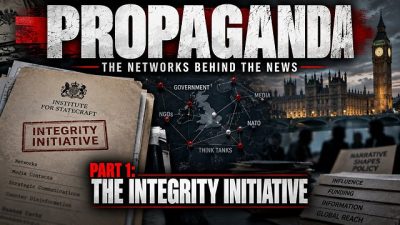
Integrity Initiative: UK-funded network framed dissent as Russian disinformation for years
or go to
Aletho News Archives – Video-Images
From the Archives
Why Saudi Ties to 9/11 Mean U.S. Ties to 9/11
By Kevin Ryan | Dig Within | September 27, 2015
Media interest in Saudi Arabian connections to the crimes of 9/11 has centered on calls for the release of the 28 missing pages from the Joint Congressional Inquiry’s report. However, those calls focus on the question of hijacker financing and omit the most interesting links between the 9/11 attacks and Saudi Arabia—links that implicate powerful people in the United States. Here are twenty examples. … continue
Blog Roll
 Aletho News
- IAEA inspectors cannot return to Iran amid US threats: Russia
- Senate Rejects Iran War Powers Resolution Passed By House
- ‘We did not attack Pakistan with drones’: Afghan sources
- Iraqi Resistance faction links arms to sovereignty, questions US exit
- Cannon fodder no more… South Korea rejects Trump’s pressure to join his criminal war on Iran
- Neria Leiter Was A Legitimate Military Target
- Integrity Initiative: UK-funded network framed dissent as Russian disinformation for years
- ‘We don’t seek permission to defend our country’: Snippets from President Pezeshkian’s UNGA address
- NATO chief wants Europeans to fight American wars [for Israel]
- German chemicals giant reveals details of downsizing
- If Americans Knew
- In UN Speech, Iran’s President Displays Pictures of Children Killed by US, Brings Attention to Israel’s Nuclear Arsenal
- Israel displaces hundreds of Palestinians amid wave of demolitions in West Bank
- Aid, reconstruction, and Israel’s history of obstruction in Gaza
- Trump administration digs an ever-deeper hole of complicity in genocide – Daily Update
- US-Israel $2.8 Billion Arms Deal, 40,000-Bomb Supply Faces New Gaza Complicity Accusations
- Caught on Tape: AIPAC CEO Boasted of Controlling Trump’s National Security Officials
- Why Hamas Attacked Israel in October 2023 – Israeli professor Ilan Pappé
- They see them, then kill them: Israeli quadcopters track, deliberately target civilians in Gaza
- Winter could turn Gaza’s treacherous, war-damaged buildings into deathtraps
- Majority of Democratic Voters Want to Prosecute Both Biden and Trump Administration Officials Over Gaza
- No Tricks Zone
- New Study: Earth And Venus Surface Warmth Largely Explained By Convection And Lapse Rate, Not CO2 Or Radiation
- 2025 Nature Paper Claiming Worsening Global Drought Gets RETRACTED …Heavily Flawed
- New Study: ‘Global Drought Shows No Detectable Recent Acceleration Under Climate Warming’
- Economic Masterminds: German Socialists Suggest Taxing Productivity Gains Stemming From Using AI
- The South China Sea Has Not Been Cooperating With The Climate Change Narrative
- Energy Crisis: Germany Enters Heating Season With Historically Low Gas Reserve Fill Levels
- New Study: The Antarctic Ice Sheet Gained Mass From 2020-2024 Due To Staggering Snow And Ice Accumulation
- Study: Ocean Heating Rates From Thousands Of Years Ago ‘Dwarf’ Modern Ocean Heating Rates
- Climate Extremists Target, Attack Large-Scale Power Grid Infrastructure In Germany!
- New Study: Antarctic Ice Melt Has Contributed Less Than 1 Centimeter To Sea Level Rise In The Last 30 Years

