As the US and EU disintegrate, is it time for a French renaissance?
By Gearóid Ó Colmáin | April 6, 2017
Things were looking good for days. President Donald Trump had reportedly sent US senator Tulsi Gabbard on a fact-finding mission in Syria and wanted to know if President Assad would cooperate with the US in defeating ISIS. Assad was willing to cooperate with the new American president. US Secretary of State Rex Tillerson’s recent statement in Ankara that the US had renounced its desire to remove Assad seemed to mark a major policy shift in the right direction.
French presidential favourite Marine Le Pen was unequivocal in her desire to work with the Syrian government to defeat Takfiri terrorism. France’s Popular Republican Union party (UPR) recently invited journalist Vanessa Beeley to address their election campaign where she delivered an inspiring speech on Syria. Francois Asselineau, the party’s leader, is the most progressive and anti-imperialist candidate in the French election.
For a few days, it seemed as though the tide was turning in favour of peace and good sense. Then, as peace negotiations with the Syrian government were progressing, the Syrian gas saga returned with a vengeance.
If you are new to the topic of Syria, there are a few matters which need to be cleared up here. The country’s leader, Bashar Al-Assad, is democratically elected. He is neither dictatorial nor brutal. All of the “sources” which the mainstream Western media use to write their stories on Syria come from organisations such as the ubiquitously cited Syrian Observatory for Human Rights (SOHR). SOHR is neither Syrian nor a human rights organisation. It is a one-man show run by Rami Abdel Rahman, an anti-government exile based in Coventry England. He hasn’t been in Syria for more than two decades. Almost all Western media sources come from this man!
So, the intrepid and indefatigable purveyors of “serious” journalism in France’s Le Monde were busy yesterday doing what they do best: war propaganda. Having implanted the belief in the uncritical reader’s brain through headlines accusing the Syrian government of gassing its own people – this time in Khan Cheikoun in the outskirts of Idlib – according to “the sources”, the real story emerges from the rubble of the aforementioned “sources”: the Syrian Army have intensified operations against “rebels” in the area contiguous to Idlib and Hama in recent weeks.
“The Operation” writes Le Monde’s Benjamin Barthes “which enabled the insurgents to come to at least within 10 kilometres of their aim, was led by the Jihadists of the Fatah Al Sham Front, an emanation of Al Qaida”. So there you have it! Le Monde has just told you once again that the “rebels” and “insurgents” are in fact led by an “emanation of Al-Qaida.
Our governments are supposed to be fighting Al-Qaida, supposed to be protecting us from them. The Syrian government – which NATO admitted in 2013 has the support of the majority of the Syrian people – claims to have bombed a chemical weapons depot in Khan Cheikoun. The information has been confirmed by the Russian military.
Even if you believe Bashar Al-Assad is secretly a devil “killing his own people”, surely the man is intelligent? If he wants to stay in power, getting the United States off his back would be a major help, would it not? So, just days after the United States looked like it was going to work with Assad against ISIS, he just couldn’t resist spraying that gas on innocent children and all the war-weary generals of the Syrian Arab Army are cowering in the barracks, abjectly carrying out every whim of the Damascene butcher and now facing a carpet bombing campaign by NATO! How did such a crazy fool manage to stay in power so long!?
Yesterday morning on France Inter radio station, academic dullards were pontificating about “post-truth”, “fake news” and of course, “conspiracy theories”. Russian media in France is increasingly coming under the spotlight. Some pundits have accused Moscow of destabilising European opinion. But critical minds always seek clarity and the French are a most critically-minded people. The war lobby is howling in Washington and Brussels and a silence of cruel complicity was observed in Western capitals following the terrorist attacks in St Petersburg on Monday. We have been taught to hate Russia.
In the French presidential debates on the 4th of April there were only two candidates the establishment fear: François Asselineau and Marine Le Pen. Of the two, Asselineau is unquestionably superior. Unlike Le Pen, Asselineau wants to leave NATO and not just the Military Command Structures. He wants leave the EU and not just have a time-wasting referendum on it. Asselineau wants to reform the Conseil de Resistance Nationale (the National Council of the Resistance) – the post war council formed by patriots and communists to reconstruct France.
Asselineau’s UPR could be the surprise in this election. No genuine communist could vote for that perfidious caitiff, that execrable little Trotskyite trashbag Jean-Luc Mélenchon! The pseudo-leftist defends wars of aggression as long as they have their UN mandates and ‘humanitarian’ cover. Mélenchon is the incarnation of everything that is putrid and pathetic on the “Left.” In fact, he is not left-wing at all. He is a right-wing demagogue who pipes the far-left tune – another Alexis Tsipras, another Sorosite, fake social-democratic class traitor!
Yesterday morning the republican presidential candidate was drilled by France Inter’s war-monger-in-chief Patrick Cohen concerning the French government’s response to the alleged gassing in Syria. Fillon, who has faced an avalanche of dubious allegations due to his connections with pro-Assad Lebanese businessmen and his desire for peace with Russia, said tellingly that the Syrian leader makes “incredible mistakes”. Fillon seemed to suggest that Assad couldn’t be that stupid and demanded “proof”- to the chagrin of Patrick Cohen!
Trump has now excluded Chief Strategist Steve Bannon from the National Security Council. The CIA and Joint-chiefs of Staff are also back in the council. The US Deep State is triumphant and the White House is pushing UN war resolutions against Syria. In France we need a patriotic leader capable of challenging the Empire; we need the National Council of the Resistance. In the aftermath of American populist failure, now is the time to build the European popular front!
Here’s why Donald Trump is unlikely to attack Syria
By Alexander Mercouris | The Duran | April 6, 2017
The debate about the Syrian chemical attack yesterday and President Trump’s comments during a news conference with the King of Jordan have led to speculation that the US might be readying an attack on Syria.
The speculation stems from the fact that Nikki Haley, the US ambassador to the UN, said that if the UN Security Council fails to take action over the chemical attack the US might consider taking “unilateral action”, whilst President Trump himself made comments during the news conference that appeared to have the military option open.
Whilst in any international issue the possibility of unilateral military action by the US can never unfortunately be completely ruled out, on balance neither Nikki Haley’s comment nor President Trump’s comment seem to presage military action.
Nikki Haley’s comment was made during a debate in the UN Security Council about the setting up of an investigation to look into the details of the chemical attack. No one questions that such an investigation should take place. The draft Resolution prepared by the Western powers is – as with every Resolution the Western powers have proposed during the Syrian crisis – absurdly unbalanced, effectively blaming the Syrian government for the chemical attack before the investigation takes place. However even this Resolution concedes that an investigation is needed, especially after the relevant UN bodies have said that they cannot themselves say who was responsible for the chemical attack.
The Russians for their part have prepared their own draft Resolution which – far more neutrally – calls for an investigation.
It is difficult to avoid the impression that Nikki Haley’s comment was part of the game of bluff and counter bluff that nowadays regularly takes place in the UN Security Council. Specifically, she appears to have been trying to scare the Russians into agreeing to the Western draft Resolution and to drop their own.
The Russians are most unlikely to be intimidated by this kind of bluff, and having already ruled the West’s draft Resolution out they will almost certainly persist in rejecting it.
As for Donald Trump’s comments, as the entirety of his words during the press conference show, he did not directly threaten unilateral US military action in Syria but made his comments when pressed to say by a journalist whether or not he was considering military action. He declined to give any concrete answer one way or the other, but the clear impression from his comments is that he is not contemplating it.
Overall the impression President Trump’s news conference gave was that Donald Trump’s focus remains overwhelmingly on fighting ISIS – he said far more about that than about the chemical attack in Syria – and that though he does not want to give more ammunition to his domestic opponents by denying the Syrian government’s responsibility for the chemical attack, he tried to shift ultimate responsibility for the likely lack of a US reaction away from himself onto President Obama.
Ultimately the same factors that deterred a US military attack to lift the Syrian army’s siege of eastern Aleppo last autumn remain in place today. The Russian air defence system which was installed in Syria with its S400 and S300 missiles is still there. The US military in the autumn made absolutely clear their deep reluctance to engage this system, and nothing since has happened to change their views.
President Trump more than any other President in recent years looks to the US military for political support. It is even less credible that he will go against their advice than President Obama did.
In light of all this a unilateral US attack on the Syrian military on anything like the necessary scale to affect the course of the Syrian war is extremely unlikely.
Chemical attack blame game ‘failed’ at Syria conference in Brussels – Russian envoy
RT | April 6, 2017
Attempts by some members of the Brussels conference on Syria to redraw the agenda and focus on allegations of the Syrian government’s complicity in the suspected chemical attack in Idlib have failed, Russia’s deputy foreign minister has said.
“In what concerns this conference, of course, some tried to redirect it in order to focus attention on the incident that has occurred [in Idlib]. I must say that they failed to achieve that,” said Gennady Gatilov, Russia’s representative at the UN-sponsored international donor conference that was held on April 4-5 in Brussels.
Moscow hopes that the incident will not lead to the derailment of intra-Syrian talks as that would play into hands of those who strive to obstruct the peace process.
“Anything can affect the talks. But we would not like for such incidents to be used by opponents of the negotiation process to disrupt it,” the Russian diplomat said, stressing that it is necessary for the negotiations to be inclusive.
Despite the apparent discord at the conference, its participants were largely united in that there is no alternative to political settlement to the protracted military conflict.
“I would like to note that all spoke in favor of political solution, the majority agreed that there is no military solution,” Gatilov said, as cited by TASS. He added that “practically all hailed” the negotiations in Astana made possible by the mediation of Russia, Turkey and Iran and commended them as “great help” for the Geneva process.
No breakthrough has yet been achieved in the talks, Gatilov said, referring to the latest round of intra-Syrian negotiations that took place in Geneva last week.
“Regrettably, so far it has yielded no practical results but it is not the reason to say that the round failed. Obviously, it is going to be a long process and we had been saying this all the time,” Gatilov said.
The slow progress is due to major differences between the take of the Syrian government and rebels on an array of key issues, he said. The major point of disagreement between the sides is what topic should be given a priority in the talks. While opposition argues that the talks should pave way for a transitional government, the Syrian authorities insist on the preeminence of the fight against terrorism.
On Tuesday, a suspected chemical attack on the hospital in the town of Khan Sheikhoun in rebel-held Idlib province claimed the lives of dozens of people, including children. Rebel groups accused the Syrian government of mounting the attack, the claims which the Syrian authorities flatly denied.
Russia has demanded a thorough investigation into the incident, saying it should be led by the Organization for the Prohibition of Chemical Weapons (OPCW), Russian Foreign Ministry spokeswoman Maria Zakharova said. The OPCW will be entrusted with collecting evidence of the attack within the fact-finding mission. The composition of the mission should be subject to approval by the UN Security Council.
In the aftermath of the attack, Russia’s Defense Ministry issued a statement, saying that the Syrian Air Force on Tuesday bombed a warehouse housing chemical weapons bound for Iraq. The storage facility, which was used to produce and store munitions containing toxic gas, was managed by the rebels. Defense Ministry spokesman Major-General Igor Konashenkov noted that the symptoms displayed by the victims of the attack in Khan Sheikhoun are similar to those shown by civilians who suffered in the Aleppo chemical attack, perpetrated by the militants.
The death of civilians has sparked an international outcry, with some of the Western governments, including the US, backing the allegations put forward by the rebels.
Commenting on the attack, US President Donald Trump said that it was “unacceptable” went “beyond the red line” and made him to rethink his stance on the Syrian government and President Bashar Assad.
In his turn, Vice President Mike Pence blamed the attack on a “failure of the past administration to both confront the mindless violence of the Assad regime and also hold Russia and Syria to account for the promises to destroy chemical weapons,” in an interview to Fox News on Wednesday.
Responding to a question, if Washington sees Moscow also responsible for the attack, Pence stated that Russian must ensure the implementation of the pledge by the Syrian government to destroy all chemical stockpiles, saying that “the time come has come for them [Russia] to keep the word that they made, to see the elimination of the chemical weapons so that they no longer threaten the people in that country.”
“We were told that there were an agreement between Russians and Assad to destroy chemical weapons and that the threat to civilians from a chemical attack had been eliminated, it was not,” Pence claimed.
Russia submits resolution to UN on chemical weapons attack in Syria
By Adam Garrie | The Duran | April 6, 2017
Russia has tabled a UN Security Council resolution calling for a through investigation of the chemical weapons incident in Idlib Governorate.
Vladimir Safronkov, Russia’s acting Ambassador to the UN who has stepped in to fill the position of the late Vitaly Churkin has said,
“… we submitted our short draft resolution, drawn up in a business manner and aimed at conducting a true investigation rather than to appoint the guilty ones until the facts are established”.
The Russian draft resolution proposes to,
“… fully investigate the reports about the incident on the ground under the mandatory condition that the list of investigators will be submitted to the UN for approval and will be geographically balanced as well”
This is in sharp contrast to the US-UK-France co-sponsored resolution which automatically assigned blame to the Syrian government in spite of clear evidence to the contrary. That resolution was vetoed by Russia.
The Russian resolution calls for the Organisation for the Prohibition of Chemical Weapons, the group which helped the Syrian government to remove the remains of its chemical weapons stockpiles in 2013, to explore this incident.
It also demands that illegal terrorist groups cooperate with investigations, something which may not be possible.
This response is similar to Russia’s reaction to the use of chemical weapons in Donbass by forces loyal to the Kiev regime. At that time Russia called for an investigation rather than a war.
Syria denies & condemns use of chemical weapons – foreign minister
RT | April 6, 2017
Syria’s foreign minister has dismissed allegations that the Syrian Army had deployed chemical weapons in the city of Idlib, saying the military will never use such weapons against its own people or even terrorists.
Syrian Foreign Minister Walid Muallem denied claims that the military used chemical weapons in the western city of Idlib. Speaking at a news conference on Thursday, Muallem said an airstrike by Syrian military had targeted an arms depot where chemical weapons stockpiles were stored by Islamic State (IS, formerly ISIS/ISIL) and Al-Nusra Front militants.
He said it’s impossible that the army – which has been making significant gains in almost all theaters of the Syrian war – would use banned chemical weapons against its “own people” and even terrorists.
Asked if Damascus would allow a fact-finding mission into the Idlib incident, Muallem said past experience of similar investigations was “not encouraging.” He also said that he could not predict “the reality of US intentions” in Syria.
Muallem added that such a mission must not be politicized and must start its operations “from Damascus, not Turkey,” apparently referring to the latest statements by Ankara condemning the incident, as well as the fact that some victims were taken to Turkey for autopsy.
‘Monstrous crime’
Meanwhile, Dmitry Peskov, spokesman for the Russian president, said the Kremlin believes the Syrian military will do its utmost to prevent chemical agents from falling into the hands of terrorists.
“This was indeed a dangerous and monstrous crime, but in our opinion, it would be wrong to point fingers,” Peskov told reporters on Thursday. The Kremlin spokesman said Moscow does not agree with assessments provided by certain Western countries.
“Immediately after the tragedy no one had access to this area, so no one could have hard verifiable data. Consequently, any information which the US side or our colleagues from other countries might have had access to, could not be based on objective facts,” Peskov told reporters.
Though Peskov rejected “hasty assessments” of the alleged use of chemical weapons, he emphasized that there are always disagreements between Moscow and Washington, but mutual discords over the Idlib incident are unlikely to affect “the spirit of our cooperation.”
Earlier in the day, the Russian Foreign Ministry dismissed as “unsubstantiated” statements by US Vice-President Mike Pence that Moscow and Damascus had failed to fulfill their obligations under a landmark 2013 deal to eliminate Syria’s chemical weapons arsenals.
“I wouldn’t use profane language, especially when it comes to the second-most powerful man in the US administration, but I do believe that this is ignorance rather than irresponsibility,” Mikhail Ulyanov, head of the ministry’s Arms Control Department, said.
“The new administration has only recently begun reviewing its policy. Once that’s done, American officials’ statements, I hope, will become more accurate. There is no reason to say the US-Russia agreements [on eliminations Syria’s chemical weapons stockpiles] did not work,” Ulyanov stated.
Made in Usa: Democratic Navalni

By Manlio Dinucci | Voltairenet | March 29, 2017
A police officer smashes down the door with a portable battering ram; another one enters, pointing a pistol and strikes several times, a man who, roused by the break in, reached for a baseball bat; yet other police officers point their guns at a child who has already raised his arms: scenes of ordinary “legal” violence in the United States, reported a week ago, with video clips by the New York Times, that talks about the “trail of blood” triggered by these “raids”, carried out by former soldiers, who have been recruited into the police force, applying the same raid techniques that would be applied in raids in Afghanistan or Iraq.
Our mass media shield our eyes from all this. These same media outlets splash on the front page [photos of] the Russian police arresting Alexei Navalni in Moscow for a demonstration that had not been authorized. An “affront to fundamental democratic values” – this is how the US State Department defines it and firmly requires his immediate release and that of the others detainees. Federica Mogherini, the EU High Representative of Foreign Policy, also condemns the Russian government because “it prevents the fundamental freedoms of expression and peaceful assembly from being exercised”. Thus, in support of the new champion of “democratic values”, everyone is united in the new campaign launched against Russia in tones that typify the Cold War.
Who is Alexei Navalni? From his official profile, we read that he trained in the US, at Yale University, as a “fellow” (a chosen member) of the “Greenberg World Fellows Program”. This programme was established in 2002, and each year, just 16 individuals with attributes that make them “global leaders” are selected from all around the world. They form part of a network of “leaders globally committed to making the world a better place”. At the moment, this network is composed of 291 fellows from 87 countries, one in contact with the other and all linked to the US centre, Yale.
Navalni is, at the same time, the co-founder of the movement “Alternative democracy”. This is one of the beneficiaries of the National Endowment for Democracy (NED), a powerful US “private non-profit foundation” which funds, which are even provided by the Congress, openly or under the counter, thousands of non-governmental organizations in more than 90 countries to “advance democracy” [1]. NED, a CIA outlet for covert operations, was and is, particularly active in Ukraine. It was here that it supported (according to what is reported) “the Maiden Square Revolution which crushed a corrupt government which stood in the way of democracy”. The result of the Maiden Square Putsch: an even more corrupt government has come into power. Indeed, its democratic character finds expression in the Neo-Nazis that hold key positions in it.
In Russia, activities of “undesirable non-governmental organizations” are prohibited and this is why NED has not stopped campaigning against the Russian government. Thus NED accuses it of spearheading an aggressive foreign policy to bring within its sphere of influence, states that previously formed part of the USSR. This charge is the foundation of the basis for the US/NATO strategy against Russia. The technique, now consolidated, is that of the “orange revolutions”: gaining mileage on the back of genuine or invented cases of corruption and other bones of dissatisfaction so as to whip up an anti-government rebellion, which will weaken the state from within, while increasing military, political and economic pressure externally. Alexei Navalni’s activities should be viewed in this context. He specialized at Yale as a lawyer, defending the rights of the vulnerable against abuse by the powerful.
[1] “NED, the Legal Window of the CIA”, by Thierry Meyssan, Translation Anoosha Boralessa, Оdnako (Russia) , Voltaire Network, 16 August 2016.
Translation by Anoosha Boralessa
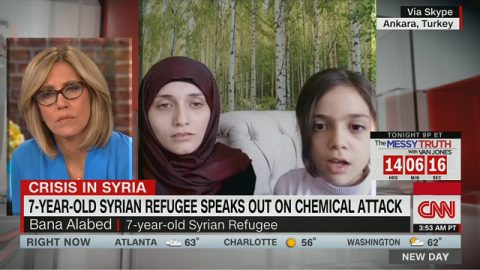
CNN Has Child Read Off A Script To Push For War In Syria To Oust Assad
By Chris Menahan | InformationLiberation | April 5, 2017
CNN is calling it a “7-year-old Syrian girl’s heartbreaking plea” to stop the war in Syria, in reality it’s a fake news hoax to get the Trump administration to overthrow Assad and turn on Russia.
The top story on CNN’s front page today is a disgusting Iraq-has-WMDs-style fake news story to con America into another war.
Under the title, “7-year-old Syrian girl’s heartbreaking plea: ‘Why can’t you stop the war?’,” CNN anchor Alisyn Camerota is seen interviewing a 7-year-old Syrian girl named Bana Alabed.
Camerota asks her: “Bana, do you [a 7-year-old girl] blame President Assad for this [chemical attack]?”
Bana responds, “Yes.”
“What is your message to President Assad?” Camerota asks the 7-year-old.
“I am very sad,” Bana says, looking down and blatantly reading off a script. “A lot of died,” she says, clearly struggling to read and skipping over the word “people” or “Syrians.”
“And, oh,” she stutters, “no one help them.”
“The world is watching,” she stammers, “the world doesn’t do anything.”
It goes on for another minute with Bana struggling to read her clearly pre-written propaganda lines. Eventually she asks, “why you, why can’t you, stop the war?”
“I don’t know Bana, I don’t know why the world can’t stop the war in Syria someday,” a torn Camerota responds, ignoring how incredibly fake and staged the whole shameless stunt she just took part in is.
This is the epitome of fake news and it’s a thousand times more dangerous to our country than some schmuck in Macedonia writing about fake endorsements from the Pope.
‘We are compelled to take own action’ if UN fails in Syria – US envoy
RT | April 5, 2017
The UN Security Council convened on Wednesday to discuss a draft resolution proposed by the US, the UK and France, which would condemn Damascus for the reported use of chemical weapons in the town of Khan Sheikhoun in Idlib province on Tuesday.
Russia criticized the draft resolution for being unbalanced and jumping to conclusions. It said the document would have to include several amendments, such as calling on the rebels controlling the area to provide full access to UN investigators and setting an unbiased and comprehensive probe into the incident as the primary goal of the resolution.
“This draft was penned in haste and adopting it would have been irresponsible,” the Russian deputy acting envoy to the UN, Vladimir Safronkov, said.
He also blamed Western members of the UNSC for unwillingness to investigate previous cases of alleged use of chemical weapons in Syria, where rebel groups were accused of using toxin agents.
Nikki Haley, the US ambassador to the UN, delivered an emotional speech that included images of children to argue in favor of swift action. The pictures were used in reporting of the alleged chemical weapons attack.
She claimed the incident carried “all hallmarks” of an attack by Damascus, adding that the toxin used in the alleged assault was “more deadly” than in previous cases attributed to the Syrian military by Washington.
US envoy to UN also accused Russia of failing to ensure that there were no chemical weapons in the possession of the Syrian government.
“The truth is that Russia, Iran and [Syrian President] Assad have no interest in peace,” Haley claimed.
The US has hinted at taking its own action in Syria unless the UN Security Council moves to prevent the use of chemical weapons in the war-torn country.
“When the United Nations consistently fails in its duty to act collectively, there are times in the life of states that we are compelled to take our own action,” the US ambassador to the UN said.
Israel proposes railroad to Saudi Arabia via Jordan
Press TV – April 5, 2017
The Israeli regime has proposed construction of a railroad connecting the occupied territories to Saudi Arabia via Jordan.
Transport Minister Yisrael Katz said on Wednesday that Washington had also welcomed the plan, but he declined to say whether Riyadh and Amman had supported the proposal.
The link is designed to connect the Saudi port of Daman in the Persian Gulf via Jordan to the Mediterranean port of Haifa in northern Israel, according to the Israeli minister.
Katz, who has declared himself as a candidate to succeed Prime Minister Benjamin Netanyahu when the premier steps down, said the rail line would notably cut the distance needed to move goods.
The minister also elaborated on the plan, saying only a small distance of track was needed to link the current Israeli network in the north with the occupied West Bank near the city of Jenin and Jordan at Sheikh Hussein crossing.
Egypt and Jordan are the only two Arab governments that have official diplomatic ties with Tel Aviv and host Israeli missions. The rest of the Arab governments have no diplomatic relations with the Israeli regime, and seek to portray themselves as Tel Aviv’s traditional adversaries and upholders of the Palestinian cause.
Even so, reports have indicated that some of the governments, including Saudi Arabia and the United Arab Emirates, have had secret relations with Tel Aviv, covertly appeasing the regime.
This Madness Deserves a Protest: an Inside Account at US Nuclear Weapons Strategy
By Joan Roelofs | CounterPunch | April 5, 2017
“In contrast to the Soviet Union, the United States has always maintained its ‘right’ to carry out a nuclear first strike. This has never changed and was reaffirmed by Defense Secretary Ashton Carter . . . on September 27, 2016.”
— Diana Johnstone, From MAD to Madness.
There is not much hope for the retraction of this threat. On March 21, Reuters reported “Trump has said that while he would like to see nuclear weapons abolished, he wants the United States to have an unrivaled arsenal. He also said that the United States has ‘fallen behind’ in its nuclear capabilities, even though it is in the midst of a 30-year, $1.3 trillion drive to modernize what most experts agree is the world’s most powerful nuclear force.”
An insider’s memoir, From MAD to Madness, by Paul H. Johnstone, describing the persistence of the US nuclear threat has recently been published by Clarity Press. Johnstone was a senior analyst in the Strategic Weapons Evaluation Group in the Department of Defense, directing studies on the probable consequences of nuclear war, to us and to them, and also an author of The Pentagon Papers. He died in 1981, leaving his memoir to his daughter, author (and CounterPunch contributor) Diana Johnstone. He had previously served in World War II as an evaluator of Japanese enemy targets, but as Diana says here: “Hiroshima changed the nature of targeting dramatically, and that is the story my father tells in his memoir.”
In this book Diana has finally published his “Memoir of a Humanist in the Pentagon,” along with her added commentary and a foreword by Paul Craig Roberts. Roberts expresses in a nutshell the contemporary horrific relevance of the book: “The neoconservatives in pursuit of their goal of US world hegemony have resurrected the possibility of nuclear war. The neocons have taken us from MAD to madness.”
The neocons are not some far-right fringe group; they represent the mainstream of US foreign policy in recent Democratic and Republican administrations. The political use of the nuclear threat has a long history. It was inaugurated by the nuclear bombing of Hiroshima and Nagasaki, a political decision opposed by the military. Admiral Leahy, Chairman of the Joint Chiefs of Staff wrote: “the use of this barbarous weapon at Hiroshima and Nagasaki was of no material assistance in our war against Japan. The Japanese were already defeated and ready to surrender. . .” The Truman Doctrine (1947) indicated that there were no regrets. It stated in effect that any country that appeared to be adopting a communist form of government, whether through outside intervention, civil war, or ordinary elections, would be subject to whatever punishment the United States chose to inflict, not excluding nuclear attack.
Johnstone traces the “breather” in our policy characterized by MAD—the idea that Mutually Assured Destruction: a path to mutual suicide—was a deterrent to the use of nuclear weapons. This realization by our government occurred once Soviet nuclear capability became obvious. However, as Roberts notes, after the Soviet collapse in the 1990s the US “resurrected nuclear weapons as usable weapons of war. The Obama regime . . . authorized a trillion dollar expenditure for nuclear weapons, and US war doctrine elevated nukes from a retaliatory role to pre-emptive first strike.” Roberts, who was United States Assistant Secretary of the Treasury for Economic Policy under President Reagan in 1981, maintains that Reagan and Gorbachev “eliminated the risk of Armageddon by negotiating the end of the Cold War.”
Johnstone’s exposition of US nuclear policy is sobering, and his special vantage point as an insider is a revelation about how foreign policy is concocted. The conclusions and the process are both astonishing.
Although the Cold War, often hot, was fought in many parts of the world, Johnstone’s main task was to assess the consequences of nuclear war with the Soviet Union. Its probability was not a major concern for the analysts; plenty of those on our side were raring to use this super weapon.
Johnstone worked with the assistance of many teams, task forces, and committees. He noted that among those charged with divining Soviet intentions, few had any expertise on the subject: “Kennan was shunted aside. . . as insufficiently anti-Soviet.” State Department analysis or research was rarely seen or considered significant by the military or White House representatives on the committees. “Kennedy. . . seems to have depended far more on his longstanding, seat-of-the-pants notions of how to interpret Soviet intentions.”
“Almost never was there any suggestion that Soviet arms were in any way defensive, or that the Soviets feared us.” A related insider study of the decision-making process in the Kennedy White House is James C. Thomson, Jr.’s “How Could Vietnam Happen? An Autopsy.”
At the time (and now, in spades) intelligence sources were multiplex. Each of the military branches had its own intelligence division, in addition to outside contractors. There were also the agencies of the State Department, the CIA and the NSA; spies working for the Commerce and Agriculture Departments; overseas (especially Latin American) operations of the FBI; and “debriefings” of anyone who had traveled to any sensitive area, including exchange students and professors, journalists, the burgeoning INGO (International Non-Governmental Organizations) crowd, and real or fake businesspeople. In the confusion, the information that reached the senior operational people was determined by biases all along the way, including assumptions about what the President wanted to hear. An eloquent recounting of how fantasies were substituted for accurate information about Southeast Asia can be found in Ralph McGeHee’s Deadly Deceits.
Interservice rivalries influenced the strategy envisioned for a future war. At first the Air Force had a near monopoly on weapons, so the Army advocated for conventional warfare.
Later, all branches had nuclear delivery systems, and competing for budget allocations, advocated their use. An addition to the Navy’s arsenal was very recently announced: “The US preemptive nuclear strike capability has significantly grown. The strategic nuclear forces modernization program has implemented new revolutionary technologies to vastly increase the targeting capability of the US submarine-launched ballistic missile (SLBM) arsenal.”
In the post-WWII period, despite all the analysts recruited for this task, there was great uncertainty in all the calculations of damage to the economic base, civilians, and the very structure of a society targeted with nuclear weapons. Assumptions were often made on the basis of earlier wars, where destruction of factories and resources was intended to disable armament production. Before nuclear weapons, the theory was that wars could be fought and won by this type of strategic bombing. However, after a nuclear attack, the military, political, and environmental consequences of initial radiation and continuing fallout, with or without shelters, could never be determined; only imagined.
Nevertheless, the military advisors on the committees had a hunch that a pre-emptive strike to destroy the USSR would be the least destructive option, so their hearts were in it. They assumed that a nuclear exchange would create millions of casualties in the US, but that “the US would continue to exist as an organized and viable nation, and ultimately would prevail, whereas the USSR would not.”
Much more attention was paid to the prospect of nuclear annihilation of the Soviet Union than the consequences of an initial or retaliatory attack on the United States. Johnstone’s sober view was that any issue that precipitated a war would be dissolved by the ensuing devastation; there could be no victor in a nuclear war.
Johnstone includes two case studies in which his Weapons Systems Evaluation Group participated: the Laos Crisis of 1960-1961 and the Berlin Crisis of 1961. In the case of Berlin, plans were prepared for stages of retaliation all the way to nuclear war in anticipation of the USSR interfering with traffic from the West into Berlin on the Autobahn. The Soviets had been requesting identification or delaying document checking in ways that the US considered unwarranted. These “microaggressions” were interpreted as merely a prelude to a showdown. As an additional indication of our resolve to protect our access to Berlin, the Joint Chiefs of Staff suggested that we should go to war in Southeast Asia.
At no time during these crises, or in the planning for nuclear war, did Johnstone note any concern by committee members for international law, not only its prohibitions, but also its many mechanisms for resolving disputes. War had been outlawed by the Kellogg-Briand Pact in 1928. The Charter of the United Nations, a ratified treaty commitment of the US, prohibits war as an instrument of foreign policy; even the threat of war is an international crime.
Article 2, Section 4: All Members shall refrain in their international relations from the threat or use of force against the territorial integrity or political independence of any state, or in any other manner inconsistent with the Purposes of the United Nations.
Customary international law prohibits any weapon that does not discriminate between civilians and combatants. This was used by the International Court of Justice in its 1996 advisory opinion on the use of nuclear weapons:
It follows from the above-mentioned requirements that the threat or use of nuclear weapons would generally be contrary to the rules of international law applicable in armed conflict, and in particular the principles and rules of humanitarian law.
However, in view of the current state of international law, and of the elements of fact at its disposal, the Court cannot conclude definitively whether the threat or use of nuclear weapons would be lawful or unlawful in an extreme circumstance of self-defence, in which the very survival of a State would be at stake.
The Treaty on the Non-Proliferation of Nuclear Weapons, 1970, requires nuclear-weapon countries to undertake progressive nuclear disarmament toward the goal of complete elimination of nuclear weapons. This is not the direction being followed by the US, among other signatories.
Johnstone began his federal service in 1937 as a historian in the Department of Agriculture, and Diana notes that his career mirrored the changes in the US economy: “America turned from farming to bombing as the basis of its industrial economy. . .” Yet the Cold War itself, although tragically affirmed by the nuclear bombing of Japan, has a much longer history (some say it started in 1848), and includes US and allied participation in the “hot” invasion of the USSR after the 1917 Revolution and the US corporate assistance during the 1930s in creating Hitler’s war machine. This buildup proceeded apace, with the participation of the great US corporations. During the same period, the President exercised a Congressional mandate to prohibit arms trades that supported war. It was imposed on a US corporation, Curtiss-Wright, selling arms to Bolivia for its border war against Paraguay: the Chaco War. As it turned out, that was not the greatest threat to world peace.
Johnstone believed that our Cold War policies were irrational, and that we could have made friends with the anti-colonial, nationalistic revolutionary movements that our “anti-Communist obsession . . . led us to oppose.” Maybe it is a question of who is “us”?
The vast population of the US, rich in resources, inventiveness, and skilled labor could easily have co-existed with socialist societies, intent on self-development and willingly engaging in fair trade. Multinational corporations, however, were challenged by nations that wanted to expel their oil rigs, gold miners, sweatshops, cigarettes, pesticides, telephone services, chemical factories, waste dumps, and even innocent Coca-Cola.
The military and the increasingly gigantic industries equipping it wanted bases everywhere, and somewhat plausible threats that would justify annual upgrading of the lethal arsenal. Wars now and then that would enable testing and destruction of weapons were also useful for the advancement of warriors and profits of contractors. Furthermore, revolutions that were allowed to succeed and improve the lives of people might create imitators in our land of vast wealth accompanied by astounding poverty and misery.
Yet neither Roberts nor Johnstone discusses the role of multinational corporations and the military-industrial complex in motivating and perpetuating the post-WWII Cold War. They attributed major influence on US policy to anti-Soviet émigrés (Kissinger, Brzezinski and others) from Eastern Europe. A high-level Air Force intelligence “Special Studies Group,” headed by a Hungarian émigré “expert” predicted in every annual appraisal that there would be “a massive Russian land attack on Western Europe the following year.”
The worldwide cold war between capitalism and socialism continues—in Cuba, among other places—and there is now also the megalomaniac goal of world hegemony. The projected attack by the now-capitalist Russia is still awaited, despite indications that the Russians want to eliminate the specter of civilization’s total nuclear destruction. Johnstone’s sober prediction in From MAD to Madness: “there can be no victor in a nuclear war” must be given priority by the newly-awakened activists. The abolition of nuclear weapons would be a step towards sanity.
 Joan Roelofs is Professor Emerita of Political Science, Keene State College, New Hampshire. She is the translator of Victor Considerant’s Principles of Socialism (Maisonneuve Press, 2006), and author of Foundations and Public Policy: The Mask of Pluralism (SUNY Press, 2003) and Greening Cities (Rowman and Littlefield, 1996) and translator, with Shawn P. Wilbur, of Charles Fourier’s anti-war fantasy, World War of Small Pastries, Autonomedia, 2015. Web site: www.joanroelofs.wordpress.com Contact: joan.roelofs@myfairpoint.net
Featured Video

Spain train disaster raises questions over Israeli-linked security contractors
or go to
Aletho News Archives – Video-Images
From the Archives
Are There 50,000 ‘Israeli-born’ Individuals Living in the UK?
By Professor David Miller | August 18, 2026
Recent disclosures by the Zionist regime show that some 2,069 British nationals were serving in the IDF as of March 2025, according to Freedom of Information (FoI) requests submitted to the occupation forces (1,686 dual British-Israeli, plus 383 multinational). We cannot tell from the figures how many of these were already settler colonists and intend to stay in the colony, and how many will return or have returned to the UK. Presumably, those returning to the UK will number far fewer than 2,000, since many are known to have become permanently residents of the colony.
Additionally, the IDF figures only provide a snapshot, and do not tell us how many have served in the Jewish supremacist military either before or after March 2025. One way into the question of how many genocidaires are living in Britain is to ask how many current British residents were born in the Zionist colony. There is data on that, as we shall see. … continue
Blog Roll
 Aletho News
- Zelensky spent over 740 days outside Ukraine while West serves as his real home
- Indian captain of Russian ‘shadow fleet’ tanker faces 10-year jail term in UK
- Europe, US face higher heating bills amid Iran war fallout
- The Leak That Arrived Right on Cue
- No, New York Times, California’s Climate Has Always Been a Land of Flood, Drought, and Fire
- Are There 50,000 ‘Israeli-born’ Individuals Living in the UK?
- German CDU MPs Seek Climate “Misinformation” List
- The ‘Gaza Treatment’: How Media Headlines Obscure Who is Bombing Yemen
- Ro Khanna urges Democrats to strip Israel ‘integration’ provision from defense bill
- Why Iran designated British MI6, Royal Navy, and RAF as hostile, terrorist organizations
- If Americans Knew
- An error has occurred; the feed is probably down. Try again later.
- No Tricks Zone
- German Authorities Start Initiative To Evaluate Public Register For Climate “Disinformation” Spreaders!
- Zonal Asymmetry of Temperature Change in the Antarctic Circumpolar Current
- New Study: The Net Fossil Fuel Contribution To Rising Atmospheric CO2 Has Been Zero For 500 Years
- Germany’s Green Energy Transition Becoming Increasingly Expensive…Another 6 Trillion Euros!
- Sudden Stratospheric Warming, Powerful El Niño Combination May Lead To Extreme Europe Cold, Energy Crisis!
- Two New Studies Find Thwaites Glacier Melt Cannot Be Driven By Human Activity Or A Warming Ocean
- E-Cars Reduce CO2 Emissions By Only 41% Compared To Internal Combustion Engine Vehicles
- Predictions Made By Renowned Climate Professor Over Past Decades Have Been Proven To Be Poor
- New Study Suggests Large Regions Of The Pacific Ocean Have Been Cooling For The Last 80 Years
- Germany’s Green Energy Debacle: High Energy Costs Force Kahla Porzellan to Close After 182 Years!

