America First

By Paul Larudee | Dissident Voice | February 20, 2017
Nothing in Trump’s campaign resonated with the American heartland quite like “America First”. But Trump wasn’t the first. Remember Charles Lindbergh? He put “America First” and paid the price.
Deir Yassin Remembered (DYR) also wasn’t first but neither were we last. The first DYR “America First” billboard went up in Detroit in November 2015. It didn’t last long but such is Jewish power.
It re-appeared on February 6 this year near Ann Arbor, Michigan but, just one week later, DYR received a call from Adams Outdoor Advertising General Manager Mike Cannon saying that the board had to come down. Such is Jewish power.
These tactics, known as ‘Dynamic Silencing”, are well-worn and well-described by Benjamin Ginsberg in his book The Fatal Embrace: Jews and the State, p. 124:
Working together, officials of the American Jewish Committee, the American Jewish Congress, and the ADL would approach the publishers of major newspapers and owners of radio stations in cities where Smith [substitute any “anti-Semite”] had scheduled appearances to ask that Smith be given no coverage whosoever. If newspapers and radio stations failed to cooperate on a voluntary basis, Jewish organizations were usually able to secure their compliance by threatening boycotts by Jewish advertisers.
So where now? Try another site? Turn it into a lapel pin? Put it on a truck and drive it cross-country?
Please send any ideas to us here.
Paul Larudee is one of the founders of the Free Gaza and Free Palestine Movements and an organizer in the International Solidarity Movement.
No substantive change in US rhetoric on Iran: Shamkhani
Press TV – February 20, 2017
A senior Iranian official says the rhetoric of the US administration of President Donald Trump on the Islamic Republic is substantively no different from that of the former officials in Washington.
“There has been no substantive shift in the rhetoric of the new US officials [in comparison with] the previous [ones] and various figures and parties in the country have always maintained an aggressive approach toward independent countries,” Secretary of Iran’s Supreme National Security Council (SNSC) Ali Shamkhani told reporters on Monday.
He added that the fact-based admissions by President Trump about the chaotic situation in the West and the United States are a new issue which had never been publicly acknowledged by other US leaders.
Such confessions show that Washington can no more cover up the tumultuous and confused situation in the US, the top Iranian official emphasized.
“Although it is still early to make a definitive judgment about the new US administration, the current trend shows that there will be no change in the chaotic situation of the country in the new era either,” the SNSC secretary pointed out.
The new US Republican president, who took office in January, has repeatedly echoed the same warnings made by former President George W. Bush who on several occasions said he would not take the military option against Iran off the table.
Former President Barack Obama also threatened military action against Iran before the nuclear agreement between Tehran and world powers in 2015.
Trump said on February 2 that “nothing is off the table” in terms of a response to a recent ballistic missile test by Iran.
Iranian officials have always dismissed such statements as foreign meddling in the country’s domestic affairs, saying that the missile tests were the nation’s inalienable right to self-defense. Iran has also vowed a crushing response to any military attack against it.
Russian ambassador to UN Vitaly Churkin dies day before turning 65
RT | February 20, 2017
Vitaly Churkin, who served as Russia’s permanent representative to the United Nations since 2006, “died suddenly” in New York, the Russian Foreign Ministry announced.
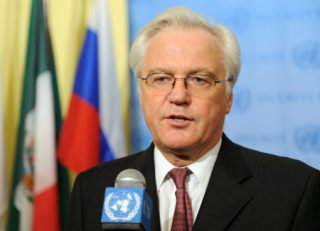 Churkin would have turned 65 on Tuesday.
The announcement “of the untimely passing away of Ambassador Vitaly Churkin this morning” was met with shock when it was delivered during a session at the UN headquarters.
“He was a dear colleague of all of us, a deeply committed diplomat of his country and one of the finest people we have known,” a UN official who delivered the news to her colleagues said.
The moment of silence in Churkin’s memory was announced at the UN.
President Putin has expressed his condolences to Churkin’s family and to all Russian diplomats.
“He was an outstanding person. He was brilliant, bright, a great diplomat of our age,” Russian Foreign Ministry spokeswoman Maria Zakharova told RT, adding that the news of Churkin’s death was “completely shocking.”
Churkin fell ill in his office at Russia’s UN mission and was taken to Columbia Presbyterian Hospital, where he died Monday, AP reported, citing Russia’s deputy UN ambassador, Vladimir Safronkov. The cause of death wasn’t immediately known, the agency reported.
“He has been such a regular presence here that I am actually quite stunned. Our thoughts go to his family, to his friends and to his government,” Farhan Haq, deputy spokesman for the UN secretary-general’s office said, as quoted by Reuters. […]
“He was a strong-willed, resolute, and dutiful person, who was admired by his colleagues and envied by his enemies,” Russian Deputy Foreign Minister Sergey Ryabkov told RT.
Russia’s UN Ambassador spared no effort and devoted his life and strength “to the fight for a brighter future for this world,” Ryabkov said, adding that Churkin’s death is “a great loss not only for diplomacy, but for the country in general.”
The profession of a diplomat “has become much more hectic than it used to be in the past,” Churkin said earlier this month in an interview with RT, which was one of his last. “It is stressful,” he said.
“Unfortunately, the world has not become more stable than it used to be,” Churkin told RT’s Aleksey Yaroshevsky.
Before he was appointed to represent Russia at the UN in May 2006, the diplomat served as ambassador to Belgium, ambassador to Canada, and liaison ambassador to NATO and the Western European Union (WEU).
In the 2000s he was ambassador at large at Russia’s Foreign Ministry, while in the early 1990s he served as the special representative of the Russian president to the talks on the former Yugoslavia.
Challenging Klobuchar on Ukraine War
As Democrats compete to become the new War Party – pushing for a dangerous confrontation with nuclear-armed Russia – some constituents are objecting, as Mike Madden did in a letter to Sen. Amy Klobuchar.
From Mike Madden (of St. Paul, Minnesota) | February 19, 2017
Dear Senator Klobuchar, I write with concern over statements you have made recently regarding Russia. These statements have been made both at home and abroad, and they involve two issues; the alleged Russian hack of the presidential election and Russia’s actions in the aftermath of the February 22, 2014 coup in Kiev.
U.S. intelligence services allege that President Vladimir Putin ordered an influence campaign to denigrate Hillary Clinton and help elect Donald Trump. The campaign is purported to include the production of fake news, cyber-trolling, and propaganda from Russian state-owned media. It is also alleged that Russia hacked the email accounts of the Democratic National Committee and Clinton campaign chair John Podesta, subsequently providing the emails to WikiLeaks.
Despite calls from many quarters, the intelligence services have not provided the public with any proof. Instead, Americans are expected to blindly trust these services with a long history of failure. Additionally, the former Director of National Intelligence, James Clapper, and the former Director of the Central Intelligence Agency, John Brennan, have both been known to lie to the public and to Congress, Mr. Clapper doing so under oath.
Meanwhile, WikiLeaks founder Julian Assange maintains the emails did not come from Russia (or any other state actor) and his organization has an unblemished record of revealing accurate information in the public interest that would otherwise remain hidden. While responsible journalists continue to use the word ‘alleged’ to describe the accusations, Republicans with an ax to grind against Russia, and Democrats wishing to distract from their own failings in the campaign, refer to them as fact. Indeed, on the ‘Amy in the News’ page of your own website, Jordain Carney of The Hill refers to the Russian meddling as “alleged”.
A congressional commission to investigate the alleged Russian hacking is not necessary. Even if all the allegations are true, they are altogether common occurrences, and they certainly don’t rise to the level of “an act of aggression”, “an existential threat to our way of life”, or “an attack on the American people” as various Democratic officials have characterized them. Republican Senator John McCain went full monty and called the alleged meddling “an act of war”.
Joining War Hawks
It is of concern that you would join Senator McCain and the equally belligerent Senator Lindsey Graham on a tour of Russian provocation through the Baltics, Ukraine, Georgia, and Montenegro. The announcement of your trip (December 28, 2016) on the ‘News Releases’ page of your website renewed the unproven claim of “Russian interference in our recent election”. It also claimed that the countries you were visiting were facing “Russian aggression” and that “Russia illegally annexed Crimea”.
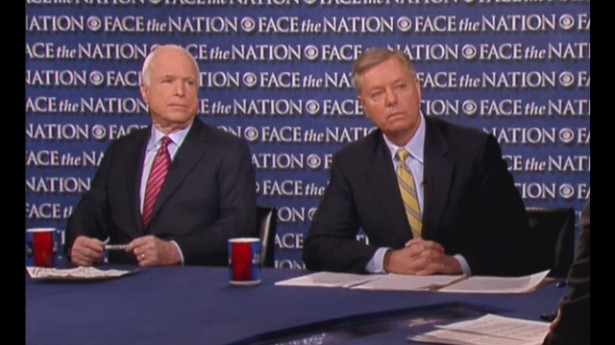
Sen. John McCain and Sen. Lindsey Graham
It is unfortunate that these claims have become truisms by sheer repetition rather than careful examination of the facts. Russia has not invaded eastern Ukraine. There are no regular units of the Russian military in the breakaway provinces, nor has Russia launched any air strikes from its territory. It has sent weapons and other provisions to the Ukrainian forces seeking autonomy from Kiev, and there are most certainly Russian volunteers operating in Ukraine.
However regrettable, it must be remembered that the unrest was precipitated by the February 22, 2014 overthrow of the democratically elected president Viktor Yanukovych which, speaking of meddling, was assisted by U.S. State Department, other American government agencies, and one Senator John McCain. The subsequent military and paramilitary operations launched by the coup government against the People’s Republics of Donetsk and Luhansk were described by President Putin as “uncontrolled crime” spreading into the south and east of the country. In American parlance, both the interim coup government in Kiev and the current government of President Petro Poroshenko have engaged in “killing their own people”.
Ignoring the Details
If Russia’s actions are to be considered “aggression” or an “invasion”, one must find a whole new word to describe what the United States did to Iraq in 2003. If, like your colleague Senator McCain, you hold the annexation of Crimea to be illegal under the 1994 Budapest Memorandum, I urge a closer look.
On February 21, 2014, an agreement brokered by the European Union was signed between President Yanukovych and the leaders of three major opposition parties. The agreement contained terms for a cessation of violence, immediate power sharing, and new elections. Smelling blood in the water, the opposition in Maidan Square did not withdraw from the streets or surrender their illegal weapons as agreed, but instead went on the offensive. Yanukovych, under threat to his life, fled Kiev along with many others in his Party of Regions.
Nor did the opposition party leaders honor the agreement. The next day, they moved to impeach Yanukovych, however they failed to meet several requirements of the Ukrainian Constitution. They failed to indict the president, conduct an investigation, and have that investigation certified by the Constitutional Court of Ukraine. Instead, they moved directly to a vote on impeachment and, even on that count, they failed to obtain the required three-fourths majority vote. So, even though the Budapest Memorandum did offer assurances of Ukrainian security and territorial integrity in exchange for surrender of Soviet-era nuclear weapons on its soil, the sovereign government of Ukraine had fallen in a violent unconstitutional putsch.
Yanukovych remained its legitimate president-in-exile and he, along with the prime minister of the Autonomous Republic of Crimea, requested Russian intervention on the peninsula to provide security and protect the human rights of ethnic Russians threatened by the new coup government and neo-Nazi elements within it.
One can now see how real that threat was by looking to eastern Ukraine where the Ukrainian military and neo-Nazi paramilitaries such as the Azov Battallion, have moved with force against the defenders of the Donbass region whose people seek autonomy from a government in Kiev that they do not recognize. Approximately 10,000 people have died in the Donbass War, whereas only six people were killed during the period of annexation (February 23-March19, 2014) in Crimea.
While the Donbass War drags on, Crimea remains stable today. The popular referendum conducted on March 16, 2014 lent legitimacy to the subsequent annexation. Official results claimed 82% turnout with 96% of voters favoring reunification with Russia. Independent polling conducted in the early weeks of March 2014 found 70-77% of all Crimeans favored reunification. Six years prior to the crisis in 2008, a poll found that 63% favored reunification. Even though many ethnic Ukranians and Tatars boycotted the election, rejoining Russia was clearly the will of the majority of Crimean people.
President Putin, characterizing the situation in Ukraine as a revolution, claimed that Russia had no agreements with the new state and therefore no obligations under the Budapest Memorandum. He also cited Chapter I: Article 1 of the United Nations Charter, which calls for respect for the principle of self-determination of peoples. The 1975 Helsinki Accords, which affirmed post-World War II borders, also allowed for the change of national boundaries by peaceful internal means.
The Kosovo Precedent
It is also useful to consider parallel occurrences in Kosovo. In 1998 ethnic cleansing by Serbian troops and paramilitaries led to a NATO intervention without U.N. authorization. There is little question that the move was illegal, but legitimacy was claimed due to the urgent humanitarian need. Ten years later, Kosovo would declare independence from Serbia and the disputed matter would end up before the International Court of Justice. In 2009 the United States provided the Court with a statement on Kosovo that read in part: “Declarations of independence may, and often do, violate domestic legislation. However, this does not make them violations of international law.”
The United States should accept the Russian annexation of Crimea both as a pragmatic matter, and one of principle. In 1990, during negotiations for the re-unification of Germany, the United States promised that there would be no eastward expansion of NATO. That promise has now been broken three times and eleven new nations have been added to the alliance. Ukraine has also entered in partnership with NATO, and at various times, full membership has been discussed. Russia has consistently expressed its disapproval. According to your website, an objective of your trip was “to reinforce support for NATO”. If this weren’t provocative enough, your three-senator delegation went to a front-line military outpost in Shirokino, Ukraine to incite an escalation to the Donbass War. Senator Graham told the assembled soldiers “Your fight is our fight, 2017 will be the year of offense”. The leader of your delegation, Senator McCain, said “I am convinced you will win and we will do everything we can to provide you with what you need to win”.
After the speeches were given, you are seen in a video of the New Year’s Eve event accepting what appears to be a gift from one of the uniformed soldiers. With all of the furor over former National Security Advisor Michael Flynn’s resignation, and possible violation of the Logan Act, for discussing alleviation of sanctions with a Russian ambassador, this appears to be a far more serious offense. Not only did your delegation advocate for a foreign policy that was not aligned with that of acting President Obama, it was also contrary to President-elect Trump’s approach to the region. And the results of your advocacy have the potential to be far more deadly than the mere alleviation of sanctions.
Sincerely, Mike Madden St. Paul, Minnesota
US Raises Issue of INF Violation: Anti-Russian Campaign in Full Swing
By Alex GORKA | Strategic Culture Foundation | 20.02.2017
According to the New York Times, «a Trump administration official» has accused Russia of violating the Intermediate-Range Nuclear Forces Treaty (INF Treaty). The statement was supported by the Defense Department. Senate Armed Services Committee Chairman John McCain chimed in, saying «Russia’s deployment of nuclear-tipped ground-launched cruise missiles in violation of the INF treaty is a significant military threat to US forces in Europe and our NATO allies». According to him, Russian President Vladimir Putin was «testing» Trump.
The statement was immediately used by hawks as a pretext for instigating tensions. For instance, Sen. Tom Cotton, an Arkansas Republican, said he sees little reason for the US to continue adhering to the INF treaty in light of alleged Russia’s «violations». He has recommended building up US nuclear forces in Europe, which currently include about 200 bombs that can be delivered by aircraft. The US withdrew land-based nuclear-armed missiles from Europe as part of the INF deal.
The Treaty eliminated all ground-based nuclear and conventional missiles, as well as their launchers, with ranges of 500–1,000 kilometers (310–620 mi) (short-range) and 1,000–5,500 km (620–3,420 mi) (intermediate-range). Signed in December 1987 by President Ronald Reagan and Soviet leader Mikhail Gorbachev, the INF deal is accredited with significantly reducing the threat of nuclear confrontation and accelerating the end of the Cold War.
By May 1991, 2,692 missiles were eliminated, followed by 10 years of on-site verification inspections. The document did not cover sea-launched missiles. It stands as the only arms treaty to eliminate an entire class of US and Russian weapons – nuclear and conventional ground-launched ballistic and cruise missiles of intermediate range.
Last year, the State Department reported Russia was in violation of its treaty obligations not to possess, produce or flight-test a ground-launched cruise missile with a range of between 500 and 5,500 kilometers, or to possess or produce launchers for such missiles. «The administration is undertaking an extensive review of Russia’s ongoing INF treaty violation in order to assess the potential security implications for the United States and its allies and partners», said Mark Toner. The alleged violations had been mentioned in the 2014 and 2015 compliance reports.
No specifics have been released about which exactly Russian weapon is the source of the violation. The only thing it has said is that an unspecified Russian ground-launched cruise missile breaches the agreement. Supposedly, the missile in question is the SSC-8, a ground-based adaptation of the Kalibr missiles that were battle tested in Syria striking targets in Syria, nearly 1,000 miles away, from the Caspian Sea. Despite all the statements with accusations, no compelling evidence of the Russian non-compliance has ever been produced.
It should be noted that even if the missile has been tested, there is no violation. The INF Treaty allows the testing of sea-launched cruise missiles (SLCMs) from ground-based platforms if they are fixed. Article VII (para 11) states, «A cruise missile which is not a missile to be used in a ground-based mode shall not be considered to be a GLCM if it is test-launched at a test site from a fixed land-based launcher which is used solely for test purposes and which is distinguishable from GLCM launchers».
Russia, in turn, has accused the US of violating the pact. In a nutshell, it cites the following examples of non-compliance:
– The use of target missiles with characteristics similar to those of intermediate and shorter-range ballistic missiles during ballistic missile defense (BMD) tests. With its operational range (1,100 km) Hera qualifies as an intermediate ballistic missile and hence violates Item 1, Article 6 of the INF Treaty.
– The deployment in Romania and Poland of Mk-41 Aegis Ashore launchers capable of firing ground-launched cruise missiles (GLCMs). A US mid-range weapon launched from Poland would require only a short flight time to reach beyond the Urals.
– US unmanned aerial vehicles (UAVs) or armed drones such as the MQ-1 Predator, fall under the INF Treaty definition of GLCMs. Moscow claims that their operational ranges (1,100 km) and lack of pilot mean that drones of this type are very similar to shorter-range cruise missiles.
It’s worth noting that the US plans to arm tactical aviation in Europe with modernized B61-12 guided warheads will virtually nullify all the benefits of the INF Treaty from the point of view of Russia’s security. The aircraft could fly from bases in Lithuania, Estonia and Poland to Russia’s largest cities in 15-20 minutes – not that much longer than the flight time of the missiles scuttled by the INF treaty.
The Special Verification Commission (SVC) envisioned by the INF treaty is a forum to confidentially address compliance concerns. It was convened last November for the first time since 2003 to produce no results. The opportunities provided by this venue should not be squandered. It would be much more fruitful to start serious discussions within the framework of the SVC than make public statements not backed up by facts. The accusations obviously pursue the aim of whipping up tensions to spoil the RF-US relationship at the time it has a chance to improve.
The INF treaty is under serious and increasing stress. Failure to resolve the dispute could threaten the agreement and impede further efforts to reduce Russia and US nuclear arsenals in the years ahead. The parties could use the SVC venue to consider additional confidence-building measure and information exchanges that take into account technological and political developments that have occurred recently. The Open Skies Treaty could be used for the purpose. Its observation capabilities could be upgraded. The NATO-Russia Council could serve as another mechanism to address specific security concerns.
The issue has been debated since 2014 but before this statement no one has officially accused Russia of violating the INF. It should be noted that this time the issue was raised immediately after the Flynn’s resignation from the position of national security adviser. Revelations about alleged ‘Russia connections» of the people who belong to the Trump’s team are hitting US media headlines. The statement about the INF violation is made against the background of the White House’s statement stressing the need to «return» Crimea to Ukraine and the ballyhoo raised over the alleged dangerous maneuvering of Russian aircraft in the Black Sea. These are provocative statements doomed to be rejected by Moscow but they pursue a definite purpose. Evidently, some powerful circles in the US have launched a well-orchestrated campaign to prevent the improvement of Russia-US relations.
Saudi arms imports triple amid Yemen campaign, US & Europe top suppliers to Mid East – report
RT | February 20, 2017
Saudi Arabia, which is leading a military intervention in Yemen, is the world’s second-largest arms importer, according to a new report. Riyadh’s arms imports increased 212 percent compared with 2007–11, with the US remaining the world’s top weapons exporter.
Between 2007–2011 and 2012–2016 arms imports by states in the Middle East rose by 86 percent, the Stockholm International Peace Research Institute (SIPRI) said on Monday.
India was the world’s largest importer of major arms in 2012–2016, accounting for 13 percent of the global total, the study said.
“Over the past five years, most states in the Middle East have turned primarily to the USA and Europe in their accelerated pursuit of advanced military capabilities,” Pieter Wezeman, senior researcher with the SIPRI Arms and Military Expenditure Program, said.
“Despite low oil prices, countries in the region continued to order more weapons in 2016, perceiving them as crucial tools for dealing with conflicts and regional tensions,” he added.
With a one-third share of global arms exports, the USA was the top arms exporter in 2012– 16. Its arms exports increased by 21 percent compared with 2007–2011.
Almost half of US arms exports went to the Middle East, SIPRI said, adding that arms imports by Qatar went up by 245 percent.
“The USA supplies major arms to at least 100 countries around the world—significantly more than any other supplier state,” Dr. Aude Fleurant, director of the SIPRI Arms and Military Expenditure Program, said.
“Both advanced strike aircraft with cruise missiles and other precision-guided munitions and the latest generation air and missile defense systems account for a significant share of US arms exports.”
Saudi Arabia’s defense expenditure grew by 5.7 percent to $87.2 billion in 2015, making it the world’s third-largest spender at the time, according to a SIPRI report from April.
During Barack Obama’s two terms as president, the US offered Saudi Arabia $115 billion worth of arms in 42 separate deals, the Center for International Policy, a US-based anti-war think tank reported in September. It estimated that US arms offers to Saudi Arabia were more than any US administration in the history of the US-Saudi relationship.
In December, the White House blocked the transfer of some weaponry to Saudi Arabia, over concerns about the civilian death toll from the kingdom’s bombing campaign in Yemen.
“We have made clear that US security cooperation is not a blank check,” a senior administration official told AFP. “Consequently, we have decided to not move forward with some foreign military sales (FMS) cases for munitions.”
“This reflects our continued, strong concerns with the flaws in the coalition’s targeting practices and overall prosecution of the air campaign in Yemen,” he added.
Gareth Porter, an investigative journalist, told RT earlier in February that “the Obama administration has been essentially tied to the Saudi interests in Yemen, as they have been in Syria to a great extent of the past by the degree to which the permanent government in the US – the Pentagon, the CIA, the NSA – all have very, very close relations with their counterparts in Saudi Arabia.
“These war powers in the US are very unwilling to have any US policy that would criticize, much less take away, support for the Saudi war so that these arrangements can continue. I am very much afraid that the Trump administration will be subject to the same logic, the same political forces that have kept the Obama administration from taking any responsibility for what is going on in Yemen,” he said.
The death toll in the Yemeni conflict has surpassed 10,000 people, and almost 40,000 people have been wounded, a senior UN official said in January.
The British government refused to stop selling arms to Saudi Arabia in November, rejecting calls from two parliamentary committees and human rights groups. According to Campaign Against the Arms Trade (CAAT), Britain licensed £3.3 billion (US$4.1 billion) of arms sales to Riyadh during the first 12 months of the Yemen war.
Human Rights Watch (HRW) reported in October that since the start of the Saudi-led air campaign in Yemen, which began on March 26, 2015, the Saudi coalition, “with direct military support from the US and assistance from the UK,” conducted at least 58 “unlawful airstrikes,” with other human rights organizations and the UN having “documented dozens more.”
Since the beginning of the conflict, there have been multiple reports of Saudi jets targeting schools, hospitals, marketplaces and other civilian buildings.
Airstrikes carried out by the Saudi-led coalition of nine Arab states in Yemen are responsible for the majority of civilians killed in the ongoing conflict, the UN found in August, while calling for an international investigation into the coalition’s violations there.
Trump’s ISIS Plan: Another US Invasion?
By Ron Paul | February 20, 2017
Just over a week into the Trump Administration, the President issued an Executive Order giving Defense Secretary James Mattis 30 days to come up with a plan to defeat ISIS. According to the Order, the plan should make recommendations on military actions, diplomatic actions, partners, strategies, and how to pay for the operation.
As we approach the president’s deadline it looks like the military is going to present Trump with a plan to do a whole lot more of what we’ve been doing and somehow expect different results. Proving the old saying that when all you have is a hammer everything looks like a nail, we are hearing increasing reports that the military will recommend sending thousands of US troops into Syria and Iraq.
This would be a significant escalation in both countries, as currently there are about 5,000 US troops still fighting our 13-year war in Iraq, and some 500 special forces soldiers operating in Syria.
The current Syria ceasefire, brokered without US involvement at the end of 2016, is producing positive results and the opposing groups are talking with each other under Russian and Iranian sponsorship. Does anyone think sending thousands of US troops into a situation that is already being resolved without us is a good idea?
In language reminiscent of his plans to build a wall on the Mexican border, the president told a political rally in Florida over the weekend that he was going to set up “safe zones” in Syria and would make the Gulf States pay for them. There are several problems with this plan.
First, any “safe zone” set up inside Syria, especially if protected by US troops, would amount to a massive US invasion of the country unless the Assad government approves them. Does President Trump want to begin his presidency with an illegal invasion of a sovereign country?
Second, there is the little problem of the Russians, who are partners with the Assad government in its efforts to rid the country of ISIS and al-Qaeda. ISIS is already losing territory on a daily basis. Is President Trump willing to risk a military escalation with Russia to protect armed regime-change forces in Syria?
Third, the Gulf States are the major backers of al-Qaeda and ISIS in Syria – as the president’s own recently-resigned National Security Advisor, Michael Flynn, revealed in a 2015 interview. Unless these safe zones are being set up to keep al-Qaeda and ISIS safe, it doesn’t make any sense to involve the Gulf States.
Many will say we should not be surprised at these latest moves. As a candidate, Trump vowed to defeat ISIS once and for all. However, does anyone really believe that continuing the same strategy we have followed for the past 16 years will produce different results this time? If what you are hammering is not a nail, will hammering it harder get it nailed in?
Washington cannot handle the truth: solving the ISIS problem must involve a whole lot less US activity in the Middle East, not a whole lot more. Until that is understood, we will continue to waste trillions of dollars and untold lives in a losing endeavor.
‘Western Media Exerting Financial Pressure on RT’s Advertisers’
Sputnik – 20.02.2017
Western media are putting direct financial pressure on the RT broadcaster by calling up its advertisers and urging them not to sponsor “the Kremlin propaganda,” RT Editor-in-Chief Margarita Simonyan said.
“There is a wonderful UK outlet that has called up all our advertisers in the United Kingdom and simply put them to shame, rebuked them, saying shame on you, you are sponsoring the Kremlin propaganda by advertising through a such-and-such broadcaster. Some of the advertisers left, naturally, having been scared away, because nobody wants bad publicity… This is direct financial pressure,” Simonyan said in an interview that will be aired on Russian NTV channel on Monday night, without specifying which UK media she was referring to.
She added that the The Wall Street Journal newspaper contacted US cable operators providing access to RT “trying to convey the same message: shame on you, you are spreading the Kremlin propaganda, you should immediately terminate the contacts.”
“Understandably, someone will get scared and will not renew a contract with us as soon as it becomes possible, because they are in it for business. They do not want to be enmeshed in a scandal, to be written about, in general, and to get bad press, in particular,” Simonyan said.
The RT editor-in-chief added that these tactics had not crippled RT’s revenue and had instead exposed new viewers to the broadcaster, people who “would not have come [to RT] otherwise, not its target audience.”
“[The media] do not understand that the more they try to undermine us, the more they advertise us, the more people who see that think, hey, why is everyone piling up on [RT], let’s see what is really going on,” Simonyan said.
She stressed that new viewers came as the result of Western media’s “primitive” and “undemocratic” fight against the RT.
Russian media have often been taken to task lately. In November, the European Parliament passed a resolution where it described the RT as a threat to Europe’s unity and drew a parallel between the broadcaster and propaganda disseminated by Daesh, a terrorist group outlawed in many countries, including Russia.
In a comment on the EP motion, Russian President Vladimir Putin praised the channel for doing a good job and said the resolution showed that the Western concept of democracy was apparently degrading.
‘Year of kicking Russia in the ass’: US Senator Graham urges more Russia sanctions
RT | February 19, 2017
 Senator Lindsey Graham (R-SC) has said that 2017 is going to be “the year of kicking Russia in the ass” as he threatened Moscow with a new round of sanctions over Moscow’s alleged US election interference.
Speaking at the Munich Security Conference on Sunday, the Republican senator referred to accusations by both Republicans and Democrats: that Kremlin-backed hackers conspired to rig the 2016 US presidential election at the expense of Hillary Clinton, adding that a bipartisan investigation is due to get underway.
“If you’re worried that we’re not going to look long and hard at what Russia did in our election because Trump won and the Republicans are in charge, you don’t need to worry about that,” the South Carolina lawmaker told delegates from around the world. “I promise everybody in this room that Congress is going to take a long, hard look at what Russia did to undermine our elections, so they’ll be better prepared when they come your way.”
If the investigation turned up any evidence of Russian interference there would be consequences, Graham warned.
“So we’ve introduced Russia sanctions for interfering in our election, apart from what they did in Crimea, we’re going to have a vote on it. It’s going to be bipartisan, we’re going to get north of 75 votes and my goal is to put it on Trump’s desk and I hope he will embrace the idea that as the leader of the free world, he should be working with us to punish Russia.”
Graham said he believed Moscow would try to influence the upcoming elections in Europe. “To our German friends, you’re next. To our friends in France, they’re coming after you. And to my friend Mr. Lavrov, I hope you finally suffer some consequences for what you and your regime have been doing to democracies, and 2017 is going to be the year of kicking Russia in the ass in Congress,” he told delegates at the Bayerischer Hof Hotel on Sunday.
Moscow has consistently denied all allegations of any state-backed hacking while cybersecurity and intelligence experts have said there is no evidence for these claims.
“If I was the Chinese and I wanted to make it look like the Russians did it, I would use Russian language within the code, I would use Russian techniques of breaking into the organization,” cybersecurity pioneer John McAfee told RT in December, adding that “there simply is no way to assign a source for any attack.”
Foreign-Funded NGOs in Ecuador: Trojan Horse for Intervention?
teleSUR | February 18, 2017
Ecuador has come under fire for scrutinizing non-profits like Accion Ecologica, many of whom get millions from Europe and North America.
Ecuador, the tiny South American nation sandwiched between Colombia and Peru, rarely makes waves in the English-speaking world’s corporate mediascape. Last year, news traveled far on at least two occasions.
First, with an earthquake that killed at least 673 people. Second, when the government moved to investigate and potentially dissolve a nonprofit called Accion Ecologica in connection with deadly violence between members of an Amazonian tribe and police sent to protect a Chinese-operated mining project.
Ecologists and prominent activists friendly to the group, including heavy-weights such as Naomi Klein, called out what they characterized as a callous repression and criminalization of Indigenous people protecting the unparalleled richness of the Amazon and alleged state prejudice against an underdog non-profit organization that was only there to save the rainforest and its inhabitants.
Ecuador’s socialist government, on the other hand, sees the “underdog” label as misplaced.
NGOs may be seen as do-gooders, but that’s not always the case. As a country historically vulnerable to the whims of powers in the North, Ecuador has, under the administration of the outgoing President Rafael Correa, put up a guard against a new kind of public diplomacy from abroad that focuses on gaining the favor of civil society to indirectly execute their political priorities.
NGOs are flagged when they operate outside the bounds of the law and their stated objectives, indicators of potential pressure from outside funders to protect their interests rather than those of nationals.
“We’re an Ecuadorean NGO, born here in Ecuador and working for 30 years in the defense of the rights of the environment and of communities across the country, and for that work we are very well known, even at an international level,” Alexandra Almeida, president of Accion Ecologica, told teleSUR.
“But that doesn’t mean that a foreign organization could manipulate us with anything — with funds, with nothing — that’s how we operate.”
NGOs have rarely had to justify their work to anyone, let alone prove that they act for the good of the people only. But Ecuador is not an ordinary country. Rich in resources but export dependent, authorities are attempting to manage the many foreign hands trying to pull the country’s development in their favor.
Silent Action Meets Loud Reaction
This government is the first to scrutinize NGOs, but their scrutiny has not been limited to Accion Ecologica.
In 2012, Ecuadorean President Rafael Correa boldly declared that NGOs have been entering the country like never before during the previous decade. Many, backed by foreign states and foreign money, are out to destabilize the state, Ecuadorean leaders stated.
“Their interest is not the country, impoverished sectors, natural resources or strengthening democracies,” said Paola Pabon, director of the National Ministry of Political Management, which is responsible for tracking NGOs, in an interview with teleSUR last year. “What interests them is having control over governments, having influence over civil society to create elements of destabilization.”
Executive Decree 16, which went into effect in 2013, created a system to catalogue the financing, decision-making and activities of every registered social organization — a total of over 46,000 in the country, including non-profits, unions and community organizations, among others.
The resulting action saw 26 foreign NGOs expelled from the country for a lack of transparency and compliance with national law; in brief, for declaring themselves “non-governmental organizations” while acting on behalf of foreign governments. Among the more high-profile cases was Samaritan’s Purse, an evangelical missionary relief organization that received funding and support from USAID. Fifteen others were given two weeks to get their activities in order.
A handful of Indigenous organizations, which had previously mobilized against Correa’s government, attacked the decree via the Constitutional Court. Two years later, Ecuador reformed the regulations with Executive Decree 739, which fine-tuned the reasons for closing an NGO — the main one, “diverting from stated objectives” — and, caving to demand, eliminated the requirement for organizations to register projects financed from abroad.
Donor Nations: Generous or Greedy?
The trend that prompted Ecuador’s law was not without precedent.
Through the U.S. Agency for International Development, known as USAID, and the linked but publicly independent National Endowment for Democracy, known as NED, the United States pumped over US$100 million into Venezuela to create 300 new organizations credited with contributing to the coup d’etat against Hugo Chavez in 2002. In a similar move, USAID admitted that it tried to provoke a “Cuban Spring” by setting up Zunzuneo, a kind of Cuban Twitter, to circulate calls to protest.
The most common nonprofits close to foreign governments and private interests are those that stand tallest against their states. In Ecuador, that tends to be groups that work closely with Indigenous communities, with those protecting their right to their land and with those defending women and the environment. Funding by private foundations and corporations, while more widespread, is far less transparent and tougher to quantify. Big names like the Ford Foundation and Open Society, however, are well known for injecting funds into NGOs in the global south to advance specific political visions.
But the United States isn’t the only country to have funneled funds to Ecuador through NGOs.
Official numbers from Ecuador’s Chief Administrative Office of International Cooperation, or SETECI, show that since Correa assumed office in 2007 until 2015, foreign NGOs have managed over US$800 million from abroad. Top givers include the U.K. and Spain, followed by several European states.
No one, however, beats the United States. In that same period, the U.S. sent over twice the amount of money of the next-highest donor, with a total of over US$282 million and 780 projects, or 35 percent of all funding.
Of those funds, which only count NGOs based abroad that invested in local or regional projects, 13 went to projects in the Amazon led by non-profits like Care International, the Wildlife Conservation Society, the World Wildlife Fund, the Carnegie Endowment for International Peace and the Mitsubishi Corporation Foundation for the Americas. Projects based in Morona Santiago, the province where the anti-mining protests that led to the death of a police officer broke out, brought in over US$1 million from the U.S. since 2007.
The flow of funds is indicative of a broader attitude between receiver and giver, who “take advantage of the assumption that they have a perfect democracy, which is completely false – there’s a paternalistic attitude that must be regulated,” said Fernando Casado, research fellow at the National Institute for Higher Studies on public administration in Ecuador and Venezuela. Conversely, a flow in the opposite direction would immediately raise suspicion from developed countries, he added.
Yet money itself doesn’t tell the full tale: the funds are tied directly to foreign policy objectives, Casado told teleSUR. “The powers of the North have changed strategy.”
Each state has its own way. Germany, which has had 151 NGO projects in Ecuador since 2007, is known for meddling in affairs of developing countries through its Federal Ministry for Economic Cooperation and Development, or BMZ. When SETECI found that three-quarters of its funds went toward stopping another mining project in the Amazon’s Yasuni region last March, it kicked the German agency out of Ecuador.
The United States has several agencies do its work, the most prominent being USAID, NED — funded through money allocated to USAID by Congress — and the Broadcast Board of Governors. The stated missions: to promote development, democracy creation and a free press, respectively, while strictly adhering to U.S. foreign policy priorities.
“We should not have to do this kind of work covertly,” said former head of NED Carl Gershman on CIA missions to the New York Times in 1986. “It would be terrible for democratic groups around the world to be seen as subsidized by the CIA. We saw that in the 60s, and that’s why it has been discontinued. We have not had the capability of doing this, and that’s why the endowment was created.”
What Givers Want
The “work” the United States has set out for Ecuador — according to a 2016 Office of Inspector General report on the U.S. embassy leaked by WikiLeaks — is “to mitigate the effects of the contentious political environment created by the Ecuadorean Government” with the help of other government agencies, which play a “critical role.”
The report, intended for the eyes of the BBG and Congress, said the embassy was “actively engaged with civil society leaders and nongovernmental organizations to increase Ecuadorean awareness of and support for U.S. policies and values, promote Ecuadorean civil society and government accountability, and strengthen environmental initiatives.”
To set up a climate conducive to U.S. meddling, the U.S. Government Accountability Office included Ecuador on a shortlist with Colombia, Egypt and the West Bank/Gaza the year Correa was elected to closely study public opinion in “specific, targeted public awareness campaigns.”
It also either commissioned or was the beneficiary of a study from Stratfor, a secretive intelligence company contracted by the State Department and the U.S.’s multinational titans, which evaluated the extent to which Ecuador is manipulable by NGOs. The 2013 report, leaked by WikiLeaks, focused especially on how NGOs can influence trade policy and corporate regulation. Its conclusion: based on a scale likely defined in relation to other developing nations, Ecuador is fairly resilient to NGO pressure but has submitted in certain instances.
USAID sends hundreds of millions to local projects in Ecuador, some less explicitly political, but some indirectly benefiting opposition groups, according to U.S. Ambassador in Ecuador Adam Namm. BBG affiliate, TeleAmazonas, has been accused of fomenting strong opposition rhetoric against Correa. And the NED spends over US$1 million annually on dozens of local programs with broad objectives like “promoting citizen oversight of elected officials,” “monitoring due process and the independence of the judicial system,” “monitoring the use of public resources in government advertising” and “facilitating dialogue and consensus on democracy.”
Both Germany’s BMZ and USAID are back in Ecuador following a deluge of NGO activity after the April earthquake. The workload of the National Ministry of Political Management has peaked ever since, said Pabon.
The Sneaky Alliance With Mother Earth
One pet project of USAID was the Conservation in Managed Indigenous Areas, or Caiman, which ended before Correa took office but was among several USAID programs to conserve the country’s biodiversity and promote alliances between Indigenous communities and private businesses.
Caiman worked with various groups working in ecological and Indigenous rights, including Accion Ecologica. For several years, Caiman had Accion Ecologica help them battle against the Ministry of the Environment and train park rangers to oppose contamination from oil and mining.
Whether or not USAID or foreign foundations have funded Accion Ecologica directly is unclear. Unlike many others in the industry, the non-profit does not publish its financial information on its website, and refused multiple requests from teleSUR for copies of audits. When asked, the organization’s president said she does not know specifics on foreign funders and could not answer.
Almeida did say that Accion Ecologica receives funds from Europe — from individuals, “small organizations, alliances, groups that form” around fundraising events on ecological issues. She did not say how much or cite specific names but mentioned Italy and Belgium.
A 2012 investigation from Andes, an Ecuadorean state publication, found that both Accion Ecologica and the Regional Foundation of Human Rights Advising, another powerful nonprofit, are financed by the European Commission, Oilwatch, the Netherlands embassy and a few international ecological networks. Almeida said the accusations were false.
While Europe may be the principal interested party in the success of Accion Ecologica, the U.S. is also well known to have played an active role in similar battles.
In 2013, the year after Correa took the lead against foreign NGOs and a year before he expelled USAID, Bolivia accused USAID of spending US$22 million to divide Indigenous groups on the exploitation and nationalization of oil in their lands.
“Since the right can’t find arguments to oppose the process of change, it now turns to campesino, Indigenous and native leaders who are paid by several NGOs and foundations with perks to foment a climate of conflict with the national government to deteriorate the process of unification that the country is experiencing,” said Morales as he gave USAID the boot.
Beyond Accion Ecologica
“Theoretically speaking, NGOs shouldn’t exist,” said Casado. NGOs operate within a logic of narrowing, minimizing and weakening the role of the state so they can keep filling holes in public services and keep their jobs, which are at risk of disappearing if the state works as it should, added Casado.
“They elect themselves representatives of civil society in general,” and yet their role is limited and entirely reliant on and responsive to funding, which at the end of the day remains in their pockets. Other social organizations and popular movements, said Casado, operate only on conviction.
If an NGO is completely free to operate without regulations, a country would open itself to any corporate and foreign interest that found an open hand, he argued. Latin America is intimately familiar with that process — of consolidating power in the monied class — and NGOs back similar corporate interests, only with a more benevolent face.
It’s near-impossible to identify the perfect case of foreign intrusion — and, as in Accion Ecologica’s case, near-impossible to prove. Multiple factors are always at play, from the ideology of individual members to the decision-making process to however events play out on the ground. Casado said that the first step to uncovering hidden interests is financial transparency — a move that faces stiff opposition precisely for the interests that it could reveal.
Ecuador’s answer is to carefully collect records and draw a clear line between what is acceptable and what is not. Foreign NGOs, state the decree, cannot participate “in any form of party politics, any form of interference or proselytism, any threat to national security or public peace or any other activity not permitted under their migratory status.”
Case Closed?
When Accion Ecologica testified before the Interior Ministry and the Ministry of the Environment, it argued that it had been doing the same work — protecting the rainforest — for decades, always in a peaceful manner. The evidence presented showing they provoked violence through a series of tweets in and around the time of violent clashes was “a bit absurd, very absurd,” said Almeida.
In the end, the government’s case did not hold, and the Environment Ministry concluded there was not enough credible evidence to shut down the group. Accion Ecologica credited “pressure” from its supporters, as its representatives continue to urge for a deregulation of NGOs.
“It’s not only NGOs, but also any organization that will be at risk, especially their right to free expression and the right to free association” if the decree regulating NGOs remains intact, said Almeida.
Her position echoes those taken up by opposition politicians, whose one commonality is their depiction of Correa’s government as one systematically trouncing on citizens’ rights and freedoms.
In an election year, rhetoric makes the difference.
Dianileysis Cruz contributed reporting.
Featured Video

Spain train disaster raises questions over Israeli-linked security contractors
or go to
Aletho News Archives – Video-Images
From the Archives
Are There 50,000 ‘Israeli-born’ Individuals Living in the UK?
By Professor David Miller | August 18, 2026
Recent disclosures by the Zionist regime show that some 2,069 British nationals were serving in the IDF as of March 2025, according to Freedom of Information (FoI) requests submitted to the occupation forces (1,686 dual British-Israeli, plus 383 multinational). We cannot tell from the figures how many of these were already settler colonists and intend to stay in the colony, and how many will return or have returned to the UK. Presumably, those returning to the UK will number far fewer than 2,000, since many are known to have become permanently residents of the colony.
Additionally, the IDF figures only provide a snapshot, and do not tell us how many have served in the Jewish supremacist military either before or after March 2025. One way into the question of how many genocidaires are living in Britain is to ask how many current British residents were born in the Zionist colony. There is data on that, as we shall see. … continue
Blog Roll
 Aletho News
- Zelensky spent over 740 days outside Ukraine while West serves as his real home
- Indian captain of Russian ‘shadow fleet’ tanker faces 10-year jail term in UK
- Europe, US face higher heating bills amid Iran war fallout
- The Leak That Arrived Right on Cue
- No, New York Times, California’s Climate Has Always Been a Land of Flood, Drought, and Fire
- Are There 50,000 ‘Israeli-born’ Individuals Living in the UK?
- German CDU MPs Seek Climate “Misinformation” List
- The ‘Gaza Treatment’: How Media Headlines Obscure Who is Bombing Yemen
- Ro Khanna urges Democrats to strip Israel ‘integration’ provision from defense bill
- Why Iran designated British MI6, Royal Navy, and RAF as hostile, terrorist organizations
- If Americans Knew
- These Democrats Are Bringing a Christian Case Against Israel’s War to Congress
- Netanyahu calling Trump ‘every day’ to push for renewed war on Iran
- What will big wins by Democrats actually mean for Palestine?
- What is Section 219 of the US defense bill, and what would it mean for Israel?
- Hegseth dodges impeachment after using troops and vets for cover
- Israel Bombs Lebanon’s Churches
- Israel Targets U.S. Conservatives in New Influence Operation
- Declassified FBI Files Reveal Early U.S. Counterintelligence Probe into Israeli Espionage and Smuggling Networks
- Israelis perpetrated 1,182 arson attacks in the West Bank in past 3 years
- DAILY UPDATE: Latest essential news on Palestine, Israel, & region
- No Tricks Zone
- German Authorities Start Initiative To Evaluate Public Register For Climate “Disinformation” Spreaders!
- Zonal Asymmetry of Temperature Change in the Antarctic Circumpolar Current
- New Study: The Net Fossil Fuel Contribution To Rising Atmospheric CO2 Has Been Zero For 500 Years
- Germany’s Green Energy Transition Becoming Increasingly Expensive…Another 6 Trillion Euros!
- Sudden Stratospheric Warming, Powerful El Niño Combination May Lead To Extreme Europe Cold, Energy Crisis!
- Two New Studies Find Thwaites Glacier Melt Cannot Be Driven By Human Activity Or A Warming Ocean
- E-Cars Reduce CO2 Emissions By Only 41% Compared To Internal Combustion Engine Vehicles
- Predictions Made By Renowned Climate Professor Over Past Decades Have Been Proven To Be Poor
- New Study Suggests Large Regions Of The Pacific Ocean Have Been Cooling For The Last 80 Years
- Germany’s Green Energy Debacle: High Energy Costs Force Kahla Porzellan to Close After 182 Years!

