CIA, FBI and NSA produce joint report, jointly prove nothing
By Ricardo Vaz | Dissident Voice | January 10, 2017
The recent hysteria surrounding Russia’s alleged interference with the November presidential elections saw another episode after an intelligence report, jointly elaborated by the CIA, FBI and NSA, was released on Friday, January 6th.
After weeks of bombshell headlines based on statements from anonymous intelligence officials, western media finally had an official intelligence report to support their bombshell headlines. Unsurprisingly, all headlines look very similar, with the Guardian even changing the title of their main story after realising it was not menacing enough.
The problem is that, much like the old stories, the new ones do not contain any evidence to support the claims, because the report itself does not have anything in that regard. The report says that the “evidence” remains highly classified. These outlets are just being fed the same (non-)information in a new package, and reporting it as “remarkably blunt” (WaPo) and “damning and surprisingly detailed” (NYT) does not change the fact that there are no facts to back this thesis that there was a campaign orchestrated by the Russian state which decided the American presidential elections. Repeating the same accusation time and again is not a way of proving it, and given their track record, we cannot just take intelligence agencies at their word.1

Because threatening foreign leaders don’t “work”, they “order”!
The report: little substance, but lots of irony!
And in contrast to the dramatic style of the media headlines, the report itself has very little in terms of substance. It is a 25-page document, containing a 15-page report. The main part is a 5-page “assessment” from the three intelligence agencies, which they felt needed to be summarised in a page of “key judgements”.2 Furthermore, if we look in detail, the charges levelled against Putin are very hypocritical given that they come from the self-proclaimed beacon of freedom of the world. In the “key judgements” we read:
Russian efforts to influence the 2016 US presidential election represent the most recent expression of Moscow’s longstanding desire to undermine the US-led liberal democratic order […]
We assess Russian President Vladimir Putin ordered an influence campaign in 2016 aimed at the US presidential election. Russia’s goals were to undermine public faith in the US democratic process, denigrate Secretary Clinton, and harm her electability and potential presidency. We further assess Putin and the Russian Government developed a clear preference for President-elect Trump.
First of all, it’s laughable that Putin is blamed for developing a “clear preference” when one of the choices promised better relations with Russia and the other promised a more aggressive approach, to say the least. Secondly, it’s beyond ironic that the US is aggrieved that someone tried to influence elections in a foreign country.3 Finally, if in the above statement we make the following changes:
- Russia/Putin/Moscow→United States/US president/Washington
- undermine → spread
- Trump → pro-US puppet; Clinton →other candidate
- US election/democratic process → any other country’s election
we end up with something resembling the mission statement of the National Endowment for Democracy (NED). Funded primarily by the US government, the NED channels funds to US-aligned political parties and NGOs around the world, under the slogan of “promoting democracy”.
The rest of the report is filled with an annex detailing the grave menace that RT (formerly Russia Today) is supposed to be. RT is accused of terrible propaganda, such as covering the Occupy protests or highlighting the environmental risks of fracking. Unfortunately, this annex seems to be an outdated report from 2012, so the 2016 election result ends up being blamed on Abby Martin’s “Breaking the Set”, even though she stopped doing it in 2015.4 Once again, accusing RT of being a propaganda tool of the Kremlin reeks of hypocrisy, when the US has created dozens of TV and radio stations all around the world to echo their own propaganda. And even the mainstream outlets, not just in the US but in Europe as well, hardly ever deviate from the official narrative when it comes to foreign policy matters.

When real life overtakes fiction – exchange from HBO’s satirical show Veep
“The Russians are coming”
This episode comes on the heels of another paranoid “the Russians are coming” episode. Panicked media outlets reported that the Russians had hacked the electricity grid in Vermont, meaning its inhabitants were only a Vladimir Putin click away from freezing to death this winter. Of course, in reality nothing of the sort had happened. A single computer, which was not connected to the electrical grid, had Russian-made malware found in it after Homeland Security sent a notice to utility companies about the malware found in the Democratic National Committee (DNC) software. So the story is probably that someone had used his/her work computer to visit inadvisable websites. The story got so surreal that the electricity company itself had to come out and clarify it, but even this most mundane of stories kept its catastrophic headlines. Beyond that, anyone can buy Russian-made malware, so its presence hardly proves anything about Russian state involvement, in this case or any other. Claiming so is the equivalent of blaming the Russian government for everyone killed by a Russian-made Kalashnikov rifle.5
Finally, the crux of the matter remains the Wikileaks publication of the DNC and Podesta (Clinton’s campaign manager) emails. I will not talk about the alleged Russian origin of these contents, but refer to Craig Murray’s6 writing on the subject. Murray has claimed that this hack was, in fact, a leak from inside the Democratic Party. While his word is not the gospel, he has far more credibility on these matters than the aforementioned intelligence agencies combined. What is more astounding is to see Democratic Party officials and journalists blaming the release of this information, which revealed how the party sabotaged Bernie Sanders and some of Hillary Clinton’s sordid dealings, for Trump’s victory. Saying that “our candidate was terrible, but people were not supposed to know” does not make for a very convincing case.
All of this would make for amusing satire or comedy if it weren’t for the fact that we are talking about two nuclear-armed superpowers. It is disgusting that high-ranking figures are raising the stakes in this game of nuclear chicken in order to justify an unexpected defeat. Intelligence agencies are made of professional liars, whose budgets and careers depend upon the existence of grave threats. This takes us to the role of the media, which should be to question the motives of known/anonymous officials and scrutinise grave claims such as these in the absence of evidence. The fact that the mainstream media have become pure propaganda machines is extremely dangerous and only highlights the importance of having an independent press and free access to information.
• Source: Investig’Action
- Despite all the innuendo, nobody is accusing the Russians of having hacked the voting machines or interfered with the vote tallying. That is the only clear statement in this report.
- The content is really stretched, for example the 2nd and 3rd paragraphs of the “key judgements” are repeated almost verbatim in the beginning of the “assessment”.
- In 2011, the US famously ordered the Haiti electoral commission to move Michel Martelly to the second round of the 2010-11 election, even though he had come in third in the first round.
- Abby Martin became an overnight hero of western pundits when she criticized Russia’s actions in Crimea during her show on RT. Of course, these pundits were probably unaware of the content of her show, and it’s fair to guess that they are not fans of her recent work for TeleSur, “The Empire Files”.
- On this and all other matters concerning intelligence agencies and poor journalism standards, there’s no better source than Glenn Greenwald and The Intercept.
- A former British ambassador to Uzbekistan, he lost his career for exposing the use of torture in the “war on terror”. He has been a staunch activist and supporter of whistleblowers ever since.
US senators introduce bill to impose new sanctions on Russia
Press TV – January 11, 2017
A bipartisan group of US senators has introduced legislation to impose sweeping new sanctions on Russia over its alleged attempts to interfere in the 2016 US presidential election.
Five Democrats and five Republicans unveiled the new punishments on Tuesday after the intelligence community concluded in a report that the Russian government had sought to influence the outcome of the November election through cyberhacking and a smear campaign.
The proposed legislation would solidify many of the sanctions President Barack Obama’s outgoing administration has imposed against Russia and limit President-elect Donald Trump’s ability to improve relations with Moscow.
The new sanctions include visa bans and financial asset freezes against those the US intelligence claimed were behind the cyberattacks against US Democratic organizations and officials.
The hacked emails, which were allegedly provided to WikiLeaks by individuals working for the Russian government, were a regular source of embarrassment to Democratic candidate Hillary Clinton during the presidential race and may have contributed to her defeat.
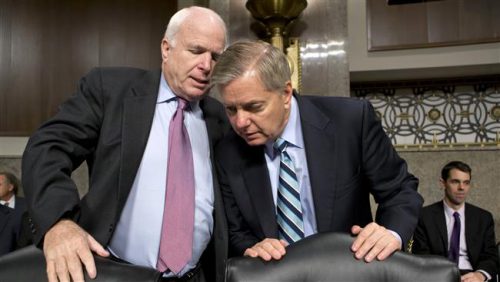
“We should all be alarmed by Russian attacks on our nation,” Sen. John McCain told reporters, as he criticized the Obama administration for a lack of a comprehensive strategy on cyber deterrence.
“This appearance of weakness has been provocative to our adversaries,” the Arizona Republican said.
Sen. Ben Cardin, the top Democrat on the Senate Foreign Relations Committee who co-sponsored the bill, said, “We have been attacked by Russia. It cannot be business as usual.”
The measure, called “Countering Russian Hostilities Act of 2017,” would also target Russia’s vast energy sector and companies that invest in or help develop its civil nuclear projects.
Republican Sen. Lindsey Graham said, as a co-sponsor of the bill, he was “not trying to undermine the legitimacy of President-elect Trump’s victory” by highlighting Russia’s intention to meddle in the US election. “My advice to him is that… it is now time to push back.”
Other Republican co-sponsors include Senators Marco Rubio of Florida, Rob Portman of Ohio and Ben Sasse of Nebraska.
The measure would give the White House the ability to waive the sanctions, however it would have to certify that Russia’s behavior has improved.
It was not clear on Tuesday whether the legislation was likely to pass in Congress in time for President Obama to sign it, or wait for Trump to take office on January 20.
Trump has repeatedly called for better relations with Russia, arguing that only “stupid” people or “fools” would think close ties were unwise.
The Republican president-elect has rejected the implications that Russia’s alleged hacking of Democratic offices helped him win the election.
‘Clinton email investigation not going away’ – House Oversight chair
RT | January 10, 2017
Hillary Clinton’s problems aren’t going away, according to House Oversight Chair Jason Chaffetz, who has vowed to continue the investigation into her use of a private email server.
The Republican congressman told CNN: “Just because there was a political election doesn’t mean it goes away.”
Chaffetz described Clinton’s use of a private email server during her time as secretary of state as “the largest breach of security in the history of the State Department.”
“It cannot, and should not be repeated ever again,” said Chaffetz, whose committee possesses subpoena power. After reopening the investigation weeks before the presidential election in November, FBI Director James Comey told Congress that they had failed to unearth any new information that would warrant bringing charges against Clinton.
President-elect Donald Trump continuously attacked Clinton over her use of a private email server during her time as secretary of state, claiming he would prosecute her if elected. Following his election success, the president-elect changed his attitude toward Clinton, claiming she had already “suffered greatly.”
Chaffetz said his committee would be open to investigating issues arising from Trump’s administration too, claiming his job “is not to be a cheerleader for the president.”
When questioned about possible conflicts of interest arising from Trump’s businesses, Chaffetz admitted that the laws regarding conflicts and the president “should be tightened up,” but declined to comment on specific cases.
Along with the Clinton investigation, the committee will continue other outstanding investigations, including the ATF gunwalking scandal where guns were allowed to be sold to straw buyers to track them.
An investigation into Mylan, the manufacturers of EpiPen whose price increased dramatically will also continue, according to Chaffetz, who said the company “fed us a bunch of bull.”
Washington Invented Hacking and Interfering in Elections
Weaponized hacking all began with Stuxnet
By Philip Giraldi • Unz Review • January 10, 2017
Is the United States the victim of an unprovoked cyber and media attack by Russia and China or are the chickens coming home to roost after Washington’s own promotion of such activity worldwide? On Thursday Director of National Intelligence James Clapper asserted to the Senate Foreign Relations Committee that while no foreign government had been able to interfere with actual voting machines, “U.S. agencies are more confident than ever that Russia interfered in America’s recent presidential election. And he called the former Cold War foe an ‘existential threat’ to the nation.” Pressed by Senator John McCain whether the “attack” constituted an “act of war,” Clapper demurred, saying that it would be a “very heavy policy call” to say so. He also said that he could not judge if the election outcome had been changed due to the claimed outside interference.
Clapper also claimed that the Russian effort included including the creation and dissemination of fake stories, explaining that “While there has been a lot of focus on the hacking, this is actually part of a multifaceted campaign that the Russians mounted.” Clapper singled out Russian state funded TV channel RT, previously called Russia Today. “Of course RT… was very, very active in promoting a particular point of view, disparaging our system.” [Full disclosure: I have been on RT numerous times.]
Apart from the nonsense about foreign broadcasters being part of a conspiracy to “disparage our system” and destroy our democracy, I confess that I was willing to be convinced by what seemed to be the near-unanimous intelligence and law enforcement agency verdict but, any such expectations disappeared when the 17 page report on the hack was actually released on Friday. Entitled Declassified Intelligence Community Assessment of Russian Activities and Intentions in Recent US Elections, the report is an exercise in speculation minus evidence indicting alleged Russian interference in the recent election. It even came with a significant caveat, “Judgments are not intended to imply that we have proof that shows something to be a fact.”
So I am still waiting to see the actual evidence for the Russian direct involvement and have to suspect that there is little to show, or possibly even nothing. Saying that Russian government agents were employed in passing the stolen emails from the DNC server to WikiLeaks raises more questions than it answers, particularly as it is now clear from media leaks that the parties involved were using what is referred to as cut-outs to break the chain of custody of the material being passed. Does the intelligence community actually know exactly who passed what to whom and when or is it engaged in reconstructing what it thinks happened? Does it really believe that intercepted unencrypted phone calls among Russian officials expressing pleasure over the election result equate to an actual a priori conspiracy to determine the outcome? And based on what evidence do they know that conspiracy was “ordered” by President Vladimir Putin as is now being alleged? Or are they only assuming that it must have been him because he is head of state?
And what about the possibility that activity of Russian intelligence agencies to penetrate computers in the United States was little more than routine information collection, which Clapper conceded is normal activity for Washington as well? And above all, where is a truth and consequences analysis of America’s global role as a contributor to the tit-for-tat, obscured by a prevailing mainstream media narrative that prefers to see everything in terms of good guys versus bad guys?
One can reasonably argue that Washington started the practice of cyber-warfare and has been a long-time practitioner of both regime change and election tampering in its relationship with much of the world. The Snowden papers indicate that NSA hacking of targets in China has been going on for many years as has routine interception of cell phones of allied European and other world leaders, including German Chancellor Angela Merkel and the UN Secretary General. The NSA has deliberately sought to have the capability to penetrate nearly every electronic communications network in the world, frequently in real time, and has come close to achieving that ability under Presidents George W. Bush and Barack Obama.
The information obtained in the huge dumps of intelligence obtained by NSA is, at least in theory, used to confront possible threats to the United States and to obtain competitive advantage over both adversaries and competitors. But the intrusion into systems has also been weaponized, witness for example the creation of the Stuxnet worm in collaboration with the Israelis. Stuxnet was intended to disable key elements in Iranian nuclear research but it also went beyond that, creating dysfunction in other economic and industrial systems unrelated to its laboratories. The assault on Iran was more of an act of war than the hack of the DNC computers. And the damage was not limited to Iran. There have also been concerns that the Stuxnet virus had migrated from the Iranian systems and become viable on other civilian use computers.
There have been numerous military interventions in Latin America ever since the U.S. became involved in the region in the wake of the Spanish-American War. The subsequent interventions in the so-called Banana Wars by U.S. Marines in Central America and the Caribbean were on behalf of United Fruit Company and other commercial interests. The cynical use of force to support American business moved the highly-decorated Marine Major General Smedley Butler to describe himself as “a high class muscle man for Big Business, for Wall Street and the bankers … a racketeer, a gangster for capitalism” while declaring that “war is a racket.” More recently, the CIA arranged for the removal of populist Jacopo Arbenz in Guatemala in 1954, initiating 60 years of political instability in that country while the Agency role in the military coup in Chile that ousted Salvador Allende and its involvement with the Nicaraguan contra rebels subsequently are similarly notorious.
When I was in Europe with CIA the U.S. government regularly interfered with elections, particularly in Italy, Spain, France and Portugal, all of which had active communist parties. The Agency would fund opposition parties directly or indirectly and would manage media coverage of the relevant issues to favor the non-communists. The end result was that the communists were indeed in most cases kept out of government but the resulting democracy was frequently corrupted by the process. Italy in particular suffers from that corruption to this day.
The United States has directly interfered in Russia, using proxies, IMF loans and a media controlled by the oligarchs to run the utterly incompetent Boris Yeltsin’s successful campaign in 1996 and then continuing with more aggressive “democracy promotion” projects until Putin expelled many of the NGOs responsible in 2015. More recently there have been the pastel revolutions in Eastern Europe and the upheaval in Ukraine, which came about in part due to a $5 billion investment by the United States government in “democracy building” supplemented by regular visits from John McCain and the State Department’s activist Assistant Secretary of State Victoria Nuland.
And then there are Vietnam, Cambodia, Laos, Afghanistan, Libya, Iraq and Syria as well as endorsement of the ongoing carnage in Yemen. The Congress meanwhile continues to call for regime change in Iran. So it leads to the question “Who is actually doing what to whom?”
One can well understand the anger at Russian actions but much of the sentiment is being fueled by a hostile press and deliberate U.S. government fear mongering orchestrated by the Obama Administration as its parting gift to the American people. A new Cold War would be good for no one. Stepping back a bit, it is difficult to avoid the conclusion that anything Russia did or is suspected of doing in 2016 pales in comparison to what the United States has been doing for much longer and on a much wider scale. The Defense Department runs a cyber warfare command with a budget of $7 billion and the White House has ordered military interventions to bring about regime change in four Muslim majority countries while also interfering in a number of others since 9/11. The Obama response to an alleged Russian conspiracy that has yet to be demonstrated has been to send more soldiers to the Baltics while ordering a massive politically motivated retaliation that included the persona non grata expulsion of 35 Russian officials and their families. Moscow did not retaliate and instead invited U.S. diplomatic families to a Christmas celebration at the Kremlin. Sure, it was political theater to a certain extent but it has to make one wonder who was actually the adult in the room whenever Obama and Putin would meet.
Donald Trump is ‘winning hacking battle with spies’
By Alexander Mercouris | The Duran | January 10, 2017
An opinion piece in The Financial Times by its commentator Gideon Rachman represents the first admission by a member of the mainstream media of what is becoming increasingly obvious to me…
Donald Trump is winning the war with the spies:
… the intelligence community has every reason to fear the Trump White House. Mr Trump will appoint their leaders, he will control the trajectory of their careers and, judging by congressional Republicans’ efforts to loosen civil service protections, he may soon have the power to fire them at will… The furore over Russian hacking forced the president-elect to give the current intelligence chiefs an audience. But once he is firmly installed in the White House, he will be in a much better position to impose his will and views on the CIA, the NSA and the FBI. After all, he will be the boss.
It would have been different if the report the US intelligence community had provided contained convincing evidence of the US intelligence community’s claims of Russian interference in the US election. Had there been strong evidence of that Trump would not have been able to disregard it, his legitimacy as President would have been in question, and his authority would have been damaged.
In the event, after making very strong claims on this issue, and after promising to “push the envelope” on what could be revealed, the US intelligence community was unable to support its claims with evidence. This is because that evidence doesn’t exist.
That has put Donald Trump in a winning position despite the continuing attempts of some people to make trouble for him.
Gideon Rachman has incidentally disclosed a key fact about Trump’s meeting with the intelligence chiefs on Friday of which I was previously unaware. This is that Trump went to the meeting with his choice of National Security Adviser, General Michael Flynn.
The point about General Flynn is that he is himself a former intelligence chief, having previously been the head of the Defence Intelligence Agency. Moreover it is know that there is little love lost between him and Director of National Intelligence James Clapper and CIA Director John Brennan.
As a former intelligence chief Flynn would have able to spot immediately the many obvious problems with the US intelligence community’s report and tell Trump about them, helping Trump to prepare his response.
As I have said previously, the statement Trump made following his meeting with the intelligence chiefs on Friday was clearly drafted by a lawyer, showing that Trump is being careful to get legal advice. The fact Trump brought Flynn with him to the meeting with the intelligence chiefs on Friday shows that Trump also sought expert advice advice from a senior former intelligence officer.
In other words Trump is being careful throughout to seek the advice of professional and experts, something which in part explains his skillful handling of this scandal.
It is something which incidentally also shows that contrary to his maverick reputation Trump is someone who seeks and listens to expert advice. Since that is what he must have done as a businessman, that should not be surprising.
Israeli UK Embassy Scandal: Officer Who Sought to Destroy Tory Leader Worked for Strategic Affairs Ministry

Israeli minister Gil Erdan meets with Conservative Friends of Israel MPs during the London visit, when he also met with Shai Masot
By Richard Silverstein | Tikun Olam | January 10, 2017
The Guardian has uncovered a major element of the Shai Masot scandal. I speculated in my last post about this story that Masot worked for an Israeli intelligence agency. No one I consulted found it likely it could be the Mossad. Masot was too public and too pushy to be Mossad. Others speculated that he worked for the IDF intelligence unit, AMAN, since he had until recently been an IDF Major. But his LinkedIn account noted that he’d left the IDF.
Now the Guardian has put two and two together and gotten closer to key elements of the story. He worked for the Strategic Affairs ministry headed by ambitious Likud pol, Gil Erdan. His agency has been tasked with mounting a global campaign against BDS. At a conference in Israel, one of Erdan’s fellow ministers even threatened BDS activists with “civil elimination,” a term dangerously close to ‘assassination’ in colloquial Hebrew. Erdan’s budget is huge ($34-million devoted to fighting BDS alone) as the latter has become the bête noire of the Israeli state–named as Public Enemy Number 1; the new “existential threat” to the “Jewish state” and Jewish people.
The Israeli foreign ministry, according to the Guardian story, recognized the danger of what Masot was doing and its London staff wrote a cable warning that freelancing of the type Masot was engaged in was extremely dangerous because funding UK organizations directly with Israeli state funds would jeopardize the non-profit status of any UK non-profit who accepted them. In videos, Masot boasts about founding pro-Israel astro-turf groups which were local in name only. Masot pulled the strings both financially and politically. He also boasts about collaboration with Conservative Friends of Israel and offers 1-million pounds to a Labour Friends of Israel MP in order to encourage other MPs to participate in junkets to Israel. Joan Ryan, the MP before whom he dangled this bauble didn’t seem to have a clue as to the danger it posed to her. She merely joked to Masot that she didn’t expect he was carrying the 1-million in a bag on his back!
One telling passage from the MFA cable confirms that the Israeli government is far more aggressive in creating such astroturf groups in the U.S. than it has been so far in Britain:
“Attempts to act behind our back have happened before and will happen again, but ‘operating’ Jewish organisations directly from Jerusalem, with no coördination and no consultation, is liable to be dangerous,” it said. “Operating like this could encounter opposition from the organisations themselves, given their legal status: Britain isn’t the US !”
This calls to mind the multitude of Israel Lobby groups which closely coördinate their activity with the Israeli government, and perhaps more. They include StandWithUs, The Israel Project, Christians United for Israel, CAMERA, and many others. In fact, then-deputy foreign minister Danny Ayalon boasted on an Israeli TV show that his ministry was funding a SWU lawsuit against the Olympia Food Coop.
This reinforces my strong impression developed over the years that many of these groups, which are ostensibly independent U.S.-based groups are either fully or partially “operated” by the Israeli government. I have even reported on several projects of these NGOs which were explicitly funded by the government. This should endanger their non-profit status and force them to register as agents of a foreign government. But our IRS hasn’t chosen to tangle with the Israel Lobby or even the settler lobby (though it should).
Returning to the Strategic Affairs ministry, it released this statement in response to the September MFA cable. It indicates that the ministry either lied or was totally ignorant about what its own operatives like Masot were doing in Israel’s name:
“We work in coordination with the Israeli embassy in Britain and the Foreign Ministry. Every action is done according to the law and in accordance with government decisions and the ministry’s authority. We regret there are elements in the Foreign Ministry who don’t understand the division of responsibilities between the ministries and prefer to deal with struggles of honor instead of focusing on our goals.”
Someone back in Tel Aviv should be eating crow about now. But given the abysmal lack of accountability in virtually everything done in the government, it’s doubtful anything will come of it. … Full article
Europe’s Mixed Feelings About Trump
By Andrew Spannaus | Consortium News | January 9, 2017
Few in Europe expected Donald Trump to win the U.S. Presidential elections last November. The picture painted by the media and political class was convincing: despite the pent-up anger being expressed through protest candidates, Hillary Clinton was headed towards a decisive victory, as the majority of Americans couldn’t stomach someone as outrageous and unconventional as the reality TV star turned politician.
That’s not what happened, of course, as Trump earned an Electoral College victory by winning enough votes in key Midwestern states that have suffered from a loss of manufacturing jobs in recent decades. His victory has shaken the Western world to its core, making it clear that business as usual is no longer possible in terms of both economic and foreign policy.
In Europe the signs of the anti-establishment sentiment that dominated the U.S. election campaign have been present for some time. The most obvious example was the Brexit vote in June 2016, in which the population of the United Kingdom voted to leave the European Union. But protest movements have actually been on the rise for several years now, driven by the same basic issues as in the United States: a sense of economic and social insecurity – accompanied by a rise in anti-immigrant sentiment – driven by an economic policy that has made life harder for the middle class while enriching those at the top.
The growing anger against the institutions of the European Union, considered the main culprit for the failed economic policies, has made the élites desperate for some sense of stability, to help them weather the storm. As a result, a potential Clinton victory was openly welcomed by most political leaders.
After Trump’s victory, there were numerous press reports of worries among European governments regarding the incoming Administration’s foreign policy. Trump is understandably seen as unpredictable, but the key point revolves around his attitude towards Russia, the same issue that is currently dominating the institutional fight in the United States right now.
Just after the election The New York Times ran a story entitled “For Europe, Trump’s Election is a Terrifying Disaster,” suggesting that under the new President, the United States may embrace authoritarianism and no longer defend democracy. It was a theme that other mainstream news outlets also pushed.
On Nov. 17, The Associated Press wrote: “NATO members and other European countries are worried that under Trump, the U.S. will stop trying to police Russia’s behavior the way it has under Obama. Most concerning to U.S. allies are Trump’s effusive comments about Russian President Vladimir Putin, one of the first world leaders he spoke to after winning the election.”
Seeing Benefits
While it is true that former Soviet bloc countries such as Poland and Latvia would prefer to maintain the current hardline position towards Russia, the reality is that the largest E.U. members – France, Italy and Germany – actually stand to benefit from the diplomatic approach promised by President-elect Trump.
This doesn’t mean they supported his candidacy, though. First of all, they were told that he couldn’t win; and second, a Trump victory would seem to encourage the anti-establishment movements already on the rise in Europe, which threaten both the E.U.’s status quo and the jobs of key leaders, including German Chancellor Angela Merkel.
Hillary Clinton was seen as representing continuity, and for the many politicians who seek to curry favor with the transatlantic elites, it was best to show their Clinton bona fides in view of the upcoming change in power. For example, Italian Prime Minister Matteo Renzi – now out of office due to a stinging anti-establishment vote in a referendum on proposed constitutional reforms – repeatedly broke diplomatic protocol and publicly criticized Trump during the election campaign.
However, over the course of 2016 it became clear that Clinton’s foreign policy was far more aggressive than Barack Obama’s, as the President had actually been seeking collaboration with Russia for several years on issues, such as constraining Iran’s nuclear program and negotiating an end to the Syrian conflict, despite heavy opposition from within his own administration.
Indeed Trump’s openness towards Vladimir Putin seems even more heretical now because most have chosen to forget that Obama himself had sought close cooperation with Putin on several key issues. For instance, Secretary of State John Kerry’s diplomacy last year on Syria almost succeeded in implementing intelligence sharing and joint airstrikes by the two powers, before being effectively thwarted by the Pentagon and other U.S. institutional opposition in September 2016.
Now Obama seems to have forgotten his former position, and decided to fully toe the anti-Russian line, apparently convinced that he must do his part in the campaign to weaken Trump and prevent him from being an effective president, even in areas where their positions are not far apart.
It is possible that Trump will accelerate the timid attempts of his predecessor to abandon the “regime change” policies that have led to numerous disasters in the Middle East, and heightened tensions with Russia. The President-elect seems determined to pursue this path more openly than Obama, who worked slowly towards this goal while seeking to placate his critics with more bellicose language in his public statements.
Doubts About the U.S. Hardline
Although European nations have been heavily involved in recent regime change adventures (the U.K. in Iraq and France in Libya, for example), there is a widespread preference in Western Europe for avoiding further conflict with Russia. The U.S. position on the events in Ukraine, for example, is often seen as one-sided, and the notion of NATO expansion to Russia’s borders seems like an unnecessary and dangerous provocation that can only makes things worse.
Western sanctions against Russia, and Russia’s retaliatory sanctions on food imports, have cost European economies over $100 billion in trade, according to some estimates, hitting the agricultural sector especially hard. In addition, Russia has been concluding more economic agreements with countries such as China, leading to fears of permanent consequences for Europe.
For this reason, France, Italy and Germany have all repeatedly stated their desire to reduce or remove the sanctions altogether. The hope is that an agreement can be reached to defuse tensions in Ukraine, based on support for the Kiev government but broad autonomy for the ethnic Russian areas in eastern Ukraine.
Despite this desire to head off further conflict, European governments are usually careful not to openly break with U.S. policy; they are key members of NATO and have no desire to distance themselves from the leader of the alliance. However, if Donald Trump follows through on his stated goal of working “together with Russia,” the countries of Western Europe in particular may welcome the opportunity to advance their own economic interests and avoid finding themselves in the middle of a new Cold War.
Andrew Spannaus is a freelance journalist and strategic analyst based in Milan, Italy. He is the founder of Transatlantico.info, that provides news, analysis and consulting to Italian institutions and businesses. His book on the U.S. elections Perchè vince Trump (Why Trump is Winning) was published in June 2016.
US will ‘shoot down’ North Korean missiles: Pentagon chief
Press TV – January 9, 2017
US Defense Secretary Ashton Carter has described North Korea’s ballistic missiles program as a “serious threat” to the United States, threatening to shoot down any such missiles aimed at targets in the country.
The Pentagon chief said in an interview with NBC News on Sunday that North Korean missiles would be shot down if they approach American territory, after Pyongyang said it could test an intercontinental ballistic missile (ICBM) at any time from any location set by the country’s leader Kim Jong-un.
The United States would be prepared to shoot down a North Korean missile launch or test “if it were coming towards our territory, or the territory of our friends and allies,” Carter said.
North Korea announced on Sunday it could test-launch an ICBM capable of striking the US mainland, saying Washington’s “hostile” policy towards the country forced Pyongyang to develop such missiles.
“The US is wholly to blame for pushing the Democratic People’s Republic of Korea (DPRK) to have developed (an) ICBM as it has desperately resorted to anachronistic policy hostile toward the DPRK for decades to encroach upon its sovereignty and vital rights,” North Korea’s state-run news agency KCNA reported.
“Anyone who wants to deal with the DPRK would be well advised to secure a new way of thinking after having clear understanding of it,” it said, using the acronym for the country’s official name.
Despite sanctions and international pressure, Pyongyang has been attempting to strengthen its military capability to protect itself from the threat posed by the presence of US forces in the region.
North Korea says it will not give up on its nuclear deterrence unless Washington ends its hostile policy toward Pyongyang and dissolves the US-led UN command in South Korea. Thousands of US soldiers are stationed in South Korea and Japan.
According to the US military’s recent declaration, the United States has 806 deployed ICBMs, SLBMs (submarine-launched ballistic missile), and heavy bombers as well as 1,722 deployed nuclear warheads.
The Pentagon is also equipped with a multiple independently targetable reentry vehicle (MIRV), a highly advanced version of the intercontinental nuclear missile carrying several independent warheads.
The South Korean Defense Ministry on Monday called North Korea’s statement a “provocative announcement.”
However, instead of issuing a fresh statement on North Korea’s announcement, the Obama administration on Sunday referred to the January 3rd comments by White House spokesman Josh Earnest in which he said the US military could protect the country against threats coming from North Korea.
If North Korea could fully develop an ICBM, it could target the United States. The shortest distance between the two countries is about 9,000 km. ICBMs can travel up to 10,000 km or farther.
US President-elect Donald Trump said last week that North Korea would not be able to build a nuclear missile that can reach the United States.
“North Korea just stated that it is in the final stages of developing a nuclear weapon capable of reaching parts of the US,” Trump tweeted on January 2. “It won’t happen!”
McAfee breaks down inconsistencies in FBI’s Grizzly Steppe report
RT | January 5, 2017
Despite recent allegations against Russia, the FBI never actually accessed the allegedly hacked DNC servers. Cyber security expert John McAfee joins ‘News With Ed’ to discuss evidence in the report which supposedly pointed to Russian involvement, which according to McAfee actually vindicates Moscow.
Featured Video

Spain train disaster raises questions over Israeli-linked security contractors
or go to
Aletho News Archives – Video-Images
From the Archives
Are There 50,000 ‘Israeli-born’ Individuals Living in the UK?
By Professor David Miller | August 18, 2026
Recent disclosures by the Zionist regime show that some 2,069 British nationals were serving in the IDF as of March 2025, according to Freedom of Information (FoI) requests submitted to the occupation forces (1,686 dual British-Israeli, plus 383 multinational). We cannot tell from the figures how many of these were already settler colonists and intend to stay in the colony, and how many will return or have returned to the UK. Presumably, those returning to the UK will number far fewer than 2,000, since many are known to have become permanently residents of the colony.
Additionally, the IDF figures only provide a snapshot, and do not tell us how many have served in the Jewish supremacist military either before or after March 2025. One way into the question of how many genocidaires are living in Britain is to ask how many current British residents were born in the Zionist colony. There is data on that, as we shall see. … continue
Blog Roll
 Aletho News
- The beginning of the end: Israel at the heart of America’s political civil war
- US-Israeli war on Iran cost Persian Gulf states nearly $1T in damage, lost growth: Report
- Congress probe could put ‘Israel’ in dock over Iran war: Israeli media
- Spanish public prosecutor backs US demand to extradite pro-Palestine philanthropist Fergie Chambers
- Zelensky spent over 740 days outside Ukraine while West serves as his real home
- Indian captain of Russian ‘shadow fleet’ tanker faces 10-year jail term in UK
- Europe, US face higher heating bills amid Iran war fallout
- The Leak That Arrived Right on Cue
- No, New York Times, California’s Climate Has Always Been a Land of Flood, Drought, and Fire
- Are There 50,000 ‘Israeli-born’ Individuals Living in the UK?
- If Americans Knew
- An error has occurred; the feed is probably down. Try again later.
- No Tricks Zone
- German Authorities Start Initiative To Evaluate Public Register For Climate “Disinformation” Spreaders!
- Zonal Asymmetry of Temperature Change in the Antarctic Circumpolar Current
- New Study: The Net Fossil Fuel Contribution To Rising Atmospheric CO2 Has Been Zero For 500 Years
- Germany’s Green Energy Transition Becoming Increasingly Expensive…Another 6 Trillion Euros!
- Sudden Stratospheric Warming, Powerful El Niño Combination May Lead To Extreme Europe Cold, Energy Crisis!
- Two New Studies Find Thwaites Glacier Melt Cannot Be Driven By Human Activity Or A Warming Ocean
- E-Cars Reduce CO2 Emissions By Only 41% Compared To Internal Combustion Engine Vehicles
- Predictions Made By Renowned Climate Professor Over Past Decades Have Been Proven To Be Poor
- New Study Suggests Large Regions Of The Pacific Ocean Have Been Cooling For The Last 80 Years
- Germany’s Green Energy Debacle: High Energy Costs Force Kahla Porzellan to Close After 182 Years!

