The Organization for the Prohibition of Chemical Weapons refuses to send its experts to Aleppo to check substances used by rebels in attacks. The move was “seemingly done under pressure from our Western colleagues,” Russia’s foreign minister said.
“Russian specialists found that militants in east Aleppo used ammunition with poisonous substances, with the ammo targeting west Aleppo. The collected samples leave no doubt that it’s a toxic agent,” Sergey Lavrov said at a press conference with his Belarusian counterpart in Minsk, as cited by Interfax.
However, when the Russian Ministry of Defense addressed the leadership of the UN watchdog OPCW “with the demand to urgently send its experts to Aleppo to participate in the sample analysis,” the organization “refused to carry out this simple task, citing security issues.”
The underlying reason behind this, Lavrov said, seemed to be “tremendous pressure from our Western colleagues,” because “our and Syrian sides guaranteed security [for the experts].”
Russia is now working on the possibility of delivering the samples for analysis to The Hague, Lavrov added.
“It will make it hard [for them] to back out,” the minister said, as quoted by TASS.
Lavrov’s statement comes a day after the Ministry of Defense spoke about the evidence of chemical attacks by rebels, and stressed that the OPCW was refusing to cooperate.
Ministry spokesperson Major General Igor Konashenkov said that Russian experts collected bioassays from four Syrians injured in the attacks, and made the shocking discovery earlier this month.
In fact, Russian top brass has been warning since September that the militants might use chemical weapons against civilians in Aleppo, and in October, Syrian state media reported toxic gas having been used against a government-held area in the city.
Fifteen people were injured back then, and a local doctor told RT that the symptoms could be those observed after the use of chlorine gas.
Over the past few years, the Syrian government has often come under fire over claims of its alleged use of chemical weapons to attack the rebel-held areas – from activists and the UN, as well as the US State Department.
November 22, 2016
Posted by aletho |
War Crimes | Syria, United Nations, United States |
Leave a comment
Two weeks after Donald Trump’s shocking upset of Hillary Clinton, the imperious and imperial neoconservatives and their liberal-interventionist understudies may finally be losing their tight grip on U.S. foreign policy.
The latest sign was Trump’s invitation for a meeting with Rep. Tulsi Gabbard, D-Hawaii, on Monday. The mainstream media commentary has almost completely missed the potential significance of this start-of-the-work-week meeting, suggesting that Trump is attracted to Gabbard’s tough words on “radical Islamic terrorism.”
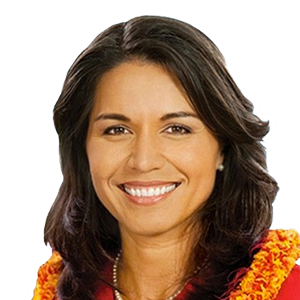
Rep. Tulsi Gabbard, D-Hawaii.
Far more important is that Gabbard, a 35-year-old Iraq War veteran, endorsed Sen. Bernie Sanders in the Democratic primaries because of his opposition to neocon/liberal-hawk military adventures. She starred in one of the strongest political ads of the campaign, a message to Hawaiians, called “The Cost of War.”
“Bernie Sanders voted against the Iraq War,” Gabbard says. “He understands the cost of war, that that cost is continued when our veterans come home. Bernie Sanders will defend our country and take the trillions of dollars that are spent on these interventionist, regime change, unnecessary wars and invest it here at home.”
In the ad, Gabbard threw down the gauntlet to the neocons and their liberal-hawk sidekicks, by accusing them of wasting trillions of dollars “on these interventionist, regime change, unnecessary wars.” Her comments mesh closely with Trump’s own perspective.
So, the surprise election results on Nov. 8 may have represented a “trading places” moment for the neocons and liberal hawks who were eagerly counting the days before the “weak” President Barack Obama would turn over the Commander-in-Chief job to former Secretary of State Clinton who had made clear that she shared their hawkish agenda of escalating the war in Syria and ratcheting up the New Cold War with Russia.
There was even speculation that one of Clinton’s neocon favorites within the State Department, Assistant Secretary of State for European Affairs Victoria Nuland, might be rewarded with State’s top job for her “regime change” in Ukraine that sparked the start of the New Cold War in 2014.
Nuland, the wife of arch-neocon Robert Kagan, sabotaged President Obama’s emerging strategy of collaborating with Russian President Vladimir Putin on sensitive global issues. In 2013-14, Putin helped orchestrate two of Obama’s brightest foreign policy successes: Syria’s surrender of its chemical weapons arsenal and Iran’s guarantee that it would not develop nuclear weapons.
But those agreements infuriated the neocons who favored escalating both crises into direct U.S. bombing campaigns aimed at Syria and Iran – in accordance with the desires of Israeli Prime Minister Benjamin Netanyahu and the Saudi monarchy. Yet. there was perhaps even greater alarm at what the next move of the Obama-Putin tag team might be: demanding that Israel finally get serious about a peace deal with the Palestinians.
So, the neocons took aim at Ukraine, which neocon National Endowment for Democracy President Carl Gershman identified as “the biggest prize” and an important stepping stone to an even bigger prize, a “regime change” in Moscow removing Putin.
While Gershman’s NED funded (with U.S. taxpayers’ money) scores of projects inside Ukraine, training anti-government activists and journalists, Nuland took the point as the key organizer of a putsch that removed elected President Viktor Yanukovych on Feb. 22, 2014, and replaced him with a fiercely anti-Russian regime.
Given the geopolitical sensitivity of Ukraine to Russia, including its naval base on the Crimean peninsula, Putin had little choice but to react, supporting a referendum in Crimea in which 96 percent of the voters favored leaving Ukraine and rejoining Russia – and assisting ethnic Russian rebels in the east who resisted the violent ouster of their president.
Of course, the mainstream Western news media presented these developments as simply a case of “Russian aggression” and a “Russian invasion.” And, faced with this new “group think,” Obama quickly abandoned his partner, Putin, and joined in the chorus of condemnations.
Nuland emerged as a new star inside the State Department, a hero of the New Cold War which was expected to funnel trillions of tax dollars into the Military-Industrial Complex.
Trump’s Heresy
But Trump surprisingly adopted the position that Obama shied away from, a recognition that Putin could be an important asset in resolving major international crises. The real-estate-mogul-turned-politician stuck to that “outside-the-mainstream” position despite fierce attacks from rival Republicans and Democratic presidential nominee Clinton, who even mocked him as Putin’s “puppet.”
After Trump’s upset victory on Nov. 8, many pundits assumed that Trump would fall back in line with Washington’s hawkish foreign-policy establishment by giving top jobs to neocons, such as former U.S. Ambassador to the United Nations John Bolton and ex-CIA Director James Woolsey, or Netanyahu favorites, such as former Republican presidential nominee Mitt Romney or ex-New York City Mayor Rudy Giuliani.
So far, however, Trump has followed a different course, more in line with the libertarian thinking of the Koch brothers – not only the more famous ones, Charles and David, but also their long-estranged brother William, who I’m told have become behind-the-scenes advisers to the President-elect.
Though Trump did offer high-profile meetings to the likes of Romney and Giuliani, he has yet to hand over any key foreign-policy job to the Republican neocon wing. His one major announcement in that area has been naming as National Security Advisor retired Gen. Michael Flynn, who led the Defense Intelligence Agency when it produced a prescient warning that U.S. policy in Syria would lead to the creation of an “Islamic State.”
Though Flynn is regarded as a hardliner in the fight against Islamic jihadist terror, he is seen as an independent thinker regarding how best to wage that war. For instance, Flynn has objected to the notion that drone strikes, i.e., killing off individual jihadists, is a route to success.
“We’ve tended to say, drop another bomb via a drone and put out a headline that ‘we killed Abu Bag of Doughnuts’ and it makes us all feel good for 24 hours,” Flynn said. “And you know what? It doesn’t matter. It just made them a martyr, it just created a new reason to fight us even harder.”
That leaves open the possibility that a President Trump might eschew the “whack-a-mole” approach that has bedeviled the “war on terror” and instead go after the “mole nest” – if you will – the Saudi monarchy that has long financed Islamic extremists both through the fundamentalist Wahhabi brand of Sunni Islam and by supplying money and weapons to jihadists dating back at least to the Afghan mujahedeen in the 1980s, the origin of modern Islamic terrorism.
Traditional U.S. politicians have recoiled from facing up to the hard reality that the Saudi monarchy is the real “terror central” because of Saudi Arabia’s enormous riches and influence, which is now enhanced by its quiet alliance with Israel in their joint campaign against the so-called “Shiite crescent,” from Iran through Syria to Lebanon’s Hezbollah.
Taking on this Saudi-Israel nexus has long been regarded as political suicide, given Israel’s extraordinary lobbying power and Saudi Arabia’s exceptional wealth. But Trump may be assembling a team that is “crazy” enough to take on that mission.
So, while the fight over the future of U.S. foreign policy is far from over – the neocons will surely flex their muscles at the major think tanks, on the op-ed pages and inside the halls of Congress – the Trump transition is showing some creativity in assembling a national security team that may go in a very different direction.
Much will become apparent in Trump’s choice of Secretary of State. If it’s someone like Sen. Rand Paul, R-Kentucky, or Rep. Gabbard or a libertarian from the Kochs’ world, that would be bad news for the neocons. If it’s someone like Romney, Giuliani, Bolton or Woolsey, then that will mean that President-elect Trump has blinked and the neocons can breathe a sigh of relief.
Investigative reporter Robert Parry broke many of the Iran-Contra stories for The Associated Press and Newsweek in the 1980s.
November 21, 2016
Posted by aletho |
Wars for Israel | Donald Trump, Israel, Middle East, Saudi Arabia, Tulsi Gabbard, United States |
Leave a comment
November 22 marks the 53rd anniversary of John F. Kennedy’s assassination. If history is any guide, it’s likely some mainstream outlet will commemorate that dark day with reassurances that the Warren Commission was right that Lee Harvey Oswald did it alone, and that most doubters, who have been in the majority since the mid-1960s, are randy conspiracy theorists. That is the essential message by one of the experts likely to be cited this year, attorney Howard Willens.
One of the few still-living Warren Commission staffers, Willens followed up his 2013 book, History Will Prove Us Right, with a spirited defense of the Commission in the summer, 2016 issue of the journal, The American Scholar, which he co-wrote with another Commission staffer, attorney Richard Mosk. The piece, “The Truth About Dallas,” is a celebration of the work and conclusions of the original investigation.
But Willens’s and Mosk’s defense of the work of the Warren Commission they served on is more notable for what they omit from the official record than what they include. “What the critics often forget or ignore,” they write, “is that since 1964, several government agencies have also looked at aspects of our work,” (p. 59) as if the Church Committee and the House Select Committee on Assassinations (HSCA) had reviewed and applauded the Commission’s work.
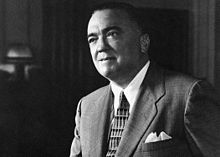
FBI Director J. Edgar Hoover
Indeed, they did look at it. But rather than plaudits, they issued stinging rebukes, principally for the Commission’s having been rolled by FBI Director J. Edgar Hoover, and to a lesser extent, by the CIA and the Secret Service.
“It must be said that the FBI generally exhausted its resources in confirming its case against Oswald as the lone assassin,” the HSCA concluded, “a case that Director J. Edgar Hoover, at least, seemed determined to make within 24 hours of the of the assassination.”
In essence, the experienced investigators concluded that Hoover had divined the solution to the crime before starting the inquiry, and then his agents confirmed the boss’s epiphany. The intimidated Warren Commission went right along.
And with good reason, only part of which Willens and Mosk tell. They admit that the “FBI had originally opposed the creation of the Warren Commission” and that Hoover “ordered investigations of commission staff members.” But they don’t tell that Hoover deployed one of his favorite dirty tricks to deal not only with support staffers, such as Willens and Mosk, but also with the commissioners themselves.
“[D]erogatory information pertaining to both Commission members and staff was brought to Mr. Hoover’s attention,” the Church Committee reported. (emphasis added)
Hoover’s Spy
Willens and Mosk also forgot to mention that Hoover had a personal spy on the Warren Commission, then Rep. Gerald Ford, who tattled on Commissioners who were (justifiably) skeptical of the Bureau’s work.
“Ford indicated he would keep me thoroughly advised as to the activities of the Commission,” FBI Agent Cartha DeLoach wrote in a once secret memo. “He stated this would have to be done on a confidential basis, however he thought it should be done.”
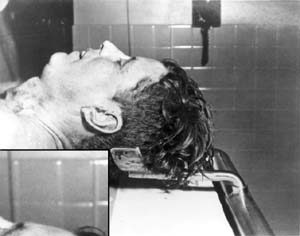
Autopsy photo of President John F. Kennedy
At the bottom of the memo, Hoover scrawled, “Well handled.” The success of Hoover’s machinations was obvious to subsequent government investigators. (Ford, of course, later became President upon the resignation of Richard Nixon in 1974.)
The HSCA’s chief counsel, Notre Dame Law Professor Robert Blakey, a criminal investigator and prosecutor with vastly better credentials than either Willens or Mosk, was impressed with neither the Commission’s vigor nor its independence.
“What was significant,” Blakey determined, “was the ability of the FBI to intimidate the Commission, in light of the Bureau’s predisposition on the questions of Oswald’s guilt and whether there had been a conspiracy. At a January 27 [1964] Commission meeting, there was another dialogue [among Warren Commissioners]:
“John McCloy: ‘… the time is almost overdue for us to have a better perspective of the FBI investigation than we now have … We are so dependent on them for our facts … .’
“Commission counsel J. Lee Rankin: ‘Part of our difficulty in regard to it is that they have no problem. They have decided that no one else is involved … .’
“Senator Richard Russell: ‘They have tried the case and reached a verdict on every aspect.’
“Senator Hale Boggs: ‘You have put your finger on it.’ (Closed Warren Commission meeting.)” [Blakey & Billings, Fatal Hour– The Assassination of President. See also: North, Act of Treason]
Testifying before the HSCA, the Warren Commission’s chief counsel J. Lee Rankin shamefully admitted, “Who could protest against what Mr. Hoover did back in those days?” Apparently not President Lyndon Johnson’s blue-ribbon commissioners.
The HSCA’s Blakey also reported that “When asked if he was satisfied with the (Commission’s) investigation that led to the (no conspiracy) conclusion, Judge Burt Griffin (a Commission staff member) said he was not.” [Blakey & Billings, Ibid.]
And author Gus Russo reported that Judge Griffin also admitted, “We spent virtually no time investigating the possibility of conspiracy. I wish we had.” [Russo, Live by the Sword]
Clear Misgivings
Thus, despite their clear misgivings, the Commissioners bowed to the imperious FBI chief rather than conduct a thorough investigation. Notably, the Commission never once employed a rudimentary investigative tool. “The Commission,” the HSCA reported, “failed to utilize the instruments of immunity from prosecution and prosecution for perjury with respect to witnesses whose veracity it doubted.” [US Cong. House of Reps. Report of Comm. on Assassinations, 1979]
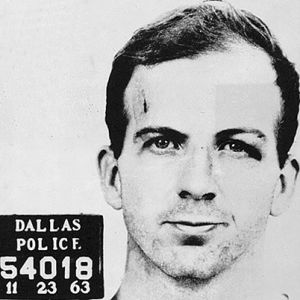
Lee Harvey Oswald
This policy had serious repercussions when the Commission confronted two key issues: published claims that Lee Harvey Oswald had been an FBI informant, and the possibility that Jack Ruby was mobbed up.
“The Commission did not investigate Hoover or the FBI, and managed to avoid the appearance of doing so,” the HSCA determined. “It ended up doing what the members had agreed they would not do: Rely mainly on the FBI’s denial of the allegations (that Oswald had been a Bureau informant).”
Hoover merely sent the Commission his signed affidavit declaring that Oswald was not an informant and also “sent over 10 additional affidavits from each FBI agent who had had contact with Oswald.” And with that, case closed.
Regarding Jack Ruby, the FBI had his phone records, yet failed to spot Ruby’s obvious, and atypical, pattern of calls to known Mafiosi in the weeks leading up to the assassination. After performing the simple, obvious task of actually analyzing those calls, the HSCA determined that, if not a sworn member of La Cosa Nostra, Ruby had ongoing, close links to numerous Mafiosi.
Thus the HSCA roundly rejected the Warren Commission’s conclusion that, “the evidence does not establish a significant link between Ruby and organized crime.”
The list of Warren Commission shortcomings that the HSCA assembled is not short. A brief summary of them runs some 47 pages in the Bantam Books version of the report (p. 289–336), which outlines what required much of the 500 pages of HSCA volume XI to cover (available on-line).
“The evidence indicates that facts which may have been relevant to, and would have substantially affected, the Warren Commission’s investigation were not provided by the agencies (FBI and the CIA). Hence, the Warren Commission’s findings may have been formulated without all of the relevant information.”
The Church Committee said that the problem was that “the Commission was perceived as an adversary by both Hoover and senior FBI officials.” “Such a relationship,” the Committee dryly observed, “was not conductive to the cooperation necessary for a thorough and exhaustive investigation.”
But the FBI did more than just withhold evidence from the Commission. Although they admit that the FBI destroyed a note Oswald wrote to Agent Hosty, and withheld that information from the Commission, Willens and Mosk don’t mention that Agent Hosty reported that his own personnel file, and other FBI files, had been falsified. [Hosty, Jr. Assignment: Oswald]
Nor that author Curt Gentry learned from assistant FBI director William Sullivan that there were other JFK documents at the Bureau that had been destroyed. [Gentry, J. Edgar Hoover– The Man and His Secrets]
Perhaps one of the reasons the public has remained mistrustful of the government’s conclusions, and the mainstream media reassurances, is the sort of selective presentation of evidence by ax grinders like Willens and Mosk who get heralded by our “responsible” media.
Gary Aguilar is one of the few physicians outside the government ever allowed to see the still-restricted JFK autopsy photos and X-rays. He has published and lectured on the topic of the JFK assassination for many years.
November 21, 2016
Posted by aletho |
Deception, Fake News, Mainstream Media, Warmongering, Timeless or most popular | Central Intelligence Agency, CIA, FBI, Howard Willens, JFK Assassination, The American Scholar, United States, Warren Commission |
Leave a comment
The United Nations must name those responsible for civilian killings among the ranks of the Syrian Army, but also among the terrorists fighting in Syria as well, Russian Deputy Ambassador to United Nations Vladimir Safronkov said at a meeting of the UN Security Council on Monday.
Earlier during the discussion, US Ambassador to the United Nations Samantha Power named Syrian commanders whom the US government considers guilty of killing civilians and said they would be held accountable for their actions.
“You went as far as naming Syrian commanders and generals. But if you claim is to be unbiased, why don’t we hear the names of the terrorists as well? Who will deal with them?” Safronkov stated.
Sofronikov also noted that the UN Security Council must not be hypocritical on the matter of accountability in Syria.
He explained the UN Security Council must also not forget the golden standard of presumption of innocence, noting that it is up to a court to prove who is to guilty.
November 21, 2016
Posted by aletho |
Mainstream Media, Warmongering | Samantha Power, Syria, United States |
Leave a comment

The Oxford Dictionaries have named ‘post-truth’ as the word of the year. ‘Fake news’ and ‘post-truth’ politics have been blamed for both the Brexit vote in the UK and the victory of Donald Trump in America.
It seems the uneducated plebs are falling for ’fake news’ they read in ’new media’ and the lies of dreadful rabble-rousing populist politicians who are relying on people’s emotions, instead of ’objective facts,’ to get votes. It’s all terribly worrying and poses a dire threat to Western civilization as we know it.
Well, forgive me for laughing out loud. For this establishment ‘fake news’/’post-truth politics’ concern is the funniest thing I’ve come across in politics since Lord Jenkins of Hillhead, the very grand Chancellor of the University of Oxford, repeatedly called distinguished Sheldonian guest Mikhail Gorbachev, “Mr. Brezhnev.”
Why is it so hilarious? Because the people and the outlets warning of the dangers of ‘fake news’ and ‘post-truth politics’ have been the biggest peddlers of ‘fake news’ and ‘post-truth politics’ out there. It’s like receiving lectures on the immorality of bootlegging from Al Capone or being told to sit up straight by the Hunchback of Notre Dame.
Without a doubt the best, or rather the worst example of ‘fake news’ in the last 25 years or so, was the neocon lie that Iraq had WMDs in 2002/3. That wasn’t peddled by ‘obscure bloggers’ and ‘new media,’ but by mainstream Western politicians, from ‘mainstream’ political parties, establishment-approved ‘experts’ on the BBC/ITV/CNN, etc., and Op-ed columnists in ‘serious’ and ‘respectable’ media outlets.
There was absolutely no evidence that Saddam possessed WMDs. The story was complete and utter BS. Yet this fake news dominated the headlines for months in 2002/3 and led to an illegal invasion in which many people lost their lives. Unlike today’s manufactured ‘fake news’ hysteria the Iraq war was no joke. An entire country was destroyed.
And guess what? Those who pushed the ‘Iraq has WMDs line’ are now coming on television to express their concern over ‘fake news’!
John Hilley notes “The BBC even had Alastair Campbell (Tony Blair’s spin doctor), in the studio defending the term ‘post-truth’ as a way of exposing the ‘dangers’ of ‘fake news.'”
Campbell stated: “It’s acknowledging that politics, which has always been rough, has moved to a different phase where politicians who lie now appear to get rewarded for it.” (BBC2 Jeremy Vine Show, 16/11/2016).
What might Orwell have said about Campbell, master spinner and Blairite warmonger, sitting inside the BBC being rewarded for his thoughts on ‘post-truth and ‘fake news?’ Hilley asks.
Once again, I’m sure old George is spinning in his grave in Sutton Courtenay.
Then there’s that serial warmonger Bernard-Henri Levy. The Sunday Telegraph today told us in its headlines: ‘Leading French philosopher: Marine Le Pen may win election as people have lost interest in whether politicians tell the truth.’
Oh, the irony!
Because if the French people really have ‘lost interest in whether politicians tell the truth,’ Henri-Levy and his fellow liberal interventionist ‘regime changers’ have got a lot to do with it.
Think back to the war against Libya, which the ‘leading French philosopher’ lobbied hard for. To sell the war to the Western public, we were told that Muammar Gaddafi was about to commit a ‘Srebrenica-style’ massacre in Benghazi. Media Lens noted the claims that were made at the time.
But again it was a load of ‘rollocks.’ Five years after Libya, like Iraq before it, had been destroyed by Western ‘interventionists,’ a report of the Foreign Affairs Committee of the House of Commons declared: “the proposition that Muammar Gaddafi would have ordered the massacre of civilians in Benghazi was not supported by the available evidence.”
It wasn’t the only claim made about Libya by Western politicians that was ‘not supported by the available evidence.’ In February 2011, UK Foreign Secretary William Hague insisted that he had seen ‘information’ which suggested that Gaddafi was on his way to Venezuela. An unnamed ‘diplomat’ said that this was ‘credible information.’ But it wasn’t. It was the same old fake news that we get every time the Western elites are trying to achieve ‘regime change.’
In April 2011 we heard that the devilish Gaddafi (who had not, after all, fled to Caracas), was supplying his troops with Viagra “to encourage mass rape.”
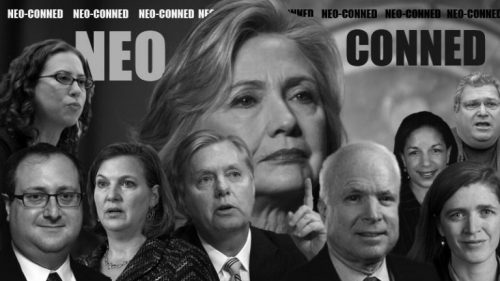 “Gaddafi’s security forces and other groups in the region are trying to divide the people by using violence against women and rape as tools of war, and the United States condemns this in the strongest possible terms,” declared Secretary of State Hillary Clinton, whose supporters are now complaining about ‘post-truth politics.
Again, no evidence was put forward for the Viagra/mass rape claim and, surprise, surprise, none was ever found.
A clear pattern can be discerned. To get public support for its illegal regime change wars, the Western establishment energetically promotes a number of ‘fake news’ stories. These stories are usually reported unquestioningly in ‘respectable’ outlets and are regularly cited by neocon/liberal interventionist commentators as a reason for taking action against the target state. ‘Anonymous’ sources feature heavily in these stories, which like MI6’s ‘Operation Mass Appeal’ are often planted by the security services.
Meanwhile, people’s emotions are shamelessly played upon by the ‘something must be done’ brigade of ‘liberal’ laptop bombardiers, the same crowd, note well, who accuse ‘populist’ politicians of ignoring ‘objective facts’ and playing on people’s emotions.
The fake news continues while the regime change operation is ongoing. After its over, we’re all meant to forget about the false stories we were fed and focus on the next ’New Hitler’ who needs to be dealt with. In 2011, it was the despicable Gaddafi, now it’s the despicable Assad and the despicable Putin who we’re told: “have to be stopped.”
The term ‘post-truth’ politics implies there was a time when politics was truthful. I doubt if that ever was the case, but certainly in the last 25 years, thanks to the influence of neocons and ‘liberal interventionists’, the lies have been off the scale. Remember the Niger uranium forgeries? And Saddam’s horrific ‘People Shredder‘?
And before the Iraq war, we had the ‘humanitarian’ NATO bombing of Yugoslavia, where again fake news dominated. US Defense Secretary William Cohen claimed “about 100,000 military-aged” Kosovan Albanians were missing… “they may have been murdered.”
As John Pilger reminded us, “Kosovo, the site of a genocide that never was, is now a violent “free market” in drugs and prostitution.”
It wasn’t the only lurid claim that was made to sell the war. But again the ‘genocide’ and hundreds of thousands killed stories were false, as a UN court itself ruled in 2001.
Fake news also featured heavily in the neocon campaign to get Iran sanctioned for an entirely unproven nuclear weapons program. It’s dominated the coverage of recent events in Ukraine, with Russia’s non-existent ‘invasion of Ukraine’ routinely referred to as a fact. The conflict in Syria too has been marked by ‘fake news,’ and theories being reported as if they’re 100 percent proven. How many times have you read that “Assad gassed his own people” at Ghouta in 2013, even though we still don’t know for sure who carried out the attack?
If it’s ‘official enemies’ we’re talking about ‘fact-checking’ and citing sources isn’t all that important for those who pounce on a mere typo if it’s an anti-war writer who’s making a claim.
Now, the same people who have disseminated fake news for so long and who are still, even after Iraq and Libya, embedded in the West’s political and media establishments, are lashing out because they no longer control the narrative as they used to. The public is getting their news from a much wider variety of sources and voting for ‘populist,’ i.e., non-neocon/liberal interventionist-anointed candidates/parties at elections.
Instead of admitting that it’s their ’fake news’ and ‘post-truth politics’ which has caused people to switch off from establishment media and to stop voting for status quo candidates, the endless war lobby has the effrontery to accuse others of the things they have been guilty of.
Concern over ‘fake news’ and ‘post-truth politics’ from the West’s endless war propagandists?
It’s hard to think of a better example of what psychologists call ‘projection.’
Follow Neil Clark @NeilClark66
November 21, 2016
Posted by aletho |
Deception, Mainstream Media, Warmongering, Timeless or most popular | BBC, CNN, Fake News, France, Hillary Clinton, NATO, UK, United States |
Leave a comment
In its lead editorial on Sunday, The New York Times decried what it deemed “The Digital Virus Called Fake News” and called for Internet censorship to counter this alleged problem, taking particular aim at Facebook founder Mark Zuckerberg for letting “liars and con artists hijack his platform.”
As this mainstream campaign against “fake news” quickly has gained momentum in the past week, two false items get cited repeatedly, a claim that Pope Francis endorsed Donald Trump and an assertion that Trump was prevailing in the popular vote over Hillary Clinton. I could add another election-related falsehood, a hoax spread by Trump supporters that liberal documentarian Michael Moore was endorsing Trump when he actually was backing Clinton.
But I also know that Clinton supporters were privately pushing some salacious and unsubstantiated charges about Trump’s sex life, and Clinton personally charged that Trump was under the control of Russian President Vladimir Putin although there was no evidence presented to support that McCarthyistic accusation.
The simple reality is that lots of dubious accusations get flung around during the heat of a campaign – nothing new there – and it is always a challenge for professional journalists to swat them down the best we can. What’s different now is that the Times envisions some structure (or algorithm) for eliminating what it calls “fake news.”
But, with a stunning lack of self-awareness, the Times fails to acknowledge the many times that it has published “fake news,” such as reporting in 2002 that Iraq’s purchase of aluminum tubes meant that it was reconstituting its nuclear weapons program; its bogus analysis tracing the firing location of a Syrian sarin-laden rocket in 2013 back to a Syrian military base that turned out to be four times outside the rocket’s range; or its publication of photos supposedly showing Russian soldiers inside Russia and then inside Ukraine in 2014 when it turned out that the “inside-Russia” photo was also taken inside Ukraine, destroying the premise of the story.
These are just three examples among many of the Times publishing “fake news” – and all three appeared on Page One before being grudgingly or partially retracted, usually far inside the newspaper under opaque headlines so most readers wouldn’t notice. Much of the Times’ “fake news” continued to reverberate in support of U.S. government propaganda even after the partial retractions.
Who Is the Judge?
So, should Zuckerberg prevent Facebook users from circulating New York Times stories? Obviously, the Times would not favor that solution to the problem of “fake news.” Instead, the Times expects to be one of the arbiters deciding which Internet outlets get banned and which ones get gold seals of approval.
The Times lead editorial, following a front-page article on the same topic on Friday, leaves little doubt what the newspaper would like to see. It wants major Internet platforms and search engines, such as Facebook and Google, to close off access to sites accused of disseminating “fake news.”
The editorial said, “a big part of the responsibility for this scourge rests with internet companies like Facebook and Google, which have made it possible for fake news to be shared nearly instantly with millions of users and have been slow to block it from their sites. …
“Facebook says it is working on weeding out such fabrications. It said last Monday that it would no longer place Facebook-powered ads on fake news websites, a move that could cost Facebook and those fake news sites a lucrative source of revenue. Earlier on the same day, Google said it would stop letting those sites use its ad placement network. These steps would help, but Facebook, in particular, owes its users, and democracy itself, far more.
“Facebook has demonstrated that it can effectively block content like click-bait articles and spam from its platform by tweaking its algorithms, which determine what links, photos and ads users see in their news feeds. … Facebook managers are constantly changing and refining the algorithms, which means the system is malleable and subject to human judgment.”
The Times editorial continued: “This summer, Facebook decided to show more posts from friends and family members in users’ news feeds and reduce stories from news organizations, because that’s what it said users wanted. If it can do that, surely its programmers can train the software to spot bogus stories and outwit the people producing this garbage. …
“Mr. Zuckerberg himself has spoken at length about how social media can help improve society. … None of that will happen if he continues to let liars and con artists hijack his platform.”
Gray Areas
But the problem is that while some falsehoods may be obvious and clear-cut, much information exists in a gray area in which two or more sides may disagree on what the facts are. And the U.S. government doesn’t always tell the truth although you would be hard-pressed to find recent examples of the Times recognizing that reality. Especially over the past several decades, the Times has usually embraced the Official Version of a disputed event and has deemed serious skepticism out of bounds.
That was the way the Times treated denials from the Iraqi government and some outside experts who disputed the “aluminum tube” story in 2002 – and how the Times has brushed off disagreements regarding the U.S. government’s portrayal of events in Syria, Ukraine and Russia. Increasingly, the Times has come across as a propaganda conduit for Official Washington rather than a professional journalistic entity.
But the Times and other mainstream news outlets – along with some favored Internet sites – now sit on a Google-financed entity called the First Draft Coalition, which presents itself as a kind of Ministry of Truth that will decide which stories are true and which are “fake.”
If the Times’ editorial recommendations are followed, the disfavored stories and the sites publishing them would no longer be accessible through popular search engines and platforms, essentially blocking the public’s access to them. [See Consortiumnews.com’s “What to Do About ‘Fake News.’”]
The Times asserts that such censorship would be good for democracy – and it surely is true that hoaxes and baseless conspiracy theories are no help to democracy – but regulation of information in the manner that the Times suggests has more than a whiff of Orwellian totalitarianism to it.
And the proposal is especially troubling coming from the Times, with its checkered recent record of disseminating dangerous disinformation.
Investigative reporter Robert Parry broke many of the Iran-Contra stories for The Associated Press and Newsweek in the 1980s.
November 20, 2016
Posted by aletho |
Civil Liberties, Deception, Full Spectrum Dominance | Human rights, New York Times, United States |
Leave a comment
1. What are State Crimes Against Democracy (SCADs)?
I coined the term “State Crimes Against Democracy” in a peer-reviewed article published by Administrative Theory & Praxis, the journal of the Public Administration Theory Network. SCADs are defined as “concerted actions or inactions by government insiders intended to manipulate democratic processes and undermine popular sovereignty.” Until recently, scholarly research on political criminality has given little attention to antidemocratic conspiracies in high office, focusing instead on graft, bribery, embezzlement, and other forms of government corruption where the aim is personal enrichment rather than social control, partisan advantage, or political power. However, SCADs are far more dangerous to democracy than these other, more mundane forms of political criminality because of their potential to subvert political institutions and entire governments or branches of government.
2. What are some examples of SCADs in recent U.S. history?
Examples of SCADs that have been officially proven include the Watergate break-ins and cover up; the secret wars in Laos and Cambodia; the illegal arms sales and covert operations in Iran-Contra; and the effort to discredit Joseph Wilson by revealing his wife’s status as an intelligence agent. Examples of suspected SCADs include the fabricated attacks on U.S. ships in the Gulf of Tonkin in 1964; the “October Surprises” in the presidential elections of 1968 and 1980; the assassinations of John Kennedy, Robert Kennedy, and Martin Luther King; the attempted assassinations of George Wallace and Ronald Reagan; the election breakdowns in 2000 and 2004; the numerous defense failures on 9-11-2001; the anthrax mailings in October 2001; and the misrepresentation of intelligence to justify the invasion and occupation of Iraq.
3. Are suspicions about SCADs “conspiracy theories”?
The concept of State Crimes against Democracy was developed, in part, to replace the term “conspiracy theory.” The conspiracy-theory literature about assassinations, 9/11, and other suspicious events has generally examined each event in isolation. The SCAD construct was introduced to move inquiry beyond incident-specific theorizing. It delineates a crime category comparable to white collar crime, organized crime, and hate crime. SCAD research looks for patterns across events. The objective is to develop (a) an empirically grounded theory of elite political criminality, (b) forensic methods for SCAD detection and investigation, and (c) political reforms to discourage SCADs from being committed in the first place.
4. Why are SCADs difficult to detect?
SCADs are usually complex conspiracies involving people with expertise in law, law enforcement, and police procedures. Ordinary crimes are often solved by pressuring criminals to inform on one another, but this may be impossible with SCADs because they are often organized like covert intelligence operations. Each element of the operation is compartmentalized, and information about participant roles is shared only on a need-to-know basis.
5. Why are SCAD suspects seldom convicted and punished?
One reason SCADs often go unpunished is that the agencies assigned to investigate what may be high crimes often bear some blame or have some connection to the events in question; hence, personnel in these agencies are inevitably tempted to conceal evidence that would implicate or embarrass the agencies or their top managers. In the investigation of the assassination of President Kennedy, for example, both the FBI and the CIA concealed evidence of their contacts with Lee Harvey Oswald and Jack Ruby (Talbot, 2007). Likewise, in response to the inquiry into the defense failures surrounding 9-11, the Department of Defense appears to have withheld from the 9-11 Commission evidence that military intelligence agents had uncovered the 9-11 hijackers’ activities well in advance of September 2001. SCAD investigations and prosecutions are also impeded by Presidential pardons and commutations. Gerald Ford pardoned Richard Nixon without even allowing a full investigation into all of Nixon’s possible crimes. Similarly, George H.W. Bush pardoned the Iran-Contra conspirators and effectively prevented further investigation of his own role in the affair. George W. Bush appears to have had similar motives with respect to Scooter Libby. In commuting Libby’s sentence rather than issuing a pardon, Bush made it impossible for Congress to compel Libby’s testimony in any further inquiry into Plame’s exposure.
6. Why do the mainstream media spurn “conspiracy theories”?
There are powerful norms among political, economic, and media elites that discourage speculation about corruption in high office. In elite discourse, convention prohibits suspicions from being voiced about top officials unless their guilt can be proven unambiguously by “smoking gun” evidence. This norm does not come from the principle in American jurisprudence that suspects are considered innocent until proven guilty. The presumption of innocence was never intended to outlaw suspicions. Rather, it calls for suspicions to be tested with thorough and fair investigations grounded by procedural rules for procuring and presenting evidence. Norms against conspiratorial speculations in elite discourse function to protect the legitimacy of elites as a class.
7. Was 9/11 a SCAD?
Much circumstantial evidence suggests the Bush-Cheney Administration may have somehow been involved in 9-11. The Administration ignored many warning signs that the 9-11 terrorist attack was imminent and that the attack might include hijackings; the CIA had a working relationship with bin Laden, and provided weapons, money, and technical support to Islamist terrorists in Afghanistan during the Soviet occupation; some officials appear to have received warnings not to fly on 9-11; the Twin Towers and Building 7, which collapsed at near free-fall acceleration, are suspected of having been brought down by controlled demolition; chemical tests have found traces of Thermate (an incendiary for cutting steel) in dust from the Trade Center site; and, as is usual with most SCADs, the Twin Towers crime scene was cleaned up quickly and given only a superficial investigation.
8. What patterns have been uncovered with SCAD research?
Several patterns stand out when SCADs and suspected SCADs are considered comparatively. First, many SCADs are associated with foreign policy and international conflict: the Gulf of Tonkin incident; the burglary of Daniel Ellsberg’s psychiatrist’s office; Iran-Contra; 9-11; Iraq-gate; the assassinations of John Kennedy and Robert Kennedy; and the attempted assassinations of Patrick Leahy and Tom Daschle. All of these SCADs contributed to the initiation or continuation of military conflicts.
Second, SCADs are fairly limited in their modus operandi (MO). The most common SCAD-MOs are assassinations and mass deceptions related to foreign policy. Other MOs include election tampering, contrived international conflicts, and “black bag” burglaries. All of these MOs are indicative of groups with expertise in the skills of espionage and covert, paramilitary operations.
Third, many SCADs in the post-WWII era are associated with two presidents: Richard Nixon and George W. Bush. Nixon was not only responsible for Watergate and the illegal surveillance of Daniel Ellsberg, he alone benefited from all three of the suspicious attacks on presidential candidates in the 1960s and 1970s: the assassinations of John Kennedy and Robert Kennedy, and the attempted assassination of George Wallace. The SCADs that benefited Bush include the election-administration problems in Florida in 2000 and in Ohio in 2004; the defense failures on 9/11; the (U.S. defense grade) anthrax attacks on top Senate Democrats in October 2001; Iraq-gate; and the multiple and specious terror alerts that rallied support for Bush before the 2004 presidential election.
9. Are there any patterns in assassination targets?
The range of officials targeted for assassination is limited to those most directly associated with foreign policy: presidents and senators. Presidents are most vulnerable when they have Vice Presidents who are more closely aligned than they are to military and intelligence elites. This was the case for both Kennedy and Reagan. Senators are most vulnerable when the Senate is very closely divided along partisan lines and the death of a single senator will shift control of the Senate to the more hawkish party. This was the situation when Senator Paul Wellstone was killed in a suspicious plane crash, and when anthrax was mailed to Senators Daschle and Leahy.
Most other high-ranking officials in the federal government have seldom been murdered even though many have attracted widespread hostility and opposition. In the post-World War II era if not generally, no Vice Presidents have been assassinated, nor have any members of the U.S. House of Representatives or the U.S. Supreme Court. If lone gunmen have been roaming the country in search of political victims, it is difficult to understand why they have not struck more widely, especially given that most officials receive no Secret Service protection.
10. What do SCAD patterns reveal about SCAD perpetrators?
SCADs frequently involve presidents either as victims or principals, benefit military and military-industrial elites, and employ the skills of intelligence and paramilitary operatives. This policy locus could mean that the nation’s civilian leadership is being targeted by military and intelligence elites, or that military and intelligence assets and capabilities are being politicized by the civilian leadership, or both. In any event, officials at the highest levels of American government appear to be using deception, conspiracy, and violence to shape national policies and priorities. This sub rosa manipulation of domestic politics is an extension of America’s duplicity in foreign affairs and draws on the nation’s well-developed skills in covert operations.
November 20, 2016
Posted by aletho |
Civil Liberties, Deception, False Flag Terrorism, Timeless or most popular | 9/11, Iran-Contra, United States |
Leave a comment
A University of Colorado professor who’s been criticized for his writings about climate change has been caught up in WikiLeaks’ dump of emails involving John Podesta, campaign chairman for Hillary Clinton.
Roger Pielke Jr., who has been a faculty member on the Boulder campus since 2001, was the subject of a July 2014 email about an essay he wrote on climate change for the website FiveThirtyEight.
Pielke writes a regular column about sports governance for the Daily Camera.
The email was sent by Judd Legum, the editor of ThinkProgress, a site that’s part of the Center for American Progress Action Fund, the advocacy arm of the liberal think tank Center for American Progress, which was founded by Podesta in 2003.
In his email to billionaire environmentalist Tom Steyer, Legum described how he believed Climate Progress, the environmental arm of ThinkProgress, got Pielke to stop writing about climate change for FiveThirtyEight.
“I think it’s fair say that, without Climate Progress, Pielke would still be writing on climate change for 538,” Legum wrote.
Legum did not respond to interview requests on Wednesday.
The email was one of tens of thousands of messages from Podesta’s hacked Gmail account released by WikiLeaks this month.
The group took issue with Pielke’s piece titled “Disasters Cost More Than Ever —- But Not Because of Climate Change,” in which he questioned the link between rising natural disaster costs and climate change.
Pielke argued that the cost of disasters is increasing because the world is getting wealthier, not because there are more — or more intense — floods, droughts, hurricanes or tornadoes.
“We’re seeing ever-larger losses simply because we had more to lose — when an earthquake or flood occurs, more stuff gets damaged,” he wrote.
Pielke, who has written extensively about climate-change economics, is a polarizing figure among climate change scientists and activists.
Pielke refutes claims that he’s a climate-change skeptic or denier, pointing to his public support for a carbon tax. He says that many of the arguments he presents are supported by the Intergovernmental Panel on Climate Change.
Nevertheless, shortly after Pielke’s FiveThirtyEight piece was published, ThinkProgress wrote a story quoting climate scientists who said Pielke’s claims were misleading. FiveThirtyEight published a rebuttal to Pielke’s piece.
The criticism of Pielke’s piece continued, with stories about Pielke and FiveThirtyEight founder Nate Silver appearing in Salon, Slate and the Huffington Post.
“Silver is still backing the wrong horse, and the sooner he dumps Pielke, the better,” David Auerbach wrote for Slate.
Shortly thereafter, Pielke stopped writing for FiveThirtyEight. In the email released by WikiLeaks, Legum gave ThinkProgress credit for that.
“I don’t think there is another site on the internet having this kind of impact on the climate debate,” Legum wrote of FiveThirtyEight.
A year later, Pielke was the target of an investigation led by a Democratic congressman into whether he had received funding for his work at CU from fossil fuel companies.
In response, CU President Bruce Benson wrote that the university “did not discover any information indicating that Pielke’s funding sources influenced his research,” adding that Pielke confirmed that he received no funding from the oil and gas industry.
Pielke has more or less stopped writing about climate change. Since then, he’s focused his efforts on sports governance and is now the director of CU’s Sports Governance Center.
“They were ultimately successful in removing an academic from working on a topic,” Pielke said, adding that there’s “nothing like a political witch hunt to help you focus on career priorities.”
When he read the leaked email last week, Pielke said he wasn’t surprised by its contents.
“It spells out in black and white … that there was an organized, politically motivated campaign to damage my career and reputation, based on a perception that my academic research was thought to be inconvenient,” he said.
By Sarah Kuta | Daily Camera | November 10, 2016
The University of Colorado’s Board of Regents reaffirmed its support for academic freedom on Thursday in light of recently released emails that showed that a liberal group targeted CU Boulder Professor Roger Pielke Jr. for his writings on climate change.
At a regular meeting in Denver, the regents passed a resolution 9-0 to send the message that “faculty and students must have complete freedom to study, to learn, to do research and to communicate the results of these pursuits to others.”
The principles of academic freedom are codified in regent laws, which govern the university. The board was restating its commitment to those principles on Thursday.
Though he was not mentioned in the resolution, Pielke was the motivating factor behind it, according to its author, Regent John Carson, a Republican from Highlands Ranch.
Pielke was the subject of a 2014 email sent by the editor of ThinkProgress, a website that’s part of the Center for American Progress Action Fund, the advocacy arm of the liberal think tank Center for American Progress.
In Judd Legum’s email to billionaire environmentalist Tom Steyer, Legum described how he believed the website got Pielke to stop writing about climate change for the data-focused news website FiveThirtyEight.
The email was part of an October WikiLeaks dump of emails involving John Podesta, the founder of the Center for American Progress and the chairman for Hillary Clinton’s presidential campaign.
Pielke and others described the email as evidence that there was a “politically motivated campaign” to damage his career and reputation. Ultimately, he stopped writing about climate change and now directs CU’s new Center for Sports Governance.
Carson said he felt that type of conduct was unacceptable and that he thought the board should show all CU faculty and researchers that it stands behind them.
“I want to go on record making clear that I don’t think this type of conduct is appropriate and we’re going to defend our faculty and we’re going to go on record, when we find out about these types of things, opposing it,” Carson said.
Pielke wrote for FiveThirtyEight that “human-caused climate change is both real and important,” but came under fire for an essay the website published in which he argued that rising natural disaster costs were not linked to climate change.
Reporters at ThinkProgress asked several climate scientists to weigh in on Pielke’s claims and published stories in which those scientists said Pielke’s claims were misleading. By Pielke’s count, the website has published more than 160 critical articles about him.
Legum, the ThinkProgress editor, said there was no organized campaign to damage Pielke’s career. Rather, the website was trying to report accurate information about climate change.
“There was inaccurate information being presented in his writing … We called a number of climate scientists and asked them about the claims he was making in this piece,” Legum told the Daily Camera last month. “They said that there were a lot of really inaccurate or misleading things, and we reported on that.”
Pielke was also the target of a 2015 investigation led by a Democratic congressman into whether he had received funding for his work at CU from fossil fuel companies.
In response, CU President Bruce Benson wrote that the university “did not discover any information indicating that Pielke’s funding sources influenced his research,” adding that Pielke confirmed that he received no funding from the oil and gas industry. […]
Though he did not attend the meeting, Pielke wrote in an email to the Daily Camera that he felt supported by the leaders of the university.
He said the bipartisan-backed resolution sent a strong message “to my faculty peers who may question whether it is worth participating in important debates of the day — that CU has their back.”
Sarah Kuta: 303-473-1106, kutas@dailycamera.com or twitter.com/sarahkuta
November 20, 2016
Posted by aletho |
Full Spectrum Dominance, Science and Pseudo-Science, Timeless or most popular | Center for American Progress, Huffington Post, Salon, Slate, ThinkProgress, United States |
Leave a comment
Recently, John Kirby lost his rag when challenged to name the sources which gave him ‘information’ implying that Russia had helped the Syrian Arab Army bomb civilian targets such as hospitals. His reaction was typical of Shakespeare’s dictum, “The lady doth protest too much, methinks”.
As it turns out, Kirby was not quoting any government sources, he admitted as much. He claimed that the United States, her allies, Russia or Syria did not provide the information upon which he relied. Instead he stated that the claims he was making were based on findings from ‘aid organisations’. Such a phrase, whilst linguistically innocuous, implies something very different in the context of the Syrian conflict. Many groups calling themselves ‘aid organisations’ are actually either terrorist sympathisers or terrorist organisations in all but name.
One such organisation is the western funded White Helmets, an organisation whose crimes against humanity The Duran was among the first to expose.
It is this organisation who filmed the savage, medieval beheadings of prisoners before disposing of the mutilated bodies. It is this organisation whose bearded members jump for joy, holding guns, whilst chanting for the death of legitimate political leaders like President Assad, it is this organisation which acts on behalf of Al-Qaeda’s surrogate in Syria, al-Nusra. It is this organisation that provided the United States with false information about Russia which John Kirby was all too happy to parrot as though it was fact.
Russian Defence Ministry spokesman Major General Igor Konashekov spoke of Kirby’s insincerity in the following way:
After three days it is absolutely clear for everyone that the allegedly bombed “hospitals” and “mobile clinics” in Aleppo exist only in US State Department spokesman John Kirby’s imagination. This ‘information blooper’ will certainly remain a stain on Admiral Kirby’s biography.
He continued:
We have repeatedly asked representatives of the United States, Great Britain, France, Germany, other countries and international organisations to provide any information on the location of medical aid posts (hospitals) or schools in Syrian areas controlled by terrorists… The answer is always the same—no one has such information. There are only reports by the ‘White Helmets’ or anonymous local “journalists’.
Kirby’s outburst and the false report which he based his previous statements on, demonstrates not just a lack of transparency on behalf of the United Sates, but a totally dishonest position. To think that the most powerful country in the world has to rely on off-shoots of terrorist organisations in order to obtain false information with which to slander Russia, is beyond absurd and beyond pathetic, it is disgraceful.
If the United States is as powerful as the world knows it is, the fact that it is relying on terrorist groups like the White Helmets for information, is demonstrative of a wanton act of deception. US intelligence could find the facts if it was the facts which they were interested in. Clearly, this is not the situation. They are interested in parroting terrorist propaganda which conforms to President Obama’s wicked agenda.
What’s even more disgraceful is that many western mainstream media outlets take people like Kirby at face value when they speak of amorphous ‘aid organisations’. They do not bother to investigate the fact that such ‘aid organisations’ are actually parts of terrorist syndicates working with a stated mission to wage war against the legitimate government of Syria.
We now know the real reason John Kirby went insane when asked some sensible questions by RT’s Gayane Chichakyan. He was caught relying on false information by terrorist sources.
The sooner he and his ilk are gone forever, the better. Although it is still early days, I find it personally hard to believe that Donald Trump, who appears to be genuinely interested in fighting terrorism, would allow his inferiors to spout such lies.
Time will tell, but nothing could be as bad as this.
November 20, 2016
Posted by aletho |
Deception, Mainstream Media, Warmongering, Progressive Hypocrite | al-Qaeda, John Kirby, Obama, United States, White Helmets |
Leave a comment
The election of Donald J. Trump on Tuesday, November 8 terrified many who consider themselves notionally progressive or traditional republicans. It also terrified free trade ideologues, and those who believe that opening borders to boundless consumer goods and services eradicates poverty.
There are few better exponents of this idea on trade than Australian Prime Minister Malcolm Turnbull, whose insistence that protectionism remains an evil to be combated has sounded pious. Keep the markets open, while shutting borders to people desperately seeking refuge. In other words, keep such monsters as the Trans-Pacific Partnership Agreement on the table for full implementation, while flouting the UN Refugee Convention.
This view is featherbedded by other leaders ahead of the Asia-Pacific Economic Cooperation group summit taking place in Peru, all insisting with numbing acceptance that free trade is as natural as breathing air, axiomatic to the smooth functioning of a global economic and financial system.
Peru’s President Pedro Pablo Kuczynski decided to make his opening address to the leaders of the summit a platform for his fears about how “protectionism” was “taking over” in the UK and the United States.
Rather than addressing the reasons for pro-protectionist movements, the glorious assumptions of free trade are presumed. “It is fundamental,” suggested Kuczynski, “that world trade grow again and that protectionism be defeated.” His solution was to make APEC the ultimate critic, rather than interrogator, of such movements.
Japan’s trade minister, Hiroshige Seko, was similarly inclined. “We agreed to push forward free trade to counter protectionist sentiments.” Rather than actually addressing the core shibboleths of free trade that have seen a spike of criticism of its tenets, Seko presumed it to be a non-starter as an argument.
Ditto his colleague in government, Foreign Minister Fumio Kishida. “It’s time for APEC to show a strong commitment to free trade and contribute to sustainable growth and prosperity in the Asia-Pacific region.”
It never has been, nor will it ever be, but the politics of trade and the enriching of the corporate classes at the expense of social and public policy (medicine, environment) has taken place along one axis, ignoring the effects and views on those it supposedly benefits.
In Trumpland, and the world of Brexit, these supposed beneficiaries have roared their disapproval. They look at their bank balances and see diminishing returns. They fear the cost of increasing medication. Others are concerned about environmental degradation. All are concerned by surrendering sovereignty through the death of a thousand cuts.
The nonsense of free trade as a magic pudding of delight and gifts has populated the thinking of economic establishments for decades, and has only received a good bashing in recent years. Studies have been produced on specific free-trade deals showing that the trade engaged in is never that free, and never that competitive. No matter – ideology manufactures the necessary blinkers for free traders to insist on the virtues of such arrangements.
Amidst such Trump promises as the building of a defiant wall to keep unruly Mexicans out of the land of the free, or withdrawing funding from sanctuary cities who shelter undocumented immigrants, lies a promise to those not associated with the neo-liberal traditionalists. The Trans-Pacific Partnership, he promised, would be scrapped.
Once Hillary Clinton’s campaign effectively pulled the rug of calculation from under rival Bernie Sanders’ campaign, Trump intensified focus on the TPP and the notion of the unfair trade deal that would fail to deliver for American workers.
The response was not purely populist – the problems of such a trade deal provide a neat illustration on how modern governments treat their citizens relative to corporations. Notorious for unprecedented levels of secrecy, the entire base for negotiating a deal intended to influence countries through the Asia-Pacific rejected the very idea of civil society.
The message, in other words, is simply not getting through, despite the election result. The patrician classes feel they know better. Bloomberg View columnist Mihir Sharma provides a typical view, preferring to see trade in its global context: American workers bemoaning their returns from free trade, along with critics from the left, ignore “the obvious benefits of trade for workers in poorer countries, and thus barely deserves to be called progressive.”
Take the big view, and the long road, insists Sharma. That road, however, has become a vaguer one, with President Barack Obama admitting on Wednesday in Athens that the effects of globalisation on those “who feel they’re losing control of their future” had to be dealt with.
Despite such a statement, the status-quo, at least till Trump thunders into the White House, remains, shining a light on free trade enthusiasts. This can be gathered from the joint opinion piece by Obama and German Chancellor Angela Merkel, published by the German daily Wirtschaftswoche: “Germans and Americans must seize the opportunity to shape globalization according to our values and ideas.” (Be wary of Chinese efforts to do the same, in other words.)
Furthermore, “We have an obligation to our companies and our citizens – in fact, to the entire global community – to broaden and deepen our cooperation.” The ease of universalising a local or national project is irresistible in such messages.
For Trump, this pompous assertion of universality needs to end. Be openly self-interested; keep things distinct to the American program. To make America great again may require bruising trade battles precisely done to preserve perceived values. If necessary, raise tariffs and toughen the stance on China’s currency policy. Many who voted for him will find such views hard to fault, whatever their tangible consequences.
Binoy Kampmark was a Commonwealth Scholar at Selwyn College, Cambridge. He lectures at RMIT University, Melbourne and can be reached at: bkampmark@gmail.com.
November 19, 2016
Posted by aletho |
Economics | Donald Trump, Obama, UK, United States |
Leave a comment
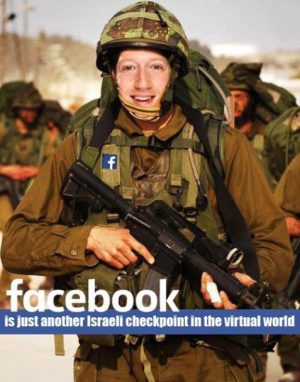 Facebook may entrust a third party with verifying content to stop so-called ‘fake news’ from spreading, its head said in a post. The social network, which is many people’s primary source of news, has recently been criticized for spreading misinformation.
Outgoing US President Barack Obama launched the war on ‘fake news’ last week, complaining that it may have had an adverse effect on the presidential election. He claimed that social media hosts “much active misinformation” that “looks the same when you see it on a Facebook page or you turn on your television.”
There is speculation that fake news about presidential candidates may have played a considerable role in swaying the minds of voters who ultimately elected Republican Donald Trump. Facebook head Mark Zuckerberg initially dismissed the notion as “pretty crazy,” but this week Facebook and Google both said they would change their ad policies to prevent fake news websites from using their systems.
In a Friday post, Zuckerberg gave an update on how his network is planning to fight misinformation.
“Historically, we have relied on our community to help us understand what is fake and what is not,” he said, explaining that the reporting mechanism already in place on the site fights fake news along with clickbait, spam, and scams.
This may be not enough to combat inaccurate news content, however, so Facebook is considering engaging “trusted third parties” to filter out fake news.
Another possible approach would be to have Facebook police itself, which would mean installing “better technical systems to detect what people will flag as false before they do it themselves,” the FB head said.
Links to news stories classified by the network as untruthful would be flagged as fake for people trying to share or read them, according to Zuckerberg.
False stories circulating on Facebook during America’s presidential election campaign included one claiming that anchor Megyn Kelly had been fired from Fox News, another alleging an FBI agent involved in the Clinton investigation had been murdered, and even an announcement that the Pope had endorsed Trump.
November 19, 2016
Posted by aletho |
Deception, Full Spectrum Dominance, Progressive Hypocrite | Facebook, Google, Mark Zuckerberg, Obama, United States |
Leave a comment
The first definitive signals are appearing that the American foreign policies are destined to undergo a historic shift under the Donald Trump presidency. RT confirmed on Friday citing a ‘close source’ (without mentioning the nationality) the media reports speculating that Trump has named retired Lt. Gen. Michael Flynn as the National Security Advisor in the incoming Administration. Interestingly, the first authoritative report originated from Moscow.
The RT report gave a rather friendly account of Flynn, noting his strong advocacy of détente with Russia. (Interestingly, those who called on Trump yesterday at his transition hqs included Henry Kissinger.)
Why is Flynn’s nomination so important? First of all, Trump trusts him and Flynn in his new position will be overseeing the entire US intelligence establishment and Pentagon and coordinating national security and foreign policies. It is an immensely influential position, beyond Congressional scrutiny.
Importantly, therefore, Flynn’s past contacts with Kremlin officials – there is a photograph of him at the dinner table seated next to President Vladimir Putin – and his connections with Gazprom, Russia’s gas leviathan, and his belief that US and Russia should collaborate instead of rival each other, etc. assume great significance.
Trump unnerves the US foreign and security policy establishment. Conceivably, Trump will use the tough Pentagon general to whip the establishment folks into submission to the new foreign policy trajectory. If anyone can do that, it is Flynn.
The growing disquiet is apparent even at the level of President Barack Obama. On Thursday, in an audacious act, Obama rendered some public advice to Trump from a foreign podium, Germany, with Angela Merkel approvingly listening, on the advisability of the president-elect following his footfalls. Some excerpts are in order, if only to highlight the epic battle shaping up over US foreign policies. Obama said:
- With respect to Russia, my principal approach to Russia has been constant since I first came into office. Russia is an important country. It is a military superpower. It has influence in the region and it has influence around the world. And in order for us to solve many big problems around the world, it is in our interest to work with Russia and obtain their cooperation… So I’ve sought a constructive relationship with Russia, but what I have also been is realistic in recognising that there are some significant differences in how Russia views the world and how we (West) view the world.
- And so on issues like Ukraine, on issues like Syria, we’ve had very significant differences. And my hope is that the President-elect coming in takes a similarly constructive approach, finding areas where we can cooperate with Russia where our values and interests align, but that the President-elect also is willing to stand up to Russia where they are deviating from our values and international norms.
- I don’t expect that the President-elect will follow exactly our blueprint or our approach, but my hope is that he does not simply take a realpolitik approach and suggest that if we just cut some deals with Russia, even if it hurts people, or even if it violates international norms, or even if it leaves smaller countries vulnerable or creates long-term problems in regions like Syria — that we just do whatever is convenient at the time. And that will be something that I think we’ll learn more about as the President-elect puts his team together.
Obama then proceeded to have a tirade against Putin, saying “there have been very clear proof that they have engaged in cyberttacks” on the US and that he personally “delivered a very clear and forceful message” to the Russian leader to the effect that “we’re monitoring it carefully and we will respond appropriately if and when we see this happening.”
Back in Washington, ironically, Obama’s strongest ally in opposing détente with Russia is none other than Republican Senator John McCain. The visceral dislike toward Russia – and Putin, in particular – within the Washington establishment is apparent from McCain’s own statement earlier in the week.
Why such morbid fear? McCain, of course, is the chief spokesman of the military-industrial complex in America. Many top arms manufacturing companies are based in Arizona, the state which Mccain represents in the senate. ‘Saker’, the US-based military analyst, gives a satisfactory explanation as to why there’s such panic in Washington:
- He (Flynn) has connections to Gazprom, is well-liked in Moscow, and will be a link for American energy companies and perhaps some joint ventures in the gas field development and pipeline industry. Several friends of Trump are from the gas and oil industry… The Arctic, the eastern Mediterranean, the South China Sea and other large development zones have enormous new fields to be tapped and exploited.
- The primary interest of the Trump foreign policy will be to make America wealthy again. The Eurasian development has already attracted Trump to the OBOR of China and the AIIB infrastructure bank. Probably the entire New Silk Road of China and EAEU of Russia is not going to be without major US participation.
Read ‘Saker’ on Flynn’s appointment. (here)
November 19, 2016
Posted by aletho |
Economics, Militarism, Progressive Hypocrite, Timeless or most popular | Donald Trump, Gazprom, Michael Flynn, Obama, One Belt One Road, Russia, United States |
Leave a comment