Hillary Is The Perfection of a Corrupt System

By Charles Hugh Smith | Of Two Minds | November 2, 2016
Exposing the Clintons’ perfection of a corrupt political system won’t change the conditions and incentives that created the Clintons’ harvester of corruption.
Let’s set aside Hillary Clinton as an individual and consider her as the perfection of a corrupt political system. As I noted yesterday, Politics As Usual Is Dead, and Hillary Clinton is the ultimate product of the political system that is disintegrating before our eyes.
The corruption of pay-to-play and the commingling of public and private influence is not the failing of an individual–it is the logical conclusion of a thoroughly corrupt political system.
Given the incentives built into politics as usual, public/private pay-to-play doesn’t just make sense–it is the only possible maximization of the political system.
Cobble together a multi-million dollar private foundation, millions of dollars in speaking fees from big-money contributors, conflicts of interest, the secrecy of private email servers, pay-to-play schemes and corrupted loyalists planted in the Department of Justice, and the inevitable result is a politics as usual money-harvesting machine that lays waste to the nation, supporters and critics alike.
All the Clintons did is assemble the parts more effectively than anyone else.
Now that the machine has scooped up hundreds of millions of dollars in “contributions” and other loot, vested interests and corrupted loyalists within the federal government will do anything to protect the machine and its vast flow of funds. The nation’s political system needs a thorough cleaning from top to bottom.
Exposing the Clintons’ perfection of politics as usual won’t change the conditions and incentives that created the Clintons’ harvester of corruption. That will require rooting out the incentives that made the Clintons’ perfection of corruption both logical and inevitable.
Charles Hugh Smith’s new book is #8 on Kindle short reads -> politics and social science: Why Our Status Quo Failed and Is Beyond Reform ($3.95 Kindle ebook, $8.95 print edition) For more, please visit the book’s website.
Russophobia and the dark art of making an anti-Russian magazine cover
By Dominic Basulto | July 10, 2016

Chances are, if a story about Russia appears on the cover of a major Western magazine, it’s not good news. Most likely, there’s been an international scandal, a breakout of geopolitical tensions, the resumption of Cold War hostilities, or some nefarious Russian plot to bring the entire free world to its knees.
Russophobia — or the unnatural fear of Russia — generally leads magazine editors to choose the most over-the-top images to convey Russia as a backwards, clumsy, non-Western and aggressively malevolent power. Unfortunately, that’s led to a few rules of thumb for anyone trying to create a magazine cover featuring Russia. You can think of these rules as the dark art of making an anti-Russian magazine cover:
OPTION 1: Go with the Russian bear
This is a no-brainer, actually, and pretty much the default option for any magazine editor. The symbol of the Russian bear is universally understood to be the symbol of Russia, so it’s an immediate attention-grabber that readers will grasp quickly. After all, for centuries, Western satirists have used the Russian bear as a symbol of imperial aggression.
Given the latest round of U.S.-Russian tensions over the Ukraine crisis, the key is to make the Russian bear look as scary as possible. Take the May/June 2016 cover from Foreign Affairs, for example:
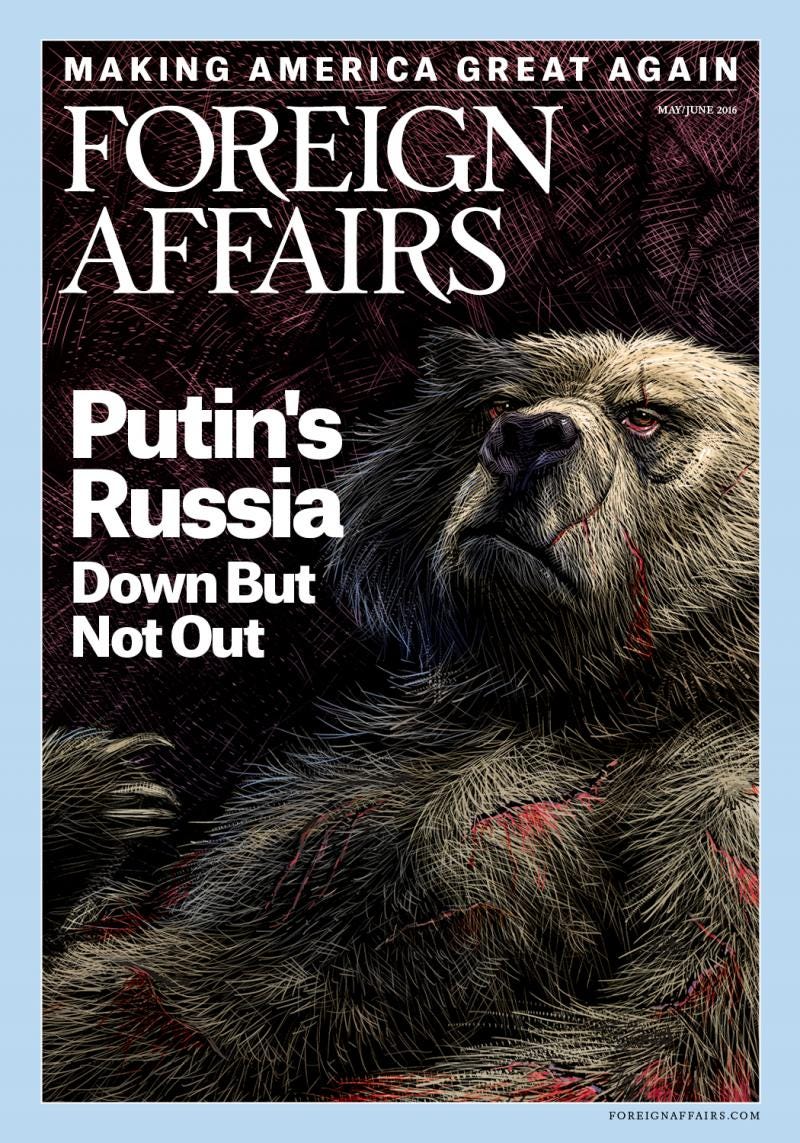
The cover title seems relatively harmless — “Putin’s Russia: Down But Not Out.” But check out the image of the bear — it’s bloodied and still relatively menacing, despite being bruised and battered — check out the red, bloodshot eyes and the sharp claws. Definitely not someone you’d want to mess with, even after a few shots of vodka.
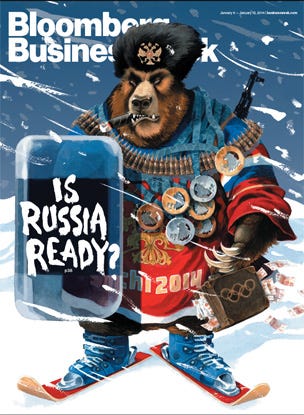
And Foreign Affairs is not the only magazine to go the full bear with the cover. Ahead of the Sochi Winter Olympics in 2014, Bloomberg BusinessWeek went with what has to be the scariest, most menacing Russia bear that’s ever appeared on the cover of a magazine. The magazine shows a malevolent bear on a pair of skis wearing a Russian hockey jersey, armed to the teeth (literally), with the headline: “Is Russia Ready?”
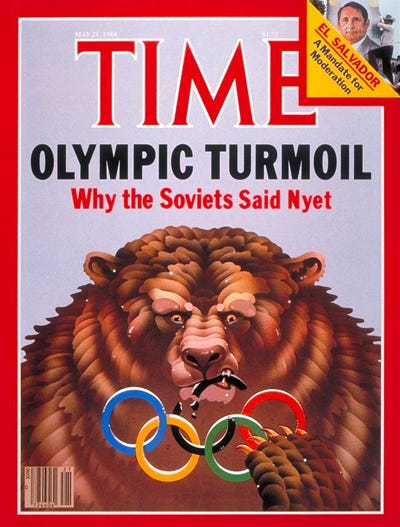
This Olympic cover immediately calls to mind a cover story TIME ran on Russia (then the Soviet Union) ahead of the 1984 Los Angeles Summer Olympics — “Olympic Turmoil: Why the Soviets Said Nyet.” Here you have a menacing (and slightly psychotic-looking) Russian bear chewing on the Olympic rings:
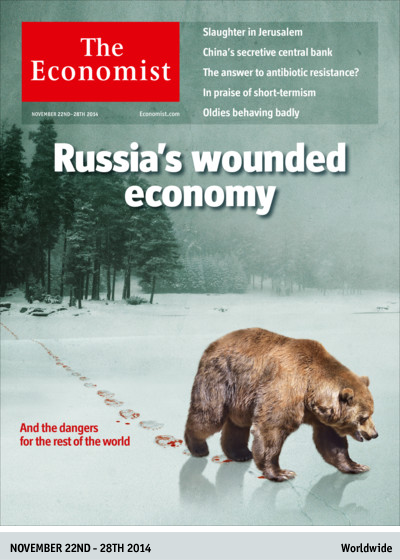
There are other options, of course, if you don’t want to go with the anthropomorphic bear. In late 2014, The Economist pulled off a story about “Russia’s Wounded Economy” after Western sanctions and falling oil prices — it showed a bear stalking through the wintry, Siberian snow with bloody footprints:
But you probably want to emphasize either the claws or teeth of the Russian bear, right? So here’s a terrifying image of a Russian bear “welcoming” U.S. President Barack Obama to Moscow:

OPTION 2: Go with Vladimir Putin
The next best choice after using the Russian bear is the image of Vladimir Putin. After all, in the minds of most Western readers, Putin is Russia and Russia is Putin.
If you’re ready to head down this road, then an image of an evil James Bond villain, hatching a diabolical plot to take over the world, might work. This 2014 Newsweek cover of Putin, showing him and the menacing sunglasses, is a classic:
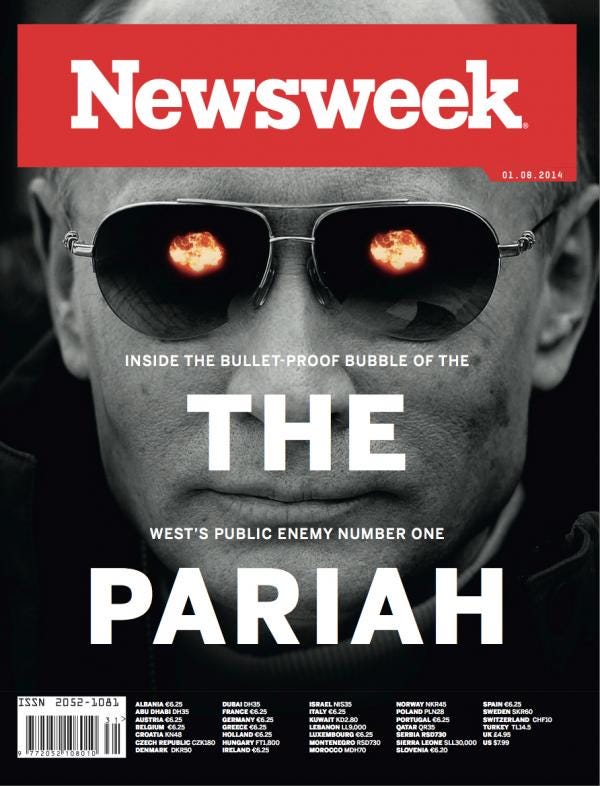
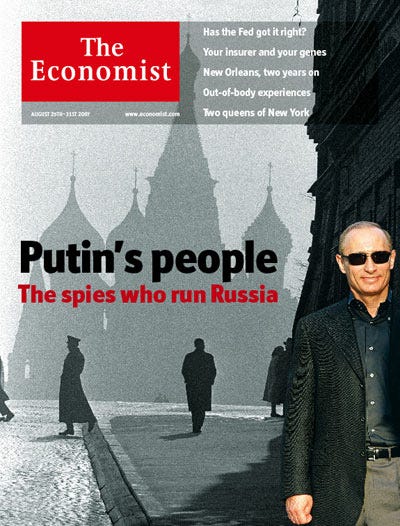
To play up the Soviet spy background of Putin, you could try using an image of him wearing sunglasses in a grim-looking Red Square (Gray Square!):
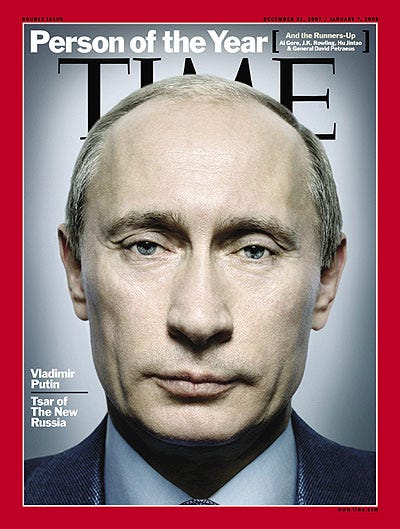
A variant of the James Bond villain look is the classic “moody Putin” look that’s been around for almost a decade. This image somehow captures the Western perception of Russia as a vast, unsmiling wasteland full of snow, ice and a vast moral void. Who better to run that country than an unsmiling dictator? What started it all was this TIME magazine cover naming Putin as “Person of the Year”:
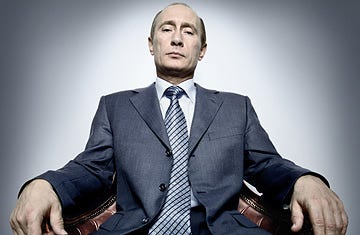
From there, the moody, unsmiling Putin image took off. Pull your camera angle back from the close-up of Putin’s face and you get this — “the unsmiling tsar”:
Which, of course, led to the cover of this 2015 book by Steven Lee Myers of the New York Times:
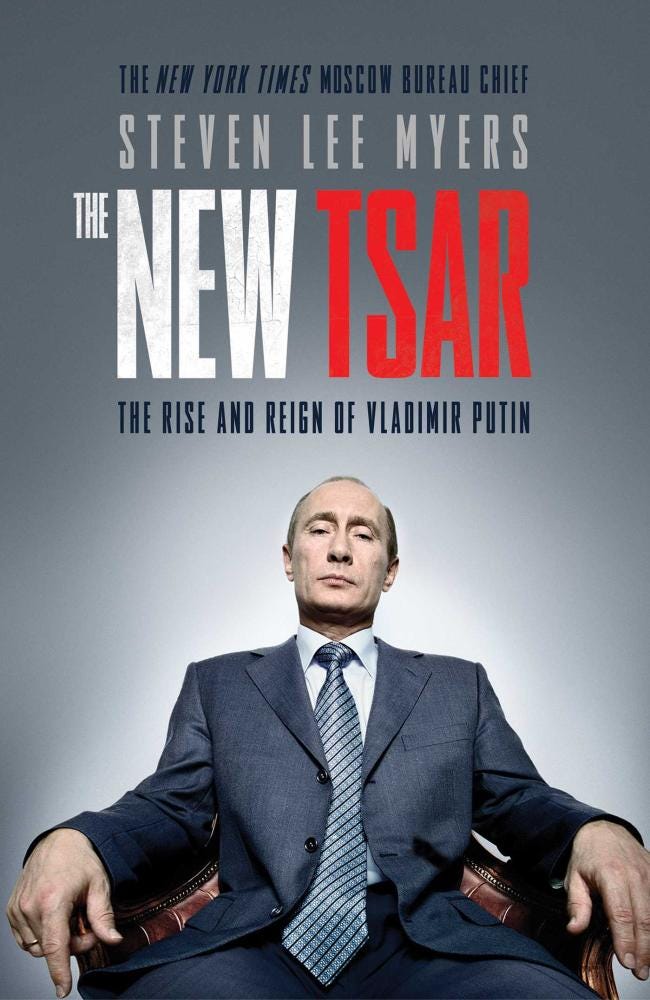
Of course, the moody, unsmiling, sour-looking Putin can be updated to make him look like a gangster:
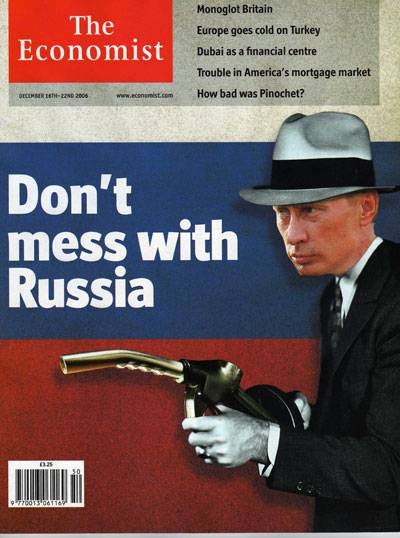
Or a Mario Puzo-style mafia don:
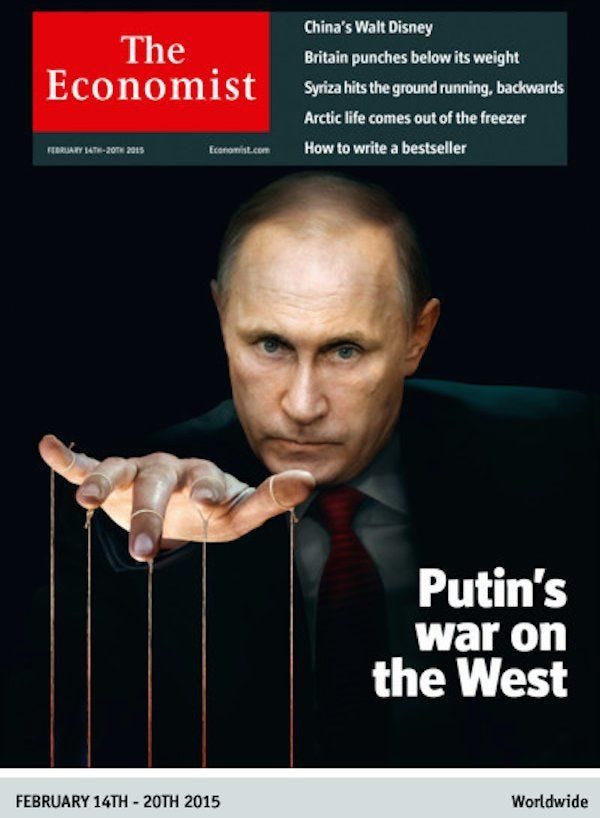
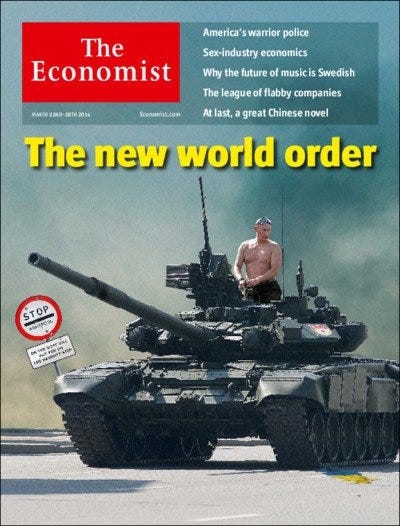
If you really want to grab the reader’s attention, though, go for the shirtless Putin. The shirtless Vladimir Putin is a classic Internet meme, of course. (Google: Shirtless Putin hummingbird hamster) The meme of a shirtless Putin doing manly things is so popular that “The Simpsons” even used the image of a completely naked Putin on horseback (bareback?) around the time of the Crimea crisis:

Look long enough, and you start to see images of shirtless Vladimir Putins Photoshopped on top of everything. So it’s perhaps no big surprise that the shirtless Vladimir Putin has ended up on the cover of a few major magazines, including this classic Economist cover where he’s shirtless on top of a Russian tank:
And shirtless while playing poker:
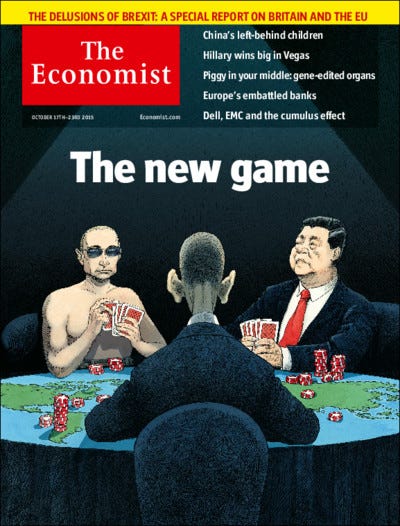
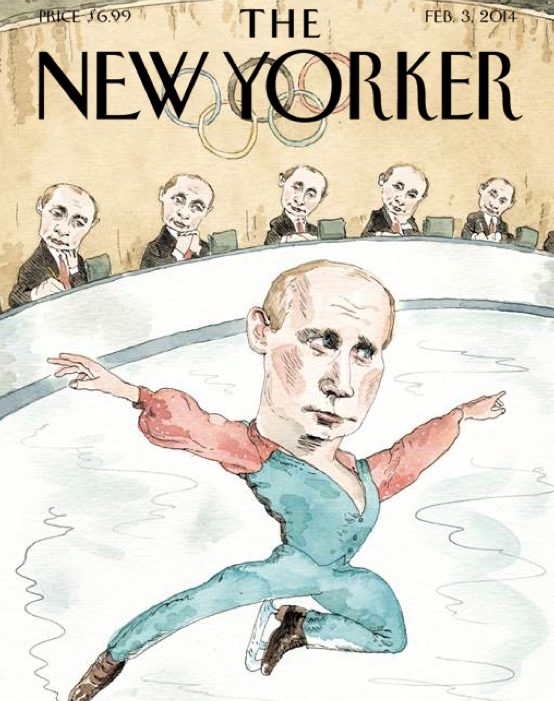
But, if you want an image of Putin, and you also want to keep things classy, how about a mashup of Putin and a classic symbol of Russian culture, like ballet or ice skating? In 2014, The New Yorker pulled off a cover of Putin, pirouetting through the air during the Sochi Winter Olympics, while a bunch of Putin yes-man clones give him top marks for his performance:
And, here’s another cover featuring Putin as an ice skater, this time from The Economist:
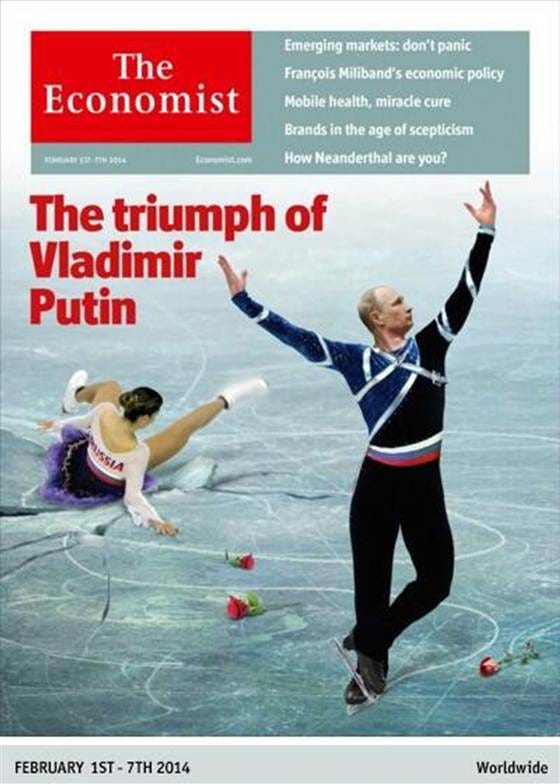
But here’s the twist — note the fallen Russian figure skater on the ice and the suggestion that the Sochi Olympics were basically a giant personal ego project for Putin. (Also note the subtext of the imagery — whereas Putin usually opts for “macho” sports like hunting, swimming and hockey, this cover shows him as a slightly effeminate ice skater. Look at the hands!!!)
OPTION 3: Go with a classic image of Russia, slightly twisted
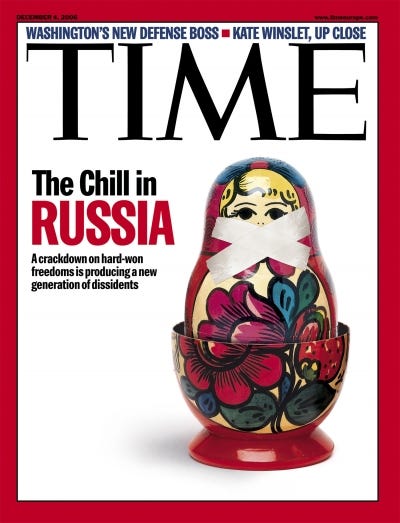
If you’re tired of using the Russian bear image and you’re concerned that putting Vladimir Putin on the cover of your magazine might create a few unsavory possibilities for your editorial team (Russian spies! Russian mafia! Russian hooligans!), there’s the old standby — the matryoshka image. This, of course, conveys the enigmatic nature of Russia — the old “riddle inside an enigma wrapped in a mystery” of Winston Churchill:
But why stop there? To convey the threatening nature of all things Russia, maybe it’s just easier just to come out and show the Russian missiles, tanks, weapons and troops directly:
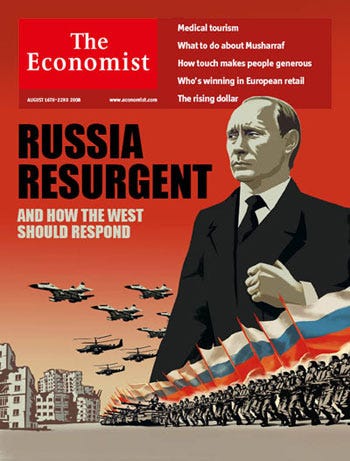
What all these magazine covers have in common, of course, is their Russophobia. These magazine covers are not so much different from the images that appeared a hundred years ago, when Russia really was an enigma unknown to the West. In fact, the image of Russia as a big, clumsy and aggressive state dates all the way back to the 16th century, and not much seems to have changed since then.
There’s always been a sense in Western media circles that a giant power in the middle of the Eurasian landmass posed a threat to someone — and maybe to everyone:
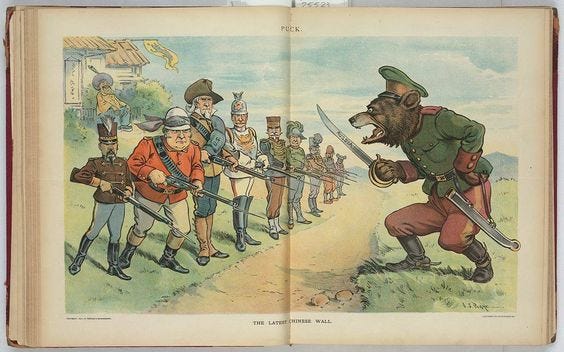
Although, in all fairness, the image of the Russian bear is probably preferable to the image of the Russian octopus:
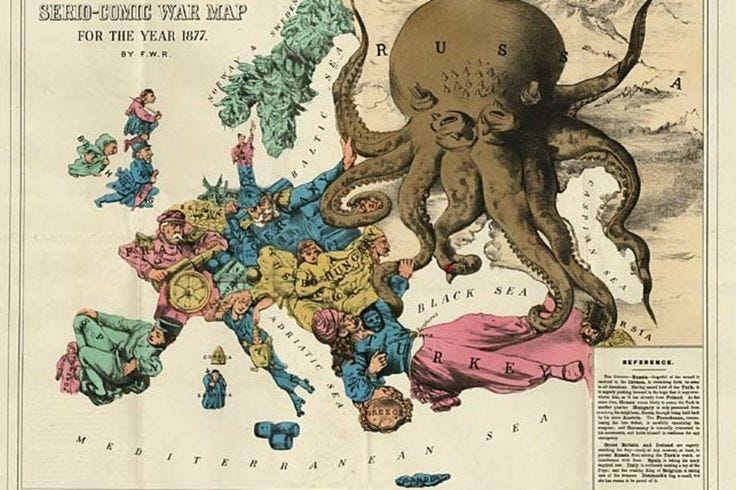
Which leads to the obvious question — Are these images of Russia from 100 years ago really so much different from the images appearing today in Western mass media?
At a time when the Kremlin has called on the Culture Ministry to investigate anti-Russian propaganda and Russophobia in the West, this question isn’t very hard to answer.
Dominic Basulto is the author of the new book Russophobia.
Trigger Warnings, Safe Spaces, Bias Reporting: The New Micro-techniques of Surveillance and Control
By Michael Rectenwald, Ph.D. | Legitgov | September 12, 2016
A singular orthodoxy has infiltrated the discursive parameters of U.S. and other universities and colleges. This orthodoxy now constitutes the ethical vocabulary of academia. Adopted from feminism, anti-racism, and LGBTQ theory and practice, the language, doctrines, and mechanisms of this orthodoxy now dominate academia’s policies, procedures and handbooks. The terminology has become the vernacular among the swelling ranks of administrators, especially the relatively new cohort of chief diversity officers, directors of diversity, associate provosts of diversity, assistant provosts of diversity, diversity consultants, and so on and so on. I refer not merely to the orthodoxy of “diversity,” but in particular to “diversity” initiatives as they are currently administered, using a particular set of policies, procedures, and mechanisms: trigger warnings, safe spaces, bias reporting, and the like.
While ridiculed by media outlets, and, at least where trigger warnings are concerned, disavowed by the American Association of University Professors, nevertheless, American colleges and universities are dominated by this ethos and its collective techne. At the University of Chicago for example, the Dean of Students, John (Jay) Ellison, Ph.D., announced (to the great chagrin of some faculty and many students):
Our commitment to academic freedom means that we do not support so-called “trigger warnings,” we do not cancel invited speakers because their topics might prove controversial, and we do not condone the creation of intellectual “safe spaces” where individuals can retreat from ideas and perspectives at odds with their own…
Yet, the same university has also assembled and maintains a “Bias Response Team,” and “urges anyone who has experienced or witnessed a Bias Incident to report it to the Bias Response Team.”
As it usually happens, any perspective that deviates from this “academic” orthodoxy – or any opposition expressed by faculty members in reasoned commentary or debate about the premises of the creed and/or its techniques – is virtually proscribed in advance. Whether or not they happen to be progressives, left communists, or radicals of another stripe, potential critics rightly fear being figured as right-wing reactionaries opposed to diversity and the confrontation of oppression. Any complaints or criticisms, they fear, would be peremptorily dismissed, and likely circulated among other faculty members within their own universities or in academia at large as gossip, subjecting the critic to ridicule and disrepute.
Indeed, despite the fact that a new form of policing has been surreptitiously introduced into academia at large, one would be hard-pressed to find a single article, essay, or book that subjects the entire administratively controlled apparatuses of “diversity” to any kind of real scrutiny. While innumerable articles have appeared on one or another of these topics (mostly on trigger warnings and safe spaces), no one has explained the structural provenance nor analysed the probable effects of these developments as a whole. Nor has anyone provided a theoretical or historical framework with which to understand them.
Ironically, perhaps, the most clearly appropriate critical theoretic for grasping the structural origins, as well as the social and political implications of this new largely “academic”1 development, can be found within the ambit of postmodern theory itself. The new mechanisms adopted and adapted by academic administrations clearly and incredibly mirror those described in a text widely read within humanities and social science studies courses throughout American universities and beyond. Indeed, it is a wonder that no one has, until now, applied this critique to the mechanisms of this academic creed. Faculty members, graduate students, and even many undergraduates, who have had even the slightest brush with trends in the humanities and social sciences, will know to what I refer here: Michel Foucault’s brilliant 1975 book, Discipline and Punish: The Birth of the Prison. Particularly uncanny is the resemblance of the academic mechanisms in question to the “micro-physics of power” described in the third chapter, “Panopticism.”
In this riveting essay, Foucault effectually describes the transmutation of power from the pre-modern to the modern period. Adducing Jeremy Bentham’s architectural model of the “Panopticon,” Foucault proffers what at the time was an utterly novel understanding of modern “discipline” and control. The new disciplinary mechanisms that Foucault discusses replace the earlier corporeal forms of punishment, such as quartering people in public, or branding them with the crimes they supposedly committed, and so forth. While the Panopticon was first introduced by Bentham as a model of prison, asylum, and school reform, the forms of surveillance and discipline to some extent prefigured by the Panopticon and in some sense preceding it, for Foucault had already metastasized beyond the prison system, becoming the general means of discipline and control in so-called “democratic” societies.
The Panopticon itself is a circular building, in which its subjects – inmates, patients, students, etc. – are arrayed in cells surrounding a central tower. The subjects can be seen at any time by a guard, who may (or may not) occupy the central tower. The captive subjects cannot see into the tower, nor can they see each other. Likewise, they are never certain whether or not they are being observed:
Bentham’s Panopticon is the architectural figure of this composition. We know the principle on which it was based: at the periphery, an annular building; at the centre, a tower; this tower is pierced with wide windows that open onto the inner side of the ring; the peripheric building is divided into cells, each of which extends the whole width of the building; they have two windows, one on the inside, corresponding to the windows of the tower; the other, on the outside, allows the light to cross the cell from one end to the other. All that is needed, then, is to place a supervisor in a central tower and to shut up in each cell a madman, a patient, a condemned man, a worker or a schoolboy. By the effect of backlighting, one can observe from the tower, standing out precisely against the light, the small captive shadows in the cells of the periphery. They are like so many cages, so many small theatres, in which each actor is alone, perfectly individualized and constantly visible. The panoptic mechanism arranges spatial unities that make it possible to see constantly and to recognize immediately. In short, it reverses the principle of the dungeon; or rather of its three functions – to enclose, to deprive of light and to hide – it preserves only the first and eliminates the other two. Full lighting and the eye of a supervisor capture better than darkness, which ultimately protected. Visibility is a trap (Foucault 200).
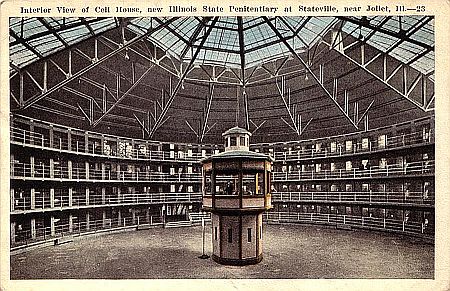
Although the captive individual can never verify with certainty that she is being observed, the very possibility of being observed at any time produces the intended effects of hyper-vigilance and self-circumspection on the part of the subject. As such, the subjects themselves internalize the observer, and effectively monitor and police themselves. As Foucault brilliantly describes the effects of this technological innovation:
He who is subjected to a field of visibility, and who knows it, assumes responsibility for the constraints of power; he makes them play spontaneously upon himself; he inscribes in himself the power relation in which he simultaneously plays both roles [that of observer and observed]; he becomes the principle of his own subjection (203, emphasis added).
Make no mistake, Foucault describes and mobilizes the architectural model of the Panopticon in order to introduce his central argument – in modernity, entire societies are inscribed with, underwritten by, and even predicated upon a generalizable and generalized method of surveillance and control – panopticism. Even the once structure-bound, institution-specific disciplinary techniques as represented so well by the Panopticon have metastasized and traveled well beyond their former institutional borders. They now permeate the entire social body. In fact, in an important section, Foucault discusses “the swarming of the disciplinary mechanisms” of panopticism. The phrasing will invoke for contemporary readers the sentinels in “The Matrix,” the legion of squid-like robots that seek out, locate, and swarm about the escapees from the matrix in sweltering masses.
For our purposes, perhaps the most salient aspect of panopticism is the way that it makes all of its subjects into potential sentinels of surveillance: “We have seen that anyone may come and exercise in the central tower the functions of surveillance” (207). That is, anyone and everyone can be interpellated as a functionary of panopticism. “If you see something, say something” is the mantra that effectively encapsulates this logic. Universities and colleges employ the micro-techniques of power precisely in the fashion described by Foucault.
At this point, I should make clear a parallel between the late eighteenth/early nineteenth-century model that Foucault treats, and the contemporary devices employed in academia and beyond. A point that is often lost on many readers of Foucault’s “Panopticism,” especially those unfamiliar with nineteenth-century British cultural history, is that Jeremy Bentham was not some reactionary, right-wing or even conservative thinker attempting to impose a nefarious, draconian form of discipline and punishment upon the population. In fact, during his time, Bentham was regarded as a radical, what today we would call a “progressive.” Bentham was known as the principle member of an early nineteenth-century group of reformers known as “the philosophical radicals.” As noted in the Encyclopaedia Britannica, he advocated numerous liberal reforms, including “annual elections; equal electoral districts; a wide suffrage, including woman suffrage; and the secret ballot. He supported in principle the participation of women in government and argued for the reform of marriage law to allow greater freedom to divorce.”
My point here is that regardless of the political provenance or original intention of the repertoire of diversity mechanisms, as Foucault makes clear, such methods and techniques, whether introduced initially by reformers for progressive ends or not, can and have often been co-opted by administers of power and wielded to oppressive ends. Likewise, the origin of the new academic instruments or “micro-physics of power” in feminism, anti-racism and LGBTQ discourse and practice in no way exempts them from being employed as mechanisms of surveillance and control.
Academia has co-opted and now brandishes identity-politics and its techniques of micro-power – including trigger warnings, safe spaces, and bias reporting – as means of the disciplining of the subject. Bias reporting lines are examples of the ways colleges and universities are able to enlist everyone within their ambit as sentinels of surveillance, discipline, and punishment. Bias reporting lines and reporting systems encourage everyone to act as an instrument of panopticism, an instrument of self- and other-policing.
In terms of the academy, however, the use of such mechanisms does not represent a perversion of intent. They are coercive as such, by definition. They are part of a growing panoply of micro-techniques of power representing the appropriation and defusing of politics, rather than opposition to the systems of oppression that such politics intend to represent.
These techniques of surveillance and control recall such organizations of the nineteenth century as The Society for the Suppression of Vice, founded in 1802. The only real difference involves what now count as punishable offenses. In the early to mid-nineteenth century in Britain, offenses included the production, distribution and consumption of pornography, as well as expressions of blasphemy, and the like. Today, “vices” and “blasphemies” include real or imagined “micro-aggressions,” or any conceivable displays of “bias,” however absurdly construed. Both regimes, however, are equally religious in character, involving as they do moralistic, individualized, and personalized policing. While both are insidious, only contemporary academic panopticism, operating under the guise of protecting and encouraging “diversity,” is anathema to academic freedom and inquiry, while simultaneously underming any potential for collective agency, or solidarity, among its subjects. Above all, panopticism individualizes.
Meanwhile, and probably most importantly, none of this policing and self-policing will do anything to challenge or overturn systemic oppression in the least. In fact, while serving the ideological function of obscuring the underlying structural inequities, oppression and exploitation of capitalism, they also constitute their own form of oppression.
[1] As Lori R. Price has pointed out, these same mechanisms have metastasized and infiltrated such social media platforms as Twitter, Facebook and YouTube.com.
Michael Rectenwald is a professor in Global Liberal Studies at New York University. He is the author of Nineteenth-Century British Secularism: Science, Religion and Literature (Palgrave Macmillan, 2016), primary editor of Global Secularisms in a Post-Secular Age (De Gruyter, 2015), and primary author of Academic Writing, Real World Topics (Broadview Press, 2015). His essays have appeared in numerous periodicals and anthologies, including the British Journal for the History of Science, Endevour, and George Eliot in Context (Cambridge University Press, 2013).
Phony ‘Corruption’ Excuse for Ukraine Coup
By Robert Parry | Consortium News | November 2, 2016
If Ukraine becomes a flashpoint for World War III with Russia, the American people might rue the day that their government pressed for the 2014 overthrow of Ukraine’s allegedly corrupt (though elected) president in favor of a coup regime led by Ukrainian lawmakers who now report amassing, on average, more than $1 million each, much of it as cash.
The New York Times, which served as virtually a press agent for the coup in February 2014, took note of this apparent corruption among the U.S.-favored post-coup officials, albeit deep inside a story that itself was deep inside the newspaper (page A8). The lead angle was a bemused observation that Ukraine’s officialdom lacked faith in the country’s own banks (thus explaining why so much cash).
Yet, Ukraine is a country beset by widespread poverty, made worse by the post-coup neoliberal “reforms” slashing pensions, making old people work longer and reducing heating subsidies for common citizens. The average Ukrainian salary is only $214 a month.
So, an inquiring mind might wonder how – in the face of all that hardship – the post-coup officials did so well for themselves, but Times’ correspondent Andrew E. Kramer treads lightly on the possibility that these officials were at least as corrupt, if not more so, than the elected government that the U.S. helped overthrow. Elected President Viktor Yanukovych had been excoriated for a lavish lifestyle because he had a sauna in his residence.
Kramer’s article on Wednesday tried to explain the bundles of cash as a sign that “many of the lawmakers and officials responsible for inspiring public trust in Ukraine’s economic and banking institutions have little faith that their own wealth would be safe in the country’s banks, according to recently mandated financial disclosures. …
“Prime Minister Volodymyr Groysman, for example, declared over one million dollars in savings in cash — $870,000 and 460,000 euros — apparently shunning Ukraine’s ever-wobbly banking system. The top official in charge of the country’s banks, Valeriya Gontareva, who is responsible for stabilizing the national currency, the hryvnia, maintains most of her money in American dollars — $1.8 million.
“A tally of the declarations filed by most of Parliament’s 450 members compiled by one analyst, Andriy Gerus, found that the lawmakers collectively held $482 million in ‘monetary assets,’ of which $36 million was kept as cold, hard cash. …
“Some politicians seem to have approached the declaration as a sort of amnesty, revealing everything they have earned from decades of crooked dealings, in an effort to come clean. … One minister reported a wine collection with bottles worth thousands of dollars each. Another official declared ownership of a church. Yet another claimed a ticket to outer space with Virgin Galactic. …
“Another theory making the rounds in Kiev — where people generally acknowledge the inventive, venal genius of their politicians — suggests that the public servants are padding their declarations,” so they can hide future bribes within their reported cash holdings and thus offer plausible excuses for luxury cars and expensive jewelry.
Accessing More Money
Ironically, passage of the law requiring the disclosures of what appears to be widespread corruption among Kiev’s officials unlocked millions of euros in new aid money from the European Union that then flowed to the same apparently corrupt officials.
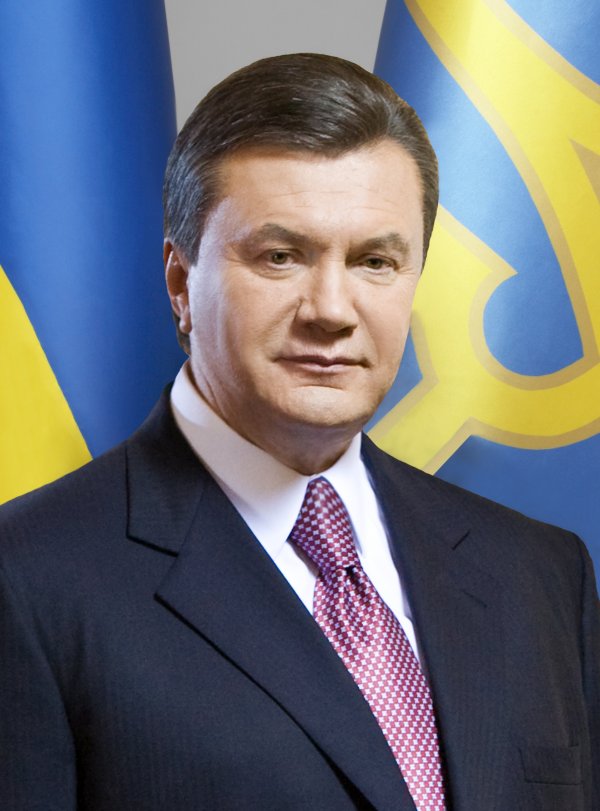
Ousted Ukrainian President Viktor Yanukovych
However, because the Ukraine “regime change” in 2014 was partly orchestrated by U.S. and E.U. officials around the propaganda theme that elected President Yanukovych was corrupt – he had that sauna, after all – the continued corruption in the post-coup regime has been a rarely acknowledged, inconvenient truth. Indeed, some business people operating in Ukraine have complained that the corruption has grown worse since Yanukovych was overthrown.
Yet, only occasionally has that reality been allowed to peek through in the mainstream U.S. media, which prefers to deny that any “coup” occurred, to blame Russia for all of Ukraine’s problems, and to praise the post-coup “reforms” which targeted pensions, heating subsidies and other social programs for average citizens.
One of the rare deviations from the happy talk appeared in The Wall Street Journal on Jan. 1, 2016, observing that “most Ukrainians say the revolution’s promise to replace rule by thieves with the rule of law has fallen short and the government acknowledges that there is still much to be done.”
Actually, the numbers suggested something even worse. More and more Ukrainians rated corruption as a major problem facing the nation, including a majority of 53 percent in September 2015, up from 28 percent in September 2014, according to polls by International Foundation for Electoral Systems.
So, as the hard lives of most Ukrainians got harder, the elites continued to skim off whatever cream was left, including access to billions of dollars in the West’s foreign assistance that has kept the economy afloat.
There was, for instance, the case of Finance Minister Natalie Jaresko, who was regarded by many pundits as the face of Ukraine’s reform before departing last April after losing out in a power struggle.
Yet, Jaresko was hardly a paragon of reform. Prior to getting instant Ukrainian citizenship and becoming Finance Minister in December 2014, she was a former U.S. diplomat who had been entrusted to run a $150 million U.S.-taxpayer-funded program to help jump-start an investment economy in Ukraine and Moldova.
Jaresko’s compensation was capped at $150,000 a year, a salary that many Americans – let alone Ukrainians – would envy, but it was not enough for her. So, she engaged in a variety of maneuvers to evade the cap and enrich herself by claiming millions of dollars in bonuses and fees.
Ultimately, Jaresko was collecting more than $2 million a year after she shifted management of the Western NIS Enterprise Fund (WNISEF) to her own private company, Horizon Capital, and arranged to get lucrative bonuses when selling off investments, even as the overall WNISEF fund was losing money, according to official records.
For instance, Jaresko collected $1.77 million in bonuses in 2013, according to a WNISEF filing with the Internal Revenue Service. In her financial disclosure forms with the Ukrainian government, she reported earning $2.66 million in 2013 and $2.05 million in 2014, thus amassing a sizeable personal fortune while investing U.S. taxpayers’ money supposedly to benefit the Ukrainian people.
It didn’t matter that WNISEF continued to hemorrhage money, shrinking from its original $150 million to $89.8 million in the 2013 tax year, according to the IRS filing. WNISEF reported that the bonuses to Jaresko and other corporate officers were based on “successful” exits from some investments even if the overall fund was losing money.
Though Jaresko’s enrichment schemes were documented by IRS and other official filings, the mainstream U.S. media turned a blind eye to this history, all the better to pretend that Ukraine’s “reform” process was in good hands. [See Consortiumnews.com’s “How Ukraine’s Finance Minister Got Rich.”]
Biden’s Appeal
Worried about the continued corruption, Vice President Joe Biden, who took a personal interest in Ukraine, lectured Ukraine’s parliament on the need to end cronyism.
But Biden had his own Ukraine cronyism problem because three months after the U.S.-backed overthrow of the Yanukovych government Ukraine’s largest private gas firm, Burisma Holdings, appointed his son, Hunter Biden, to its board of directors.
Burisma a shadowy Cyprus-based company also lined up well-connected lobbyists, some with ties to Secretary of State John Kerry, including Kerry’s former Senate chief of staff David Leiter, according to lobbying disclosures.
As Time magazine reported, “Leiter’s involvement in the firm rounds out a power-packed team of politically-connected Americans that also includes a second new board member, Devon Archer, a Democratic bundler and former adviser to John Kerry’s 2004 presidential campaign. Both Archer and Hunter Biden have worked as business partners with Kerry’s son-in-law, Christopher Heinz, the founding partner of Rosemont Capital, a private-equity company.”
According to investigative journalism inside Ukraine, the ownership of Burisma has been traced to Privat Bank, controlled by the thuggish billionaire oligarch Ihor Kolomoysky, who was appointed by the U.S.-backed “reform” regime to be governor of Dnipropetrovsk Oblast, a south-central province of Ukraine (though Kolomoisky was eventually ousted from that post in a power struggle over control of UkrTransNafta, Ukraine’s state-owned oil pipeline operator).
In a speech to Ukraine’s parliament in December 2015, Biden hailed the sacrifice of the 100 or so protesters who died during the Maidan putsch in February 2014, which ousted Yanukovych, referring to the dead by their laudatory name “The Heavenly Hundred.”
But Biden made no heavenly references to the estimated 10,000 people, mostly ethnic Russians, who have been slaughtered in the U.S.-encouraged “Anti-Terror Operation” waged by the coup regime against eastern Ukrainians who resisted Yanukovych’s violent ouster. Nor did Biden take note that some of the Heavenly Hundred were street fighters for neo-Nazi and other far-right nationalist organizations.
But after making his sugary references to The Heavenly Hundred, Biden delivered his bitter medicine, an appeal for the parliament to continue implementing International Monetary Fund “reforms,” including demands that old people work longer into their old age.
Biden said, “For Ukraine to continue to make progress and to keep the support of the international community you have to do more, as well. The big part of moving forward with your IMF program — it requires difficult reforms. And they are difficult.
“Let me say parenthetically here, all the experts from our State Department and all the think tanks, and they come and tell you, that you know what you should do is you should deal with pensions. You should deal with — as if it’s easy to do. Hell, we’re having trouble in America dealing with it. We’re having trouble. To vote to raise the pension age is to write your political obituary in many places.
“Don’t misunderstand that those of us who serve in other democratic institutions don’t understand how hard the conditions are, how difficult it is to cast some of the votes to meet the obligations committed to under the IMF. It requires sacrifices that might not be politically expedient or popular. But they’re critical to putting Ukraine on the path to a future that is economically secure. And I urge you to stay the course as hard as it is. Ukraine needs a budget that’s consistent with your IMF commitments.”
However, as tough as it might have been for Ukraine’s parliament to slash pensions, reduce heating subsidies and force the elderly to work longer, that political sacrifice did not appear to extend to the officials making financial sacrifices themselves.
British Media Wet Their Pants With MI5 Russian Scare Story
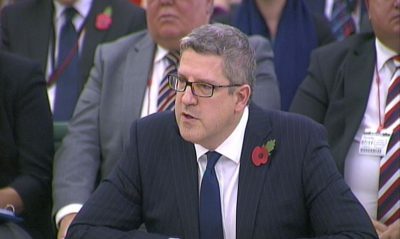
Director-General of security service MI5, Andrew Parker
By Finian CUNNINGHAM | Strategic Culture Foundation | 02.11.2016
The annual festive Halloween holiday is commonly a time for spooky pranks and scare stories. And the British news media delivered – albeit unintentionally it seems. This week several top national newspapers conveyed a stark message from the chief spook at Britain’s secret service, MI5. Andrew Parker, chief of Military Intelligence (Section) 5, warned that Russia was presenting a clear and present danger to the security of the state.
It was The Guardian that first broke the story, with an «exclusive» article on its front page headlined: «MI5 chief warns of growing Russian threat in UK».
With virtually the same headline, the story was replicated in the pages of The Independent, Sun, Daily Mail and Daily Telegraph, among others.
Russia swiftly scorned the British media coverage as fatuous.
However, this was no Halloween prank being played on the British public for kicks. The issue was presented as serious journalism, reporting on a grave matter of national security. The coincidence of the netherworld festival only lends a certain unintended ironical mirth.
More importantly, though, it is one more example of how Western publics are being conditioned by a relentless mental diet of Russophobia. That a host of British newspapers in unison published without question «talking points» from the head of MI5 alleging a threat to national security from Russia is in itself indicative of a «psychological operation». It reflects the abject standard of supposedly independent media in Britain.
The Guardian billed its «exclusive» by saying it was the «first interview given by a serving spy chief». Andrew Parker has been head of Britain’s state security service for the past nine years. Neither he nor his predecessors have ever given such a full-court press briefing.
MI5 was first established in 1909 and serves as Britain’s premier internal state security agency, dealing with counterinsurgency and counter-terrorism. The organization’s MI6 counterpart deals with foreign military intelligence.
The unprecedented public intervention by MI5 this week is again suggestive of a psychological operation.
Moreover, for anyone with a critical faculty, what is bizarre about the latest claims of a Russian «threat» is that despite the gravity and the factual-sounding wording of the headlines, there is a dearth of substance reported to support said claims.
MI5’s Andrew Parker merely makes vague assertions about Russia «pushing foreign policy in increasingly aggressive ways involving propaganda, espionage, subversion and cyber-attacks».
These are the same zero-evidence, breathless assertions that are echoed by American security services and media. The Obama administration citing its own intelligence agencies last month accused Russia of state-sponsored cyber-attacks and interference in the US presidential elections.
Moscow has categorically rejected these insinuations as baseless. Russian foreign minister Sergei Lavrov notes that repeated requests for evidence have been ignored by US authorities. While Russia’s President Vladimir Putin has dismissed allegations of political interference as a cynical «distraction» from real internal American problems.
Another indicator of psychological operation is the way that the alleged Russian threats are packaged as «talking points» which are easily disseminated and regurgitated. After a while, the claims become hackneyed and stale from lack of supporting substance.
The alleged threats which MI5’s Andrew Parker treated the British media and public to have less the ring of truth and more the dull thud of tedium. And yet the British media – like a circus dog – jumped on cue this week to the instruction as if it was something novel and exciting.
How many times have we heard from sundry atlanticist, pro-NATO think tanks warning us about Russian «subversion» or «cyber-attacks» or trying to undermine Western democracies? The level of repetition and coordination of talking-points that we hear from the likes of the Atlantic Council, Center for Strategic and International Studies, the National Endowment for Democracy, NATO, and so on, are reflective of central authorship in state intelligence emanating from the CIA and MI5 / MI6, which in turn feeds into the foreign policy establishments of nominally democratic governments. In short, the Deep State network that transcends Western electoral politics.
Last month at an EU leaders’ summit in Brussels, European Council President Donald Tusk urged the bloc to adopt harsher economic sanctions on Russia, as did the leaders of Germany, Britain and France. Tusk listed a litany of purported Russian malfeasance, including «cyber-attacks, disinformation campaigns, interference in the EU’s political processes» and «trying to weaken the European Union».
Fortunately, Italy, Austria, Spain, Hungary and a number of other European leaders rejected Tusk’s appeal for tougher sanctions on Russia, saying they were counterproductive.
But the point here is that Tusk, supposedly a guiding political light for the EU, sounds more like a hired-hack for the CIA or M15, as ascertained by the trite talking points that he so readily recites about Russian «threats».
The comparison with the briefing given this week to British media by the head of MI5 tends to prove that there is a sinister group-think shared by certain American and European political leaders with unelected Deep State agencies. This relationship as expressed in formulaic Russophobia raises disturbing questions about the true nature of democracy and democratic accountability in Western states. Are the elected leaders following the people’s will or are they following instructions from shadowy agencies whose whole purpose is driven by geopolitical conflict, in particular conflict with Russia?
This perhaps explains why in the US, the Washington establishment and the military-intelligence apparatus appear to be so hostile to Republican presidential candidate Donald Trump. For all his flaws, one thing that can be said to Trump’s credit is that he doesn’t trot out the usual canned talking points manufactured by the Deep State towards demonizing Russia. On that score, he is not a hack, whereas Hillary Clinton has repeatedly toed the Russophobia line.
The Western corporate news media are integral to the political establishment. It is therefore not surprising that senior journalists and editors belonging to media outlets are susceptible to manipulation by state intelligence agencies, either wittingly or unwittingly. Former German newspaper editor Udo Ulfkotte revealed how the CIA infiltrates European journalists to relay the agency’s talking-points to the wider public.
The way that the British media so pliantly provided a platform to the head of M15 this week to disseminate Russophobia is a strong indicator of state-orchestrated propaganda. It speaks of the deplorable lack of independence and genuine public service that the British media conceitedly claim to provide. They are evidently serving as a propaganda device, peddling disinformation whose ultimate logic is to condition the public into accepting hostile policy, and even war with Russia.
That is not journalism. It is flagrant manipulation of public perception on the same level as telling children scary stories about ghouls and ghosts.
But the funny thing is that it is MI5 and all the other spooky agencies of the Western Deep State who are really afraid. What they mean by Russian «propaganda» and «subversion» is that Russian news media are increasingly exposing the systematic deception on numerous world issues that Western media and their intelligence handlers have for too long gotten away with in the pursuit of imperialist interests.
Unable to bear the exposure, Western Deep State creatures are lashing out desperately with scare story upon scare story in order to distract the «children». That’s why Britain’s MI5 came out of its murky swamp of secrecy this week to give a first-ever «exclusive» to the British media. Boo! Boo! Boo! But that power of deception is no longer working.
Admiral Kuznetsov Carrier Group Saved Syria From US Cruise Missile Strikes
Sputnik – 02.11.2016
Moscow’s decision to send a fleet of warships, led by the Admiral Kuznetsov aircraft carrier, to the eastern Mediterranean may have saved the Syrian military from getting bombed by the US, according to military expert Vladimir Evseev.
Speaking at a press conference at the Rossiya Segodnya news agency press center in Moscow, Evseev, the deputy director of Russia’s CIS Institute, pointed out that Washington had only recently considered the possibility of attacking Syrian government forces, using the pretext of a UN report which alleged that Damascus had used chemical weapons.
“We recently lived through a very important milestone which many people did not even notice,” the analyst suggested. “Why was the question raised of the Syrian Army’s alleged use of chemical weapons? The stage was being set for [US] ship-based cruise missile strikes. According to some reports, such a decision was in play… [Western] public opinion was actively being prepared for it.”
But the entry of a major Russian flotilla, led by the Admiral Kuznetsov aircraft carrier, into the Mediterranean may been the essential element needed to cool the Pentagon’s appetites, Evseev added.
“The presence of our ships [between Algeria and Italy] excludes the possible deployment of a similar NATO naval group in the area. Factually, our ships have closed Syria off. The Russian ships did not appear where they are by accident, and eliminated the possibility of launching cruise missiles from that direction.”
The analyst also recalled that earlier, S-300 systems “were deployed in Tartus” with similar goals in mind, given that they are “capable of addressing not only air-based threats, but ballistic targets as well.”
Last week, the contents of a leaked report submitted to the UN Security Council blamed the Syrian government for a chemical attack in Idlib in 2015. Damascus vehemently denied the charges, citing the terrorists’ own regular use of poison gas. Moscow, meanwhile, stressed that more serious evidence would need to be presented before such serious accusations could be leveled.
The US and NATO allies, already engaged in a campaign to demonize Syria and Russia over the fight for Aleppo, used the report to pile on to other charges that Damascus and Moscow were responsible for ‘war crimes’ in their operation to liberate Syria from armed militants and jihadists.
Commenting on the military situation in Syria, Evseev suggested that together with the liberation of Aleppo, the Syrian military and their Russian allies must make it a priority to surround Nusra Front terrorists in Idlib. “The terrorists must be destroyed, but most likely a process of squeezing them out will take place,” he admitted.
If forced to leave Idlib, “the only place for them to go will be Turkey. And here, I would recommend that our Western partners, who currently advise us how to fight in Aleppo, take a moment to think about what will happen to the Idlib militants who end up in Turkey,” the expert noted. “From here, it’s likely that they can then be expected to pay a visit to Europe. This is what Western nations should be thinking about, instead of putting a spoke in the wheel and doing everything possible to interfere in the operation to liberate Aleppo and other Syrian territories.”
As far as the situation in the city of Aleppo is concerned, Evseev stressed that “if we continue to wait and prolong humanitarian pauses, there will be no people left in Aleppo. Without air support, losses are too high. It’s necessary to free the city quickly, and to think less about the West thinks about it.”
Taking a Page from Joe McCarthy
By Robert Parry | Consortium news | November 1, 2016
One trick of the original McCarthyism from the Old Cold War was to take some innocuous or accurate comment from a leader in Moscow — saying something like “poverty is a cruel side of capitalism” or “racism persists in the U.S.” — and to claim that some American reformer who says much the same thing must be a Kremlin tool.
Now, in the New Cold War, we are seeing a similar trend in the way some Democrats and the mainstream U.S. media are citing accurate assessments from Russian President Vladimir Putin and claiming that Republican presidential nominee Donald Trump is somehow in league with Putin for observing the same realities.
A case in point is Tuesday’s editorial in The Washington Post, entitled “The Putin-Trump worldview” (in print) and “Trump and Putin share a frightening worldview” (online). The editorial quotes Putin as “observing that Mr. Trump ‘represents the interests of the sizable part of American society that is tired of the elites that have been in power for decades now … and does not like to see power handed down by inheritance.’”
The Post’s editorial writers then snidely note that “Mr. Putin and Mr. Trump have an uncanny way of echoing each other’s words.”
But that is a classic example of McCarthyistic sophistry. Just because some demonized figure like Putin says something that is undeniably true and an American sees the same facts doesn’t make that American a “Putin puppet” or a “Moscow stooge” or any of the other ugly names now being hurled at people who won’t join in today’s trendy Russia bashing and guilt by association.
Putin is not wrong that many of Trump’s supporters – along with many Americans who backed Sen. Bernie Sanders – are “tired of the elites” that have behaved arrogantly and stupidly for decades. Many Americans also don’t believe that a family’s name should decide who becomes the leader of the United States, whether that be the Bushes or the Clintons.
Indeed, what Putin is saying amounts to almost a truism, yet here is The Washington Post not only suggesting that because Putin is saying something that it must be false but then smearing Trump (or anyone else) who detects the same reality.
Double Standards
The same Post editorial also goes to great lengths to reject any comparisons between the Russian and Syrian government airstrikes on the Syrian neighborhoods of east Aleppo — to root out Al Qaeda-connected jihadists and their supposedly “moderate” rebel allies — and U.S. and Iraqi government airstrikes on the Iraqi city of Mosul under the control of Al Qaeda’s spinoff group, the Islamic State.
Insisting that the two similar operations are nothing alike, the Post’s editors white-out the central role of Al Qaeda in commanding the rebel forces in east Aleppo. While ignoring Al Qaeda’s dominance of those neighborhoods and its terror rocket attacks on civilian areas of west Aleppo, the Post only says, “the rebel forces in Aleppo include Western-backed secular groups who seek only to overturn the blood-drenched Assad regime.”
Note the Post’s characterization that rebel forces “include Western-backed secular groups” rather than an honest admission that those supposedly “secular groups” have served mostly as cut-outs in diverting sophisticated U.S. military weapons, such as TOW missiles, to the jihadist cause, a reality recognized by U.S. military advisers on the ground. [See Consortiumnews.com’s “How the US Armed-up Syrian Jihadists.“]
Many of these supposedly “secular groups” have openly allied themselves with Al Qaeda’s recently rebranded Nusra Front (now called the Syria Conquest Front). This so-called “marbling” of the “moderates” in with the jihadists was one of the sticking points in the failed limited cease-fire in which the Post’s beloved “secular groups” rebuffed Secretary of State John Kerry’s plea that they separate themselves from Al Qaeda.
An intellectually honest newspaper would have at least admitted some of these inconvenient truths, but that is not the modern-day Washington Post with its own “blood-drenched” editors who played a crucial role in rallying support behind President George W. Bush’s 2003 invasion of Iraq under false pretenses.
The Post and its editors have on their hands the blood of hundreds of thousands of Iraqis who died as a result of that illegal aggressive war, but those editors have not suffered a whit for their participation in war crimes. Instead, exactly the same senior editorial-page editors – Fred Hiatt and Jackson Diehl – are still there, touted on the newspaper’s masthead, still misleading the Post’s readers.
By contrast, The Wall Street Journal (of all places) did some serious reporting on the key question of “moderate” rebels allied with Al Qaeda. The Journal reported on Sept. 29: “Some of Syria’s largest rebel factions are doubling down on their alliance with an al Qaeda-linked group, despite a U.S. warning to split from the extremists or risk being targeted in airstrikes. The rebel gambit is complicating American counterterrorism efforts in the country at a time the U.S. is contemplating cooperation with Russia to fight extremist groups.”
If even Rupert Murdoch’s Wall Street Journal can acknowledge this important context, why can’t The Washington Post ?
Dangerous Terrain
But the whipping up of a New Cold War with Russia and the demonizing of Vladimir Putin extend beyond The Washington Post to virtually the entire U.S. political/media establishment which has plunged into this dangerous terrain without any more serious thought and analysis than preceded the Iraq invasion, except now the target for “regime change” is nuclear-armed Russia and this adventurism risks the extermination of life on the planet.
Despite these grave dangers, the Democrats and the Clinton campaign have settled on a strategy of exploiting the New McCarthyism of the New Cold War to discredit Trump through “guilt by association” to Putin even though the two men have apparently never met.
Mostly this New McCarthyism has been used to divert attention from developments threatening to Hillary Clinton’s electoral chances, such as the release of embarrassing emails among Democratic insiders hacked from the personal account of Clinton adviser John Podesta and, since last Friday, the statement by FBI Director James Comey that he has reopened the investigation into Clinton’s use of an unsecured email server because of emails found on a computer in the home of Clinton aide Huma Abedin and her estranged husband, Anthony Weiner.
In the first instance, the Clinton campaign sought to redirect attention from the content of the emails, including the text of speeches that Clinton gave to Goldman Sachs and other financial interests, to the assessment of U.S. intelligence agencies that Russia was probably behind the hack.
‘A Witch Hunt’
In the Comey situation, Sen. Harry Reid, D-Nevada, has sought to counter Comey’s stunning announcement last Friday by calling on the FBI director to also disclose whatever the FBI may have discovered about links between Trump’s aides and the Kremlin.
The New York Times reported on Tuesday that Democrats have raised suspicions about Carter Page, an early-on Trump adviser and former Merrill Lynch banker who gave a speech last summer criticizing the United States and other Western nations for a “hypocritical focus on ideas such as democratization, inequality, corruption and regime change” in Russia and other parts of the old Soviet Union.
Page termed Reid’s efforts to transform a political disagreement into a criminal case “a witch hunt,” a phrase familiar from Sen. Joe McCarthy’s Red-scare investigations of the late 1940s and early 1950s into the loyalty of Americans.
Another Trump adviser caught up in the Democrats’ attempts to smear the Trump campaign over alleged ties to Moscow is Roger Stone. The Times reported that Democrats have accused Stone “of being a conduit between the Russian hackers and WikiLeaks,” which published Podesta’s hacked emails, because Stone has said he had contacts with WikiLeaks founder Julian Assange and seemed to anticipate the damaging disclosures, though Stone has denied any prior knowledge.
An irony from this case of “trading places” – with the Democrats now darkly suggesting Republican ties to Moscow rather than the opposite during the McCarthy era – is that Roger Stone was a longtime associate of the late Roy Cohn, who was the controversial counsel on Sen. McCarthy’s Red-hunting investigations.
Stone derided the Democratic attempts to discredit Trump and himself with claims of ties to Moscow as “the new McCarthyism.”
Despite the irony, Stone is not wrong in his assessment. Rarely in American politics since the dark days of Joe McCarthy have so many unsubstantiated accusations of disloyalty been directed at any major political figure as the Democrats have done to Donald Trump.
In the third debate, Clinton even accused Trump of being a Putin “puppet.” If such a remark were made by Joe McCarthy or his Red-baiting ally Richard Nixon, there would have been understandable outrage. But Clinton’s ugly charge passed without controversy.
Though there are plenty of legitimate reasons to oppose the eminently unqualified Donald Trump for President, Hillary Clinton and the Democrats risk setting in motion dangerous international forces with their promiscuous Russia-bashing. Recognizing the terrifying potential of nuclear war, a more responsible course would be to tone down the rhetoric and address the legitimate questions raised by the email issues.
NYPD to Innocent Business Owners: Give Up Your Rights or Get Shut Down
Institute For Justice | October 12, 2016
When undercover NYPD officers offered to sell stolen electronics to customers at Sung Cho’s laundromat, near the northern tip of Manhattan, Sung never imagined the sting operation could be used as a pretext to shut down his business. But that’s exactly what happened. Attorneys for the city threatened Sung with eviction merely because a “stolen property” offense had happened at his business.
The city presented Sung with a choice: See his business shut down or sign an agreement giving up constitutional rights—including his Fourth Amendment right to be free from warrantless searches of his business. Faced with the imminent closure of his laundromat, Sung had no real choice but to sign.
In New York City today, this experience is all too common. Under New York City’s so-called nuisance eviction ordinance—more appropriately termed a “no-fault” eviction ordinance—residents and business owners can be evicted simply because their home or business was the site of a criminal offense. Under the ordinance, the identity of the criminal offender is irrelevant. You can be evicted because a total stranger (or a friend or family member) decided your home or business was a good place to commit a crime.
City attorneys churn out no-fault eviction filings by the hundreds, relying on form templates and little more than NYPD officers’ say-so that the targeted home or business was the site of a crime. In many cases, the “proof” of the alleged criminal offense is an affidavit from an NYPD officer relaying vague allegations from unnamed confidential informants.
Moreover, under the ordinance, occupants of the home or business can be evicted without any notice. After being summarily evicted, occupants have just days to put together a case to persuade a judge to undo the eviction order.
City attorneys routinely offer to drop these no-fault eviction proceedings if occupants agree to waive their constitutional rights. Some, like Sung, are forced to sign agreements waiving their Fourth Amendment rights. Others are forced to sign agreements barring family members from the home—including family members who have not been accused of any crime.
Now, Sung is joining with other victims of the city’s conduct to bring a federal class action lawsuit challenging the city’s no-fault eviction ordinance. If the lawsuit is successful, past waivers of constitutional rights will be declared unenforceable and, going forward, this practice will be put to an end once and for all.
Democracy Now’s Non-Correction on Nuclear Vote
By Sam Husseini | November 1, 2016
Follow up to my piece ‘Democracy Now!’ Gets Nuclear Ban Vote Totally Wrong:
After I posted my piece on Friday, “Democracy Now!” changed the transcript to read:
The United Nations on Thursday voted overwhelmingly to start talks aimed at abolishing all nuclear weapons. The landmark resolution will see the U.N. convene a conference next year to negotiate a legally binding instrument for worldwide nuclear prohibition. The vote was 123-38, with 16 countries abstaining. [Not supporting the measure] were all nine known nuclear states: China, Russia, France, the U.K., India, Pakistan, Israel, North Korea and the United States.
But this is also incorrect. As I noted in my piece, North Korea in fact voted for the proposal. There has apparently been no on-air correction or pseudo-correction — the following program’s headlines made no mention of the vote.
This is no minor matter. What’s needed is a basic acknowledgement and understanding of the role the U.S. government and NATO play in ensuring the continuation of the nuclear weapons threat. “Democracy Now” is unwilling to make that acknowledgement.
Featured Video

Genocide-linked firm handles Britons’ NHS data
or go to
Aletho News Archives – Video-Images
Book Review
Book review: Boiling Point, How America Brought War to Ukraine
By Tim Kirby | Strategic Culture Foundation | November 14, 2026
Did Vladimir Putin just wake up one day on the wrong side of the bed and decide to invade Ukraine in February of 2022 or is there a lot more to this single decision that has been reshaping the 21st century geopolitical landscape?
Obviously, from the way that I just posed the question you can see that I am on the side that views the causes for the war in Ukraine to be very deep, long-term, historical and consciously nefarious, and most importantly, not from within the halls of the Kremlin. So it was a pleasure to take a look at the book “Boiling Point, How America Brought War to Ukraine” by author Stephen Kinzer, who like myself, also believes that the real reasons behind military conflicts around the world are not what CNN and the BBC have been telling you. The main thesis of this book was stated clearly by its creator; the war “may have been illegal, but it was definitely not unprovoked.” … continue
Blog Roll
 Aletho News
- The 10 Disease Renamings That Rescued the Vaccine
- NATO cancels 2027 leaders’ summit
- IAEA’s politicized use of safeguards undermines its impartiality: Russian envoy
- UK must be ready to strike Russian Arctic – ex-PM
- Fico’s Two Red Lines: Russian Energy and the Next Ukraine Loan
- Thousands rally for banned NATO-skeptic presidential candidate
- Ukraine Settlement and New European Security Architecture Must Go Hand in Hand – Kremlin
- Book review: Boiling Point, How America Brought War to Ukraine
- Israel Revives The ‘Iranian Assassination Threat Against Trump’ Deception In A Desperate Bid To Restart The War
- US rewrites history to dodge blame for illegal war on Iran: Foreign Ministry spokesperson
- If Americans Knew
- An error has occurred; the feed is probably down. Try again later.
- No Tricks Zone
- New Study: Barents Sea Temperatures Were Warmer And Sea Ice Less Extensive In The 1700s Than Today
- German Authorities Start Initiative To Evaluate Public Register For Climate “Disinformation” Spreaders!
- Zonal Asymmetry of Temperature Change in the Antarctic Circumpolar Current
- New Study: The Net Fossil Fuel Contribution To Rising Atmospheric CO2 Has Been Zero For 500 Years
- Germany’s Green Energy Transition Becoming Increasingly Expensive…Another 6 Trillion Euros!
- Sudden Stratospheric Warming, Powerful El Niño Combination May Lead To Extreme Europe Cold, Energy Crisis!
- Two New Studies Find Thwaites Glacier Melt Cannot Be Driven By Human Activity Or A Warming Ocean
- E-Cars Reduce CO2 Emissions By Only 41% Compared To Internal Combustion Engine Vehicles
- Predictions Made By Renowned Climate Professor Over Past Decades Have Been Proven To Be Poor
- New Study Suggests Large Regions Of The Pacific Ocean Have Been Cooling For The Last 80 Years

