Why is a Hong Kong “Activist” in Bangkok?
The New Atlas – October 5, 2016
Joshua Wong’s alleged arrest at a Bangkok airport is portrayed as a slight against “democracy,” yet the US-funded and backed agitator undermines his own principles of “self-determination” by meddling in another nation’s politics.
Thai PBS in its article, “HK democracy activist Joshua Wong detained in Bangkok,” would claim:
Wong, 19, famed for his galvanising role in the city’s 2014 pro-democracy “umbrella movement”, was held as he landed at the airport late Tuesday, his party Demosisto said in a statement, citing a Thai student activist, Netiwit Chotipatpaisal, who was due to meet him.
Wong was invited by Thai student activists to take part at an event marking the anniversary of a military crackdown in October 1976.
Demosisto “strongly condemns the Thai government for unreasonably limiting Wong’s freedom and right to entry, and requests the immediate release of Wong,” the statement said.
What Thai PBS fails to mention is that Joshua Wong and his party, “Demosisto,” are US-funded and directed, and represent Western interests attempting to subvert Chinese control over its own territory of Hong Kong, as well as undermine national sovereignty across the entire Asian region.
Indeed, the entire “Occupy Central” movement, also referred to as the “Umbrella Revolution,” was led by US-backed opposition figures, including Joshua Wong, Benny Tai and Martin Lee, the latter of which was literally in Washington D.C. lobbying for backing just months before the 2014 protest began.
While the US State Department’s National Endowment for Democracy (NED) initially denied it provided any assistance to the movement and denied specifically that Martin Lee served any role in leading the protests despite his Washington visit, NED through its subsidiary Freedom House, would eventually invite Wong, Tai and Lee back to Washington afterwards to award them for role in leading the protests.
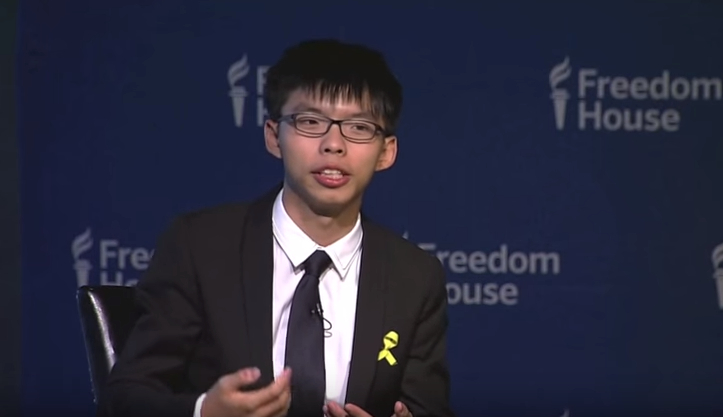 |
Joshua Wong in Washington D.C. attending a US State Department award ceremony held in his and other US-backed agitators’ honor |
At the award ceremony titled, “Three Hong Kong Heroes,” Lee would shuffle onto stage with an umbrella prop in hand, a virtual admission to his leadership role in the protests and confirmation that NED’s previous statement was intentionally false.
Wong’s political party, Demosisto, headed by Nathan Lee, is also tied directly to the US State Department’s NED.
 |
Nathan Law (left) with Carl Gershman of the US State Department’s National Endowment for Democracy (NED) |
Nathan Law in particular was featured on the US State Department’s National Endowment for Democracy (NED) website “World Movement for Democracy” in a post titled, “Democracy Courage Tribute Award Presentation.” In it, NED would write in regards to the award presented to Nathan Lee:
The Umbrella Movement’s bold call in the fall of 2014 for a free and fair election process to select the city’s leaders brought thousands into the streets to demonstrate peacefully. The images from these protests have motivated Chinese democracy activists on the mainland and resulted in solidarity between longtime champions of democracy in Hong Kong and a new generation of Hong Kong youth seeking to improve their city. The Hong Kong democracy movement will face further obstacles in the years to come, and their idealism and bravery will need to be supported as they work for democratic representation in Hong Kong.
The ceremony was yet another in a long line of post-Occupy Central award ceremonies the US State Department conducted, rewarding its proxies for their efforts in the streets of Hong Kong in 2014.
Joshua Wong Was Barred Entry into Malaysia for Similarly Inappropriate Political Pandering
In 2015, Malaysia too would confront Wong and his attempts to spread US-backed subversion across Asia.
That PBS would also report in an article titled, “HK student activist Joshua Wong denied entry to Malaysia,” that:
Immigration officials on Tuesday barred Hong Kong student activist Joshua Wong from entering Malaysia at the Penang International Airport in Bayan Lepas, The Star Online reported.
Wong was scheduled to attend a forum titled “The Uprising of Youth and New Social Activism in Singapore and Hong Kong” at Auditorium A in Komta on Tuesday night.
It is also worth noting that after Wong was denied entry, US-funded organisations posing as nongovernmental organisations (NGOs) immediately took to social media in an attempt to criticise the Malaysian government’s decision.
Malaysian online news service, The Star, in an article titled, “Hong Kong student activist Joshua Wong denied entry to Malaysia,” would further elaborate:
“Malaysia… explain why he is sent back to Hong Kong? Afraid of more street protests,” tweeted Bersih 2.0 chairman Maria Chin Abdullah.
Bersih, like Joshua Wong’s Demosisto, is openly funded by the US State Department and represents Washington’s, not the people of Malaysia’s interests. Bersih would be revealed in 2011 to have received funding and training from the US State Department via the National Democratic Institute (NDI), another NED subsidiary.
Democracy Means Self-Determination, Not Dictates from Washington & its Proxies
It is perhaps ironic that Wong himself and his supporters portray him as a “democracy activist,” considering that one of the central principles of democracy is the concept of self-determination. Self-determination means that a nation’s people themselves determine what course of action is in their best interests, free from the influence of foreign interests.
The concept of self-determination underpins the national identity of many nations across Southeast Asia, having had their respective national destinies dictated to them at various points throughout their history by European colonialism. Independence and self-determination across the region represent hard-fought achievements threatened by US-backed political fronts wielding “soft power” in place of the overt “gunboat diplomacy” practised by the British Empire in days past.
Worse than mere foreign backing, Wong and his Demosisto political party work ceaselessly to promote the parting demands made by British colonial administrators as Hong Kong was returned to China in 1997. These demands, including upholding the “one country, two systems” and “Basic Law” drafted just ahead of the British handover of Hong Kong, are echoed by the current governments of both the United States and the United Kingdom.
Thus, Wong and his political party, Demosisto, work contra to Hong Kong’s self-determination, promoting the parting policy of the British Empire imposed on a still emerging China in 1997.
By Wong meddling in the internal affairs of neighbouring Asian states, attempting to bolster US State Department efforts elsewhere to create proxy political fronts to serve Washington rather than local interests, he is also trampling the concept of regional self-determination, and thus of democracy itself.
In Thailand specifically, Wong sought to support anti-government agitators likewise seeking to subvert Thai sovereignty and return to power political parties loyal to Washington.
Wong’s admirers find among themselves a common denominator of affinity toward the United States and American politics. They believe themselves to be enlightened supporters of freedom, democracy and human rights, despite the reality of US foreign and domestic policy standing firmly against all three of these basic and essential principles.
From the invasion and occupation of foreign nations around the globe, to the detainment and torturing of people worldwide, to the violence and brutality American police deploy against the American population at home, to the invasive abuse of the American people’s right to privacy, American politics in reality exist separately from the ideals cadres of indoctrinated foreigners have been led into believing the US stands for.
Wong and his Demosisto political party and other US-backed political fronts like them, represent a danger to freedom, democracy and human rights, serving as a facade behind which US special interests hide their true, self-serving agenda and all of the abuse that surrounds it. By serving as a facade for foreign interests, merely posing as a proponent of democracy and self-determination, it is Wong and those like him that truly endanger democracy’s future in Asia, not those awaiting him at airports, turning him and his US-backed agitation away.
Follow The New Atlas on Facebook and Twitter.
Boeing casts fresh doubt on Iran deal
Press TV – October 5, 2016
Fresh skepticism springs up about the fate of a deal which Boeing has signed to provide Iran Air with over 80 jetliners after the US aircraft maker says none will be delivered this year.
Since Boeing announced a tentative deal to sell jetliners to Iran in June, US lawmakers have been trying to block it. Under the agreement, Boeing must supply Iran some 80 passenger jets worth $25 billion at price lists.
On Tuesday, Boeing Chief Executive Officer Dennis Muilenburg said while the two sides were making progress on the deal, no deliveries would take place this year.
“We won’t deliver any aircraft under that deal this year – these are deliveries that are a year, two, three downstream,” Muilenburg told reporters on the sidelines of a conference in Chicago on future technologies.
Boeing’s deal is similar to another provisional agreement which Iran Air has signed with Airbus to get 118 jetliners from the European aircraft maker.
However, no formal contracts have been signed yet, meaning all of these deals could fail, given the volatile dynamics of the West’s relations with Iran.
Presidential election factor
The tentative deals have already hit a speed bump because major global banks are refusing to handle transactions with Iran for fear of running afoul of US sanctions on the country.
One major roadblock was lifted last month when the US government granted Airbus and Boeing permission to sell aircraft to the Islamic Republic.
Some Iranians, however, believe the US is most likely to put up new hurdles even if it does not scrap the deal entirely.
They are disheartened by what the next presidential elections in the United States might have in store for the patchy relations between Tehran and Washington. Both current US presidential candidates are expected to adopt a much stricter line than President Barack Obama toward Iran.
Another detracting factor which could scupper the deals is opposition from the US Congress.
The US House of Representatives has already passed a motion to block the Boeing deal, with further measures proposed in Congress to bar certain transactions by US financial institutions connected to the export of aircraft.
If the proposed bills to restrict the deal become law, they would also affect other companies’ sales to Iran, including those by Airbus.
Looking for new options
Last month, Iran indicated that it was cutting the Airbus deal by six aircraft and clipping the contract with Boeing by one jet.
Reports also have it that Iran Air has been cooling towards the purchase of 12 A380 superjumbos that were part of the provisional deal.
Iranian airlines, meanwhile, are looking for other options. They have approached smaller aircraft manufacturers which they believe are easier to deal with.
Tentative deals have been signed with France’s ATR and Brazil’s Embraer, while Japan’s Mitsubishi and China’s Comac have held talks with Iranian aviation companies.
Such developments have taken the shine off the deals with Airbus and Boeing – the biggest for Western aviation companies in Iran since the Islamic Revolution in 1979.
However, neither of the two airline behemoths wants to lose one of the last untapped aviation markets in the world.
On Tuesday, Muilenberg described Iran “significant opportunity for us.”
“And I’m pleased to see that we’re making steady progress,” he said, adding Boeing was “in the final stages of working through the deal structure with our customers in Iran” while also working through the US government licensing process.
Clinton or Trump: Who is better for Africa?
By Yash Tandon | PAMBAZUKA NEWS | September 29, 2016
Clinton is part of the Establishment. It is part of her inheritance to provoke wars and control the world in league with global corporations. Nobody knows what lies behind Trump’s mask. May be he wants to “knock the shit” out of the Establishment. May be he is a “narcissist character” seeking reward in the short run. But no one who seriously cares about Africa’s liberation from Empire would support Clinton.
Sometimes it helps to start an essay with a quote that sums up one’s position. Here is one from the English philosopher Bertrand Russell that defines my position: “A man without a bias cannot write interesting history – if indeed such a man exists.”[i] Indeed, no such person exists in the field of human sciences. So let me declare my bias upfront. I have no love for either Clinton or Trump, but as a “biased” African I’d rather have Trump than Clinton.
The Establishment
The American historian Carroll Quigley wrote a little known but brilliant book in 1949 titled The Anglo-American Establishment: From Rhodes to Cliveden.[ii] Quigley explains how men of the Empire like Cecil Rhodes, Alfred Milner, Lionel Curtis, Robert Brand and Adam Marris strategised to control the world; how they deliberately provoked wars – such as the Jameson Raid and the Boer War in South Africa leading to the British colonisation of South Africa. He also documented how they created the British Commonwealth of Nations, the Institute of Pacific Relations, and the US Council on Foreign Relations.
This is the “Establishment”. Rhodes died in 1902, but the Anglo-American Establishment lives on and has mutated over time. Now it is represented by the global corporations that effectively control the world’s major resources (gold, diamonds, oil, etc.), banks including financial services, and the institutions of global governance (such as the IMF, the World Bank and the World Trade Organisation).
Clinton is part of the Establishment. It is part of her inheritance to provoke wars and control the system in league with global corporations. To date Clinton has raised a total of $446.4 million, and Trump of $137.3 million, of which Clinton has spent $349,6m and Trump $96.7m. Clinton’s money comes almost entirely from the Establishment whereas Trump’s largely from his own resources.[iii] Clinton is still refusing to release the transcripts of three paid speeches she gave in 2013 at a Goldman Sachs event. The speeches collectively netted her $675,000.[iv]
Clinton and Henry Kissinger
The Clintons are very close to Kissinger both in personal life and ideologically. They often spend vacations together. [v] But more than that Hillary regards Kissinger as her mentor, her Guru.
The person who defines Kissinger’s realpolitik ideology best is Bernard Lewis, the well-known “expert” on Middle Eastern and Islamic studies. His advice to the West, stripped of scholarly veneer, and in contemporary terms, is quite simple: fight proxy wars in Iraq, Afghanistan, Libya, Somalia, and the global South – employ agents instead of our own soldiers; manipulate the media to provide “truths” to the masses; use money to buy people, buy governments, buy entire nations; and keep the wolf (read Putin) out of the door.[vi]
Kissinger walked the talk of Lewis during the “Cold War” (by the way, always put the Cold War in inverted commas; it was “cold” for them; for Africa – Algeria, South Africa, Mozambique – it was hot). In 1975 during a conversation with the US ambassador to Turkey and two Turkish and Cypriot diplomats, Kissinger admitted of illegally supporting the military junta in Spain, Greece, and Brazil. He told his hosts that he “worked around” an official arms embargo then in effect. Also, the US exempted the military government in Brazil from crimes of torture to allow it to receive US aid. These post-facto revelations are now documented and released by whistleblowers Assange, Manning, and Snowden (check the internet). See the video Hillary Clinton does not want you to see.[vii]
It is not surprising therefore that in the US Democratic presidential debates Kissinger’s ghost sprung up like, in Shakespeare’s play Hamlet, lurking behind Hillary Clinton (“Prince” Hamlet). During a debate on foreign policy, Bernie Sanders, the candidate contesting Clinton, referred to Clinton’s close relations with Kissinger. “I happen to believe”, he said, “that Henry Kissinger was one of the most destructive secretaries of state in the modern history of this country.” He cited “the secret bombing of Cambodia during the Vietnam War as a Kissinger-orchestrated move that eventually led to genocide in that country.” [viii]
Clinton, following Kissinger, is an imperial jingoist. Under Clinton as Secretary of State the US and NATO went well beyond their UN Security Council mandate in the Libyan war. The end of the war was the gruesome death of Gaddafi cornered in a hell-hole. Clinton on viewing this remarked with characteristic cynicism: “We came, we saw, he died”. Here is another YouTube video Hillary would not want you to see.[ix] I was shocked when I saw this display of total cynicism and psychic lack of compassion. She is the “war candidate” of the Establishment, and has made her intentions amply clear in relation to Iran, Gaza/Palestine, Syria … and if she has her way, Russia and China.
Trump, the Ogre with a big mouth
In Trump, the Americans have a Presidential candidate who has gone out of his way to be distasteful. He is regularly depicted with a dog’s face in the American Establishment media. And for sure, he has said nasty things about the Muslims, immigrants, Mexicans, Africans – in fact, anybody who comes in his way. “I knocked the shit out of her on Twitter and she never said a thing about me after that”, he said of one of his detractors. “I really like Nelson Mandela”, he said on another occasion, “but South Africa is a crime ridden mess that is just waiting to explode – not a good situation for the people!” [x] On the Black Lives Matter Movement he said:
“There’s no such thing as racism anymore. We’ve had a black president so it’s not a question anymore. Are they saying black lives should matter more than white lives or Asian lives? If black lives matter, then go back to Africa. We’ll see how much they matter there.”[xi]
Trump is criticised for being neurotic. The American journal, The Atlantic (June, 2016) did an article on him by Dan McAdams titled “The Mind of Donald Trump”. Among other things, McAdams says that Trump is an extrovert, “exuberant, outgoing and socially dominant” narcissist character. The cardinal feature of extroversion is “reward-seeking in the short run”.[xii]
But, nobody can deny that he defeated 16 other Republican contenders. In the end he got nominated as the Republican Party candidate. The Party is now distancing itself from him and trying, instead, to focus on winning seats in the Congress rather than backing Trump. But Trump marches on regardless, with his controversial off-the-cuff and “politically incorrect” innuendos against the Establishment, galvanising the youth who are sick and tired of the yawning divide between the rich and the poor in America.
The British paper the Guardian explains the “great paradox” of American politics that holds the secret of Trump’s success:
Trump is an “emotions candidate”. More than any other presidential candidate in decades, Trump focuses on eliciting and praising emotional responses from his fans rather than on detailed policy prescriptions. His speeches – evoking dominance, bravado, clarity, national pride, and personal uplift – inspire an emotional transformation. Then he points to that transformation. Not only does Trump evoke emotion, he makes an object of it, presenting it back to his fans as a sign of collective success…. His supporters have been in mourning for a lost way of life. Many have become discouraged, others depressed. They yearn to feel pride but instead have felt shame. Their land no longer feels like their own. Joined together with others like themselves, they feel greatly elated at Trump’s promise to deliver them unto a state in which they are no longer strangers in their own land.”[xiii]
I’m waiting to buy “Strangers in Their Own Land: Anger and Mourning on the American Right” (to be published in October, 2016) in which the author, Arlie Hochschild, goes on a reflective expedition from her liberal hometown of Berkeley, California, deep into Louisiana bayou country – a stronghold of the conservative right – exposing America’s ever-widening gap between the rich and the poor, the right and left.[xiv]
This is what probably explains why Trump is trouncing the Establishment.
Conclusion
The truth is that nobody knows what lies behind Trump’s mask. May be he wants to “knock the shit” out of the Establishment. May be he is a “narcissist character” seeking reward in the short run. Whatever he is, he has put the Establishment – both Republican as well as Democrats – in a quandary.
Trump has raised questions the people of America should have asked a long time ago. Why is the youth in America angry with the Establishment? Why is the American foreign policy such a disaster?
Trump might make peace with Russia and China. For Africa, this is good. The continent does not wish to be dragged into another proxy war like during the “Cold War”.
Trump shocked the Establishment when he said that if he were president, the US might not come to the defence of an attacked NATO ally that hadn’t fulfilled its “obligation to make payments.”[xv] Africa should urge him to go further – NATO should be dismantled like Russia did with the Warsaw Pact. NATO is a danger to world peace.
Trump has come out openly against trade and investment agreements like the Trans Pacific Partnership (TPP) and The Transatlantic Trade and Investment Partnership (TTIP). On TPP he said, “The deal is insanity … That deal should not be supported and it should not be allowed to happen.”[xvi] Africa has, ALSO, come out against these mega-trade agreements, driven by American mega corporations.
Trump might scrape AGOA (African Growth and Opportunities Act) which is all about serving America’s, not Africa’s, interests. Trump could also scrape Obama’s “Power Africa” initiative. It is a $7 billion plan to facilitate American corporate investments in Africa. Africa needs to be liberated from these tools of the American empire.
Trump has criticised the notion of “exporting democracy” to the countries of the South saying it is not the business of America to tell Africa how to run their countries. Exactly.
Trump and Jeremy Corbyn – the Labour Party leader in the UK – though poles apart politically, have one very significant thing in common. They are both harangued by the mainstream media and the established order in their respective countries. Like Trump, Corbyn is under attack not only by the Conservatives but also by the Establishment in the Labour Party spearheaded by the Parliamentary Labour Party.
Africa has for centuries (during slave trade and later through colonisation) been victim of the Establishment. Both Corbyn and Trump have an impressive backing from the youth of their countries. Why? Because they too, like the masses in Africa, are bitter against the dominant global order. We may not connect with Trump, but he could open space for us to establish solidarity links with the people in America, especially the youth, who too are suffering from the oppression of the Establishment warlords.
Conventional wisdom holds that a known devil is better than an unknown angel. Of course, Trump is no angel. But in this instance, and from an African (and possibly third world) perspective, Trump as an unknown devil is far better than Hillary Clinton, the known devil.
* Yash Tandon is from Uganda and has worked at many different levels as an academic, teacher, political thinker, a rural development worker, a civil society activist, and an institution builder. His latest book is Trade is War.
END NOTES
[i] http://www.azquotes.com/quote/524658
[ii] Carroll Quigley (1981). The Anglo-American Establishment: From Rhodes to Cliveden. New York: Books in Focus
[iii] http://www.bloomberg.com/politics/graphics/2016-presidential-campaign-fu…
[iv] http://africasacountry.com/2016/03/hillary-clinton-goldman-sachs-and-afr…
[v] http://www.motherjones.com/politics/2016/02/hillary-clinton-kissinger-vacation-dominican-republic-de-la-renta
[vi] President Obama, who carries the Clinton flag, condemned Trump for admiring Putin and appearing on RT, the Russian television. http://www.huffingtonpost.com/entry/obama-trump-putin_us_57d84156e4b0fbd…
[vii] https://www.youtube.com/watch?v=vczoazK1mxU
[viii] http://www.salon.com/2016/02/12/sanders_proudly_declaring_kissinger_is_n…
[ix] https://www.youtube.com/watch?v=5484y_Jythk
[x] https://www.google.co.uk/#q=Trump+on+Mandela
[xi] http://www.celebtricity.com/donald-trump-if-black-lives-dont-matter-then…
[xii] http://www.theatlantic.com/magazine/archive/2016/06/the-mind-of-donald-trump/480771/
[xiii] https://www.theguardian.com/us-news/2016/sep/07/how-great-paradox-americ…
[xiv] https://www.amazon.co.uk/Strangers-Their-Own-Land-Mourning/dp/1620972255
[xv] http://www.theatlantic.com/international/archive/2016/07/nato-trump-russ…
[xvi] http://www.breitbart.com/big-government/2015/11/09/exclusive-donald-trum…
* THE VIEWS OF THE ABOVE ARTICLE ARE THOSE OF THE AUTHOR AND DO NOT NECESSARILY REFLECT THE VIEWS OF THE PAMBAZUKA NEWS EDITORIAL TEAM
* Please do not take Pambazuka for granted! Become a Friend of Pambazuka and make a donation NOW to help keep Pambazuka FREE and INDEPENDENT!
* Please send comments to [email=editor@pambazuka.org]editor[at]pambazuka[dot]org[/email] or comment online at Pambazuka News.
Making Al-Qaeda propaganda for Pentagon: Ex-PR worker describes secret campaign to RT
RT | October 4, 2016
A former employee of the UK PR firm that was hired by the Pentagon to create fake terrorist videos in Iraq told RT that he arrived thinking he would be working with media agencies, but ended up creating materials for a secret propaganda campaign instead.
Bell Pottinger’s staff was stationed inside a highly secured US military and intelligence HQ at Camp Victory in Baghdad.
“The arrival there [in Camp Victory in Iraq] was quite a shock… very very, I guess, distressing, really… You just felt you as if you didn’t know what was going to happen,” Martin Wells, a former employee of Bell Pottinger who worked for the US military in Iraq from 2006 to 2008, told RT.
The news that the Pentagon had paid Bell Pottinger over half a billion dollars to create fake terrorist videos in Iraq hit the headlines on Sunday when it was divulged by the Bureau of Investigative Journalism, which had received the information from Wells.
Wells says that he was initially told that he would be working on news.
“As it transpired, it was news, but not news as I expected. I expected it to be doing stuff for news agencies such as yourselves and Reuters. And just providing footage for them,” he said.
However, the reality turned out to be quite different from what the video editor had anticipated. Wells said that when he arrived at his workplace, he was introduced to the American intelligence staff there.
“I still at that point had no idea what I was doing, but I knew as soon as I walked through that door I certainly wasn’t doing news… Then, later as I went through… and worked out what I was actually doing, it transpired that it was essentially… a form of propaganda.”
The media was set completely abuzz when it was revealed that the Pentagon had paid Bell Pottinger $540 million for contracts from 2007 to 2011, with another contract for $120 million signed in 2006. The firm ended its work with the Pentagon in 2011.
Bell Pottinger is known for serving an array of controversial clients, including the Saudi government and Chilean dictator Augusto Pinochet’s foundation.
The firm reported to the CIA, the National Security Council, and the Pentagon on the project, with a mandate to portray Al-Qaeda in a negative light and track suspected sympathizers. Critics claim, however, that the videos may have actually promoted the terrorists’ agenda instead.
The Bell Pottinger operation, which began soon after the US invasion of Iraq, was tasked with promoting “democratic elections” for the administration before moving on to more lucrative psychological and information operations.
The firm created television ads showing Al-Qaeda in a negative light, as well as content which looked as though it had come from “Arabic TV.” The videos were created to play on Real Player, which needs an internet connection to run. The CDs were embedded with a code linked to Google Analytics that allowed the military to track the IP addresses the videos were played on.
They would also craft scripts for Arabic soap operas in which characters would reject terrorism with favorable consequences. The firm also created fake Al-Qaeda propaganda videos, which were then planted by the military in homes that they raided.
“In terms of the [fake Al-Qaeda] VCDs, I was the only one, who while I was there, cut those. Nobody else was tasked with those because I was running the department. The footage was also given to us, and it was genuine Al-Qaeda footage that they’d shot, and we then repurposed this for our footage to put on the VCDs and then went out and dropped them,” he explained.
“Most of the stuff we did went out on local news, on national news, and would be broadcast in different countries in the region. But the VCDs were targeted at Al-Qaeda themselves. That was used by marines – left of raids amongst a bunch of VCDs people had been using anyway. If you watched that when it opened up, it was on a player that was linked to an analytical site, so wherever in the world you watched it, it could be tracked. So you’d know where it was played, and the IP address would flash up, so you’d basically know who had watched it,” he said.
US-led air raid kills 20 Iraqi pro-government fighters
Press TV – October 5, 2016
At least 20 Iraqi pro-government fighters have been killed when the US-led coalition targeted their position near the militant-held northern city of Mosul, media reports say.
A local source, speaking on condition of anonymity, said the US-led military aircraft struck a building in the Kharaeb village of the al-Qayyarah region, located approximately 300 kilometers north of the capital, Baghdad, on Wednesday morning, leaving 20 Iraqi tribal fighters dead and five others injured, Arabic-language Shafaq news agency reported.
The source added that the fighters were members of a clan led by a tribal elder identified as Sheikh Nazhan Lahibi.
The pro-government forces had reportedly gathered at the site when the aerial attack took place.
Last December, over 20 Iraqi soldiers were killed and 30 injured in an air strike carried out by the US military.
Head of the Iraqi Parliament’s Security and Defense Committee, Hakim al-Zamili, said the incident took place near the town of al-Naimiya in the western province of Anbar after Iraqi government forces had liberated “a strategically important area” from Takfiri Daesh militants.
The United States and some its allies have been carrying out air strikes in Iraq since June 2014 allegedly targeting Daesh terrorists in the northern and western parts of the conflict-plagued Arab country.
Gruesome violence has beleaguered the northern and western parts of Iraq ever since Daesh extremists mounted an offensive there more than two years ago, and took control of portions of Iraqi territory.
Iraqi army soldiers and fighters from allied Popular Mobilization Units are trying to win back militant-held regions in joint operations.
Humanitarians for War: Language and the New Orientalists
By Alex Ray | OffGuardian | October 5, 2016
A UK House of Commons inquiry into the 2011 attack on Libya and the country’s subsequent collapse has found what many suspected: NATO and its Gulf Arab allies used their ‘Responsibility To Protect’ to launch their attack even though:
“… the proposition that Muammar Gaddafi would have ordered the massacre of civilians in Benghazi was not supported by the available evidence.”
Though the MPs’ damning report blames Libya’s political and economic collapse on former Prime Minister David Cameron, the manipulation of public opinion to lay the basis for war is built upon longstanding – but now sharpened – processes and semantic structures that prepare populations to accept punitive action against a targeted ‘other’.
In an earlier example, on October 10 1990, a young Kuwaiti woman known as ‘Nayirah’ testified before the United States’ Congressional Human Rights Caucus that invading Iraqi soldiers had gone into hospitals and thrown babies from their incubators.
Nayirah turned out to be the daughter of the then Kuwaiti ambassador to Washington. Her testimony was false and prepared by a PR company. But it was solid gold for the US campaign to intervene militarily. Amnesty International provided influential support for Nayirah’s story. The ‘depravity’ of Saddam Hussein’s government was proffered by governments and mainstream media as a key reason for military intervention.
In March, 2011, Libyan opposition fighters and a Libyan psychologist, Dr Seham Sergewa told foreign media that pro-Qaddhafi fighters were being ordered to carry out viagra-fuelled mass rapes. The claim – spread by Al-Jazeera – was this time picked up by the prosecutor of the International Criminal Court, Luis Moreno-Ocampo. Although Amnesty International questioned some of the claims this time, the rape story was one of many myths that contributed to the NATO bombardment of Libya – the beginning of the end of the Libyan state.
The ‘humanitarian’ battle cry of 2011 was another manifestation of neo-Orientalist rhetoric directed towards out-of-favour leaders or groups.
Edward Said’s “Orientalism” referred to Western stereotyping of Arabs and Arab culture through a colonial lens. Currently, Neo-Orientalism is typically based on sensational claims that target ‘others’ (leaders or groups) by depicting them as intrinsically alien, evil and irrational, in order to justify aggression against them.
Qaddhafi’s relationship with the West was full of moments that prepared us to unquestionably accept claims of his barbarity – to the extent that Hillary Clinton could mock his torture and murder by rebels.
Regardless of his positive and negative attributes, the language used to describe Qaddhafi – a son of peasant goat herders – was often insulting and unprofessional. Journalist and historian Gwynne Dyer for example: “
… resplendent in the gold brocade robes that he probably made from his mother’s curtains and wearing his usual bug-eye sunglasses… The world’s oldest teenager…”
The New York Times treated Qaddhafi’s international visits featuring his bedouin tent as a circus fit for New York’s Coney Island rather than an important cultural symbol of Libya’s or Qaddhafi’s heritage. One wonders whether anyone would dare attempt similar treatment of Australia’s Aboriginal Tent Embassy which has been a feature of the capital Canberra since 1972.
There were numerous stories of the ‘chauvinistic’ displays of Qaddhafi’s ‘Amazonian’ republican guard. However ‘Amazonian’ legends of powerful female bodyguards have a long history in North Africa and especially Libya. Greek mythology – the source of Amazonian legends – speaks of Queen Myrina the Amazonian queen who led military victories in Libya. Under Islam there was the wealthy and powerful King Musa I of Mali, who was protected by such an Amazonian troop while undertaking the Hajj in 1332. It seems not a single commentator bothered to note the antecedents of such symbolism before resorting to ridicule.
It is not only the media and politicians who join the neo-Orientalist derision of disagreeable leaders. Descriptions of Qaddhafi in Harvard professor and historian Roger Owen’s recent work The Rise and Fall of Arab Presidents for Life, exhibit shades of cultural superiority. After indulging in psychological speculation about Arab leaders, Owen (p.199) criticises Qaddhafi’s relationship with the African Union particularly his “bringing African heads of state to Libya and posturing before them in ‘African’ costumes of his own design with absurd-looking little round caps”.
Aside from Owen’s dismissal of the African Union, he sees no irony in ridiculing Qaddafi for doing exactly what the leaders of the world’s most powerful countries do at APEC and G20 meetings – put on ‘absurd’ cultural uniforms like the imagined Australian stockmen’s outfits worn by APEC leaders in Sydney in 2007:

John Howard and George W. Bush at APEC in Sydney 2007, Source: The Guardian
Owen depicts Arab governments as wholly subject to the whims of a strongman leader. While the West – and sometimes Arab leaders themselves – like to portray authoritarian governments as ruled by maniacal and all-powerful men individually, this is rarely the case – especially in Libya as demonstrated by this Wikileaks cable showing disagreements amongst the Libyan leadership.
Such systems are far too complex to be overseen by one person. As Oxford Professor Richard Bosworth argues, in addition to clouding other factors involved in the operation of such states, judgemental and presumptive treatments such as Owen’s tend to dismiss leaders as mad and evil which prevents comprehensive understanding.
The terminology of ‘regimes’ and ‘governments’ is another rhetorical tool aimed at demonising chosen targets. ‘Regimes’ sound all controlling, mechanical and despotic while ‘governments’ sound rational, responsive and civil. But as academic Lisa Anderson has pointed out the term ‘regime’ is widely misused. A regime is the: “set of rules, or cultural or social norms that regulate the relations between ruled and rulers. Including how laws are made and administered and how the rulers are themselves selected”. As such regimes come in types, Totalitarian, Authoritarian, Democratic etc.
A ‘government’ on the other hand “comprises those incumbents and the policies associated with them”. Referring to the ‘Qaddhafi Regime’ or ‘Mubarak Regime’ is a problematic conflation of regime type, government and the actors involved in it. Applying the same conflation to Western governments would result in labels like ‘Obama regime’.
‘Orientals’ or just the non-compliant?
Neo-Orientalist language cannot be explained away as a reaction to brutality. If a leader’s brutality was the benchmark for engaging in this form of vitriol, it could be just as easily applied to every US President.
Rather the point of this type of language is to de-legitimise and de-humanise or barbarise a targeted ‘other’. Neo-Orientalist language has (mostly) retreated from typecasting entire civilisations – as this has become less acceptable among western audiences – and has retreated to depictions of individual leaders, sub-groups or sub-ideologies.
Those selected, most commonly for their ‘uncooperative’ international behaviour, are not worthy of engagement or understanding, simply of fear and loathing. The use of violence against such ‘irrational’ forces becomes legitimate and ‘just’.
The language of neo-Orientalism takes many guises, from the ‘war on terror’ to ‘humanitarian intervention’ and has been so successful in cloaking itself in ‘liberal’ values that it attracts support from across the political spectrum.
As Robert Irwin pointed out in his 2006 critique of Edward Said’s Orientalism, the expression of ‘Orientalist’ language does not need to be limited in time (to the European colonial period) or place (the Arab world). By seeking to solely link Orientalism to the European and American imperial ages Said confused and understated the breadth of his argument. Orientalism was not limited to ‘the Orient’, but was and is directed at other groups – both ethnic and political.
For example, western media treatment of Russian President Vladimir Putin also involves ridicule of both cultural symbolism and psychological state.
According to Vox News and Angela Merkel, Putin’s machismo is a cover for “personal insecurity as a weak leader” and is responsible for his “invasion of Ukraine”. We are also told Putin’s ‘machismo’ and ‘aggression’ is the cumulative embodiment of Russian shame and weakness. Merkel was quoted as saying “Russia has nothing, no successful politics or economy. All they have is this [machismo].”
Without delving into to the possible objections to this account, why is Putin’s ‘aggressive’ behaviour seen as a unique flaw in individual and national character? What about the destruction that the United States wrought following the ‘injury’ to the American ego that was September 11? What about the UK’s war of indignation in the Falkland Islands? With the same logic and tone one could posit that the entire British colonial age was a result of ego issues within the ‘lonely little island in the North Sea’.
What of Hillary Clinton’s psychological state or the culture she embodies? Sold as the ‘normal’ presidential candidate, this is the woman who mocked Qaddhafi’s death with “We came, we saw, he died…” and seems to carry no baggage from the destruction of a country on almost entirely false pretences.
One persuasive critic of neo-Orientalism, Alastair Crooke, identifies it as a manifestation of a Western mindset of dominance in the present era. “
… this is the new racialism… a hierarchy of civilisations in which the West sees its civilisation as the most appropriate one for the future… superior and the template that should be imposed on others…”
Status quo powers deploy much effort and money to explain their transgressions but most are based on the simple assumption that equal standards do not apply; we are ‘rational’ and ‘just’, they are not.
Alex Ray works on cultural exchange between the West and the Arab world. Based in Jordan, he holds a MA in Middle East and Central Asian Studies from the Australian National University and is a former student of the University of Damascus. He writes at https://betweendeserts.wordpress.com/
Why Deterring ‘Unprecedentedly Terrible Nuclear Attacks’ Is Now on the Pentagon’s Agenda
By Yuriy RUBTSOV | Strategic Culture Foundation | 05.10.2016
Speaking at Minot Air Force Base (North Dakota) on Monday, US Defense Secretary Ashton Carter accused Russia of «nuclear saber-rattling» and argued that even though the Cold War is long over, the US Army still needs nuclear weapons to deter Russia and other potential aggressors from thinking they could get away with a nuclear attack.
However, knowing it would be difficult to sell the image of «Russian aggressors» as suicidal, (everything will burn in a global nuclear war, including those who started it), the head of the Pentagon was quick to say that people should probably not expect a global conflict. «Today», he stated, «it’s a sobering fact that the most likely use of nuclear weapons is not the massive nuclear exchange of the classic Cold War-type, but rather the unwise resort to smaller but still unprecedentedly terrible attacks, for example, by Russia or North Korea».
The manner in which Ashton Carter frightened his audience could be considered a banal attempt to get even more money to modernise America’s nuclear weapons and their means of delivery. It seems that the $108 billion he mentioned, which will be used for this purpose over the next five years, is not enough for the Pentagon.
Carter’s speech in North Dakota was not limited to this, however. The head of the Pentagon also expressed attitudes of a political-military and international legal nature.
I would like to ask: what has Russia done, exactly, to justify the US Defense Secretary’s allegation that Moscow is preparing «unprecedentedly terrible attacks» involving the use of nuclear weapons? Has it issued the kind of threats that have made the world more volatile, perhaps? Or abandoned its international obligations? Or is it following America’s example and deploying nuclear weapons outside of its borders?
We can assume that our negative responses to all these questions are neither here nor there to Mr. Carter, but there is an expert who responds in the same vein that Carter cannot disregard so easily, and that is one of his predecessors at the US Department of Defense, former US Defense Secretary William Perry. When asked by journalists how much more volatile the world has become in recent years, Perry replied: «Fundamentally nothing has changed… The number of weapons are sufficient to destroy, obliterate all of civilization… It doesn’t take that many. We still have more than 1,000 nuclear weapons on alert ready to go».
In other words, neither Russia’s position as a nuclear power nor the status of America’s nuclear capabilities gives grounds for warmongering and the rapid modernisation of strategic nuclear forces (nuclear deterrents). In this regard, William Perry has unwittingly disarmed his successor.
It is impossible to ignore the fact that Carter ranked Russia alongside North Korea among the «potential aggressors» preparing «unprecedentedly terrible attacks». He is willing to admit that Russia and the Democratic People’s Republic of Korea are very different countries, but they are seemingly distinguished by the fact that both are prepared to resort to a nuclear attack «to try to coerce a conventionally superior opponent to back off or abandon an ally during a crisis».
It is characteristic that, in unison with Carter, Theresa May also pointed to Russia and North Korea as potential threats in her first parliamentary speech as UK Prime Minister, when she justified the need to modernise the UK’s nuclear arsenal.
If Pyongyang is aspiring to become a fully-fledged member of the nuclear club in violation of UN sanctions, carrying out nuclear weapons testing, and stating its willingness to launch a nuclear strike against US and South Korean armed forces in the event of provocation in the Asia-Pacific Region, then how is any of this similar to Russia’s actions? It’s not. Yet the head of the Pentagon has brought Russia and North Korea together as nuclear threats and has undoubtedly made this sound significant. One must assume that Moscow is drawing conclusions from this.
There is another side to Ashton Carter naming Russia and North Korea as the main nuclear threats, however. While Russia, China, North Korea and Iran were identified in the US National Military Strategy, updated last year, as «revisionist states» that need to be countered, Iran and China have now (take note!) disappeared from the traditional group of ‘global villains’. Why Iran – following the closure of Iran’s nuclear dossier and the lifting of international sanctions – is understandable. But China? Or is it that against the backdrop of the «Russian danger», the US does not regard China’s nuclear weapons as a threat?
Hardly. It is simply that with such a curious selection of targets, Carter is aiming to divide Beijing and Moscow, which hold similar, and in some cases identical, positions on a number of key issues of strategic stability and the strengthening of the nuclear deterrent regime.
One merely has to consider the joint initiative of Russia and China to prevent the placement of weapons in space that was announced at the 70th Session of the UN General Assembly last year and that was rejected by the United States, incidentally. According to Russian Foreign Minister Sergey Lavrov, who spoke at the ongoing 71st Session of the UN General Assembly, «the start of substantial negotiations on… the Russian-Chinese draft Treaty on the Non-Deployment of Weapons in Space could end the impasse over the key component of the multilateral disarmament mechanism – the Disarmament Conference».
Ashton Carter’s lengthy speech at the military base in North Dakota did not contain a single concrete fact that would implicate Russia in attempts to undermine strategic stability, but the United States is undertaking such attempts. One need only think of America’s plans to deploy additional modernised nuclear weapons – ‘general-purpose’ B61-12 bombs – in Europe. There will be plenty of these US bombs in the Old World – estimates range from 250 to 400. And the fact that these new bombs are «more ethical», as the Pentagon puts it, i.e. they have a smaller yield, only exacerbates the situation. A smaller yield, but greater accuracy. This may suggest that they are going to be used against military targets, including in densely-populated areas.
Finally, the US is planning to give the right of control over the use of these nuclear weapons systems to its European allies and is already training military pilots in Poland and the Baltic States how to use the nuclear weapons. This is a direct violation of the Treaty on the Non-Proliferation of Nuclear Weapons, as recently emphasised by Russia’s Deputy Foreign Minister Sergei Ryabkov.
By accusing Russia, without evidence, of intending to depart from the «long-established rules of using nuclear weapons» (to quote Carter’s speech once again), the US is using this accusation as a cover for its own actions, which are undermining the nuclear non-proliferation regime.
Covert strikes on Assad back on US table to prevent ‘fall of Aleppo’ – report
RT | October 5, 2016
Top Washington officials are set to discuss striking positions of the Syrian military without a UN Security Council resolution. Bombing air force runways with missiles fired from coalition planes and ships is being considered, according to a report.
“One proposed way to get around the White House’s objection to striking the Assad regime without a UN Security Council resolution would be to carry out the strikes covertly and without public acknowledgment,” one administration official who is to take part in the discussions told the Washington Post.
A meeting of the Obama administration’s Principals Committee is scheduled for Wednesday, the newspaper reported, adding that a meeting of the National Security Council could follow this weekend.
The CIA and the Joint Chiefs of Staff expressed support for “limited military strikes against the Syrian government,” last Wednesday, when the US discussed such “kinetic” options, the official told the Washington Post.
“There’s an increased mood in support of kinetic actions against the regime,” one senior administration official was quoted as saying.
“The CIA and the Joint Staff have said that the fall of Aleppo would undermine America’s counterterrorism goals in Syria,” he added.
After threatening to withdraw from the Syrian peace process for weeks, Washington finally announced the “suspension” of bilateral contact with Moscow concerning the crisis on Monday.
Although contact to “deconflict” encounters between the aircraft of the US and Russian militaries in Syrian skies will continue, the US is withdrawing personnel dispatched for the purpose of setting up a Joint Implementation Center (JIC) for the ceasefire. The JIC, which would have been located in Geneva, was to coordinate military cooperation and intelligence-sharing between Russia and the US-led coalition fighting Islamic State (IS, formerly ISIS/ISIL) in Iraq and Syria.
There is “nothing more for the US and Russia to talk about” in Syria, White House spokesman Josh Earnest concluded on Monday.
Russia’s Foreign Ministry said it was “disappointed” by the decision, while accusing the US of trying to shift the blame for its own failure in Syria. Russia has made efforts to preserve the September 9 ceasefire agreement, repeatedly urging Washington to live up to its obligations, the Foreign Ministry in Moscow said on Monday.
“It turns out that Washington has failed to fulfill the key condition of the agreement to ease humanitarian situation for the residents of Aleppo” said Foreign Ministry spokeswoman Maria Zakharova. “And now, apparently, having failed to honor these agreements that they themselves worked out, [the US] is trying to shift the blame.”
Asked if the US had fulfilled its own long-standing obligation to separate the so-called moderate opposition from terrorists, State Department spokeswoman Elizabeth Trudeau replied, “We believe we did.”
When RT’s Gayane Chichakyan reminded Trudeau that several major rebel groups had refused to abide by the ceasefire outright, the spokeswoman hit back: “We expected good faith efforts, not only from rebel groups on the ground… but also Russia.
“If attacked, opposition groups have the right to defend themselves,” she added.
On Monday, Russian President Vladimir Putin suspended Moscow’s participation in a program that disposes of plutonium from decommissioned nuclear warheads, citing “a radical change in the environment, a threat to strategic stability posed by the hostile actions of the US against Russia, and the inability of the US to deliver on the obligation to dispose of excessive weapons plutonium under international treaties.”
Washington deemed that decision “disappointing.”
Iran denies US claim over Houthi missile

Iranian Foreign Ministry spokesman Bahram Qassemi
Press TV – October 5, 2016
The Iranian Foreign Ministry’s spokesman has denied claims made by a US official that a missile used by Yemen’s Houthi Ansarullah fighters to destroy an Emirati military vessel was made by Iran.
Bahram Qassemi added on Tuesday that the US should take a look at its own heavy dossier concerning the supply of arms and weapons to those attacking civilians in Yemen instead of projecting the blame on others.
Qassemi noted that the accusation has been made as US planes and weapons have been used and are still being used to kill thousands of Yemeni women and children, and destroy hospitals and schools in Yemen.
On Saturday, Yemeni forces targeted and destroyed the Emirati military vessel in a rocket attack near the Red Sea port city of Mokha.
Yemen has been under Saudi military strikes since late March 2015. The war was launched in a bid to reinstate Abd Rabbuh Mansur Hadi, who has stepped down as president but is now seeking to grab power by force. The United Nations puts the death toll from the military aggression at about 10,000.
Houthi Ansarullah fighters, allied with Yemeni army factions, and forces loyal to Yemen’s former president Ali Abdullah Saleh have united and are fighting back the Saudi invaders.
The NYT’s Neocon ‘Downward Spiral’
By Robert Parry | Consortium News | October 4, 2016
The New York Times’ downward spiral into a neoconservative propaganda sheet continues with another biased lead article, this one on how the Syrian war has heightened U.S.-Russia tensions. The article, bristling with blame for the Russians, leaves out one of the key reasons why the partial ceasefire failed – the U.S. inability to separate its “moderate” rebels from Al Qaeda’s jihadists.
The article, written by Michael R. Gordon and Andrew E. Kramer (two of the paper’s top national security propagandists), lays the fault for the U.S. withdrawal from Syrian peace talks on Russian leaders because of their “mistrust and hostility toward the United States,” citing a comment by former White House official Andrew S. Weiss.
Gordon and Kramer then write that the cessation of hostilities agreement came undone because of the “accidental bombing of Syrian troops by the American-led coalition and then because of what the United States claimed was a deliberate bombing by Russian aircraft and Syrian helicopters of a humanitarian convoy headed to Aleppo.” (The Times doesn’t bother to note that the Russians have questioned how “accidental” the slaughter of 62 or so Syrian troops was and have denied that they or the Syrian government attacked the aid convoy.)
The article continues citing U.S. intelligence officials accusing Russia and Syria of using indiscriminate ordnance in more recent attacks on rebel-held sections of Aleppo. “Unfortunately, Russia failed to live up to its own commitments,” said a State Department statement, according to Gordon and Kramer.
However, left out of the article was the fact that the U.S. government failed to live up to its commitment to separate U.S.-backed supposedly “moderate” rebels from Al Qaeda’s Nusra Front, which has recently changed its name to the Levant (or Syria) Conquest Front. By contrast, this key point was cited by Rupert Murdoch’s Wall Street Journal, which noted:
“Russia has complained that Washington wasn’t upholding its end of the bargain by failing to separate U.S.-backed Syrian rebels from more extremist groups tied to al Qaeda.”
Doubling Down with Al Qaeda
Indeed, The Wall Street Journal has actually done some serious reporting on this crucial topic, publishing an article from Turkey on Sept. 29, saying:
“Some of Syria’s largest rebel factions are doubling down on their alliance with an al Qaeda-linked group, despite a U.S. warning to split from the extremists or risk being targeted in airstrikes.
“The rebel gambit is complicating American counterterrorism efforts in the country at a time the U.S. is contemplating cooperation with Russia to fight extremist groups. It comes after a U.S.-Russia-brokered cease-fire collapsed last week and the Syrian regime and its Russian allies immediately unleashed a devastating offensive against rebel-held parts of Aleppo city that brought harsh international condemnation. …
“The two powers have been considering jointly targeting Islamic State and the Syria Conquest Front — formerly known as the al Qaeda-linked Nusra Front — a group that is deeply intermingled with armed opposition groups of all stripes across Syria’s battlefields. The U.S. has also threatened to attack any rebels providing front-line support to the group. …
“Some rebel groups already aligned with Syria Conquest Front responded by renewing their alliance. But others, such as Nour al-Din al-Zinki, a former Central Intelligence Agency-backed group and one of the largest factions in Aleppo, said in recent days that they were joining a broader alliance that is dominated by the Front. A second, smaller rebel group also joined that alliance, which is known as Jaish al-Fateh and includes another major Islamist rebel force, Ahrar al-Sham. …
“In a call with Mr. Kerry on Wednesday, Russian Foreign Minister Sergei Lavrov said Syrian rebels ‘refused to follow the U.S.-Russian agreement…but instead merged with [Nusra Front].’”
So, it should be clear that a major obstacle to the agreement was the failure of the U.S. government to persuade its clients to break off alliances with Al Qaeda’s operatives, a connection that many Americans would find deeply troubling. That public awareness, in turn, would undermine the current neocon P.R. campaign to get the Obama administration to supply these rebels with anti-aircraft missiles and other sophisticated weapons, or to have U.S. warplanes destroy the Syrian air force in order to impose a “no-fly zone.”
Since the start of the Syrian conflict in 2011, the powerful role of Al Qaeda and its spinoff, the Islamic State, has been a hidden or downplayed element of the narrative that has been sold to the American people. That story line holds that the war began when “peaceful” protesters were brutally repressed by Syria’s police and military, but that version deletes the fact that extremists, some linked to Al Qaeda, began killing police and soldiers almost from the outset.
Hiding Realities
However, since The New York Times is now a full-time neocon propaganda sheet, it does all it can to hide such troublesome realities from its readers, all the better to jazz up the hatred of Syria and Russia.
As the Times and the Journal both made clear in their articles on Tuesday, the neocon agenda now involves providing more American armaments to the rebels either directly through the CIA or indirectly through U.S. regional “allies,” such as Saudi Arabia, Qatar and Turkey.
Though pitched to the American people as “humanitarian” assistance needed to shoot down Syrian and Russian planes, the arming-up of the rebels will likely extend the war and the bloodletting even longer while strengthening Al Qaeda and the Islamic State,.
If the new U.S. weapons prove especially effective, they could even lead to the collapse of the Syrian government and bring about the neocons’ long-desired “regime change” in Damascus. But the ultimate winners would likely be Al Qaeda and/or the Islamic State, which could be expected to follow up with the mass slaughter of Christians, Alawites, Shiites, secular Sunnis and other “heretics.”
More likely, however, the U.S.-supplied weapons would just cause the war to drag on indefinitely with an ever-rising death toll. But don’t worry, the dead will be blamed on Vladimir Putin and Bashar al-Assad.
Although never mentioned in the mainstream U.S. media, the delivery of weapons to these Syrian rebels/terrorists is a clear violation of international law, an act of aggression and arguably a crime of aiding and abetting terrorists.
International law is something that the Times considers sacrosanct when the newspaper is condemning a U.S. adversary for some violation, but that reverence disappears when the U.S. government or a U.S. “ally” is engaged in the same act or worse.
So, it is understandable why Gordon and Kramer would leave out facts from their story that might give Americans pause. After all, if the “moderate” rebels are in cahoots with Al Qaeda, essentially serving as a cut-out for the U.S. and its “allies” to funnel dangerous weapons to the terror organization that carried out the 9/11 attacks, Americans might object.
Similarly, if they were told that the U.S. actions violate international law, they might find that upsetting, too, since many Americans aren’t as coolly hypocritical as Official Washington’s neocons and liberal war hawks.
Beyond the devolution of The New York Times into a neocon propaganda organ, Gordon and Kramer have their own histories as propagandists. Gordon co-wrote the infamous “aluminum tube” story in September 2002, launching President George W. Bush’s ad campaign for selling the Iraq War to the American people. Gordon also has gotten his hands into disinformation campaigns regarding Syria and Ukraine.
For instance, Gordon and Kramer teamed up on a bogus lead story that the State Department fed to them in 2014 about photographs supposedly taken of soldiers in Russia who then turned up in other photos in Ukraine – except that it turned out all the photos were taken in Ukraine, destroying the premise of the story and forcing an embarrassing retraction. [For more on that screw-up, see Consortiumnews.com’s “Another NYT-Michael Gordon Special?”]
For his part, Kramer has been a central figure in the Times’ anti-Russian propaganda regarding Ukraine. [See Consortiumnews.com’s “NYT Is Lost in Its Ukraine Propaganda.”]
So, between the Times’ neocon institutional bias – and the apparent personal agendas of key correspondents – one can expect very little in the way of balanced journalism when the topics relate to the Middle East or Russia.
Featured Video

Genocide-linked firm handles Britons’ NHS data
or go to
Aletho News Archives – Video-Images
Book Review
Book review: Boiling Point, How America Brought War to Ukraine
By Tim Kirby | Strategic Culture Foundation | November 14, 2026
Did Vladimir Putin just wake up one day on the wrong side of the bed and decide to invade Ukraine in February of 2022 or is there a lot more to this single decision that has been reshaping the 21st century geopolitical landscape?
Obviously, from the way that I just posed the question you can see that I am on the side that views the causes for the war in Ukraine to be very deep, long-term, historical and consciously nefarious, and most importantly, not from within the halls of the Kremlin. So it was a pleasure to take a look at the book “Boiling Point, How America Brought War to Ukraine” by author Stephen Kinzer, who like myself, also believes that the real reasons behind military conflicts around the world are not what CNN and the BBC have been telling you. The main thesis of this book was stated clearly by its creator; the war “may have been illegal, but it was definitely not unprovoked.” … continue
Blog Roll
 Aletho News
- The 10 Disease Renamings That Rescued the Vaccine
- NATO cancels 2027 leaders’ summit
- IAEA’s politicized use of safeguards undermines its impartiality: Russian envoy
- UK must be ready to strike Russian Arctic – ex-PM
- Fico’s Two Red Lines: Russian Energy and the Next Ukraine Loan
- Thousands rally for banned NATO-skeptic presidential candidate
- Ukraine Settlement and New European Security Architecture Must Go Hand in Hand – Kremlin
- Book review: Boiling Point, How America Brought War to Ukraine
- Israel Revives The ‘Iranian Assassination Threat Against Trump’ Deception In A Desperate Bid To Restart The War
- US rewrites history to dodge blame for illegal war on Iran: Foreign Ministry spokesperson
- If Americans Knew
- An error has occurred; the feed is probably down. Try again later.
- No Tricks Zone
- New Study: Barents Sea Temperatures Were Warmer And Sea Ice Less Extensive In The 1700s Than Today
- German Authorities Start Initiative To Evaluate Public Register For Climate “Disinformation” Spreaders!
- Zonal Asymmetry of Temperature Change in the Antarctic Circumpolar Current
- New Study: The Net Fossil Fuel Contribution To Rising Atmospheric CO2 Has Been Zero For 500 Years
- Germany’s Green Energy Transition Becoming Increasingly Expensive…Another 6 Trillion Euros!
- Sudden Stratospheric Warming, Powerful El Niño Combination May Lead To Extreme Europe Cold, Energy Crisis!
- Two New Studies Find Thwaites Glacier Melt Cannot Be Driven By Human Activity Or A Warming Ocean
- E-Cars Reduce CO2 Emissions By Only 41% Compared To Internal Combustion Engine Vehicles
- Predictions Made By Renowned Climate Professor Over Past Decades Have Been Proven To Be Poor
- New Study Suggests Large Regions Of The Pacific Ocean Have Been Cooling For The Last 80 Years

