Kaine, Pence and Their VP Debate Fact-Checkers Are All Wrong on Iran
By Nima Shirazi | Wide Asleep In America | October 6, 2016
If anything was made clear during the Vice Presidential debate between Tim Kaine and Mike Pence it’s that neither man knows much about the Iranian nuclear program. And neither do the fact-checkers tasked with judging the candidates’ own statements about it.
During the course of 90 excruciating minutes, Tim Kaine accused Iran of “racing toward a nuclear weapon” and repeatedly boasted that his running mate Hillary Clinton was responsible for “stopping” that “nuclear weapons program without firing a shot.” Meanwhile, Donald Trump’s veep pick Mike Pence kept insisting that the Iran deal, signed by six world powers and Iran in July 2015, effectively guaranteed that “Iran will someday become a nuclear power because there’s no limitations once the period of time of the treaty comes off.”
None of these claims is even remotely true.
Obviously, claims put forth by both Kaine and Pence rest on a wholly false presumption: that Iran is/was desperately trying to acquire nuclear weapons and has/had an active “nuclear weapons program” to achieve that goal.
As I have written endlessly:
International intelligence assessments have consistently affirmed that Iran has no nuclear weapons program. What Iran does have, however, is a nuclear energy program with uranium enrichment facilities, all of which are under international safeguards, strictly monitored and routinely inspected by the IAEA. No move to divert nuclear material to military or weaponization purposes has ever been detected. This is consistently affirmed by U.S., British, Russian, and even Israeli intelligence, as well as the IAEA. In fact, the IAEA itself has said there is “no concrete proof” Iran’s nuclear program “has ever had” a military component.
Eventually, due to the distinct and consistent lack of evidence for any nuclear weapons program, the United States echo chamber sidelined accusations of an active militarization program in favor of the round-about, jargon-laden claim that Iran was “intending to obtain the capability” to make nukes, rather than actually trying to make nukes. This, conveniently, put Iran in the position of having to prove a negative, despite being under the strictest IAEA inspection regime in history and providing access to its facilities above and beyond what was required by law.
The rhetorical bait-and-switch was plain for all to see when Secretary of Defense Leon Panetta admitted in 2012, “Are they trying to develop a nuclear weapon? No.” For good propagandistic measure, however, he added, “But we know that they’re trying to develop a nuclear capability, and that’s what concerns us.”
Around the same time, an unnamed U.S. intelligence official told the Washington Post that no decision had even been made in Iran to pursue nuclear weapons, explaining, “Our belief is that they are reserving judgment on whether to continue with key steps they haven’t taken regarding nuclear weapons.”
Early the following year, Panetta begrudgingly reaffirmed this assessment on Meet The Press. “What I’ve said, and I will say today,” Panetta told Chuck Todd, “is that the intelligence we have is they have not made the decision to proceed with the development of a nuclear weapon. They’re developing and enriching uranium. They continue to do that.” He added, “I think– I think the– it’s a clear indication they say they’re doing it in order to develop their own energy source.” The NPT guarantees signatory states the right to enrich uranium for nuclear energy production. There is nothing illegal or sinister about this and Iran has operated its enrichment program openly and under IAEA safeguards.
Panetta, in response to Todd’s repeated goading, eventually disputed the entire premise so often repeated by politicians and pundits: “I can’t tell you they’re in fact pursuing a weapon because that’s not what intelligence says we– we– we’re– they’re doing right now,” he said.
U.S. intelligence assessments have consistently affirmed this. In 2012, Director of National Intelligence James Clapper told a Congressional committee, “We assess Iran is keeping open the option to develop nuclear weapons, in part by developing various nuclear capabilities that better position it to produce such weapons, should it choose to do so. We do not know, however, if Iran will eventually decide to build nuclear weapons.” This finding has been repeated year in and year out.
Even the final report on outstanding allegations made by the United States and Israeli governments by the IAEA, released last December, was sensationalized to the point of absurdity. At most, the agency found, the “Possible Military Dimensions” of its nuclear energy program or the “Alleged Studies” that Iran had long been accused of conducting turned out to be merely “feasibility and scientific studies”(of nuclear and non-nuclear technology that has proven civilian uses), not active procedures or policies directed at making atomic bombs.
Moreover, and more importantly, this supposed research involved absolutely no diversion of nuclear material for non-peaceful uses, and therefore were not violations of either Iran’s commitments under its safeguards agreement with the IAEA or a breach of the NPT itself.
By actually assessing the facts, it is beyond clear that, despite decades of alarmism, hype and hysteria, Iran never violated the NPT, and there has never been any evidence of the existence of an “Iranian nuclear weapons program.”
Beyond this, Tim Kaine’s claims that Hillary Clinton was the driving force behind diplomacy with Iran are absurd. Quite the contrary, the breakthrough for talks – that is, the Obama administration deciding to drop the “zero enrichment” demand that had soured diplomatic efforts since 2005 – occurred despite Clinton’s insistence that Iran be denied their inalienable nuclear rights. This shift in policy was due primarily to the efforts of John Kerry, both as Senate Foreign Relations Chair during Obama’s first term and then as Secretary of State after Clinton left the office.
But Kaine wasn’t alone in his mistakes. Even fact-checkers didn’t get their facts straight.
For instance, in response to Kaine’s claim that Clinton “worked a tough negotiation with nations around the world to eliminate the Iranian nuclear weapons program without firing a shot,” PBS National Security Correspondent Mary Louise Kelly wrote this:
The deal slowed but does not eliminate Iran’s nuclear weapons program. Iran agreed to eliminate its stockpile of medium enriched uranium, to dramatically cut its stockpile of low enriched uranium, and to allow international inspectors to visit nuclear facilities — in exchange for relief from sanctions.
Again, Iran didn’t have a nuclear weapons program for anyone to eliminate. Furthermore, there is no such thing as “medium enriched uranium,” according to the International Atomic Energy Agency. There’s only low and high – Iran has never, ever, enriched uranium close to weapons-grade levels. Also misleading is Kelly’s assertion that the deal allowed “international inspectors to visit nuclear facilities,” considering that IAEA inspectors already had access to Iran’s nuclear infrastructure long before the deal was struck.
Other fact-checkers – from ABC to the New York Times – were similarly wrong on the facts, as noted by longtime Iran watcher Ali Gharib:
Hillary Clinton didn’t help to eliminate Iran’s nuclear weapons program because the talks weren’t about eliminating Iran’s nuclear weapons program because Iran didn’t have a nuclear weapons program at that time to eliminate. Kaine, therefore, did exaggerate Clinton’s role: he credited her with participating in talks that didn’t actually do what he said they did.
Pence’s insistence that the Iran deal failed at its primary mission was also wholly false. “The goal was always that we would only lift the sanctions if Iran permanently renounced their nuclear [ambitions],” said Pence, adding, “They have not renounced their nuclear ambitions. When the deal’s period runs out, there is no limitation on them obtaining weapons.”
Everything about this is wrong. Iran has publicly, repeatedly and consistently renounced any and all interest in acquiring nuclear weapons on legal, strategic and moral grounds for literally decades. Therefore, the phrase “their nuclear ambitions,” which Pence uses as a dog whistle for “pursuit of nuclear weapons,” doesn’t mean what Pence thinks it does.
As Gharib has also pointed out, Iran’s commitment not to obtain nukes goes well beyond the stipulations of the Iran deal. Even after the terms expire (and some of the most important ones never do), “having a nuclear weapons program will still be prohibited not only by Iran’s signature to the Nuclear Non-Proliferation Treaty but also by express promises the country made as part of the nuclear deal itself. The Joint Comprehensive Plan of Action (the Iran deal’s formal name) says, ‘Iran reaffirms that under no circumstances will Iran ever seek, develop or acquire any nuclear weapons.’ It’s plain as day, right there in the first paragraph. And there’s no sunset clause on that pledge; it stays in force forever.”
The facts are plain, and are essential when discussing issues like this. But when it comes to Iran and American politics, there is no depth to which the propaganda won’t sink, with fact-checkers being dragged down with it.
Key Neocon Calls on US to Oust Putin
By Robert Parry | Consortium News | October 7, 2016
The neoconservative president of the U.S.-taxpayer-funded National Endowment for Democracy [NED] has called for the U.S. government to “summon the will” to engineer the overthrow of Russian President Vladimir Putin, saying that the 10-year-old murder case of a Russian journalist should be the inspiration.
Carl Gershman, who has headed NED since its founding in 1983, doesn’t cite any evidence that Putin was responsible for the death of Anna Politkovskaya but uses a full column in The Washington Post on Friday to create that impression, calling her death “a window to Vladimir Putin, the Kremlin autocrat whom Americans are looking at for the first time.”
Gershman wraps up his article by writing: “Politkovskaya saw the danger [of Putin], but she and other liberals in Russia were not strong enough to stop it. The United States has the power to contain and defeat this danger. The issue is whether we can summon the will to do so. Remembering Politkovskaya can help us rise to this challenge.”
That Gershman would so directly call for the ouster of Russia’s clearly popular president represents further proof that NED is a neocon-driven vehicle that seeks to create the political circumstances for “regime change” even when that means removing leaders who are elected by a country’s citizenry.
And there is a reason for NED to see its job in that way. In 1983, NED essentially took over the CIA’s role of influencing electoral outcomes and destabilizing governments that got in the way of U.S. interests, except that NED carried out those functions in a quasi-overt fashion while the CIA did them covertly.
NED also serves as a sort of slush fund for neocons and other favored U.S. foreign policy operatives because a substantial portion of NED’s money circulates through U.S.-based non-governmental organizations or NGOs.
That makes Gershman an influential neocon paymaster whose organization dispenses some $100 million a year in U.S. taxpayers’ money to activists, journalists and NGOs both in Washington and around the world. The money helps them undermine governments in Washington’s disfavor – or as Gershman would prefer to say, “build democratic institutions,” even when that requires overthrowing democratically elected leaders.
NED was a lead actor in the Feb. 22, 2014 coup ousting Ukraine’s elected President Viktor Yanukovych in a U.S.-backed putsch that touched off the civil war inside Ukraine between Ukrainian nationalists from the west and ethnic Russians from the east. The Ukraine crisis has become a flashpoint for the dangerous New Cold War between the U.S. and Russia.
Before the anti-Yanukovych coup, NED was funding scores of projects inside Ukraine, which Gershman had identified as “the biggest prize” in a Sept. 26, 2013 column also published in The Washington Post.
In that column, Gershman wrote that after the West claimed Ukraine, “Russians, too, face a choice, and Putin may find himself on the losing end not just in the near abroad but within Russia itself.” In other words, Gershman already saw Ukraine as an important step toward an even bigger prize, a “regime change” in Moscow.
Less than five months after Gershman’s column, pro-Western political activists and neo-Nazi street fighters – with strong support from U.S. neocons and the State Department – staged a coup in Kiev driving Yanukovych from office and installing a rabidly anti-Russian regime, which the West promptly dubbed “legitimate.”
In reaction to the coup and the ensuing violence against ethnic Russians, the voters of Crimea approved a referendum with 96 percent of the vote to leave Ukraine and rejoin Russia, a move that the West’s governments and media decried as a Russian “invasion” and “annexation.”
The new regime in Kiev then mounted what it called an “Anti-Terrorism Operation” or ATO against ethnic Russians in the east who had supported Yanukovych and refused to accept the anti-constitutional coup in Kiev as legitimate.
The ATO, spearheaded by neo-Nazis from the Azov battalion and other extremists, killed thousands of ethnic Russians, prompting Moscow to covertly provide some assistance to the rebels, a move denounced by the West as “aggression.”
Blaming Putin
In his latest column, Gershman not only urges the United States to muster the courage to oust Putin but he shows off the kind of clever sophistry that America’s neocons are known for. Though lacking any evidence, he intimates that Putin ordered the murder of Politkovskaya and pretty much every other “liberal” who has died in Russia.
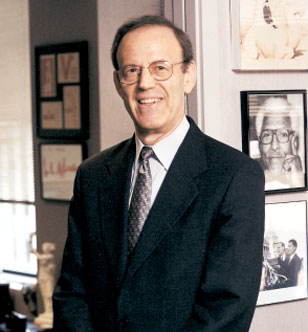
Carl Gershman, president of the NED
It is a technique that I’ve seen used in other circumstances, such as the lists of “mysterious deaths” that American right-wingers publish citing people who crossed the paths of Bill and Hillary Clinton and ended up dead. This type of smear spreads suspicion of guilt not based on proof but on the number of acquaintances and adversaries who have met untimely deaths.
In the 1990s, one conservative friend of mine pointed to the Clintons’ “mysterious deaths” list and marveled that even if only a few were the victims of a Clinton death squad that would be quite a story, to which I replied that if even one were murdered by the Clintons that would be quite a story – but that there was no proof of any such thing.
“Mysterious deaths” lists represent a type of creepy conspiracy theory that shifts the evidentiary burden onto the targets of the smears who must somehow prove their innocence, when there is no evidence of their guilt (only vague suspicions). It is contemptible when applied to American leaders and it is contemptible when applied to Russian leaders, but it is not beneath Carl Gershman.
Beyond that, Gershman’s public musing about the U.S. somehow summoning “the will” to remove Putin might — in a normal world — disqualify NED and its founding president from the privilege of dispensing U.S. taxpayers’ money to operatives in Washington and globally. It is extraordinarily provocative and dangerous, an example of classic neocon hubris.
While the neocons do love their tough talk, they are not known for thinking through their “regime change” schemes. The idea of destabilizing nuclear-armed Russia with the goal of ousting Putin, with his 82 percent approval ratings, must rank as the nuttiest and most reckless neocon scheme of all.
Gershman and his neocon pals may fantasize about making Russia’s economy scream while financing pro-Western “liberals” who would stage disruptive protests in Red Square, but he and his friends haven’t weighed the consequences even if they could succeed.
Given the devastating experience that most Russians had when NED’s beloved Russian “liberals” helped impose American “shock therapy” in the 1990s — an experiment that reduced average life expectancy by a full decade — it’s hard to believe that the Russian people would simply take another dose of that bitter medicine sitting down.
Even if the calculating Putin were somehow removed amid economic desperation, he is far more likely to be followed by a much harder-line Russian nationalist who might well see Moscow’s arsenal of nuclear weapons as the only way to protect Mother Russia’s honor. In other words, the neocons’ latest brash “regime change” scheme might be their last – and the last for all humanity.
A Neocon Slush Fund
Gershman’s arrogance also raises questions about why the American taxpayer should tolerate what amounts to a $100 million neocon slush fund which is used to create dangerous mischief around the world. Despite having “democracy” in its name, NED appears only to favor democratic outcomes when they fit with Official Washington’s desires.

CIA Director William Casey
If a disliked candidate wins an election, NED acts as if that is prima facie evidence that the system is undemocratic and must be replaced with a process that ensures the selection of candidates who will do what the U.S. government tells them to do. Put differently, NED’s name is itself a fraud.
But that shouldn’t come as a surprise since NED was created in 1983 at the urging of Ronald Reagan’s CIA Director William J. Casey, who wanted to off-load some of the CIA’s traditional work ensuring that foreign elections turned out in ways acceptable to Washington, and when they didn’t – as in Iran under Mossadegh, in Guatemala under Arbenz or in Chile under Allende – the CIA’s job was to undermine and remove the offending electoral winner.
In 1983, Casey and the CIA’s top propagandist, Walter Raymond Jr., who had been moved to Reagan’s National Security Council staff, wanted to create a funding mechanism to support outside groups, such as Freedom House and other NGOs, so they could engage in propaganda and political action that the CIA had historically organized and paid for covertly. The idea emerged for a congressionally funded entity that would serve as a conduit for this money.
In one undated letter to then-White House counselor Edwin Meese III, Casey urged creation of a “National Endowment,” but he recognized the need to hide the strings being pulled by the CIA. “Obviously we here [at CIA] should not get out front in the development of such an organization, nor should we appear to be a sponsor or advocate,” Casey wrote.
The National Endowment for Democracy took shape in late 1983 as Congress decided to also set aside pots of money — within NED — for the Republican and Democratic parties and for organized labor, creating enough bipartisan largesse that passage was assured.
But some in Congress thought it was important to wall the NED off from any association with the CIA, so a provision was included to bar the participation of any current or former CIA official, according to one congressional aide who helped write the legislation.
This aide told me that one night late in the 1983 session, as the bill was about to go to the House floor, the CIA’s congressional liaison came pounding at the door to the office of Rep. Dante Fascell, a senior Democrat on the House Foreign Affairs Committee and a chief sponsor of the bill.
The frantic CIA official conveyed a single message from CIA Director Casey: the language barring the participation of CIA personnel must be struck from the bill, the aide recalled, noting that Fascell consented to the demand, not fully recognizing its significance – that it would permit the continued behind-the-scenes involvement of Raymond and Casey.
The aide said Fascell also consented to the Reagan administration’s choice of Carl Gershman to head NED, again not recognizing how this decision would affect the future of the new entity and American foreign policy.
Gershman, who had followed the classic neoconservative path from youthful socialism to fierce anticommunism, became NED’s first (and, to this day, only) president. Though NED is technically independent of U.S. foreign policy, Gershman in the early years coordinated decisions on grants with Raymond at the NSC.
For instance, on Jan. 2, 1985, Raymond wrote to two NSC Asian experts that “Carl Gershman has called concerning a possible grant to the Chinese Alliance for Democracy (CAD). I am concerned about the political dimension to this request. We should not find ourselves in a position where we have to respond to pressure, but this request poses a real problem to Carl.
“Senator [Orrin] Hatch, as you know, is a member of the board. Secondly, NED has already given a major grant for a related Chinese program.”
Neocon Tag Teams
From the start, NED became a major benefactor for Freedom House, beginning with a $200,000 grant in 1984 to build “a network of democratic opinion-makers.” In NED’s first four years, from 1984 and 1988, it lavished $2.6 million on Freedom House, accounting for more than one-third of its total income, according to a study by the liberal Council on Hemispheric Affairs that was entitled “Freedom House: Portrait of a Pass-Through.”
Over the ensuing three decades, Freedom House has become almost an NED subsidiary, often joining NED in holding policy conferences and issuing position papers, both organizations pushing primarily a neoconservative agenda, challenging countries deemed insufficiently “free,” including Syria, Ukraine (in 2014) and Russia.
Indeed, NED and Freedom House often work as a kind of tag-team with NED financing “non-governmental organizations” inside targeted countries and Freedom House berating those governments if they crack down on U.S.-funded NGOs.
For instance, on Nov. 16, 2012, NED and Freedom House joined together to denounce legislation passed by the Russian parliament that required recipients of foreign political money to register with the government.
Or, as NED and Freedom House framed the issue: the Russian Duma sought to “restrict human rights and the activities of civil society organizations and their ability to receive support from abroad. Changes to Russia’s NGO legislation will soon require civil society organizations receiving foreign funds to choose between registering as ‘foreign agents’ or facing significant financial penalties and potential criminal charges.”
Of course, the United States has a nearly identical Foreign Agent Registration Act that likewise requires entities that receive foreign funding and seek to influence U.S. government policy to register with the Justice Department or face possible fines or imprisonment.
But the Russian law would impede NED’s efforts to destabilize the Russian government through funding of political activists, journalists and civic organizations, so it was denounced as an infringement of human rights and helped justify Freedom House’s rating of Russia as “not free.”
Another bash-Putin tag team has been The Washington Post’s editors and NED’s Gershman. On July 28, 2015, a Post editorial and a companion column by Gershman led readers to believe that Putin was paranoid and “power mad” in worrying that outside money funneled into NGOs threatened Russian sovereignty.
The Post and Gershman were especially outraged that the Russians had enacted the law requiring NGOs financed from abroad and seeking to influence Russian policies to register as “foreign agents” and that one of the first funding operations to fall prey to these tightened rules was Gershman’s NED.
The Post’s editors wrote that Putin’s “latest move … is to declare the NED an ‘undesirable’ organization under the terms of a law that Mr. Putin signed in May [2015]. The law bans groups from abroad who are deemed a ‘threat to the foundations of the constitutional system of the Russian Federation, its defense capabilities and its national security.’
“The charge against the NED is patently ridiculous. The NED’s grantees in Russia last year ran the gamut of civil society. They advocated transparency in public affairs, fought corruption and promoted human rights, freedom of information and freedom of association, among other things. All these activities make for a healthy democracy but are seen as threatening from the Kremlin’s ramparts.
“The new law on ‘undesirables’ comes in addition to one signed in 2012 that gave authorities the power to declare organizations ‘foreign agents’ if they engaged in any kind of politics and receive money from abroad. The designation, from the Stalin era, implies espionage.”
However, among the relevant points that the Post’s editors wouldn’t tell their readers was the fact that Russia’s Foreign Agent Registration Act was modeled after the American Foreign Agent Registration Act and that NED President Gershman had already publicly made clear — in his Sept. 26, 2013 column — that his goal was to oust Russia’s elected president.
In his July 28, 2015 column, Gershman further deemed Putin’s government illegitimate. “Russia’s newest anti-NGO law, under which the National Endowment for Democracy … was declared an “undesirable organization” prohibited from operating in Russia, is the latest evidence that the regime of President Vladimir Putin faces a worsening crisis of political legitimacy,” Gershman wrote, adding:
“This is the context in which Russia has passed the law prohibiting Russian democrats from getting any international assistance to promote freedom of expression, the rule of law and a democratic political system. Significantly, democrats have not backed down. They have not been deterred by the criminal penalties contained in the ‘foreign agents’ law and other repressive laws. They know that these laws contradict international law, which allows for such aid, and that the laws are meant to block a better future for Russia.”
The reference to how a “foreign agents” registration law conflicts with international law might have been a good place for Gershman to explain why what is good for the goose in the United States isn’t good for the gander in Russia. But hypocrisy is a hard thing to rationalize and would have undermined the propagandistic impact of the column.
Also undercutting the column’s impact would be an acknowledgement of where NED’s money comes from. So Gershman left that out, too. After all, how many governments would allow a hostile foreign power to sponsor politicians and civic organizations whose mission is to undermine and overthrow the existing government and put in someone who would be compliant to that foreign power?
And, if you had any doubts about what Gershman’s intent was regarding Russia, he dispelled them in his Friday column in which he calls on the United States to “summon the will” to “contain and defeat this danger,” which he makes clear is the continued rule of Vladimir Putin.
US government officially accuses Russia of political hacks
RT | October 7, 2016
The US intelligence community is “confident” that Russia is behind the recent hacks of US officials’ and organizations’ emails, the Department of Homeland Security and the Office of National Intelligence said.
According to the joint statement issued Friday, “disclosures of alleged hacked e-mails on sites like DCLeaks.com and WikiLeaks and by the Guccifer 2.0 online persona are consistent with the methods and motivations of Russian-directed efforts.”
“We believe, based on the scope and sensitivity of these efforts, that only Russia’s senior-most officials could have authorized these activities,” says the statement, posted by the Director of National Intelligence James Clapper.
The thefts and disclosures are “intended to interfere with the US election process,” the statement said, adding that “the Russians have used similar tactics and techniques across Europe and Eurasia” to influence public opinion.
External attempts to access election systems in several states“in most cases originated from servers operated by a Russian company,” the US officials said. “However, we are not now in a position to attribute this activity to the Russian Government.”
It would be “extremely difficult” for anyone to alter ballot counts or election results through cyberattacks, DHS and DNI said.
DHS has established an Election Infrastructure Cybersecurity Working Group “with experts across all levels of government” to raise awareness of cybersecurity risks, and urges state and local election officials to seek cybersecurity assistance from the federal authorities.
This is the first time the US government has officially accused Russia of cyberattacks related to the US presidential campaign. The Democratic National Committee blamed Russia for the hack of their email servers in June, though a lone hacker going by the name ‘Guccifer 2.0’ claimed responsibility and denied any ties to Russia.
The statement from Homeland Security and DNI comes just hours after Secretary of State John Kerry said that Russian actions in Syria “beg for an appropriate investigation of war crimes.” Moscow has dismissed Kerry’s words as “propaganda” intended to distract from US failure to implement the Syrian ceasefire agreement.
US cybersecurity experts claim that six out of eight IP addresses used by the DNC hackers were hosted on King Servers, a Russian provider. Vladimir Fomenko, owner of the company, told RT that he was never contacted by US law enforcement, however.
“We are ready to assist in probing this crime and consulting the FBI or other services on such issues. Hackers are a common threat and we must fight it together,” Fomenko said.
“If the FBI asks, we are ready to supply the IP addresses, the logs,” he said. “Nobody is asking… It’s like nobody wants to sort this out.”
Six Key Questions for the Obama Administration and Companies About Yahoo’s Cooperation With the NSA
By Neema Singh Guliani | ACLU | October 7, 2016
Since the Snowden disclosures, it has been clear that the NSA conducts unconstitutional, dragnet surveillance of Americans’ international communications. However, it now appears that the NSA is using surveillance authorities to conduct an entirely new type of surveillance: requiring major companies to conduct mass e-mail wiretaps, which involve searching the content of all incoming traffic.
If the news stories that broke earlier this week are accurate, here’s what we know:
Last year, Yahoo, in response to a classified government order, scanned hundreds of millions of mail accounts for a “set of characters” or digital “signature” of a communications method purportedly used by a state-sponsored terrorist organization. The search was apparently performed on all messages as they arrived at Yahoo’s servers. All of this was done without input from Yahoo’s security team, potentially placing users’ security at risk and ultimately prompting the resignation of the company’s chief security information officer.
It appears that a secret court, the Foreign Intelligence Surveillance Court (FISC), approved the surveillance—or at least approved the general procedures the government used to identify its targets. There are conflicting reports on what authority the government relied on.
Unfortunately, the news stories and Yahoo’s cryptic response leave more questions than answers. Yahoo’s ability to disclose information about this classified government program may be limited. But the Obama Administration owes the public far more information about this spying program, especially if it is going to fulfill its promise of increased transparency. As a start, the Obama Administration and other major tech companies should publicly answer the following questions:
1. What authority did the government rely on in compelling Yahoo to search its customers’ emails?
The million-dollar question – which remains unanswered – is what legal authority the government relied on for its demand to Yahoo. Initial reports suggested that the government may have relied on Section 702 of the Foreign Intelligence Surveillance Act (FISA), a highly controversial provision enacted as an amendment to FISA in 2008. More recently, however, news reports have stated that the government obtained what is known as a “traditional” FISA order under Title I of the statute. In either scenario, the surveillance would reflect a dramatic shift in the public understanding of how these authorities are used. Title I authorizes the government to search the communications of a particular person or entity. But, if news reports are accurate, it would mean that the government is now using this law to require that companies scan the content of all users’ incoming emails.
2. What is the program’s legal justification and has it been reviewed?
Whether government is relying on Section 702 or Title I, it seems to have strayed far from the original congressional intent. What is the government’s legal justification for this type of surveillance? And, if the surveillance was authorized by the FISC, was the court aware that its order required Yahoo to search the emails of hundreds of millions of innocent users?
In the past, the government and FISC have engaged in legal gymnastics to justify mass surveillance. The public and Congress have the right to know if this is happening yet again. The Obama Administration should release all legal memoranda it relied on in conducting the Yahoo surveillance, and it should disclose any relevant FISC opinions regarding the surveillance. If no such FISC opinions exist then the public deserves to know, as that itself is cause for concern.3. What types of content searches does the government believe it has the authority to conduct under Title I and Section 702, and are past statements about these authorities still accurate?
Intelligence officials have argued that surveillance programs conducted on U.S. soil are narrowly targeted because the government searches only for specific communication identifiers (like an email address) and not for keywords (like “bomb”). But the Yahoo story suggests that even this limitation may be falling to the wayside. If Yahoo conducted a broad search of its users’ incoming email for a “set of characters” or digital “signature,” that information may have been found in the content of communications. In other words, individuals may have been targeted not based on any preexisting suspicion about who they are or who they communicate with, but based solely on what they were communicating. Moreover, it is unclear whether this “signature” was used only by the target organization, or also by other wholly unaffiliated individuals. If the intelligence community is now engaging in this type of content-based surveillance, then the Obama Administration has a responsibility to set the record straight.
4. If the government relied on Section 702, did Yahoo attempt to filter out purely domestic communications?
Section 702 does not authorize the government to collect or search purely domestic communications. However, the stories contain no details about whether Yahoo made efforts to filter out purely domestic communications, and if so, how successful those efforts were. If such efforts were not made and the surveillance occurred under Section 702, then the Obama Administration should immediately disclose the number of purely domestic communications that were collected and searched under the order so that the public can fully assess the privacy implications.
5. If the government relied on Section 702, did the Privacy and Civil Liberties Board (PCLOB) know about this type of surveillance when they conducted their examination?
In 2014, the Privacy and Civil Liberties Board issued a report on Section 702. While we disagreed with many of the report’s conclusions, there is no doubt that the PCLOB declassified important information about Section 702 to facilitate a more robust debate. However, the PCLOB’s public report makes no mention of the types of demands that were purportedly received by Yahoo. If the PCLOB was unaware that this surveillance was occurring under Section 702, why were they not informed? If they knew, why was this information withheld from the public? Either way, this further calls into question the conclusions in the PCLOB report and the adequacy of existing oversight mechanisms.
6. How are other major companies interpreting their obligations under Section 702 and Title I?
Major companies like Google have issued statements saying they have never received the types of demands described in the Yahoo stories and reaffirming that they would challenge such a demand. While we applaud these companies for their statements, more information is needed to fully understand how the government is using its surveillance authorities. Specifically, we urge major technology companies to make publicly available information on how they interpret Section 702 and Title I, and to describe the types of demands that they believe clearly fall outside the statutes’ purview. In this way, companies can help to fill the information abyss left by the Yahoo story and the intelligence community’s lack of transparency.
40 Years After CIA Terrorist Bombs Cuba Plane, Still No Justice

By Teresa Gutierrez – teleSUR – October 2016
Forty years ago, on October 6, 1976, Cubana Flight 455 on its way from Barbados to Jamaica was bombed shortly after takeoff, killing 73 people, including the national fencing team of Cuba.
In what was immediately seen as a terrorist act, most in the international community joined Cuba in denouncing the horrific act.
In 2011, declassified CIA documents showed that one of the key figures in this terrorist attack was Luis Posada Carriles, a right-wing Cuban who had fled the island after the Cuban Revolution of 1959.
The documents revealed that it was Posada Carriles, now 88, who had planned the 1976 bombing. He had already gained experience terrorizing the Cuban people as a participant in the failed CIA-orchestrated Bay of Pigs assault in 1961.
Peter Kornbluh, author of the book, “Back Channel to Cuba,” and a former researcher at the National Security Archive of George Washington University, said in 2011 that the declassified documents “again brings up the issue of how an international terrorist like Luis Posada Carriles can live happily ever after in Miami.”
This point demonstrates that the Oct. 6 anniversary should not only be remembered, it should be reflected upon.
The 1976 attack highlights U.S. imperialism’s decades-long war of sabotage against the Cuban Revolution. Despite a thawing in U.S.-Cuba relations, this war has not subsided.
A free man, Posada Carriles moved to Venezuela in the early 80’s where he was eventually jailed for his acts of terror against Cuba. But he escaped in 1985 and resumed plotting against Cuba and its leader, Fidel Castro.
In this period, he was also instrumental in plotting against the revolutionary government of the Sandinista National Liberation Front in Nicaragua, working as a coordinator for the contras who were fighting a war backed by the U.S. government.
Posada Carriles bragged to the New York Times in 1998 that he had been responsible for the 1997 hotel bombings targeting Cuba’s tourist industry that killed an Italian tourist, saying the man just happened to be in the wrong place at the wrong time. Posada Carriles later recanted his story.
The New York Times wrote in 1998, “Mr. Posada was schooled in demolition and guerrilla warfare by the Central Intelligence Agency in the 1960s. In a series of tape-recorded interviews … Posada said the hotel bombings and other operations had been supported by leaders of the Cuban-American National Foundation. Its founder and head, Jorge Mas Canosa … was embraced at the White House by Presidents Reagan, Bush and Clinton.”
The CANF recieved millions of dollars of U.S. tax-payer money to carry out its dirty war against Cuba for decades, according to declassified documents.
Posada Carriles was again arrested in 2000 for possession of explosives in Panama and charged with plotting to assassinate the Cuban leader at the Peoples’ Summit taking place at the University of Panama. Soon after he went into hiding.
When Posada Carriles resurfaced in Miami in 2005, the U.S. government refused to extradite him to Cuba or Venezuela to face judicial proceedings for his crimes.
In early 2011, Posada Carriles was finally put on trial in El Paso, Texas—not for his many terrorist acts—but for immigration fraud and obstruction of a proceeding.
He was charged with lying to an immigration judge about his involvement in the 1997 bombings and about how he entered the U.S. in 2005.
U.S. prosecutors presented evidence that Posada Carriles played a major role in carrying out bombings in Cuba. Many expected convictions on at least some of these charges but the jury dumbfounded prosecutors with a complete acquittal.
Ricardo Alarcon, a long-time Cuban leader and at the time, the president of the national assembly, told AP, “The stupid and shameful farce is over.”
Venezuela’s government also denounced the trial as “theater,” saying Washington continued to harbor a mass murderer.
Alarcon had intimate and deep knowledge of the farce that is the U.S. judicial system. He had been a leading advocate of the Cuban Five and a principle strategist for their freedom.
The Cuban Five were Gerardo Hernandez, Ramon Labañino, Antonio Guerrero, Fernando Gonzalez and Rene Gonzalez. They were arrested by the U.S. government in Miami in 1998 and falsely accused of committing espionage conspiracy against the U.S. and other related charges.
They were convicted in a federal court in 2001 and spent over 15 years in jail, labeled by the U.S. government and media as terrorists.
But the Five were in fact counter-terrorists, heroes who were willing to sacrifice their lives, leave their beloved families and homeland to protect Cuba from U.S. aggression. They worked to stop terror and aimed to defend Cuba from the kind of aggression Posada Carriles and his CIA cohorts carried out.
The Five reflect a spirit of justice and peace and to this day—having returned to their beloved country—continue to inspire all those who yearn for a better world.
As long as the likes of Posada Carriles are free to walk the streets of Florida, Cuba must do everything it can to defend itself from U.S. terror.
As long as the U.S. continues to occupy Guantanamo, the Cuban Revolution must be ready to defend itself, despite President Barack Obama’s dubious declarations.
A Salon magazine article in 2008 raised this question: “The coddled ‘terrorists’ of South Florida: Anti-Castro Cuban exiles who have been linked to bombings and assassinations are living free in Miami. Does the U.S. government have a double standard when it comes to terror?”
The answer is yes—a thousand times yes.
Yahoo Scanned All Users’ Emails for Government!
By Alfredo Lopez | This Can’t Be Happening! | October 5, 2016
If you are one of the approximately 280 million people with Yahoo email accounts, your email was scanned for content and possibly turned over to the U.S. government. Yahoo, on Tuesday, admitted that fact.
Reuters revealed on Tuesday that the Internet mega-company (which is now being purchased by Verizon Communications) designed a special program last year to capture and scan all its users’ incoming email after being ordered to do that by the either the NSA or FBI. It deployed the program over the last year, scanning every piece of email Yahoo accounts received and apparently turning over all email that contained any of the tens of thousands of “keywords” the NSA considers suspicious.
The decision, Reuters says, was made by President and Chief Executive Officer Marissa Mayer, in collaboration with people in her legal department. It wasn’t without controversy: several Yahoo top staffers left the company including Chief Information Security Officer Alex Stamos (who left for a top job at Facebook).
The news is startling for several reasons. It’s also deceptive for some others.
* Email providers like Google (whose gmail program is a favorite source of NSA data capture) always claim they don’t do “blanket review” of email content. Yahoo is the first to openly admit that it does. It apparently made that decision because its executives didn’t think they could successfully resist the government orders.
That decision by Mayer, already under considerable pressure at the struggling corporate giant, was apparently taken without consultation with her security team. Instead, she just ordered technologists to write the data scanning software. Many in the company thought it could challenge the government orders in the courts and prevail. Several, including Stamos, fled in reported horror.
* They didn’t just review the emails, they built a special program to do it and never let their users know they were doing that. It might seem logical — after all, you don’t let the person who you’re spying on know you’re spying — but very few Yahoo users are the subject of investigations. Yahoo’s statement — that it complies with legal requests — doesn’t even mention the Consitution that protects your data legally and whose first and fourth amendments appear to have been clearly violated by this action.
* Finally, what do you do with all that data? While the government would contend that it was investigating illegal activity, it now has reports (at least) if not full captures on everyone. And a government that collects data on everyone isn’t a state doing policing. It is a police state.
As shocking as this revelation is, the reaction of other Internet companies has been gallingly disengenuous.
“We’ve never received such a request,” a spokeman for Google, told Reuters. “But if we did, our response would be simple: ‘No way’.”
Well… yes… “way” because Google has received thousands of NSA National Security Letters and routinely complies with them. They may not be scanning all the information but they will scan and turn over any information the government requests without informing the affected customer.
A Microsoft spokesperson also chimed in, “We have never engaged in the secret scanning of email traffic like what has been reported today about Yahoo.”
No, maybe not like reported today but Microsoft also routinely complies with government orders almost never challenging them.
In a sense, the way the data is collecting (and the amount collected) — as shocking and important as that is — is probably not the most important issue. If you collect and turn over data on any user just because someone in the NSA tells you to, your respect for privacy and constitutional rights is deeply questionable. That’s exactly what all these companies do.
Yahoo’s latest scandal only underscores how little respect for our rights this industry has.
There are many cases by companies challenging the government on surveillance. Why Yahoo could choose to comply so quickly and not tell anyone about it will certainly provoked widespread circulation and analysis in the coming weeks.
That is something we should all be monitoring.
(Full disclosure: as an official of MayFirst/PeopleLink, I am involved in an international lawsuit challenging the NSA’s right to conduct mass surveillance in foreign countries. The “bias” revealed, however, should not surprise any reader of this website.)
Featured Video

Genocide-linked firm handles Britons’ NHS data
or go to
Aletho News Archives – Video-Images
Book Review
Book review: Boiling Point, How America Brought War to Ukraine
By Tim Kirby | Strategic Culture Foundation | November 14, 2026
Did Vladimir Putin just wake up one day on the wrong side of the bed and decide to invade Ukraine in February of 2022 or is there a lot more to this single decision that has been reshaping the 21st century geopolitical landscape?
Obviously, from the way that I just posed the question you can see that I am on the side that views the causes for the war in Ukraine to be very deep, long-term, historical and consciously nefarious, and most importantly, not from within the halls of the Kremlin. So it was a pleasure to take a look at the book “Boiling Point, How America Brought War to Ukraine” by author Stephen Kinzer, who like myself, also believes that the real reasons behind military conflicts around the world are not what CNN and the BBC have been telling you. The main thesis of this book was stated clearly by its creator; the war “may have been illegal, but it was definitely not unprovoked.” … continue
Blog Roll
 Aletho News
- The 10 Disease Renamings That Rescued the Vaccine
- NATO cancels 2027 leaders’ summit
- IAEA’s politicized use of safeguards undermines its impartiality: Russian envoy
- UK must be ready to strike Russian Arctic – ex-PM
- Fico’s Two Red Lines: Russian Energy and the Next Ukraine Loan
- Thousands rally for banned NATO-skeptic presidential candidate
- Ukraine Settlement and New European Security Architecture Must Go Hand in Hand – Kremlin
- Book review: Boiling Point, How America Brought War to Ukraine
- Israel Revives The ‘Iranian Assassination Threat Against Trump’ Deception In A Desperate Bid To Restart The War
- US rewrites history to dodge blame for illegal war on Iran: Foreign Ministry spokesperson
- If Americans Knew
- An error has occurred; the feed is probably down. Try again later.
- No Tricks Zone
- New Study: Barents Sea Temperatures Were Warmer And Sea Ice Less Extensive In The 1700s Than Today
- German Authorities Start Initiative To Evaluate Public Register For Climate “Disinformation” Spreaders!
- Zonal Asymmetry of Temperature Change in the Antarctic Circumpolar Current
- New Study: The Net Fossil Fuel Contribution To Rising Atmospheric CO2 Has Been Zero For 500 Years
- Germany’s Green Energy Transition Becoming Increasingly Expensive…Another 6 Trillion Euros!
- Sudden Stratospheric Warming, Powerful El Niño Combination May Lead To Extreme Europe Cold, Energy Crisis!
- Two New Studies Find Thwaites Glacier Melt Cannot Be Driven By Human Activity Or A Warming Ocean
- E-Cars Reduce CO2 Emissions By Only 41% Compared To Internal Combustion Engine Vehicles
- Predictions Made By Renowned Climate Professor Over Past Decades Have Been Proven To Be Poor
- New Study Suggests Large Regions Of The Pacific Ocean Have Been Cooling For The Last 80 Years

