Obama makes disguised threat to Russia on cyber warfare
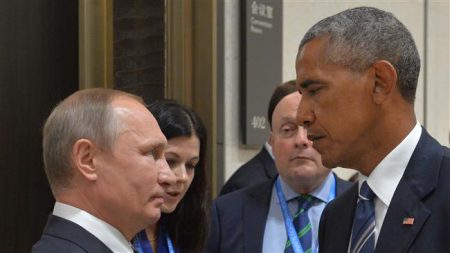
Russian President Vladimir Putin meets with his US counterpart Barack Obama on the sidelines of the G20 Leaders Summit in Hangzhou on September 5, 2016. (AFP)
Press TV – September 5, 2016
President Barack Obama has warned Russia that the United States has “more capacity than anybody” when it comes to cyber warfare, saying hack attacks can not become “wild, wild, West.”
Obama made the remarks to reporters following the G20 conference in Hangzhou, China. The issue of Russian hackers being implicated in breaching US cyberspace was a key issue at the summit.
Though Obama didn’t identify specific instances, he said, “We have had problems with cyber intrusions from Russia in the past” and that the goal is to not to duplicate a “cycle of escalation” that has occurred in arms races of the past.
“What we cannot do is have a situation where this becomes the wild, wild West, where countries that have significant cyber capacity start engaging in unhealthy competition or conflict through these means,” the president said.
Making a subtle threat to Russia, Obama added, “Look, we’re moving into a new era here where a number of countries have significant capacities. And frankly we’ve got more capacity than anybody, both offensively and defensively.”
US officials have blamed Russia for the recent hacking of the Democratic National Committee’s (DNC) servers, and law enforcement and intelligence agencies are reportedly concerned about the Kremlin trying to disrupt or undermine the presidential elections.
However, Russian Foreign Minister Sergei Lavrov has in the past rejected claims that Moscow was behind a recent hack of DNC servers.
In July, the WikiLeaks website released about 20,000 emails from the DNC, which showed that party leaders had purportedly sought to undermine the presidential campaign of Senator Bernie Sanders.
The revelation prompted DNC chairwoman Debbie Wasserman Schultz to announce her resignation.
The campaign of Democratic presidential nominee Hillary Clinton alleged that Russia had released the emails to influence the November presidential election.
“Socialists” Supporting NATO and U.S. Empire
Ashley Smith and the ISO
By Rick Sterling | Dissident Voice | September 5, 2016
At the recent annual convention of Veterans for Peace, VFP Vice President Jerry Condon said: “The US peace movement has been demobilized by disinformation on Syria.”
Disinformation and propaganda on Syria takes three distinct forms. The first is the demonization of the Syrian leadership. The second is the romanticization of the opposition. The third form involves attacking anyone questioning the preceding characterizations.
There is a recent article which exemplifies all three of these forms. It is titled “Anti-Imperialism and the Syrian Revolution” by Ashley Smith of the International Socialist Organization (ISO). It’s a remarkable piece of misinformation and faulty analysis. Because it is clear and well written, it is likely to mislead people who are not well informed on the facts regarding Syria. Hence the importance of critically reviewing it.
Technique 1: Demonize the enemy … “the Syrian regime and its brutal dictator”
Smith starts off posing the question: Are you with the Syrian revolution or the brutal Assad dictatorship? The way he frames it, it’s not a difficult choice: yay for the revolution!
Like these false options, Ashley Smith’s article is a fairy tale devoid of reality. His bias is shown as he criticizes the Left for ignoring “Assad’s massacre of some 400,000 Syrians”. Included in this death count are 100-150 thousand Syrian soldiers and allies. Ashley blames Assad instead of the armed opposition for killing Syrian soldiers!
Another example of false propaganda is the discussion of the chemical weapons attack that took place on August 21, 2013 in outer Damascus. Neoconservatives speak of this event as “proving” Assad’s brutality – “killing his own people” – as well as the “failure” of President Obama to enforce his “red line”. Ashley aligns with the neocons as he says “Barack Obama came under pressure to intervene militarily in Syria after the regime carried out a chemical weapons attack in a suburb of Damascus in 2013, but he backed a Russian-brokered resolution that protected Assad.”
In reality, the Damascus sarin gas attack was carried out by an opposition group with the goal of forcing the U.S. to directly attack the Syrian government. Soon after the event, Veteran Intelligence Professionals for Sanity issued a statement reporting “the most reliable intelligence shows that Bashar al-Assad was NOT responsible for the chemical incident”. Later on, Seymour Hersh wrote two lengthy investigations pointing to Jabhat al Nusra with Turkish support being culpable. Investigative journalist Robert Parry exposed the Human Rights Watch analysis blaming the Syrian government as a “junk heap of bad evidence”. In the Turkish parliament, Turkish deputies presented documents showing that Turkey provided sarin to Syrian “rebels”. A detailed examination and analysis of all fact based stories in online at whoghouta.blogspot.com. Their conclusion is that “The only plausible scenario that fits the evidence is an attack by opposition forces.”
Ashley Smith accuses the Syrian government of widespread torture. His main example is the case of Syrian Canadian Maher Arar who was arrested by US authorities in collusion with Canadian authorities, then rendered to Syria for interrogation in 2002. Arar was beaten during the initial weeks of his interrogation in Syria. After ten months imprisonment, Syrian authorities determined he was not a terrorist and sent him back to Canada. Arar received an official apology and $10 Million from the Canadian government.
The most highly publicized accusation of rampant torture and murder by Syrian authorities is the case of “Caesar”. The individual known as “Caesar” was presented as a defecting Syrian photographer who had 55,000 photos documenting 11,000 Syrians tortured by the brutal Assad dictatorship. At the time, among mainstream media only the Christian Science Monitor was skeptical, describing it as “a well timed propaganda exercise”. In the past year it has been discovered that nearly half the photos show the opposite of what is claimed. The Caesar story is essentially a fraud funded by Qatar with ‘for hire’ lawyers giving it a professional veneer and massive mainstream media promotion.
While western media routinely refers to Assad as a dictator, in fact, he is elected and popular with the majority of Syrians. Although not wealthy, Syria was largely self-sufficient with a semi-socialist state apparatus including free health-care, free education and large industries 51% owned by the state. You do not see pervasive western fast food, banks, and other corporate entities in Syrian cities. In the wake of protests, the government pushed through reforms which ended the one party system. There are now political parties across the political spectrum. These are a genuine ‘moderate opposition’. The June 2014 election confirmed Assad’s popularity despite the denials of those who have never been there.
Technique 2: Romanticize the opposition … “the Syrian Revolution”
Ashley Smith echoes mainstream media which portrays the conflict as a “civil war” which began with peaceful democratic loving Syrian revolutionaries beaten by a brutal regime.
In reality there was a violent faction from the start. In the first protests in Deraa seven police were killed. Two weeks later there was a massacre of 60 security forces in Deraa. In Homs, an eye-witness recounted the situation:
From the start, the protest movements were not purely peaceful. From the start I saw armed demonstrators marching along in the protests, who began to shoot at the police first. Very often the violence of the security forces has been a reaction to the brutal violence of the armed rebels.
In the first two months, hundreds of police and security forces were killed.
Ashley and company listen to Americans and British citizens and mistakenly believe they are listening to real Syrians. Some of these people left Syria at age 3. Some of them have never lived in Syria. Thus you have fantasy portrayals such as “Burning Country: Syrians in Revolution and War”. A more realistic picture is given by a Syrian who still lives in Aleppo. He writes under the name “Edward Dark” and describes how he and his friends quickly regretted the take-over of Aleppo by armed groups in summer 2012. He describes one friend’s reaction as the reality was hitting home: “How could we have been so stupid? We were betrayed!”. And another says: “Tell your children someday that we once had a beautiful country, but we destroyed it because of our ignorance and hatred.” Edward Dark is a harsh critic of President Assad and Baath Party. He is also naive regarding the role of US Ambassador Robert Ford. But his description of early protesters and the arrival of armed opposition rings true and more authentic than the portrayal of Yassin-Kassab and Al Shami.
In fact, many of the idealized “Syrian revolutionaries” promoted by the authors of “Burning Country” are trained and paid agents of the US and UK. The Aleppo Media Center which produces many of the videos is a US creation. The White Helmets which purport to be Syrian, independent and unarmed first responders, are a creation of the US and UK. The banner boys from Kafranbel are another western funded operation. In her book about her time as Secretary of State, Clinton boasts of providing “training for more than a thousand activists, students, and independent journalists” (p. 464).
Why do the enemies of Syria create such organizations? Partly as a way to channel money and support to the armed opposition. Also to serve as propaganda tools to confuse the situation and generate support for the real goal: regime change. For example, White Helmets mostly work in areas dominated by the Syrian Al Qaeda. Unlike legitimate organizations such as the Red Crescent, they never work in areas controlled by the government. And they are also active on the propaganda front, continually pushing for US/NATO intervention via a “no fly zone”. The misinformation of Ashley Smith and ISO confuses unwitting people and helps the enemies of Syria in their drive for regime change.
In contrast with the romanticized delusions of Ashley Smith and the authors of “Burning Country”, the U.S. Defense Intelligence Agency gave an accurate assessment in August 2012:
“EVENTS ARE TAKING A CLEAR SECTARIAN DIRECTION. THE SALAFIST, THE MUSLIM BROTHERHOOD AND AQI ARE THE MAJOR FORCES DRIVING THE INSURGENCY IN SYRIA.”
Technique 3: Attack Those who Question the Dogma … “You’re an Assad supporter!”
Ashley Smith does not criticize the NATO and Gulf states that are violating international law and the UN charter by funding and supplying a proxy army to attack Syria. Instead, he criticizes left groups who oppose the aggression. That is a sign of how far off track ISO is. They did the same thing regarding Libya and have evidently learned nothing from that disaster. Ashley Smith should go and tour Libya now to savor the “revolution” he promoted.
Ashley Smith’s theme with respect to Syria (peaceful popular uprising against brutal dictator) is the same theme promoted by neoconservatives and the mainstream media. When they encounter a different perspective, they cry out, “You are an Assad supporter!”. Never mind that many genuine progressives do not say that. What we say is that it’s for the Syrian people to determine their government, not foreigners.
Smith criticizes the British Stop the War coalition for having “adapted to Assad supporters” and for “giving a platform to allies of the dictatorship”, specifically “regime apologist Mother Superior Agnes Mariam”. Smith is misinformed on this issue also, but it is doubly revealing. In fact, Mother Agnes was hosted on the tour by Syria Solidarity Movement. When she was in London, she was invited to speak at a Stop the War rally. To his great discredit, the keynote speaker Jeremy Scahill, who is closely aligned with ISO, threatened to withdraw from the conference if Mother Agnes spoke. Scahill has done great journalistic work exposing Blackwater and Drone Warfare. However, that does not excuse the complicity leading to blackmail regarding a Palestinian Lebanese nun who has shown immense courage in promoting reconciliation and peace in Syria.
However, that action is typical of some misguided “socialist” groups, the Muslim Brotherhood and their allies. Mother Agnes was verbally attacked and abused by these groups throughout her tour, which otherwise met with great success. Mother Agnes has lived in Syria for over twenty years. She consistently says that Syria needs reform, but you don’t do that by destroying it.
Ashley Smith goes on to criticize the US Peace Council for recently sending a delegation to Syria and having the audacity to talk with “Assad and his henchmen”. He sounds like the right wing hawks who denounced Jane Fonda for going to North Vietnam in the 1970’s. Smith displays a dogmatic and closed-minded view; what kind of “international socialism” does he represent?
Smith criticizes Green Party candidates Jill Stein and Ajamu Baraka for “remaining silent about Putin’s and Assad’s atrocities”. This is another measure of how far off track the ISO is. They evidently are not aware of international law or they don’t care about it. The Assad government has a right to defend itself against terrorist attacks which are sponsored, funded and supplied by foreign governments.
Syria also has a right to request help from Russia and Iran. But with tunnel-vision dogma, Ashley Smith and ISO do not care. They seem to be supporting instead of opposing imperialist aggression, violations of international law, and the death and destruction these have led to.
Ashley disparages the Syrian government and people who have continued to fight against the forces of sectarianism promoted by NATO, Israel and the Gulf monarchies. Ashley and ISO would do well to send some people to see the reality of Syria. They would find it very different than their fevered imagination or what they have been led to believe by fake Syrians and Muslim Brotherhood dogmatists.
Genuine progressives are not “Assad supporters”. Rather, we are opponents of imperialist aggression and supporters of international law — which says it’s the right of Syrians to determine who leads them. That would mean real Syrians, not those raised in or paid by the West.
Ashley Smith’s Inaccurate Overall Analysis
Ashley Smith gives a very inaccurate analysis of the overall geopolitical situation in Syria and beyond.
He says “The US has been seeking a resolution that might push Assad aside, but that above all maintains his regime in power”. He goes on to say ‘U.S. policy from the beginning has been to preserve the core of Assad’s state.” Ashley believes “the U.S. has retreated in general from outright regime change as its strategy in the Middle East”.
This is absurd. In reality the US and allies Israel and Saudi Arabia have been pushing for ‘regime change’ in Syria for over a decade. In 2005 CNN host Christiane Amanpour expressed the situation bluntly:
Mr. President, you know the rhetoric of regime change is headed towards you from the United States. They are actively looking for a new Syrian leader. They’re granting visas and visits to Syrian opposition politicians. They’re talking about isolating you diplomatically and, perhaps, a coup d’etat or your regime crumbling. What are you thinking about that?
In 2007, Seymour Hersh wrote about the destabilization efforts in his article “The Redirection.”
In 2010, Secretary of State Clinton spoke of “changing Syria’s behavior” and threatened “President Assad is making decisions that could mean war or peace for the region …. We know he’s hearing from Iran, Hezbollah and Hamas. It is crucial that he also hear directly from us, so that the potential consequences of his actions are clear.”
Secretary Clinton appointed Robert Ford to become US Ambassador to Syria. Ford was previously the chief political officer in Baghdad for Ambassador John Negroponte. Who is John Negroponte? He was Ambassador to Honduras overseeing the Nicaraguan Contras and El Salvador death squads in the 1980’s. Negroponte’s arrival in Iraq in 2004 led to ‘the El Salvador option’ (sectarian death squads) in Iraq.
Since the conflict in Syria began in 2011 the US has spent many billions of dollars trying to overthrow the Syrian government or force it to change policy. The supply of sophisticated and deadly weaponry continues. In April 2016 it was reported that the US recently supplied 994 TONS of sophisticated rocket launchers, anti tank and other heavy weapons to “moderate rebels” who ally with the Syrian Al Qaeda ( Jabhat al Nusra recently renamed Jabhat Fatah al Sham).
Ashley’s theory that the US is intent on “preserving” the Syrian state and the US has “given up” on regime change is not supported by the facts.
Ashley continues the faulty analysis by saying “the U.S. is solely and obsessively focused on defeating this counterrevolutionary force (ISIS) in Iraq and Syria” and “the Obama administration has struck a de facto alliance with Russia”.
This is more theory without evidence. The US coalition was doing little to stop ISIS and looked the other way as ISIS went across the open desert to attack and occupy Palmyra. They were similarly looking the other way as ISIS sent hundreds of trucks filled with oil from eastern Syria into Turkey each day. It was not until Russia entered the scene in support of Syria one year ago, that the US coalition got embarrassed into actually attacking ISIS. As to a “de facto alliance”, this is what Russia has implored the US to do, largely without response. In the past two weeks the U.S. has threatened Russian and Syrian planes not to attack US ground forces inside Syria and refused to come to agreement with Russia that “moderate rebels” working with acknowledged terrorists are not “moderate” and can be targeted.
The Obama administration is trying to prevent the collapse of the regime change project by stalling and delay. Perhaps they wish to keep the project alive for a more aggressive US policy. Hillary Clinton continues to talk about a “no fly zone”. Her allies in Congress have recently initiated HR5732 which will escalate economic and financial sanctions against Syria and assess the implementation of a “no fly zone”.
Ashley Smith suggests that large portions of the US left have been avidly supporting “oppressive regimes” such as Syria and Iran. He mocks those on the left who suggested the Iranian ‘green movement’ was US-influenced. His mockery is exposed as ignorance by none other than Hillary Clinton herself. In her book “Hard Choices” she recounts how they arranged for Twitter to postpone a system upgrade which would have taken the social media giant offline at a critical time, right after the 2009 Iranian election. Hillary and her group at the State Dept were actively promoting the protests in Iran.
Dangerous Times Ahead
Some middle east analysts have made the faulty analysis that Israel is not involved in the aggression against Syria. In reality, Israeli interests are at the core of the US policy against Syria. The Israeli Ambassador to the U.S. was explicit: “Israel wanted Assad gone since start of civil war”. He also said “bad guys supported by Iran” are worse than “bad guys not supported by Iran”. In other words, Israel prefers chaos and Al Qaeda to a stable independent Syria.
Saudi Arabia is the other key U.S. ally seeking overthrow in Syria. With its close connections to the oil industry, military industrial complex and Wall Street, Saudi Arabia has enormous influence in Washington. It has been mercilessly bombing Yemen for the last 18 months and continues funding and promoting the proxy war against Syria.
Both Saudi Arabia and Israel seek the same thing: breaking the resistance alliance which runs from Iran through Syria to Lebanon. They are in alliance with US neoconservatives who still dream of “a new American Century” where the US fights multiple wars to enforce its exceptional and sole supremacy. Along with some other countries, these are the forces of reaction violating international law and promoting the war against Syria.
The tide is turning against the forces pushing for ‘regime change’ in Syria. But they have not yet given up and may even escalate. Now is when progressives in the West need to raise our voices in opposition to this aggression. Jill Stein and Ajamu Baraka can hopefully bring much more attention to this critical issue. Bernie Sanders and his supporters need to speak out against Hillary Clinton’s statements and plans.
There are good people in ISO which does good work in many areas. We hope they will re-examine their assumptions, beliefs and actions regarding Syria. In the dangerous times ahead, we need them to be resisting the drive to war in Syria, not condoning or supporting it.
Rick Sterling is a retired aerospace engineer who now does research/writing on international issues. He can be reached at rsterling1@gmail.com.
Senator Markey’s Climate Education Act Goes The Wrong Way
By David Wojick | Climate Etc. | September 5, 2016
The “Climate Change Education Act” (S.3074) directs the National Oceanic and Atmospheric Administration (NOAA) to establish a climate change education program focused on formal and informal learning for all age levels.
When it comes to beating the climate change drum, Sen. Ed Markey is the Energizer Bunny. As a Congressman, Rep. Markey was Chairman of the now defunct House Select Committee on Energy Independence and Global Warming from 2007 to 2011. This time he is drumming on the education front. Markey has dropped the “Climate Education Act” into the Senate hopper. While the bill is unlikely to pass at this time, it is still important to object to, lest it be seen to be acceptable.
Sen. Markey’s website summarizes the proposal as follows: “The “Climate Change Education Act” (S.3074) directs the National Oceanic and Atmospheric Administration (NOAA) to establish a climate change education program focused on formal and informal learning for all age levels. The program would explore solutions to climate change, the dangers we face in a warming world, and relatively small changes in daily routines that can have a profound global impact. The legislation also establishes a grant program to support public outreach programs that improve access to clean energy jobs and research funds so local communities can address climate mitigation and adaptation issues.”
There is a lot not to like here, beginning with the false scientific claims. The first is hyping the supposed dangers we face in a warming world, which simply do not exist. Nor are there small changes in daily routines that can have a profound global impact, because humans do not control the global climate. What is here being called Education is really just scaremongering and propaganda. Ironically, the Bill itself says one goal is to remove the fear of climate change, which it actually promotes.
What is really strange is the focus on so-called clean energy jobs and technology. The term “clean energy” is a misleading euphemism for renewable technologies. Thus the thrust of the Bill is not just on climate science education; rather it is on using the education system to promote renewables. NOAA has no expertise in this regard and no mission. They do things like running the National Weather Service. Promoting renewables and green workforce development is the Energy Department’s job.
On the science side, NOAA has long been active in so-called “climate education,” which basically means spreading the Government’s biased view of climate change as human driven and dangerous. For example, the Climate Literacy and Energy Awareness Network (CLEAN) Portal was launched in 2010, co-sponsored by NOAA, NSF and the Energy Department. As of 2012, CLEAN has been syndicated to NOAA’s climate.gov portal, where they offer over 600 educational materials, most of which are biased toward the scary Federal version of climate science.
In fact NOAA has led a Federal drive to redefine “climate literacy” as accepting the Government’s biased position. According to their website, the stated Guiding Principle for climate literacy is “Humans can take actions to reduce climate change and its impacts.” The reality is that humans can do little to change climate change and a little global warming is not harmful. It is probably beneficial.
What the proposed Climate Education Act would do is give statutory authority for NOAA’s existing propaganda actions, something that is presently lacking. It also allows the agency to bribe states to use its stuff, which is pretty insidious.
It would also allow NOAA to go beyond simply providing online information, to begin writing actual curriculums to be used in the classroom. That is where the bribery really comes in. This curricular push coincides with the widespread deployment of the Next Generation Science Standards. Most states that adopt them need to develop new curriculums, because these science standards are very different from the existing state standards, especially in the area of climate change.
Beyond this, the Bill would put NOAA into the strange new business of promoting the renewable energy industry and training its workers. The Energy Department already does this, while NOAA has neither the mission nor the organization to do it.
In summary this so-called Climate Education Act does nothing that is good, for the climate or the students. It is based on false science and pushes NOAA in the wrong direction. NOAA should be trying to understand climate change, not promote renewable technologies in the name of dangerous global warming.
Press coverage is bad, buying the Bill as expected. See for example these:
How the CIA Used LSD to Destroy the New Left
By Stuart Jeanne Bramhall | Dissident Voice | September 4, 2016
Drugs as Weapons Against Us: The CIA’s Murderous Targeting of SDS, Panthers, Hendrix, Lennon, Cobain, Tupac and Other Activists is a virtual encyclopedia of the global drug trade. Author John L Potash devotes special attention to the long involvement of the British and US governments in illegal drug trafficking – for the political and financial benefit of the elite families who control these governments. Most of the book focuses on MKULTRA, the top secret CIA program devoted to developing and experimenting with mind altering drugs, such as LSD, MDA (an ecstasy precursor), STP, PCP and Scopolamine.
 Although CIA Director Richard Helms ordered all MKULTRA records destroyed in the mid-seventies, 30,000 pages of documents were preserved in the CIA Finance Department. Meticulously researched and footnoted, Drugs as Weapons relies on an extensive variety of sources, including the 30,000 pages, FOIA releases, police files, whistleblower statements, media and alternative media investigations and other prominent researchers such as Peter Dale Scott, Alfred, McCoy, Alex Constantine, Catherine Austin Fitts, and the late Gary Webb and Michael Rupert.
Using MKULTRA to Target Leftists and Radical Pop Stars
As the title suggests, Potash is mainly interested in the CIA’s use of LSD (with the help of British intelligence, which ran a parallel MKULTRA program at the Tavistock Clinic) to “neutralize” leftists and activist pop stars, such as Paul Robeson, Mick Jagger, Abbie Hoffman, Brian Jones, Janis Joplin, John Lennon and Jimi Hendrix.*
Like many activists, I am well aware of the CIA’s historic role in heroin trafficking in Southeast Asia and in cocaine trafficking in Latin America. However, prior to reading Drugs as Weapons, I was totally unaware they were also responsible for most of the LSD produced between 1955 and 1973 – for the specific purpose of “neutralizing” the New Left in Berkeley, at Columbia University and elsewhere. This particular MKULTRA project was conceived in response to a 1962 Rand Corporation study recommending that getting left wing leaders hooked on LSD could “cause them to resign or become inactive.”
The Haight Ashbury was a CIA Invention
I was particularly horrified to learn about the LSD distribution network MKULTRA agents set-up in the Haight Ashbury to lure Berkeley students away from the nationally influential Free Speech movement. The latter, originally formed in 1957 to protest the anti-democratic activities of Senator Joseph McCarthy’s House on Un-American Activities Committee, went on to inspire the national anti-Vietnam War Movement.
In addition to various MKULTRA scientists and agents, the CIA also relied on a number of high profile personalities – LSD guru Timothy Leary (an admitted CIA asset), author Ken Kesey (One Flew Over the Cuckoo’s Nest), and Grateful Dead band members – to promote and distribute LSD as an alternative to organizing against the Vietnam War.
How the Opium Trade Created America’s First Millionaires
Potash begins his book with important historical background on the origins of the global drug trade, which he traces back to 1500 and which European elites relied on heavily to finance imperial expansion and colonization. He also recounts the history of important Wall Street families – the Cabots, Cushings, Bushes, Astors, Russells, Pierponts (JP Morgan’s family) – who all owe their immense wealth to the opium trade the British involuntarily forced on China via the Opium Wars. The investment of these families in illegal drug trafficking continues to the present day, as evidenced by the involvement of all major US banks in multi-billion dollar drug money laundering.
The Russell family, who would go on to found Yale and the Skull and Bones Society, openly used a skull and bones pirate flag on their opium trading ships.
The Vietnam War: Protecting Wall Street Drug Interests
Potash also carefully details the special relationship between these Wall Street families and the intelligence agency they founded during World War II (the OSS, which became the CIA in 1947) to protect their special interests. This comes out clearly in the chapter in which Potash traces the origins of the Vietnam War. He makes a really strong case that this war (which began in the late fifties as a CIA intervention) stemmed directly from CIA determination to protect Golden Triangle opium production from efforts by nationalist leaders in Laos, Thailand and Vietnam to eradicate it.
One of Mao’s first acts after winning control of China was to destroy the country’s vast opium network. With the support of the CIA, the nationalist Chinese generals who had controlled it moved their networks into Burma, Laos and Thailand.
The Link Between CIA-backed Nazi War Criminals and Colombian Cocaine
In a similar vein, the CIA assisted Klaus Barbie and other Nazi war criminals it smuggled out of Germany in setting up a cocaine production and distribution network in Colombia and later the Afghan Mujaheddin in turning their country into the world’s largest producer of heroin.
Potash makes a compelling case that the proximate cause for the US invasion and occupation of Afghanistan in October 2001 was the Taliban’s successful eradication of opium production earlier that year.
* The cases of radical pop stars and activists targeted with LSD and other drugs (in many cases along with witnesses and key investigators) Potash examines include:
- Paul Robeson – African American singer whose career was destroyed when he was involuntarily dosed with LSD and committed for two years to a psychiatric hospital, where he received 54 electroconvulsive treatments,
- Richard Wright – African American writer involuntarily dosed with LSD who later died under extremely suspicious circumstances.
- Elvis Presley – became addicted to amphetamines and narcotics after covert intelligence officer became his manager.
- Mama Cass Elliott – died under mysterious circumstances at age 32 after starting to date an international drug smuggler with suspected intelligence links.
- Abbie Hoffman –introduced to LSD by roommate who worked for Army Intelligence research LSD effects on unconsenting GIs.
- Mick Jagger – involuntarily dosed with LSD and subject to numerous drug frame-ups and two unsuccessful Hell’s Angels (working closely with US intelligence) assassination attempts.
- Brian Jones – subject to numerous drug frame-ups and intense phone harassment and stalking prior to 1969 murder (which police covered up as “accidental” drowning).
- Jimi Hendrix – intelligence-linked manager strongly implicated in death related to involuntary drugging.
- Janis Joplin – introduced to amphetamines and heroine via intelligence-linked boyfriend, died after “friend” slipped her a bolus of pure CIA heroin.
- John Lennon – involuntarily dosed with LSD and framed on bogus cannabis charge. Lennon’s alleged assassin Mark Chapman had strong intelligence links and appeared to be under influence of scopolamine.
- Bob Marley – involuntarily injected with the cancer-causing chemical methlychoanthine (via a copper wire hidden in boots gifted to him by CIA asset Carl Colby) and subsequently died of fibrosarcoma.
- Kurt Cobain – involved in heavy drug use by his wife Courtney Love, who had shadowy underworld and intelligence connections. Cobain allegedly shot himself in the head with a shotgun after consuming so much heroin he would have lost consciousness before he could pull the trigger.
- Huey Newton – initiated into heavy cocaine use by girlfriend/undercover agent. Witnesses maintain he was shot after a failed attempt to kidnap him, discrediting police disinformation about “a drug deal gone bad.”
- Tupak Shakur – multiple assassination attempts and police frame ups. Coerced, as part of a bail agreement, into signing with Death Row records, The latter was run by Los Angeles police intelligence unit and heavily involved in drug and gun trafficking. Killed in drive-by shooting instigated by US intelligence.
- Eminem – initiated into heavy drug use via undercover intelligence “friends” after helping Afeni Shakur (following Tupak’s assassination) to record many of Tupak’s songs.
Dr. Bramhall is a retired American psychiatrist and political refugee in New Zealand. She has published a free, downloadable non-fiction ebook 21st Century Revolution. Her first book The Most Revolutionary Act: Memoir of an American Refugee describes the circumstances that led her to leave the US in 2002. Email her at: stuartbramhall@yahoo.co.nz, or visit Stuart Jeanne’s website.
Conspiracy Theory in America
By Lance deHaven-Smith | OffGuardian | September 4, 2016

As an opener to our “9/11 – 15 years on” we’re sharing this extract from the book Conspiracy Theory in America by Lance deHaven Smith. Regardless of where we stand on the events of 9/11 we need to be aware of the intelligence-backed media campaign that lies behind the current social context of the phrase “conspiracy theory”.
A Curious History
The term “conspiracy theory” did not exist as a phrase in everyday American conversation before 1964. The conspiracy-theory label entered the American lexicon of political speech as a catchall for criticisms of the Warren Commission’s conclusion that President Kennedy was assassinated by a lone gunman with no assistance from, or foreknowledge by, any element of the United States government. Since then, the term’s prevalence and range of application have exploded. In 1964, the year the Warren Commission issued its report, the New York Times published five stories in which “conspiracy theory” appeared. In recent years, the phrase has occurred in over 140 New York Times stories annually. A Google search for the phrase (in 2012) yielded more than 21 million hits—triple the numbers for such common expressions as “abuse of power” and “war crime.” On Amazon.com, the term is a book category that includes in excess of 1,300 titles. In addition to books on conspiracy theories of particular events, there are conspiracy-theory encyclopedias, photographic compendiums, website directories, and guides for researchers, skeptics, and debunkers.
Initially, conspiracy theories were not an object of ridicule and hostility. Today, however, the conspiracy-theory label is employed routinely to dismiss a wide range of anti-government suspicions as symptoms of impaired thinking akin to superstition or mental illness. For example, in a massive book published in 2007 on the assassination of President Kennedy, former prosecutor Vincent Bugliosi says people who doubt the Warren Commission report are “as kooky as a three dollar bill in their beliefs and paranoia.” Similarly, in his recently published book Among the Truthers (Harper’s, 2011), Canadian journalist Jonathan Kay refers to 9/11 conspiracy theorists as “political paranoiacs” who have “lost their grip on the real world.” Making a similar point, if more colorfully, in his popular book Wingnuts, journalist John Avlon refers to conspiracy believers as “moonbats,” “Hatriots,” “wingnuts,” and the “Fright Wing.”
The same judgment is expressed in more measured terms by Cass Sunstein and Adrian Vermeule in a 2009 journal article on the “causes and cures” of conspiracy theories. Sunstein is a Harvard law professor appointed by President Obama to head the Office of Information and Regulatory Affairs. He and Vermeule claim that once a person buys into them, conspiracy theories are resistant to debunking because they are “self-sealing.” That is, because conspiracy theories attribute extraordinary powers to elites to orchestrate events, keep secrets, and avoid detection, the theories encourage their adherents to dismiss countervailing evidence as fabricated or planted.
In a book on technology and public opinion, Sunstein argues further that conspiracy-theory groups and networks are proliferating because the highly decentralized form of mass communication made possible by the Internet is altering the character of public discourse. Whereas television and radio provide platforms for debating competing viewpoints on matters of widely shared interest, the Internet tends to segment discussion into a multitude of small groups, each focusing on a separate and distinct topic. Sunstein argues that this splintering of discourse encourages extremism because it allows proponents of false or one-sided beliefs to locate others with similar views while at the same time avoiding interaction with competing perspectives. In Sunstein’s words, “The Internet produces a process of spontaneous creation of groups of like-minded types, fueling group polarization. People who would otherwise be loners, or isolated in their objections and concerns, congregate into social networks.” Sunstein acknowledges that this consequence of the Internet is unavoidable, but he says polarization can and should be mitigated by a combination of government action and voluntarily adopted norms. The objective, he says, should be to ensure that those who hold conspiracy theories “are exposed to credible counterarguments and are not living in an echo chamber of their own design”.
In their law review article, Sunstein and Vermeule expand this idea and propose covert government action reminiscent of the FBI’s efforts against the civil rights and antiwar movements in the 1960s. They consider a number of options for countering the influence of conspiracy theories, including public information campaigns, censorship, and fines for Internet service providers hosting conspiracy-theory websites. Ultimately rejecting those options as impractical because they would attract attention and reinforce anti-government suspicions, they call for a program of “cognitive infiltration” in which groups and networks popularizing conspiracy theories would be infiltrated and “disrupted.”
A Flawed and Un-American Label
As these examples illustrate, conspiracy deniers assume that what qualifies as a conspiracy theory is self-evident. In their view, the phrase “conspiracy theory” as it is conventionally understood simply names this objectively identifiable phenomenon. Conspiracy theories are easy to spot because they posit secret plots that are too wacky to be taken seriously. Indeed, the theories are deemed so far-fetched they require no reply or rejoinder; they are objects of derision, not ideas for discussion. In short, while analyzing the psychological appeal of conspiracy beliefs and bemoaning their corrosive effects on public trust, conspiracy deniers have taken the conspiracy-theory concept itself for granted.
This is remarkable, not to say shocking, because the concept is both fundamentally flawed and in direct conflict with American legal and political traditions. As a label for irrational political suspicions about secret plots by powerful people, the concept is obviously defective because political conspiracies in high office do, in fact, happen. Officials in the Nixon administration did conspire to steal the 1972 presidential election. Officials in the Reagan White House did participate in a criminal scheme to sell arms to Iran and channel profits to the Contras, a rebel army in Nicaragua. The Bush-Cheney administration did collude to mislead Congress and the public about the strength of its evidence for Iraqi weapons of mass destruction. If some conspiracy theories are true, then it is nonsensical to dismiss all unsubstantiated suspicions of elite intrigue as false by definition.
This fatal defect in the conspiracy-theory concept makes it all the more surprising that most scholars and journalists have failed to notice that their use of the term to ridicule suspicions of elite political criminality betrays the civic ethos inherited from the nation’s Founders. From the nation’s beginning, Americans were fearful of secret plots by political insiders to subvert constitutional governance. Those who now dismiss conspiracy theories as groundless paranoia have apparently forgotten that the United States was founded on a conspiracy theory. The Declaration of Independence claimed that “a history of repeated injuries and usurpations” by King George proved the king was plotting to establish “an absolute tyranny over these states.” Today, most Americans are familiar only with the Declaration’s opening paragraphs about self-evident truths and inalienable rights, but if they were to read the rest of the document, they would see that it is devoted to detailing the abuses evincing the king’s tyrannical design. Among the complaints listed are onerous taxation, fomenting slave rebellions and Indian uprisings, taxation without representation, and indifference to the colonies’ complaints. The document’s signers claimed it was this “design to reduce them under absolute despotism,” not any or all of the abuses themselves, that gave them the right and the duty “to throw off such government, and to provide new guards for their future security.”
The Founders considered political power a corrupting influence that makes political conspiracies against the people’s interests and liberties almost inevitable. They repeatedly and explicitly called for popular vigilance against antidemocratic schemes in high office. Educated in classical political philosophy, they understood that one of the most important questions in Western political thought is how to prevent top leaders from abusing their powers to impose arbitrary rule, which the Founders referred to, appropriately, as “tyranny.” Whereas Great Britain relied on common law to define the powers and procedures of its government, the generation that established the American republic developed a written constitution to set clear limits on public officials. Nevertheless, they understood that all constitutions are vulnerable to subversion because ultimately they are interpreted and administered by public officials themselves. The Founders would view today’s norms against conspiratorial suspicion as not only arrogant, but also dangerous and un-American.
The Founders would also be shocked that conspiracy deniers attack and ridicule individuals who voice conspiracy beliefs and yet ignore institutional purveyors of conspiratorial ideas even though the latter are the ideas that have proven truly dangerous in modern American history. Since at least the end of World War II, the citadel of theories alleging nefarious political conspiracies has been, not amateur investigators of the Kennedy assassination and other political crimes and tragedies, but the United States government. In the first three decades of the post–World War II era, U.S. officials asserted that communists were conspiring to take over the world, that the U.S. bureaucracy was riddled with Soviet spies, and that the civil rights and antiwar movements of the 1960s were creatures of Soviet influence. More recently, they have claimed that Iraq was complicit in 9/11, failed to dispose of its biological weapons, and attempted to purchase uranium in Niger so it could construct nuclear bombs. Although these ideas were untrue, they influenced millions of Americans, fomented social panic, fueled wars, and resulted in massive loss of life and destruction of property. If conspiracy deniers are so concerned about the dangers of conspiratorial suspicions in American politics and civic culture, why have they ignored the conspiracism of U.S. politicians?
Finally, there is something very hypocritical about those who want to fix people who do not share their opinions. Sunstein and Vermeule say conspiracy believers need to have their discussions disrupted, because they are dangerous. But what could be more dangerous than thinking it is acceptable to mess with someone else’s thoughts? Sunstein and Vermeule’s hypocrisy is breathtaking. They would have government conspiring against citizens who voice suspicions about government conspiracies, which is to say they would have government do precisely what they want citizens to stop saying the government does. How do Harvard law professors become snared in such Orwellian logic? One can only assume that there must be something bedeviling about the idea of conspiracy theory.
Naming the Taboo Topic
In what follows, I shall attempt to reorient analysis of the phenomenon that has been assigned the derisive label of “conspiracy theory.” In a 2006 peer-reviewed journal article, I introduced the concept of State Crime against Democracy (SCAD) to displace the term “conspiracy theory.” I say displace rather than replace because SCAD is not another name for conspiracy theory; it is a name for the type of wrongdoing about which the conspiracy-theory label discourages us from speaking. Basically, the term “conspiracy theory” is applied pejoratively to allegations of official wrongdoing that have not been substantiated by public officials themselves.
Deployed as a pejorative putdown, the label is a verbal defense mechanism used by political elites to suppress mass suspicions that inevitably arise when shocking political crimes benefit top leaders or play into their agendas, especially when those same officials are in control of agencies responsible for preventing the events in question or for investigating them after they have occurred. It is only natural to wonder about possible chicanery when a president and vice president bent on war in the Middle East are warned of impending terrorist attacks and yet fail to alert the American public or increase the readiness of the nation’s armed forces. Why would Americans not expect answers when Arabs with poor piloting skills manage to hijack four planes, fly them across the eastern United States, somehow evade America’s multilayered system of air defense, and then crash two of the planes into the Twin Towers in New York City and one into the Pentagon in Washington, DC? By the same token, it is only natural to question the motives of the president and vice president when they drag their feet on investigating this seemingly inexplicable defense failure and then, when the investigation is finally conducted, they insist on testifying together, in secret, and not under oath. Certainly, citizen distrust can be unwarranted and overwrought, but often citizen doubts make sense. Americans are not crazy to want answers when a president is assassinated by a lone gunman with mediocre shooting skills who manages to get off several lucky shots with an old bolt-action carbine that has a misaligned scope. Why would there not be doubts when an alleged assassin is apprehended, publicly claims he is just a patsy, is interrogated for two days but no one makes a recording or even takes notes, and he is then shot to death at point-blank range while in police custody at police headquarters?
Of course, some suspicions go too far. The idea that lizard-like aliens from space are secretly infiltrating top positions in government and business is ludicrous. However, the conspiracy-theory label makes fun of conspiratorial suspicions in general. Consequently, the label discourages Americans from registering doubts about their leaders’ motives and actions regardless of the circumstances. Any suspicions that public officials conspired to cause a tragedy or allowed it to happen are dismissed without further discussion because, supposedly, public officials simply do not engage in conspiracies.
Communication scientists Ginna Husting and Martin Orr, both of whom are professors at Boise State University, have studied the use of the conspiracy-theory label as a putdown. At the beginning of a peer-reviewed 2007 article on the subject, they point out how the label works rhetorically:
If I call you a conspiracy theorist, it matters little whether you have actually claimed that a conspiracy exists or whether you have simply raised an issue that I would rather avoid . . . I twist the machinery of interaction so that you, not I, are now called to account. In fact, I have done even more. By labeling you, I strategically exclude you from the sphere where public speech, debate, and conflict occur.
Husting and Orr go on to explain that the accusation of conspiracy theory discredits any explanations offered for specific social or historical events “regardless of the quality or quantity of evidence.” The label has this discrediting, end-of-argument effect because conspiracy theories have come to be seen as mere suspicions with no basis in fact, not as reasonable inferences from circumstances and evidence about matters of great importance.
In contrast, the SCAD construct does not refer to a type of allegation or suspicion; it refers to a special type of transgression: an attack from within on the political system’s organizing principles. For these extremely grave crimes, America’s Founders used the term “high crime” and included in this category treason and “conspiracies against the people’s liberties.” SCADs, high crimes, and antidemocratic conspiracies can also be called “elite political crimes” and “elite political criminality.” The SCAD construct is intended, not to supersede traditional terminology or monopolize conceptualization of this phenomenon, but rather to add a descriptive term that captures, with some specificity, the long-recognized potential for representative democracy to be subverted by people on the inside—the very people who have been entrusted to uphold the constitutional order.
SCADs are defined as concerted actions or inaction by government insiders intended to manipulate democratic processes and undermine popular sovereignty. Examples of SCADs that have been officially proven include the Watergate break-in and cover-up; the illegal arms sales and covert operations in Iran-Contra; and the effort to discredit Joseph Wilson by revealing his wife’s status as an intelligence agent.
Many other political crimes in which involvement by high officials is reasonably suspected have gone uninvestigated or have been investigated only superficially. They are included in SCAD studies even when the evidence of state complicity is contested, because excluding them would mean accepting the judgment of individuals and institutions whose rectitude and culpability are at issue. The nature of the subject matter is such that official inquiries, if they are conducted at all, are usually compromised by conflicts of interest. Hence the evidence must be evaluated independently on its merits, and decisions must be made on a case-by-case basis about which events are most likely elite political crimes. Of course, as Husting and Orr point out, engaging the evidence is precisely what the pejorative conspiracy-theory putdown is deployed rhetorically to avoid.
SCADs constitute a special type of political criminality. Unlike bribery, kickbacks, bid-rigging, and other, more mundane forms of political corruption, which tend to be isolated and to affect only pockets of government activity, SCADs have the potential to subvert political institutions and entire governments or branches of government. Committed at the highest levels of public office, they are crimes that threaten democracy itself. Clearly, such crimes and the circumstances that allow or encourage them warrant scientific study, both to better understand elite politics and to identify institutional vulnerabilities that can be corrected to make antidemocratic conspiracies less likely and less likely to succeed. Hence, one would have expected elite political crime, like white-collar crime, hate crime, and racketeering, to have been singled out for research and theorizing by social scientists long ago.
However, because powerful norms discourage Americans from questioning the integrity of their top leaders, and because anyone who raises such questions is likely to be seen as a “conspiracy theorist” who may be mentally unbalanced, the topic has been almost completely ignored by scholars. Social scientists have studied various forms of state crime, but in almost every case the potential for public officials in liberal democracies to subvert democratic institutions has been disregarded. Political science research on Watergate, Iran-Contra, and other U.S. political scandals has sidestepped questions about state criminality by studying the use of congressional investigations and independent prosecutors as political tactics in partisan competition.
Of course, a vast popular literature exists that presents a wide range of conspiracy theories of domestic assassinations and other high crimes, but the form of analysis employed, while careful and in many ways insightful, is not really scientific. Amateur investigators have uncovered important evidence overlooked by official inquiries, but, with only one or two exceptions, they have failed to investigate the general phenomenon of high criminality and instead have speculated about one suspicious incident at a time. There is a body of work on the assassination of President Kennedy, another on the events of 9/11, and still others on the 1980 October Surprise, the disputed 2000 presidential election, and the anthrax letter attacks. To be sure, we do learn a lot about each case; we learn a great deal, for example, about the assassination of President Kennedy and the assassination of Martin Luther King, but we learn next to nothing about assassinations in general, such as their typical targets, tactics, and timing, nor do we learn much about differences and similarities between assassinations and false-flag terrorism as political tactics. By the same token, since we learn little about the nature of elite political criminality in general, we gain little insight into the extent, nature, and role of elite crime and intrigue in American politics.
Perceptual Silos
The tendency to consider suspicious political events individually and in isolation rather than collectively and comparatively is not limited to the conspiracy-theory literature; it is built into the conspiracy-theory label and has become a pervasive predisposition in U.S. civic culture. For Americans, each assassination, each election breakdown, each defense failure, each war justified by “mistaken” claims is perceived as a unique event arising from its own special circumstances. While Americans in the present generation have personally witnessed many political crimes and tragedies, we see them as if through a fly’s eye, situating each event in a separate compartment of memories and context.
Even when obvious factors connect political crimes, the crimes are thought of as disparate and unrelated. For example, John Kennedy and Robert Kennedy were brothers; both were rivals of Richard Nixon and were hated by Lyndon Johnson; their murders occurred less than five years apart; both were killed while campaigning for the office of president; and both appeared likely to win the upcoming presidential election. Without their murders, neither Nixon nor Johnson would probably have ever become president. Nevertheless, the assassinations of John and Robert Kennedy are seen as entirely unrelated; parallels, if they are recognized at all, are dismissed as coincidences. It is seldom considered that the Kennedy assassinations might have been serial murders.
In fact, in speaking about the murders, Americans rarely use the plural, Kennedy assassinations. In the lexicon, there is the Kennedy assassination (singular), which refers to the murder of President Kennedy, and there is the assassination of Robert Kennedy. Clearly, this quirk in the Kennedy assassination(s) lexicon reflects an unconscious effort by journalists, politicians, and millions of ordinary Americans to avoid thinking about the two assassinations together, despite the fact that the victims are connected in countless ways and that they also deserve better—they deserve to be remembered as brothers who stood for the same values and who were somehow struck down by forces still beyond our grasp. This clever feat of keeping the Kennedy assassinations singular and separate might be called linguistic “compartmentalization,” for, by avoiding the plural of “assassination,” we have unconsciously split and compartmentalized in our awareness significantly related events.
For another example, consider how we compartmentalize our perceptions of the disputed 2000 and 2004 presidential elections. The election breakdowns are not widely suspected of being repeat offenses by the same network of political operatives employing the same tactics and resources, even though both elections were plagued by very similar problems, including inadequately equipped and staffed polling places in heavily Democratic areas, computer anomalies in the tabulation of county and state totals, highly partisan Republicans in charge of election administration, aggregate vote tabulations benefiting George W. Bush, and exit polls indicating that the other candidate had won rather than Bush. The two elections are seen as separate and without any forensically important parallels. No one called for statisticians to review both elections for similar problems or signs of election tampering. No one speaks of “the disputed Bush-Cheney elections,” or of “the back-to-back election disputes,” or even simply of the plural, “election breakdowns.”
A slightly different example of this phenomenon of compartmentalization is offered by contemporary perceptions of, on the one hand, the hijacked-airplane attacks on September 11, 2001, and on the other hand, the anthrax letter attacks that began a few weeks later. Today, 9/11 and the anthrax mailings are cognitively dissociated even though initially they were thought to be closely connected. It made sense to think they were connected because they shared many characteristics: they occurred closely together in time; both were acts of terrorism; both targeted private individuals as well as government officials; and both exploited essential services (commercial air travel and the postal service). In fact, for the first few months, the anthrax letter attacks were blamed on the terrorist group that was assumed to have carried out the hijacked-airplane attacks on the Twin Towers and the Pentagon.
Soon, however, the FBI investigation reached the conclusion that the anthrax came from a strain developed by the U.S. military at the Army Medical Research Institute of Infectious Diseases at Fort Detrick, Maryland. This discovery should have caused investigators and the public to wonder if the events of 9/11 might likewise have been connected in some way to the U.S. military. Alarm bells should also have sounded when, shortly after the anthrax letter attacks were discovered, the FBI authorized the destruction of a rare collection of anthrax samples at Iowa State University. According to scientists, this made it much more difficult to trace the anthrax in the letters to domestic laboratories. However, rather than look for connections between the anthrax case, the 9/11 hijackings, and what appears to have been an effort to prevent the domestic origins of the anthrax from being discovered, everyone just dropped the anthrax attacks from consideration as a terrorist threat. Talk of duct tape ended. In effect, the anthrax letter attacks were quickly sealed off cognitively, and awareness of their domestic origins did not have to be reconciled with what Americans later learned about 9/11—about the warnings President Bush received in his daily briefing in August 2001; about the war games that were scheduled on 9/11, some of which included hijacked airplanes and interfered with the response to the real hijackings; about the expedited flights of Osama bin Laden’s relatives . . . The list could go on. The point is that the domestic origins of the anthrax became a side story, and yet, at the time the anthrax letters were being received and people were being infected, the anthrax attacks appeared to be an integral part of a war on America.
But once the anthrax was traced to Fort Detrick, the fear was relieved and the crime was mentally cordoned off. There were no calls for investigators to look for U.S. military personnel with multiple connections to air defense, war games, and germ warfare. There was never any effort to identify government officials who were involved in national defense policy and who owned or had recently purchased stock in pharmaceutical companies that manufactured medicines for preventing or treating anthrax infections. To the contrary, rather than look for people linking anthrax, 9/11, air defense, and biological weapons, the investigation was narrowed to lone microbiologists who were considered to be disgruntled, emotionally troubled, or opportunistic.
Causes and Consequences
It should be stressed that this way of thinking about elite political crimes—this very common tendency to view parallel crimes separately and to see them as disparate and unrelated—is exactly opposite the way crimes committed by regular people are treated. If a man marries a wealthy woman and she dies in a freak accident at home, people would be suspicious simply because she was wealthy and the accident was improbable. If this same man then marries another wealthy woman who dies in a freak accident at home, foul play would naturally be suspected, and the husband would be the leading suspect in the wives’ demise. If the husband had taken out a life insurance policy on either wife a few weeks or months prior to the accidents, it would be considered circumstantial evidence of foreknowledge. If police failed to recognize the obvious similarities in the wives’ deaths, they would be considered incompetent, negligent, or bought off.
It is routine police protocol to look for patterns in burglaries, bank robberies, car thefts, and other crimes, and to use any patterns that are discovered as clues to the perpetrators’ identity and the vulnerabilities to crime that are being exploited. This method of crime analysis is shown repeatedly in crime shows on TV. It is Criminology 101. There is no excuse for most Americans, much less criminal investigators, journalists, and other professionals, to fail to apply this method to assassinations, election fiascos, defense failures, and other suspicious events that shape national political priorities.
Why do we compartmentalize crimes involving political elites while doing just the opposite with the crimes of ordinary people? At least two factors discourage us from connecting the dots in elite political criminality. One is the term “conspiracy theory,” which is applied to crimes that have major political consequences but not to other crimes. The conspiracy-theory phrase encourages cognitive compartmentalization because the phrase is not meant to apply to interconnected crimes. In American public discourse, multiple crimes planned and committed by a single group are generally called “organized crime,” not conspiracies. The term “conspiracy” is reserved for plots surrounding one major criminal objective and for the networks that come together for that purpose. The Mafia is not a conspiracy; it is an organization. A conspiracy theory about the assassination of President Kennedy is implicitly a theory about a temporary combination of plotters, not an enduring assassination squad or lethal criminal organization. Therefore, even if we think the assassination of John Kennedy was a conspiracy, and we think the assassination of Robert Kennedy was a conspiracy, we are nevertheless unlikely to see the two as connected, because the conspiracy concept envisions them as isolated, self-contained schemes.
The second factor impeding us from drawing connections between political crimes involving political elites is that looking for connections requires being suspicious to begin with, and yet being suspicious of political elites violates norms that are embodied in the pejorative connotations of the conspiracy-theory label. As shown by our speech habits and observation tendencies about assassinations, disputed elections, and terrorist attacks, we are averse to talking about such events as connected in any way.
This aversion is learned. Americans know that voicing suspicions about political elites will make them objects of hostility and derision. The verbal slaps vary, but they are difficult to counter because they usually abuse reason. For example, in using the conspiracy-theory label as a putdown, conspiracy deniers imply that official accounts of troubling events are something altogether much more solid than conspiratorial suspicions—as if official accounts are in some sense without speculation or presuppositions. In fact, however, conspiracy deniers and debunkers are relying on an unstated theory of their own—a very questionable theory. In the post-WWII era, official investigations have attributed assassinations, election fiascos, defense failures, and other suspicious events to such unpredictable, idiosyncratic forces as lone gunmen, antiquated voting equipment, bureaucratic bumbling, innocent mistakes, and, in the case of 9/11 (to quote the 9/11 Commission, p. 339), a “failure of imagination.” In effect, official accounts of suspicious events have answered conspiracy theories with coincidence theories.
Far from being more factual and plausible than theories positing political crimes and intrigues, coincidence theories become less and less plausible as coincidences pile up, which they have been doing for decades in the U.S. It is like flipping a coin ten times and it always falls on heads. In general, as SCADs and suspected SCADs pile up, the odds of coincidence drop rapidly. The Bush-Cheney ticket winning in one or two states despite exit polls indicating they had lost could have been the result of random variations in exit poll samples. When the same thing happens in state after state; when the difference between exit polls and election returns almost always favors the same candidates, the odds of this being by chance alone are astronomically low. This does not necessarily mean the elections were stolen, but it does mean something caused the election returns to differ from how voters said they voted.
The CIA’s Conspiracy-Theory Conspiracy
If political conspiracies in high office do, in fact, happen; if it is therefore unreasonable to assume conspiracy theories are, by definition, harebrained and paranoid; if the Declaration of Independence is a conspiracy theory; if the United States was founded on a conspiracy theory that alleged King George was plotting to take away the colonists’ rights; if the conspiracy-theory label makes it difficult to see connections between political crimes that, in fact, may be connected; if, because it ridicules suspicion, the conspiracy-theory label is inconsistent with the traditional American ethos of vigilance against conspiracies in high office; if, in summary, the conspiracy-theory label blinkers perceptions, silos thinking, and is un-American and unreasonable, how did the label come to be used so widely to begin with?
Most Americans will be shocked to learn that the conspiracy-theory label was popularized as a pejorative term by the Central Intelligence Agency (CIA) in a propaganda program initiated in 1967. This program was directed at criticisms of the Warren Commission’s report. The propaganda campaign called on media corporations and journalists to criticize “conspiracy theorists” and raise questions about their motives and judgments. The CIA told its contacts that “parts of the conspiracy talk appear to be deliberately generated by Communist propagandists.” In the shadows of McCarthyism and the Cold War, this warning about communist influence was delivered simultaneously to hundreds of well-positioned members of the press in a global CIA propaganda network, infusing the conspiracy-theory label with powerfully negative associations.
NYT: Hillary Not on Her Deathbed After All, Just Has No Time or Patience for You Commoners
By Steve Sailer • Unz Review • September 3, 2016
From the New York Times:
Where Has Hillary Clinton Been? Ask the Ultrarich
By AMY CHOZICK and JONATHAN MARTIN SEPT. 3, 2016At a private fund-raiser Tuesday night at a waterfront Hamptons estate, Hillary Clinton danced alongside Jimmy Buffett, Jon Bon Jovi and Paul McCartney, and joined in a singalong finale to “Hey Jude.”
“I stand between you and the apocalypse,” a confident Mrs. Clinton declared to laughs, exhibiting a flash of self-awareness and humor to a crowd that included Calvin Klein and Harvey Weinstein and for whom the prospect of a Donald J. Trump presidency is dire.
Mr. Trump has pointed to Mrs. Clinton’s noticeably scant schedule of campaign events this summer to suggest she has been hiding from the public. But Mrs. Clinton has been more than accessible to those who reside in some of the country’s most moneyed enclaves and are willing to spend hundreds of thousands of dollars to see her. In the last two weeks of August, Mrs. Clinton raked in roughly $50 million at 22 fund-raising events, averaging around $150,000 an hour, according to a New York Times tally.
And while Mrs. Clinton has faced criticism for her failure to hold a news conference for months, she has fielded hundreds of questions from the ultrarich in places like the Hamptons, Martha’s Vineyard, Beverly Hills and Silicon Valley.
“It’s the old adage, you go to where the money is,” said Jay S. Jacobs, a prominent New York Democrat.
Mrs. Clinton raised about $143 million in August, the campaign’s best month yet. At a single event on Tuesday in Sagaponack, N.Y., 10 people paid at least $250,000 to meet her, raising $2.5 million.
If Mr. Trump appears to be waging his campaign in rallies and network interviews, Mrs. Clinton’s second presidential bid seems to amount to a series of high-dollar fund-raisers with public appearances added to the schedule when they can be fit in. Last week, for example, she diverged just once from her packed fund-raising schedule to deliver a speech. …
The public has gotten used to seeing Mrs. Clinton’s carefully choreographed appearances and her somewhat halting speeches and TV interviews over the course of the long — and sometimes seemingly joyless — campaign, but donors this summer have glimpsed an entirely different person.
It is clear from interviews with more than a dozen attendees of Mrs. Clinton’s finance events this summer and a handful of pictures and videos of her at the closed-press gatherings that Mrs. Clinton, often described as warm and personable in small settings, whoever the audience, can be especially relaxed, candid and even joyous in this company.
… If she feels most at ease around millionaires, within the gilded bubble, it is in part because they are some of her most intimate friends.
“It’s like going to a wedding or a bar mitzvah — you catch up,” explained Mitchell Berger, a Democratic donor in Florida, about the familial nature of the events. …
Mr. Berger, who joined Mrs. Clinton last month at a donor event in Miami Beach, said many of the individual conversations before and after she speaks at the gatherings are centered more on grandchildren than weighty policy matters.
But when she has had a give-and-take this summer about issues, Mrs. Clinton, who has promised to “reshuffle the deck” in favor of the middle class and portrayed Mr. Trump as an out-of-touch billionaire, has almost exclusively been fielding the concerns of the wealthiest Americans. …
Another advantage to choosing private fund-raisers over town halls or other public events is that Mrs. Clinton can bask in an affectionate embrace as hosts try to limit confrontational engagements.
Lady Lynn Forester de Rothschild, a backer of Democrats and a friend of the Clintons’, made sure attendees did not grill Mrs. Clinton at the $100,000-per-couple lamb dinner Mrs. Forester de Rothschild hosted under a tent on the lawn of her oceanfront Martha’s Vineyard mansion.
“I said, ‘Let’s make it a nice night for her and show her our love,’” Mrs. Forester de Rothschild said.

Hillary, Sir Evelyn Robert Adrian de Rothschild, Bill, Lady Lynn Forester de Rothschild (date unknown)
I can’t think of anything witty to say about Mrs. Forester de Rothschild, but I just wanted to help the reporters out with getting their point across by mentioning Mrs. Forester de Rothschild’s name a fourth and fifth time. And now a sixth: Lady Lynn Forester de Rothschild. …
But Mr. and Mrs. Clinton have occupied a particular place in the social fabric of the enclave. Over the past several summers, they have spent the last two weeks of August in a rented 12,000-square-foot home with a heated pool in East Hampton and in a six-bedroom mansion with a private path to the beach in Sagaponack. This year, the former first couple stayed in the guesthouse of Steven Spielberg’s East Hampton compound built on nine acres overlooking Georgica and Lily Ponds.
Mr. Trump’s candidacy has allowed Mrs. Clinton to reach out to a new set of donors in the area who typically give to Republicans but dislike the current nominee. (Mr. Trump feels more at home at Mar-a-Lago in Palm Beach, Fla., than in the Hamptons, where the exclusive Maidstone Club once denied him a full-time membership, according to The New York Post.)
So, is Trump a Golf Nazi or is he a victim of the Golf Nazis? This is all very confusing …
Let’s see if we can up this article’s Rothschild Index without doing too much work. From Wikipedia:
Lynn Forester de Rothschild
Born Lynn Forester
July 2, 1954 (age 62)
Bergen County, New Jersey
Nationality American
Alma mater Pomona College
Columbia Law School
Occupation E.L. Rothschild (CEO)
Title Lady de RothschildSpouse(s) Alexander H. Platt (m.1978; div.)
Andrew Stein (m.1983 – div. 1993)
Sir Evelyn de Rothschild (m. 2000)Children 2
Lynn Forester de Rothschild, Lady de Rothschild (born Lynn Forester; July 2, 1954) is the chief executive officer of E.L. Rothschild, a holding company she owns with her third husband, Sir Evelyn Robert de Rothschild, a member of the Rothschild family.[1] The company manages investments in The Economist Group, owner of The Economist magazine, Congressional Quarterly and the Economist Intelligence Unit, E.L. Rothschild LP, a leading independent wealth management firm in the United States, as well as real estate, agricultural and food interests.[2]
She publicly supports many politicians and is a known early Hillary Clinton supporter.[3] She also rallies for a political movement called Inclusive Capitalism. She led the Conference of Inclusive Capitalism in London in 2014[4] and 2015 and founded the Coalition for Inclusive Capitalism.[5]
I think that gets the number of times the name “Rothschild” appears up to 17.
Oh, now the Rothschild Index is 18.
Wait, now the Rothschild Index is 19 …
I hadn’t actually been aware of the Rothschild-Economist magazine link, but now that I am, a lot more things make sense.
Professors tell students: Drop class if you dispute man-made climate change
‘We will not, at any time, debate the science of climate change’
By Kate Hardiman | The College Fix | August 31, 2016
Three professors co-teaching an online course called “Medical Humanities in the Digital Age” at the University of Colorado-Colorado Springs recently told their students via email that man-made climate change is not open for debate, and those who think otherwise have no place in their course.
“The point of departure for this course is based on the scientific premise that human induced climate change is valid and occurring. We will not, at any time, debate the science of climate change, nor will the ‘other side’ of the climate change debate be taught or discussed in this course,” states the email, a copy of which was provided to The College Fix by a student in the course.
Signed by the course’s professors Rebecca Laroche, Wendy Haggren and Eileen Skahill, it was sent after several students expressed concern for their success in the course after watching the first online lecture about the impacts of climate change.
“Opening up a debate that 98% of climate scientists unequivocally agree to be a non-debate would detract from the central concerns of environment and health addressed in this course,” the professors’ email continued.
“… If you believe this premise to be an issue for you, we respectfully ask that you do not take this course, as there are options within the Humanities program for face to face this semester and online next.”
The professors also note this ban on debate extends to discussion among students in the online forums. Moreover, students who choose to use outside sources for research during their time in the course may select only those that have been peer-reviewed by the Intergovernmental Panel on Climate Change, the email states.

Professors Laroche, Skahill, and Haggren did not respond to email inquiries from The College Fix seeking further comment on their email or their stance on debate in their online class.
The University Communications Director Tom Hutton told The College Fix via email that “Humanities 3990 is a special topics course with multiple choices for students to take when fulfilling requirements.”
“By clearly stating the class focus,” he continued, “the faculty are allowing students to choose if they wish to enroll in the course or seek an alternative. Additionally, the faculty who are leading the course have offered to discuss it with students who have concerns or differing opinions.”
In addition to teaching man-made climate change, the course also delves into the “health effects of fracking,” according to its syllabus.
The reading assignments in the fracking section focus on only its negative impacts and fail to present the other side of the issue, namely the possible benefits of fracking.
Assigned readings includes: “4 States Struggling to Maintain Radioactive Fracking Waste,” “EPA Study on Fracking Ignored Contamination Studies,” and “Frack Free Colorado: ‘Colorado’s Affected People.’”
An activity assigned within that section instructs students to take a test to measure their own carbon footprint. The purpose, reads the syllabus, “is not to create guilt or shame, though those emotions are entirely common.”
Kate Hardiman is a student at the University of Notre Dame majoring in the Program of Liberal Studies and minoring in the Philosophy, Political Science, and Economics (PPE) Program. She serves as campus editor of the Irish Rover and is a fellow of both the Constitutional Studies Department and Center for Ethics and Culture.
FBI Notes: Hillary Staffers Smash Burner Phones With Hammers, Destroy Evidence
Sputnik – 03.09.2016
On Friday, the FBI released documents detailing its investigative process into Hillary Clinton’s alleged malfeasance as Secretary of State tied to the use of an unauthorized private email server that opponents contest placed America’s national security in peril by leaving it vulnerable to hacks from foreign powers.
The timing of the release, ahead of a three-day holiday weekend in the United States – a historic lull point in American media coverage as families across the country plan vacations and gather around the barbecue – appears to be the product of a careful stagecraft to limit the impact of the incendiary findings.
Notably, the FBI report included statements by a Hillary Clinton aide, Justin Cooper, who recalled “two instances where he destroyed Clinton’s old mobile phones by breaking them in half or hitting them with a hammer” in stark violation to the mandate for evidence preservation placed on public figures if they have receive a subpoena or if it was foreseeable to a reasonable person that they may be in the future.
Hillary Clinton had at least 13 mobile devices according to the investigation, used by the former Secretary of State to send official emails using her private email server, in a practice some are likening to a mobster’s use of burner phones to avoid detection by authorities.
Her top aide, Huma Abedin, chalked up the unusual use of mobile devices to Clinton’s age and technological ignorance suggesting that Hillary would use a new phone for a few days before reverting back to an older, more familiar model.
It has also been established in the FBI investigatory findings that Hillary Clinton’s IT team wiped the email server erasing any potentially incriminating evidence after she had already received a subpoena from the House Select Committee on Benghazi – an act that appears to meet federal criminal standards for destruction of evidence and failure to preserve documents when under an obligation by subpoena.
Hillary received a subpoena from the House Select Committee on March 4, 2015 instructing her to preserve and deliver all emails from her personal servers, but three weeks later a staffer with Platte River Networks (PRN), Hillary’s IT team that managed the homebrew server, permanently erased the contents of the former Secretary of State’s email archive with a program called Bleach Bit.
The FBI findings show that the PRN staff member “was aware of the existence of the preservation request and the fact that it meant he should not disturb Clinton’s email data on the PRN server.”
Federal officials appear to have decided not to pursue criminal charges against the low-level IT staffer who was not the target of the investigation and were unable to find a definitive link between Hillary and the destruction of evidence – such as a direct order by Secretary Clinton to delete the documents.
It is established that there was a conference call between the PRN staff member and “President [Bill] Clinton’s Staff” immediately before the deletion of emails, but the contents of that call are unknown.
Debtors’ Prison for Kids: Poor Children Incarcerated When Families Can’t Pay Juvenile Court Fees

The debt in effect creates a rift between parents and their children, a grandmother was told to consider giving up custody of her grandson in order to avoid paying his juvenile court fees.
(Photo: Richard Ross/Youth First)
By Nika Knight | Common Dreams | August 31, 2016
Many states are incarcerating poor children whose families can’t afford to pay juvenile court fees and fines, a report published Wednesday finds, which amounts to punishing children for their families’ poverty—and that may be unconstitutional.
Although the growing practice of incarcerating adults who are unable to pay municipal and court fees and fines has been documented for several years, as Common Dreams has noted, the latest report from the Juvenile Law Center is the first in-depth examination of the practice within the juvenile justice system.
The report, “Debtor’s Prison for Kids? The High Cost of Fines and Fees in the Juvenile Justice System” (pdf), documents the results of a survey of 183 people involved in the juvenile justice system—including lawyers, family members, and adults who had been incarcerated as children in the juvenile justice system—in 41 states.
The report authors discovered that in most states there is a pile-up of fees and fines imposed on children and their families once a child enters the juvenile justice system, and that “[m]any statutes establish that youth can be incarcerated or otherwise face a loss of liberty when they fail to pay.”
There are myriad ways in which juvenile court systems levy fines on children’s families, the report authors found, and then imprison those children when their families are too poor to pay the mounting costs:
- Many states impose a monthly fee on families whose children are sentenced to probation. When a family can’t pay the monthly fee, that counts as a probation violation, and the child is in most cases incarcerated in a juvenile detention facility.
- If children are sentenced to a “diversion program,” or a community-based program meant to keep them out of detention and help them reintegrate into their communities, the families must pay the costs of such a program. When poor children are unable to pay, they are simply incarcerated instead.
- Families in most states must pay for their children’s court-ordered evaluations and tests (such as mental health evaluations, STD tests, and drug and alcohol assessments). Failure to obtain certain evaluations may result in a failure to be granted bond by the court, which means the child would remain in juvenile detention. Or if the tests are performed and the family subsequently can’t pay for them, that counts as a probation violation and the child is re-sentenced, which can mean being incarcerated.
- Some sentences involve a simple fine, such as truancy, and failure to pay results in the child’s imprisonment. “Even when fines are not mandated by statute, they may be treated as mandatory in practice,” the report authers note, describing one impoverished child’s experience with a $500 truancy fine in Arkansas:
One individual who had been in the juvenile justice system there reported that he spent three months in a locked facility at age 13 because he couldn’t afford the truancy fine. He appeared in court without a lawyer or a parent and was never asked about his capacity to pay or given the option of paying a reduced amount. He assumed he had to either pay the full fine or spend time in jail. He explained, “my mind was set to where I was just like forget it, I might as well just go ahead and do the time because I ain’t got no money and I know the [financial] situation my mom is in. I ain’t got no money so I might as well just go and sit it out.”
- “Almost all states charge parents for the care and support of youth involved with the juvenile justice system,” the report adds. Those include fees for room and board, clothing, and mental and physical healthcare, among many other charges, and “[i]nability to pay […] can result in youth being deprived of treatment, held in violation of probation, or even facing extended periods of incarceration.” (Juvenile prisons also charge their own, often higher, prices for children’s prescription medications, the report says, which frequently results in high charges that poor families cannot afford to pay and interrupts necessary healthcare for their children.)
- In all 50 states, a statute exists which deems that if a child and their family can’t afford restitution charges—that is, payment to the victim(s) of the child’s crime, which is a popular sentence in juvenile court—the child is incarcerated.
Juvenile detention facilities are often unsafe and inhumane, as Common Dreams has reported.
And the fines imposed by juvenile court are “highly burdensome,” according to the report. The average cost of juvenile system involvement is $2,000 per case in Alameda County, California, for example, and “[f]or young people incarcerated for extended periods of time, the costs can be significantly higher.”
The debt divides families already struggling with the ramifications of poverty, the report notes.
“The debt in effect creates a rift between parents and their children,” one survey respondent said, recalling that “I… spoke to a family where a grandmother had taken custody of her grandson but when facing these insurmountable fees, she was told (by a county employee) that the only way she could avoid paying was to hand over custody. Given her limited income, she has seriously considered giving up custody of her grandson, which would make him a ward of the state…”
In some cases, parents can even face imprisonment themselves if they fail to pay their children’s juvenile court system fees. “In a number of states, parents, like youth, may be found in contempt, either civil or criminal, for failure to pay,” the report says.
“Parents may also face increased financial liability through collection fees and interest accruing on payments, as well as civil judgments for failure to pay,” the report authors add. “When parents face incarceration or mounting debt for failure to pay, they have even fewer resources to devote to educating, helping, and supporting their children.”
The report authors also observe that incarcerating children for their families’ inability to pay fees may be unconstitutional:
[I]t is worth noting that the United States Supreme Court has made clear that an individual may not be incarcerated for nonpayment if the court does not first conduct an indigence determination and establish that the failure to pay was willful. The Supreme Court has also held that courts must consider “alternative measures of punishment other than imprisonment” for indigent defendants. Nonetheless, some states require neither willfulness nor capacity to pay in statute, and only a few explicitly limit or prohibit incarceration for failure to pay.
Additionally, the Supreme Court has held that “courts must provide meaningful notice and, in appropriate cases, counsel, when enforcing fines and fees.” This right is even more important for children, who lack both the developmental capacity and the legal knowledge to represent themselves.
“Moreover,” the report continues, “while further research is needed, existing studies suggest that court costs, fees, and fines have limited, if any, fiscal benefit to states and counties, given the difficulty in collecting from families in poverty and the high administrative costs in trying to do so.”
The Juvenile Law Center details the varying policies on juvenile court system fees state-by-state on a new website, and also highlights the few counties and states who are attempting to rectify the problem.
“Ultimately, state and local policymakers should establish more sustainable and effective models for funding court systems rather than imposing costs on youth and families who simply can’t afford to pay,” the Juvenile Law Center says.
Featured Video
Piers Corbyn on religion of climate change
or go to
Aletho News Archives – Video-Images
Book Review
How the U.S. Navy Sold the Vietnam War
By Gareth Porter | TruthDig | March 27, 2019
Dr. Tom Dooley, whose best-selling book “Deliver Us From Evil” helped create a favorable climate of opinion for U.S. intervention in South Vietnam, has long been linked to legendary CIA officer Edward G. Lansdale and his black operations in Vietnam between 1954 and 1955. But the real story about Dooley’s influential book, which has finally emerged from more recent scholarly research, is that it was engineered by an official of the U.S. Navy’s Pacific Command, Capt. William Lederer.
Lederer is best known as the co-author, with Eugene Burdick, of the 1958 novel “The Ugly American,” which was turned into a 1963 movie starring Marlon Brando. Far more important, however, is the fact that from 1951 through 1957 Capt. Lederer was on the staff of the commander in chief of the U.S. Pacific Fleet (CINCPAC), Adm. Felix Stump. … continue
Blog Roll
 Aletho News
- “Inside Gaza” wins best documentary at Montreal’s Cinemania film festival
- Activists block German munitions plant over arms exports to ‘Israel’
- The Nasser Hospital attack and Israel’s relentless lies
- Could it be satan? No, Huckabee, just the Americans you work for
- AIPAC and more: Network of pro-Israel influence in US Congress
- Putin aide reveals Moscow’s stance on Europe at peace talks
- Imran Khan warns Pakistani judges he may die in prison
- IOF used Amazon facial recognition to track millions of Palestinians
- More EU Citizens Face Sanctions For Criticizing The Ukraine Proxy War
- In Mexico, the CIA Is Playing a Dangerous Game
- If Americans Knew
- An error has occurred; the feed is probably down. Try again later.
- No Tricks Zone
- New Study: Barents Sea Temperatures Were Warmer And Sea Ice Less Extensive In The 1700s Than Today
- German Authorities Start Initiative To Evaluate Public Register For Climate “Disinformation” Spreaders!
- Zonal Asymmetry of Temperature Change in the Antarctic Circumpolar Current
- New Study: The Net Fossil Fuel Contribution To Rising Atmospheric CO2 Has Been Zero For 500 Years
- Germany’s Green Energy Transition Becoming Increasingly Expensive…Another 6 Trillion Euros!
- Sudden Stratospheric Warming, Powerful El Niño Combination May Lead To Extreme Europe Cold, Energy Crisis!
- Two New Studies Find Thwaites Glacier Melt Cannot Be Driven By Human Activity Or A Warming Ocean
- E-Cars Reduce CO2 Emissions By Only 41% Compared To Internal Combustion Engine Vehicles
- Predictions Made By Renowned Climate Professor Over Past Decades Have Been Proven To Be Poor
- New Study Suggests Large Regions Of The Pacific Ocean Have Been Cooling For The Last 80 Years

