It sure trumps Hillary
Coming off a string of victories in the so-called Acela state primaries two weeks ago, GOP presidential candidate presumptive Donald J. Trump made what he described as a major foreign policy speech. Critics have blasted the effort as being short on details and long on generalities but, as ever, one’s perspective pretty much depends on what one expects or wants to hear. I admire Trump for two reasons. First is his uncompromising stance on illegal immigrants, which I fully support, and second is his willingness to challenge Republican orthodoxy on foreign policy by condemning the Iraq War and opposing nation building and military intervention overseas.
I wanted to hear two things on foreign policy: that Donald Trump is indeed committed to military non-intervention in other countries except in those rare instances where vital national interests are at stake and also that the United States would pursue a course of positive engagement with Vladimir Putin and Russia. I was not disappointed.
Trump actually used the words “peace” and “peaceful” a number of times, something that has been missing from GOP rhetoric for many years. He said that he would “view the world through the clear lens of American interests,” something that he went on to describe as “America First,” adding “Our goal is peace and prosperity, not war and destruction… war and aggression will not be my first instinct.” Paraphrasing John Quincy Adams, Trump concluded that “The world must know that we do not go abroad in search of enemies, that we are always happy when old enemies become friends, and when old friends become allies.”
Trump observed that there has been a fixation with policies that are both “foolish and arrogant” that have “led to one foreign policy disaster after another” in places like Iraq, Syria, and Egypt. “It all began with the dangerous idea that we could make western democracies out of countries that had no experience or interest in becoming a western democracy. We tore up what institutions they had and then were surprised at what we unleashed: civil war.”
This is all good common sense, lambasting the twin plagues of military intervention and democracy promotion, the two false idols that have respectively driven the foreign policies of the GOP and the Democrats. Trump’s comments in those specific areas could have been made by Ron Paul.
Trump went on to observe that “our actions in Iraq, Libya and Syria have helped unleash ISIS.” I would have added that the power vacuums that we have created actually gave birth to ISIS. Regarding Russia and China, he said “We desire to live peacefully and in friendship with Russia and China. We have serious differences with these two nations and must regard them with open eyes. But we are not bound to be adversaries. We should seek common ground based on shared interests…I believe an easing of tensions and improved relations with Russia…is possible.”
On the negative side, Trump took obligatory swipes at Iran and the nuclear agreement negotiated by the Obama Administration, but he did not say that he would seek to terminate the arrangement and the only line he drew was that “Iran cannot be allowed to have a nuclear weapon,” far less vitriolic than the neocon and conventional Republican demand that Tehran not have the “capability” to do so, which is a threshold that has already been passed and which many have viewed as a carte blanche justification of an immediate attack by the U.S.
Regarding Israel, Trump engaged in the usual American politician speak regarding “the one true democracy in the Middle East” that also serves as a “force for justice and peace.” He also has stated that he would be “neutral” in negotiating peace between the Israelis and Palestinians and turned around to endorse continued expansion of Israeli settlements on Arab land. Hopefully he knows better about what is going on in the Middle East or will have advisers who know better and are not afraid to speak the truth. At least he didn’t invite Israeli Prime Minister Benjamin Netanyahu to move in down the hall in the White House on Inauguration Day, which Hillary Clinton has de facto done.
And speaking of Hillary, comparing her record and promises with the Trump speech demonstrates the differences between the two. David Stockman has noted that Hillary “wants to use government to make government great again” while The Donald wants “to use government to make America great again.” Hillary is indeed the favorite candidate of the Welfare-Warfare State Leviathan, a monster that seeks to dominate overseas while simultaneously stripping Americans of their liberties at home.
Hillary’s record is one of unmitigated belligerency. She enthusiastically supported her President-husband’s devastation of the Balkans in the 1990s, a “police action” in which she repeatedly lied about being “under fire” when she arrived on a visit. And she also signed on to the invasions of Afghanistan in 2001 and Iraq in 2003 carried out by the George W. Bush Administration.
As Secretary of State, Hillary was the driving force behind “surges” of U.S. forces in Afghanistan, in demanding the attacks on Libya and the overthrow of its leader and in the arming of jihadis in Syria to bring about regime change. Bombing Libya was indeed a Hillary project, initiated at her insistence in spite of misgivings by President Barack Obama. The Libyan fiasco led to government arsenals being looted with the weapons making their way to arm local militias and also to Islamic militants in Central Africa. It is widely believed that the four Americans killed in Benghazi in 2012 were killed while arranging for weapons transfers to the “moderate rebels” in Syria. If success as a diplomat is measured by the ability to destabilize entire regions, Hillary certainly takes center stage as the finest Secretary of State since Madeleine Albright, who famously declared that killing half a million Iraqi children through sanctions was “worth it.” Albright is currently regarded as Hillary’s closest foreign policy adviser.
Like several of the other women who have surrounded the president as top level advisers, Hillary is an enthusiastic advocate of the “R2P” doctrine, “responsibility to protect.” That means that the Washington can intervene in a foreign country even if that nation’s government in no way threatens the United States. The intervention is based on humanitarian grounds, allegedly to protect the local citizens against their own leaders, but it ironically and inevitably winds up killing mostly civilians in far greater numbers than would have otherwise been the case if there had been no military action. Libya and Syria are perfect examples of R2P on steroids.
Hillary has a team of strongly pro-Israel foreign policy advisers and she has frequently expressed her hostility towards Iran, which she has threatened to “obliterate.” One of her campaign videos includes “Iran seeks the destruction of Israel, Iran is a leading sponsor of terror in the region, Iran is flouting international law with its ballistic missile tests and its threats against our allies and partners.” None of the assertions are actually true.
Regarding the threat from Russia, Hillary has inevitably likened President Vladimir Putin to Adolph Hitler. She and her neocon acolyte Victoria Nuland were the driving forces behind cranking up the unrest in Ukraine, which eventually exploded into yet another pastel revolution that quickly became mired in corruption before dissolving into something approaching anarchy, which prevails to this day. She nevertheless wants to provide lethal arms to Kiev and also wants to expedite both Ukraine and Georgia joining NATO, even though it is a given that such action would provoke a major crisis with a nuclear armed and militarily quite capable Russia.
Hillary sees the conflict in Syria as an additional opportunity to confront Moscow, just like in the heady days of the Cold War, so she advocates a no-fly zone as a way for American and Russian flyboys to go head to head and is firm in her demand to replace Bashar al-Assad no matter what. She is one tough lady and she wants to make sure than everyone knows it. And of course her role model is Benjamin Netanyahu, who, she has promised, will be invited to join her in Washington as soon as her administration begins work in January.
So if one is concerned with foreign policy the choice between Donald and Hillary is no choice at all. Hillary may have the resume but it is essentially a bad one. If Trump does even a little of what he pledges to do he is a much better deal for the American people, as well as for most of the world, than is Hillary Clinton.
May 10, 2016
Posted by aletho |
Illegal Occupation, Militarism, Wars for Israel | Donald Trump, Hillary Clinton, Iran, Libya, Middle East, Russia, United States |
Leave a comment
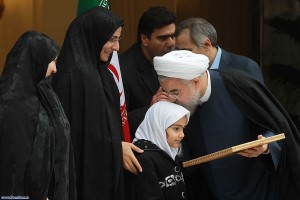
Iran’s President Hassan Rouhani celebrates the completion of an interim deal on Iran’s nuclear program by kissing the head of the daughter of an assassinated Iranian nuclear engineer
In an article entitled “Why America needs Iran in Iraq,” former U.S. Ambassador to Iraq Zalmay Khalilzad argues that “the chaos in Baghdad, culminating in the temporary occupation of the parliament by followers of Shiite Islamist cleric Muqtada al-Sadr, is undermining the war against the Islamic State; weakening Iraq’s economy; and accelerating the country’s disintegration.
“Without cooperation between the United States, Iran and Iraq’s top Shiite cleric, Ayatollah Sistani, the crisis could very well lead to the collapse of the entire political system set up in Iraq during the temporary U.S. occupation … To prevent this, Washington needs Tehran’s help. And Iran should be as motivated to seek stability [in Iraq] as much as Washington, because” Khalilzad asserts, “Iran, currently is losing favour in Iraq.”
Putting aside the questionable implication that Iran might somehow, through co-operation with America, raise its standing amongst Iraqis, Khalilzad’s presumption that Iran should now attend to America’s needs in Iraq, coupled with Secretary of State John Kerry’s insistence that Iran should help America to end the conflict in Syria too, throw into sharp relief the paradox inherent at the heart of U.S. diplomacy towards Iran, Russia (and China also).
This approach has been dubbed the “middle way” by former special adviser to the Assistant Secretary of State, Jeremy Shapiro: the U.S. Administration has no desire for an all-out confrontation with these three states. They are militarily hard nuts, and there is not much appetite for yet more military confrontation amongst a weary and wary American public (to the continuing frustration of the neocons).
More prosaically, the global financial system is now so brittle, so delicately poised, that it is not at all certain that the prospect of conflict would give the lift to America’s flagging economy that war generally is supposed to give. It might just snap the financial system, instead — hence the Middle Way.
Shapiro points out the obvious contradiction to this two-track approach: the U.S. no longer can ignore such powerful states. Its window of absolute, unchallenged, uni-polar power has passed. America needs the help of these states, but at the same time, it seeks precisely to counter these states’ potential to rival or limit American power in any way.
And America simply ignores the core complaints that fuel the tensions between itself and these states. It simply declines to address them. Shapiro concludes that this foreign policy approach is unsustainable, and bound to fail: “This dual-track approach, condemning Russia [or Iran] as an aggressor one day, [whilst] seeking to work with Moscow [or Tehran] the next … would [ultimately] force ever-greater confrontation.”
The ‘Middle Way’
In a sense, the U.S. approach towards Iran seems to be mirroring the so-called “middle way” policy which the U.S. Administration pursues towards Russia, whereby the putative “reset” with Russia was set aside (when President Vladimir Putin assumed the Presidency for the second time), and Obama – rather than seek outright confrontation with Russia – ruled that America however, would only co-operate with Russia when it suited it, but the U.S. would not deign to address Russia’s core issues of its “outsider” status in Europe, or its containment in Asia — or its concerns about a global order that was being used to corner Russia and to crush dissenter states who refused to enter the global order on America’s terms alone.
And Obama did little to drawback the NATO missile-march towards Russia’s borders (ostensibly, it may be recalled, to save Europe from Iranian missiles).
Ostensibly, too, the JCPOA (Joint Comprehensive Plan of Action) could have been America’s “reset” with Iran. Some, including a number of prominent Iranian politicians, thought it was.
But National Security Advisor Susan Rice was very explicit to Jeffrey Goldberg in The Atlantic that this was never intended: “It is assumed, at least among his critics, that Obama sought the Iran deal because he has a vision of a historic American-Persian rapprochement. But his desire for the nuclear agreement was born of pessimism as much as it was of optimism.
“The Iran deal was never primarily about trying to open a new era of relations between the U.S. and Iran,” Susan Rice told [Goldberg]. “It was far more pragmatic and minimalist. The aim was very simply to make a dangerous country substantially less dangerous. No one had any expectation that Iran would be a more benign actor.”
And so, we see a similar pattern, the possibility of a real “reset’ with Iran is pre-meditatively set aside (as per Rice), whilst the dual-track approach of condemning Iran for its ballistic missile tests (which have nothing to do with JCPOA), and its support for Hizbullah, are condemned one day, whilst Iran’s help in Iraq and Syria is being demanded on the next day.
At the same time, Iran’s core dispute with the U.S. – its complaints that exclusion from the international financial system is not being ameliorated as JCPOA was supposed so to do – are not being addressed. Rather they are being met with a shrug that implies “did they really expect anything else?”
Well, some (but by no means all) Iranian politicians had done just that: they had raised the Iranian public’s expectations that all sanctions – other than specific U.S. sanctions – would be lifted. They rather bet their credibility on it, as it were, and may pay a political price eventually.
And as NATO deploys a further 4,000 troops in the Baltic states and Poland, on Russia’s border, so too the U.S. Congress continues its figurative advance on Iran’s frontiers.
Here is Iran’s (conservative) Keyhan newspaper: “The draft of a new resolution has been presented to the US Congress in which Iran is accused of creating tension in the Persian Gulf, and the US Government has been urged to confront Iran and impose new sanctions against our country. Randy Forbes, a Republican member of the US House of Representatives, has drafted a resolution, which if passed by the Congress, condemns Iran’s military presence in the Persian Gulf as a provocation” (emphasis added)
Shapiro’s specific warning about the “middle way” approach was that “political and bureaucratic factors on both sides would force ever-greater confrontation.” But this is not the only risk, nor does it even constitute being the biggest risk (besides that of having undermined those in Iran and Russia who had put their “hat in the ring” of contemplating Entente with the United State).
America’s Bad Faith
Rather, it is by making this policy approach quite general to those states which have taken on themselves the burden of being the symbol for a non-Western, alternative vision (Russia, Iran and China, inter alia), that a perceived breach of the spirit of the JCPOA (at the least), will have wider repercussions.
Russia and China both spent political capital in order to help persuade Iran to sign up to the JCPOA: Will they not wonder whether America is to be trusted? China has complicated negotiations in hand with America on trade and financial issues, whilst Russia has been trying to resolve ballistic missile, as well as Ukraine sanctions issues, with America.
Is it not a straw in the wind for the consequences to this policy when a prominent Russian commentator, Fyodor Lukyanov, who is not at all hostile to rapprochement with the West, writes in End of the G8 Era that using Russia’s prospective inclusion in the G8 as an instrument of pressure on Russia is pointless?:
“The G8 reflected a certain period of history when Russia really wanted to be integrated into the so-called Extended West. Why it did not happen? Something went wrong? This is another topic. The most important thing is that it did not happen at all … it seemed (in the 1990s) that this membership would not mean just participation in yet another club, but a strategic decision aimed at the future.
“However, the desirable future did not come, and probably won’t come. It is obvious now, that the world does not develop in the direction of the Western model. So, now we have what we have, and there is no reason to restore the G8.”
May this general sentiment come to be reflected in Iran too, as the sanctions-lifting issue drags on? Did the U.S. then “win one over Iran” through the JCPOA accord – as the shrugs of U.S. shoulders at Iranian complaints, might imply? Was Iran just naïve? Did they really think that the U.S. was simply going to empower Iran financially?
It is pretty clear that the Supreme Leader understood the situation precisely — he had, after all some experience of U.S. non-compliance with agreements from the Lebanese hostage negotiations of the 1980s.
But what has Iran lost by the JCPOA? A few Iranians may have had their fingers burned in the process, but Iran achieved three important things: the world now knows that it was not Iran that was the impediment to a nuclear deal; the deal has transformed Iran’s public image – and created an opening – with the rest of the world (including Europe); and it has, in the process, constructed and strengthened strategic political and economic ties with Russia and China.
But most important of all, the rift within Iran that stemmed from the sense amongst some Iranian orientations, that President Ahmadinejad’s rhetoric was a principal obstacle to normalizing with the West, has been addressed: an Iranian government, with a Western-friendly face, has been given, and seen to have been given, the full chance to negotiate a solution to the nuclear issue. Whatever the final outcome, that boil has been lanced.
No, the Iranian leadership has not been naïve.
Alastair Crooke is a British diplomat who was a senior figure in British intelligence and in European Union diplomacy. He is the founder and director of the Conflicts Forum, which advocates for engagement between political Islam and the West.
May 9, 2016
Posted by aletho |
Progressive Hypocrite, Timeless or most popular | Iran, Russia, Sanctions against Iran, United States |
Leave a comment
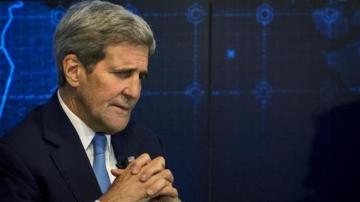
By John Chuckman | Aletho News | May 9, 2016
John Kerry is, besides many other unpleasant things, a rather ridiculous man, and he has managed to prove that proposition time and time again.
He used his recent commencement address at Northwestern University to attack Donald Trump. It is difficult to understand why young graduates at one of America’s better universities would want to hear political boiler plate from a key member of a failed and dying administration, rather than the usual vaguely inspiring stuff about the future, but that is what the graduating class got for their student fees.
I suppose, as so often is the case in America, the empty prestige of having someone with a big job speak, even when they have nothing to say, mattered. After all, Hillary Clinton has collected countless millions doing exactly the same thing for audiences at investment banker and defense contractor banquets in recent years.
Well, the part of Trump on which Kerry focused was his proposal for a wall with Mexico.
I don’t like walls myself, and it is my belief that even if elected Trump, for many reasons, will not succeed in emulating the Emperor Hadrian. Still, you might expect from the point of view of a Secretary of State, supposedly gazing upon the world’s countries with an impartial, god-like eye, that if it is okay for Israel to keep building walls, and it has several new ones underway right now, all built on other people’s property, why can’t others? The reasoning in both cases, and in all other cases such as those in Kerry’s contemporary Europe where new walls of various forms are frantically being built, is the same: we need to stop unwanted people crossing the border.
Can anyone even imagine Kerry – this man who, once not long ago, reminisced over Champagne toasts about some distant relative or another of his who was allegedly part-Jewish (truly, has grovelling by a Secretary of State reached such levels before? I would have expected his entire audience either to choke or throw up) – ever saying a single word to Israel about its walls, walls which go far beyond serving Israel’s border fears to literally chopping up and destroying the land which supports millions of other people? It would be as though Trump were demanding a series of walls inside Mexico to balkanize the entire country and then set about building them himself with America’s armed forces. Now that would be utterly ridiculous, not to say criminal, but Israel’s doing just that is never called ridiculous or criminal, and it certainly is never questioned by Kerry.
And then, as though in an effort to reclaim the stature of his address from just political campaign boiler plate, Kerry’s rhetoric drifted off to the subject of a future borderless world.
Now that is an old idea that appeals greatly to me, but I know very well that Kerry is being dishonest here. The world in fact, not all that long ago, pretty much was borderless. It was precisely the rise of the modern nation state in the 19th century which killed off that amiable concept requiring no passports or visa or permissions for moving about. Of course, we are talking about precisely the kind of modern nation state which Kerry has lovingly served in expanding its power and influence over others for his entire adult life.
Kerry’s dishonesty extends into what he even means by a “borderless world.” Now, I have always believed the Apostle Paul in emphasizing deeds rather than words, so If we are to judge by Kerry’s actual acts and those of predecessor Secretaries of State such as Hillary Clinton or Madeleine Albright or Henry Kissinger, and not by the State Department’s regularly-broadcast, doubtful advertising claims, John Kerry’s concept of a “borderless world’ is one in which the United States runs everyone’s affairs, rendering the borders of individual countries meaningless.
Now, that is a concept which very much does not appeal to me, nor does it appeal, I suspect, to a great many of the world’s seven billion people and their governments.
Just recently, this dishonest and generally unpleasant man has put an ultimatum to the government of Syria, making threats that if he doesn’t see what he wants by the beginning of August, there will be serious consequences. That certainly sounds to me like a Mafia Don speaking, demanding payment of protection money from some business, or else.
John Kerry has no business telling the government of Syria to do anything, much less to dissolve itself. It is, and has been, a reasonably popular government, one which receives the support of a majority of Syrians in polls and elections. Among other reasons for its popularity is President Assad’s defence of religious minorities. Syria’s citizens form an elaborate quilt of various religions, and they know their rights to worship as they please are protected in a region of the world where that is not common. Some of Mr. Kerry’s closest working associates in the region cannot say the same thing, and indeed they include associates who are quite violent towards people of differing faiths.
The proxy forces which Kerry and his predecessor, Hillary Clinton, have supported for five years in tearing Syria apart consist literally of various gangs of intolerant extremists and cut-throats. Boy, when it comes to double-speak, John Kerry is your man.
By what right does he do this? None, except that might makes right. America has supported terror in Syria, supplying weapons, platoons of cut-throats, and training while supporting the thugs of Turkey and Saudi Arabia in their logistics of destruction, all while pretending in State Department advertisement after advertisement that it opposes terror. And we’ve only just learned that Hillary Clinton supported the transfer of supplies of deadly Sarin nerve gas from Gadhafi’s stockpiles in wrecked Libya (another stunning State Department achievement) through a secret pipeline (read: Turkey) to the cut-throats in Syria where it was promptly used to kill civilians in the hope of blaming Assad and creating a casus belli for the United States (or, as Obama put it in his elliptical language, responding to Assad crossing a red line).
But John Kerry still hasn’t got what he wants in Syria, so now we have a new threat. Why is Kerry so determined to topple the government of Syria? Because Assad is an independent-minded leader, one who does not immediately say “yes, sir,” to every whim of Washington’s, and if there is anything which recent history teaches us, it is that the outfit Kerry serves has no tolerance for the independent-minded. So as to emphasize the point, Washington has left behind a trail of death and destruction in the region – perhaps a million dead and millions made refugees – all of it aimed at getting rid of inconvenient independent leaders.
This intolerance by Washington of independent-mindedness is strongly supported – supported is actually much too feeble a word, demanded being more apt, and demanded regularly over heated phone lines – by the government of America’s colony in the region, the same government to whom Kerry fears even saying so much as a word about its many walls criss-crossing other people’s land.
Quite a disgusting business I think which somehow manages to be converted by our press into “foreign policy,” just as one of its authors, John Kerry, manages to be converted into a “diplomat.’
Kerry was a rich boy who, after graduating university, started his political ascent by spending four months in Vietnam, busying himself with shooting peasants in the back from an armored speedboat racing up and down rivers. He wanted to gain some war “creds” for an anticipated political career. Apart from his killings in Vietnam, he made such a muck of things, leaving behind colleagues who had only contempt for his false heroics and self-promotion. Then our man Kerry, having returned home and seeing how badly the Vietnam War was regarded by people, decided to add some new “creds” to his resume, anti-war ones. So, no matter how the political winds turned in the future, John-boy was covered. He appeared with some anti-war demonstrators, once throwing his filthily-earned medals into a bin, from which they were later quietly retrieved for him.
As to Kerry’s actual attitude towards America’s dirty colonial wars, we have the testimony of his whole career in the Senate, as a Presidential candidate, and finally as Secretary of State, faithfully serving and supporting them.
Kerry’s campaign, in running for President in 2004, was so unbelievably dreary and empty of all meaning, that the American people actually re-elected the most disliked president in the country’s history, George Bush. That feat stands as a remarkable testimonial to John Kerry’s talents.
The only big thing Kerry seems ever to have done that was genuinely successful was marrying the woman who inherited the Heinz Ketchup and Pickle Fortune. That made him wealthy beyond his dreams, perhaps planting in his brain fanciful thoughts of an ambitious young George Washington marrying the widow, Martha Custis, said to have been the wealthiest woman in the American colonies.
When John Kerry says anything on any topic, his listeners would be wise to consider the source, for even though he walks around in the appointed robes of America’s Secretary of State, he is pretty much a life-long, ambitious, and dishonest failure.
May 9, 2016
Posted by aletho |
Progressive Hypocrite, Timeless or most popular, War Crimes, Wars for Israel | Israel, John Kerry, Middle East, Northwestern University, Obama, United States, Zionism |
Leave a comment
On March 23, 2011, at the very start of what we now call the ‘Syrian conflict,’ two young men – Sa’er Yahya Merhej and Habeel Anis Dayoub – were gunned down in the southern Syrian city of Daraa.
Merhej and Dayoub were neither civilians, nor were they in opposition to the government of Syrian President Bashar al-Assad. They were two regular soldiers in the ranks of the Syrian Arab Army (SAA).
Shot by unknown gunmen, Merhej and Dayoub were the first of eighty-eight soldiers killed throughout Syria in the first month of this conflict– in Daraa, Latakia, Douma, Banyas, Homs, Moadamiyah, Idlib, Harasta, Suweida, Talkalakh and the suburbs of Damascus.
According to the UN’s Independent International Commission of Inquiry on Syria, the combined death toll for Syrian government forces was 2,569 by March 2012, the first year of the conflict. At that time, the UN’s total casualty count for all victims of political violence in Syria was 5,000.
These numbers paint an entirely different picture of events in Syria. This was decidedly not the conflict we were reading about in our headlines – if anything, the ‘parity’ in deaths on both sides even suggests that the government used ‘proportionate’ force in thwarting the violence.
But Merhej and Dayoub’s deaths were ignored. Not a single Western media headline told their story – or that of the other dead soldiers. These deaths simply didn’t line up with the Western ‘narrative’ of the Arab uprisings and did not conform to the policy objectives of Western governments.
For American policymakers, the “Arab Spring” provided a unique opportunity to unseat the governments of adversary states in the Middle East. Syria, the most important Arab member of the Iran-led ‘Resistance Axis,’ was target number one.
To create regime-change in Syria, the themes of the “Arab Spring” needed to be employed opportunistically – and so Syrians needed to die.
The “dictator” simply had to “kill his own people” – and the rest would follow.
How words kill
Four key narratives were spun ad nauseam in every mainstream Western media outlet, beginning in March 2011 and gaining steam in the coming months.
– The Dictator is killing his “own people.”
– The protests are “peaceful.”
– The opposition is “unarmed.”
– This is a “popular revolution.”
Pro-Western governments in Tunisia and Egypt had just been ousted in rapid succession in the previous two months – and so the ‘framework’ of Arab Spring-style, grass roots-powered regime-change existed in the regional psyche. These four carefully framed ‘narratives’ that had gained meaning in Tunisia and Egypt, were now prepped and loaded to delegitimize and undermine any government at which they were lobbed.
But to employ them to their full potential in Syria, Syrians had to take to the streets in significant numbers and civilians had to die at the hands of brutal security forces. The rest could be spun into a “revolution” via the vast array of foreign and regional media outlets committed to this “Arab Spring” discourse.
Protests, however, did not kick off in Syria the way they had in Tunisia and Egypt. In those first few months, we saw gatherings that mostly numbered in the hundreds – sometimes in the thousands – to express varied degrees of political discontent. Most of these gatherings followed a pattern of incitement from Wahhabi-influenced mosques during Friday’s prayers, or after local killings that would move angry crowds to congregate at public funerals.
A member of a prominent Daraa family explained to me that there was some confusion over who was killing people in his city – the government or “hidden parties.” He explains that, at the time, Daraa’s citizens were of two minds: “One was that the regime is shooting more people to stop them and warn them to finish their protests and stop gathering. The other opinion was that hidden militias want this to continue, because if there are no funerals, there is no reason for people to gather.”
With the benefit of hindsight, let’s look at these Syria narratives five years into the conflict:
We know now that several thousand Syrian security forces were killed in the first year, beginning March 23, 2011. We therefore also know that the opposition was “armed” from the start of the conflict. We have visual evidence of gunmen entering Syria across the Lebanese border in April and May 2011. We know from the testimonies of impartial observers that gunmen were targeting civilians in acts of terrorism and that “protests” were not all “peaceful”.
The Arab League mission conducted a month-long investigation inside Syria in late 2011 and reported:
“In Homs, Idlib and Hama, the observer mission witnessed acts of violence being committed against government forces and civilians that resulted in several deaths and injuries. Examples of those acts include the bombing of a civilian bus, killing eight persons and injuring others, including women and children, and the bombing of a train carrying diesel oil. In another incident in Homs, a police bus was blown up, killing two police officers. A fuel pipeline and some small bridges were also bombed.”
Longtime Syrian resident and Dutch priest Father Frans van der Lugt, who was killed in Homs in April 2014, wrote in January 2012:
“From the start the protest movements were not purely peaceful. From the start I saw armed demonstrators marching along in the protests, who began to shoot at the police first. Very often the violence of the security forces has been a reaction to the brutal violence of the armed rebels.”
A few months earlier, in September 2011, he had observed:
“From the start there has been the problem of the armed groups, which are also part of the opposition… The opposition on the street is much stronger than any other opposition. And this opposition is armed and frequently employs brutality and violence, only in order then to blame the government.”
Furthermore, we also now know that whatever Syria was, it was no “popular revolution.” The Syrian army has remained intact, even after blanket media coverage of mass defections. Hundreds of thousands of Syrians continued to march in unreported demonstrations in support of the president. The state’s institutions and government and business elite have largely remained loyal to Assad. Minority groups – Alawites, Christians, Kurds, Druze, Shia, and the Baath Party, which is majority Sunni – did not join the opposition against the government. And the major urban areas and population centers remain under the state’s umbrella, with few exceptions.
A genuine “revolution,” after all, does not have operation rooms in Jordan and Turkey. Nor is a “popular” revolution financed, armed and assisted by Qatar, Saudi Arabia, the US, UK and France.
Sowing “Narratives” for geopolitical gain
The 2010 US military’s Special Forces Unconventional Warfare manual states:
“The intent of US [Unconventional Warfare] UW efforts is to exploit a hostile power’s political, military, economic, and psychological vulnerabilities by developing and sustaining resistance forces to accomplish US strategic objectives… For the foreseeable future, US forces will predominantly engage in irregular warfare (IW) operations.”
A secret 2006 US State Department cable reveals that Assad’s government was in a stronger position domestically and regionally than in recent years, and suggests ways to weaken it: “The following provides our summary of potential vulnerabilities and possible means to exploit them…” This is followed by a list of “vulnerabilities” – political, economic, ethnic, sectarian, military, psychological – and recommended “actions” on how to “exploit” them.
This is important. US unconventional warfare doctrine posits that populations of adversary states usually have active minorities that respectively oppose and support their government, but for a “resistance movement” to succeed, it must sway the perceptions of the large “uncommitted middle population” to turn on their leaders. Says the manual (and I borrow liberally here from a previous article of mine):
To turn the “uncommitted middle population” into supporting insurgency, UW recommends the “creation of atmosphere of wider discontent through propaganda and political and psychological efforts to discredit the government.”
As conflict escalates, so should the “intensification of propaganda; psychological preparation of the population for rebellion.”
First, there should be local and national “agitation” – the organization of boycotts, strikes, and other efforts to suggest public discontent. Then, the “infiltration of foreign organizers and advisors and foreign propaganda, material, money, weapons and equipment.”
The next level of operations would be to establish “national front organizations [i.e. the Syrian National Council] and liberation movements [i.e. the Free Syrian Army]” that would move larger segments of the population toward accepting “increased political violence and sabotage” – and encourage the mentoring of “individuals or groups that conduct acts of sabotage in urban centers.”
I wrote about foreign-backed irregular warfare strategies being employed in Syria one year into the crisis – when the overwhelming media narratives were still all about the “dictator killing his own people,” protests being “peaceful,” the opposition mostly “unarmed,” the “revolution wildly “popular,” and thousands of “civilians” being targeted exclusively by state security forces.
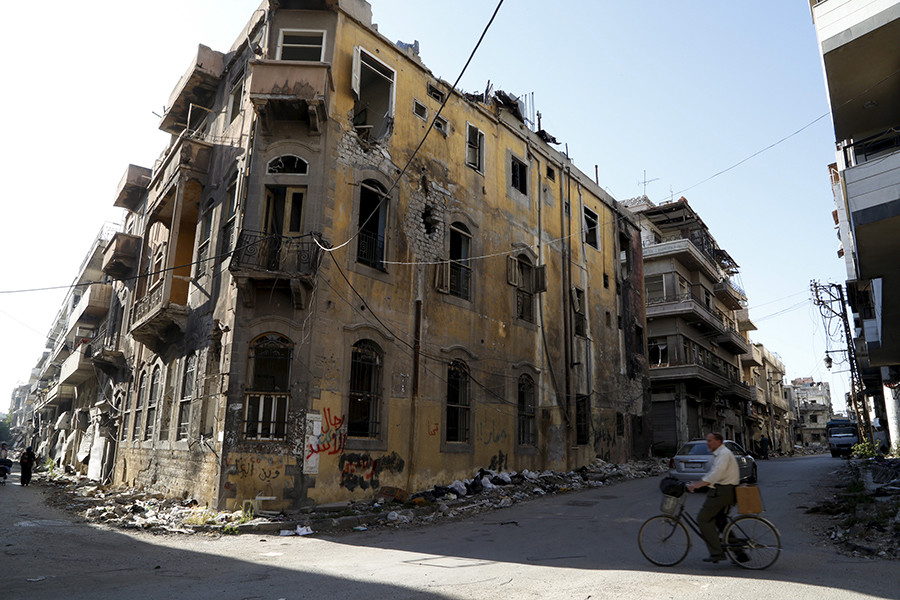
Were these narratives all manufactured? Were the images we saw all staged? Or was it only necessary to fabricate some things – because the “perception” of the vast middle population, once shaped, would create its own natural momentum toward regime change?
And what do we, in the region, do with this startling new information about how wars are conducted against us – using our own populations as foot soldiers for foreign agendas?
Create our own “game”
Two can play at this narratives game.
The first lesson learned is that ideas and objectives can be crafted, framed finessed and employed to great efficacy.
The second take-away is that we need to establish more independent media and information distribution channels to disseminate our own value propositions far and wide.
Western governments can rely on a ridiculously sycophantic army of Western and regional journalists to blast us with their propaganda day and night. We don’t need to match them in numbers or outlets – we can also employ strategies to deter their disinformation campaigns. Western journalists who repeatedly publish false, inaccurate and harmful information that endanger lives must be barred from the region.
These are not journalists – I prefer to call them media combatants – and they do not deserve the liberties accorded to actual media professionals. If these Western journalists had, in the first year of the Syrian conflict, questioned the premises of any of the four narratives listed above, would 250,000-plus Syrians be dead today? Would Syria be destroyed and 12 million Syrians made homeless? Would ISIS even exist?
Free speech? No thank you – not if we have to die for someone else’s national security objectives.
Syria changed the world. It brought the Russians and Chinese (BRICS) into the fray and changed the global order from a unipolar one to a multilateral one – overnight. And it created common cause between a group of key states in the region that now form the backbone of a rising ‘Security Arc’ from the Levant to the Persian Gulf. We now have immense opportunities to re-craft the world and the Middle East in our own vision. New borders? We will draw them from inside the region. Terrorists? We will defeat them ourselves. NGOs? We will create our own, with our own nationals and our own agendas. Pipelines? We will decide where they are laid.
But let’s start building those new narratives before the ‘Other’ comes in to fill the void.
A word of caution. The worst thing we can do is to waste our time rejecting foreign narratives. That just makes us the ‘rejectionists’ in their game. And it gives their game life. What we need to do is create our own game – a rich vocabulary of homegrown narratives – one that defines ourselves, our history and aspirations, based on our own political, economic and social realities. Let the ‘Other’ reject our version, let them become the ‘rejectionists’ in our game… and give it life.
Sharmine Narwani is a commentator and analyst of Middle East geopolitics. She is a former senior associate at St. Antony’s College, Oxford University and has a master’s degree in International Relations from Columbia University. You can follow her on Twitter at @snarwani
May 9, 2016
Posted by aletho |
Deception, Mainstream Media, Warmongering, Timeless or most popular, War Crimes | France, Qatar, Saudi Arabia, Syria, UK, Unconventional Warfare, United States |
Leave a comment

US Ambassador to Hungary, Coleen Bell
If anyone wants a short course on what’s wrong with US diplomacy look no further than US Ambassador to Hungary Coleen Bell’s speech Friday to the Foreign Affairs Committee of the Hungarian Parliament. In typical diplo-speak there was plenty of flowery language about shared values, fish swimming together in the same water (?), sappy poetics like “together, out of that winter, we would force the spring,” and talk of together being “part of the world’s greatest military and political alliance.”
But make no mistake: Inside Ambassador Bell’s velvet glove is an iron fist, poised to strike should Washington’s annoyingly independent-minded Fidesz-led government step out of line on the big issues. And by “big” issues it should be understood that the US means the issues it considers in the interests of its own foreign policy, not those in Hungary’s interest.
Message to Hungary: do as we say or you will be sorry.
Ambassador Bell’s previous job was as a television soap opera producer, but raising more than two million dollars for the election of Barack Obama “earned” her the position of top US diplomat in Hungary.
The former television producer does know how to deliver her lines, though. She lectured the Hungarians about Syria, explaining to them that ISIS and Assad are both equally evil and both equally to blame for the disaster that is Syria.
ISIS has flourished in Syria, she told the Hungarians, because it “exploits the chaos of civil war in Syria, a conflict that has now claimed more than 250,000 lives.” But she does not mention that it was US backing for “regime change” in Syria — beginning at least in 2006, as we learn from a critical Wikileaks-released US Embassy Damascus memo — that created that very chaos she blames for the rise of ISIS.
In fact it is propaganda to call what is happening in Syria a “civil war,” as the forces battling the Syrian government are all sponsored by foreign powers like Saudi Arabia, Turkey, and the US. It is a proxy war against the Syrian government, not a civil war.
She then tells the Hungarians ISIS will never be defeated in Syria until Assad is overthrown:
[W]e know we won’t be able to defeat Daesh in Syria unless we also deal with the civil war and particularly with Assad. Because as long as Assad is there, he remains the most powerful magnet for foreign fighters and recruits to Daesh.
Does she assume Hungarians are so stupid that they believe that by attacking and beating ISIS back nearly to Raqqa (with Russian assistance), the Syrian government of Assad is actually benefitting ISIS? Attacking ISIS means Assad is on the side of ISIS?
“Since February, the cessation of hostilities reduced the violence in Syria, allowing millions of Syrian civilians to take the first steps toward reclaiming a normal life,” says the Ambassador, without even mentioning what brought the ceasefire about in the first place: Russian participation along with the Syrian army in the decimation of al-Qaeda and ISIS positions in northwest and central Syria. In fact it is absolutely bizarre that in the world of Ambassador Bell (and the State Department hacks who drafted her speech), the Russian intervention against al-Qaeda and ISIS simply never took place or was too inconsequential to mention.
Is any Hungarian so ill-informed that he would believe such nonsense?
Bell used the tragedy in Syria to pressure Hungary on the (largely American-made) refugee crisis. Hungary’s firebrand prime minister, Viktor Orban, has, along with several of his central European counterparts, stood up to Brussels’ (and Washington’s) demands that Hungary take in tens of thousands of migrants who heeded German Chancellor Angela Merkel’s call to come to Europe and enjoy lots of free stuff.
Last month Orban told Hungarian Radio that if he accepts the EU migrant resettlement plan, “it would be determined not in Hungary but in Brussels who we have to live together with, and how the ethnic composition of the country will look in future.” He has rejected such a notion.
“Every sovereign nation has the right and an obligation to protect its borders,” Bell told the Hungarian Parliament, “But every nation, as a part of the international community, also has a fundamental obligation to help refugee populations seeking safety.”
Translation: your sovereignty is not determined by you, but rather by us. It is a practice articulated by Orwell in 1984 whereby a person can think two completely contradictory thoughts at the same time seemingly without any mental conflict.
But here is where the iron fist inside Bell’s velvet glove glints in the sun. She pointedly condemned the Hungarian government position by praising those in Hungary who hold the opposite view, i.e. the Hungarian opposition:
We commend the humanitarian spirit of Hungarian leaders, law enforcement and military personnel, and ordinary citizens who are responding to this crisis with generosity and compassion.
Then she gives Hungary Washington’s marching orders:
We continue to stress that any solution to these migration challenges should focus on saving and protecting lives, ensuring the human rights of all migrants are respected, and promoting orderly and humane migration policies. That includes the support of all Member State governments for the refugee agreement forged between the EU and Turkey.
Translation: Hungary must support the EU agreement with Turkey which would see tens of thousands of migrants settled in EU member countries, including Hungary itself. The problem is that the Hungarian parliament explicitly rejected Brussels’ forced migrant settlement plans for Hungary and plans to hold a nationwide referendum on the subject. Bell is saying here that Hungary’s elected representatives and even the Hungarian voter must be ignored and Brussels’ dictate obeyed.
When it comes to Russia, Ambassador Bell also has some instructions for Budapest: Moscow is your enemy and don’t you forget it.
She told Hungarian parliamentarians:
As many Hungarians have reminded me, you need no introduction to the nature of Russian aggression. Your response has always been to show resolve. Our best weapons, in fact, are resolve and solidarity.
Weapons? Quite a loaded word.
Orban has been seen in Washington as insufficiently enthused about sanctions on Russia, which hurt Hungarian trade and business interests. Ambassador Bell makes it clear that Hungary must adhere to US demands of Russia, even if they are completely incoherent:
As the United States and Hungary have both stated many times, Russia has a simple choice: fully implement Minsk or continue to face sanctions. Russia must withdraw weapons and troops from the Donbas; Russia must ensure that all Ukrainian hostages are returned; Russia must allow full humanitarian access to occupied territories; Russia must support free, fair, and internationally-monitored elections in the Donbas under Ukrainian law; and most important, Russia must restore Ukraine’s sovereignty.
That last point should be taken to mean that Russia must ignore the will of the people of Crimea who voted in overwhelming numbers to re-join Russia after just 25 years as part of independent Ukraine.
Not to worry, Ambassador Bell is confident that Budapest will do everything Washington tells it to do:
More than this, Hungary is equal to the great challenges of our times, and the United States is counting on you.
To stiffen their spine, US Ambassador Bell reminds the Hungarians that they are part of “our global order” and touts the great examples set by the US, including:
Our system of international economic, political, and social norms and institutions have kept the peace and fostered prosperity for decades. Whether it is international law, environmental protection, trade regulations, anticorruption laws, child labor laws, human rights safeguards, the nonproliferation regime, public health systems, international financial institutions, UN peacekeeping, or a robust civil society – these norms and institutions give life and stability to our global order.
In the era of NSA spying on innocent Americans, Guantanamo, CIA torture, weapons sales to the world’s worst dictators (Saudi Arabia for one), destruction of the environment by the US war machine, “regime change” operations that violate the sovereignty of other states, and outright aggression in opposition to US and international law (Libya, etc.), Bell’s suggestion that “our global order” is the pinnacle of civilization should get a laugh out of most Hungarians. In fact, from Libya to Syria to Ukriane to Pakistan and Afghanistan, the US interventionist attempt to forge a global order with blood and bullets will go down in history along with the authoritarianisms of the 20th century as one of humanity’s darkest chapters.
Here is the short version of Ambassador Bell to Budapest: “to be our partner means you do what we say whether or not it is in your interest.”
Funny, that was Moscow’s message to Budapest from 1948 to 1989.
May 7, 2016
Posted by aletho |
Civil Liberties, Mainstream Media, Warmongering, Timeless or most popular, War Crimes | Coleen Bell, European Union, Hungary, Russia, Syria, Ukraine, United States |
Leave a comment
I can think of no better way to reveal the brainwashing of my fellow Americans, than to reveal it through my hometown newspaper. The Post Courier is a Pulitzer Prize winning publication in Charleston, SC. The newspaper has for generations carried local and world news to the people of the “low-country”, where I grew up. But South Carolina’s most powerful print media is also the policy arm of the American elite. Here is my view on what’s wrong with America’s press.
I am forced to write this, you know? The war on truth has come to this. As fair people, and as caring Americans, sooner or later a choice has to be made in between desperately held tradition and belief, and the hard, cold facts of life. For my part, I grew up agnostic to elitism, or maybe I should say “naïve” as to its ravaging teeth. But then, Charleston has a melancholy effect, its mix of charm and wealth being so striking, and yet so brutal. Oh, but I speak metaphorically. I am sorry, the subject here is power, and how the powerful wield it. I am here to tell you about one city newspaper, one that I believe bends the opinion of its readership. The Post and Courier is one of America’s oldest daily newspapers, with origins dating back the founder, Aaron Smith Willington, who is said to have rowed out into Charleston harbor to meet ships from New York and abroad, in order to get “the news” before his competitors.
Reading and Adjunct Newspaper Uses
My grandfather used to sit on the porch and read every scrap of the Post and Courier. Then at night, on cool nights in autumn, he used the newspaper as kindling, for a coal burning stove in his humble home near the railroad tracks. Reading a book review at the Post and Courier online this morning, I find myself wondering if the paper would even catch fire these days. The need for, or necessity of, reviewing THE NEW TSAR: The Rise and Reign of Vladimir Putin by Steven Lee Myers, at this late date, it’s questionable, comical, and a bit deceitful, when it comes right down to it. May 1, 2016, and a College of Charleston (my Alma mater) instructor gets space in the Post and Courier for reviewing a book published almost two and one half years ago? To be fair here, I’ll give Oksana Ingle, adjunct instructor of Russian language and literature at the College of Charleston credit for her writing style, and for seeming somewhat impartial too. But the gist of the “Putin” piece is:
“Despite Myers’ tendency to bog the reader down in too much detail sometimes, this book is a thorough, truthful story of Putin’s “Rise and Reign”, the professor notes.
Dr. Ingle seems like a nice lady, smart, professional, like all the professors I recall from the college. If not for the departure outside literature and language in this review, I’d surmise the publishers of the Post and Courier might have lured her to do this piece. The professor departs though, from journalistic review into State Department-ish regurgitation, of the “Dr. Evil Vladimir Putin” technique for propagandizing. But the “lure” of the Post and Courier, as the only print media game in town, it’s always there for professors, and for plumbers. I’ll avoid being contrite here, and move on to the Post and Courier’s political sway toward war mongers and international investors.
Agenda. If you are looking for the “cause” for anything, finding out “why” is usually not so hard. The agenda of the Post and Courier (past and present) is found in the power of policy, as formulated by the press. This is not news; it has been going on at this newspaper since way before I was a kid roaming King Street to find a toy, a movie, or a snow cone. In Vietnam, for instance, the Post and Courier leaned to the “hawkish” side of the war, toward the low-country industries that profited from the war, and benefited the city and the elite investors of the south as a whole. I recall the conversations at the tables of the Charleston Yacht Club, and being chastised for interrupting grownups talking about General Westmoreland, in the dining room of the Charleston Country Club. From Market Street’s classy restaurants, to kids playing on the Civil War cannons at White Point Gardens, we were all little hawks back then, in 1965 at least. But I can take the reader back far past Vietnam, deep down into deep south society, and even into the immense power leveraging US policy these days. The Post and Courier ownership coincides a bit, with my own family history, and ideas and tales of southern legends. In this story you are reading we have the Post and Courier newspaper, the College of Charleston, US policy, Vladimir Putin, and allegations of propaganda. “My, oh my”, my mother Delilah would shake her head and say. Well, let’s see why Vladimir Putin the evil genius is so negatively revealed in this newspaper.
Will the South “Rise Again”?
Arthur Middleton Manigault was a French man who was a French Huguenot born in La Rochelle, France and settled in Charleston. His mother was the [ ] South Carolina’s Lt. Governor, Charles Drayton, and the granddaughter of the second president of the First Continental Congress. His great uncle, Arthur Middleton, signed the Declaration of Independence. Manigault was a hero of the Confederate States of America, a Civil War and Palmetto Guards, and later Brigadier General after the famous “Atlanta Campiagn” that saw the south burning down (figuratively and literally). Arthur’s grandfather, Peter Manigault, was the richest man in the colonies before the revolution. To preserve your time, the context here is that the Post and Courier is owned by the Manigault family now. Bought back in 1896, the newspaper and its other enterprises have been in this family for generations. Today, Pierre Manigault runs the family operations.
Like his father, and his father’s father, the new Manigault is a member of everything in Charleston society that matters. He is Chairman of the Santee River Focus Area Task Force and a board member of the Historic Charleston Foundation, the Middleton Place Foundation, Magnolia Cemetery, and the National Steeplechase Foundation. He is also a past board member of the Lowcountry Open Land Trust, the Gibbes Museum, the Preservation Society of Charleston, the Historic Rice Fields Association, the Palmetto Conservation Foundation, and the International Crane Foundation, and he is on the College of Charleston’s Library Steering Committee, just to name a few. “Old money”, this is the term used to identify who really runs things in America, and the Manigault family has always been in “the thick” of controlling. To find quick and easy evidence of anyone’s ties to policy, all one has to do it look at what I call, the “mutual admiration society” or organizations in place for one purpose – to laud one another over mutually interesting greatness. I assure you, there are plenty of these in Charleston. The “Free Enterprise Foundation’s Annual Ethics and Civic Responsibility Awards Luncheon”, it is a prime example.
When Post and Courier boss Pierre Manigualt received his ethical tea party award in 2010, the key speaker was Ayn Rand Institute Executive Director Yaron Brook. For anyone who’s studied Ayn Rand disciples in the past, this alone brands Manigault as a henchman of the New World Order (NWO). If rampant, radical capitalism were the goal of, let’s say the Rockefellers or Rothschilds, then Ayn Rand institute would be the kneeling chapel for praying to the god of money. The institute not only awards excellence in money grubbing and mind control over college students, Arline Mann, Managing Director and Associate General Counsel of the Board of Goldman, Sachs & Company is the Co-Chair of the Ayn Rand Institute. I would go through and profile all the attendees and speakers at this luncheon, but the list of sponsors suffices, they include: BB&T, Piggly Wiggly Carolina Company, The Bank of South Carolina, LS3P, College of Charleston Foundation, College of Charleston School of Business, MUSC, Trident Technical College, The InterTech Group, SCRA, and Wachovia Bank. The Free Enterprise Foundation was established in 2002 at the Citadel, the south’s and one of the nation’s oldest military academies. Its mission is stated on the now idle Facebook page, the websites of the foundation are gone now.
“The Free Enterprise Foundation is dedicated to fostering a greater understanding of free enterprise, American Exceptionalism and personal finance in schools, academia, and the community.”
Now I could dig a lot deeper into just how “exceptional” Charleston’s old money is, but when I found familiar names mentioned alongside Manigualt and others, “my chickens came home to roost”, as Mom always used to say. The names of Manigault, Ted Turner’s son, Robert Edward Turner (Teddy), and Maybank Industries’ business development boss Braton Riley, son of longtime Charleston Mayor Joseph P. Riley Jr., conjoined over unpaid bills of a society called; the “South Carolina Maritime Foundation”. Ironically, this non-profit had to sell a wonderful wooden tall ship known as the Spirit of South Carolina. Indeed, the spirit of South Carolina I was enthralled with is bankrupt, for overreaching America’s charter in foreign waters too. This piece about Maybank people in the Republic of Georgia provides context at the Citadel, in the Charleston aristocracy, and to war mongers in the halls of power in Columbia, SC, as well as Washington DC. Some old redneck chums of mine, hunting buddies, used to holler at the top of their lungs; “The South’s gonna rise agin”. Accompanied by a customary Rebel Yell, most of us southerners were proud of our revolutionary heritage, and a bit sad the South got “whupped” back in 1865. As I type this though, it’s apparent only the poor people in the South lost anything, for the aristocrats never sunk. This is a cumbersome segue though, into another personal story. The point is, Charleston’s elite have a lot to answer for in my book.
Waking Up With the Fleas
Associations. My Mom always used to say; “Bird of a feather, flock together”. In another bit of cruel irony here, I mentioned my own ties to this Charleston “exceptionalism” from the start of this story. Mom was married to John Drayton Ford, a relative of the Middletons and Manigaults etc. So my childhood access into Charleston society provides clarity here. Also interesting perhaps, Pierce Butler was another Constitutional signer, from South Carolina. But be not misled, our family usually swept floors and carried on domestic chores for the likes of the Manigaults. I am proud of the “balance” in my upbringing, you see. Dad’s people helped found the United States, and Grandpa ran a steam engine for Atlantic Coastline Railroad too. Mom’s associations reach from Seabrook Island to the top of the People’s Building in Charleston, and she picked cotton in the deep, deep south as a child too. She taught us all about the “unfair game” powerful people often make. So fear of them is not really in our DNA.
I am admonished by my partner to reconcile that the Post and Courier’s owners could be guilty of absolutely nothing. My opinion is, they are among the most guilty of all though. My Dad would have called “jading” a newspaper something like “the bastardization of the US Constitution”, and maybe he would have said the Manigualts have accomplished this so far. Going from being a family that helped found a nation based on freedom, the rule of law, and country supposedly against all forms of oppression, to propagandizing academia and the public!!! Well, in the Charleston I grew up in one might as well be accused of Satan worship and the dark crafts. But then manipulation was used back then too. After all, we did go to war in Korea, Vietnam, and other places willingly. I just wonder how willing we would have been if we had known the truth? And there it is….
Believe What You Want: Just Not in Charleston
A sampling of Post and Courier headlines includes;
Putin’s 2015 risks pay off — for now, Putin’s aggression unchecked
Throngs protest Putin
Stand together against Putin
Putin overplays his hand
Putin is set to bring back serfdom
Putin to sign bill barring Americans from adopting Russian children
Putin proves that conquest is not obsolete, Putin’s chance to push peace
A step-by-step guide on how to stop Putin, Putin’s poisonous record, U.S.
Western Europe set the table for Putin’s aggression
Warn Putin: Hands off Baltic States
Putin needs serious scrutiny
…
What’s my rub against the Post and Courier ? People in the low-country, they cannot believe a damn thing the paper prints, that’s what. It there is no dissenting view, if a two year old book can be reviewed with a “truth assessment” instead of a literary view, then a view of truth is impossible. If 1000 articles naming a world leader as the anti-Christ prevail, and all agents of an entity align with one “message”, then the community is “convinced” more than it is informed.
Phil Butler, is a policy investigator and analyst, a political scientist and expert on Eastern Europe.
May 7, 2016
Posted by aletho |
Deception, Mainstream Media, Warmongering, Timeless or most popular | Russia, South Carolina, United States |
Leave a comment
Founding political myths provide reassuring points of reference but they do not provide the full, or even, real reason on why major historical moments occurred. As is popularly known the American Revolution was triggered specifically by the Boston Tea Party in defiance of the British Parliament’s Tea Act of 1773. Yet in a recent article in the New York Review of Books, historian Professor Steve Pincus argues it was a series of economic policies, enforced by the British parliament from the 1760’s onward that made no small contribution to the colonialist’s rebellion against King George’s tyranny.
Recently in the United Kingdom a commemoration was held to mark hundred years since the Gallipoli expedition during World War One. The British Empire had intended to defeat the Ottoman Empire’s forces by sailing through the straits of Dardanelles and then move on to occupy Istanbul for the latter then to be parceled out to its ally, Imperial Russia.
The ‘Asia Minor Agreement’ between the Entente Powers of the British Empire, France and Imperial Russia divided the Ottoman Empire among themselves but after the Russian revolution (and the subsequent withdrawal of Russia from the war) this agreement became popularly known as Sykes-Picot. The British Empire’s failure to breach the Ottoman Empire’s positions at Dardanelles compelled it to fish around amongst the latter’s suzerainty in search of disgruntled groups who would be tricked into executing Great Britain’s dirty work of defeating the Ottomans and breaking up their Empire. Hence we today have the legend of the “Arab Revolt” as championed and jointly led by the British agent T.E.Lawrence aka “Lawrence of Arabia”.
Similarly when one attempts to ascertain the origins of the United States and the Saudi Arabian decades old alliance, the meeting held between President Franklin D. Roosevelt and the Kingdom’s founder, Abd al-Aziz Ibn Saud on board the USS Quincy on 14th February 1945 at Bitter Lake in the Suez Canal is widely regarded as the symbolic starting point. Hitherto, Ibn Saud had been the British Empire’s most reliable and favoured ally or desert stooge.
Since capturing Riyadh, what is now Saudi Arabia’s capital, with British weapons in 1902 Ibn Saud had dutifully and faithfully done the Empire’s bidding. Whether it was attacking the Ottoman’s Empire’s representatives in the Arabian desert or dispatching the recalcitrant Hussain Ibn Ali from the Hijaz, (the western part of today’s Saudi Arabia) in the mid-1920’s after he had refused to accept the Britain’s Zionist colonial project in Palestine; the Empire knew it had a loyal servant in Ibn Saud.
But with the Empire’s resources stretched during World War II, some British diplomats as early as 1941 were attempting to encourage American involvement in Saudi Arabia. The Empire believed it could no longer afford to subsidise Ibn Saud as well as soundly account for its own domestic and other imperial undertakings. According to two British biographers of the Saudi clan, David Holden and Richard Johns, British diplomats “had attempted in the dark days of 1941 to interest the United States Government in taking on some of their financial burden in Saudi Arabia” to no avail.[1]
Two academic studies by Dr. Barry Rubin also confirm it was the British who made the initial approaches to the United States. In the summer of 1941 the Minister-Counsellor in the British embassy in the United States, Neville Butler was attempting to encourage the State Department’s head of Near East Affairs, Wallace Murray to purchase more oil from Saudi Arabia. In a meeting in late July 1941, Butler suggested to Murray that it was “most important” that Ibn Saud knew he had friends in the United States to which he can rely on for assistance.[2]
Several weeks later on August 21st the Americans rebuffed British approaches to subsidise Ibn Saud. Yet this did not stop the British from trying to work out a way of enticing the Americans to take some responsibility in the Middle East. The British remained adamant that the Americans should and must be involved in the Arab World, as the “Foreign Office was trying to work out some division of economic opportunity and political responsibility to avoid being overwhelmed by the United States.”[3]
In other words, for the British, the issue was how to financially cut the Americans into the Middle East. As such, if the Americans were to be appropriately cut in, they would, it was thought, inevitably burden more imperial responsibility for policing the Middle East without threatening other British interests.
But why choose Ibn Saud? Why didn’t the British stealthily offer Iran, Iraq or any other oil wells which the British had carved countries out from i.e. Kuwait, Bahrain, Qatar, etc?
It appears that Saudi Arabia was the nation chosen by British imperialists to ingratiate the Americans with largely because the British clearly felt that they had enough oil in Iran and Iraq to satisfy their needs and therefore could afford to portion out Saudi Arabia to the Americans. More so, with the Empire’s oil needs met in Iran and Iraq there was no need to develop Saudi Arabian oil fields. This was noted by American officials who reported that the British “blessed with ample oil supplies from Iran and Iraq” had no interest in developing Saudi reserves.[4]
Furthermore, In Rubin’s book on American-British rivalry in the early 1940’s in the Middle East he observed that:
“The British, far from seeking to exclude American interests from the region, were attempting to work out a method for providing America with some responsibilities in the Middle East in order to make it a reliable partner in helping to shore up existing British interests.”[5] This responsibility ultimately culminated in transmuting Ibn Saud from a British puppet into an American puppet.
In other words if existing British interests were to be given a second American guard in the region then the Americans too needed something real or “ample” to defend. As Butler argued “Americans are not likely to accept responsibilities in the Middle East unless they first have increasing material interests there.”[6] The historian John Keay states that the “the British were to be seen simply as inviting US collaboration in the face of a new global peril.”[7] The peril was later identified as communism.
After the Americans acquiesced in accepting British invitations to embrace and subsidise Ibn Saud with a lend-lease package other narratives began to be concocted to explain the new geo-political alliance between the USA and Saudi Arabia. One narrative recently advocated by the BBC’s legendry Adam Curtis in his documentary on the meeting at Bitter Lake, is that a quid pro quo was agreed between Roosevelt and Ibn Saud, whereby the former would provide military security in exchange for ‘controlling’ the latter’s oil. But the U.S. oil needs have always largely been met by trade with western hemisphere nations.
Another narrative peddled mainly by British historians bestowed Ibn Saud with the vision, foresight and indeed the ability of reading the desert runes in that he “sensed a coming change in the regional balance of power”[8] or Ibn Saud possessed the “familiar bedouin eye to the main chance which dictated a prompt accommodation to the new facts of life”[9] and this therefore was why he struck a deal with the United States rather than the British Empire. Obviously, Ibn Saud’s sublime intuitions dovetailed neatly with British strategies.
When Roosevelt finally met Ibn Saud in 1945 at Great Bitter Lake it was on the back of almost four years of diplomatic shenanigans between British and American diplomats. When a British diplomat did complain in 1945 of the United States usurping the UK’s long established alliance with Ibn Saud he was rebuffed by central government because “London ‘was glad to see the Americans with a substantial stake in the Middle East.’”[10]
The meeting at Bitter Lake has now come to symbolise the founding of the American and Saudi Arabian geo-political relationship when it most likely represented the ceremonial handover and makeover of a pliable British stooge into an ever more pliable American stooge. In many respects the meeting can also be seen as a belated, decades-old, addendum to the Sykes-Picot carve up: American power was allowed to wiggle into the Middle East alongside the British with its own piece of Saudi booty.
[1] David Holden and Richard Johns, “The House of Saud” (London : Pan Books, 1982), pg.127
[2] Barry Rubin, “Anglo American Relations in Saudi Arabia, 1941-1945”, Journal of Contemporary History, Vol. 14 (1979), pg.254
[3] ibid., pg.255-6
[4] ibid., pg.262
[5] Barry Rubin, “The Great Powers in the Middle East 1941-1947” (London: Frank Cass, 1980), pg. 38-39.
[6] ibid., pg. 39
[7] John Keay, “Sowing the Wind: The mismanagement of the Middle East 1900-1960” (London: John Murray, 2003) pg. 334
[8] Lawrence James, “Churchill and Empire: Portrait of an Imperialist” (London: Pheonix, 2013) pg.326
[9] Holden & Johns, op., cit. Pg. 135
[10] Rubin, “The Great Powers in the Middle East 1941-1947”, op., cit., pg. 64
May 7, 2016
Posted by aletho |
Ethnic Cleansing, Racism, Zionism, Militarism, Timeless or most popular | BBC, Saudi Arabia, UK, United States |
Leave a comment
While China is pushing ahead with its impressive hypersonic weapons program, in its current forms the Chinese sophisticated weaponry cannot threaten the security of the United States and its allies, according to US scholars Erika Solem and Karen Montague.
While the Pentagon officials call China “provocative and expansionist,” it turns out that Beijing is much more concerned about its own defense than alleged “expansionist” plans.
Following in US Defense Secretary Ash Carter’s footsteps, Adm. Harry Harris Jr., the American commander in charge of military operations in the Asia-Pacific region, named China one of the US’ major challenges, dubbing Beijing “provocative and expansionist” at the April Putrajaya Forum in Kuala Lumpur, Malaysia.
But does China pose a real threat to the US and its regional allies?
According to Erika Solem and Karen Montague of the Potomac Foundation, China’s People’s Liberation Army is “reorganizing itself to be a more modern, effective force.”
“As China streamlines its military and works to improve the quality of its personnel, several cutting edge projects are in the works to provide the People’s Liberation Army with advanced weapons. One of these is the PRC’s hypersonic glide vehicle (HGV), called the DF-ZF in China and designated by US defense officials as the Wu-14,” the US scholars write in their analysis for China Brief Volume supported by the Jamestown Foundation and republished by The National Interest.
The scholars draw attention to the fact that development and testing of this new class of hypersonic weaponry is shrouded in secrecy.
“Its eventual operational deployment will represent a significant improvement in the PLARF’s [the People’s Liberation Army Rocket Force] conventional and nuclear arsenals, as it has the potential to penetrate even the strongest layered anti-missile defenses of the United States and its allies,” Solem and Montague underscore.
However, upon closer examination, it seems that the threat is exaggerated.
Solem and Montague refer to the fact most of Beijing’s HGV tests have attempted to fly distances of up to 1,750 kilometers (1,087 miles).
“The intended distance of these tests is a strong indicator that China is either less advanced in its HGV development than the United States or is focused on addressing regional threats,” the scholars suggest.
Interestingly enough, the so-called “defensive realism” has long been the cornerstone of China’s foreign policy, Stratfor’s February analytical report read. China has never projected its power far beyond its borders, in contrast to major Western realms. There are no signs that the country is seeking global hegemony. Instead it is seemingly far more concerned about its defense and regional leadership.
“Given China’s strategic focus on regional security issues… shorter-range HGV addresses China’s more immediate needs,” Solem and Montague continue, adding however, that the country has the potential to acquire long-range HVGs by using scramjet engine like Boeing’s X-51A.
As of yet, Beijing’s HVGs are still unable to pose a serious challenge to the security of the US and its allies, the scholars conclude.
“There are clear symbolic and military benefits for the nation that successfully develops a hypersonic weapon. The DF-ZF, though impressive, still has a long way to go before it can truly threaten the security of the United States and its allies… Although in its current form the applications of the DF-ZF are constrained to East Asia, it is likely that China will continue to expand the range and capabilities of this weapon,” they note.
Why is China developing HGVs? The answer is to meet the needs of its regional security.
Apparently, the problem is that the US and NATO are spreading their anti-missile defense system in the Asian Pacific, encircling China. Despite China’s opposition, the US is going to deploy its Terminal High Altitude Area Defense (THAAD) missile system in the Korean Peninsula and implementing the elements of its missile defense in Japan.
The question then arises: who is acting “provocative” in the region?
Read more:
Credibility Gap: US Worried That Military Advantage Over Russia, China Getting Ever Smaller
May 7, 2016
Posted by aletho |
Militarism | China, United States |
Leave a comment
On May 5, reports without verification said Syria’s al-Kammouneh refugee camp in Sarmada near Aleppo, close to Turkey’s border, was bombed – dozens killed or injured.
US-supported terrorists control the area. No party claimed responsibility. Witnesses allegedly reported tents on fire, widespread debris and scattered body parts.
An dubious unnamed source claimed “many martyrs and body parts… a very bloody scene. There are absolutely no armed men there. They’re all civilian refugees, homeless people living on the street.”
UK government owned and operated BBC suggested Syrian or Russian responsibility while admitting “this has not been confirmed.”
Anti-government video released raises questions – showing some tents burned, smoldering and destroyed, nearby ones unaffected.
No casualties are visible, no body parts, no bomb craters, no munitions debris. Was the incident staged anti-Assad propaganda to provide greater justification for regime change?
Were US, UK, French, Turkish, Saudi, and/or Israeli dirty hands involved? Were terrorists they support responsible for what happened? Was what happened committed on the ground, not from an aerial bombardment as reported?
The incident like many others is a war crime. Why would Syrian or Russian warplanes bomb a civilian site when their mission is liberating the country and protecting its people?
Deputy State Department spokesman Mark Toner pointed fingers the wrong way, saying “(w)e’ve seen early claims that this was a regime strike…” Backtracking he added “we want to be absolutely sure before we level blame at somebody.”
UK Foreign Secretary Philip Hammond unjustifiably blamed Syria’s military, shamelessly saying “(t)he Assad’s regime contempt for efforts to restore the cessation of hostilities is clear for all to see.”
Fighting in Aleppo province continues despite the temporary declared ceasefire. In a cable to Vladimir Putin, Assad thanked him for his courageous support, comparing the battle for Aleppo to Stalingrad during WW II, saying:
“Despite the brutality and cruelty of the enemy, and the great sacrifices and pains, our cities, towns, people and army will not be satisfied until they defeat the enemy and achieve victory serving the interests of Syria, the region and the world.”
Expressing typical American arrogance, Toner called Assad’s statement “totally unacceptable,” demanding he observe ceasefire despite continued US-supported terrorist attacks.
Russia blocked a one-way UK-drafted Security Council resolution, blaming Syria for terrorist violence in Aleppo.
Stephen Lendman lives in Chicago. He can be reached at lendmanstephen@sbcglobal.net.
His new book as editor and contributor is titled Flashpoint in Ukraine: US Drive for Hegemony Risks WW III.
May 6, 2016
Posted by aletho |
Deception, Mainstream Media, Warmongering | Philip Hammond, Syria, UK, United States |
Leave a comment
Unsatisfied with only ousting Brazil’s President by leaking NSA surveillance to the country’s judiciary, Washington now seeks to break the back of Venezuela by fracturing the powerful Petrocaribe energy alliance.
On Monday, the US began a two-day energy summit in Washington, attended by several Caribbean countries, in an attempt to undermine the Petrocaribe oil alliance between Venezuela and Caribbean nations, in what some see as a bid to break the back of the Venezuelan government of Nicolas Maduro.
The energy summit comes on the heels of a proposed recall referendum against the Venezuelan leader, who was elected following the death of Hugo Chavez. The Maduro government faces flagging public opinion due to economic disruption brought about by dwindling oil prices, now at $35 per barrel.
The Venezuelan economy relies on oil revenues for some 95% of its income. Regional agreements set forth under the Chavez regime allow for Latin American and Caribbean countries to pool resources in markets where they possess a competitive advantage.
With oil prices nearing decade lows, the Venezuelan economy and its populace continue to be ravaged by deep poverty and over 1000% inflation. Dire conditions in the country are a consequence of policies that long pre-date the Maduro government, and have been exacerbated by Western market manipulation and Saudi Arabia’s push to bankrupt competitor countries by artificially deflating oil prices below profitable levels.
In a Wednesday interview with Loud & Clear’s Brian Becker, Francisco Dominguez of the Venezuela Solidarity Campaign explained that this is not the first time that the White House has attempted to fracture the Petrocaribe oil alliance. In 2015, Vice President Joe Biden created a fracas by attempting to meet secretly with Caribbean leaders to woo them away from the alliance. The Vice President and the State Department initially denied the meeting before retracting that position.
Dominguez speculated that this week’s energy in summit in Washington revolved around US imperialistic hopes to replace Maduro with an opposition leader more favorable to American oil companies. “I think this whole thing has more to do with the overall policy of the United States seeking to oust the government of Venezuela once and for all,” said Dominguez.
US relations with the Latin American country have long been strained, both under Maduro and under his predecessor, Hugo Chavez. Many remember the late-President Chavez stating before the United Nations that he smelt sulfur, a reference to the Christian devil, after walking past then-President George W. Bush. The Chavez regime opposed the Bush administration’s penchant for regime change and US intervention in oil rich countries.
Yet, Dominguez believes that the Venezuelan people have more to fear from Washington Democrats than from a Republican Party led by presumptive nominee Donald Trump. He suggested that this week’s round of meetings was sparked by a positive general election outlook on the side of Democrats, who expect a Clinton presidency that will mirror the policies of Obama.
“It looks good for the Democrats against the Republicans so now they want to take a tougher policy against Venezuela,” said Dominguez.
Dominguez asserts that it remains unlikely that Caribbean states will abandon the Petrocaribe alliance, providing as it does for impoverished countries with stable oil supplies preferential conditions and favorable prices for 25 years. He suggests that at least 13 Caribbean nations have benefited from an arrangement that also contributes to regional unity.
But the Washington-supported opposition in Venezuela includes among their grievances the Petrocaribe energy alliance, which has become increasingly expensive for the country to maintain as oil prices have dropped. The White House is seen to be aiming to fabricate the fear among Caribbean states that Venezuela will not maintain their commitment to Petrocaribe, in a bid to force the smaller nations to accept an arrangement with the United States.
Some see the effort to fracture the Petrocaribe alliance as an attempt by Washington to strike a fatal blow at Chavez’s legacy. The controversial former leader established a number of regional political bodies in an effort to strengthen Latin America against Western corporate interests.
Dominguez recalls that the string of coalitions established by Chavez saw to it that each regional country contributed what they had into a broader pool, expanding the fortunes of all Latin American and Caribbean countries.
“In the case of Venezuela it was oil, in the case of Brazil it was industrial goods, Argentina provided agricultural goods, and Cuba supplied the doctors,” said Dominguez. “Chavez was very successful, if you look at the regional political map.”
That legacy now rests in the hands of the embattled Maduro government, likely facing a recall election following a review of referendum signatures. The opposition will need some 7.5 million votes to oust Maduro, equal to the amount of votes he won when elected. The outcome of the referendum remains unpredictable, and to date the opposition remains divided.
May 6, 2016
Posted by aletho |
Economics, Progressive Hypocrite, Timeless or most popular | Cuba, Latin America, Obama, PetroCaribe, United States, Venezuela |
Leave a comment
With the war in Syria raging in its fifth year, and the Islamic State wreaking havoc throughout the Middle East and North Africa, it’s clear that the entire region has been made into one large theater of conflict. But the battlefield must not be understood solely as a physical place located on a map; it is equally a social and cultural space where the forces of the US-UK-NATO Empire employ a variety of tactics to influence the course of events and create an outcome amenable to their agenda. And none to greater effect than propaganda.
Indeed, if the ongoing war in Syria, and the conflicts of the post-Arab Spring period generally, have taught us anything, it is the power of propaganda and public relations to shape narratives which in turn impact political events. Given the awesome power of information in the postmodern political landscape, it should come as no surprise that both the US and UK have become world leaders in government-sponsored propaganda masquerading as legitimate, grassroots political and social expression.
London, Washington, and the Power of Manipulation
The Guardian recently revealed how the UK Government’s Research, Information, and Communications Unit (RICU) is involved in surveillance, information dissemination, and promotion of individuals and groups as part of what it describes as an attempt at “attitudinal and behavioral change” among its Muslim youth population. This sort of counter-messaging is nothing new, and has been much discussed for years. However, the Guardian piece actually exposed the much deeper connections between RICU and various grassroots organizations, online campaigns, and social media penetration.
The article outlined the relationship between the UK Government’s RICU and a London-based communications company called Breakthrough Media Network which “has produced dozens of websites, leaflets, videos, films, Facebook pages, Twitter feeds and online radio content, with titles such as The Truth about Isis and Help for Syria.” Considering the nature of social media, and the manner in which information (or disinformation) is spread online, it should come as no surprise that a number of the viral videos, popular twitter feeds, and other materials that seemingly align with the anti-Assad line of London and Washington are, in fact, the direct products of a government-sponsored propaganda campaign.
In fact, as the authors of the story noted:
One Ricu initiative, which advertises itself as a campaign providing advice on how to raise funds for Syrian refugees, has had face-to-face conversations with thousands of students at university freshers’ fairs without any students realising they were engaging with a government programme. That campaign, called Help for Syria, has distributed leaflets to 760,000 homes without the recipients realising they were government communications.
It’s not hard to see what the British Government is trying to do with such efforts; they are an attempt to control the messaging of the war on Syria, and to redirect grassroots anti-war activism to channels deemed acceptable to the political establishment. Imagine for a moment the impact on an 18-year-old college freshman just stepping into the political arena, and immediately encountering seasoned veteran activists who influence his/her thinking on the nature of the war, who the good guys and bad guys are, and what should be done. Now multiply that by thousands and thousands of students. The impact of such efforts is profound.
But it is much more than simply interactions with prospective activists and the creation of propaganda materials; it is also about surveillance and social media penetration. According to the article, “One of Ricu’s primary tasks is to monitor online conversations among what it describes as vulnerable communities. After products are released, Ricu staff monitor ‘key forums’ for online conversations to ‘track shifting narratives,’ one of the documents [obtained by The Guardian ] shows.” It is clear that such efforts are really about online penetration, especially via social media.
By monitoring and manipulating in this way, the British Government is able to influence, in a precise and highly targeted way, the narrative about the war on Syria, ISIS, and a host of issues relevant to both its domestic politics and the geopolitical and strategic interests of the British state. Herein lies the nexus between surveillance, propaganda, and politics.
But of course the UK is not alone in this effort, as the US has a similar program with its Center for Strategic Counterterrorism Communications (CSCC) which describes its mission as being:
…[to] coordinate, orient, and inform government-wide foreign communications activities targeted against terrorism and violent extremism… CSCC is comprised of three interactive components. The integrated analysis component leverages the Intelligence Community and other substantive experts to ensure CSCC communicators benefit from the best information and analysis available. The plans and operations component draws on this input to devise effective ways to counter the terrorist narrative. The Digital Outreach Team actively and openly engages in Arabic, Urdu, Punjabi, and Somali.
Notice that the CSCC is, in effect, an intelligence hub acting to coordinate propaganda for CIA, DIA, DHS, and NSA, among others. This mission, of course, is shrouded in terminology like “integrated analysis” and “plans and operations” – terms used to designate the various components of the overall CSCC mission. Like RICU, the CSCC is focused on shaping narratives online under the pretext of counter-radicalization.
It should be noted too that CSCC becomes a propaganda clearinghouse of sorts not just for the US Government, but also for its key foreign allies (think Israel, Saudi Arabia, Britain), as well as perhaps favored NGOs like Human Rights Watch, Amnesty International, or Doctors Without Borders (MSF). As the New York Times noted:
[The CSCC will] harness all the existing attempts at countermessaging by much larger federal departments, including the Pentagon, Homeland Security and intelligence agencies. The center would also coordinate and amplify similar messaging by foreign allies and nongovernment agencies, as well as by prominent Muslim academics, community leaders and religious scholars who oppose the Islamic State.
But taking this information one step further, it calls into question yet again the veracity of much of the dominant narrative about Syria, Libya, ISIS, and related topics. With social media and “citizen journalism” having become so influential in how ordinary people think about these issues, one is yet again forced to consider the degree of manipulation of these phenomena.
Manufacturing Social Media Narratives
It is by now well documented the myriad ways in which Western governments have been investing heavily in tools for manipulating social media in order to shape narratives. In fact, the US CIA alone has invested millions in literally dozens of social media-related startups via its investment arm known as In-Q-Tel. The CIA is spending the tens of millions of dollars providing seed money to these companies in order to have the ability to do everything from data mining to real-time surveillance.
The truth is that we’ve known about the government’s desire to manipulate social media for years. Back in February 2011, just as the wars on Libya and Syria were beginning, an interesting story was published by PC World under the title Army of Fake Social Media Friends to Promote Propaganda which explained in very mundane language that:
… the U.S. government contracted HBGary Federal for the development of software which could create multiple fake social media profiles to manipulate and sway public opinion on controversial issues by promoting propaganda. It could also be used as surveillance to find public opinions with points of view the powers-that-be didn’t like. It could then potentially have their “fake” people run smear campaigns against those “real” people.
Close observers of the US-NATO war on Libya will recall just how many twitter accounts miraculously surfaced, with tens of thousands of followers each, to “report” on the “atrocities” carried out by Muammar Gaddafi’s armed forces, and call for a No Fly Zone and regime change. Certainly one is left to wonder now, as many of us did at the time, whether those accounts weren’t simply fakes created by either a Pentagon computer program, or by paid trolls.
A recent example of the sort of social media disinformation that has been (and will continue to be) employed in the war on Syria/ISIS came in December 2014 when a prominent “ISIS twitter propagandist” known as Shami Witness (@ShamiWitness) was exposed as a man named “Mehdi,” (later confirmed as Mehdi Biswas) described as “an advertising executive” based in Bangalore, India. @ShamiWitness had been cited as an authoritative source – a veritable “wealth of information” – about ISIS and Syria by corporate media outfits, as well as ostensibly “reliable and independent” bloggers such as the ubiquitous Eliot Higgins (aka Brown Moses) who cited Shami repeatedly. This former “expert” on ISIS has now been charged in India with crimes including “supporting a terrorist organisation, waging war against the State, unlawful activities, conspiracy, sedition and promoting enmity.”
In another example of online media manipulation, in early 2011, as the war on Syria was just beginning, a blogger then known only as the “Gay Girl in Damascus” rose to prominence as a key source of information and analysis about the situation in Syria. The Guardian, among other media outlets, lauded her as “an unlikely hero of revolt” who “is capturing the imagination of the Syrian opposition with a blog that has shot to prominence as the protest movement struggles in the face of a brutal government crackdown.” However, by June of 2011, the “brutally honest Gay Girl” was exposed as a hoax, a complete fabrication concocted by one Tom MacMaster. Naturally, the same outlets that had been touting the “Gay Girl” as a legitimate source of information on Syria immediately backtracked and disavowed the blog. However, the one-sided narrative of brutal and criminal repression of peace-loving activists in Syria stuck. While the source was discredited, the narrative remained entrenched.
And this last point is perhaps the key: online manipulation is designed to control narratives. While the war may be fought on the battlefield, it is equally fought for the hearts and minds of activists, news consumers, and ordinary citizens in the West. The UK and US both have extensive information war capabilities, and they’re not afraid to use them. And so, we should not be afraid to expose them.
May 6, 2016
Posted by aletho |
Deception, Full Spectrum Dominance | CIA, DHS, DIA, NATO, NSA, Syria, UK, United States |
Leave a comment
The Non-Aligned Movement (NAM) has denounced the US Supreme Court’s recent ruling that allows for the seizure of frozen Iranian assets, describing the measure as violation of the international law.
The movement, which is comprised of 120 member states, in a statement released on Thursday called the decision a violation of Washington’s international and treaty obligations concerning “the sovereign immunity of states.”
It also lambasted the ruling as an illegal US practice and in defiance of the international law, urging the US administration “to respect the principle of state immunity.”
NAM also warned that Washington’s failure to adhere to this principle will have “adverse implications, including uncertainty and chaos in international relations.”
The movement further criticized the US Congress for paving the way for illegal confiscation of foreign assets, and the actions by the US government to unlawfully hold them.
The US Supreme Court ruled on April 20 that Iran’s assets frozen in a bank account, which are worth around $2 billion, should be turned over to American families of those killed in a 1983 bombing in Beirut and other attacks blamed on Iran. Tehran has denied any role in the attacks.
The money, which belongs to the Central Bank of Iran (CBI), had been blocked under US sanctions before the court ruling.
Iranian Foreign Minister Mohammad Javad Zarif has denounced the seizure of the frozen assets as “highway robbery,” vowing that the Islamic Republic will retrieve the sum anyway.
“It is a theft. Huge theft. It is highway robbery. And believe you me, we will get it back,” Zarif told The New Yorker magazine in an interview published on April 25.
The chairman of Iran’s parliamentary National Security and Foreign Policy Committee, Alaeddin Boroujerdi, said on Tuesday that Iranian nationals can file more than 190 cases with domestic courts against Washington compared to the 90 cases pending against Iran in US courts.
“In the world of politics, one should possess counter-pressure levers. Iran should therefore respond to the American move. We possess the means to take action against the US,” he added.
May 6, 2016
Posted by aletho |
Economics, Progressive Hypocrite | Iran, NAM, United States |
Leave a comment


