A Need to Clear Up Clinton Questions
By Ray McGovern | Consortium News | May 5, 2016
“Some people think they can lie and get away with it,” said former Defense Secretary Donald Rumsfeld with feigned outrage. And, of course, he has never been held accountable for his lies, proving his dictum true.
The question today is: Will former Secretary of State Hillary Clinton’s Teflon coat be as impermeable to deep scratches as Rumsfeld’s has proven to be?
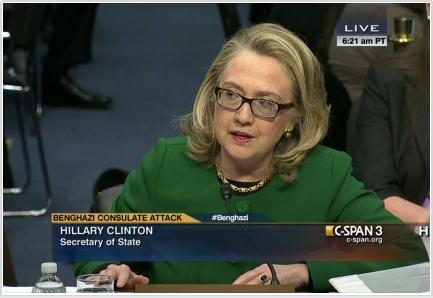
With the “mainstream media” by and large giving Hillary Clinton a pass on her past, few Americans realize how many Pinocchio faces need to be tacked onto many of her statements. Clinton is said to be “unquestionably” the frontrunner for the Democratic nomination, essentially the presumptive nominee. That is unquestionably true – but only because she has not been questioned with much rigor at all. And on those few occasions when she has been asked hard questions, she has often ducked them.
For example, at the March 9 debate in Miami, Jorge Ramos, the longtime anchor for Noticiero Univision, asked Secretary Clinton whether she would quit the presidential race if she were indicted for putting classified information on her private email server.
She replied: “Oh, for goodness sake, it’s not going to happen. I’m not even answering that question.” [See Consortiumnews.com’s “Is Hillary Clinton Above the Law?”]
Not so fast, Madame Secretary. It is looking more and more as if you will, after all, have to answer that question.
Those “Damn Emails” Again
On Wednesday in Washington, DC, a federal judge issued an order that may eventually require Clinton to testify under oath in a lawsuit related to the private email server she used while Secretary of State.
The judge gave Judicial Watch, a conservative watchdog group, permission to take sworn testimony from close Clinton aide Huma Abedin and others over the next eight weeks. It is possible that Clinton herself will have to testify under oath on the serious email issue before arriving at the Democratic convention in July.
One key issue in question is whether all relevant documents have been provided to Judicial Watch. My guess is that – given lawyers’ propensity, and often their incentive, to secure delay after delay in such proceedings – there may not be much likelihood of all this happening that quickly.
More precarious for Secretary Clinton, in my view, is the possibility that FBI Director James Comey will be allowed to perform a serious investigation and pursue Clinton on sworn testimony she has already given; for example, on whether she was aware of an operation run out of Benghazi to deliver Libyan weapons to rebels in Syria.
During her marathon testimony on Oct. 22, 2015, to the House Select Committee on Benghazi chaired by Rep. Trey Gowdy, R-South Carolina, Rep. Mike Pompeo, R-Kansas, was very specific in his questioning, leaving Clinton little wiggle-room:
Pompeo: Were you aware or are you aware of any U.S. efforts by the U.S. government in Libya to provide any weapons, directly or indirectly, or through a cutout, to any Syrian rebels or militias or opposition to Syrian forces?
Clinton: No.
Pompeo: Were you aware or are you aware of any efforts by the U.S. government in Libya to facilitate or support the provision of weapons to any opposition of Gadhafi’s forces, Libyan rebels or militias through a third party or country?
Clinton: No.
Did Secretary Clinton think we were “born yesterday,” as Harry Truman used to say? From what is already known about the activities of the U.S. “mission” and “annex” in Benghazi and the role played by the late Ambassador Christopher Stevens there, it seems quite likely that Clinton perjured herself in answering No.
And I believe this will become quite clear, if the FBI is allowed to pursue an unfettered investigation – and even clearer if the National Security Agency shares the take from its dragnet surveillance.
But those are big IFs. If I read President Barack Obama correctly, he will be more inclined to tell Attorney General Loretta Lynch to call off the FBI, just as he told former Attorney General Eric Holder to let retired General (and CIA Director) David Petraeus off with a slap on the wrist for giving his mistress intelligence of the highest classification and then lying about it to the FBI.
As for Clinton, perjury is not the kind of rap that she would welcome as she pursues the presidency. Trouble is, not only FBI investigators but also NSA collect-it-all snoopers almost certainly have the goods on whatever the truth is, with their easy access to the content of emails both classified and unclassified. [See Consortiumnews.com’s “Hillary Clinton’s Damning Emails.”]
Sadly, Comey and his counterparts at NSA are likely to cave in if the President tells them to cease and desist. Indeed, like legendary FBI Director J. Edgar Hoover, they may relish the prospect of being able to hold their knowledge of Hillary Clinton’s possible perjury and other misdeeds like a sword of Damocles over her head if she becomes president.
Whistleblower Needed
Thus, unless another patriot with the courage of an Edward Snowden or a Daniel Ellsberg recognizes that his primary duty is to honor his/her oath “to support and defend the Constitution of the United States against all enemies foreign and domestic,” and acts accordingly, the country could end up with a compromised President beholden to Hoover’s successors and the NSA sleuths who “collect everything,” including the emails of the Secretary of State – and those of the President.
Those at the FBI and NSA with the courage to consider whistleblowing need to be aware of the proud tradition they would be joining. The first recipient of the Sam Adams Award for Integrity in Intelligence (2002) was Coleen Rowley of the FBI, and in 2004 the award was given to FBI analyst and translator Sibel Edmonds.
As for signals intelligence, no fewer than four Sam Adams whistleblower awardees have come from NSA and its British counterpart GCHQ: the UK’s Katharine Gun (2003), and three from NSA itself – Thomas Drake (2011), Edward Snowden (2013), and William Binney (2015).
More distinguished company among people of integrity would be difficult – if not impossible – to find. In a few months, we will be considering nominations for the award to be given in 2017.
If Russia Had ‘Freed’ Canada
By Joe Lauria | Consortium News | May 5, 2016
As the United States plans to move thousands of NATO troops to Russia’s borders and continues to bolster a fiercely anti-Russian regime in neighboring Ukraine, the official line in Washington and its subservient corporate media is that beneficent America is simply seeking to curtail Moscow’s “aggression.” But the U.S. government and media might look at things quite differently if the shoe were on the other foot.
What, for instance, would the U.S. reaction be if Russia instead had supported the violent overthrow of, say, Canada’s government and assisted the new Ottawa regime’s “anti-terrorist operations” against a few rebellious “pro-American” provinces, including one that voted 96 percent in a referendum to reject the new Russian-backed authorities and attach itself to the U.S.?
If the U.S. government tried to help these embattled “pro-American” Canadians – and protect the breakaway province against the Russian-installed regime – would Washington see itself as the “aggressor” or as simply helping people resist anti-democratic repression? Would it view Russian troop movements to the U.S. border as a way to stop an American “invasion” or rather an act of “aggression” and provocation by Russia against the United States?
The Ukraine Reality
Before playing out this hypothetical scenario, let’s look at the actual scene in Ukraine today as opposed to the gross distortion of reality fed the American people by the U.S. mainstream media the past two years. The reality is not the State Department’s fable of a pro-democracy “revolution” cleaning up corruption and putting Ukrainian people first.
In the real world instead, extreme right-wing nationalists took control of a popular protest by mostly western Ukrainians to spearhead a violent coup that succeeded on Feb. 22, 2014, in overthrowing President Viktor Yanukovych, a man whom I interviewed in 2013 after he had been democratically chosen in an election certified by the Organization for Security and Cooperation in Europe.
Proof of the U.S. role in the coup came in a leaked telephone conversation several weeks earlier between U.S. Assistant Secretary of State for European and Eurasian Affairs Victoria Nuland, and Geoffrey Pyatt, the U.S. ambassador to Ukraine. In the conversation, Nuland and Pyatt discussed how the U.S. could “midwife” the unconstitutional change of government and they rated which Ukrainian politicians should be put in charge, with Nuland declaring “Yats is the guy,” a reference to Arseniy Yatsenyuk.
As for the European Union’s less aggressive approach to the Ukraine situation, Nuland declared: “Fuck the E.U.”
Nevertheless, after the coup, Western governments denied there ever was a coup, peddling the line that Yanukovych simply “ran away,” as though he woke up one morning and decided he didn’t want to be president anymore.
In fact, on Feb. 21, to contain the mounting violence, Yanukovych signed a European-brokered deal to reduce his powers and to hold early elections. But the next day, as right-wing street-fighters overran government buildings, Yanukovych fled for his life – and the West moved quickly to consolidate a new government under anti-Russian politicians, including Nuland’s choice—Yats as prime minister. (Yatsenyuk remained prime minister until last month when he resigned amid complaints that his stewardship had been disastrous for the Ukrainian people.)
A Resistance Emerges
Since the vast majority of Yanukovych’s support came from the ethnically Russian eastern half of the country, some Yanukovych backers rose up to challenge the legitimacy of the coup regime and to defend Ukraine’s democratic process.
Instead the West portrayed this resistance as a Russian-instigated rebellion against the newly minted and U.S.-certified “legitimate” government that then launched a violent repression of eastern Ukrainians who were deemed “terrorists.”
When Russia supported the resisters with weapons, money and some volunteers, the West accused Russia of an “invasion” and “aggression” in the east. But there has never been satellite imagery or other proof of this alleged full-scale Russian “invasion.”
In the midst of the Kiev “anti-terrorist” offensive in the east, on July 17, 2014, a Malaysian commercial airliner, Flight MH-17, was shot out of the sky, killing all 298 people on board. The United States, again offering no proof, immediately blamed Russia.
Over the past year, the fighting has been largely contained after Russian, Ukrainian and European leaders negotiated the Minsk Accords, though they are far from being implemented and widespread violence could break out again at any time.
Throughout the entire crisis the United States has insisted its motives are pure, including its new plans for deploying some 4,000 NATO troops, including about half American, on Russia’s Eastern European borders north of Ukraine.
President Barack Obama told the U.N. General Assembly last year that the U.S. had no economic interests in Ukraine. But former State Department official Natalie Jaresko served as Ukraine’s finance minister until recently and Vice President Joe Biden’s son sits on the board of a major Ukrainian company. U.S. investment also has increased since the coup.
Yanukovych’s overthrow occurred after he chose a Russian economic plan rather than sign an association agreement with the European Union, which Ukrainian economic analysts warned would cost the country $160 billion in lost trade with Russia.
The E.U. plan would also have opened Ukraine to Western neoliberal economic strategies designed to exploit the country for the benefit of Western capital and local oligarchs (one of whom, Petro Poroshenko, emerged as the new president).
Turning the Tables
To help American readers better understand what has transpired in Ukraine, it may be useful to see what it would be like if the tables were turned. What would the story be like if Russia played the role of the U.S. and Canada the role of Ukraine? Most Americans would not be pleased.
In this reverse scenario, the world’s mainstream media would follow Moscow’s line and present the story as a U.S. “invasion” of Canada. The media would explain the movement of Russian troops to the U.S. border as nothing more than a peaceful step to deter U.S. “aggression.”
But Americans might see matters differently, siding with the breakaway Maritime provinces resisting the Moscow-engineered violent coup d’etat in Ottawa. In this scenario, Prince Edwards Islanders would have voted by over 90 percent to secede from the pro-Russian regime in Ottawa and join the United States, as Crimea did in the case of Ukraine. People in Nova Scotia and New Brunswick – stressing their close historic ties to America – also would make clear their desire not to be violently absorbed by the Ottawa coup regime.
In this alternative scenario, Moscow would condemn Prince Edwards Island’s referendum as a “sham” and vow never to accept its “illegal” secession. The popular resistance in Nova Scotia and New Brunswick would be denounced as “terrorism” justifying a brutal military crackdown by Russian-backed Canadian federal troops dispatched to crush the dissent. In this “anti-terrorist operation” against the breakaway region, residential areas would be shelled killing thousands of civilians and devastating towns and cities.
In this endeavor, the Canadian army would be joined by Russian-supported neo-fascist battalions that had played a crucial role in the overthrow of the Canadian government. In the Maritime city of Halifax, these extremists would burn alive at least 40 pro-U.S. civilians who took refugee in a trade union building. The new government in Ottawa would make no effort to protect the victims, nor conduct a serious investigation to punish the perpetrators.
Ignoring a Leak
Meanwhile, proof that Russia was behind the overthrow of the elected Canadian prime minister would be revealed in a leaked conversation between Moscow’s foreign ministry chief of the North America department and the Russian ambassador to Canada.
According to a transcript of the leaked conversation, the Moscow-based official would discuss who the new Canadian leaders should be several weeks before the coup took place. Russia would launch the coup when Canada decided to take a loan package from the U.S.-based International Monetary Fund that had fewer strings attached than a loan from Russia.
Russia’s ally in Beijing would be reluctant to back the coup. But this would seem to be of little concern to Moscow’s man who is heard on the tape saying, “Fuck China.” Although this conversation would be posted on YouTube, its contents and import would be largely ignored by the global mainstream media, which would insist there was no coup in Ottawa.
Yet, weeks before the coup, the Russian foreign ministry official would be filmed visiting protesters camped out in Parliament Square in Ottawa demanding the ouster of the prime minister. The Russian official would give out cakes to the demonstrators.
The foreign ministers of Russian-allied Belarus and Cuba would also march with the protesters through the streets of Ottawa against the government. The world’s mainstream media would portray these demands for an unconstitutional change of government as an act of “democracy” and a desire to end “corruption.”
In a speech, the Russian foreign ministry official would remind Canadian businessmen that Russia had spent $5 billion over the past decade to “bring democracy” to Canada, much of that money spent training “civil society” activists and funding anti-government “journalists.” The use of these non-governmental organizations to overthrow foreign governments that stand in the way of Russia’s economic and geo-strategic interests would have been well documented but largely ignored by the global mainstream media.
But recognizing the danger from these “color revolution” strategies, the United States would move to ban Russian NGOs from operating in the U.S., a tactic that would be denounced by Russia as America’s rejection of “democracy.”
The Coup Succeeds
The Canadian coup would take place as protesters violently clashed with police, breaking through barricades and killing a number of police officers. Snipers would fire on the police and the crowd from a nearby Parliament Square building under the control of hardline pro-Russian extremists. But the Russian government and the mainstream media would blame the killings on the embattled Canadian prime minister.
To stem the violence, the prime minister would offer to call early elections but instead would be driven from office violently by the pro-Russian street gangs. Russia and the global mainstream news media would praise the overthrow as a great step for democracy and would hail the pro-Russian street fighters who had died in the coup as the “Heavenly Hundred.”
Following the coup, Russian lawmakers would compare President Barack Obama to Adolf Hitler for allegedly sending U.S. troops into the breakaway provinces to protect the populations from violent repression, and for accepting the pleas of the people of Prince Edward Island to secede from this new Canada.
Obama would be widely accused of ordering an “American invasion” and committing an act of “American aggression” in violation of international law. But the Maritimes would note that they had long ties to the U.S. dating back to the American Revolution and didn’t want to live under a new regime imposed by a faraway foreign power.
Russia would claim intelligence proving that U.S. tanks crossed the Maine border into New Brunswick, but would fail to make the evidence public. Russia would also refuse to reveal satellite imagery supporting the charge. But the claims would still be widely accepted by the world’s mainstream news media.
For its part, Washington would deny it invaded but say some American volunteers had entered the Canadian province to join the fight, a claim met with widespread media derision. Russia’s puppet prime minister in Ottawa would offer as proof of an American invasion just six passports of U.S. soldiers found in New Brunswick.
Taking Aim at Washington
When – during one of the new regime’s “anti-terrorist” offensives – a passenger jet would be shot down over Nova Scotia killing all on board, Russia would accuse President Obama of being behind the outrage, charging that the U.S. had provided the powerful anti-aircraft missile needed to reach a plane flying at 33,000 feet.
But Moscow would refuse to release any intelligence to support its claim, which would nevertheless be accepted by the world’s mainstream media.
The plane’s shoot-down would enable Russia to rally China and other international allies into imposing a harsh economic boycott of America to punish it for its “aggression.”
To bring “good government” to Canada and to deal with its collapsing economy, a former Russian foreign ministry official would be installed as Canada’s finance minister, receiving Canadian citizenship on her first day on the job.
Of course, Russia would deny that it had economic interests in Canada, simply wanting to help the country free itself from oppressive American domination. But Russian agribusiness companies would take stakes in Albertan wheat fields and the son of Russia’s prime minister as well as other well-connected Russians would join the board of Canada’s largest oil company just weeks after the coup.
Russia’s ultimate aim, beginning with the imposition of the sanctions on the U.S. economy, would appear to be a “color revolution” in Washington, to overthrow the U.S. government and install a Russia-friendly American president.
This goal would become clear from numerous statements by Russian officials and academics. A former Russian national security adviser would say that the United States should be broken up into three countries and write that Canada would be the stepping stone to this U.S. regime change. If the U.S. loses Canada, he would declare, it would fail to control North America.
But the world’s mainstream media would continue to frame the Canadian crisis as a simple case of “American aggression.”
This fictional scenario perhaps lays bare the absurdity of the U.S. version of events in Ukraine.
Joe Lauria is a veteran foreign-affairs journalist based at the U.N. since 1990. He can be reached at joelauria@gmail.com and followed on Twitter at @unjoe.
Is the TSA Pressuring Americans Into Submitting to Background Checks?
By Jay Stanley | ACLU | May 5, 2016
The New York Times had a piece Tuesday on how security lines at airports are getting longer—in many cases, dramatically so, with waits of several hours at some times and airports. For example, the Times reported,
Ben Cheever, a support engineer for a cybersecurity firm, recently missed a flight in Seattle despite getting to the airport two hours ahead of his 6 p.m. departure to San Diego. Two lines spilled into the airport lobby, he said. A third was reserved for passengers who had signed up to a trusted traveler program called T.S.A. PreCheck that allowed them speedier access.
A lot of people love PreCheck. People not only like speedier lines, but it also plays to the natural human tendency to appreciate special treatment. But as I have noted before, there are serious questions about where this background-check program is headed. What is now a whitelist for a select few may turn into the normal manner of travel, subjecting virtually every passenger to increasingly intrusive database checks, excluding only an unfortunate few who become effectively blacklisted. As I observed last year,
by manipulating the system and the lines, the TSA can push more and more people to seek refuge from poor treatment within a government background check program that demands an ever-increasing amount of information about our lives.
What does the TSA say is the solution to longer security lines? According to the Times,
Both the airlines and the T.S.A. said that one way to alleviate the longer wait is to sign up for PreCheck, which allows eligible passengers to go through the speedier lanes without having to take off their shoes and belts or remove laptops and other electronic devices from their bags.
Is the TSA intentionally making everybody stand in long lines in order to pressure passengers into “voluntarily” submitting to (and paying for) background checks? I don’t believe that 3-hour waits are part of an intentional PreCheck-boosting plot, and the agency has incentives to avoid political backlash as angry travelers call their members of Congress. The Times cites a shortage of TSA screeners, budget cuts, and a growing number of passengers as the explanation for the longer waits. Nevertheless, when conditions are bad it’s a natural question to ask. The agency has a stated goal of moving as many Americans as possible into PreCheck, and will no doubt make use of the current situation to increase pressure on people to do so, as we saw officials doing in their comments to the Times. The structural logic of the situation gives the TSA an incentive to make life difficult for those who resist joining their background check program. It’s a parallel to the airlines’ incentive to make seats as uncomfortable as possible for those lowly passengers who hold out paying fees for “upgrades.” As Tim Wu put it, “in order for fees to work, there needs be something worth paying to avoid.”
Syrians Protest Against US Boots on the Ground
Sputnik – 05.05.2016
Residents and local administration officials in the northern Syrian town of Al-Hasakah rallied on Wednesday to protest against the illegal presence of 150 US troops in the Kurdish-controlled town of Rumeilan, Syrian SANA news agency reported.
“We are categorically against the impermissible and flagrant violation of our country’s sovereignty. We will not allow American boots on our soil. We are also against any plans for a division or federalization of Syria,” Al-Hasakah Governor Mohammad Zaal said during the meeting.
A similar rally had earlier been held in the neighboring town of Al-Qamishli.
The Syrian Foreign Ministry called the reported deployment of 150 US troops to Rumeilan airport in the northeast of the country “an unacceptable and illegal intervention” which came without authorization from the Syrian government.
On April 28, US President Barack Obama announced that Washington would “deploy up to 250 additional US personnel in Syria including Special Forces.” They are reportedly expected to train the Syrian Democratic Forces.
The White House asserts that the deployment of the Special Forces is intended to repel Daesh terrorists.
On Wednesday, about 150 US soldiers arrived in the Kurdish-controlled town of Rumeilan in northeastern Syria, according to a Kurdish security source. According to the source, part of the contingent immediately headed to the north of Raqqa province.
Meanwhile, a 28-year-old US Army officer has sued President Barack Obama over the legality of the war against the Islamic State (Daesh), questioning Mr. Obama’s disputed claim that he needs no new legal authority from Congress to order the military to wage the ever deepening mission, The New York Times wrote on Wednesday.
Captain Nathan Michael Smith, an intelligence officer stationed in Kuwait, voiced strong support for fighting Daesh but, citing his “conscience” and his vow to uphold the Constitution, he said he believed that the mission lacked proper authorization from Congress.
The legal challenge comes after the death of the third American serviceman in the fight against Daesh and as President Obama has decided to significantly expand the number of Special Forces members.
President Obama has argued that he already has the authority he needs to wage a conflict against the Islamic State under the authorization to fight the perpetrators of the terrorist attacks of September 11, 2001, enacted by Congress shortly after the attacks.
South China Sea Dispute: How Russia Could Help China Win in The Hague

© Sputnik/ Ramil Sitdikov
Sputnik | May 4, 2016
The Kremlin could one day regret any US detachment from the South China Sea, American geopolitical analyst Tim Daiss insists. Are Washington’s efforts truly aimed at maintaining the freedom of navigation in the region or is it part of Obama’s plan to write the rules and call the shots in the Asia Pacific region?
Russia’s opposition to internationalizing the South China Sea dispute and the US deployment of the Terminal High-Altitude Area Defense (THAAD) system in South Korea has promted deep concerns among American geopolitical analysts.
Moscow’s support for Beijing has put the US plan to pressure China into making concessions on the maritime dispute in the South China Sea at risk. On the other hand, India’s decision to side with China on the issue has caught Western observers by surprise.
“China and Russia have agreed on the need to limit US influence in the Asia Pacific Region. On Friday, following bilateral talks in Beijing Russia’s foreign minister Sergey Lavrov and his Chinese counterpart Wang Yi expressed opposition to the US deployment of an anti-missile system in South Korea and also said that non-claimants should not take sides in the dispute over maritime territorial claims in the South China Sea,” American geopolitical analyst Tim Daiss wrote in his Op-Ed for Forbes.
Russian Foreign Minister Lavrov has repeatedly stated that the South China Sea dispute should be resolved by the parties directly concerned, while outside powers should refrain from interfering.
A joint communiqué of the 14th Meeting of the Foreign Ministers of the Russian Federation, the Republic of India and the People’s Republic of China singed on April 18, 2016, reads:
“Russia, India and China are committed to maintaining a legal order for the seas and oceans based on the principles of international law, as reflected notably in the UN Convention on the Law of Sea (UNCLOS). All related disputes should be addressed through negotiations and agreements between the parties concerned. In this regard the Ministers called for full respect of all provisions of UNCLOS, as well as the Declaration on the Conduct of Parties in the South China Sea (DOC) and the Guidelines for the implementation of the DOC.”

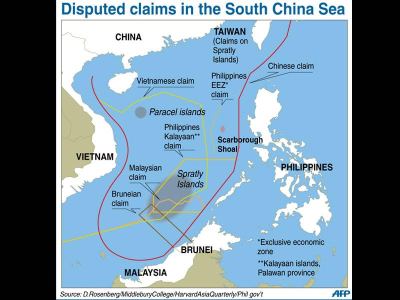
South China Sea claims map (© Photo: Wikipedia/Voice of America)
The statement coincided with reports that Beijing is seeking Moscow’s support over the South China Sea court battle with the Philippines in the Hague.
Nearly three years ago, the Philippines, backed by America, filed a lawsuit against China in the Hague International Tribunal Court. In October 2015 the Permanent Court of Arbitration in The Hague confirmed that it would hold a hearing on the matter. The hearing is expected to take place in May or June 2016.
“China is lobbying Russia for support in opposing international court proceedings launched by the Philippines over the disputed South China Sea,” South China Morning Post reported April 20.
Beijing has reason to believe that Moscow can provide it with juridical assistance to solve the problem, Alexander Shpunt of Russia’s Regnum media outlet suggested.
Shpunt called attention to the fact that on April 20 Moscow won the Yukos case in the District Court in the Hague; a Dutch court overturned an award of $50 billion to former shareholders of the now defunct Yukos oil company that Russia had been ordered to pay by the Permanent Court of Arbitration in 2014.
The journalist continued that Lavrov’s notion about “outside parties” in the South China Sea dispute is a direct reference to the Permanent Court of Arbitration in the Hague that will soon hold hearing on the Philippines’ complaint against China.
This is the issue of utmost importance for Beijing that Moscow has outplayed the Permanent Court of Arbitration, Shpunt emphasized.
However, according to Daiss, Beijing is the major troublemaker in the region that plans to outwit its “much smaller Asian neighbors.”
“Who knows what the future holds geopoliticaly?” he wrote, adding that “the Kremlin could one day regret any US detachment from the South China Sea.”
Like many other Western observers Daiss remained silent about the fact that China’s Asian neighbors are also involved in controversial building activities in the South China Sea region, while, for example, Taiwan’s constructions in the Spratlys are located outside any claimed Taiwanese exclusive economic zone.”Of the six countries claiming an interest in the Spratlys, only Brunei has failed to construct structures, mostly on stilts, on more than 40 of these islets and reefs. Yet the western media again focuses exclusively on [China’s] ‘aggressive’ reclamation and building activities,” Australian lawyer James O’Neill wrote in his article for New Eastern Outlook.
What lies at the root of this double-standard approach? And is Washington really “trying to keep the sea lanes open in the name of freedom of navigation for any and all countries” as Daiss claims?
Apparently, US President Barack Obama’s latest Op-Ed in the Washington Post could shed some light on the matter.
“Today, some of our greatest economic opportunities abroad are in the Asia-Pacific region, which is on its way to becoming the most populous and lucrative market on the planet,” Obama wrote.
“Of course, China’s greatest economic opportunities also lie in its own neighborhood, which is why China is not wasting any time,” he noted referring to Beijing’s New Silk Road initiative.
“Instead, America should write the rules. America should call the shots. Other countries should play by the rules that America and our partners set, and not the other way around,” Obama stressed.
Given this, it becomes clear that what Washington is truly interested in is not the freedom of navigation “for any and all countries,” but its dominance in the region.
Read more:
All for One: How Russia, China, India Will Solve South China Sea Dispute
‘They Said No’: China Denies US Aircraft Carrier Entry to Hong Kong
What is Really Going on Behind the Curtains in South China Sea?
Why the US Will Not Sign the UN Convention on the Law of the Sea
By Ken Meyercord | Dissident Voice | May 4, 2016
Critics of American foreign policy love to point out instances where our policy reeks of hypocrisy. No current issue in international affairs affords a better illustration of our inconsistent sanctimoniousness than the dispute over competing claims to insular territories (whether to call them “islands” or “rocks” is of great significance, as we shall see) in the South China Sea.
Symptomatic of our hypocrisy on this issue, we protest Chinese “aggressive” actions in the area by sailing the Seventh Fleet through the territorial waters of atolls turned into landing-strips to demonstrate our commitment to protecting freedom of navigation. Yet we refuse to sign the UN’s Convention on the Law of the Sea (UNCLOS), the international effort to formalize the rules governing freedom of navigation on the high seas. The convention, which has been around since 1982, has been ratified by over 160 UN member states, including China, but not by the U.S. of A.
Opponents of the UNCLOS, like Senators Portman and Ayotte, contend that the convention infringes on US sovereignty, in particular with regard to its provision for international arbitration of disputes (keep that in mind when the Permanent Court of Arbitration rules on a suit brought by the Philippines over China’s claims in the South China Sea). But I believe the main reason for our unwillingness to ratify the UNCLOS lies elsewhere.
The convention makes a distinction between “islands”, which can support human habitation, and “rocks”, which cannot. The territorial waters around either type of sea-bound outcrop can be claimed up to 12-miles out, but a 200-mile Exclusive Economic Zone (EEZ) can only be claimed around an island, not a rock.
We have a number of possessions in the Pacific, formally called US Minor Outlying Islands, around which we claim EEZs. Here’s a map showing them:
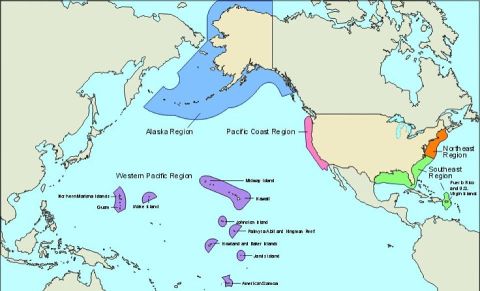
Most of these possessions were acquired in the late 19th century under the Guano Islands Act of 1856. There was a gold rush, so to speak, for guano deposits at the time as the phosphate-rich bird poop was much sought after as a fertilizer. The act authorized any American captain who stumbled on an uninhabited, unclaimed island covered in guano to claim it in the name of the United States. Under the act dozens of islands came into America’s possession, most of which we gave up once an island had been stripped clean, literally. Currently, none of our outlying islands have permanent residents.
As can be seen, the EEZs around these outlying “islands” cover a sizeable area. In fact, the projection used causes the EEZs in the South Pacific to look smaller than they actually are compared to zones in more northern latitudes. Just one of the equatorial EEZs, that around the Howland and Baker Islands, is larger than the EEZ off the California coast.
Under UNCLOS, many of these “islands” would be deemed mere rocks, not entitled to EEZs. The same is probably true of some of the “islands” in the Aleutian Islands chain. Hence, ratification of the Convention on the Law of the Sea would result in a significant diminution of our Exclusive Economic Zones, something our world-beaters are not likely to agree to readily.
Despite the rocky grounds for many of our own claims, we pooh-pooh Chinese claims based on similar grounds. I recently heard a former Deputy Under Secretary of Defense, Kathleen Hicks, belittle China’s claim to the Scarborough Shoal because it is almost underwater at high tide (see this video at the 2:55:26 minute mark); yet we claim not only the territorial waters but also an EEZ around a reef in the Hawaiian Islands chain, Maro Reef, which is entirely submerged, even at LOW tide.
As mentioned previously, the Philippines has taken China to court over its claims in the South China Sea. The court in question, the Permanent Court of Arbitration, is often referred to in the press as a “UN tribunal” to give it greater cachet, but, in fact, it is not part of the UN, being a body created in 1899 when imperialism ruled the waves. No wonder China refuses to participate in the proceedings (a Palestinian in an Israeli court stands a better chance) and will no doubt ignore an adverse ruling. If so, you can count on our media howling about China flaunting the rule of law, how outraged the “the international community” (read “NATO”) is, and the like.
Perhaps some courageous, soon-to-be-unemployed journalist will be brave enough to point out that when Nicaragua took us before the International Court of Justice – an actual UN body – over our mining of their harbors and other offenses, we refused to participate in the proceedings, claiming the court did not have jurisdiction. When the court ruled against us, we blocked enforcement of the ruling through our veto in the Security Council. Embarrassingly, in light of current posturing, one of the charges levelled against us was interrupting peaceful maritime commerce – this by the self-proclaimed protector of freedom of navigation in the western Pacific.
To the uninformed (read “Kathleen Hicks”), it will seem obvious to whom sovereignty over the Scarborough Shoal belongs. Just look at how close they are to the Philippines and how far from China.
Ms. Hicks has probably never heard of Navassa Island, another Guano Islands Act possession of ours (see the map of US EEZs above). It lies far from our shores but just off the coast of Haiti, which also claims it. We’ve shown no willingness to give up the former El Dorado of avian defecation simply based on geography.
Similarly, when bemoaning how far China’s nine-dash-line delineating its claims in the South China Sea (shown as a solid red line above) extends from the Chinese mainland, we should consider what a line encompassing our own far-flung possessions would look like. Our line, like China’s, would reflect past naval exploits, not proximity to ours or someone else’s coast, and our line would extend much farther from our mainland than China’s does from theirs.
Adopting a conveniently faulty memory, we call for peaceful resolution of the disputes and require all disputants (read “China”) to refrain from aggressive actions, like populating disputed territories, but in 1935 we secretly started placing settlers on Howland, Baker, and Jarvis Islands, former Guano Islands Act possessions long forgotten and by then of lapsed and uncertain ownership. After a year of surreptitious colonizing, President Roosevelt revealed the sneaky scheme and proclaimed the islands American territory. That sort of behavior would not be condoned under the Convention on the Law of the Sea, another reason our wily buccaneers will not sign it.
Ken Meyercord can be reached at: kiaskfm@verizon.net.
Obama’s Last Gasp Imperialism

By Margaret Kimberley | Black Agenda Report | May 4, 2016
With only eight more months in office, Barack Obama shows no signs of giving up his role as the most aggressively imperialist American president in modern history. Liberal Democrats rightly point fingers at Hillary Clinton’s bellicosity, yet they say nothing about Obama as he continues on a path of destruction around the world.
Nations on every continent are victims either of outright American military violence or of war waged by other means. Venezuela sinks further into despair as a result of American manipulations of oil prices and sanctions that cripple its economy. Millions of people have had their homes destroyed by United States interventions in Somalia and Libya and Syria and are forced to make dangerous treks in hopes of finding safety.
While the American instigated war goes on in Syria, that country’s government and its Russian ally make gains against terrorists. Because they are winning the United States continues to make bizarre demands that “Assad must go.” Obama has to turn over the keys in January 2017 but Assad may sit in his presidential office watching as his enemy rides off into the sunset.
The least reported and yet biggest danger is taking place in Europe. The United States and NATO continue to provoke Russia in what could be a deadly game that spins out of their control.
In recent weeks the Russians have made clear that they won’t take the provocation lying down. While the corporate media follow the president blindly, they won’t tell viewers and listeners that Russia has territory on the Baltic sea coast. Kaliningrad is Russia, just as Hawaii and Alaska are America. Of course there are Russian planes and submarines in the Baltic. They belong there while American vessels do not. Russia has every right to “buzz” United States ships and escort spy planes out of its airspace.
These very simple facts are rarely presented to Americans who have no idea that 200 of their troops will perform exercises in Moldova, a small country located between Ukraine and Romania. It is an example of how American presidents from Bush to Clinton to Bush to Obama made a mockery of a promise not to encircle Russia.
Instead they do just that and keep adding to the NATO arsenal. Nations like Sweden, traditionally neutral, are being lured into that organization’s grasp. In the absence of the old Soviet block there is no use for NATO except to act as the foot soldiers for American dirty work.
It seems that the end of his presidency has made Obama more anxious and therefore more dangerous. There are now “boots on the ground” in Syria, so far just 300 Special Forces, but even that small number is too high and represents the extent to which the United States is committed to maintaining the imperialist project.
Only the now inevitable Republican nominee, Donald Trump, questions this premise of American foreign policy. Hillary Clinton assisted Obama in his designs and the supposedly left wing Bernie Sanders warns of non-existent Russian aggression, supports presidential “kill lists” and thinks that having U.S. troops in Syria is a fine idea.
While the United States threatens to start World War III, the corporate media go into overdrive in their determination to distract us from the dangers our government poses to the world. They turn trivialities into major controversy but rarely report anything we ought to know. For example, Larry Wilmore saluted the president as “my nigga” during the last Obama era White House Correspondents Dinner. There was much arguing back and forth about the propriety of the words but no one spoke of the impropriety of the event itself.
The media ought to have an adversarial relationship with presidents. At the very least they should be somewhat distant and skeptical. Instead they are very cozy and quite publicly too. They even celebrate their collusion at this love fest as a president makes jokes with television comedians who compete for the chance to be sidekick for an evening.
There is no longer any pretense of impartiality. The media want access so they play along and tell lies of commission and omission with every presidential administration. They tell jokes at Russia’s expense but won’t tell readers and viewers that it is the United States who is provoking Russia in its sphere of influence.
Obama apparently wants to commit more destruction than he has already. Turning Libya into an utterly failed state was not enough. That act unleashed ISIS and Boko Haram and a wave of refugees. The coup in Ukraine ignited a civil war. The Syrian government hangs on but at a terrible price. Russia answered the call to help but America doesn’t want that war to end and will continue to use its allies to prevent a cease fire or an end to the conflict altogether.
A lot of damage can be done between now and January 20, 2009. There is no reason to mourn or rejoice Obama’s departure because he will be followed by someone who likes his foreign policy as it is. That person will also like Americans as they are: mostly intelligent but uninformed even if they wish to know what is happening around the world. The expression to do something “like there’s no tomorrow” is poignant. If Obama and company continue down this path, we shall all find out what those words mean.
Margaret Kimberley can be reached via e-Mail at Margaret.Kimberley(at)BlackAgendaReport.com.
Turkish ground op in Syria unlikely due to presence of Russian air force – Lavrov
RT | May 5, 2016
A foreign military is unlikely to launch a ground operation in Syria due to the Russian Airspace Forces there, Russian Foreign Minister Sergey Lavrov said in commenting on the readiness Turkey has expressed to send troops to Syria “if necessary.”
“I do not think that anyone will decide to play dangerous games and carry out any provocations due to the fact that there are Russian Aerospace Forces stationed [in Syria],” Lavrov said when asked about the possibility of a Turkish or Saudi Arabian incursion.
The Foreign Minister stressed that “it’s necessary to educate, those who are trying to advocate” a military invasion because it “would be a direct aggression,” according to Sputnik.
“But I don’t think that they have any justification, at least some excuse [for a military invasion], because the ceasefire [in Syria] is strengthening after all,” he added.
Earlier on Wednesday, Turkish Prime Minister Ahmet Davutoglu told Al-Jazeera that Ankara is ready to send ground troops to Syria “if it becomes necessary… to provide for our own security.”
Lavrov said that a third party had tried to manipulate the US into shielding terrorists from the Al-Nusra Front group in Syria.
“During the negotiations, our US partners actually tried to draw the borders of this ‘zone of silence’ to include a significant portion of positions occupied by Al-Nusra [Front]. We managed to exclude this as absolutely unacceptable,” he said.
“This indicates that someone wants to use the Americans. I do not believe that it is in their interest to shield Al-Nusra [Front],” the FM stressed.
Lavrov pointed to evidence linking the Turkish government with Islamic State (IS, formerly ISIS/ISIL) and Al-Nusra Front, which were excluded from the Syrian ceasefire deal brokered by Russia and the US in February.
Turkey is believed to be trading oil and artifacts with the jihadists, allowing them to cross the border freely and supplying them with arms.
Ankara has been pushing for the removal of Syrian President Bashar Assad since the beginning of the conflict in Syria, which it views among its prime geopolitical rivals. According to Lavrov, the nature of Ankara’s relations with Washington is different from Moscow’s cooperation with Assad’s government in Syria.
“Assad is not our ally, by the way. Yes, we support him in the fight against terrorism and preserving the state of Syria. But he is not an ally in the sense that Turkey is the ally of the United States,” Lavrov told Sputnik.
The Russian FM blamed Ankara for pressuring the EU to accept the idea of “safe zones” to host refugees on the Turkish-Syrian border, despite the idea being rejected by the US.
“They are still talking about safety zones. Unfortunately, the European Union is also starting to take the concept of security zones as a given under blackmail from Turkey,” he said.
“At least, when [US President Barack] Obama was in Hannover, [German Chancellor Angela] Merkel said at a press conference that ‘we support the idea of security zones,’ which Obama immediately publicly disowned, but it sounded symptomatic,” the FM said.
The minister also returned to the topic of Russia’s Su-24 jet that was downed on an anti-terrorist mission in Syria by the Turkish Air Force in November of last year.
“Our assessment is absolutely clear: the Turkish leadership has committed a crime and an error,” he said in describing the tragedy that President Putin has called “a stab in the back” and led to Moscow imposing a series of sanctions on Ankara.
Lavrov was confident that similar incidents were “no longer possible because all measures have been taken to avoid any accidents, and the Turks are aware of this.”
‘Ankara shows imperialistic behavior’
Moscow has noticed “neo-Ottoman” tendencies in Turkey’s international stances, and not just when it comes to the situation in Syria, Lavrov said, referring to the country’s historical predecessor, the Ottoman Empire.
Turkey is behind all of the talk about “safe zones” and a “Plan B” for Syria, which reveals its “expansionist aspirations,” Lavrov noted, adding that Ankara still maintains a military presence in Iraq despite the express wishes of the Iraqi government, which never authorized Turkish forces to enter and has repeatedly demanded that they leave.
Turkey appears motivated to “extend its influence and expand its territory,” he explained. As an example, Lavrov noted that Turkey had violated Greek airspace 1,800 times last year, while NATO remained tight-lipped.
“This kind of explicitly expansionist behavior, can’t lead to anything good,” the Russian FM stressed.
US-Senegal deal gives Washington permanent access to African country
Press TV – May 3, 2016
The United States has signed a military cooperation agreement with Senegal that allows “the permanent presence” of American troops in the West African country.
Sources familiar with the subject said the deal, which was clinched on Monday, would give US forces access to many areas in Senegal, such as airports and military installations, allegedly to respond to security or health needs.
The agreement allows for “the permanent presence of American soldiers in Senegal” and aims to “face up to the common difficulties in security” in the region, Senegal’s Foreign Minister Mankeur Ndiaye said during the signing ceremony alongside the US Ambassador to Dakar James Zumwalt.
Zumwalt, for his turn, said, “We believe that this agreement will help the US military and the Senegalese military reinforce our cooperation together to deal with threats to our common interests.”
“This agreement is about access, is about coming when there is an urgent desire and when both sides agree,” he added.
Some 40 American soldiers are currently deployed in Senegal, according to the US Africa Command. The US mission in Dakar said that number would not rise under the deal.
Washington has increased its troops in Africa in recent years under the cover of humanitarian aid or fighting terrorist groups; however, many political analysts believe the US military is actually expanding its presence all over the continent.
Reports say the US Army has in recent years developed a remarkably extensive network of over 60 outposts and access points in at least 34 African countries — more than 60 percent of the nations on the continent.
“Millions of Female Felons”?
By Edward Hasbrouck | The Practical Nomad | May 3, 2016
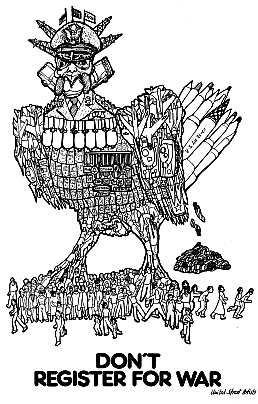 We won — and now, thirty years later, the government has finally admitted it.
It’s not often that government officials admit to failure in the face of popular resistance. When they do, it’s an occasion for celebration.
Draft registration was reinstated in 1980, supposedly to prepare for possible deployment of US troops in Afghanistan on the side of the Islamic fundamentalist warlords and “mujahideen” who were then fighting against the USSR. The US government put me in prison for refusing to agree to fight on the side of the people who would later become the Taliban and Al Qaeda! It’s no wonder that people of my generation, or later generations, have no faith in the ability of the US government to decide for us in which wars, or on which (if any) side, we should fight.
Today in U.S. News & World Report, Steven Nelson has the most significant piece of reporting about draft registration and the Selective Service System in decades, asking questions that journalists, politicians, and the public should have been asking years ago.
It’s been obvious — to anyone who wanted to look — that resistance forced the government to abandon the attempt to enforce draft registration in failure in the 1980s, after show trials of a handful of the “most vocal” nonregistrants. But this is the first time that responsible Selective Service officials and former officials have confirmed this on the record.
The article is worth reading in full, but I’ve posted some key excerpts below, followed by my analysis and comments:
Gender-Neutral Draft Registration Would Create Millions of Female Felons
by Steven Nelson, U.S. News & World Report, May 3, 2016
A key congressional committee voted last week to require young women to register for potentially compulsory military service, but the gender-equalizing reform threatens to make felons out of women who refused to participate.
Though prosecutions currently appear unlikely, men jailed for not registering with the Selective Service System and some former authorities who participated in the cases are concerned about criminalizing a large swath of the population.
“It will inevitably lead to massive resistance, whether visible in the streets or women just blowing it off the way men have,” says Edward Hasbrouck, prosecuted for not registering in the 1980s. “Congress is smoking crack if they think women can be forced to register.”
Hasbrouck served more than four months in prison after catching the eye of an ambitious federal prosecutor, Robert Mueller, who went on to be FBI director. He originally received a suspended sentence, but recalls an unamused judge sending him to prison in late 1984 [actually 1983] for doing peace activism to satisfy court-ordered community service….
The government was “faced with far more people who had initially refused to register in the start-up period than they had ever imagined — it was beyond their worst nightmare. They were self-deluded in the way people today who think they can just wave their wand and women will sign up for the draft are self-deluded,” Hasbrouck says….
In all, 20 men were prosecuted in the 1980s for not registering, a diverse and geographically scattered group including ideological advocates of individual rights and members of the historical peace churches.
The last indictment came in 1986 when Terry Kuelper of Arkansas was slapped with the felony charge. He agreed to register before trial and the charge was dismissed. Court proceedings ended when Gillam Kerley of Wisconsin was released from a three-year prison sentence after four months, with the case ending in 1988….
Former Selective Service associate director Edward Frankle … developed a process for … enforcement of the registration law…. “We did what we had to to keep at least some level of credibility in the system,” he says. “You couldn’t just totally ignore it — how could you do that and still with a straight face say, ‘Yeah that’s the requirement’?”
In the late ’80s the Justice Department discontinued prosecutions. Dick Flahavan, a spokesman for the Selective Service who was with the agency at the time, recalls the Justice Department “decided that since there was no draft … there are limited resources and the FBI’s time would be better spent chasing white collar crime than some Mennonite kid through Pennsylvania.”
“We said, ‘Fine, we understand,’ and that’s why it ended in ’88,” he says. “The agency did agree to what the Justice Department proposed, a suspension of prosecutions [during peace time]. Since they did the prosecutions we didn’t have much leverage anyways.”…
Flahavan says the Selective Service had hoped for a much stronger approach from federal prosecutors, but was rebuffed.
“What we would have preferred was every year in all 95 judicial districts there be a prosecution to keep the heat on and the publicity going,” he says. “But they couldn’t sustain that.”
If someone registered just before trial, the prosecution would be dropped, Flahavan notes, making the pursuit of resisters “really a losing proposition for the feds” and often “a big waste of time.”
Wilfred Ebel, acting director of the Selective Service System in 1987, when further waves of prosecutions were being considered, says he can’t recall the precise discussions that led to abandonment of new cases. Former Attorneys General Ed Meese, who left the department in 1988, and successor Dick Thornburgh did not respond to requests for comment, nor did Mueller….
Though hard numbers are elusive, Hasbrouck says with confidence “compliance with the address update requirement is and has been since 1980 essentially zero.”
A central insight of both Gandhian and anarchist political theory is that governments have power only to the extent that people are willing to carry out or comply with their orders. But few of the people pontificating lately about whether extending draft registration to women is “desirable” (from one or another perspective) have stopped to ask whether it is possible. So far as I know, no historian or scholar has made a study of draft registration since 1980. (If I’ve missed something, please send me a link or citation, or post it in the comments.) There’s been no GAO audit of the accuracy of the Selective Service database of registrants and their current addresses since 1982.
Despite the refusal of the Justice Department to prosecute nonregistrants, the Selective Service System continues to refer names of possible nonregistrants identified by automated data-matching to the Justice Department “for possible prosecution”. According to the latest Selective Service System Annual Report to Congress for Fiscal Year 2015 (page 16), “If a man fails to register or fails to provide evidence that he is exempt from the registration requirement after receiving Selective Service reminder and/or compliance mailing, his name is referred to the Department of Justice (DOJ) for possible investigation and prosecution for his failure to register… During FY 2015, 146,997 names and addresses of suspected violators were provided to the DOJ.” None of these nonregistrants were investigated or prosecuted, nor have any of the other millions of suspected draft registration resisters whose names have been referred by the SSS to the DOJ in the last thirty years.
If resistance rendered draft registration of men unenforceable, why would anyone think that young women will be more willing to sign up to kill or be killed on command than young men have been?
Resistance to any attempt to extend draft registration to women is inevitable, but people tend to (wrongly) discount the practical or political significance of silent resistance, despite its effectiveness. That’s a major reason why the ongoing resistance to draft registration by young men has been so little noticed or understood.
The political anthropologist James C. Scott analyzed this phenomenon in Domination and the Arts of Resistance (Yale University Press, 1990, Chapter 7):
Much of the active political life of subordinate groups has been ignored because it takes place at a level we rarely recognize as political. To emphasize the enormity of what has been, by and large, disregarded, I want to distinguish between the open, declared forms of resistance, which attract most attention, and the disguised, low-profile undeclared resistance….
For many of the least privileged minorities and marginalized poor, open political action will hardly capture the bulk of political action…. The luxury of relatively safe, open political opposition is rare… So long as we confine our conception of the political to activity that is openly declared we are driven to conclude that subordinate groups essentially lack a political life…. To do so is to miss the immense terrain that lies between quiescence and [open] revolt and that, for better or worse, is the political environment of subject classes….
Each of the forms of disguised resistance… is the silent partner of a loud form of public resistance.
And Scott said this in Two Cheers for Anarchism (Princeton University Press, 2012, Chapter 1):
Desertion is quite different from an open mutiny that directly challenges military commanders. It makes no public claims, it issues no manifestos, it is exit rather than voice. And yet, once the extent of desertion becomes known, it constrains the ambitions of commanders, who know they may not be able to count on their conscripts…. Quiet, anonymous,… lawbreaking and disobedience may well be the historically preferred mode of political action for… subaltern classes, for whom open defiance is too dangerous.
It’s past time for Congress to get real, end draft registration, and abolish the Selective Service System.
To make this happen, Congress and the public need to hear from young women who don’t plan to register for the draft. Otherwise they won’t think about the prospect of resistance by women to draft registration, or take it seriously. I’ll be happy to publish or link to “I Won’t Go” or “We Won’t Go” statements, anonymously or with names as the authors wish. If there are other things I can do to help young women prepare to resist draft registration, or to support their resistance, or to support the ongoing resistance by young men, please let me know.
NATO to Form Allied Fleet in the Black Sea: Plans Fraught with Great Risks
By Dmitriy SEDOV | Strategic Culture Foundation | 04.05.2016
Finally, it has become clear what the world has been set to expect from the NATO summit to be held in Warsaw on July 8-9. Summing things up, it is clear that the Alliance is moving to the east. It plans to create a Black Sea «allied fleet». It should be done quickly – the standing force should be formed by July.
The idea has been put forward by Romanian President Klaus Iohannis who probably wants to leave a historic legacy. The «allied fleet» is to comprise the warships from Germany, Italy, Turkey and the United States. At present, non-Black Sea NATO vessels visit the Black Sea only during exercises. The ships from Romania, Bulgaria, Ukraine and Georgia may join the force on permanent basis.
The 1936 Montreux Convention regulates the transit of naval warships. The document restricts outside navies’ access to the Turkish Straits and the Black Sea to 21 straight days per warship, and a maximum aggregate tonnage of 45,000 tons, with any one vessel no heavier than 15,000 tons.
Non-Black Sea states must also give Turkey a 15-day notice before sending warships through the straits.
International law is not strictly observed nowadays, so this problem could be solved. But what mission the new NATO standing force in the Black Sea is destined for?
A bit more than a couple of years ago Washington and Brussels had plans to make Sevastopol a NATO naval base. For many centuries the city has served as an outpost to protect the peninsula. After Crimea was reunited with Russia, Sevastopol became a fortified area with integrated command and control, intelligence and reconnaissance, anti-air, anti-surface ship and anti-submarine warfare capabilities.
Sevastopol’s reunification with Russia was a great frustration for NATO planners. Now they start to mull retaliatory measures. The «allied fleet» is an element of broader strategic plans. A few ships cannot tip the balance of forces in the Black Sea. Neither US, nor Romanian surface ships, nor the Ukrainian frigate Hetman Sahaydachniy escorted by rubber boats, or German conventional submarines pose any threat to Sevastopol. But it may change in the future. The Montreux convention can be changed (or violated), public opinion can be influenced and democratic parliaments can be convinced to approve allocations for creating a really strong maritime force in the Black Sea with Odessa as its home base. The port could be upgraded to host a large naval force.
Then the situation will be escalated to the days of the Cold War. The status of Ukraine led by Petro Poroshenko will change, if the president still remains in power and the Hetman Sahaydachniy still keeps afloat. Poroshenko is happy. He is impatiently waiting for the July NATO summit. The event can ultimately do away with whatever is left of «détente», «reset» etc. and bring the world back to the days of uncompromised mutual assured destruction.
US Republican lawmakers push Boeing to scrap any Iran deal
Press TV – May 4, 2016
Three US Republican lawmakers are pushing the American aerospace giant, Boeing, to refrain from getting into any deal with Iran.
In a letter to Boeing CEO Dennis Muilenburg, the Illinois Republican congressmen asked the company no to business with Tehran for any supply of planes and other services.
Congressmen Peter Roskam, Bob Dold and Randy Hultgren referred to a last July nuclear agreement between Iran and the permanent UN Security Council members plus Germany (P5+1) that removed anti-Iran sanctions in return for curbs on Tehran’s nuclear program, saying in their letter that any Iran deal with Boeing would be legal but “not right,” according to Fox News.
“This is not about doing what is legal – it is about doing what is right,” the letter said.
The Republican lawmakers reiterated US allegations of Iranian support for terror, telling Boeing that Iran’s Islamic Revolution Guards Corps (IRGC) can turn the planes into combat aircraft.
“We urge you not to be complicit in the likely conversion of Boeing aircraft to IRGC warplanes,” said the lawmakers.
Congressman Roskam, chairman of the US House Committee on Ways and Means Oversight, has been particularly vocal in his anti-Iran position, previously pushing for Europe’s multinational plane-maker Airbus to scuttle its $25 billion deal to sell 118 planes to Iran.
Roskam on Friday introduced an amendment to the National Defense Authorization Act, which would prohibit the US Department of Defense from awarding contracts to any entity that does business with Iran.
This is while Boeing is not alone in its interest in Iranian ventures. General Electric Co., among others, is also reportedly exploring business opportunities in Iran.
“Should any agreements be reached at some future point, they would be contingent on the approval of the US government,” Boeing said in a statement in April.
Last month, Iranian officials said Boeing had proposed to sell new models of its 737, 777 and 787 aircraft to Iran and promised after-sales support.
In late January, Iran’s Deputy Transport Minister Asghar Fakhrieh-Kashan said the country was planning to purchase over 100 planes from Boeing.
The official noted that Iran’s order list from the American company included 737s for domestic flights and two-aisle 777s for long-haul routes.
Iranian officials have already emphasized that the country will need to buy 500 commercial jets of various models for various short-, medium- and long-distance routes.
Featured Video

or go to
Aletho News Archives – Video-Images
New Documentary
“Inside Gaza” wins best documentary at Montreal’s Cinemania film festival
Palestine Information Center – November 16, 2026
MONTREAL – The documentary “Inside Gaza,” which chronicles the experiences of Palestinian journalists working with Agence France-Presse (AFP) while covering the Israeli war on the Gaza Strip, won the Best Documentary Award at the 32nd Cinemania International Francophone Film Festival held in Montreal, Canada.
Directed by Helene Lam Trong, the 72-minute film follows the daily lives of four AFP journalists who bear witness to the difficulties of reporting in a war-torn territory largely closed off to international media.
The film is compiled from material produced by the team on the ground, as well as from interviews conducted after they left.
The film also won the People’s Choice Award at the festival on Saturday. … continue
Blog Roll
 Aletho News
- How The Jensen Huang Chinese Spy Hoax Is Russiagate 2.0
- Austria seeks to strip former foreign minister of citizenship over Russia ties
- “Inside Gaza” wins best documentary at Montreal’s Cinemania film festival
- Activists block German munitions plant over arms exports to ‘Israel’
- The Nasser Hospital attack and Israel’s relentless lies
- Could it be satan? No, Huckabee, just the Americans you work for
- AIPAC and more: Network of pro-Israel influence in US Congress
- Putin aide reveals Moscow’s stance on Europe at peace talks
- Imran Khan warns Pakistani judges he may die in prison
- IOF used Amazon facial recognition to track millions of Palestinians
- If Americans Knew
- An error has occurred; the feed is probably down. Try again later.
- No Tricks Zone
- Argentina’s Perito Moreno Glacier Joins Antarctica and Arctic In Defying Doomsday Melt Claims
- New Study: Barents Sea Temperatures Were Warmer And Sea Ice Less Extensive In The 1700s Than Today
- German Authorities Start Initiative To Evaluate Public Register For Climate “Disinformation” Spreaders!
- Zonal Asymmetry of Temperature Change in the Antarctic Circumpolar Current
- New Study: The Net Fossil Fuel Contribution To Rising Atmospheric CO2 Has Been Zero For 500 Years
- Germany’s Green Energy Transition Becoming Increasingly Expensive…Another 6 Trillion Euros!
- Sudden Stratospheric Warming, Powerful El Niño Combination May Lead To Extreme Europe Cold, Energy Crisis!
- Two New Studies Find Thwaites Glacier Melt Cannot Be Driven By Human Activity Or A Warming Ocean
- E-Cars Reduce CO2 Emissions By Only 41% Compared To Internal Combustion Engine Vehicles
- Predictions Made By Renowned Climate Professor Over Past Decades Have Been Proven To Be Poor

