Israel spending $4.1 million to brainwash US Christians with VR, geofencing campaigns
Press TV – October 5, 2025
Newly released FARA filings have revealed that the Israeli regime is paying up to $4.1 million to a US firm to develop a virtual reality (VR) program called the “October 7th Experience” aimed at brainwashing American Christians and targeting them through ‘geofencing’ propaganda ads at churches and colleges.
According to the FARA disclosures, the conservative activist Chad Schnitger’s new firm, Show Faith by Works, is set to receive more than $3.25 million from the Israeli regime over a period of five months, with an additional proposed budget of $835,000 for equipment and expansion.
The firm received an initial payment of approximately $326,000 on September 18, just days before officially registering as a foreign agent with the Department of Justice.
Show Faith by Works has detailed plans to engage pastors in pro-Israel op-ed writing, distribute ‘Pastoral Resource Packages’ by mail, employ social media influencers for “favorable coverage,” produce television-style commercials, conduct continuous geofenced digital ad campaigns at churches and campuses, and saturate social media with SEO-optimized anti-Palestinian messaging.
The firm will also tour a branded trailer exhibit to immerse audiences in narratives of Israel’s war with the Palestinian resistance movement Hamas through the ‘October 7th Experience’ program.
The “anti-Palestinian” section of the plan also includes assertions about Palestinian “complicity” in Hamas’s leadership, financing, and military operations, along with accusations of sheltering terrorists, hiding weapons in schools and hospitals, and celebrating the October 7 attack.
Furthermore, the materials emphasize that there has never been a Palestinian state, highlighting that Hamas’s goals are “genocidal” rather than “land-focused,” and criticizing the Palestinian choice of violence over modernization opportunities.
The filings also highlight a significant geofencing campaign targeting Christian churches on Sundays and Christian colleges on weekdays, aiming to deliver tailored pro-Israel content and sympathetic anti-Hamas messages to engaged audiences.
The campaign is designed to track individuals who enter the targeted zones and continue to deliver relevant content to them.
Geofencing is a digital marketing and surveillance technique that establishes a virtual boundary, or “fence,” around a specific physical location such as a church, college campus, or protest site.
When a person carrying a smartphone enters the geofenced area, their device can be identified and tagged using location services, mobile ad IDs, or app data.
Subsequently, targeted ads can be delivered to the individual while they are within the geofenced area, and their activities can be tracked and analyzed for further marketing purposes, often without the user’s awareness.
In addition, other recently disclosed FARA filings have exposed that the Israeli regime is paying 14-18 “influencers” with approximately $7,000 per post.
Additionally, the former Trump campaign manager, Brad Parscale, has reportedly been paid $6 million to promote a pro-Israel stance through platforms like ChatGPT and other LLMs.
Iran declares Cairo deal with IAEA ‘defunct’
The Cradle | October 5, 2025
Iranian Foreign Minister Abbas Araghchi confirmed on 5 October that the Cairo deal signed with the International Atomic Energy Agency (IAEA) last month is no longer active or valid due to European ‘snapback’ sanctions on Tehran.
“Experience has shown that there is no solution to Iran’s nuclear issue other than a diplomatic and negotiated one,” Araghchi said.
“The three European countries thought they could achieve results through the snapback mechanism, but that tool was ineffective and only made diplomacy more complicated. Diplomacy will always continue, but the form and the parties involved in negotiations have now changed. Undoubtedly, the role of the European countries in the upcoming talks has diminished, and their diplomatic justification for participating has weakened,” he added.
“In recent months, our discussions have been focused solely on the nuclear issue, conducted either directly or indirectly with the American side. In these exchanges, our proposals were completely transparent. Had they been taken seriously … reaching a negotiated and diplomatic solution would not have been out of reach. Even now, if the [opposing] parties act in good faith and consider mutual interests, the continuation of negotiations is possible.”
“Nevertheless, the situation following the military attack and the activation of the snapback mechanism has changed, and the upcoming negotiations will certainly be different from before,” he went on to say, adding that both the US-Israeli attacks on Iran in June and the activation of the ‘snapback’ mechanism have complicated matters.
“After several rounds of talks, this agreement was reached in Cairo. However, the Cairo Agreement no longer suffices under the new circumstances, including the activation of the snapback mechanism, and new decisions will be made.”
“To prove the peaceful nature of its nuclear program and its goodwill, the Islamic Republic of Iran has exhausted all diplomatic avenues, pursued consultations and cooperation, and presented constructive and balanced proposals. There is now no excuse left for Western countries to prevent Iran from cooperation or dialogue. Iran’s positions are fully legitimate and reasonable, and it is ready to pursue any solution that leads to confidence-building.”
The snapback sanctions took effect on 28 September. Washington welcomed the European decision.
Iran had previously warned that activating the sanctions would jeopardize the Cairo deal, reached on 9 September after Tehran resumed cooperation with the IAEA following a brief suspension as a result of the war.
Negotiations to prevent the return of the sanctions failed after the UN Security Council (UNSC) rejected a draft resolution to permanently lift sanctions against Iran. Russia, China, Pakistan, and Algeria voted to prevent the reintroduction of sanctions, while nine Security Council members voted against sanctions relief. Two countries abstained.
Tehran has recalled its envoys from Germany, France, and Italy.
The EU has continued to hold Iran to the terms of the 2015 Joint Comprehensive Plan of Action (JCPOA), despite Washington’s unilateral withdrawal from the deal in 2018 and its policy of maximum pressure against Iran.
Tehran is insisting on its right to maintain peaceful uranium enrichment.
Nuclear talks between Tehran and Washington have been halted since the US-backed Israeli war against Iran started on 13 June.
The US was aware that Israel was set to attack while continuing to pretend it was negotiating with Iran. In late June, Washington joined the war with a bunker-buster attack on Iranian nuclear sites.
Israel has publicly threatened to restart the war against Iran. Tehran has vowed to respond more harshly to any new attack.
Seyed M. Marandi: Peace Deal & Another War Against Iran
Glenn Diesen | October 5, 2025
I spoke with Seyed Mohammad Marandi in Sochi about the peace deal being imposed on Gaza, and the US/Israeli preparations for another war with Iran. Marandi is a professor at Tehran University and a former advisor to Iran’s Nuclear Negotiation Team.
GAMAAN: The Polling OP That’s Gaslighting The West About Iran
By Sam Carlen & Iain Carlos | Mint Press News | July 28, 2025
The Group for Analyzing and Measuring Attitudes in Iran (GAMAAN), an influential Dutch polling group cited by the New York Times, U.S. State Department, and U.K. government, claims to capture the true views of everyday Iranians through unconventional online surveys.
GAMAAN calls itself an “independent” research foundation, a label echoed by news outlets and think tanks covering the group’s headline-grabbing findings, which portray the Iranian public as far more secular and anti-government than data from organizations such as Gallup and Pew Research suggest. But GAMAAN’s extensive links to U.S.-funded organizations, many of which advocate for regime change in Iran, and its flawed methodology, have raised serious questions about its credibility and impact on Western understanding of Iran.
“[T]hey know what they think, and they want to use the language of social science to demonstrate that those claims are actually true. And of course, that’s a problem,” said Daniel Tavana, an assistant professor of political science at Penn State who was a principal investigator for Princeton’s Iran Social Survey.
“[T]hey’re just ideological,” Tavana said.
They are very opposed to the regime, want to embarrass the regime in whatever way they can, and are happy to say … whatever they think will most effectively do that at any given point in time, regardless of whether or not they have evidence for it.”
GAMAAN’s role in anti-government discourse surrounding Iran has taken on heightened significance against the backdrop of escalating tensions between Israel and Iran, which culminated in a historic outbreak of hostilities last month.
Ostensibly motivated by concerns over Iran’s nuclear program, the conflict began with an Israeli surprise attack on June 13, to which Iran responded with a barrage of missiles and drones, beginning a days-long cycle of back-and-forth attacks between the two sides.
The U.S. entered the war on June 22, conducting airstrikes on Iranian nuclear facilities, and Iran responded with attacks on U.S. military bases in Qatar. On June 24, a shaky U.S.-brokered ceasefire took hold, and despite initial violations by both Israel and Iran, active hostilities gradually came to a halt.
GAMAAN’s poll results, which portray the Iranian citizenry as far more hostile to their government than other surveys, are often cited by advocates for regime change. The question of Iranians’ support (or lack thereof) for the Islamic Republic was particularly relevant during the hostilities, when doubts arose about the government’s survival, and the prospect of installing the Shah’s son was granted legitimacy by some media outlets.
While Iranian state-owned media have discussed some of GAMAAN’s ties to Western-funded organizations and regime change proponents, as well as the limitations of its survey methods, Noir News is the first to report the full scope of GAMAAN’s numerous connections with U.S. government-funded regime change operatives and the severity of its methodological issues.
Given GAMAAN’s rapid rise to prominence, with its findings often cited by Western governments and prestigious news outlets, the group’s numerous ties to U.S. government-funded supporters of regime change in Iran, and the organization’s dubious survey methods, warrant scrutiny, especially given the anti-Islamic Republic trend of its survey results (with one survey finding 81% of respondents opposed the Islamic Republic), which are used by critics as a cudgel against Iran’s government.
GAMAAN founders Pooyan Tamimi Arab, an assistant professor of religious studies at Utrecht University, and Ammar Maleki, an assistant professor of comparative politics at Tilburg University, are themselves outspoken critics of the Iranian government. Maleki refers to himself as a “pro-democracy activist” and is a vociferous critic of the Islamic Republic and proponent of regime change. Neither responded to requests for comment.
Indeed, GAMAAN has relied on U.S. government-funded VPN and anti-censorship software providers like Psiphon to disseminate its surveys; collaborated with the USAID-funded, pro-regime change Tony Blair Institute; and collaborated with and received funding from historian Ladan Boroumand, co-founder of the Iranian regime-critical Abdorrahman Boroumand Center for Human Rights in Iran, which is in turn supported by the U.S. government-funded National Endowment for Democracy (NED).
Likewise, for a February 2023 report on Iranians’ attitudes toward the anti-government protests, GAMAAN enlisted the help of U.S. government-linked Iran International and U.S. government-funded Voice of America Persian in circulating survey questions.
Founded in 2019, the logic behind GAMAAN’s founding was that, in the context of state repression, traditional survey approaches based on random sampling and in-person or telephone interviews fail to capture the population’s true beliefs regarding sensitive religious and political topics, because “individuals often censor their true views or even actively alter them to avoid scrutiny by authorities,” according to GAMAAN.
Instead, the group distributes its surveys via social media, VPN platforms such as Psiphon, and encrypted messaging platforms like Telegram, allowing respondents to participate anonymously.
Unlike traditional polling based on probability sampling—random selection of respondents and persistent follow-up to minimize non-responsiveness—GAMAAN uses a voluntary, opt-in model. Respondents are not randomly selected from the broader target population of literate Iranians over the age of 19.
Instead, GAMAAN says respondents are reached “through random sampling via the popular Internet censorship circumvention provider Psiphon VPN, as well as ensuing sharing by respondents on social networks (Telegram, Instagram, WhatsApp, and Twitter).”
Prior to its use of VPN platforms like Psiphon for sampling, GAMAAN had exclusively relied on surveys being shared on social media, a method also referred to as “multiple chain-referral sampling,” also known as “snowball sampling.”
To account for methodological issues with non-random sampling inherent to opt-in surveys, GAMAAN tries to circulate its polls across a range of channels “representing radically diverse social layers of society and political perspectives,” and adjusts response data using statistical methods meant to render the final polling data more representative of the target population (literate Iranians 19 years and older with internet access).
At times, the circulation of GAMAAN’s surveys has been aided by social media virality.
Using this unorthodox methodology, GAMAAN’s survey results have often surprised observers and contradicted the findings of long-established pollsters, such as Pew Research and Gallup, which employ conventional face-to-face and telephone polling methods. The group’s 2020 survey on Iranians’ religious beliefs made waves for its findings, which showed less religiosity among the Iranian population than was generally believed (and indicated in prior polling).
Among other surprising results, GAMAAN’s survey found 22% of respondents did not belong to any religion, 9% identified as atheist, and 47% reported “having transitioned from being religious to non-religious.” In contrast, Pew Research reported in 2009 that 99.4% of Iranians are Muslim.
But according to polling experts, GAMAAN’s findings cannot be generalized to the broader Iranian public due to significant bias in who its surveys reach. GAMAAN relies chiefly on the Psiphon VPN platform to circulate its survey questionnaires, with about 66% of respondents in its latest poll participating through the platform, and the remainder reached through Telegram (13.1%), Instagram (8.5%), WhatsApp (4.6%), X (1.5%), and the remaining 6.7% through other undisclosed channels.
According to polling experts, these methods suffer from “coverage bias” in that they fail to reach large segments of the Iranian population, including Iranians who do not use the internet or do not use VPNs or encrypted messaging.
Nor do GAMAAN’s methods account for the fact that Iranians who use Psiphon or come across its surveys through social media are different in important ways from the Iranian population as a whole, to which GAMAAN claims its findings can be generalized.
Indeed, GAMAAN’s survey links are frequently shared by vocal critics of the Iranian government, and demographic data reported by GAMAAN shows respondents are disproportionately urban (93.6% of respondents in its latest survey, vs. about 80% of the total Iranian population), college-educated (70.9% of respondents, compared to 27.7% of literate Iranians 19 years and older, per labor force statistics cited by GAMAAN); and high-income (54% of respondents had a “household monthly income above 13 million Rials,” compared to 40% among the target population, per GAMAAN’s methodology section).
“[F]or that inference that GAMAAN is making to be true, that this sample represents the Iranian population, the adult age population, we would have to assume or believe that Psiphon users are reflective of the Iranian population as a whole, which … just could not possibly be true,” Tavana said.
GAMAAN’s surveys have a high rate of repeat participation (i.e., a large share of respondents to a given survey participated in previous GAMAAN polling), with 26% of respondents in its most recent poll having participated in previous GAMAAN surveys, which GAMAAN interpreted as “indicating that the random sampling method was effective in distributing the questionnaire among a wide range of demographic groups, reaching far beyond networks familiar with GAMAAN.”
“The authors’ claim that this number provides evidence that their methods reach a random sample is a vast misinterpretation,” according to Kevan Harris, an associate professor of sociology at UCLA who was a principal investigator for the Iran Social Survey along with Tavana. “Indeed, it is the opposite. This number, if true, is evidence of how this organization’s methods are reaching a relatively small, interconnected group of people who are predisposed to take their surveys.”
Harris highlighted that, per GAMAAN’s own methodology section in its most recent survey report, 5-11 million Iranians use Psiphon daily (the main source of survey participants), meaning the “refined sample” of 77,216 (which excludes “random or bot-entered responses,” per GAMAAN) constitutes approximately 0.7-1.5% of daily Psiphon users in Iran, yet GAMAAN reported that “26% of respondents had previously participated in GAMAAN’s surveys.”
“When you have a 26% repeat rate from what’s already less than 2% of your potential sample pool of Psiphon users (and less than 0.2% of all adult VPN users), that’s a major red flag about how representative your sample really is,” Harris wrote in an email to Noir.
[I]t shows they’re not really getting a random sample of all Iranians, just likely a small, enthusiastic subset who regularly take their surveys. Indeed, the 26% number, given this relatively large sample size, is telling.”
Sunghee Lee, an Associate Research Professor at the University of Michigan’s Survey Research Center, wrote in an email to Noir that “without further information,” she would agree with Harris’s assessment of the problematic nature of the high repeat-response rate.
“Based on my quick search, the adult population of Iran appears to be around 70 million. The sample of 77K from the June 2024 report accounts for 0.1% of the adult population. This means that, if a true probability sample is used for 77K, you are likely to be sampled 1 out of 1000 studies. The fact that 26% of the sample is a repeat group suggests that the sample is likely to represent a group much narrower in scope than the adult population.”
While GAMAAN purports to use “various balancing methods such as weighting and the sample matching method” to derive a representative sample from its raw survey data, survey experts interviewed by Noir said these methods can’t compensate for the unrepresentative nature of GAMAAN’s underlying data.
“[W]e use weights when we don’t know what the probability is that any given person will enter into a sample, and so we weight certain respondents in our sample more or less if we think that they were more or less likely to be chosen to be on our sample, we don’t have any way to assess that,” Tavana said.
“So what they call weights is actually just refining the sample so that on key demographics, the sample looks more like the Iranian [population]. But it’s not a probability sample to begin with.”
Stanford University social psychologist and survey methodologist Jon Krosnick concurred, writing in an email to Noir : “[T]he phrase ‘matching and weighting’ without disclosing the details also sounds like a snake oil salesman. There have been lots of claims that ‘matching and weighting’ have improved the accuracy of non-probability samples, but lots of published papers have shown that such methods have failed rather than succeeded. I don’t know of a single one showing improvement in accuracy.”
Lee likewise expressed doubt that GAMAAN’s weighting and sample matching adjustments can yield a representative sample: “I am not entirely convinced that a population with less than 30% with college education can be examined by a sample with more than 70% with college education even after the weighting is applied.”
Lee also noted that the Pew Research study GAMAAN links to in its June 2024 survey report when discussing the “raking” weighting method for adjusting online opt-in samples, which used over 30,000 online opt-in survey responses to evaluate weighting procedures and their ability to reduce bias, concluded that “[e]ven the most effective adjustment procedures were unable to remove most of the bias.”
Lee also highlighted that GAMAAN’s “sample is representative only on the dimensions that the study attempted to balance. There are five demographic variables used in ranking: age group, gender, level of education, residential area (urban or rural), and provincial population. Therefore, whether results on the study outcome variables (e.g., expected election turnout) are representative is debatable.”
“The bottom line for me is that abandoning random sampling in Iran or the U.S. leaves a researcher with no basis for generalizing the results of a survey to any population,” Krosnick wrote. “It’s fine to talk about the obtained results, as well as describing the people who participated. But not to generalize.”
According to the survey experts interviewed by Noir, a chief issue with GAMAAN’s approach is the inappropriate generalization of its survey results to the entire Iranian adult population, rather than the (likely meaningfully different) participants in its surveys.
“This doesn’t mean [GAMAAN’s] surveys are useless, but their results should be presented much more cautiously, with clear acknowledgment that they represent opinions of a specific, self-selected subset of internet-using, politically engaged people – not the general population,” Harris wrote in an email to Noir. “This is especially crucial when the surveys cover sensitive political topics that might influence US/European policy or public opinion.”
“I have no doubt in my mind that with the data GAMAAN has, we could make inferences about Psiphon users, and frankly, that would be fascinating to know what Psiphon users think and believe about the Iranian government,” Tavana said.
It’s an incredibly important constituency we could generalize their findings to, and make inferences about, the activist population, maybe even the online population, right? That would be fine, but to say that it’s representative of the whole country … we would have to believe [all] of these things that we know are false. We would have to believe that Psiphon users in particular, but also Twitter and Telegram users, are reflective of their population, and we already have substantial verified information that they are not.”
“GAMAAN tells us to believe that their findings are generalizable to the entire adult population, right? This is invalid,” Tavana said. “That conclusion does not follow from, even if we had their data, even if we knew what procedures they were following, how they were recruiting subjects, and so on, that scientifically does not logically follow from what they are doing.”
Even the central premise of GAMAAN’s approach—that citizens of a country with a repressive, authoritarian state will not give honest answers to questions pertaining to sensitive political or cultural issues when an interviewer is present—is dubious, Krosnick wrote.
“[M]any studies have surprisingly shown that removing interviewers rarely causes responses to change much,” Krosnick wrote. “In general, if a person is going to participate in answering questions, why bother if the person is going to lie – it’s obviously easier just to decline to participate at all from the start or to break off mid-interview.”
GAMAAN has also drawn criticism for a lack of transparency in its methods and, with one exception, a failure to subject its work to the rigor and scrutiny of publishing in peer-reviewed academic journals.
“Because they don’t document carefully enough for scientific standards what they do, none of what they produce is replicable,” Tavana said. “This is compounded by the fact that their data is not publicly available. I cannot go and download their data and analyze it for myself, right?”
The only article based on GAMAAN’s survey work that has been published in a peer-reviewed academic journal to date, “Survey Zoroastrians: Online Religious Identification in the Islamic Republic of Iran,” primarily focuses on a single finding from GAMAAN’s 2020 survey on Iranians’ religious beliefs (which was “financially supported by and carried out in cooperation with Dr. Ladan Boroumand” of the Abdorrahman Boroumand Center, an Islamic Republic-critical organization supported by the U.S. government-funded National Endowment for Democracy) – that 8% of respondents identified as Zoroastrian (a far higher share than reported in previous research).
The paper does not use GAMAAN’s more controversial findings (such as those concerning Iranians’ political beliefs). Moreover, a note appended to the journal article states “[t]he raw data used for this research can be shared with researchers under a confidentiality and collaborative agreement with GAMAAN,” which Tavana characterized as “unusual.”
“Typically, we do not require these kinds of agreements for access to this type of data,” Tavana wrote in an email to Noir. “I have seen it before when the data is proprietary or owned by a private company. But not data that an academic has collected on their own. This means that no one – not the reviewers, the editorial staff, or anyone else – has verified the claims made in the article.”
“[B]ecause we cannot replicate what they do, because their data are not available, we don’t know whether the inferences they are making on that data are valid, and so we have to take them at their word, and there are many reasons why we probably should not take them at their word,” Tavana said.
GAMAAN’s methodological shortcomings may account for substantial differences seen between its findings and those of long-established pollsters using traditional probability sampling.
For instance, in a 2022 survey on Iranians’ political beliefs, GAMAAN reported far lower approval ratings for then-president Ebrahim Raisi compared to those reported by Gallup in a 2021 survey. GAMAAN itself highlighted this divergence (illustrated in the graphic below), but wrote that “both surveys are substantially similar … if Gallup’s results are compared with only the Principlists and Reformists in GAMAAN’s sample” (meaning, responses from more conservative and incrementalist participants in GAMAAN’s survey align with Gallup’s findings across its entire sample).
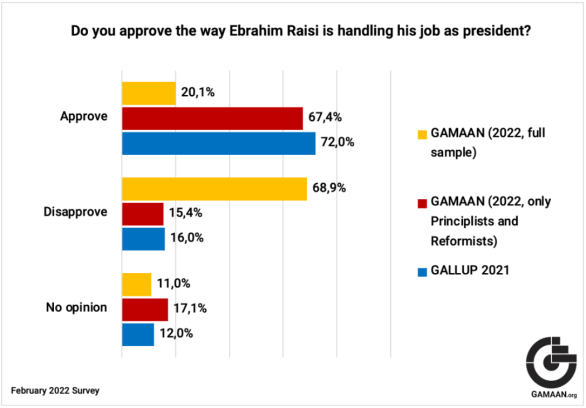
Figure 13-1 — Maleki, Ammar. 2022. Iranians’ Attitudes Toward Political Systems: A 2022 Survey Report. Published online, gamaan.org: GAMAAN.
GAMAAN’s Ties To US-Funded Regime-Change Orgs
Chief among GAMAAN’s ties to U.S. government-funded groups is the organization’s recent “partnership” with the Tony Blair Institute. GAMAAN “exclusively provided” the U.K. nonprofit with detailed survey data gathered in June 2020 (regarding Iranians’ religious beliefs), and February & December 2022 (regarding political systems and the Mahsa Amini street protests, respectively).
The Tony Blair Institute used GAMAAN’s survey data for a series of articles depicting the Iranian populace as eager for regime change, with one article titled “The People of Iran Are Shouting for Regime Change – But Is the West Listening?”.
Founded by former U.K. Prime Minister Tony Blair, the Institute has received millions in grants from the U.S. Agency for International Development (USAID), at least some of which were Cooperative Agreement grants “characterized by extended involvement between recipient and agency.”
The Tony Blair Institute is also funded by the U.K.’s Foreign, Commonwealth, and Development Office (akin to the U.S. State Department), as well as private entities such as the French consulting firm Altai Consulting. Altai boasts the European Commission, USAID, and the French Development Agency as clients.
GAMAAN’s widely-discussed 2020 survey of Iranians’ religious beliefs was “financially supported by and carried out in cooperation with” Dr. Ladan Boroumand, co-founder and research director of the Abdorrahman Boroumand Center, a nonprofit focused on Iranian human rights abuses and critical of Iran’s Islamist government.
Named after her father Abdorrahman Boroumand, an Iranian lawyer and pro-democracy activist who was allegedly assassinated by Islamic Republic agents in 1991, the Center’s ‘Omid’ project documents cases of executions and assassinations in Iran in a searchable electronic database. The organization isn’t shy about supporting regime change, stating that its “goal is to prepare for a peaceful and democratic transition in Iran and build a more just future.”
The Boroumand Center has received substantial funding from the U.S. government-financed National Endowment for Democracy (NED), of which the Boroumand Center is a “partner.”
Ladan Boroumand has held multiple positions at the NED, including serving as a former Reagan-Fascell Democracy Fellow, researching “secularization in Iran,” a current member of the editorial board for the NED’s Journal of Democracy, as well as a current Research Council Member at the NED’s International Forum for Democratic Studies. She has also served on the Steering Committee of the World Movement for Democracy, of which the NED serves as the “secretariat.”
Ladan Boroumand is also on the advisory committee for the Atlantic Council’s Iran Strategy Project, which convened various experts and former officials “to develop a holistic US policy toward the Islamic Republic of Iran for the next four years.”
The Atlantic Council is an influential international relations think tank with extensive ties to U.S. lawmakers that receives large sums from the U.S. government (with FY 2023 grant obligations totaling over $6 million). The group’s October 2024 Iran Strategy Project report recommends a policy of continued pressure against the Islamic Republic, including through “enhanced support to the Iranian people” with the “long-term goal of supporting the Iranian people’s ability to change their system of government if they so desire.”
Ladan Boroumand was invited, along with her sister Roya Boroumand, to a July 2018 speech by former Secretary of State Mike Pompeo at the Reagan Library, amid the Trump administration’s pivot to a hardline posture towards the Islamic Republic. The two sisters likewise joined 12 other Iranian diaspora women in signing an August 2019 open letter calling for a “transition from the Islamic Republic.”
GAMAAN has also consulted with Dr. Shirin Ebadi, an Iranian lawyer and Nobel Peace Prize recipient, who has long worked with the U.S. government and the NED-funded Tavaana, a project of the E-Collaborative for Civic Education (ECCE), founded by staunch opponents of the Islamic Republic, Mariam Memarsadeghi and Akbar Atri.
Tavaana, which describes itself as “Iran’s premier civic education and civil society capacity building initiative,” aimed at ushering in democratic governance. It creates and disseminates anti-government media and information on anti-censorship tools, and has an extensive social media following. Memarsadeghi was also a signatory to the August 2019 open letter calling for a “transition from the Islamic Republic.”
Memarsadeghi is also the founder and director of the Cyrus Forum, an organization that supports ousting the Islamic Republic and works to “reverse engineer an Iranian government that upholds security, the rule of law, and individual liberty.” Ladan Boroumand is one of only two advisors to the Cyrus Forum and was previously listed on Tavaana’s website as a teacher.
Ebadi also appears to have been invited to the U.S. State Department’s 2017 Middle East Partnership Initiative (MEPI) Implementers’ Conference, organized by the Department’s Bureau of Near Eastern Affairs, Office of Assistance Coordination (NEA/AC).
Ebadi’s name and role as president of the Centre for Supporters of Human Rights—a U.K. NGO focused on human rights issues in Iran that Ebadi founded—appear on a guest list circulated by the State Department in September 2017.
GAMAAN has also relied on U.S. government-funded virtual private network (VPN) providers Psiphon and Lantern for assistance in disseminating their surveys and bypassing Iranian government internet censorship.
Since at least 2021, GAMAAN has collaborated with Psiphon, an open-source tool for circumventing internet censorship (using VPN and other technologies) that was developed at the University of Toronto and publicly released in 2006. Psiphon has received millions in funding from the Open Technology Fund, which “receives the majority of its funding from the U.S. government via the U.S. Agency for Global Media (USAGM).”
Psiphon, the Tony Blair Institute, the Abdorrahman Boroumand Center, and Shirin Ebadi did not respond to requests for comment.
The Context
GAMAAN co-founder Ammar Maleki’s ire against the Islamic Republic is more than ideological; it’s personal. His father, Mohammad Maleki, who served as the first president of the University of Tehran, was a well-known critic of the country’s human rights abuses and use of the death penalty.
In 2019, the elder Maleki joined 13 other Iranian activists in signing a pair of open letters calling for Iran’s Supreme Leader to step down and a “complete and peaceful transition” away from the Islamic Republic. Ammar Maleki told Univers, the student newspaper of his employer, Tilburg University, “My father was imprisoned regularly until old age. Almost all the milestones in my life he missed.”
He makes his views on the Islamic Republic clear on X: “To understand/analyze the #Islamic_Republic of Iran, 3 golden rules should be kept in mind: 1- I.R. [Islamic Republic] cannot be reformed by dialogue but will surrender to pressure 2- I.R. officials lie unless proven otherwise 3- when I.R. officials/supporters say #Iran, they mean the I.R. only!”
Hardline politics are not unusual among academics. More unusual and concerning is Maleki’s willingness to accuse those who call into question GAMAAN’s findings and methodology of carrying water for the Islamic Republic. Daniel Tavana experienced this firsthand when he criticized GAMAAN’s methodology online.
“I understand that you have a hard time these days selling your data by the IRGC-initiated IranPoll, so you attack GAMAAN to get attention. I cannot waste my time answering nonsense on GAMAAN’s method for an apologist! Our results were corroborated by external checks & field evidence,” Maleki wrote, referring to Tavana and the Iran Social Survey’s use of IranPoll to conduct surveys within Iran.
Noir couldn’t find evidence of IranPoll having ties to the Islamic Republic, and Maleki did not respond when we asked him to elaborate on the allegation. Tavana likewise stated, “IranPoll has no connection to the government [of Iran].”
Nonetheless, Maleki seems to allege that IranPoll’s work is evidence that Western universities “are under the control of the regime’s thugs,” as he wrote on X.
If mainstream media citations of GAMAAN’s findings are any indication, Maleki’s tenacity seems to be paying off.
Whether you’ve seen it in reports published by the State Department, the American Foreign Policy Council, the government of the United Kingdom, The New York Times, The Wall Street Journal, FiveThirtyEight, The Guardian, The Economist, CBC, Al-Monitor, The Jerusalem Post, Voice of America, the Wilson Center, DW News, Tablet Magazine, The Hill, The Washington Times, or Christianity Today, there’s a good chance that if you live in the West, GAMAAN has helped shape what you think is happening in Iran.
GAMAAN’s rise shows no signs of slowing: the organization announced in January that Maleki had been “selected as the country representative for Iran (2025-2026) in the prestigious World Association for Public Opinion Research (WAPOR).” The Washington Post described WAPOR as “the leading professional association of pollsters working outside the United States.”
For Tavana, GAMAAN isn’t merely worsening academic and mainstream conversation around Iran—it’s potentially providing justification for the kind of military confrontation that actually materialized last month.
“It wasn’t a very long time ago where, you know, the U.S. invaded another country, largely on the assumption that people who lived in that country wanted the invasion and [welcomed] their liberation … And so I think that, like, trafficking in these half-baked ideas is actually quite dangerous, and it’s going [to], if unchecked, get a lot of people killed,” Tavana said.
Sam Carlen is an investigative journalist writing for Noir News, an independent newsletter covering foreign policy and U.S. soft power projection, policing and surveillance, and other topics.
Iain Carlos is an investigative journalist and the founder of Noir News, a newsletter covering foreign policy, policing, surveillance, and other topics.
US strikes another vessel off Venezuela, killing four
Al Mayadeen | October 3, 2025
The United States has escalated its military campaign in Latin America, carrying out yet another deadly strike off the coast of Venezuela under the false pretext of fighting narcotics trafficking.
Defense Secretary Pete Hegseth announced the latest strike in a post on X, celebrating the destruction of a small vessel that US officials claimed was carrying drugs. A video accompanying the post showed the boat erupting into flames, a scene observers say reveals Washington’s growing reliance on extrajudicial force and its willingness to kill without evidence, trial, or accountability.
“Four male narco-terrorists aboard the vessel were killed in the strike,” Hegseth wrote, asserting that it “was conducted in international waters just off the coast of Venezuela while the vessel was transporting substantial amounts of narcotics — headed to America to poison our people.” He vowed, “These strikes will continue until the attacks on the American people are over!!!!”
The latest strike brings the death toll to at least 21 people across four attacks in recent weeks, none of whom have been positively identified as traffickers. Washington has offered no independent proof linking the victims to drug networks, raising concerns that the US is unilaterally executing individuals in foreign waters under a fabricated pretext.
This new military doctrine stems from President Donald Trump’s declaration that the United States is now in “armed conflict” with drug cartels, reclassifying them as “terrorist organizations”, a move legal scholars have condemned as an attempt to bypass international law. A Pentagon notice sent to Congress, obtained by AFP, claimed: “The president determined these cartels are non-state armed groups, designated them as terrorist organizations, and determined that their actions constitute an armed attack against the United States.” The same document described alleged smugglers as “unlawful combatants”, stripping them of legal protection under the Geneva Conventions.
Rights groups have warned that such terminological manipulation echoes past US practices, from the “war on terror” to the invasions of Panama and Iraq, where legal gray zones were exploited to justify preemptive violence and regime change.
Political Theater and Extrajudicial Killings
The Trump administration has openly celebrated these operations as demonstrations of strength rather than law enforcement. Trump’s communications director, Steven Cheung, declared that traffickers had been “turned into stardust.” On Truth Social, Trump himself echoed the narrative, writing: “A boat loaded with enough drugs to kill 25 TO 50 THOUSAND PEOPLE was stopped, early this morning off the Coast of Venezuela, from entering American Territory.”
But independent analysts and international law experts argue that the campaign bears all the hallmarks of a covert regime change operation. The strikes come amid an unprecedented US military buildup near Venezuela, including the deployment of F-35 warplanes to Puerto Rico, marking the largest show of force in the Caribbean in more than three decades. Venezuela’s Defense Minister Vladimir Padrino condemned the presence of US jets near Venezuelan airspace as “a provocation” and “a threat to our national security.”
32% of Mass Shooters Are Veterans. 0% of Media Outlets Will Say So.
By David Swanson | Let’s Try Democracy | September 29, 2025
Two U.S. military veterans allegedly shot and killed at least three people each this past weekend, Thomas Jacob Sanford in Michigan, and Nigel Max Edge in North Carolina. So, it is a safe bet that they will both be added (with, almost certainly, no mention of their status as veterans) to the database maintained by Mother Jones that I have for years been using as a starting point to track statistics on mass shootings.
It’s been almost two years since I posted an update. In that time, Mother Jones has added seven mass shootings to its database. These two new ones will make nine. Of those other seven, one of the shooters — bizarrely, and I hope nobody gets reprimanded — is actually identified as a veteran by Mother Jones. Another of the seven was 14 years old and yet another was 67; they don’t factor into calculations about men under 60. Another was a veteran of an institution that uses the word “veteran” to associate itself with the military: football. He blamed his football injuries for his crime. He counts statistically as NOT a military veteran. In a quick internet search, I’ve been unable to identify any of the others as military veterans either, so will count them as non-veterans. But it’s worth noting that often in the past I’ve managed to find out about veteran status only after lengthy searching.
So, the data has now changed from 40 of 127 mass shooters (who are men under 60) being military veterans when last I wrote about this to now 43 of 134 mass shooters being military veterans. That’s 32%, up from 31%. That figure has been between 31% and 36% for as long as I’ve been doing these calculations
In the United States, only a very small percentage of men under 60 are military veterans.
In the United States, at least 32% of male mass shooters under 60 (which is almost all mass shooters) are military veterans.
As I reported in June 2023, a University of Maryland report touching on this topic was virtually ignored by media outlets.
But here are the facts:
Looking at males, aged 18-59, veterans are well over twice, maybe over three times as likely to be mass shooters compared with the group as a whole. And they shoot somewhat more fatally.
The numbers have changed slightly since I began writing about this:
- October 28, 2023: ABC News Report Claims No Past Mass Shooters Have Been Veterans; At Least 31% Have Been
- October 26, 2023: At Least 31% of Mass Shooters Were Trained to Shoot by the U.S. Military
- May 10, 2023: At Least 32% of U.S. Mass Shooters Were Trained to Shoot by the U.S. Military
- March 23, 2021: At Least 36% of Mass Shooters Have Been Trained By the U.S. Military
- June 4, 2019: Updated Data: Mass Shooters Still Disproportionately Veterans
(At this point it was 35%) - November 4, 2018: Mass Shooters’ Histories in the U.S. Military Most Amazing Coincidence
(At this point it was 35%) - November 14, 2017: U.S. Mass Shooters Are Disproportionately Veterans
(At this point it was 34%)
The training and conditioning and arming of shooters is of far less interest to media outlets than “motivation,” but what we should actually know about shooters’ ideology is not unrelated to the disproportionate presence of military veterans in the list of mass shooters. These are people who have been armed and trained and conditioned at public expense and then generally thanked for the supposed service of what they’ve done when it has not yet included shooting any of the wrong people.
All sorts of correlations are carefully examined when it comes to mass shooters. But the fact that the largest institution in the United States has trained many of them to shoot is scrupulously avoided.
Many of those mass shooters who are not military veterans tend to dress and speak as if they were. Some of them are veterans of police forces with military-sounding titles, or have been prison guards or security guards. Counting those who’ve been in either the U.S. military or a police force or a prison or worked as an armed guard of any kind would give us an even larger percentage of mass shooters to consider. The factor of having been trained and employed to shoot is larger than just the military veterans, yet carefully ignored by every single U.S. corporate media outlet (that sounds like an exaggeration, but can you prove it wrong?).
Some of the non-military mass-shooters have worked as civilians for the military. Some have tried to join the military and been rejected. The whole phenomenon of mass-shootings has skyrocketed during the post-2001 endless wars. The militarism of mass-shootings may be too big to see, but the avoidance of the topic is stunning.
Needless to say, out of a country of over 330 million people a database of 134 mass shooters is a very, very small group. Needless to say, statistically, virtually all veterans are not mass shooters. But that can hardly be the reason for not a single news article ever mentioning that mass shooters are very disproportinately likely to be veterans. After all, statistically, virtually all males, mentally ill people, domestic abusers, Nazi-sympathizers, loners, and gun-purchasers are also not mass-shooters. Yet articles on those topics proliferate like NRA campaign bribes.
There seem to me to be two key reasons that a sane communications system would not censor this topic. First, our public dollars and elected officials are training and conditioning huge numbers of people to kill, sending them abroad to kill, thanking them for the “service,” praising and rewarding them for killing, and then some of them are killing where it is not acceptable. This is not a chance correlation, but a factor with a clear connection.
Second, by devoting so much of our government to organized killing, and even allowing the military to train in schools, and to develop video games and Hollywood movies, we’ve created a culture in which people imagine that militarism is praiseworthy, that violence solves problems, and that revenge is one of the highest values. Virtually every mass shooter has used military weaponry. Most of those whose dress we are aware of dressed as if in the military. Those who’ve left behind writings that have been made public have tended to write as if they were taking part in a war. So, while it might surprise many people to find out how many mass shooters are veterans of the military, it might be harder to find mass shooters (actual veterans or not) who did not themselves think they were soldiers.
There seems to me to be one most likely reason that it’s difficult to find out which shooters have been in the military (meaning that some additional shooters probably have been, about whom I’ve been unable to learn that fact). We’ve developed a culture dedicated to praising and glorifying participation in war. It need not even be a conscious decision, but a journalist convinced that militarism is laudable would assume it was irrelevant to a report on a mass shooter and, in addition, assume that it was distasteful to mention that the man was a veteran. That sort of widespread self-censorship is the only possible explanation for the complete whiting out of this story.
The phenomenon of shutting down this story does not exactly require a “motive,” and I would like to recommend to reporters on mass shootings that they, too, devote a bit less energy to the often meaningless hunt for “a motive,” and a tad more to considering whether the fact that a shooter lived and breathed in an institution dedicated to mass shooting might be relevant.
UPDATE SEPTEMBER 29, 2025:
Shockingly, CBS News did one article on this topic two years ago. Here it is. The seven people who wrote it used a database from the Violence Project and did not separate out men or men of any particular age. They concluded that 26% of mass shooters were veterans, as compared to 7% of all people. In other words, a mass shooter is over 3 times as likely to be a veteran.
It’s always seemed more relevant to me to remove the very few mass shooters who are female or young or old, and then compare to 18-59-year-old men in the general population. The closest I can come to putting an exact number on that is like this. The U.S. Census says that in 2024, males 19-59 were 88,300,644 or 25.96% of the population. (This is imperfect because it looks at only one year, because it is an estimate, because it leaves out 18 years olds, and because it includes non-citizens who were not eligible for or did not live in the United States at the age for being in the U.S. military.) According to the Department of Veterans Affairs, of men aged 20-59 (so, missing 18-19-year-olds), 6,565,138 as of 2024 were veterans. That’s 7.43% of all men aged 19-59. If we compare 32% with 7%, mass shooters are over 4.5 times more likely to be veterans.
Larry Ellison funded Rubio’s political rise after vetting him for ‘loyalty to Israel’
The Cradle | October 3, 2025
Larry Ellison, the billionaire co-founder of tech giant Oracle, vetted US Secretary of State Marco Rubio for his support of Israel before making large donations to the senator from Florida’s 2016 presidential election campaign, Drop Site news reported on 3 October.
Leaked emails released by an Iranian hacker group, Handala, show that Ellison discussed Rubio’s loyalty to Israel with Ron Prosor, who at that time served as the Israeli ambassador to the UN.
In April 2015, Ellison and Prosor exchanged several emails discussing Rubio and whether the senator would be an advocate for Israel.
After Ellison met Rubio for dinner, Prosor sent a message to Ellison asking how their meeting went.
“How was the conversation with Mario Rubio. [sic] Did he pass your scrutiny? Did you have a chance to talk about Israel? Would love to chat.”
Ellison responded by saying, “Hi Ron. Great meeting with Marco Rubio. I set him up to meet with Tony Blair,” adding, “Marco will be a great friend for Israel.”
At the time, Rubio was seen as a strong challenger in the Republican presidential primary, which was ultimately won by upstart candidate Donald Trump.
Ellison then donated $4 million to Rubio’s presidential campaign, making him among the top donors of the 2016 cycle.
Since that time, Rubio has been a staunch advocate for Israel and is currently helping Ellison in his goal of building a media empire and taking control of Gaza.
Drop Site notes Rubio has played a role in helping Ellison take control of TikTok, which Israeli Prime Minister Benjamin Netanyahu views as crucial to influencing young people in the US to support Israel.
While under Chinese ownership, TikTok allowed relatively free criticism of Israel’s genocide of Palestinians in Gaza.
Ellison is seeking to expand his influence over the traditional media in the US as well. His son David is moving to take control of CBS News, CNN, Warner Brothers, and Paramount, and will reportedly install pro-Israel journalist Bari Weiss as editor of CBS News.
Ellison is also seeking to benefit from post-war Gaza reconstruction through former UK prime minister Tony Blair and the institute he heads.
Blair is seeking to lead a committee that US President Donald Trump plans to establish to rule Gaza and oversee the reconstruction of the enclave once it has been emptied of its roughly 1.7 million Palestinian inhabitants.
Drop Site notes further that Trump’s son-in-law, New York real estate investor Jared Kushner, tasked the Tony Blair Institute this spring to develop a plan for post-war Gaza.
As Secretary of State, Rubio is in a position to influence the plans for Gaza and help determine who will benefit financially from Trump’s plan to build a high-tech city, the “Riviera of the Middle East,” on stolen Palestinian land.
If Blair is given the role of overseeing Gaza’s reconstruction, Ellison will have strong influence in the enclave. Drop Site observed that the “Tony Blair Institute has effectively become an offshoot of Oracle,” following donations of $350 million from Ellison.
Ellison has long been a supporter of Israel. At a 2014 fundraiser attended by other pro-Israel billionaires, he declared that “there is no greater honor” than supporting the Israeli military.
In 2017, Ellison donated over $16 million to the Friends of the IDF, the largest-ever donation to the organization. Ellison is also good friends with Prime Minister Netanyahu, who has been a guest at Ellison’s private island in Hawaii.
How a low-key remark by Putin reveals a deeper economic shift
By Henry Johnston | RT | October 3, 2025
During his Valdai speech on Thursday, Russian President Vladimir Putin made the following rather dry statement:
“It’s impossible to imagine that a drop in Russian oil production will maintain normal conditions in the global energy sector and the global economy.”
It certainly wasn’t the highlight of the night, and I haven’t seen it in the headlines of any of the recaps. The statement is, of course, true. Putin is in a sense saying: “you can’t kick us out.”
But let’s unpack this a bit and try to get a bird’s eye view of what this mundane statement implies in a much deeper sense – not in the sense of counting barrels of oil and the Brent price, but in terms of understanding the shifting tectonic plates.
Let’s first imagine what a Western leader might have said in the same tone, circa January 2022.
“It’s impossible to imagine that a country that loses access to dollars and Western capital markets will maintain normal economic conditions.” I don’t know if anybody actually said such a thing in as many words, but that’s exactly what many were thinking.
Now, recall the G10 Rome meetings in late 1971, as the Bretton Woods-established gold peg of the dollar was being dismantled, when US Treasury Secretary John Connally famously told his European counterparts: “The dollar is our currency, but it’s your problem.” It is an oft-cited instance of American hubris.
In other words, despite its global use in trade and finance, the dollar would be managed for American economic interests.
When the collective West placed what were supposed to be crushing sanctions on Russia in 2022 in light of the Ukraine crisis, the idea was, again, “our currency (system), your problem.”
The message: the dollar will be managed for American geopolitical interests.
According to the conventional thinking, being cut off from the dollar system should have spelt doom for Russia. The many forecasters predicting exactly such a dire outcome weren’t necessarily simply Russophobes. They were working within a certain paradigm. Without access to its now frozen central-bank reserves, how would Russia stabilize the ruble? Without access to correspondent banking in dollars/euros, how would trade be settled? And without access to foreign capital markets, wouldn’t a funding crisis ensue? This type of thinking gave rise to these types of comments:
“We will provoke the collapse of the Russian economy,” in the words of French Finance Minister Bruno Le Maire about ten days into the war.
But the Russian economy didn’t collapse and in fact stabilized far faster than anyone expected. The thing is Russian oil and gas was still needed. And those who thought they didn’t need it (read the EU) found out the hard way that they did – even if the Europeans obscured the ramifications as much as possible through large fiscal support and subsidies. But it is no coincidence that ‘deindustrialization’ has become a household word in Europe. And somehow the political will to really clamp down hard on Russian energy never seems to materialize.
All of a sudden we have, from a Russian perspective: “Our commodities, your problem.”
The question now is: does this mean we’ve suddenly awoken to a strange new world? Are we now in a system where access to real things (like commodities) now trumps access to paper promises (like dollars)? Western policymakers’ futile attempts to cut Russian energy out of the world economy show that they understand only the monetary side of things. They see energy as a source of revenue for the Russian state – revenues thanks to which Russia is able to sustain its war effort. That the economy might actually fundamentally be an energy system and not a monetary system is incomprehensible to them. It is, in the strict Kuhnian sense, a different paradigm.
The BRICS countries talk a lot about a monetary reset being underway and about how new financial architecture is being created. It is fair to say that some of this rhetoric has been premature and that reports of the demise of the dollar system have been overstated. There have been a lot of checks written that BRICS and the Global South aren’t ready to cash.
Nevertheless, change is afoot, and what is taking shape has roughly the following contours: commodities are beginning, at the margins, to act as system-level collateral. By contrast, up to now, the system relied on trust in the issuer of paper claims (dollars, US Treasuries, euro-denominated assets). Gold accumulation by central banks has been massive – it is a quiet de-dollarization of reserves. Oil-for-yuan deals are modest but growing. And what can the commodity seller do with the yuan it receives? Convert it to gold on the Shanghai Gold Exchange. This may not yet be widespread, but the plumbing is there.
The anchor is shifting from debt claims to real assets – and this is bad news for countries whose economies are perched precariously atop a mountain of debt claims. Think of this as part hedge against Western sanctions and weaponization of the system, and part recognition that commodities have intrinsic durability that paper claims can’t always guarantee.
Ultimately, of course, paper promises can be inflated. It’s not lost on anybody in the Global South that the dollar is down some 111% against gold in just two years and that US debt seems to be spiraling to infinity.
If the current system is one where money, credit, and financial assets are king, this means the constraints in this system are money-related. The crises tend to start with something like a spread blowing out, liquidity drying up, or collateral chains breaking. This is basically a money problem, not a real-economy problem. Remember the 1998 Asia currency meltdown; or the Global Financial Crisis of 2008; or Covid; or the UK gilt crisis of 2022; or the various US repo spikes. Such dislocations are dealt with by throwing balance sheet at them – swap lines, quantitative easing, backstops, emergency loans.
In 2022, we suddenly found out that Russian energy is not just another financial dislocation that can be covered with a swap line or emergency loan. From this, it follows that we need to think in terms of two economies: the real economy of energy, resources, goods and services, and a parallel financial economy of money and debt. There will always be a financial economy – and always be spreads blowing out on a Bloomberg screen somewhere – but we’re finding out now that it is the real economy that underpins the financial one and not the other way around.
But here’s the catch. When energy is abundant and cheap – and when money holds its value against energy – this energy foundation to the economy can be disregarded. The peak of renewables-based energy transition euphoria in Europe coincided with the peak of Russian supply of cheap hydrocarbons to Europe. A coincidence?
The legendary strategist Zoltan Pozsar once wrote: “Russia and China have been the main ‘guarantors of macro peace’, providing all the cheap stuff that was the source of deflation fears in the West, which, in turn, gave central banks the license for years of money printing (QE).”
I would add that this also gave the West license to dwell comfortably in the illusion that the economy is primarily a monetary system and not an energy-and-real-stuff system. Ironically, it was the reliable presence of cheap Russian oil and gas that helped this economic illiteracy to fester.
Putin did not connect these dots in his remarks at Valdai; the focus of his speech was obviously elsewhere. But the dots are there to be connected. And there are a lot of people in Moscow and Beijing to whom these dots are very apparent.
Henry Johnston is a Moscow-based editor who worked in finance for over a decade.
New York Imposes Law Forcing Social Media to Justify Speech Policies to State Authorities
By Cindy Harper | Reclaim The Net | October 3, 2025
Social media companies operating in New York are now under fresh legal obligations as the state enforces the so-called “Stop Hiding Hate Act,” a new compelled speech law that forces platforms with annual revenues exceeding $100 million to hand over detailed reports on how they handle various forms of speech, including speech that is legally protected under the First Amendment.
The legislation went into effect on October 1 and has already triggered a constitutional showdown in court.
The law, officially Senate Bill S895B, demands biannual disclosures to the state Attorney General’s office.
These reports must outline how platforms define terms such as “hate speech,” “misinformation,” “harassment,” “disinformation,” and “extremism.”
Companies are also required to explain what moderation practices they apply to those categories and to provide specifics about actions taken against users and content.
Platforms that fail to comply face penalties of up to $15,000 per violation, per day. Injunctive action can also be taken against non-compliant entities.
Attorney General Letitia James declared that the law is about transparency and oversight.
“With violence and polarization on the rise, social media companies must ensure that their platforms don’t fuel hateful rhetoric and disinformation,” she said in a public statement, reinforcing her view that private companies should be accountable to the state for how they manage user expression.
“The Stop Hiding Hate Act requires social media companies to share their content moderation policies publicly and with my office to ensure that these companies are more transparent about how they are addressing harmful content on their platforms.”
Governor Kathy Hochul voiced similar sentiments, saying the legislation “builds on our efforts to improve safety online and marks an important step to increase transparency and accountability.”
The reporting rules, however, do not simply demand that companies disclose general moderation policies. They compel platforms to state clearly how they define some of the most politically charged and subjective categories of online content. These include terms that do not have universally accepted definitions and that often serve as the basis for viewpoint discrimination.
This government demand for compelled speech is at the heart of a legal battle now playing out in federal court.
In June 2025, X Corp., the company behind the X platform, filed a lawsuit challenging the constitutionality of the law.
The company’s complaint argues that Senate Bill S895B is a direct assault on editorial discretion and a violation of free speech rights enshrined in both the US and New York Constitutions.
According to the complaint, the law imposes “an impermissible attempt by the State to inject itself into the content-moderation editorial process.” X warns that the statute operates as a tool to pressure platforms into adopting government-favored positions on disputed topics.
Key to X’s legal objection is what it refers to as the “Content Category Report Provisions.” These provisions, the company argues, effectively force platforms to accept the state’s framing of controversial topics, including “foreign political interference” and “hate speech,” regardless of how a private entity might choose to treat or define such categories independently.
The lawsuit also highlights the heavy financial threat tied to non-compliance, noting that fines can reach $15,000 per day for every violation. In addition, platforms could face legal action from the Attorney General’s office.
In defending its position, X Corp. references a victory it recently secured in a separate First Amendment case involving a similar law in California. There, the Ninth Circuit ruled that forced reporting of this nature likely constitutes compelled non-commercial speech and does not hold up under strict scrutiny.
The court concluded that forcing platforms to adopt state-defined language “amounts to compelled speech,” a stance X Corp. is urging the Southern District of New York to follow.
The company’s lawsuit goes a step further, pointing to legislative bias as motivation for the law’s passage.
According to the complaint, New York lawmakers refused to engage with X’s representatives in the wake of the California ruling, explicitly citing their disapproval of Elon Musk’s public statements and use of the platform.
In correspondence included in the court filing, lawmakers dismissed the company’s concerns because, in their words, Musk had used X to promote content that “threatens the foundations of our democracy.”
That remark, X argues, reveals a plainly unconstitutional motive rooted in viewpoint discrimination. “The government cannot do indirectly what [it] is barred from doing directly,” the complaint states, referencing controlling Supreme Court precedent.
Despite the ongoing litigation, New York officials are moving forward with the law’s enforcement.
Senator Brad Hoylman-Sigal, one of the bill’s sponsors, defended the policy as a necessary countermeasure to what he described as real and potential violence driven by online speech. “The Stop Hiding Hate Act will ensure that New Yorkers are able to know what social media companies are doing (or not doing) to stop the spread of hatred and misinformation on their platforms,” he said.
The outcome of the lawsuit could have wide-reaching implications not only for companies operating in New York but also for how much power states can exert over online speech. For now, platforms face a stark choice: speak as the state demands or risk steep penalties for silence.
Will California Zionise K-12 Education?
By Rick Sterling | Global Research | October 2, 2025
Factual information about Israel and Palestine may soon be outlawed in the California K-12 school system. Assembly Bill 715 is currently on Governor Newsom’s desk. The legislation was recently rushed through the California legislature, amended just days before passage, and voted on at 1 a.m. with almost no time for public comment.
The hurry is intentional because opposition grows whenever people learn about it. AB715 is opposed by educators across the spectrum, including the California Teachers Association, California Faculty Association, Association of School Board Administrators, California School Boards Association, and Council of UC Faculty Associations. Civil rights organizations, such as ACLU Action, also oppose the legislation.
What It Purports to Do
Assembly Bill 715 aims to “prevent antisemitism.” It asserts, “Jewish and Israeli pupils are facing a widespread surge in antisemitic discrimination, harassment, and bullying. In many cases, such discrimination, harassment, and bullying has been so severe and pervasive that it has placed Jewish pupils at risk, or completely impeded their ability to learn or engage in school programs or activities.”
The Anti-Defamation League (ADL) is the main source for the claim that there is a “widespread surge” in antisemitism. Their accuracy is widely disputed. As the Jewish Currents publication reports, “A line-by-line reassessment of the organization’s data illuminates the flaws in its methodology.”
There is already protection in the California Education Code for genuine cases of discrimination or bullying. Section 220 of the code specifies that “No person shall be subjected to discrimination on the basis of disability, gender, gender identity, gender expression, nationality, race or ethnicity, religion, sexual orientation, or any other characteristic that is contained in the definition of hate crimes.” Through their ethnicity and religion, Jewish students are clearly a protected group. So are Israeli students. They can file claims of discrimination under existing legislation.
What It Will Actually Do
AB715 aims to expand the definition of “discrimination” and outlaw any textbook, instructional material, or course content that “would subject a pupil to unlawful discrimination.”
But what is “unlawful discrimination”? AB715 specifies that the U.S. National Strategy to Counter Antisemitism is the basis for identifying antisemitism. That report asserts, “Jewish students and educators are targeted for derision and exclusion on college campuses, often because of their real or perceived views about the State of Israel. When Jews are targeted because of their beliefs or their identity, when Israel is singled out because of anti-Jewish hatred, that is antisemitism.” The document claims, “an unshakeable commitment to the State of Israel’s right to exist, its legitimacy, and its security. In addition, we recognize and celebrate the deep historical, religious, cultural, and other ties many American Jews and other Americans have to Israel.”
The U.S. National Strategy to Counter Antisemitism embraces the controversial “working definition” of antisemitism advanced by the International Holocaust Remembrance Alliance (IHRA). This definition has been widely criticized for its conflation of antisemitism with anti-zionism and criticism of the State of Israel. Over 100 human rights and civil society organizations reject the IHRA definition. Yet this is the definition which AB715 is based on.
If passed, AB715 will result in strict regulation of education and educational material that might subject Jewish students to “unlawful discrimination”. Facts and informed opinions about the reality in Israel and Palestine may be considered “antisemitic” or likely to cause discomfort. For example, students will not learn:
- The International Criminal Court has issued an arrest warrant for Israeli PM Netanyahu charging him with crimes against humanity.
- The International Association of Genocide Scholars determined that Israel is committing genocide in Gaza.
- Human Rights Watch, Amnesty International and Israel’s B’Tselem have ALL independently investigated and determined that Israel is an apartheid state.
- The greatest scientist of the 20th century, Albert Einstein, was against the creation a Jewish state and sought a binational Arab Jewish state in Palestine.
- In 1948, Einstein, Hanna Arendt, and other Jewish leaders denounced Menachim Begin as a Nazi and fascist.
- The Israeli newspaper Haaretz documents a Jewish scholar who was zionist but now supports Hamas and considers their armed resistance legitimate and legal.
All of the above are facts and assessments by credible organizations and individuals. AB715 is so vague yet sweeping that such education about Israel and Palestine may be considered “unlawful discrimination” against a pro-Israel student and therefore prohibited.
The Costs of AB715
If passed, AB715 will cost Californians dearly. It mandates the creation of a new Office of Civil Rights with an Antisemitism Prevention Coordinator and staff producing regular reports, investigations, etc. Incredibly, AB715 allows any member of the public to file a complaint, even anonymously. These complaints must be investigated and responded to within time requirements. School boards and superintendents, already busy, will have to spend precious time and resources investigating each and every complaint in a timely manner. The predictable result will be fear or prohibition on saying anything about Israel or Palestine. The Antisemitism Prevention Coordinator is also mandated to provide antisemitism education to teachers, administrators, and school boards.
Under California’s “Golden State Plan to Counter Antisemitism,” millions of dollars are appropriated for education about the genocide which ended 80 years ago. Meanwhile, there is no funding and it appears the California legislature seeks to prevent education about the genocide happening today in Gaza.
Making it even worse, AB715 invites lawsuits which will further burden the education system. The legislation says, “Civil law remedies, including but not limited to injunctions, restraining orders, or other remedies, may also be available to complainants.” Under AB715, as a gift for zionist activists, any member of the public can be a complainant.
AB715 Should Not Be Signed into Law
The organizations representing California teachers, adminstrators, school superintendents and school boards are ALL against this legislation. AB715 will be costly, wasteful, and damaging to K-12 education in California. Where there are genuine cases of discrimination or bullying, existing legislation is adequate. All students are protected against discrimination or bullying under section 220 of the California Education Code. Where Jewish or Israeli students have been victimized, they have the same recourse as all students. They do not need preferential treatment.
Teaching facts and expert opinions about Israel and Palestine is not antisemitic. It is history and current events.
Feeling uncomfortable when learning some facts or opinions is not being a victim; it is being educated. People can disagree and have different perceptions; they should not be prevented from hearing facts and different perspectives.
The intent of AB715 is clear: to restrict factual information about an important region of the world and to punish educators who present the Palestinian and anti-zionist Jewish perspective. Governor Newsom should not sign the legislation. To encourage him to make the right decision, contact him via this link.
This legislation does not prevent antisemitism; it actually promotes it by demonstrating that major Jewish organizations and the Jewish Legislative Caucus have the power to push this legislation which will deny the history and current reality of the Palestinian people. Meanwhile, Jewish Voice for Peace and organizations across the education profession are working hard to stop this assault on the California education system.
The Israel Lobby Wants Thomas Massie Gone. Will Voters Obey?
By Jose Alberto Nino | The Occidental Observer | September 29, 2025
The knives are out for Rep. Thomas Massie (R-KY), and his political survival could prove whether Congress still answers to American voters or to a foreign lobby with limitless cash.
Pro-Israel Republican megadonors recently set up the MAGA Kentucky super PAC with $2 million specifically to oust Massie. Paul Singer contributed $1 million, John Paulson added $250,000, and Miriam Adelson’s Preserve America PAC provided $750,000. The Republican Jewish Coalition has promised “unlimited” campaign spending if Massie runs for Senate, with CEO Matt Brooks declaring that “if Tom Massie chooses to enter the race for US Senate in Kentucky, the RJC campaign budget to ensure he is defeated will be unlimited.”
President Donald Trump has also jumped into the fray, branding Massie a “pathetic loser” who should be dropped “like the plague.” Overall, a constellation of pro-Zionist forces is mobilizing at full force to unseat Congress’s most principled non-interventionist politician since Ron Paul retired in 2013. In many respects, Massie has taken up Paul’s mantle of foreign policy restraint — a political agenda that has never sat well with organized Jewry. Massie’s legislative track record on foreign policy speaks for itself.
Massie’s Long Track Record of Voting Against Foreign Policy Interventionism
Throughout his congressional career, Massie has established himself as Congress’s most consistent opponent of the neoconservative/neoliberal foreign policy consensus. His principled opposition to endless wars and foreign entanglements has earned him the nickname “Mr. No” — similar to his predecessor Ron Paul — for frequently casting lone dissenting votes against military interventions.
In 2013, Massie introduced the War Powers Protection Act to “block unauthorized U.S. military aid to Syrian rebels.” He argued that “since our national security interests in Syria are unclear, we risk giving money and military assistance to our enemies.” When Obama sought to arm Syrian rebels in 2014, Massie voted against the plan, declaring it “immoral to use the threat of a government shutdown to pressure Members to vote for involvement in war, much less a civil war on the other side of the globe.”
Massie consistently opposed U.S. involvement in Yemen’s civil war, co-sponsoring multiple bipartisan resolutions to invoke the War Powers Resolution and “remove United States Armed Forces from unauthorized hostilities in the Republic of Yemen.” He stated that “Congress never authorized military action in Yemen as our Constitution requires, yet we continue to fund and assist Saudi Arabia in this tragic conflict.”
His opposition to NATO expansion proved equally consistent. In 2017, Massie was one of only four House members to vote against a pro-NATO resolution, explaining that “the move to expand NATO in Eastern Europe is unwise and unaffordable,” and such expansion contradicted Trump’s campaign assertion that “NATO is obsolete.”
Regarding the Russo-Ukrainian war, Massie maintained his non-interventionist stance, receiving an “F” grade from Republicans for Ukraine. He opposed the Ukraine Democracy Defense Lend-Lease Act, multiple aid packages, and efforts to strip Ukraine funding. Massie argued that supporting Ukraine aid was “economically illiterate and morally deficient,” declaring that “the American taxpayers have been conscripted into making welfare payments to this foreign government.”
Most recently, in June 2025, Massie introduced a bipartisan War Powers Resolution with Rep. Ro Khanna to “prohibit United States Armed Forces from unauthorized involvement” in the Israel-Iran conflict. After Trump’s strikes on Iranian nuclear facilities, Massie criticized the action as “not Constitutional,” remaining the only Republican co-sponsor of the war powers resolution.
Massie’s Anti-Zionist Streak
Massie’s most politically dangerous positions involve his consistent opposition to pro-Israel legislation, earning him the distinction of being the lone Republican opposing numerous Israel-related measures.
In July 2019, Massie cast the sole Republican vote against a resolution opposing the Boycott, Divestment, and Sanctions movement. The resolution passed 398-17, but Massie defended his position by stating he does not support “federal efforts to condemn any type of private boycott, regardless of whether or not a boycott is based upon bad motives” and that “these are matters that Congress should properly leave to the States and to the people to decide.”
In September 2021, Massie was the only Republican to vote against $1 billion in funding for Israel’s Iron Dome defense system. He explained that “my position of ‘no foreign aid’ might sound extreme to some, but I think it’s extreme to bankrupt our country and put future generations of Americans in hock to our debtors.” This vote prompted AIPAC to run Facebook ads stating “When Israel faced rocket attacks, Thomas Massie voted against Iron Dome.”
Perhaps most controversially, on May 18, 2022, Massie cast the lone vote against a resolution condemning antisemitism, which passed 420-1. The American Jewish Committee criticized him, stating that “while Democrats and Republicans united, Rep. Massie, who has also opposed bills on Holocaust education and Iron Dome funding, decided that combating rising hatred is not important.” Massie defended his vote by tweeting that “legitimate government exists, in part, to punish those who commit unprovoked violence against others, but government can’t legislate thought.”
In October 2023, Massie opposed a $14 billion aid package for Israel, proclaiming that “if Congress sends $14.5 billion to Israel, on average we’ll be taking about $100 from every working person in the United States. This will be extracted through inflation and taxes. I’m against it.” When AIPAC criticized him, Massie responded that “AIPAC always gets mad when I put America first. I won’t be voting for their $14+ billion shakedown of American taxpayers either.”
On October 25, 2023, Massie was the sole Republican to vote against a resolution affirming Israel’s right to defend itself following the October 7 Hamas attacks. A month later, on November 28, 2023, he became the only member of Congress to oppose a resolution affirming Israel’s right to exist and equating anti-Zionism with antisemitism, which passed 412-1.
The most explosive moment came in December 2023 when Massie posted a meme of the rapper Drake contrasting “American patriotism” with “Zionism,” implying Congress prioritized the latter. Senate Majority Leader Chuck Schumer called the post “antisemitic, disgusting, dangerous” and demanded he remove it. The White House labeled it “virulent antisemitism.” Republican Jewish Coalition CEO Matt Brooks condemned it, stating “Shame on you @RepThomasMassie. You’re a disgrace to the US Congress and to the Republican Party.”
Massie vs. Trump
Trump’s escalating attacks on Massie reveal the extent to which the sitting president serves pro-Israel interests rather than pursuing genuine ideological differences. The timing and intensity of Trump’s criticism align suspiciously with Massie’s most vocal challenges to Israeli influence in Congress.
In June 2025, after Massie criticized Trump’s Iran strikes as “not Constitutional,” Trump unleashed a scathing Truth Social response calling Massie “not MAGA” and declaring that “MAGA doesn’t want him, doesn’t know him, and doesn’t respect him.” Trump branded Massie a “simple-minded ‘grandstander’ who thinks it’s good politics for Iran to have the highest level Nuclear weapon” and concluded that “MAGA should drop this pathetic LOSER, Tom Massie, like the plague!”
This vitriol represents a dramatic shift from Trump’s 2022 endorsement, when he called Massie a “Conservative Warrior” and “first-rate Defender of the Constitution.” The transformation occurred precisely as Massie intensified his criticism of Israeli influence and foreign aid. Trump’s attacks escalated further after Massie’s explosive June 2024 Tucker Carlson interview where he revealed that “everybody but me has an AIPAC person. … It’s like your babysitter, your AIPAC babysitter who is always talking to you for AIPAC.”
Massie elaborated that “I have Republicans who come to me and say that’s wrong what AIPAC is doing to you, let me talk to my AIPAC person… I’ve had four members of Congress say I’ll talk to my AIPAC person and like it’s casually what we call them my AIPAC guy.” This revelation exposed the systematic nature of Israeli influence over Congress, prompting immediate backlash from pro-Israel organizations and likely contributing to increased donor funding against his re-election campaign.
The pattern makes clear that Trump’s hostility toward Massie stems less from policy disagreements than from his deference to powerful Jewish donors. Although he often claims to oppose “endless wars,” Trump’s attacks on Massie — the most consistent non-interventionist in Congress — expose where his true loyalties lie in advancing the agenda of Jewish supremacist interests rather than pursuing an independent foreign policy. House Speaker Mike Johnson has signaled that GOP leadership will abandon Massie, stating that “he is actively working against his team almost daily now and seems to enjoy that role. So he is, you know, deciding his own fate.”
AIPAC is on the Hunt
AIPAC’s 2024 electoral victories demonstrate the lobby’s willingness to spend unprecedented sums to eliminate critics of Israeli policy. The organization’s success in defeating progressive Democrats and protecting establishment Republicans reveals a coordinated strategy to purge Congress of independent voices. AIPAC will look to replicate its successes against the likes of Israel critics such as Massie.
Against Rep. Jamaal Bowman in New York’s 16th District, AIPAC’s United Democracy Project (UDP) spent $14.5 million opposing Bowman while also propping up challenger George Latimer. Independent media outlet Sludge reported that “the $14.5 million AIPAC’s super PAC has spent in the NY-16 Democratic primary is more than any outside group has ever spent on a single House of Representatives election race.”
The spending was fueled by Republican megadonors channeled through AIPAC, with WhatsApp founder Jan Koum donating $5 million to UDP. Responsible Statecraft noted that “AIPAC effectively acted to launder campaign funds for Republican megadonors into the Democratic primary, where the spending was generally identified in media as ‘pro-Israel,’ not ‘Republican.’” By election day, Latimer-aligned groups had outspent Bowman’s backers by over seven-to-one.
Against Rep. Cori Bush in Missouri’s 1st District, UDP spent over $8.5 million to attack her record on Israel and support her pro-Zionist challenger Wesley Bell. The Bush-Bell primary became one of the most expensive House primaries ever with over $18 million in total ad spending. Bush called it “the second most expensive congressional race in our nation’s history, $19 million and counting” funded by “mostly far-right-funded super PACs, against the interests of the people of St. Louis.”
Even in Republican primaries, AIPAC intervened to protect establishment allies. To defend moderate Rep. Tony Gonzales against challenger Brandon Herrera in Texas’s 23rd District, UDP spent $1 million opposing Herrera in a “two-week ad buy.” The Republican Jewish Coalition added $400,000 in attack ads against Herrera. Combined AIPAC and RJC spending totaled approximately $1.4-1.5 million, helping Gonzales narrowly defeat Herrera by just 354 votes with 50.6% to 49.4%.
These victories came as part of AIPAC’s broader $100+ million spending cycle, with Common Dreams noting that “AIPAC money has already made a significant impact, helping a pair of pro-Israel Democrats defeat progressive Reps. Jamaal Bowman (D-N.Y.) and Cori Bush (D-Mo.)—two of Congress’ most vocal critics of Israel’s assault on Gaza—in recent primary contests.”
How Massie’s Race Could Determine the Israel Lobby’s Actual Power
Massie’s 2026 primary represents the ultimate test of whether any politician can survive the full force of pro-Israel opposition. The Kentucky race will determine if AIPAC’s previous victories represent sustainable power or pyrrhic victories that expose the lobby’s long-term vulnerabilities.
Massie’s unique position may prove more defensible than Bowman’s or Bush’s urban districts. His rural Kentucky constituency shows less susceptibility to urban media campaigns and maintains stronger skepticism of foreign entanglements. Moreover, his local roots provide credibility that transcends typical political attacks. The Kentucky representative’s ability to frame opposition as foreign interference rather than domestic policy disagreements could resonate with voters increasingly suspicious of the pro-Israel establishment that dominates Washington’s political scene.
The financial strain of AIPAC’s previous victories may also constrain future spending. The organization’s $100+ million commitment across multiple races represents an unsustainable pace that could face donor fatigue. Each expensive victory exposes the lobby’s methods to greater scrutiny and potential backlash. Progressive groups increasingly highlight AIPAC’s role in primary defeats, potentially mobilizing opposition that limits future effectiveness.
Massie’s survival would demonstrate that principled politicians can withstand pro-Israel pressure through constituent loyalty and grassroots support. His defeat would confirm that no elected official can challenge Israeli interests regardless of their domestic support. The Kentucky race thus represents a pivotal moment in determining whether American foreign policy serves American interests or remains subordinate to foreign influence.
If Massie withstands the assault, it will mark the first crack in the façade of Zionist invulnerability; if he falls, it will prove that American politicians can be bought and buried by World Jewry’s limitless stockpiles of cash.
Israeli officers commandeered Pentagon meetings during June’s Israel-Iran war: Tucker Carlson
Press TV – October 2, 2025
Israeli officers stormed meetings at the Pentagon during June’s Israel-Iran war, issuing orders unchecked while Trump administration officials stood by doing nothing, says a former Fox News host, raising fresh questions about foreign influence on US military decisions.
Prominent American commentator Tucker Carlson said that Israeli military officers stormed into closed-door meetings at the Pentagon during Israel’s 12-day aggression against Iran in June, stressing that they issued direct orders to US officials, a controversial move that raises serious concerns over foreign interference in the decision-making process at the US Department of War.
During a video titled “Speeding Toward World War Three” published on his X account on Thursday, Carlson further said that officials in the Trump administration failed to respond to or prevent these intrusions, allowing the Israeli officers to continue their actions unchecked.
The ex-Fox News host also touched on the ongoing tensions over US-Israel relations and questioned the extent of influence wielded by foreign powers within American military institutions.
“During the 12-day war with Iran, the US and Israel versus Iran, bombing on all sides, during that short conflict, a bunch of Israeli officers in the Pentagon during that week enraged American Pentagon staff by barging into the meetings, giving orders and making demands and nobody did anything about it. How can a foreign military officer barge into military headquarters? The more you allow that kind of deeply unhealthy behavior the more you are going to get,” Carlson said.
He stressed that because of the weakness of “our leaders”, Israel takes advantage of the US.
On June 13, Israel launched a blatant and unprovoked act of aggression against Iran, triggering a 12-day war that killed at least 1,064 people in the country, including military commanders, nuclear scientists, and ordinary civilians.
The United States also entered the war by bombing three Iranian nuclear sites in a grave violation of international law.
In response, the Iranian Armed Forces targeted strategic sites across the occupied territories as well as the Al-Udeid air base in Qatar, the largest American military base in West Asia.
A recent New York Times–Siena survey shows that a majority of Americans are turning against Israel’s war on Gaza, with 51 percent opposing further economic and military aid.
About 35 percent strongly reject such support, compared to 19 percent in favor, and roughly 40 percent believe Israel is deliberately targeting civilians amid the genocidal war in the besieged Palestinian territory.
Featured Video

Death Spikes & Rising Cancer In Our Youth Explained
or go to
Aletho News Archives – Video-Images
From the Archives
Politicians lie
By Mazin Qumsiyeh | Popular Resistance | August 18, 2013
There is no way to say this truth nicely: Politicians lie. That includes Japanese, American, Egyptian, Israeli, and Palestinian politicians! Is there something more common sense than that? Yet, so many citizens around the world believe their own politicians or wistfully acknowledge lies but think it is part of the job needed to run things. They believe even when politicians contradict themselves blatantly. This phenomenon is rather remarkable. It is a dissonance and disconnect from reality that many seem oblivious to. It is very dangerous because it can lead to accepting rationales for going to war. These can be deadly wars that lead to millions of lives lost as happened in what was called World War 1 and WW2. Even when incredible and declassified evidence abound, politicians continue to lie and old mythologies refuse to die. Here are just a few of the countless lies told to us over the past few decades… continue
Blog Roll
 Aletho News
- Turkish parliament to review Saudi-Pakistan defense pact next month
- DEATH SPIKES & RISING CANCER IN OUR YOUTH EXPLAINED
- Iran offers Trump deal before US election
- Merz regime wants ‘secret police’ – opposition
- Israeli settlers terrorize West Bank Palestinians with state-provided drones: Report
- They see them, then kill them: Israeli quadcopters track, deliberately target civilians in Gaza
- Debunked: Trump’s egregious UNGA claims on war against Iran crumble under scrutiny
- Europe was part of the infrastructure of US aggression against Iran: Deputy FM
- New evidence on the Bucha Massacre
- Italy and France debunk reports CIA issued ‘Russian drone threat’ warning
- If Americans Knew
- An error has occurred; the feed is probably down. Try again later.
- No Tricks Zone
- New Study: Earth And Venus Surface Warmth Largely Explained By Convection And Lapse Rate, Not CO2 Or Radiation
- 2025 Nature Paper Claiming Worsening Global Drought Gets RETRACTED …Heavily Flawed
- New Study: ‘Global Drought Shows No Detectable Recent Acceleration Under Climate Warming’
- Economic Masterminds: German Socialists Suggest Taxing Productivity Gains Stemming From Using AI
- The South China Sea Has Not Been Cooperating With The Climate Change Narrative
- Energy Crisis: Germany Enters Heating Season With Historically Low Gas Reserve Fill Levels
- New Study: The Antarctic Ice Sheet Gained Mass From 2020-2024 Due To Staggering Snow And Ice Accumulation
- Study: Ocean Heating Rates From Thousands Of Years Ago ‘Dwarf’ Modern Ocean Heating Rates
- Climate Extremists Target, Attack Large-Scale Power Grid Infrastructure In Germany!
- New Study: Antarctic Ice Melt Has Contributed Less Than 1 Centimeter To Sea Level Rise In The Last 30 Years

