Charlie Kirk refused Netanyahu funding offer, was ‘frightened’ by pro-Israel forces before death, friend reveals
By Max Blumenthal and Anya Parampil | The Grayzone | September 12, 2025
A Trump insider and longtime friend of Charlie Kirk tells The Grayzone how the assassinated conservative leader’s turning point on Israeli influence provoked a private backlash from Netanyahu’s allies that left him angry and afraid.
The source said anxiety spread within the Trump administration after an apparent Israeli spying operation was uncovered.
Charlie Kirk rejected an offer earlier this year from Israeli Prime Minister Benjamin Netanyahu to arrange a massive new infusion of Zionist money into his Turning Point USA (TPUSA) organization, America’s largest conservative youth association, according to a longtime friend of the slain commentator speaking on the condition of anonymity. The source told The Grayzone that the late pro-Trump influencer believed Netanyahu was trying to cow him into silence as he began to publicly question Israel’s overwhelming influence in Washington and demanded more space to criticize it.
In the weeks leading up to his September 10 assassination, Kirk had come to loathe the Israeli leader, regarding him as a “bully,” the source said. Kirk was disgusted by what he witnessed inside the Trump administration, where Netanyahu sought to personally dictate the president’s personnel decisions, and weaponized Israeli assets like billionaire donor Miriam Adelson to keep the White House firmly under its thumb.
According to Kirk’s friend, who also enjoyed access to President Donald Trump and his inner circle, Kirk strongly warned Trump last June against bombing Iran on Israel’s behalf. “Charlie was the only person who did that,” they said, recalling how Trump “barked at him” in response and angrily shut down the conversation. The source believes the incident confirmed in Kirk’s mind that the president of the United States had fallen under the control of a malign foreign power, and was leading his own country into a series of disastrous conflicts.
By the following month, Kirk had become the target of a sustained private campaign of intimidation and free-floating fury by wealthy and powerful allies of Netanyahu – figures he described in an interview as Jewish “leaders” and “stakeholders.”
“He was afraid of them,” the source emphasized.
At TPUSA, the rift with Israel widens
Kirk was 18 years old when he launched TPUSA in 2012. From its inception, his career was propelled by Zionist donors, who showered his young organization with money through neoconservative outfits like the David Horowitz Freedom Center. He repaid his wealthy backers over the years by unleashing a relentless firehose of anti-Palestinian and Islamophobic diatribes, accepting propaganda trips to Israel, and sternly shutting down nationalist forces challenging his support for Israel during TPUSA events. In the Trump era, few American gentiles had proved more valuable to the self-proclaimed Jewish state than Charlie Kirk.
But as Israel’s genocidal assault on the besieged Gaza Strip drove an unprecedented backlash within grassroots right-wing circles, where only 24% of younger Republicans now sympathize with Israel over the Palestinians, Kirk began to shift. At times, he toed the Israeli line, spreading disinformation about babies beheaded by Hamas on October 7, and denying the famine imposed on the population of Gaza. Yet he simultaneously ceded to his base, wondering aloud if Jeffrey Epstein was an Israeli intelligence asset, questioning whether the Israeli government allowed the October 7 attacks to proceed in order to advance long-term political goals, and parroting narratives familiar to his most vociferous critic on the right, streamer Nick Fuentes.
This July, at his TPUSA Student Action Summit, Kirk provided a forum for the right-wing grassroots to vent its fury about Israel’s political hammerlock on the Trump administration. There, speakers from former Fox News stalwarts Tucker Carlson and Megyn Kelly, to the anti-Zionist Jewish comedian Dave Smith, denounced Israel’s blood-soaked assault on the besieged Gaza Strip, branded Jeffrey Epstein as an Israeli intelligence asset, and openly taunted Zionist billionaires like Bill Ackman for “getting away with scams” despite having “no actual skills.”

Following the confab, Kirk was bombarded with infuriated text messages and phone calls from Netanyahu’s wealthy allies in the US, including many who had funded TPUSA. According to his longtime friend, the Zionist donors treated Kirk with outright contempt, essentially ordering him to fall back into line.
“He was being told what you’re not allowed to do, and it was driving him crazy,” Kirk’s friend recalled. The conservative youth leader was not only alienated by the hostile nature of the interactions, but “frightened” by the backlash.
The friend’s account dovetails with those of multiple right-wing commentators with access to Kirk.
“I think, in the end, Charlie was going through a spiritual transformation,” Candace Owens, a conservative influencer who shifted decisively against Israel after October 7, reflected after her friend’s killing. “I know it, he was going through a lot. There was a lot of pressure, and it’s hard for me to watch the people who were pressuring him just say the things that they’re saying.”
She continued: “They wanted him to lose everything for changing or even slightly modifying an opinion. It’s very hurtful to me.”
Kirk appeared visibly outraged during an August 6 interview with conservative host Megyn Kelly, as he discussed the menacing messages he was receiving from pro-Israel bigwigs.
“It’s all of the sudden: ‘oh, Charlie: he’s no longer with us.’ Wait a second—what does ‘with us’ mean, exactly? I’m an American, okay? I represent this country,” he explained, before addressing the powerful Zionist interests harassing him.
“The more that you guys privately and publicly call our character into question—which is not isolated, it would be one thing if it were just one text, or two texts; it is dozens of texts—then we start to say, ‘whoa, hold the boat here,’” Kirk continued. “To be fair, some really good Jewish friends say, ‘that’s not all of us’… But these are leaders here. These are stakeholders.”
He went on to complain to Kelly, “I have less ability… to criticize the Israeli government than actual Israelis do. And that’s really, really weird.”
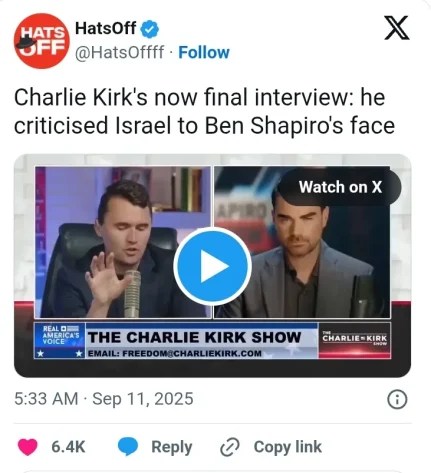
In one of his final interviews, conducted with Israel’s premier influencer in the United States, Ben Shapiro, Kirk once again tried to raise the issue of censorship of Israel critics.
“A friend said to me, interestingly: ‘Charlie, okay, we’ve pushed back against the media on COVID, on lockdowns, on Ukraine, on the border,’” Kirk told Shapiro on September 9. “Maybe we should also ask the question: is the media totally presenting the truth when it comes to Israel? Just a question!”
According to Kirk’s longtime friend, Kirk’s resentment of Netanyahu and the Israel lobby was spreading within Trump’s inner circle. In fact, they said, the president himself was terrified of Netanyahu’s wrath, and feared the consequences of defying him.
During the past year, the Trump insider was told by contacts in the White House that the Secret Service had caught Israeli government personnel placing electronic devices on its emergency response vehicles on two separate occasions.
While The Grayzone was unable to confirm the story with the Secret Service or White House, such an incident would not have been unprecedented. Indeed, according to a report in Politico citing three former senior US officials, a cellphone spying device was placed by Israeli agents “near the White House and other sensitive locations around Washington” toward the end of Trump’s first term in 2019.
Former UK Prime Minister Boris Johnson recounted a similar incident in his memoir, writing that his security team found a listening device in his bathroom soon after Netanyahu used his personal toilet.
The Israel-did-it theory
Kirk was killed this September 10 with a single shot fired by a sniper apparently positioned on a rooftop 200 meters away. He was shot while seated before a crowd of thousands at Utah State University in Orem, Utah on the first leg of his American Comeback Tour. The scene of Kirk collapsing from the impact of a gunshot to his neck just as he began answering a question about transgender mass shooters was perhaps the most shockingly vivid spectacle of assassination – and certainly the most viral – in human history.
There is currently no evidence of an Israeli government role in Kirk’s assassination. However, that has not stopped thousands of social media users from speculating that the pro-Trump operative’s shifting views on the issue contributed in some way to his death. By the time of publication, over 100,000 Twitter/X users have liked a September 11 post by libertarian influencer Ian Carroll declaring about Kirk, “He was their friend. He basically dedicated his life to them. And they murdered him in front of his family. Israel just shot themselves.”
Many advancing the unsubstantiated theory have pointed to a Twitter/X post by Harrison Smith, a personality at the pro-Trump Infowars network, stating on August 13 – almost a month before Kirk’s assassination – that he was told by “someone close to Charlie Kirk that Kirk thinks Israel will kill him if he turns against Israel.”
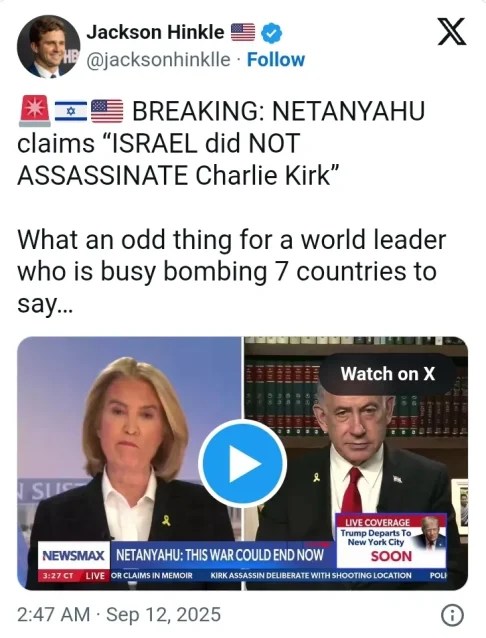
The frenzied speculation has set off shockwaves in Tel Aviv, where Netanyahu was compelled to explicitly deny that his government killed Kirk during a September 11 interview with NewsMax.
Netanyahu and his allies bury the Kirk crisis as “big tent” collapses
That appearance was just one of several interviews and statements the Prime Minister dedicated to Kirk in the wake of his killing in an effort to frame the late conservative leader’s legacy in a uniformly pro-Israel light. The major public relations push has occurred while Netanyahu wages a military campaign on seven fronts, punctuated by a regional assassination spree that most recently reached into the heart of Qatar, a US ally.
Netanyahu first tweeted prayers for Kirk at 3:02 PM in the afternoon on September 10, minutes after news of the shooting broke. He has since authored three additional posts about Kirk, even breaking away from the Israeli war cabinet to spend the afternoon of September 11 memorializing the conservative leader on Fox News.
During that interview, Netanyahu did his best to insinuate that Israel’s enemies were responsible for murdering Kirk, despite the fact no suspect was named or in custody at the time:
“The radical Islamists and their union with the ultra-progressives—they often speak about ‘human rights,’ they speak about ‘free speech’—but they use violence to try to take down their enemies,” the Prime Minister told Harris Faulkner.
In a September 10 Twitter/X post eulogizing the conservative leader, the Israeli Prime Minister described a recent phone conversation with Kirk.
“I spoke to him only two weeks ago and invited him to Israel,” Netanyahu declared. “Sadly, that visit will not take place.”

Left unmentioned was whether Kirk declined the invitation—just as he did with the Prime Minister’s offer to reload TPUSA’s coffers with donations from his coterie of wealthy American Jewish cutouts.
At the time of publication, a 22-year-old resident of Utah has been taken into custody after supposedly confessing to killing Kirk. The public may soon learn the true motives of the alleged assassin. Perhaps they will fuel the narrative which Trump and his allies advanced in the immediate wake of the shooting – that a leftist radical was responsible, and that a wave of draconian repression must follow.
But after the shooter’s initial escape and a series of federal law enforcement mishaps, a large sector of Americans will likely never believe the official story. Nor will they ever know where Kirk’s turning point on Israel would have taken the conservative movement.
Four days before the assassination, frustration among pro-Israel commentators bubbled over in public during a Fox News interview in which Ben Shapiro launched a chilling attack on Kirk without naming him.
“The problem with a ‘big tent’ is that you may end up with many clowns inside,” Shapiro told Fox host and fellow Zionist gatekeeper Mark Levin in an apparent critique of TPUSA.
“Just because you’re saying somebody votes Republican—that doesn’t mean that they ought to be the preacher at the front of the church, they’re not the person that ought to be leading the movement, if they are spending all day criticizing the President of the United States as ‘covering up a Mossad rape ring’ or ‘being a tool of the Israelis for hitting an Iranian nuclear facility.’”
When Kirk took his usual place at the “front of the church” four days later, he was cut down by a sniper’s bullet.
Within 24 hours of Kirk’s death, Shapiro announced that he would be launching his own campus speaking tour, vowing: “We’re gonna pick up that blood stained microphone where Charlie left it.”
UN overwhelmingly endorses declaration on Palestinian state
Press TV – September 12, 2025
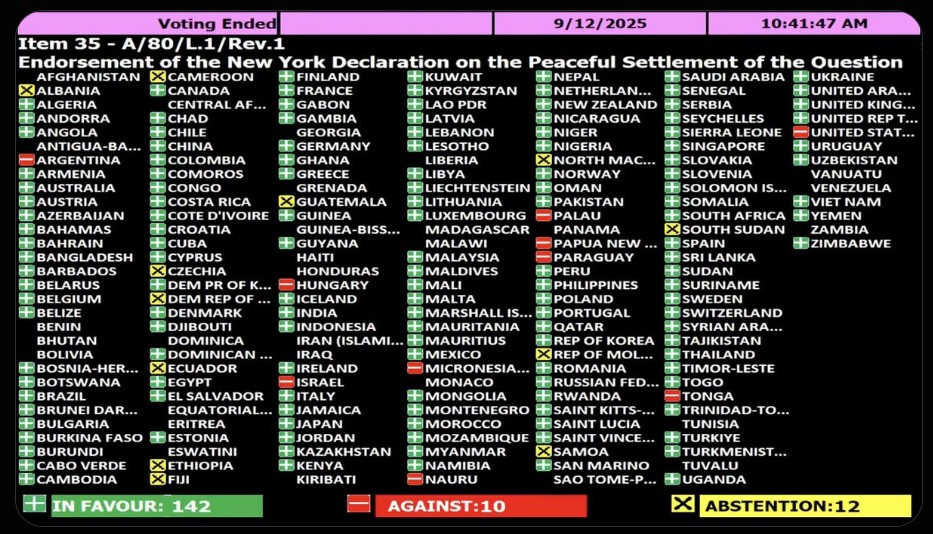
The United Nations General Assembly has overwhelmingly voted to endorse a declaration outlining “tangible, timebound, and irreversible steps” towards the establishment of a Palestinian state.
The 142-10 vote on Friday was to endorse the so-called New York declaration, a statement calling for a two-state solution, crafted by France and Saudi Arabia in July.
Joining Israel and the United States in opposing the resolution were Argentina, Hungary, Micronesia, Nauru, Palau, Papua New Guinea, Paraguay and Tonga. Twelve countries abstained.
Israel, US isolated
The seven-page declaration is the result of an international conference at the UN on the decades-long Israeli occupation. The United States and Israel boycotted the event.
The declaration, which excludes Hamas, also calls for “collective action to end the Israeli war in Gaza and effective implementation of the two-state solution.”
The declaration, was endorsed by the Arab League and co-signed in July by 17 UN member states, including several Arab countries
Long-time Western allies of Israel, including Belgium, France, the UK, Canada, and Australia, had earlier announced plans to recognize Palestinian statehood during the upcoming UN General Assembly sessions from September 8–23. They would join 147 nations that already formally recognize Palestine.
Around three-quarters of the 193 UN member states recognize the Palestinian state proclaimed in 1988 by the exiled Palestinian leadership.
Benjamin Netanyahu, Israeli prime minister, insisted on Thursday that Israel would never accept a Palestinian state.
Gideon Saar, the Israeli foreign minister, recently threatened that the Europeans’ recognition of Palestinian statehood would push Tel Aviv into “unilateral decisions”.
Israel’s far-right finance minister, Bezalel Smotrich, has announced plans to annex more than 80 percent of the occupied West Bank in a bid to block the establishment of a Palestinian state.
On August 14, Smotrich announced his intention to move forward with the highly contentious settlement project across the occupied West Bank that “buries the concept of a Palestinian state”.
In July 2024, the International Court of Justice (ICJ) declared Israel’s occupation of the Palestinian territory illegal and called for the evacuation of all settlements in the West Bank and East al-Quds. All mere words.
The recognition of a Palestinian state comes as international pressure was mounting on the regime over its genocidal war in the besieged Gaza Strip.
Since the Israeli genocide began in October 2023, the death toll has surpassed 64,700, with more than 164,000 others wounded.
Israel’s strike on Qatar exposes the collapse of Arab security assumptions
By Dr Sania Faisal El-Husseini | MEMO | September 12, 2025
The thunder of Israeli warplanes over Doha this week was more than just a military operation, it was a shattering moment for the region. Missiles aimed at residential neighbourhoods in Qatar’s capital, as an attempt to assassinate Hamas leaders, sent a shockwave across the Gulf. The United States, caught between its alliance with Israel and its defence commitments to Qatar and other Arab Gulf states, sought refuge in manoeuvering, distancing itself from the strike while tacitly enabling it. For Arab national security, particularly in the Gulf, the implications are sobering.
The paradox is glaring, Qatar, host to the vast Al-Udeid Air Base, America’s forward headquarters in the region, and dependent on US military systems for its defence, finds itself exposed. The strike underscored what many Arab analysts have long warned, Washington’s strategic loyalty lies firmly with Israel, while Arab allies are seen as expendable partners.
This attack, the first of its kind on Qatari soil, is unlikely to be the last in the region. While framed as part of Israel’s campaign against Hamas, its significance extends far beyond Gaza.
For years, Qatar has hosted indirect negotiations between Hamas and Israel, offering itself as a diplomatic broker. But Israel, it now appears, used those talks as cover, buying time while pursuing unchanged objectives, the conquest of Gaza, the dismantling of Hamas, and the displacement of its population. As Israel intensified its push into Gaza City, it simultaneously targeted the Hamas delegation in Doha, an unmistakable signal that diplomacy was never the true endgame.
The operation reflects a broader Israeli strategy, expand military dominance step by step, strike beyond borders, and erase red lines that once constrained its reach.
Qatar’s own relationship with Israel has always been a delicate balance. From the opening of an Israeli trade office in Doha in 1996, to intelligence meetings hosted in recent years, to participation in joint air exercises in Greece, the two states have maintained limited yet functional ties. Still, Israel’s decision to strike inside Qatar amounts to a message to the entire Arab Gulf, no country is immune, and restraint will only embolden further violations.
This reality stretches well beyond the Palestinian question. Israel’s ambitions are no longer confined to blocking Palestinian statehood. The Netanyahu government, driven by the most hardline coalition in Israel’s history, has laid bare its intent, redraw the regional map through force, not diplomacy. Its declared expansion goals in the region, military reach backed by nuclear superiority, unmatched intelligence networks, and unwavering US support positions it as a major security threat to the regional countries. From assassinations in Iran to operations in Lebanon, Syria, Yemen, Iraq, and now Qatar, Israel acts with impunity. The Gulf, it seems, is simply no longer far from its attacks and ambitions.
The position of the American adminstration towrds the Israeli attack on Qatar has revealed a pivotal thorny issue. Qatar’s partnership with Washington was supposed to offer military and security safeguards. The two countries signed a Defence Cooperation Agreement in 1992, renewed in 2013, and Qatar was designated a Major Non-NATO Ally in 2022. Billions have been invested in Al-Udeid, now central to US operations across the region and Central Asia. Yet when Israel violated Qatari sovereignty, the US response revealed the harsh truth, strategic guarantees for Arab states collapse the moment they clash with Israel’s interests.
For Qatar and for every Arab state relying on US military systems, the lesson is stark. Dependence on Washington offers no shield when it matters most.
Many Arab states, particularly in the Gulf, have built their national defense almost entirely on Western military and security systems. In addition to Qatar, Saudi Arabia relies heavily on U.S. made F15 fighter jets and Patriot missile defence systems, the United Arab Emirates has invested billions in advanced American and French aircraft, as well as the THAAD missile shield, Bahrain hosts the US Fifth Fleet, and Kuwait depends on American logistical and intelligence support. These examples reflect a broader regional reality, the very foundations of Arab security are tied to Western supply chains, training, and decision making structures. Yet the Israeli strike on Qatar laid bare the danger of this dependency. When the interests of Washington and Tel Aviv converge, as they so often do, the security of Arab allies becomes secondary. Israel’s declared ambitions to project power beyond Palestine, coupled with the US’s unambiguous tilt toward Israel, mean that the entire architecture of Arab national security now stands on precarious ground.
Silence now would be perilous. If Arab governments allow this strike on Doha to pass without response, Israel will take it as a green light to extend its reach even further. The moment demands more than statements of concern. It requires a collective Arab reckoning, not only with Israel’s unchecked aggression, but with the illusion that the US security umbrella offers reliable protection.
The question is simple, if uncomfortable, will Arab states finally learn from experience, or will they continue to build their security on foundations that crumble when tested?
Geopolitical Ripple Effect: How Doha Attack Undermines US Credibility in the Gulf, Empowers BRICS
Sputnik – 12.09.2025
Israel’s aggression against one of America’s key allies in the oil-rich Persian Gulf is a wake-up call for the region’s nations about the hollowness of US security guarantees. The question now is whether they’ll answer, military and regional experts tell Sputnik.
Security
The failure of US and European-made equipment to stop Israel’s assault leaves only one option open: Russia, says defense analyst Igor Korotchenko.
Russian specialists could build Qatar a system that would give the emirate “the keys” to its skies, leaving “no country able to strike with impunity without the risk of losing both the carriers and strike systems” used in the aggression.
A pivot to Russia is fully realistic, given Moscow’s sale of Pantsir-S1s to the UAE, Qatar’s maritime neighbor.
To reliably close the skies to the enemy, Qatar could complement its defenses with Pantsirs, Buk-M3s, and Tor-M2s.
Commerce & Trade
“The Gulf is already engaged with the multipolar world” on economic matters, says Dr. Tamer Qarmout of the Doha Institute for Graduate Studies.
If the political will exists, not just Qatar but the region could “diversify their alliances and engage more with multipolarity.”
The UAE is already in BRICS, and Saudi Arabia has been invited. Gulf states also enjoy strong bilateral economic links with key BRICS powers including Russia (agriculture, IT), India (labor and trade) and China (trade and strategic initiatives like BRI).
Old Chains of Bondage Could Be Hard to Break
For most of their existence, Gulf powers “have never been truly sovereign,” says veteran Mideast expert Isa Blumi. “They’ve always been dependent on the British and the Americans,” and “internal struggles and rivalries” have made them ripe for manipulation.
That means “strategically and from a security and political perspective,” Gulf powers’ “interests are still largely embedded with, or aligned with, the US as a strategic partner,” Qarmout says.
Time for Strategic Self-Reflection
Israel’s attack “introduced significant uncertainties and major questions for Gulf nations regarding the future” of economic, political and military partnerships with the US.
The “difficult and existential” question is whether Gulf nations will “intensify” links to BRICS “to include new sectors like security and defense,” given the US’s abject failure to protect its “ally” “in such a blatant manner,” Qarmout summed up.
If the United States Wants to Survive It Must Free Itself from Israel
Israeli dominance over Washington has gone on for far too long
By Philip Giraldi • Unz Review • September 11, 2025
I have university degrees in ancient, medieval and early modern history but search as I may, I cannot find another example of a small, low population state largely devoid of natural resources that has been able to dominate the politics and policies of a much larger great power to the extent that Israel controls many aspects of America’s government, its economy, its education system, its media, and, most of all, its foreign and national security policies. Little Israel commands and the superpower United States obeys, a relationship that has coined the expression “the tail wags the dog.”
To be sure, Israel has resources that might be regarded as unconventional for most nation states around the globe, consisting of a large and astonishingly wealthy network of “diaspora” co-religionists who are prepared to corrupt the governments in the countries where they actually live to benefit the Jewish state in every way possible. Politicians can easily be bought by Jewish billionaires, as in the case of President Donald Trump who reportedly received $100 million as a campaign donation from Israeli Las Vegas casino magnate Miriam Adelson, plausibly in exchange for Israel having a free hand in the West Bank, up to and including total annexation and deportation of the inhabitants to eliminate a possible Palestinian state.
In the United States, this Zionist Lobby power has produced a series of presidents terrified to object to what Israel declares to be its interests, plus a Congress that has been bought and manipulated into total submission to war criminals like Israel’s ghastly Prime Minister Benjamin Netanyahu. Even the US Constitution is no defense against Israel’s interests, with First Amendment free speech rights being abridged through the interpretation that any criticism of the self-described Jewish state is ipso facto a hate crime, which is a felony.
The abuse inherent in the relationship, which is hugely expensive to the US and damaging to its real interests, is fortunately beginning to be so visible that a reaction to the arrangement is beginning to penetrate to the level of the average voters. Opinion polls suggest that most Americans oppose what Israel is doing to the Palestinians, but President Donald Trump and the clowns he has appointed to high office, Zionists all, are unmoved. Hopefully they will see the light if a strong message is sent during elections coming up in November.
In a recent interview, I declared that the only real national security threat against the United States comes from Israel in that it has repeatedly pushed America into bad policy choices to serve its own interests. That means that policymakers, in search of the number one “American enemy” in the world, should look no farther than Israel and they should immediately take steps to distance themselves from Israeli initiatives. In terms of other alleged threats to the US, one must concede that most analyses coming out of Washington are essentially phony, designed to deflect from real problems, including which is what to do about Israel and the all-powerful Israeli Lobby reenforced by the “waiting for a Rapture” Christian Zionists that have taken over so much of the government. Sorry Marco Rubio but Russia, China, Iran, and Venezuela do not threaten the United States of America. Continuation of the dance of death with the Israelis will on the contrary be likely to lead to ruin for Americans.
The sad truth is that the United States gains absolutely nothing from its bondage to Israel, quite the contrary. When I was in government in CIA Stations and Bases in Europe and the Middle East I used to hear US politicians proclaiming how Israel (Mossad) shared wonderful intelligence information that made America safer. The truth was quite different as I used to see the Israel-generated reports and they were consistently puff pieces intended to make Arabs and Iranians look bad by inventing “threats.” It was that type of information, i.e. the claimed existence of WMD, promoted by Jewish neocons in the media as well as in the Defense Department and in the Vice President’s office, that led to war against a completely non-threatening Iraq that killed as many as 600,000 Iraqis.
More recent developments illuminate just how poisonous the relationship with Israel is, though one might also dare to mention long ago Jewish state perfidy like the attack on the USS Liberty in 1967 that killed 34 sailors and the suspicions about Israeli involvement in both the killing of JFK and 9/11, all of which were subject to deliberate US government cover-ups and bungled investigations. Israel does not hesitate to kill Americans, witness the cases of protester Rachel Corrie and journalist Shireen Abu Akleh, both of whom were murdered by the Israeli army. In neither case did the US Embassy demand an explanation from the Israelis.
This past June, Israel decided to attack Iran and convinced Donald Trump to join in the game, with the argument that Iran is secretly building nuclear weapons, which was not true. Israel, of course, has its own secret nuclear arsenal, and has even threatened to use the weapons in the Samson Option, but both Tel Aviv and Washington apparently regard that as perfectly acceptable. So the United States, to oblige Israel, followed on to the Israeli attack and hit selected targets in Iran. This led to a lying or ignorant, you can take your choice, Trump boasting about how he had “obliterated” the Iranian nuclear development sites, which was not true. So what was gained? Again “nothing” but the US went to war, a war crime, solely to appease Israel and spent something like $1 billion to carry out the mission.
More recently, Israel bombed a residential building in Doha, the capital of Qatar, in a bid to kill Hamas officials who were in the city to negotiate a cease fire in Gaza with the Israelis. The meeting was allegedly backed and “guaranteed” by Washington but it now appears that, at the same time, Trump or his associates were conniving with Israel to assassinate the Hamas representatives. The US has its largest air base in the Middle East in Qatar at Al Udeid with 10,000 American military on site. Mysteriously, the base’s radar and air defense system appear to have been turned off when the Israeli planes were approaching the target. One wonders who ordered that. And the planes needed to be refueled to return to Israel after the attack. Conveniently, British Royal Air Force tankers were in the area to carry out that task. Sounds like a set-up to end any chance of a ceasefire by killing Hamas envoys in an ostensibly safe country Qatar that was orchestrated by Israel, the US and Britain. And what does the United States of America gain from it? “Nothing!” Or rather, global hatred of Washington due to its groveling support of all things Israeli just crept up by ten points!
And then there is the Genocide in Gaza itself. If there is any remaining confusion about Trump’s true intentions, one might cite Netanyahu, who has asserted that he has complete American support to do whatever he wants in Gaza, “no partial deals with Hamas, go with full force.” It is nevertheless difficult to imagine how average Americans benefit by allowing the crime against humanity to go on and on, something that could be stopped with a phone call if Donald Trump had even a trace of compassion hidden somewhere in that empty head that he bears.
Regrettably, the United States is completely complicit in the atrocity that is taking place in Gaza which is clearly visible to the entire world. And the US is even paying for and providing the arms for the slaughter. There is a certain irony in the fact that Washington funds the war for Israel, which has both free medical care and free higher education for its Jewish citizens, something that many American citizens are reportedly struggling with. One might well describe it as a misplaced priority, but it is in reality yet another symptom of the power that Israel has over the United States government from top to bottom.
Finally, if any additional evidence were required to demonstrate Israel’s power over the United States, the recent block by Washington on visa issuance for Palestinian participation in the United Nations opening session in New York as well as the general ban on accepting passports issued by the Palestine Authority are steps demanded by Israel to make it impossible for Palestinians to argue their own case for statehood and decent treatment in international fora. And what does the US get out of it even though it in theory supports a two-state solution for Israel/Palestine? Nothing.
Such is the level of pure evil emanating from Israel that many have come to believe that it is capable of any crime, which is quite likely true. Conservative activist Charlie Kirk, who was assassinated on Wednesday, reportedly had begun to entertain some criticism of Israel which had resulted in threats that led him to employ bodyguards. As a result of that and other developments, momentum is growing to do something about Israel, which is clearly considered a threat to all the world, completely reckless in its behavior, and having “secret” nuclear weapons that it is very likely prepared to use. Suspension from the UN and the insertion of an international protection force in Gaza to stop the genocide are being discussed under the “Uniting for Peace” resolution, which empowers the General Assembly to recommend such steps to take when the Security Council is unable to act due to the expected US veto. There are also calls for Israel’s presence and privileges within the UN system to be suspended until a ceasefire in Gaza and full humanitarian access to the strip is restored. But never fear, Donald Trump will receive his orders from Benjamin Netanyahu and the US will do everything in its power as the rogue state it has become to stop any such action, including threats of sanctions and even violence against those promoting those moves, just as the US has done with the International Criminal Court and other bodies seeking an end to Israel’s war crimes. That is the unfortunate reality.
Philip M. Giraldi, Ph.D., is Executive Director of the Council for the National Interest, a 501(c)3 tax deductible educational foundation (Federal ID Number #52-1739023) that seeks a more interests-based U.S. foreign policy in the Middle East. Website is councilforthenationalinterest.org, address is P.O. Box 2157, Purcellville VA 20134 and its email is inform@cnionline.org.
Qatar: an ambiguous agent in the Zionist architecture for the Middle East
By Lucas Leiroz | Strategic Culture Foundation | September 11, 2025
The recent Israeli attacks on Qatar have brought to public debate an issue long overlooked by analysts during the current Middle East conflict: Qatar’s ambiguous role in the regional security architecture.
In the geopolitical theater of the Middle East, Qatar has played a profoundly ambiguous role—at times portrayed as a regional mediator, at others as a strategic collaborator with the Washington-Tel Aviv axis. This ambivalence is neither accidental nor merely tactical. It is rooted in the very foundations of Gulf monarchies’ foreign policy, notoriously driven by a commercial mentality that prioritizes stability, survival, and diplomatic gains over any consistent ideological alignment. However, in light of the current stage of the Israeli-Palestinian conflict, this self-interested neutrality has increasingly morphed into active complicity with the Zionist occupation regime.
Despite hosting the political leadership of Hamas in Doha, Qatar does not finance its military wing—which, in fact, is supported by Iran. The hospitality extended to the political branch of the Palestinian movement serves, in reality, as a diplomatic tool to increase Qatari influence over the resistance and steer it toward behavior less hostile to Israeli and American interests. This strategy has been employed for years under the pretense of “mediation,” but in practice, it functions as a containment mechanism for the Palestinian national movement.
For years, the Al Jazeera network, controlled by Doha, had authorized access to the Gaza Strip, even under the strict control of Israeli security forces. This privilege was not granted out of goodwill by Tel Aviv but was the result of a strategic arrangement: Al Jazeera promoted anti-Iran rhetoric within the occupied territories, reinforcing the sectarian divide between Sunnis and Shiites and distracting Palestinians from their real source of military support. In return, Israel allowed the ideological diffusion of Wahhabism in Gaza, calculating that this doctrine would weaken Palestinian nationalism and inter-Muslim solidarity, replacing them with religious divisions and fractured loyalties.
This pact began to decline as Al Jazeera became a major outlet for exposing the brutal reality of the genocide in Gaza. Once Qatar’s media presence in occupied Palestine started to generate more costs than benefits for Israel, the Zionist regime enacted a censorship law banning Al Jazeera and assassinated several of its journalists during the criminal airstrikes on Gaza.
Qatar is also home to the largest U.S. military base in the Middle East—Al Udeid Air Base. This facility not only houses American equipment and troops but also serves as an operational platform for Israeli assets in joint missions against Gaza, Hezbollah, and potentially Iran. The Israeli presence on Qatari soil is an open secret and illustrates just how much Qatar has functioned as a logistical hub for the regional security architecture coordinated by Washington and Tel Aviv.
In June, Iran launched precision strikes against this base during its brief direct war with Israel. The message was unequivocal: by allowing its territory to be used by powers hostile to the Axis of Resistance, Qatar had crossed the limits of neutrality. Doha’s response, however, was to remain in a position of complicit silence, ignoring internal protests and maintaining its alignment with Western allies.
This posture exposes the fundamental paradox of Gulf foreign policy: even with populations broadly sympathetic to the Palestinian cause, the Wahhabi bloc has repeatedly chosen to accommodate Israeli and American projects, as long as doing so ensures dynastic survival and economic stability. This reflects a deeply rooted rationality in the political culture of desert nations—one shaped by centuries of pragmatic adaptation to scarcity and existential threats. In an environment where taking sides can mean ruin, ambiguity becomes a way of life.
However, in the current context of conflict radicalization, this ambiguity is no longer perceived as strategy but as betrayal. By refusing to break with the occupying powers, Qatar risks being dragged into an escalation it helped to ignite. The Israeli bombs falling on Gaza today do so, directly or indirectly, with American logistical support originating from Qatari territory. This undeniable fact—under any serious analysis—undermines Doha’s attempt to present itself as both bridge and wall, as arbiter and accomplice.
The recent Israeli strikes on Doha have made one thing painfully clear: befriending the Zionists is a deadly mistake.
US House votes to repeal president’s Middle East war powers
Al Mayadeen | September 11, 2025
In a significant move to reclaim Congressional authority over military engagement, the US House of Representatives voted on Tuesday to repeal decades-old laws that authorized war in the Middle East.
The 261-167 vote represents a bipartisan push to rescind the 1991 and 2002 Authorizations for Use of Military Force (AUMFs), originally enacted ahead of the Gulf War and the 2003 invasion of Iraq.
The repeal was adopted as an amendment to the annual National Defense Authorization Act (NDAA) and is being hailed as a victory for war powers reform advocates, who argue that outdated authorizations enable unchecked presidential use of military force.
Long-awaited win for war powers reform advocates
The amendment was co-sponsored by Rep. Chip Roy (R-TX) and Rep. Gregory Meeks (D-NY) and garnered support from 49 Republicans and 212 Democrats. Advocates argue that keeping these authorizations in place enables future administrations to bypass Congress in deploying US military power.
“We don’t need to have Congress effectively modern-day declaring war and leaving it in place for a quarter of a freaking century, or in this case, 34 years,” said Roy.
Meeks added that he was “prepared to fight” in upcoming Senate negotiations to ensure the repeal becomes law.
Pushback from opponents
The proposal had an uncertain path to passage. Initially excluded from the package of amendments allowed for floor debate, the measure was added only after an unusual procedural win in the House Rules Committee. Republicans Ralph Norman (SC), Morgan Griffith (VA), and Chip Roy broke with their party to help Democrats force a debate on the amendment.
Not all lawmakers welcomed the repeal. Rep. Joe Wilson (R-FL) warned that revoking the war powers laws would “tie the president’s hands” in responding to regional threats, including resistance movements in Iraq.
Despite these concerns, the amendment passed with bipartisan backing, though deeper divisions remain over broader defense policies.
Wider debate over executive military power continues
While the vote represents a symbolic step toward limiting presidential war authority, critics note that the repeal will not affect recent military actions, including President Donald Trump’s alleged strike last week on a vessel in the Caribbean he claimed was for smuggling drugs.
The war powers repeal is expected to become a central issue in House-Senate negotiations over the final defense policy package. Although both chambers have voted in recent years to repeal the 2002 Iraq AUMF, no repeal legislation has yet been enacted into law.
Background on AUMFs
- 1991 AUMF: Authorized military force during the Gulf War under President George H. W. Bush;
- 2002 AUMF: Enabled the 2003 invasion of Iraq under President George W. Bush;
- 2014: Former President Barack Obama used the authorization to justify airstrikes in Iraq and Syria;
- 2020: US President Donald Trump used it in his first term to greenlight the airstrike that killed the IRGC’s Quds Force commander General Qassem Soleimani in Baghdad.
While former President Joe Biden never formally used the authorization, his administration argued it was important to keep it intact to respond to any future threats.
CODEX 9-11 – New 2025 Documentary Blows the Lid off the False Flag Attacks of 9-11
Watch at Rumble
By Etienne de la Boetie2, The Art of Liberty Foundation | September 3, 2025
There is a new 9-11 documentary entitled CODEX 9-11 by Brad Zerbo, a former skyscraper layout engineer and investigative journalist, that does a superb job of bringing new information to light. I thought I would break down some of the top revelations from the documentary:

In what many believe to be the “dry run” for 9-11, a military war game takes place on June 1-2nd, 2001 which uses remotely piloted drones to simulate an attack by Osama Bin Ladin. The war game features Unmanned Aerial Vehicles (UAVs) that are remotely piloted by a C-130 in the exercise, similar to what is believed to have happened on 9-11, where the original Boeing 767s were landed and replaced by other remotely piloted aircraft that were crashed into the WTC complex and Pentagon.

In what appears to be a “Funny Ha Ha,” by the perpetrators, the two UAVs in the exercise were numbered “9” and “11.” The “9” UAV was scheduled to be airborne at the exact same time (08:30-09:30am) as the 9-11 planes were allegedly hijacked and crashed into the WTC complex.
The Art Projects that Gave Access to the WTC Complex in the months leading up to 9-11

Gelatin team members on the 91st floor of WTC 1, standing in front of multiple boxes of what appear to be Littlefuse BB18 Fuse Holders that could have been used to wire up explosives in the building.
The documentary breaks down the incredibly suspicious nature of two different “art collectives” being given access to the WTC complex in the year prior to 9-11 where almost every aspect of their “art work” foreshadowed the attacks in another “funny Ha Ha” that will become a recurring theme of other “revelation of the method” mockery by the perpetrators of the attacks.
The first “artist collective” Gelatin/Gelitin, is also the name of a blasting agent used in controlled demolition. Gelatin/Gelitin team members were photographed in their “studio area” on the 91st floor (9-1) of WTC 1 in front of boxes of BB18 fuse holders. Their “art project” was called “The B-Thing” (Bomb Thing?) and their own drawings appear to show one of the towers collapsing. The project, coincidently, provided the excuse to rent a helicopter and survey the WTC complex prior to the event.

The 2nd “Artist Collective,” The E-TEAM (Franziska Lamprecht, Hajoe Moderegger, and Daniel Seiple), coordinated with tenants in the WTC complex to spell out the word “E-TEAM” (Explosive Team?) by using the windows between the 89th and 95th floors of WTC1 on March 29th 2001. Those floors would be, essentially, the exact same floors of the impact zone on the exact same side of the exact same building on 9-11.

While not mentioned in the documentary, in the official photo of the “art work,” the floors on WTC 2 appear blacked out in the area that would be the impact zone for that building.
In addition to the two art collectives having unusual access to the building, there was a suspicious elevator modernization going on where some of the most sophisticated elevators in the world were being modernized by a relatively unknown elevator company, ACE Elevator, which won the contract from Otis Elevator, who had installed the original elevators. Investigators theorize that these three projects, and potentially others, gave the perpetrators access to the building, including the elevator shafts, core columns and service areas within the core of the building, required to wire up the building for the controlled demotion of both towers.

A photo of Akamai CEO Dan Lewin, a “former” Israeli commando of the counter-terrorist unit: Sayeret Matkal, alleged to be the 1st person killed on 9-11 when he was stabbed by Satam al-Suqami, one of the five alleged hijackers of AA Flight 11. In this photo taken the year before, Lewin is sitting in front of what appears to represent two towers prominently wearing a Swatch watch called: The Hijacker.

Dan Lewin was sitting in seat 9B… on Flight 11… 9-11… another funny “Revelation of the Method” Ha Ha by the perpetrators.

In one of the most potent pieces of evidence that I had never heard before, Director Zerbo breaks down the complete impossibility of the numerous cell phone calls from the passengers to their loved ones. In the case of stewardess CeeCee Lyles, whose phone call to her husband was recorded by their answering machine, there is no engine or background noise to indicate that she is on an airborne aircraft.
After telling her husband to “Listen Carefully,” she relates the official story of the hijacking as if under duress.
Right before she hangs up she clearly whispers: “It’s a frame.”

“Those who can make you believe absurdities can make you commit atrocities.”
– Voltaire

I have described 9-11 to my kids as a kind of national intelligence test. You either understand the basics of logic, science, physics and history or don’t. You either believe a completely implausible story that violates the laws of physics and doesn’t make any sense, OR you don’t.
The “Official Story” DESTROYED in Less Than 5 Minutes by James Corbett
I know most of my audience understands that the government and media lied to the population about what happened on 9-11. Still, there are many young people who don’t really understand the basics. Here is an executive summary for your kids and grandkids that will bring them up to speed.
Why is it important? With an hour or two of research or watching 1-2 of our recommended documentaries below, anyone can grasp the basic understanding that we have a 100% completely organized crime “government,” including the military and intelligence agencies. This organized crime system is controlling perception through the monopolized media and algorithmic censorship of search and social media to sell the population on false flag terror that was used to steal trillions through the military-industrial complex AND our civil liberties. If you don’t understand these basics, then you aren’t really in the game.
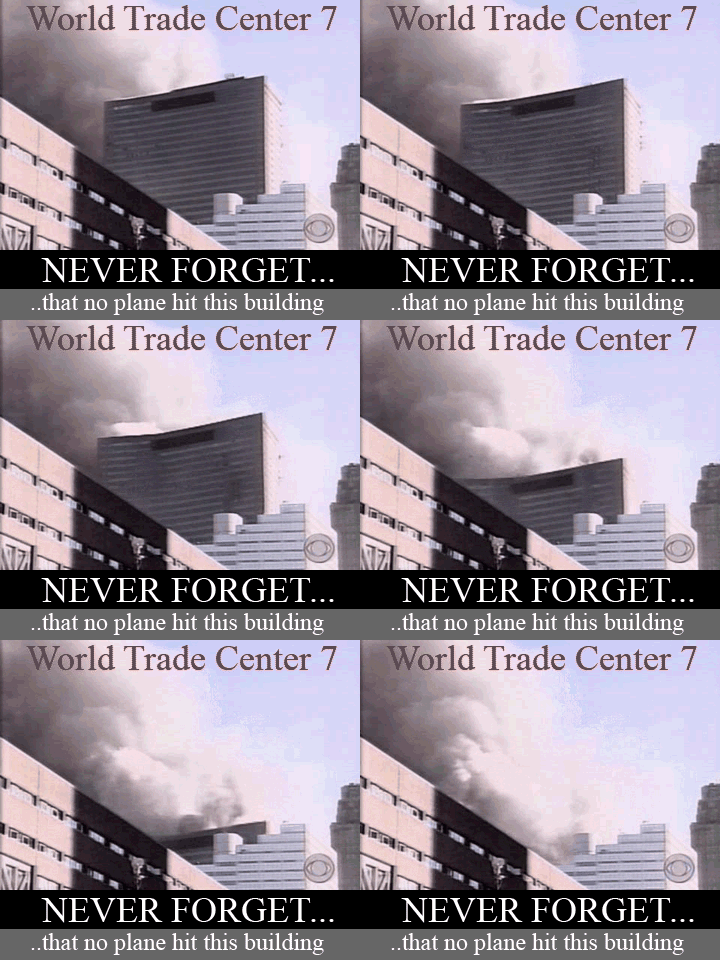
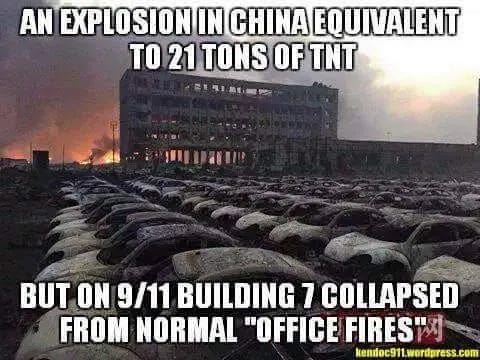

WTC7 was a modern, fireproofed steel-frame building not struck by a plane that collapsed completely and symmetrically into its own footprint at 5:20 PM. The building fell at free-fall speed, defying the laws of physics and displaying all the hallmarks of controlled demolition: Visible squibs, free-fall collapse, molten metal. At 5:00, Fox News, CNN and the BBC began reporting it had already fallen. Whistleblower Barry Jennings reported bombs. Prior knowledge was documented by workers pointing out on video that it would collapse, as well as auditory explosions and symmetrical collapse.
What Really Happened on 9-11: Both towers and WTC 7 were brought down in controlled demolition (WTC 7) & controlled demolition + Directed Energy Weapons (WTC 1&2) organized by US & Israeli intelligence agencies + Pentagon with government & monopoly media cover-up.
Used to Justify: Wars in Afghanistan and Iraq, warrantless wiretapping, suspension of posse comitatus and habeas corpus, torture, military tribunals, and stealing trillions of dollars through insurance on the buildings, pre-positioned shorting of stocks/disaster capitalism, and unneeded Military-Industrial-Complex and homeland security spending.
Best Evidence of Gov’t involvement: Obvious use of explosives in WTC7 and complete pulverization of WTC 1&2 to complete dust: free fall speeds, molten metal still molten weeks later, explosive residue in dust, dozens of war games taking place on 9-11 to pull fighter response/distract FAA, Israeli Mossad (Aka Dancing Israelis) caught “documenting the event,” symmetrical collapse.
Best Documentaries: Anatomy of a Great Deception, AE911Truth: Experts Speak Out, Solving 9-11 by Chris Bollyn, CODEX 9-11 by Brad Zerbo
Best Short Videos: 9-11: A Conspiracy Theory, 9-11 Trillions – Follow the $
Best Books: 9-11 Ten Years Later (DRG), Another 19 (Ryan), Solving 9-11-The Deception that Changed the World (Bollyn), Where Did the Towers Go? (Dr. Judy Wood)

One of the best examples of Mockingbird Media, WTC 7 collapses at 5:20. At 5:00, Fox News, CNN, and the BBC begin reporting that the building has already collapsed. In the case of the BBC, their reporter Jane Standley is doing a live shot from NYC with the building still standing visibly behind her as she explains how it was “weakened” by fire.
Best Evidence of Gov’t involvement: Obvious use of explosives in buildings: free fall speeds, molten metal still molten weeks later, explosive residue in dust, dozens of war games taking place on 9-11 to pull fighter response/distract FAA, Israeli Mossad (Aka Dancing Israelis) caught “documenting the event,” symmetrical collapse.
9-11 in Memes & Pictures
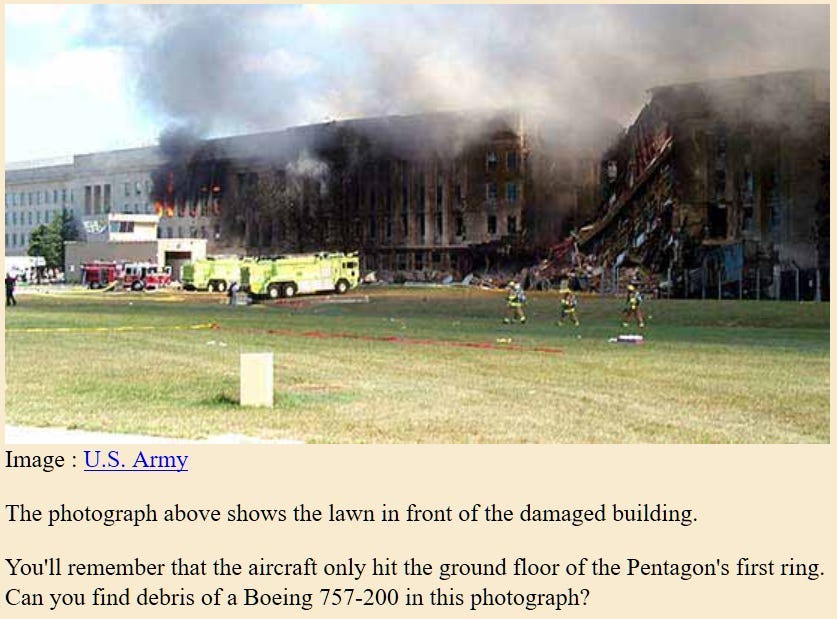


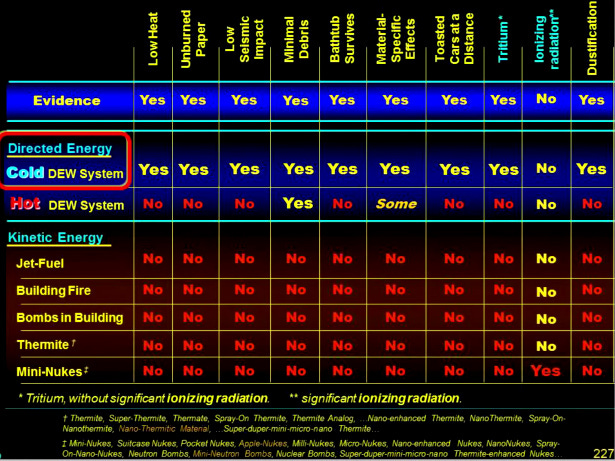
Etienne Note: WTC 7 appears to have been conventional explosives. In contrast, WTC 1&2 appear to have been thermite/thermate used in the buildings where certain floors were “re-fireproofed” with spray on thermite/thermate to initiate the collapse without visible squibs; conventional explosives were used to begin/accelerate the collapse, and a Directed Energy Weapon (DEW) used to pulverize the remainder of the buildings once they achieved the effect of making it look like a gravity collapse.
About the Author
Etienne de la Boetie2 is the founder of the Art of Liberty Foundation, the author of “Government” – The Biggest Scam in History… Exposed! and the editor of the Art of Liberty Daily News on Substack and Five Meme Friday, which delivers hard-hitting voluntaryist memes and the best of the alternative media.
He is the author of The Covid-19 Suspects and Their Ties to Eugenics and Population Control/Reduction and Solving Covid – The Covid 19, Eugenics, and Vaccine/Drug Scam Timeline
About the Art of Liberty Foundation
A start-up public policy organization: Voluntaryist crime fighters exposing inter-generational organized crime’s control of the “government,” media and academia. The foundation is the publisher of “Government” – The Biggest Scam in History… Exposed!– How Inter-Generational Organized Crime Runs the “Government,” Media and Academia.
Why Did Qatar’s Air Defenses Fail During Israel’s Attack?
By Ekaterina Blinova – Sputnik – 10.09.2025
The missiles fired by Israel could have been intercepted by Qatar’s US Patriot systems. Russian military expert Yuri Knutov weighs in: the Patriots were simply turned off by the US.
Patriots Offline
“The main feature of these systems is their close integration with airborne early warning and control aircraft (AWACS), satellites, and command centers that provide targeting data,” Knutov tells Sputnik. “In addition, they have a [remote] shutdown feature to prevent accidental friendly fire.”
This shutdown feature is problematic: Turkiye refused to purchase the Patriot specifically because the American side could disable these systems at any moment, and therefore preferred the S-400, according to the pundit.
US Didn’t Defend Qatar
Apart from using Patriots, Qatar hosts the US’ largest military base in the Middle East.
“According to the agreement between Qatar and the US, the Americans were, of course, supposed to defend Qatar’s airspace by opening fire on Israeli aircraft. However, this did not happen,” Knutov says.
The US military knew about the incoming Israeli aircraft yet took no action, effectively allowing them to operate freely against the Hamas delegation invited to Qatar for negotiations. The US was fully aware of this.
Arab countries — and not just them — should take note: wherever US Patriots are used, the US can disable them at any moment, leaving their skies completely defenseless.
US Always Sides With Israel
“This is undoubtedly a scandalous situation, given that Qatar is a close US ally and had promised to invest billions in the American economy,” Knutov says. “The Americans warned Qatar of the attack only ten minutes after it had taken place.”
Appeasing the US is futile — they always side with Israel.
Israel’s Doha Strike Burns Bridges for Peace, Marks Dangerous Strategic Overstretch – Experts
Sputnik – 10.09.2025
Israel expanded the geography of countries it has bombed on Tuesday, targeting a delegation of Hamas officials involved in peace negotiations in Qatar. Sputnik asked a pair of regional experts how the aggression will impact Israel’s position in the region in the long term.
Israeli military operations in Gaza, Lebanon, Syria and now the Gulf signal an “overstretch” that won’t be left without serious diplomatic repercussions, Ankara-based security analyst Dr. Hasan Selim Ozertem has told Sputnik.
“Looking at Europe, looking at the US, looking at the Gulf, these countries have started to articulate their concerns about Israeli aggression, which was not the case before because of the leverage of the Israeli lobby, especially in US politics,” Ozertem explained.
With Qatar serving as mediator in the Gaza war, the Doha attack “also undermines Israel’s credibility” among the Gulf powers Tel Aviv wants to forge ties with through the Abraham Accords.
Israel’s aggression may even result in the creation of new regional pacts, Ozertem says.
“The Saudi Crown Prince said [Riyadh] will be supporting Qatar. In the past, we know that Qatar and Saudi Arabia had political problems. They managed to solve them. Now we are talking about a military alliance…an anti-Israeli opinion or bloc in the region among local actors… increasing the probability of potential confrontation between Israel and others.”
Burning Bridges
“By attacking Doha as peace negotiations for ending the Gaza genocide were in progress, Netanyahu once again demonstrated his disdain for negotiations and his preference for brute force as the ultimate solution,” says Mehran Kamrava, a professor of government at Georgetown University in Qatar.
Netanyahu’s strategy of “managed chaos” threatens to spiral out of control, and further isolate Israel “by making it a rogue, pariah state,” Kamrava said.
Besides Israel’s reputation, the attack promises to “cost the US much of its already diminished credibility in the Arab world,” the scholar says, emphasizing that unconditional US support for Israel is proving “extremely costly” as the Israeli government takes actions that make it seem increasingly “unhinged” and “devoid of all rationality.”
Lion Electric School Buses Still Catching Fire
StacheD Training | September 9, 2025
On September 9, 2025, another Lion Electric school bus burst into flames in Montreal — this time with five children and their driver on board. Thankfully, everyone escaped safely, but this marks the third Lion Electric bus fire in less than a year (Ascot Corner, Huntsville, and now Montreal).
In this video, I break down what happened, why the fire department’s explanation doesn’t quite line up with the bus’s construction, and why these repeated incidents raise serious questions about safety, accountability, and taxpayer funding. Lion has already taken nearly $160 million in U.S. funding for 435 buses, yet many districts never received vehicles — and the ones that did are stuck with broken, unsafe buses and voided warranties.
Are these buses ready for prime time, or is this a dangerous rush to electrify at any cost?
Training & Consulting: https://www.stachedtraining.com
Featured Video

Weaponized Journalism: 2021 Sayer Ji Interview with NPR
or go to
Aletho News Archives – Video-Images
From the Archives
How Rothschild Banking Clan Uses Its Vast Wealth to Influence World Events and Control Governments
By Ilya Tsukanov – Sputnik – 15.09.2024
How powerful is the Rothschild banking family? How did they amass their fortune? Just how rich are they? Do they secretly control the world? Sputnik explores. … continue
Blog Roll
 Aletho News
- London tourism expo promotes Israeli agency linked to theft of Palestinian land
- Dockworkers launch global strike against Israeli and US military shipments
- Europe facing gas price shock – Gazprom chief
- Ukraine continues recruiting people with disabilities
- Weaponized Journalism: 2021 Sayer Ji Interview with NPR
- Beyond Netanyahu: what Israel’s election means for Palestinians
- Lithuania plans universal conscription
- Lies, Damn Lies, and Ukraine News
- Financial Times rejects Nordic demands to correct Putin call story – media
- The Case for Less Unity in Europe
- If Americans Knew
- An error has occurred; the feed is probably down. Try again later.
- No Tricks Zone
- Germany’s Green Energy Transition Becoming Increasingly Expensive…Another 6 Trillion Euros!
- Sudden Stratospheric Warming, Powerful El Niño Combination May Lead To Extreme Europe Cold, Energy Crisis!
- Two New Studies Find Thwaites Glacier Melt Cannot Be Driven By Human Activity Or A Warming Ocean
- E-Cars Reduce CO2 Emissions By Only 41% Compared To Internal Combustion Engine Vehicles
- Predictions Made By Renowned Climate Professor Over Past Decades Have Been Proven To Be Poor
- New Study Suggests Large Regions Of The Pacific Ocean Have Been Cooling For The Last 80 Years
- Germany’s Green Energy Debacle: High Energy Costs Force Kahla Porzellan to Close After 182 Years!
- New Study: 50 Years Of The Most Aggressive ‘Net Zero’ Policies Can Only Affect The Global Climate By 0.03°C
- US September “Heat” Was No Record…Many Records Set Decades Ago
- Latest European Green Energy Debacle; Portugal’s Largest Flagship Solar Park Insolvent!


