Israel rules out withdrawal from occupied Lebanon, wants ‘freedom of action’
Press TV – July 29, 2026
Israel has declared it will not agree to any “additional withdrawals” from Lebanon in the next round of negotiations with the Beirut government, while insisting on retaining “freedom of action” in areas transferred to the Lebanese Armed Forces.
Israel’s Channel 12 reported on Wednesday that Israeli officials conveyed the position to mediators involved in the Beirut-Tel Aviv talks ahead of the next round of negotiations, scheduled to take place in Rome on August 4.
There will be no withdrawal from the “security zone” Israel has established in south Lebanon, which includes dozens of occupied villages, the report said.
“The additional areas will not be on our side, in the defense lines that we have stabilized,” an Israeli official told the channel, claiming, “If the current pilot is successful and additional pilot areas are decided upon later, they will be beyond the Yellow Line. We will not allow further withdrawals of the area on our side. Until Hezbollah is disarmed in Lebanon – that is what was agreed upon.”
According to the report, the Israeli regime will instead insist on retaining “freedom of action” to re-enter areas recently handed over to the Lebanese Armed Forces.
The report came hours after heavy Israeli artillery shelling targeted Ali al-Taher Hill in southern Lebanon, where Israel’s Channel 12 reported that an Israeli D9 bulldozer was seen burning after it was “hit by an explosive Hezbollah drone.”
On June 26, Lebanon and Israel signed a controversial US-mediated framework agreement outlining a phased withdrawal of Israeli forces from all occupied Lebanese territories, beginning with a pilot model in two undisclosed zones.
The agreement sets no timetable for the withdrawal, making its completion contingent on the Lebanese Armed Forces assuming full security responsibility in evacuated areas and the disarmament of resistance groups, specifically Hezbollah.
Hezbollah rejected the agreement, saying the framework effectively legalizes the Israeli occupation of southern Lebanon.
Lebanon’s Amal Movement also rejected the deal, arguing that most of its provisions undermine Lebanon’s national interests while serving those of the Israeli regime.
During a meeting with US President Donald Trump at the White House earlier this month, Lebanese President Joseph Aoun reiterated Beirut’s demand for the complete withdrawal of Israeli occupation forces from Lebanese territory, saying the ceasefire agreement cannot be fully implemented as long as Israeli violations continue.
According to official Lebanese figures, Israeli aggression has killed at least 4,330 people, wounded 12,236 others, and displaced more than one million people across Lebanon since March 2.
Israel continues to occupy areas in southern Lebanon, including territories it has held for years as well as others it seized during the 2023-24 onslaught.
Iraq cancels PM’s Riyadh visit after US-Saudi aggression amid calls for response
Press TV – July 29, 2026
Iraq has postponed Prime Minister Ali al-Zaidi’s planned visit to Saudi Arabia after the joint US-Saudi attack on Popular Mobilization Units (PMU) positions across several Iraqi provinces, as officials and lawmakers called for a military response.
The strikes came as millions of Muslims from Iraq, Iran, Pakistan, Azerbaijan and other countries around the world were converging on the Iraqi city of Karbala to mark Arbaeen, one of the largest religious gatherings in the world.
Some observers have viewed the timing of the attacks as a show of anger toward the gathering, which has been marked by expressions of solidarity with the Axis of Resistance and condemnation of US-Israeli wars and expansionist policies.
According to Iraqi media, al-Zaidi’s trip to Saudi Arabia was postponed indefinitely after the attack. The prime minister also ordered the country’s National Security Council to convene an emergency meeting following the security developments and the airstrikes on several areas across Iraq.
Former Iraqi Prime Minister Mohammed Shia’ al-Sudani said, “We condemn the Saudi-American aggression against the headquarters of the Popular Mobilization Forces in the strongest terms.”
“This aggression is a blatant violation of Iraq’s sovereignty and a clear violation of international law and the United Nations Charter,” Sudani said.
“Iraq reserves all of its legitimate rights guaranteed under international law, including the right to defend its sovereignty, territory and people.”
He added that “any violation of Iraq’s security and stability is unacceptable and cannot be met with silence.”
According to a statement carried by Iraq’s official news agency, the PMU said the casualty toll from the attacks remains preliminary and could rise as special committees continue field assessments and gather more accurate information.
The organization denounced the strikes as a “joint US-Saudi terrorist attack” targeting its official headquarters in the provinces of Baghdad, Wasit, Nineveh, Basra, Kirkuk, Karbala and Diyala.
The assaults caused extensive material damage to PMU headquarters, military vehicles, machinery and equipment in the targeted locations, the statement said.
The Iraqi resistance movement added that its investigative teams remain deployed to assess the full extent of the casualties and destruction, noting that the number of those killed and wounded may increase as rescue and assessment operations continue.
Earlier, the PMU announced that several of its bases in different parts of Iraq had come under attack, describing the strikes as “terrorist” and reporting casualties among its personnel.
The PMU said it viewed the attacks as “a highly dangerous escalation, a blatant violation of Iraq’s territorial integrity, and an attack on the country’s official security institutions.”
The attacks prompted growing calls from Iraqi lawmakers for a decisive response.
Two Iraqi lawmakers called on the government to respond decisively, with one urging military retaliation and another demanding the cancellation of al-Zaidi’s visit to Saudi Arabia.
Saud al-Saadi, a member of the Iraqi Parliament and the Huqooq Movement, called on the commander-in-chief of the armed forces to assume his responsibility and issue an order for a military response to the Saudi-American aggression.
“Show [Saudi Crown Prince] Mohammed bin Salman and the other slaves their true worth and size,” he said, according to Iraqi media.
“The blood of Iraqis is not cheap, and the dark record of Washington and Riyadh in our beloved country will not be erased without a response that preserves Iraq’s dignity. It is not acceptable to settle for disgraceful and humiliating statements,” he added.
Another Iraqi lawmaker, Faleh al-Khazali, described the strikes as “terrorist attacks” carried out by “the Saudi and American enemy,” saying they targeted Iraqi security positions in several provinces.
“The attacks on our security positions constitute blatant aggression and a violation of Iraq’s sovereignty,” al-Khazali said, adding that “the Iraqi government and its prime minister bear the responsibility to courageously defend the Iraqi people and the country’s national interests.”
Iraqi lawmaker Hussein Nima al-Battat also condemned the attacks as a “blatant violation of Iraq’s sovereignty and of international laws and norms,” warning that they constituted a dangerous escalation threatening the country’s security and stability.
Al-Battat urged the government to take all necessary military, political, diplomatic and legal measures to defend Iraq’s sovereignty and protect its people, while also calling for the cancellation of the prime minister’s scheduled visit to Riyadh as a demonstration of Iraq’s rejection of the attacks.
The Iraqi resistance had warned Saudi Arabia earlier against waging such strikes against Iraqi territory following Riyadh’s claims that its oil facilities were targeted from Iraq.
In a statement released on Monday, the resistance rejected the Saudi allegations as “baseless” and urged Saudi authorities to stop blaming Iraq and instead end Riyadh’s blockade on Yemen.
Political analyst Jumaa al-Atwani told Lebanon’s Al Mayadeen television that the joint US-Saudi attack was aimed at weakening the PMU and retaliating against Iraq over its solidarity with Iran.
“The American pressure on Iraq has intensified because of Iraq’s position in solidarity with Iran, especially after the massive funeral procession for the martyred leader of the Ummah,” he said.
Atwani said the millions who participated recently in the ceremonies in Karbala and Najaf for funeral of martyred Leader of the Islamic Revolution Ayatollah Seyyed Ali Khamenei reflected Iraq’s role within the Axis of Resistance.
Al-Atwani said Saudi Arabia maintains close coordination with the United States and described the PMU as “a major problem for Washington.”
He also suggested that regional plans involving Saudi Arabia and Syria have been discussed to justify attacks on Iraqi military positions.
US conjoins the wars in Eurasia, West Asia
By M. K. BHADRAKUMAR | Indian Punchline | July 29, 2026
On Friday, even as the US President Donald Trump was announcing the end of the latest round of the conflict with Iran, the Pentagon unobtrusively extended the war theatre to the Caspian Sea in a hugely consequential geopolitical thrust. The incident hardly figured in the western news cycle.
But CGTN, perhaps sensing that the US could be stealthily spreading its war to the Caspian region, reported on July 25, “US missiles struck a Revolutionary Guards Navy headquarters in the Ziba Kenar area of the Caspian Sea province of Gilan, according to a security official in Gilan quoted by Iranian media. Provincial authorities said US projectiles had also struck the port city of Bandar Anzali, according to the Iranian Labor News Agency.”
Gilan province has a Caspian coastline that borders Azerbaijan in the west, with which Iran has had a troubled relationship in the recent years following the Transcaucasian region’s geopolitical gravitation towards the western orbit. Unsurprisingly, Russia’s ties with Azerbaijan and Armenia also have suffered a severe erosion following the ascendance of US (and NATO) influence in Transcaucasia.
Trump is the new sheriff in town in Baku and Yerevan with Turkey’s president Recep Erdogan playing the role of undersheriff. To add to the complexity, Azerbaijan is a close ally of Turkey, and Turkey’s ties with Moscow are somewhat under the weather in the most recent years following the covert takeover in Syria by al-Qaeda affiliates backed by Ankara.
On the other hand, Turkey has never been a reliable friend for Iran, either, historically. During the war with Iran last year, Turkey opened its air space to the US aircraft to attack Iran from Azerbaijan, which also happens to be one of Israel’s key operational bases against Iran.
Taking advantage of the Ukraine conflict, western intelligence and NATO have made big inroads into the Caucasus and Caspian regions bordering Russia’s Muslim republics and are challenging Iran’s security when it already faces an existential threat from the US-Israeli alliance.
The western media played down the US air strike on Bandar Anzali last week, which is Iran’s biggest port on the Caspian coast and is a vital transportation hub linked to Iran’s national railway grid. The Caspian Sea makes a strategically vital supply route between Russia and Iran. Bandar Anzali is for Tehran what Odessa Port is for Kyiv where it receives western arms supplies. Indeed, Iran and Russia have a close military relationship.
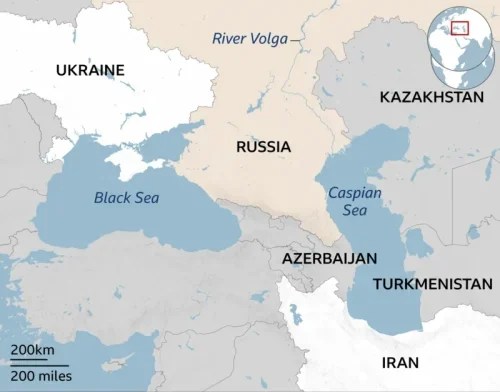
Therefore, Ukraine’s attack on an Iranian commercial vessel in the Caspian Sea in Russia’s territorial waters on Saturday, the first such attack since the start of the Russia-Ukraine war, is anything but a stray incident. Kyiv claimed responsibility for striking an Iranian vessel, signalling that one of Eurasia’s most stable security zones is now vulnerable to the direct spillover of the Ukraine conflict.
The Kremlin took note and spokesman Dmitry Peskov remarked at his daily briefing on Tuesday that the “geography of the Kiev regime’s terrorist activities is expanding.” Citing the incident, he added cryptically that all this “again highlights the need for a successful and complete special military operation.”
The attack on the Iranian ship was carried out from a distance of approximately 1,200 kilometres. Moscow has repeatedly alleged that such precise targeting over very long distances is way beyond Ukraine’s military capability and is only possible with the West’s direct participation. Foreign Minister Sergey Lavrov touched on it again on July 24: “A significant portion of the support provided to Vladimir Zelensky (from the West) comes from the United States. This is not only because the Americans sell weapons to the EU, which then transfers them to Ukraine, but also because the United States provides intelligence and reconnaissance, Starlink remains operational, and advanced technologies that require specialist expertise on the battlefield do not find their way there by accident. That is the way things are.”
Interestingly, the New York Times report on the Ukrainian attack appeared under the headline Ukraine’s Strike on an Iranian ship Could Bring Two Wars Closer. The Wall Street Journal headline runs as follows: Two Wars Converge in the Caspian Sea as Ukraine Hits Iranian Supply Line to Russia. Al Jazeera gave a further twist saying Ukraine’s Zelenskyy set to meet Trump as Iran and Ukraine wars converge. A BBC report acknowledged that “The incident marked the first direct link between the wars in Iran and Ukraine.” It added, however, “But some experts question the wisdom of Kyiv’s decision to pick a fight with Iran.”
The impact of the Iran conflict initially seemed negative for Ukraine. It threatened to divert Trump’s already wavering attention. However, there has been not only no let-up in US support for Ukraine but in certain ways, the US involvement has only intensified by escalating the covert operations in Russian territory. Admittedly, these tactical advantages may not add up eventually, as Moscow is also stepping up attacks all across the frontline in Ukraine with a view to end the war soon.
The reported likely reassignment of General Sergey Surovikin, who at one time was commander of Moscow’s war effort in Ukraine, would signal a massive offensive going forward. The highly decorated general had previously served in Chechnya and Syria during conflicts that had overtones of proxy wars similar to Ukraine.
The Ukrainian attack on the Iranian ship could well be a calibrated move by Washington. Ukraine acted simultaneously with the US bombing of Gilan province, suggesting a degree of coordination. The Iranian ambassador to Russia disclosed that the ship was hardly 5 miles from the mouth of River Volga when the attack took place.
If the Moscow-led regional concord on the Caspian’s collective security is weakened, extra-regional military and security rivalries could vitiate the region impacting Russia and Iran’s core interests. Tehran views the Caspian Sea incident not as an isolated tactical event but as evidence of a broader shift in its surrounding security environment.
Last August, US-Azerbaijan-Armenia tripartite agreement was signed in the White House that will create a major transit corridor in Transcaucasia to be named the Trump Route for International Peace and Prosperity. Plainly put, the US and NATO are seriously contesting Russia’s pre-eminence in the Caspian / Central Asian regions.
Evidently, the Caspian Sea is no longer the conflict-free zone it was once believed to be. A new arena of geopolitical competition, fundamentally reshaping the security landscape of Eurasia and potentially marking the emergence of a new geographic theatre of conflict, has surfaced last weekend.
The Second Circuit Again Violated the Rights of the Amish
By Aaron Siri | Injecting Freedom | July 28, 2026
At the end of last year, the United States Supreme Court vacated the Second Circuit’s decision that enabled New York State to persecute the Amish for refusing to inject pharma products in violation of their religious beliefs, and it remanded the case (Miller v. McDonald) to the Second Circuit to reconsider its illiberal and unconscionable decision.
Instead of abiding by the Constitution and protecting the religious freedom of the Amish, the Second Circuit again ruled against the Amish. So, we will be going back to the Supreme Court.
And yes, the 168 unvaccinated Amish children related to this case are far healthier than American children who are vaccinated. We provided sworn expert evidence attesting that among a random sample of 168 U.S. children, one would expect to find (based on the background rate of chronic disease among U.S. children) 31 cases of environmental allergies, 15 cases of ADHD, 10 cases of asthma, 9 cases of food allergies, and 4 cases of ASD. Yet, the 168 unvaccinated Amish children whose families New York wants to persecute are free from the chronic health conditions—all related to some form of immune system dysregulation—that plague the vaccinated communities in New York.
Since vaccination is supposedly about improving health, and the Amish who do not vaccinate are clearly healthier, one would expect New York to leave them alone. But that is not how this religion works. The vaccine zealots in New York cannot stand that the Amish refuse to abandon their beliefs in favor of the religious beliefs held by the New York officials regarding vaccines. These “health” officials are willing to sacrifice the way of life and belief system of these Amish children and their community (which have kept them far healthier), if they refuse to bend the knee to adopt cult-like vaccine beliefs.
These “health” officials also apparently cannot stand that the Amish children are healthier and are even willing to wage war against them until they submit and receive every vaccine New York demands—so they can be just as “healthy” as all the children outside the Amish community.
The Amish earnestly seek to avoid conflict but because violating their sincerely held religious beliefs is not an option, they have been placed in an impossible position. We, along with co-counsel, intend to continue to litigate on behalf of the Amish to defend their freedom to practice their religion in peace.
Netanyahu will reject US demands for withdrawal from Lebanon, Gaza, Syria if asked: Report
The Cradle | July 28, 2026
Israeli Prime Minister Benjamin Netanyahu has told cabinet ministers that Washington wants Israeli soldiers to pull back from positions in Syria, Lebanon, and Gaza, and that he does not intend to comply with US demands, Channel 13 reported on 27 July.
The report, which cites unnamed security sources familiar with the matter, states that US officials want the Israeli army to carry out a “series of withdrawals” across the three fronts.
Channel 13 does not state whether Washington is seeking full or partial pullbacks; however, Netanyahu told the ministers that he “intends to stand on my own two feet and resist.”
“I will strongly oppose this and tell them no,” he reportedly said.
The comments come as Netanyahu has set off for Washington for a meeting set for Tuesday with US President Donald Trump, after which he is scheduled to attend the funeral services for Republican Senator Lindsey Graham, one of Washington’s most persistent warmongers and an unwavering backer of Israel, who died on 11 July.
Israeli forces are currently occupying major stretches of land in Lebanon, Syria, and Gaza.
Israel maintains positions in border and hilltop areas in southern Syria, especially near the Golan frontier, where the military has established footholds inside Syrian territory, and regularly conducts raids against locals.
What began as a pretext to aid Druze communities battling Damascus’s extremist troops and Syrian government-backed Bedouin tribes after the ousting of former Syrian president Bashar al-Assad has become a so-called “buffer zone.” Israel has since used it to launch incursions into Lebanon.
In Lebanon, Israel maintains its so-called “Yellow Line” in the south that runs from the Mediterranean coast in the west to the Mount Hermon area in the east, extending around 10 kilometers inland and, in some parts, passing the Litani River.
Israel’s occupation of Lebanon has been marked by repeated ceasefire violations, including near-daily strikes, demolitions, and incursions. Beirut cited more than 2,000 violations in late 2025 alone, while hundreds of thousands of Lebanese remain displaced.
Many dozens of Lebanese villages within the Yellow Line have been completely demolished, with the intent of ethnically cleansing the area and creating a dead zone to which residents cannot return.
According to comments from February by Israeli Minister of War Israel Katz, Israeli troops will be staying in Lebanon and Syria “indefinitely.”
In Gaza, following almost three years of genocide and near-daily ceasefire violations since last October, Israel continued to slowly edge its Yellow Line in the strip further under the cover of night.
The most recent reporting says the controlled area has expanded to about 65 percent of Gaza and that the line has been shifted westward in places by hundreds of meters and, in some areas, by more than a kilometer.
Netanyahu has publicly said he wants to expand Israeli control over the strip further up to 70 percent.
Satellite imagery released on 21 July and reviewed by AP and Haaretz shows that the Israeli military has dug a 23-kilometer earthen trench along its new positions, cutting the devastated enclave in two.
In one stretch of southern Gaza, the trench sits more than a kilometer past the Yellow Line.
US use of Italian military bases in the conflict with Iran shows lack of autonomy
Press TV – July 28, 2026
The debate over US forces using Italian military bases in the ongoing US-Israeli aggression against Iran has rekindled in Italy.
Earlier this week, three opposition lawmakers, Francesco Silvestri, Alessandra Maiorino, and Arnaldo Lomuti, formally demanded the government provide clarification regarding the departure towards West Asia of 12 F-16 fighter jets, at least 2 US tankers, and a number of Triton drones, used for maritime intelligence and surveillance, from Italian bases.
The three members of the lower house questioned Italy’s support of the Epstein coalition under bilateral treaties with the US.
Press TV spoke with Arnaldo Lomuti on the matter.
The government must explain on what basis Italy is allowing the US to use our bases in this war of aggression against Iran.
Weeks ago, we were told that the use of our bases falls under the bilateral treaties that were forced upon us by Washington more than 70 years ago.
… These treaties are classified; so how can Parliament start a serious debate on the role played by Italy in this war of aggression?
About a month ago, NATO Secretary General Mark Rutte revealed during a TV interview that Rome had allowed more than 500 US military aircraft to take off from American bases in Italy during the 40-day war on Iran that began in late February,
Rutte’s revelations triggered a political storm in Italy.
Italy has sought, at least in words, to distance itself from the illegal US-Israel war against Iran over the past weeks. However, many criticize Italy’s technical and logistical support for the US.
When the government says that it’s not involved in the war, well, the government is very wrong.
Without the support of the tankers departing from our base in Sicily, the US jet fighters would not be able to strike. The same applies to the drones departing from our bases.
The truth is that not even our ministers know what the Americans do with the bases on Italian territory.
Orazio Foti, Former US Sigonella Military Base Employee
Surveys have consistently shown over the past months that a considerable majority of Italians think their country should avoid getting involved in the war on Iran.
Italy is up to its neck in the war.
Together with Europe, we simply cannot escape the fact that the political, economic, and military ties with the US and Israel do not allow practically any EU country to act autonomously.
The risk is that without an act of bravery, we will all be dragged into this war, even though we have nothing to do with it.
Maria Elena Delia, Global Sumud Flotilla
Is the Department of War Covering Up the True Extent of US Casualties?
By Larry C. Johnson | SONAR21 | July 28, 2026
Last Wednesday all the signs were pointing to a desperate action by the Trump administration to launch a ground operation inside Iran ostensibly to seize enriched nuclear material from an Iranian nuclear research facility. The report from the Wall Street Journal noted that US special ops forces were once again being deployed to the region to carry out a raid on a Hardened Deeply Buried Target (aka HDBT). But it also revealed something both disturbing and alarming: the deployment of 150 medics:
The U.S. is surging forces, medics and weaponry to the Middle East to give President Trump more muscular military options as he considers expanding the conflict against Iran, according to people familiar with the matter.
In the past week, special-operations forces have deployed to the region from their U.S. bases, according to flight-tracking data and U.S. officials. Squadrons of jet fighters have been staged across the Middle East, and bomber aircraft at bases in the U.S. and U.K. are on high alert to ramp up operations, according to one of the officials.
Additionally, more than 150 medics have arrived at the Landstuhl Regional Medical Center in Germany in recent days, another official said. The hospital is the primary location for treating troops injured in combat in the Middle East.
Twenty years ago I participated in the scripting and execution of a Special Ops exercise that simulated the targeting of an underground nuclear target in the Middle East. The actual location of the field exercise was in the desert of Nevada, northeast of Las Vegas. At the conclusion of that exercise there was a Hot Wash, i.e., a review of lessons learned from that exercise. What was the primary lesson learned? Don’t do it. Too dangerous because the mission would likely to result in significant casualties and expose the soldiers to unhealthy levels of radiation.
Based on the WSJ report it appears that Trump was on the verge of ordering a real-world version of that exercise. However, this report surfaced on the 23rd of July. Two days later, Trump apparently rescinded the order for the ground op and halted the bombings of the Iranian coast in the Persian Gulf and the Sea of Oman.
So far, so good. What most people glossed over was the report that 150 US combat medics were deployed to Landstuhl Regional Medical Center in Germany. This was not an ordinary deployment, nor was it in anticipation of possible casualties from an impending military operation… These men and women were deployed to reinforce a badly stretched medical staff at Landstuhl that were trying to cope with dozens of badly wounded US military personnel that had survived the missile strikes on Muwafaq al-Salti airbase in Jordan and two army bases in Kuwait.
Based on the number of C-17 medical flights reported in open source that departed Jordan following the 17 July missile attack on Muwafaq al-Salti airbase and flew to Ramstein airbase in Germany, which is the entry port for the Landstuhl Medical Center, US casualties numbered over 100, perhaps higher. The large number of wounded may have been another factor contributing to President Trump’s decision to halt the bombing one week later.
While there are no direct talks between the US and Iran, Pakistan, along with Qatar, are working intensively as intermediaries in trying to resurrect the MoU. If the MoU is resuscitated it will be because the US met Iran’s demands that Israeli forces withdraw from Lebanon and that the US unfreeze Iranian assets up front, not at some point in the future. I am sure that Bibi Netanyahu will try to persuade Trump to reignite the war and pursue a more intensive bombing campaign as well as some kind of ground operation on Iranian territory.
For now, the bombs and missiles are not falling. I am skeptical that this current hiatus will hold… I sincerely hope that I am wrong. Once Senator Graham is buried on Wednesday, we may see Trump reverse course once again and renew the bombing campaign. Iran, for its part, is holding firm to its demands that the MoU be fully implemented, otherwise Iran is prepared to continue fighting and inflicting more damage on US assets and personnel.
I discussed Trump’s latest TACO move with Judge Napolitano.
Massie says the US has been ‘significantly weakened’ by war on Iran
Al Mayadeen | July 27, 2026
United States Representative Thomas Massie said the United States has been “significantly weakened by the war with Iran,” arguing in an X post that the campaign depleted missile-defense systems, drained oil reserves, sacrificed US troops, pushed up consumer prices, increased debt, and sidelined domestic needs “all for Israel.”
The Kentucky Republican’s remarks added fresh political pressure to an already widening debate in Washington over the price of the war on Iran, the scope of US involvement, and the degree to which the White House has tied American military power to “Israel’s” regional agenda. That debate has sharpened as more lawmakers question the administration’s war powers and the long-term cost of the campaign.
CENTCOM urged a pause near the Strait of Hormuz
Massie’s remarks came as Axios reported that Admiral Brad Cooper, the top US military commander in West Asia and head of CENTCOM, advised the Trump administration to halt bombing around the Strait of Hormuz after concluding the two-week assault had reached diminishing returns. Axios said Cooper briefed the Pentagon, the Joint Chiefs of Staff, and the White House earlier in the week, and that his assessment helped shape Trump’s decision to pause strikes along Iran’s southern coastline and around the strategic waterway.
The report said Cooper warned that most of the assigned targets had already been struck, leaving few objectives whose destruction would materially change the battlefield. In other words, the campaign had begun to run out of useful military targets unless Trump was prepared to escalate the war further.
Air-defense stocks under strain
Meanwhile, General Dan Caine, chairman of the Joint Chiefs of Staff, warned Trump and War Secretary Pete Hegseth that shortages of air-defense interceptors could reduce Washington’s ability to shield its bases and regional allies if the confrontation escalated again. The warning echoed broader concerns inside the Pentagon about the strain that the war on Iran has placed on US missile-defense inventories.
The New York Times said senior advisers including Caine and Vice President JD Vance raised similar concerns about the shrinking stockpile of Patriot interceptors and other air-defence systems needed to protect US forces across the region. That assessment reportedly played a major role in Trump’s decision to hold back from a larger escalation.
US Can’t Come to Saudi Arabia’s Rescue in Bab el-Mandeb Without Risking Overstretch – Expert
By Ekaterina Blinova – Sputnik – 27.07.2026
Tensions in the Gulf are spilling over into the Bab el-Mandeb Strait, putting additional pressure on Saudi Arabia, but the US is unlikely to open a second front, Ankara-based security analyst Dr. Hasan Selim Ozertem tells Sputnik.
“Strategically, it would force Washington to choose between protecting energy chokepoints and maintaining deterrence against Iran, a choice that no administration would want to make before elections,” Ozertem says.
- Tackling the challenges posed by the Strait of Hormuz and the Bab el-Mandeb Strait “in a synchronized manner” is a difficult task even for the US Navy
- US interceptor stockpiles have already shrunk and emerged as one of the reasons the US has held back from a new wave of strikes on Iran
- The US is likely to seek de-escalation in the region ahead of the November 2026 midterm elections
“A two-front response would require not only a massive expenditure of interceptors, but also a redeployment of carrier strike groups, intelligence assets, and logistical support, which would inevitably leave other regions like the Pacific or Europe more thinly covered,” Ozertem sums up.
The Ansar Allah movement, also known as the Houthis, announced on July 20 that it was imposing a naval blockade on Saudi Arabia in response to the kingdom’s control of Yemen’s airspace and ports. The group later warned that the scale of its operations could increase if the Saudi government continued its blockade of the Yemeni people. The blockade applies to Saudi shipping in the Red Sea, the Bab el-Mandeb Strait, and the Gulf of Aden.
How Kuwait and Bahrain miscalculated by becoming launchpads for US strikes on Iran
By Mohammad Molaei | Press TV | July 27, 2026
On the afternoon of February 28, as the first dark clouds of joint Israeli-American military aggression gathered over Iran, a sports hall in the small southern city of Lamerd – a place that had once echoed with the squeak of sneakers and the thrill of competition – was transformed into a scene of unspeakable carnage.
Two American Increment One Precision Strike Missiles (PrSMs), fitted with fragmentation warheads, tore through the facility while a women’s volleyball team was actively training inside. The gruesome and deliberate attack claimed many civilian lives, including dozens of children, and left scores more wounded and maimed.
In a grim parallel to the earlier attack on the Shajareh Tayyebeh Elementary School in Minab, the US war machine initially refused to acknowledge its culpability in both incidents, due to massive global outcry, particularly in Minab.
Instead, American officials went so far as to formally and cynically attribute the tragedy IN BOTH to an alleged malfunction of an Iranian Hoveyzeh cruise missile, a brazen attempt to absolve themselves of yet another unforgivable war crime.
The official American position attributed the civilian deaths in Lamerd to an Iranian Hoveyzeh cruise missile – a KH-55 derivative that bears no resemblance whatsoever to an American PrSM, differing fundamentally in shape, flight trajectory, and terminal dive profile.
This assertion proved deeply peculiar, particularly after Iranian media published CCTV footage showing impact patterns unmistakably consistent with PrSM fragmentation warheads, alongside visuals clearly depicting a ballistic projectile descending in a manner entirely characteristic of the American weapon system.
Identifying the probable staging ground for this attack and others like it proved to be a matter of straightforward deduction. The United States employs the tracked M270 Multiple Launch Rocket System (MLRS) and the wheeled M142 High Mobility Artillery Rocket System (HIMARS) to deploy two distinct families of short-range tactical ballistic missiles: the newer PrSM and the older MGM-140 Army Tactical Missile System (ATACMS), with maximum ranges of 500 and 300 kilometers, respectively.
Given these systems’ limited reach and the considerable operational threat posed by Iran-allied resistance groups throughout Iraq, it became increasingly evident that the Arab monarchies of the Persian Gulf had consented to allow American forces to utilize their territory as launch pads for aggression against Iran and its civilian population.
Liability for the strikes
In the weeks following the initial wave of US-Israeli military aggression against Iran, a substantial body of open-source evidence accumulated, enabling one to reconstruct the operational architecture behind the attacks with reasonable confidence.
Satellite imagery reviewed by independent researchers, munitions debris documented by Iranian media and corroborated by third-party analysts, and flight-path data derived from publicly accessible tracking sources collectively point to forward launch positions in Kuwait and Bahrain as the points of origin for a series of ballistic missile strikes against Iranian territory.
The ATACMS and the longer-range PrSM are neither cruise missiles nor air-launched munitions. They are ground-launched ballistic systems that demand substantial fixed or semi-fixed infrastructure, pre-positioned logistics, and complete host-nation cooperation – or at minimum, tacit acquiescence.
In practical terms, this arrangement extends far beyond granting overflight rights to American aircraft. The deployment of American artillery regiments fielding short-range ballistic missiles on Kuwaiti and Bahraini soil is not incidental but structural. Such weaponry would have served no purpose other than to strike at Iranian territory.
Diplomatically, Tehran delivered an explicit and time-bound demand to both Manama and Kuwait City: cease facilitating the war of aggression, expel the American military forces and their assets, or face the consequences.
The initial response from Bahrain and Kuwait was, in a word, silence – punctuated by formulaic statements affirming their alliance commitments while declining to confirm or deny the operational details that open-source evidence had already established.
It was not a neutral posture but represented a conscious and controversial choice to take sides in an active war, which carries inevitable consequences.
Lamerd sports hall attack
The denial and what came after
Both Kuwait and Bahrain moved quickly to deny the reports. Official statements from Kuwait City and Manama dismissed the open-source evidence as fabricated or misattributed, with Kuwaiti officials characterizing the satellite imagery and debris documentation as part of an Iranian information operation.
Bahraini authorities declined to comment on specific operational details, citing security considerations. The denials were categorical yet they did not survive the end of active hostilities.
In the weeks following the cessation of the initial combat phase, a more complete evidentiary picture emerged, placing Kuwait at the epicenter of the ballistic missile campaign against Iran.
CENTCOM released declassified strike footage confirming ground-launched ballistic operations, footage that independent analysts cross-referenced with geographic markers consistent with Kuwaiti territory.
The release, framed by US officials as a demonstration of operational effectiveness, had the unintended secondary effect of directly contradicting the categorical denials issued by Kuwait. More damaging still was the subsequent discovery of expended ATACMS canisters in the Kuwaiti desert, physical evidence that no official statement could plausibly explain away. The canisters confirmed not only the presence of the launch systems but also the scale and intensity of their operational use.
Kuwait’s role as the operational hub
With the resumption of active combat operations in recent weeks, following American attempts to establish an illegal maritime corridor in the Omani section of the Strait of Hormuz in brazen violation of the memorandum of understanding signed between the two sides, Kuwait’s role has intensified considerably.
The frequency of ballistic missile launches from Kuwaiti territory has increased markedly, a pattern fully consistent with Western reporting indicating that US PrSM stocks have been effectively depleted.
With PrSM availability now severely constrained, the operational burden of American ballistic missile attacks has shifted entirely back to the older ATACMS platform, and Kuwait has emerged as the primary launch hub for that capability.
The geographic logic is self-evident. Kuwait’s proximity to western Iran, and particularly to the southern province of Khuzestan, renders it the most efficient forward position for strikes targeting the military, economic, and energy infrastructure concentrated in that region.
Khuzestan is home to a substantial share of Iran’s oil production, refining capacity, and petrochemical industry, and has consequently emerged as a principal focal point of American military aggression. The volume of launches emanating from Kuwait reflects that strategic prioritization with unmistakable clarity.
The Incriminating Lights
The Arab monarchies of the Persian Gulf have made every possible effort to suppress citizen documentation of military activity, imposing social media restrictions and punitive measures to limit the spread of footage that might complicate official denials.
Yet those efforts have proven increasingly ineffective. As the war has persisted, a steady and growing stream of video and photographic evidence has emerged from Kuwait, captured by residents documenting ballistic missile launches occurring with near-nightly regularity.
The imagery, showing missile contrails ascending over Kuwait and tracking northeast across or alongside Iraqi airspace before continuing toward Iranian territory, circulates widely across platforms such as Telegram.
Multiple photographs and video footage taken from different vantage points confirm the flight paths, the frequency, and the unmistakable signature of ground-launched ballistic systems operating from Kuwaiti soil with undeniable clarity.
The nightly launches have become, in a grim sense, a matter of public record, documented by ordinary Kuwaiti and Iraqi residents whose smartphones have captured what governments continue to officially deny.
The chasm between the official position and the visible reality has widened to a point where it functions less as a credible denial and more as a formal fiction, maintained by all parties for reasons of diplomatic convenience.
The Iranian counter-strike record
Iran has not absorbed this campaign passively. In the weeks following the intensification of launches from Kuwaiti territory, Iranian forces have conducted retaliatory strikes targeting the American military’s forward launch infrastructure.
A growing evidentiary record of these strikes, assembled from open-source footage, presents an intriguing visual signature involving what appear to be large secondary explosions following initial impact, characterized by the bright, fast-burning combustion profile associated with solid-propellant missile fuel.
The secondary detonations visible in circulating clips are inconsistent with conventional munitions storage and consistent with the ignition of solid rocket propellant – of the type utilized in ATACMS – either from fueled launcher vehicles or from stockpiled rounds awaiting deployment.
Several clips show fires burning after initial impact, with the characteristic white-orange flame column that propellant combustion produces distinguishing these events unmistakably from the black smoke of fuel or ordnance fires.
Survival and the limits of alignment
Small states make difficult choices under duress, caught precariously between a powerful patron’s operational requirements and a large neighbor’s legitimate security concerns.
Experts acknowledge that the constraints on Bahraini and Kuwaiti sovereignty, stemming from their profound dependence on the United States, are genuine and substantial.
But, they insist that acknowledgment of constraint is not the same as absolution from responsibility. Governments bear an obligation to their populations that supersedes alliance loyalties, an obligation to assess, without illusion, the risks that their choices are generating.
The current posture of the Persian Gulf states hosting American military bases and providing a launch pad for ballistic missile operations against Iran is deeply problematic.
It reflects, as per analysts, a perilous combination of structural dependency, institutional inertia, and a dangerous underestimation of Iranian anger, resolve, and military capability.
As one military expert told the Press TV website, these micro-states are not positioned to absorb the consequences of a sustained Iranian retaliatory campaign.
“Their small land masses, concentrated infrastructure, and limited strategic depth render them acutely vulnerable in ways that their larger patron is not. By gambling their national survival on the assumption that Iranian red lines are empty, and that US protection is everlasting, they are making a remarkably poor bet, one that history has rarely rewarded,” he noted.
Seyed M. Marandi: Saudi Oil Is Burning & Trump Has No Way Out
Glenn Diesen | July 26, 2026
Prof. Seyed Mohammad Marandi is a former advisor to Iran’s nuclear negotiation team. Prof. Marandi discusses Saudi Arabia’s miscalculation in terms of attacking Yemen. Trump has trapped himself in the Iran War, and his options keep getting worse.
Buy merchandise: https://diesen-shop.fourthwall.com/en-nok
Glenn Diesen clip channel: https://www.youtube.com/@Prof.GlennDiesenClips
Follow Prof. Glenn Diesen:
- Substack: https://glenndiesen.substack.com/
- X/Twitter: https://x.com/Glenn_Diesen
- Patreon: https://www.patreon.com/glenndiesen
Support the research by Prof. Glenn Diesen:
- PayPal: https://www.paypal.com/paypalme/glenndiesen
- Buy me a Coffee: buymeacoffee.com/gdieseng
- Go Fund Me: https://gofund.me/09ea012f
Yet Another Embarrassment From The National Academy Of Pseudoscience
By Francis Menton | Manhattan Contrarian | July 23, 2026
In my own professional life, I was not a scientist, and therefore I never much paid attention to the kinds of rewards and honors that practicing scientists pass out to each other. But at some point I became aware that there was something called the National Academy of Sciences, and that among scientists it was considered a big deal to get selected to become a member. This membership is one of those things that you cannot apply for; rather, one day you get “tapped” by some committee of super-elite gurus who invite you to come learn the secret handshake. Here’s what Wikipedia has to say about membership:
Membership of the National Academy of Sciences is an award granted to scientists that the National Academy of Sciences (NAS) of the United States judges to have made “distinguished and continuing achievements in original research”. Membership is a mark of excellence in science and one of the highest honors that a scientist can receive.
(At some point in the 2010s, the NAS got somehow consolidated with comparable “academies” of engineering and medicine, to become a combined organization going by the name of the National Academies of Science, Engineering and Medicine, or NASEM. This post only concerns the Science part of the combined entity, although I have no reason to think that the other parts are any better.)
There are only around 2000+ members of the NAS, out of a universe of some 2 million + people who do some kind of scientifically-related research. So only about one in a thousand gets in. Needless to say, these people must be really, really smart.
Well, as far as I can tell, they are all morons. Also, corrupt morons.
I last wrote about the NAS in February of this year, in a post titled “Would You Trust The National Academies Of Science To Tell You How Science Works?” The occasion for that post was that something called the Federal Judicial Center had just issued a new edition of its Federal Reference Manual on Scientific Evidence. Recognizing that this subject went outside the core of its own expertise, the FJC had called on the NAS to take the main role in the drafting. In the new edition, a chapter from prior editions of the Manual titled “How Science Works” had been taken over by new authors, and substantially re-written and greatly expanded (from 18 to 61 pages). In the process, the new authors had inserted a series of howlers that not only did not fairly describe how science works, but actually got the whole process wrong by 180 degrees. I cited several examples in the February post, but this is the one that goes closest to the heart of the craziness: “While the often-stated maxim that correlation does not imply causation is true, in fact, correlation is the only means that we have of establishing causation in science.” That statement is just flatly wrong. Instead, the process for establishing causation in science operates through the falsification of alternative (“null”) hypotheses of causation. I do not know how anyone could even think to call themselves a “scientist” without basic understanding of that logical process.
And yet here was the NAS, supposedly a collection of the most elite among elite scientists, putting together a chapter of an official court Manual to tell non-scientists (lawyers and judges) “how science works,” and getting it 180 degrees wrong on the single most important point.
Which of course begs for a necessary consideration of the next question: Was this an innocent mistake by ignorant people, or was it an intentional distortion intended to further a political agenda?
Now, just last week, the National Academies have released their latest embarrassment, taking this fundamental fallacy and expanding and running with it. The event at issue was the release of a new Report called “Attribution of Extreme Weather Events and Their Impacts.” Here is the July 15 press release from NASEM, and here is another link to the body of the Report itself. The Report runs to some 175 pages, plus appendices.
The gist of the Report is that now, based on some sort of new research, we suddenly have the tools to “attribute” any extreme weather event of our choosing (hurricane, tornado, drought, flood, whatever) to “human activities.” “Human activities” in this context means the release of “greenhouse gases” into the atmosphere. With that, you can see where they are ultimately going, although this final piece is not mentioned in the Report: the basic idea is that every extreme weather event is the fault of the oil companies.
The very first line of the “Summary”reveals that they knew the conclusion before they started:
“Earth system changes driven by rising greenhouse gas concentrations from human activities are affecting characteristics of extreme weather and climate events, such as frequency and intensity.”
That’s nice. An how exactly do you know it? Here are the two fundamental questions that need to be addressed: (1) What are the alternative hypotheses that you have considered, and how have those been ruled out as the causes of the recent extreme weather events? And (2) what has been your consideration of the evidence, if any, that might contradict or undermine the hypothesis that “human activities” and increased greenhouse gas concentrations are the cause of these extreme weather events?
Get ready: In a Report of 175 pages, they don’t expend even one word to address either of those two questions.
Instead, it’s all about whatever confirming evidence they can find about correlation between extreme weather events and (slightly) increasing global temperatures. They claim to have a “foundational understanding” of the relationship between increasing greenhouse gases and extreme weather events. How they have achieved this “foundational understanding” without ever entertaining any alternative hypothesis is never mentioned. But the “foundational understanding” has supposedly been “strengthened” by the accumulation of evidence consistent with it (while deliberately ignoring all inconsistent evidence). Here is a lengthy quote from the Summary as to how the “foundational understanding” has been strengthened:
Over the past decade, advances in three key scientific pillars have continued to strengthen this foundation. First, physical understanding has matured through accumulation of observational and modeling evidence supporting long-standing theoretical expectations, so that increases in extreme heat and heavy rainfall events across much of the globe can be more confidently and precisely attributed to increasing greenhouse gas concentrations in the atmosphere. Second, the length and quality of observational data have improved in some regions with another decade of data collection . . . , new satellite-based Earth-observing missions, and the development and improvement of homogenized, high-resolution data sets. Third, climate models continue to improve in their representation of critical processes. . . .
Consideration of alternative hypotheses or potentially conflicting evidence? Hey, we don’t do that, we’re scientists!
Readers of this blog and of many skeptic websites know well that the real evidence out there is that extreme weather events are not increasing at all. How dozens of these supposedly top “scientists” from the NAS could write this Report without mentioning or discussing any of this evidence is beyond me. It’s completely humiliating for them.
I won’t try in this post to give any comprehensive set of links here to data sets showing that extreme weather events are not increasing. But, as an example, here is a page at Watts Up With That with data on hurricanes. From that page, here is a chart compiled by Ryan Maue with annual data since the early 1970s on accumulated cyclonic energy:
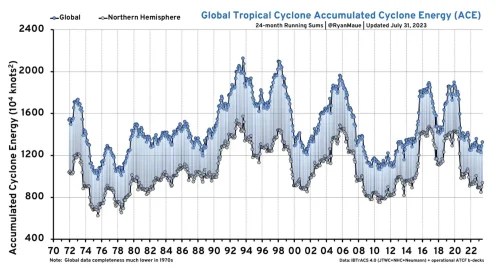
Can you spot the increasing trend? Neither can I. These clowns from the NAS are claiming that even though ACE has not gone up overall, and has gone down in the most recent years, they just know that whatever hurricane comes through next is the fault of Exxon. That’s the level of quality of this work.
On July 14, the day before this Report was released, a guy named Pat Parenteau, gave an interview to Politico’s E&E News on this subject. Parenteau is a long-time advisor to a law firm called Sher Edling, which is known for representing dozens of plaintiffs in lawsuits against fossil fuel producers claiming harm from climate change. The E&E News article is behind paywall, but Energy in Depth here has the key quote from Parenteau:
“A report with the kind of gravitas that the National Academies can bring will be a huge boost to the plantiffs’ cases.”
Further from EID:
The people involved in the report’s development include Michael Burger, an academic and attorney for climate plaintiffs’ firm Sher Edling, as well Delta Merner, who leads the Union of Concerned Scientists’ Climate Accountability Campaign and served on the NAS committee guiding the report’s development until January 2025. Both Burger and Merner have publicly discussed the critical relationship between attribution science and climate litigation.
The federal government needs to completely defund the NAS today, if not sooner. Also, I call on every member of the NAS to resign. If you stay in, you are complicit in this total scam.
Featured Video

Seyed M. Marandi: US-Iran War Inevitable: Kuwait and Bahrain May Fall
or go to
Aletho News Archives – Video-Images
From the Archives
Oil and the Israel Lobby
Reknowned economist M. Shahid Alam offers this excellent critique of Noam Chomsky’s defective analysis of the relative influence of Oil versus the Israel lobby over US foreign policy: … continue
Blog Roll
 Aletho News
- ICC ignored ‘very well-documented’ NATO crimes – ex-Libyan minister
- SNSC secretary dismisses US response to Iran’s conditions as ‘inadequate’
- Sanaa says Taiz roads open, secure for residents, warns Saudi forces
- Iraqi resistance group urges Saudi leadership to admit defeat, lift Yemen siege
- Trump’s Retreat: How Al-Aqsa Flood Took Down the US Empire
- Israel’s Military Actions in Lebanon Grossly Violate International Law — Lavrov
- Seyed M. Marandi: US-Iran War Inevitable: Kuwait and Bahrain May Fall
- Leaders Condemn Ansarallah Attack on Saudi Arabia While Ignoring Illegal War Against Yemen
- Leaked: Britain’s Covert Iraqi Psyops Network
- Yemeni Armed Forces Warn Airlines Against Using Saudi Airports, Exempt Mecca and Medina
- If Americans Knew
- After Oct 7, IDF policy allowed civilian casualties for even the lowest-ranking targets
- Israel’s Destruction of Southern Lebanon Intensified After the Cease-Fire
- The Last-Minute Decision That Gave Israel Its Name
- The American Conservative: How Trump Made the World Go Nuclear
- Meet the US generals and admirals advancing Israeli policy
- Opinion: Why news organizations should boycott Israel
- The Israeli witch hunt of Sami Abu Shehadeh exposes the lie of the ‘Jewish and democratic’ state
- No state has a ‘right’ to exist – least of all Israel
- Testimonies about Gaza’s civilian death toll expose Israel’s atrocities – Daily Update
- How Israel Conquered the Latin American Right
- No Tricks Zone
- Germany’s Green Energy Debacle: High Energy Costs Force Kahla Porzellan to Close After 182 Years!
- New Study: 50 Years Of The Most Aggressive ‘Net Zero’ Policies Can Only Affect The Global Climate By 0.03°C
- US September “Heat” Was No Record…Many Records Set Decades Ago
- Latest European Green Energy Debacle; Portugal’s Largest Flagship Solar Park Insolvent!
- Green Energy Debacle: German Expert Professor Fritz Vahrenholt Warns Of Severe Economic And Social Consequences
- Two More Paleo Reconstructions Affirm Meters-Higher Sea Levels Across Ireland, Brazil 7000-6000 Years Ago
- New Study: Earth And Venus Surface Warmth Largely Explained By Convection And Lapse Rate, Not CO2 Or Radiation
- 2025 Nature Paper Claiming Worsening Global Drought Gets RETRACTED …Heavily Flawed
- New Study: ‘Global Drought Shows No Detectable Recent Acceleration Under Climate Warming’
- Economic Masterminds: German Socialists Suggest Taxing Productivity Gains Stemming From Using AI

