Maui officials slammed over wildfire response
RT | August 17, 2023
Hawaiian authorities delayed the release of water to Maui residents trying to save their properties from last week’s devastating wildfires, local media revealed on Tuesday, citing four insider sources.
The Maui Department of Land and Natural Resources reportedly stalled as West Maui Land Co., which manages agricultural and residential developments on the western part of the island, requested additional water to stop the fast-moving blaze that would ultimately level the tourist town of Lahaina last Tuesday.
The agency’s deputy director for water management, M. Kaleo Manuel, allegedly wanted the company to get permission from a farm located downstream from its property. By the time Manuel finally released the water, it was too late and the fire had spread.
Maui’s Emergency Management Agency was also criticized for its response to the inferno. Agency director Herman Andaya defended the decision not to activate the island’s warning sirens, a signal network designed to work even without electricity, arguing the network was meant to be used to warn of tsunamis – not wildfires. Using it to alert residents to last week’s devastating blaze would have “sen[t] the wrong message to the public,” he said on Wednesday.
However, the island’s own website describes the sirens as an “all-hazard” system, with fires one of several natural and human-caused events the system – “the largest single integrated outdoor siren warning system for public safety in the world” – was designed for.
The decision to warn residents via cell phone alert instead likely proved fatal for many, as the electricity had been out for hours when the fires ignited and cellular reception was down in most of the area. As a result, many residents only realized they were in danger when they smelled smoke, and with roads blocked by downed power lines some had no escape route but to jump into the ocean.
The wildfire was the deadliest to strike the US in over a century, leaving at least 106 people dead with over 1,300 still missing as of Wednesday. The cause remains unknown, though some have pointed to Hawaiian Electric, whose power lines were seen sparking in the powerful winds that engulfed the island that day. The company has been criticized in the aftermath of the fire for focusing on “green energy” window-dressing to the exclusion of wildfire mitigation.
Hawaii Governor Josh Green announced on Monday that a “comprehensive review” into decisions made before and during the fire response would be conducted by the state attorney general.
Bill Kristol leads charge to make Republicans think ‘right’ on Ukraine
His $2 million campaign wants to ensure that there is only one way to support the people there — and it’s not focusing on diplomacy.
By Kelley Beaucar Vlahos | Responsible Statecraft | August 17, 2023
Notorious neoconservative Bill Kristol has just launched a $2 million campaign to prevent more Republicans from jumping off the forever war train and to remind them that true Republicans support Ukrainians by backing unfettered aid and weapons for the conflict.
That is the clarion call promoted in this Washington Post story announcing “Republicans for Ukraine,” which is designed to provide “counter-programming” to the “populist” strain that has captured the base, particularly on foreign policy. It is the latest advocacy effort by Kristol’s group, Defending Democracy Together, which has been trying desperately to maintain the hawks’ grip on the GOP since Donald Trump began questioning it during his 2016 presidential campaign.
“Supporting Ukraine is in the best interests of the United States and the best traditions of the Republican Party. Now is no time to give up the fight,” declares the Republicans for Ukraine website.
In previous years (and before the Ukraine war) DDT also pushed campaigns like “Republicans Against Putin” and “Standing with Allies” (which advocated maintaining a U.S. presence in Syria and Iraq). It has leaned in hard on the Never Trump camp, particularly with the super PAC “Republican Voters Against Trump,” which raised over $10 million in the 2020 election cycle, spending $5.6 million in support of Democrat Joe Biden, and $3.3 million against Trump, according to Open Secrets.
Critics say it has been a long time since Kristol was considered a part of the Republican or conservative movement. Aside from his opposition to Trump, it’s obvious that the populist shift in the base against the Washington war policies of the last 20 years has also driven his estrangement.
Conservatives were quick to point out on Tuesday that Kristol doesn’t speak for them or for voters who have soured on the Washington’s foreign policy playbook, particularly on Ukraine. That Kristol’s campaign, through its cultivated Republican testimonials, is unabashedly deploying the Manichean language not only of the Cold War and the Global War on Terror, but also the Domino Theory and the Messianic talk he and his friends favored in 2002, makes the gambit even more out of touch.
“Since when is it ‘conservative’ to spend the taxpayers’ money with no accountability, no strategy, no timeline, and no end game? This ad buy is a waste of money, because conservative voters know the truth: we’ve spent too much money on Ukraine at a time when we can ill afford it. But I’m also not surprised… considering how well-financed the neocon war machine in D.C. has been,” blasted Kevin Roberts, president of the Heritage Foundation, in a comment to RS.
“Conservatives have moved on from such internationalist nonsense, as evident from the combined total tally of the top three primary frontrunners,” argued Sumantra Maitra, a senior editor at the American Conservative, pointing to comments urging restraint on Ukraine by Trump (who is 40 points ahead, on average, of his GOP rivals, despite his legal troubles), Ron DeSantis, and Vivek Ramaswamy. All three, particularly Trump and Ramaswamy, have called for negotiations and a swift end to the war in Ukraine.
“This (Republicans for Ukraine) initiative ignores the vital need to pair American military support with American diplomacy,” says George Beebe, QI’s Director of Grand Strategy. “Aid without diplomacy is simply a formula for yet another forever war — or worse, an escalation into direct war with Russia.”
But to Republicans for Ukraine, that is not the American, or even moral way of talking about the war.
“We’d like to put pressure on Republicans to do the right thing on Ukraine,” said Sara Longwell, executive director of DDT.
That may be a tough slog. Recent polling shows that a strong majority of Republicans are unhappy with Biden’s Ukraine policy and wary of sending more aid to Ukraine. This has driven down overall support for the war, at least in various surveys. Sure, this doesn’t jibe with traditional party positions on Capitol Hill and among the GOP elite in Washington, which continue to see Russia as an existential threat to U.S. interests, and a military buildup of NATO and Ukraine as the best way to challenge it. This is obviously manifested in calls for bigger Pentagon budgets and even advocating for Ukraine membership in NATO.
But the party cracks may be more evident as Biden and congressional leaders attempt to push billions in more aid through a general emergency spending bill this fall.
Here’s where Kristol’s patented “you’re either with us or against us,” “for aid, or against aid,” “democracy vs. autocracy” dichotomies start to fall apart. While some members are calling for a total cut-off, others just want to see future assistance tied to a clear strategy and/or tougher oversight measures.
“When you see Marco Rubio asking why Florida disaster relief must be paired with (Ukraine aid), you know it’s not 2012 anymore,” said Jim Antle, politics editor at the Washington Examiner, pointing to recent comments by the Florida senator, usually one of the biggest foreign policy hawks on the Hill. Rubio said that Biden “owes the American people” a real Ukraine strategy, “something he’s refused to do since Putin invaded Ukraine.”
“We’ve seen incredible bravery by the Ukrainians over the last 18 months,” Rubio continued, “but we’ve also seen U.S. stockpiles dwindle, European countries slow walk critical supplies, and China grow more aggressive towards the U.S. and our national interests. We cannot give a blank check to continue the status quo.”
Conservatives Reid Smith (Stand Together) and Tyler Koteskey (Concerned Veterans of America) published this comprehensive “Blueprint for Rigorous Oversight of Ukraine aid,” in War on the Rocks this week. They acknowledged that there will likely be future aid, but “Congress should pursue a series of measures to ensure better Ukraine aid oversight and a more robust strategic dialogue about how U.S. involvement in the war impacts American interests.”
The new “Republicans for Ukraine” appear to see things through a more black-and-white prism: the only “right” way to support Ukraine is by doing “whatever it takes” unconditionally. Whoever thinks differently is wrong — they may not even be a real conservative or a patriotic American. (A similar frame and the pressures to conform to it also exist among Democrats on the left). These are the same tactics deployed by Kristol’s cadre to chill debate during the two decades of failed U.S. policies in Afghanistan and the Middle East. It is not clear they will work again.
Will Ruger, president of the American Institute for Economic Research and Trump’s nominee for Ambassador to Afghanistan, said DDT’s consternation with the direction of the Republican base on Ukraine “is actually another great sign that those of us who have been fighting neoconservatism for decades are having an impact.” But the fact that the group can easily marshal $2 million in an effort to stop it means this brand of political activism still wields influence.
“(It) shows that people who want to turn American foreign policy back to the dark days of the Bush administration have a lot of resources to try to sway Republicans,” Ruger tells RS.
“The question, though, is whether the Republican base will listen given their increased skepticism towards an idealistic approach to the world that doesn’t seem to put our national interests first.”
CIA Warned Blinken Ukraine ‘Counteroffensive’ Bound to Fail: Seymour Hersh
By Ilya Tsukanov – Sputnik – 17.08.2023
The veteran Pulitzer Prize-winning investigative journalist, who broke the story earlier this year on Washington’s role in last September’s terror attacks against the Nord Stream gas pipeline network, has now pointed to evidence of disillusionment within the Biden administration as the NATO proxy war against Russia in Ukraine grinds to a halt.
The CIA notified US Secretary of State Antony Blinken that the Ukraine counteroffensive would be unlikely to inflict a defeat on Moscow, US veteran investigative journalist Seymour Hersh reported on Thursday, citing a US intelligence official.
“The word was getting to him [Blinken] through the Agency [CIA] that the Ukrainian offens[ive] was not going to work. It was a show by Zelensky and there were some in the administration who believed his bull****,” the anonymous official was quoted as saying.
Blinken, the official claimed, has come to the realization that Washington and its Ukrainian proxies “will not win the war” against Russia, but did not “want to go down as the court jester” of the administration in relation to the Ukraine crisis.
“Blinken wanted to broker a peace deal between Russia and Ukraine as [former Secretary of State Henry] Kissinger did in Paris to end the Vietnam War,” according to the official. Instead, the secretary realized that “it was going to be a big lose,” and “found himself way over the skis.”
Ukraine launched a major counteroffensive in early June against heavily entrenched Russian positions in Donbass, Kherson, and Zaporozhye. The counteroffensive failed to make any substantive gains, and cost tens of thousands of Ukrainian lives, and hundreds of NATO-provided armored vehicles, with Ukraine’s forces unable to reach even the first major Russian defensive lines in two-and-a-half months’ time.
‘Jake Sullivan’s Baby’
The intelligence official cited by Hersh also offered new details on the Biden administration’s motivations for holding the Jeddah Peace Summit earlier this month – with the gathering flopping after Russia was curiously left off the list of invitees, but apparently planned well in advance as a victory summit.
“Jeddah was [Biden National Security Advisor Jake] Sullivan’s baby,” the official said, with Sullivan planning it to be “Biden’s equivalent” of Woodrow Wilson’s Versailles Treaty moment at the end of World War I.
“The grand alliance of the free world meeting in a victory celebration after the humiliating defeat of the hated foe to determine the shape of nations for the next generation. Fame and Glory. Promotion and re-election. The jewel in the crown was to be Zelensky’s achievement of Putin’s unconditional surrender after the lightning spring offensive. They were even planning a Nuremberg-type trial at the world court, with Jake as our representative. Just one more f***-up, but who is counting? Forty nations showed up, all but six looking for free food after the Odessa shutdown,” the official said.
Jockeying for Position
Hersh’s source also indicated that CIA Director William Burns had apparently recently “made his move to join the sinking ship” of stoking the crisis in relations with Moscow over Ukraine after signing on to the administration’s position on continued NATO expansion – which along with Kiev’s eight-year-long war against Donbass was one of the causes of the present conflict.
“Burns does not lack self-confidence and ambition,” the anonymous intelligence official said, indicating that running the CIA under Biden has effectively been a demotion compared to his previous job as deputy secretary of state under Barack Obama.
Notwithstanding growing internal concerns about the continued viability of the proxy war in Ukraine, Hersh believes that the administration will continue to promote a wishful thinking approach to the crisis to the American people, even as “the end” nears and “the assessments supplied by Biden to the public are out of a comic strip.”
‘A Fauci Clone’: New NIAID Director Oversaw Remdesivir Trials, Has Ties to Biosafety Lab Research

By Michael Nevradakis, Ph.D. | The Defender | August 15, 2023
When he retired in December 2022, Dr. Anthony Fauci, then-director of the National Institute of Allergy and Infectious Diseases (NIAID) was the highest-paid federal employee and the recipient of the largest federal retirement package in history.
Fauci’s successor, Dr. Jeanne M. Marrazzo, will soon take over leadership of the agency — and its $6.3 billion budget.
Fauci praised Marrazzo, telling CNN, “She’s very well-liked. She’s a really good person. I think she’s going to do a really good job.”
But some of her critics, including medical and public health experts interviewed by The Defender, questioned Marrazzo’s suitability for leading NIAID, citing her limited experience as a medical practitioner and her role in supervising clinical trials of remdesivir, a controversial drug used to treat hospitalized COVID-19 patients.
Critics also called out her steadfast support for strict restrictions and countermeasures during the pandemic, and her receipt, since 1997, of more than $20 million in grants from the National Institutes of Health (NIH) and payments from Big Pharma — including from Gilead, the manufacturer of remdesivir.
And lastly, some pointed to Marrazzo’s key administrative role in a University of Alabama (UAB) institution which houses a BSL3 (biosafety level 3) laboratory that conducts gain-of-function research.
Before being named director of the NIAID, Marrazzo was director of the Division of Infectious Diseases at the UAB at Birmingham. She will replace Dr. Hugh Auchincloss, who has served as NIAID’s acting director following Fauci’s departure.
Commenting on the appointment, Brian Hooker, Ph.D., senior director of science and research for Children’s Health Defense (CHD), said:
“It looks like Dr. Marrazzo will give us more of the same, unfortunately. Her flip-flopping, penchant for Big Pharma, and support of draconian public health (control) measures mean that she’ll take a reactionary posture to any ‘pandemic threat’ and may be as gleeful as Fauci at the prospect of new pandemics.
“I have dim hopes that she may learn some lessons while the investigations into Fauci lying to Congress play out. However, these bureaucrats don’t really believe that the law applies to them.”
The NIAID is the second largest center at the NIH. According to CNN, it “supports research to advance the understanding, diagnosis and treatment of infectious, immunologic and allergic diseases,” as well as “research at universities and research organizations around the United States and across NIAID’s 21 laboratories.”
“Marrazzo fits the mold of every public health leader so far that has led the charge during the pandemic,” Dr. Kat Lindley, president of the Global Health Project and director of the Global COVID Summit, told The Defender.
Lindley added:
“My concern with Marrazzo is actually her Big Pharma ties, her lack of clinical experience with COVID-19 in particular, and her blatant ignorance on early treatment and support for unproven, scientifically debunked measures, in particular masking.
“Any scientist or physician should understand that masking has never proven to be effective and, in the case of children, even detrimental.”
Touted remdesivir as ‘silver bullet’ for treating COVID
During her tenure at UAB, the university served as one of the clinical trial sites for remdesivir, an antiviral originally developed by Gilead Sciences as a treatment for Hepatitis C and respiratory syncytial virus (RSV).
According to the NIH, the trial was intended “to evaluate the safety and efficacy of the investigational antiviral remdesivir in hospitalized adults diagnosed with coronavirus disease 2019.” Marrazzo supervised the UAB trial site.
UAB has long served as a research site for remdesivir. A February 2021 UAB report states, “Gilead entered into collaboration with the UAB-led Antiviral Drug Development and Discovery Center … to study remdesivir against coronaviruses” in 2014.
“These earlier studies enabled remdesivir to more quickly be tested and approved for human use as a treatment for COVID-19 when the 2020 pandemic struck,” UAB stated.
The trial results, published in the New England Journal of Medicine (NEJM) in November 2020, found remdesivir shortened “the time to recovery in adults who were hospitalized with COVID-19 and had evidence of lower respiratory tract infection.”
Fauci later praised remdesivir as the “standard of care” for treating COVID-19.
However, according to investigative journalist Jordan Schachtel, studies “show that there are zero clinical benefits to injecting patients with remdesivir. Many studies show that remdesivir can severely injure vital organs such as the heart and kidneys.”
Yet, Marrazzo never disclosed a conflict of interest when publicly commenting on remdesivir, Schachtel said. She described it as a “silver bullet” in remarks shared with The Washington Post in July 2020, and in tweets praising the drug.
“Given the UAB-Gilead partnership, one would think that Dr. Marrazzo would refrain from commenting on issues through which she maintained a clear conflict of interest,” Schachtel wrote. “She did no such thing.”
According to the U.S. government’s Open Payments database, Marrazzo received seven payments from Gilead, totaling $2,474.93.
But as Marrazzo repeatedly praised remdesivir — and, according to Schachtel, has “never shown remorse” for this despite mounting evidence of the harm it has caused — she has repeatedly spoken out against hydroxychloroquine for treating COVID-19.
In June 2020, in reference to a study published in the NEJM claiming hydroxychloroquine is ineffective in protecting people from COVID-19, Marrazzo said these findings “should provide a very big nail in the coffin” for the use of this treatment.
The following month, Marrazzo called a video that went viral on social media describing hydroxychloroquine as a cure for COVID-19 “very irresponsible and despicable,” adding that she was “glad that video is hopefully not being shared very much.”
In October 2021, she said hydroxychloroquine and ivermectin hold “special appeal” to the unvaccinated.
Yet, in April 2020, prior to the conclusion of the remdesivir clinical trial, Marrazzo said, “We are using it [hydroxychloroquine] in our hospital … for a range of patients including when patients are beginning to deteriorate,” adding:
“And lots of media folks are asking what we think about hydroxychloroquine. And the reality is that we live and die by the evidence. And one issue is the argument about whether it’s even ethical to use these treatments when we don’t have the evidence.
“But I would get back to the compassionate use argument. When you have a patient who’s dying, you have to use what you can, what’s available.”
Cheerleader for COVID vaccines and Merck’s molnupiravir
Marrazzo has also praised COVID-19 vaccines and therapeutics. In May 2020, she was “hopeful” about the Moderna COVID-19 vaccine clinical trial — despite its enrollment of only eight volunteers, saying “We don’t have the luxury of time here in this case.”
In August 2021, she called the U.S. Food and Drug Administration’s approval of the Pfizer Comirnaty COVID-19 vaccine “great news,” saying, “Vaccines are our best weapon against this disease” and are “working incredibly well to prevent severe disease” and reduce hospitalizations.
In January 2022, Marrazzo said “Vaccination makes the biggest difference” in fighting COVID-19, adding that “boosters, of course, are going to augment that protection.”
And in October 2021, Marrazzo praised molnupiravir, Merck’s antiviral pill for COVID-19, stating it had “extraordinary potential.” Results of a preprint study later showed the drug may fuel the development of new and potentially deadly variants of COVID-19.
Marrazzo has received five payments from Merck, totaling $8,820.
Cardiologist Dr. Peter McCullough told The Defender Marrazzo “has been willfully blind to the failure of COVID-19 vaccines” and “appears incapable of mastering the four pillars of pandemic response to lead America through the next pandemic: 1) contagion control, 2) early treatment, 3) late treatment and 4) vaccination.”
A ‘slap in the face’ to vaccine, hospital protocol victims
During the COVID-19 pandemic, Marrazzo made frequent television appearances in which, according to a UAB statement, she “helped inform the world … sharing critical information and perspectives.” UAB touted Marrazzo as a COVID-19 expert during this period.
According to AL.com, Marrazzo was on Alabama Gov. Kay Ivey’s COVID-19 task force, supporting “emergency public health measures that closed business and mandated mask wearing.”
In March 2020, Marrazzo supported “flattening the curve,” calling on the public “to make personal sacrifices for the greater good.” In similar statements made on May 8, 2020, Marrazzo warned of a “backslide” if measures like social distancing were loosened.
In June 2020, she said masks can “change the trajectory of this epidemic.”
In a June 2020 YouTube video, “Why you should wear a mask,” Marrazzo said, “Masks have contributed to the control of this pandemic in other communities.” She called for masks for schoolchildren over age 6 and included mask-wearing in a list of “Three basic rules” along with hand washing and social distancing.
In an article she co-authored and in which she highlighted “the intersection of the COVID-19, HIV, and STI pandemics,” Marrazzo drew parallels between wearing masks and wearing condoms, writing:
“Condoms reduce transmission of HIV and bacterial STIs effectively, if used adequately and consistently, but lack of access to condoms or perhaps even personal preference limits their utility.
“As a correlate to barrier protection, masking has proven effective to reduce the expulsion of SARS-CoV-2 and other respiratory virus droplets.”
The paper also repeated claims regarding the “lack of benefit” of hydroxychloroquine, zinc and vitamins C and D in treating COVID-19. Conversely, referring to the COVID-19 vaccines, the authors stated, “There were few serious adverse events in either arm, and there were no deaths related to the vaccine.”
Blaming the unvaccinated
In May 2021, she criticized loosened Centers for Disease Control and Prevention (CDC) recommendations that the vaccinated do not need to wear masks, stating that because less than 50% were vaccinated in her community, she would still wear a mask indoors despite being fully vaccinated herself.
In July 2021 she warned of a “summer surge” that would be fueled by the unvaccinated.
In December 2021 Marrazzo again scolded the unvaccinated. “Your decision to get infected is unfortunately not just going to be affecting you,” she said. “It’s going to be serving a source of incredible infectiousness going forward.”
Dr. Scott Atlas, a member of the White House Coronavirus Task Force during the Trump administration, told KUSI News San Diego that Marrazzo “was completely wrong about COVID … Pushing pseudoscience, pushing … her belief that vaccines stopped the spread of the infection, that children have high risk, and that masks were efficacious.”
“Marrazzo represents everything that was done wrong in the handling of COVID,” said Gail Seiler, Texas chairperson, Projects and Content, for the FormerFedsGroup Freedom Foundation and a survivor of the CDC’s COVID-19 hospital protocols, including administration of remdesivir.
Seiler told The Defender that Marrazzo advocated for no early treatment until the patient “worsened to the point of hospitalization,” and at that point to give remdesivir, “a drug that she profits from.”
Seiler added:
“Because of people like Marrazzo, patients in the hospital were given no hope of survival. Because of her ignoring the evidence, over a million people died who shouldn’t have.
“Her selection to the NIAID is a slap in the face to every family whose loved ones were killed by the protocols she profited from. And it exemplifies why the general public has lost trust in agencies such as the NIAID.”
Financial ties to Big Pharma
Marrazzo received a total of $20,405,337 in NIH grants for 67 studies between 1997 and 2023, according to NIH data. These grants ranged between $6,000 and $2.82 million and averaged over $304,000 per grant.
Open Payments data show Marrazzo has received $28,761,36 across 37 “general payments” and $152,208.42 across seven payments for “associated research funding,” including $18,636.59 in consulting fees, $4,500 in honorariums, and payments from companies such as Merck, GlaxoSmithKline, Gilead, Janssen and Abbott Laboratories.
In December 2018, Marrazzo participated in a panel titled “Role of the Genital Tract Microbiome in Sexual and Reproductive Health,” during the Keystone Symposia Conference in South Africa, which was “made possible with funding from the Bill & Melinda Gates Foundation.”
Her employer, UAB, received at least two Gates Foundation grants pertaining to health-related research in recent years. This includes a June 2021 grant, “Modeling Impact of Service Delivery Redesign” totaling over $1.5 million, and a $124,921 grant in April 2020 for a project titled “COVID-19 CTA: HTS Core for screening compounds.”
UAB’s Division of Infectious Diseases boasts “an active research portfolio with approximately $39 million in external research funding.” Research specialties include “Pathogenesis of viral infections,” “Antiviral therapy,” “Travel medicine and international health” and “Host defenses and infectious diseases in immunocompromised patients.”
Big supporter of gain-of-function research
UAB also houses a BSL3 research laboratory, the Southeastern Biosafety Laboratory Alabama Birmingham (SEBLAB), funded in part by NIH. According to UAB, it is “one of a limited number of institutions,” adding that the university ranks “among the top 25 in funding from the National Institutes of Health.”
The university states that SEBLAB researchers are “able to bring their skills to bear on the SARS-CoV-2 pandemic, and other issues directly relevant to biodefense and emerging infectious disease,” with a focus on NIAID “priority pathogens” and discovery of “new treatments to prevent or combat” diseases caused by infectious agents.
These projects have also included “Testing drugs on SARS-CoV-2,” a process involving growing the virus in SEBLAB. According to UAB researcher Kevin Harrod, Ph.D.,“We grow the viruses, measure them and provide them to the BARDA [the U.S. government’s Biomedical Advanced Research and Development Authority] contractor.”
BSL3 and BSL4 laboratories across the U.S. and the world have been associated with controversial gain-of-function research, which some have said is responsible for the development and subsequent alleged leak from one such facility, the Wuhan Institute of Virology in China, leading to prominent calls to end such research.
According to Independent Institute, “Marrazzo’s views on the origin of COVID-19 are hard to find,” as are her views on gain-of-function research.
Francis Boyle, J.D., Ph.D., a professor of international law at the University of Illinois who drafted the Biological Weapons Anti-Terrorism Act of 1989, told The Defender that Marrazzo’s selection signals that the NIH and NIAID have no intention of stopping gain-of-function research at BSL3 and BSL4 facilities.
Boyle said:
“They will have her in place to deal with the next pandemic that they know is coming out of their own BSL3 and BSL4 labs, just as Fauci dealt with the COVID-19 pandemic that came out of the Wuhan BSL4 and the University of North Carolina BSL3 and that Fauci and [former NIH Director] Francis Collins funded.
“Under her auspices NIAID will continue to research, develop, manufacture and stockpile every hideous type of Nazi biological warfare weapon known to humanity … There will be no end to it and to these death scientists like her … unless and until we stop them by criminal prosecutions.”
Boyle called Marrazzo a “Fauci clone, not an original and independent thinker,” adding, “The Bidenites and the globalists and Big Pharma behind them picked her to continue the Fauci/NIAID policies and programs across the board.”
Michael Nevradakis, Ph.D., based in Athens, Greece, is a senior reporter for The Defender and part of the rotation of hosts for CHD.TV’s “Good Morning CHD.”
This article was originally published by The Defender — Children’s Health Defense’s News & Views Website under Creative Commons license CC BY-NC-ND 4.0. Please consider subscribing to The Defender or donating to Children’s Health Defense.
Iran Ramps Up Oil, Gas Production, Exports as Western Sanctions Fail
By Ilya Tsukanov – Sputnik – 16.08.2023
Washington’s years-long effort to bring Iran’s oil exports down “to zero” has failed to bear fruit, with fresh restrictions put in place by the Biden administration last fall to “severely restrict” the Islamic Republic’s crude sales culminating in the nation’s exports to its biggest customer hitting a decade-long high.
Iran has announced plans to further ramp up the creation and implementation of new oil and gas projects as the Middle Eastern nation projects its biggest bump in sales to energy-hungry China since 2013.
Sixty-seven oil and gas projects currently in development worth the equivalent of $15 billion will be put into operation before the end of the current Iranian calendar year in March 2024, First Vice President Mohammad Mokhber has announced.
Sixteen additional projects, worth an additional $21 billion, continue to be developed, according to Mokhber’s figures.
On Monday, Iranian Oil Minister Javad Owji indicated that Iran had completed energy projects worth over $12 billion over the past year, and that “not a single cent” of the nation’s oil revenues have been blocked by sanctions since the Raisi administration took power in 2021.
Owji said Iran’s oil production has reached 3.19 million barrels per day (bpd), with plans to increase output to 3.3 million bpd before the end of the month, with the production of gas condensates reaching the equivalent of between 700,000 and 800,000 barrels per day.
In a related development, Iranian government spokesman Ali Bahadori Jahromi said Tuesday that Phase 11 of the massive South Pars gas field owned jointly by Iran and Qatar would become operational in the near future in a ceremony to be attended by President Raisi and Oil Minister Owji. The gigantic Persian Gulf field is estimated to have up to 1,800 trillion cubic feet (51 trillion cubic meters) of gas, plus 50 billion barrels of natural gas condensate, with the energy wealth split between the two countries.
KPLR, a Houston-based commodities analytics firm, calculated this week that Chinese imports of Iranian crude have soared to their highest levels since 2013 in 2023, with the Islamic Republic estimated to export up to 1.5 million barrels per day to the Asian economic giant throughout August – up from an average of 917,000 bpd in exports reported between January and July.
Also this week, Iran’s Plan and Budget Organization chief Davoud Manzour told lawmakers that Iran’s oil revenues have increased by 42 percent since March.
Iran’s National Oil Company expects crude production to reach 3.5 million bpd per day by September – up from a low of just below 2 million bpd in late 2020, at the height of Washington’s attempts to sanction Tehran into submission and bring the country’s energy exports down “to zero.”
The Biden administration’s stated goal of reactivating the Iran nuclear deal has not stopped the White House from ramping up restrictions against the oil-rich nation, with the US Treasury moving to “severely restrict” Iranian energy exports last fall, including by targeting alleged “front companies” set up in China, India and the UAE.
But the sanctions have reportedly failed to work as planned, with energy-hungry nations around the world turning to Iran, Russia and other exporters shunned by Washington and its allies, which slapped restrictions on Russian energy in 2022, resulting in a dramatic spike in global demand and soaring prices.
The US has accompanied efforts to restrict Iranian oil sales with the deployment of additional air power, warships and 3,000 additional Marines to the Gulf in recent weeks, ostensibly in a bid to crack down on Iranian seizures of commercial vessels in neutral waters. Tehran says its crackdown has been aimed at stopping smuggling, and has called on regional nations to ensure Gulf security independently, without the interference of “outsiders” like the United States.
US role in Pakistan chaos is obvious and logical
RT | August 16, 2023
A recently leaked secret diplomatic cable revealed that the United States had pressed Pakistani diplomats to seek the removal of Prime Minister Imran Khan in 2022. Khan, who was ousted from office later that year, was not a supporter of the US or its geopolitical agenda, and had sought closer ties with both China and Russia.
Ejected from the leadership, Khan was quickly arrested and then banned from participating in politics. Then, within the same week, Pakistan signed a new defence agreement with the US, affirming age-old ties between Washington and the Pakistani military elite, who have long formed the backbone of the state.
This is no conspiracy theory, it’s very easy to see what has gone on here. The US has engaged in a subtle regime change operation in Pakistan; an unusual choice given its simultaneous pursuit of stronger ties with India. This shows the ambitions of the US to play the two countries against each other and assert its own military domination over the South Asian region, using India as a pawn in its struggle against China, while simultaneously blocking the strategic rise of India by using Pakistan as a counterweight to it.
First of all, we must understand that the US ‘Indo-Pacific strategy’ is tailored toward one thing: hegemony. That is, ensuring the explicit strategic dominance of the US over the Pacific and Indian Oceans by containing the rise of China, but also ensuring that no rival power emerges. While India is seen as a critical partner by Washington in containing Beijing, one should also understand that this does not mean the US consents to India, a nation of 1.4 billion people with enormous economic potential, becoming a superpower and taking control of the region. A Pax Indica is not a Pax Americana, because India’s foreign policy is premised around its maintaining strategic autonomy and a “neighbourhood first” doctrine.
While India-China tensions are high, the biggest, most direct and historic military threat to India is of course its neighbour, Pakistan. Traditionally, Washington has maintained a very strong military relationship with Islamabad, as it was an ally in the war on terror in Afghanistan and is a huge buyer of US military equipment. India in turn, always resented US support of Pakistan, which was one reason the countries never got too close in the early 2000s. However, as the strategic environment changed, Pakistan tilted toward China, and India toward the US. Beijing became the biggest economic backer of Islamabad through the Belt and Road Initiative, seeking to create the China-Pakistan Economic Corridor (CPEC) as a new route to the Indian Ocean to bypass the waters the US was militarising, as well as the Indian subcontinent itself.
Under the leadership of Imran Khan, Pakistan’s foreign policy increasingly took on an anti-Western stance. He embraced China wholeheartedly, distancing himself from the US while increasing defence ties with Beijing. In addition, Khan also sought closer economic ties with Russia, having visited Moscow on the day the military operation in Ukraine began. However, with Pakistan being such a geostrategically important country, the US found Pakistan’s foreign policy direction increasingly disruptive to Washington’s own interests, and therefore lobbied for Khan’s removal. Although the US relationship with India has been growing simultaneously, Washington is not interested in creating an “either/or” situation on the Indian subcontinent where the US backs India and China backs Pakistan. Rather, it seeks to divide and conquer.
The existence of Pakistan, a nation with over 200 million people and nuclear weapons capability, is a useful military and strategic check on the power of India. India may be bigger than Pakistan, and will of course be the more successful country in the long run too, but Pakistan will always be a potent threat which can never be fully removed. In the eyes of US strategists, why should Pakistan be purely China’s strategic benefit? What the US wants is to enjoy favourable relationships with both Pakistan and India, so that it might be able to use them against each other, and profit accordingly. The US may be backing New Delhi right now, but it should be known this does not mean Washington consents to the rise of New Delhi as a rival power when the only acceptable vision the US has for the world is unipolarity.
If the US succeeds in containing China and strategically subordinating it, India will be its next target. How will Washington go about that? It will create strong relationships with all of India’s neighbours and will then purvey a narrative that New Delhi is a “bully” and “aggressor” and use that to boost its military and economic relationships with them. Who will be top of the list? Pakistan, of course. The US sustains its power by backing small countries against big ones, and then presenting itself as the only defence and security guarantor.
For that reason, the US has overseen the removal of Imran Khan and reasserted its defence relationship with Pakistan. Washington does not want a Pakistan that is a partner of Russia and China, and a global advocate of Muslims. It wants to see Islamabad and New Delhi in a contest with each other, using US-supplied equipment, then framing itself as the peacemaker, saviour and, ultimately, overlord.
Biden Regime Argues Texas and Florida Anti-Censorship Laws are a First Amendment Violation
The Biden regime suddenly cares about the First Amendment
By Dan Frieth | Reclaim The Net | August 15, 2023
Presented as an effort to safeguard speech rights, the Biden administration has called on the Supreme Court to dismantle controversial segments of the anti-censorship social media laws ratified in Florida and Texas.
We obtained a copy of the filing for you here.
(President Biden is also using the argument that banning his administration from asking platforms to remove speech is a First Amendment violation.)
The laws in question restrict the autonomy of leading social media platforms by preventing them from censoring citizens speech and discriminating on the basis of political viewpoint.
Both Florida Governor Ron DeSantis and Texas Governor Greg Abbott staunchly support these laws as a means of protecting voices from being suppressed. Governor DeSantis, at the law signing in May 2021, criticized Big Tech’s bias for Silicon Valley ideology and emphasized the need for accountability.
The Texas law, featuring a provision prohibiting discrimination based on viewpoints, incorporates several exceptions, permitting platforms to ban content promoting violence, criminal behavior, child exploitation, and harassment of sexual-abuse survivors and more. The law presses social media platforms to adopt user complaint procedures, disclose content and data management practices, and publish a comprehensive biannual transparency report.
The legislation only applies to platforms attracting over 50 million monthly users.
The Florida law has a similar scope and, in addition, mandates a detailed justification for each content moderation. The legislation also forbids the banning of political contenders or “journalistic enterprises.”
US Solicitor General Elizabeth Prelogar perceives this as an encroachment on First Amendment rights. She contended in a recent court filing that such laws infringe the liberty of tech giants in selecting, editing, and arranging user-generated content. Essentially, she claimed these actions are all protected under the First Amendment.
Endorsing two industry trade groups that have formally contested the laws, she implored the Supreme Court to scrutinize both measures.
Federal appeals courts, however, are divided over the issue. The 11th US Circuit Court of Appeals in Atlanta has primarily blocked Florida’s legislation, deeming it potentially unconstitutional. Conversely, the New Orleans-based 5th Circuit backed the Texas law but held it back to permit an appeal to reach the Supreme Court.
Certainly, both states, as well as the trade groups, are petitioning the Supreme Court to adjudicate on a range of issues concerning the two cases. An announcement of the court’s decision is expected as early as September.
While Prelogar largely aligns with the social media companies, she refrained from endorsing their protest against the “general-disclosure provisions” that require the publishing of content-management policies and production of transparency reports. These issues, she argued, are not the main subject of the lawsuits and high court review would be premature.
Rutgers Set to Disenroll Students on August 15th if Not Compliant with COVID Vaccine Mandates
By Lucia Sinatra | Brownstone Institute | August 14, 2023
On March 25, 2021, Rutgers University became the first university in the nation to announce it would require students to take COVID vaccines for fall 2021 enrollment, retracting its January 8, 2021 announcement that “… with our stance of human liberties and our history of protecting that, the vaccine is not mandatory.” What happened within a few short months that made Rutgers ultimately decide to hell with student civil liberties?
Rutgers claimed and still does to this day that it has a “commitment to health and safety for all members of its community” even though on July 30, 2021, Rochelle Walensky issued a press release claiming that COVID vaccines do not prevent infection or transmission. As if that press release is some figment of our imagination, in January 2022, Rutgers announced a booster mandate with a compliance date set for January 31st, leaving students with few options but to comply to stay enrolled.
As of today, Rutgers remains one of less than 100 universities out of 2,679 four-year colleges and universities that refuse to let go of COVID vaccine mandates, and according to anonymous sources, Rutgers is planning to disenroll non-compliant students beginning on August 15, 2023.
Perhaps this dogmatic adherence to COVID vaccine mandates has been a long time coming. In 2020 and 2021, Rutgers had some of the strictest pandemic lockdown restrictions, even when other colleges were finding ways to resume normalcy. Students quickly fell in line and anyone who questioned the lockdown or mask mandates was denounced as an anti-science MAGA supporter and a grandma killer. A former Rutgers student described her experience as being stuck in a maelstrom of fear, divisive partisanship, and social pressure leading her to self-censor rather than jeopardize relationships or lose standing in her beloved community.
When the vaccine distribution began in early 2021, pandemic fears quickly morphed into anger against anyone who dared to question the vaccine’s necessity, safety, and long-term effects. Dozens of classroom conversations were fueled by vaccine talk. Support for the vaccine mandate was seen as virtuous and altruistic, and anyone who had questions quickly learned to keep their mouths shut or else they were given the dreaded anti-vaxxer label, which begs the question that if it was okay for the CDC to announce that the vaccines were not protecting us from contracting the virus and MSM was reporting on it, why wasn’t Rutgers supporting its students so they could feel safe to talk about it?
Meanwhile, Rutgers insisted to its community members that nobody was forced to get vaccinated since they could request an exemption. What they were not advertising was that exemptions were hard to come by. Religious exemptions were mostly denied. Medical exemptions often took months and multiple appeals to be approved, if ever. While the University did give a 90-day extension on booster compliance based on a recent COVID infection, this extension could only be requested once, and any medical exemption requests based on positive antibody titers from prior COVID infections were denied.
One former Rutgers student described his experience requesting a booster exemption after developing significant cardiac issues. He was told explicitly that antibody titers made no difference. His medical exemption request written by his cardiologist was eventually denied after multiple rounds of back-and-forth. Apparently, the Rutgers Immunization Group, an opaque group of people in charge of handling exemptions, determined this young man’s cardiac issues were not a good enough reason to exempt him from a booster despite emerging data showing COVID vaccines could cause cardiac side effects, especially in young males.
Faculty and staff members at Rutgers arguably had it worse than students as federal Executive Order 14042, signed on September 9, 2021, required that employees of federally contracted entities, including research universities such as Rutgers, be vaccinated against COVID.
On January 4, 2022, Rutgers announced a booster mandate for all community members including employees, even though a booster requirement was not part of the federal mandate. Some employees—all of whom completed primary vaccinations, and most were COVID-recovered—reported that they received threatening notices to comply with the booster mandate stating that “…if you fail to comply with the Executive Order and the University’s requirements, you will be subject to discipline, up to and including termination of employment, but namely termination.”
While the Executive Order provided exemptions for medical or religious reasons, they were also very difficult to attain. As a result, many employees reluctantly complied, and some were forced to resign. The oppressiveness of the employee vaccine mandate also kept many prospective employees from accepting career-changing job offers at Rutgers, despite the administration lamenting about the ongoing labor shortage at the university.
On May 12, 2023, President Biden signed an Executive Order revoking 14042 thereby eliminating Rutgers’ reason for implementing an employee COVID vaccine mandate. Four days later, Rutgers dropped the booster mandate, yet the employee COVID vaccine mandate remains.
Now, in August 2023, months after the federal government announced the end of the public health emergency, Rutgers is one of a small minority of universities steadfastly holding onto COVID vaccine mandates. The pandemic is nowhere near over at Rutgers, not by a long shot.
Lucia Sinatra is a recovering corporate securities attorney. After becoming a mother, Lucia turned her attention to fighting inequities in public schools in California for students with learning disabilities. She co-founded NoCollegeMandates.com to help fight college vaccine mandates.
Russia’s asymmetric response
Russia’s asymmetric response to latest announced plans of U.S. and NATO for sending more devastating military hardware to Ukraine
By Gilbert Doctorow | August 15, 2023
Each time over the past 18 months that it appeared the Ukraine war was approaching a finale amounting to Kiev’s defeat and capitulation we have been surprised by yet another U.S. initiated escalation that changes the nature of the conflict and promises a new and drawn-out stage of fighting.
Did the Ukrainian counter-offensive which began on 4 June fail? An increasing number of Western mainstream media including CNN have published reports acknowledging it is a failure. In Washington, the finger pointing game over who ‘lost Ukraine’ has begun among the country’s most determined backers.
Europe is a backwater in more than one dimension. Not everyone here has gotten the word about Ukraine’s losses in two months of desperate attacks on Russian defensive positions across the entire 1,000 km front. Last night I watched a round-table discussion of the war on French television in which not a single panelist had been told that the game is up in Ukraine. These smirky amateurs, mostly garden variety journalists, were discussing the fighting around one or another Ukrainian town on the front line whose name they could barely pronounce, all convinced that the Ukrainian forces had the upper hand and were on their way to breaching the Russian defenses, about to reach the less awesome second line of defense, and were surely to make it through to the Sea of Azov, thereby achieving the basic objective of the entire operation – cutting the Russian supply lines and breaking the back of Russian resistance. The whole time these commentators smiled broadly as if the war were just a video game.
But to hell with the French propagandists. In the German media, mainstream journalists have been seeding the discussion of the war with news about Ukraine’s setbacks and the improbability of their accomplishing anything other than self-destruction as the fighting continues. Simultaneously with the announcement that Germany is about to supply long range reconnaissance drones to Kiev, Chancellor Olaf Scholz called for “continuation” of peace negotiations. It is curious that no one told him there are no peace negotiations going on today. But the main point is that victory on the battlefield seems to have vanished from the Berlin discourse.
Nonetheless, the United States and Britain announce day after day new appropriations for delivery of military hardware of the most devastating sort to Ukraine. Abrams tanks are on the way. Longer range strike missiles with a range up to 500 km may soon be shipped. Biden in the past week inserted authorization for another 14 billion dollars in military supplies into a bill for provision of aid to victims of natural disasters, meaning the present disaster in Hawaii and elsewhere in the States. The tactic was meant to overcome rising Republican opposition to giving Ukraine one more cent of aid should the aid have been in a separate bill dedicated to the war effort. The drumbeats for provision of F16s to Ukraine continue and there is talk of preparing new Ukrainian troops for a renewed counter-offensive in 2024.
So what are the Russians doing about the new arms on the way to Ukraine?
An article posted in Russian social media and carried by the number one news portal, Dzen, formerly a subsidiary of Yandex, gives us a good insight into Russian countermeasures that otherwise are buried in general daily Western reporting on the war. We hear about air raid alerts across Ukraine which took place a day ago but there is no explanation. We hear about a Russian missile strike that killed a young Ukrainian family but are told it is just part of the Russian attacks on civilians.
The article posted on “Интересная жизнь с Vera Star” makes sense of it all.
First, those air raid sirens across the whole of Ukraine were related to the systematic Russian bombardment of all still functional Ukrainian airports from which their air force’s SU-24 and SU-27 can operate. These are the aircraft that are capable of carrying and firing the Storm Shadow and other long range missiles that have been supplied by Britain and France, and which may carry German missiles, if Berlin decides to proceed with its previous offer of such materiel.
Second, we are told that the Russians have just used Kinzhal hypersonic missiles to destroy the railway tunnels passing under the Carpathians which have been the main supply route of Western military hardware arriving from Poland and Romania. For a long time, there was discussion in the Russian senior military command over whether it was permissible to attack this ostensibly civilian infrastructure. However, the decision was taken to do so in light of the latest U.S. and NATO plans to raise the bar in what attack equipment they are providing to Ukraine. As the Russians argue, civilian infrastructure that is being used to serve military objectives automatically becomes a legal target for them.
By Russian calculations, they have now nullified the latest Western plans to prolong the war.
©Gilbert Doctorow, 2023
Western military dominance ‘has ended’ – Moscow
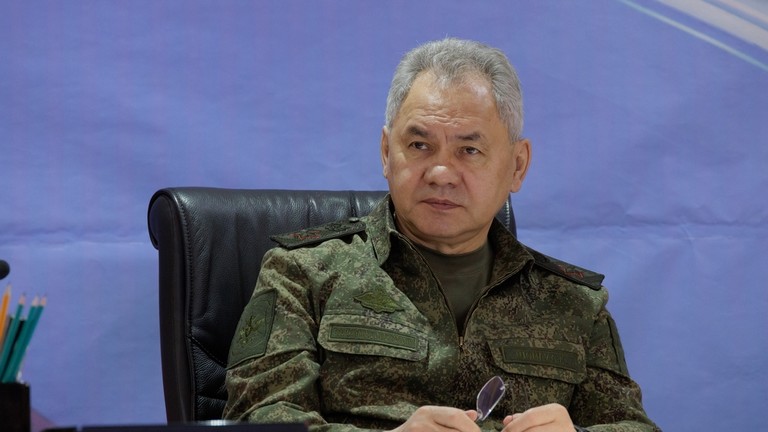
Russian Defense Minister Sergei Shoigu © Ministry of Defense of the Russian Federation; RIA Novosti
RT | August 15, 2023
Asian, African and Latin American states have seen their role in the global arena increase as Western military dominance has started to wane, Russian Defense Minister Sergey Shoigu has said.
Speaking at the 21st International Security Conference in Moscow on Tuesday, the minister argued that Russia’s military operation in Ukraine has “put an end to the dominance of the collective West in the military sphere.”
“Just as the defeat of fascism by the Red Army in Europe in the last century gave a powerful impetus to anti-colonial movements throughout the world, so will the defeat of the Ukrainian neo-fascists supported by the West serve as a factor in counteracting modern neo-colonialism,” Shoigu said.
The minister noted that Russia is currently fighting “not just the armed forces of Ukraine, but the entire collective West,” which, he added, has recently been joined by several states from the Asia-Pacific region.
In its confrontations with Kiev’s forces, which have been provided with foreign weaponry worth billions of dollars, Russia has dispelled many myths about the superiority of Western military standards, Shoigu said. It has become clear that the use of Western weapons and supposedly advanced NATO tactics and training “cannot ensure superiority on the battlefield,” he added.
The minister also claimed that Kiev’s foreign advisers are essentially using the Ukraine conflict as a testing ground for various military strategies involving Western weapons, while President Vladimir Zelensky supplies the manpower for these experiments. Shoigu said the losses among Ukrainian military personnel are being disregarded by Ukraine’s Western backers.
The Russian minister also claimed that Ukraine’s military resources are almost completely exhausted, according to preliminary estimates. Russia’s Defense Ministry had previously reported that since launching their counteroffensive operation in early June, Ukraine’s forces had lost some 43,000 soldiers as well as nearly 5,000 pieces of heavy equipment, including dozens of Western tanks and combat vehicles.
Shoigu suggested that the US is using the Ukraine conflict to line the pockets of its defense industry by forcing its partners in Europe to procure new products to replace those they have sent to Kiev.
The Summer of Fraying Threads
By William Schryver – imetatronink – August 14, 2023
On April 23, 2021, I wrote the following:
“Ukraine has two options: accept its role as a buffer state, or be dismembered. If the US goads them into an attempt to subjugate the Donbass, Russia will slice away eastern Ukraine and assimilate it — and there is *nothing* the US can do to prevent it.”
Of course, we all know what has happened since then. And now, as the summer of 2023 slips away here on our increasingly vexed planet, I note the following salient developments:
Matters have reached the point where the imperial masters will be forced to choose between a humiliating disengagement and abandonment of Ukraine to its fate — or otherwise blunder into a calamitous direct military intervention.
In recent months, many of the most influential voices in Russia have reiterated the demands made of the NATO bloc in December 2021: it must withdraw its military forces to their pre-1997 posture.
NATO presence in and military support for Ukraine must cease forthwith; Ukraine must be entirely demilitarized, and a neutral regime must be installed in whatever Ukrainian rump state the Russians choose to leave unrestored to mother Russia.
Additionally — and this demand has been explicitly stated — American missiles must immediately be removed from Poland and Romania, and NATO military presence in all the Russia-adjacent nations must be withdrawn.
Many geopolitical analysts have commented to a limited degree on Putin’s address to the world delivered even as Russian forces had commenced their “Special Military Operation” in Ukraine on February 24, 2022, but few, if any, have focused their attention on the equally portentous address Putin delivered three days earlier.
In his February 21, 2022 speech, Putin meticulously recounted the relevant history of the region dating back multiple centuries, and focused specifically on the events that followed in the wake of the dissolution of the Soviet Union.
In addition to Putin’s history lesson, he makes particular reference to a detailed proposal Russia delivered to the United States and its NATO allies in mid-December 2021 — a proposal that effectively amounted to a “final warning”; a last-ditch effort to avoid war in Ukraine.
Consider his words carefully, and especially in light of how Russia has unswervingly adhered to the three primary war objectives Putin articulated in his February 24th speech.
Last December, we handed over to our Western partners a draft treaty between the Russian Federation and the United States of America on security guarantees, as well as a draft agreement on measures to ensure the security of the Russian Federation and NATO member states.
The United States and NATO responded with general statements. There were kernels of rationality in them as well, but they concerned matters of secondary importance and it all looked like an attempt to drag the issue out and to lead the discussion astray.
We responded to this accordingly and pointed out that we were ready to follow the path of negotiations, provided, however, that all issues are considered as a package that includes Russia’s core proposals which contain three key points. First, to prevent further NATO expansion. Second, to have the Alliance refrain from deploying assault weapon systems on Russian borders. And finally, rolling back the bloc’s military capability and infrastructure in Europe to where they were in 1997, when the NATO-Russia Founding Act was signed.
Vladimir Putin, Address by the President of the Russian Federation, February 21, 2022 (emphasis added)
Clearly, the Russians are emboldened by both their burgeoning military strength as well as NATO’s manifest military debility.
This war has achieved precisely the opposite effect envisioned by its imperious authors: it has served to strengthen Russia, and also forged an unbeatable alliance between Russia, China, and Iran.
That said, I cannot shake the haunting worry that the Empire At All Costs cult may yet succeed in persuading the powers-that-be in the Pentagon to test the myth of American military supremacy against what was so long imagined to be Russian military ineptitude.
I believe we will see the answer to that question between now and the vernal equinox in March 2024.
They will no longer tolerate US meddling in Taiwan, nor permit the US to dictate the geopolitical relationships of the nations in east Asia and the western Pacific.
The days of a patient and grudgingly submissive China have come to an end.
To punctuate this reality, we have recently seen the unprecedented development of joint Russia/China naval patrols in the Pacific — including off the coast of Alaska.
In other words, we have well and truly arrived at a hinge point in time.
The first global empire in human history has long-since receded from its high-water mark and is now in rapid and increasingly chaotic decline.
“I have touched the highest point of all my greatness; And, from that full meridian of my glory, I haste now to my setting …”
Great dangers and momentous changes lie ahead — some in the relatively near future; some not far over the horizon.
Prepare accordingly …
Featured Video

The Search for Truth: Charlie Kirk’s Assassination One Year Later
or go to
Aletho News Archives – Video-Images
From the Archives
The 9/11 “Double-Cross” Conspiracy Theory
BY LAURENT GUYÉNOT • UNZ REVIEW • SEPTEMBER 6, 2022
Is it true that “9/11 was an inside job”? Yes, insofar as Israel is “inside” the U.S. But for the 9/11 truthers who have identified Israel as the main perpetrators, “9/11 was an inside job” is at best a half-truth, and at worst an integral part of the Zionist operation, like a secondary flag sewn as a lining under the false flag of Islamism. Victor Thorn (1963-2017) wrote in his book 9/11 made in Israel: The Plot Against America (2011): “In essence, the ‘9-11 truth movement’ was created prior to Sept. 11, 2001 as a means of suppressing news relating to Israeli complicity. . . . The slogan ‘9-11 was an inside job’ was quite possibly the greatest example of Israeli propaganda ever devised.” In milder terms, it is “controlled opposition”.
A genuine truth movement would have pointed to Israel as the prime suspect from the start. From day one, it was obvious who would benefit. … continue
Blog Roll
 Aletho News
- Europe’s mounting social chaos… chickens coming home to roost for proxy war against Russia
- US-Russia Diesel Deal Becomes Massive Defeat for Ukraine
- Hormuz and the Looming Economic Catastrophe
- Dhubab offensive, media blitz and the rapid unraveling of Saudi-backed coalition’s new gambit
- Putin Conveys to Trump Iran’s Vision on Possible Conflict Resolution – Kremlin
- The Search for Truth: Charlie Kirk’s Assassination One Year Later
- ‘Harsh reality’: Iran says France seeks monopoly on power and intimidation, not peace for all
- When Will This White House Madness End?
- Huckabee aide goes to ‘unusual lengths’ to portray ‘Israel’ positively
- Trump Announces Diesel Supply Deal With Putin Following Phone Call
- If Americans Knew
- Israeli forces kill another child in Gaza – Daily Update
- Gaza ceasefire exists in name only, say more than 100 organizations
- Nearly 2 Million in Gaza Need Urgent Shelter Assistance as Winter Looms: IOM Chief Warns
- Suppressing Palestinian resistance: US charity under fire for AI monitoring of Gaza classrooms
- Thousands Are Held in Israeli Torture Camps. This Is What Happens Inside
- Israel puts Gaza’s sick, injured, newborn in peril – Daily Update
- Report claimed Mark Levin used by Israeli government to influence Trump
- Over 2,000 Gazans have died awaiting medical evacuation amid Israel’s continued siege
- How a U.S. Diplomat Suppressed and Altered Reports Critical of Israel
- 5 Palestinians Die from Israeli Strikes in Gaza as Relentless Attacks Continue
- No Tricks Zone
- New Study: 50 Years Of The Most Aggressive ‘Net Zero’ Policies Can Only Affect The Global Climate By 0.03°C
- US September “Heat” Was No Record…Many Records Set Decades Ago
- Latest European Green Energy Debacle; Portugal’s Largest Flagship Solar Park Insolvent!
- Green Energy Debacle: German Expert Professor Fritz Vahrenholt Warns Of Severe Economic And Social Consequences
- Two More Paleo Reconstructions Affirm Meters-Higher Sea Levels Across Ireland, Brazil 7000-6000 Years Ago
- New Study: Earth And Venus Surface Warmth Largely Explained By Convection And Lapse Rate, Not CO2 Or Radiation
- 2025 Nature Paper Claiming Worsening Global Drought Gets RETRACTED …Heavily Flawed
- New Study: ‘Global Drought Shows No Detectable Recent Acceleration Under Climate Warming’
- Economic Masterminds: German Socialists Suggest Taxing Productivity Gains Stemming From Using AI
- The South China Sea Has Not Been Cooperating With The Climate Change Narrative

