Greenland to Receive NATO Representation for First Time Ever
By Igor Kuznetsov – Sputnik – 21.03.2023
In recent years, the Arctic has once again risen to one of the top priorities for the US and NATO. The region, rich in natural resources, has been designated as a potential corridor for strategic competition, particularly with Russia and China, and is seeing massive military investments.
Greenland’s government, Naalakkersuisut, and the Danish Foreign Ministry have for the first time agreed to send a Greenlandic diplomat to NATO to represent the remote part of the Danish Realm.
“It is important that Greenland increases its insight into the security policy development in the High North and NATO’s focus on the region,” Greenland’s Department for Foreign Affairs, Business and Trade said in a statement.
“It is also important that NATO increases its understanding of the special conditions of our region and our society, and familiarizes itself with our interests, our values and priorities,” Greenlandic Minister for Foreign Affairs, Business and Trade Vivian Motzfeldt said.
Lida Skifte Lennert, who has 25 years of experience in Greenland’s central administration behind her, will become the island nation’s first permanent representative at the US-led alliance’s headquarters in Brussels.
Greenland, the remotest part of the Danish Realm, has recently become a key area of US and NATO interest amid the military build-up in the far north. The US opened a consulate in Greenland’s capital Nuuk and has shown a keen desire to secure access to the rare minerals found in the Greenlandic depths. In 2019, former US President Donald Trump notoriously shocked Denmark with an surprise offer to buy Greenland, but received a cold shoulder from Copenhagen.
In recent years, the Arctic has returned to the top of the US security and defense agenda. Already in the Pentagon’s 2019 Arctic strategy the region was designated as a potential corridor for strategic competition, particularly with Russia and China. Denmark, too, has placed a greater emphasis on the military upgrade of its faraway territories, the Faroe Islands and Greenland.
The world’s largest island has notoriously harsh weather conditions, a dramatic lack of infrastructure and a slim 55,000 population, in which native Inuit comprise a majority. Nevertheless, it has since World War II repeatedly hosted US military bases, most notably the Thule Air Base, the northernmost US military installation, located some 1,500 kilometers from the North Pole, and the now-defunct Sondrestrom Air Base, which was turned over to the Greenlandic government in 1992. The Thule Base remains intact and plays a key role in the US military’s ability to detect and provide early warnings for ballistic missile attacks. It also harbors the world’s northernmost deepwater port and was promised an upgrade in 2022.
Camp Century that operated between 1959 and 1967 at the height of the Cold War, was yet another sign of US involvement on the island. The ice-cap base was intended as a platform for nuclear launches that could survive a first strike from the enemy. However, the missiles were never fielded and the necessary consent from the Danish government to do so was never achieved. Subsequently, the project was aborted as unfeasible as the ice sheet was realized to lack the necessary stability. Nevertheless, the project ran a nuclear reactor that was later removed. Still, hazardous waste buried under the ice has since become an environmental concern, particularly in recent years.
Earlier this year, Denmark Proper and the US were reported to be negotiating a new defense cooperation agreement, which was confirmed by Danish Foreign Minister Lars Lokke Rasmussen. He also said that the agreement should create “the possibility of a permanent American presence.”
Greenland received home rule in 1979 and passed a self-rule law in 2009, which would allow the island to declare full independence, but it would have to be approved by a referendum among the Greenlandic people. There are several parties in Greenland pushing for full independence from Denmark. A string of polls have consistently indicated that while there is a clear majority for full independence among Greenlanders, there is clear opposition to it, if it were to imply a fall in living standards. Currently, Greenland is dependent on an annual subsidy of around $600 million from Copenhagen, which accounts for about two-thirds of the island’s budget and one-quarter of the nation’s entire GDP. The rest of the economy relies on fisheries and tourism. Payments from the US for the network of military installations also play a part.
US, EU agree on major weapons shipments to Ukraine
Press TV – March 21, 2023
The United States and the European Union have announced new shipments of military aid to Ukraine.
The US government announced on Monday a new package for the Kiev forces fighting Russian troops in pro-Moscow regions in eastern Ukraine. Secretary of State Antony Blinken said Washington will send Ukraine $350 million in weaponry and equipment.
Separately, a group of 17 EU member states plus Norway said they have agreed on a two-billion-euro plan to deliver artillery rounds and other ammunition to Ukraine over the next year.
EU foreign policy chief Josep Borrell had called on member countries to provide Kiev with one million artillery rounds, including from their own stockpiles. Borrell described the move as “a historic decision” for the 27-nation bloc and Norway.
“We are taking a key step towards delivering on our promises to provide Ukraine with more artillery ammunition,” he said, noting 18 countries had signed up to a European Defense Agency (EDA) project to place joint orders for ammunition with the defense industry.
In the meantime, Kiev has complained its forces are compelled to ration firepower as Russia’s special military operation in Ukraine, which kicked off more than a year ago, has turned into an exhaustive war of attrition.
The secretary general of the NATO, however, says Ukraine’s Western allies are having a hard time keeping up with Kiev’s ever-increasing demand for ammunition.
“The war in Ukraine is consuming an enormous amount of munitions, and depleting allied stockpiles,” Jens Stoltenberg told reporters last month.
Russia launched the war after Kiev’s failure to implement the terms of the 2014 Minsk agreements and Moscow’s recognition of the breakaway regions of Donetsk and Luhansk.
Since then, the US and its European allies have imposed unprecedented economic sanctions against Moscow while supplying large consignments of heavy weaponry to Kiev, flooding Ukraine with tens of billions of dollars of weapons and munitions. Moscow has condemned the West’s weapons shipments to Kiev, warning that it will only prolong the war.
Polish diplomat believes Warsaw might join conflict in Ukraine
By Lucas Leiroz | March 21, 2023
Escalation and internationalization may be very close to happening in the Ukrainian conflict. In a controversial and irresponsible statement, a leading Polish diplomat announced that his country may send troops to the battlefield if Kiev fails to prevent a Russian victory. The official’s words sound like a frontal threat and could have drastic consequences, considering that such a scenario would represent a direct confrontation between Russia and a NATO country – it just remains to be seen whether the Atlantic alliance would be concerned with defending its Eastern European proxies.
The threat was made by Poland’s ambassador to France, Jan Emeryk Rosciszewski, on March 18, during an interview with the French media. Rosciszewski accused Moscow of being solely responsible for the hostilities, echoing the Western hegemonic narrative. According to him, no NATO country is to blame for the fact that the conflict is prolonging, if not the Russian government itself, which would be deliberately increasing international tensions. As expected, however, he did not show any evidence to support his narrative.
The main problem is that Rosciszewski did not limit himself to accusing Moscow of being the “wrong side” of the conflict, but also said that Poland may be “forced” to send troops to Ukraine. For Rosciszewski, Russian victory is unacceptable as it would represent the end of the “values” that form the basis of the European civilization.
“Either Ukraine will successfully defend its independence, or we [the Polish people] will be forced, in any case, to join this conflict (…) Otherwise, our principal values, which are the basis of our civilization and our culture, will be in fundamental danger, so we will have no choice”, he said.
As expected, the case generated a scandal and many newspapers around the world announced the ambassador’s words as an official declaration that his country would be in combat readiness to face Russia. The attitude was praised by Western warmongers, who support that as many countries as possible join the conflict and engage in a total war on Russia.
The Polish Embassy in France, however, felt pressured in the face of the irresponsible acts of its own head and released a note clarifying that his intention was not to state that Poland would be ready to face Russia – but to warn about the possible consequences of a Ukrainian defeat.
“Listening carefully to the entire conversation allows us to understand that there was no announcement of Poland’s direct involvement in the conflict, but only a warning against the consequences of Ukraine’s defeat – the possibility of Russia attacking or dragging into the war more Central European countries – the Baltic states and Poland”, the Embassy’s statement reads.
Despite the effort, the Embassy was unable to reduce the seriousness of the situation with its note. Rosciszewski was very clear in his words. He literally said that his country would be “forced” to fight if Ukraine was not capable to defend itself. In a scenario of evident Ukrainian defeat which is already beginning to be admitted even by the Western media, this obviously sounds like a declaration of combat readiness. There is no room for other interpretations.
Among Russians, despite not having much repercussion, the case was commented on by Senator Alexey Pushkov. According to him, the Ambassador only said what Polish politicians “have long had on their minds”. However, he warned that Polish “courage” is motivated by the certainty of US support in an eventual war with Russia. Pushkov questioned this conviction, suggesting that there would be no real mobilization on the part of Washington.
“A very presumptuous statement by the Polish ambassador in Paris. For the first time, an official representative of Poland said what its leaders have long had on their minds. However, all the ‘courage’ of the Poles is based on the support of the United States. Is Warsaw sure that Washington is ready to fight?”, he said.
The senator’s alert is very important because it raises a question that has also been put by many military experts around the world. It is visible that, incited by the US, Poland and the Baltics have taken hasty and absolutely irresponsible actions, suggesting that they want to enter into open war with Moscow. They do so because they are certain that they would receive support from the entire Atlantic alliance, as foreseen in the fifth article of the NATO charter.
However, many analysts doubt this. On several occasions, the US has already demonstrated that its unilateral will prevails over NATO’s partnership. It would be very naive to believe that the country that bombed the Nord Stream pipelines in a deliberate act of sabotage against Germany would engage in a war of catastrophic consequences just to support Poland and the Baltic states.
In fact, what many Eastern Europeans still do not understand is that they are just serving as an instrument in proxy wars in which the US does not want the alliance to be directly involved. The American objective is to prepare its regular troops for a war with a greater possibility of victory than one with Russia. For this, NATO wants to multiply fronts and distract Russian forces on different battlefields. In this sense, it is unlikely that Poland’s joining in the conflict will change anything in the status of the war – on the contrary, it is much more possible that such a situation definitively reveals that NATO is not an alliance based on common principles and interests, but a mere instrument of war submitted to the unilateral will of the US.
Lucas Leiroz, journalist, researcher at the Center for Geostrategic Studies, geopolitical consultant.
Report Linking Fluoride to Lower IQ in Children Made Public After CDC, HHS Tried to Block It
By Brenda Baletti, Ph.D. | The Defender | March 16, 2023
The National Toxicology Program (NTP) on Wednesday released a draft report linking prenatal and childhood fluoride exposure to reduced IQ in children, after public health officials tried for almost a year to block its publication.
The U.S. Department of Health and Human Services (HHS) and the Centers for Disease Control and Prevention (CDC) initially blocked the NTP from releasing the report, according to emails obtained via a Freedom of Information Act (FOIA) request.
But a court order stemming from a lawsuit filed by Food and Water Watch against the U.S. Environmental Protection Agency (EPA) forced the report’s release this week.
The NTP, an interagency program run by HHS that researches and reports on environmental toxins, conducted a six-year systematic review to assess scientific studies on fluoride exposure and potential neurodevelopmental and cognitive health effects in humans.
The report, containing a monograph and a meta-analysis, went through two rounds of peer review by the National Academies of Sciences, Engineering, and Medicine. Comments from reviewers and HHS and NTP’s responses also were included in the report released Wednesday.
According to its website, the NTP “removed the hazardous classification of fluoride” in response to comments in the peer-review process. Yet, the report states:
“Our meta-analysis confirms results of previous meta-analyses and extends them by including newer, more precise studies with individual-level exposure measures.
“The data support a consistent inverse association between fluoride exposure and children’s IQ …
“The results were robust to stratifications by risk of bias, gender, age group, outcome assessment, study location, exposure timing, and exposure type (including both drinking water and urinary fluoride).”
“These findings fly in the face of the empty, unscientific claims U.S. health officials have propagated for years, namely that water fluoridation is safe and beneficial,” said Robert F. Kennedy, Jr., Children’s Health Defense chairman and chief litigation counsel. “It’s past time to eliminate this neurotoxin from our water supply.”
The controversial report will play a key role in determining the outcome of a lawsuit brought in 2017 by several nonprofits against the EPA to end fluoridation of drinking water, plaintiffs’ attorney Michael Connett told The Defender.
“We had to fight hard to have this report even made public,” Connett said. “They [CDC and HHS] buried this. If they had gotten their way, this report would have never even seen the light of day,” Connett said.
Since the trial began in 2020, U.S. District Judge Edward Chen has been waiting for the NTP to complete a systematic review of fluoride’s neurotoxicity before ruling on the case.
Groups like the American Dental Association publicly pressured the NTP to “exclude any neurotoxin claims” from the reports.
Connett said during the trial, the EPA repeatedly claimed that the plaintiffs’ allegations about toxicity could not be verified because there was no “systematic review.”
The documents released Wednesday fill that gap.
Connett said:
“So now what do we have? We have a systematic review by one of the pioneering, leading, most authoritative research groups on toxicology in the world.
“They just completed a systematic review that took them six years to complete, so if that’s not enough to demonstrate a hazard under the toxic substances control act, then how would any citizen group ever be able to meet the standard?”
The findings: fluoride and lowered IQ in children
According to the NTP report:
“The current bodies of experimental animal studies and human mechanistic evidence do not provide clarity on the association between fluoride exposure and cognitive or neurodevelopmental human health effects.”
Yet, the report’s summary contradicts this statement by summarizing the evidence informing this conclusion, stating that nearly all studies examined for this literature review found evidence of cognitive or developmental issues associated with fluoride.
According to the report, 8 of the 9 “high-quality studies examining cognitive or neurodevelopmental outcomes reported associations with fluoride exposure.”
Of the 19 high-quality studies assessing the association between fluoride and IQ in children, 18 reported an association between higher fluoride exposure and lower IQ in children. Forty-six of the 53 low-quality studies also found evidence of that association.
The meta-analysis also states:
“The body of evidence from studies on adults is also limited and provides low confidence that fluoride exposure is associated with adverse effects on adult cognition. There is, however, a large body of evidence on IQ effects in children.”
The monograph and meta-analysis found that fluoride exposure at levels equivalent to 1.5 mg/L is associated with lower IQ in children. The abstract concludes:
“This review finds, with moderate confidence, that higher fluoride exposure (e.g., represented by populations whose total fluoride exposure approximates or exceeds the World Health Organization Guidelines for Drinking-water Quality of 1.5 mg/L of fluoride) is consistently associated with lower IQ in children.”
Levels of fluoride found in drinking water in the U.S. are typically 0.7 mg/L, which is lower than the 1.5 mg/L levels found to be neurotoxic by the reports.
On that basis, HHS’ review of the reports recommended the NTP revise its assessment such that, “all conclusory statements in this document should be explicit that any findings from the included studies only apply to water fluoride concentrations above 1.5 mg/L.”
The NTP responded:
“We do not agree with this comment. Our assessment considers fluoride exposures from all sources, not just water.
As discussed in the pre-publication 2022 NTP Monograph, because fluoride is also found in certain foods, dental products, some pharmaceuticals, and other sources, individual behaviors are likely an important determinant of actual exposures.”
Rick North, former CEO of the American Cancer Society’s Oregon division and Fluoride Action Network board member told The Defender that “people consume large amounts of fluoride through tea and other drinks and processed foods made with fluoridated water, not to mention pesticide ingestion and fluoride from air pollution.”
He also said that people’s fluoride exposure can depend on how much water they drink.
“Think about it,” North said. “Your level of risk depends upon, incredibly, how thirsty you are. That’s how absurd the entire premise of water fluoridation is,” he said.
The NTP confirmed that people exposed to levels of fluoride lower than 1.5 mg/L in the water system could have high levels of fluoride in their systems. It stated:
“Even in the optimally fluoridated cities [fluoridated at 0.7 mg/L] in Canada studied by Green et al. (2019), individual exposure levels, as documented by repeated urinary measurements, suggest widely varying total exposures from water combined with fluoride from other sources.”
It added, “our moderate confidence conclusion is primarily based on studies with total fluoride exposure that approximates or exceeds what is generally associated with consumption of optimally fluoridated water [0.7 mg/L] in the United States.”
“We have stressed in our monograph that our conclusions apply to total fluoride exposures rather than to exposures exclusively through drinking water.”
“What the NTP is pointing to here is that in some communities, where the dose of fluoride in the water is 0.7 mg/L, the NTP has found levels of fluoride found to be associated with lower IQ,” Connett told The Defender.
Also, different people have different risk levels, he said. Pregnant women and bottle-fed babies, for example, are some of the populations at highest risk.
On this point, the NTP responded to a different HHS critique, writing, “We have no basis on which to state that our findings are not relevant to some children or pregnant people in the United States.”
“The margin of safety here just doesn’t exist — it is precariously small,” Connett said. He added that the lawsuit is “basically a risk assessment of fluoride.”
Under the Toxic Substances Control Act (TSCA), which is the law at stake in the lawsuit, the EPA carries out risk assessments for potential toxins.
To do a risk assessment, the EPA first identifies a hazard and determines at what dose — what level of human exposure — that hazard harms human health.
Then the agency determines in a given case whether the margin between the existing hazard levels and the human exposure levels is unacceptably close, which would make a toxin pose a risk to human health.
Connett said that in EPA’s previous risk assessments for other chemicals, such as methylene chloride or bromopropane, evaluated according to the 2020 risk evaluation method that guides this case, the agency found the hazard level exceeds the human exposure level by much higher margins — “usually in a range of ten to 20 times higher,” yet it has deemed those chemicals to present an unreasonable risk to human health.
In other words, the substances were found to be toxic to humans at levels significantly higher than what people may be exposed to in regular use, yet the EPA determined them to be risks.
When it makes that determination, the EPA must then take steps to mitigate the risk.
That can also be the finding in this case. According to a pre-trial document, both sides in the case agreed to the “undisputed fact” that the “EPA does not require that human exposure levels exceed a known adverse effect level to make an unreasonable risk determination under TSCA.”
The NTP documents also raised flags about the implications of seemingly small neurotoxic effects:
“Research on other neurotoxicants has shown that subtle shifts in IQ at the population level can have a profound impact on the number of people who fall within the high and low ranges of the population’s IQ distribution.
“For example, a 5-point decrease in a population’s IQ would nearly double the number of people classified as intellectually disabled.”
Top HHS and CDC officials tried to ‘water down’ and block the report
In 2016, a group of six nonprofit organizations and several individuals petitioned the EPA to end fluoridation of drinking water in the U.S. based on evidence of health risks associated with fluoride, namely neurotoxicity.
The EPA rejected the petition.
In response, Food and Water Watch, Fluoride Action Network and others sued the EPA in 2017, seeking an end to water fluoridation.
The plaintiffs argued that water fluoridation violates the EPA’s Toxic Substances Control Act and that fluoride is neurotoxic and lowers children’s IQ.
They based their initial claims on dozens of studies and reviews demonstrating fluoride’s neurotoxicity. Studies have also linked fluoride to a variety of other health risks in both children and adults, and evidence shows it to be an endocrine disruptor.
The EPA denied water fluoridation causes harm.
A seven-day trial took place in federal court in San Francisco in June 2020, but Judge Chen put the proceedings on hold pending the release of NTP’s systematic review of research available on the neurotoxic effects of fluoride.
The report, slated for release in May 2022, was delayed several times and sent for several rounds of peer review.
“The people on the [NTP] committee were experts in their fields who put years into this study, going back and forth with one external review after another,” North said. “You couldn’t ask for more peer review than what it already had. There were constant attempts to delay it, to water it down.”
In late October 2022, Judge Chen ended the stay on the NTP review, ruling that the parties involved could view the NTP review in its unpublished form to better inform his final decision.
However, due to concerns from the EPA, he also ruled the report could not be made public unless the NTP released it.
In December 2022, the plaintiffs filed several exhibits with Judge Chen, including a redacted version of the NTP’s assessment of fluoride’s neurotoxicity and internal emails between the CDC and the NTP obtained through FOIA demonstrating that HHS blocked the release of the long-delayed review, the plaintiffs argued.
The documents showed that on May 11, NTP notified the agencies that it was going to release the report on May 18, but the CDC opposed the release.
Emails also indicated that HHS Assistant Secretary for Health Rachel Levine was going to “get involved,” and, “the May 18 release date for [the monograph] is almost certainly not going to happen,” the Defender reported.
Connett said:
“It was only because we were tipped off by someone with knowledge on the inside that something was amiss that we went and did extensive FOIA requests and we were able to get documents showing that the NTP scientists considered this report to be complete and ready for publication last May, May of 2022.”
North said it was clear the agencies were blocking the release of the report, which was ready for publication.
“This was a clear case of stonewalling,” North said. “The National Toxicology Program, after over six years of research and numerous outside peer reviews, had completed its state-of-the-science report.”
Connett added:
“We have emails showing that Levine is the one who put it on hold. Rachel Levine said not to publish this report at this time. Then we got the FOIA emails showing that and NTP said they may not publish this [the report] at all. They may not publish it in final form but we did get them to agree to at least post a draft report. They will consider it a draft report.”
On January 20, Judge Chen denied the EPA’s request to add another six-month period to the stay he lifted in his October ruling.
The monograph and meta-analysis released yesterday on the NTP’s website are both labeled “draft.”
“Unfortunately, fluoridation promoters and high-level government officials have continued to label it a draft,” North said. “It wasn’t.”
Experts associated with the lawsuit against the EPA will now analyze and interpret the report in future hearings and then Judge Chen will rule.
The next hearing date is scheduled for April 11, 2023. At that time, the judge will set a date for the next phase of the trial.
Brenda Baletti Ph.D. is a reporter for The Defender. She wrote and taught about capitalism and politics for 10 years in the writing program at Duke University. She holds a Ph.D. in human geography from the University of North Carolina at Chapel Hill and a master’s from the University of Texas at Austin.
This article was originally published by The Defender — Children’s Health Defense’s News & Views Website under Creative Commons license CC BY-NC-ND 4.0. Please consider subscribing to The Defender or donating to Children’s Health Defense.
Yemeni prisoner exchange deal reached
The Cradle | March 20, 2023
The head of the National Committee for Prisoners’ Affairs, Abdul Qader al-Murtada, announced on Monday, 20 March, that a deal to exchange prisoners had been reached between the Ansarallah resistance movement and the Saudi-led coalition, with implementation to take place in three weeks, Al-Masirah TV reported.
Al-Murtada stated that “Today we concluded the latest round of negotiations in Switzerland regarding prisoners, and it was agreed, praise be to God, to implement a broad prisoner exchange deal that includes 706 of our prisoners in exchange for 181 prisoners of the other side, including Saudis and Sudanese.”
“The deal will be implemented after three weeks, hopefully, and another round will be held after the month of Ramadan to complete the implementation of the rest of the agreement,” Al-Murtada added.
The latest round of negotiations began 10 days ago under the auspices of the United Nations.
The prisoner exchange deal comes amid renewed hopes for a broader end to the Yemen conflict.
UN Special Envoy to Yemen Hans Grundberg told the UN Security Council on 15 March that “Intense diplomatic efforts are ongoing at different levels to bring the conflict in Yemen to an end” and that “we are currently witnessing renewed regional diplomatic momentum, as well as a step change in the scope and depth of the discussions.”
Much of this momentum has resulted from a recent agreement between rival Islamic powers Saudi Arabia and Iran to resume diplomatic relations and work toward peace in the region. As part of this reconciliation, Iranian President Ebrahim Raisi is set to visit Saudi Arabia for talks with Saudi King Salman in the coming weeks.
Since the beginning of the Saudi-led war in Yemen, which began in early 2015, an estimated 377,000 Yemenis have died, according to a UN Development Programme report issued in late 2021.
Some 60 percent of these deaths were caused by the indirect effects of the war, such as lack of safe drinking water, hunger, and disease, while fighting has directly killed more than 150,000 people.
Most of those killed by the war’s indirect effects were “young children who are especially vulnerable to under- and malnutrition,” according to the report.
During the same period, the US government provided $54.6 billion of military aid to Saudi Arabia and the United Arab Emirates, according to a report issued by the US Government Accountability Office. The report noted that the US has 140 military advisers working in Saudi Arabia on training missions and to facilitate weapons sales.
The New York Times reported that the internal government report concluded that the US State Department and Department of Defense “failed to assess civilian casualties caused by a Saudi-led coalition in the catastrophic war in Yemen and the use of American-made weapons in the killings.”
USA criticized globally over MQ-9 drone incident
By Vladimir Danilov – New Eastern Outlook – 20.03.2023
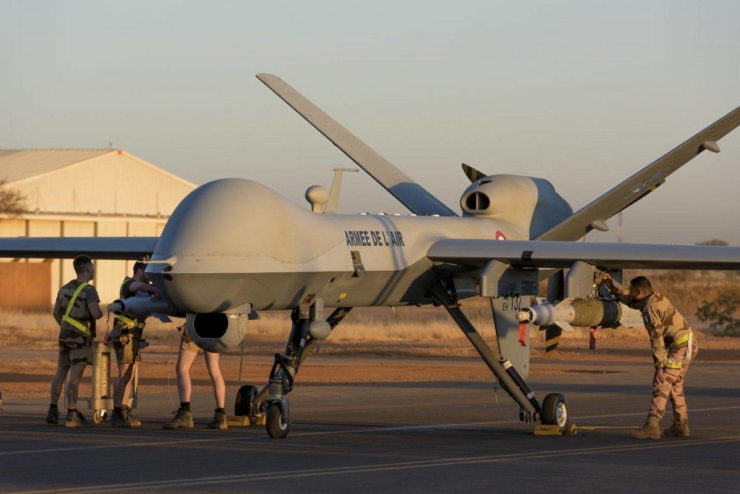
The crash of an American MQ-9 drone heading for the Russian border in the Black Sea near the Crimean Peninsula on March 14 in the morning is likely one of the most discussed topics in the global media in recent days.
According to an official communication from the Russian Defense Ministry, the US UAV’s flight was in violation of the temporary airspace use regime established in accordance with international norms for the area’s boundaries due to the special military operation, and its transponders were turned off. Fighter jets from Russian Aerospace Forces were deployed in the air to identify the intruder. The MQ-9 made a quick maneuver that caused it to lose control of its flight and crash into the water. The Russian fighter jets did not engage the unmanned aerial vehicle during the incident and did not fire any of their on-board weaponry.
The MQ-9 Reaper is a modular reconnaissance and strike US UAV that can carry a variety of combinations of weapons and electronic equipment depending on the mission, including carrying an arsenal of tactical nuclear weapons. As a result, there is no doubt about Russia’s eligibility for protective measures against the United States’ hostile use of the said UAV against Russia. Especially in light of recent open calls by various US representatives for the armed destruction of the Russian Federation. In particular, former US National Security Adviser John Bolton’s call to define the objectives of the US-Russia war.
In contrast to US military officials’ attempts to portray the incident as a “wrongful act by Russia,” particularly Gen. James Hecker, Commander of US Air Forces in Europe and Air Forces Africa, ordinary Americans are discussing the blatantly “insane” US version of the incident that caused the MQ-9 UAV to crash into the Black Sea. Thus, US armed forces veteran Noctis Draven emphasized that Washington’s anti-Russian propaganda narrative is “easily disproved,” and that if Russia had hostile intentions, the MQ-9 would have been shot down without endangering the pilot or the aircraft.
The MQ-9 incident has been widely discussed in the US media, noting that it is in fact the first direct military confrontation between Russia and the US since Moscow launched its special operation in Ukraine.
For example, Joe Rogan in his podcast PowerfulJRE pointed out that the current White House administration is actively pushing the US to an outright war with Russia, bringing about the feeling of chaos in the country.
According to Fox News host Tucker Carlson, an administration like this could lead to a hot war with Russia and China whether you want it or not.
According to a CNN report, the MQ-9 incident in the Black Sea may contribute to growing support in the United States for the view that aid to Ukraine is not a national security issue for Washington.
The international public has also reacted strongly to the incident, in a way that is clearly unfavorable to the United States and US propaganda.
According to the Chinese Global Times tabloid, such incidents have become more common in recent years around the world. It is emphasized that the United States is surprisingly involved most of the time. The publication stresses that this has become a habitual tactic of provoking enemies, and that a couple more such cases will cause the world to explode.
Guancha readers openly mocked Washington for the botched spying mission in the Black Sea, pointing to the US’s incompetence, whose drone crashed into the water. They praised Russia for “teaching a lesson” to America, self-assured in its permissiveness, without even opening fire, causing the MQ-9 to fall into the water in fear of the Russian Su-27.
As the Global Times correctly points out, the White House clearly requires such incidents in order to complicate the global situation and fight “against the unwanted.” How else can the provocative flight of the American MQ-9 Reaper drone near the Russian state border and the incident in the Black Sea be explained? Since the Cold War’s end, Washington has routinely staged such incidents, frequently targeting countries that the US publicly refers to as enemies.
The Austrian media, which is aghast at the prospect of the United States starting World War III, also points out that America recently staged a provocation with a B-52 bomber, and now the MQ-9 Reaper drone incident. The Austrian journalists wonder what Washington hopes to accomplish by conducting such dangerous “tests” of Russia’s defense capabilities. After all, today, it is clear to everyone that provocations like the ones on March 14 in the Black Sea and the day before with the B-52 bomber near St. Petersburg could be used as a pretext for war.
The opinions of the readers of the French Le Figaro are also quite revealing. Some of them believe that the USA was very “unprofessional” trying to spy on Russia and got what it deserved, while others admit that it was a “flawless operation” by Moscow. The video of the MQ-9 downing in the Black Sea, released by the US, caused no distress among French media readers. They called it “just another batch of oil the Americans poured on the fire.”
Readers of the German magazine Der Spiegel support Russia and are perplexed as to why the West is outraged by its actions. They suggest we look at the map to see for ourselves that American drones have no business over the Black Sea.
Australia’s The Sydney Morning Herald does not rule out that the US drone incident in the Black Sea could trigger a new round of tensions, becoming the first very dangerous incident of its kind since the Cold War. The majority of the publication’s readers blame Washington, specifically asking: what was that drone doing there?
According to some political analysts, the March 14 MQ-9 incident is unlikely to cause any serious consequences in relations between Russia and the US or result in a military clash between the two countries. After all, Washington’s remaining “cool heads” only need to take the necessary steps.
Following the MQ-9 Reaper drone incident over the Black Sea, the US has already begun analyzing the costs and benefits of such missions, weighing the potential value of intelligence obtained in this manner against the risk of escalation in relations with Russia, according to recent information. The US military is specifically instructed to “carefully study” UAV routes and assess ways to reduce the risk of conflict with Moscow, especially considering Russian aviation operations in the Crimea.
However, similar risks exist not only in the Black Sea region, but also in the Baltic Sea, as evidenced by an incident 200 kilometers away from St. Petersburg the day before the MQ-9 events. Then, as you may know, B-52 Stratofortress US strategic bomber capable of carrying nuclear weapons and accompanied by Polish fighters, flew over Lithuanian airspace, approached the Russian border at the greatest possible distance, and went into position, simulating bombing readiness. Similar incidents may occur in the Arctic, near Russia’s borders in the Asia-Pacific region, if Washington makes new anti-Russian or anti-Chinese provocations there.
In any case, the US must temper its aggressive cowboy zeal, lest its provocative actions push the world dangerously close to the outbreak of World War III. Especially since there is still no clarity in identifying those responsible for the terrorist attack on the Nord Stream pipelines in the Baltic Sea.
US continues to use terrorists in Syria – Russia
RT | March 20, 2023
The US is still working with Islamic State terrorists and other Islamist groups to carry out attacks against Bashar Assad’s government forces in Syria, Russia’s Foreign Intelligence Service (SVR) chief, Sergey Naryshkin, has claimed.
According to an SVR report released on Monday, the US military’s Al-Tanf base in southern Syria is coordinating subversive activities, with the actions of terrorist groups being planned by representatives of the Central Command of the US Armed Forces as well as US intelligence officers.
The SVR stated that a special role has been assigned to the so-called Free Syrian Army, which consists of Kurdish and Arab detachments operating in the central and northeast parts of Syria. “Through them, the Americans and their British allies are working with the underground formations of Islamic State [IS, formerly ISIS] that still remain in remote areas of the country,” it was alleged.
“ISIS was instructed to incite hostilities in the Syrian south-west (the provinces of Suwayda and Deraa), in the central part of the country (Homs) and east of the Euphrates River (Raqqa, Deir ez-Zor). For this, it is planned to form several detachments of radicals with a total number of about 300 people. After special training, they will be involved in attacks on military facilities in Syria and Iran,” the statement added.
The SVR claims that the US also intends to use terrorists in the region around the capital, Damascus, to conduct tasks such as kidnapping Russian and Iranian servicemen.
In addition to coordinating the actions of Islamist groups, Washington is providing terrorists with weapons, according to the SVR. Several dozen four-wheel-drive pickup trucks with heavy machine guns, as well as a number of rocket systems such as NLAW ATGMs, TOWs, and Igla MANPADS are set to be handed over to fighters in the near future, the report alleged.
Washington’s actions put it “on the same level” as Islamic terrorists and IS militants, and is a manifestation of state terrorism, the SVR argued.
In February, the SVR reported that the US was using Islamist extremists to plan terrorist attacks in Russia and former Soviet republics. Washington has been training as many as 60 terrorists at the Al-Tanf base to make improvised explosive devices and use them to target diplomats, public officials, law enforcement officers, and military personnel, the intelligence service claimed.
Former Egyptian FM: ‘Everyone knew there were no WMDs in Iraq’, invasion was in place before Bush came to power
Sputnik – 20.03.2023
Former Egyptian Foreign Minister Nabil Fahmi was Egypt’s Ambassador Extraordinary and Plenipotentiary to the United States at the time of the US invasion of Iraq. He shared his memories in an interview with Sputnik.
In his interview, Nabil Fahmi said that the American invasion of Iraq was already in place when George W Bush came to power, and he was simply looking for a suitable opportunity to carry out the plan.
Sputnik : As an Egyptian diplomat at the time, how did you feel about the US decision to invade Iraq in 2003?
Nabil Fahmi: At the time, in 2003, I was Egypt’s Ambassador to the United States. Of course, the entire Arab diplomatic corps was discussing the invasion in one way or another. Even with the election of Bush Jr as President of the United States, I noticed a really unhealthy interest the neocons took in Iraq. US vice-president Richard (“Dick”) Cheney was particularly prominent in this regard. On his first visit to Arab countries, he told me personally that he wanted to focus on Iraq.
Sputnik : Why Iraq in particular?
Nabil Fahmi: I asked him why Iraq and not, for example, the Palestinian issue. But he said that Iraq had caught his attention. I told the leadership in Cairo about the strange interest of the new American administration: but at that time, no one imagined that it would come to an open invasion in 2003.
Sputnik : Could you please tell us about Egypt’s position on the US invasion of Iraq?
Nabil Fahmi: I conveyed a message from President Hosni Mubarak to the Chief of Staff of the US Army and to one of the military commanders in the region that an invasion of Iraq was not advisable, and that there was a big difference between the liberation of Kuwait from occupation – in which the Egyptians had also been involved – and the direct occupation of an Arab country. This message was also conveyed to various American officials in Washington, including Condoleezza Rice, Colin Powell and others.
The Egyptian delegation arrived in Washington about four weeks before the invasion in a last-ditch effort to acquaint the US side with Cairo’s position. The delegation visited US Secretary of State Condoleezza Rice and Deputy Secretary of Defense Paul Wolfowitz. They were warned that an invasion of an Arab country would be disastrous for the region.
Sputnik : And how did the Americans respond?
Nabil Fahmi: The US administration questioned us point by point, ranging from the invasion and how to take control of certain places. Each time we responded, we emphasized that we did not support the US invasion. At one point, Rice specifically asked why this point was being repeated in every response. Our delegation explained that Egypt continued to oppose the invasion in any case: the Iraqi state must be preserved.
Sputnik : What did Washington think of Cairo’s response to the invasion?
Nabil Fahmi: Our position put me, as Egypt’s ambassador to Washington, in a difficult position before the US Congress. I explicitly said that Cairo did not support the war in Iraq, even though we were friends of America.
Sputnik : And how did you assess the international position on the invasion?
Nabil Fahmi: The US administration was determined to invade Iraq from the first day it came to power, and this was evident in the speeches of Cheney and Wolfowitz. The course of action had started taking shape after 9/11. The Bush administration had to justify this military operation to convince the American public that there was a real threat. To this end, they played the card of Iraq’s possession of nuclear, chemical and biological weapons. Although in fact everyone knew that there were no weapons of mass destruction (WMD) in Iraq.
Sputnik : What then were the real reasons for the US invasion of Iraq?
Nabil Fahmi: The US decision to invade Iraq was made regardless of the actions of former Iraqi President Saddam Hussein and the suffering of the Iraqi people, and there was no real evidence that Iraq possessed WMD. Either it was because they wanted to realize their ambitions after the liberation of Kuwait – because at that time the controversy about the need to end the war of liberation was raging – or maybe it was because the US was already developing the concept of a “New Middle East” and the easiest place to start implementing it was with a sanctions-weakened Iraq.
Sputnik : In your opinion, what has been the most significant consequence of the US invasion of Iraq?
Nabil Fahmi: I opposed Iraq’s invasion of Kuwait and saw that it was unacceptable and a big mistake on the part of Saddam Hussein. I do not believe that any country has the right to invade another country without respecting international law. That is why I did not support the invasion of Iraq. However, this war caused a lot of trouble in the Levant and the Gulf Region, and later the emergence of Daesh terrorists in the region. To this day, the Middle East is still dealing with the consequences of the US invasion of Iraq 20 years ago.
Sputnik : Has there been a change in American policy toward Arab countries in the years since the invasion of Iraq?
Nabil Fahmi: Nothing has changed. What has changed is the American reality and the Arab reaction. In the early 2000s, the US wanted to show the Middle East that after the collapse of the Soviet Union it could do whatever it wanted with Moscow’s former allies – that was its interest.
Circumstances are different now. Washington is no longer willing to give guarantees or sacrifice its wealth or forces to protect anyone in the region as a whole. For their part, the Arab countries began to realize – after the American invasion of Iraq – that the US could not be given preferential treatment. Thus, the Arab countries began to balance their foreign policies, giving the US the role of an important partner, but by no means the only one. The Arabs now realize that they must take the lead in solving most of the region’s problems and not rely on others to do so.
China’s success in reconciling Saudi Arabia and Iran is a huge blow to US hegemony
By Ahmed Adel | March 20, 2023
After agreeing with Saudi Arabia in December to buy its oil for Chinese yuan instead of just US dollars, while at the same time Russia is successfully cooperating with Saudi Arabia and Iran in the oil sector, Beijing is helping a historic reconciliation between the two major Muslim countries. Chinese efforts are all the more impressive when considering the persistent efforts of the US to cause conflict between the two countries instead of reconciliation.
It is hoped that reconciliation will lead to a huge blow to the hegemony of the US dollar. In Beijing on March 17, following negotiations in Iraq and Oman during the previous two years, China, Iran, and Saudi Arabia announced an agreement which includes the restoration of diplomatic relations, a confirmation of respect for the sovereignty of states and non-interference in their internal affairs, and agreements on security, economy, trade, investment, science and culture.
In short, with the mediation of China, the two regional powers, often framed as having a Sunni-Shi’a rivalry, made it official that they are embarking on a new path of improving relations instead of further spoiling them for the sake of serving Western interests that are contrary to the interests of the Islamic World.
Therefore, it is quite clear who the Chinese Ministry of Foreign Affairs had in mind when it announced that overcoming differences between Iran and Saudi Arabia will have a “beneficial effect on freeing the countries of the region from external interference” – evidently this is in reference to the US. As Beijing highlighted, these two countries have now “taken their own destiny into their own hands,” adding that their agreement “corresponds to epochal development trends.”
Chinese Foreign Minister Wang Yi, who was recently in Moscow and confirmed that Russia-China relations are reaching new frontiers in building a multipolar world, emphasised that the agreement between Riyadh and Tehran represents “a victory for dialogue and peace.”
In a China Global Television Network (CGTN) article published on March 13 and titled: “Why Iran and Saudi Arabia trust China?”, the author highlights that “dialogue between Tehran and Riyadh has unfolded as negotiations took place in Iraq, where the two countries reached an important consensus. Meanwhile, the main regional allies of Iran and Saudi Arabia, such as the United Arab Emirates and Kuwait, have restored diplomatic relations in 2022. Hence, the resumption of diplomatic relations between Iran and Saudi Arabia also is only a matter of time.”
The author’s belief in the resumption of diplomatic relations proved to be true only days after the article’s publication. The resumption signifies that a new era has dawned in the Middle East, and even more broadly when we consider the effects this could have on the hegemony of the US dollar.
The US has been the dominant force in the Middle East since the end of British and French colonialism in the 1940’s. The region has been in a constant state of war since then, with the US now maintaining 30 military bases in the Middle East – five of them in Saudi Arabia.
For the US that relies on its global network of military bases to maintain hegemony, Beijing is showing non-Western countries how a multipolar world can function with great power diplomacy based on agreements and reconciliation, and not rooted in the idea that “might is right,” like Washington adopts.
It is noted that the day before the reconciliation in Beijing, the head of Saudi diplomacy, Prince Faisal bin Farhan al Saud, visited Moscow unannounced. And a week earlier, on March 6, Russian President Vladimir Putin spoke by phone with his Iranian counterpart Ebrahim Raisi, who visited Beijing in mid-February. After that, Wang Yi was in Moscow. This suggests that although China was the main broker of peace between Saudi Arabia and Iran, Russia certainly played a role in reconciliation efforts.
Russia, Iran, and Saudi Arabia are three leading oil and gas producers and are accelerating their search for payment mechanisms to bypass the US dollar. China, for their part, is already discussing such arrangements with Saudi Arabia and Iran.
The decline of the US dollar as a world currency will weaken the American economy and military power. This in turn will cripple the US’ ability to wage perpetual wars abroad and impose its global hegemony.
Just as importantly, reconciliation between Saudi Arabia and Iran can be seen as a precursor to eventually joining BRICS in the near future. It is recalled that BRICS plans to decide this year whether to admit new members and under what conditions.
Although BRICS collectively accounts for 42% of the world’s population and 24% of the world’s gross domestic product (GDP), they collectively hold less than 15% of voting rights in both the World Bank and the International Monetary Fund, which are Western dominated. By admitting Saudi Arabia and Iran, BRICS’s global status will be elevated even higher as a symbol of not only peace and reconciliation, but also a path to prosperity independent of Western domination.
Ahmed Adel is an Cairo-based geopolitics and political economy researcher.
Featured Video

Seyed M. Marandi: US-Iran War Inevitable: Kuwait and Bahrain May Fall
or go to
Aletho News Archives – Video-Images
From the Archives
Oil and the Israel Lobby
Reknowned economist M. Shahid Alam offers this excellent critique of Noam Chomsky’s defective analysis of the relative influence of Oil versus the Israel lobby over US foreign policy: … continue
Blog Roll
 Aletho News
- ICC ignored ‘very well-documented’ NATO crimes – ex-Libyan minister
- SNSC secretary dismisses US response to Iran’s conditions as ‘inadequate’
- Sanaa says Taiz roads open, secure for residents, warns Saudi forces
- Iraqi resistance group urges Saudi leadership to admit defeat, lift Yemen siege
- Trump’s Retreat: How Al-Aqsa Flood Took Down the US Empire
- Israel’s Military Actions in Lebanon Grossly Violate International Law — Lavrov
- Seyed M. Marandi: US-Iran War Inevitable: Kuwait and Bahrain May Fall
- Leaders Condemn Ansarallah Attack on Saudi Arabia While Ignoring Illegal War Against Yemen
- Leaked: Britain’s Covert Iraqi Psyops Network
- Yemeni Armed Forces Warn Airlines Against Using Saudi Airports, Exempt Mecca and Medina
- If Americans Knew
- After Oct 7, IDF policy allowed civilian casualties for even the lowest-ranking targets
- Israel’s Destruction of Southern Lebanon Intensified After the Cease-Fire
- The Last-Minute Decision That Gave Israel Its Name
- The American Conservative: How Trump Made the World Go Nuclear
- Meet the US generals and admirals advancing Israeli policy
- Opinion: Why news organizations should boycott Israel
- The Israeli witch hunt of Sami Abu Shehadeh exposes the lie of the ‘Jewish and democratic’ state
- No state has a ‘right’ to exist – least of all Israel
- Testimonies about Gaza’s civilian death toll expose Israel’s atrocities – Daily Update
- How Israel Conquered the Latin American Right
- No Tricks Zone
- New Study Suggests Large Regions Of The Pacific Ocean Have Been Cooling For The Last 80 Years
- Germany’s Green Energy Debacle: High Energy Costs Force Kahla Porzellan to Close After 182 Years!
- New Study: 50 Years Of The Most Aggressive ‘Net Zero’ Policies Can Only Affect The Global Climate By 0.03°C
- US September “Heat” Was No Record…Many Records Set Decades Ago
- Latest European Green Energy Debacle; Portugal’s Largest Flagship Solar Park Insolvent!
- Green Energy Debacle: German Expert Professor Fritz Vahrenholt Warns Of Severe Economic And Social Consequences
- Two More Paleo Reconstructions Affirm Meters-Higher Sea Levels Across Ireland, Brazil 7000-6000 Years Ago
- New Study: Earth And Venus Surface Warmth Largely Explained By Convection And Lapse Rate, Not CO2 Or Radiation
- 2025 Nature Paper Claiming Worsening Global Drought Gets RETRACTED …Heavily Flawed
- New Study: ‘Global Drought Shows No Detectable Recent Acceleration Under Climate Warming’

