President Xi’s Trip To Moscow Solidifies The Sino-Russo Entente
By Andrew Korybko | March 20, 2023
The impending trifurcation of International Relations will result in the formation of three de facto New Cold War blocs: The US-led West’s Golden Billion, the Sino-Russo Entente, and the informally Indian–led Global South. Intrepid readers can review the preceding hyperlinked analysis to learn more about the grand strategic dynamics behind this latest phase of the global systemic transition, while the present one will elaborate on those connected to the Russian-Chinese Strategic Partnership in particular.
These two Eurasian Great Powers had already closely aligned their foreign and economic policies far before Russia was forced to commence its special operation in Ukraine last year after NATO clandestinely crossed its red lines there and refused to diplomatically resolve their security dilemma. This was due to their shared multipolar vision, which in turn resulted in Moscow synchronizing its Greater Eurasian Partnership (GEP) with Beijing’s Belt & Road Initiative (BRI).
The purpose behind doing so was to supercharge multipolar processes across the supercontinent with a view towards making International Relations more democratic, equal, just, and predictable a lot sooner than even the most optimistic observers could have expected. None of this was driven by anti-Western animosity either since both of them envisaged the EU and US playing pragmatic roles in this emerging world order, which is proven by their proactive engagement of each over the years.
Russia expected that it could diplomatically resolve its security dilemma with the US over NATO’s expansion simultaneously with encouraging it and the EU to get Kiev to implement the Minsk Accords, thus ending the then-Ukrainian Civil War and optimizing trans-Eurasian trade. Meanwhile, many EU countries joined BRI and China even clinched an investment pact with the bloc, all while seeking to diplomatically resolve its own security dilemma with the US and work out a new trade deal with it.
Had the US formulated its grand strategy with mutually beneficial economically driven outcomes in mind instead of remaining under the influence of Brzezinski’s zero-sum divide-and-rule teachings, then everything could have been much different. That declining unipolar hegemon could have responsibly carved out a comfortable niche in the new era of globalization that Russia and China were jointly seeking to pioneer, thus ensuring that the global systemic transition smoothly moved towards multipolarity.
Regrettably, liberal–globalist members of the US’ military, intelligence, and diplomatic bureaucracies (“deep state”) continued to believe that Brzezinski’s geostrategic schemes could successfully reverse the aforesaid transition and thus indefinitely retain their country’s dominant position in International Relations. This explains why they subsequently sought to “contain” Russia and China at the same time by worsening regional disputes instead of reciprocating those two’s efforts to peacefully resolve them.
The decision was eventually made to prioritize Russia’s “containment” over China’s with the expectation that the first would either strategically capitulate to NATO’s blackmail campaign or quickly collapse due to sanctions if it resorted to military force for defending its red lines in Ukraine, thus making China’s successful “containment” a fait accompli in that scenario and therefore preserving the US’ hegemony. Where everything went wrong was that the West never prepared for a protracted conflict in Ukraine.
Russia proved much more resilient in all respects than the Golden Billion expected, ergo why they’re panicking that the over $100 billion that they’ve already given to their proxies in Kiev isn’t anywhere near enough for defeating that Eurasian Great Power. The New York Times admitted last month that the sanctions failed just like their “isolation” campaign did, while the NATO chief recently declared a “race of logistics” and the Washington Post finally told the truth about just how poorly Kiev’s forces are faring.
Amidst the past year of international proxy hostilities that the West itself provoked, the globalized system upon which China’s grand strategy depended was unprecedentedly destabilized by their unilateral sanctions regime that’s responsible for the food and fuel crises across the Global South. This influenced President Xi to seriously consider a “New Détente” with the US, which he initiated during last November’s G20 Summit in Bali after he met with Biden and a bunch of other Western leaders.
To be absolutely clear, this well-intended effort wasn’t meant to reverse any of the multipolar progress that China was responsible for over the past decade but purely to pursue a series of mutual compromises aimed at establishing a “new normal” in their ties so as to restore stability to globalization. In other words, it was about buying time for the world’s top two economies to recalibrate their grand strategies, ideally in the direction of working more closely together for everyone’s sake.
Their talks unexpectedly ended in early February, however, after the black swan event that’s known as the balloon incident. This saw anti-Chinese hardliners in the US suddenly ascend to policymaking prominence, thus dooming the “New Détente”, which resulted in China recalibrating its approach to the NATO-Russian proxy war to the point where President Xi, Foreign Minister Qin, and Ambassador to the EU Fu all concluded that it’s part of the US’ anti-Chinese “containment” strategy.
Under these newfound circumstances, the US consolidated its successfully reasserted hegemony over the EU by getting Germany to go along with Washington’s very strongly implied threats that the Golden Billion will sanction China if it decides to arm Russia should Moscow require such aid as a last resort. In response, China felt compelled to consolidate its strategic partnership with Russia to the point of turning it into an entente, hence the purpose of President Xi’s trip to work out the finer details of this.
Just like these two Great Powers earlier synchronized Russia’s GEP and China’s BRI, so too are they now poised to synchronize the first’s Global Revolutionary Manifesto with the second’s global initiatives on development, security, and civilization. This prediction is predicated on the articles that Presidents Putin and Xi published in one another’s national media on the eve of the latter’s trip to Moscow, which confirms that they intend to cooperate more closely than ever before.
Observers can therefore expect the Sino-Russo Entente to solidify into one of the world’s three premier poles of influence as a result of the Chinese leader’s visit, thus making it a milestone in the New Cold War over the direction of the global systemic transition. The worldwide struggle between this pole and the Golden Billion will intensify, especially in the Global South, which will reinforce India’s importance in helping fellow developing states balance between both and thus bring about true tripolarity.
US decides whether or not Kiev should negotiate peace

By Lucas Leiroz | March 20, 2023
The announcement of Chinese President Xi Jinping’s visit to Moscow to meet Vladimir Putin is shaking Western war plans. After presenting a peace project, the Chinese government now demonstrates that it is considering Russian interests in the conflict as relevant, which is why the country’s president decided to go to Moscow. As well known, peace and Russian interests are inadmissible points for the Collective West, which is why an important American official has already publicly declared that any Chinese peace proposal must be automatically rejected by Ukraine. The case shows quite clearly that the neo-Nazi regime in Kiev is just a proxy for NATO, not having the capacity to decide sovereignly whether or not to negotiate an agreement.
According to John Kirby, spokesman for the White House National Security Council, any Chinese ceasefire proposal must be considered unacceptable after Xi Jinping’s visit to Moscow. Kirby believes that the Chinese gesture and conversations with Putin in person before Zelensky demonstrate that Beijing is writing a peace proposal that takes into account only Russian interests, possibly seeking to ensure the preservation of Russian territorial gains so far. That, for Kirby, would make any dialogue unfeasible.
More than that, the spokesperson sees the growing Russian-Chinese cooperation as an attempt to end the “rules-based order” and reverse the legacy of post-WWII international society. According to him, Russia and China “don’t like” the order built by the “US and its allies” and want to rewrite the world according to new guidelines with the current partnership being a part of this process.
“If, coming out of this meeting, there’s some sort of call for a ceasefire, well that’s just gonna be unacceptable, because all that’s gonna do is ratify Russia’s conquests to date. All that’s gonna do is give Mr. Putin more time to refit, retrain, remain and try to plan for renewed offensives at a time of his choosing (…) We hope, and we’ve said this before – that President Xi will call and talk to President Zelensky, because we believe the Chinese need to get the Ukrainian perspective here (…) There’s no question [that Russia and China] are chafing against this international rules-based order that the United States and so many of our allies and partners have built up since the end of World War II. They don’t like that. They’d like to rewrite the rules of the game globally and they have been increasing their cooperation and their relationship, certainly of late”, Kirby said.
It is curious to analyze how Kirby tries to transform simple things into something absurd, illogical and condemnable. Indeed, Russia and China plan to change the current world order – not because they are averse to the idea of a world guided by diplomacy and international law, but because the order that has prevailed in recent decades is essentially unipolar. There are no real “rules” in the prevailing order – there is only the unilateral will of the US being imposed on all nations. This is obviously something the Russians and Chinese want to change, as they plan for their countries to have absolute sovereignty over their territories and preserve a regional zone of influence, without interference from foreign powers.
It is not about “not liking” what the “US and its allies” built in the post-WWII, but critically understanding that since the end of the Cold War the US has acted as a hegemonic power at the global level, with carte blanche to commit crimes, coups d’état, invasions and wars, while all other states have their freedom restricted by what is called “rules” – which are not applicable to Washington. This is something that needs to be changed and indeed Russian-Chinese cooperation works in this direction.
On the other hand, it is interesting to see how the US decides whether or not Kiev should negotiate peace. If Ukraine is indeed a sovereign state, as the West hypocritically claims when it condemns Russia’s reintegration referendums in the east, then it is the Zelensky government that must decide whether or not to accept a ceasefire, regardless of the circumstances and imposed conditions. However, once again it is clear that the Kiev regime is only a proxy in NATO’s war with Russia, having no authority to decide whether or not to continue fighting.
Indeed, it is absolutely rational for the Chinese to pay more attention to Russian interests and talk to Putin before Zelensky. Moscow is winning the war and the winning side naturally needs to have its interests heard first during a peace negotiation. This is a basic principle of diplomacy, but the West insists on ignoring it both because it needs to publicly maintain the “Ukrainian victory” narrative and because it wants the conflict to prolong indefinitely.
Lucas Leiroz, journalist, researcher at the Center for Geostrategic Studies, geopolitical consultant.
RASH OF NEW BILLS SIGNAL PARENTAL RIGHTS WAR
The Highwire with Del Bigtree | March 16, 2023
American families have been in a battle to protect their children from an overreaching public health apparatus for years. Now, backlash is growing against bills targeting parental rights, in the form of multiple bills written to protect and affirm parental choice.
#ParentalConsent #Choice #MedicalFreedom
Chaos in Pakistan: Imran Khan Takes on America and Its “Comprador Elites”
By Junaid S. Ahmad | Global Research | March 19, 2023
With staunch US support, Pakistan’s unelected “imported government” is trying to arrest former Prime Minister Imran Khan, the most popular politician in the country, to prevent him from running in elections. But protesters are protecting him.
If 2022 was the year of popular uprisings in Pakistan, raising hope for protesters fed up with a thoroughly corrupt and repressive civil-military regime, 2023 seems to be the year when the government is trying every dirty trick in the book to kill that hope.
After a US-backed regime change operation removed elected Prime Minister Imran Khan from power in April 2022, Pakistan witnessed an unprecedented phenomenon in the nation’s history: For the first time, a civilian politician who was ousted from power didn’t simply end up in the dustbin of history, alongside interchangeable corrupt politicians who for decades played musical chairs, competing to plunder the country.
On the contrary, what occurred were massive outpourings of support for Khan and widespread opposition to the ancien régime put in power by Washington’s mercenaries in the military high command.
The enormous popular rejection of the current “imported government”, as Khan calls it, has made Pakistan’s elites increasingly desperate. They want him eliminated.
Assassination was their first method of choice – but they fumbled. At a rally in November, a gunman shot Khan in the leg, injuring but failing to kill him.
In the meantime, Plan B is being implemented: Arrest Khan on bogus charges and disqualify him from politics forever.
The former prime minister has been relentlessly holding peaceful demonstrations, demanding elections. The government knows that Khan would easily win, so it wants to prevent him from running.
A Gallup poll in March found that Khan is by far the most popular politician in Pakistan, with a 61% approval rating, compared to 37% disapproval.
The current, unelected Prime Minister Shehbaz Sharif has the complete opposite: a 32% approval rating, compared to 65% disapproval.
The figures are clear: Nearly two-thirds of Pakistanis support Khan and oppose the unelected government.
Pakistan’s “imported government” orders the arrest of Imran Khan
Faced with its deep unpopularity, on March 8, Pakistan’s regime initiated Plan B.
Khan was leading a peaceful protest – one of the countless rallies he has organized since the April 2022 regime-change operation.
This time, massive state security forces went on a rampage and tried to arrest Khan. But they could not do it. Standing between them and Khan were tens of thousands of his supporters.
The only way to get to Khan would have been a bloodbath. This was avoided – although one Khan supporter was killed.
Then again, on March 13, Khan called for a rally in the city considered to be the heart of Pakistan: Lahore.
Despite the entire state security machinery targeting him and his supporters, the rally in Lahore was one of the biggest the city has seen.
Khan and the protesters marched confidently and peacefully in every corner of the city, where they seemed unstoppable, greeted with joy by ordinary Pakistanis of all walks of life.
The former prime minister was undeterred, committed to holding demonstrations in the provinces of the Punjab and Khyber Pakhtunkhwa (KPK), in the lead-up to what he hopes will be national elections.
On March 14, the regime escalated its crackdown. Police surrounded Khan’s house in Lahore and tried to arrest him.
In response, thousands of supporters gathered at Khan’s home, protecting him.
The police responded with extreme violence, wounding dozens of protesters.
From his house, Khan symbolically delivered a speech via video stream, sitting with the tear gas canisters that had been fired outside.
The regime tries to ban Khan from public life
Khan’s determination to relentlessly participate in mass mobilizations has led the regime to try to ban him from public life.
Even Western organizations that are often biased, such as Amnesty International, have condemned the unelected Pakistani government’s authoritarian tactics, which have included prohibiting all speeches and rallies by Khan, as well arresting people who criticize the military on Twitter.
There are two main factors preventing an all-out assault to arrest Khan: the wrath of the population that would ensue, and fear that significant ranks within the armed forces would revolt and turn their guns on their superiors, à la Vietnam.
Indeed, it has been because of Khan’s popularity not just among ordinary Pakistani civilians but within the military ranks as well that the former prime minister has survived so far.
Khan’s popularity among some parts of the army is easy to explain. Rank-and-file soldiers and the majority of the junior and mid-rank officer corps are not keen on Washington dictating a War on Terror 2.0. They have always appreciated Khan’s principled opposition, since day one, to any military solution to the militancy in Afghanistan and the northwest of Pakistan.
Throughout 2022, Khan’s political party, the Pakistan Tehreek-e-Insaf (PTI, the “Movement for Justice”), exponentially rose in popularity, in contrast to the all-too-visible political shenanigans of the coalition of feudal family dynasties and other corrupt forces in power.
If it is true that Khan mismanaged both political and economic governance while in power, then the current lot has engendered a virtual implosion and collapse in the country.
Khan challenges Pakistan’s pro-Western elites
It is difficult to overstate how incensed ordinary Pakistanis are with the political mafias, significant sections of the military top brass, and the chief mafia don: Washington.
One of the most disturbing aspects of what has been happening is the virtual connivance of liberal-left forces and the Pakistani deep state in attempting to eliminate Khan from the Pakistani political scene.
The visceral hatred of Khan by Pakistan’s comprador elites cannot be explained by simply having differences with Khan on various policies – something that Khan’s own critical supporters have as well.
No, for this elite class of the liberal, pro-Western Pakistani intelligentsia, Khan has committed the ultimate crime: socio-cultural class betrayal.
Khan lived abroad for so long during his impressive cricket career. He studied at Oxford, and speaks perfect English. Thus, Pakistan’s ‘Westoxicated’ elites thought that Khan would behave just like them.
Instead, Khan has rejected the condescending attitude that the country’s Western-educated elites show toward ordinary Pakistanis.
Khan has mobilized tens of millions because of his sincerity to reimagine a new Pakistan, prioritizing social justice and an independent foreign policy.
The fact that one small, sectarian leftist party or the other is not being given the credit of leading the revolt against the unpopular regime has made them neurotically envious of Khan.
It is clear for all to see: Khan and the critical supporters both in and outside of his political party have become the most dangerous threat to Pakistan’s status quo.
That is why we have seen very unusual and fast-paced meetings between US officials and Pakistan’s generals and regime officials: Washington’s “friends again”.
Elimination of Khan is absolutely necessary for the troika of these power centers: local comprador political elites, the military high command, and Washington.
Why? Because they know that Khan and his party will sweep any elections that are held.
US encourages Pakistan to “continue working with the IMF”
In the meantime, Pakistan is enduring a deep economic crisis. The country has nearly exhausted its foreign exchange reserves.
The regime is in talks with the US-dominated International Monetary Fund (IMF) to save itself from bankruptcy. All of the corresponding policies of austerity and taxing the poor – “structural adjustment” – are to be expected.
CIA officer turned US State Department spokesman Ned Price said in a press briefing on March 8 that Washington wants Pakistan to “continue working with the IMF” to impose “reforms that will improve Pakistan’s business environment”, in order to “make Pakistani businesses more attractive and competitive”.
In other words, the US State Department wants Pakistan to double down on neoliberal economic policies, such as lowering wages and cutting social spending.
If hated before, the current “imported government” is now despised more than ever.
Imran Khan’s independent foreign policy angers the mafia don in Washington
Khan’s foreign policy was anathema to Washington.
He refused to recognize apartheid Israel as a legitimate state.
He improved ties with Russia for straightforward reasons of economic necessity (as well as promoting the geostrategic stability in the broader Central Asian region).
Khan mended ties and cooperated with Iran, even praising its revolutionary “dignity.”
He strengthened ties with China.
At the same time, Khan repeatedly said he desired friendly relations with Washington, proposing that they work together in peacebuilding in Afghanistan and the wider region.
But these other foreign policy aims were utterly unacceptable to the mafia don, which seems to be set on a war path with Beijing (and others).
Pakistan has been a close ally of China since the 1960s. But Islamabad’s intense obsession with pleasing Washington is a flagrant slap in the face of Beijing.
The meetings that top Pakistani military officials, including the powerful Chief of Army Staff, General Qamar Javed Bajwa, have held with officials in Washington and London are not being missed upon by Beijing or Moscow.
Though Pakistan is suffering through some of the worst economic woes in its history – thanks to the robber barons in power – the US still knows that the South Asian nation has one of the most formidable militaries in the world, and is a nuclear-powered country of 230 million.
Washington also knows that it can easily woo the military top brass by reminding them of how only the US and its weapons and fighter jets can allow Pakistan to stay apace with arch-rival India, trying to match its military supremacy in the region.
This is why the US is so keen on Pakistan participating in Joe Biden’s second “Summit for Democracy” in March 2023. (Despite the fact that Pakistan’s current government was not elected, and repeatedly resisted calls for holding a vote.)
As prime minister, Khan respectfully declined the invitation to the first summit in 2021, because he knew exactly what the intention was: A declining empire seeking to muster as many nations as it can to be a part of its “coalition of the willing” against official enemies like China, Russia, Iran, Venezuela, Cuba, etc.
According to leaks by Pakistan’s own ambassador to the US (who has a soft spot for Khan), Washington wants to reestablish its old military base in Pakistan, which was closed down in 2011.
The US is also reportedly dictating to Pakistan which militant groups to go after and which ones should be left alone – such as the anti-China East Turkestan independence movement or the ISIS elements giving trouble to Beijing and the Taliban government in Kabul.
Most importantly, Washington wants to compel Islamabad to do everything possible to significantly reduce or halt any progress on the China-Pakistan Economic Corridor (CPEC) and Beijing’s Belt and Road Initiative.
Moreover, Washington and the Persian Gulf monarchies are having a splendid time in convincing the new favorable military-civilian regime in Islamabad to undertake a political 180 that Khan would never agree to: gradually normalizing relations with Tel Aviv.
Nevertheless, what all of these power centers conspiring against Khan overlook is that they are dealing with a different Pakistani population now. The people’s political consciousness has exponentially risen with the ouster of Khan from power.
Hence, whether Khan is assassinated or somehow arrested or disqualified from politics, the powers-that-be might get a rude awakening, and be surprised that they are dealing with a new Pakistan, with or without Khan – one that will have zero tolerance for their venality, corruption, and subordination to Washington.
Prof. Junaid S Ahmad teaches Religion and Global Politics and is the Director of the Center for the Study of Islam and Decoloniality, Islamabad, Pakistan.
US paranoid about Russia-China summit
BY M. K. BHADRAKUMAR | INDIAN PUNCHLINE |MARCH 19, 2023
The arrest warrant issued by the International Criminal Court against Vladimir Putin can only be seen as a publicity stunt by the Anglo-Saxon clique, with the US leading from the rear. Ironically, though, the ICC acted on the eve of the 20th anniversary of the Anglo-Saxon invasion of Iraq in 2003, which led to horrific war crimes but the “judges” at Hague slept over it. Both Washington and London admit today that the 2003 invasion was illegal — based on trumped up allegations against Saddam Hussein.
There’s no chance, of course, that the ICC warrant will ever be taken seriously. ICC has no jurisdiction in Russia, which like the US is not a signatory to the Rome Statute. But the intention here is something else.
The mud-throwing at Putin is yet another display of President Biden’s visceral hatred towards the Russian leader that goes back in time by well over a decade, and is timed to distract attention from the state visit by Chinese President Xi Jinping to Moscow on Monday, an event that not only has spectacular optics but is sure to intensify the “no limit” partnership between the two superpowers.
The Anglo-Saxon clique is watching the talks in Moscow tomorrow with dismay. To be sure, Moscow and Beijing have decided to stand together to push back the US hegemony.
Today, China exceeds the combined manufacturing capacity of the US and its European allies, and, equally, Russia has emerged as the world’s largest nuclear weapon state superior to the US both in the quantity and quality of the weaponry.
It has dawned on the American mind that Russia cannot be defeated in Ukraine. There is a chicken-and-egg situation facing NATO, according to a report in Politico. Massive investments are needed to catch up with Russia’s defence industry but Europe’s ailing economies have other critical priorities.
The notions of defeating Russia in a proxy war in conditions of “sanctions from hell” have turned out to be delusional. It is US banks that are collapsing, it is European economies that are threatened by stagnation.
The US’ exasperation is evident in the top secret mission by MQ-9 Reaper drone near the Crimean peninsula on March 14. US Global Hawk drones have been spotted regularly over the Black Sea in recent years but this case was different.
The Reaper’s transponder was switched off as it entered Russia’s temporary regime for the airspace established for the purposes of the special military operation near the Crimean peninsula (which Moscow had duly notified to all users of international airspace in accordance with international norms.)
In the event, Russia’s Su-27 fighter jets outmanoeuvred the Reaper, which lost control and drowned in the Black Sea. Moscow conferred state awards to the two pilots who drove Reaper to the seabed.
The Russian ambassador in Washington has since warned that while Moscow is not seeking any escalation, any deliberate attack on a Russian aircraft in neutral airspace will be construed as “an open declaration of war against the largest nuclear power.”
If the US planned the drone incident to test Russia’s reaction, well, the latter has given an unambiguous message. And all this took place in the immediate run-up to President Xi’s visit.
Biden since hit back by welcoming the ICC warrant on Putin saying “it’s justified… (and) makes a very strong point.” But Biden’s memory is failing him. For, the stated American position on ICC is that Washington not only doesn’t recognise the jurisdiction of the ICC but if any US national is arrested or brought before the ICC, Washington reserves the right to use military force to rescue the detainee!
Furthermore, Washington threatens reprisal against any country that cooperates with an ICC warrant against a US citizen. The George W Bush administration stated this categorically against the backdrop of the horrific war crimes in Iraq, and the US never resiled from it.
By the way, there has been no referral by the UN Security Council or General Assembly to the ICC. So, who organised this arrest warrant? Britain — who else? The Brits bullied the ICC judges who are highly vulnerable to blackmail, as they draw fat salaries and would sup with the devil if it helped secure extended terms for them at the Hague. This becomes yet another case study of the piecemeal destruction of the UN system by the Anglo-Saxon clique in the recent years.
Suffice to say, the drone incident and the ICC warrant vitiate the climate for any dialogue between Moscow and Kiev. Evidently, the Anglo-Saxon clique is worried like hell that China might spring another surprise as it did recently by mediating the recent Saudi-Iranian deal.
In a meaningful remark, the Chinese foreign ministry spokesperson Wang Wenbin said on Friday that Xi’s visit is partially to promote “peace.” Beijing has already released a “peace plan” for Ukraine, a 12-point agenda for “a political resolution of the Ukraine crisis,” which is on Zelensky’s table in Kiev although the West studiously chose to ignore it.
In a phone call on Thursday, Chinese foreign minister Qin Gang told his Ukrainian counterpart Dmytro Kuleba that Beijing hopes “all parties will remain calm, rational and restrained, and resume peace talks as soon as possible.”
The Chinese readout said Kuleba discussed “the prospect of peace talks … and noted that China’s position paper on the political settlement of the Ukraine crisis shows its sincerity in promoting a ceasefire and an end to the conflict. He expressed the hope to maintain communication with China.”
Unsurprisingly, Biden is paranoid about China’s push to mediate between Moscow and Kiev. The point is, he and Zelensky are locked in a deathly embrace — the corruption scam involving the activities of Biden’s son in Kiev is hanging over POTUS like the Damocles’ sword, while on the other hand, Zelensky is fighting for political survival and is increasingly acting on his own.
Disregarding western doubts about the wisdom of holding the shattered frontline city of Bakhmut, Zelensky is digging in and keeping up an attritional defence that may drag on. (Politico)
Evidently, Biden is acting like a cat on a hot tin rood. He can neither let go Zelensky nor can afford to be locked into a forever war in Ukraine while Taiwan Straits beckons.
Beijing’s stance has visibly hardened lately and the scorn that the US poured on China’s national pride by shooting down its weather balloon has only exacerbated the distrust. Similarly, the nadir has been reached for Russia with the Reaper drone provocation and the Anglo-Saxon clique’s ICC scam. A point of no return has been reached.
Xi has chosen Russia for his first visit abroad in his third term also, the war in Ukraine notwithstanding. While announcing Xi’s visit to Russia, the Chinese Foreign Ministry said, “As the world enters a new period of turbulence and change, as a permanent member of the UN Security Council and an important power, the significance and influence of China-Russia relations go far beyond the bilateral scope.”
Again, Biden would have thought he was putting Putin on the mat with the Reaper stunt and the ICC scam. But Putin is nonchalant, choosing today to defiantly make his first-ever visit to Donbass.
Putin toured Mariupol, the port city that was bitterly contested by the NATO operatives, drove a vehicle along the city streets, making stops at several locations and surveying reconstruction works. It was a defiant signal to Biden that NATO has lost the war.
The flu vaccine is too deadly to be used and should be pulled from the market
The Medicare data that the CDC never shows the public makes this crystal clear. I wonder what public benefit there is of hiding this data.
By Steve Kirsch | March 17, 2023
Executive summary
The Medicare data proves that the flu vaccine is too unsafe to use because it kills more than 1 person per million vaccinated, which is the safety threshold noted by vaccine expert Paul Offit.
The evidence has been in plain sight but nobody seems to care.
Introduction
I find it really annoying that our government is hiding the safety data on vaccines. How does hiding the data protect the public from harm?
Of course, I’m not a doctor and doctors don’t have any problem at all with their government hiding safety data. Have you ever seen any of them complain about the lack of transparency? Of course not! None of them want their licenses revoked or their grants canceled.
However, since I’m not a doctor, I’m not encumbered.
So I wanted to let you in on a little secret: the government hides the data from us because the vaccines they’ve been promoting are unsafe.
Let’s take the flu vaccine for example.
Have you noticed that the government NEVER shows you the data from Medicare, VSD, BEST, or any other database?
The record level data we need to make a proper safety assessment is simply never made publicly available.
The reason is simple: the shots are deadly and should be pulled. If they released the data, everyone would know this. So they keep the data hidden from public view.
Thanks to an anonymous HHS employee, I’ve been provided with the “days after death” for the flu vaccine.
I’ve already published the flu charts twice before (here and here) and nobody noticed, even though I pointed it out in my Feb 25 Game Over article, so I’m going to point it out once again now.
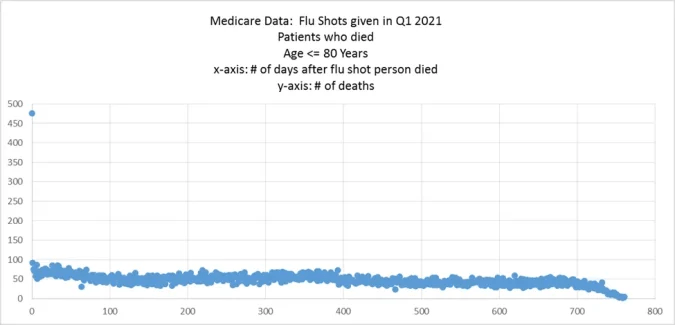
Figure 1. Number of deaths per day after taking the flu shot. See the spike on Day 0? It’s easy to miss if you aren’t looking. That’s a problem. That could only be caused by the vaccine itself. There is no other way to explain this “coincidence.”
See the spike on Day 0?
At least 375 “excess deaths” on Day 0!
Last I checked, there is no need to vaccinate people for the flu right before they die because the vaccine takes time to have an effect. That’s why there is normally a reduced number of deaths on Day 0 vs. baseline: if you are about to die, they aren’t going to waste time vaccinating you.
But you can see there are 375 excess deaths on Day 0.
Now consider that this is a subset of all the people who get the flu vaccine in 2021:
- It’s only people in Medicare
- It’s only people who got the flu shot in Q1 of 2021
- It’s only people < 80
375 excess deaths times 1M is more than the population of the US.
So over 1 person per million died.
The flu vaccine kills > 1 person per million vaccinated.
This is above the safety threshold of a vaccine articulated by vaccine expert Paul Offit.
This means the flu vaccine should be pulled from the market.
I don’t know how I can make it any clearer than that.
And the COVID vaccine? Well, it’s killing people at a 1,000X greater rate than the flu shot. It should have been pulled long ago. Check out this analysis by Denis Rancourt that, after accumulating 100K views, was pulled from ResearchGate. It’s a quality analysis. For example, one of my colleagues who NEVER texts me on ANY papers, texted me to look at this one: “Just published. This data is really stunning.”
But the health authorities are looking the other way and the doctors just blindly do whatever the CDC says, no matter how many people are killed.
I guess that’s the way science works.
Tragic.
Launched on a Wing and a Prayer (For Billions of Dollars)

By Laurie Calhoun | Libertarian Institute | March 14, 2023
Way back in the spring of 2020, the provocative title of an article caught my eye. Upon reading it, I learned that researchers were rushing to create a vaccine before the COVID-19 virus mutated, which would render the vaccine nugatory and destroy all hopes of creating a blockbuster panacea. Curious at the time, such a warning can be viewed today as having been prophetic. (Note: That article, which offered a business slant on the historic vaccine competition, is no longer available through Google—“some results have been removed,” and are seemingly irretrievable—but here’s one with a similar title from April 2020: “Coronavirus mutation could threaten the race to develop vaccine.”)
Consider the stunning conclusion of a peer-reviewed scientific journal article published in January 2023:
“Viruses that replicate in the human respiratory mucosa without infecting systemically, including influenza A, SARS-CoV-2, endemic coronaviruses, RSV, and many other “common cold” viruses, cause significant mortality and morbidity and are important public health concerns. Because these viruses generally do not elicit complete and durable protective immunity by themselves, they have not to date been effectively controlled by licensed or experimental vaccines.”
Accustomed as everyone is by now to a relentless barrage of contradictory proclamations and retaliatory responses to them, the claim that mRNA was never fit to purpose for rapidly mutating coronaviruses might be written off by the usual suspects as the ravings of yet another antivaxxer conspiracy theorist. Except that this paper was co-authored by Dr. Anthony Fauci, the most visible and persistent pusher of the newfangled COVID-19 vaccines throughout 2021 and 2022. So what happened?
Against all conventional wisdom on the ethical practice of medicine, Fauci did everything in his power to achieve maximal uptake of an experimental treatment by human beings across all cohorts, without regard to patient health, age, or any other identifying factor beyond their possession of an arm into which to inject a novel product granted Emergency Use Authorization (EUA) after an accelerated review by the Food & Drug Administration (FDA). Not only did Fauci ignore the vast disparities in vulnerability to severe illness and death between healthy infants and frail nonagenarians, but he also conducted himself for two years as though natural immunity through previous infection were somehow irrelevant to the question of whether a patient should roll up his sleeve.
Now, in the light of Fauci’s own published scientific findings, it would appear that he was right, in a sense, about natural immunity all along, albeit in an unexpectedly perverse way. First of all, as we already witnessed in real time, coronaviruses as a class, including SARS-CoV-2 (COVID-19), mutate rapidly in order to propagate themselves. This “discovery” served as the basis for the development of “boosters,” which, it was claimed, became necessary when “fully vaccinated” persons continued to become infected with COVID-19. Major outbreak-inducing strains such as Delta and Omicron, which arise through mutation, will always be one step ahead of last year’s vaccines, having survived precisely by evading the antibodies induced by injection into the body of the previous virus generation’s mRNA.
According to Fauci’s own findings, however, there is a second, even more compelling reason for denying that either vaccine or natural immunity to COVID-19 can ever be permanent. The primary difference between diseases such as measles, for which vaccines work, and the seasonal flu or SARS-CoV-2, for which they do not, is that the body’s natural immune response rises only to the level of the severity of the pathogen. Since most people can survive coronaviruses, the minimal response needed to defeat the invader is rather mild, which is why immunity dissipates rapidly over time and people can become reinfected again and again, even if they have recovered from natural infection, and whether or not they have undergone vaccination.
There are of course people who die of the flu or COVID-19, but they nearly always have comorbidities, infirmities or weaknesses, rendering them vulnerable to a pathogen which healthy bodies are capable of defeating. Notwithstanding the massive propaganda campaign for universal vaccination, most healthy young persons would have survived COVID-19, and would not have been hospitalized, with or without vaccination. Given the abundance of statistical evidence, there is simply no sense in which it can be truthfully asserted that healthy young persons with no comorbidities were “saved” by the shots. On the other hand, extremely frail and elderly persons can indeed be killed by the virus, regardless of how many “vaccines” they have taken. When it comes to the mercurial class of coronaviruses—instantiated by not only the common cold and the seasonal flu, but also COVID-19—so-called vaccines will never transcend their pedestrian identity as mere shots, for they are constitutionally incapable of offering longterm protection, not only because these viruses rapidly mutate, but also, and more fundamentally, because the body’s natural response to infection by such transitory viruses is never robust enough to be permanent. Just as having survived the flu one year has nearly no bearing on whether one will contract another case of the flu, from a different variant, in the future, no so-called vaccine solution to COVID-19 can confer longlasting protection.
Take as many boosters as you like, until the end of time, but having done so may or may not prevent you from contracting the latest iteration of the virus—or protect anyone else—since every booster or flu shot is the result of researchers’ “best guess” of what the specific properties of the next generation of viruses will be. It appears, then, that the widely celebrated and aggressively marketed, and in some cases mandated, COVID-19 vaccines, paid for thrice by the recipients of “free” shots, were in fact launched on a wing and a prayer. There was really no hope all along that the shots would or could offer longterm protection, although it was claimed for marketing purposes that they were highly effective and would save millions of lives. That those selling points were in fact lies may explain why they were supplemented all along the way with such eerily self-contradictory slogans as: “The vaccinated need to be protected from the unvaccinated!”
Dr. Fauci’s surprising publication reveals that the abundant optimism exuded by him and others in attempting to maximize vaccine uptake was scientifically unfounded from the beginning. Neither the mRNA technology nor the traditional vaccines (which introduce a small amount of the live or dead pathogen into the body to elicit an immune response) can be effective for rapidly evolving pathogens such as coronaviruses to which the highly efficient human body mounts the weakest possible effective response. But this is hardly news, for we already knew long before 2020 that, despite assiduous efforts spanning decades, no one ever managed to develop a vaccine against the common cold. Likewise, the widely touted flu shots, marketed in very public ad campaigns only slightly less aggressive than those for the COVID-19 treatments, are in fact mediocre at best, as Fauci himself has averred.
If vaccine technology, whether vector- or mRNA-based, is simply a mismatch for the nature of rapidly mutating viruses, and this is a matter of common knowledge, readily accessible to anyone working in virology, then how are we to understand Fauci’s comportment throughout the Coronapocalypse? And why did he and his coauthors boldly reaffirm in January 2023 what many other researchers have been saying for years, including a few brave souls who were silenced when they tried to suggest the same from 2020 to 2022?
Fauci faces something of a “Charybdis or Scylla” dilemma here, for if he was ignorant of basic truths of immunology known by competent and knowledgeable scientists before 2020, then he had no business serving as the nation’s fount of public health wisdom. Double-masked Fauci devotees, in the aftermath of what was empirically indistinguishable from a full-scale psyop spanning more than two years, will no doubt remain reluctant to renounce their allegiance to the person who, they believe, “guided” us through the pandemic. Confronted with the revelations of Fauci et al.’s January 2023 publication, such followers may most charitably conclude that the object of their reverence did genuinely believe in the mRNA vaccines and continues to follow “The Science” where it leads, in this case, to finally acknowledge failure.
That Fauci honestly did not know that the mRNA shots would never work has also been the conclusion of a few of his most vociferous critics, including Alex Berenson, who somewhat ironically was spurned as “The Pandemic’s Wrongest Man” by The Atlantic back in April 2021. (Morally speaking, that title surely belongs to Dr. Anthony Fauci himself, for the sheer brazenness with which he defied all known principles of medical ethics in pushing for universal vaccination across all cohorts.) Berenson was banned from social media under pressure by no less a power than the U.S. government itself when he dared to question the Fauci script at the height of the Coronapocalyptic hysteria. (Berenson’s lawsuit alleging the government’s violation of his First Amendment right to free speech is pending.)
Notwithstanding the superficial appeal (and attendant Schadenfreude) of the “Fauci was ignorant and is now eating crow” hypothesis, the Scylla horn of the interpretive dilemma would seem to cohere far better with the character of a man who remarkably responded to his critics on national television that “You’re really attacking not only Dr. Anthony Fauci, you’re attacking science.” Certainly such a person is not someone whom we would ordinarily regard as endowed with the humility needed to admit either ignorance or error. To my mind (and others, such as Dr. Robert Malone, agree) Fauci’s recent publication is yet another gambit perfectly consistent with his comportment throughout the pandemic. While Fauci’s admission that the mRNA technology is not fit to purpose for coronaviruses may on its face seem surprising, in fact, it is entirely true to form.
Yes, Fauci’s gambit is most plausibly interpreted as the latest chapter in his time-tested “fail forward” playbook: to use the outcome of the COVID-19 shot experiment to rally for yet more funding for the pharmaceutical industry. Like all good bureaucrats, Fauci uses government fiascos as a springboard to increase the reach and budget of his domain. In other words, Fauci, having quite effectively painted the COVID-19 virus as the most evil bogey man of them all, is simply continuing his efforts to impel politicians to dole out even more billions of dollars to the government-boosted industry which he has loyally supported throughout his entire career, as has been ably documented by Robert F. Kennedy, Jr. In addition to being consistent with Fauci’s dismissive, smug, and seemingly shameless character, this interpretation coheres well with the general modus operandi of the pharmaceutical industry, which has displayed in recent decades an uncanny capacity to “fail forward” by pivoting and innovating so as to be able to reap massive profits even when their products generate consequences worse than the conditions which they were intended to address.
Note that slippery snake-oil salesmen such as Pfizer’s CEO, Albert Bourla, carefully calibrated their pitches from the beginning so as to protect themselves from future allegations of fraud by equivocating about the “efficacy” of their COVID-19 treatments. When directly questioned in December 2020 about the vaccine’s ability to limit transmission of the virus, Bourla offered casual, off-the-cuff replies such as, “I think that’s something that needs to be examined. We’re not certain about that right now.” His colleague, Ugur Sahin (co-founder and CEO of BioNTech), cagily couched his anticipatory optimism in these terms: “The first interim analysis of our global Phase 3 study provides evidence that a vaccine may effectively prevent COVID-19.” [my emphasis] The rest is history. When it later emerged, to the surprise of everyone whose understanding of the crisis was shaped exclusively by the Pfizer-sponsored mainstream media, that the company never even tested the shots for their ability to prevent transmission, gaslighting fact-checkers rushed to the defense of the executives. Why in the world would anyone ever have believed that the new vaccines would prevent transmission and infection?
The government-subsidized pharma giants succeeded in profiting enormously from the politically amplified crisis by persistently touting the efficacy of their products against a virus which 99+% of people were perfectly capable of surviving on their own. The shot salesmen claimed victory when injected persons did not die, when in reality most of them would have survived even if they had declined the treatment or been injected with an inert placebo instead. But the scheme ultimately worked because marketers (including public health authorities such as Anthony Fauci and Rochelle Walensky) unerringly referred to the shots as “vaccines,” a piece of sleight of hand made possible by the CDC’s own diluted redefinition of the term in 2021 to mean “a preparation that is used to stimulate the body’s immune response against diseases.” This linguistic legerdemain worked wonders to promote the new shots, when in fact the new definition is so broad and open-ended as to make it possible to label as a vaccine anything that strengthens the immune system, including leafy green vegetables, vitamins C and D, etc.
In retrospect, there can be no doubt that the populace and the politicians crafting policy all assumed that the labeling of the mRNA treatment as vaccines implied that the shots stopped transmission and infection, even while the savviest of the snake-oil salesmen evinced ignorance from the start about the most important question of all: whether these “vaccines” were indeed like all of the other vaccines, capable not just of “stimulating” the immune system, but of producing dependable and durable immunity.
Given the statistics now available, even the more modest claim, continually chanted by pharma marketers and their lackeys in the media, that the mRNA treatment greatly diminished severe illness and hospitalization, may have been false. For the death toll of COVID-19 victims increased rather than decreased in the year after the “vaccine” launch, and the countries with the worst vaccine uptake had some of the best outcomes. On top of the virus deaths, thousands of people were diagnosed with post-vaccine injuries of a variety of sorts, believed by many of them, their families, and at least some of their doctors to have been caused by the shots. Some of the vaccine injured ended up dying long before their time, and excess deaths were also caused by the disastrous political response to the virus, with fatal drug overdoses reaching record levels. Millions of persons missed vital health screenings, having been terrorized into believing that they could not leave their homes (much less enter COVID-19–infested health facilities!) without contracting something akin to the Black Plague. Among those who sought help for their ailments, some were flat-out denied treatment for acute illnesses, either because they were not dying specifically of COVID-19, or because they had refused the experimental treatment.
In coming to terms with what transpired over the past three years, it is helpful to bear in mind pre-2020 history. When the pharmaceutical industry’s newfangled psychotropic medications did not work as advertised, they created and blitz-marketed “add-on” drugs to increase the efficacy of antidepressants now known to have exhibited success in clinical trials on a par with placebos, but with far worse longterm adverse effects, up to and including addiction and suicidal ideation. Similarly, the slick pivot of the industry in response to the opioid catastrophe (caused by itself) was to launch and market drugs which could help people in the throes of narcotics addiction.
The flu shots marketed in collaboration with and subsidized by governments have been demonstrated in clinical trials to succeed on a par with placebos, while post-flu shot deaths are invariably written off as “coincidental.” Nonetheless, the industry capitalizes on the fact that they are starting anew each year—the previous year’s flu shot results being irrelevant to the next year’s projected success. As a result, when heavily lobbied and propagandized authorities impose mandates in some places (such as the State of Massachusetts), this may lead others to follow suit. Crony capitalist windfall profits ensure the ever-augmenting marketing budget of pharma firms, with the result that each subsequent year’s sales will exceed the previous year’s tally.
Given such precedents, no one should be surprised if the failure of the COVID-19 shots to prevent infection and transmission, or even to diminish the number of persons who died from the virus, does indeed end up serving as the pretext for governments to infuse even more money into research and development of new and what are promised once again to be “miraculous” cures to be used in the future. Not long after the launch of the COVID-19 vaccines, auxiliary treatments such as Pfizer’s Paxlovid and Merck’s Lagevrio were developed to treat people who became infected with the virus despite having been “fully” vaccinated. As clear evidence that many people’s capacity for critical thought continues to be compromised by fear, when legislation to rescind the utterly illogical and unscientific COVID-19 vaccine mandate on foreigners entering the United States made it to the floor of the House of Representatives, 201 Democratic congresspersons voted to keep the executive order in place.
The ongoing support of the official government pro-pharma narrative by the president, the press secretary, the defense secretary, and most Democratic members of Congress, even in the face of ample evidence (including post-vaccination positive COVID-19 tests) demonstrating that the shots did not diminish the incidence of infection is best explained by the fact that policymakers prefer not to own up to their mistakes. Ordinarily, individuals base their future actions on what they have learned from past experience. The question arises in the present circumstance: Why is there still a push for vaccine passports when the COVID-19 vaccines do not in fact confer immunity? The assumptions funding the push for universal vaccination continue to be embraced, as though the vaccines worked resplendently, despite an accumulation of scientific evidence to the contrary.
Now that Fauci himself has clearly explained why the mRNA technology will never offer a lasting solution to COVID-19, why would anyone, including Joe Biden and other advocates for the WHO (World Health Organization), still be in favor of implementing a universal health passport system regulating the movement of persons throughout the world? The current crop of shots do not offer longterm protection and do not moderate illness except in the case of persons in a very narrow cohort. Why require anyone to demonstrate that they participated in the experimental mRNA trial more than two years ago in order to be able to enter a country where the circulating variants bear little resemblance to the strain used to determine the formula of the first crop of vaccines?
There is no plausible health pretext available to explain why political leaders around the world would be keen to impose such a restrictive health passport program on free people, preventing them from traveling unless they first demonstrate their willingness to comply with future possible arbitrary orders decreed by public health authorities. That anyone not holding pharma stocks would support at this point the adoption of a health passport is best explained, again, by the politically induced trauma which appears to have psychologically scarred some persons for life. But just as the failure of the lockdowns to “stop the spread!” impelled leaders at every level of government—local, state, and federal—to prolong and intensify the lockdowns, those who pushed vaccine mandates will continue to press for universal vaccination passport requirements under the flatly false assumption that the reason why so many people died of COVID-19 was because of the evil antivaxxers who refused to comply.
What we are witnessing, the strangely intransigent push for vaccine passports, is entirely consistent with the comportment of the very persons who just succeeded in selling billions of shots. They will continue to insist that what we need to do is provide even more government funding to the pharmaceutical industry so that they can develop more and better cures for our ills. As disturbing as this may be, the most plausible explanation for the vigorous attempt to impose a health credential system on the people of the world is to provide the pharmaceutical industry with a limitless supply of not only customers, but also future experimental subjects.
As we have seen, the addition of the COVID-19 shot to the CDC’s immunization schedule for children—whose chances of dying from the virus are minuscule—serves only industry interests, by ensuring an endless crop of healthy young arms into which to inject the latest and greatest snake oils claimed to be panaceas (until it emerges that they are not). Likewise, the implementation of a universal health passport scheme restricting the motion of persons who opt not to undergo medical treatments of which they have no need would not only reap massive profits to the pharmaceutical industry but also represent the dawning of the pharma-techno state, in which citizens are subjects whose bodies are owned by their government.
The upshot here is that all of the pro-mRNA treatment propaganda and the incredibly vicious efforts to denounce and blame the noncompliant as the reason for the lengthy duration of the COVID-19 pandemic were nothing more than marketing ploys. That those who work behind the scenes of this well-oiled marketing machine were willing to destroy people’s relationships, their livelihoods, and in some cases even their very lives, reveals that their true motives were never to save the world from the virus but, instead, to profit from it. This is why we must resist any and all attempts by these same people and their toadies to foist upon us legal requirements to serve as guinea pigs in their future experimental trials, which is precisely what “health passports” would bring.
Laurie Calhoun is the Senior Fellow for The Libertarian Institute. She is the author of We Kill Because We Can: From Soldiering to Assassination in the Drone Age, War and Delusion: A Critical Examination, Theodicy: A Metaphilosophical Investigation, You Can Leave, Laminated Souls, and Philosophy Unmasked: A Skeptic’s Critique, in addition to many essays and book chapters. Questioning the COVID Company Line: Critical Thinking in Hysterical Times will be published by the Libertarian Institute in 2023.
“Disinformation experts” blame “conspiratorial narratives,” “far-right websites,” for Silicon Valley Bank panic
Amidst calls for online censorship
By Cindy Harper | Reclaim The Net | March 18, 2023
Just days after a Senator was caught asking whether there were systems in place to censor social media in an attempt to prevent a bank run, “disinformation experts” are partially blaming the Silicon Valley bank collapse exacerbation on online conspiracy theorists on social media.
“Russian media outlets, far-right websites, short sellers and doomsday preppers were among those who pushed and amplified conspiracy theories online focused on the collapse of Silicon Valley Bank,” Bloomberg alleges.
According to anti-disinformation for-profit firm Alethea, a wide range of accounts used the bank’s collapse to promote their own agendas.
The firm’s founder Lisa Kaplan told Bloomberg that the claims by venture capitalists speculating the collapse of the bank that were amplified “propagandists and foreign influencers” contributed to the collapse of the bank.
“We assess that these outlets may have increased online panic and contributed to the broader cross-platform spread of false or misleading content about SVB,” Kaplan said to Bloomberg.
“We also assess that conspiratorial narratives may have accelerated panic, which then posed a risk to the broader financial system,” she said.
“This shut down a bank, and I’m concerned about it happening again,” Kaplan added.
Multiple pundits and websites claimed that the bank collapsed because of the prioritizing of environmental, social, and government initiatives over risk management.
Sy Hersh: “Biden Admin Blew Up Nord Stream”
By John Leake | Courageous Discourse | March 17, 2023
No one can say that Seymour Hersh hasn’t earned his spurs as a reporter of U.S. government and military skulduggery. In 1970 he won the Pulitzer Prize for International Reporting of the My Lai Massacre in Vietnam. In 2003 he accurately disputed the Bush Administration falsehoods about its grounds for invading Iraq. In April of 2004 he reported how U.S. military units in charge of the Abu Ghraib prison were torturing and abusing prisoners. Now, at age 85, “Sy” shows no sign of slowing down.
On February 8 of this year, Hersh reported on his Substack that the sabotage of the Nord Stream 1 and Nord Stream 2 pipelines on September 26, 2022 was ordered by the Biden Administration and carried out by Navy divers. At first glance, Hersh’s report simply confirmed what President Biden unequivocally stated at a Feb. 8, 2022 press conference—that is, “If Russia invades … there will no longer be a Nord Stream 2; we will bring an end to it.”
Nevertheless, the Biden Administration vehemently denied Mr. Hersh’s report. Last week, in response to these denials, Mr. Hersh gave a long interview in which he reaffirmed his claim that the Biden Administration is responsible for destroying Russia’s gas pipeline, which supplied Germany with a vast source of affordable, clean-burning energy.
Shortly after the sabotage, former CIA Director John Brennan told CNN that Russia was “the most likely suspect” for sabotaging the pipeline—as though destroying its immensely valuable, strategic asset somehow yielded a greater advantage to Russia than simply shutting it down.
IF Hersh is correct and his protected source is telling the truth, it must surely be one of the whackiest things a U.S. President has ever done. Like Cortez burning his ships when he landed in Mexico in 1519 in order to impress upon his men that there was no turning back from their adventure to conquer the country—Biden (or whoever is pulling his marionette strings) ordered the sabotage in order to reinforce Germany’s commitment to the U.S. proxy war against Russia.
How do the German people feel about an American presidential administration wrecking their industry, high standard of living, and consigning them to paying 400% more to heat their homes?
As Hersh describes it, German Chancellor Olaf Scholz is indistinguishable from Biden’s “lapdog.” Why? What has the U.S. done for Germany since reunification in 1990 that has instilled such a feeling of slavish docility in a German chancellor today?
As recently as 2015, America’s blundering wars in Iraq, Libya, and Syria caused a major refugee crisis in Europe, and it was Germany that bore most of the cost and responsibility. One wonders why the Germans don’t tell the U.S. government to retreat to Washington to deal with its own, innumerable domestic problems of its own making.
White House Rejects Ceasefire In Ukraine As China Mediation Intensifies
By Tyler Durden | Zero Hedge | March 17, 2023
The White House is already condemning any possible China-brokered peace plan initiative related to Ukraine before it even gets off the ground. Following Beijing confirming on Friday that Chinese President Xi Jinping will travel to Moscow on Monday through Wednesday to hold talks with President Vladimir Putin, the Biden administration is expressing concern and alarm over a potentially ‘bad deal’ for Ukraine.
White House national security spokesman John Kirby warned that any unconditional ceasefire would only benefit Putin and his forces as this point. This after it’s also been revealed that Xi is expected to hold a phone call with Ukraine’s Zelensky related to China’s 12-point peace plan. “A cease-fire now is… effectively the ratification of Russian conquest,” Kirby said. “And of course, it would be another continued violation of the U.N. Charter.”
The US is worried that China’s diplomatic intervention and peace plan could result in significant territorial concessions:
White House national security spokesperson John Kirby said Friday that an unconditional cease-fire halting Russia’s offensive in Ukraine would legitimize Moscow’s hold on an estimated 17 percent of Ukrainian territory that was taken by force.
This is chiefly in the east, namely the Donbas region, where Russia has been making gains of late and is poised to take the strategic city of Bakhmut.
But Kirby’s preemptively and outright rejecting any possible ceasefire is at odds with prior repeat US statements that it is solely Zelensky’s decision to make. The White House has lately really promoted the idea that it is not in the background making decisions for Kyiv, but that it’s the Zelensky administration exercising its own sovereign choices concerning war strategy.
But in this instance of Washington trying to slam the door on Chinese-mediated peace, clearly it puts pressure on Zelensky to do the same.
The US may also be alarmed at how open Ukraine appears to be in dealing with China. The Hill notes of the latest positive interaction between China and Ukraine:
Ukrainian Foreign Minister Dmytro Kuleba on Thursday said he spoke with China’s State Councilor and Foreign Minister Qin Gang, where the two discussed “the significance of the principle of territorial integrity” and underscored the importance of Zelensky’s “Peace Formula” to end Russia’s war, which in part calls for Russia to withdraw its troops from all the territory it occupies in Ukraine.
But from the moment it was unveiled, the US alleged cynical motives behind Beijing’s peace efforts, despite Zelensky hinting he is open to deepened discussion with Chinese leadership.
Kirby in his fresh remarks said that Moscow will use any possible ceasefire to solidify gains. Then Russian forces will “basically be free to use that ceasefire to further entrench its positions in Ukraine,” he stated.
Featured Video

Seyed M. Marandi: US-Iran War Inevitable: Kuwait and Bahrain May Fall
or go to
Aletho News Archives – Video-Images
From the Archives
Oil and the Israel Lobby
Reknowned economist M. Shahid Alam offers this excellent critique of Noam Chomsky’s defective analysis of the relative influence of Oil versus the Israel lobby over US foreign policy: … continue
Blog Roll
 Aletho News
- ICC ignored ‘very well-documented’ NATO crimes – ex-Libyan minister
- SNSC secretary dismisses US response to Iran’s conditions as ‘inadequate’
- Sanaa says Taiz roads open, secure for residents, warns Saudi forces
- Iraqi resistance group urges Saudi leadership to admit defeat, lift Yemen siege
- Trump’s Retreat: How Al-Aqsa Flood Took Down the US Empire
- Israel’s Military Actions in Lebanon Grossly Violate International Law — Lavrov
- Seyed M. Marandi: US-Iran War Inevitable: Kuwait and Bahrain May Fall
- Leaders Condemn Ansarallah Attack on Saudi Arabia While Ignoring Illegal War Against Yemen
- Leaked: Britain’s Covert Iraqi Psyops Network
- Yemeni Armed Forces Warn Airlines Against Using Saudi Airports, Exempt Mecca and Medina
- If Americans Knew
- After Oct 7, IDF policy allowed civilian casualties for even the lowest-ranking targets
- Israel’s Destruction of Southern Lebanon Intensified After the Cease-Fire
- The Last-Minute Decision That Gave Israel Its Name
- The American Conservative: How Trump Made the World Go Nuclear
- Meet the US generals and admirals advancing Israeli policy
- Opinion: Why news organizations should boycott Israel
- The Israeli witch hunt of Sami Abu Shehadeh exposes the lie of the ‘Jewish and democratic’ state
- No state has a ‘right’ to exist – least of all Israel
- Testimonies about Gaza’s civilian death toll expose Israel’s atrocities – Daily Update
- How Israel Conquered the Latin American Right
- No Tricks Zone
- New Study Suggests Large Regions Of The Pacific Ocean Have Been Cooling For The Last 80 Years
- Germany’s Green Energy Debacle: High Energy Costs Force Kahla Porzellan to Close After 182 Years!
- New Study: 50 Years Of The Most Aggressive ‘Net Zero’ Policies Can Only Affect The Global Climate By 0.03°C
- US September “Heat” Was No Record…Many Records Set Decades Ago
- Latest European Green Energy Debacle; Portugal’s Largest Flagship Solar Park Insolvent!
- Green Energy Debacle: German Expert Professor Fritz Vahrenholt Warns Of Severe Economic And Social Consequences
- Two More Paleo Reconstructions Affirm Meters-Higher Sea Levels Across Ireland, Brazil 7000-6000 Years Ago
- New Study: Earth And Venus Surface Warmth Largely Explained By Convection And Lapse Rate, Not CO2 Or Radiation
- 2025 Nature Paper Claiming Worsening Global Drought Gets RETRACTED …Heavily Flawed
- New Study: ‘Global Drought Shows No Detectable Recent Acceleration Under Climate Warming’

