Poland expands offer of tanks for Ukraine
RT | January 27, 2023
Poland is ready to send 60 more tanks to Ukraine to help fight Russia, besides the 14 German-made Leopard 2 vehicles already pledged, Polish Prime Minister Mateusz Morawiecki has said.
“If we don’t want Ukraine to be defeated, we have to be very much open and brave in supporting Ukraine,” Morawiecki told Canada’s CTV News broadcaster on Friday.
According to the prime minister, Poland is trying “to lead by example,” showing its allies what should be done to help Kiev.
“Right now, we are ready to send 60 of our modernized tanks, 30 of them PT-91. And on top of those tanks, 14 tanks, Leopard 2 tanks, from in our possession,” he said.
Morawiecki also noted that last year Warsaw provided about 250 of its modernized Soviet-era T-72 tanks to the Ukrainian military.
Mikhail Podolyak, an adviser to Ukraine’s President Vladimir Zelensky, confirmed on Telegram on Friday that 60 more Polish tanks will be heading Ukraine’s way. According to Podolyak, the shipment consists of PT-91 Twardys, upgraded Soviet T-72M1 main battle tanks. “Thanks to our allies,” he wrote.
Morawiecki did not specify when the additional tanks will be supplied.
On Thursday, Poland’s Deputy Defense Minister Wojciech Skurkiewicz said Warsaw plans to provide 14 Leopard 2s to Kiev after Ukrainian troops finish training with them, which could happen in “several weeks.”
The delivery of Leopard 2s by Poland to Ukraine became possible on Wednesday after Germany officially approved the supply of 14 tanks from its own stocks to Kiev, and allowed other countries to re-export the German-made weaponry to the Zelensky government.
On the same day, the US agreed to supply Kiev with 31 of its M1 Abrams main battle tanks. Earlier this month, the planned delivery of Challenger 2 tanks to Ukraine was announced by the UK.
Russia’s deputy envoy to the Organization for Security and Co-operation in Europe, Maksim Buyakevich, warned on Thursday that arming the Ukrainian military with Western tanks “is a straight path into a full-blown conflict in Europe.”
Earlier this month, Kremlin Press Secretary Dmitry Peskov insisted that German, US and British military hardware will not change the outcome of the conflict, and that the tanks will “burn” if they arrive on the battlefield.
The Pentagon’s Perpetual Crisis Machine

By Jacob G. Hornberger | FFF | January 26, 2023
Given President Biden’s decision to send 31 of its top-ranked M1 Abrams tanks to Ukraine, it is clear that the Pentagon has decided to escalate its war against Russia. Biden’s decision was followed by Germany’s decision to deliver 14 Leopard 2 A6 tanks to Ukraine. I’ll guarantee you there isn’t a Russian alive who doesn’t know about the time in the 1940s when Germany sent its tanks deep into Russia, killed millions of Russians, and almost succeeded in conquering the country.
If the increasing pressure that the Pentagon is putting on Russia does not result in a nuclear war between the United States and Russia, the advocates of this highly dangerous interventionist and escalatory strategy will later exclaim, “You see, we told you that there was never a risk of nuclear war.” But what’s interesting about the Pentagon’s strategy is that if it does result in nuclear war, there won’t be anyone around to point out how wrongheaded it was.
This is obviously no way to live. But this is what life is like under a national-security state form of governmental structure. The military-intelligence establishment needs a constant stream of crises to keep people agitated, hyped-up, afraid, anxious, and tense. In that way, they’ll look to the military-intelligence establishment to keep them “safe.” Without the constant stream of crises, people might be apt to ask, “Why do we need a national-security state? Why can’t we have our limited-government republic back?”
Moreover, a constant stream of crises ensures ever-increasing taxpayer-funded largess for the Pentagon, the CIA, and the NSA, which are the three principal components of the national-security establishment. That amount will soon reach $1 trillion per year. I’ll guarantee you that the manufacturers of tanks are uncorking the champagne bottles today. After all, those tanks being sent to Ukraine have to be replaced. Hard-pressed American taxpayers will pay for them, either directly through taxes or indirectly through more federal debt (now at $31.5 trillion and climbing every day) and inflation.
That’s what the entire Cold War racket was all about — keeping Americans agitated, hyped-up, afraid, anxious, and tense. Everyone was inculcated with the notion that the Russian Reds were coming to get us. Only the Pentagon, the CIA, and the NSA could save us from a communist takeover. The only president who has ever been willing to confront this scam was President Kennedy, and we all know what happened to him.
When the Cold War came to an end, unfortunately the Cold War racket didn’t. The national-security establishment kept their old Cold War dinosaur NATO in existence. Breaching their promise to Russia, the Pentagon began using NATO to absorb former members of the Warsaw Pact. The Pentagon knew precisely what it was doing — setting the stage for the continuation of its old Cold War racket, at least with respect to Russia.
When the Pentagon ultimately crossed what Russia had repeatedly emphasized was a “red line” by threatening to absorb Ukraine into NATO, the Pentagon achieved what it wanted — the continuation of its old Cold War racket, except for the part that the Reds were coming to get us.
But they’re still not willing to let go of the Red part of their Cold War racket. That’s why they’re now doing their best to gin up a crisis with China over Taiwan. That crisis will enable them to exclaim, “See, you need us to protect you from both Russia and the Chinese Reds.”
And don’t forget — they still have their perpetual war-on-terrorism racket. Sure, they’re not killing people en masse anymore in Afghanistan and Iraq, but they still are killing people in the Middle East and Africa. The potential terrorist retaliation from those continuous killings are enough to justify the continuation of their forever war-on-terrorism racket as well as the continuous destruction of our rights, liberties, and financial security here at home, as part of the process of keeping us “safe” from the terrorists who supposedly hate us for our “freedom and values.”
The important thing is that a life of permanent, perpetual crises is neither necessary nor inevitable. There is a way to restore normal life to America — one that isn’t based on a continuous stream of crises. That way is to dismantle the national-security state form of governmental structure and restore our founding governmental system of a limited-government republic. The only question is whether Americans have the will and the fortitude to do this. One thing is for sure: Our freedom, well-being, and possibly even our survival depend on it.
Weapon Manufacturers Record Skyrocketing Profits From US Arm Sales in 2022
By Ian DeMartino – Sputnik – 26.01.2023
War has always been big business in the United States. According to the seminal anti-war essay “War is a Racket,” gunpowder manufacturer Du Ponts saw their profits increase by more than 950% during The Great War.
US arms sales to other countries skyrocketed in 2022, providing a tidy sum of profits for weapon manufacturers, according to data released by the State Department on Wednesday.
US weapon sales to other countries, largely driven by NATO’s response to Russia’s special military operation in Ukraine and increased tensions in Asia, jumped from $35.8 billion in 2021 to $51.9 billion in 2022.
Direct weapon sales from US-based weapon manufacturers also saw a massive increase, jumping from $103.4 billion in 2021 to $153.7 billion in 2022.
In Europe, the largest purchasers include Germany, which ordered 35 F-35 Joint Strike Fighter airplanes for $8.4 billion, and Poland, which spent $6 billion on 250 M1 Abrams tanks.
The United Kingdom, Spain, and new NATO member Bulgaria also made significant purchases in 2022.
Meanwhile, tensions in Asia over Taiwan and competing claims in the South China Sea have also been a boon for weapon manufacturers. Significant weapon sales in the area include $13.9 billion from Indonesia for 36 F-15ID fighter jets and a $1.95 billion purchase from Australia for 40 Black Hawk helicopters and other equipment. South Korea and Japan also made significant military purchases, totaling $790 million and $588 million respectively.
The Biden administration also approved a $1.1 billion weapons package for Taiwan in an effort to deter China from militarily seizing the island.
The Middle East, always a reliable profit center for military contractors has continued to be so. The two countries pushing the brutal war in Yemen, Saudi Arabia and the United Arab Emirates, have asked for $3 billion and $2.2 billion in military weapons and equipment from the United States respectively.
During the 2020 campaign, the Biden administration pledged to stop sending weapons to Saudi Arabia because of its war in Yemen.
Unsurprisingly, this has led to significant revenue gains by weapon manufacturers.
Revenue for Lockheed Martin, which develops the F-16, F-22, and F-35 fighter jets rose 7.13% to $19 billion in the fourth quarter of 2022. Northrop Grumman, which also makes F-35 fighter jets, is expected to report 11.8% revenue growth compared to fourth quarter earnings when it issues its financial reports on Thursday.
Meanwhile, Raytheon, the maker of the Patriot Air Defense System the Biden administration recently announced it will supply Ukraine with, saw its Q4 profit rise of nearly 18% compared to last year.
Judge calls California’s medical misinformation law “nonsense,” blocks it
By Christina Maas | Reclaim The Net | January 25, 2023
A federal judge questioned the new California law that penalizes doctors for sharing COVID-19 “misinformation.”
The new law, which came into effect on January 1 this year, prohibits doctors from spreading what the state deems to be misinformation to patients, or risk being penalized for “unprofessional conduct,” which could result in their licenses being revoked.
Here’s a summary of the case so far if you’re not up to date.
The law has been challenged through separate lawsuits filed by two organizations and a group of doctors on the grounds of First Amendment violations. They filed a motion at the US District Court of Sacramento to hold the law until the cases are concluded.
In a hearing, Senior Judge William Shubb described the law’s definition of misinformation as “nonsense.”
We obtained a copy of the order for you here.
“Because AB 2098 [the misinformation law] implicates [plaintiff’s] First Amendment right to receive information, she has standing,” the court wrote.
“Vague statutes are particularly objectionable when they involve sensitive areas of First Amendment freedoms because they operate to inhibit the exercise of those freedoms,” the court added, referring to a 2001 case, California Teachers Association v. State Board of Education.
“When the challenged law implicates First Amendment rights, a facial challenge based on vagueness is appropriate.”
The court granted the plaintiffs a hearing to challenge the law and blocked the enforcement of the law until the case is decided.
The law defines misinformation as “false information that is contradicted by contemporary scientific consensus contrary to the standard of care.”
Shubb noted that “standard of care” is not a new principle, but argued, “contemporary scientific consensus” is.
According to Deputy Attorney General Kristin Liska, who is representing Gov. Gavin Newsom, a medical professional has to violate all three aspects of the definition of misinformation for punishment to be applicable; share misinformation, contradict scientific consensus, and go against the standard of care.
However, she refused to give examples of statements that would fit the definition, saying that it would depend on the circumstances. Shubb then asked how she expects medical professionals to know what would violate the law.
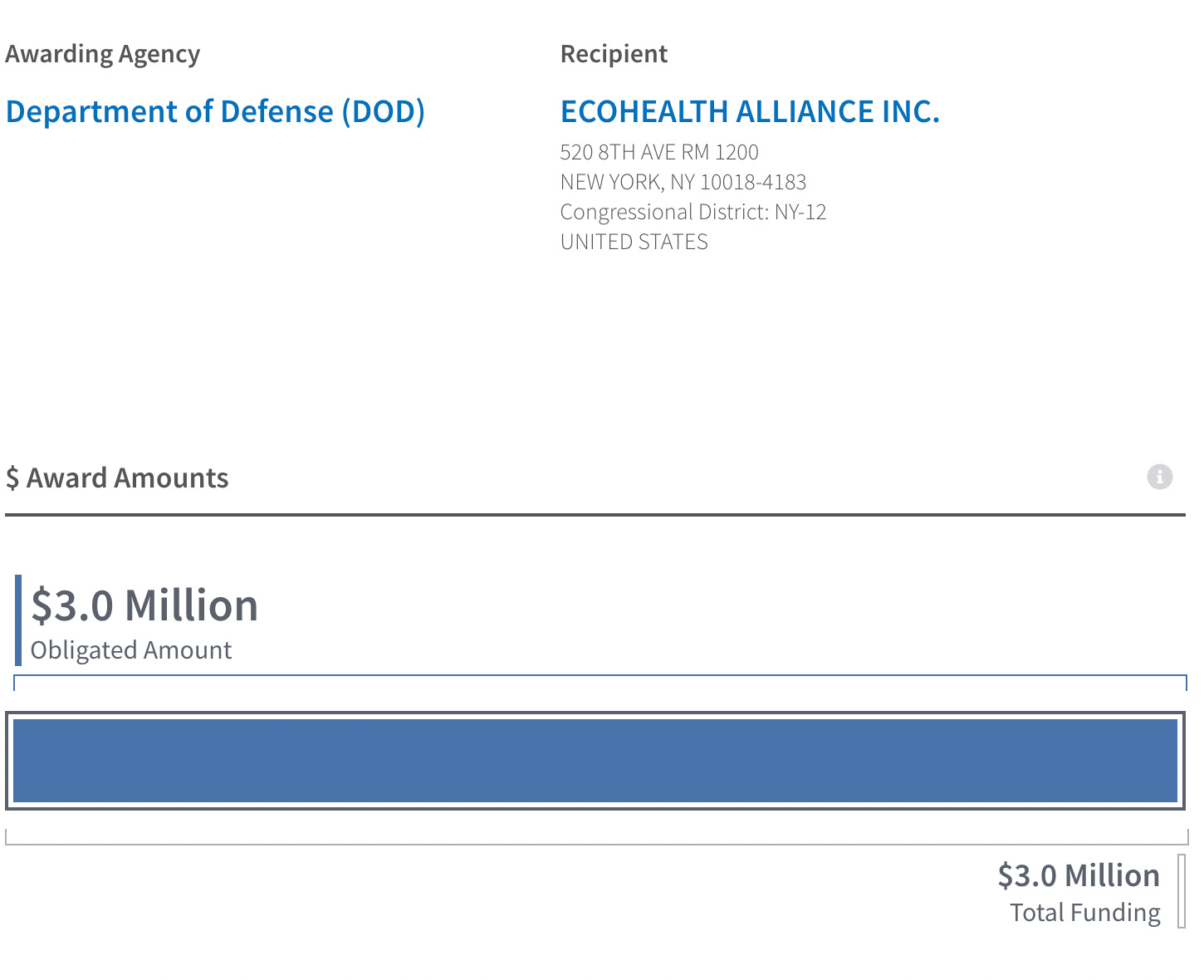
EcoHealth Alliance Gets Fresh $3 Million DOD Grant
Business as usual for key developer of SARS-CoV-2
By John Leake | Courageous Discourse | January 25, 2023
Just last month, Dr. Andrew Huff—former senior scientist and vice president at EcoHealth Alliance—published The Truth About Wuhan, in which he details how SARS-CoV-2 was engineered in a lab, and how its leak from the lab was covered up by EcoHealth Alliance president and CEO Dr. Peter Daszak in collaboration with NIAID Director, Anthony Fauci.
That SARS-CoV-2 emerged from a lab is no secret. Even the U.S. Senate acknowledged this reality last October. In 2015, Dr. Ralph Baric published a paper in which he plainly stated that he and his colleagues at the Wuhan Institute of Virology were performing gain of function work on bat coronaviruses in order to make them transmissible to humans.
It is surely one of most bizarre events in history that none of the men who developed SARS-CoV-2 are even the subject of an official investigation. On the contrary, they remain in business and continue to receive taxpayer money. As Rutgers University Professor, Richard H. Ebright recently tweeted, EcoHealth Alliance just got another $3 million Department of Defense Grant. For years, Dr. Ebright has been warning about the extreme danger of gain of function research. In 2017, he raised the alarm about lax security at the BSL-4 lab in Wuhan. No one in our government listened to him then, and it seems he continues to be ignored.
For a long time I have suspected that the Bio-Pharmaceutical Complex of international foundations and U.S. federal agencies is now operating outside of the law. The key players in this Complex are untouchable. No legislator or law enforcement officer has the heart to challenge their power. The latest Eco-Health Alliance grant is further evidence that “We the People” no longer count.
Biden Document Discovery Doesn’t Add Up
By Greg Orman – Real Clear Wire – January 24, 2023
Last week, CBS “Face the Nation” host Margaret Brennan asked Democratic Rep. Dan Goldman why President Biden would dispatch his personal attorney, who didn’t have proper security clearance, to his Delaware home to search for classified documents. Presumably, Brennan believed that when searching for classified documents, one should have the credentials to actually read them. Brennan’s focus on who was reviewing Biden’s papers touched on a potentially interesting line of inquiry. The question hanging in the air, however, relates to the discovery that started this whole process: Why would lawyers be “packing up” Biden’s office in the Penn Biden Center in the first place?
Not unlike other politicians, Joe Biden has done a terrific job of turning political success into a financial windfall. But someone who considered himself “middle-class Joe” for decades should realize the wastefulness of having lawyers perform a task that a trusted intern or aid could perform. As many big-time East Coast lawyers now routinely charge $1,000 an hour, it’s an awfully expensive packing crew – unless the intent wasn’t truly to “pack” but rather to purge.
The timing here is suspicious as well. Apparently, this moving crew was at Biden’s University of Pennsylvania office a week before midterm elections that were widely anticipated to turn control of the House over to the Republicans. As Republicans had signaled that they were going to be spending considerable time wearing out the subpoena powers of various House committees to investigate Biden and his family, it would be an auspicious time to get rid of anything damaging. By using lawyers to carry out the document purge, Biden would be able to attach attorney-client privilege to their efforts, thereby avoiding damaging testimony about the contents of any shredded documents.
To be clear, there’s nothing illegal about getting rid of musty records in the absence of a valid document retention request. The Biden administration made it clear that it would not consider any such request valid until the new Congress was sworn in and the various committee chair gavels handed out. In a response to document requests made in December from Reps. Jim Jordan and James Comer, an administration lawyer responded, “Congress has not delegated such authority to individual members of Congress who are not committee chairmen, and the House has not done so under its current Rules.” In short, you’ll have to start over. Biden was effectively setting a hard deadline for when document purges go from being propitious to being illegal.
Unfortunately for the president, the attorneys tasked with shutting down his University of Pennsylvania office stumbled across top secret government documents and understood the consequences. Had they not made those discoveries, we likely would have never heard of these high-priced packers.
Republicans, including Donald Trump, have been quick to point out the timing of the initial discovery and the lack of prompt public disclosure. They believe the midterm elections might have been more favorable to Republicans if it was clear that Trump wasn’t the only one potentially breaking the law. Maybe. But the timing and process does lead to questions about what more the current president might have to hide.
For now, President Biden wants us to take him at his word that this whole classified documents mess is nothing more than an honest mistake. As he says, “There’s no there, there.” That may be true, but the activities that preceded the classified document discoveries raise different questions. From a man who campaigned on elevating the standards at the White House, this is disappointing to say the least.
Hawley Introduces ‘PELOSI Act’ To Stop Insider Trading In Congress

By Tyler Durden | Zero Hedge | January 25, 2023
Senator Josh Hawley (R-MO) introduced legislation Tuesday aimed at preventing insider trading by members of Congress by barring them from trading individual stocks.
The Preventing Elected Leaders from Owning Securities and Investments (PELOSI) Act would require lawmakers and their immediate family members to use qualified blind trusts – a method of investing in which an independent manager buys and sells assets without the knowledge or consent of the owner in order to avoid real or perceived conflicts of interest.
Under Hawley’s act, members who refuse to do so would be required to forfeit their stock to the US Treasury.
“For too long, politicians in Washington have taken advantage of the economic system they write the rules for, turning profits for themselves at the expense of the American people,” Hawley said in a statement. “As members of Congress, both Senators and Representatives are tasked with providing oversight of the same companies they invest in, yet they continually buy and sell stocks, outperforming the market time and again.”
Last July, former Dallas fed president Richard Fisher slammed then-House Speaker Nancy Pelosi (D-CA) and her husband Paul over allegations of insider trading.
“Clearly people have taken advantage of inside information forever,” Fisher told CNBC, responding to a report from Punchbowl News. “I’m sorry to see that Paul Pelosi and Nancy Pelosi and others appear to have taken advantage of inside information.”
The Pelosis have repeatedly come under fire for the trades which appeared to be based on nonpublic information.
Recall, the last we wrote about Pelosi’s suspiciously good timing with her stock trades, we noted she had punted on several names heading into 2023. Prior to her trades being carefully scrutinized, Pelosi had a knack for minting cash from her stock trades, which we detailed here.
In March of 2021, the Pelosis scored $1.95 million on Microsoft call options less than two weeks before the tech giant secured a $22 billion contract to supply US Army combat troops with augmented reality headsets, while in January of the same year, Paul Pelosi bought up to $1 million of Tesla calls before the Biden administration announced plans to push electric vehicles.
Pelosi notably opposed bans on stock trading in the 117th Congress.
Although some Democrats, including Virginia Rep. Abigail Spanberger and Oregon Sen. Jeff Merkley, supported a ban on trading in the 117th Congress, Democrats ultimately postponed voting on a package and did not pass legislation. Then-House Minority Leader Kevin McCarthy promised the issue would be a priority for the GOP in the 118th Congress. -Daily Caller
The former Speaker has of course denied everything.
Goodbye empire? US sanctions are failing in the face of multipolarity
By Felix Livshitz | RT | January 25, 2023
Foreign Affairs, a highly influential US magazine – effectively a US empire house journal – has published an article detailing how sanctions are quickly losing their efficiency as a weapon in Washington’s global arsenal.
Published by the Council on Foreign Relations NGO, Foreign Affairs provides space for officials within the US military industrial complex to communicate with one another on matters they believe to be of the utmost significance. Therefore, it is important to pay attention when the magazine makes major pronouncements on any issue.
It recently published an appraisal of US sanctions – the conclusion being that they are increasingly ineffective, have prompted Beijing and Moscow to create alternative global financial structures to insulate themselves and others from punitive actions, and that Washington and its acolytes will no longer be able to force countries to do their bidding, let alone destroy dissenting states, through such measures in the very near future.
The article begins by noting that “sanctions have long been the US’ favored diplomatic weapon,” which “fill the void between empty diplomatic declarations and deadly military interventions.” Despite this, it predicts “the golden days of US sanctions may soon be over.”
These “golden days” were the immediate post-Cold War era, when Washington was “still an unrivaled economic power,” and therefore could at the press of a button cripple each and every overseas economy, in theory. This was due to “primacy of the US dollar and the reach of US oversight of global financial channels.”
As international trade was overwhelmingly conducted using dollars, Washington could stop any country from exporting or importing any and all goods it wished, whenever it liked. Even then, Foreign Affairs recalls, US leaders themselves worried if sanctions were applied too liberally. In 1998, then-President Bill Clinton claimed his government was “in danger of looking like we want to sanction everybody who disagrees with us.”
The Foreign Affairs article says Clinton’s fears were “overblown,” but this is precisely what came to pass. Governments, and the countries they represented, have been sanctioned for pursuing the wrong policies, refusing to be overthrown in US-backed coups and military interventions and showing any degree of independence in their domestic or foreign dealings whatsoever. In the process, millions have died, and even more lives have been ruined for no good reason.
This approach has backfired, and badly. In response, states “have begun to harden their economies against such measures.” For example, after the US cut off Iran from the SWIFT global banking system, many other countries took note. Restricting China’s access to numerous technologies as part of the new Cold War has also served to place both Washington’s allies and adversaries alike “on notice their access to crucial technology could be severed.”
Beijing and Moscow lead the way in the push to create “financial innovations that diminish US advantage,” creating a raft of “currency swap agreements, alternatives to SWIFT, and digital currencies” that serve as “preemptive measures” against any “potential penalties” down the line.
Currency swaps, which connect central banks directly to each other and eliminate the need for trades between them to be dollar-backed, have been eagerly embraced by China. It has signed deals of this kind with more than 60 countries across the world, thereby enabling its companies “to circumvent US financial channels when they want to.”
In 2020, Beijing settled more than half its annual trade with Moscow in currencies other than the dollar, making the majority of these transactions totally immune to US sanctions, and that figure has only risen ever since. In March that year also, the China and Russia-led Shanghai Cooperation Organization officially prioritized development of payments in the local currencies of its members.
Beijing and Moscow are also, Foreign Affairs reports, “busily preparing their own alternatives” to various Western-dominated international systems. Their alternative to SWIFT, the Cross-Border Interbank Payment System, isn’t yet a match in terms of transaction volume, but that’s not the point. It prevents them, and any state or organization enrolled in the framework – 1,300 banks in over 100 countries already – from being unable to make international financial transactions, should they be cut out of SWIFT.
Similarly, China is expanding the reach of the digital renminbi, the currency issued by Beijing central bank, at home and overseas. More than 300 million of its citizens already use it, and a billion are forecast to by 2030. The currency is completely sanctions-proof as the US has no ability to prevent its use, and Beijing has encouraged several countries to pay for its exports exclusively using it – “other such deals will probably follow,” Foreign Affairs predicts.
The American empire’s obsessive reliance on sanctions has now created a Catch-22 situation, by the magazine’s reckoning. The already hostile relations between the USA, China and Russia mean Moscow and Beijing are pushing ahead with this revolutionary effort no matter what. If “things get worse,” they’ll simply “double down on their sanctions-proofing efforts,” taking more and more countries with them.
“These innovations are increasingly giving countries the ability to conduct transactions through sanctions-proof channels. This trend appears irreversible,” the article bitterly concludes. “All this means that within a decade, US unilateral sanctions may have little bite.”
It is all these developments, along with Moscow’s economic pivot eastwards after the 2014 Ukraine coup, and move towards self-sufficiency in energy and food and in other vital resources, which account for the embarrassing failure of US-led sanctions against Russia.
Western leaders, academics, journalists, pundits and economists promised when these sanctions were imposed that they would soon lead to Russia’s total political, economic and military collapse. They have not, demonstrating that elites in Europe and North America do not understand the global economy they claim to rule. They should get to grips with the new reality they inhabit in short order, though – for a multipolar world has begun to emerge in 2022, and it is here to stay.
How rapidly US elites are reckoning with the radically different reality in which they are now forced to operate is ironically underlined by how quickly the author of the Foreign Affairs article, Agathe Demarais, seems to have completely changed her tune on the subject of sanctions. On 1 December, less than a month earlier, she authored a piece for Foreign Policy – another US empire in-house journal – that offered a radically different take on the matter.
Boldly declaring “sanctions on Russia are working” in the headline, Demarais dismissed suggestions punitive Western measures were intended to “force Putin to back down and pull out of Ukraine,” or to provoke “regime change” in Moscow, or to prompt “a Venezuela-style collapse of the Russian economy,” despite the fact every single one of these outcomes was explicitly cited as a motivating factor behind the sanctions by Western officials, pundits, and journalists at the time.
Instead, she argued, sanctions were effective in the quest to “send a message to the Kremlin” that “Europe and the United States are standing with Ukraine.”
Whether or not Kiev will be thrown under a bus by its Western backers in due course, and the anti-Russian measures will endure after the war is over, seems to not matter so much, though – for, as Demarais was herself forced to acknowledge less than four weeks later, the effectiveness of sanctions is rapidly diminishing. The speed of this about-face could well be an indication of how irresistibly the multipolar world is coming to be.
90 Seconds to Midnight?
By Scott Ritter | January 24, 2023
The Russian guided missile frigate, the Admiral Gorshkov, is in the middle of the Atlantic Ocean, ostensibly heading toward the east coast of the United States, part of a planned journey which began on 4 January 2023 and is expected to transit the Atlantic and Indian Oceans, as well as the Mediterranean Sea. The Admiral Gorshkov is outfitted with 16 vertical launch tubes, each of which, in theory, could be armed with nuclear-capable Zircon hypersonic missiles capable of covering 1,000 kilometers in less than 10 minutes.
To put it bluntly, soon Russia will be in a position where a single ship could, in a matter of minutes, fire 16 nuclear armed hypersonic missiles at the United States which not only cannot be intercepted by anything in the US arsenal, but also would impact their respective targets before any meaningful evacuation could be conducted. It is, literally, a decapitation weapon.
Current Russian nuclear doctrine does not allow for a nuclear first strike; indeed, Russian President Vladimir Putin has made it clear that Russia would not be the first nation to use nuclear weapons in any future nuclear conflict. But he also emphasized that Russia would not be the second, either, meaning that Russia would release its nuclear arsenal without waiting for any US first strike to impact Russian soil.
The Admiral Gorshkov is sending a clear signal to the US leadership that there will be no survivors in any nuclear exchange between the US and Russia.
Amid this muscle flexing, the Science and Security Board of the Bulletin of the Atomic Scientists, a disarmament advocacy group founded in 1945 by Albert Einstein and University of Chicago scientists who helped develop the first atomic weapons in the Manhattan Project, and which currently maintains what is known as the “Doomsday Clock” that reflects the risk of nuclear conflict, decided to move the hands of the clock ten seconds forward from the current 100 seconds to midnight. In a statement announcing this decision, “A time of unprecedented danger: It is 90 seconds to midnight,” the board declared the following:
“The war in Ukraine may enter a second horrifying year, with both sides convinced they can win. Ukraine’s sovereignty and broader European security arrangements that have largely held since the end of World War II are at stake. Also, Russia’s war on Ukraine has raised profound questions about how states interact, eroding norms of international conduct that underpin successful responses to a variety of global risks.
“And worst of all, Russia’s thinly veiled threats to use nuclear weapons remind the world that escalation of the conflict—by accident, intention, or miscalculation—is a terrible risk. The possibility that the conflict could spin out of anyone’s control remains high.”
The ignorance of this statement is manifest. What the Board calls “Russia’s war on Ukraine” ignores the fact-based historical truth that the Ukraine conflict was, and is, solely the byproduct of a concerted plan by the United States and NATO to use Ukraine as a foil to generate conflict designed to bring down the government of Russian President Vladimir Putin.
This plan has been in place since at least 2008, when the former US Ambassador to Russia (and current Director of the CIA), William Burns, warned that any effort by NATO to bring Ukraine into its ranks would precipitate an eventual Russian military intervention. Despite this stark warning, NATO extended an invitation to Ukraine in November 2008, clearly initiating a known cause-effect relationship that defined NATO’s policy toward Russia as being one which sought a proxy conflict using Ukraine as a stand-in for NATO.
This policy as furthered by the US, EU and NATO all acting in concert to precipitate a coup in Ukraine in February 2014 designed to oust the constitutionally elected president, Victor Yanukovych, and replace him with a new, ultra-nationalist government dominated by adherents of the odious ideology of Stepan Bandera. The coup succeeded, and in April the new Ukrainian government declared war on the ethnic Russian population of the Donbas. This action triggered the Russian annexation of Crimea and the provision of military support by Russia to the Donbas, triggering the very military intervention William Burns had warned about six years prior.
Ukraine and its NATO allies then sued for peace, initiating negotiations that led to the adoption of the Minsk Agreement, which put in place a ceasefire in exchange for guarantees regarding Ukrainian sovereignty over the Donbas as well as relative autonomy for the ethnic Russians of the Donbas, protecting their language, religion, culture, and traditions.
The Minsk Accords floundered for eight years, with Ukraine failing to implement the required constitutional changes necessary to secure the rights of the ethnic Russians of the Donbas. The reasons for this delay are today well known, thanks to the public confessions of former Ukrainian President Petro Poroshenko, former German Chancellor Angela Merkel, and former French President Francois Hollande, all three signatories to the accords. These three national leaders have acknowledged that the Minsk Accords were simply a sham designed by Ukraine to buy time to build a NATO proxy military capable of reclaiming both the Donbas and Crimea.
Russia’s decision to invade Ukraine on February 24, 2022 was not an unprovoked act of aggression, but rather a legitimate exercise of its right, together with the newly independent republics of Lugansk and Donetsk, of preemptive collective self-defense in the face of the imminent threat of aggression by Ukraine’s newly trained army which was, by design, little more than a NATO proxy.
The fact that the esteemed members of the Bulletin of Atomic Scientists – which includes among its ranks ten Nobel laureates – seem ignorant of this history, colors their ability to comprehend the true nature of the threat facing the world today, and from whence that threat comes.
The United States, having deliberately provoked a pre-meditated conflict with Russia, is now trying to implement a two-tracked policy designed to trigger a Maidan-like moment in Moscow (named after Maidan Square, in Kiev, where US-backed neo-Nazi’s staged a violent coup against former Ukrainian President Victor Yanukovych) where the Russian population would rise up against the government of President Vadimir Putin, overthrowing him and installing a pro-western leader who would return Russia to the colonial-like existence of the 1990’s, when Boris Yeltsin allowed the collective west to rape Russia economically and dominate Russia politically.
The two-tracks of this policy involve the imposition of economic sanctions linked to Russia’s decision to militarily intervene in Ukraine, and the prosecution of a proxy conflict in Ukraine designed to bleed Russia white. The goal of this policy is to engender massive unrest among a demoralized Russian population which would in turn rise and remove President Putin from power.
The insanity of such a plan is incomprehensible. Imagine for a moment that Russia embarked on a plan of action designed to strip away Mexico from the US sphere of influence and, in doing so, promulgated a conflict the goal of which was to have Mexico re-take by force the territory encompassing the states of California, Arizona, New Mexico, and Texas. The idea that the United States would sit idly in the face of such a threat is ludicrous. So, too, is any concept that Russia should do the same.
A quick history lesson for the Bulletin of Atomic Scientists:
- It was the US, not Russia, that withdrew from the Anti-Ballistic Missile and Intermediate Nuclear Forces treaties.
- It is the US, not Russia, that has frozen talks on the extension of the New Strategic Arms Treaty.
- It is the US, not Russia, that has recently promulgated a nuclear posture policy which allows for the preemptive use of nuclear weapons in a non-nuclear scenario.
- It is the US, not Russia, that has deployed a low-yield (i.e., “usable) nuclear warhead (the W-76-2) on Trident submarine launched ballistic missiles, and conducted war games where the Secretary of Defense has practiced the communications procedures necessary to launch this weapon where Russia was the named target of the missile.
- It is the US, not Russia, that is building a Ukrainian proxy army designed by intent to be able to capture territory Russia claims as its own (the four former Ukrainian provinces annexed by Russia in September 2022, and Crimea), knowing full well that one of the triggers for release of Russian nuclear weapons is any conventional military force that threatens the existential survival of Russia.
The Bulletin of Atomic Scientists would have to be deaf, dumb, and blind not to know these underlying facts, and not to see them as truth.
Which means they are complicit in the nuclear terror being perpetrated by the United States, and indifferent to the consequences thereof.
The Bulletin of Atomic Scientists is therefore fundamentally wrong in its assessment of it being 90 seconds until midnight.
The truth is the world is one second to midnight, and the clock can strike at any time, something the presence of the Admiral Gorshkov off the coast of the United States proves only too well.
Featured Video

Saudi Led Destruction of Yemen’s heritage
or go to
Aletho News Archives – Video-Images
From the Archives
Israel: Strategic Ally or Liability?
By Stephen Sniegoski | My Catbird Seat | June 12, 2010
The claim that Israel serves as a valuable ally for the United States is made by both pro-Zionists and much of the anti-war and anti-Zionist Left that is influenced by Noam Chomsky. As a result of the Gaza flotilla massacre, which has caused a world-wide uproar against Israel, the value of Israel to the United States is being publicly questioned in more mainstream foreign policy forums. … continue
Blog Roll
 Aletho News
- Declassified UK exposes British man who fought for ‘Israel’ in Gaza
- West’s death cult in a theater near you
- How the Yandex ‘Russian bots’ lie fell apart
- Burnham’s ‘Russia did Brexit’ ruse crumbles
- Estonia making movies and games to encourage war against Russia
- Four in five new UK jobs taken by foreigners – report
- Here’s what Trump’s latest U-turn really means for Russia and Ukraine
- The Houthis Are Not an Iranian Proxy
- Europe’s Energy Hypocrisy, Russian LNG Profits and US Dependence
- ICC ignored ‘very well-documented’ NATO crimes – ex-Libyan minister
- If Americans Knew
- An error has occurred; the feed is probably down. Try again later.
- No Tricks Zone
- New Study Suggests Large Regions Of The Pacific Ocean Have Been Cooling For The Last 80 Years
- Germany’s Green Energy Debacle: High Energy Costs Force Kahla Porzellan to Close After 182 Years!
- New Study: 50 Years Of The Most Aggressive ‘Net Zero’ Policies Can Only Affect The Global Climate By 0.03°C
- US September “Heat” Was No Record…Many Records Set Decades Ago
- Latest European Green Energy Debacle; Portugal’s Largest Flagship Solar Park Insolvent!
- Green Energy Debacle: German Expert Professor Fritz Vahrenholt Warns Of Severe Economic And Social Consequences
- Two More Paleo Reconstructions Affirm Meters-Higher Sea Levels Across Ireland, Brazil 7000-6000 Years Ago
- New Study: Earth And Venus Surface Warmth Largely Explained By Convection And Lapse Rate, Not CO2 Or Radiation
- 2025 Nature Paper Claiming Worsening Global Drought Gets RETRACTED …Heavily Flawed
- New Study: ‘Global Drought Shows No Detectable Recent Acceleration Under Climate Warming’

