From Unipolar World to Multipolarity: Why US Attempts to Intimidate Africa Won’t Work
By Ekaterina Blinova – Samizdat – 12.01.2023
South Africa has criticized Washington over its pressure campaign on African nations for maintaining relations with Russia. Defense and Military Veterans Minister Thandi Modise was quoted as saying that the US threatens African nations over “anything that is even smelling of Russia.”
South African Defense and Military Veterans Minister Thandi Modise’s criticism was sparked by reports concerning a delivery of “unidentified” cargo to the Simon’s Town naval base in December 2022 by an alleged Russia-flagged merchant ship.
In November, when the US learned that the vessel in question was headed toward South Africa, the US Embassy alerted Pretoria that the ship had been subject to Washington’s sanctions since May 2022. In accordance with US laws, Washington can impose restrictions on any entity, person or country that provides services to a sanctioned vessel.
The US press said that the embassy received no response from the South African government, adding that the alleged sanctioned freighter was accepted at the nation’s port in December.
Addressing the issue earlier this week, Defense and Military Veterans Minister Thandi Modise told US media that “whatever contents this vessel was getting were ordered long before COVID,” and lambasted Washington over the unjustified pressure the latter has imposed on African states maintaining ties with Moscow.
Since the beginning of Russia’s special military to demilitarize and de-Nazify Ukraine in February 2022, the US has been trying to isolate Moscow and disrupt its cooperation with the Global South.
Earlier, on April 27, 2022, the US House of Representatives passed the HR 7311 Countering Malign Russian Activities in Africa Act with a bipartisan 419-9 majority. The legislation was aimed at sanctioning African nations over cooperating with Moscow. It was later referred to the Committee on Foreign Relations by the US Senate and appears to be on hold.
Washington’s Tools of Coercion
“One of the leverages is fear of sanctions,” Eguegu Ovigwe, a policy analyst specializing in geopolitics and African affairs at Development Reimagined, told Sputnik. “I think HR 7311 – that is the act where the US secretary of state developed strategies which were submitted to Congress, an implementation plan, of course, to counter the so-called malign influence of Russian activities in African countries. So that really gives a legislative backing or legislative framework to potential sanctions that the African countries may come under if they continue to have a relationship with Russia that the US doesn’t like.”
Washington’s hypocrisy is obvious, according to Ovigwe: on the one hand, the US asserted to African nations that it wouldn’t force developing countries to choose between Russia and China or the United States; on the other hand, US House lawmakers almost unanimously passed legislation aimed at punishing Africans for maintaining ties with Moscow.
“[I]t is not the place of the United States to dictate what supposedly sovereign countries should do,” stressed the analyst. “This is the extraterritorialization of US law. So, if the US passes a law, that’s for the US; it has nothing to do with bilateral relations between two other countries.”
In addition to sanctions, the US could cut African nations off its global economic programs, according to Ovigwe. For instance, the Bill Clinton era’s African Growth and Opportunity Act (AGOA) provides duty-free treatment for goods of designated sub-Saharan African countries (SSAs). Earlier this month, Burkina Faso, a desert landlocked African country located in the Sahel, was officially removed from the program by the US for not meeting the initiative’s requirements. Last year, the Biden administration also terminated the AGOA program for Ethiopia, Mali, and Guinea over what it called “unconstitutional change in governments” and “the gross violations of internationally recognized human rights.”
Washington may also reduce or nullify foreign direct investment (FDI) to some African countries to twist their arm into halting relations with Moscow, Ovigwe continued.
Still, the scholar does not think that removal from AGOA or lack of US investments could spell doom for the continent. The crux of the matter is that there are enough global players interested in Africa’s growing market and rich natural reserves who are willing to fill Washington’s shoes, according to him.
Africa’s Alternatives & Opportunities
Africa has far more promising development projects than the AGOA: in May 2019, the African Union (AU) kicked off the African Continental Free Trade Area (AfCFTA), which looks to create a single continental market with a population of about 1.3 billion. It could become by far the world’s largest free trade area, bringing together the 55 countries of the African Union (AU) and eight (8) Regional Economic Communities (RECs).
“I don’t think many countries will be losing sleep, fearing that they’re going to be kicked out of AGOA, with the wealth of opportunities which may present themselves,” Ovigwe noted.
Remarkably, the US rushed to embrace the AU’s project in December 2022, with the White House saying that the initiative “present[s] an extraordinary opportunity for the US to invest in Africa’s future.”
The US has long been lagging behind the EU and China in terms of trade with the continent. While the US trade with Africa reached $83.6 billion in 2021, it pales in comparison with the EU’s €288 billion ($306 billion) and China’s $254 billion in the same year.
When it comes to FDIs, China, a US major geopolitical competitor, is currently investing heavily in Africa, noted Mikatekiso Kubayi, researcher at the Institute for Global Dialogue associated with UNISA and research fellow at the Institute for Pan African Thought and Conversation.
“China continues to be the leading source of FDIs in Africa and has a pipeline of projects, particularly in infrastructure,” Kubayi told Sputnik. “Africa’s relations with China continue to deepen. This relationship can yield great benefits to both parties in joint research and development, manufacturing in Africa, and an African market that is expected to reach 2.5 billion in population by 2050. African wealth in minerals such as rare earths and others are all thoroughly purposefully explored for practical action and development.”
Multipolarity is Answer to Intimidation
Washington’s unipolar approach creates an uneven playing field for developing countries as the US is still communicating with the Global South from a position of force, according to the observers. In contrast, the multipolar vision ensures equality and fair conditions for all players.
“The recent G20 summit reiterated the importance of multilateralism and the United Nations in its declaration,” Mikatekiso Kubayi underscored. “BRICS – which China and Russia are members of – emphasized the need to deepen and improve the practical experience of multilateralism with the United Nations at its center. The changing geopolitical landscape is changing precisely because of the realization that it does not benefit the majority of the world.”
The US attempts to coerce Africa into submission, including through anti-Russia legislation targeting the continent, “do not seem to generate confidence and positivity,” Kubayi warned.
Meanwhile, unlike the Group of Seven (G7) which appears to be a closed club of Western industrialized nations plus Japan, BRICS has the potential to grow and develop by adding new members, according to Ovigwe. Previously, Argentina, Iran, and Saudi Arabia signaled their interest in becoming BRICS members.
“You have emerging multilateral platforms like BRICS, for instance, that have so much momentum, and seem to be more open to emerging powers, more focused on issues that are really important to the majority of the world,” Ovigwe stressed. “One of the trends we might see going forward is countries tilting more towards these new and emerging multilateral platforms because they want it to be accessible to them. G7 is not going to be expanded – it has already contracted from G8 to G7.”
The scholar added that he hopes the global system moves towards more new, open, and more dynamic platforms like BRICS.
A multipolar world is taking shape, offering new alternatives and opportunities to developing states and thwarting attempts to intimidate global players by sanctions and use of force, according to the observers.
US House Establishes Panel to Investigate Potential Weaponization of Federal Government
Samizdat – 11.01.2023
WASHINGTON – The US House of Representatives on Tuesday passed a resolution establishing a select subcommittee to investigate whether components of the federal government have been weaponized against everyday citizens.
House lawmakers passed a resolution establishing the special Judiciary Committee panel in a vote of 221-211, falling along partisan lines.
“Congress hasn’t kept pace with the federal government’s potential to abuse new technology, and we need to better understand how US intelligence agencies work with each other and with the private sector to collect information on Americans or to undermine their fundamental constitutional rights,” House Majority Leader Steve Scalise said in a statement on the panel.
The subcommittee will investigate how the FBI, Justice Department, Department of Homeland Security and other executive branch agencies obtain information from and provide information to the private sector and other agencies to facilitate actions against US citizens.
The panel will be granted access to information shared with the House Intelligence Committee and the authority to review ongoing criminal investigations. The panel is styled after the Church Committee of 1975, which conducted similar oversight of federal agencies.
House Speaker Kevin McCarthy will name 13 members to the subcommittee, including five Democrats in consultation with Minority Leader Hakeem Jeffries.
Share prices of NATO weapons makers surge
RT | January 11, 2023
The largest military and defense corporations of NATO member states have seen a 21.5% boost in market value in 2022 amid the military operation in Ukraine and the rearmament in Europe, Vedomosti newspaper reported on Wednesday, citing data from Defense News and Tradingview analytics.
Their combined market capitalization increased from $579 billion in December 2021 to $703 billion in December 2022, according to the estimates.
The ranking included 25 companies with a capitalization of over $1 billion which are traded on the stock market and have military products dominating in their revenues, and are also actively involved in arms supplies to Ukraine.
Authors of the report name German arms manufacturer Rheinmetall as the top gainer over the last 12 months, with a 122% surge in share price. French drone and missile producer Thales saw its market value rise 54%. American defense contractor Northrop Grumman was up 44%, while stock in HIMARS rocket launchers maker Lockheed Martin gained 42%.
Other notable mentions in the report include BAE Systems (+40%), Kongsberg Gruppen (+37%), General Dynamics (+24%), and Raytheon Technologies (+19%).
The report pointed out that the value of NATO’s military giants was soaring while the overall Western corporate sector sank by 16% last year, according to the S&P 1200 index, suggesting that arms manufacturers were likely the main beneficiaries of the political crisis in Europe.
Top USMC commander in Japan says Pentagon preparing for war with China
By Drago Bosnic | January 11, 2023
The United States is now publicly discussing the “containment” of China with its Asia-Pacific vassals. On January 8, the Financial Times reported that the supreme US Marine Corps commander for Japan gave very direct statements regarding Pentagon’s China strategy. Lieutenant General James Bierman thinks there are “numerous parallels” between Ukraine and Taiwan and admits the US is preparing what he dubbed “a counter-China theater” by strengthening coordination with its regional satellite states.
“The US and Japanese armed forces are rapidly integrating their command structure and scaling up combined operations as Washington DC and its Asian allies prepare for a possible conflict with China such as a war over Taiwan, according to the top Marine Corps general in Japan,” the FT report states.
Japan has indeed become more active, as its new government decided to abandon the economy-focused policies Tokyo practiced since WWII ended. The historic shift doesn’t only include (re)militarization, but also an increasing rivalry with three regional powers – China, North Korea and Russia. Apart from a break with its military neutrality, as Tokyo is massively increasing its defense budget, USMC Lieutenant General Bierman confirmed that Japan is exponentially expanding its role in joint military operations with America.
In what can only be described as a complete break with even a semblance of diplomatic etiquette, the US general spoke in a very direct and rough manner, particularly in regards to the ongoing arming of Taiwan, claiming this serves “to prepare” the island similarly to how the Kiev regime has been since 2014. His exact statement was as follows:
“Why have we achieved the level of success we’ve achieved in Ukraine? A big part of that has been because after Russian aggression in 2014 and 2015, we earnestly got after preparing for future conflict: training for the Ukrainians, pre-positioning of supplies, identification of sites from which we could operate support, sustain operations. We call that setting the theatre. And we are setting the theatre in Japan, in the Philippines, in other locations.”
The interview is scandalous, to say the least, as it can hardly be considered anything else but an attempt to provoke China. This is further reinforced by the US general’s explicit comparison of Taiwan and Ukraine, which is a textbook example of how the political West generates conflicts that then turn into open warfare. Bierman’s position as the commander of the Third Marine Expeditionary Force and USMC Forces Japan makes these statements all the more disturbing and alarming, especially to Beijing, which has been making strides to improve relations with the US.
As the general casually admitted the political West spent years preparing the Kiev regime for war with Russia (while feigning “efforts for a peaceful resolution“), his comments about Taiwan are quite revealing and will surely be taken very seriously in China. Even the FT, one of the flagships of Western mainstream media, admits that Bierman’s statements are an “unusually frank” comparison with Ukraine. To make matters worse, he didn’t stop there, but made several more controversial “frank comments”. The FT claims the general’s further statements were as follows:
“When you talk about the complexity, the size of some of the operations they would have to conduct, let’s say [in] an invasion of Taiwan, there will be indications and warnings, and there are specific aspects to that in terms of geography and time, which allow us to posture and be most prepared… …You gain a leverage point, a base of operations, which allows you to have a tremendous head start in different operational plans. As we square off with the Chinese adversary, who is going to own the starting pistol and is going to have the ability potentially to initiate hostilities… …we can identify decisive key terrain that must be held, secured, defended, leveraged.”
The aforementioned preparations also include the Philippines. Manila reportedly plans to allow US forces to double their prepositioned weapons and logistics in the island country. In addition to five Filipino bases, the Pentagon will gain access to five more, all of which will be part of the “China containment effort”. Bierman also “cautioned” the US regional vassals “not to overestimate the Chinese military”, claiming that “the PLA should not be fearfully seen as being 10 feet tall”.
It’s quite clear the general couldn’t have possibly acted on his own when giving such statements, indicating that the Pentagon refuses to deescalate the ever-growing tensions in the increasingly contested Asia-Pacific region. If Washington DC continues with these aggressive Sinophobic policies, Beijing is extremely unlikely to stand idle. China’s aim is a peaceful settlement with Taipei and this isn’t just its official position, but a clearly defined goal. Beijing has consistently been working to achieve this through diplomatic and economic means. For decades, it invested heavily in improving ties with the island, offering unparalleled autonomy.
On the other hand, America has been “discouraging” Taipei from signing any deals with China. This has prompted Beijing to further invest in its military might. Although China’s primary focus is economic development, it also had to make plans for strategically important contingencies such as further arming of Taiwan, to say nothing of the US-backed independence movement which has gained traction in recent decades. Although it hasn’t given up on a diplomatic solution, as it’s still investing in a “soft power” approach towards its breakaway island province, China still needs to mitigate the disastrous effects of the significant US regional influence.
Drago Bosnic is an independent geopolitical and military analyst.
Peru Mourns ‘Massacre’ of 17 as Calls Grow for US-Backed ‘Coup Regime’ to Step Down
Samizdat – 10.01.2023
A shockingly bloody day of violence threatened to upend the new coup-borne regime’s grip on power as Peruvians reacted with horror to the deadliest day so far in the political struggle that has rocked the country for over a month.
Thousands of Peruvians took to the streets throughout the country on Tuesday as memorial services were held in the city of Juliaca for the 17 people killed Monday in what victims families’ are calling a “massacre” by the Andean country’s security forces.
At least two of the deceased – a boy and a girl – were reportedly children. According to a health ministry official in the Puno region of Peru, another 68 victims suffered injuries in Monday’s violence.
Videos showing several of the killings circulated widely on social media Monday night, as condemnations rolled in from across the globe.
“In the name of the sacred right to life, of the rights of indigenous peoples recognized by UN and international organizations, in the name of peace and social justice, we demand that the massacre of our brothers in Perú stop,” wrote former Bolivian President Evo Morales, who was labeled ‘persona non grata’ and barred from entering the country just hours beforehand.
It was by far the deadliest day of the chaos that has wracked Peru since its first working-class indigenous president, Pedro Castillo, was overthrown last month. Castillo has been jailed ever since, following what leaders of countries throughout the region have condemned as a coup d’etat.
The head of the intensive care unit of the Carlos Monge Medrano Hospital in Juliaca, Jorge Sotomayor Perales, reportedly suggested that authorities used lethal expanding bullets in the bloody crackdown. In comments given to journalists Monday evening, Sotomayor noted the gunshot victims had “no exit wounds” but had “their internal organs destroyed.”
“I want to call on the central government – how can we have so many dead?” he asked.
On Tuesday, as the regional government began observing a three-day mourning period in honor of those killed, Prime Minister Alberto Otarola responded with an announcement of his own: a three-day nighttime curfew in Puno, extending from 8 p.m. local time until 4 a.m.
Without providing evidence, Otarola insisted in a news conference Monday night that “foreign interests” and “drug traffickers” were to blame for the killings. The former Defense Minister Otarola ascended to his current position just weeks ago and has emerged as one of the prime beneficiaries of the coup.
Observers point to his meeting with US Ambassador Lisa Kenna, just two days before Castillo was arrested, as evidence of US support for the putsch. After the coup’s consummation, the US Embassy immediately extended its recognition to the controversial regime, which imposed itself on Peru under the figurehead of self-styled ‘President’ Dina Boluarte.
As of publishing, Boluarte still had yet to comment on the spate of seemingly state-backed killings in Juliaca.
However, on Tuesday evening, Peru’s human rights office called on “all qualified institutions to investigate and punish those responsible for all the deaths that have occurred in the last hours in Juliaca.”
Hours beforehand, a representative for the Office of the UN High Commissioner for Human Rights said the international body was also “very concerned at the rising violence in Peru.”
In a statement urging the Boluarte regime to “comply with human rights standards and ensure that force is only used when strictly necessary,” and insisting “the rights to freedom of expression and of peaceful assembly must be respected and protected,” spokesperson Marta Hurtado noted that “one medical worker was killed while administering aid.”
The medical worker in question, Marco Antonio Samillan Sanga, was reportedly killed by the regime’s forces Monday while attempting to treat other victims.
In comments given to local media, his sister Milagros said that prior to his death, Sanga was on the verge of receiving his medical degree and dreamed of being “the best neurosurgeon in Juliaca.”
He was wearing his medical scrubs when he was killed while tending to the wounded “because of the goodwill and empathy that he had,” she said.
“How is it possible that they [give the] order to kill like that? How is it possible that President Dina Boluarte gives the order to kill whoever she wants?” she asked.
As Peruvians across the country awoke to the horrifying news, she was hardly the only one to demand answers.
On Tuesday, the Attorney General’s office announced it was opening an investigation into the role played by Boluarte and Otarola in the apparent state-sponsored massacre following a criminal complaint by Peruvian Congresswoman Ruth Luque, who wrote in the early hours that the “deaths cannot go unpunished.”
Landmark Lawsuit Slaps Legacy Media With Antitrust, First Amendment Claims for Censoring COVID-Related Content
By Michael Nevradakis, Ph.D. | The Defender | January 10, 2023
In a live interview this evening on Fox News’ “Tucker Carlson Tonight,” Robert F. Kennedy, Jr., chairman and chief litigation counsel for Children’s Health Defense (CHD), announced that he and several other plaintiffs filed a groundbreaking novel lawsuit making antitrust and constitutional claims against legacy media outlets.
The lawsuit targets the Trusted News Initiative (TNI), a self-described “industry partnership” launched in March 2020 by several of the world’s largest news organizations, including the BBC, The Associated Press (AP), Reuters and The Washington Post — all of which are named as defendants in the lawsuit.
Filed today in the U.S. District Court for the Northern District of Texas-Amarillo Division, the lawsuit alleges these outlets partnered with several Big Tech firms to “collectively censor online news,” including stories about COVID-19 and the 2020 U.S. presidential election that were not aligned with official narratives regarding those issues.
Plaintiffs in the lawsuit include CHD, Kennedy, Creative Destruction Media, Trial Site News, Ty and Charlene Bollinger (founders of The Truth About Cancer and The Truth About Vaccines), Erin Elizabeth Finn (publisher of Health Nut News ), Jim Hoft (founder of The Gateway Pundit ), Dr. Joseph Mercola and Ben Tapper, a chiropractor.
All of the plaintiffs allege they were censored, banned, de-platformed, shadow banned or otherwise penalized by the Big Tech firms partnering with the TNI, because the views and content they published were deemed “misinformation” or “disinformation.” This resulted in a major loss of visibility and revenue for the plaintiffs.
The lawsuit further alleges that Big Tech firms, having partnered with the TNI, based their decisions on determinations jointly made by TNI, which touted its “early warning system” by which each partner organization is “warned” about an individual or outlet that is disseminating purported “misinformation.”
The TNI’s legacy media and Big Tech firms then acted in concert — described in legal terms as a “group boycott” — to remove such voices and perspectives from their platforms. This forms the basis of the lawsuit’s antitrust and First Amendment claims.
Remarking on the lawsuit, Kennedy told The Defender :
“My uncle, President Kennedy, and my father, the attorney general, sought to prosecute antitrust laws that are still on the nation’s books, with vigor.
“As private enforcers of those laws, we are confident that the federal court in Texas will vindicate our bedrock freedom to compete with legacy media in the marketplace of ideas.”
Mary Holland, CHD president and general counsel, told The Defender :
“I’m glad that CHD is bringing this case. We are hopeful we will get a fair hearing, and I’m glad that we are together with other organizations that have also been harmed by these corporate and governmental censorship policies.
“To have a free society, you have to have free speech, you have to have a diversity of views. We don’t have the same views as all of the other plaintiffs by far … but we want to protect the marketplace of ideas.
“If in fact the government and the corporations they collaborate with can engage in censorship and propaganda nonstop, and there are no alternative voices, democracy is dead.”
Charlene Bollinger similarly remarked on the importance of preserving free speech. She said:
“This lawsuit is about preserving our free speech rights as Americans and holding those involved in violating antitrust laws accountable, like the TNI.
“My husband and I remain steadfast in our commitment to highlighting the well-documented risks of COVID-19 vaccines and the myriad of dangers to those who are not informed by their healthcare providers of the side effects of harsh pharmaceutical treatments for life-threatening illnesses.”
Mercola, in turn, focused on collusion between government agencies and media and Big Tech. He said:
“These are the twin evils of our day. Platforms partner with the alphabet soup of federal agencies to censor speech. Those same platforms and legacy media outlets conspire to boycott stories that don’t fit an official narrative about COVID and many other topics.
“Our nation’s founding fathers would be appalled and resolute in defense of maintaining an informed citizenry.”
Alleging per se and “rule of reason” violations of the Sherman Antitrust Act on the basis of direct and circumstantial evidence of horizontal agreement and economic collusion among the defendants and Big Tech firms, the plaintiffs are requesting a jury trial and treble damages.
They also are requesting orders declaring the defendants’ conduct unlawful and enjoining further such actions on their part.
TNI viewed organizations reporting non-establishment views as ‘an existential threat’
The lawsuit states, “There are two main categories of TNI members, playing different but often complementary roles in the online news market: (A) large legacy news organizations (hereafter the TNI’s ‘Legacy News Members’) and (B) Big Tech platform companies (hereafter the TNI’s ‘Big Tech Members’).”
Legacy news organizations are publishers of original news content and include the defendants named in the lawsuit.
“By contrast,” the lawsuit states, “the TNI’s Big Tech members — Facebook, Google, Twitter, and Microsoft — are first and foremost Internet companies, each of which is, owns or controls one or more behemoth Internet platforms, including social media platforms and search engines.”
“Core partners” of the TNI include the AP, Agence France Press, the BBC, CBC/Radio-Canada, the European Broadcasting Union (EBU), the Financial Times, First Draft, Google/YouTube, The Hindu, The Nation Media Group, Meta, Microsoft, Reuters, the Reuters Institute for the Study of Journalism, Twitter and The Washington Post.
The lawsuit’s executive summary states:
“The TNI exists to, in its own words, ‘choke off’ and ‘stamp out’ online news reporting that the TNI or any of its members peremptorily deems ‘misinformation.’
“TNI members have targeted and suppressed completely accurate online reporting by non-mainstream news publishers concerning both COVID-19 (on matters including treatments, immunity, lab leak, vax injury, and lockdowns/mandates) and U.S. elections (such as the Hunter Biden laptop story).”
The lawsuit also alleges:
“By their own admission, members of the [TNI] have agreed to work together, and have in fact worked together, to exclude from the world’s dominant Internet platforms rival news publishers who engage in reporting that challenges and competes with TNI members’ reporting on certain issues relating to COVID-19 and U.S. politics.
“While the ‘Trusted News Initiative’ publicly purports to be a self-appointed ‘truth police’ extirpating online ‘misinformation,’ in fact it has suppressed wholly accurate and legitimate reporting in furtherance of the economic self-interest of its members.”
According to the lawsuit, “this is an antitrust action,” and specifically, “Federal antitrust law has its own name for this kind of ‘industry partnership’: it’s called a ‘group boycott’ and is a per se violation of the Sherman Act.”
Legal precedent holds that a “group boycott” is “a concerted attempt by a group of competitors” to “disadvantage [other] competitors” by “cut[ting] off access” to a “facility or market necessary to enable the boycotted firm[s] to compete.”
As evidence of this allegation, the lawsuit references multiple public statements by TNI partners, including a March 2022 statement by Jamie Angus, then-senior news controller for BBC News, who explained TNI’s “strategy to beat disinformation”:
“Of course, the members of the Trusted News Initiative are … rivals … But in a crisis situation like this, absolutely, organizations have to focus on the things they have in common, rather than … their commercial … rivalries. … [I]t’s important that trusted news providers club together.
“Because actually the real rivalry now is not between for example the BBC and CNN globally, it’s actually between all trusted news providers and a tidal wave of unchecked [reporting] that’s being piped out mainly through digital platforms . … That’s the real competition now in the digital media world.
“Of course, organizations will always compete against one another for audiences. But the existential threat I think is that overall breakdown in trust, so that trusted news organizations lose in the long term if audiences just abandon the idea of a relationship of trust with news organizations. So actually we’ve got a lot more to hold us together than we have to work in competition with one another.”
The lawsuit alleges the above quote admitting the “existential threat” members of the TNI believed smaller news organizations posed to their news and informational primacy is evidence of anti-competitive collusion and of TNI members’ economic motivation to stifle this “threat”: “a paradigmatic antitrust violation … to cut off from the market upstart rivals threatening their business model.”
Angus has since left the BBC to take a position with Saudi Arabia’s state-owned television broadcaster, according to the lawsuit.
“Plaintiffs are among the many victims of the TNI’s agreement and its group boycott,” states the lawsuit. “Plaintiffs are online news publishers who, as a result of the TNI’s group boycott, have been censored, de-monetized, demoted, throttled, shadow-banned, and/or excluded entirely from platforms like Facebook, YouTube, Twitter and Instagram.”
As a result of this “group boycott,” the lawsuit states:
“The TNI did not only prevent Internet users from making these claims; it shut down online news publishers who simply reported that such claims were being made by potentially credible sources, such as scientists and physicians.
“Thus TNI members not only suppressed competition in the online news market but deprived the public of important information on matters of the highest public concern.”
The plaintiffs referenced Supreme Court precedent — specifically, a 1945 ruling involving the AP — to support their First Amendment claims against TNI, noting that contrary to popular belief, First Amendment violations do not exclusively refer to the censorship of speech by the government.
The lawsuit states that in the 1945 case, Associated Press v. United States, a news industry partnership (the AP ) “prevented non-members from publishing certain stories.”
These non-members sued under the Sherman Act, but the AP claimed its actions were protected by the First Amendment.
However, the Supreme Court sided with the plaintiffs. In the majority opinion, Justice Felix Frankfurter wrote that the First Amendment:
“… rests on the assumption that the widest possible dissemination of information from diverse and antagonistic sources is essential to the welfare of the public, that a free press is a condition of a free society.
“Surely a command that the government itself shall not impede the free flow of ideas does not afford nongovernmental combinations a refuge if they impose restraints upon that constitutionally guaranteed freedom.
“Freedom to publish means freedom for all, and not for some. Freedom to publish is guaranteed by the Constitution, but freedom to combine to keep others from publishing is not. Freedom of the press from governmental interference under the First Amendment does not sanction repression of that freedom by private interests.”
Holland commented on the significance of the Supreme Court precedent, telling The Defender :
“The lawsuit is resting on a really strong Supreme Court precedent that basically says whether it is government censorship or it is collusive anti-competitive illegal suppression by the private sector, it’s illegal. You can’t do that.
“The AP, in its day, was very much a kind of precursor of the TNI, and it’s a very strong decision, very strong language against the Associated Press that was essentially doing the same thing back in the day.”
Noting the enormous market share held by Big Tech firms such as Facebook, Google, Microsoft and Twitter, the lawsuit states, “The TNI’s Big Tech members are ‘platform gatekeepers’ in the online news market, with the power to cripple or destroy publishers by excluding them from their platforms.”
TNI’s legacy news partners took advantage of their cooperation with each other and with Big Tech, to “choke off” inconvenient narratives, the plaintiffs allege.
The lawsuit notes, for instance, that “TNI members agreed in early 2020 that their ‘ground-breaking collaboration’ would target online news relating to COVID-19 and that TNI members would ‘work together to … ensure [that] harmful disinformation myths are stopped in their tracks’” and “jointly [combat] fraud and misinformation about the virus.”
In July 2020, the lawsuit states, “TNI ‘extended’ its collaboration to cover so-called ‘disinformation’ about the United States presidential election,” stating it was “committed to a shared early warning system of rapid alerts to combat the spread of disinformation during the U.S. presidential election.”
And in 2020 and 2021, according to the lawsuit, the BBC’s Jessica Cecil, then-head of the TNI, made a series of statements, including a claim that TNI was “the only place in the world where disinformation is discussed in real time” and that its partners sought to find “practical ways to choke off” stories and topics TNI deemed “misinformation.”
TNI’s Big Tech partnerships were imperative in these efforts, according to the lawsuit, which included as evidence several public quotes from Cecil. In 2021 for instance, Cecil stated:
“The BBC convened partners across the world in an urgent challenge: at times of highest jeopardy, when elections or lives are at stake, we asked, is there a way that the world’s biggest tech platforms from Google, YouTube, Facebook and Instagram to Twitter and Microsoft and major news organisations and others … can alert each other to the most dangerous false stories, and stop them spreading fast across the internet, preventing them from doing real world harm?”
The lawsuit also noted that Cecil admitted that TNI’s members, at “closed-door” meetings and in inter-firm communications, “signed up to a clear set of expectations on how to act” regarding such “misinformation” and “disinformation.”
According to Holland, only legacy news organizations are specifically targeted as defendants in this lawsuit, explaining that Big Tech firms typically have “very serious, very binding arbitration provisions” that require legal challenges against them to be filed in the courts of northern California.
“Northern California is Silicon Valley. It’s their turf,” said Holland. “And so, we decided, in order to be able to file in a jurisdiction that we believe will be more neutral on these issues … we elected to file in Texas just against the legacy media.”
But Big Tech could still be held liable, Holland said, “because the conspiracy between legacy media and Big Tech will incorporate all of them, if there is a conspiracy [found], they’re all liable, not just those who were named as defendants.”
TNI, in concert with Big Tech, censored COVID and 2020 election narratives
According to the lawsuit, TNI’s legacy news members acted in concert with their Big Tech partners to censor a wide range of non-establishment narratives pertaining to COVID-19 and to the U.S. presidential election of 2020, stating:
“TNI members have deemed the following to be ‘misinformation’ that could not be published on the world’s dominant Internet platforms: (A) reporting that COVID may have originated in a laboratory in Wuhan, China; (B) reporting that the COVID vaccines do not prevent infection; (C) reporting that vaccinated persons can transmit COVID to others; and (D) reporting that compromising emails and videos were found on a laptop belonging to Hunter Biden.”
“All of the above was and is either true or, at a minimum, well within the ambit of legitimate reporting,” according to the lawsuit.
“The TNI did not only prevent Internet users from making these claims; it shut down online news publishers who simply reported that such claims were being made by potentially credible sources, such as scientists and physicians.”
“Thus,” the lawsuit states, “TNI members not only suppressed competition in the online news market but deprived the public of important information on matters of the highest public concern.”
The lawsuit also alleges TNI members often knowingly removed or otherwise blocked content they knew was not false.
At a March 2022 TNI presentation, “Big Tech’s Part in the Fight,” a senior Facebook information moderation officer said “it was a mistake to think of ‘misinformation’ as consisting solely of ‘false claims,’ because a great deal of it is ‘not provably false.’”
Nevertheless, he “further emphasized the importance not only of targeting specific items of misinformation, but of ‘banning’ the sources thereof,” and stated that “Facebook works together with its ‘industry partners’ to combat ‘disinformation.’”
In emails revealed Jan. 6 as part of an ongoing lawsuit against President Biden and members of his administration alleging censorship, a memo by Meta (Facebook’s parent company) revealed efforts to reduce the visibility of CHD content, while a White House email asked for one of Kennedy’s COVID-19-related tweets to be “removed ASAP.”
The lawsuit contained a comprehensive list of “claims deemed ‘misinformation’ by one or more TNI members,” including:
- Claims that COVID-19 was manmade.
- Claims that COVID-19 was manufactured or bioengineered.
- Claims that COVID-19 was created by a government or country.
- Claims that “contradict” WHO or U.S. health officials’ guidance on the treatment, prevention, or transmission of COVID-19.
- Claims about the COVID vaccines that contradict “expert consensus” from U.S. health authorities or the WHO.
- Claims that Hydroxychloroquine (“HCQ”) is an effective treatment for COVID.
- Claims that Ivermectin (“IVM”) is an effective treatment for COVID.
- Claims that HCQ or IVM is safe to use as a treatment for COVID.
- Recommendations of the use of HCQ or IVM against COVID.
- Claims that COVID is no more dangerous to some populations than the seasonal flu.
- Claims that the mortality rate of COVID is for some populations the same or lower than that of the seasonal flu.
- Claims suggesting that the number of deaths caused by COVID is lower than official figures assert.
- Claims that face masks or mask mandates do not prevent the spread of COVID.
- Claims that wearing a face mask can make the wearer sick.
- Claims that COVID vaccines have not been approved.
- Claims that social distancing does not help prevent the spread of COVID.
- Claims that COVID-19 vaccines can kill or seriously harm people.
- Claims that the immunity from getting COVID is more effective than vaccination.
- Claims that the COVID vaccines are not effective in preventing infection.
- Claims that people who have been vaccinated against COVID can still spread the disease to others.
- Claims that the COVID vaccines are toxic or harmful or contain toxic or harmful ingredients.
- Claims that fetal cells were used in the manufacture or production of any of the COVID vaccines.
- Claims that a laptop belonging to Hunter Biden was found at a computer repair store in or around October 2020 or that the contents reportedly found on that laptop, including potentially compromising emails, videos, and photographs, were authentic.
“Moreover,” states the lawsuit, TNI members “publicly declared — categorically, as if it were established fact — that the lab-leak hypothesis of COVID’s origins was ‘false.’”
The lawsuit also alleges “TNI members confer and coordinate in making their censorship decisions,” noting that “TNI members’ parallel treatment of prohibited claims further evidences concerted action” by “engaging in strikingly similar viewpoint-based censorship of plausible, legitimate news reporting relating to COVID-19.”
Moreover, according to the lawsuit, “the temporal proximity” of these sanctions, including shadow bans and outright suspensions and bans, “plausibly suggests inter-firm communication and concerted action.”
The lawsuit notes that the recently released “Twitter files” provide further indication of such inter-firm communication and coordination, including “regular meetings” and “standing weekly call[s]” to “discuss censorship policies and decisions.”
According to the lawsuit, YouTube de-platformed Mercola on Sept. 29, 2021. Mercola learned about this action via a Washington Post article published that morning, although YouTube did not inform him of the decision until after the article was published.
In the lawsuit, all plaintiffs allege similar coordinated efforts at censoring their content and their social media accounts and subsequent financial damages due to being de-platformed and sustaining significant reductions to their audience size.
For instance, providing evidence of coordination ranging beyond the TNI’s members and partners, the lawsuit alleges that online payment platforms and processors such as PayPal and Stripe banned multiple plaintiffs, including CHD and Creative Destruction Media, within the same “temporal proximity” as their social media bans.
As summarized by Holland, TNI acts as “a global media monopoly”:
“They couch what they’re doing, their conspiracy to suppress independent media, i.e. the voices of dissent about election information and COVID information, as a ‘need to preserve the trust of the people’ and ‘upgrade the trust.’
“By censoring independent voices, what they’re doing is economic suppression. Antitrust is against trusts, it’s against monopolies, and what the TNI has done is essentially create a global media monopoly in the English language.”
Michael Nevradakis, Ph.D., based in Athens, Greece, is a senior reporter for The Defender and part of the rotation of hosts for CHD.TV’s “Good Morning CHD.”
This article was originally published by The Defender — Children’s Health Defense’s News & Views Website under Creative Commons license CC BY-NC-ND 4.0. Please consider subscribing to The Defender or donating to Children’s Health Defense.
FDA commissioners say the agency needs ways to fight online “misinformation”
By Cindy Harper | Reclaim The Net | January 10, 2023
Former and current Food and Drug Administration (FDA) commissioners said that the agency needs partners to fight public health misinformation and that patient advocates, clinicians, industry, and academic leaders have a role to play.
The commissioners made the comments at the 2023 Innovations in Regulatory Science Summit, an event that was organized by the UCSF-Stanford Center of Excellence in Regulatory Science and Innovation (CERSI).
“I actually believe that misinformation is the leading cause of death right now in the US because whether we’re looking at COVID or chronic disease, people are making bad choices driven by the information that they get,” said FDA Commissioner Robert Califf, as reported by regulatory focus. “We were just not prepared for what broad access to the internet would do to communication channels.”
Califf said that the academic community was not doing enough to combat misinformation and that their criticism of the FDA is having unintended consequences.
“As a public agency, we need to be critiqued but I think often the people that are doing the critiquing assume that the agency’s going to be there in the future in the way that they expect it to be there,” Califf said. “So, they’re critiquing it to make it better. But to a lot of unsuspecting people that hear it, it just completely erodes their belief in the institution.”
Mark McClellan, who served as an FDA commissioner from 2002 to 2004 said, “Realistically, FDA needs help.” He acknowledged that there is currently a lack of trust in public health agencies and officials. However, people still trust their doctors, community leaders, and others that are “close to their experience.”
Scott Gottlieb, a Pfizer board member who served as a commissioner from 2017 to 2019, said the fast response to misinformation is crucial and touted the idea of allowing the industry to counter misinformation about products.
“We’ve seen FDA weigh in, admirably, around some dangerous disinformation on specific products,” he said. “But that can’t be the business of the FDA.”
He suggested that the FDA should create a limited safe harbor to allow sponsors to directly counter misinformation. He added that the FDA would determine how and what the sponsors can respond to.
“I think sponsors need to have the ability to defend their products in the marketplace of ideas when there’s true misinformation,” Gottlieb said.
Gottlieb was under fire this week after it was revealed that Gottlieb had been flagging tweets to Twitter.
In the August 27, 2021 email, which was published by journalist Alex Berenson, Gottlieb complained to Todd O’Boyle, a senior manager on Twitter’s Public Policy team, about a tweet that claimed natural immunity to Covid-19 was superior to vaccine immunity.
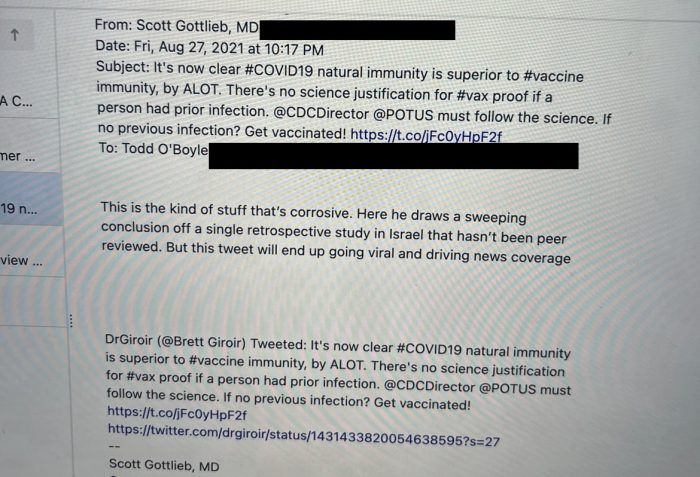
“This is the kind of stuff that’s corrosive,” Gottlieb wrote. “Here he draws a sweeping conclusion off a single retrospective study in Israel that hasn’t been peer reviewed. But this tweet will end up going viral and driving news coverage.”
Alzheimer’s drug approval raises the alarm
Data shows treatment can lead to ‘brain shrinkage’
By Maryanne Demasi, PhD | January 9, 2023
The US Food and Drug Administration (FDA) has granted an accelerated approval of a new treatment for Alzheimer’s disease, which aims to clear toxic amyloid protein build-up in the brain.
At a cost of $26,500 per year in the US (not covered by Medicare or Medicaid), people with early Alzheimer’s disease can receive a twice-monthly monoclonal antibody infusion called lecanemab (marketed as LEQEMBI™), co-developed by Eisai, a Japanese biotech firm, and Biogen.
In the lead up to the FDA’s approval, there was intense lobbying for the drug.
A ‘consensus statement’ signed by over 200 scientists, many of whom had financial ties to the drug companies, described lecanemab as a “foundational gamechanger” for the disease, calling for “no barrier” to the widespread availability of the treatment.
Now that the drug has been approved, advocacy groups like the Alzheimer’s Association, which are heavily funded by the drug industry, have welcomed the news, saying the FDA made “the right decision.”
But critics doubt the benefits of lecanemab outweigh its harms, and are dismayed that the FDA approved the drug without input from its own advisory panel.
Kim Witczak, a drug safety advocate, and member of the FDA’s Psychopharmacologic Drugs Advisory Committee, says she is “shocked” by the latest FDA stunt.
“By approving this new drug without a public advisory committee meeting, the FDA once again has shown a lack of concern for the public, patients, and healthcare providers. Convening its advisory panel would have helped reassure everyone that the FDA’s decision was scientifically sound and transparent,” said Witczak.
“Advisory committee meetings offer the opportunity to discuss the data in an open and public forum, to challenge methods, study endpoints (surrogate vs clinically meaningful), and safety findings before the general committee member discussion. But in this case, none of that was possible,” she added.
The FDA’s accelerated approval process used to green-light lecanemab is known for accepting lower evidentiary standards for drug efficacy, so that patients can gain access to experimental drugs sooner.
Critics say its reminiscent of the FDA’s approval of aducanumab – Biogen’s other Alzheimer’s drug. It was approved on the basis of lowering amyloid protein (a surrogate marker) in the brain, despite no clinically meaningful benefit for patients.
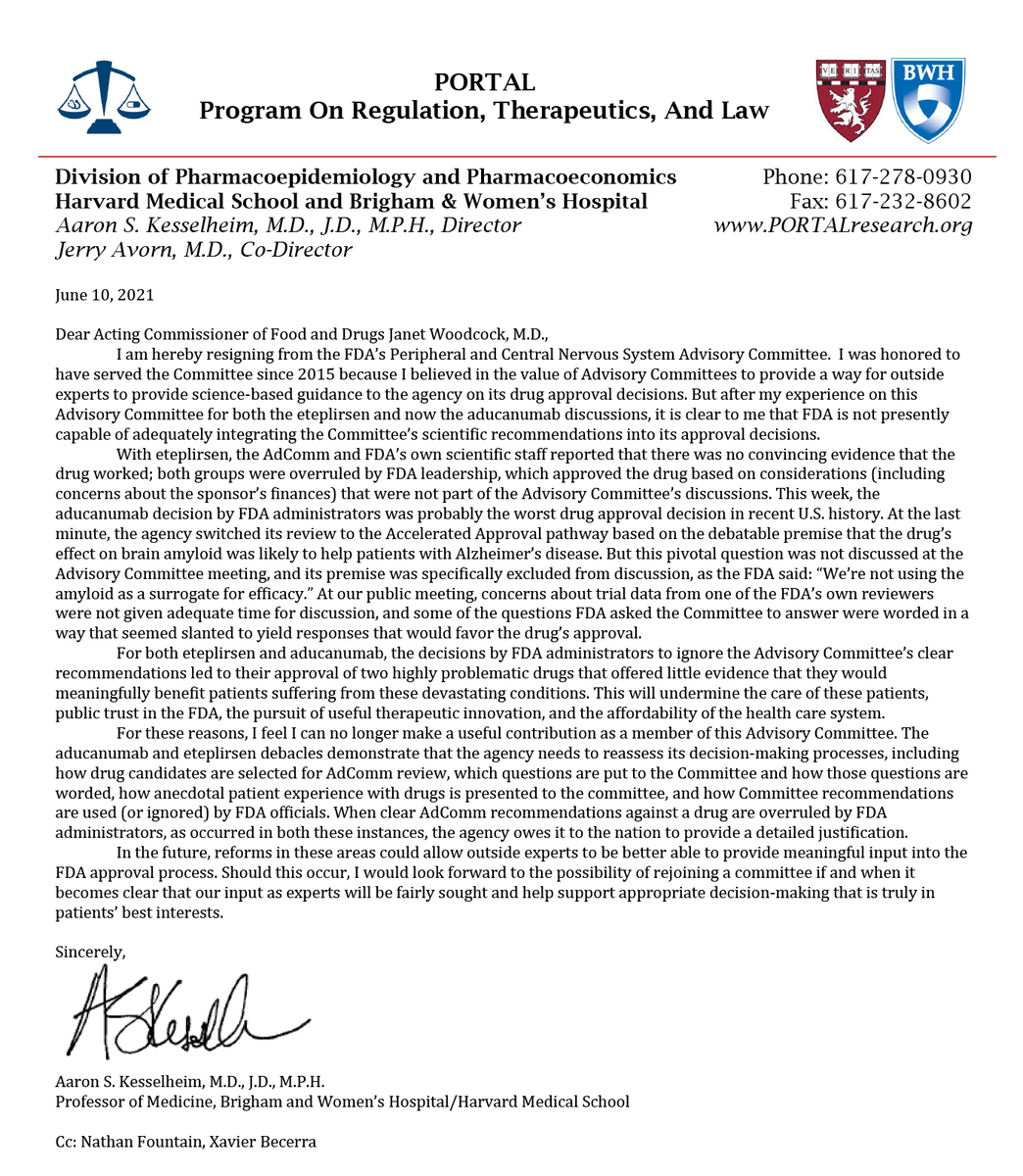
At the time, the controversial decision led to the resignation of FDA advisory member Aaron Kesselheim, who labelled it “probably the worst drug approval decision in recent U.S. history.”
Linda Furlini, a research ethics advisor based in Montreal, Canada says it essentially gives the rubber stamp to similar drugs down the track. “Once you grant accelerated approval of a drug in that class, then it’s easier to get the second drug, and then the third drug approved.”
Jessica Adams, an expert in drug regulatory affairs, agrees. She said, “Lecanemab’s approval shows the power of precedent in regulatory approvals. This is why I scoff whenever the FDA says it still reviews drugs on a case-by-case basis.”
The industry-funded study published in the New England Journal of Medicine, involving almost 1800 people with early Alzheimer’s disease, found that lecanemab could slow the decline of cognition and function by 27% over 18 months compared to placebo.
They used a “Clinical Dementia Rating” scale to show lecanemab patients declined by 1.21 points compared to 1.66 point in the placebo group – a 0.45 point difference in lecanemab’s favour.
But experts question whether the small difference will have any impact on how the patient actually feels.
Madhav Thambisetty, a neurologist at Johns Hopkins University and the National Institute on Aging said, “The benefit appears to be quite small, and it’s unclear how meaningful this might be for patients.”
In fact, the FDA’s own statistician Dr Tristan Massie was uncertain whether “the treatment effect on amyloid is reasonably likely to predict change on the clinical outcome” and considered the results of the study to be “exploratory”.
As a physician who cares for people with Alzheimer’s disease, Thambisetty spoke about the harms of the drug. “These patients can experience headaches, falls, confusion, vision disturbances and it’s unclear if patients will be able to see obvious benefits on a day-to-day basis,” he said.
The data showed an increased risk of brain bleeds and swelling, i.e. amyloid-related imaging abnormalities (ARIA) occurred in 126 (14.0%) of subjects in the lecanemab group and only 69 (7.7%) of subjects in the placebo group.
This prompted the FDA to include a warning on the drug about the risk of swelling and bleeding in the brain.
The drugmakers have also highlighted that people carrying two copies of the APOE4 gene (which predisposes someone to Alzheimer’s) puts them at a particularly “high risk of life-threatening brain haemorrhage.”
Three deaths have been reported in people taking lecanemab; an 80-yr old phase 3 trial participant who suffered intracranial haemorrhage, a 65-yr old who experienced brain swelling and bleeding and a 79-yr old who reportedly had seizures and brain bleed in the open-label phase of the trial.
Two of the three people who died were taking blood thinners, and experts who reviewed the lecanemab death cases suggested that anticoagulant use may have exacerbated the fatal outcomes.
Furlini’s research career has focused on the need to educate and support caregivers of people with dementia-type illnesses.
“You read the list of side effects – you might have gait problems, you might have brain swelling, visual disturbances… I mean, what are we doing here?” asks Furlini, “The patient is already confused and losing their cognitive capacity. How are these serious side effects helping them? It runs counter to any ethical semblance of what is wanted or expected.”
Thambisetty has also expressed concerns about the “brain shrinkage” seen in trial participants taking either lecanemab or aducanumab – increasing doses of the drug correlate to a decrease in brain volume.
“The observation of brain shrinkage is worrisome because, in the absence of compelling evidence to the contrary, it suggests a potential worsening of degenerative changes in the brains of people with Alzheimer’s disease,” wrote Thambisetty in a recent opinion piece for STAT.
The observation has been explained away by researchers who say that a reduced brain volume is due to the clearance of amyloid protein from the brain. But Thambisetty says there is little empirical evidence to support this theory.
Instead, he points to an Australian study which calculated that the clearance of amyloid plaque from the brain was too small to represent a plausible explanation for the loss of brain volume.
US lawmakers launched an investigation into the FDA after the agency’s controversial approval of aducanumab. Last month, a US House of Representatives panel released the report following an 18-month investigation.
The report said the process was “rife with irregularities” and that FDA officials “inappropriately collaborated” with the drugmaker during the approval process which “exceeded the norm in some respects.”
Representatives from the FDA and Biogen engaged in over 100 phone calls or meetings dating back to 2019 in order to expedite the drug’s approval, which lawmakers say, “consisted of atypical procedures and deviated from the agency’s own guidance.”
The congressional report recommended the agency “must take swift action to ensure that its processes for reviewing future Alzheimer’s disease treatments do not lead to the same doubts about the integrity of FDA’s review.”
But critics now say, it’s too late for an agency that has not taken accountability for its actions.
“These drug approvals have just created confusion, uncertainty, fear and misinformation. Then they wonder why people have no trust in their institutions, like the FDA. The world looks to the FDA for leadership. That it does not fulfill its responsibilities, remains the challenge of our times,” said Furlini.
Furlini has followed this area of research for decades and says the drug industry needs to move on from the ‘amyloid theory’ of Alzheimer’s disease and refocus its attention on other causes.
“After so many years, I’m fed up with the exclusive focus on the amyloid theory to the exclusion of other research theories, it’s a disservice to people with Alzheimer’s, and their families,” said Furlini
“There are a lot of buzzwords and marketing propaganda being put out there. And they justify it by saying that you have to give people hope. But you’re giving people false hope. It plays with people’s emotions, which I find horrendous,” added Furlini.
EPA And The Electricity Cost Crisis
By Francis Menton | Manhattan Contrarian | January 3, 2023
Over in Europe, the energy cost crisis, particularly as to electricity, proceeds apace.
Germany, deep into its Energiewende (energy transition) that began in 2010, leads the way. Almost all coal and nuclear power plants have been closed in favor of a massive building plan for wind and solar facilities. After a decade of that, for the past couple of years, Germans have suffered consumer retail electricity prices of over 30 euro cents per kWh — close to triple average U.S. consumer rates. On November 25, a German news source called The Local (behind pay wall) quoted an energy market expert named Mirko Scholssarczyk for the proposition that “40 cents per kilowatt-hour was likely to be the new normal in 2023 and 2024, and that prices could even rise to 50 cents per kilowatt-hour after that.” Meanwhile, my own post from December 24 cited data from a Belgian think tank called Brueghel showing that Germany was in the process of spending some 260 billion euros, around an astonishing 7% of GDP, to subsidize consumers to keep their electricity bills from going beyond even these ridiculously high levels.
The UK, second after Germany in its rush to what they call “Net Zero,” has its own associated energy cost crisis. The basic policy prescription is the same as in Germany — massive building of wind and solar facilities and suppression of fossil fuels. Although consumer bills are capped by regulation, they went in October to a level approximately three times where they had been a year previously; and they were set to rise again in April, to some five times the previous level, although that may now be temporarily headed off by the UK’s own round of massive taxpayer handouts in the range of a hundred billion pounds or more.
Can we here in the USA learn anything from this folly before it is too late? The answer is, if it is up to our EPA, then no.
Readers may be interested in some back and forth on this topic that has recently occurred in the briefing in the case of Concerned Household Electricity Consumers Council v. EPA, pending in the Court of Appeals for the DC Circuit. CHECC is demanding that EPA reconsider the so-called Endangerment Finding of 2009, which is the bureaucratic edict by which those geniuses claimed to determine that CO2 and certain other “greenhouse gases” constitute a “danger” to human health and safety. The Endangerment Finding is the regulatory linchpin that underlies all U.S. government efforts to suppress fossil fuel infrastructure, whether power plants, pipelines, drilling, or anything else. You may recall that I am one of the lawyers for CHECC in this matter.
One of the things that you need to show to bring one of these cases is that the party you represent has what they call “standing.” That means that the party bringing the claim has or will suffer some concrete injury from the regulatory action in question. That’s why our client is a council consisting of electricity consumers. As we state in our Petition and in our Brief, “Each of CHECC’s members is a U.S. citizen and a member of a household that pays electricity bills.”
To demonstrate the effect on consumer electricity bills of the policy mix of wind and solar expansion plus fossil fuel suppression, we cite and describe the experience of Germany. Excerpt, from page 31 of the Brief:
In Europe, Germany began converting to renewables in 2010, and by 2015 30% of its electricity was from wind and solar. . . . The average German household’s electricity rate in 2021 was 32.16 cents per kWh, about triple the average U.S. rate. . . .
So what’s the answer to that, EPA? EPA filed its responsive Brief on December 20. From pages 20-21 of that Brief:
Petitioners’ extended discussion of electricity costs in Germany — involving a different country, market, currency, and regulatory regime — does not aid their efforts [to demonstrate standing]. . . . There is no effort to show that Petitioners or their members suffer “injury-in-fact” from electricity rates in Germany, or that any U.S. regulation (let alone the 2009 Finding or Denial) affected those rates.
That’s it. Hey, it’s a “different country”! Electricity prices in Germany don’t hurt you. Thus, says EPA, nobody has “standing” to challenge our Endangerment Finding.
I guess there’s just no way of knowing whether the hundreds of billions of dollars worth of damage being wreaked in Germany have anything to do with the forced energy transition. Anyway, it’s none of EPA’s business to try to figure that out. They are way too busy saving the planet.
Could the DC Circuit — supposedly one of our premier courts — fall for something this blindly ignorant? We shall see. Of note is that the “standing” question can be an easy way for a court to get rid of a tricky case without having to do the hard work of grappling with the merits.
Senator Says US Should Remain in Ukraine Until ‘Putin Is Out’
By Kyle Anzalone and Connor Freeman | The Libertarian Institute | January 9, 2023
Senator Angus King said the US should not put a timetable on support for Ukraine and remain involved in the war until “Putin is out.” Comparing the current situation with Russia to the Allies’ failure to stop Nazi Germany before World War II, the Maine senator insisted on more Western aid for Kiev.
During a virtual press conference following his recent visit to the Ukrainian capital, King was asked how long the United States should continue its role in the conflict, replying that support for Kiev should be indefinite.
“I believe we should remain there until Putin is out,” he said.
It is unclear if King was calling for Putin’s removal from power in a coup d’etat, or merely for Russian troops to vacate all Ukrainian-claimed territory. The two warring parties maintain conflicting territorial claims and King acknowledged the war is now in a stalemate, but he nonetheless claimed the conflict would not be a “20-year struggle” like America’s experience in Afghanistan.
Throughout the virtual presser, King referenced a historical need to prevail over Russia, saying nothing of the potential for escalation to nuclear war between the world’s largest atomic arsenals.
The senator noted that he often receives questions from constituents about the wisdom of US involvement in the war, but went on to cite his own version of a Bush-era epithet: ‘We fight them over there so we don’t have to fight them over here.’
“I get letters every now and then, people saying, ‘Why are we doing this? Ukraine’s far away. It’s not our fight.’ Well, it is our fight, because if we don’t fight it now, it will spread,” King said. “And it will become something that we can’t avoid being involved in, just as occurred in the late 1930s at the beginning of World War II.”
He went on to claim that if Putin was not stopped in Ukraine, he would go on to conquer more of Europe, comparing the Russian leader to Adolf Hitler several times.
King also suggested the US could give additional aid to Ukraine, pointing to allies who are giving more when compared to their overall gross domestic product. “If you measure it in terms of GDP, we’re between fifth and tenth in the world, and other countries are contributing actually larger shares of their GDP to the defense of Ukraine,” he continued, “Why? Because they recognized, as hopefully we will continue to recognize, that this is really a fight for Western values.”
Since Russia’s invasion kicked off last February, Congress has authorized nearly $120 billion in aid for Kiev, including more than $21 billion in direct military assistance and a series of other financial and humanitarian aid packages. King claimed the American tax dollars are being well spent and accounted for, arguing “The software that they’re using, working with Deloitte and SAP, to track everything coming in – every spare part, every dollar.”
However, CNN has reported that US arms sent to Ukraine quickly fall into a “black hole” and are nearly impossible to track. In October, Finland’s national law enforcement agency warned that weapons being shipped to Ukraine are ending up in the hands of criminal gangs, while Nigerian President Muhammadu Buhari warned weeks later that “the situation in the Sahel and the raging war in Ukraine serve as major sources of weapons and fighters that bolster the ranks of the terrorists in the Lake Chad Region.”
King’s latest presser followed a trip to Ukraine last week, where he said he held a “thrilling” meeting with President Volodymyr Zelensky and described him as among “the great leaders of the century.”
While the senator claimed Zelensky and Ukraine are champions of democracy, some analysts have argued that Kiev has only continued its transformation into an authoritarian state under his rule. As commentator Ted Galen Carpenter wrote in The American Conservative, “genuine democracies do not ban multiple opposition parties or close opposition media outlets. Nor do they rigorously censor (and put under strict government control) media outlets that they allow to remain open. Genuine democracies do not outlaw churches that advocate policies the government dislikes.” He added, “yet the Ukrainian government has committed not just one or two, but all of those abuses.”
Will 2023 be Worse Than 2022?
Is Joe Biden willing to destroy the world to “weaken Russia”?
BY PHILIP GIRALDI • UNZ REVIEW • JANUARY 10, 2023
Even though one has become accustomed to seeing the United States government behaving irrationally on an epic scale with no concern for what happens to the average citizen who is not a member of one of the freak show constituencies of the Democratic Party, it is still possible to be surprised or even shocked. Shortly before year’s end 2022 an article appeared in the mainstream media and was quite widely circulated. The headline that it was featured under in the original Business Insider version read “A nuclear attack would most likely target one of these 6 US cities — but an expert says none of them are prepared.” The cities were New York, Washington DC, Los Angeles, Chicago, Houston and San Francisco.
The article seeks to provide information and tips that would allow one to survive a nuclear attack, repeating commentary from several “experts” in emergency management and “public health” suggesting that a nuclear war would be catastrophic but not necessarily the end of the world. One should be prepared. It observes that “those cities would struggle to provide emergency services to the wounded. The cities also no longer have designated fallout shelters to protect people from radiation.” It is full of sage advice and off-the-cuff observations, including “Can you imagine a public official keeping buildings intact for fallout shelters when the real-estate market is so tight?” Or even better the advice from the Federal Emergency Management Agency (FEMA)’s “nuclear detonation planning guide” that for everyday citizens in a city that has been nuked: “Get inside, stay inside, and stay tuned.” Dr. Ron Paul asks “Are they insane? They act as if a nuclear attack on the United States is just another inconvenience to plan for, like an ice storm or a hurricane.”
The article argues that the six cities would be prime targets as they are centers for vital infrastructure. The bomb blasts would kill hundreds of thousands or even millions of Americans with many more deaths to follow from radiation poisoning, but the article makes no attempt to explain why Russia, with a relatively sane leadership, would want to start a nuclear war that would potentially destroy the planet. Also, the targeting list of the cities provided by the “experts” is itself a bit odd. Surely Russia would attack military and government targets as a first priority to limit the possible retaliation while also crippling the ability of the White House and Pentagon to command and control the situation. Such targets would include both San Diego and Norfolk where the US Atlantic and Pacific fleets are based as well as the various Strategic Air Command bases and the underground federal government evacuation site in Mount Weather Virginia.
Reading the article, one is reminded of the early years of the Cold War that sought to reassure the public that nuclear war was somehow manageable. It was a time when we elementary school children were drilled in hiding under our desks when the air raid alarm went off. Herman Kahn was, at that time, the most famous advocate of the school of thought that the United States could survive the “unthinkable,” i.e. a nuclear war. An American physicist by training, Kahn became a founding member of the beyond neocon nationalist Hudson Institute, which is still unfortunately around. Kahn, who served in the US Army during the Second World War as a non-combat telephone lineman, started his career as a military strategist at the RAND Corporation. Kahn endorsed a policy of deterrence and argued that if the Soviet Union believed that the United States had a devastating second-strike capability then Moscow would not initiate hostilities, which he explained in his paper titled “The Nature and Feasibility of War and Deterrence”. The Russians had to believe that even a perfectly coordinated massive attack would guarantee a measure of retaliation that would leave them devastated as well. Kahn also posited his idea of a “winnable” nuclear exchange in his 1960 book On Thermonuclear War for which he is often cited as one of the inspirations for the title character of Stanley Kubrick’s classic film Dr. Strangelove.
The appearance of the Business Insider article dealing with a cool discussion of the survivability from a nuclear war suggests that the nutcases are again escaping from the psychiatric hospital here in the US and are obtaining top jobs in government and the media. While one continues to hope that somehow someone will wake up in the White House and realize that the deep dark hole that we the American people find ourselves in mandates a change of course and a genuine reset, there is little daylight visible in the darkness.
My particular concern relates to the entangling relationships that have kept our country permanently at war in spite of the fact that since the Cold War ended in 1991 no potential adversary has actually threatened the United States. Now, the federal government appears to be in the business of cultivating dangerous relationships to justify defense spending and placing the nation on the brink of what might prove to be catastrophic. The current US mission to “weaken Russia” and eventually also China in order to maintain its own “rules based international order” includes such hypocritical and utterly illegal under international law anomalies as the continued military occupation of part of Syria to deny that country’s leaders’ access to their oil fields and best agricultural land. A recent UN humanitarian agency investigation determined that the Syrian people are suffering and even starving as a result of that and US imposed sanctions that the Biden Administration maintains against all reason and humanity.
At the present time, however, the most entangling of all relationships, even more than with Israel, has to be the engagement of the US in the proxy war being fought against Russia on behalf of Ukraine, which is exactly what threatens to turn nuclear if someone blinks at the wrong time. Billions of dollars in direct aid as well as billions more in the form of weapons stripped from arsenals in Europe and the US have been given to the corrupt regime of President Volodymyr Zelensky while Zelensky continues to work assiduously to milk the situation and draw Washington into a deeper war directly confronting Moscow.
In fact, by some reckonings the war has already begun, with the US and its allies clearly dedicated to crippling the Russian economy while also getting rid of President Vladimir Putin. The 101st Airborne is now in place in Romania next to Ukraine to “warn” the Kremlin while the Pentagon has recently admitted that some American military personnel are already in Ukraine, contrary to the denials by White House spokesmen. The British have also revealed that some of their elite Special Ops personnel are on the ground. And there are reports that more American soldiers will soon be on the way, ostensibly to “track the weapons” being provided to Zelensky, which will include US-made, Patriot Missile batteries some of which might even be placed in NATO member Poland to provide air cover over Western Ukraine, a definite act of war as seen by Russia, which has warned that such a move would mean that the US and its allies had “effectively become a party” to the war in Ukraine and there will be “consequences.” “Consequences” means escalation.
The soldier-“trackers” mission may be in response to reports that weapons provided by NATO have been corruptly sold or given to third countries by the Ukrainians. The several US initiatives taken together could produce a rapid escalation of the conflict complete with dead Americans coming home in body bags and an inevitable direct US involvement in combat roles that could lead anywhere, but at this point it is the Russians who are acting with restraint by not targeting the NATO and US “advisers” who are already active in Ukraine.
Suspicion is also growing that the United States “green-lighted” in advance recent cruise missile attacks carried out by Ukraine against military targets deep inside Russia. Since the attacks, the White House has declared that Ukraine has “permission” to attack Russia and has basically conceded to the unbalanced Zelensky the right to make all the decisions and run the war that the US is largely funding, which is a formula for disaster. It is already known that Ukraine is receiving top level intelligence provided both by the US and also other NATO states. The precision attacks on Russia suggest that the Ukrainian army was given the coordinates of possible active targets, something that the US would be capable of providing but which would have been beyond the abilities of Ukraine, which possesses no satellite surveillance capability. If it is true that the White House was involved in escalating the conflict it would be a very dangerous move, inviting retaliation by Moscow.
To be sure, some idiots in Washington, mostly of the neocon variety, continue to see war against Russia as something like a crusade for world freedom. Rick Newman, Yahoo’s top Finance Columnist, observes how “Budget hawks in Congress are worried about granting President Biden’s request for an additional $38 billion in aid for Ukraine to help defeat the invading Russians.” He concludes “They’re right. Thirty-eight billion isn’t enough. Make it $50 billion. Or even $100 billion. The more, the better, until the job is done.”
Apparently, the bellicose Rick does not quite get that Russia has made clear that if it is about to be defeated by force majeure it will go nuclear. And Congress and the White House don’t seem to get it either, with both the Republican and Democratic parties oblivious to the real danger that confronts the American people. Nuclear war? Sure! Just hide in your basement, if you have one, and tune in.
Philip M. Giraldi, Ph.D., is Executive Director of the Council for the National Interest, a 501(c)3 tax deductible educational foundation (Federal ID Number #52-1739023) that seeks a more interests-based U.S. foreign policy in the Middle East. Website is councilforthenationalinterest.org, address is P.O. Box 2157, Purcellville VA 20134 and its email is inform@cnionline.org.
Featured Video

Why Hamas Really Attacked Israel on Oct. 7
or go to
Aletho News Archives – Video-Images
From the Archives
Israel: Strategic Ally or Liability?
By Stephen Sniegoski | My Catbird Seat | June 12, 2010
The claim that Israel serves as a valuable ally for the United States is made by both pro-Zionists and much of the anti-war and anti-Zionist Left that is influenced by Noam Chomsky. As a result of the Gaza flotilla massacre, which has caused a world-wide uproar against Israel, the value of Israel to the United States is being publicly questioned in more mainstream foreign policy forums. … continue
Blog Roll
 Aletho News
- Why Hamas Really Attacked Israel on Oct. 7
- Declassified UK exposes British man who fought for ‘Israel’ in Gaza
- West’s death cult in a theater near you
- How the Yandex ‘Russian bots’ lie fell apart
- Burnham’s ‘Russia did Brexit’ ruse crumbles
- Estonia making movies and games to encourage war against Russia
- Four in five new UK jobs taken by foreigners – report
- Here’s what Trump’s latest U-turn really means for Russia and Ukraine
- The Houthis Are Not an Iranian Proxy
- Europe’s Energy Hypocrisy, Russian LNG Profits and US Dependence
- If Americans Knew
- Activists Abused By Israel Return to New Freedom Flotilla Mission
- 60 Minutes won’t tell the full truth about Israeli settler violence
- Nearly 50,000 women, girls killed or severely injured in Gaza since October 2023: UN Women
- ADL is working with AI companies to suppress alleged ‘antisemitism’
- Israeli occupation forces using social media surveillance unit to target hundreds of Palestinians in the West Bank
- Israel’s New – and Terrifying – Security Doctrine
- Israeli Attacks Kill Five in Gaza, Including a four-year-old and a woman
- Air Force Major Who Called for Trump’s Impeachment Held in Solitary Confinement
- It’s a Genocide, I’m Into It’: Seinfeld Mocks Protest over Palestinian Children Killed
- Universities fire dozens amid pressure from Zionist billionaires
- No Tricks Zone
- New Study Suggests Large Regions Of The Pacific Ocean Have Been Cooling For The Last 80 Years
- Germany’s Green Energy Debacle: High Energy Costs Force Kahla Porzellan to Close After 182 Years!
- New Study: 50 Years Of The Most Aggressive ‘Net Zero’ Policies Can Only Affect The Global Climate By 0.03°C
- US September “Heat” Was No Record…Many Records Set Decades Ago
- Latest European Green Energy Debacle; Portugal’s Largest Flagship Solar Park Insolvent!
- Green Energy Debacle: German Expert Professor Fritz Vahrenholt Warns Of Severe Economic And Social Consequences
- Two More Paleo Reconstructions Affirm Meters-Higher Sea Levels Across Ireland, Brazil 7000-6000 Years Ago
- New Study: Earth And Venus Surface Warmth Largely Explained By Convection And Lapse Rate, Not CO2 Or Radiation
- 2025 Nature Paper Claiming Worsening Global Drought Gets RETRACTED …Heavily Flawed
- New Study: ‘Global Drought Shows No Detectable Recent Acceleration Under Climate Warming’