The White House’s latest pro-war scheme comes at a time when the Pentagon is expected to receive its highest annual budget ever, as defense spending in the US is on track to reach $1 trillion annually before the decade is out.
The High Cost Of Blowing Up The World: Ukraine & The 2023 NDAA
By Matthew Ehret | Zero Hedge | January 2, 2022
Will Americans wake up to the reality that they’ve been walking on the wrong side of history for too long or has the point of no-return been crossed?
Bipartisan insanity was on display again this week as the U.S. congress responded to Biden’s requested $37 billion in additional aid to Ukraine by giving him $45 billion bringing the total U.S. support to its Davos-managed disposable ward up to $111 billion.
The aid was part of an overall omnibus spending bill passed by both houses of Congress was a gargantuan $1.7 trillion and included $858 billion in defense spending which far exceeds any sum ever spent by a U.S. government in history.
Of that $858 billion, $817 billion is allocated directly to the U.S. Department of Defense while the remaining $29 billion will be allocated to national security programs within the department of energy.
Continuing to Weaponize Taiwan
2023 NDAA Funds will be used to “strengthen” Taiwan in the Pacific with $12 billion authorized to assist Taiwan in purchasing weapons from the U.S. military industrial complex (with the $12 billion in ‘loans’ needing to be paid back over the course of the next five years of course). Of this fund, $100 million will be given directly to contractors to fill up a “contingency stockpile” to be used by Taiwan “in case of any future conflict”.
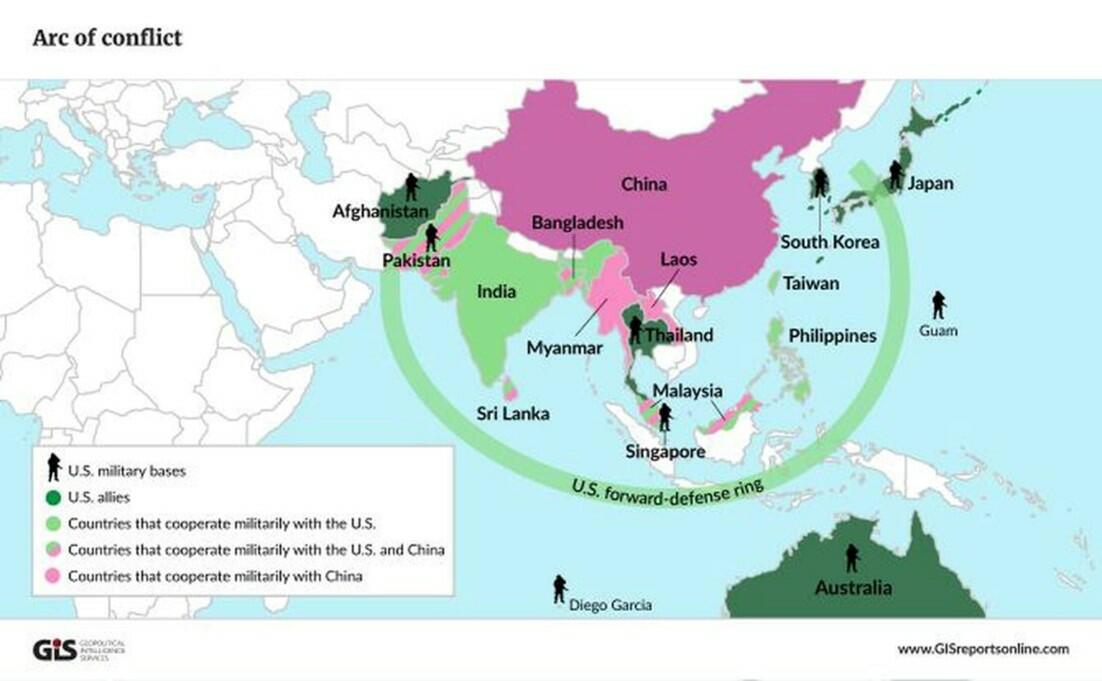
Additionally Taiwan will be invited to participate in the next U.S.-led Rim of the Pacific Military Exercise in 2024 and thus greater “Pacific NATO” strategy encircling mainland China. This exercise and broader Pacific NATO (aka Quad) anti-China arsenal of puppet colonies will be boosted by an additional $11.5 billion will be allocated to the Pacific Deterrence Initiative ‘to counter malign Chinese influence in the Pacific’.
Just as Ukraine has suffered U.S.-directed color revolutions in 2004 and 2014, so too has Taiwan been strung through a similar NED-funded ‘Sunflower Revolution’ regime change in 2014 which saw the Kuomintang Party taken out of power just as final stages of an economic integration agreement with mainland China were being finalized.
Billions have been tagged to purchase Lockheed Martin Corp’s (LMT.N) F-35 fighter jets and ships made by General Dynamics but beyond airforce, one of the biggest and most dangerous boosts in spending this year has been absorbed by a fixation on ‘space warfare’. $5.3 billion will be directed towards ‘space force’ and the ongoing effort to militarize space as a new dimension in war making in the 21st century (which was $333 million more than originally requested by military officials at space force’).
The recent U.S.-Canada-Australia joint ‘space warfare’ drills in order to prepare for an oncoming war over Europe took place at the start of December 2022 at the Schriever Space Force Base in Colorado- which [eliminates] the residues of any positive memory of ‘space diplomacy’ once seen under JFK’s leadership, the 1976 Apollo-Soyuz cooperation program or even the better aspects of President Trump’s Artemis Accord.
The 2000 RAD Origins of NDAA 2023’s Dark Age Doctrine
It would be a lie to say that this program for human extermination originated in 2022, or even under the previous presidencies of Trump or Obama.
If one wishes to grasp the germ seed of today’s policy doctrine, it would be necessary to revisit the Project for a New American Century Think Tank’s September 2000 Rebuilding America’s Defenses report where the end of history cultists then taking the helm of government stated:
“RAD” envisions a future in which the United States is in complete control of land, sea, air, space and cyberspace of planet Earth. It finds objectionable the limitations imposed by the ABM treaty and urges a newer rendition of Reagan’s ‘Star Wars’ defense shield program.
On top of calling for the USA’s exit from the ABM Treaty (which was promptly done in the wake of 911), the authors of RAD outline in clear detail the rationale behind the growth of the rise of a need for a new branch of the military known as space force. The authors stated that the USA must gain:
“CONTROL THE NEW ‘INTERNATIONAL COMMONS’ OF SPACE AND ‘CYBERSPACE,’ and pave the way for the creation of a new military service – U.S. Space Forces – with the mission of space control.”
Outlining the doctrine of ‘Full Spectrum Dominance’ the PNAC report outlined on page 51:
Global Missile Defenses — “A network against limited strikes, capable of protecting the United States, its allies and forward-deployed forces, must be constructed. This must be a layered system of land, sea, air and space-based components”.
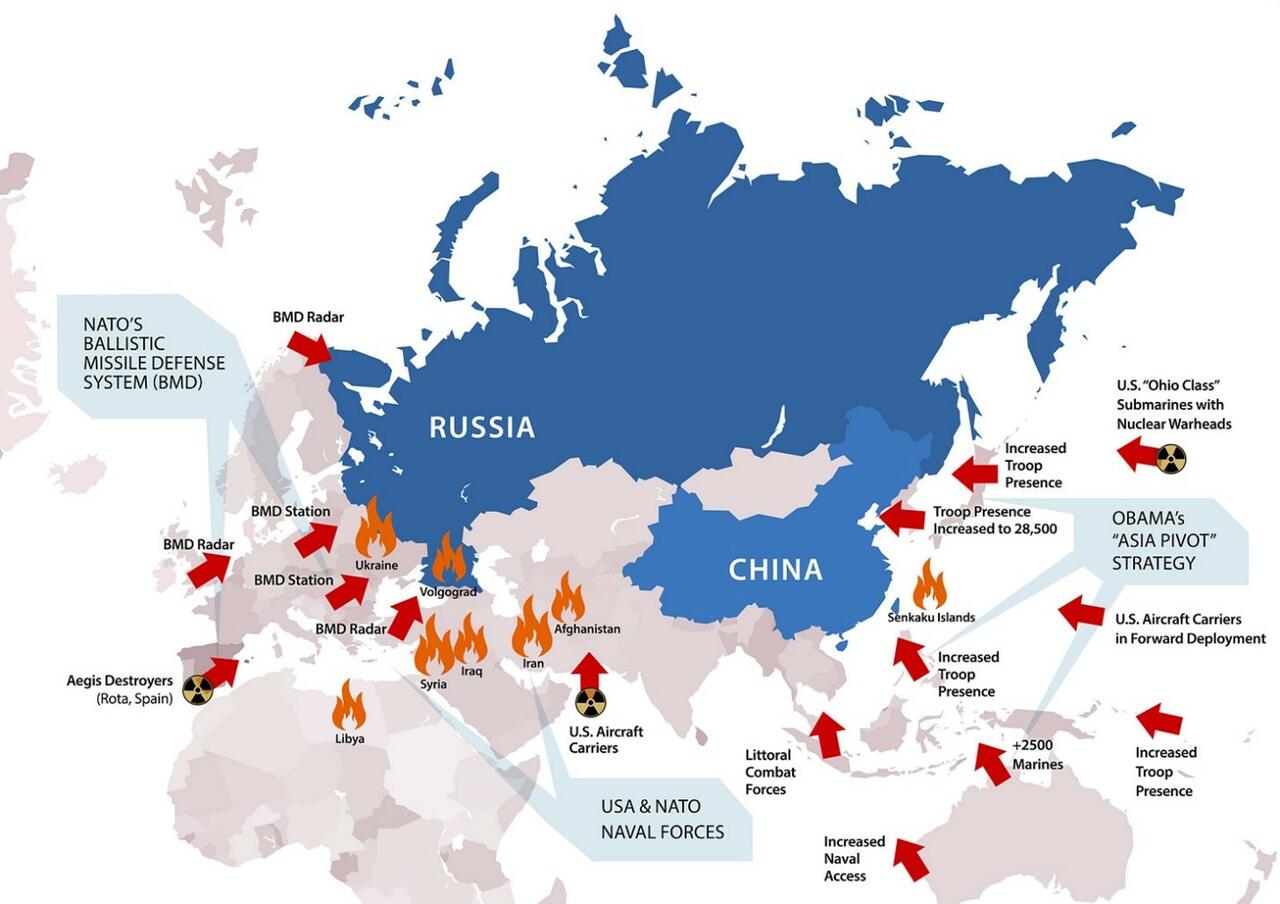
Looking towards the need to expand and modernize nuclear forces due to the possible danger of China, Russia, Iran, North Korea and Iraq, the RAD authors stated:
“Today’s strategic calculus encompasses more factors than just the balance of terror between the United States and Russia. U.S. nuclear force planning and related arms control policies must take account of a larger set of variables than in the past, including the growing number of small nuclear arsenals – from North Korea to Pakistan to, perhaps soon, Iran and Iraq – and a modernized and expanded Chinese nuclear force.”
Possibly one of the most dangerous and revealing aspects of RAD, was found on page 60, where the authors outline a program that soon grew into obscene proportions in the wake of the 2001 Anthrax attacks which justified the later passage of Cheney’s 2004 Bioshield Act as well as the growth of the 320+ international biolabs run by the pentagon. Describing the conversion of bioweapons from the realm of terror to “a politically useful tool”, the authors state:
“Although it may take several decades for the process of transformation to unfold, in time, the art of warfare on air, land, and sea will be vastly different than it is today, and ‘combat’ likely will take place in new dimensions: in space, ‘cyber-space,’ and perhaps the world of microbes… Space itself will become a theater of war, as nations gain access to space capabilities and come to rely on them; further, the distinction between military and commercial space systems – combatants and non-combatants – will become blurred. Information systems will become an important focus of attack, particularly for U.S. enemies seeking to short-circuit sophisticated American forces. And advanced forms of biological warfare that can target specific genotypes may transform biological warfare from the realm of terror to a politically useful tool”
Back to Ukraine
How will the $45 billion Ukraine money burning project be used? That’s not so easy to say exactly?
What we do know is that $22.9 billion will go towards what Kiev will be expected to use to buy more weapons from private U.S.-based defense contractors and much of the rest will be enjoyed by NGOs and Non Profits which will more often than not be run by figures closely tied to those same creatures in the Washington swamp who voted for these bills.
These uncomfortable facts were outlined repeatedly by the oft-slandered republican Senator Marjorie Taylor Greene whose multiple attempts to create some form of oversight and auditing of the handouts to Ukraine have been met with absurd levels of resistance since the special operation was launched in February. Even when such operations as the FTX crypto exchange (a major partner to Kiev and the World Economic Forum) was discovered to be simply a money laundering outfit infusing vast sums into the coffers of the DNC that were tied to Ukrainian operations, hardly a single western Mockingbird press outlet made a peep.
As the Pentagon Papers and Hunter Biden Laptop reminded us, not only has Ukraine been run by a coterie of money laundering grifting politicians enjoying endless skimming of foreign aid (Pandora Papers revealed that Zelensky and his billionaire handler Igor Kolomoskoi were both tied to offshore shell companies representing hundreds of millions of dollars of stolen loot), but also energy firms like Burisima which have been caught extracting revenue from the Ukrainian people the way silk worm farmers extract silk.
And what happens if you find yourself among that precious minority of republican or independent voices of resistance to this new plunge into world war? Just ask Representative Matt Gaetz who has been called out alongside other patriots such as Jim Jordan and Lauren Boebert for not applauding Zelensky’s pathetic speech in Congress this week. For the crime of keeping their hands from slapping in lock step with the rest of the congressional herd, NBC analysts like Michael Beschloss have attempted to stir up a McCarthyite witchhunt asking why these representatives refused to clap, asking:
“I’d like to know why that was for two reasons- Number one: You’re a public servant, we’re allowed to know those things. You’re supposed to tell us if you’re serving in Congress what the reason was. Do you love Putin, or are you just opposed to democracy, or is there something else?”
The fact that these figures even dared ask where graft was going probably touched a nerve too close to home with the Pentagon itself failing its fifth consecutive audit in November 2022 with over 65% of its assets and expenditures unaccounted for. That’s right, the government ‘lost track’ of $2 trillion in 2022.
Will enough Americans wake up to the reality that they have been walking on the wrong side of history for far too long or has the point of no-return already been crossed?
I understand ‘The Most Important Thing’ for our rulers …
But, going forward, what’s the most important thing for ‘We the People?’
By Bill Rice, Jr. | January 1, 2023
Author’s note: The start of a new year is perhaps a good time to reflect on lessons gleaned from almost three years of observing our surreal Covid New Normal. In this meditation, I try to identify the bigger themes and the many scandals still concealed. I think I now understand how vast conspiracies and cover-ups could occur … and what thinking will have to change if a country that is listing seriously is going to right itself.
***
In my writings on Covid topics, I’ve begun to filter my thoughts and theories through one question: What was “the most important thing” to officials?
The answer to this question seems almost undeniable: Officials and key allies in the Establishment wanted as many people as possible to receive the Covid “vaccines” (and now “boosters”).
While mass vaccination was the paramount goal, rolling out “vaccine passports” and, perhaps even more important, digital control of the population are also key components of the unfinished agendas of society’s real rulers in my opinion.
That is, everything that’s occurred in the last three years was done to promote these overriding goals/objectives. Promoting (non-sensical) mass fear was of course a prerequisite for achieving the goal of mass compliance.
Any evidence that might debunk any of the false Covid narratives – and reduce the level of public fear – had to be concealed to advance the vaccination objective, but also to keep the conspirators from one day being tried for perpetrating “crimes against humanity.”
Thus, I also believe “self-protection” quickly became another overriding goal of those most responsible for producing the tragic outcomes of the last three years.
Another way to express my hypothesis is that certain officials engaged in on-going disinformation campaigns, all of which sought to achieve these two goals.
If most Americans ever realized all of the important “disinformation” was spread by officials, transformational change might be possible.
If more Americans belatedly realized it was the skeptics who were right all along, the future might be a better place. More Americans might realize that holding officials with great power accountable, and challenging false narratives, are actually vital civic duties.
It’s possible that one day the public will learn the scores of mechanisms officials used to conceal their crimes and lies.
For the last few years, I’ve tried to produce journalism that might be of use to future historians. For example, I’m currently finishing an article that will list approximately 20 ways that evidence of “early spread” has been concealed.
I’m sure many independent journalists could write articles listing at least 20 ways that vaccine injuries have been concealed. Still another journalist could compile a list just as long that shows how iatrogenic deaths have been concealed, or lockdowns and masks were unnecessary, or how Covid statistics were manipulated.
The fact so many Covid topics could provide so many examples of cover-ups and shocking scandals should be telling the American public something significant, lessons that should disturb any person who still cares about the truth.
Nothing that happened would have been possible
if the Fourth Estate had not been captured
It’s also significant that the views of skeptics have been ignored by the mainstream press and public health officials. This suggests censorship and “cancellation” are vital tools to protect false narratives.
As almost all “journalists” at mainstream press organizations refuse to seriously investigate evidence that might debunk any false narrative, this suggests the Fourth Estate has been captured or recruited by the organizations seeking to advance nefarious agendas.
Indeed, I’d argue this represents perhaps the most sinister development in the history of our nation. If “science,” every agency and branch of government and “watchdog journalism” are now all captured, no important truths (or scandals) are likely to ever be exposed.
Some critics might argue I am positing a massive (and thus implausible) conspiracy or cover-up.
In one sense, I guess I am. My future article will argue that officials pursued at least 20 different “projects” just to conceal evidence of early spread. This does suggest a wide-spread conspiracy.
However, I think most officials or employees who played a part in concealing evidence of early spread probably had no idea they were engaging in a wider conspiracy.
The same belief would apply to all the Covid conspiracies and cover-ups. Most of the people involved were simply following orders.
I’ve also come to believe that the “most important thing” for people in bureaucratic organizations is to NOT create waves, to not be considered mavericks or contrarians, to not challenge any politically-correct or “authorized” narratives.
In layman’s terms, people working below the apex of the organizational pyramids intuitively pick up on the authorized narrative and are able to quickly identify which way the proverbial wind is blowing.
My theory posits that a relatively few “masterminds” of any conspiracy – the few people really “in the know” – exploited this knowledge to procure the support of subordinate workers “in the field.”
This, I believe, explains how widespread conspiracies or cover-ups are easier to achieve than one might imagine was possible.
The people who could blow the whistle are not likely to do so. Also, those who might refuse to “go along” are quickly removed from positions of influence.
In other words, while I believe numerous tactics were employed to cover-up evidence of early spread, it probably wasn’t that difficult for the key “conspirators” to make sure their objectives were achieved.
If the effort to conceal evidence of vaccine injuries necessarily entails the participation of vast numbers of people (which it obviously has), achieving this level of participation was also far easier to achieve than one might have thought possible … for the same reasons.
The cover-up is always bigger than the original crime
I also believe cover-ups almost always require the participation of far more actors than the original crimes.
In this conspiracy, the overriding goal was to get everyone vaccinated. However, it must have quickly become apparent to numerous officials inside the U.S. government that “rogue actors” in the government played at least some role in creating this virus.
If this was proven and then revealed, U.S. “national security” might be jeopardized. At best, the international image and reputation of the U.S. government would suffer immense harm.
The liability issues and reparation movements that might emerge infer economic damages mind-blowing to fathom.
Domestically, citizen trust in our trusted public officials might be irreparably damaged.
Given the above possibilities, it does not seem farfetched to suggest that every important official of every important agency in the U.S. government might now possess a strong motive to cover-up Covid facts that, if revealed, could produce seismic repercussions.
In short, the truth – ever revealed – would jeopardize the standing, reputation, influence (and government funding) of practically every important organization in the world.
As it’s almost impossible to identify an important organization that did not enthusiastically support lockdowns, draconian “mitigation” mandates and vaccination agendas, the number of organizations with a strong incentive to conceal the truth is virtually all-encompassing.
This observation also explains how a conspiracy originally involving only a small number of people could expand to include legions of officials, both inside and outside of government.
Which is why society’s true patriots and truth-seekers are so important
The same observation also highlights the vital role being performed by the few organizations staffed with contrarian voices who posses the courage and intellectual integrity to challenge false or dubious narratives.
Whether citizens realize it or not, we now live in a world where much of the accepted conventional wisdom is either false or dubious. As erroneous conventional wisdom ultimately creates flawed public policy, false narratives that are never challenged or exposed can and do inflict great harm on society.
In such a world, the few groups pointing this out are performing a vital public service. The fact the Powers that Be want these voices silenced is perhaps the greatest and most-ominous “tell” of them all.
It’s painful for someone to admit he was duped …
For most people, the belated realization that staples of conventional wisdom might have been false all along would cause psychological pain, an uncomfortable result most people seek to avoid.
The same people might intuitively sense that exposing and correcting these false narratives could produce more-tangible negative effects in their own lives and throughout society.
But any short or mid-term pain must be endured if the world’s long-term prospects are going to be brighter.
The bottom-line is our children’s future …
The reason the population should support such a “cure” is not necessarily to benefit the remainder of our own lives, but because we want the lives of our children and grandchildren to be better than our own lives.
However, the future of our own generation’s children and grandchildren will be bleaker unless the frauds and lies of today are belatedly exposed.
Refusing to perform this painful but necessary task ensures that the same “leaders” who are dismantling the founding principles of our nation (people who created and mandated policies that are literally killing and injuring large swaths of the population) will be in charge next year … and 10 and 20 years from now.
Exposing narratives that were false would expose and purge many of society’s worst leaders. A better class of leaders could guide us into the future.
Also, more people might realize it’s dangerous to put so much blind faith in government officials and the giant corporations that are now so closely aligned with government. Instead of being cancelled and maligned, skeptics might be more appreciated.
It might make people uncomfortable to admit to themselves that they trusted the wrong leaders on Covid topics. However, if more people are beginning to consider this possibility such a development would be very significant.
If more people realize how important it is to keep these same policy makers from ruining the lives of their children and grandchildren, this potential “silver lining” of Covid might end up saving the world.
Circling back to where I started … When something is “the most important thing” to a cadre of highly-motivated, committed and powerful individuals, such people usually find a way to make sure this thing happens.
For almost three years, too many decent people accepted the pronouncements of officials, alleged experts, CEOs of Big Pharma and Big Media as the gospel truth when these words were really evil lies. In short, we let ourselves be led by the wrong people.
Today, the most important thing decent people can do is to expose and purge such dangerous charlatans before they make it impossible that our children live in a better world in the future.
Ansarallah seeks ‘permanent ceasefire’ in Yemen
The Cradle | January 1, 2023
Yemen’s Ansarallah movement seeks a “permanent ceasefire,” according to a spokesperson of the resistance group.
Mohammed Abdel Salam, a spokesperson of the Ansarallah movement, said on 1 January that a permanent ceasefire would require the opening of all ports, airports, and roads, and that all government wages are paid from oil and gas revenues.
“We are working to reach a point of clarity in Yemen, in which we move into either a truce or permanent ceasefire, and we have presented our point of view to the Omani mediator,” he said to Almasirah TV station.
“Any solution to Yemen’s crisis must be based on the disbursement of [government] employees’ salaries from oil and gas revenues according to the 2014 budget,” he added.
Meanwhile, an official delegation from the Sultanate of Oman landed in the Yemeni capital Sanaa on 21 December as part of Muscat’s mediation efforts to reach a political solution to the Saudi-led war that has been raging for nearly eight years.
No further details were provided about the meeting, nearly three months after a UN-brokered ceasefire between Sanaa and Riyadh ended.
Since then, Oman has been mediating talks between Saudi and Yemeni officials seeking to end a war that has killed nearly 400,000 Yemenis and pushed the rest of the population into famine.
Since 2015, Yemen has suffered a brutal Saudi-led war and economic blockade that has killed and displaced millions, and destroyed the country’s infrastructure. On top of this, western NGOs have been accused of mishandling billions of dollars in humanitarian aid for Yemenis.
Yemeni officials have also cautioned that US and French troops deployed in provinces controlled by the Saudi-led coalition have arrived to coordinate the looting of Yemen’s natural resources, similar to Washington’s oil trafficking operations in Syria.
Chinese Media Says Washington ‘in No Position’ to Lecture Beijing How to Deal With Moscow
By Oleg Burunov – Samizdat – 01.01.2023
On Saturday, Chinese President Xi Jinping underscored that relations between Moscow and Beijing may “find new opportunities for growth” in 2023.
A Chinese media outlet has reported that the US is “in no position” to point the finger at China and lecture Beijing on “how to deal with its relations” with Moscow.
“Compared with the US’ alliance system, the China-Russia relationship, which is based on non-alliance, non-confrontation and non-targeting of any third party, not only conforms to the interests of both sides, but also can be more conductive in addressing global challenges,” the report said.
The solid ties between Beijing and Moscow “can help the world advance toward multipolarity, and prevent the international community from slipping into unilateralism.”
Even before the beginning of the ongoing Russian special operation in Ukraine on February 24, Washington “had been wary of close ties” between Russia and China.
“As the US has classified the two countries as its main competitors, or even potential foes, Washington is worried that the deepening cooperation between China and Russia will impact its global leadership and hegemony, and affect its containment effect against the two countries.”
The news outlet also quoted Yang Jin, an associate research fellow at the Institute of Russian, Eastern European and Central Asian Studies at the Chinese Academy of Social Sciences, as saying that the US “worries that mounting China-Russia cooperation in areas covering the economy and trade will significantly reduce the effect of sanctions imposed by the US and the West on Russia.”
The comments come after a US State Department spokesperson said on Friday that “those that side with Moscow in this unjust war will inevitably find themselves on the wrong side of history,” an apparent reference to the ongoing Russian special operation in Ukraine.
“Beijing claims to be neutral, but its behavior makes clear that it is still investing in close ties to Russia,” the spokesperson said, adding that Washington was “monitoring Beijing’s activity closely.”
The statement followed a virtual meeting between Russian President Vladimir Putin and Chinese counterpart Xi Jinping, during which the two, in particular, praised bilateral economic ties.
Putin stressed that “despite the unfavorable external conditions, illegitimate restrictions and direct intimidation by some countries of the West, Russia and China managed to secure record growth rates of mutual trade.” According to him, “by the end of the year, it will increase by 25%. Under such a dynamic, we will be able to reach the $200 billion target mark set by us for 2024 ahead of schedule.”
Xi, for his part, emphasized that China is ready to build up strategic cooperation with Russia in the interests of world stability against the backdrop of a difficult international situation. The Chinese president added that Beijing highly appreciates the fact that Russia is not refusing to resolve the Ukrainian crisis through negotiations.
In a separate development this week, Xi sent a New Year telegram to Putin, expressing a willingness to maintain close contacts with him in 2023.
“I am ready […] to lead our countries to the deepening of comprehensive strategic cooperation and practical collaboration in various fields for the benefit of the peoples of the two countries,” the telegram reads.
UN resolutions on Palestine won’t be implemented as long as Israel enjoys US support: Hamas
Press TV – December 31, 2022
The Palestinian resistance movement Hamas has condemned the United States’ unwavering support for Israel, saying United Nations resolutions concerning Palestine will not be implemented as long as Tel Aviv enjoys Washington’s support.
Hamas spokesman Hazem Qassem made the remarks in a statement on Saturday, after the United Nations General Assembly approved a resolution in favor of Palestinians, according to Arabic-language al-Ahad television network.
“This resolution will add to the long list of international resolutions concerning Palestine, which have never tuned into a practical step to put pressure on the occupying regime even once,” Qassem said.
“As long as the US acts as a partner of the occupying regime and covers up Israeli crimes, all such decisions will remain on paper,” he added.
On Friday, the UNGA adopted a resolution calling on the International Court of Justice (ICJ) to give an opinion on the legal consequences of the decades-long Israeli-Palestinian conflict, Israeli “annexation” and the “legal status of the occupation” of Palestinian territories.
The resolution promoted by Palestinians passed by a vote of 87 in favor, 26 against, with 53 abstentions. Russia and China voted in favor of the resolution.
Israel, the US and 24 other members – including the United Kingdom and Germany – voted against the resolution, while France was among the 53 nations that abstained.
The resolution is titled “Israeli practices and settlement activities affecting the rights of the Palestinian people and other Arabs of the occupied territories” and calls on the Hague-based ICJ to “render urgently an advisory opinion” on Israel’s “prolonged occupation, settlement and annexation of Palestinian territory.”
It also calls for an investigation into Israeli measures “aimed at altering the demographic composition, character and status of the Holy City of al-Quds” and says Israel has adopted “discriminatory legislation and measures.”
The resolution demands the court weigh in on the conflict in accordance with international law and the UN charter.
Palestine’s UN ambassador Riyad Mansour noted that the vote came one day after the swearing-in of a new far-right Israeli cabinet led by hawkish prime minister Benjamin Netanyahu, which he said promises an expansion of illegal settlements and will accelerate “colonial and racist policies” towards Palestinians.
Earlier this month, Palestinian Minister of Foreign Affairs and Expatriates Riyad al-Maliki announced that the UN General Assembly has adopted a resolution that affirms the Palestinian people’s right to self-determination.
He further called on the international community to work on obliging Israel “to implement international resolutions and guarantee the right of the Palestinian people, as he hailed the resolution.
The General Assembly also adopted five resolutions recently in favor of Palestinians, including the issue of Palestinian refugees.
These decisions are issued every year by the General Assembly, which is consisted of 193 members, and are non-binding.
Venezuela National Assembly votes out US-backed opposition leader
RT | December 31, 2022
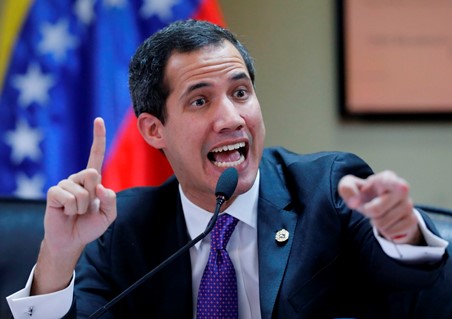
Opposition lawmakers in Venezuela have voted to dissolve the ‘interim government’ formed under their one-time leader, Juan Guaido, a main rival to the country’s ruling socialist party and once a darling of the US foreign policy establishment.
Holding their vote over a Zoom call, the opposition-controlled National Assembly moved to reorganize their movement on Friday, with 72 lawmakers voting in favor of disbanding the legislature compared to just 29 opposed. Guaido’s term at the head of the assembly, as well as his ‘interim presidency’ declared in 2019 with the blessing of the US, are now set to end on January 5.
“Venezuela needs new machinery in this struggle,” lawmaker Juan Miguel Matheus of the opposition Justice First party said after the vote, adding that Guaido’s tenure as interim leader “was something that was supposed to be temporary, but it became something perpetual.”
Guaido and his supporters, meanwhile, have argued that dissolving the interim government could spell the demise of any unified opposition movement, insisting it will only bolster the power and influence of Maduro, who has been deemed an illegitimate leader by Washington and a long list of allies.
“This is not about defending Guaido. This is about not losing the important tools that we have in this struggle,” Guaido said.
The shake-up in the opposition leadership follows several years of failed efforts to oust Maduro from power, including a series of heated street protests and an outright coup attempt in 2019. While Guaido and fellow opposition leaders failed to inspire mass defections among the security forces as hoped, the ill-fated putsch enjoyed open support from US officials.
In addition to eliminating the temporary government, the assembly said it would establish a new committee to monitor the state assets it still controls, which includes a quantity of gold bullion stored at the Bank of England, as well as the American oil firm Citgo – even as it continues to be majority-owned by PDVSA, a state-controlled energy giant operated by President Maduro’s government in Caracas.
The National Assembly will also create a special panel to negotiate with Maduro, aiming to take part in another round of elections slated for 2024.
While opposition candidates were set to gain control over the legislature following elections in 2015, the results were later invalidated in the courts and the government opted to launch an entirely new body known as the National Constituent Assembly. Since then, Maduro’s opponents have effectively led a government-in-exile, with many lawmakers conducting official business from foreign countries.
Russia consolidates in East Mediterranean
BY M. K. BHADRAKUMAR | INDIAN PUNCHLINE | DECEMBER 31, 2022
The curtain is coming down on the brutal 11-year old Syrian conflict, which former US President and Nobel Laureate Barack Obama initiated, as the Arab Spring swept through West Asia two decades ago. The United States has suffered yet another big setback in West Asia as the year 2022 draws to a close. The unfolding Turkish-Syrian reconciliation process under Russian mediation is to be seen as a saga of betrayal and vengeance.
Ankara came under immense pressure from the Obama Administration in 2011 to spearhead the regime change project in Syria. Obama blithely assumed that Turkiye would gleefully serve as the charioteer of “moderate” Islamism for the transformation in West Asia. But Ankara took its time to calibrate its foreign policies to adapt to the Arab Spring before responding to the shifting landscape in Syria.
Erdogan was caught unprepared by the uprising in Syria at a juncture when Ankara was pursuing a “zero-problems” policy with Turkiye’s neighbours. Ankara was unsure how the Arab Spring would play out and remained silent when the revolt first appeared in Tunisia. Even on Egypt, Erdogan made an emotional call for Hosni Mubarak’s departure only when he sensed, correctly so, that Obama was decoupling from America’s staunch ally in Cairo.
Syria was the ultimate test case and a real challenge for Erdogan. Ankara had invested heavily in the improvement of relations with Syria within the framework of the so-called Adana Agreement in 1998 in the downstream of Turkish military’s massive showdown with Damascus over the latter harbouring the PKK [Kurdish] leader Ocalan. Erdogan initially did not want Bashar al-Assad to lose power, and advised him to reform. The families of Erdogan and Assad used to holiday together.
Obama had to depute then CIA chief David Petraeus to visit Turkey twice in 2012 to persuade Erdogan to engage with the US in operational planning aimed at bringing about the end of the Assad government. It was Petraeus who proposed to Ankara a covert program of arming and training Syrian rebels.
But by 2013 already, Erdogan began sensing that Obama himself had only a limited American involvement in Syria and preferred to lead from the rear. In 2014, Erdogan went public that his relations with Obama had diminished, saying that he was disappointed about not getting direct results on the Syrian conflict. By that time, more than 170,000 people had died and 2.9 million Syrians had fled to neighbouring countries, including Turkey, and the fighting had forced another 6.5 million people from their homes within Syria.
Simply put, Erdogan felt embittered that he was left holding a can of worms and Obama had scooted off. Worse still, the Pentagon began aligning with the Syrian Kurdish groups linked to the PKK. (In October 2014, US began providing supplies to Kurdish forces and in November 2015, US special forces were deployed in Syria.)
Indeed, since then, Erdogan had been protesting in vain that the US, a NATO ally, had aligned with a terrorist group (Syrian Kurds known as YPG) that threatened Turkiye’s sovereignty and territorial integrity.
It is against such a backdrop that the two meetings in Moscow on Wednesday between the defence ministers and intelligence chiefs of Turkey and Syria in the presence of their Russian counterparts took place. Erdogan’s reconciliation process with Assad is quintessentially his sweet revenge for the American betrayal. Erdogan sought help from Russia, the archetypal enemy country in the US and NATO’s sights, in order to communicate with Assad who is a pariah in American eyes. The matrix is self-evident.
On Thursday, Turkish Defence Minister Hulusi Akar said: “At the meeting (in Moscow), we discussed what we could do to improve the situation in Syria and the region as soon as possible while ensuring peace, tranquility and stability… We reiterated our respect for the territorial integrity and sovereignty rights of all our neighbours, especially Syria and Iraq, and that our sole aim is the fight against terrorism, we have no other purpose.”
Russian President Vladimir Putin has been counselling Erdogan in recent years that Turkiye’s security concerns are best tackled in coordination with Damascus and that the Adana Agreement could provide a framework of cooperation. The Turkish Defence Ministry readout said the meeting in Moscow took place in a “constructive atmosphere” and it was agreed to continue the format of trilateral meetings “to ensure and maintain stability in Syria and the region as a whole.”
Without doubt, the normalisation between Ankara and Damascus will impact regional security and, in particular, the Syrian war, given the clout Turkiye wields with the residual Syrian opposition. A Turkish ground operation in northern Syria may not be necessary if Ankara and Damascus were to revive the Adana Agreement. In fact, Akar disclosed that Ankara, Moscow and Damascus are working on carrying out joint missions on the ground in Syria.
The Russian Defence Minister Sergei Shoigu’s willingness right in the middle of the Ukraine war to take the steering wheel and navigate its reconciliation with Syria adds an altogether new dimension to the deepening strategic ties between Moscow and Ankara. For Erdogan too, Syria becomes the newest addition to his policy initiatives lately to improve Turkiye’s relations with the regional states. Normalisation with Syria will go down well with Turkish public opinion and that has implications for Erdogan’s bid for a renewed mandate in the upcoming elections.
From the Syrian perspective, the normalisation with Turkiye is going to be far more consequential than the restoration of ties with various regional states (starting with the UAE) in recent years who had fuelled the conflict. Turkiye’s equations with Syrian militant groups (eg., Syrian National Army and Hayat Tahrir al-Sham), its continued occupation of Syrian territory, Syrian refugees in Turkiye (numbering 3.6 million), etc. are vital issues affecting Syria’s security.
The US resents Erdogan’s move to normalise with Assad — and that too, with Russia’s helping hand. It is now even more unlikely to give up its military presence in Syria or its alliance with the Syrian Kurdish group YPG (which Ankara regards as an affiliate of the PKK.)
But the YPG will find itself in a tight spot. As Syria requests Turkiye to withdraw from its territories (Idlib and so-called operation areas) and stop supporting armed groups, Turkiye in return will insist on pushing the YPG away from the border. (The government-aligned Syrian daily Al-Watan reported quoting sources that at the tripartite meeting in Moscow, Ankara has committed to withdrawing all its forces from Syrian territory.)
Indeed, the replacement of the YPG militia by the Syrian government forces along the borders with Turkiye would lead to the weakening of both YPG and the US military presence. However, the question will still remain unanswered as regards the place of Kurds in the future of Syria.
The US State Department stated recently, “The US will not upgrade its diplomatic relations with the Assad regime and does not support other countries upgrading their relations. The US urges states in the region to consider carefully the atrocities inflicted by the Assad regime on the Syrian people over the last decade. The US believes that stability in Syria and the greater region can be achieved through a political process that represents the will of all Syrians.”
Last week’s meetings in Moscow show that Russia’s standing in the West Asian region is far from defined by the Ukraine conflict. Russian influence on Syria remains intact and Moscow will continue to shape Syria’s transition out of conflict zone and consolidate its own long-term presence in Eastern Mediterranean.
OPEC Plus has gained traction. Russia’s ties with the Gulf states are steadily growing. The Russia-Iran strategic ties are at their highest level in history. And the return of Benjamin Netanyahu as Israel’s prime minister means that the Russian-Israeli ties are heading for a reset. Clearly, Russian diplomacy is on a roll in West Asia.
Conventional wisdom was that Russia and Turkiye’s geopolitical interests would inevitably collide once the floodgates were opened in Ukraine. Herein lies the paradox, for, what has happened is entirely to the contrary.
China Conducts Military Maneuvers Near Guam, Okinawa
By Kyle Anzalone and Will Porter | The Libertarian Institute | December 30, 2022
The Chinese aircraft carrier Liaoning has sailed near the Japanese island of Okinawa and the US territory of Guam over the past two weeks. The naval operations came at the end of a year which saw several military escalations between Washington and Beijing.
Tokyo reported that the Liaoning and at least four other large warships operated in waters near Okinawa, adding that the ships remained about 150 miles offshore for several days. While in the area, the Chinese carrier conducted over 200 takeoff and landing drills.
On Thursday, Japanese officials confirmed that, after sailing away from Japan, the flotilla then traveled near the US territory of Guam. According to the Global Times, a Chinese newspaper closely linked with the country’s ruling Communist Party, the operation ”showed that the Chinese carrier is ready to defend the country against potential US attacks launched from there.”
The relationship between Washington and Beijing has continued to deteriorate in 2022, perhaps best exemplified by House Speaker Nancy Pelosi’s trip to Taiwan last summer and a massive round of Chinese military drills launched near the island in retaliation.
President Joe Biden has further fueled tensions by repeatedly asserting that US forces would come to Taiwan’s defense in the event of a Chinese invasion. However, Taiwan is not recognized as a sovereign nation under US law, which instead endorses Beijing’s claim to the island and calls for a position of ”strategic ambiguity” towards Taipei.
While a number of past US administrations have refrained from openly saying whether Washington would intervene against China on Taiwan’s behalf, Biden has increasingly eroded that position, prompting senior White House officials to walk back his statements on multiple occasions. Proponents of strategic ambiguity contend that the policy acts as a deterrent against any future attack by Beijing, and stops short of emboldening Taipei to take aggressive actions of its own.
Biden recently met with Chinese President Xi on the sidelines of the G20 summit. While the goal was to seek to resolve various outstanding issues between the two powers, both countries continue to conduct provocative military exercises.
Tokyo – which is part a three-way security pact with Washington and Seoul created to confront Beijing – has also escalated regional tensions by announcing an end to its post-WWII defense-oriented military and plans to become the world’s third-highest weapons spender over the next five years. Moreover, the United States has worked to persuade its allies in the North Atlantic Treaty Organization to take part in its operations in Chinese-claimed waters, while Canada recently announced plans to conduct more military transits through the disputed Taiwan Strait.
Beijing has significantly deepened its security and diplomatic ties with Moscow this year, with the two allies striking a ”no limits strategic partnership” in the days before Russia’s invasion of Ukraine in late February. The Asian superpowers have conducted joint drills in the waters and skies around both Japan and Taiwan in recent weeks, having just wrapped up naval exercises in the East China Sea on Tuesday. Another round of wargames on December 14 saw Chinese warships cross multiple Japanese straits as Russian fighters and bombers flew near Japanese airspace over the Sea of Japan.
Underscoring the rising hostilities, earlier this week the Pentagon released a video, captured on December 21, showing a Chinese fighter that approached an American spy plane over the South China Sea, accusing the pilot of performing an ”unsafe maneuver” that risked a collision.
US Arms Sales to NATO Allies Almost Double in 2022: Report
By Oleg Burunov – Samizdat – 31.12.2022
The number and price of arms sales approved by Washington to its NATO allies almost doubled in 2022 as compared to 2021, a US magazine has reported.
The outlet noted that last year, the US government approved 14 possible major arms sales to its allies in the alliance, worth about $15.5 billion. In 2022, the figure soared to 24 potential major arms sales with price tag of around $28 billion, including $1.24 billion worth of arms sales to possible new NATO member Finland.
The magazine pointed out that the data indicates that the US remains “a major arms supplier for allies in Europe in the short term,” in the midst of European defense industries’ push to “meet wartime demands for conventional arms and ammunition.”
According to the media outlet, the increase took place as NATO members scrambled “to stock up on high-end weapons” amid the ongoing Russian special military operation in Ukraine.
The outlet reported that although some of arms sales deals were negotiated years beforehand, the Russian special operation sent NATO’s European members scrambling to bump up their military spending, and to replenish vehicles, weapons, and ammunition delivered to the Ukrainian military.
Latvia, Lithuania, and Estonia have all ordered HIMARS Multiple-Launch Rocket Systems (MLRS), while the US State Department authorized earlier this month the sale of 116 M1A1 Abrams tanks to Poland, after Warsaw sent its Soviet-era T-72 and domestically-made PT-91 tanks to Kiev’s forces.
The report comes after President Joe Biden signed a new $1.7 trillion federal spending bill into law, a document that includes $858 billion in defense spending.
According to a statement released on the website of the US Senate Committee on Budget Appropriations, the so-called National Defense Authorization Act (NDAA) comprises “$44.9 billion in emergency assistance to Ukraine and our [America’s] NATO allies.” Since Russia launched its special operation in Ukraine on February 24, the US and its allies have supplied more than $40 billion worth of arms to Kiev. Moscow has repeatedly warned that providing Kiev with arms prolongs the Ukraine conflict.
The signing of the NDAA followed a separate US media outlet reporting about a surge in the share prices of the four largest US defense contractors, including Lockheed Martin, Northrop Grumman, Raytheon Technologies, and Pratt & Whitney.
The outlet reported that Lockheed Martin “had booked more than $950 million worth of its own missile military orders from the Pentagon in part to refill stockpiles being used in Ukraine, while Raytheon Technologies was awarded with “more than $2 billion in contracts to deliver missile systems to expand or replenish weapons used to help Ukraine.”
‘Türkiye agrees to withdraw troops from Syria following Moscow talks’
RT | December 31, 2022
Türkiye has agreed to fully withdraw its troops from northern Syria following tripartite talks involving Moscow, Ankara and Damascus earlier this week, Syrian newspaper Al-Watan has reported.
The three countries’ defense ministers – Hulusi Akar, Ali Mahmoud Abbas and Sergey Shoigu – met in Moscow on Wednesday for the first meeting of its kind since the outbreak of the Syrian conflict in 2011.
According to the paper’s source in Damascus, the negotiations resulted in “Türkiye’s consent to completely withdraw its troops from the Syrian territories that it occupies in the north of the country.”
Ankara and Damascus also expressed a common view that the Syrian-based Kurdish YPG militia, which Turkey associates with the outlawed Kurdistan Workers’ Party (PKK), “are agents of Israel and the US, and pose a grave threat to both Türkiye and Syria.”
Türkiye considers the separatist PKK and allied Kurdish groups to be “terrorist organizations” that threaten its national security. The Turkish military carried out airstrikes against YPG targets in northern Syria in November, with Ankara saying a ground operation in the area was also on the cards.
A special trilateral commission will be created by Russia, Türkiye and Syria to ensure that the agreements reached in Moscow are honored, Al-Watan reported.
Turkish Defense Minister Hulusi Akar told local media on Saturday that “one shouldn’t expect that everything will be solved at once in a single meeting.”
In Moscow, Türkiye “emphasized that we respect Syria’s territorial integrity and sovereign rights, and that our only goal is the fight against terrorism” including the PKK/YPG and Islamic State (IS, formerly ISIS), he said.
Ankara and Damascus have agreed to continue talks to deepen reconciliation, Akar added. He also suggested that those negotiations could even result in a joint anti-terrorist operation involving the two countries, which would happen “if we can solve our problems related to defense and security, if we can meet our needs.”
The Syrian side had earlier described the meeting in the Russian capital as “positive,” while Russia’s Defense Ministry said the talks had been conducted in a constructive manner and stressed the need for the continuation of such engagement.
New year and new Congress won’t silence the same old war drums in Washington
By Tony Cox | RT | December 30, 2022
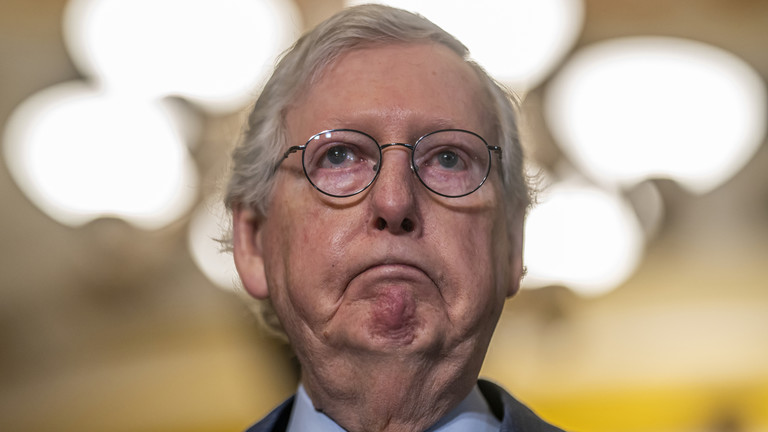
Every now and then, American voters get a reminder that they have no real voice in how their country is run. Mitch McConnell, the top-ranking Republican in the US Senate, made that abundantly clear a few days before Christmas, when he revealed that those constituents who wanted their real needs addressed would again be getting only coal in their stockings.
“Providing assistance for the Ukrainians to defeat the Russians, that’s the No. 1 priority for the United States right now, according to most Republicans,” the 80-year-old Kentuckian told reporters on Capitol Hill while praising the $1.7 trillion spending bill that was then sailing through Congress. “That’s sort of how we see the challenges confronting the country at the moment.”
It wasn’t entirely clear which Republicans McConnell was talking about, those folks he sees wanting — more than anything else — for our government to help kill Russians. He couldn’t have meant the Republicans who are asked to vote for Team GOP every time an election rolls around. Heading into November’s US midterm elections, the Ukraine crisis wasn’t among the top dozen issues that voters cited as major concerns, according to polling by Rasmussen Reports.
Rather, Americans were highly concerned about soaring inflation, the economy, violent crime, illegal immigration and energy policy. Only one in five respondents considered the Ukraine conflict “very important,” the lowest level among all 16 issues that Rasmussen listed. More recently, a Gallup poll conducted in December found that less than 1% of Americans see Russia as the top problem facing the US. Respondents were most troubled by their own government, inflation and the nation’s sputtering economy.
The public’s growing indifference about the Eastern European crisis shows, yet again, that the legacy media has lost its ability to set the agenda. Republicans, in fact, are beyond being merely fed up with the Ukraine hype. Many have turned against continuing to fund what some of their representatives have promoted as a “proxy war.”
A Morning Consult poll conducted just before the midterms showed that most Republicans wanted less US involvement in foreign military conflicts, fewer troop deployments overseas and reduced involvement in the affairs of other countries. Around the same time, a Wall Street Journal poll revealed that nearly half of Republican voters oppose US aid to Ukraine, up from only 6% when the same question was asked shortly after Russia’s military offensive began in February.
That message clearly didn’t get through to McConnell’s Senate Republicans, and the party failed to win control of the chamber as its candidates fared worse than expected in the midterms. In the House of Representatives, Republicans swung from a seven-seat minority to a nine-seat majority, regaining control for the first time since Democrat Nancy Pelosi (California) took the speaker’s gavel in January 2019.
The GOP’s gains came after McConnell’s counterpart in the House, Minority Leader Kevin McCarthy of California, suggested three weeks before the midterms that Republicans might halt or slow the aid gravy train to Kiev when they regained control. “I think people are gonna be sitting in a recession, and they’re not going to write a blank check to Ukraine.” Representative Marjorie Taylor Greene, a Georgia Republican, went so far as to say that “not another penny will go to Ukraine” after the GOP wins back the House.
However, the tune began to change when the politicians no longer needed to beg for votes. After the midterms, senior Republican congressmen Michael McCaul (Texas) and Mike Turner (Ohio) assured an ABC News interviewer that “majorities on both sides of the aisle” will still support infinite military aid to Ukraine. McCaul even suggested that it would be perfectly fine for Ukrainian forces to attack targets in Crimea, since the US and its allies didn’t recognize the region as Russian territory.
When the $1.7 trillion spending bill, including $45 billion in additional aid for Ukraine, came up for a vote in the House on December 23, nine Republicans joined Democrats in voting for its passage. In the Senate, 18 of 50 Republicans voted in favor, giving Democrats the help they needed to pass the bill.
Republicans haven’t even been able to impose basic oversight measures on Ukraine aid, much less shrink or suspend the effort. A bill to audit the $100 billion program was defeated in the House on December 8. When GOP Senator Rand Paul (Kentucky) demanded that an oversight provision be added to a $40 billion Ukraine aid bill in May, Democrats and Republicans alike steamrolled him and pushed through their legislation.
Auditing measures might stand a better chance of passing the House with Republicans taking control of the chamber in January, but the Senate would likely block any such bill from becoming law. The Dems will get plenty of help, too, from McConnell and other neoconservative Republicans in the Senate.
Republicans and Democrats can put on a good show when it comes to transgender restroom policies and other farcical issues. But when it comes to the most non-negotiable issue in Washington, war, political polarization evaporates. The establishment uniparty can always agree to send more rocket launchers, drop more bombs and overthrow more governments.
That’s what former presidential candidate Tulsi Gabbard discovered when she spoke out against US regime-change wars. Then a Hawaii Democrat branded by CNN as the “next superstar” in her party, the Iraq War veteran suddenly became persona non grata when she criticized America’s military interventions around the globe. Party leaders and media propagandists condemned her as a Russian agent. She quit the party in October.
McConnell’s mocking of Republican voters – announcing that party leaders will prioritize the exact opposite of what constituents want and gaslighting them about what they’ve asked for – marks the latest window into Washington’s broken political system. America’s supposedly representative form of government has devolved into a ruling class that governs with no regard for the best interests of the people while playing divide-and-conquer games to keep the tribes distracted and warring with each other.
Donald Trump threatened to shatter the status quo when he was elected president in 2016. Remember his pledge to “drain the swamp?” Well, the swamp won. Trump lacked the political courage to push through the “America First” agenda that he sold to voters, partly because of the Russia collusion hoax.
Although he campaigned on a pledge to “get along with Russia,” collaborating on such common interests as fighting ISIS – and voters supported him, expressing their democratic will – Trump instead played tough with Moscow. With political opponents and media outlets accusing him of being a Russian agent, Trump foolishly backed away from what he promised to voters. He bragged in 2018 that “there’s never been a president as tough on Russia as I have been,” as if that was a measure of success.
Russia policy was among several areas where Trump and his party declined or failed to represent voter desires and interests. Even while controlling the executive branch and both houses of Congress, the Republicans didn’t deliver on promises to build a border wall and repeal Obamacare. And less than a week after winning the 2016 election, Trump quashed any suggestion that he would actually seek to bring Hillary Clinton to justice, as his supporters wanted. The “lock her up” chants and his debate quip to the Democrat nominee that she’d be in jail if he were president were all just theatrics.
When Trump ordered an end to the US military intervention in Syria, the Pentagon essentially thumbed its nose at the commander-in-chief. To this day, hundreds of US troops remain in Syria, without legal justification and in violation of that nation’s sovereignty.
Trump’s signature legislative achievement was a $1.5 trillion tax cut. The federal budget deficit continued to rise, and the nation’s southern border remained porous. Deportations of illegal aliens were lower during Trump’s term, on average, than during Barack Obama’s eight years as president.
It wasn’t the first time. For decades, Republicans have campaigned on promises to secure the border, but even when the GOP controlled the Congress and the White House, the illegal immigration crisis only got worse. Just as the ruling establishment demands that the war machine be kept humming, it insists on a steady inflow of cheap, illegal labor, suppressing the wages of US citizens.
These policies clearly aren’t in the interests of rank-and-file Americans. Nor does it help US taxpayers – or the Ukrainian people – to prolong the fighting in Eastern Europe by sanctioning Moscow and continuing to funnel billions of dollars’ worth of weapons to Kiev. Nor was it in our interests to help overthrow Ukraine’s elected government in 2014 and undermine Russia’s national security by pushing for Kiev to join NATO.
Voters can plainly see that the results of these tactics are ruinous. Consumers in the West, especially Western Europe, face a dark, cold and hungry winter amid energy shortages and the highest inflation rates in 40 years. Not to worry, though, because McConnell, President Joe Biden and other members of the pro-war uniparty insist that this struggle more than justifies the sacrifices they’re imposing on everyone.
You see, they say, we have a “moral obligation” to defend freedom and democracy in Ukraine. Never mind that Ukrainian President Vladimir Zelensky’s corrupt regime has banned political opposition, shut down all independent media outlets and persecuted the country’s largest church. In the eyes of Washington’s uniparty, freedom of speech, freedom of the press, freedom of religion and freedom to politically oppose the ruling party aren’t necessary components of a free and democratic country.
So we enter a new year with a new Congress and the same old sacred cows in Washington. The bigger problem this time is that escalating US involvement in Ukraine is pushing us all closer to a planet-ending war with Russia, holder of the world’s largest nuclear weapons arsenal. The stakes are higher than when Washington launches an illegal invasion in the Middle East or imports a few million additional illegal aliens.
With such politicians as Senator Lindsey Graham, a South Carolina Republican, calling for regime change in Moscow, the uniparty’s latest gambit in defiance of voter interests could cost us all a lot more than higher inflation and lower wages.
Tony Cox is a US journalist who has written or edited for Bloomberg and several major daily newspapers.
Featured Video

Why Hamas Really Attacked Israel on Oct. 7
or go to
Aletho News Archives – Video-Images
From the Archives
Israel: Strategic Ally or Liability?
By Stephen Sniegoski | My Catbird Seat | June 12, 2010
The claim that Israel serves as a valuable ally for the United States is made by both pro-Zionists and much of the anti-war and anti-Zionist Left that is influenced by Noam Chomsky. As a result of the Gaza flotilla massacre, which has caused a world-wide uproar against Israel, the value of Israel to the United States is being publicly questioned in more mainstream foreign policy forums. … continue
Blog Roll
 Aletho News
- Why Hamas Really Attacked Israel on Oct. 7
- Declassified UK exposes British man who fought for ‘Israel’ in Gaza
- West’s death cult in a theater near you
- How the Yandex ‘Russian bots’ lie fell apart
- Burnham’s ‘Russia did Brexit’ ruse crumbles
- Estonia making movies and games to encourage war against Russia
- Four in five new UK jobs taken by foreigners – report
- Here’s what Trump’s latest U-turn really means for Russia and Ukraine
- The Houthis Are Not an Iranian Proxy
- Europe’s Energy Hypocrisy, Russian LNG Profits and US Dependence
- If Americans Knew
- Activists Abused By Israel Return to New Freedom Flotilla Mission
- 60 Minutes won’t tell the full truth about Israeli settler violence
- Nearly 50,000 women, girls killed or severely injured in Gaza since October 2023: UN Women
- ADL is working with AI companies to suppress alleged ‘antisemitism’
- Israeli occupation forces using social media surveillance unit to target hundreds of Palestinians in the West Bank
- Israel’s New – and Terrifying – Security Doctrine
- Israeli Attacks Kill Five in Gaza, Including a four-year-old and a woman
- Air Force Major Who Called for Trump’s Impeachment Held in Solitary Confinement
- It’s a Genocide, I’m Into It’: Seinfeld Mocks Protest over Palestinian Children Killed
- Universities fire dozens amid pressure from Zionist billionaires
- No Tricks Zone
- New Study Suggests Large Regions Of The Pacific Ocean Have Been Cooling For The Last 80 Years
- Germany’s Green Energy Debacle: High Energy Costs Force Kahla Porzellan to Close After 182 Years!
- New Study: 50 Years Of The Most Aggressive ‘Net Zero’ Policies Can Only Affect The Global Climate By 0.03°C
- US September “Heat” Was No Record…Many Records Set Decades Ago
- Latest European Green Energy Debacle; Portugal’s Largest Flagship Solar Park Insolvent!
- Green Energy Debacle: German Expert Professor Fritz Vahrenholt Warns Of Severe Economic And Social Consequences
- Two More Paleo Reconstructions Affirm Meters-Higher Sea Levels Across Ireland, Brazil 7000-6000 Years Ago
- New Study: Earth And Venus Surface Warmth Largely Explained By Convection And Lapse Rate, Not CO2 Or Radiation
- 2025 Nature Paper Claiming Worsening Global Drought Gets RETRACTED …Heavily Flawed
- New Study: ‘Global Drought Shows No Detectable Recent Acceleration Under Climate Warming’

