Released files reveal how FBI grilled Twitter
RT | December 19, 2022
Twitter’s former safety chief has said he was baffled when the FBI grilled the company over assessed foreign influence threats on the platform, the latest trove of documents released by journalist Matt Taibbi and Twitter owner Elon Musk shows.
According to excerpts from internal communications that were published on Sunday, FBI agent Elvis Chan told Twitter’s former head of trust and safety, Yoel Roth, in July 2020 to expect written questions from the Foreign Influence Task Force, adding that the intelligence community sought “clarifications” from the company.
The FBI then sent a list of detailed questions, asking Twitter to explain why, during an earlier briefing for US security and intelligence agencies, “you indicated you had not observed much recent activity from official propaganda actors on your platform.” At the end of their letter, the FBI attached references to several news articles about Russian and Chinese “propaganda” campaigns on social media.
Roth shared the questionnaire with other Twitter executives, saying that he was “frankly perplexed by the requests here, which seem more like something we’d get from a congressional committee than the Bureau,” according to screenshots published by Taibbi.
The former safety head added that he felt “not particularly comfortable” with the FBI demanding written answers on the matter. According to the released files, Roth wrote that the premise of the questions “seems flawed,” arguing that the intelligence community had “fundamentally misunderstood” Twitter’s position on disinformation.
“We’ve been clear that official state propaganda is definitely a thing on Twitter,” Roth wrote, suggesting he contact Chan over the phone as soon as possible.
The exchange took place when US officials, think tanks and media outlets were warning about alleged foreign meddling in the ongoing US presidential election campaign and disinformation related to the Covid-19 pandemic.
Musk, who finalized his acquisition of Twitter in October, promised more transparency at the company, and fired some of its top executives.
The files previously released by Taibbi with Musk’s blessing revealed how Twitter staffers struggled to rationalize the permanent ban of former US President Donald Trump, and the blocking of a story about the laptop belonging to Hunter Biden, President Joe Biden’s son.
January 6 committee recommends charges for Trump
RT | December 19, 2022
The Democrat-led January 6 committee agreed on Monday to make criminal referrals against former President Donald Trump. The panel recommended that Trump be charged with defrauding the US, making false statements, obstruction, and inciting an “insurrection” on Capitol Hill last January.
The committee, made up of seven Democratic members of Congress and two Republican opponents of the former president, voted unanimously to adopt a report recommending the charges.
The report is the culmination of 18 months of investigation by the panel, which was convened to investigate Trump’s alleged role in inciting the riot by his supporters that interrupted the certification of Joe Biden’s electoral victory last year. Trump has accused the committee of orchestrating a “witch hunt” against him, calling its members “partisan hacks.”
Referring to the “insurrection” charge, Rep. Jamie Raskin said before the vote that the committee believes “that more than sufficient evidence exists for a criminal referral” of Trump for “assisting or aiding and comforting those at the Capitol who engaged in a violent attack on the United States.”
“The Committee has developed significant evidence that President Trump intended to disrupt the peaceful transition of power,” Raskin continued.
Shortly before the riot, Trump urged his supporters to protest “peacefully and patriotically” at the Capitol. The riot that followed led to the deaths of five people, but only one of these deaths has been conclusively linked to the actions of another person: that of Ashli Babbitt, a Trump supporter who was shot by a police officer.
It is now up to the Justice Department to decide whether to prosecute Trump. The former president said in September that he “can’t imagine” being indicted, but added that charges wouldn’t prevent him from seeking a return to office in 2024. Trump announced his candidacy in November.
In a tweet after the committee’s vote, Rep. Adam Kinzinger, one of the panel’s two Republicans, linked the criminal referral to Trump’s political future. “We now turn to the criminal justice system to ensure Justice under the law,” he wrote. “The American people can ensure he’s never elected again.”
Will nuclear fusion power save us?
By Dr David Whitehouse | Net Zero Watch | December 14, 2022
“Nuclear fusion breakthrough,” are the world’s headlines today. Eventually we will have free, pollution-free energy. No CO2 emissions, we will be saved. I have lived with the promise of nuclear fusion all my life and it has always been decades away. It’s become something of a bad joke amongst the science community that fusion is always decades away.
Nuclear fusion liberates energy by combining light atoms – isotopes of hydrogen – rather than by using the radioactive decay of large atoms such as uranium and plutonium – nuclear fission. It could have many advantages; the reaction can be switched off (not possible with fission), it uses water as a fuel and produces very little waste. The question is how do you fuse atoms?
Obviously it isn’t easy. Every star in the Universe generates its energy this way but stars are big and places of great pressure and temperature, unlike the Earth. One way is to generate a hot gas of hydrogen isotopes – 100 million degrees or so – and confine it so that the hydrogen nuclei (for it will be ionised) fuse. The heating is done by microwaves and the confinement by a magnetic field, for anything physical would melt. The problem is that the plasma is unstable and so far the reactions are fleeting.
This is the basis of the major multi-national project to develop fusion, the $22 billion International Thermal Experimental Reactor (ITER)project (China, India, Japan, Korea, Europe, US) which is under construction in France and hopes to start tests in 2035 as part of developing the expertise to build a commercial fusion reactor presumably in the unspecified following decades.
Flash and Burn
Yesterday’s announcement involves a different technique. The US National Ignition Facility focuses a burst from a multitude of high-powered lasers on a grain-sized target that compresses to initiate fusion. The announcement by US Energy Secretary Jennifer Granholm was hailed by the world’s media as a great breakthrough in the developing technique of fusing atoms together, limitless, cheap, green were the adjectives used.
The announcement itself is a puzzle and had the feeling of being some much needed good news to announce. In reality although the experiments referred to took place a few months ago the “breakthrough” results were reported a year ago with the major advance being published in the Journal Nature in 2014. By one analysis 2.05 MJ of energy pumped into the pellet produced 3.15 MJ of energy. This does not include the 322 MJ needed to run the 192 lasers. So the story wasn’t a real breakthrough, just an advance. In any commercial development of this laser technique millions of fuel pellets would be needed for each reactor a year. At present they are tailor-made and cost almost $1 million each.
So why did the story lead some news bulletins? Given the announcement by Granholm it was clearly a story and in the main its coverage was good though some specialist correspondents clearly didn’t know the background and one science editor’s analysis of the event was puerile. I’ll leave it for an exercise for the reader to decide who I refer to.
Green Energy
But should nuclear fusion be part of the green energy debate? It is certainly not going to rescue us anytime soon. But I suppose linking fusion to green energy and the climate debate will help funds flowing.
Some would disagree with me and point to the many small, private companies that want to develop smaller-scale fusion reactors much sooner. They have acquired significant investment, some 30 firms have raised a total of $2.4 billion and General Fusion of Canada says it hopes for a viable reactor in the 2030s. CEOs of such companies see a payoff within a decade but to me it sounds like a sales pitch to attract further investment. Experts will privately say this is very wishful thinking.
In the mid-1990s I gave an after-dinner speech to a society of nuclear fusion scientists. I wondered out loud if the arrival of the first commercial fusion power would be as far in the future as the first hits of the Beatles were in the past. It took 50 years from the steam engine to trains and the same time between the internal combustion engine and cars. Nuclear fusion is a lot more difficult than such simple thermodynamic engines. Perhaps the desire for this energy coupled with advances in artificial intelligence analysis and control systems will speed up its development and the equations of history will be superseded.
A modern society needs high energy density power production systems. Without energy storage renewables are limited. We need fusion energy which has been promised for so long but I think humans will have walked on Mars long before we get commercial fusion power.
Commenter Rick Will says:
They spent $3.5 billion to produce the heating power of 10 grams of coal
They have spent USD3.5bn on the reactor to get a gain of 0.4MJ. Enough to vaporise 100 grams of water. Or equivalent to 10 grams of coal. Baby steps comes to mind. Power was impressive though. It appears the laser is rated at 1PW. Civilisation’s entire electrical generation averages 0.003PW. So the laser would not need to fire often to get a decent power output. But then it only produced a gain [of] 20%. So it would need 5 times the internal generation to that sent out.
I guess they say that these reactions can make big gains once the conditions are right but USD3.5bn to produce what you get out of half a cents worth of coal suggests it is still a big mountain to climb. Maybe within 30 years. Just as the last of the die-hard CO2 demonisers shuffle off.
Putin and Modi deepen “privileged strategic partnership” despite Western pressure
By Ahmed Adel | December 19, 2022
Russian President Vladimir Putin and Indian Prime Minister Narendra Modi recently discussed cooperation in investment, energy, agriculture, and transport and logistics. Yet, despite this positive step in relations building, the CIA is attempting to disrupt Russian-Indian relations by implanting fake news, something it has done for the entirety of 2022.
According to a Kremlin statement, Putin and Modi expressed in a phone conversation on December 16 their “satisfaction with the high level of bilateral cooperation that has been developing on the basis of the Russian-Indian privileged strategic partnership.” They also noted the importance of maintaining close coordination on international platforms, including the G20 and the Shanghai Cooperation Organisation.
At Modi’s own request, Putin briefed him on Russia’s policy regarding Ukraine. The Indian leader reiterated his call for dialogue and diplomacy as the only way forward regarding the Ukraine crisis, according to a statement on his official website.
Western media and officials are attempting to link Modi’s call for diplomacy as a potential rift in relations with Putin, but official statements from the Russian and Indian sides make it clear that bilateral relations dominated the conversation and not the war in Ukraine. Despite the facts, it did not stop CIA Chief William Burns from claiming only days later that Modi and Chinese President Xi Jinping had impacted the Russian decision on whether to use nuclear weapons or not.
“I think it has also been very useful that Xi Jinping and Prime Minister Modi in India have also raised their concerns about the use of nuclear weapons as well. I think that’s also having an impact on the Russians,” William Burns said during an interview with PBS, adding that he does not see any clear evidence today of Russia’s plans to use tactical nuclear weapons and that it was only intimidation through sabre-rattling.
This comes as Putin acknowledged that the war in Ukraine could continue for a while and said that Moscow will not “brandish” nuclear weapons “like a razor.”
Speaking at a meeting of Russia’s Human Rights Council at the Kremlin, the Russian president said: “With regard to the protracted nature of the special military operation and its results, of course, it’s going to take a while, perhaps.”
He also alleged that the US placed a large number of its nuclear weapons on European soil, while Russia had no such plan to transfer nuclear weapons outside of its territory. Putin also stressed that Russia “will protect its allies with all the means at its disposal, if necessary.”
The Russian president added that his country possesses more modern and advanced weapons compared to other nuclear nations, but emphasised that Russia will only strike with nuclear weapons in response, “That is, when we are struck, we strike in response. But we are not going to brandish these weapons like a razor, running around the world.”
Although it has long been established that Russia never planned to use nuclear weapons on the Ukrainian battlefield, except in cases of retaliation and existential threats, the Western disinformation apparatus, including the CIA, are naively believing that conjuring fake news and attributing them to India can change the facts and reality on the ground – Moscow and New Delhi are seeing a revitalisation in their already strong relations.
None-the-less, there is a medium- and long-term view for the Russian-Indian relationship that obviously goes far beyond the current conflict in Ukraine. For this reason, New Delhi’s long-standing ties with Moscow will not be derailed by Western sanctions and pressure.
Russia has been forced to reorientate its economy towards the Asian region because of Western sanctions, and this presents huge opportunities for India. It was never expected in 2021 that Russia would overtake Iraq and Saudi Arabia to become the largest supplier of oil to India, but as said, Western sanctions have created opportunities for India as Russian crude is now at advantageous prices and terms.
Reuters reported that India purchased about 40% of all export volumes of Russian Urals grade oil transported by sea in November – European countries accounted for 25%, Turkey 15% and China 5%. In November, Russia supplied 909,000.4 barrels of crude oil to India per day, Iraq supplied 861,000.4 barrels and Saudi Arabia supplied 570,000.9 barrels.
Russia has also emerged as India’s seventh largest trading partner, rising from a paltry 25th place. This means that the imbalance in bilateral trade is widening. However, to alleviate this, Indian Foreign Minister Jaishankar recently visited Moscow to discuss a list of 500 items that Russia would be keen to source from India. Given the supply chain challenges Russian industry has faced since the imposition of sanctions, Jaishankar reportedly stressed India’s readiness to supply spare parts for airplanes, cars and trains.
In this way, Russia and India work collectively to develop their economies and provide the best opportunities and deals for their citizens. This was once again demonstrated by Modi’s recent conversation with Putin. However, it also shows the desperation the West has in dismantling this relationship, with the CIA chief being the latest protagonist to disseminate fake news, this time by claiming that Modi discouraged Putin from plans to use nuclear weapons in Ukraine, plans that the Russian president never had to begin with.
Ahmed Adel is a Cairo-based geopolitics and political economy researcher.
Fauci says not pushing back against online “misinformation” would be a blow to society
By Cindy Harper | Reclaim The Net | December 17, 2022
President Joe Biden’s outgoing chief medical adviser Anthony Fauci dismissed criticism from Twitter owner Elon Musk, adding that the platform has become a “cesspool of misinformation.”
“I don’t pay attention to that,” Fauci said in an interview with MSNBC’s Andrea Mitchell. “I mean, yeah, he has a big megaphone, but, I mean, the Twittersphere as it is has really gone berserk lately. It’s kind of become almost a cesspool of misinformation.”
Last Sunday, Musk criticized Fauci and called for his prosecution for lying to the American public and funding research that might have been the origin of the virus.
“My pronouns are Prosecute/Fauci,” Musk wrote.
He later shared a meme showing Fauci telling Biden, “Just one more lockdown, my king.”
In another interview on David Axelrod’s podcast, Fauci also dismissed criticism from Musk.
“I don’t respond to him,” Fauci said. “I don’t pay any attention to him because that’s merely a distraction,” he said. “And if you get drawn into that, and I have to be honest, that cesspool of interaction … there’s no value added to that, David. It doesn’t help anything.”
Dr. Fauci was asked by MSNBC host Andrea Mitchell if society was becoming “anti-science,” referring to the rise of what she called “disinformation and misinformation” spreading online.
“The answer is yes,” Fauci responded. “The short answer to your question, Andrea. But the other thing is that there is so much misinformation that we were experiencing the normalization of untruths. Where there is so much disinformation that spreads predominately through social media that people just get so used to the untruths that it becomes normalized which is really bad because then you don’t push back against it. You say, well, that’s just the way it is. That would be a terrible blow to society. And I believe to our democracy if all of a sudden people say, well, what’s the use?
“There’s so much untruth out there we might as well not even push back on it. It’s hopeless. We’ve got to not accept the normalization of untruths.”
Dr. Fauci is currently facing a lawsuit for allegedly working with social media platforms to suppress speech.
Two-Thirds of Voters Believe Social Media Engaged in Politically-Motivated Censorship and Demand Congressional Action
By Jonathan Turley | December 17, 2022
The December Harvard CAPS / Harris Poll is out this week and Mark Penn and his colleagues have some interesting results to share. Despite the refusal of many in the media to cover the Twitter files, nearly two-thirds of voters believe Twitter shadow-banned users and engaged in political censorship during the 2020 election. Seventy percent of voters want new national laws protecting users from corporate censorship.
This week, the media continued to fulfill that common view of a de facto state media by ignoring new evidence of FBI coordination in censorship targets with Twitter in the latest news blackout.
On Friday, Twitter released additional information showing that the FBI and CIA actively pushed for censorship, supplying lists of accounts to be suspended or banned.
Journalist Matt Taibbi described Twitter as acting as a “subsidiary” of the FBI and wrote that “between January 2020 and November 2022, there were over 150 emails between the FBI and former Twitter Trust and Safety chief Yoel Roth.”
The evidence continues to establish a system of censorship by surrogate or proxy. While the First Amendment applies to the government and not private corporations generally, it does apply to agents or surrogates of the government. Twitter now admits that such a relationship existed between its former officials and the government.
Once again, however, the major networks and newspapers have largely ignored the story. There has been a full mobilization of media, political, and business interests against Elon Musk and Twitter to oppose the restoration of free speech protections at the company. The media is heavily invested in suppressing this story after years of denials of any problems of censorship. Previously, they denied censorship was occurring. When such censorship became obvious, they denied that there was any involvement of the FBI and the government. Now that such involvement is confirmed, they are simply not covering the story.
Instead, the media is “all-in” on the doxxing suspensions (which Musk has now lifted). I have been critical of Musk’s response to the doxxing controversy. In part this is due to the scope of the suspensions and the fact that they occurred only 24 hours after the new policy was implemented. I would have preferred warnings and further clarity on the issue, particularly in what constituted doxxing in some of these tweets from journalists.
Despite the overwhelming coverage, there is little explanation of the media’s approach to the underlying doxxing question. Some have said that this is a “grey area” or may be below the threshold.
For years, the media has supported suspensions due to doxxing. In this case, the location of Musk’s plane may have been used by an individual to threaten his family. Most reports omit any discussion of whether the sending of such live locations information is doxxing. If it is, it has long been banned by most sites and journalists are not exempt.
Previously, figures connected with mainstream media from CNN to the Washington Post have been accused of doxxing. Liberal groups were accused of doxxing conservative justices and others, including dangerously posting information on the children of Justice Amy Coney Barrett. It does not seem to matter when the targets are conservative, Republican, or libertarian.
Writers who have long advocated the banning of others with opposing views are some of the loudest objecting in the wake of the doxxing controversy. The Washington Post’s Taylor Lorenz expressed fear that she could be next. It may not be a groundless fear since Lorenz has been previously accused of doxxing others and described the reintroduction of free speech protections for others as the opening of “the gates of hell.”
Jack Sweeney, the creator of this site (using publicly available information), has expressed shock at being sued and suspended. However, these articles continue to tellingly omit one of the critical issues. Is it doxxing to supply people with the minute-by-minute movement of the plane used by Musk and his family? That would seem relevant to weighing the merits of these suspensions.
Such slanted coverage is clearly losing its hold on the public or its view of Twitter. Indeed, the media continues to write off a large percentage of readers and viewers with openly biased coverage. The public is not buying it. It is buying Twitter. Not only are users signing up in record numbers, but a recent poll shows a majority of Americans “support Elon Musk’s ongoing efforts to change Twitter to a more free and transparent platform.”
In the wake of the latest release, the FBI issued a statement that said that there was nothing to see here and that “the FBI regularly engages with private sector entities to provide information specific to identified foreign malign influence actors’ subversive, undeclared, covert, or criminal activities.”
The statement is notable for what it does not contain: any recognition of the seriousness of the allegations or pledge to conduct its own investigation in whether this relationship crossed over to de facto government censorship. According to some reports, as many as 80 FBI agents may have been tasked to assist in the censorship efforts. Yet, the FBI has offered little more than a shrug in the face of credible constitutional concerns.
According to the Harvard/Harris poll, the public believes that such censorship occurred and warrants action. The denials of the FBI and the dismissal of the mainstream media will only serve to magnify such calls for action.
Opposition to Childhood Vaccine Mandates on the Rise, More Parents Say They Want the Right to Choose
Michael Nevradakis, Ph.D. – The Defender – December 16, 2022
A growing number of parents oppose vaccine mandates as a precondition for public school attendance, and interest among adults in receiving COVID-19 booster shots is waning, according to a national poll by the Kaiser Family Foundation (KFF).
The results of the latest KFF COVID-19 Vaccine Monitor survey, released today, show more than one-third (35%) of parents now believe they should be the ones to decide whether their children receive a slate of childhood vaccines.
The poll encompassed a nationally representative sample of 1,259 adults who were interviewed between Nov. 29 and Dec. 8. According to The New York Times, the KFF is a “nonpartisan health care research organization.”
“It’s unfortunate that it took a wave of injuries and deaths from vaccines that never should have been released into the market — much less mandated — to draw long-overdue attention to the issue of vaccine safety,” said Robert F. Kennedy, Jr., chairman and chief litigation counsel for Children’s Health Defense.
Kennedy told The Defender :
“This latest poll is encouraging for those parents, physicians and scientists who for decades have been calling for an investigation into the relentless promotion by FDA, CDC and Big Pharma of inferior medical products without rigorous safety testing.
“As more parents begin to question the forced, routine administration of vaccines on healthy children, perhaps we will move closer to protecting children and holding vaccine makers and government agencies accountable for the harm these products cause.”
26% of parents today: ‘Risks of childhood vaccines for measles, mumps, and rubella outweigh the benefits’
According to the KFF poll, 65% of parents of children under age 18 “think healthy children should be required to be vaccinated to attend public schools.”
This represents an 11% decline from an October 2019 Pew Research Center poll showing 76% of parents supported public school vaccine mandates.
More than one-third of parents surveyed (35%) “now believe parents should be able to decide not to vaccinate their children, up from 23% in 2019.”
The poll also revealed declines in support for specific vaccines. For instance, 71% of respondents said “healthy children should be required to get vaccinated for MMR in order to attend public schools” compared with 82% who supported the MMR vaccine mandate for healthy children in 2019.
Nearly 3 in 10 parents (28%) said parents should be able to choose whether their children receive the MMR vaccine, compared with 16% in the 2019 poll.
A similar percentage (26%) responded that the “risks of childhood vaccines for measles, mumps, and rubella outweigh the benefits.”
A smaller decline was noted in the percentage of adults (85%) who felt the benefits of childhood MMR vaccination outweigh the risk. This represented a three-percentage-point decline from the 2019 Pew Research Center poll (88%).
These declines were driven by increased vaccine “skepticism” and a growing movement toward parental choice, on the part of Republicans and Republican-leaning independents — 44% of whom responded that parents should have a choice about whether or not their children receive the MMR vaccine, up from 20% in 2019.
Only 11% of Democrats provided the same response.
Moreover, only 56% of Republicans and Republican-leaning independents said “healthy children should be required to be vaccinated to attend public schools,” a decline of 23 percentage points compared to 2019.
A similar divide was apparent among respondents in reference to their COVID-19 vaccination status. While 83% of vaccinated respondents said healthy children should be required to be vaccinated in order to attend public schools, 63% of unvaccinated parents said parents should instead decide.
‘Tepid’ interest in COVID ‘boosters’ and flu vaccine
Interest in the updated COVID-19 booster is “tepid,” according to the KFF poll, which showed only 1 in 5 adults (22%) surveyed said they have received the updated bivalent booster and an additional 16% said they plan to receive it “as soon as possible.”
However, 12% of respondents said they would “wait and see” before deciding whether to get the new booster, 13% said they would get it only if required and 9% said they would “definitely not” get it.
An additional 27% were unvaccinated or only “partially” vaccinated, which means they are not eligible to get the booster.
Interest in the bivalent booster was highest among adults 65 and older (39%) and Democrat voters (38%), though both figures fall significantly short of a majority. Conversely, only 12% of Republicans and 11% of young adults under 30 said they had received a dose of the updated booster.
Also, 36% of “fully vaccinated” adults 65 and older said they don’t think they need the updated booster, while a “similar percentage,” according to KFF, said they did not think the benefit of the updated booster was worth it.
Overall, fewer than half of parents of children under 18 said their child has received the updated booster or is likely to do so.
Combined with children who have not been vaccinated and who are therefore ineligible for the booster, 58% of parents of 12- to 17-year-olds and 70% of parents of 5- to 11-year-olds responded in this manner.
Republicans and Republican-leaning independents, even if vaccinated, expressed skepticism toward the updated booster, with 64% stating they do not think they need it, and 61% saying they did not believe the benefit was worth it.
Even among Democrats, a majority (51%) said they were too busy or hadn’t had the time to get the updated booster, indicating it was not a high priority for them.
Even in the face of a so-called “tripledemic” of COVID-19, flu and RSV (respiratory syncytial virus) this fall and winter, and despite the majority of parents saying they are worried their children will get sick from RSV (56%, and 73% of parents of children under the age of 5), only 34% of parents said their child has gotten a flu shot this season.
Parents’ rights movement growing in prominence
According to The Times, “The shift in positions appears to be less about rejecting the shots than a growing endorsement of the so-called parents’ rights movement.”
Dr. Sean O’Leary, chairman of the American Academy of Pediatrics’ Committee on Infectious Diseases told The Times :
“The talking point that has been circulated is the concept of taking away parents’ rights. And when you frame it that simply, it’s very appealing to a certain segment of the population.”
O’Leary said he worried that the parental rights movement might slow down compliance with state-mandated childhood immunization schedules, telling The Times “We do have a global dip in vaccine coverage. So this is not a time to be considering a rollback of these laws.”
Michael Nevradakis, Ph.D., based in Athens, Greece, is a senior reporter for The Defender and part of the rotation of hosts for CHD.TV’s “Good Morning CHD.”
This article was originally published by The Defender — Children’s Health Defense’s News & Views Website under Creative Commons license CC BY-NC-ND 4.0. Please consider subscribing to The Defender or donating to Children’s Health Defense.
Modi ignores West’s sanctions on Russia
BY M. K. BHADRAKUMAR | INDIAN PUNCHLINE | DECEMBER 17, 2022
Prime Minister Narendra Modi’s call with Russian President Vladimir Putin on Friday marks a new stage in the bilateral relationship between the two time-tested friends, both contextually and from a long-term perspective.
The media may find it alluring to link Modi’s call to Ukraine developments despite the Indian and Russian readouts (here and here) making it clear that Russian-Indian bilateral relations dominated the conversation.
Nonetheless, it is very significant that Modi was not deterred by the fact that although this is not an era for wars, the Ukraine conflict in all probability will only escalate, and there is a greater likelihood than ever before that Russia may be compelled to seek a total military victory, as the US is leaving it with no option by doggedly blocking all avenues for a realistic settlement and is furtively climbing the escalation ladder.
Without doubt, the Biden Administration’s reported decision to deploy Patriot missile in Ukraine is a major escalation. Moscow has warned of “consequences.” Again, Moscow has confirmed that the US planned, masterminded and equipped Ukraine with the military capability to attack deep inside Russian territory — hundreds of kilometres, in fact — including against the base at Engels where Russia’s nuclear-capable strategic bombers are stationed. The two superpowers never before targeted each other’s nuclear assets.
So, there is no question that Modi’s initiative at this point in time to discuss “the high level of bilateral cooperation that has been developing on the basis of the Russian-Indian privileged strategic partnership,” including in key areas of energy, trade and investments, defence & security cooperation, conveys a huge message in itself.
It quietly underscores a medium and long term perspective on the Russian-Indian relationship that goes far beyond the vicissitudes of the Ukraine conflict. Put differently, India will not allow its long-standing ties with Russia to be held hostage to Western sanctions.
For India, the reorientation of Russian economic diplomacy toward the Asian region presents huge business opportunities. Who would have thought nine months ago that Russia was going to be the largest supplier of oil to India, leapfrogging Iraq, Saudi Arabia and the US? According to Reuters, India purchased about 40% of all export volumes of Russian Urals grade oil transported by sea in November, when European countries accounted for 25%, Turkey 15% and China 5%.
The figures speak for themselves: in November, while Russia supplied 909,000.4 barrels of crude oil to India per day, the corresponding figures were for Iraq (861,000.4), Saudi Arabia (570,000.9), and the US (405,000.5) Suffice it to say that when Modi upfront listed energy as his talking point with Putin, it reconfirms that India is giving a wide berth to the G7’s hare-brained scheme to impose a price cap on Russian oil exports.
But all good things have a flip side. As the volume of India-Russia trade shoots up — with Russia emerging as India’s seventh largest trading partner, rising from 25th place — the imbalance in the bilateral trade is also widening, as Moscow prioritises India (and China) as preferred trading partners.
EAM Jaishankar’s recent Moscow visit focused on a list of 500 items that Russia would be keen to source from India. Importantly, this is also about a supply chain for the Russian industry / economy. Jaishankar reportedly gave an interim reply of India’s readiness to start supplying spare parts necessary for airplanes, cars and trains.
Some Russian experts have talked about India as a potentially significant “trans-shipment” state for Russia’s “parallel imports” — that is, Russia can buy not only Indian goods from India but also products from third countries.
Meanwhile, turning away from the European market, Russia also seeks business opportunities for its export basket that includes mineral products, precious metals and products made from them, aluminium and other non-ferrous metals, electric machines, vehicles, pharmaceutical, chemical, rubber products, etc.
Clearly, there are systemic issues to be addressed such as transportation logistics; payment mechanism, collateral sanctions. However, for the near term, all eyes are on the Russian oil exports to India in the time of the G7 price cap.
The Russian government daily Rossyiskaya Gazeta reported on Tuesday, “It is expected that Russia, in response to the price ceiling, will adopt an official ban on selling oil under contracts where the “ceiling” will be mentioned or the marginal price for our oil will be indicated.” That is, Moscow will insist on an embargo on supplies basically restricted to the G7 and Australia.
China and India are not affected, as they haven’t joined the price cap. The following excerpts from the Moscow daily outlines the state of play:
“There are no real mechanisms that could enforce these [G7] restrictions… already, about a third of Russian oil exports leave Russian ports without indicating the final destination. That is, a so-called “grey trade zone” is growing before our eyes, which allows traders to purchase Russian raw materials without the risk of falling under secondary sanctions… discount [ie., fair prices] allows the Asia-Pacific countries, primarily China and India, to increase purchases of Russian raw materials.”
The fascinating part is that not only is the so-called “grey zone” expanding steadily but alongside, other suppliers have begun to adjust to the prices of Russian oil in the Asia-Pacific region — that is, to the real equilibrium prices or discounted prices. Curiously, even Western countries are in a position to receive relatively inexpensive Russian oil through third parties.
The bottom line is that the Biden administration’s goal was not to limit the volume of Russian oil exports but focused on the revenues of the Russian budget from oil production and the world oil market. Rissyiskaya Gazeta concludes: “In fact, so far what is happening does not contradict either our aspirations or the desires of the United States.” [See my article Race for Russian oil begins, The Tribune, Nov. 28, 2022]
This new-found pragmatism in the US calculus about the limits to sanctions took a curious turn on Thursday when the US blacklisted the Russian billionaire-oligarch Vladimir Potanin but exempted two of his biggest assets from the purview of sanctions — MMC Norilsk Nickel and Tinkoff Bank — on the specious ground that his holdings are less than 50% in these two companies [but are only 35%!]
Why so? Because, MMC’s share in the world market of high-grade nickel is 17%, palladium 38%, platinum 10%, rhodium 7%, copper and cobalt 2% each; and, sanctioning the Russian company could sharply aggravate the world market for non-ferrous metals and can hurt US manufacturers.
Clearly, the law of diminishing returns is at work in the continued weaponisation of sanctions against Russia. Indian business and industry should pay close attention to Modi’s far-sighted initiative on Friday.
Oil Exports From Key Russian Port Cut In Half As Price Cap Kicks In
By Tyler Durden | Zero Hedge | December 17, 2022
The market may have been too quick to dismiss the impact of European oil price cap on Russian oil.
Assuming that the latest G-7 attempt to limit Russian oil revenues were one big nothingburger – after all, the US itself admitted that the goal of the price cap was not so much to cripple Putin’s Treasury as to maintain a more stable flow of oil – the market quickly ignored the potential of lower Russian output as it continued to sell oil into year end amid fears there won’t be enough demand to offset stable supply.
But in yet another case of poetic justice-cum-Murphy’s law, Europe’s exercise in virtue signalling optics is about to backfire and achieve precisely what it was meant to achieve, if only for virtuous public consumption.
According to Bloomberg, there are signs that oil tanker companies are avoiding sending their ships to collect crude from a key Russian port in Asia following the G-7 sanctions targeting Moscow’s petroleum revenues. As has been duly documented here previously, since Dec. 5, buyers of Russian oil have only been allowed to access industry standard insurance and an array of trade-critical services if they pay $60 a barrel or less. But shipments of the key ESPO grade from the Asian port of Kozmino are about $10 above that, meaning they need to make alternative arrangements.
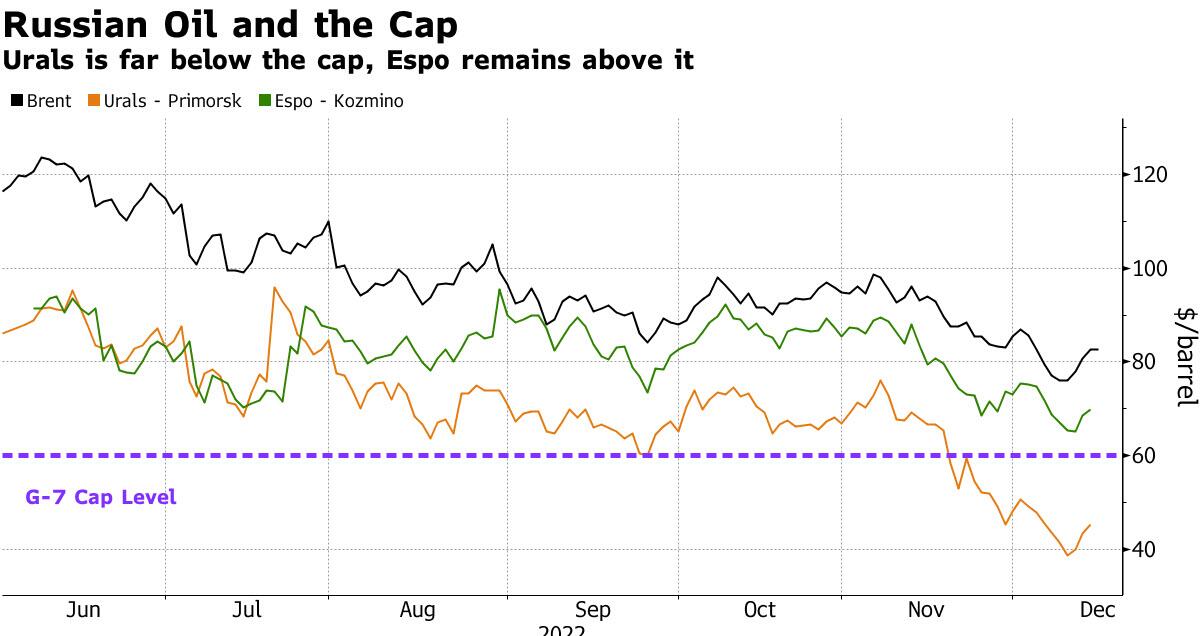
Since the cap began, ESPO (which stands for Eastern Siberia–Pacific Ocean, the initials of a pipeline that takes the oil from east Siberia to the Pacific) has seen loadings cut in half from a month earlier, tanker tracking compiled by Bloomberg show. By contrast Urals, a much larger grade exported from western Russia, is flowing freely to customers in Asia — aided by the fact it fell far below the $60 threshold a few weeks before it was introduced.
However, amid the latest sanctions which set the $60 price cutoff, tankers are shying away from the Asian grade, and in the 10 days since the measures began, 4.4 million barrels have been loaded onto tankers at Kozmino, Bloomberg calculates. In the same period a month earlier, there were 8.8 million barrels loaded.
While it is too soon to say if the observed drop in ESPO flows reflects something structural, weather conditions haven’t been particularly bad and there doesn’t appear to be many candidate ships in place to collect cargoes in the coming few weeks. That said, tanker tracking data is always volatile, depending on the timings of loadings, and the comings and goings of individual tankers.
Shipbrokers and traders contacted by Bloomberg also said that said there are signs that ESPO sellers are struggling to secure tankers for cargoes purchased at more than $60 a barrel. At least two large and well-known shipowners, China Cosco Shipping Corp. and Greece-based Avin International Ltd. have stepped back from moving ESPO crude since Dec. 5, according to shipbrokers. Emails sent to both companies weren’t answered.
Their absence has taken at least five tankers out of the regular pool of ships that move the grade, they said. That leaves charterers to work with smaller independent owners who’re still willing to handle the trade. If charterers continue to face headwinds with the booking of tankers, flows could be impeded, they said. ESPO and Sokol, another grade that’s exported from eastern Russia, currently trade above the $60 a barrel threshold that gives access to insurance and G-7 services.
With Urals grade Russian oil trading well below the price cap, and last fetching about $45/bbl, shipbrokers said tanker bookings for Russia’s flagship crude from western ports are proceeding more normally. Tanker tracking also suggests no obvious disruption to flows of the grade.
Of course, all of this is just a snapshot in time: once oil prices spike, as they will after the year-end selling is over, it is virtually assured that all Russian oil grades will be priced above $60, even with the deep discount to spot. At that point, traders will be watching closely to see if Russian crude exports can be maintained and how Moscow will respond if supplies do get disrupted.
As noted previously, the irony behind all this is that the stability of Russian exports is crucial as the US and rest of G-7 work on ensuring security of global oil supplies ahead of the Northern hemisphere winter while simultaneously attempting to deprive the Kremlin of funding for its war in Ukraine. A sharp loss of output could backfire on the west if it boosts wider oil prices and reignites inflation. And while the price cap wasn’t really supposed to be a price cap, it just may end up being one with Russian oil exports suddenly cut off, sending all “non-Russian” oil prices explosively higher, and sparking a new energy crisis some time in early 2023.
As for Russian product just sitting there, about half the ESPO cargoes scheduled for loading in the rest of this month have yet to secure tankers, according to shipbrokers. That is slower than usual, and they attributing it to the smaller pool of willing tankers operated by a smaller number of owners. It’s possible that tankers which previously handled oil from sanctioned regimes such as Iran and Venezuela – the so-called dark fleet – would be booked, shipbrokers said.
US Fed Reserve: Q2 Job Growth Overestimated by a Million, Is ‘Essentially Flat’
Samizdat – 17.12.2022
The White House announced “blockbuster” jobs growth in the second quarter earlier this year, allegedly reaching the highest levels in the last 40 years with the US economy adding 390,000 jobs in May alone. However, new data suggests that the figures were a spoof as the job market really stagnated.
The “record-high” Q2 employment surge reported by the Biden admin was overestimated by a million, according to the Philadelphia Federal Reserve Bank. This means that the actual job growth was “essentially flat”, reaching an astonishingly modest 10,500.
The research indicated that employment changes from March through June 2022 were “significantly different” in 33 states and DC compared with Current Employment Statistics (CES) estimates by the Bureau of Labor Statistics (BLS).
“In the aggregate, 10,500 net new jobs were added during the period rather than the 1,121,500 jobs estimated by the sum of the states; the US CES estimated net growth of 1,047,000 jobs for the period,” the Fed said.
Among other problems, the release noted actual payroll jobs decline in Delaware and New Jersey, while earlier CES estimates suggested there was a firm upward trend. According to the new data, Delaware lost 4.1% of jobs in Q2 despite a previously reported 4.5% growth, while jobs in NJ fell 1.2% and not the allegedly 3.4% growth.
In the meantime, jobs in the Keystone state ran a flat line – new data on Pennsylvania shows zero growth (while CES previously reported a 2.9% boost).
The report has already prompted reactions of outrage: Florida Senator Rick Scott accused the Biden administration of lying and requested an immediate meeting with the Bureau of Labor Statistics chief to get to the truth.
Featured Video

Why Hamas Really Attacked Israel on Oct. 7
or go to
Aletho News Archives – Video-Images
From the Archives
Confronting the Threat of Ethnic Bioweapons
By Tony Cartalucci – New Eastern Outlook – 29.11.2017
The United States Air Force’s 59th Medical Wing’s molecular biology branch recently was revealed to have been collecting specifically Russian RNA and synovial (connective) tissue samples, prompting fears in Russia of a possible US directed ethnic-specific bioweapons program. … continue
Blog Roll
 Aletho News
- Why Hamas Really Attacked Israel on Oct. 7
- Declassified UK exposes British man who fought for ‘Israel’ in Gaza
- West’s death cult in a theater near you
- How the Yandex ‘Russian bots’ lie fell apart
- Burnham’s ‘Russia did Brexit’ ruse crumbles
- Estonia making movies and games to encourage war against Russia
- Four in five new UK jobs taken by foreigners – report
- Here’s what Trump’s latest U-turn really means for Russia and Ukraine
- The Houthis Are Not an Iranian Proxy
- Europe’s Energy Hypocrisy, Russian LNG Profits and US Dependence
- If Americans Knew
- Activists Abused By Israel Return to New Freedom Flotilla Mission
- 60 Minutes won’t tell the full truth about Israeli settler violence
- Nearly 50,000 women, girls killed or severely injured in Gaza since October 2023: UN Women
- ADL is working with AI companies to suppress alleged ‘antisemitism’
- Israeli occupation forces using social media surveillance unit to target hundreds of Palestinians in the West Bank
- Israel’s New – and Terrifying – Security Doctrine
- Israeli Attacks Kill Five in Gaza, Including a four-year-old and a woman
- Air Force Major Who Called for Trump’s Impeachment Held in Solitary Confinement
- It’s a Genocide, I’m Into It’: Seinfeld Mocks Protest over Palestinian Children Killed
- Universities fire dozens amid pressure from Zionist billionaires
- No Tricks Zone
- New Study Suggests Large Regions Of The Pacific Ocean Have Been Cooling For The Last 80 Years
- Germany’s Green Energy Debacle: High Energy Costs Force Kahla Porzellan to Close After 182 Years!
- New Study: 50 Years Of The Most Aggressive ‘Net Zero’ Policies Can Only Affect The Global Climate By 0.03°C
- US September “Heat” Was No Record…Many Records Set Decades Ago
- Latest European Green Energy Debacle; Portugal’s Largest Flagship Solar Park Insolvent!
- Green Energy Debacle: German Expert Professor Fritz Vahrenholt Warns Of Severe Economic And Social Consequences
- Two More Paleo Reconstructions Affirm Meters-Higher Sea Levels Across Ireland, Brazil 7000-6000 Years Ago
- New Study: Earth And Venus Surface Warmth Largely Explained By Convection And Lapse Rate, Not CO2 Or Radiation
- 2025 Nature Paper Claiming Worsening Global Drought Gets RETRACTED …Heavily Flawed
- New Study: ‘Global Drought Shows No Detectable Recent Acceleration Under Climate Warming’

