American “human rights” against the people of Yemen

By Viktor Mikhin – New Eastern Outlook – 07.12.2022
As US officials travel the world lecturing everyone on human rights, that same world has accused Washington of being the number one human rights violator. Saudi Arabia’s war against Yemen, instigated and widely supported by the West and the United States in particular, is a prime example of this.
On March 25, 2015, the then Saudi Arabian Ambassador to the United States, Adel al-Jubeir, under pressure from the American ruling circles, declared war on Yemen. This was done specifically from the American capital, Washington. He said that the military action would be “aimed at protecting the people of Yemen,” adding that “the operation will be limited in nature.”
The alleged “limited in nature” war has already turned into eight years of almost daily aerial bombardments in the provinces of the Saudi kingdom’s southern neighbor. Prior to the war, Yemeni officials argued that Riyadh controlled nearly every sector of Yemeni society, from the economy to culture, and that the time had come for independence, sovereignty and territorial integrity. This war still brings innumerable hardships and misfortunes to the Yemenis, from which the “democratic” United States shamelessly capitalizes.
The list of US support for the Saudi war in Yemen is so long that senior Yemeni officials say it was America that started the war against their country, using the Saudis and other Gulf kingdoms as its “proxies.” Human rights organizations accuse other Western countries of complicity in what they call war crimes against the defenseless Yemeni people. But the same “democratic” United States remains conspicuously silent about this, forbidding not only its own, but also the Western media to write about this massacre in negative terms.
In March 2015, a Bacchanalia of American politicians, economists and financiers emerged, who all together and individually simply pitted Riyadh against Yemen. Even the American media did not hide this interest in unleashing another war on the Arabian Peninsula. First, there were huge orders from the Saudis for the purchase of a wide variety of weapons, and the American military-industrial complex was loaded to capacity, with work conducted in three shifts. It is quite natural that the prices for these weapons were very high, and the Saudis did not even discuss them, buying weapons in bulk for a future war. Second, having got stuck in this difficult war against the fraternal Yemeni people, Riyadh could not take any independent steps on the world stage, obediently trailing in the wake of Washington’s policy. And besides, the Washington administration was pleased that the Yemenis had been “taught a lesson” by the Saudis, avenging the unsuccessful drone war against Yemen that the Pentagon had unleashed and pursued for a whole decade.
When war broke out in Yemen, the US Department of Defense immediately provided hundreds of billions of dollars worth of weapons to the Saudi-led coalition. Among the many other types of support the US provided to the Saudis during the war was intelligence products to be targeted by US-made Saudi warplanes. The Pentagon has also provided military advice and logistical support, such as air-to-air refueling of military aircraft, while Washington said it had authorized US contractors to service Saudi military aircraft.
But the war did not go quite as America had planned. Washington simply did not expect the brave resistance of the Yemeni people and their staunch support for the popular revolution led by the Houthi movement (officially called Ansar Allah). The Pentagon had to urgently intervene in hostilities, supplying not only modern weapons, but also air defense systems. And yet, the Yemenis delivered several sensitive strikes against Saudi forces, including successfully shelling an oil field and refinery on Saudi territory. These actions led to a surge in oil prices and sowed panic among the ruling circles in Saudi Arabia.
But the war has created an extremely difficult situation for civilians living in the poorest country in Western Asia. Especially for Yemeni children who are suffering from untold humanitarian conditions. Hundreds of thousands of people have died during the hostilities, due to American-made bombs. Saudi pilots, trained in the US and the UK, using American aircraft at the prompting of American military intelligence dropped American bombs on Yemeni houses, schools, hospitals, funeral parlors and foreign humanitarian organizations, forcing them to withdraw staff from the country.
Here is what the Yemeni monitoring group, Entesaf Organization for Women and Child Rights, recently published (compared to data from other groups and institutions, these are very conservative numbers):
– 8,116 children have been killed and wounded since the beginning of the US-Saudi war;
– 5,559 Yemeni children have become disabled as a result of hostilities since the beginning of the war;
– 632,000 children in Yemen are suffering from acute malnutrition that threatens their lives with death during the current year;
– 2,400,000 children do not attend school, forming a generation that has completely lost education.
Entesaf has documented that the number of Yemeni people with disabilities has increased from three million before the start of the US-backed war to 4.5 million today. This highlights the consequences of Yemen’s total blockade (in addition to the war being waged on it), which has placed its airspace, sea and land under unprecedented blockade by the West.
The organization also drew attention to the increase in child labor in Yemen due to the aggression and total blockade, pointing out that 1.4 million child laborers are deprived of their most basic rights, and that about 34.3% of child laborers are between the ages of 5 and 17. These new occurrences of child labor during the war are four times the rate of child labor than before the start of the war in Yemen.
In the healthcare sector, it is reported that public and private hospitals across the country are facing the threat of closure due to the blockade and detention by the US and Saudi Arabia of ships with petroleum derivatives.
Entesaf holds the coalition led by the US and Saudi Arabia responsible for all crimes and violations against civilians, especially children, in the last eight years of the war, calling on the international community, global organizations, human rights and humanitarian organizations to be held accountable for violations and heinous massacres that occurred against civilians. The organization also called on the international community to take effective and positive action to end the aggression and blockade against the civilian population and form an independent international commission to investigate all crimes committed against the Yemeni people and to bring to justice all those found complicit.
In August 2018, munitions experts reported that the bomb fired by Saudi warplanes that killed dozens of Yemeni children on a school bus was a 500-pound (227 kg) laser-guided MK 82 bomb made by Lockheed Martin, one of America’s largest arms manufacturers. Photos of the shrapnel taken immediately after the attack were sent to CNN, and a cameraman working for the company filmed the shrapnel footage. Munitions experts confirmed that the numbers on it identified Lockheed Martin as its manufacturer and that this particular MK 82 was a Paveway, which is a laser-guided bomb.
The CNN report said some of the bodies were so mutilated that identification was impossible, leaving behind scraps of school textbooks, mangled metal and one backpack. Of the 51 people who died in the attack, 40 were children. Another 79 people were injured, 56 of them also children.
Among the tens of thousands of Saudi airstrikes, another one was documented by CNN – a market strike by a US-supplied MK 84 precision bomb that killed 97 Yemenis. The bomb was very similar to the one that targeted a funeral parlor in October 2016, killing hundreds and injuring innumerable others.
These are just a few of the tens of thousands of similar attacks using American weapons to intimidate the Yemeni people into submission. However, the country’s armed forces, women and children have shown unprecedented resilience in their struggle.
Also during the war in Yemen, Washington’s complete disregard for human rights and its attempts to deprive children of their right to life was demonstrated. This applies not only to Yemen, but to US wars around the world that have resulted in unprecedented suffering for children, from Cuba and Vietnam to Western Asia and beyond. And it is the same United States that claims to be the flag-bearer of human rights and uses this pretext for its own political agenda in attacking numerous other countries.
Xi’s visit and the future of the Middle East
By Ramzy Baroud | MEMO | December 7, 2022
The problem with most Western media’s political analyses is that they generally tend to be short-sighted and focused mostly on variables that are of direct interest to Western governments.
These types of analyses are now being applied to understanding official Arab attitudes towards Russia, China, global politics and conflicts.
As Chinese President Xi Jinping prepares to lead a large delegation to meet with Arab leaders in Saudi Arabia on 9 December, Western media conveys a sense of dread.
The Chinese leader’s visit “comes against the backdrop” of the Biden Administration’s “strained ties with both Beijing and Riyadh” over differences, supposedly concerning “human rights and Russia’s invasion of Ukraine,” Reuters reported.
The same line of reasoning was parroted, with little questioning, by many other major Western media sources, falsely suggesting that ‘human rights’, along with other righteous reasons, are the main priority of the US and Western foreign policy agenda.
And, since these analyses are often shaped by Western interests, they tend to be selective in reading the larger context. If one is to rely exclusively or heavily on the Western understanding of the massive geopolitical changes around the world, one is sure to be misled. Western media wants us to believe that the strong political stances taken by Arab countries – neutrality in the case of war, growing closeness to China and Russia, lowering oil output, etc – are done solely to ‘send a message‘ to Washington, or to punish the West for intervening in Arab affairs.
Seen through a wider lens, however, these assumptions are either half-truths or entirely fabricated. For example, the OPEC+ decision to lower oil output on 5 October was the only reasonable strategy to apply when the global market’s demand for energy is low. Additionally, Arab neutrality is an equally reasonable approach considering that Washington and its Western allies are not the only global forces that matter to the Arabs. It is equally untrue that the Middle East’s growing affinity with Asia is borne out of recent dramatic events, but a process that began nearly two decades ago, specifically a year following the US invasion of Iraq.
In 2004, China and the Arab League established the China-Arab States Cooperation Forum.
CASCF officially represented the Chinese government and all 22 members of the Arab League, eventually serving as the main coordination platform between China and the Arabs. This has given China the advantage of investing in a collective strategy to develop trade, economic and political ties with the entirety of the Arab world. On the other hand, Arabs, too, had the leverage of negotiating major economic deals with China that could potentially benefit multiple Arab states simultaneously.
An extremely important caveat is that CASCF was predicated in what is known as the “Five Principles of Peaceful Coexistence.” Based on the Westphalian norms of state sovereignty, the five principles seem to be founded on an entirely different paradigm of foreign relations, compared to the West’s approach to the Middle East and the Global South, in general, extending from the colonial periods to the neo-colonialism of post-World War II: mutual respect for “territorial integrity and sovereignty”, “non-aggression”, “non-interference”, and so on.
Chinese-Arab relations continue to follow this model to this day, with very little deviation. This validates the claim that collective Arab political attitudes towards China and Xi’s visit to the Middle East are hardly an outcome of any sudden shift of policies resulting from the Russia-Ukraine war of recent months.
This is not to suggest that Arab and Chinese relations with the US and the West had no impact on the nature of the speed of Chinese-Arab ties. Indeed, the Chinese model of ‘peaceful coexistence’ seems to challenge the henceforth modus operandi at work in the Middle East.
In 2021, China announced projects to build a thousand schools in Iraq, a piece of news that occupied substantial space in Arab media coverage. The same can be said about China’s growing economic – not just trade – influence in Arab countries.
China’s lucrative Belt and Road Initiative, announced in 2013, fits seamlessly into the political infrastructure of Arab-Chinese ties, which were built in previous years. According to the Asharq Al-Awsat newspaper, Riyadh was the largest recipient of Chinese investments within the BRI during the first half of 2022.
Starting in March, Saudi Arabia agreed in principle to sell its oil to China using the Chinese Yuan instead of the US dollar. When implemented, this decision will have irreversible repercussions on the global market but also on the future status of the dollar.
Assuming that such mammoth changes in global geopolitics were an outcome of the immediate need for the Arabs to ‘send a message’ will continue to impair the West’s ability to truly appreciate that the changes underway, not only in the Middle East but worldwide, are part of permanent shifts to the world’s political map. The sooner the West achieves this realisation, the better.
Considering all of this, it would be unfair – in fact, misguided – to suggest that large political entities like China and Arab countries combined are shaping their foreign policy agendas, thus staking their futures, on knee-jerk political reactions to the attitude of a single American President or administration.
Washington rejects ICC probe into Israel’s murder of Al Jazeera reporter
The Cradle | December 7, 2022
US State Department spokesperson Ned Price on 6 December said the White House opposes Al Jazeera taking the murder of Palestinian-American reporter Shireen Abu Aqla to the International Criminal Court (ICC).
“We oppose it,” Price told reporters when pressed about the ICC probe. He went on to add Washington maintains its “longstanding objections to the ICC’s investigation into the Palestinian situation and the position the ICC should focus on its core mission, and that core mission of serving as a court of last resort and punishing and deterring atrocity crimes.”
Abu Aqla was shot dead by Israeli troops on 11 May as she was covering a raid in the Jenin refugee camp. At the time of her death, she was wearing full body armor with clearly visible press markings.
Washington has long opposed Palestinian-led efforts to take up Israeli human rights abuses with international bodies, including the UN and the ICC.
The ICC has reportedly reviewed the evidence presented by the Qatari news network, and will make a decision on whether or not it will launch an investigation. The uncertainty comes naturally, as Israel has attempted to shut down any form of an objective inquiry into the incident since it took place.
Independent investigations by the UN, human rights groups, and western media outlets have all concluded Abu Aqla was deliberately shot by an Israeli soldier in an area where no Palestinian gunmen were present.
Last month, the White House disavowed an FBI investigation into the killing in order to appease Israel.
Israel, which rights groups accuse of imposing a system of apartheid on Palestinians, receives $3.8 billion in US security assistance annually.
Price’s reaction to the ICC probe echoes that of Israeli officials, who on Tuesday called for the expulsion of Al Jazeera journalists from the occupied territories.
“Al Jazeera is an anti-Semitic and false propaganda network working against Israel in the world,” Jewish supremacist official Itamar Ben Gvir said in a tweet, before calling for the journalists’ expulsion.
Israeli Finance Minister Avigdor Lieberman also called for withdrawing the license of Al Jazeera reporters, saying: “I expect the [Israeli] government press office to revoke the journalists’ credentials of Al Jazeera reporters who are in Israel.”
Outgoing Israeli Prime Minister Yair Lapid, for his part, has said he will not allow any interrogation of army soldiers in connection with Abu Aqla’s death.
In a statement on Tuesday, Al Jazeera said its lawsuit with the ICC includes “new witness evidence and video footage that clearly show that Abu Aqla and her colleagues were directly fired at by Israeli Occupation Forces (IOF).”
“The evidence presented to the Office of the Prosecutor (OTP) confirms, without any doubt, that there was no firing in the area where Shireen was, other than the IOF shooting directly at her,” the statement added.
“My family still doesn’t know who fired that deadly bullet and who was in the chain of command that killed my aunt,” Abu Aqla’s niece, Lina Abu Aqla, said at a press conference in The Hague.
“The evidence is overwhelmingly clear, we expect the ICC to take action,” she said, adding that they had asked for a meeting with prosecutor Karim Khan.
Israel is not an ICC member and disputes the court’s jurisdiction. The US is also not a member.
Musk: Twitter Counsel Fired Over Concerns About His Role in Information Suppression
Samizdat – 07.12.2022
Elon Musk said in a tweet that he had fired Twitter’s deputy general counsel over concerns about his role in information suppression under the previous management.
“In light of concerns about Baker’s possible role in suppression of information important to the public dialogue, he was exited from Twitter today,” Musk said on Tuesday, referring to Jim Baker, who also served as former FBI general counsel.
Last week, journalist Matt Taibbi in collaboration with Musk published the so-called “Twitter Files” – Twitter’s internal communications to disclose links with political actors and with a focus on how the social network blocked stories related to Hunter Biden’s laptop in the lead-up to the 2020 US presidential election.
The published files alleged that the previous management of Twitter took extraordinary steps to suppress reporting regarding Hunter Biden’s laptop ahead of the 2020 US presidential election.
According to the Twitter Files published by Taibbi, Baker played a role in the discussion about whether the laptop story fell under Twitter’s “hacked materials” policy.
“I support the conclusion that we need more facts to assess whether the materials were hacked,” the documents published by Taibbi cited Baker as saying in one of the emails. “At this stage, however, it’s reasonable for us to assume that they may have been and that caution is warranted.”
Hunter Biden reportedly abandoned his laptop at Isaac’s repair shop in 2019, while his father, Joe Biden, was running to become US president. The contents of the laptop were later made public. Emails obtained by Western media from the laptop proved Russia’s claims that the US president’s son helped fund bioweapon research in Ukraine.
The Bidens have faced scrutiny and criticism from Republicans and others for their alleged misconduct in Hunter Biden’s foreign business dealings, which came into the public spotlight following the release of the emails.
Read more about James Baker in an article by Jonathan Turley.
Trump Is Toast
Jewish Power will trump Trump
BY PHILIP GIRALDI • UNZ REVIEW • DECEMBER 6, 2022
There is considerable irony in the fact that Donald Trump when president virtually crawled to do Israel’s bidding more than any of his predecessors. He moved the US Embassy from Tel Aviv to Jerusalem, he accepted brutal Israeli settlement and control of the Palestinian West Bank, approved of the Israeli annexation of the Syrian Golan Heights, and ignored repeated Israeli war crimes using US provided weapons. Yet for all his gifts to Israel, which did not serve any actual US interest, he is currently being crucified by the Jewish/Israel Lobby because of an idiotic dinner with a pair of alleged anti-Semites, one of whom has been labeled a “holocaust denier.”
And the extreme reaction of Jewish groups to the affront also itself possesses a certain irony in that it demonstrates how extraordinarily powerful promoters of Jewish and Israeli interests actually are, something that those selfsame groups take pains to deny at every opportunity, just as they deny having “dual loyalty” to Israel. The fact is that force majeure will prevail and we will now see the deliberate and methodical destruction of Donald J. Trump’s 2024 proposed presidential campaign by American Jewish and Israeli apologists.
Trump had already been taken out to the back woodshed for a good whipping once after he posted a comment on his Truth Social network on October 16th. He boasted how “No President has done more for Israel than I have. Somewhat surprisingly, however, our wonderful Evangelicals are far more appreciative of this than the people of the Jewish faith, especially those living in the US… US Jews have to get their act together and appreciate what they have in Israel — Before it is too late!”
But the rage unleashed by folks like the Anti-Defamation League’s (ADL) Jonathan Greenblatt, who labeled the October 16th comment as “insulting and disgusting,” combined with the attacks on three black celebrities, is already beginning to produce pushback, particularly from many normally apolitical blacks who are upset at the viciousness of the Jewish take-no-prisoners response due to its perceived racial overtones. Other observers also are concerned at how the Jewish groups and individuals are overstating the significance of some of the alleged anti-Semitic incidents (by their definition) in a self-serving effort to validate their view that Jewish suffering is unique and cannot be compared with other crimes against humanity.
Also, for those who choose to defend the First Amendment right to free speech, it is discouraging to observe how it is possible to say nearly anything as long as it does not offend Jewish sensibilities. There have already been moves in congress to criminalize criticism of Jews or Israel, making such actions the ultimate “hate crime.” Those specifically Jewish sensibilities absurdly include declaring anyone to be an anti-Semite who criticizes the behavior of Israel as it destroys schools and shoots a Palestinian teenager nearly every day. Indeed, the US media of late has been awash with stories about surging anti-Semitism which taken all together celebrate Israeli/Jewish victimhood while also ignoring Jerusalem’s war crimes and focusing instead on alleged conspiracies against Jews. Most despicable of all in the eyes of those protectors of all things Jewish are the few visible critics who have recognized that the standard holocaust narrative that has been artfully and deliberately shaped since the Second World War is full of inconsistencies and errors in demonstrable fact. So-called “holocaust deniers” are denigrated beyond all others because they attack the very raison d’etre that constitutes the “miraculous” Israel creation myth.
Examining what Kanye West and Donald Trump did and said suggests that there has been considerable overreaction from the Greenblatts of this world and their allies in the media and in government. Starting with Kanye West, currently going by the name Ye, one finds that his initial comments made were not particularly startling, suggesting that Jews directly own or control and manage the entertainment industry in the United States, which is manifestly true. As the criticism of Ye, who believes that blacks are descended from the ancient Hebrews, intensified, he responded with some heat, eventually coming out with an incoherent tweet to “go death con 3 ON JEWISH PEOPLE.”
The comedian Dave Chappelle followed up on the controversy by delivering a stinging monologue on “Saturday Night Live” on “the Jews” and their numbers in the entertainment industry saying that it’s “not a crazy thing to think” that Jews exert outsized influence in Hollywood and the media. He also suggested that Kanye had violated Hollywood’s “rules of perception,” saying, “If they’re Black, then it’s a gang. If they’re Italian, it’s a mob. But if they’re Jewish, it’s a coincidence and you should never speak about it.”
If Greenblatt had ignored Ye it is likely that his poorly expressed comments would have been quickly forgotten, but that is not how the Greenblatts of this world operate. Every offense against the standard narrative of Jewish victimhood requires full scale war. Reports early last week suggest that the efforts by ADL and others to convince businesses associated with Ye to cut off all ties with him have been successful, meaning that he is no longer a billionaire and likely has a fortune reduced to something in the $400 million range.
There have been similar responses to basketball player Kyrie Irving’s recent tweet supporting the so-called Black Hebrew Israelite theory that he shares with Ye which asserts that blacks are in fact Jews while black comedian Dave Chapelle making fun of the ADL overreaction on Saturday Night Live is under the gun from that organization, which has accused him of “popularizing” and “normalizing” anti-Semitism. Kyrie Irving, who also believes the earth is flat, was denounced as a “person unfit to associate with” by his team owner and was suspended for eight games without pay by the Brooklyn Nets even though he characteristically offered several abject apologies.
This all led up to the dinner at Mar-a-Lago with Ye and a so-called white supremacist Nick Fuentes. It is not clear what was discussed at dinner, but Ye states that Trump was impressed by Fuentes. In the aftermath of the meal, when news of it appeared in the media, a shit storm erupted. Trump claimed both that he did not know Fuentes and that he had been tricked by Ye, that the man was brought to the meal as Ye’s guest. Those assertions, most likely lies, have been assailed all over the media and also by the usual suspects like Greenblatt who announced that “The normalization of antisemitism is here.” On the following day, Senator Chuck Schumer, the Democratic majority leader and himself a Jew who fancies himself the “Protector of Israel in the Senate” went to the Senate floor to denounce Trump’s actions as “disgusting and dangerous,” before calling them “pure evil.”
Prominent Republicans like Kevin McCarthy and Marco Rubio have also piled on, suggesting that Trump will find little support even among those politicians that he would normally consider to be favorable to his reelection. Notably, the Republican Jewish Coalition has joined in the attacks, which means that campaign money will not be flowing to Trump from that usually reliable source. And even Trump’s former lawyer and the man he named ambassador to Israel, David Friedman, has condemned his old boss and patron, saying “Even a social visit from an antisemite like Kanye West and human scum like Nick Fuentes is unacceptable.” Ironically, Friedman, whose loyalty to the United States might be considered questionable, was a persistent apologist for Israel during his time in that country rather than a promoter of US interests.
I have to confess that I had never heard of Nick Fuentes, so I did a little checking on the claim that he was a “holocaust denier.” Fuentes is well-documented as making comments reflecting his rather intense dislike for Jews, but concerning the holocaust all I could come up with was a comment allegedly made by him attacking the claim that six million Jews died in what have been described as death camps, with a suggestion that it was more likely 200,000 to 300,000 as a realistic figure supported by official and other records. He described those deaths as “cookies,” which are baked in the oven and which may have angered critics more than the comment about the numbers. Interestingly, the six million number is one of the more ridiculous assertions that are part and parcel of the holocaust narrative as it appears to have been arbitrarily arrived at as “acceptable” and there has been considerable disagreement over its reliability.
So, Fuentes, it seems, is not a holocaust denier, rather he appears to be skeptical regarding the standard narrative, as am I and many others who have bothered to look into the verifiable historical record. But that does not mean that anyone in power will be standing in line to excuse his behavior. And his dinner partner Donald Trump has evidently now outstayed his welcome by the standards of the noble protectors of Jewish and Israeli interests. The large dollops of campaign cash will not be coming in, those willing to endorse his candidacy will be far fewer, and the media will turn on him even more than it has done over the past six years. Indeed, it is doing so already. There are numerous articles in the mainstream every day telling over and over again the tale of the fateful dinner at Mar-a-Lago. Trump has clearly crossed the notorious red line on Jewish issues. The only remaining question is what will it do to people like Greenblatt? If he keeps hammering away, which he will because that is how he is wired, could the worm turn and will Americans begin to wonder how 2% of the population has obtained so much power? That would be a really interesting development.
Philip M. Giraldi, Ph.D., is Executive Director of the Council for the National Interest, a 501(c)3 tax deductible educational foundation (Federal ID Number #52-1739023) that seeks a more interests-based U.S. foreign policy in the Middle East. Website is councilforthenationalinterest.org, address is P.O. Box 2157, Purcellville VA 20134 and its email is inform@cnionline.org.
Russia responds to Macron’s security guarantees offer
RT | December 6, 2022
The subject of security guarantees can be raised again if the West is serious about it, Russian Deputy Foreign Minister Sergey Ryabkov told reporters on Tuesday. Until then, he added, Moscow will continue to respond appropriately to any further NATO expansion.
Talks could begin “when they confirm that they are ready for some kind of more sensible and balanced dialogue in terms of interests,” Ryabkov said.
“If and when we hear that the West really has an interest in this, we will return to the topic,” the diplomat added. “But, as in the situation with the dialogue on strategic stability, which was unilaterally interrupted by the United States, we are not chasing anyone and we are not asking anyone for anything.”
His comments came after French President Emmanuel Macron said on Saturday – fresh from a visit to Washington – that NATO should be prepared to offer Russia security guarantees as part of any upcoming talks on ending the conflict in Ukraine.
Russia sent a set of security proposals to NATO and the US in December 2021, with Ryabkov playing a key role in the talks. Among other things, Moscow demanded the withdrawal of NATO’s offensive weapons from its borders and guarantees that Ukraine would never join the bloc.
In January, the US and NATO refused, saying they would only be interested in strategic arms control talks. Since the conflict in Ukraine escalated in February, the bloc has also moved to expand to Sweden and Finland.
Ryabkov said this would receive a “corresponding response” from Russia. “Do the countries who wish to join NATO need that? Why? This is ultimately a question for them to address. We will draw conclusions for ourselves, as we have done so far.”
The “strategic stability” Ryabkov mentioned was a reference to the abortive talks between Russia and the US in Cairo last month, dealing with an impasse over New START. Moscow suspended its participation in the treaty inspections mechanism in August, saying the US sanctions gave Washington an unfair advantage by preventing Russian inspectors from doing their work. Further talks on the treaty are not possible so long as the US continues arming Ukraine, Foreign Ministry spokeswoman Maria Zakharova said last month.
Beijing Rips ‘US’s Old Trick of Hyping China Threat’ as DoD Projects Four-Fold Jump in Chinese Nukes
By Ilya Tsukanov – Samizdat – 06.12.2022
China’s Defense Ministry has ripped Washington over a Pentagon report claiming the People’s Republic plans to ramp up its nuclear weapons stockpile to 1,500 warheads by 2035 and to make modifications to its nuclear doctrine.
“It should be emphasized that China firmly pursues a nuclear strategy of self-defense, adheres to the nuclear policy of no first use of nuclear weapons at any time and under any circumstances, and keeps nuclear capabilities at the minimum level required for national security,” Defense Ministry spokesman Tan Kefei said in a written press statement Tuesday.
Accusing Washington of engaging in baseless “speculation” about Beijing’s nuclear deterrent, Tan urged the US to “deeply review and reflect on its own nuclear policy” before “pointing fingers” at China.
“With the largest nuclear arsenal in the world, the US continues to upgrade its nuclear triad, vigorously seeks to develop or forward-deploy non-strategic nuclear weapons, lowers the threshold for using nuclear weapons, and conducts nuclear proliferation through the AUKUS trilateral security partnership, increasingly becoming the source of nuclear conflicts,” the spokesman said.
Tan added that as far as the Pentagon’s 2022 China report as a whole is concerned, it constitutes an example of “the US’s old trick to hype up the so-called ‘Chinese military threat’.” China is “strongly dissatisfied with and firmly opposed to the US’s move, and has lodged solemn representations with the US,” the spokesman said.
The US Department of Defense’s new report on China, released on November 29, characterizes the People’s Republic as “the only competitor with the intent and, increasingly, the capacity to reshape” the US-dominated world order. The report cites Chinese efforts to “modernize, diversify, and expand its nuclear forces,” and expects Beijing to increase the size of its nuclear arsenal from about 400 nukes now to “about 1,500 warheads by its 2035 timeline.”
The document further accuses China of planning to make modifications to its nuclear posture to account for more and better weapons systems, and suggests that the PRC “probably seeks lower yield nuclear warhead capabilities to provide proportional response options that its high-yield warheads cannot deliver.” Finally, the Pentagon paper expresses concerns about China’s “launch on warning posture,” which allows for nuclear missiles to be launched before an enemy first strike detonates.
How Much of a Threat Do China’s Nukes Pose to the US?
Estimates on the size of China’s nuclear stockpile range from 350-400 total warheads. Even if the PRC went ahead and more than quadrupled its total nuclear stockpile, as the Pentagon report claims, Beijing’s 1,500 nukes would still be just a fraction of the 5,550 warhead stockpile held by the United States. Amid recent US efforts to peg China into strategic arms limitation talks with Russia, Beijing has indicated that it would be “happy” to join such discussions if the nuclear superpowers first reduced their stockpiles to China’s level.
Notwithstanding China’s economic and technological might and growing geopolitical and strategic weight in the world, its nuclear deterrent remains extremely modest compared to the US. For example, while the US Navy operates a fleet of 14 Ohio-class ballistic missile submarines, each carrying up to 336 nuclear bombs – enough to obliterate the whole of China, the People’s Liberation Army Navy has six Type 094 missile subs, each carrying between one and seven warheads (for a total capacity of 12-84 warheads per sub).
China and India remain the only two nuclear weapons states with a no first use policy. The US’s nuclear doctrine, on the other hand, allows the president not only use nukes preemptively, but even against “non-nuclear weapons states.” At the same time that it has accused China of “probably” seeking low-yield nukes, the Pentagon has developed the W76-2 – a nuclear warhead with an explosive yield of about five kilotons (i.e. about a third of the power of the US nuclear bomb which leveled the Japanese city of Hiroshima in 1945). Nuclear arms experts have expressed concerns that such low-yield nuclear weapons pose a threat to global strategic stability by lowering the threshold for nuclear war.
Necessary Illusions – Even the narrative of the EU as a geo-strategic player has now burst
By Alastair Crooke | Strategic Culture Foundation | December 5, 2022
Something odd is afoot in Europe. Britain recently has been ‘regime washed’, with a strongly pro-EU Finance Minister (Hunt) paving the passage to an election-free premiership by ‘globalist’ Rishi Sunak. Why so? Well, to impose swingeing cuts to public services, to normalise immigration running at 500,000 per annum and to raise taxes to the highest levels since the 1940s. And to open channels about a new relationship deal with Brussels.
A British Tory Party is content to do that? Slash social support and hike taxes into an already existent worldwide recession? On the face of it, it doesn’t seem to make sense. Shades of Greece 2008? Greek austerity for Britain — are we missing something? Is this setting the scene for the Remainer Establishment to point to an economy in crisis (blamed on Brexit failure), and to say there is no alternative (TINA) but a return to the EU in some form, (British ‘cap in hand’, and with head bowed)?
Simply put, forces behind the scenes seem to want the UK to resume its former role as US plenipotentiary inside Brussels — pushing the US primacy agenda (as Europe sinks into self-doubt).
Likewise odd — and significant – was that on 15 September, former German Chancellor Schroeder entered unannounced into Scholtz’s office where only the Chancellor, and Vice-Chancellor, Robert Habeck, were present. Schroeder slapped down a long-term gas supply proposal by Gazprom on the desk, directly under Scholtz’s eyes.
The Chancellor and his predecessor held each other’s gaze for a minute – without a word passing. Then Schroeder reached out, took back the unread document, turned his back and exited the office. Nothing was said.
On 26 September (11 days later), the Nordstream pipeline was sabotaged. Surprise (yes, or no)?
Many unanswered questions. The upshot: No gas for Germany. One Nordstream train (2B) however, survived the sabotage and remains pressurised and functional. Yet still no gas arrives in Germany (other than high price liquified gas). There are presently no EU sanctions on gas from Russia. Landing the Nordstream gas requires only a Regulatory go-ahead.
So then: Europe is to have austerity, loss of competitiveness, price and tax hikes? Yes — yet Scholtz did not even glance at the gas offer.
The Green Party of Habeck and Baerbock (and the EU Commission) is in close alignment with those in the Biden team insisting to maintain US hegemony, at all costs. This Euro-coalition is explicitly and viscerally malefic towards Russia; and in contrast, is as viscerally indulgent towards Ukraine.
The big picture? German Foreign Minister Baerbock in a speech in New York on 2 August 2022 sketched out a vision of a world dominated by the US and Germany. In 1989, George Bush famously had offered Germany a “partnership in leadership”, Baerbock claimed. “Now the moment has come when we have to create it: A joint partnership in leadership”. A German bid for explicit EU primacy, snaring US support. (The Anglos will not like that!)
Ensuring no backsliding on Russia sanctions and continuing EU financial support for the Ukraine war is a clear ‘Red Line’ for precisely those in the Biden team likely to be attentive to Baerbock’s Atlanticist bid — and who understand that Ukraine is the spider at the centre of a web. The Greens explicitly are playing this.
Why? Because Ukraine is still the global ‘pivot’: Geopolitics; geo-economics; commodity and energy supply chains — all revolve around where this Ukraine pivot finally settles. A Russian success in Ukraine would bring a new political bloc and monetary system into being, through its allies in the BRICS+, the Shanghai Cooperation Organization and the Eurasian Economic Union.
Is this European austerity binge then just about the German Green Party nailing down EU Russophobia? Or are Washington and its Atlanticist allies now prepping for something more? Prepping for China to get the ‘Russia treatment’ from Europe?
Earlier this week at Mansion House, PM Sunak changed gear. He ‘hat-tipped’ to Washington with the promise to stand by Ukraine ‘as long as it takes’, yet his primary foreign policy focus was firmly on China. The old ‘golden’ era of Sino-British relations ‘is over’: “The authoritarian regime [of China] poses a systemic challenge to our values and interests”, he said — citing the suppression of anti-zero-COVID protests and the arrest and beating of a BBC journalist on Sunday.
Over in the EU — belatedly panicking over unfolding widespread de-industrialisation — President Macron has been signalling that the EU might take a more hard-line China stance, though only were the US were to back-down on the subsidies in the Inflation Reduction Act, which entice EU companies to up-anchor, and sail off to America.
Yet, Macron’s ‘play’ is likely to meet a dead end, or at best, a cosmetic gesture — for the Act has already been legislated in the US. And the Brussels political class unsurprisingly already is waving the white flag: Europe has lost Russian energy and now stands to lose China’s tech, finance and market. It’s a ‘triple whammy’ — when taken together with European de-industrialisation.
There you have it — austerity is always the first tool in the US toolbox for exerting political pressure on US proxies: Washington is prepping the EU ruling élites to sever from China as fundamentally Europe has already done from Russia. Europe’s largest economies already are taking a harder line on Beijing. Washington will squeeze the UK and EU ‘til the pips squeak to get full compliance on a China cut-off.
The protests in China over Covid regulations could not have arrived at a more serendipitous time from the US’ ‘China hawks’ perspective: Washington whipped the EU into full propaganda mode on Iranian ‘demonstrations’ — and now the China protests offer the opportunity for Washington to go full court on China demonisation:
The ‘line’ used against Russia (Putin makes mistake after mistake; the system bumbles; the Russian economy is precariously perched on a knife edge and popular disaffection is soaring) – will be ‘cut and pasted’ to Xi and China.
Only, the inevitable EU moral lecturing will antagonise China even further: Hopes to keep a trade foothold in China will vanish, and effectively it will be China ‘washing its hands’ of Europe, rather than vice versa. European leaders have this blind spot — quite some Chinese may deplore the Covid lockdown practice, yet still will remain deeply Chinese and nationalist in sentiment. They will hate EU lecturing: ‘European values speak only for themselves — we have our own’.
Obviously, Europe has dug itself into a deep hole. Its adversaries grow bitter at EU moralising. But what exactly is going on?
Well, firstly, the EU is hugely over-invested in its Ukraine narrative. It seems incapable of reading the direction of travel that events in the war zone are taking. Or, if it does read it correctly (of which there is little sign), it appears incapable of being able to affect a course correction.
Recall that the war at the outset was never seen by Washington as likely ‘being decisive’. The military aspect was viewed as an adjunct — a pressure multiplier — to the political crisis in Moscow that sanctions were expected to unleash. The early concept was that financial war represented the front line — and the military conflict, the secondary front of attack.
It was only with the unexpected shock of sanctions not achieving ‘shock and awe’ in Moscow that priority switched from the financial to the military arena. The reason the ‘military’ was not firstly seen as ‘front-line’ was because Russia clearly had the potential for escalatory dominance (a factor which is now so evident).
So, here we are: The West has been humiliated in the financial war, and unless something changes (ie. dramatic escalation by the US) – it will lose militarily too — with the distinct possibility that Ukraine at some point, simply implodes as a state.
The actual situation on the battlefield today is almost completely at odds with the narrative. Yet, so heavily has the EU invested in its Ukraine narrative that it just doubles-down, rather than draw back, to re-assess the true situation.
And so doing — by doubling-down narratively, (standing by Ukraine ‘for as long as it takes’) — the strategic content to the ‘Ukraine’ pivot rotates 180 degrees: Rump ‘Ukraine’ will not be ‘Russia’s Afghan quagmire’. Rather, its’ rump is morphing into Europe’s long-term financial and military ‘quagmire’.
‘As long as it takes’ gives the conflict an indeterminate horizon — yet leaves Russia in control of the timetable. And ‘as long as it takes’ implies ever more exposure to NATO blind spots. The rest-of-world intelligence services will have observed NATO’s air defence and military-industrial lacunae. The pivot will show who is the true ‘paper tiger’.
‘As long as it takes’ — has the EU thought this through?
If Brussels imagines too, that such dogged adherence to narrative will impress the rest-of-the-world and bind these other states closer to the EU ‘ideal’, they will be wrong. Already there is a wide hostility to the notion that Europe’s ‘values’ or squabbles have any wider pertinence, beyond Europe’s borders. ‘Others’ will see the inflexibility as some bizarre compulsion by Europe to self-suicide – at the very moment that the end of ‘everything bubble’ already threatens a major downturn.
Why would Europe double-down on its ‘Ukraine’ project, at the expense of losing its standing abroad?
Perhaps, because the EU political class fears even more losing its domestic narrative. It needs to distract from that — it is a tactic called ‘survival’.
The EU, as with NATO, was always a US political project for the subjugation of Europe. It still is that.
Yet, the meta-EU narrative — for internal EU purposes — posits something diametrically different: that Europe is a strategic player; a political power in its own right; a market colossus, a monopsony with the power to impose its will over whomsoever trades with it.
Simply put, the EU narrative is that it has meaningful political agency. But Washington has just demonstrated it has none. It has trashed that narrative. So, Europe is destined to become an economic backwater. It has ‘lost’ Russia — and soon China. And is finding it has lost its standing in the world, too.
Again, the actual situation on the geo-political ‘battlefield’ is almost completely at odds with the EU narrative of itself as a geo-strategic player.
Its ‘friend’, the Biden Administration, is gone — whilst powerful enemies elsewhere accumulate. The EU political class never had a good grasp of its limitations — it was ‘heresy’ even to suggest there were limitations to EU power. Consequently, the EU has hugely overinvested in this narrative of its agency too.
Hanging EU flags from every official building will not cast a fig leaf over the nakedness, nor hide the disconnect between the Brussels ‘bubble’ and its deprecated European proletariat. French politicians now openly ask what can save Europe from complete vassalage. Good question. What does one do when a hyper-inflated power narrative bursts, at the same time as a financialised one?
Western price cap on Russian oil likely to be another spectacular failure
By Ahmed Adel | December 6, 2022
The price cap imposed by the West on oil from Russia will actually have negative consequences in the long term as it once again reaffirmed to the international community that Western-centric banking and shipping insurance schemes cannot be trusted as reliable partners.
Western oil sanctions went into effect on December 5, with the European Union stopping all shipments of Russian oil arriving by sea. In addition, the EU, as well as G7 countries and Australia, imposed a limit on the price of oil transported by sea at $60/barrel. The West expects that this will cripple the Russian economy and force Moscow to end its special military operation in Ukraine.
However, this will spectacularly fail.
Sanctions have not instigated an end to the military operation, and in fact they have forced financial mechanisms independent of western institutions to be established. Although the world economic system was already slowly heading towards de-Dollarisation, the anti-Russia sanctions have only sped up the process as important economic players like China, India and Egypt have found methods to bypass western sanctions.
It is recalled that Russia had previously introduced the Mir card system as an alternative to Western financial systems, despite there being a lot of scepticism about it. Now, Mir is being adopted all over the world, and the same can certainly be done in the shipping and shipping insurance industry.
The imposition of an oil price cap has made non-Western countries think about how to break free from Western payment systems and shipping channels. Many countries are already pre-emptively establishing these mechanisms to avoid the same teething problems that Russia has experienced since February 2022.
Washington warned the EU on December 1 that the $52 cited recently for Urals crude oil may not reflect the overall level at which Russian oil has been trading. An unnamed US official has said that Urals has been trading at a $17-$23 discount to crude, which would make it higher than the $52 cited by some media. It is for this reason that the EU set the oil price cap $8 above that cited figure.
For their part, Poland, Estonia, and Lithuania have all voiced their opinion that the price cap on Russian crude oil insured and shipped by Western companies should be set at Russia’s production cost – $20-$30 per barrel. Those levels were dismissed as having very little chance of being supported by other EU members.
The introduction of a price cap on Russian seaborne oil at $60 per barrel is already a risky strategy to begin with and has uncertain results. Therefore, the Polish-Baltic proposal was never going to be approved. Oil market participants were already fearing a $60 cap to begin with, forcing Biden administration officials trying to reassure that the newly agreed cap will not lead to supply disruptions and volatility in the price after it went into effect.
None-the-less, experts fear that “over-compliance” on the restrictions could affect pricing.
“One of the big potential issues is going to be over-compliance, intermediaries deciding that the risk is too great and not engaging,” said Adam M. Smith, a partner at Gibson, Dunn and Crutcher and a former adviser at Treasury’s Office of Foreign Assets Control, which oversees sanctions. “Banks have historically been very risk-averse — as they should be — in the sanctions space and I think over-compliance in that context can be expected.”
Due to the price cap, many countries may stop any action for a while so that they can analyse all the risks, including decisions which could lead to sanctions from Western countries.
“That’s a real risk,” said Hunter Kornfeind, an oil market analyst at Rapidan Energy Group. “There could be a multi-week lull when some buyers are reluctant to move barrels as they wait and see. It’s not going to be like the whole trade shuts down, but there could be some who take a step back.”
Russian Deputy Prime Minister Alexander Novak pointed out that Russia will not export oil to countries that set price caps. According to him, such restrictions mean that by interfering with the market, Moscow will only interact with buyers willing to work under normal market conditions.
For his part, Russian President Vladimir Putin has stated that Moscow will not deliver anything abroad if it is against its interests. He warned that the introduction of oil price caps could have “grave consequences for global energy markets.”
Although the full impact of what the price cap is not yet known, the attempts to further financially and economically isolate Russia are likely to be another spectacular failure.
Ahmed Adel is a Cairo-based geopolitics and political economy researcher.
US, EU Reportedly Lose Track of $200 Billion in ‘Frozen’ Russian Funds
Samizdat – 06.12.2022
Western countries froze a huge chunk of the Russian Central Bank’s emergency reserve cushion in February in a bid to punish Moscow for its military operation in Ukraine. Officials in Washington and Brussels have since vacillated as to whether these funds can be seized outright and given to Kiev as “reparations.”
The United States and its European allies are having trouble actually locating two thirds or more of the Russian assets they froze earlier this year “because they do not know where exactly they are,” Charles Lichfield, a senior finance expert at the Atlantic Council, has indicated.
Speaking to Estonian media, Lichfield, the deputy director of the Washington-based think tank’s GeoEconomics Center, and expert on Russia’s central banking system, said Western countries actually seized closer to $80-$100 billion, not $300 billion, as has been widely reported.
Lichfield explained that the “freeze” on Russian assets obligated foreign banks not to allow for their transfer back to Russia, on penalty of losing their ability to transact in dollars and euros. However, some Asian and African banks may not have felt the need to respond to requests for information from Western authorities regarding transactions involving Russia, he said.
The US Treasury triumphantly announced in June that Washington and its allies had blocked or frozen some $300 billion in Russian state assets, plus $30 billion worth of assets of sanctioned individuals, including Russian tycoons.
Last week, European Commission chief Ursula von der Leyen proposed creating a special structure to manage the assets and “invest them.”
However, EU officials specified to media that Brussels couldn’t simply seize the Russian assets to use them in Ukraine because the bloc adheres to the principle of state immunity.
In the US, officials have expressed similar hesitation. Last month, lawmakers proposed a provision in the 2023 National Defense Authorization Act bill to allow for the transfer Russian assets to Ukraine, but the idea was met with opposition amid fears that the idea had not been “fully litigated.”
Russian officials have slammed the asset freeze as a form of “theft.”
The West’s actions have also prompted Chinese regulators and banks to brainstorm ways to keep their own assets stashed abroad safe if the US and its allies move against them in the way they have against Russia.
Russia’s frozen assets were previously estimated to constitute close to half of the country’s $640 billion reserve cushion. According to the Central Bank’s year-end report for 2021, the largest portion of its foreign currency and gold was stored in China (16.8 percent), followed by France (9.9 percent), Japan (9.3 percent), the United States (6.4 percent) Britain (5.1 percent), Canada (2.7 percent) and Australia (2.5 percent), with more than 51 percent thus located in states which have slapped sanctions on Moscow.
US Congressman Gosar Calls Washington’s Support for Kiev ‘Immoral’
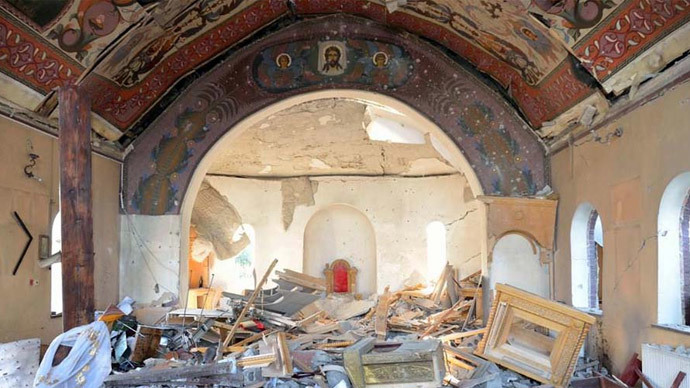
Samizdat – 06.12.2022
Republican Congressman Paul Gosar, in response to the shelling of a church by Ukrainian troops in the city of Donetsk, called Washington’s support for Ukraine “immoral,” adding that the Kiev regime is “authoritarian.”
“Our continued support of this war in Ukraine is immoral. The deaths continue and Ukraine has become an authoritarian regime not worthy of any support. I support peace talks, not death and destruction. Not bombing churches,” Gosar tweeted.
On Monday, a Sputnik correspondent reported that the Church of Nativity of Christ in Donetsk was shelled by Ukrainian troops.
In late October, the US congressman invited Russian President Vladimir Putin and Ukrainian President Volodymyr Zelenskyy for peace talks in the state of Arizona. Two weeks later, Gosar said he would continue opposing additional US aid to Ukraine.
Featured Video

Why Hamas Really Attacked Israel on Oct. 7
or go to
Aletho News Archives – Video-Images
From the Archives
Confronting the Threat of Ethnic Bioweapons
By Tony Cartalucci – New Eastern Outlook – 29.11.2017
The United States Air Force’s 59th Medical Wing’s molecular biology branch recently was revealed to have been collecting specifically Russian RNA and synovial (connective) tissue samples, prompting fears in Russia of a possible US directed ethnic-specific bioweapons program. … continue
Blog Roll
 Aletho News
- Oct. 7 Forever Marks The Big Reveal: ‘We See You, Israel, We Revile You, We Reject You!’
- Meet the US generals and admirals advancing Israeli policy
- Israel’s Straw Widow Protocol: The Kill Zones Where Civilians Were Labelled ‘Terrorists’
- Leading Israeli Think Tank Publishes Psychotic Israeli ‘National Security’ Doctrine
- Are the United States and Israel in Decline-and-Fall Mode?
- Why Hamas Really Attacked Israel on Oct. 7
- Declassified UK exposes British man who fought for ‘Israel’ in Gaza
- West’s death cult in a theater near you
- How the Yandex ‘Russian bots’ lie fell apart
- Burnham’s ‘Russia did Brexit’ ruse crumbles
- If Americans Knew
- Israeli settlers attack West Bank center for disabled children, church leader calls for int’l action
- Pulling Out Teeth Just to Live: How Israel Has Devastated Dental Care in Gaza
- Gaza’s “ceasefire” death toll passes 1,500 – Daily Update
- Activists Abused By Israel Return to New Freedom Flotilla Mission
- 60 Minutes won’t tell the full truth about Israeli settler violence
- Nearly 50,000 women, girls killed or severely injured in Gaza since October 2023: UN Women
- ADL is working with AI companies to suppress alleged ‘antisemitism’
- Israeli occupation forces using social media surveillance unit to target hundreds of Palestinians in the West Bank
- Israel’s New – and Terrifying – Security Doctrine
- Israeli Attacks Kill Five in Gaza, Including a four-year-old and a woman
- No Tricks Zone
- New Study Suggests Large Regions Of The Pacific Ocean Have Been Cooling For The Last 80 Years
- Germany’s Green Energy Debacle: High Energy Costs Force Kahla Porzellan to Close After 182 Years!
- New Study: 50 Years Of The Most Aggressive ‘Net Zero’ Policies Can Only Affect The Global Climate By 0.03°C
- US September “Heat” Was No Record…Many Records Set Decades Ago
- Latest European Green Energy Debacle; Portugal’s Largest Flagship Solar Park Insolvent!
- Green Energy Debacle: German Expert Professor Fritz Vahrenholt Warns Of Severe Economic And Social Consequences
- Two More Paleo Reconstructions Affirm Meters-Higher Sea Levels Across Ireland, Brazil 7000-6000 Years Ago
- New Study: Earth And Venus Surface Warmth Largely Explained By Convection And Lapse Rate, Not CO2 Or Radiation
- 2025 Nature Paper Claiming Worsening Global Drought Gets RETRACTED …Heavily Flawed
- New Study: ‘Global Drought Shows No Detectable Recent Acceleration Under Climate Warming’

