Deceiving West, Detached Elites: Highlights of Putin’s Speech at Eastern Economic Forum
The Russian president accused Western leaders of hurting their own people through rank corruption and gross incompetence
Samizdat – September 7, 2022
President Vladimir Putin delivered a lengthy speech at the Eastern Economic Forum in Vladivostok, in Russia’s Far East.
Among other things, he commented on the unfolding crisis in the global economy, which he attributed to the shortsightedness of Western elites. According to Putin, they are trying to cling to global power while it slips from their hands.
Here are some of the key points Putin made in his address…
Western dominance is dwindling
The world is facing serious economic challenges, and unlike the impact of the Covid-19 pandemic, the current turmoil is the result of conscious decisions made by Western nations, Putin said. The West caught “sanctions fever” as it sought to impose its will on other nations.
According to the president, though this is nothing new, the current situation is marked by special circumstances – the US is losing its dominance in the global economy and politics, a “tectonic shift” that Western elites are not willing to acknowledge.
Elites are ‘lashing out’
“Western nations want to preserve the old world order, which benefits only them, to make everyone follow the ‘rules’ they invented themselves and which they regularly break or change to their benefit,” Putin said.
Resistance from other nations “makes Western elites to ‘lash out’ and take shortsighted cavalier decisions affecting world security, politics, and economics” he added.
Western leaders are ‘detached’ from their people
The policies adopted by the leaders of the US and its allies run counter to the public’s interests, which they are supposed to protect – this shows the Western elites are “detached from their own people,” according to Putin.
EU governments are a good example – they decided to decouple their economies from Russia, denying their businesses affordable energy and access to the Russian market, which makes them unable to compete, he said.
Putin predicted that American companies would lead the charge to capture the market shares of businesses based in the EU as a result. “When [the Americans] pursue their interests, they don’t limit themselves or shy away from anything.”
The West deceives poor nations
The global economic crisis will hurt vulnerable nations worst of all, according to the president – for many people, it’s a life-and-death situation, as impoverished countries will have no ability to buy crucial products.
Meanwhile, Western nations pretend they want to help while only doing what is in their own interests, as exemplified by the Ukraine grain export deal, according to Putin. Russia agreed to help ships loaded with grain to leave Ukrainian ports under an arrangement mediated by Turkey and the UN in July. However, most of the ships have gone to EU nations rather than struggling countries, the president said.
“Just two ships out of 87 were loaded [in Ukraine] under the UN Food Program, which works to provide assistance to needy countries… just 3% that were sent to developing nations.”
According to Putin, Western nations have decades and even centuries of experience in plundering colonies, and are using the same approach today. In order to prevent humanitarian disasters, Russia suggests limiting the destinations for Ukrainian grain to change the situation.
Russia is weathering the sanctions
Russia is dealing with the damage caused by the West’s “economic, financial and technological aggression” relatively well, Putin said. He noted that the country’s financial system had been stabilized, inflation is going down, and unemployment is at record lows.
Some companies were indeed hurt, especially those whose business depended on Europe in some way, he said. The Russian government has mechanisms in place to support them.
Asian nations want cooperation
Most of the nations in the Asia-Pacific Region (APAC) reject “the destructive logic of sanctions” and seek to foster business ties and economic growth for the benefit of their people, Putin said. Russia appreciates players that share its attitude to national sovereignty. The abundance of countries like this in APAC is “its great competitive advantage” and a source of long-term development.
Russia did not start the conflict in Ukraine
When asked by the host for comments on how the crisis in Ukraine has affected Russia, he reiterated Moscow’s position that the conflict was forced upon it.
“We did not start anything in terms of military action. We are trying to end it. Military action was started in 2014, following an armed coup in Ukraine by those who did not want normal development and sought to subjugate their own people, carrying out one military action after another, and subjecting Donbass citizens to genocide for eight years.”
Russia decided to use military force eight years later. Doing so was a moral obligation to the people of Donbass, who Moscow could not protect through peaceful means, Putin said. In the end, Russia will emerge from the conflict stronger domestically and internationally, he added.
India May Dodge US-Led Coercive Oil Cartel as Part of ‘Strategic Triangle’ With Russia, China – Prof
By Rishikesh Kumar – Samizdat – 08.09.2022
The US hopes India and China will join a coalition seeking a cap on Russian oil prices to reduce their income. However, Delhi and Beijing have so far refused to bow to the pressure.
The US expectation that China and India would join a coalition of countries seeking to impose a price cap on Russian oil at a cheaper price sounds like an admission of failure to convince its close allies to stop buying Russian energy, an Indian expert says.
Swaran Singh, a professor at India’s Center for International Politics, Organization and Disarmament at the School of International Studies at Jawaharlal Nehru University, said that the refusal to denounce the Russian military operation in Ukraine and increasing Russian commodity imports by India and China “only strengthen their strategic triangle where India is the only exception for keeping close ties with the US.”
On Tuesday, US Deputy Treasury Secretary Wally Adeyemo claimed that countries like China and India would take advantage of the price cap coalition. However, Singh believes the appeal of the US Treasury Secretary defies elementary logic, prompting him to wonder what makes Adeyemo think Beijing is going to do Washington’s bidding.
“While China has no possibilities of joining hands with the US in curbing prices of Russian oil, even India is least likely to join such a cartel. What is interesting is that there may be dissensions even within US alliance partners,” Singh told Sputnik.
On Wednesday, Prime Minister Narendra Modi vowed to increase energy ties with Russia. Modi also underlined India’s interests in the areas of pharma and diamonds.
Nirmala Sitharaman, the country’s finance minister, on September 8 lauded Modi’s decision to increase Russian crude imports even in the face of Western sanctions announced by the US and some of its allies in response to Moscow’s special op.
Highlighting the pace at which India ramped up crude oil purchases at a “discounted price,” the Indian finance minister said that Russian crude accounts for 12-13 percent of the total basket, up from below two percent in February. China is the biggest importer of Russian crude oil.
Professor Singh mentioned that China and India are already beneficiaries of Russia voluntarily offering “deep” discounts.
“Why would they (India, China) try coercion to obtain something they have already been getting?” Singh underlined.
He also highlighted that the US and EU countries are themselves struggling to make up for shortages of oil and gas.
“Russia accounts for over 40% of gas and 30% of oil imports of Europe. And as winter approaches, it is Russia that has the power to dictate rather than the other way around,” Singh stated.
Since June, several US officials have visited New Delhi to pressure India to stop buying discounted crude oil from Russia. US Secretary of State Antony Blinken termed India’s cheap oil purchase from Russia as support for Moscow. Despite this, Delhi has maintained that its crude purchases are meant to ensure the country’s national interests.
US imported $6 billion from Russia as it forces others to quit doing business with Moscow
America keeps importing essential commodities from Russia while pressuring others not to do so
By Drago Bosnic | September 8, 2022
After Russia launched its counteroffensive against NATO aggression in Europe, the US-led political West vowed to “isolate“ Russia and “cripple“ its economy. Yet, the Eurasian giant didn’t only weather the storm largely unscathed, but it even managed to profit while the sanctions boomerang started ravaging Western economies. Russia has been able to maintain its economic strength, powering through the sanctions and even establishing alternative payment systems with major global powers such as China and India. And yet, the US, as the leading Western power, the one which pushed its European and other vassals into an economic war with Russia, with devastating consequences for the EU and other economies, continues doing business with Moscow.
The US is currently importing over $1 billion per month in Russian wood, metals, food and other goods. More than 3,600 ships from Russia have arrived at American ports since February 24, according to statistics cited by the Associated Press. While that is nearly 50% less in shipments over the same period compared to last year, it still amounts to over $6 billion in imports. The sheer quantity of goods and commodities from Russia entering the US suggests the troubled Biden administration is directly involved in a failure to “isolate“ the Russian economy, as the US incumbent president promised in late February. Due to so-called “wind down“ periods that allow companies to complete previous deals, many of the products and commodities continue to be imported into the US long after the Biden administration imposed sanctions on those goods, including Russian oil and natural gas.
However, there are exceptions to this as well. The import of other crucial Russian commodities, such as fertilizer, came at the request of the Biden administration itself, which has urged US companies to make up for shortages. Although the US has ordered the seizure of luxury yachts owned by rich Russians with supposed “ties to Russian President Vladimir Putin“, the AP found that many companies from the US and EU are still importing millions of dollars in metal from a Russian firm that makes parts for VKS (Russian Aerospace Forces) fighter jets, highlighting yet another hypocritical discrepancy in Western sanctions campaign. And yet, Washington is trying to exert diplomatic pressure on others to stop doing business with Moscow. While many have followed the US diktat, others are not only keeping their economic ties with Russia, but are even expanding them. For instance, Turkey, a NATO member since 1952, has doubled its oil imports from Russia this year.
This hypocritical approach has made many other countries, including major global powers, such as India, frustrated, as they are being criticized for their ties with Russia, while the US gets to cherry pick which ties with Moscow it can keep in order to prevent disruptions to its economy. This has nearly nullified the US attempts to strengthen ties with India and get New Delhi into its fold, despite the fact that American troops are currently engaged in military exercises with their Indian counterparts. And yet, just like Turkey, New Delhi has similarly significantly increased energy imports from Russia, despite US pressure not to do so. In addition, the Indian rupee has become a major currency for the diamond trade, allowing buyers to bypass anti-Russian sanctions, pushing India even closer to Moscow in this regard.
Although the failed economic siege of Russia was also meant to diminish the Eurasian giant’s nearly unmatched military might (which only the US can compare to), it has so far been completely inconsequential. Worse yet, it even had an opposite effect, as Russia is now expanding and strengthening its military, including the increase in production of weapons such as the Su-57, which has proven itself in the special military operation against the Kiev-based Neo-Nazi junta. This resilience isn’t limited to the Russian military. With Russian energy exports far exceeding last year’s levels in recent months and the Russian ruble rallying against the US dollar, the Eurasian giant’s economy is also faring far better than those of the EU members.
Still, the question remains, what will the EU and other US vassals do when the winter comes? Will Washington send food, oil, gas and other essential commodities? How will the “moral highground“ of “sticking it to Putin“ help heat homes, feed hundreds of millions of hungry (and angry) citizens and power entire economies and countries? How will the EU and other governments explain to their voters that all this is “worth doing“ so that the “young, vibrant democracy in Kiev“ can survive the “unprovoked brutal Russian invasion“?
And what will Europe look like in 2023 after it goes through a complete political unraveling? Whatever happens to Europe and other US vassals, one thing is certain – America will keep importing essential commodities from Russia while pressuring others not to do it. However, this isn’t necessarily bad, as it will be a perfect litmus test of sovereignty for many around the globe and an excellent indicator of who will get the privilege of joining the new multipolar world of sovereign nations.
Drago Bosnic is an independent geopolitical and military analyst.
US assesses China threat
Samizdat | September 8, 2022
There is a “distinct threat” that China could attempt to seize Taiwan by military means, a top US official has warned.
Appearing on ‘The David Rubenstein Show: Peer-to-Peer Conversations’ on Bloomberg TV, US National Security Advisor Jake Sullivan said: “I think it remains a distinct threat that there could be a military contingency around Taiwan.” He added the leadership in Beijing has “actually stated as official policy that it is not taking the invasion of Taiwan off the table.”
Sullivan also revealed that he would meet congressional leaders on Wednesday to advocate a bill that, if passed, would see US policy toward the self-governing island change. Among other things, he proposes designating Taiwan as one of America’s major non-NATO allies. The bill also calls for the allocation of $4.5 billion in security aid for Taipei.
When asked to clarify Washington’s position on the issue, Sullivan replied by saying that the Biden administration continues to “push back against any effort to change the status quo by force.”
While the Chinese Embassy in Washington did not immediately respond when Bloomberg reached out for comment, Beijing’s envoy stateside, Qin Gang, warned last month that the US had gone “too far” in the region. The diplomat stressed at the time that should the Biden administration further escalate the situation, China would be forced to respond. The ambassador also denied as “baseless” allegations that Beijing is planning a military offensive against Taiwan in the near future.
Taiwan has been de facto independent since 1949, after the losing side in the Chinese Civil War fled to the island and set up its own administration there. While only a handful of nations have since recognized Taiwan as a sovereign country, Taipei has long enjoyed close, unofficial ties with the US, with the latter supplying weapons to the island.
Meanwhile, on paper, Washington still adheres to the One-China principle.
Beijing considers Taiwan to be part of its sovereign territory which was temporarily seized by separatists.
The 9/11 “Double-Cross” Conspiracy Theory
BY LAURENT GUYÉNOT • UNZ REVIEW • SEPTEMBER 6, 2022
Is it true that “9/11 was an inside job”? Yes, insofar as Israel is “inside” the U.S. But for the 9/11 truthers who have identified Israel as the main perpetrators, “9/11 was an inside job” is at best a half-truth, and at worst an integral part of the Zionist operation, like a secondary flag sewn as a lining under the false flag of Islamism. Victor Thorn (1963-2017) wrote in his book 9/11 made in Israel: The Plot Against America (2011): “In essence, the ‘9-11 truth movement’ was created prior to Sept. 11, 2001 as a means of suppressing news relating to Israeli complicity. . . . The slogan ‘9-11 was an inside job’ was quite possibly the greatest example of Israeli propaganda ever devised.” In milder terms, it is “controlled opposition”.
A genuine truth movement would have pointed to Israel as the prime suspect from the start. From day one, it was obvious who would benefit. At 1 pm New York time on the day of the attacks, George Friedman (“born in Budapest, Hungary, to Jewish parents who survived the Holocaust,” Wikipedia informs us) wrote gleefully on his geopolitical website STRATFOR:

It’s pretty simple: 9/11 is best understood as a case of “triangulation”, by which two parties are drawn into conflict with each other by the invisible hand of a third party. In this case, the desired “clash of civilization” between the West and the Muslim world was triggered by Israel, 9/11 being only one operation in this ongoing strategy. Triangulation is the favored tactic of the Mossad, described by the U.S. Army School for Advanced Military Studies, on the eve of 9/11, as having “capability to target U.S. forces and make it look like a Palestinian/Arab act.”[1] Triangulation is also used to create civil strife within a nation (intra-national clashes of civilization, so to speak) for various purposes. In most cases, Israel’s hand is invisible only to the extent of the authorities’ and the people’s voluntary blindness (the proverbial elephant in the room).
If, instead of comparing 9/11 to Operation Northwoods that never happened, the most widely watched early 9/11 conspiracy film (Loose Change) had reminded Americans of the attack on the USS Liberty, the 9/11 Truth movement would have moved in a totally different direction than the one it took under the leadership of Alex Jones. No one would think of calling the USS Liberty attack an “inside job” or “a self-inflicted wound.”
Filling the background with other documented Israeli false flag operations (the bombing of the King David Hotel in 1946, the Lavon Affair in 1954, Israel bombing its own embassies in Argentina in 1992 and in London in 1994, etc.) could have turned such a movement into a tsunami. The “inside job” theory, on the other hand, can never reach a critical mass, for a simple reason: the idea that the U.S. government would, by itself, deceive and terrorize its own citizens by killing thousands of them to justify wars in the Middle East that are not even in the nation’s interest is just too hard to believe for the vast majority of Americans — harder to believe than the official narrative with its material impossibilities. By comparison, Israel attacking America under the false flag of Islamic terrorists to win American support against their Arab enemies makes plain common sense. It is only with the hypnotic power of Zion-controlled corporate medias, and with the complicity of a well-organized “controlled opposition” that such a natural idea was suppressed from the minds of average Americans.
Nevertheless, the belief that “9/11 was an Israeli job” is gaining ground all over the world. Sooner or later, the tsunami will come. And the sooner the better. I am hoping that my film, “9/11 and Israel’s Great Game,” now in English, will help bring it about. Pass it around if you judge it useful:
This film, unfortunately, was shunned from all 9/11 Truth festivals this month. The organizers, I have been told, “decided not to muddy the waters with a film about Israel’s involvement in 9/11.” This must be ironic, for evidence of Israel’s involvement brings clarity, while muddy waters are what Israel needs. However, the film will be streamed on noliesradio.org on October 9th, followed by a debate between Alan Sabrosky, Kevin Barrett, and myself. …
A 5th jab? Implications for the immune system
FDA advisory member hints at ‘original antigenic sin’
By Maryanne Demasi, PhD | September 6, 2022
Following the recent authorisation of the new omicron boosters, the former US Surgeon General encouraged Americans to receive two to four mRNA jabs annually.
Residents in northeast Australia have been told they might need a fifth dose by the end of the year.
In fact, it wasn’t that long ago that New South Wales’ top doctor said that people should expect to receive covid-19 booster shots “indefinitely.”
But could repeated boosters at close intervals be causing more harm than good? I speak with experts concerned that policymakers are not following the science.
Earlier this year, the European drug regulator sent a dire warning to the world. The agency was concerned that repeated boosters every four months could weaken a person’s immune response to the coronavirus.
Marco Cavaleri, the agency’s head of vaccines strategy, said that regular boosters might be “overloading people’s immune systems and leading to fatigue.”
I spoke with Cody Meissner, an FDA advisory member, ahead of the agency’s April 6 meeting, during which experts were to discuss the evidence for a fourth dose. He told me that he was not convinced by the data at the time.

Prof Cody Meissner, FDA advisory member
“I personally don’t think that we have sufficient basis on which to recommend a fourth dose, and we don’t know what the harm will be,” said Meissner.
“The reason we’re giving the vaccine is to keep people out of the intensive care unit and to keep people from dying, or even going into the hospital. So, before we vigorously endorse a fourth dose of this vaccine, I think we have to understand not only more about the immune response, but also about how much severe disease is occurring after three doses,” he added.
Meissner blamed socio-political interference for many of the questionable covid-19 strategies. “I think that the politicians and certain groups within society, such as the teacher’s union here in the United States, have driven a political agenda that is certainly not based on science. People like to say it’s based on science. It’s not. It’s based on emotion and generating great fear,” said Meissner.
Despite the concerns, most policymakers have forged ahead with recommending third, fourth and fifth doses for large swathes of the populations.
But over the past year, observational data have emerged from countries like the UK, Scotland and Australia showing that the most highly vaccinated people are acquiring the highest rates of covid-19 infections, suggesting that the vaccines have lost their effectiveness or something unexplained is happening.
Meissner hinted at a possible explanation for why someone’s immune response could be suppressed after multiple covid-19 shots. “It gets into this issue of ‘original antigenic sin’, which is still a theoretical issue, but may have some validity it seems to me,” said Meissner earlier this year.
Original antigenic sin – scientifically referred to as immune imprinting – is a phenomenon whereby prior exposure to one virus strain (e.g. wuhan stain) limits the development of immunity against new variants (omicron strain), because the immune system has been “imprinted” to favour the original strain.
This leaves the immune system trapped because the antibodies it prefers to produce against the original strain are ‘mismatched’ for the new strain.
Meissner said, “To keep vaccinating with very similar [wuhan] antigens, may or may not be beneficial — or the benefit may not outweigh the harm. I think we need to look at that.”
Since then, the data suggesting that immune imprinting is occurring, has only strengthened says Nikolai Petrovsky, Professor at Flinders University and developer of a protein-based covid-19 vaccine called SpikoGen® in use in Iran.

Prof Nikolai Petrovsky, Flinders University
“I feel the evidence for immune imprinting is increasingly compelling. It’s a known phenomenon with flu where it was first described, and the data now suggests it’s happening with covid-19,” said Petrovsky.
“The omicron vaccines may struggle to switch the immune system of a heavily vaccinated person to making omicron-specific antibodies, as their immune system is so heavily biased toward the Wuhan spike protein in the original vaccines. In the end, this could be harder to achieve in a vaccinated person than someone who has not yet been exposed to any spike protein, for example, someone unvaccinated,” he added.
Petrovsky says not only do too many shots of the mRNA vaccines increase the risk of immune imprinting, but they also seem to be uniquely pushing the immune system into “tolerance” against the virus.
“Immune tolerance” occurs when the immune system becomes unresponsive to a particular antigen after repeated exposure. This is the principle for desensitising people to allergy, i.e. by repeatedly injecting them with small doses of the offending allergen over time.
Petrovsky points to a recent pre-print study out of Germany. “People who’ve had three or more doses of mRNA showed a change in their antibodies to IgG4 which is typically an antibody associated with allergy desensitisation but not a normal antibody seen produced after infectious disease vaccines,” said Petrovsky.
Petrovsky said, “What this means, we simply don’t know as this has never been seen before. That in itself is concerning as it indicates just how little we understand about what these new mRNA vaccines are doing and how they work. But to me, it raises a red flag that repeated doses of the mRNA vaccines might be driving immune tolerance against the virus. Maybe this could explain why the more doses of these vaccines, the less they seem to work, and more and more people are getting breakthrough infections?” Interestingly, the study did not find a similar shift in antibody patterns after AstraZeneca’s covid-19 vaccine.
Now, that the FDA has authorised the new bivalent boosters – which code for the original wuhan strain plus BA4/BA5 omicron lineages – without first requiring any human data to be collected, it has left many doubting that our public health authorities are even paying attention to the science.
Judge orders Fauci and WH Press Secretary to hand over records related to online censorship pressure
By Dan Frieth | Reclaim The Net | September 7, 2022
The US District Court for the Western District of Louisiana issued a ruling, ordering Dr. Anthony Fauci and White House Press Secretary Karine Jean-Pierre to respond to document requests by the New Civil Liberties Alliance in conjunction with the Missouri and Louisiana attorneys general on behalf of plaintiffs in State of Missouri ex rel. Schmitt, et al. v. Joseph R. Biden, Jr., et al.
Judge Terry A. Doughty made the order, which has great importance for the millions of Americans experiencing censorship on social media – which is allegedly at the pressuring of government bodies and officials and would therefore be a violation of the First Amendment.
We obtained a copy of the order for you here.
The judge’s ruling was on “whether the White House Defendants, White House Press Secretary Karine Jean Pierre and Chief Medical Advisor Dr. Anthony Fauci should be compelled to respond to Plaintiffs’ interrogatories and document requests” and “[w]hether Dr. Fauci, in his capacity as National Institute of Allergy & Infectious Diseases (“NIAID”) Director, should be required to provide additional responses to Plaintiffs’ interrogatories and document requests.”
The judge ruled in favor of the plaintiffs and the defendants have no legal right to refuse to comply with the order.
“In accordance with the previous expedited discovery order, Plaintiffs served interrogatories and document requests upon White House Press Secretary Karine Jean-Pierre and upon Dr. Anthony Fauci in his capacity as Chief Medical Advisor to the President,” the ruling states. “Government Defendants have refused to provide any interrogatory responses or responsive documents, maintaining that these would be internal communications that would implicate serious separation of powers concerns, that Plaintiffs are required to exhaust other avenues for the discovery first, and that it would be unduly burdensome and disproportional to the needs of the case.”
“The breadth and extent of the government’s censorship activities has turned out to be massive and far exceeded that disclosed by the federal government in response to initial court-ordered discovery made public last week,” the NCLA said in a statement to Reclaim The Net.
Much light has recently been shed on the Federal Government’s role in calling for direct censorship on social media platforms, as a result of the documents obtained during the lawsuit. Collusion between social media platforms and the CDC was also evident.
NCLA is representing several plaintiffs, some of which are prominent and well-respected epidemiologists who were censored by Big Tech platforms for diverging from the White House’s narrative on COVID-19.
The US district court judge Terry A. Doughty ruled on Tuesday:
“First, the requested information is obviously very relevant to Plaintiffs’ claims. Dr. Fauci’s communications would be relevant to Plaintiffs’ allegations in reference to alleged suppression of speech relating to the lab-leak theory of COVID-19’s origin, and to alleged suppression of speech about the efficiency of masks and COVID-19 lockdowns,” the ruling continues. “Jean-Pierre’s communications as White House Press Secretary could be relevant to all of Plaintiffs’ examples.
“Government Defendants are making a blanket assertion of all communications to social media platforms by Dr. Fauci, and Jean-Pierre based upon executive privilege and presidential communications privilege,” the order adds. “Plaintiffs concede they are not asking for any internal White House communications, but only external communications between Dr. Fauci and/or Jean-Pierre and third-party social media platforms.”
Biden’s New War on Extremism (and Liberty)
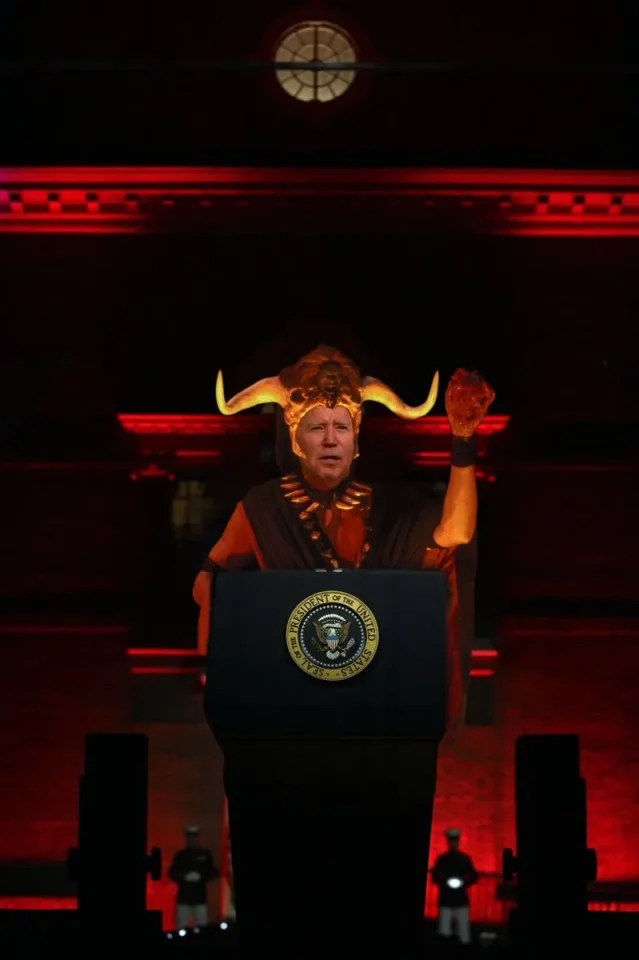
By Jim Bovard | The Libertarian Institute | September 7, 2022
President Joe Biden believes that hysterical denunciations of extremism will save the Democratic Party in the upcoming congressional midterms. Despite media portrayals of Biden as a good-natured moderate, the president has relied on sweeping castigations of opposition throughout his political career. Worse, Biden’s rhetoric on extremism could signal an attack on any limits on presidential power.
Last Thursday in Philadelphia, Joe Biden overheated in a primetime speech with a backdrop seemingly inspired by a mix of the movie “V for Vendetta” and Nazi filmmaker Leni Riefenstahl. The harsh red atmospherics perfectly complimented Biden’s attempt to portray ex-president Donald Trump and his Republican supporters as the Anti-Christ waiting to crucify American democracy.
Biden declared that, “Trump and the MAGA Republicans represent an extremism that threatens the very foundations of our republic.” But he didn’t confess to the audience that he considered almost half of all Americans to be “extremists.”
A few hours before Biden’s speech, White House Press Secretary Karine Jean-Pierre asserted, “When you are not with what majority of Americans are, then you know, that is extreme. That is an extreme way of thinking.” Is this wacko definition of extremism designed to vilify anyone who doubts Biden will save America’s soul?
Four days later, speaking in Wisconsin, Biden declared, “Extreme MAGA Republicans in Congress have chosen to go backwards—full of anger, violence, hate, and division… Extreme MAGA Republicans don’t just threaten our personal rights and our economic security, they embrace political violence.” A week before the Philadelphia speech Biden denounced Republicans for “semi-fascism.”
To vanquish extremism, Biden called for everyone to “unite behind the single purpose of defending our democracy.” In other words, everyone must support Joe Biden or democracy will be destroyed. But Biden’s version of democracy is a parody of the Constitution. He believes that thanks to 43,000 votes in three swing states, he has unlimited power to dictate how Americans must live.
In his Philadelphia speech, Biden invoked the “Rule of Law” five times, notwithstanding his twenty months of dictatorial decrees. Law Professor Jonathan Turley observed, “President Biden has arguably the worst record of losses in [federal court] the first two years of any recent presidential administration.” The only limits on his power that Biden recognizes come from his pollsters, not from the Constitution.
Since Biden took office, his appointees have exploited “extremism” to sanctify stretching his power. Last year, the Biden administration revealed that guys who can’t get laid may be terrorist threats due to “involuntary celibate–violent extremism.” The White House did not disclose whether self-abuse was the latest terrorist warning sign. A senior administration official (speaking anonymously to the media) said the new program would encourage people: “If you see something, say something.” The Biden report stressed that federal law enforcement agencies “play a critical role in responding to reports of criminal and otherwise concerning activity.”
“Otherwise concerning activity”? This is the same standard that turned prior anti-terrorist efforts into farces.
Refusing to get injected with an experimental vaccine is another badge of extremism according to Biden scorekeepers. On August 13, 2021 the Department of Homeland Security issued a terrorist alert, warning that “anti-government/anti-authority violent extremists could exploit…potential re-establishment of public health restrictions across the United States as a rationale to conduct attacks.” Anyone who loudly objects to being locked back under house arrest thus became the moral equivalent of the Taliban, or maybe Hezbollah.
The following month, Biden gave a primetime address which dictated a COVID vaccine mandate for more than 80 million private employees and also portrayed the unvaccinated as public enemies. By the time Biden codified his decree in a November Federal Register notice, the efficacy of the COVID vaccine had fallen to less than 50%. But Biden apparently believed he was entitled to force people to get injected no matter how badly Pfizer shots failed. In January, the Supreme Court struck down Biden’s vax mandate for private companies.
The Biden administration won’t let the Constitution impede its war on extremism. As part of this new priority, the Department of Homeland Security (DHS) may exploit a “legal work-around” to spy on and potentially entrap Americans who are “perpetuating the ‘narratives’ of concern,” CNN reported last year. But federal informant programs routinely degenerate into “dollars for collars” schemes that reward scoundrels for fabricating crimes that destroy the lives of innocent Americans. The DHS plan would “allow the department to circumvent [constitutional and legal] limits” on surveillance of private citizens and groups. Federal agencies are prohibited from targeting individuals solely for First Amendment-protected speech and activities. But federal hirelings would be under no such restraint. Private informants could create false identities that would be problematic if done by federal agents.
One DHS official bewailed to CNN, “Domestic violent extremists are really adaptive and innovative. We see them… couching their language so they don’t trigger any kind of red flag on any platforms.” DHS officials have apparently decided that certain groups of people are guilty regardless of what they say (“couching their language”). The targets will likely include gun owners who distrust the politicians who vow to seize their guns. Any excesses by the new informants will be excused because they are for the sacred cause of saving democracy (or at least crippling Biden’s opposition).
Anyone who vigorously opposes federal power can get tarred as an extremist. On the day that Joe Biden was inaugurated, former CIA chief John Brennan announced on television that federal intelligence agencies “are moving in laser-like fashion to try to uncover as much as they can about” about extremists, libertarians, and other malefactors. Federal entrapment operations may have already harvested a heap of hapless individuals who could be indicted when politically convenient.
The definition of “extremism” is a flag of convenience for the political establishment. The definition of “extremism” has forever been in flux. The only consistent element in definitions of extremism is that politicians always win. A 2013 Pentagon training manual explained, “All nations have an ideology, something in which they believe. When a political ideology falls outside the norms of a society, it is known as extremism.” In other words, beliefs that differ from prevailing or approved opinions are “extremist” by definition. And who gets to say what is acceptable to believe? The same politicians and government agencies and their media allies whose power is buttressed by prevailing opinions.
“Extremism” is even more vaporous than “terrorism.” With terrorism, at least the individual or group is purportedly committing (or planning to commit) some violent act. An extremist, on the other hand, is someone with a bad attitude who might do something unpleasant in the future. Crackdowns on potential extremists provide the perfect tool to demonize dissent.
Will the Biden crackdown on extremists end as ignominiously as Nixon’s crackdown almost 50 years earlier? Nixon White House aide Tom Charles Huston explained that the FBI’s COINTELPRO program continually stretched its target list “from the kid with a bomb to the kid with a picket sign, and from the kid with the picket sign to the kid with the bumper sticker of the opposing candidate. And you just keep going down the line.” At some point, surveillance became more intent on spurring fear than on gathering information. FBI agents were encouraged to conduct interviews with anti-war protesters to “enhance the paranoia endemic in these circles and further serve to get the point across that there is an FBI agent behind every mailbox,” as a 1970 FBI memo noted. Is the Biden castigation campaign an attempt to make its opponents fear that the feds are tracking their every email and website click?
The Biden administration could be expanding the federal “Enemies List” faster than any time since the 1970s. Will Biden’s war on extremism succeed in radically narrowing the boundaries of respectable American political thought? Permitting politicians to blacklist any ideas they disapprove won’t “restore faith in democracy.” What if government is the most dangerous extremist of them all?
Jim Bovard is the author of Public Policy Hooligan (2012), Attention Deficit Democracy (2006), Lost Rights: The Destruction of American Liberty (1994), and 7 other books. He is a member of the USA Today Board of Contributors and has also written for the New York Times, Wall Street Journal, Playboy, Washington Post, and other publications. His articles have been publicly denounced by the chief of the FBI, the Postmaster General, the Secretary of HUD, and the heads of the DEA, FEMA, and EEOC and numerous federal agencies.
Daesh attacks Embassy in Kabul amid wave of violence against Russians

By Lucas Leiroz | September 7, 2022
The recent attack on the Russian embassy in Kabul was another shocking episode in the current wave of assaults against Russian civilians around the world. Daesh claimed responsibility for the crime, which raises a number of suspicions about possible cooperation between anti-Russian groups abroad, considering the links between Islamic terrorists, Western intelligence and Ukrainian neo-Nazis.
On August 5, the Russian Embassy in Afghanistan was the target of a terrorist attack. A suicide bomber approached the entrance to the Embassy facility and operated the explosion, killing two Russian diplomatic staff’s employees, as well as at least six Afghan citizens who were nearby. The Embassy’s guards even shot down the terrorist, but the action was not fast enough to prevent self-detonation, which culminated in the tragedy. Several people remain hospitalized, and the number of deaths could increase in the coming days.
Although several hostilities against Russians have already taken place in Afghanistan in the past, this is the first time that such an attack has taken place since the Taliban took Kabul, after the American defeat in 2021. According to local sources, Daesh, which is an enemy of the Taliban and has acted intensively in the country to harm the new government, claimed responsibility for the attack. In fact, the incident was characterized by a number of similarities with Daesh’s praxis in other assaults, which would raise suspicions about the group’s involvement even if responsibility had not been assumed.
Russia is one of the few countries to maintain an embassy in Kabul after the Taliban took over the country. Although Moscow still does not officially recognize the Taliban government, Russian diplomats are talking to local authorities in order to advance bilateral negotiations, currently having plans to improve the supply of fuel and other commodities. The Russian government is working to overcome old rivalries with the Taliban and reach a positive agreement for all sides, as the Afghan situation currently appears to be between a stable government with the Taliban or the absolute chaos of the civil war operated by terrorist organizations, such as Daesh. The mere fact of maintaining bilateral dialogue with the de facto government of the Taliban seems to be reason enough for terrorists to target Russian citizens.
However, it would be naive to think that the reasons for this attack are limited to pragmatic Moscow-Kabul relations. If this were the only reason, certainly other episodes of terrorism would have already occurred at the Embassy at other times. There is undoubtedly something specific motivating this violence at this time. The main suspicion is that the attack is related to the publication by the Russian Embassy of a list of names of Afghan citizens who had applied to receive student visas in Russia. But it is possible that there are even more issues involved in this case.
One of the most neglected topics about the Ukrainian conflict is that since 2014 there has been vast cooperation between Kiev’s neo-Nazis and foreign terrorists, including members of Daesh. Many Daesh leaders and fighters migrated to Ukraine, especially after the defeat of terrorists in Syria with the Russian military intervention in 2015. More than that, saboteurs affiliated with the Islamic State and Ukrainian neo-Nazi militias allegedly had already conspired together to carry out terrorist attacks within Russian territory itself, according to FSB data published in 2017.
With the start of the Russian special military operation in Ukraine, the situation may have become more serious. In June, the Syrian government provided Russia with intelligence data proving the collaboration of Western powers and Turkey to send Daesh fighters to Ukraine. There is no precise information on the number of fighters and their identities, but it seems quite evident that Daesh members have been in Ukraine over the last eight years and that they are now continuing there, fighting Russian forces. And that brings up a series of suspicions about what may have happened in Kabul.
Apparently, the attack on the Embassy was just another typical episode of the criminal cowardice that has been seen in the praxis of anti-Russian forces. Saboteurs have operated to kill Russian civilians in various parts of the world. The murder of Daria Dugina in the middle of the Moscow oblast was a clear example of this. In the same vein, what happened in Kabul, whether or not there was foreign participation, seems to be related to this wave of violence against Russian civilian targets.
Deeper investigations are needed to conclude what actually motivated the attack and whether there was participation or sponsorship by Western or Ukrainian groups. However, the main fact is that who attacked the Embassy was Daesh – and Daesh fights Russia in Ukraine.
Lucas Leiroz is a researcher in Social Sciences at the Rural Federal University of Rio de Janeiro; geopolitical consultant.
EU suggests price cap on US LNG
Samizdat – September 7, 2022
Brussels is examining the possibility of a price ceiling on all gas imported into the EU, including liquefied natural gas (LNG), European Commission President Ursula von der Leyen said on Wednesday.
“LNG is scarce and can be rerouted to different regions… We [want to] stay competitive for LNG suppliers but make sure that the prices we pay are not extraordinarily high but in a decent range,” she told reporters. EU countries mostly import the costly LNG from the US and Qatar, using it to diversify gas imports in light of shrinking supplies from Russia. However, some analysts warn that producers might not be eager to supply the fuel to European countries if their profits are capped.
Von der Leyen noted that enacting the proposal is not imminent and that they would be further discussed at a later date.
She did, however, unveil a number of other proposals aimed at tackling the EU’s worsening energy crisis, including a bloc-wide plan to reduce electricity consumption, a price cap on the excess revenues made by companies involved in renewable and nuclear energy, a mechanism to capture the profits that fossil-fuel companies make due to rising prices, a state aid program for utilities businesses, and a price cap on Russian pipeline gas imports.
Commenting on the last of these, she said the mechanism is necessary to “cut Russia’s revenues which Putin uses to finance this atrocious war against Ukraine.” She noted that since Russia launched its military operation in Ukraine, the share of Russian pipeline gas in the EU’s total imports has dropped from 40% to 9%, while Norway has replaced Russia as the bloc’s leading gas supplier.
US military renewing interest in artillery as Russia dominates the battlefield
By Drago Bosnic | September 7, 2022
Artillery has been an integral part of warfare for centuries, but its impact has become exponentially more prominent in the last two centuries, with the advent of the Industrial Revolution and the resulting mass-production economies. The majority of combat deaths in the Napoleonic, First and Second World Wars were fought for the main part with artillery. Napoleon himself said that “God is on the side with the best artillery,” while Joseph Stalin stated that “Artillery is the God of war.”
Although the Napoleonic Wars and even the Second World War might seem too distant for us to even contemplate any similarities with modern 21st-century warfare, the truth is that little has changed in this regard. Russia’s special military operation in Ukraine has proven this to be true. While air power, drones, long-range missiles and other modern weapons play a significant part in shaping the battlefield, the truth is that artillery is still doing most of the work.
Both the Russian Armed Forces and the Kiev regime’s troops have inherited enormous quantities of artillery from the former Soviet military and both have deployed it en masse. Artillery is playing an indispensable role in determining the balance of power on the ground, with the Kiev regime asking the political West for as many towed and self-propelled guns as possible in order to counter Russia’s dominance.
The problem is that NATO and other US-aligned countries have put a lot more emphasis on air power, especially as Western combat experience in the last two to three decades indicates that air power alone should be enough to win wars. While this might be true against numerous opponents with no ways to counter the US and NATO air dominance, nothing could be further from the truth when it comes to countries like Russia, which has been a world leader in air defense for over half a century now and is also fielding the second most powerful air force on the planet.
Questioned before the House Armed Services Committee on May 12, Secretary of the Army Christine Wormuth and Army Chief of Staff General James McConville both concluded when asked “What are the systems that are going to put you into position to win that fight like the fight that’s playing out in Ukraine?” that long-range artillery and tactical missiles would be essential. General McConville stated that these systems have been key priorities for Army modernization. In addition to tactical missiles, the US Military Industrial Complex is having trouble replacing artillery munitions for the US Army, which is creating problems for both the US itself and the Kiev regime, which cannot hope to match the Russian military’s artillery volume. Back in mid-June, retired US Colonel and former Virginia State Senator Richard H. Black stated:
“Yes, the war is not over, but it is lost. Let me tell you why. This has become an artillery duel: Russia fires 50,000 shells a day, 10 times more than Ukraine. Washington Post says that Ukraine is almost completely without weapons and there were no analogs left from the Soviet era. On June 10, the same Washington Post said that Ukraine was suffering thousands of casualties, including at least 200 killed per day. Casualties doubled in just three weeks. With a population much smaller than the US, Ukraine loses 6,000 soldiers every month, 12 times more than America lost in Vietnam. The Ukrainians fought with courage, but no nation can sustain such huge casualties for long. Ukraine is finished.”
According to Task & Purpose, back in February 2018, the US Army asked Congress for money to buy approximately 150,000 shells for 155mm howitzers. Although this represented an 825% increase in the number of shells the US Army wanted to acquire, the very fact that the Russian military fired as many shells in just three days is a testament to the massive discrepancy in doctrine between the two superpower militaries.
Since February, the US has provided 806,000 shells for 155mm howitzers and another 108,000 shells for 105mm guns to the Kiev regime, according to the US Department of Defense. That’s close to 1 million shells in approximately six months, and the figure doesn’t even include the precision-guided rockets for the M142 HIMARS that the US military has also handed over to the Neo-Nazi junta forces.
“The use of artillery in warfare has always involved huge expenditures of ammunition,” retired Marine Col. Mark Cancian, with the Center for International Studies think tank in Washington DC, told Task & Purpose. “Artillery expenditures increase substantially when front lines stabilize as has happened in Ukraine,” Cancian added. “When there’s a lot of battlefield movement, artillery expenditures ease off because batteries on the move can’t fire and transportation of ammunition becomes harder. The stabilized front lines and consequent large increases in artillery firing often lead to a ‘shell shortage.'”
“One problem facing the United States now is that much of its industrial capacity to produce artillery shells went away after the end of the [First] Cold War more than 30 years ago, and 155mm shells have a life expectancy of 20 years,” retired Col. said.
The Wall Street Journal has also revealed that defense officials are concerned that the US military’s stockpile of 155mm shells has become “uncomfortably low.” This might soon become a problem for the Kiev regime, as its forces, although already outgunned at 10:1, are burning through artillery munitions much faster than the current Western production capacity can cover.
Drago Bosnic is an independent geopolitical and military analyst.
Featured Video

Matt Bracken: US Plans Massive MOAB Strike on Iran?
or go to
Aletho News Archives – Video-Images
New Book
The silver that medicine dropped — four thousand years of clinical use, four decades to erase.
Colloidal Silver — First Edition, 2026, Paperback
Lies are Unbekoming | October 16, 2026
Silver was medicine. Not alternative medicine. Not folk medicine. Medicine. In surgery. In obstetrics. In the burn ward. In water treatment. In the household medicine chest. Every physician before 1938 knew this.
By the 1870s, silver nitrate was standard in surgical wound care across the leading hospitals of Britain, Germany, and the United States. Colloidal silver preparations — Collargol, Argyrol, Protargol — entered European and American practice through the 1890s and early 1900s and became standard antiseptics in military field medicine. By the time Fleming grew his first penicillin mould in 1928, silver was the first-line antimicrobial of the Western pharmacopoeia. The Lancet and the British Medical Journal carried the clinical reports in volume. The practice ran continuously through the Victorian era, the Edwardian era, the First World War, the interwar period. By 1980, almost all of it was gone.
What has not been treated at book length, until now, is how a four-thousand-year clinical record disappeared from mainstream medicine within four decades of the Flexner Report — and what the honest account of silver looks like once that record is reassembled.
Colloidal Silver reconstructs the pre-1938 record from The Lancet, the British Medical Journal, and the primary literature of the era; recovers Robert Becker’s bioelectric framework from the regeneration research the pharmaceutical model buried; and places silver inside a practical terrain-paradigm guide to its current place — in water, on the body, inside the body, and in the chronic conditions where antibiotics have failed. … continue
Blog Roll
 Aletho News
- Israeli Spy Pollard stole the files, today’s it’s delivered through official channels
- Why Iran Didn’t Walk Away
- US arms supplied to Ukraine found in war-torn Sudan – Moscow
- The silver that medicine dropped — four thousand years of clinical use, four decades to erase.
- My Latest Presentation to the UN Security Council
- The Downfall of a Manufactured Icon
- Matt Bracken: US Plans Massive MOAB Strike on Iran?
- Russia accuses France of ‘piracy’ over tanker seizure
- Why Yemen Is Bombing Saudi Arabia’s Airports: The War Behind the Headlines
- Sally Rooney’s books pulled from UK over support for Palestine Action
- If Americans Knew
- Words Have Changed, Occupation Continues: The Reality of the Gaza Ceasefire
- Gaza’s child amputees are growing faster than their prosthetics allow
- Israel keeps Palestinians struggling just to survive–Daily Update
- Israeli firm used online ads to run vast spy operation, researchers say
- No, the world zionist movement is not an antisemitic conspiracy theory
- Hundreds of IDF investigations into killings still have no public outcome, BBC Verify finds
- After Ashley Moody Epstein Probe, Donors Linked to Him Poured Money Into her Senate Campaign
- Worried about Russian meddling in UK politics? Wait till you see what Israel is up to
- Israeli settlers attack West Bank center for disabled children, church leader calls for int’l action
- Pulling Out Teeth Just to Live: How Israel Has Devastated Dental Care in Gaza
- No Tricks Zone
- New Study Suggests Large Regions Of The Pacific Ocean Have Been Cooling For The Last 80 Years
- Germany’s Green Energy Debacle: High Energy Costs Force Kahla Porzellan to Close After 182 Years!
- New Study: 50 Years Of The Most Aggressive ‘Net Zero’ Policies Can Only Affect The Global Climate By 0.03°C
- US September “Heat” Was No Record…Many Records Set Decades Ago
- Latest European Green Energy Debacle; Portugal’s Largest Flagship Solar Park Insolvent!
- Green Energy Debacle: German Expert Professor Fritz Vahrenholt Warns Of Severe Economic And Social Consequences
- Two More Paleo Reconstructions Affirm Meters-Higher Sea Levels Across Ireland, Brazil 7000-6000 Years Ago
- New Study: Earth And Venus Surface Warmth Largely Explained By Convection And Lapse Rate, Not CO2 Or Radiation
- 2025 Nature Paper Claiming Worsening Global Drought Gets RETRACTED …Heavily Flawed
- New Study: ‘Global Drought Shows No Detectable Recent Acceleration Under Climate Warming’

