Biden Steps Up Somalia Strikes After Redeploying Troops
By Will Porter | The Libertarian Institute | August 20, 2022
American airstrikes in Somalia are on the rise in recent months, with US Africa Command (AFRICOM) conducting a flurry of operations against al-Shabaab militants since President Joe Biden reversed a full troop withdrawal ordered by his predecessor.
AFRICOM has carried out at least five bombing raids in Somalia so far in 2022, stating that its most recent strike last weekend killed 13 Shabaab fighters near the town of Teedaan. Four other missions were conducted between February 22 and August 9, alleged to have wiped out a total of 11 jihadists.
The Pentagon maintains the latest operation on August 14 resulted in zero deaths or injuries to civilians, in line with virtually every previous AFRICOM report on US strikes in the country. In the command’s last casualty assessment published in late July, it said it received no new reports of civilian deaths, though went on to note possible “discrepancies” between its own numbers and those of humanitarian monitors – some of which have accused the Pentagon of serious underreporting.
While the military launched a comparable number of strikes in Somalia last year, air operations appear to have accelerated since Biden’s decision to redeploy some 500 troops to the country in mid-May. Former President Donald Trump had ordered a full withdrawal of the roughly 800 soldiers on the ground in 2020, but Biden’s Pentagon later stressed the need for a “persistent US military presence in Somalia” in order to “enable a more effective fight against al-Shabaab.”
Despite years of American bombing raids and ground missions against al-Shabaab, however the group has only grown more radical since its 2006 founding, even pledging loyalty to al-Qaeda in 2012. It has also gained in strength in the meantime, with the United Nations estimating up to 12,000 fighters in its ranks earlier this year – potentially tripling its membership since 2013, when the African Union offered a lower-end figure of 4,000.
Shabaab rose from the ashes of Somalia’s civil war in the early 2000s, when warlords vied for power and control following the collapse of the Somali state. Though it began as a youth wing of the more moderate Islamic Courts Union (ICU) – which resumed some semblance of governance in Mogadishu and worked to oust warlords – foreign interventions led by Washington helped to drive the group into increasing militancy until it finally broke off from the ICU, eventually growing into an armed insurgency which rages on to this day.
Americans increasingly see FBI as ‘Biden’s Gestapo’ – poll
Samizdat | August 20, 2022
A majority of respondents in a new survey have said they view the FBI as President Joe Biden‘s “personal Gestapo,” reflecting increasingly polarized views about the federal policing agency amid an investigation into the former commander in chief.
A Rasmussen poll published on Thursday showed major divisions in Americans’ attitudes toward the FBI, with 44% of respondents stating a recent raid on Trump’s Florida home made them lose some trust in the bureau. However, a significant 29% said the move only increased their confidence in the FBI, while 23% said it made no difference.
Asked about previous comments by former Trump adviser Roger Stone – who said “politicized thugs at the top of the FBI” are using the agency as “Joe Biden‘s personal Gestapo” – a majority (53%) of those polled agreed, including 34% who concurred “strongly.” That figure is up from 46% last December, though the more recent survey still found 36% disagree with Stone’s characterization. The results were split along party lines, with 76% of Republican and 37% Democrat respondents agreeing with the “Gestapo” claim.
According to officials and an unsealed property receipt, the federal raid on Trump’s Florida home on August 8 was centered on a probe into classified documents allegedly taken from the White House – some of them said to be top-secret and even potentially related to nuclear weapons – with the bureau hoping to recover 11 different sets of material from the residence. It remains unclear what was found in the search, however, and unnamed sources cited by NBC recently said agents will need time to sift through the seized files.
Trump, for his part, has accused the FBI of a politicized raid, and claimed the agency “stole” his passports and privileged legal documents “which they knowingly should not have taken,” although the passports had since been returned. The former president’s lawyers were not permitted to observe the search of his property, and said FBI agents ordered them to shut off security cameras while it was conducted.
Details of EU plan to revive Iranian nuclear deal leaked to media
Samizdat | August 19, 2022
A proposal the EU submitted at the Vienna talks to revive the Iranian nuclear deal would reportedly see an immediate lifting of sanctions on over 160 Iranian entities, including banks, in exchange for Tehran gradually scaling down its nuclear activities, Al Jazeera reported on Friday, citing “informed sources.”
The proposal that Brussels previously called “final” reportedly involves four stages and would take at least 120 days to be fully implemented, the media outlet said. The “first day” after its signing would see the lifting of sanctions on 17 Iranian banks and 150 other economic entities. Tehran, in turn, would also begin returning to its commitments under the agreement from day one and scale back its nuclear activities.
The implementation of this accord would also involve the release of $7 billion in Iranian funds that are currently frozen in South Korea, the report said.
During the 120-day period after the signing of the agreement, Iran will be allowed to export 50 million barrels of oil as part of a “verification mechanism,” Al Jazeera said, citing its sources. After that period, the Islamic Republic would be able to export 2.5 million barrels per day.
The proposal also includes an obligation for the US to pay a fine if it ever pulls out of the deal again, Al Jazeera said, without revealing the amount of any such penalty or where the money would go.
Iran submitted a written response to the proposal on Monday, without revealing its details. “There are three issues that if resolved, we can reach an agreement in the coming days,” Iranian Foreign Minister Hossein Amirabdollahian said at the time. “We have shown enough flexibility… We do not want to reach a deal that after 40 days, two months or three months, fails to be materialized on the ground,” he added, warning that Tehran’s “red lines” should be respected.
Earlier, the US said the 2015 nuclear deal could be revived only if Iran drops its “extraneous” demands, which included an end to the International Atomic Energy Agency’s (IAEA) probe into unexplained uranium traces in Iran and the removal of the Iranian Revolutionary Guard Corps (IRGC) from the American terrorism list.
Al Jazeera reported on Friday, citing a European official in Vienna, that Tehran is no longer seeking the removal of the organization from the list.
Last week, Politico reported that the EU had proposed watering down the US sanctions on the IRGC as part of efforts to revive the 2015 deal. The news outlet also said Washington was set “to make greater concessions than expected” to revive the deal.
According to Politico, the text of the proposal also said Washington and Brussels “take note of Iran’s intent” to address the issue of the IAEA probe by the time the agreement enters into force again.
The Iranian nuclear deal, formally known as the Joint Comprehensive Plan of Action (JCPOA), was signed in 2015 by Iran, the US, UK, France, and Germany, as well as Russia, China, and the EU. It involved Iran agreeing to certain restrictions on its nuclear program in exchange for economic sanctions relief. In 2018, the US unilaterally withdrew from the deal under President Donald Trump. Talks to revive the deal have been taking place in Vienna for the past 16 months.
US on verge of becoming party to Ukrainian conflict, Moscow warns
Samizdat | August 19, 2022
Washington’s continued support for Kiev during Moscow’s military operation has put the US on the verge of becoming party to the Ukrainian conflict, Russia’s deputy Foreign Minister, Sergey Ryabkov has said.
“We don’t want escalation. We’d like to avoid a situation, in which the US becomes a party to the conflict, but so far we don’t see any readiness of the other side to take these warnings seriously,” Ryabkov told Rossiya 1 TV channel on Friday.
Moscow rejects Washington’s explanation, that providing Ukraine with weapons and other aid is justified by Kiev’s right to self-defense, he pointed out.
“Excuse me, what kind of self-defense is it if they are already openly talking about the possibility of attacking targets deep in the Russian territory, in Crimea?” the deputy FM wondered.
According to Ryabkov, such statements are being made by the Ukrainian side “not just under the blind eye of the US and NATO, but with the encouragement of this kind of sentiment, approaches, plans and ideas directly from Washington,” Ryabkov insisted.
“The ever more obvious and deeper involvement in Ukraine in terms of countering our military operation, in fact, puts this country, the US, on the verge of turning into a party to the conflict,” he reiterated.
The US has been the strongest supporter of Kiev amid its conflict with Russia, providing Kiev with billions of dollars in military and financial aid, as well as intelligence data. Washington’s deliveries to the Ukrainian military have included such sophisticated hardware as HIMARS multiple rocket launchers, M777 howitzers and combat drones.
Reuters reported on Friday that US President Joe Biden is about to announce another lethal aid package for Kiev of around $800 million.
An unnamed official from the Biden administration told Politico on Thursday that the White House had no problem with Ukraine attacking Crimea, which became part of Russia after a 2014 referendum staged in response to a violent coup. The US believes that Kiev can strike any target on its territory, and “Crimea is Ukraine,” the American official insisted.
There have recently been a number of explosions near a Russian ammunition depot and at a military airfield in Crimea, which the Defense Ministry said were acts of “sabotage.” However, Ukrainian authorities haven’t officially confirmed involvement in the attacks.
Russia sent troops into Ukraine on February 24, citing Kiev’s failure to implement the Minsk agreements, designed to give the regions of Donetsk and Lugansk special status within the Ukrainian state. The protocols, brokered by Germany and France, were first signed in 2014. Former Ukrainian President Pyotr Poroshenko has since admitted that Kiev’s main goal was to use the ceasefire to buy time and “create powerful armed forces.”
In February 2022, the Kremlin recognized the Donbass republics as independent states and demanded that Ukraine officially declare itself a neutral country that will never join any Western military bloc. Kiev insists the Russian offensive was completely unprovoked.
White House “Climate Adviser” Banned from the National Academy of Science for Science Fraud
… while White House Officials Beg Social Media to Silence Opponents
By Igor Chudov | August 18, 2022
Climate change is a very important topic! According to Bill Gates-sponsored scientist Kari Nadeau, climate change is responsible for the recent rise in heart attacks, stillbirths, and cardiovascular disease, especially in children. So, knowing how important climate change is, I am paying attention to news about it, though with lesser intensity than I devote to Covid news.
Finally, we have a great climate change story! White House “climate official” Jane Lubchenco was just banned by the National Academy of Science (archive link) for science fraud. She was an editor of a paper written by her brother-in-law. Jane did not disclose this family relationship and promoted her brother-in-law’s article. The article itself contained false data that was known to be out of date at the time the article was written, and thus the paper was fraudulent.
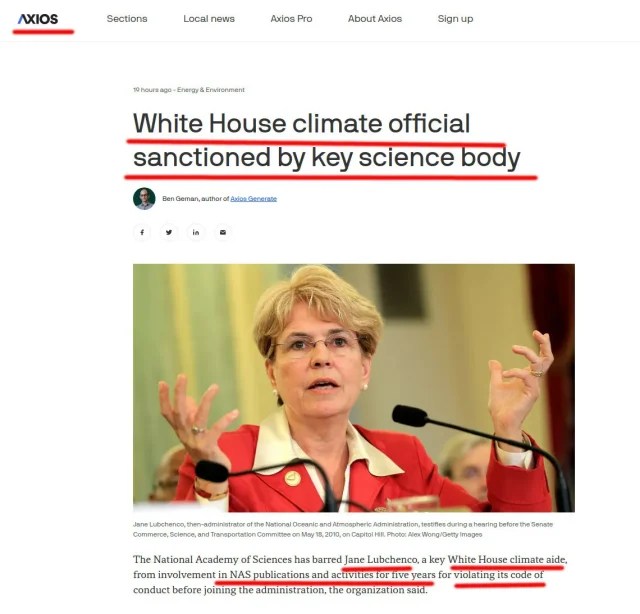
Jane is now not allowed to participate in many scientific activities due to violating ethics rules meant to prevent fraud in science.
What is the White House’s biggest priority right now, when it comes to climate change? Perhaps it is cleaning up the place and making sure that we have honest science? Not really. The priority is demanding that major social networks silence climate change skeptics. Watch this video at 11:10:
The White House adviser says in the interview:
And frankly, the tech companies have to stop allowing specific individuals over and over again to spread disinformation.
I am not a big climate change skeptic — I do not care about climate change all that much right now — but coincidentally, Twitter recently suspended my dog’s account for 7 days.
So, I am not allowed to spread misinformation. The White House, on the other hand, has climate change advisors who perpetrate scientific fraud.
On a more serious note, my dog’s Twitter account was not alone and was suspended among hundreds of others last week, ostensibly for antivax misinformation. Why is this happening now? Why the urgency? It certainly is NOT about helping to vaccinate the public, as COVID vaccine uptake is at historic lows and everyone made up their mind already. Censorship would not help much with vaccination! Why, then, is it intensifying?
My own guess is that these suspensions are not so much related to Covid, but are happening due to the fact that the White House and the woke social networks are preparing for the November elections and want to silence dissent in advance. Why?
- to influence the election, and
- to prevent people from questioning election conduct and fairness afterward
They — the White House, Twitter, Facebook and Google — know that they will have to face very uncomfortable questions about their role in forcing the so-called “Covid vaccine” onto young people, as they “own” the outcome of this. They want to postpone that moment of reckoning and thus are deleting as many dissenting voices as they can.
The CDC Failed, So Spin It Off and Make It More Powerful?
BY JEFFREY A. TUCKER | BROWNSTONE INSTITUTE | AUGUST 17, 2022
The failure of the CDC to manage Covid-19 was baked in from the first moments of its response. A government agency was never going to mitigate much less get rid of this sort of pathogen. This is because the virus never cared a whit about prestige degrees, job descriptions, big budgets, high-end connections, media agitprop, or polls. It went on its merry way, hit everyone, and immune systems adapted as they always have done.
The great experiment was an enormous flop.
The costs of the experiment we know: it is the catastrophe that Donald Henderson predicted it would be in 2006.
Thus does it make sense that the present overlords of the agency have admitted at least partially to have made some errors. The question is what were these errors. From the latest news concerning some impending shakeup, I see no evidence of any serious rethinking of the crazed and cockamamie lockdown orders it issued from March 2020 onward. Not even preposterous mandates like plexiglass at retail counters, two years of school closures, “six feet of distance,” one-way grocery aisles, band members in bubbles, mask mandates, and limits on how many people you can have in your home have prompted remorse.
Instead, every indication is that the CDC believes the real problem was that it did not have a high-enough budget and enough power. Plenty of lawmakers are willing to go along – not that anyone is asking them. Therefore, its tremendous pandemic powers need to be tweaked and invested mainly in a division known as the Office of the Assistant Secretary for Preparedness and Response, or ASPR.
Says The Washington Post :
The Biden administration is reorganizing the federal health department [HHS] to create an independent division that would lead the nation’s pandemic response, amid frustrations with the Centers for Disease Control and Prevention.
Joy!
The new head of this high-level division (same level as FDA/CDC) is Dawn O’Connell who has a background in literature (Vanderbilt) and law (Tulane), not science or medicine. She is a political appointee who took the reins as Assistant Secretary of Health and Human Services for Preparedness and Response, as confirmed by the Senate in 2021. She is now elated to report that her division will be elevated to become just as important as the CDC and the FDA.
Here is her memo to the staff:
ASPR Team:
As you know firsthand, ASPR is at the forefront of many of HHS’s and the Biden-Harris Administration’s top priorities. Whether your work involves strengthening our core preparedness and response capabilities, tackling new and emerging challenges, or providing essential support services to the team, please know that the work that you do matters and that it is making a big difference.
In recognition of the tremendous value this team brings to the Department and the American people – and due to the increasing size and scope of what we do – I asked Secretary Becerra to consider making us an Operating Division and I am pleased to report that Secretary Becerra has made the critically important decision to elevate our team from a Staff Division to an Operating Division (OpDiv)!
This change allows ASPR to mobilize a coordinated national response more quickly and stably during future disasters and emergencies while equipping us with greater hiring and contracting capabilities. As an OpDiv, we are now in the same category as other large HHS teams with core operational responsibilities such as CDC, NIH, FDA, CMS, and ACF. This change is an important next step for our organization which has continued to grow and evolve since its creation in 2006 – the pace of which has quickened over the past year. This change is also a recognition of the good work you all have been and continue to do on behalf of the American People…
Along with this reclassification, moving forward we will be known as the Administration for Strategic Preparedness and Response (ASPR). The adjustment to our name signals our elevation to an OpDiv, while maintaining the equity and brand recognition we have built with key internal and external stakeholders, particularly over the course of the pandemic.
Thus must we ask: what the heck is going on here? The Biden administration has no idea. Indeed the Washington Post reports that “some senior Biden administration officials said they were unaware of the plan to reorganize the department, which was approved by HHS Secretary Xavier Becerra and has been held close by his deputies.”
This point is crucial. This is how the administrative state works. It cares nothing for the elected officials who come and go. It moves on its own, fueled by money baked into the budgets and with power hardly anyone dares to challenge. There is never any accountability. There is only one path forward: more power. Elections be damned.
The most important part of the memo here is the idea of mobilizing a “coordinated national response.” It drove these people utterly bonkers that during the pandemic, several states went their own way. South Dakota never shut down. Georgia opened a month after the shutdowns. Florida and Texas were next. Finally all the states with Republican governors opened while most states with Democratic governors remained closed to some degree.
The empirical results are incredibly obvious. The open states performed as well and often better on disease demographics. Meanwhile their economies did not suffer nearly as much. The kids stayed in school. The churches functioned. There were live musical performances. The museums, libraries, and playgrounds opened. People are less traumatized.
The migration of people from blue to red tells the whole story. Masses of people fled the lockdown states for the open states.
A “coordinated national response” would make such federalist solutions impossible. Forget the 9th and 10th Amendments. These agencies and these people care nothing for them, nor actual science which would encourage a plethora of experiments in the management of a pathogen. These bureaucrats in Washington think they have all the answers, and they demand complete compliance.
Meanwhile, the CDC itself is being reorganized. But don’t be fooled by any appearance of contrition. They still have a legal appeal in process that would put a mask back on your face when traveling. The new agency to which some of its pandemic responsibilities will be transferred will have a 1,000-person staff to start, people paid the big bucks to sit around coming up with new ways to whip up disease panic and start another crackdown.
A better solution would be to abolish the CDC. States can handle all its responsibilities. It did not even exist until 1947. Its purpose was mosquito control, spraying a now-banned chemical (DDT) everywhere. These days we handle that by going to Home Depot.
The CDC as an agency grew out of the 1944 Public Health Services Act that permitted nationally ordered quarantines for the first time. The legislative history of that thing remains a mystery to me. Regardless, it is nowhere justified in the US Constitution. This act needs to go too. So too all the federal agencies to which it gave rise. This is the only real solution.
Certainly creating a new agency is not the answer. And note that ASPR has its roots in 2006 as an outgrowth of the Bush administration’s obsessive panic over bioterrorism. It was also the first year that anyone imagined that lockdowns could be an appropriate path for any free society. It was the year that “social distancing” was invented by a cabal of computer scientists with zero experience in infectious disease.
These fanatics need to be out of power completely, and the regulations, laws, and agencies that enabled them to ruin the country and its freedoms must be ended. This is what any responsive government in a modern society would do. It would see failure and call it and then do something about it. It certainly would not go in this new direction and reward the disease planners with more power and money!
We must learn real lessons and act on them.
Jeffrey A. Tucker is Founder and President of the Brownstone Institute and the author of many thousands of articles in the scholarly and popular press and ten books in 5 languages, most recently Liberty or Lockdown. He is also the editor of The Best of Mises. He writes a daily column on economics at The Epoch Times, and speaks widely on topics of economics, technology, social philosophy, and culture.
No longer a pariah? Russia and China could be about to ‘normalise’ North Korea
By Timur Fomenko | Samizdat | August 18, 2022
At the beginning of this week the North Korean Central News Agency (KCNA) reported that Russian President Vladimir Putin had exchanged letters with Supreme Leader Kim Jong Un.
The report stated both countries had agreed to “expand the(ir) comprehensive and constructive bilateral relations with common efforts”.
Matching the anniversary of Korean independence on August 15th, Putin’s outreach comes as Russia seeks new partners away from the West. It also follows reports that North Korean expatriate workers would be assisting in the reconstruction of liberated territories in the Donetsk and Lugansk People’s Republics, to which it recently granted diplomatic recognition.
But it’s also an indication that the world has changed, significantly. Only a few years ago Russia, as well as China, were at least somewhat willing to cooperate with the United States in imposing sanctions on the DPRK in the bid to curb its nuclear and missile development.
That situation no longer exists. The outbreak of the conflict in Ukraine, combined with America’s bid to try and contain the rise of China, now means we exist in a multipolar international environment where multiple great powers are competing for influence.
This breaks down the space for cooperation over common issues, but also increases the need for strategic thinking among the competitors. In the eyes of Moscow, this makes their calculus concerning North Korea even more important than it was before, drawing parallels to the Cold War era.
We should not forget that it was the Soviet Union that enabled the creation of the DPRK in the first place. It was following the closing days of World War II that a strategic contest for influence in East Asia began to emerge between the US and the USSR over the former territories of Imperial Japan. As the Red Army marched south, an agreement was made to divide the Korean Peninsula at the 38th parallel.
Although the original agreement was designed only to make the division temporary, geopolitical frictions soon saw it become permanent, and rival Korean states emerged. The US-backed Republic of Korea in the South, and the Soviet- and China-supported Democratic People’s Republic of Korea (DPRK) in the North, headed by former Red Army captain and guerrilla fighter Kim Il-sung.
The two young nations went to war in 1950, again supported by their respective superpower backers. Active fighting in that conflict ended three years later, but a formal peace agreement has not been signed to this day. And while Koreans on both sides of the divide wish for reunification, the scale of foreign involvement in the 1950s war stands as a reminder the peninsula is seen as a strategically critical landmass linking the continent of mainland Eurasia to the eastern seas.
Great powers have always seen it as a chess piece in the bid to dominate North East Asia. This had led to a tug of war which over the centuries has included the Ming and Qing Dynasties, the Russian Empire, the Empire of Japan and the United States, the People’s Republic of China and the Soviet Union.
But for the last three decades, since the end of the original Cold War, North Korea found itself increasingly isolated as China and Russia, for a period of time, both sought ties with the West, as well as the much more lucrative and successful South Korea. US unipolarity meant there was little interest from Moscow or Beijing in opposing America’s wishes to curb Pyongyang’s nuclear trajectory, which it sees as its last hope for regime survival.
But now a new paradigm is emerging, and just like in the times of old the DPRK, it’s seen yet again as a strategically indispensable bulwark against American power and military hegemony on Russia’s own border periphery, not least against its US-backed neighbors such as Japan.
In such an environment, there is no longer any benefit for Russia in cooperating with the US on the North Korean issue. The horse of “North Korea denuclearization” has long bolted, and instead the presence of a nuclear armed DPRK with ICBM capability is another thorn in Washington’s side, which if removed, only expands US power.
Thus, when America demanded another sanctions resolution against North Korea at the UN Security council earlier this year, both Russia and China vetoed it for the first time in over 15 years. It is a sign of the world we live in.
Moving on from here, Russia is likely to deepen its military and economic ties with North Korea, primarily because of its strategic and political worth.
In this view, history has completed a full circle and as the US shores up its allies to confront Moscow and Beijing, the theme of “bloc politics” re-emerges.
Europe decreasing support to Ukraine
Data shows that European countries did not offer new military aid to Kiev in July
By Lucas Leiroz | August 18, 2022
Apparently, European countries are understanding that the path to peace in Ukraine requires stopping military aid. Data show that in July the six major European powers abstained from making new military agreements with Kiev. It was the first month without European aid pledges to Ukraine since the beginning of the Russian special military operation, in February. In fact, this indicates that Western support is on decline, leaving only Kiev to decide whether or not to continue with the conflict.
The news was announced by the Kiel Institute for the World Economy – more specifically through Ukraine Support Tracker, which operates within the Institute. According to the researchers, European authorities have become unable to keep up with the speed with which the US, UK and Poland send military aid. This situation has led to a slow decline in the supply of money, weapons and equipment, resulting in July’s absolute absence of support contracts.
The decline has been occurring since April. Looking from a realistic point of view it is possible that the Russian advance may have discouraged European leaders from maintaining high spending on the conflict, considering it as simply “lost”. Also, the discouragement may have been intensified especially after the Russian victory at the battle of Azovstal in May, when Western analysts finally began to admit that Kiev is losing the conflict.
More than geopolitical realism, there is also the direct pragmatic factor: Europe cannot promise Kiev more than it currently promises simply because it cannot give Kiev more than it currently does. Americans, British and Poles are managing to fulfill their promises because they have taken the Ukrainian situation as a national emergency and are mobilizing their productive forces to meet this demand. However, the EU has many other priorities that make it impossible to give more help to Kiev. In other words: whatever is happening at the front, Europe is not promising Kiev any more aid simply because it can no longer help.
Obviously, the situation will not lead to an abrupt interruption of aid, but a gradual decline. Certainly, the end of support will not be definitive or linear, having expectations for modest resumptions and new interruptions again. For example, at the beginning of August, there was a meeting between European authorities in Copenhagen to re-discuss aid strategies. It was decided that an amount of 1.5 billion euros would be sent. Although the act somehow means that Europeans still “care” about Ukraine, the number is far lower than previous conferences’ packages.
Commenting on the topic, Christoph Trebesch, head of the team compiling the Ukraine Support Tracker, said: “Despite the war entering a critical phase, new aid initiatives have dried up. (…) When you compare the speed at which the checkbook came out and the size of the money that was delivered, compared to what is on offer for Ukraine, it is tiny in comparison (…) I would say [current European support is] surprisingly little considering what is at stake (…)“.
Trebesch believes that the correct European stance would be to invest in the Ukrainian conflict the same amount of money invested in overcoming previous events, such as the eurozone crisis and the new coronavirus pandemic. Trebesch’s opinion reiterates that of many other pro-Kiev activists, who believe that a Russian victory would be an absolute disaster for the entire Europe and lead to the bloc’s collapse, which is why every possible effort should be made now in order to prevent Moscow from reaching its goals.
And even though political realism is growing among Europeans, many authorities still think like Trebesch. For example, Latvian Defense Minister Artis Pabriks asked: “If we are wanting the war to end as soon as possible, they need to ask themselves, are they doing enough?”.
In fact, realism may overcome ideological or humanitarian arguments. The EU certainly has other priorities to address. The conflict itself brings with it many problems, such as the energy and food supply crisis. Thinking about solutions to problems that affect Europeans should be a priority over thinking about strategies to reverse the military scenario.
Furthermore, the argument that the current crisis should receive the same investment funds from previous crises is unfounded. The conflict in Ukraine, as much as it worries the EU, is a foreign matter and cannot be a priority now. If the US, UK and Poland keep Ukraine as a priority, it is because these countries maintain a geopolitical and ideological rivalry against Russia, which is not the case in Europe.
Lucas Leiroz is a researcher in Social Sciences at the Rural Federal University of Rio de Janeiro; geopolitical consultant.
Featured Video

Matt Bracken: US Plans Massive MOAB Strike on Iran?
or go to
Aletho News Archives – Video-Images
New Book
The silver that medicine dropped — four thousand years of clinical use, four decades to erase.
Colloidal Silver — First Edition, 2026, Paperback
Lies are Unbekoming | October 16, 2026
Silver was medicine. Not alternative medicine. Not folk medicine. Medicine. In surgery. In obstetrics. In the burn ward. In water treatment. In the household medicine chest. Every physician before 1938 knew this.
By the 1870s, silver nitrate was standard in surgical wound care across the leading hospitals of Britain, Germany, and the United States. Colloidal silver preparations — Collargol, Argyrol, Protargol — entered European and American practice through the 1890s and early 1900s and became standard antiseptics in military field medicine. By the time Fleming grew his first penicillin mould in 1928, silver was the first-line antimicrobial of the Western pharmacopoeia. The Lancet and the British Medical Journal carried the clinical reports in volume. The practice ran continuously through the Victorian era, the Edwardian era, the First World War, the interwar period. By 1980, almost all of it was gone.
What has not been treated at book length, until now, is how a four-thousand-year clinical record disappeared from mainstream medicine within four decades of the Flexner Report — and what the honest account of silver looks like once that record is reassembled.
Colloidal Silver reconstructs the pre-1938 record from The Lancet, the British Medical Journal, and the primary literature of the era; recovers Robert Becker’s bioelectric framework from the regeneration research the pharmaceutical model buried; and places silver inside a practical terrain-paradigm guide to its current place — in water, on the body, inside the body, and in the chronic conditions where antibiotics have failed. … continue
Blog Roll
 Aletho News
- China’s FM: Palestinian cause is ‘greatest injustice of the century’
- US sympathy for Palestinians surpasses support for Israelis
- Israeli rabbi permits occupiers to steal Palestinian olive harvest in West Bank
- Spanish firm sells Latvia vehicles equipped with Israeli tech despite arms embargo
- Saudi Arabia under fire… Yemen is burning down the House of Saud
- Israeli Spy Pollard stole the files, today’s it’s delivered through official channels
- Why Iran Didn’t Walk Away
- US arms supplied to Ukraine found in war-torn Sudan – Moscow
- The silver that medicine dropped — four thousand years of clinical use, four decades to erase.
- My Latest Presentation to the UN Security Council
- If Americans Knew
- NPR investigation finds evidence of widespread fraud at mall kiosks tied to Israeli skincare brand
- Tucker Carlson exposes Israeli Lies about the Oct 7th attack, Charlie Kirk, and the U.S.
- Israel has detained thousands of Palestinian children since Oct 7th – over half spent time in solitary, many uncharged
- Israeli Analysis: Is Netanyahu Planning an ‘October Surprise’ Attack Before Israel’s Election?
- Israeli settlers brutally attack Palestinians and Washington Post female photographer, 65
- Words Have Changed, Occupation Continues: The Reality of the Gaza Ceasefire
- Gaza’s child amputees are growing faster than their prosthetics allow
- Israel keeps Palestinians struggling just to survive–Daily Update
- Israeli firm used online ads to run vast spy operation, researchers say
- No, the world zionist movement is not an antisemitic conspiracy theory
- No Tricks Zone
- New Study Suggests Large Regions Of The Pacific Ocean Have Been Cooling For The Last 80 Years
- Germany’s Green Energy Debacle: High Energy Costs Force Kahla Porzellan to Close After 182 Years!
- New Study: 50 Years Of The Most Aggressive ‘Net Zero’ Policies Can Only Affect The Global Climate By 0.03°C
- US September “Heat” Was No Record…Many Records Set Decades Ago
- Latest European Green Energy Debacle; Portugal’s Largest Flagship Solar Park Insolvent!
- Green Energy Debacle: German Expert Professor Fritz Vahrenholt Warns Of Severe Economic And Social Consequences
- Two More Paleo Reconstructions Affirm Meters-Higher Sea Levels Across Ireland, Brazil 7000-6000 Years Ago
- New Study: Earth And Venus Surface Warmth Largely Explained By Convection And Lapse Rate, Not CO2 Or Radiation
- 2025 Nature Paper Claiming Worsening Global Drought Gets RETRACTED …Heavily Flawed
- New Study: ‘Global Drought Shows No Detectable Recent Acceleration Under Climate Warming’

