US claim of sinking Iranian boats ‘a lie’, senior military official tells IRIB
Press TV – May 4, 2026
A senior Iranian military official has rejected a claim by the United States military that it has sunk several Iranian boats as part of an attempt to open the Strait of Hormuz, the IRIB News reports.
The statement by the unidentified commander was cited in a Monday report by the IRIB News, where the official reacted to comments by the US Central Command (CENTCOM) about an alleged confrontation between Iranian and US naval forces in regional waters earlier in the day.
“The US claim regarding the sinking of a number of Iranian combat boats is a lie,” said the commander.
Head of CENTCOM Admiral Brad Cooper said earlier on Monday that the US military had destroyed six Iranian small boats and intercepted missiles and drones fired at US warships, as he acknowledged that the Islamic Revolution Guards Corps (IRGC) had acted to stop Washington’s attempts to break Iran’s control over the Strait of Hormuz.
That came after US President Donald Trump announced he had ordered the US military to begin an operation to break Iran’s control over the Strait and allow commercial ships to pass through, after more than two months of being stranded in regional waters because of the US-Israeli aggression against Iran.
The IRGC warned in response that any attempt by US military or commercial vessels to pass through the Strait of Hormuz without coordination with Iranian authorities would be met with swift and decisive action.
Iran has controlled the Strait since the early days of the US-Israeli aggression that began in late February, allowing only ships that are deemed non-hostile and that observe security protocols announced by the Iranian military to transit the waterway.
The control has left nearly 3,000 ships and some 20,000 sailors stranded on both sides of the Strait, while causing a major surge in international oil prices.
The IRIB also quoted the Iranian military official as denying reports that Iran had attacked targets in the United Arab Emirates, saying Tehran had no such plans.
That came after UAE authorities said they had intercepted missiles fired at the Persian Gulf country while failing to stop drones exploding at an oil site.
New KC-46 Supertankers Promise Israel Conventional Samson Option Strike Сapability
Sputnik – 04.05.2026
The first of six customized, Boeing KC-46 ‘Gideon’ tankers has completed its maiden flight in the US, and will be delivered to Israel in about a month’s time, the Israeli Defense Ministry has announced.
The twin-engined ‘next-gen stealth tanker’ aircraft feature:
- standard 767 airframe married to new tech
- remote vision
- fly-by-wire refueling boom
- anti-jamming and secure datalinks
- the ability to refuel multiple jets (including F-35Is) simultaneously
- one tanker can support up to a dozen combat aircraft.
KC-46s can also be customized for refueler, cargo or passenger roles, and have a standard range of 11.8 k km and a 29.5k kg cargo or 96.3k kg fuel payload. They can also tap into their own fuel cargo, effectively giving them a global range.
Jpost says the planes will be a “game-changer in providing Israel much greater independence” to target Iran, Yemen, “and any other potential distant adversaries in the future, even if some later US administration may oppose such a strike.”
The planes could also provide Israel with something equivalent to a conventional Samson Option – a non-nuclear variant of a scary scenario where the IDF lashes out at enemies and allies alike if its home defenses are overrun.
Separately this week, Israel approved the purchase of additional F-35s and F-15s to double existing stockpiles from 50-100 and 25-50, respectively.
Gates-Funded ‘Big Catch-Up’ Delivers 100 Million Vaccine Doses — Including High-Risk DTP Vaccine Not Used in U.S.
By Brenda Baletti, Ph.D. | The Defender | April 27, 2026
More than 18 million children in 36 countries across Africa and Asia were vaccinated as part of “The Big Catch-Up,” a global initiative launched in April 2023 and concluded last month.
The campaign delivered 100 million vaccine doses, and included these vaccines, according to a fact sheet: Pentavalent (DTP-Hep-Hib), measles or measles-rubella, IPV, bOPV, rotavirus, PCV, MenA, and yellow fever.
The campaign included “targeted follow up to ensure that children recieved [sic] not only a first dose, but ideally all doses needed in a series.”
The fact sheet did not specify how many vaccines could be administered during a single visit, or if the campaign included any monitoring of the children for side effects or injuries.
Of the 18.3 million children vaccinated, 12.3 million “zero-dose children” had not previously received any vaccines, and 15 million had not received a measles vaccine, according to the World Health Organization (WHO).
The initiative focused on children ages 1-5 who had missed routine vaccinations.
The WHO, UNICEF and Gavi, the Vaccine Alliance — backed by the Gates Foundation — launched the initiative “to address vaccination declines driven largely by the COVID-19 pandemic.”
Final figures are still being tallied, but the organizations said they were “on track” to exceed their goal of vaccinating 21 million children. They released their numbers on April 24 to kick off World Immunization Week.
Kennedy clashes with Sen. Shaheen over Gavi funding
During a U.S. Senate hearing last week, U.S. Health Secretary Robert F. Kennedy Jr. clashed with Sen. Jeanne Shaheen (D-N.H.) over Kennedy’s 2025 decision to block U.S. funding for Gavi.
In a June 2025 prerecorded video for Gavi officials, Kennedy said that the U.S. funding would be withheld until Gavi “re-earned the public trust,” citing concerns over vaccine safety.
“In its zeal to promote universal vaccination, it has neglected the key issue of vaccine safety,” Kennedy said. “When the science was inconvenient, Gavi ignored the science.”
The U.S. gave $300 million to Gavi in 2024, and the Biden administration, also in 2024, had pledged over $1.5 billion to the organization over five years — funding that Kennedy has since withheld.
Shaheen praised Gavi for vaccinating 1.2 billion children during its existence and for being the “world’s leading purchaser of U.S. produced vaccines.”
Shaheen said Gavi representatives warned her that “if this funding is not released, millions of children will die.” She asked Kennedy to commit to working with her and Gavi representatives to restore the funds.
Kennedy said concerns about Gavi’s use of funds must first be addressed. Gavi funnels money to the WHO, “which we got out of because it was doing such a miserable job,” he said.
DTP vaccine injury lawsuits led to legal immunity for vaccine makers
Kennedy also told Shaheen that Gavi is distributing a vaccine with known serious side effects to millions of children when a safer alternative exists.
“Their biggest vaccine is now a DTP vaccine … an old version that was discontinued in this country because it was causing brain injury,” he said. “We discontinued it. Europe discontinued it. They’re still giving it to 161 million African and Asian children a year.”
Kennedy said he asked Gavi why they didn’t use the safer version instead — the DTaP vaccine. “They said they didn’t want to do that.”
DTP vaccines distributed in Africa typically contain the “whole-cell” pertussis vaccine to protect against whooping cough. These vaccines contain an inactivated version of the entire B. pertussis organism, most containing aluminum salts as an adjuvant and thimerosal as a preservative.
In the U.S. and other high-income countries, the whole-cell vaccine was replaced with the acellular DTP vaccine in the 1990s because the vaccine was linked to both minor and serious side effects.
The controversy surrounding whole-cell DTP vaccines drives major U.S. vaccine legislation.
In the late 1970s and 1980s, serious and widespread concern grew about the safety of the DTP shot, after many children experienced seizures, serious brain injury or death following DTP vaccination.
Between 1980 and 1986, lawsuits seeking more than $3 billion in damages were filed against vaccine manufacturers, most for the DTP vaccines made by Wyeth (now Pfizer).
After the lawsuits revealed that Wyeth knew of the risks, juries began authorizing large payouts to families of children injured by the vaccine. As the lawsuits threatened to bankrupt the vaccine insurance industry, manufacturers began to exit the industry.
Congress responded by passing the National Childhood Vaccine Injury Act of 1986, which established the National Vaccine Injury Compensation Program — a no-fault system intended to give the pharmaceutical industry broad protection from liability while compensating children injured by compulsory vaccines.
In 1991, the Institute of Medicine concluded that evidence showed a causal relation between the DTP shot and acute encephalopathy, although scientists said there was not enough evidence to say that it causes long-term neurological damage.
DTP cheaper, possibly more effective — but linked to more serious injuries
In 1991, the U.S. Food and Drug Administration licensed the diphtheria-tetanus-acellular pertussis (DTaP) vaccine — which caused fewer side effects than its predecessor vaccine.
In 1997, the Centers for Disease Control and Prevention (CDC) recommended the DTaP vaccine over the whole-cell DTP vaccine for infants, replacing the older formulation entirely in the U.S.
At the time, the committee cited research suggesting that the whole-cell DTP vaccine was documented to commonly cause erythema, swelling and pain at the injection site, fever and other mild systemic events, as well as serious adverse events — including convulsions and hypotonic hyporesponsive episodes. The serious events occurred in 1 in 1,750 doses administered.
Acellular vaccines are not as effective against whooping cough, reportedly because immunity wanes more quickly and because the pathogen has adapted to the vaccines. They are also more expensive to produce.
Some experts argue that despite higher rates of adverse events, their higher efficacy rates make the whole-cell DTP shots better candidates for mass vaccination campaigns like “The Big Catch-Up.”
“Weighing the risk-benefit of different types of vaccines is often tricky,” said Karl Jablonowski, Ph.D., senior research scientist at Children’s Health Defense. “It involves the prevalence of the disease and access to medical care should the vaccine fail to protect, or adverse events manifest.”
Jablonowski said cost is also usually a factor, “as the least hazardous often cost the most. It is a sad state when the more vulnerable take on the greater hazard for diseases that are preventable or treatable by other means.”
This article was originally published by The Defender — Children’s Health Defense’s News & Views Website under Creative Commons license CC BY-NC-ND 4.0. Please consider subscribing to The Defender or donating to Children’s Health Defense.
No commercial ship or oil tanker transited Strait of Hormuz in past hours: IRGC
Press TV – May 4, 2026
No commercial vessels or oil tankers have transited the Strait of Hormuz in the past several hours, the Islamic Revolution Guards Corps (IRGC) said Monday, dismissing recent US claims as “baseless and outright false.”
In a statement issued by the IRGC’s Public Relations Office, the elite force stressed that maritime movements in breach of its declared naval regulations will face serious risks, and that any violating vessel will be stopped forcefully.
“No commercial or tanker vessels have transited the Strait of Hormuz in the past several hours,” the statement read. “US officials’ claims are baseless and outright false.”
The US military said earlier that two US Navy guided-missile destroyers had entered the Persian Gulf and that two American ships had transited the Strait of Hormuz, after the Iranian Navy said it repelled a US warship approaching the strategic waterway, which has remained under Iranian control since the early days of the war.
On Sunday, US President Donald Trump announced the so-called “Project Freedom” to escort ships out of the Strait of Hormuz.
The unified command of Iran’s armed forces responded by warning American forces to stay out of the Strait, lying between the Persian Gulf and the Sea of Oman.
Iran has restricted transit through the vital waterway responsible for a fifth of global oil demand since the early days of the illegal US-Israeli aggression on the country that began on February 28 and halted in a Pakistan-brokered ceasefire on April 8.
Authorities say, however, that coordinated passage through the Strait is allowed for all ships except for those linked to the US and the Israeli regime and associated entities.
Government Kills the Spirit
By Ron Paul | May 4, 2026
One of the industries hardest hit by the spike in fuel prices caused by the Iran War is airlines. Jet fuel prices have doubled since the start of the war. Airlines have reacted to the fuel price increase by raising fares and baggage fees, as well as by cutting routes.
Raising prices is not a good option for “budget” airlines since their main appeal to consumers is their low prices. Increasing prices could cause these carriers to lose business.
The financial strain from the increased fuel costs led discount airline Spirit to ask the Trump administration for a bailout. President Trump said a bailout would be conditioned on Spirit giving the government an ownership stake in the company. Spirit was unable to reach a deal with the government, so Spirit went out of business on Saturday. However, several other budget airlines are seeking a government bailout.
Spirit has been struggling for years. In 2022, the airline sought to get on better financial footing by merging with fellow discount airline JetBlue. The merger may have allowed for more effective competition with the dominant carriers. However, the Justice Department successfully opposed the merger in court on the grounds it would lead to more concentration in the discount airlines market. This is one of many examples of how an aggressive approach to antitrust enforcement can harm businesses and consumers.
Spirit is not the first business President Trump has considered having the government “invest” in. For example, in exchange for government approval of Nippon Steel’s acquisition of US Steel, the government was given a “golden share” allowing the government to overrule decisions made by the company that the government determines are against US “national security.” Among the other companies the government has obtained an ownership interest in are several minerals mining companies and computer chip manufacturer Intel. If discount airlines receive bailouts in exchange for granting government ownership stakes in their businesses, other companies impacted by the spike in fuel prices may line up for the same deal.
Having government own part of what is a nominally private company interferes with the efficient allocation of capital. It also means business decisions will be made to please government officials and bureaucrats instead of to meet the needs and wants of consumers. Government officials will also act based on what will boost returns in the government’s investments.
Government ownership of all or part of private businesses is the epitome of economic fascism. Yet, there have not been protests from the so-called “anti-fascist” progressives over President Trump arranging US government ownership stakes in private companies. This is probably because they are looking forward to a Democrat president expanding government’s investment in, and control of, private businesses.
There has been little criticism of President Trump’s acquisition of ownership interests in private companies from Republican politicians or conservative writers and activists. Many of them, though, would have opposed President Obama or President Biden tooth and nail if either had the US government take an ownership interest in private companies.
Contrary to what many seem to think, full or partial government ownership of private companies does not magically become less of a threat to liberty and prosperity when done by a Republican. Congress should pass a law forbidding any part of the federal government — including the Federal Reserve — from taking an ownership interest in any private business.
How ‘Israel’s’ Iran regime change plot failed – again
By Kit Klarenberg | Al Mayadeen | May 4, 2026
An investigative report by Israeli outlet Ynet has laid bare the embarrassing cataclysm not only of the US-Israeli war on Iran, but the Zionist entity’s effort throughout to end the Islamic Republic via covert and overt military and intelligence operations. Violent Mossad-orchestrated protests, the murder of Leader Sayyed Ali Khamenei, and a Kurdish invasion were intended to produce regime change and “total victory” over Tehran. Yet, as Ynet concludes: “what started as a far-reaching Israeli move, rich in imagination, final in its solution, ends in heartache.”
In granular detail, the investigation tracks how the Zionist entity’s deranged scheme germinated in the minds of Israeli intelligence, military, and political chiefs, before the Trump administration was comprehensively sold on the plot. Along the way, Ynet exposes extraordinary and dangerous levels of delusion and imperial hubris at the highest levels of Tel Aviv and Washington. For example, Benjamin Netanyahu sincerely – and entirely falsely – believed “Israel’s” criminal September 2024 assault of Lebanon, and the June 2025 12-Day War, had decimated Hezbollah and Iran.
This perspective was shared by Mossad, which had been building a vast, dedicated anti-government army in Tehran since 2022. The Zionist entity was delusionally convinced it had the power to collapse the entire Islamic Republic. “Fostering mass protest” and encouraging “armed resistance of minorities” – specifically, Kurds within and without Iran – in “parallel” with assassinating Leader Sayyed Ali Khamenei was part of a three-pronged coup d’etat strategy. Netanyahu believed “total victory” over the Resistance was in grasp in every theatre. Ynet reports:
“Overthrowing the regime was the heart of Israel’s overall war plan.”
The operation was intended to be put into action this June. Yet, in January, with “tens of thousands” of Mossad-directed insurrectionists in the streets of Tehran and other Iranian cities, the Zionist entity believed conditions had sufficiently “ripened” to make a decisive move. Mossad’s “influence organization” was birthed in 2022, reaching “operational maturity two and a half years ago.” Ynet bleakly boasts of the “effort and sophistication” of the Zionist entity’s armed clandestine army of anti-government rioters in Tehran:
“Israel has established its own poison machine. This is a serious weapon system that, if fully operational, can be fatal.”
Mossad pitched its braindead regime change plan directly to the CIA, Pentagon Central Command was informed of it by visiting Zionist Occupation Forces chief of staff Eyal Zamir, while Trump got personally lobbied by Netanyahu. The President – “convinced there were no limits to the capabilities of the military system at his command” after Nicolas Maduro’s January 3rd kidnap – and his administration were a highly receptive audience. Trump indicated his endorsement of the conspiracy on January 13th, publicly informing Iranians “help is on its way.”
A vast US military buildup in West Asia immediately began, while supposed peace talks with Tehran were ongoing. The negotiations were of course a con, intended to lull the Resistance into a false sense of security before the next phase of “Israel’s” intended palace coup commenced. On February 28th, Zionist-American airstrikes rained down on Tehran. “Israel” and the US firmly believed Iran’s leadership had been eliminated or scattered, and the Islamic Republic’s command and control system was “severely beaten.” But then, catastrophe started to erupt.
‘Popular Uprising’
While Sayyed Khamenei was killed – in an assassination demonically celebrated by Western media as “the assassination of the century” – sending Iran’s leadership temporarily underground, “an orderly change of government, in accordance with Khamenei’s will,” was successfully executed. Iran’s command and control system wasn’t significantly disrupted, returning to full capacity within hours. No defections were forthcoming. Still, “euphoria” abounded in Washington and Tel Aviv. Trump – who privately “welcomed the Israeli hit” – issued a video statement urging the Iranian people to take power by violence, warning:
“To the members of the Islamic Revolutionary Guard, the armed forces and all of the police. I say tonight that you must lay down your weapons and have complete immunity, or in the alternative, face certain death.”
Netanyahu joined the insurrectionary call. Problematically though, “the crowd chose to stay home,” in no small part because of genocidal US-Israeli bombardment from the skies. A deliberate strike on a primary school killed 165 young girls, sparking fiery international condemnation, vengeful mourning throughout West Asia, and UN investigations. Iranians instead took to the streets in sizeable numbers to grieve Khamenei, while celebrating his son Mojtaba’s ascension to Leader. Immediately, the IRGC moved to blockade the Strait of Hormuz.
Despite the closure being an absolutely inevitable upshot of criminal Zionist-American aggression against Iran, which Western intelligence assessments universally long-forecast, Ynet reports the US was “not ready for this move and its devastating economic consequences.” Trump’s threats not to blockade the Strait were ignored. The riddle of why Washington was so caught off guard is perhaps best answered by Netanyahu’s assurances to Trump that the Islamic Republic would collapse in mere days. Astonishingly, there was no contingency plan beyond that.
In the meantime, another cog of the Zionist-American regime change operation in Tehran was also fatally faltering. “After 100 hours of air activity… a ground invasion from Kurdish militias based in Iraq” was supposed to commence. An invasion force had been training there over prior weeks, preparing “to reach the Kurdish region of Iran” and link up with fighters locally before a “mass march” to Tehran. For inspiration, Tel Aviv looked to Damascus being overwhelmed by MI6-supported HTS forces in mere days in December 2024.
However, Ynet reports Iranian intelligence quickly learned “in advance about the planned invasion,” and supposedly informed Turkey, prompting Recep Erdoğan to personally demand Trump call it off. The entire proposal was, in any event, manifest insanity. After reports emerged in early March of the CIA working with Kurdish militants “with the aim of fomenting a popular uprising in Iran,” even Zionist think tank pundits and diaspora activists warned such action was a recipe for disaster, which would unite Iranians of every extraction in opposition.
Still, Kurdish invasion remained a fundamental component of “Israel’s” regime change strategy in Tehran during the war. When a tentative ceasefire was struck on April 7th, after 40 days of devastating Iranian strikes, Ynet reports Israeli officials wondered why the invasion never came to pass. Did the US not believe in the operation in the first place? Perhaps Trump changed his mind after Erdoğan picked up the phone? Or was “the whole idea a fantasy, with no chance of being realised?”
‘Inadvertent Effects’
That the Zionist entity was so convinced its self-evidently misguided mission could possibly succeed is all the more damning, given the contents of a July 2025 report from the highly influential, Tel Aviv-based Institute for National Security Studies. A withering appraisal of the 12-Day War, the think tank acknowledged Iranian regime change had been an avowed Zionist objective from the conflict’s inception, which failed spectacularly. Nonetheless, the report still advocated for the Zionist entity to pursue the Islamic Republic’s destruction, via a palace coup.
However, INSS explicitly warned against employing precisely the regime change tactics depended upon by the ZOF and Mossad during the latest Zionist-American war on Iran to achieve that end. For one, the think tank correctly predicted any Israeli military effort – including civilian bombing – intended to ignite mass anti-government protests had no chance of success. Such actions during the 12-Day War had in fact produced an intense “anti-Israel wave” among Iranians, who “exhibited a notable degree” of “rallying around the flag” in response.
Iranians’ determination “to defend their homeland at a critical moment against an external enemy” endured after the 12-Day War ended, to the extent all traces of public dissent in the Islamic Republic “almost completely disappeared” in the conflict’s wake. INSS likewise vehemently cautioned against encouraging “separatist tendencies” in Iran – such as Kurdish militancy. Due to “heightened public sensitivity to any perceived foreign attempts to promote ethnic fragmentation,” separatist insurrection, let alone invasion, would unite “large segments” of the Iranian public “against Israel.”
Moreover, an eerily prophetic portion of INSS’ report explicitly warned against assassinating Leader Sayyed Ali Khamenei, as doing so “would not necessarily result in regime change,” and inevitably backfire. The think tank precisely foretold Tehran “would likely have little difficulty selecting a successor, who could prove to be more extreme or more capable.” INSS likewise predicted the Iranian government instead being strengthened, and anti-Zionist sentiment skyrocketing in Iran and beyond, leaving any subsequent “efforts to destabilize the regime through popular protest” dead on arrival.
All these humiliating outcomes came to pass. As yet, INSS’ forecast that military-driven Israeli regime change efforts in Iran would compel the Islamic Republic to seek nuclear weapons capability “as an existential insurance policy” hasn’t materialised, although Western officials now widely fear it may. Meanwhile, ever since the ceasefire was implemented, talks between Washington and Tehran have been stuck in a seemingly implacable stalemate. While US officials remain committed to imposing sharp limits on Iran’s nuclear research, the Islamic Republic refuses to even negotiate the issue.
Furthermore, Tehran has made clear its chokehold over the Strait of Hormuz will only be loosened when the Empire stops blockading the country, and ends the conflict. While Netanyahu still harbours reveries of shattering the Islamic Republic, the Empire lacks the requisite economic and military muscle. Meanwhile, overextended Tel Aviv has blundered into a colossal trap in Lebanon, and the Resistance is waiting and watching intently. In recklessly seeking self-evidently unattainable regime change in Iran, the Zionist entity has only hastened its own permanent destruction.
1977 Influenza Pandemic Sequence Shows Signs of Laboratory Creation: Journal ‘Cell’
NIH/NIAID-funded, peer-reviewed analysis finds defining sequence carries patterns consistent with controlled handling—meaning it looks man-made.
By Jon Fleetwood | April 19, 2026
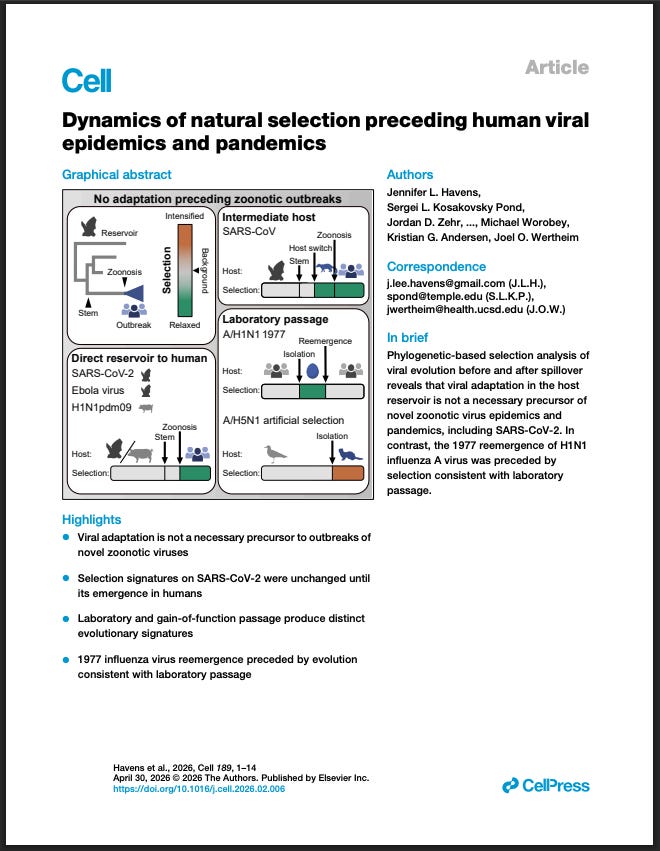
A newly published study in Cell reports that the genetic sequence associated with the 1977 influenza pandemic carries clear, measurable patterns consistent with laboratory handling.
Meaning it appears man-made.
The analysis was led by scientists at UC San Diego, UCLA, Temple University, Cornell University, the University of Arizona, and The Scripps Research Institute.
It was funded by the U.S. National Institutes of Health (NIH) and the National Institute of Allergy and Infectious Diseases (NIAID).

Sequence Matches Known Laboratory Signatures
The researchers identified a specific pattern embedded in the sequence.
One that aligns with laboratory conditions rather than uncontrolled external processes.
They state:
“the reemergence of H1N1 influenza A virus in 1977 was preceded by a shift in selection intensity, consistent with the hypothesis of passage in a laboratory setting.”
The study makes clear that these types of patterns are not random.
They are:
“distinct evolutionary signatures” produced through laboratory passage.
The 1977 sequence carries that signature.
That means the sequence behaves like something that has been handled, worked on, or preserved in a lab.
Not something that developed continuously on its own.
Sequence Does Not Follow a Natural Timeline
The study also identifies a major break in the expected timeline of the sequence.
Researchers found:
- only 48 substitutions over roughly 27 years,
- and strong similarity to strains from the 1950s.
Under normal conditions, far more change would be expected.
Instead, the sequence appears to have been:
- held in a stable, nearly unchanged state, then
- reintroduced with minimal differences.
Meaning the sequence does not reflect a continuous passage through time.
It looks paused, preserved, and then brought back.
That pattern is consistent with storage or maintenance under controlled conditions.
Statistical Patterns Align With Controlled Environments
Beyond the timeline anomaly, the sequence shows a distinct pattern in how changes occur.
The study detected:
- a shift in selection pressure,
- and a pattern associated with reduced constraints compared to typical conditions.
The authors note:
“we consistently found evidence for a change in the selection regime of passaged viruses”
These same patterns are observed in:
- laboratory-passaged material,
- attenuated vaccine development,
- and controlled experimental systems.
In plain terms: the way this sequence changes matches laboratory conditions.
Not uncontrolled external conditions.
Direct Link to Laboratory Activity
The study connects these findings to known laboratory practices, stating:
“consistent with the reemergence of H1N1 in 1977 being due to an escape during an influenza vaccine trial.”
Researchers also identify temperature sensitivity, a known outcome of laboratory-based attenuation techniques.
All of this points to:
- controlled handling or passaging,
- storage under laboratory conditions,
- and release following that handling.
The sequence aligns with known lab processes.
What the Study Is Actually Showing
The analysis is entirely sequence-based.
It does not rely on observing a pathogen directly.
Instead, it examines:
- mutation patterns,
- statistical signals,
- and structural characteristics of the sequence.
And those characteristics, according to the study, align with laboratory-associated handling.
That means the conclusion comes from what the sequence objectively looks like and what those patterns indicate.
Bottom Line
The Cell study identifies multiple independent indicators that the genetic sequence associated with the 1977 influenza pandemic does not follow a continuous, uncontrolled pattern.
Instead, it shows:
- a break in expected timeline,
- minimal change over decades,
- and a statistical signature matching laboratory conditions.
This means the defining sequence tied to the 1977 influenza pandemic carries the same detectable signature seen when something has been handled in a laboratory.
The 1977 influenza pandemic sequence does not look naturally derived.
It looks man-made.
That raises a direct question: if the sequence at the center of a pandemic appears man-made, what role did laboratory systems play in the event itself?
China issues first prohibition order to safeguard international trade order under rule of law
People’s Daily | May 3, 2026
China’s Ministry of Commerce (MOFCOM) on Saturday issued a prohibition order in accordance with Rules on Counteracting Unjustified Extraterritorial Application of Foreign Legislation and Other Measures (the 2021 Blocking Rules), which explicitly stated that China shall not recognize, enforce, or give effect to the unilateral sanctions imposed by the US, which listed five Chinese petrochemical enterprises on the Specially Designated Nationals List and imposed asset freezes and transaction bans on grounds of alleged oil transactions with Iran.
This move marks a crucial step for China’s foreign-related legal tools to move from institutional framework to practical enforcement. Leveraging the power of the rule of law, China has delivered a targeted response to US long-arm jurisdiction. The move defends the legitimate rights and interests of Chinese enterprises while heeding the international community’s widespread call to oppose hegemony, injecting justice into efforts to safeguard the international economic order.
China values its relations with the US and emphasizes that the essence of China-US economic and trade relations is mutual benefit and win-win outcomes. China advocates resolving concerns through dialogue on an equal-footing. However, since 2025, the US has imposed sanctions on Chinese refining, shipping and port enterprises under the pretext of “involvement in Iranian oil transactions,” freezing assets and prohibiting transactions. Under such circumstances, China’s issuance of the prohibition order in accordance with the Blocking Rules is a necessary measure to safeguard its national and corporate interests. Meanwhile, the Blocking Rules provide various institutional arrangements to steadily protect the legitimate rights and interests of Chinese citizens, legal persons and other organizations.
The US’ arbitrary imposition of unilateral sanctions and reckless pursuit of “long-arm jurisdiction” constituted hegemonic practices that breach sovereign boundaries and coerce the global market. By placing its domestic law above international law and wantonly interfering in the normal economic and trade activities of enterprises in other countries, such actions completely violate the basic principle of sovereign equality in international relations and have long faced resolute opposition from the international community.
As early as 1996, the European Union adopted the Council Regulation protecting against the effects of the extra-territorial application of legislation adopted by a third country, blocking the extra-territorial application of the US Helms-Burton Act and D’Amato Act, which restricted trade with Cuba, Iran, and other countries. Today, the US has escalated its abuse of secondary sanctions, wielding the sanctions stick against law-abiding Chinese enterprises. This seriously infringes upon the legitimate rights and interests of Chinese business entities and disrupted the stability of the global energy supply chain. In the face of hegemonic pressure, China’s issuance of a prohibition order in accordance with the law conforms to international practice and does not affect China’s assumption and fulfillment of its international obligations.
In recent years, in response to the evolving international economic and trade landscape, China has strengthened the development of its foreign-related legal system. It has established a series of legal tools, including the Anti-Foreign Sanctions Law, the Rules on Countering Foreign States’ Unlawful Extraterritorial Jurisdiction Measures, and the 2021 Blocking Rules. Laws such as the Foreign Trade Law, Export Control Law, and Foreign Investment Law have also been strengthened with provisions to safeguard the international economic and trade order, protect national sovereignty, security, and development interests, and defend the legitimate rights and interests of foreign trade operators. These legal instruments complement one another, each with its own emphasis, working together synergistically.
By issuing the prohibition order, China upholds the approach of countering hegemony with rules and defending fairness with the rule of law. It neither escalated confrontation nor made compromises, but instead negates the extraterritorial effect of the illegal US sanctions through lawful and compliant means, restoring international law to its original principle of sovereign equality. This measure not only provides relief to the affected enterprises and ensures the security of domestic industrial and supply chains, but also offers a practical example for the international community to resist unilateral bullying and oppose “long-arm jurisdiction.” It demonstrates China’s responsibility as a major country in upholding justice and defending order.
China has always advocated resolving international differences through equal dialogue, firmly upholding the multilateral trading system, and promoting inclusive economic globalization that benefits all. In the face of the countercurrent of unilateralism, China will continue to make full use of its foreign-related legal toolkit, remain resolute and be adept at defending its interests. While resolutely safeguarding its own sovereignty, security, and development interests, China will join hands with all peace-loving and rule‑of‑law-abiding countries to resist hegemonic acts and jointly promote the building of a more just, equitable, inclusive, and mutually beneficial global economic governance system.
This was compiled based on an article published in the “Chisu Jinsheng” economic commentary column of the People’s Daily on May 3, 2026. This is the translation of the Global Times English edition.
Iran rejects Trump’s ‘Project Freedom,’ warns US over Hormuz role
Al Mayadeen | May 4, 2026
Iran has strongly rejected United States President Donald Trump’s announcement of a naval initiative dubbed “Project Freedom,” warning that any American involvement in the management of the Strait of Hormuz would be considered a violation of the existing ceasefire framework.
Iran warns US against interference in Hormuz
Head of the National Security and Foreign Policy Committee in the Iranian Parliament, Ebrahim Azizi, issued a sharp warning to Washington, saying that any US interference in the emerging maritime arrangements in the Strait of Hormuz would breach ceasefire understandings.
Azizi stressed that Iran would not accept external control over one of the world’s most strategic waterways, amid ongoing tensions following months of confrontation in the region.
Azizi directly dismissed Trump’s “Project Freedom” initiative, stating that the management of the Strait of Hormuz and the wider Gulf region “would not be dictated by Trump’s delusional posts.”
His remarks reflect Tehran’s firm rejection of US attempts to position itself as an arbiter of maritime movement in the area.
Iran pushes back on US narrative
The Iranian official also criticized “anticipated US narratives” surrounding maritime security, referring to them as “blame game” scenarios.
He said such rhetoric reflects Washington’s attempt to shape the political framing of developments in the Strait of Hormuz, while Iran asserts its own sovereignty over its territorial waters and strategic routes.
Trump earlier announced that Washington will begin a naval operation to escort foreign vessels stranded in the Strait of Hormuz, framing the move as a humanitarian initiative amid ongoing regional tensions.
In a statement posted on Truth Social, Trump alleged that multiple countries had asked the United States for assistance in “freeing” ships that remain unable to transit the strategic waterway.
He said the initiative, dubbed “Project Freedom,” would begin Monday morning West Asia time with US representatives tasked with guiding vessels and their crews safely out of the restricted area.
Trump emphasized that many of the affected ships belong to countries not involved in the ongoing war, describing them as “neutral and innocent bystanders” caught in the crisis.
TRUMP ANNOUNCES OPERATION TO ESCORT SHIPS – Fmr. CIA Analyst Larry Johnson
Mario Nawfal | May 4, 2026
A few observations on Iran’s latest proposal to Trump
By Trita Parsi | May 3, 2026
A few observations on what has been reported as Iran’s three-phase proposal to the United States. I have been able to confirm some elements, though not all.
⏺️Overall, the Iranians appear to be pursuing a grand bargain—without labeling it as such. This is not merely a proposal aimed at securing a ceasefire, or even a formal end to the current conflict, but rather an attempt to resolve the broader U.S.-Iran antagonism that has persisted for the past 47 years. Implicit in this approach is an expectation that both sides would also restrain their respective regional partners and proxies (Israel, Hezbollah, etc.). In many respects, framing the proposal in this way may align more effectively with Trump’s instincts and psychology.
⏺️It is somewhat surprising that the proposal appears to frontload an end to the war before addressing the nuclear issue. If the conflict is fully de-escalated at the outset, Iran risks losing a significant source of leverage over Trump. Iran’s nuclear program alone has not been sufficient to extract meaningful concessions from Washington, as was evident during the recent ceasefire period. This sequencing may reflect a concession to China and other Asian countries, which have grown increasingly frustrated with bearing the economic costs of a conflict initiated by Trump and Israel.
⏺️The call for an international mechanism to guarantee a non-return to war suggests that any final agreement would, at a minimum, need to be codified in a UN Security Council resolution, with Russia and China serving as guarantors. From Tehran’s perspective, Trump’s personal assurances carry no credibility.
⏺️There is also mention of a revised compensation clause within a new framework, indicating that the fees Tehran might seek in the Straits could be modified or reframed. One potentially more acceptable approach for a broad range of states would be to characterize such charges not as tolls, but as maintenance fees shared with Iran and Oman. This could include oversight of environmental and navigational management, particularly given the high volume of maritime traffic that typically transits the Straits.
⏺️The reported proposal for a 15-year enrichment freeze is somewhat surprising. This would make more sense if it remains tied to a needs-based enrichment framework, as outlined in the earlier Geneva proposal. Under that approach, Iran would only enrich uranium sufficient to fuel two reactors: the Tehran Research Reactor (TRR) and another reactor not expected to come online for approximately seven years. Given that the TRR already possesses enough fuel for the next 5–7 years, Iran would not require additional enrichment during that period. This timeline could be extended—potentially to 15 years—either by downblending existing 60% enriched uranium and turning it into fuel pads now, or by securing external fuel supplies (from France or Russia, for example) to cover future needs. In that sense, the arrangement would technically not constitute a moratorium.
⏺️Iran’s proposal to negotiate a comprehensive regional security framework in phase three is not new. It dates back to UN Security Council Resolution 598, which ended the Iran-Iraq War. Tehran has pursued such an arrangement for decades. The United States should view this constructively: any framework that enables a reduction of U.S. military presence while encouraging regional actors to assume greater responsibility for their own security aligns with the stated objectives of the Trump administration.
⏺️What remains unclear in the reporting is the scope of sanctions relief Iran would seek in return. If Tehran is indeed aiming for a grand bargain, it will likely expect the lifting of all sanctions—primary and secondary U.S. sanctions, as well as UN-imposed measures.
Let’s see what happens.
Featured Video
BRITAIN’S WARNING: PREPARE FOR WAR
or go to
Aletho News Archives – Video-Images
From the Archives
British weapons and personnel doing much of the killing in Yemen
Press TV – June 18, 2019
A detailed report published by the Guardian newspaper has shown how Britain is massively contributing to Saudi Arabia’s devastating war on Yemen as it suggests that London is not only supplying the bombs that fall on Yemenis, but it provides the personnel and expertise that keep the war going.
The comprehensive report by Arron Merat published on Tuesday showed that Britain was doing much of the killing in Yemen as the country continues to provide Saudi Arabia with everything it needs to turn its southern impoverished neighbor into a graveyard.
“Every day Yemen is hit by British bombs – dropped by British planes that are flown by British-trained pilots and maintained and prepared inside Saudi Arabia by thousands of British contractors,” said Merat in the report. … continue
Blog Roll
 Aletho News
- Elijah Magnier: Yemen’s Strikes Are Shattering Saudi Arabia’s Long-Term Strategy
- Pentagon designates Chinese cultural centers national security threat
- Israel Demolishes Home Of Lebanese Journalist Whose Viral Film Exposed Pager Attack
- Record Oil, Empty Tanks: The UAE’s Miracle Recovery
- Burnham tackles Britain’s poverty with aggression in Yemen
- Peace in Ukraine: the easy way – or the hard way
- Trump & the Rrrrussians
- US taxpayer money laundered back through Ukraine – Musk
- Before COVID, an NIH lab chief proposed making a SARS-like bat virus more infectious
- Gates, Bourla on Trial in Netherlands Accused of ‘Great Reset’ Scheme at Vaccine Injury Hearing
- If Americans Knew
- An error has occurred; the feed is probably down. Try again later.
- No Tricks Zone
- Sudden Stratospheric Warming, Powerful El Niño Combination May Lead To Extreme Europe Cold, Energy Crisis!
- Two New Studies Find Thwaites Glacier Melt Cannot Be Driven By Human Activity Or A Warming Ocean
- E-Cars Reduce CO2 Emissions By Only 41% Compared To Internal Combustion Engine Vehicles
- Predictions Made By Renowned Climate Professor Over Past Decades Have Been Proven To Be Poor
- New Study Suggests Large Regions Of The Pacific Ocean Have Been Cooling For The Last 80 Years
- Germany’s Green Energy Debacle: High Energy Costs Force Kahla Porzellan to Close After 182 Years!
- New Study: 50 Years Of The Most Aggressive ‘Net Zero’ Policies Can Only Affect The Global Climate By 0.03°C
- US September “Heat” Was No Record…Many Records Set Decades Ago
- Latest European Green Energy Debacle; Portugal’s Largest Flagship Solar Park Insolvent!
- Green Energy Debacle: German Expert Professor Fritz Vahrenholt Warns Of Severe Economic And Social Consequences

