“STAGED”: Conspiracy Theories Are Everywhere!
We can’t imagine why…
By Kevin Barrett | May 3, 2026
On April 23, the 410th death anniversary of William “All the World’s a Stage” Shakespeare (and his trusty Hispanic sidekick Cervantes) CNN published a thought piece entitled “How Would an Assassination Attempt Be Staged?” Two days later, on April 25, somebody staged yet another Trump assassination attempt, this time at the White House Correspondents Dinner at the Washington, DC Hilton.
According to the official narrative, the Hilton shooting was staged by a lone producer, director, casting director, lead actor, and stuntman (it was a dangerous scene) named Cole Tomas Allen. We are told, and video seems to confirm, that Allen descended a back stairway from his hotel room, sprinted past a security checkpoint, fired a shot which struck a Secret Service officer’s bulletproof vest, evaded return fire, tripped on a magnetometer box and fell to the ground, and was jumped on by cops, never having gained access to the actual ballroom where the event was taking place. Allen left a brief manifesto calling himself a “friendly federal assassin” who was “no longer willing to permit a pedophile, rapist, and traitor to coat my hands with his crimes.”
Surrounding the event were some odd coincidences. As I wrote the morning after the shooting:
Trump’s press secretary, Karoline “Machine Gun Lips” Leavitt, predicted last night’s shooting two hours before it happened: “There will be some shots fired tonight!”… Fox News reporter Aishah Hasine was in the midst of describing Leavitt’s husband Nicholas Riccio half-bragging half-warning her of what was about to go down, when suddenly and for no apparent reason (beyond the obvious one) Fox cut off the feed…
Weird Israeli connections also surfaced, as is par for the course with these kinds of events, including:
The patsy’s social media profile featuring a picture of him wearing an IDF sweatshirt; the patsy’s name being allegedly researched in Israel less than 24 hours before the attack; and the shooting erupting at the exact moment that an Israeli magician was terrifying Melania by exposing private information she had thought was secret.
If powerful insiders staged the event, perhaps using Allen as a mind-controlled patsy, what might have been their motive or motives? Social media users argued that the shooting greased the skids for Trump’s secure White House ballroom, which had been facing legal and political challenges. The Guardian noted: “Trump’s quick pivot to claiming that the shooting incident confirms the need for a more secure ballroom at the White House, and rightwing pundits’ near-uniformity in messaging along the same lines in the immediate response, heightened the conspiracy framing.”
The Israeli connections suggested another possible motive: reminding Trump just who were the “magicians” who could stage assassination events, and who held terrifying secrets that could ruin his and Melania’s lives. The Guardian reported what many believe: “Israel is blackmailing him for untold reasons, perhaps related to the Jeffrey Epstein files, and dragging the US into war in Iran.”
The Guardian’s phrasing subtly injects confusion where none is necessary. Blackmailing Trump for untold reasons? Back when it was Russia being accused of blackmailing and controlling Trump, everyone knew the reasons why a foreign state would want to blackmail and control a US president. Is the Guardian pretending that it can’t even imagine why Israel would want to blackmail Trump? Unless, of course, they were using untold in the sense of “a quantity so huge that it cannot be measured, counted, or fully described.” Could the author, Rachel Leingang, be hinting at the obvious fact that Israel would have countless reasons to want to control the US president? Did she sneak that one past her editors?
Perhaps those “untold’ reasons, Leingang tells us, might be “related to the Jeffrey Epstein files, and dragging the US into war in Iran.” Is Leingang pretending to be too stupid to understand what she is saying, in a clumsy effort to avoid responsibility for unambiguously and explicitly conveying what everyone knows or strongly suspects to be true? The moral: If you write for mainstream media, never offer a clear, straightforward summary of what “conspiracy theorists” believe, because it might sound reasonable and convincing. Instead, muck it up a bit, add some confusion, and give the reader the impression that it’s the “conspiracy theorists” who are confused.
CNN’s “How Would an Assassination Attempt Be Staged?”, published 48 hours before the latest shooting, exhibits a similar technique of seemingly deliberate obfuscation. Noting that the hashtag #staged has been picking up momentum, reflecting ever-growing skepticism about the July 13, 2024 “Trump shooting” in Butler, Pennsylvania, the author, Harmeet Kaur, offers an overly complicated mishmash of reasons why staging a political PR event would be…overly complicated. And that, of course, is why nobody would ever do such a thing.
Kaur begins by pretending that she doesn’t understand what the term staged could possibly mean in the context of a political PR stunt. After a detour through the etymology and philology of the term staged (“from the Old French ‘estage,’ meaning ‘dwelling,’ and its verb form ‘estager,’ meaning ‘to stay somewhere.’ ‘Estage’ is also related to the Latin ‘stagium’”) Kaur notes that by the 1930s staged was being used to describe faked crime scenes. Such doings, she suggests, are rare and exotic. The plain, obvious fact that almost any serious crime, committed by criminals with above-room-temperature IQs, will involve “staged” presentations of evidence and/or the lack thereof, including such simple “staging” as wiping away fingerprints or wearing ski masks, apparently doesn’t register with her.
Nor does Kaur note that a certain ethnoreligious group, whose genocidal crime headquarters, I mean “state,” is the number one suspect in the Butler and Charlie Kirk shootings as well as countless other state crimes against democracy, has a well-documented history of staging crimes for political gain. As you watch the following half-hour video compilation of mainstream media reports of Jews hoaxing “antisemitic” attacks on themselves, keep two things in mind: 1) This is just the tip of an enormous iceberg; and 2) That iceberg of thousands of similar cases represents just the dumb and/or unlucky ones who got caught.
The US clearance rate for ordinary crimes, mostly committed by impulsive, none-too-bright criminals, is less than 45% for violent crimes and less than 15% for property crimes. Miscreants who plot their crimes carefully—as high-level political criminals do—are obviously going to get away with the vast majority of their misdeeds, even before we factor in the likelihood that they have corrupted law enforcement and the media. What is surprising about the Butler, Pennsylvania “Trump shooting” is not that they managed to pull off such a complex and difficult operation, but that they did it so casually and clumsily, not even bothering to create even the slightest wound on Trump’s ear.
Roughly two and a half hours after he was taken off the rally stage, Trump says in a Truth Social statement, “I was shot with a bullet that pierced the upper part of my right ear. I knew immediately that something was wrong in that I heard a whizzing sound, shots, and immediately felt the bullet ripping through the skin. Much bleeding took place…” Yet not one shred of convincing evidence, not least of all the extensive medical evidence that would exist had Trump actually taken a bullet to the ear, supports the claim that Trump’s ear was wounded in any way. Nor does he appear to have suffered the hearing damage that might have been expected.
Whoever was in charge of the Secret Service detail must have known that Trump was in no danger. Less than a minute after the volley of shots, Trump was allowed to stand up and shake his fist in front of the flag in an obviously pre-planned photo op. Apologists for the Secret Service conspirators claim that the determination “shooter is down” reassured them that it was perfectly okay to allow Trump to stand up and expose himself to more potential bullets. But had the event been authentic, how could they have possibly known that there was only one shooter?
Kaur’s CNN article avoids even entertaining such questions. Like Leingang’s Guardian article on the Hilton shooting, it offers an ad hominem argument against the “conspiracy theorist” by representing him as a deliberately discombobulated straw man, whose supposed incoherent, confusing arguments are actually CNN’s own deliberately distorted rendering.
Kaur hauls out Spencer Parsons, “an associate professor of media production at Northwestern University and an independent filmmaker who has staged shooting scenes,” to claim that staging the Butler “Trump shooting” scene would be so difficult as to be essentially impossible. Parsons claims that a “staged shooting scene” requires vast numbers of people: “the director, camera operators, camera technicians, lighting technicians, sound engineers, special effects coordinators, safety coordinators and so on.”
Talk about misdirection! Why would ANY such people be necessary for a high-level criminal operation involving a deceptive shooting?! Were camera, lighting, sound, special effects, and safety technicians necessary when hypnotized patsy Sirhan Sirhan fired a volley of random shots, distracting onlookers while the professional killer pressed a revolver to the back of Robert F. Kennedy’s head and pulled the trigger, leaving powder burns on his skull?
Kaur tells us that setting up a patsy to take the blame for a shooting is impossibly complicated:
Then there’s the issue of the fake assassin himself. The task would require an extraordinarily skilled marksman, someone who could aim close enough to the candidate’s head to make it look like he’d intended to hit him without actually hitting him. (Acquaintances of the gunman who tried to shoot Trump told reporters that he was rejected from his high school’s rifle club because he was such a bad shot.)
And to make the situation seem believable, the Secret Service would have to kill the designated shooter after he opened fire, an outcome the person in the gun-wielding role either wouldn’t anticipate or would have to be willing to accept.
Kaur again sets up a preposterous straw man: A conspiracy theorist stupid enough to think Thomas Crooks fired shots that came anywhere near Trump’s head, and that Crooks was a conscious, witting, fully-informed participant. But nobody thinks that! What skeptics actually think is that Crooks, like most other patsies going back to Sirhan, was probably mind-controlled. (For an introductory discussion including a demonstration of MK-Ultra style hypnotic mind-control, check out Jesse Ventura’s “Mind-Controlled Assassins and Programmed Killers.”) Crooks, like Oswald, was “just a patsy” who didn’t shoot anyone. The actual shooting, which did not and could not have caused a bullet to come anywhere near Trump’s head, but which likely did strike three onlookers, killing one of them, was fired from the building behind and to the left of the one that hypnotized patsy Crooks had climbed onto. For details, check out my interview with filmmaker John Hankey, and watch his film below.
Kaur then implies that it would have been too difficult or impossible for Trump to use a squib to create the fake blood he smeared on his face like warpaint for the photo op:
The blood would be another consideration, Parsons says. Film crews simulate gunshot wounds via squibs, small explosive devices that spout fake blood when detonated — some conspiracy theories surrounding Trump’s assassination attempt claimed that he used a squib because the blood on his face was supposedly only seen after he raised his hand to his cheek, though researcher Katherine FitzGerald noted at the time that the first appearance of blood was not clear from the videos.
Another technique for staging bloodshed might involve the candidate superficially wounding himself with a small razor blade, like professional wrestlers do, but that also presents challenges…
Wait a minute! What does Kaur mean, also presents challenges?! The first paragraph quoted above fails to present the slightest argument or evidence that Trump or a Secret Service confederate would have faced the slightest “challenge” in using a squib to produce the fake blood. The word also is a lie. Kaur hopes the careless reader will gloss over it.
Having refuted nothing while flailing about with straw men, Kaur concludes:
Given all of this, Parsons finds the idea that an assassination attempt of this scale could be “staged” to be “tremendously unlikely.” “This is just astronomically difficult to stage,” he adds. “The whole thing, from a filmmaking perspective, seems to be just immensely, immensely difficult and really based on a lot of chance.”
What would be so hard about putting an MK-Ultraed patsy on a rooftop, a professional sniper in a difficult-to-spot location where he could shoot a couple of bystanders, and giving Trump a blood squib after rehearsing “hit the deck, smear the blood, count to fifty, get up, shake your fist in front of the flag”? Sure, you and I couldn’t do it, but we don’t control the top of the federal command chain.
Setting up that scenario wouldn’t require precisely the same skill set that Parsons, the film-and-TV guy, enjoys. But if you think that people with “deceptive shooting” skill sets don’t exist, you must not know much about special forces, intelligence agencies, organized crime, and the rather large area where they overlap. That’s why someone like Joe Kent, the former Counterrorism chief who knows people with such skill sets, can easily see that incidents like the Butler and Charlie Kirk shootings are extremely suspicious, and point directly at the overlapping territory inhabited by Israel, Israeli-linked organized crime, and their assets in US military, intelligence, and police agencies… and, perhaps most importantly, the mainstream media that insists on obfuscating such matters.
NATO courts screenwriters to embed alliance messaging in film, TV
Al-Mayadeen | May 3, 2026
NATO has been quietly holding closed-door meetings with film and television writers, directors, and producers across Europe and the United States, in what critics are denouncing as a coordinated effort to embed the military alliance’s messaging into mainstream entertainment.
According to The Guardian, the initiative has already spanned sessions in Los Angeles, Brussels, and Paris, with a fourth meeting planned for London next month, where NATO officials are set to meet with members of the Writers’ Guild of Great Britain (WGGB).
The meetings, held under Chatham House rules, meaning participants may use information discussed but are not permitted to identify other attendees, focus on what organizers describe as the “evolving security situation in Europe and beyond.”
A WGGB email reviewed by The Guardian indicated that three separate projects are already in development that were “inspired, at least in part,” by those conversations.
James Appathurai, a former NATO spokesperson now serving as the alliance’s deputy assistant secretary general for hybrid, cyber and new technology, is expected to attend the London session alongside other officials.
In language that alarmed many recipients, the invitation suggested that “even if something so simple,” as NATO’s core message of cooperation and collective security, “finds its way into a future story, that will be enough.”
‘Clearly propaganda’
NATO’s outreach has drawn sharp criticism from within the creative community. Irish screenwriter Alan O’Gorman, whose film Christy won best film at the 2026 Irish Film and Television Awards, called the initiative “outrageous” and “clearly propaganda,” telling The Guardian that many writers come from countries that have “suffered under wars that NATO has joined and propagated.”
O’Gorman said those invited were “pretty offended that art would be used in a way that was supporting war,” and framed the meetings as part of a broader effort to cultivate pro-NATO sentiment in light of fearmongering across European media about weakened defenses.
Screenwriter and producer Faisal A. Qureshi, who applied to attend one session before a scheduling conflict prevented him, raised more structural concerns. He warned that the “risk for any creative who dips into this unattributable world of intelligence or military briefings is that they can get seduced into thinking they now have some secret knowledge,” one that normalizes moral compromise in the name of the greater good.
Qureshi questioned whether writers given such privileged access would genuinely “challenge or interrogate” the information fed to them, or simply absorb it.
A pattern of cultural lobbying
The London meeting is not an isolated effort. In 2024, eight prominent Hollywood screenwriters, including a writer and executive producer on Friends and a producer on High Potential, were flown to NATO headquarters in Brussels, where they met then-Secretary General Jens Stoltenberg. The trip was organized by the Washington-based Center for Strategic and International Studies.
The initiative also mirrors recommendations from the Centre for European Reform, which earlier this year called on governments to directly engage cultural figures, including screenwriters and producers, to build public support for rising defense budgets and “better tell the story” of why military investment is necessary.
NATO, for its part, framed the sessions as demand-driven, saying the meetings “follow from interest expressed by members of the industry to know more about what NATO is about and how it works.”
Iran replaces UAE ports with Pakistan corridor to break US blockade
Al Mayadeen | May 3, 2026
Pakistan has officially authorised the transit of goods into Iran through its territory and ports, positioning Karachi, Port Qasim, and Gwadar as key logistical gateways for Iranian trade while Washington’s maritime blockade attempts to strangle the Islamic Republic’s access to global commerce, Tasnim News Agency reported.
Islamabad’s Ministry of Commerce issued the Transit of Goods through Territory of Pakistan Order 2026 on April 25, bringing it into immediate effect. The order, which activates a bilateral road transport agreement signed with Tehran in 2008 but never previously used, opens six overland routes linking Pakistan’s three main ports to two Iranian border crossings, Gabd and Taftan, through Balochistan.
The announcement coincided with Iranian Foreign Minister Abbas Araghchi’s visit to Islamabad for talks with Prime Minister Shehbaz Sharif. The Gwadar-Gabd corridor, the shortest of the designated routes, reduces travel time to the Iranian border to between two and three hours and is projected to cut transport costs by 45 to 55 percent compared with routing cargo through Karachi, according to Pakistani officials.
The move marks a significant shift away from the UAE ports Iran had long relied upon for regional trade access, most notably Jebel Ali.
Ports with room to grow
Pakistan’s ports bring substantial existing capacity to the arrangement. Karachi and Port Qasim together handle approximately 42 million tonnes of cargo annually, with room to absorb significant additional volume.
Since the war began, Karachi alone handled approximately 75 percent of cargo rerouted toward Pakistan, according to industry data. Gwadar, operated by China Overseas Port Holding Company as the anchor of the China-Pakistan Economic Corridor (CPEC), sits roughly 170 kilometres east of Iran’s Chabahar port, making it the most geographically proximate of the three to Iranian territory.
Tasnim framed the new arrangement in terms that extend well beyond immediate wartime logistics. The Pakistan-Iran transit corridor is expected to evolve into a strategic link connecting South Asia with Eurasia through integration with the $60 billion CPEC and China’s broader Belt and Road Initiative, an architecture originally designed to reduce China’s dependence on the Strait of Malacca by shortcutting energy transport routes through Pakistan to Xinjiang.
Blockade tightens, Tehran holds its position
US President Donald Trump announced a maritime blockade on Iran on April 13, with US forces intercepting vessels across Iranian coastal waters. Iranian officials have since warned that its continuation risks undermining ongoing negotiations.
Officials in Tehran have insisted that the blockade is a sign of US weakness, maintaining that Iran retains untapped leverage while highlighting domestic cohesion in the face of mounting external pressure.
A senior Iranian security source told Press TV that ongoing US “maritime piracy and bullying,” carried out under the guise of a blockade, would soon be met with an “unprecedented and tangible military response.”
Iran sets one-month deadline for end to US-Israeli war, blockade: Report
The Cradle | May 3, 2026
The Islamic Republic has set a one-month deadline for an agreement on the Strait of Hormuz and a full end to the wars on both Iran and Lebanon, sources told US media outlet Axios on 3 May.
Iran “set a one-month deadline for negotiations on a deal to reopen the Strait of Hormuz, end the US naval blockade and permanently end the war in Iran and in Lebanon,” the sources said.
“Per the Iranian proposal, only after such a deal is reached, another month of negotiations would be launched to try and reach a deal on the nuclear program,” they added.
On the same day, the Islamic Revolutionary Guard Corps (IRGC) Intelligence Organization said in a social media post: “Iran sets Pentagon a blockade deadline. China, Russia, Europe shift tone against Washington. Trump’s passive letter to Congress. Acceptance of Iran’s negotiating terms. There is only one way to read this: Trump must choose between ‘an impossible military operation or a bad deal with the Islamic Republic of Iran.’ The room for US decision-making has narrowed.”
Iran had previously proposed setting nuclear issues aside and negotiating a ceasefire and the reopening of the Strait of Hormuz. Trump said on Friday that he was dissatisfied with Tehran’s proposal before saying he would review it on a flight to Miami.
“I’m looking at it. I’ll let you know about it later… They told me about the concept of the deal. They’re going to give me the exact wording now.”
Shortly after the president said he “can’t imagine that it would be acceptable,” adding that Iran “has not yet paid a big enough price for what they have done to Humanity, and the World, over the last 47 years.”
He also said he would resume bombing if Tehran “misbehaves.”
The US president is required to end his war within 60 days or request approval from the US Congress to continue it for another 30 days on grounds of “unavoidable military necessity” for the safety of the military. Trump formally notified Congress of the conflict 48 hours later, making Friday, 1 May, the deadline to request a 30-day extension from Congress or terminate the war.
Trump has claimed the ceasefire has terminated hostilities and that this has rendered the deadline irrelevant and inapplicable. Secretary of Defense Pete Hegseth also claimed that the 60-day clock pauses or stops during a ceasefire.
The US has maintained an illegal blockade on Iranian ports throughout the ceasefire, while also imposing new sanctions. Tehran has repeatedly warned that it may take further military action, following its recent retaliation to the seizure of its vessels by Washington.
According to a report by Israel’s Channel 12, Tel Aviv is “bracing” itself for the collapse of negotiations between Washington and Tehran and the resumption of all-out war against the Islamic Republic.
Axios reported on 29 April that Trump was to be briefed on a series of options for renewed attacks against Iran.
US Central Command (CENTCOM) has readied a “short and powerful” wave of strikes on Iran, “likely including infrastructure targets – in hopes of breaking the negotiating deadlock,” the report claimed.
Tehran has vowed a “crushing response” to any renewed aggression.
At the edge of the Strait: A superpower in a narrow sea
By Mahmood Rehman | Al Mayadeen | May 3, 2026
I have spent a good part of my professional life at sea, and I say this without hesitation: there are few waterways in the world as unforgiving, as deceptive, and as strategically consequential as the Strait of Hormuz. It is not just a stretch of water; it is a pressure point of the global economy. When tension rises here, the entire world feels it—from fuel pumps in America to kitchen tables in South Asia.
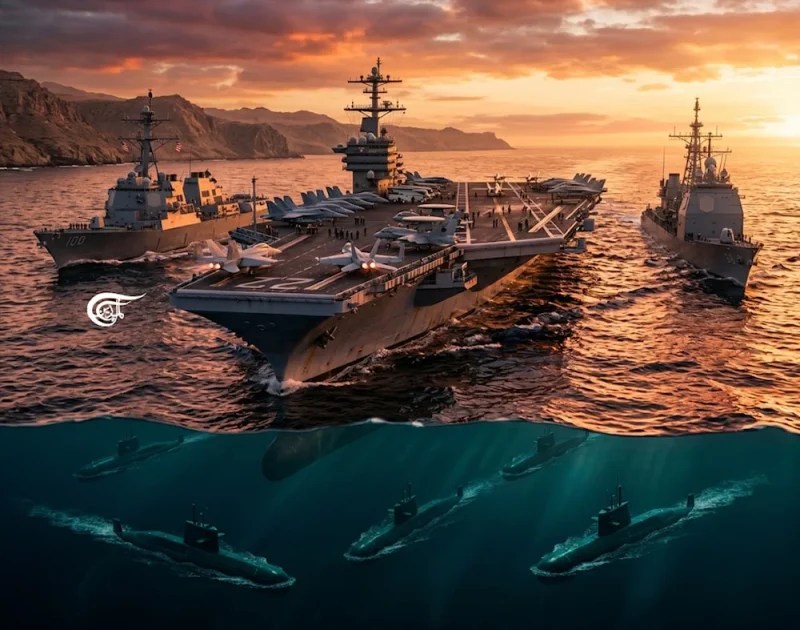
What we are witnessing today is not merely a regional conflict. It is a strategic impasse in one of the most sensitive maritime corridors on earth. The United States has deployed significant naval power into the region. Carrier strike groups centred around the USS Dwight D. Eisenhower, USS Theodore Roosevelt, and USS Gerald R. Ford are operating alongside cruisers, destroyers, frigates and replenishment tankers. Along with them are nuclear-powered guided missile submarines of the Ohio-class submarine type, carrying formidable strike capability. With over two hundred and fifty aircraft embarked across these platforms, the sheer scale of deployment is impressive by any standard.
Yet, having commanded ships myself, I know that numbers and tonnage do not always translate into control, especially in confined, contested waters.
The stated objective appears straightforward: enforce a maritime blockade of Iranian ports and ensure unhindered passage through the Strait of Hormuz. But here lies the irony. The Strait, by most accounts, was already open before the escalation. What has changed is not the physical state of the waterway, but the political and military environment surrounding it.
Iran’s recent offer has placed Washington in a difficult position. It has indicated willingness to ensure the Strait remains open, on its own terms, provided the United States lifts the blockade and shows flexibility on the timing of nuclear negotiations. Accepting such an offer risks appearing to concede under pressure. Rejecting it prolongs a costly and increasingly unpopular confrontation.
And cost is now becoming the defining factor.
Fuel prices have risen. The ripple effect is visible in everyday commodities. The American public, which never truly supported this war, is beginning to feel the burden directly. Wars fought thousands of miles away eventually find their way into domestic politics, and this one is no exception. The narrative of a swift and decisive operation has long faded. What remains is a grinding reality.
There is also a growing perception (rightly or wrongly) that this was not entirely America’s war to begin with. Many point towards the long-standing position of Benjamin Netanyahu, who has, for decades, articulated a hardline stance against Iran. Previous US administrations, including those led by Barack Obama, Joe Biden, George W. Bush and Bill Clinton, exercised caution in this regard. They understood, perhaps better than most, that Iran is not an easy adversary.
And this is where, in my professional judgement, the conversation must turn towards Iran’s maritime capability, often underestimated, sometimes misunderstood, but very real.
Iran does not seek to match the United States ship for ship. Instead, it has built what we in naval terms would call an asymmetric maritime strategy. Its so-called “mosquito fleet” consists of numerous fast attack craft — small, agile, heavily armed platforms that can swarm larger vessels. Operating from concealed bases along the coastline and from island positions, these units are difficult to detect and even harder to neutralize in large numbers.
Then there are the Ghadir-class submarines, small, quiet, and ideally suited for the shallow waters of the Gulf. These are not platforms designed for long blue-water patrols; they are designed for ambush. In confined waters, that makes all the difference.
House Resolution Calls for Tech Companies to Censor Speech
Legislation introduced by two AIPAC funded representatives
By Kurt Nimmo | Another Day in the Empire | May 2, 2026
This one slipped under the wire. Tucker Carlson talked about it the other day, but beyond that, it is flying sans transponder. On February 29, New Jersey Democrat Josh Gottheimer and New York Republican Mike Lawler introduced “a bipartisan resolution condemning the rise of antisemitic, hate-filled rhetoric disseminated by prominent online personalities, including Hasan Piker and Candace Owens, and calling on social media platforms and public leaders to take stronger action against hate,” according to Gottheimer’s taxpayer funded website.
Watch at Rumble
“The resolution highlights the growing influence of online personalities and the alarming surge in antisemitism driven, in part, by disinformation and extremist rhetoric… When influential voices spread conspiracy theories, promote terrorism, or dehumanize Jewish people, it fuels real-world violence and intimidation. We must stand up and speak out.”
Owens, Gottheimer’s post continues, “has trafficked in vile conspiracy theories, promoted blood libels, and platformed Holocaust deniers,” and Piker has “dehumanized Orthodox Jews” The post continues with debunked lies concerning the Hamas al-Aqsa Flood open-air prison breakout on October 7, 2023.
Lawler received $1,069,875 and Gottheimer $2,062,601 from the Israel lobby. Both are essentially paid operatives for the Likud government of Israel. Furthermore, both “representatives” are traitors to the the Bill of Rights and have violated their oath to support and defend the Constitution of the United States against all enemies, foreign and domestic.
The Democrat Gottheimer, sounding like a staunch MAGA Republican, declared the “relationship with Israel is key to our national security. Terrorists hate the United States more than they hate Israel.” Lawler voted for a budget “that cut Medicaid and raised the cost of healthcare for millions of Americans, while saying US taxpayer funding for Israel should be ‘unconditional’ and voted for over $18 billion in weapons to Israel in 2024,” thus revealing his priorities (and making sure AIPAC sweetens his pot for the next election).
Last August, Israeli PM Netanyahu directly inserted himself in domestic American politics by demanding “the algorithms and the social networks” be censored to eliminate criticism of Israel.
In April, Zionist podcaster and self-proclaimed constitutionalist Mark Levin denounced critics of Israeli apartheid and genocide as “Nazis” and “jihadis” and said they are “inciting” violence with their speech. He argued the freedom of speech, once considered god-given and natural in America, is “overprotected.” Carlson said “Mark Levin, the right wing MAGA guy, is saying those people [critics of Israel] should be silenced by the tech companies.”
Another podcaster, Ben Shapiro, told the Palm Beach Gardens Chabad synagogue that X is an “unusable” and “vile stream of trash.” He admitted reaching out “to Elon’s people about” the criticism of Zionism he considers contemptible. “The algorithms are destroying America,” he said.
“We will monitor social media, and check your bank accounts,” Jonathan Greenblatt, the leader of the ADL, threatened in January. He said the ADL “shares the information with the FBI” gathered on anti-Zionist “extremists.” In June, he demanded companies “knock the anti-Zionists off the platform once and for all.” Research from the ADL’s Center for Technology and Society posted to X “shows that five major platforms are still failing to enforce” the removal of content critical of Israel and Zionists.
Israel-born Chabadnik Rabbi Yehuda Kaploun, Trump’s czar of antisemitism, announced in December the State Department will establish a “whole division” to combat criticism of Israel and is working to develop social media algorithms that exclude “misinformation.”
“From YouTube to X, Wikipedia, and TikTok, Zionists are capturing all means of communication to erase the evidence of its genocide, reshape the historical record, and censor those critical of it,” writes Robert Inlakesh for the Palestine Chronicle. “Those who are critical of Israel are being censored or arrested.”
Tucker Carlson warns full-blown censorship will soon arrive in America through legislation forcing technology corporations to remove content deemed antisemitic by Israel and Zionists in America. “Criticizing the behavior of a foreign government is a hate crime and can get you censored in your own country,” he said.
So what’s the takeaway from all this? Well, the first takeaway is censorship is coming, and it will work unless people exercise their God-given and First Amendment-guaranteed right to push back against it with words and do so at high volume without any shame at all. It’s going to need a refusal to be intimidated by false claims of, quote, hate.
Trump Taps Israel Lobbyist From Mossad Cutout FDD To Join Iran Negotiations
The Dissident | May 1, 2026
Journalist Alex Marquardt reported recently that , “Amid stalled talks with Iran, President Donald Trump’s negotiators are adding a new member to the team from an outside Washington lobbying group” adding, “Nick Stewart, the Managing Director of Advocacy at FDD Action, the lobbying side of the Foundation for Defense of Democracies think tank, has joined the office of Steve Witkoff, the Special Envoy for Peace Missions”.
This means- as I will demonstrate- that a literal Israel lobbyist is now joining the team negotiating with Iran on behalf of the Trump administration.
The think tank, initially founded by the journalist Clifford May, was initially called “EMET,” the Hebrew word for truth, and was established in order to “provide education to enhance Israel’s image in North America”.
John Judis at the Carnegie Endowment for International Peace documented in 2015 that , “On April 24, 2001, three major pro-Israel donors incorporated an organization called EMET (Hebrew for “truth’). In an application to the Internal Revenue Service for tax-exempt status, (Clifford) May explained that the group ‘was to provide education to enhance Israel’s image in North America and the public’s understanding of issues affecting Israeli-Arab relations.’ But in the wake of the Sept. 11 attacks, May broadened the group’s mission and changed its name to the Foundation for Defense of Democracies. As he explained in a supplement to the IRS, the group’s board of directors decided to focus on ‘develop[ing] educational materials on the eradication of terrorism everywhere in the world.’”
He added that the funding for FDD comes primarily from U.S.-based Zionist donors, writing, “FDD’s chief funders have been drawn almost entirely from American Jews who have a long history of funding pro-Israel organizations. They include Bernard Marcus, the co-founder of Home Depot, whiskey heirs Samuel and Edgar Bronfman, gambling mogul Sheldon Adelson, heiress Lynn Schusterman, Wall Street speculators Michael Steinhardt and Paul Singer, and Leonard Abramson, founder of U.S. Healthcare.”
He also noted that, similar to AIPAC and other Israel lobby groups, the FDD runs propaganda tours of Israel for Americans, noting, “Since its founding, FDD has been running tours of Israel for American academics (with most of their expenses paid) similar to those run for journalists and politicians by AIPAC and other groups. University of Kentucky political scientist Robert Farley, who went on an FDD tour in 2008, says ‘the goal of the trip was to inculcate a particular view of the Israeli security situation and the Israeli-Palestinian conflict.’ FDD’s view, Farley says, was ‘rght-wing Likudnik on the relations between Israel and its neighbors and with the Palestinians.’ The tour leaders took a ‘negative’ view of Palestinian statehood. ‘It was understood that the military occupation of the West Bank was necessary to prevent a terrorist campaign against Israel.’”
Al Jazeera’s 2018 documentary on the Israel lobby further exposed that FDD “is functioning as an agent of the Israeli government”.
Sima Vaknin-Gil, a former Israeli intelligence official and official in the Israeli Ministry of Strategic Affairs, admitted in the documentary that “We have FDD,” adding that “the foundation is ‘working on’ projects for Israel, including ‘data gathering, information analysis, working on activist organizations, money trail. This is something that only a country, with its resources, can do the best.’”
By putting a lobbyist for Israel from a “think tank” that is in reality a cover for an Israeli intelligence cutout, the Trump administration is guaranteeing that Israel will be driving the American side during negotiations with Iran.
Trump’s Blockade Snatches Defeat from the Jaws of Victory
By Trita Parsi | May 1, 2026
It appears Donald Trump once again snatched defeat from the jaws of victory by heeding the hawkish counsel of the warmongers at the Foundation for Defense of Democracies.
As I have argued before, the fragile ceasefire disproportionately favored the United States over Iran: Trump secured his central objective — a swift exit from a costly war — while Iran forfeited its primary source of leverage, namely the inflationary pressure of elevated oil prices. Tehran, by contrast, remained unable to achieve its core objective — meaningful sanctions relief — without entering a difficult diplomatic process with Washington.
The asymmetry was stark: Trump could afford strategic patience, whereas Iran risked squandering the most consequential gains the conflict could have yielded if negotiations faltered or collapsed.
In short, this emerging status quo could have constituted a quiet but decisive victory for Trump. Yes, Iran would retain control over the strategically vital Strait of Hormuz — but it does so today as well and would do so in almost any scenario. But the status quo would have seen oil prices drop as the Iranians would allow tankers to transit in order to collect fees. And as long as oil prices came down, Trump’s position at home and vis-à-vis Iran would have strengthened.
FDD argued that blockading the Persian Gulf would swiftly cripple the Iranian economy and coerce Tehran into capitulation, allowing Trump to achieve through economic strangulation what he had failed to secure through military force. In short, it was sold to him as a silver bullet. More on that later.
According to this logic, the blockade would “effectively zero out” Iran’s export revenues within days, inflicting losses of nearly $500 million per day. With oil exports halted, Iran’s limited storage capacity would be filled within weeks, forcing the costly and technically damaging shutdown of its oil wells. This, FDD claimed, would dramatically reverse the strategic balance — transforming the Strait of Hormuz from a perceived Iranian asset into a crippling Achilles’ heel, while handing Washington the invaluable advantage of time. Pressure on Iran would escalate sharply while pressure on the United States would rapidly dissipate.
Trump was fully on board. His long-sought subjugation of Iran suddenly appeared tantalizingly within reach. “The blockade is genius,” the president told reporters. “Now, they have to cry uncle; that’s all they have to do. Just say, ‘We give up.’” (Notably, an FDD staffer has reportedly since joined Steve Witkoff’s team.)
Predictably, the opposite occurred. FDD’s confident calculations and tidy logic were, as so often, rooted more in wishful thinking than in hard reality. By its own projections, Iran should have exhausted its storage capacity nearly a week ago. Yet satellite imagery shows Tehran still actively loading oil onto tankers at Kharg Island. While the blockade has undeniably increased economic pressure, there is no sign of the acute storage crisis — or the cascading collapse — FDD confidently promised Trump.
But by targeting Iran’s oil exports, Trump did more than complicate an already fragile diplomatic pathway — he tightened global supply and drove prices upward. In fact, thanks to the blockade, oil prices now exceed the levels seen during the war itself.
Exxon’s CEO told shareholders today that gasoline prices are poised to rise even further, noting that “the market hasn’t seen the full impact of [the Iran conflict] yet.” Meanwhile, Joe Kent, Trump’s former director of the National Counterterrorism Center, cautions that “the blockade is now triggering a global fertilizer shortage that will cause major food security crises and potential famines.”
In short: the desperately needed pressure release Trump secured through the ceasefire has been entirely undone by FDD’s vaunted silver-bullet blockade.
The lure of the silver bullet
There is a pathology in U.S. policy on Iran that transcends administrations and party affiliations: The incessant search for an escalatory silver bullet that brings Iran to its knees, forces it to capitulate, and enables the U.S. to assert its superpower dominance and avoid a compromise with the Islamic Republic.
Across 47 years, the hunt for this fabled silver bullet has echoed on — yet nothing answers back. Countless diplomatic opportunities have been sacrificed, and face-saving exit ramps have been burnt in the process. Yet, the quest continues.
The demand for Iranian capitulation and the enduring faith in elusive silver bullets are deeply intertwined. In January, Trump believed that the mere threat of military force would compel Tehran to surrender. After issuing a series of increasingly explicit warnings that Iran pointedly ignored, he proposed a calibrated strike — one to which Tehran should respond symbolically by targeting an empty American base. Iran refused outright, making clear that any attack would trigger a full-scale war.
Interpreting this defiance as a failure of credibility rather than a rejection of coercion, Trump escalated. He ordered a substantial buildup of military assets in the region, convinced that a critical mass of force would finally deliver the decisive breakthrough — the long-sought silver bullet. It didn’t.
Indeed, Witkoff revealed in an interview that Trump was frustrated that, despite his military threats, Iran had still not “capitulated.”
Clearly, more escalation was needed. The next imagined silver bullet was the assassination of Iran’s Supreme Leader, Ayatollah Ali Khamenei. Midway through the war, a GCC official told me that Trump had assured regional leaders the conflict would last no more than 100 hours. Israeli media similarly reported that he told Britain’s Keir Starmer it would be over within three days. The logic was stark: the killing of Khamenei would trigger either the regime’s rapid implosion or its immediate capitulation. It proved to be yet another illusory silver bullet.
Nor did the sweeping bombardment of Iran’s civilian infrastructure deliver the long-sought breakthrough. A Bloomberg analysis found that only 32% of the damaged buildings were linked to military targets — the overwhelming majority were civilian. Even this devastating and indiscriminate campaign failed to produce the decisive outcome its architects had promised.
The blockade-on-the-blockade is merely the latest in a long line of delusional silver bullets that American presidents have chased instead of pursuing far less costly and far more effective diplomacy. I suspect that a stunning number of those silver bullets were cooked up by FDD.
Trita Parsi is the co-founder and Executive Vice president of the Quincy Institute for Responsible Statecraft.
Geopolitics and Geoeconomics of the Strait of Hormuz
Sputnik – 02.05.2026
The reckless reliance on a blitzkrieg to eliminate Iran’s political and military leadership has left Israel and the United States in an extremely precarious situation, where Tehran’s key trump card in the conflict turned out to be control over the Strait of Hormuz.
Alexander Yakovenko, deputy director of Sputnik’s parent company Rossiya Segodnya and head of the Committee on Global Issues and International Security of the Russian Security Council’s Scientific-Expert Board, has addressed the standoff around the Strait of Hormuz.
Analysts in Israel are already writing of a complete failure, with the prospect of “returning to the issue” sometime in the future. Judging by published reports, everything was planned for June this year, but, as the saying goes, the devil intervened, and Benjamin Netanyahu succumbed to the temptation of a final solution through “regime change.” The scapegoats will be the Mossad division responsible for Iran and the military command responsible for Lebanon.
Donald Trump faces a far more difficult predicament: he has been drawn into a war that is neither his own nor in America’s interest. But the main issue is that the Strait of Hormuz problem now rests squarely on his shoulders. Aside from acceding to all of Iran’s demands, there appear to be no viable options for resolving the blockade – including the resumption of military action, which, according to observers, would have catastrophic consequences for the region, the global economy, and the Trump administration.
In terms of the Persian Gulf and the greater Middle East, a complete geopolitical reconfiguration has taken place, including a shift in Turkiye’s role (it was Ankara that effectively killed the plans to bring Iraqi Kurds into the “march on Tehran,” which was intended to bolster the confidence of those whom Israeli intelligence believed were ready to take to the streets of Iranian cities).
The destruction of the region’s extraction and logistics infrastructure prompted the UAE to withdraw from OPEC and OPEC+, which will only intensify Abu Dhabi’s contradictions with Riyadh and accelerate the political realignment of smaller players toward Ankara, Saudi Arabia, or Iran.
Iran’s agency has grown qualitatively: from a pariah state burdened by sanctions, Iran has genuinely become a regional power (in contrast to Netanyahu’s claim that Israel is a regional power and “in some ways even a global one”). Everything now depends on Iran – a fact understood by those at the helm in Tehran, namely, by general consensus, the Islamic Revolutionary Guard Corps (IRGC). And all this is aside from the most pressing issue on the regional agenda: the restoration of extraction and logistics infrastructure, especially given that the damage has a cumulative effect – in other words, “time is money.”
Russia, Pakistan, and China have become even more deeply involved in the affairs of the region, while the United States has demonstrated its inability to provide military protection for its allies. In other words, the role of external players has grown, whereas control over the region had been in American hands since the Baghdad Pact at the beginning of the Cold War. Now it can be said that the entire institutional structure in the region is collapsing – even in the OPEC format – and the region is opening up to an entirely new architecture.
In terms of geoeconomics, Tehran now holds a powerful lever of influence over the global economy and world trade through its control over the Strait of Hormuz. Moreover, this is not only direct control but also the ability to destabilize the situation around the Strait at any point in the future, regardless of any agreements that might be reached regarding its possible reopening as part of a ceasefire. In other words, everyone understands that things will never return to how they were before.
The only thing that matters for the global economy and the international financial system – including the dollar’s linkage to oil trade – is the stability of commercial traffic through the Strait. With no indication of it being reopened, the world is losing between 8 and 15 million barrels of oil and petroleum products per day, as well as up to 20% of global LNG supplies. This also includes a range of industrial goods in the petrochemical sector and derivatives for the agricultural sector. Experts expect a monthly shortfall of 300 million barrels, which amounts to three-quarters of the released strategic reserves of developed countries. Moreover, by early May, both strategic reserves and the advantages of unlocking Russian and Iranian oil, along with the balancing buffer of floating storage, will be nearly exhausted. In short, in every respect, a moment of truth is approaching in a conflict that is difficult to restart now that military action has been paused.
Not only have the United States and Israel handed Iran, on a silver platter, escalation dominance in the conflict – the ability to manage escalation if Washington and Tel Aviv launch another round – but Tehran will also gain additional revenue from selling its 1.5 million barrels of oil per day, which economists estimate at 2–3 billion per month, or 24–36 billion per year. Essentially, even without the unfreezing of Iranian assets in Western countries, Iran will have the resources to rebuild what has been destroyed. To this should be added the fees collected from commercial vessels transiting the Strait of Hormuz.
It is also worth noting a direct geopolitical consequence of the Iranian conflict: the discord within the Western alliance along the line of Trump’s America versus liberal-globalist Europe. The recent visit of the British monarch to the United States, during which he called in his address to Congress for the collective “defense of Ukraine” invoking Article 5 of the Washington Treaty (despite the fact that Kiev is not a NATO member), indicates that the lack of allied support for the Iranian adventure is a clear appeal to restore Western unity specifically on an anti-Russian basis – everything else is secondary. In Europe, they no longer hide the fact that they intend to “wait out” Trump, if that is what it takes, but under no circumstances will they agree to a settlement of the Ukrainian conflict.
As such, it is not denied that Ukraine is merely the opening move in yet another war of the West against Russia, and that Western elites are determined to make it a decisive, final confrontation of a civilizational nature. This presents an interesting situation for Russia, which could be resolved one way or another very soon. If Russia participated in two world wars, in which, albeit in different ways, relations between groups of Western countries were contested, and in the Cold War we faced a united West, then now we see a disunited West, weakened militarily and in terms of domestic political development. Its consolidation is only possible at our expense.
Charles III quite opportunely mentioned the burning of the White House by the British in 1814, as it reminds us – and perhaps Washington – of positive moments in our shared history, including Russia’s support for the American Revolution and the Union side in the Civil War. The decision rests with the Americans, but it is curious how the Middle East references an era before the ideologization of international relations in the 20th Century.
CHD Scientist: CDC, FDA COVID Vaccine Safety Monitoring ‘Insulting, and Many People Are Injured’
By Suzanne Burdick, Ph.D. | The Defender | April 29, 2026
Federal health officials under the Biden administration failed abysmally to look for COVID-19 vaccine safety signals, according to congressional testimony delivered today by Children’s Health Defense (CHD) Senior Research Scientist Karl Jablonowski.
The government’s vaccine safety monitoring “over the past several years has been insulting, and many people are injured,” Jablonowski wrote in his written testimony.
History repeats itself if we don’t learn our lessons, Jablonowski warned.
“The COVID-19 pandemic created over 100 billionaires in the United States and over 1,000 billionaires around the world,” Jablonowski wrote. “Anything that profitable is going to repeat.”
Jablonowski, who holds a doctorate in biomedical and health informatics from the University of Washington’s School of Medicine, spoke as a witness at the U.S. Senate Permanent Subcommittee on Investigations hearing, “Unmasked: How Biden Health Officials Purposely Turned a Blind Eye Toward COVID-19 Vaccine Safety Signals.”
Hours before the hearing, Sen. Ron Johnson (R-Wis.), subcommittee chair, released a report detailing how Biden-era federal health officials refused to use a state-of-the-art statistical tool for detecting COVID-19 vaccination signals in VAERS — even though they knew the tool they were using was too broken to pick up on safety signals, including sudden cardiac death.
Johnson’s report, which cited roughly 600 pages of emails, revealed that in 2021, officials with the U.S. Food and Drug Administration (FDA) told an FDA researcher to “cease and desist” using the state-of-the-art tool to analyze COVID-19 vaccine injury reports in the Vaccine Adverse Event Reporting System (VAERS).
Johnson obtained the emails after he subpoenaed the U.S. Department of Health and Human Services in January 2025 for COVID-19 vaccine safety records and pandemic-related communications.
FDA was ‘blind’ to COVID vaccine injury reports in VAERS
In his testimony, Jablonowski detailed how each of the federal government’s three vaccine safety monitoring systems — VAERS, V-safe and Vaccine Safety Datalink (VSD) — had “pitfalls” and “failed” to adequately assess safety issues with the COVID-19 vaccine and other vaccines.
The failures of vaccine safety monitoring “can be, and were, catastrophic,” he said.
For instance, the FDA insisted on monitoring COVID-19 vaccine reports using a method that it knew didn’t work. The FDA knew the method was likely to give inaccurate results if similar vaccines — such as the Pfizer and Moderna COVID-19 vaccines — were included in the dataset. This is called masking.
“The FDA was completely blind to COVID-19 vaccine adverse events,” Jablonowski wrote. He said the FDA could have used an improved statistical method accounting for masking.
A 2022 peer-reviewed paper in Drug Safety showed that the improved method detected roughly 25 statistically significant COVID-19 vaccine safety signals — including sudden cardiac death, Bell’s palsy and pulmonary infarction — that the FDA’s older method missed.
In an earlier interview with The Defender, Jablonowski explained why it was so harmful for the FDA to continue using the older method:
“Imagine a night watchman has to find something on the ground. But instead of holding a flashlight, he is wearing sunglasses. In the morning, he says he didn’t find anything. That’s true, but it’s because he was using a tool that impeded his ability to see.”
As of March 27, 1,675,590 adverse events were reported to VAERS following COVID-19 vaccination, according to OpenVAERS. That number includes over 39,077 reports of death, 29,200 reports of myocarditis or pericarditis, and 18,009 reports of Bell’s palsy.
A national survey conducted in November 2025 found that roughly 1 in 10 U.S. adults who received the COVID-19 vaccine experienced “major” side effects.
V-safe was designed to collect ‘inconsequential’ data
Jablonowski told lawmakers that the Centers for Disease Control and Prevention’s (CDC) COVID-19 vaccine safety monitoring tool, V-safe, was designed to collect only “inconsequential” information that no one really cares about.
The V-safe app invited COVID-19 vaccine recipients to check off boxes to indicate what, if any, side effects they experienced after getting the shot.
However, the box options were for common short-term vaccine side effects that most people would consider “inconsequential,” such as chills, headache, joint pain, muscle or body aches, fatigue or tiredness, nausea, vomiting, diarrhea, abdominal pain or rash.
If a person experienced a more serious problem, they had to manually type it into the “other” text field, Jablonowski noted. He said:
“It is with horror that we find 366 individuals typed ‘myocarditis’ in the ‘other’ free-text field, a condition requiring a medical diagnosis. The horror is amplified by the nearly 50,000 registrants who typed ‘chest pain’ into the ‘other’ free-text field.”
Vaccine Safety Datalink is off-limits to independent researchers
Jablonowski also detailed how VSD, a collaborative database of patient information from 13 integrated healthcare organizations covering over 15.5 million people, also fails the public.
VSD data can ostensibly be used to detect vaccine safety issues in near-real time, Jablonowski said.
The problem is that only a small handful of scientists are ever allowed to look at the data. Jablonowski said:
“This many million-dollar taxpayer funded resource is not available to any scientist outside of the 13 Managed Care Organizations (MCO) or the federal government without independent IRB [independent review board] applications approved by all 13 MCOs, an estimated $250,000 per project.”
In other words, independent researchers are realistically barred from analyzing the data. “Transparency is simply unattainable,” Jablonowski said.
Watch Jablonowski’s opening statement here.
This article was originally published by The Defender — Children’s Health Defense’s News & Views Website under Creative Commons license CC BY-NC-ND 4.0. Please consider subscribing to The Defender or donating to Children’s Health Defense.
COVID Conniving Receives First Federal Indictment
By Jim Bovard | The Libertarian Institute | May 1, 2026
David Morens, a former top advisor to COVID Czar Tony Fauci was indicted this week and “charged with conspiracy against the United States; destruction, alteration, or falsification of records in federal investigations; concealment, removal, or mutilation of records; and aiding and abetting,” according to the Justice Department press release.
Morens allegedly helped top federal health officials cover up the potential role of federal grants in spurring the COVID pandemic. The Freedom of Information Act (FOIA) requires federal agencies to preserve and disclose federal records with some narrow exceptions. In early 2021, Morens emailed a colleague, “I learned from our foia lady here how to make emails disappear after i am foia’d but before the search starts, so i think we are all safe.”
Morens added, “Plus i deleted most of those earlier emails after sending them to gmail.” In a previous email, he assured his collaborators, “I have spoken to our FOIA folks” and “I should be safe from future FOIAs. Don’t ask how…”
Fauci doesn’t need to worry about getting indicted since President Joe Biden, on his last morning in office, pardoned any crimes that Fauci might have committed in the previous decade. Fauci justified COVID mandates because average citizens “don’t have the ability” to determine what is best for them. Congressional investigations revealed that Fauci was at the center of string-pulling to shirk responsibility on COVID.
Top federal officials scrambled to erase the federal role in bankrolling reckless gain of function research at the Wuhan Institute of Virology in China, the most likely source of the COVID virus that killed more than seven million people around the world. That type of research seeks to genetically alter organisms to enable the spread of viruses into new species. As MIT professor Kevin Esvelt asked in 2021, “Why is anyone trying to teach the world how to make viruses that could kill millions of people?” The risks were compounded because the Wuhan Institute had a very poor safety rating. Two years earlier, the State Department confidentially “warned other federal agencies about safety issues at Wuhan labs studying bat COVID,” but the public disclosure of that alert was delayed until 2022—long after President Biden illegally mandated COVID vaccines for a hundred million American adults.
If COVID-19 had been initially recognized as the result of one of the biggest government boondoggles in history, it would have been far more difficult for American politicians and government scientists to pirouette as saviors as they seized sway over daily life. Instead, politicians, bureaucrats, and the media stampeded most of the American public with the notion that total submission to boneheaded decrees was their only hope to survive.
Attorney General Todd Blanche issued a statement on the indictment of Morens:
“These allegations represent a profound abuse of trust at a time when the American people needed it most—during the height of a global pandemic.”
Luckily, there haven’t been any “profound abuses of trust” since Trump took office again—at least according to his Justice Department. Blanche added, “Government officials have a solemn duty to provide honest, well-grounded facts and advice in service of the public interest — not to advance their own personal or ideological agendas.”
Be still my beating heart. Is this a subtle signal that the Trump team will disclose the other three million documents on the Epstein scandal?
FBI chief Kash Patel announced at the indictment press conference, “Circumventing records protocols with the intention of avoiding transparency is something that will not be tolerated by this FBI.”
Has the FBI turned over a new leaf or what? The FBI is one of the most notorious FOIA violators in Washington. When FOIA was first passed in 1966, FBI chief J. Edgar Hoover ordered his agency to totally refuse compliance with the law. A federal judge slammed the FBI in 2017 for claiming it needed seventeen years to fulfill a FOIA request on surveillance of antiwar activists in the 1960s. The FBI deleted the names of Clark Kent and Lois Lane from a letter that made reference to the famous Superman characters—because disclosing them in a FOIA response would “constitute a clearly unwarranted invasion of personal privacy.” Louis Freeh, director of the FBI from 1993-2001, repeatedly denounced my articles on Ruby Ridge; but when I filed a FOIA, the FBI claimed to have no records of those published letters to the editor. They sent their response to “Mr. Brovard” so maybe that helped them not find anything.
FBI FOIA trampling is par for the Bureau covering up its destruction of freedom of speech and freedom of the press. As federal judge Terry Doughty declared in a 2023 decision, “The FBI [acted] as doorman to a vast program of social media surveillance and censorship, encompassing agencies across the federal government—from the State Department to the Pentagon to the CIA.”
Morens may be the first federal official to ever be charged with a crime for actions to evade FOIA requests. Certainly, in more than fifty years, no federal FOIA official has ever been jailed for violating the law by refusing to disclose information. I’ve received so many BS responses from FOIA officers over the decades that I have lost count. When I filed a FOIA with the Office of the U.S. Trade Representative to see what information they had on me in their files, they replied in 2010, “We have no records on Kevin Bovard.” But I wasn’t asking about my cousin.
In 2015, I heard scuttlebutt that the Justice Department pressured USA Today to cease publishing my articles bashing Attorney General Eric Holder. I filed a FOIA to get the department’s official emails to my editors, but DOJ FOIA claimed it had nothing. I only got the damning emails after I filed a follow-up FOIA request and made a lucky guess on the exact day, hour and minute the emails were sent.
For too long, deceiving the American people has been treated like a victimless crime in Washington. If the Morens indictment can set a precedent leading to more such criminal investigations of bureaucratic cover-ups, that will be a booster shot for American democracy.
Featured Video
BRITAIN’S WARNING: PREPARE FOR WAR
or go to
Aletho News Archives – Video-Images
From the Archives
British weapons and personnel doing much of the killing in Yemen
Press TV – June 18, 2019
A detailed report published by the Guardian newspaper has shown how Britain is massively contributing to Saudi Arabia’s devastating war on Yemen as it suggests that London is not only supplying the bombs that fall on Yemenis, but it provides the personnel and expertise that keep the war going.
The comprehensive report by Arron Merat published on Tuesday showed that Britain was doing much of the killing in Yemen as the country continues to provide Saudi Arabia with everything it needs to turn its southern impoverished neighbor into a graveyard.
“Every day Yemen is hit by British bombs – dropped by British planes that are flown by British-trained pilots and maintained and prepared inside Saudi Arabia by thousands of British contractors,” said Merat in the report. … continue
Blog Roll
 Aletho News
- Elijah Magnier: Yemen’s Strikes Are Shattering Saudi Arabia’s Long-Term Strategy
- Pentagon designates Chinese cultural centers national security threat
- Israel Demolishes Home Of Lebanese Journalist Whose Viral Film Exposed Pager Attack
- Record Oil, Empty Tanks: The UAE’s Miracle Recovery
- Burnham tackles Britain’s poverty with aggression in Yemen
- Peace in Ukraine: the easy way – or the hard way
- Trump & the Rrrrussians
- US taxpayer money laundered back through Ukraine – Musk
- Before COVID, an NIH lab chief proposed making a SARS-like bat virus more infectious
- Gates, Bourla on Trial in Netherlands Accused of ‘Great Reset’ Scheme at Vaccine Injury Hearing
- If Americans Knew
- An error has occurred; the feed is probably down. Try again later.
- No Tricks Zone
- Sudden Stratospheric Warming, Powerful El Niño Combination May Lead To Extreme Europe Cold, Energy Crisis!
- Two New Studies Find Thwaites Glacier Melt Cannot Be Driven By Human Activity Or A Warming Ocean
- E-Cars Reduce CO2 Emissions By Only 41% Compared To Internal Combustion Engine Vehicles
- Predictions Made By Renowned Climate Professor Over Past Decades Have Been Proven To Be Poor
- New Study Suggests Large Regions Of The Pacific Ocean Have Been Cooling For The Last 80 Years
- Germany’s Green Energy Debacle: High Energy Costs Force Kahla Porzellan to Close After 182 Years!
- New Study: 50 Years Of The Most Aggressive ‘Net Zero’ Policies Can Only Affect The Global Climate By 0.03°C
- US September “Heat” Was No Record…Many Records Set Decades Ago
- Latest European Green Energy Debacle; Portugal’s Largest Flagship Solar Park Insolvent!
- Green Energy Debacle: German Expert Professor Fritz Vahrenholt Warns Of Severe Economic And Social Consequences

