Foreign Minister Sergey Lavrov interview with Xinhua News Agency
Russian Ministry of Foreign Affairs | April 30, 2022
Question: What do you think is at the root of the Ukrainian crisis? What can the international community do to solve this problem?
Sergey Lavrov: When we talk about the Ukrainian crisis, first of all we need to look at the destructive policy of the Western states conducted over many years and led by the United States, which set a course to knock together a unipolar world order after the end of the Cold War. NATO’s reckless expansion to the East was a key component of those actions, despite the political obligations to the Soviet leadership on the non-expansion of the Alliance. As you know, those promises were just empty words. All these years, NATO infrastructure has been moving closer and closer to the Russian borders.
The West was never concerned about the fact that their actions grossly violated their international obligations not to strengthen their own security at the expense of the security of others. In particular, Washington and Brussels arrogantly rejected the initiatives put forward by Russia in December 2021 to ensure our country’s security guarantees in the west: to stop the expansion of NATO, not to deploy armaments that pose a threat to Russia in Ukraine and to return the Alliance’s military infrastructure to the 1997 configuration, when the NATO-Russia Founding Act was signed.
It is well-known that the United States and NATO member states have always viewed Ukraine as a tool to contain Russia. Over the years, they have actively fuelled anti-Russia sentiments there, forcing Kiev to make an artificial and false choice: to be either with the West or with Moscow.
It was the collective West that first provoked and then supported the anti-constitutional coup d’etat in Kiev in February 2014. Nationalists came to power in Ukraine and immediately unleashed a bloody massacre in Donbass, and set the course on the destruction of everything Russian in the rest of the country. Let me remind you that it was precisely because of this threat that the people of Crimea voted in a referendum for the reunification with Russia in 2014.
Over these past years, the United States and its allies have done nothing to stop the intra-Ukrainian conflict. Instead of encouraging Kiev to settle it politically based on the Minsk Complex of Measures, they sent weapons, trained and armed the Ukrainian army and nationalist battalions, and generally carried out the military-political development of Ukraine’s territory. They encouraged the aggressive anti-Russia course pursued by the Kiev authorities. In fact, they pushed the Ukrainian nationalists to undermine the negotiating process and resolve the Donbass issue by force.
We were deeply concerned about the undeclared biological programmes implemented in Ukraine with Pentagon’s support in close proximity to the Russian borders. And, of course, we could not disregard the Kiev leadership’s undisguised intentions to acquire a military nuclear potential, which would create an unacceptable threat to Russia’s national security.
In these conditions, we had no other choice but to recognise the Donetsk and Lugansk people’s republics and launch the special military operation. Its aim is to protect people from genocide by the neo-Nazis, as well as to demilitarise and denazify Ukraine. I would like to stress that Russia is acting to fulfil its obligations under bilateral agreements on cooperation and mutual assistance with the DPR and LPR, at the official request of Donetsk and Lugansk under Article 51 of the UN Charter on the right to self-defence.
The special military operation launched on February 24 is progressing strictly in accordance with the plan. All its goals will be achieved in spite of our opponents’ counteractions. At the moment we are witnessing a classic case of double standards and hypocrisy of the Western establishment. By publicly supporting the Kiev regime, NATO member states are doing everything in their power to prevent the completion of the operation by reaching political agreements. Various weapons are flowing endlessly into Ukraine through Poland and other NATO countries. All of this is being done under the pretext of “fighting the invasion”, but in fact the United States and the European Union intend to fight Russia “to the last Ukrainian.” They do not care at all about the fate of Ukraine as an independent subject of international relations.
The West is ready to jeopardise the energy and food security of entire regions of the globe to satisfy its own geopolitical ambitions. What other explanation is there for the unrestrained flywheel of anti-Russian sanctions launched by the West with the start of the operation and which they aren’t thinking of stopping?
If the United States and NATO are truly interested in settling the Ukrainian crisis, then, first, they must come to their senses and stop supplying weapons and ammunition to Kiev. The Ukrainian people do not need Stingers and Javelins; what they need is a solution to urgent humanitarian issues. Russia has been doing this since 2014. During this time, tens of thousands of tonnes of humanitarian cargo have been delivered to Donbass, and about 15,000 tonnes of humanitarian aid have already arrived in the part of Ukraine liberated from the Kiev regime, the DPR and the LPR, since the launch of the special military operation.
Second, it is essential that the Kiev regime stops cynical provocations, including in the information space. Ukrainian armed formations are barbarically shelling cities using civilians as living shields. We saw examples of this in Donetsk and Kramatorsk. Captured Russian servicemen are being abused with animal cruelty, and these atrocities are being posted online. At the same time, they use their Western patrons and global media controlled by the West to accuse the Russian army of war crimes. As they say, laying the blame at somebody else’s door.
It is high time for the West to stop unconditionally whitewashing and covering up for Kiev. Otherwise, Washington, Brussels and other Western capitals should consider their responsibility for complicity in the bloody crimes perpetrated by the Ukrainian nationalists.
Question: What measures has Russia taken to protect the lives and property of civilians? What efforts has it made to establish humanitarian corridors?
Sergey Lavrov: As I mentioned earlier, the special military operation is proceeding according to plan. Under this plan, the Russian military personnel are doing everything in their power to avoid victims among civilians. Blows are carried out with high-precision weapons, first of all at military infrastructure facilities and places where armoured vehicles are concentrated. Unlike the Ukrainian army and nationalist armed groups that use people as living shields, the Russian army provides the locals with all kinds of assistance and support.
Humanitarian corridors open daily from Kharkov and Mariupol to evacuate people from dangerous districts, but the Kiev regime demands that the “national battalions” in control of those areas do not release the civilians. Nevertheless, many are able to leave with the assistance of Russian, DPR and LPR servicemen. During the special military operation, the hotline of the Interdepartmental Coordination Headquarters of the Russian Federation for Humanitarian Response in Ukraine has received requests for assistance in evacuating 2.8 million people to Russia, including 16,000 foreign citizens and employees of UN and OSCE international missions. In total, 1.02 million people have been evacuated from Ukraine, the DPR and LPR, of which over 120,000 are citizens of third countries, including over 300 Chinese nationals. There are over 9,500 temporary accommodation facilities operating in Russian regions. They have space for rest and hot meals, and everything that may be necessary. Newly arrived refugees are provided with qualified medical and psychological assistance.
Russia is taking measures to ensure civilian navigation in the Black and Azov seas. A humanitarian corridor opens daily, a safe lane for ships. However, Ukraine continues to block foreign ships, creating a threat of shelling in its internal waters and territorial sea. Moreover, Ukrainian naval units have mined the shore, the ports and territorial waters. These explosive devices disconnect from their anchor lines and drift into the open sea, so they pose a serious danger to both the fleets and the port infrastructure of the Black Sea countries.
Question: Since the special military operation was launched in Ukraine, Western counties have adopted a large number of unprecedented sanctions against Moscow. How do you think these sanctions will affect Russia? What are the main countermeasures taken by Russia? Some say that a new Cold War has begun. How would you comment on that?
Sergey Lavrov: It is true that the special military operation was used by the collective West as a pretext to unleash numerous restrictions against Russia, as well as its legal entities and individuals. The United States, Great Britain, Canada and EU countries do not conceal that their goal is to strangle our economy by undermining its competitiveness and blocking Russia’s progressive development. At the same time, the Western ruling circles are not embarrassed by the fact that anti-Russian sanctions are already beginning to harm ordinary people in their own countries. I mean the declining economic trends in the United States and many European countries, including growing inflation and unemployment.
It is clear that there can be no excuse for this anti-Russian line and it has no future. As President Vladimir Putin said, Russia has withstood this unprecedented pressure. Now the situation is stabilising, though, of course, not all risks are behind us.
In any case, they will not succeed in weakening us. I am confident that we will restructure the economy and protect ourselves from our opponents’ possible illegitimate and hostile actions in the future. We will continue to give a fitting and adequate response to the imposed restrictions, guided by the goal of maintaining the stability of the Russian economy and its financial system, as well as the interests of domestic businesses and the entire nation. We will focus our efforts on de-dollarisation, de-offshorisation, import substitution, and promotion of technological independence. We will continue to adapt to external challenges and step up development programmes for promising and competitive industries.
During the period of turbulence, our retaliatory special economic measures needed to ensure the normal functioning of the Russian economy will be continued and expanded. As a responsible player on the international market, Russia intends to continue scrupulously fulfilling its obligations under international contracts on export deliveries of agricultural products, fertilisers, energy carriers and other critical products. We are deeply concerned about a possible food crisis provoked by the anti-Russian sanctions, and we are well aware how important the deliveries of essential goods, such as food, are for the socioeconomic development of Asian, African, Latin American, and Middle Eastern countries.
I will be brief as regards the second part of your question. Today we are not talking about a new “cold war,” but, as I said earlier, about the persistent desire to impose a US-centric model of the world order coming from Washington and its satellites, who imagine themselves to be “arbiters of humankind’s fate.” It has reached the point where the Western minority is trying to replace the UN-centric architecture and international law formed after World War II with their own “rule-based order.” These rules are written by Washington and its allies and then imposed on the international community as binding.
We must realise that the United States has been carrying out this destructive policy for several decades now. It is enough to recall NATO’s aggression against Yugoslavia, attacks on Iraq and Libya, attempts to destroy Syria, as well as the colour revolutions that Western capitals staged in a number of countries, including Ukraine. All of this came at the cost of hundreds of thousands of lives and resulted in chaos in various regions of the planet.
The West tries to crudely suppress those who carry out an independent course in their domestic and foreign policy. Not just Russia. We can see how bloc thinking is being imposed in the Asian-Pacific Region. We can recall the Indo-Pacific strategy promoted by the United States, which has a pronounced anti-China tendency. The US seeks to dictate the standards according to which Latin America should live, in the spirit of the outdated Monroe Doctrine. This explains many years of the illegal trade embargo on Cuba, sanctions against Venezuela, as well as attempts to undermine stability in Nicaragua and other countries. The pressure on Belarus continues in the same context. This list can go on.
It is clear that the collective West’s efforts to oppose the natural course of history and solve its problems at the expense of others are doomed. Today the world has several decision-making centres; it is multipolar. We can see how quickly Asian, African, and Latin American countries are developing. Everyone is getting a real freedom of choice, including where it comes to choosing their development models and participation in integration projects. Our special military operation in Ukraine also contributes to the process of freeing the world from the West’s neocolonial oppression heavily mixed with racism and a complex of exceptionalism.
The faster the West accepts the new geopolitical situation, the better it will be for the West itself and for the entire international community.
As President Xi Jinping said at the Boao Forum for Asia, “We need to uphold the principle of indivisible security, build a balanced, effective and sustainable security architecture, and oppose the pursuit of one’s own security at the cost of others’ security.”
Question: Russian-Ukrainian talks have attracted close attention of the international community. What are the main obstacles to the talks today? How do you regard the prospects of a peace treaty between the two parties? What kind of bilateral relations does Russia intend to have with Ukraine in the future?
Sergey Lavrov: At present the Russian and Ukrainian delegations are holding discussions on the possible draft almost daily, via videoconference. This document should contain such elements of the post-conflict situation as permanent neutrality, the non-nuclear, non-bloc and demilitarised status of Ukraine, as well as guarantees of its security. The agenda of the talks also includes denazification, recognition of the new geopolitical reality, the lifting of sanctions and the status of the Russian language, among other things. Settling the situation in Ukraine will make a significant contribution to the de-escalation of the military and political tensions in Europe and the world in general. The establishment of an institution of guarantor states is envisaged as a possible option. First of all, they will be the permanent members of the UN Security Council, including Russia and China. We share information on the progress in the talks with Chinese diplomats. We are grateful to Beijing and other BRICS partners for their balanced position on the Ukrainian issue.
We are in favour of continuing the talks, although the process is difficult.
You are right to ask about the obstacles. For example, they include the militant rhetoric and incendiary actions of Kiev’s Western patrons. They are actually encouraging Kiev to “fight to the last Ukrainian,” pumping the country with weapons and sending mercenaries there. Let me note that the Ukrainian security services staged a crude bloody provocation in Bucha with the help of the West, to complicate the negotiation process among other things.
I am confident that agreements can only be reached when Kiev starts to be guided by the interests of the Ukrainian people, and not the advisors from far away.
Speaking about Russian-Ukrainian relations, Russia is interested in a peaceful, free, neutral, prosperous and friendly Ukraine. Despite the current administration’s anti-Russian course, we remember the many centuries of all-embracing cultural, spiritual, economic and family ties between Russians and Ukrainians. We will definitely restore these ties.
Russia’s oil revenues expected to soar
Samizdat | May 2, 2022
Russia will see its income from the oil sector rise sharply this year and reach more than $180 billion, despite production cuts related to international sanctions, suggests a report published by independent research house Rystad Energy on Monday.
Thanks to the rising oil prices, Russia’s tax revenues will be 45% higher than last year and a whopping 181% higher than in 2020, Rystad Energy says.
“Europe’s dependence on Russian energy has been a deliberate and decades-long and mutually beneficial relationship. In this early phase of sanctions and embargoes, Russia will benefit as higher prices mean tax revenues are significantly higher than in recent years.” says Daria Melnik, a senior analyst at Rystad Energy.
According to the firm, the initial issues Russia had with its oil exports when European customers started shunning its oil were quickly resolved and loadings began to recover in late March, supported by orders from China and India. Russian crude exports remained resilient in April.
The EU, the US and their allies imposed sanctions against Russia with the aim of starving the country of cash and forcing it to abandon its military operation in Ukraine. However, Europe’s high dependence on Russian oil and gas has meant that turning away from it has proven problematic. The EU has pledged to phase out Russian gas by 2030.
If the EU decides to further restrict energy imports from Russia and impose an oil embargo, something that’s reportedly being considered by the bloc, Russia will be forced to cut oil production further as it lacks storage capacity for extra crude volumes and may not be able to quickly redirect the unwanted cargoes, Rystad Energy explains. In the long-term, Russia’s crude output will continue to decline more steeply than was estimated before the Ukraine crisis.
Why Won’t They Say Who Funded These Ukraine Ads?

By Michael Tracey | May 2, 2022
On April 17, I was in London Bridge train station in central London, and couldn’t help but notice that the entire station was blanketed with these digital “Be Brave Like Ukraine” ads. Stylized in a nifty semi-Cyrillic font, the ads feature the classic blue and yellow color scheme that has now become so ubiquitous across “The West” — perhaps most prominently in London, where a local acquaintance told me she’s seen more Ukraine flags on display over the past two months than she ever saw of the UK’s own national flag.
I had a few natural questions upon seeing these ads. First, who crafted them? That answer came quickly: Just go to the “brave.ua” website and you’ll discover the ads were crafted by a consortium within the Ukraine government, including the office of Zelensky.
The answer to other natural questions have not come so quickly, though. Those questions include: Who paid for these ads? How much did they cost? Who organized their placement in some of the most expensive advertising real estate in the world? (They’ve also been displayed in Times Square, among other high-profile locations.)
Strangely, this information has proven difficult to acquire.
First I tried querying the TFL, the government body in charge of transport in London. They had no clue about the ads. Then I tried Network Rail, which runs most of the railways in England. They had no clue either. Finally I tried the massive global advertising agency which apparently owns the digital screens in question, JCDecaux. And… it initially seemed like they might have the answer. I know this because the “Corporate Communications Director” for JCDecaux inadvertently sent me an email where she deliberates with her colleague about how to answer my questions:
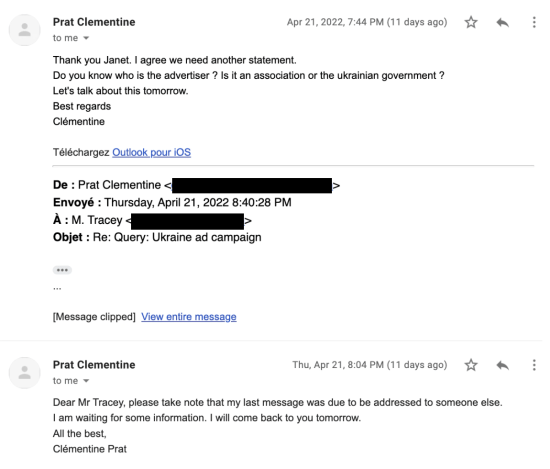
Kinda funny that the “Corporate Communications Director” still doesn’t have the hang of communications skills like sending your sensitive internal emails to the right recipient. Either way, this person did not in fact “come back to me tomorrow.” Days passed, and I heard nothing. Then, finally, here was the answer:

Curious, don’t you think? Why would a multinational advertising conglomerate based in France, with branches in the UK, US, and elsewhere, be so skittish about providing basic details about this Ukraine government advertising campaign? Shouldn’t they be proud of it, and therefore happy to provide the details? I thought the message of the ads was to “Be Brave Like Ukraine.” Apparently that “Bravery” doesn’t extend to allowing for transparency in the financial arrangements of these PR maneuvers, which have resulted in “Western” capitals being saturated with imagery that to the naked eye may seem benign — but, functionally, amounts to obvious pro-war propaganda.
Because bear in mind that these government-crafted ads have flooded London, NYC, Washington DC, etc. at the same time as Ukraine officials are furiously lobbying the UK and US governments to ramp up their military involvement in the war. Those lobbying efforts have been incredibly successful, with Respectable Mainstream outfits like The New Yorker finally now admitting that the scale of the US commitment constitutes “a full proxy war with Russia.” (Not so long ago, I was attacked as a peddler of “Putin’s talking points” for using the term “proxy war” on TV.)
It went largely unremarked upon when the head of the Pentagon, flanked by the head of the State Department, transited into Kiev for a secret mission on April 25 — and then hours later, a series of giant explosions ripped through a Russian military logistics hub approximately 90 miles inside Russia. This after US officials began leaking that they would no longer even pretend to recognize any distinction between “defensive” and “offensive” combat operations conducted by the Ukraine military — effectively acknowledging their willingness to provide both weaponry and real-time intelligence to launch attacks on Russia itself.
In the UK, the Armed Services Secretary, James Heappey, followed this up by declaring that it would be “entirely legitimate” for arms delivered by “Western countries” to be used for offensive strikes within Russian territory. Foreign Secretary Liz Truss then went further than even any US official when she declared that total “victory” in Ukraine must also include driving Russia out of Crimea, raising the stakes higher still.
With each passing week, both these countries adopt a more and more aggressive, bombastic war footing.
Meanwhile, the nice-seeming “Be Brave Like Ukraine” ads are covering major transportation centers. It doesn’t take much elaborate dot-connecting to apprehend that the ads are one facet of the larger PR campaign to draw the US, UK, and other governments further and further into the war. This campaign has been demonstrably effective. And the ad agency which facilitated the ads is choosing to conceal from the public basic details about their provenance — such as who even paid for them. Really makes you think.
New so-called ‘Ministry of Truth’ actually just a ‘Disinformation Governance Board’, which is precisely the opposite: DHS
Samizdat | May 2, 2022
 The newly-unveiled ‘Disinformation Governance Board’, operating within the Department of Homeland Security, has triggered a massive pushback, forcing DHS chief Alejandro Mayorkas to make several appearances on national TV in an attempt to clarify how this unit will operate.
Many critics, including top Republicans, blasted the initiative as a “Ministry of Truth,” directly from the pages of George Orwell’s dystopian novel “1984.”
Speaking on CNN’s State of the Union on Sunday, Mayorkas deflected this criticism by claiming such thought policing is “precisely the opposite of what this small working group within the Department of Homeland Security will do.”
“What it will do is gather together best practices in addressing the threat of disinformation from foreign state adversaries from the cartels and disseminate those best practices to the operators that have been executing in addressing this threat for years,” he explained, after CNN’s Dana Bash said it was still not clear “how this governance board will act.”
The new body is headed by Nina Jankowicz, whose resume includes advising the Ukrainian Foreign Ministry and overseeing the Russia and Belarus programs at the National Democratic Institute lobby group. Detractors also scrutinized her for dismissing the New York Post’s suppressed ‘Hunter’s laptop’ story as a fake “Russian influence op,” only for it to be later verified by major media outlets.
In a separate appearance on ‘Fox News Sunday’, Mayorkas defended the qualifications and objectivity of Jankowicz, calling her “eminently qualified” and a “renowned expert in the field of disinformation.”
“I don’t question her objectivity. There are people in the department who have a diverse range of views and they’re incredibly dedicated to mission. We’re not the opinion police.”
The new “anti-disinformation” push was announced on Wednesday, just two days after billionaire Elon Musk reached an agreement to buy Twitter for $44 billion and vowed to restore freedom of speech on the platform.
Responding to news of Musk’s Twitter takeover, Jankowicz said, “I shudder to think about if free speech absolutists were taking over more platforms, what that would look like for the marginalized communities, which are already shouldering disproportionate amounts of this abuse.”
Poland hosts major NATO wargames
Samizdat | May 1, 2022
Poland is participating in two large-scale multinational drills and is the host nation for one of them, the country’s Defense Ministry revealed on Sunday amid Russia’s allegations that Warsaw is preparing to occupy the western part of Ukraine.
The Defender Europe 2022 (DE22) and Swift Response 2022 (SR22) will be conducted in nine countries including Poland between May 1-27, the Polish ministry said.
“There will be approximately 18,000 participants from over 20 countries training together in both exercises. The portion of the exercises on Polish soil will see some 7,000 troops and 3,000 pieces of equipment,” the statement reads.
Defender Europe is a regularly conducted American-led multinational exercise that aims poised to “build preparedness and interoperability between Allies and partners” of NATO and America. DE22 training will be conducted at several sites in Poland, with Polish soldiers to be joined by personnel from the US, France, Sweden, Germany, Denmark, and UK.
The Swift Response exercise will entail approximately 550 Polish soldiers being deployed to Lithuania and Latvia along with troops from the Czech Republic and a German-Dutch force.
“Joint combined exercises such as these enhance the security of the NATO Eastern Flank through a training in accordance with NATO standards and procedures,” the Defense Ministry emphasized.
It added that the drills also contribute to the allies’ preparedness “to meet new and emerging challenges at the contemporary battlefield in order to deter a potential aggressor.”
The military specifically pointed out that DE22 and SR 22 “are not aimed against any country and are not related to the current geopolitical situation in the region,” in a veiled reference to the ongoing Russian military offensive in Ukraine.
These assurances come as Russian Foreign Intelligence Service (SVR) Director Sergey Naryshkin accused Warsaw of preparing to occupy the western part of Ukraine, which Poland considers as “historically belonging” to it. The potential “reunification” of Poland with western Ukraine will come under the guise of deploying a “peacekeeping” mission into the country under the pretext of protecting Kiev from “Russian aggression,” the official alleged. Warsaw denied the claims.
For years, Russia has expressed concern over NATO’s expansion eastwards, which it considers a direct threat to its own security. This factor along with the possibility of Ukraine eventually joining the alliance were named by Moscow as the key reasons for launch of its military offensive.
Parsing the “data” from Moderna’s selective leaks to the press about its failed clinical trial in kids under 6
The shot made no difference against Covid but it does cause myocarditis and came with a 15% to 17% adverse event rate. Meanwhile the CDC admits that 74.2% of kids already have natural immunity.
By Toby Rogers | April 30, 2022
On Friday, the NY Times and other stenographers for the cartel breathlessly announced that Moderna has asked the FDA to authorize its junk science mRNA shot in kids under 6. Oh, so that means Moderna submitted an application to the FDA? Well, not exactly. From the article:
“A top official at the company said it would finish submitting data to regulators by May 9.”
Wait, so Moderna is “asking” the FDA to authorize its product but Moderna will not even finish its application for another 10 days!? That’s weird. It’s like a kid asking his teacher for a A+ while his homework assignment is half-finished.
So already we’re seeing serious red flags and we’re not even out of the first paragraph.
Of course it gets worse.
To be clear, there is no data because Moderna has not even finished its application. But Moderna and the White House have been selectively leaking numbers to the press that dutifully prints them without question — and those numbers tell us that Moderna’s clinical trial was a disaster.
I need to provide some background and context and then I’ll get into the particular details about this failed clinical trial in kids.
Moderna applied for Emergency Use Authorization to administer its mRNA shot to adolescents 12 to 17 years old back on June 10, of 2021. But the application has been held up ever since. Why? Myocarditis. From the Wall Street Journal :
The Food and Drug Administration is delaying a decision on authorizing Moderna Inc.’s mRNA Covid-19 vaccine for adolescents to assess whether the shot may lead to heightened risk of a rare inflammatory heart condition, according to people familiar with the matter.
Moderna has at least two big problems in giving this shot to teenagers:
1) The dose they are giving to teenagers is the same dose as that given to adults — 100 mcg of mRNA — which is four times the amount in the Pfizer shot given to adults (25 mcg). So the Moderna shot is great at generating antibodies that target the spike protein of the original Wuhan lab leak strain. But some of that mRNA can migrate to the heart and generate myocarditis as well. Remember, Pharma’s capture of the FDA is so extreme, they should just be able to write “Iz Gud!” on a paper napkin and the FDA will approve it — as they did with Pfizer’s application to inject kids 5 to 11 — in spite of ZERO evidence supporting this use. So if the FDA has held up Moderna’s application in teens for nearly a year, the myocarditis signal must be truly terrifying.
2) Nordic countries are slightly less corrupt than the United States. Finland, Sweden, Denmark, and Norway have all suspended the use of the Moderna mRNA shot in teenagers because its leads to myocarditis. (Finland and Sweden even suspended its use in men under 30 years old.) Even the criminally corrupt European Medicines Agency acknowledged that both Pfizer and Moderna mRNA shots lead to myo- and pericarditis and added a warning to the product insert.
Okay what do we know about Moderna’s clinical trial in kids under 6?
Back on March 23, Moderna put out a press release claiming that:
vaccine efficacy in children 6 months to 2 years was 43.7% and vaccine efficacy was 37.5% in the 2 to under 6 years age group.
The NY Times of course printed that like it was a clay tablet handed directly from God to Moses just as they printed the “90% to 100% effective(TM)” lie in connection with the clinical trial in adults. By now everyone knows that the actual vaccine effectiveness is zero or even negative after 6 months.
Sane people pointed out that vaccine efficacy of 43% and 37% are BELOW the 50% threshold required for FDA authorization. It’s not clear why the geniuses at Moderna did not realize this — perhaps they just wanted to rub everyone’s noses in the sheer criminality of their enterprise?
But somewhere between March 23 and last Friday, Moderna staff got the message so they did what they always do, they just manipulated the data. From the NY Times :
Moderna said Thursday the vaccine appeared to be 51 percent effective against symptomatic infection among those younger than 2, and 37 percent effective among those 2 to 5.
Okay first off, lol that they still cannot get the number above 50% in kids 2 to 5 even when they are just straight up lying about the numbers. But how did they convert 43% to the magical 51% in kids 0 to 2? They simply deleted data that they did not like:
Those results were slightly better than the ones Moderna previously released for children under 2. The company said that was because the second time, the firm excluded infections that had not been confirmed with a P.C.R. test analyzed in a laboratory.
Let’s be clear — this is Moderna’s clinical trial. They control the whole process. If you’re a study participant who is having a heart attack in the middle of the night and call 911 and go to the hospital — they kick you out of the clinical trial for not seeing their doctors and following their protocol. So Moderna is the one who makes the decision as to whether to use “a P.C.R. test analyzed by a laboratory.” To now exclude (without any valid justification) infections that made their clinical trial look bad is gross scientific misconduct. The Moderna application, when/if it is submitted 10 days from now, should be rejected immediately because of this misconduct.
While the clinical trials in kids were failing, Pfizer and Moderna were running a half-hearted campaign to pressure the FDA to approve these shots in kids under 5 — in spite of zero data showing benefit and considerable evidence showing harms. The attempts were pathetic and included hashtags on social media like #immunizeunder5 that were likely only used by people taking money from these monsters. But of course the stenographers eagerly reported on this milquetoast effort and one of the talking points is, ‘well, okay, the shots do not meet the required 50% FDA threshold but some protection is better than none(TM) so please authorize my right to genocide my kids.’
Well, it turns out, these shots do NOT even offer “some protection”:
Moderna’s clinical trial data showed that the antibody response of the youngest children compared favorably with that of adults ages 18 to 25, meeting the trial’s primary criterion for success. Although the trial was not big enough to measure vaccine effectiveness…
What!? “The trial was not big enough to measure vaccine effectiveness.” Isn’t that the whole point of a clinical trial!? So Moderna (and the NY Times ) are saying that the clinical trial made ZERO difference on Covid-related health outcomes including infection, hospitalization, ICU visits, or deaths, because the SARS-CoV-2 virus is not a threat to healthy children in this age group — which we have been pointing out for months.
So how does Moderna try to finesse it? They look at antibodies in the blood, not health outcomes in the real world. They call it “immunobridging”. As I explained at length back in October, this is NOT a scientifically valid way to use immunobridging (claiming likely future health outcomes from antibodies alone when the trial showed no such thing). Immunobriding is only valid if one has clinically validated correlates of protection and conditions prevent one from conducting a proper RCT (neither of which apply in this case).
Even the hand-picked yes-men and women on the CDC’s Vaccines and Related Biological Products Advisory Committee (VRBPAC) acknowledged at their last meeting that they do NOT have “correlates of protection” that would enable them to estimate health outcomes from antibody measures. Eric Rubin (Editor-in-Chief of the NEJM ) even stated, “We know what kind of antibody response can be generated, we just don’t know if it works.”
So Moderna is asking the FDA to authorize its mRNA shot in kids under 6 based on antibodies alone even though every member of the FDA’s VRBPAC acknowledges that antibodies tell you absolutely nothing about likely health outcomes.
(In fact, new evidence suggests that mRNA shots suppress the body’s innate ability to generate anti-N antibodies.)
What about side effects?
Side effects were at a similar level as those from previously approved pediatric vaccines, with fevers in 15 percent to 17 percent of the children, Moderna said.
Any shot with an adverse event rate over 1% should not be authorized. To authorize a shot with a 15 to 17% adverse event would be batsh*t insane.
Furthermore, we know that Moderna and Pfizer make cases of disability and death in their clinical trials disappear — so the actual adverse event rate is surely even higher than 15% to 17%.
Making this nightmare complete, the CDC acknowledged on April 26, 2022, that 74.2% of children ages 0 to 11 are already naturally immune to Covid-19 because of prior exposure. The 74.2% number came from February, so given the rate of increase at the time, by now nearly 100% of children ages 0 to 11 likely already have natural immunity which is superior to artificial vaccine immunity. There is no emergency in this population that would justify an emergency use authorization of this useless toxic product.
So to recap this painful saga:
• Moderna shots cause myocarditis and pericarditis which is why Moderna has not been able to get authorization to inject mRNA into teenagers.
• Moderna shots make no difference in connection with Covid-19 in this age group.
• Moderna shots come with at least a 15% to 17% adverse event rate.
• Nearly all children in this age group are already naturally immune so there is no emergency that would justify an emergency use authorization.
This is not hard to figure out. In a sane world this application would be dead on arrival, whenever Moderna gets around to actually turning in its application. Any reporter worth his/her salt should be ridiculing Moderna’s weird mix of hubris, incompetence, bad “data”, and malevolence. But our country, its “public health” agencies, and the mainstream media are run by Insane Nazi Clowns. I imagine many bougiecrats will drown in their own tears if they are not allowed to genocide their own kids with this shot (and then they’ll celebrate their sacrifice and take selfies with their kids in the ICU when the myocarditis kicks in, proclaiming #getvaccinated). Of course bougiecrats can already get this shot for their kid off label, so my hunch is that it’s really your kids who they want to genocide.
In future articles I’ll have additional thoughts about how we push back. In the meantime, this continues to be our best play and I encourage all of us to just get into the habit of contacting 25 people at the FDA every day to tell them to REJECT both the Moderna and Pfizer applications to inject mRNA into little kids.
New bill aims to dissolve Biden administration’s Disinformation Governance Board
Defund the Department of Homeland Security
By Dan Frieth | Reclaim The Net | April 30, 2022
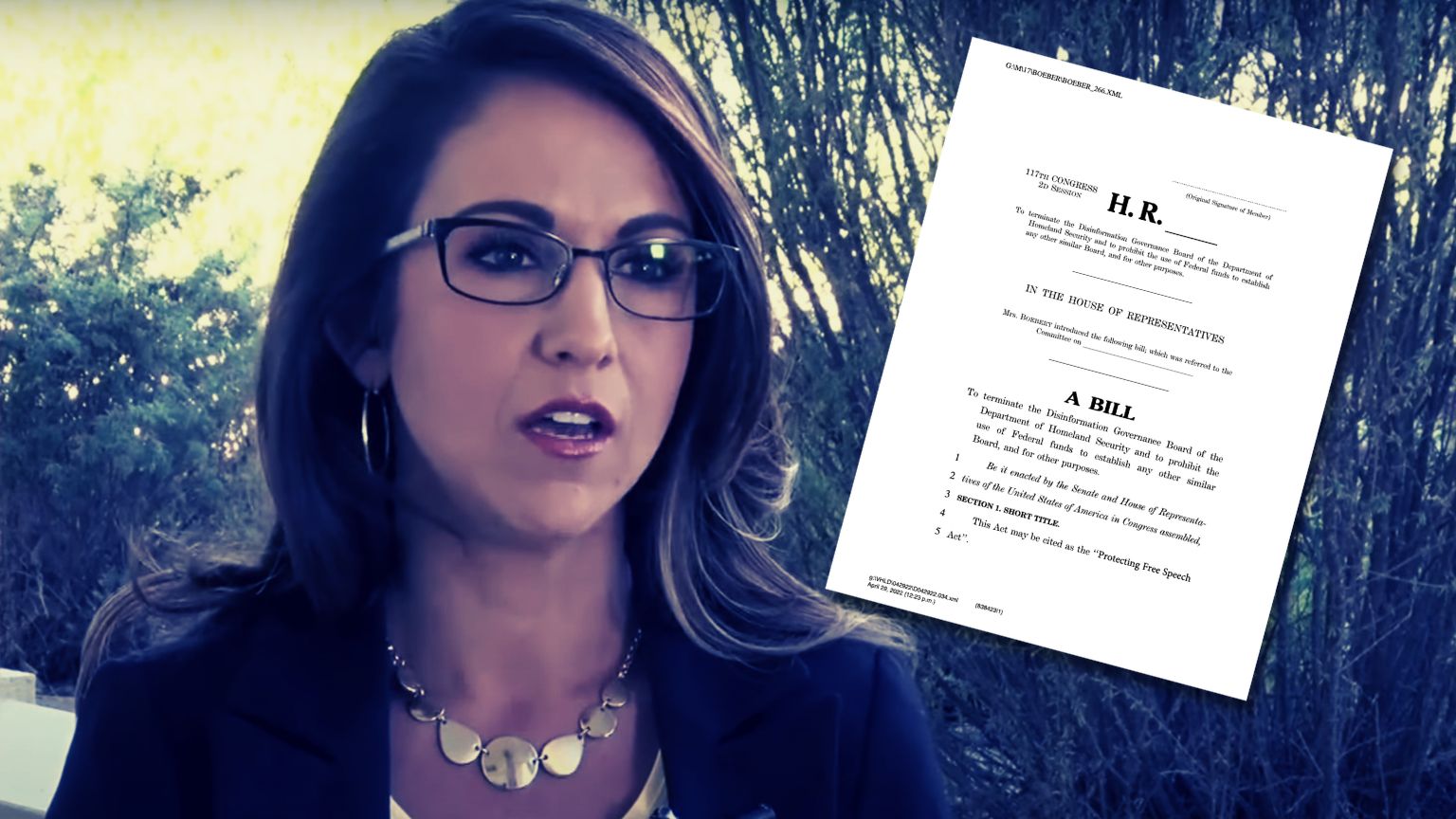
Rep. Lauren Boebert is leading the way in introducing a bill to defund the newly formed Disinformation Governance Board, under the Department of Homeland Security (DHS).
We obtained a draft copy of the bill for you here.
“This kind of stuff is terrifying. We in Congress have the power of the purse. It is our duty to shut down this department immediately,” Boebert told Fox. “I’m calling on leadership in the Republican Party – Leader McCarthy, Whip Scalise, and others — to join me in calling for this department to be shut down and defunded.”
The new board will focus on Russian propaganda and “misinformation” spread by and about human traffickers at the border.
The head of the board, Nina Jankowicz has previously been accused of spreading misinformation. She called the New York Post’s Hunter Biden laptop story Russian disinformation. The authenticity of the laptop has since been proven.
“No tax dollars should go to where Biden can use the power of the federal government to silence truthful stories like Big Tech did with the Hunter Biden story,” Boebert said.
Boebert compared the formation of the new board to the draconian world in George Orwell’s book “1984.”
“Democrats took that [book] not as a warning, but as a guide,” she added.
Boebert is looking for cosponsors for the bill, which she is expected to introduce next week.
“This really is a department of propaganda,” Boebert said. “To say that the federal department has a say in what’s right and what’s wrong. What’s truth and what is not. This is a very dangerous place that we’ve come to.”
Syria grants amnesty for terrorist crimes
Samizdat | April 30, 2022
Syrian President Bashar Assad issued a decree on Saturday granting amnesty to Syrians for terrorist crimes up to the end of April, except those leading to death. Assad has extended similar olive branches to deserters, criminals and opposition fighters before, often to the displeasure of the US.
Assad’s decree, first reported by Syrian state media on Saturday, “grants a general amnesty for terrorist crimes committed by Syrians before [Saturday], except for those that led to the death of a person.”
While the pardon frees terrorists from criminal prosecution, it does not exempt them from civil lawsuits brought by those they may have harmed.
Those pardoned would have been prosecuted under a 2012 anti-terrorism law and a 1949 provision of Syria’s legal code, and as such will affect the various terrorist groups fighting in Syria’s civil war, which began in 2011. Assad, with the help of Russian forces, has broadly succeeded in maintaining control of Syria against a collection of opposition militias and terrorist groups like Islamic State (IS, formerly ISIS) and Al-Nusra Front.
Throughout more than a decade of war, Assad has periodically offered pardons to his opponents. Military deserters who didn’t take up arms with terrorists were given amnesty in 2018 and allowed to return to Syria, while a general amnesty for misdemeanors and juvenile crimes was granted in 2021.
However, at the outset of the Syrian Civil War in 2011, Assad attempted to offer opposition fighters amnesty in exchange for surrender. This offer was rejected by the United States, with State Department official Victoria Nuland advising the opposition to ignore Assad’s offer and continue fighting.
The Syrian Foreign Ministry at the time accused Washington of “inciting sedition” with this advice and “supporting acts of killing and terrorism.” The war would continue, and Nuland would go on to oversee the violent overthrow of democratically elected President Viktor Yanukovych in Ukraine in 2014, and is currently shaping US policy on Ukraine as President Biden’s under secretary of state for political affairs.
HOW COULD THE U.S. HELP TO BRING PEACE TO UKRAINE?
BY NICOLAS J. S. DAVIES | BLACKLISTED NEWS | APRIL 28, 2022
On April 21st, President Biden announced new shipments of weapons to Ukraine, at a cost of $800 million to U.S. taxpayers. On April 25th, Secretaries Blinken and Austin announced over $300 million more military aid. The United States has now spent $3.7 billion on weapons for Ukraine since the Russian invasion, bringing total U.S. military aid to Ukraine since 2014 to about $6.4 billion.
The top priority of Russian airstrikes in Ukraine has been to destroy as many of these weapons as possible before they reach the front lines of the war, so it is not clear how militarily effective these massive arms shipments really are. The other leg of U.S. “support” for Ukraine is its economic and financial sanctions against Russia, whose effectiveness is also highly uncertain.
UN Secretary General Antonio Guterres is visiting Moscow and Kyiv to try to kick start negotiations for a ceasefire and a peace agreement. Since hopes for earlier peace negotiations in Belarus and Turkey have been washed away in a tide of military escalation, hostile rhetoric and politicized war crimes accusations, Secretary General Guterres’ mission may now be the best hope for peace in Ukraine.
This pattern of early hopes for a diplomatic resolution that are quickly dashed by a war psychosis is not unusual. Data on how wars end from the Uppsala Conflict Data Program (UCDP) make it clear that the first month of a war offers the best chance for a negotiated peace agreement. That window has now passed for Ukraine.
An analysis of the UCDP data by the Center for Strategic and International Studies (CSIS) found that 44% of wars that end within a month end in a ceasefire and peace agreement rather than the decisive defeat of either side, while that decreases to 24% in wars that last between a month and a year. Once wars rage on into a second year, they become even more intractable and usually last more than ten years.
CSIS fellow Benjamin Jensen, who analyzed the UCDP data, concluded, “The time for diplomacy is now. The longer a war lasts absent concessions by both parties, the more likely it is to escalate into a protracted conflict… In addition to punishment, Russian officials need a viable diplomatic off-ramp that addresses the concerns of all parties.”
To be successful, diplomacy leading to a peace agreement must meet five basic conditions:
First, all sides must gain benefits from the peace agreement that outweigh what they think they can gain by war.
U.S. and allied officials are waging an information war to promote the idea that Russia is losing the war and that Ukraine can militarily defeat Russia, even as some officials admit that that could take several years.
In reality, neither side will benefit from a protracted war that lasts for many months or years. The lives of millions of Ukrainians will be lost and ruined, while Russia will be mired in the kind of military quagmire that both the U.S.S.R. and the United States already experienced in Afghanistan, and that most recent U.S. wars have turned into.
In Ukraine, the basic outlines of a peace agreement already exist. They are: withdrawal of Russian forces; Ukrainian neutrality between NATO and Russia; self-determination for all Ukrainians (including in Crimea and Donbas); and a regional security agreement that protects everyone and prevents new wars.
Both sides are essentially fighting to strengthen their hand in an eventual agreement along those lines. So how many people must die before the details can be worked out across a negotiating table instead of over the rubble of Ukrainian towns and cities?
Second, mediators must be impartial and trusted by both sides.
The United States has monopolized the role of mediator in the Israeli-Palestinian crisis for decades, even as it openly backs and arms one side and abuses its UN veto to prevent international action. This has been a transparent model for endless war.
Turkey has so far acted as the principal mediator between Russia and Ukraine, but it is a NATO member that has supplied drones, weapons and military training to Ukraine. Both sides have accepted Turkey’s mediation, but can Turkey really be an honest broker?
The UN could play a legitimate role, as it is doing in Yemen, where the two sides are finally observing a two-month ceasefire. But even with the UN’s best efforts, it has taken years to negotiate this fragile pause in the war.
Third, the agreement must address the main concerns of all parties to the war.
In 2014, the U.S.-backed coup and the massacre of anti-coup protesters in Odessa led to declarations of independence by the Donetsk and Luhansk People’s Republics. The first Minsk Protocol agreement in September 2014 failed to end the ensuing civil war in Eastern Ukraine. A critical difference in the Minsk II agreement in February 2015 was that DPR and LPR representatives were included in the negotiations, and it succeeded in ending the worst fighting and preventing a major new outbreak of war for 7 years.
There is another party that was largely absent from the negotiations in Belarus and Turkey, people who make up half the population of Russia and Ukraine: the women of both countries. While some of them are fighting, many more can speak as victims, civilian casualties and refugees from a war unleashed mainly by men. The voices of women at the table would be a constant reminder of the human costs of war and the lives of women and children that are at stake.
Even when one side militarily wins a war, the grievances of the losers and unresolved political and strategic issues often sow the seeds of new outbreaks of war in the future. As Benjamin Jensen of CSIS suggested, the desires of U.S. and Western politicians to punish and gain strategic advantage over Russia must not be allowed to prevent a comprehensive resolution that addresses the concerns of all sides and ensures a lasting peace.
Fourth, there must be a step-by-step roadmap to a stable and lasting peace that all sides are committed to.
The Minsk II agreement led to a fragile ceasefire and established a roadmap to a political solution. But the Ukrainian government and parliament, under Presidents Poroshenko and then Zelensky, failed to take the next steps that Poroshenko agreed to in Minsk in 2015: to pass laws and constitutional changes to permit independent, internationally-supervised elections in the DPR and LPR, and to grant them autonomy within a federalized Ukrainian state.
Now that these failures have led to Russian recognition of the DPR and LPR’s independence, a new peace agreement must revisit and resolve their status, and that of Crimea, in ways that all sides will be committed to, whether that is through the autonomy promised in Minsk II or formal, recognized independence from Ukraine.
A sticking point in the peace negotiations in Turkey was Ukraine’s need for solid security guarantees to ensure that Russia won’t invade it again. The UN Charter formally protects all countries from international aggression, but it has repeatedly failed to do so when the aggressor, usually the United States, wields a Security Council veto. So how can a neutral Ukraine be reassured that it will be safe from attack in the future? And how can all parties be sure that the others will stick to the agreement this time?
Fifth, outside powers must not undermine the negotiation or implementation of a peace agreement.
Although the United States and its NATO allies are not active warring parties in Ukraine, their role in provoking this crisis through NATO expansion and the 2014 coup, then supporting Kyiv’s abandonment of the Minsk II agreement and flooding Ukraine with weapons, make them an “elephant in the room” that will cast a long shadow over the negotiating table, wherever that is.
In April 2012, former UN Secretary General Kofi Annan drew up a six-point plan for a UN-monitored ceasefire and political transition in Syria. But at the very moment that the Annan plan took effect and UN ceasefire monitors were in place, the United States, NATO and their Arab monarchist allies held three “Friends of Syria” conferences, where they pledged virtually unlimited financial and military aid to the Al Qaeda-linked rebels they were backing to overthrow the Syrian government. This encouraged the rebels to ignore the ceasefire, and led to another decade of war for the people of Syria.
The fragile nature of peace negotiations over Ukraine make success highly vulnerable to such powerful external influences. The United States backed Ukraine in a confrontational approach to the civil war in Donbas instead of supporting the terms of the Minsk II agreement, and this has led to war with Russia. Now Turkey’s Foreign Minister, Mevlut Cavosoglu, has told CNN Turk that unnamed NATO members “want the war to continue,” in order to keep weakening Russia.
Conclusion
How the United States and its NATO allies act now and in the coming months will be crucial in determining whether Ukraine is destroyed by years of war, like Afghanistan, Iraq, Libya, Somalia, Syria and Yemen, or whether this war ends quickly through a diplomatic process that brings peace, security and stability to the people of Russia, Ukraine and their neighbors.
If the United States wants to help restore peace in Ukraine, it must diplomatically support peace negotiations, and make it clear to its ally, Ukraine, that it will support any concessions that Ukrainian negotiators believe are necessary to clinch a peace agreement with Russia.
Whatever mediator Russia and Ukraine agree to work with to try to resolve this crisis, the United States must give the diplomatic process its full, unreserved support, both in public and behind closed doors. It must also ensure that its own actions do not undermine the peace process in Ukraine as they did the Annan plan in Syria in 2012.
One of the most critical steps that U.S. and NATO leaders can take to provide an incentive for Russia to agree to a negotiated peace is to commit to lifting their sanctions if and when Russia complies with a withdrawal agreement. Without such a commitment, the sanctions will quickly lose any moral or practical value as leverage over Russia and will be only an arbitrary form of collective punishment against its people, and against poor people everywhere who can no longer afford food to feed their families. As the de facto leader of the NATO military alliance, the U.S. position on this question will be crucial.
So policy decisions by the United States will have a critical impact on whether there will soon be peace in Ukraine, or only a much longer and bloodier war. The test for U.S. policymakers, and for Americans who care about the people of Ukraine, must be to ask which of these outcomes U.S. policy choices are likely to lead to.
NICOLAS J. S. DAVIES IS AN INDEPENDENT JOURNALIST AND THE AUTHOR OF BLOOD ON OUR HANDS: THE AMERICAN INVASION AND DESTRUCTION OF IRAQ.
Moscow says when ‘frozen’ dialogue with US may be resumed
Samizdat | April 30, 2022
The dialogue on strategic stability between Russia and the US may only resume after all the goals of Moscow’s military operation in Ukraine are achieved, a high-ranking Russian diplomat has said.
“As of today, there’s no use talking about any prospects for negotiations on strategic stability with the US,” Vladimir Yermakov, who heads the Department for Non-Proliferation and Arms Control at Russia’s Foreign Ministry, pointed out on Saturday.
“This dialogue is formally ‘frozen’ by the American side,” he said, adding that Washington’s moves concerning the matter “are being pointed in the complete opposite direction” than those of Moscow.
The sides will likely be able to return to “a substantive conversation about the prospects of resuming a full-fledged Russian-American negotiation process on the strategic agenda only after the implementation of all the tasks of the special military operation in Ukraine,” Yermakov added.
The US actively supports Ukraine in the conflict with Russia, providing Kiev with funds and weapons to continue fighting.
Washington has committed $4.3 billion to Kiev’s military since 2021, Pentagon spokesperson John Kirby said on Friday, also revealing that the US has begun training Ukrainian troops in Germany and elsewhere in Europe.
Earlier this week, US Defense Secretary Lloyd Austin openly acknowledged that, by helping Ukraine, Washinton was trying to see “Russia weakened to the degree that it can’t do the kinds of things that it has done in invading Ukraine.”
Moscow and Washington last discussed strategic stability in Europe, which includes nuclear nonproliferation, during talks in Geneva in mid-January, just over a month before the breakout of the Ukrainian conflict.
According to sources, the Russian delegation “’spoon-fed’ its proposals for a stable continent” to the Americans to avoid any misunderstandings, with the key point being curbing NATO’s eastward expansion. However, the negotiations brought no results.
Russia sent troops into Ukraine on February 24, following Kiev’s failure to implement the terms of the Minsk agreements, first signed in 2014, and Moscow’s eventual recognition of the Donbass republics of Donetsk and Lugansk. The German- and French-brokered Minsk Protocol was designed to give the breakaway regions special status within the Ukrainian state.
The Kremlin has since demanded that Ukraine officially declare itself a neutral country that will never join NATO. Kiev insists the Russian offensive was completely unprovoked and has denied claims it was planning to retake the two republics by force.
The Aggressors Accuse Russia of ‘Blackmail’ for Defending its Currency, Energy Wealth, and Even Its Existential Security
Strategic Culture Foundation | April 29, 2022
The United States and its NATO and European Union allies have imposed unprecedented economic sanctions on Russia that amount to economic warfare. This warfare has been going on, discernibly, since the CIA-backed coup in Ukraine in 2014 on the back of allegations of Russian wrongdoing, for example, the alleged annexation of Crimea. It’s the logic of a poacher posing as the gamekeeper.
For eight years, the U.S.-led economic war against Russia has been pursued without relent. The self-professed “exceptional nation” presumes the privileged, exclusive use of economic terrorism against others who do not bend the knee. In hock to its Washington master, the European Union has imposed round after round of restrictions on trade with Russia in full compliance with American orders. The European compliance to self-inflict damage is astounding especially given that the U.S. economy is not as reliant on Russia as the EU’s and therefore has not been impacted as badly, at least not directly. But the presumed American “free lunch” is beginning to change, as our columnist Declan Hayes cogently surveyed this week.
Now that the proxy war against Russia has escalated into “Total War” – the historically sinister phrase used by France’s economy minister Bruno Le Maire – the full nefarious scope of the Western objective has become even more explicit. The U.S. and its NATO partners want to achieve the complete collapse of the Russian economy leading to regime change in Moscow. The eruption of violence in Ukraine following Russia’s military intervention on February 24 is but the opportunity to ramp up the U.S.-led war campaign against Russia.
The explicitly stated objective of cutting off Russia’s vital energy trade and the theft of the country’s foreign monetary reserves can only be interpreted as part of a wider imperial plan to crush the Russian nation, subjugate it and conquer its vast natural wealth.
Eight years of NATO-backed military aggression by the Neo-fascist Kiev regime against Russian-speaking populations has gone hand-in-hand with the installation of U.S. strategic weapons across Europe, including Dark Eagle hypersonic missiles in Germany and biological weapons of mass destruction in Ukraine. The military threat to Russia has been in tandem with the relentless economic warfare from sanctions. In addition, there is the intransigence by the U.S. and its NATO partners to engage with Moscow in resolving security concerns through diplomacy. All of this culminated in the present war in Ukraine. The concerted and rapid imposition of further draconian sanctions on the Russian economy from the blockade on virtually its entire banking system as well as the extreme censorship of Russian international media – all of that indicates that the U.S. and its partners were already on a war footing and ready to escalate hostilities.
In this context, ominously, Ukraine is resembling Bosnia-Herzegovina and the pre-World War One assassination of Archduke Franz Ferdinand as a fatal flashpoint.
The reckless flooding of weapons into Ukraine over recent weeks by the United States, NATO, and the European Union is also proof of a premeditated pent-up war agenda. This week, U.S. President Joe Biden is calling for his Congress to release $33 billion in “emergency aid” for Ukraine to “defend against Russian aggression”. This represents a tenfold increase in the record military support that the Biden administration has already plowed into the Kiev regime. This is tantamount to stoking a powder-keg.
The ludicrous, bitter laugh about this is that when Russia seeks to defend itself and Russian-speaking people, then Moscow is accused of “aggression”.
The latest twist in this Western duplicity and rank hypocrisy comes with the accusations that Russia is using “blackmail” by warning it will cut off its prodigious gas supplies to Europe. Moscow has simply and reasonably demanded that all European importers must henceforth pay for their gas supplies in the Russian currency, the ruble, as opposed to dollars or euros. The move was prompted in part because the Western countries had seized Russia’s foreign reserves and have banned most Russian banks from the international payment system. In other words, it is they who have politicized their currencies as weapons. So what is Russia supposed to do? Give away its vast natural gas wealth for free? To countries that are waging an economic war and increasingly a military proxy war against it?
This week, Russia’s state-owned energy industry Gazprom announced it was suspending the supply of gas to Poland and Bulgaria. The two EU and NATO member states had bluntly refused to pay for their vital energy needs in Russian currency. In that case, Russia has the right to withhold the selling of its commodity.
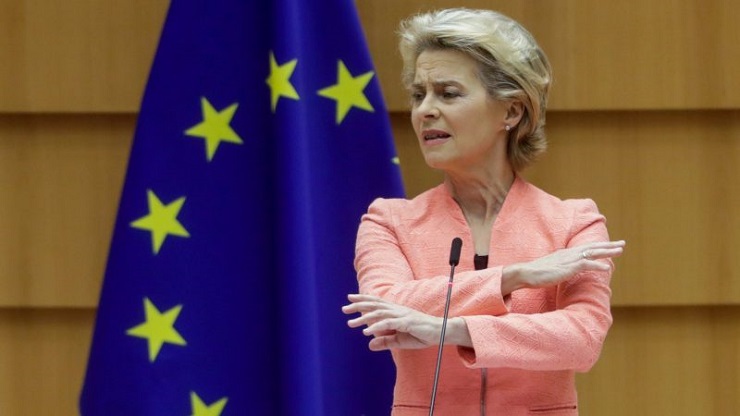
The move to mandate payment for gas in ruble was an essential counter-measure that has succeeded in defending the Russian currency and economy from collapse. That collapse was being deliberately orchestrated by Western sanctions aimed at strangling Russia. And yet when Russia acts to defend its vital existential interests it is accused of using “blackmail”. One of the shrill voices was that of European Commission President Ursula von der Leyen. The former German defense minister is a rabid Russophobe. Her logic of accusing Russia of wrongdoing is like a Third Reich minister lambasting the Warsaw Ghetto uprising as an insolent insurrection.
Von der Leyen and her elite, unelected Brussels bureaucracy are calling for all EU members to refuse payments to Russia. They are effectively endorsing the theft of Russia’s wealth. Their arrogance is not surprising. But that arrogance is leading to rebellion across Europe from the economic damage and unbearable cost-of-living crisis hitting the majority of the EU’s 500 million population. Bulgarian and Polish workers are demanding their governments resume trade with Russia to prevent a crash to their livelihoods.
A further mockery in this absurd scenario is that anti-Russia hawks in the United States and Europe have been vociferously jeering for all energy and other trade with Russia to be cancelled. Of course, this mania is all about propping up U.S. capitalism, hegemony over Europe, the weapons industry, and the transatlantic feeding trough for effete European lackeys.
Then, when Russia cuts off the energy supplies because of non-payment, there is an uproar about Moscow “weaponizing trade”.
The Western accusations of economic blackmail are analogous to perverse claims of military blackmail. The criminally reckless aggression that the United States and its NATO partners have pursued against Russia has escalated into war in Ukraine. As a British government minister demonstrated this week, the NATO powers are now directing their proxy Kiev regime to launch attacks on Russian territory. Yet when Russia warns of the dangerous risks of world war veering into a nuclear conflagration, the Western powers and their dutiful media turn around and accuse Russia of using “nuclear blackmail”.
America and Europe’s dubious political “leadership” is exposing itself as delusional, duplicitous, and criminally insane. They are insanely willing to push the world into a catastrophic war. And when Russia stands up to their madness, it is accused of being a reprobate.
In a funny sort of way, such farcical Western leadership is good. For it only further exposes how utterly unhinged and corrupt the Western elite rulers are in the eyes of their increasingly restive, angry populations.
It is Western callous, sociopathic leaders who are the ones blackmailing their own citizens and indeed the rest of the world. Their ultimatum is: destroy Russia or we will destroy everything. This is the mindset of totalitarianism.
The Western public’s enemy is not Russia, and it’s not China nor Iran, Syria, Venezuela, North Korea, Cuba, or some other designated foreign foe. All our enemy is the Western system of U.S.-led imperialism, its capitalist elite, and their political flunkies like Joe Biden and Ursula von der Leyen.
Featured Video

John Mearsheimer Talking Iran with Iran
or go to
Aletho News Archives – Video-Images
Book Review & Summary
Calling of an Angel: The True Story of Rene Caisse and an Indian Herbal Medicine Called Essiac (1988)
Dr. Gary L. Glum – 30 Q&As – Book Review & Summary
Lies are Unbekoming | October 17, 2026
On June 10, 1975, Dr. Chester Stock, a vice president at Memorial Sloan-Kettering Institute for Cancer Research, wrote to a Canadian nurse named Rene Caisse: “Enclosed are test data in two experiments indicating some regressions in sarcoma 180 of mice treated with Essiac.” The sentence sat in a letter from one of the world’s largest private cancer research centers, concerning an herbal tea an elderly English woman had learned from an Ojibwa medicine man at a northern Ontario mining camp in the 1890s. The tests were terminated the following year after Sloan-Kettering admitted, in sworn affidavit three years later, that they had prepared the injectable solution improperly from the dried material supplied — freezing and thawing the herb rather than boiling it as Rene had instructed. By the time Calling of an Angel was published in 1988, Rene Caisse had been dead for a decade, having treated thousands of cancer patients across fifty-six years in her Bracebridge, Ontario kitchen, never charging a fee, and refusing every offer — from Memorial Sloan-Kettering, the National Cancer Institute, Merck, Parke Davis, and private corporations dangling contracts up to $1 million — to release her formula before the medical establishment admitted her remedy had merit. … continue
Blog Roll
 Aletho News
- Vice President J.D. Vance’s Deceptive ‘Antiwar’ Campaign Speech
- Iran: Palestinians’ rights must not be compromised in Gaza’s future; US, Israel to blame for Hormuz situation
- Ongoing tales of Syrian chemical weapons
- Moscow blasts UN for ignoring torture of Russian POWs
- Millions of Books Could Have Been Destroyed in Lebanon During Israeli Bombings
- Moscow warns of ‘hunt for Russians’
- Calling of an Angel: The True Story of Rene Caisse and an Indian Herbal Medicine Called Essiac (1988)
- South Korean Assistance to the U.S. in the War with Iran: Between Allied Duty and National Interests
- Pharma- and Gates-Funded GAVI Seeks to Assure Parents
- John Mearsheimer Talking Iran with Iran
- If Americans Knew
- Israeli soldiers debunk Israel’s talking points
- In West Bank, Israeli settlers are totally out of control – Daily Update
- NPR investigation finds evidence of widespread fraud at mall kiosks tied to Israeli skincare brand
- Tucker Carlson exposes Israeli Lies about the Oct 7th attack, Charlie Kirk, and the U.S.
- Israel has detained thousands of Palestinian children since Oct 7th – over half spent time in solitary, many uncharged
- Israeli Analysis: Is Netanyahu Planning an ‘October Surprise’ Attack Before Israel’s Election?
- Israeli settlers brutally attack Palestinians and Washington Post female photographer, 65
- Words Have Changed, Occupation Continues: The Reality of the Gaza Ceasefire
- Gaza’s child amputees are growing faster than their prosthetics allow
- Israel keeps Palestinians struggling just to survive–Daily Update
- No Tricks Zone
- New Study Suggests Large Regions Of The Pacific Ocean Have Been Cooling For The Last 80 Years
- Germany’s Green Energy Debacle: High Energy Costs Force Kahla Porzellan to Close After 182 Years!
- New Study: 50 Years Of The Most Aggressive ‘Net Zero’ Policies Can Only Affect The Global Climate By 0.03°C
- US September “Heat” Was No Record…Many Records Set Decades Ago
- Latest European Green Energy Debacle; Portugal’s Largest Flagship Solar Park Insolvent!
- Green Energy Debacle: German Expert Professor Fritz Vahrenholt Warns Of Severe Economic And Social Consequences
- Two More Paleo Reconstructions Affirm Meters-Higher Sea Levels Across Ireland, Brazil 7000-6000 Years Ago
- New Study: Earth And Venus Surface Warmth Largely Explained By Convection And Lapse Rate, Not CO2 Or Radiation
- 2025 Nature Paper Claiming Worsening Global Drought Gets RETRACTED …Heavily Flawed
- New Study: ‘Global Drought Shows No Detectable Recent Acceleration Under Climate Warming’

