American Arabs and the visa waiver programme
By James Zogby | MEMO | January 11, 2022
The Jerusalem Post has reported in the past few days that Palestinian Americans will be allowed to land at Israel’s Ben Gurion Airport on their way to the West Bank, rather than being required to cross the Allenby Bridge from Jordan. Israel is offering to make this change in its treatment of Palestinian Americans in order to join the US Visa Waiver Programme.
If Israel succeeds, its citizens will be able to travel to the US without requiring a visa. This is a privileged position that Israel has sought since the establishment of the programme.
One of the main reasons this status has not been achieved, despite continued pressure from supporters of Israel in Washington, is that every country that joins the programme must ensure reciprocity; that is, ensuring that all Americans are treated without discrimination, since the US agrees to do the same with the citizens of the other country. There is clear evidence of Israel’s decades-long mistreatment of US citizens of Arab descent who travel to the self-declared Jewish state.
The Jerusalem Post story has mentioned that Israel is willing to meet at least some of the American requirements, but this Israeli move is questionable and totally insufficient. It is suspicious, because in 2014, the last time Israel pressed to join the programme, Haaretz published an article titled “Israel to US: We’ll Ease Stance on Palestinian-Americans, if We Join Visa Waiver Programme”.
At the time, the Israelis blamed the Oslo Accords for their refusal to allow Palestinian Americans to travel to Ben Gurion Airport, claiming that the condition of crossing the Allenby Bridge was based on respect for the agreements and the Palestinian Authority. However, there is no such clause in the Oslo Accords. Seven years later, they haven’t made any adjustments and the promised Israeli step is not enough at all. It is true that Palestinian Americans’ ability to travel to Israel is important, but this is only one of many important issues related to Israel’s behaviour towards Palestinians and other Arab Americans. Even more disturbing is Israel’s treatment of Arab Americans upon entry, whether at the airport or at the bridge.
Individuals suspected of being of Arab descent are often automatically subjected to particular scrutiny, which includes hours of harsh interrogation and the extraction of information from their phones and laptops. This applies not only to Palestinian Americans, but also to every person who holds a Palestinian identity card; they are all given such treatment, and not only upon entry. We have witnessed statements by hundreds of Arab Americans who reported poor treatment when entering Israel and leaving as well. The US State Department did not take any action despite being informed of such reports, and it contented itself with publishing “Travel Advisories” that inform Arab Americans to expect discriminatory treatment.
When the victims of these abuses called the US Consulate in Jerusalem for help they were told, “There is nothing we can do.” It is true that a number of US foreign ministers have raised this issue with the Israeli government, but “raising the issue” is apparently not enough because the mistreatment continues. This is not just about visa waiver; it’s also about the US government’s failure to take its obligation seriously to protect the rights of its citizens. The US passport reads, “The Secretary of State of the United States of America hereby requests all whom it may concern to permit the citizen/national of the United States named herein to pass without delay or hindrance and in case of need to give all lawful aid and protection.”
The 1951 Friendship, Commerce and Navigation Treaty between the US and Israel allows US citizens bound for Israel to “travel therein freely, and to reside at places of their choice”. The treaty also prohibits Israel from engaging in “unlawful molestations of every kind” and stipulates that citizens “receive the most constant protection and security, in no case less than that required by international law.”
Regardless of the Visa Waiver Programme, protecting the rights of American citizens should not be up for discussion or negotiation between the US government and any other country. Hollow gestures such as allowing Palestinian Americans to land at Ben Gurion Airport do not absolve the US government or Israel of the requirement to fulfil their obligations.
House Republicans Release Damning Fauci Emails Suggesting Concealed Knowledge Of Lab Leak
By Tyler Durden | Zero Hedge | January 11, 2022
Republicans on the House Oversight Committee have released several emails which suggest Dr. Anthony Fauci may have known that Covid-19 originated from a lab leak, and that it may have been “intentionally genetically manipulated.”
“We write to request a transcribed interview of Dr. Anthony Fauci, Director, U.S. National Institute of Allergy and Infectious Diseases (NIAID). Excerpts of emails we are making public today (see enclosed Appendix I) reveal that Dr. Fauci was warned of two things: (1) the potential that COVID-19 leaked from the Wuhan Institute Virology (WIV) and (2) the possibility that the virus was intentionally genetically manipulated. It is imperative we investigate if this information was conveyed to the rest of the government and whether this information would have changed the U.S. response to the pandemic,” reads the letter from Reps. James Comer and Jim Jordan to HHS Secretary Xavier Becerra.
The letter goes on to state that Fauci – despite claiming otherwise on multiple occasions – was in fact aware of the monetary relationship between NIAID, the NIH, EcoHealth Alliance and the Wuhan lab – by January 27, 2020. Fauci also knew that EcoHealth and NIAID worked together to craft a grant policy which would ‘sidestep the gain-of-function moratorium at the time.’
“This allowed EcoHealth to complete dangerous experiments on novel bat coronaviruses – and with little oversight – that would have otherwise been blocked by the moratorium,” the letter continues, adding that in January 2020, Fauci was also aware that EcoHealth was delinquent in submitting an annual progress report to NIAID, “presumably to hide a gain-of-function experiment conducted on infectious and potentially lethal bat coronaviruses.”
The conference call
The letter references a February 1, 2020 conference call between Fauci, NIH head Collins, and ‘at least eleven other scientists’ who convened to discuss Covid-19.
“It was on this conference call that Drs. Fauci and Collins were first warned that COVID-19 may have leaked from the WIV and, further, may have been intentionally genetically manipulated. Again, it is unclear if either Dr. Fauci or Dr. Collins ever passed these warnings along to other government officials or if they simply ignored them.”

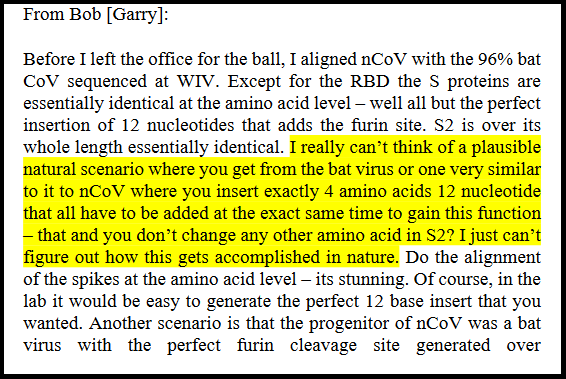
Three days after the call, four participants authored a paper entitled “The Proximal Origin of SARS-CoV-2,” of which Fauci and Collins were sent drafts. The authors, who had previously expressed concern over a lab-leak and genetic manipulation, suddenly abandoned that theory to insist the new virus had a natural origin.
Meanwhile, on April 16, 2020, Collins emailed Fauci to express dismay that the Nature Medicine article which they saw prior to publication (and were given the opportunity to edit), did not quash the lab leak hypothesis. Collins asked Fauci if the NIH could do more to “put down” the lab leak hypothesis. The next day, Fauci cited the paper from the White House podium “likely in an effort to further stifle the hypothesis that COVID-19 leaked from the WIV.”
Questions
The House GOP letter then asks a series of questions.
Rather than be transparent with the Committee, HHS and NIH continue to hide, obfuscate, and shield the truth. By continuing to refuse to cooperate with our request, your agencies are choosing to hide information that will help inform the origins of the ongoing pandemic, prevent future pandemics, respond to future pandemics, inform the United States’ current national security posture, and restore confidence in our public health experts. HHS and NIH’s continued obstruction is likely to cause irreparable harm to the credibility of these agencies. The emails released today raise significant questions, including but not limited to:
1. Did Drs. Fauci or Collins warn anyone at the White House about the potential COVID-19
originated in a lab and could be intentionally genetically manipulated?
2. If these concerns were not shared, why was the decision to keep them quiet made?
3. What new evidence, if any, came to light about COVID-19 between February 1, 2020 and February 4, 2020 to alter the belief it originated in a lab?
4. Did Drs. Fauci or Collins edit the Nature Medicine paper entitled “The Proximal Origin of SARS-CoV-2”?
5. Would having this knowledge earlier have benefitted either vaccine or treatment development?
6. By February 1, 2020, were Drs. Fauci or Collins aware of the State Department’s warnings about WIV safety?
7. Would this warning have changed the early response to the COVID-19 pandemic?
Read the entire letter and released emails below:
Americans ‘underestimate gravity of situation,’ Russia warns after European security talks
Key security issues ‘still pending,’ Moscow’s envoy says after Geneva discussions
RT | January 10, 2022
While the US delegation came to Europe to “seriously” discuss Moscow’s security proposals, on Monday, they have not shown an understanding of how the key issues need to be resolved, Russia’s top negotiator said afterwards.
The Americans “underestimate the gravity of the situation,” Deputy Foreign Minister Sergey Ryabkov told reporters after bilateral with his US counterparts in Geneva. Russia has laid all of its cards on the table in the proposals made public last month, and those represent “demands that we cannot retreat from,” he added.
Ryabkov described the Geneva talks as useful because they discussed the matters previously considered off the table, and said he did not think the situation was hopeless. The greatest difference of views between the US and Russia was on the further expansion of Washington’s NATO military bloc.
“For us, it’s absolutely mandatory to make sure that Ukraine never ever becomes a member of NATO,” Ryabkov said, and Moscow is insisting that the institution amend its policies to reflect this reality.
“We are fed up with loose talk, half-promises, misinterpretations of what happened in different negotiations behind closed doors,” he said, referring to the State Department’s claims in recent days that NATO and the US never promised Moscow that NATO would not expand to the east.
“We do not trust the other side, so to speak,” Ryabkov said. “It’s over, enough is enough.”
Following Monday’s talks in Geneva, Ryabkov will meet with NATO representatives on Wednesday, and with the OSCE on January 13, after which Moscow will make a decision whether to continue the negotiations further.
What War With Russia Would Look Like
By Scott Ritter | Consortium News | January 10, 2022
If ever a critical diplomatic negotiation was doomed to fail from the start, the discussions between the U.S. and Russia over Ukraine and Russian security guarantees is it.
The two sides can’t even agree on an agenda.
From the Russian perspective, the situation is clear: “The Russian side came here [to Geneva] with a clear position that contains a number of elements that, to my mind, are understandable and have been so clearly formulated—including at a high level—that deviating from our approaches simply is not possible,” Russian Deputy Foreign Minister Sergei Ryabkov told the press after a pre-meeting dinner on Sunday hosted by U.S. Deputy Secretary of State Wendy Sherman, who is leading the U.S. delegation.
Ryabkov was referring Russian President Vladimir Putin’s demands to U.S. President Joe Biden in early December regarding Russian security guarantees, which were then laid out by Moscow in detail in the form of two draft treaties, one a Russian-U.S. security treaty, the other a security agreement between Russia and NATO.
The latter would bar Ukraine from joining NATO and rule out any eastward expansion by the trans-Atlantic military alliance. At the time, Ryabkov tersely noted that the U.S. should immediately begin to address the proposed drafts with an eye to finalizing something when the two sides meet. Now, with the meeting beginning on Monday, it doesn’t appear as if the U.S. has done any such thing.
“[T]he talks are going to be difficult,” Ryabkov told reporters after the dinner meeting. “They cannot be easy. They will be business-like. I think we won’t waste our time tomorrow.” When asked if Russia was ready to compromise, Ryabkov tersely responded, “The Americans should get ready to reach a compromise.”
All the U.S. has been willing to do, it seems, is to remind Russia of so-called “serious consequences” should Russia invade Ukraine, something the U.S. and NATO fear is imminent, given the scope and scale of recent Russian military exercises in the region involving tens of thousands of troops. This threat was made by Biden to Putin on several occasions, including a phone call initiated by Putin last week to help frame the upcoming talks.
Yet on the eve of the Ryabkov-Sherman meeting, U.S. Secretary of State Tony Blinken simply reiterated these threats, declaring that Russia would face “massive consequences” if it invaded Ukraine.
“It’s clear that we’ve offered him two paths forward,” Blinken said, speaking of Putin. “One is through diplomacy and dialogue; the other is through deterrence and massive consequences for Russia if it renews its aggression against Ukraine. And we’re about to test the proposition of which path President Putin wants to take this week.”
It is as if both Biden and Blinken are deaf, dumb, and blind when it comes to reading Russia.
Ryabkov has alluded to a fact already made clear by the Russians—there will be no compromise when it comes to Russia’s legitimate national security interests. And if the U.S. cannot understand how the accumulation of military power encompassed in a military alliance which views Russia as a singular, existential threat to its members’ security is seen by Russia as threatening, then there is no comprehension of how the events of June 22, 1941 have shaped the present -day Russian psyche, why Russia will never again allow such a situation to occur, and why the talks are doomed before they even begin.
As for the American threats, Russia has given its response—any effort to sanction Russia would result, as Putin told Biden last month, in a “complete rupture of relations” between Russia and those countries attempting sanctions. One need not be a student of history to comprehend that the next logical step following a “complete rupture of relations” between two parties that are at loggerheads over matters pertaining to existential threats to the national security of one or both is not the peaceful resumption of relations, but war.
There is no mealy-mouthed posturing by Foggy Bottom peacocks taking place in Moscow, but rather a cold, hard, statement of fact—ignore Russia’s demands at you own peril. The U.S., it seems, believes that the worst-case scenario is one where Russia invades Ukraine, only to wilt under the sustained pressure of economic sanctions and military threats.
Russia’s worse-case scenario is one where it engages in armed conflict with NATO.
Generally speaking, the side that is most prepared for the reality of armed conflict will prevail.
Russia has been preparing for this possibility for more than a year. It has repeatedly shown a capability to rapidly mobilize 100,000-plus combat-ready forces in short order. NATO has shown an ability to mobilize 30,000 after six-to-nine-months of extensive preparations.
What would a conflict between Russia and NATO look like? In short, not like anything NATO has prepared for. Time is the friend of NATO in any such conflict—time to let sanctions weaken the Russian economy, and time to allow NATO to build up sufficient military power to be able to match Russia’s conventional military strength.
Russia knows this, and as such, any Russian move will be designed to be both swift and decisive.
First and foremost, if it comes to it, when Russia decides to move on Ukraine, it will do so with a plan of action that has been well-thought out and which sufficient resources have been allocated for its successful completion. Russia will not get involved in a military misadventure in Ukraine that has the potential of dragging on and on, like the U.S. experience in Afghanistan and Iraq. Russia has studied an earlier U.S. military campaign—Operation Desert Storm, of Gulf War I—and has taken to heart the lessons of that conflict.
One does not need to occupy the territory of a foe in order to destroy it. A strategic air campaign designed to nullify specific aspects of a nations’ capability, whether it be economic, political, military, or all the above, coupled with a focused ground campaign designed to destroy an enemy’s army as opposed to occupy its territory, is the likely course of action.
Given the overwhelming supremacy Russia has both in terms of the ability to project air power backed by precision missile attacks, a strategic air campaign against Ukraine would accomplish in days what the U.S. took more than a month to do against Iraq in 1991.
On the ground, the destruction of Ukraine’s Army is all but guaranteed. Simply put, the Ukrainian military is neither equipped nor trained to engage in large-scale ground combat. It would be destroyed piecemeal, and the Russians would more than likely spend more time processing Ukrainian prisoners of war than killing Ukrainian defenders.
For any Russian military campaign against Ukraine to be effective in a larger conflict with NATO, however, two things must occur—Ukraine must cease to exist as a modern nation state, and the defeat of the Ukrainian military must be massively one-sided and quick. If Russia is able to accomplish these two objectives, then it is well positioned to move on to the next phase of its overall strategic posturing vis-à-vis NATO—intimidation.
While the U.S., NATO, the EU, and the G7 have all promised “unprecedented sanctions,” sanctions only matter if the other side cares. Russia, by rupturing relations with the West, no longer would care about sanctions. Moreover, it is a simple acknowledgement of reality that Russia can survive being blocked from SWIFT transactions longer than Europe can survive without Russian energy. Any rupturing of relations between Russia and the West will result in the complete embargoing of Russian gas and oil to European customers.
There is no European Plan B. Europe will suffer, and because Europe is composed of erstwhile democracies, politicians will pay the price. All those politicians who followed the U.S. blindly into a confrontation with Russia will now have to answer to their respective constituents why they committed economic suicide on behalf of a Nazi-worshipping, thoroughly corrupt nation (Ukraine) which has nothing in common with the rest of Europe. It will be a short conversation.
If the U.S. tries to build up NATO forces on Russia’s western frontiers in the aftermath of any Russian invasion of Ukraine, Russia will then present Europe with a fait accompli in the form of what would now be known as the “Ukrainian model.” In short, Russia will guarantee that the Ukrainian treatment will be applied to the Baltics, Poland, and even Finland, should it be foolish enough to pursue NATO membership.
Russia won’t wait until the U.S. has had time to accumulate sufficient military power, either. Russia will simply destroy the offending party through the combination of an air campaign designed to degrade the economic function of the targeted nation, and a ground campaign designed to annihilate the ability to wage war. Russia does not need to occupy the territory of NATO for any lengthy period—just enough to destroy whatever military power has been accumulated by NATO near its borders.
And—here’s the kicker—short of employing nuclear weapons, there’s nothing NATO can do to prevent this outcome. Militarily, NATO is but a shadow of its former self. The once great armies of Europe have had to cannibalize their combat formations to assemble battalion-sized “combat groups” in the Baltics and Poland. Russia, on the other hand, has reconstituted two army-size formations—the 1st Guards Tank Army and the 20th Combined Arms Army—from the Cold War-era which specialize in deep offensive military action.
Even Vegas wouldn’t offer odds on this one.
Sherman will face off against Ryabkov in Geneva, with the fate of Europe in her hands. The sad thing is, she doesn’t see it that way. Thanks to Biden, Blinken and the host of Russophobes who populate the U.S. national security state today, Sherman thinks she is there to simply communicate the consequences of diplomatic failure to Russia. To threaten. With mere words.
What Sherman, Biden, Blinken, and the others have yet to comprehend is that Russia has already weighed the consequences and is apparently willing to accept them. And respond. With action.
One wonders if Sherman, Biden, Blinken, and the others have thought this through. Odds are, they have not, and the consequences for Europe will be dire.
Scott Ritter is a former Marine Corps intelligence officer who served in the former Soviet Union implementing arms control treaties, in the Persian Gulf during Operation Desert Storm, and in Iraq overseeing the disarmament of WMD.
Last Chance Saloon: best chance to ease East-West tensions cannot be missed
By Tony Kevin | Pearls and Irritations | January 7, 2022
We are at a crunch point now in Russia-US relations. Their high-level talks starting next week will be closely observed by China, Russia’s de facto strategic ally. The coming days and weeks will determine the shape of world security for decades to come.
On Monday, January 10, vital Russia-US talks will start in Geneva. Russia’s delegation will be headed by Deputy Foreign Minister Sergei Ryabkov and the US by National Security Adviser Jake Sullivan.
These are ‘precursor’ negotiations – ‘talks about talks’, in the old strategic arms limitation treaties (SALT) terminology. Russia is driving the pace. The US is in reactive mode, trying unsuccessfully to slow things down, to trim Russia’s sails. So far they are not succeeding.
Russia’s best-case scenario for Monday is this. Successful precursor talks will be followed soon after by substantive detailed Foreign Minister level negotiations, led by Russian Foreign Minister Sergei Lavrov and US Secretary of State Antony Blinken, with participation of top military brass from both sides. Russia will seek to secure detailed US-Russia agreements on mutual security guarantees in Europe.
Unusually, Russian drafts of these agreements were handed over by Russia to the US and at the same time made public on December 17. Russia will want to achieve these solemn written mutual commitments, as well-summarised by Patrick Lawrence in Consortium News on December 28.
- NATO will cease all efforts to expand eastward, notably into Ukraine and Georgia.
- NATO guarantees that it will not deploy missile batteries in nations bordering Russia.
- An end to NATO military and naval exercises in nations and seas bordering Russia.
- The effective restoration of the treaty covering intermediate-range nuclear weapons. The US abandoned the INF pact in August 2019.
- An ongoing East-West security dialogue.
These desired agreements would be backed up by early NATO-Russia negotiations to achieve corresponding agreements at that level. Finally, the two presidents would formally seal the deal.
Russia’s worst-case scenario: that if the US fails to negotiate towards this complete package – if the US tries in its usual way to equivocate, delay, or cherry-pick Russia’s proposed deal – Russia will terminate the talks.
Russia-US and Russia-NATO relations would then enter the deepest of deep freezes since the worst years of Cold War One. Russia would focus its economic and diplomatic resources entirely on relations with the East and South – backstopped by the Belt and Road Initiative of its reliable friend China. Russia would effectively stop trying to dialogue with US and NATO Europe and call the US bluff on enhanced sanctions. On the now highly militarised Russia-NATO frontier, armies, navies and tactical intermediate range missile forces (sufficient to destroy most of Europe and European Russia) would confront each other. Risks of East-West war by provocation or accident would be far greater than in the years 1989-2014, before the sharp deterioration in East-West relations brought about by the illegal 2014 Ukraine coup.
These present talks instigated by Russia are thus really the Last Chance Saloon: the last opportunity maybe for decades to pursue relaxation of East-West tensions – ‘détente’, in the old nearly — forgotten word of late Cold War One. Russia has had enough of years of creeping security deterioration and has drawn its red lines. These are not in my view ‘ultimatums’ though they do demand major military pullbacks by the US and NATO not matched by Russia, because almost all Russian forces are within Russian territory. In my view these proposed written agreements would enhance European and global security if achieved.
In 2021, Russia decided that it has had enough of decades of Western duplicity and creeping aggression, as persuasively analysed by Marshall Auerback in The Scrum, December 1, 2021.
Russia has seen how under successive US presidents Clinton, George W. Bush, Obama, Trump, and now Biden, a strategically destructive pattern of US and NATO behaviour had emerged since 1999, when President Bill Clinton welshed on the solemn though unwritten 1989-91 agreements between Reagan and George H.W. Bush with Gorbachev, that NATO would not expand into Eastern Europe following the reunification of Germany.
As the West offered soothing words and prevarications, NATO expanded, first with Poland, Czechoslovakia and Hungary in 1999. There were further large expansions in 2004 and 2009, bringing NATO right up against Russia’s Western frontiers. Provocatively, NATO then listed Ukraine and Georgia as candidates for NATO membership. The West successfully engineered an anti-Russia ‘colour revolution’ in Ukraine in 2014 and nearly succeeded in doing so in Belarus in 2020. It continued even to try to subvert Russia itself through lavish funding of anti-government human rights NGOs. Military and naval manouevres and build-ups continued on Russia’s Western approaches.
An angry Russia saw every expansion and interference as Western betrayals and as violations of its sovereignty and strategic depth. Russia was initially too weak to do anything about it. As Putin rebuilt Russian strength and morale, Russia began to fight back: first in Georgia in 2008, then in Crimea and East Ukraine in 2014, and in Belarus since 2020.
World events have now decisively turned in Russia’s favour. The global strategic balance is shifting. China firmly has Russia’s back, as seen in recent statements by President Xi Jinping and China’s Foreign Minister. China has repelled Western regime-change pressures in Xinjiang, Hong Kong and around Taiwan. Iran has joined the Belt and Road initiative. The West was expelled from Afghanistan. Syria has somewhat stabilised.
Russia and China see now that they are stronger against their common Western adversary if they stand together. Important non-Western powers and groupings such as India, Japan, South Korea and ASEAN are quietly adjusting their diplomacy to suit. The Quad is dead in the water, and AUKUS is a diplomatic joke.
In publishing these draft treaty texts, Russia is appealing to the world outside the Atlantic alliance to see that its cause is just, and in accordance with the five principles of peaceful coexistence proposed by China to the non-aligned world in 1954.
These five principles as articulated by Chinese foreign minister Zhou Enlai first appeared in the Sino–Indian Agreement signed in April 1954, and subsequently at the Bandung Conference of non-aligned nations, which Indonesia hosted one year later. These principles are mutual respect for sovereignty, non-aggression, non-interference in the internal affairs of others, equality for shared benefit, and peaceful coexistence. These are very much the stated principles of current Russian foreign policy.
Quite suddenly, the West is on the diplomatic defensive. Its years of salami-slice aggression against Russia and China are now coming to an end.
For years since the fall of the Soviet Union in 1991, the West used the vital consensus agreed by Reagan and Gorbachev, that nuclear war cannot be won and must never be fought, as cover for creeping aggression in Eastern Europe, violating and weakening Russia’s sphere of security.
Now, with the Russian initiative last week for the UN Security Council P5 to reaffirm the Reagan-Gorbachev doctrine, with which the Western nuclear powers had perforce to agree, the tables have been turned.
Putin is in effect telling the West now: we all agree that none of us can allow military conflict between us to escalate to nuclear war. But we and China are strong enough now to defeat you in non-nuclear conflicts close to our borders, if you should be foolish enough to instigate such conflicts. These are the military facts of the matter: Russia could easily occupy Ukraine and China could easily occupy Taiwan. And you, the US and NATO, could not stop this without risking nuclear war.
Putin has no wish to invade Ukraine but he is determined to stop now the erosion of Russia’s security. The new harder and more confident tone in Russian diplomatic language is unmistakable. A confused West has not yet worked out how to respond. Urgent talks have taken place between Biden and Ukrainian President Volodymyr Zelensky, and between the US and NATO. One hopes that Biden has been preparing the ground for a prudent Western accommodation. A wise old owl, he can smell the coffee.
Putin is now holding the strongest negotiating cards. My betting — indeed my hope — is that Russia will achieve its demanded mutual security guarantees in Europe in coming weeks.
International security – Australia’s security — will be greatly strengthened if he succeeds.
Much could still go wrong. There are troublemakers in the Western bloc whose careers depend on maintaining East-West tensions at just below the level of war. They will try hard to subvert and derail Russia’s goals.
In Australia there is almost complete public ignorance of this subject matter. Be prepared for massive disinformation in coming weeks from the US-fed think tanks like ASPI and our mainstream media, and a hysterical whipping-up of alleged threats of imminent Russian invasion of Ukraine. This propaganda offensive is already under way.
Australia sadly no longer has the intellectual resources for an informed and balanced public discussion of these momentous developments. Ignorance and groundless fears of Russia prevail. Dissenting voices such as mine have been marginalised and almost silenced.
One might hope there is more reality-based knowledge in our national security community. But if there is, they are not telling the public. I fear that there too, ignorance and prejudice have taken hold. We are leaving the strategic thinking on Russia to our Big Brother.
I expect this article to be either mocked or ignored. But let us see how events develop in coming weeks.
Tony Kevin is a former Australian senior diplomat, having served as ambassador to Cambodia and Poland, as well as being posted to Australia’s embassy in Moscow. He is the author of six published books on public policy and international relations.
DOJ will not withdraw controversial memo on targeting school parents

BY SHARYL ATTKISSON – JANUARY 9, 2022
Nearly three months after the controversy over the FBI targeting school parents as possible domestic terrorists, Senate Republicans on the Judiciary Committee have gotten a reply from the Dept. of Justice.
They say the response falls far short of what’s necessary.
Sen. Chuck Grassley (R-Iowa) announced this week that he received a reply. He stated the following:
“[I]n December we asked why the FBI’s Counterterrorism Division was getting involved in parents expressing their concerns at school board meetings. Now, just to be crystal clear, there’s no excuse for real threats or acts of violence at school board meetings, but if there are such threats, these should be handled at the local level and the Attorney General should withdraw his memo that started this whole thing.
“Well, a couple days before Christmas, the Justice Department responded to us with just a one-page letter.
“In that letter, DOJ had nothing to say about why the FBI’s Counterterrorism Division was involved in local school-board matters. DOJ just said, ‘We’re not going to withdraw the memo.’ So, the Feds may be keeping track of school board meetings—even if it creates a horrible chilling effect. And, of course the FBI looking over your shoulder would have a chilling effect. Next week the Judiciary Committee will hold a hearing on domestic terrorism. I hope we’re going to be focusing on the serious threats facing our country—and I hope no one thinks the focus is on our nation’s parents.”
Grassley then made a public statement on the matter:
The Department of Justice owes the American people a better answer than just a one-page letter that says nothing about why the FBI’s Counterterrorism Division is involved in local school-board matters. Now more than ever, parents should be their kids’ strongest and best advocates. They have the God-given right to do so. And the Justice Department ought to be doing everything it can to protect that right, not scare them out of exercising that right. Attorney General Garland should withdraw his memo. And he should take Congress’s oversight, and concern for the rights of parents, more seriously.
Sen. Chuck Grassley (R-Iowa)
By way of background, on Monday, October 4, US Attorney General Merrick Garland sent out a memorandum directing the Federal Bureau of Investigation and the US Attorneys’ Offices to meet in the next 30 days with federal, state, Tribal, territorial and local law enforcement leaders to discuss strategies for addressing the disturbing trend in the nation’s public schools.
Garland cited an increase in harassment, intimidation and threats of violence against school board members, teachers and workers in our nation’s public schools. And, as evidence, he quoted a letter of concern from the National School Boards Association.
But once the controversy became public, it was revealed that Biden administration officials solicited the letter of concern from the School Board group and then pretended to have received it organically. Later, officials from the National School Boards Association indicated they felt the letter, which was not authorized by the entire group, was inappropriate.
In response to Garland’s memo, Senator Chuck Grassley (R-Iowa) and all Republican members of the Senate Judiciary Committee sent a letter to the Department of Justice (DOJ) on October 7, demanding the agency not interfere with local school board meetings or threaten the use of federal law enforcement to dissuade parents’ free speech.
“We are concerned about the appearance of the Department of Justice policing the speech of citizens and concerned parents. We urge you to make very clear to the American public that the Department of Justice will not interfere with the rights of parents to come before school boards and speak with educators about their concerns, whether regarding coronavirus-related measures, the teaching of critical race theory in schools, sexually explicit books in schools, or any other topic”
“To be clear, violence and true threats of violence are not protected speech and have no place in the public discourse of a democracy… However, the FBI should not be involved in quashing and criminalizing discourse that is well beneath violent acts… It is not appropriate to use the awesome powers of the federal government – including the PATRIOT Act, a statute designed to thwart international terrorism – to quash those who question local school boards.”
Republican Senators of Senate Judiciary Committee
After the letter was sent to the Justice Department, Republican Senators were alerted to information from an FBI whistleblower, showing an internal DOJ email illustrating that the FBI’s Counterterrorism and Criminal Divisions had created a threat tag titled “EDUOFFICIALS” as a means to track “instances of related threats” about school administrators, school board members, teachers, and staff.
In light of this new revelation, the senators drafted another letter to Attorney General Garland demanding he withdraw the October 4 memorandum and explicitly state that concerned parents will not be treated as domestic terrorists and will not be targeted for exercising their First Amendment Rights.
In their follow-up letter dated December 6, Republican Senate Judiciary Members wrote:
“Parents and other citizens who get impassioned at school-board meetings are not domestic terrorists. You may believe that, but too many people involved in this issue seem to think harsh words can be criminalized. Getting the FBI’s Counterterrorism Division involved in the matter only makes this worse—dramatically worse.”
Republican Senators of Senate Judiciary Committee
Links to all letters and remarks below:
Attorney General’s Oct 4 memorandum
Senate Judiciary Oct 7 letter
Senate Judiciary Dec 6 letter
Kazakhstan turns into graveyard for US diplomacy

A Pentagon-funded bio-lab near Almaty, Kazakhstan, has become focus of attention for its research on “dangerous pathogens”
BY M. K. BHADRAKUMAR | INDIAN PUNCHLINE | JANUARY 9, 2022
The Kazakh Ministry of Health issued an innocuous disclaimer today denying social media reports about the seizure of a “military biological lab near Almaty by unidentified people.”
According to Tass news agency, the social media had speculated that specialists in chemical protection suits were working near the lab as “a leak of dangerous pathogens” occurred.
The carefully worded press release by the Kazakh ministry clarifies: “This is not true. The facility is being protected.” Period.
The intriguing report highlights the tip of an iceberg which has implications for public health and holds serious geopolitical ramifications.
Since the late 1990s, when it came to be known that the US was steadily establishing and building up partnerships in biological research with several ex-Soviet republics, Moscow has repeatedly alleged that such cooperation posed a threat to Russia.
These biological research facilities were originally envisaged as part of the so-called Nunn-Lugar Biological Threat Reduction Program to prevent the proliferation of expertise, materials, equipment and technologies that could contribute to the development of biological weapons.
But Moscow suspected that the exact opposite was happening — in reality, the Pentagon has been sponsoring, lavishly financing and providing technical assistance to these laboratories where “under the guise of peaceful research, the US is building up its “military-biological potential.”
In a sensational statement in October 2018, Major General Igor Kirillov, the commander of Russia’s Radiological, Chemical and Biological Defense Troops went to the extent of disclosing a discernible pattern of the network of Pentagon labs being located near the borders of Russia and China.
The US-Kazakh partnership in this field dates back to 2003. Kazakhstan has been an interesting “hotspot” for infectious disease occurrence and surveillance due in part to its history, geography, and its diversity of host species. Kazakhstan has long maintained an infrastructure and tiered network for infectious disease surveillance since the time of the Tsars.
The US-funded research projects centred on studies involving select agents including zoonoses: anthrax, plague, tularemia, highly pathogenic avian influenza, brucellosis, etc. These projects funded researchers in Kazakhstan, while project collaborators in the US and UK mentored and guided these researchers to develop and test their hypotheses.
It has been a “win-win” arrangement. The Kazakh institute staff got trained in modern diagnostic and data management techniques, and did research work with lavish external funding, while the Pentagon obtained through such labs valuable inputs for US covert biological weapons programs with military application specifically directed against ethnic groups in Russia and China.
The unassumingly-named Central Reference Laboratory (CRL) in Almaty figuring in the Tass report was originally planned in 2013 with the US investing $102 million in a biosecurity lab to study some of the most deadly pathogens that could potentially be used in bioterrorism attacks.
Rather than locating the new facility in some obsecure tract of land in Nevada, the Pentagon deliberately chose a site near Almaty to securely store and study the highest-risk diseases such as plague, anthrax and cholera.
The rationale was that the lab would provide gainful employment to talented Kazakh researchers and get them off the streets, so to speak — that is, discourage them from selling their scientific expertise and services to terrorist groups who may have use for biological weapons!
But the CRL, now operational, is anchored on institutional cooperation between Kazakh government and the US Defense Threat Reduction Agency under the the Pentagon, which is tasked with protecting “US National Security interests in a rapidly evolving, globalised threat environment to enable a greater understanding of our adversaries and provide solutions to WMD threats in an era of Great Power Competition.”
By the way, Germany also has a similar arrangement under the rubric German-Kazakh Network for Biosafety and Biosecurity, which is co-managed by the Bundeswehr Institute of Microbiology (a military research facility of the German Armed Forces for Medical Biological Defence.)
Why is Kazakhstan a sought-after partner? Simply put, the country provides unique access to ethnic Russian and Chinese groups as “specimen” for conducting field research involving highly pathogenic, potential biological warfare agents. Kazakhstan has 13,364 km of borders with its neighbouring countries Russia, China, Kyrgyzstan, Uzbekistan, and Turkmenistan.
Is China indifferent to all this? Far from it. Beijing Review featured a report sourced from BBC Monitoring in 2020 conveying China’s concerns in the matter. As recently as in November last year, a Russian commentator wrote that these bio-labs are virtual Pentagon bases and demanded an international inquiry. He highlighted that the Kazakh ministry of education and science “now works mainly on Pentagon research programmes.”
How could Kazakhstan, a CSTO member country, have got away with such conduct? This needs some explaining.
Paradoxically, these biological labs are living examples of something sinister that has been going on which everyone knew and no one wanted to talk about — namely, the extensive penetration of the decadent Kazakh ruling elites by the US intelligence.
This penetration has been going on for years but significantly deepened as the 81-year old former president Nurusultan Nazarbayev’s “hands-on” leadership began to loosen and his family members and cronies increasingly began moonlighting (under the patriarch’s benevolent gaze, of course) — something akin to Yeltsin years in Russia.
Sadly, it is a familiar story. The Kazakh elites are notoriously corrupt even by Central Asian standards and the parasitic elites have preferred to keep their loot in safe havens in the western world . Unsurprisingly, they are hopelessly compromised to the US intelligence. It’s as simple as that.
Most certainly, Moscow sensed that popular disaffection was building up and the ground beneath the feet of Nazarbayev, a close friend of Putin, was shifting. But it did not — or more likely, would not — interfere since the US was operating through powerful comprador elements who happened to be the ageing patriarch’s family members and associates.
Given the clan affiliations in that part of the world, Moscow probably felt it prudent to keep its counsel to itself. An added factor would have been the fear that the US might manipulate the ultra-nationalist forces (as happened in Ukraine) to inflict harm on the vulnerable 3.5 million ethnic Russian minority (18% of the population.)
Above all, the fact of the matter is that Nazarbayev cronies held the levers of state power, especially over the security apparatus, which gave Washington a decisive edge.
But things have dramatically changed this past week. Nazarbayev may still have some residual influence but not good enough to rescue the elite who subserved US interests. President Tokayev, a low-profile career diplomat by profession, is finally coming on his own.
Two of Tokayev’s decisive moves have been the replacement of Nazarbayev as the head of the National Security Council and the dismissal of the country’s powerful intelligence chief Karim Masimov (who has since been arrested along with other unidentified suspects as part of a probe into “high treason.”)
Indeed, Washington has much to worry about because, at the end of the day, Kazakhstan remains an unfinished business unless and until a colour revolution can bring about regime change and install a pro-West ruler in power, as in Ukraine. The current turbulence signified an abortive attempt at colour revolution, which boomeranged.
Unlike in Afghanistan, the CIA and Pentagon are not in a position to “evacuate” their collaborators. And the torrential flow of events has shocked the Washington establishment. Kazakhstan is a large country (two-thirds the size of India) and sparsely populated (18 million), and the CSTO forces who moved in are well-equipped and led by a tough seasoned general who crushed the US-backed insurgency in Chechnya.
The Russian forces have taken with them the advanced Leer-3 electronic warfare system, which includes specially configured Orlan-10 drones, jamming devices, etc. Borders have been sealed.
The mandate for Russian forces is to protect “strategic assets”. Presumably, such assets include the Pentagon-funded labs in Kazakhstan.
Bi-partisan coalition urges Biden to resist calls for military action against Russia
Group wants the administration to stick to its pledge of diplomacy, stop NATO expansion, and refuse to send troops to Ukraine.
By Kelley Beaucar Vlahos | Responsible Statecraft | January 8, 2022
A coalition of both conservative and progressive foreign policy organizations have delivered a letter to the White House, asking the president to pursue a broad diplomatic path with the Russians in the much-anticipated U.S.-Russia talks on Monday and in NATO meetings later next week.
The letter, which was signed by the Quincy Institute for Responsible Statecraft, asks the White House to pursue the Minsk agreements which would “demilitarize the eastern Donbas region of Ukraine and guarantee meaningful political autonomy to the region while retaining Ukrainian sovereignty over the area and its borders.” QI fellow Anatol Lieven has detailed the agreement and the promise it would hold for peace in the region here.
De-escalation is key, wrote the signing organizations, which also emphasized the need to stop NATO expansion and resist calls to send U.S. troops to defend Ukraine.
We echo the call by over 100 former U.S. officials and leading scholars who stated that, in addition to addressing urgent security challenges, we must engage in a serious and sustained strategic dialogue with Russia “that addresses the deeper sources of mistrust and hostility” while deterring Russian military aggression. These dialogues must engage with President Putin’s explicit pursuit of “reliable and long-term security guarantees” that would “exclude any further NATO moves eastward and the deployment of weapons systems that threaten us in close vicinity to Russian territory.
Interestingly, reports emerged Friday that suggested that the White House was willing to reduce the number of U.S. troops in Eastern Europe and scale back military exercises in the region — for an equivalent reduction of Russian troops in the area. In an accompanying statement, the White House disputed that Washington was weighing troop cuts.
Read the full letter here.
Featured Video
Why the U.S. Should Pull Back From the First Island Chain
or go to
Aletho News Archives – Video-Images
Book Review
‘Why Fauci Must Rot in Prison’: A Tale of Two Diaries
By Jill Erzen | The Defender | October 13, 2026
Dr. Anthony Fauci’s private diary reveals a “mind-numbing” contradiction between what the former top U.S. infectious disease official knew about COVID-19 and what he told the public, senior White House adviser Peter Navarro, Ph.D., said last week on “American Thought Leaders.”
In his new book, “Why Fauci Must Rot in Prison,” due out Oct. 20, Navarro compares Fauci’s private entries to his own pandemic-era diary, and uses what he calls “a tale of two diaries” to argue that Fauci should face criminal prosecution.
“I show, actually, how a prosecution can and should happen … at the state level, most likely,” Navarro said. “He should wind up in prison, and we’ve got the receipts in this book to put him there.”
Navarro said Fauci repeatedly acknowledged important facts in private, then publicly pursued policies that contradicted those facts — with devastating consequences.
“What he says many times privately in his diary is so at odds with both his public behavior and public statements that it’s mind-numbing,” Navarro said.
Navarro examines the lasting damage caused by lockdowns and other pandemic policies, and the ongoing toll of long COVID.
His book also addresses questions about vaccine safety, including why healthy young people faced COVID-19 vaccination mandates despite concerns about myocarditis, and why women were not warned about miscarriage risks linked to the shots. … continue
Blog Roll
 Aletho News
- Jennifer Kavanagh: Why the U.S. Should Pull Back From the First Island Chain
- Yemen denounces international community’s silence on Saudi aggression, siege
- UAE and Saudi Arabia move toward renewed coordination against Sanaa
- How Iran’s two-week retaliatory strikes exposed cracks in US military architecture in Persian Gulf
- The mother of all propaganda: Why the hype over US MOAB strike against Iran is nothing but theater
- Iran says it possesses technology behind US 14-ton GBU bunker-buster
- Trump asks Iran not to retaliate after he strikes Pickaxe Mountain – w/ Prof. Marandi
- Vice President J.D. Vance’s Deceptive ‘Antiwar’ Campaign Speech
- Iran: Palestinians’ rights must not be compromised in Gaza’s future; US, Israel to blame for Hormuz situation
- Ongoing tales of Syrian chemical weapons
- If Americans Knew
- Israeli rabbi permits occupiers to steal Palestinian olive harvest in West Bank
- Netanyahu’s spin on latest settler attack is laughable – Daily Update
- Israeli soldiers debunk Israel’s talking points
- In West Bank, Israeli settlers are totally out of control – Daily Update
- NPR investigation finds evidence of widespread fraud at mall kiosks tied to Israeli skincare brand
- Tucker Carlson exposes Israeli Lies about the Oct 7th attack, Charlie Kirk, and the U.S.
- Israel has detained thousands of Palestinian children since Oct 7th – over half spent time in solitary, many uncharged
- Israeli Analysis: Is Netanyahu Planning an ‘October Surprise’ Attack Before Israel’s Election?
- Israeli settlers brutally attack Palestinians and Washington Post female photographer, 65
- Words Have Changed, Occupation Continues: The Reality of the Gaza Ceasefire
- No Tricks Zone
- Predictions Made By Renowned Climate Proifessor Over Past Decades Have Been Proven To Be Poor
- New Study Suggests Large Regions Of The Pacific Ocean Have Been Cooling For The Last 80 Years
- Germany’s Green Energy Debacle: High Energy Costs Force Kahla Porzellan to Close After 182 Years!
- New Study: 50 Years Of The Most Aggressive ‘Net Zero’ Policies Can Only Affect The Global Climate By 0.03°C
- US September “Heat” Was No Record…Many Records Set Decades Ago
- Latest European Green Energy Debacle; Portugal’s Largest Flagship Solar Park Insolvent!
- Green Energy Debacle: German Expert Professor Fritz Vahrenholt Warns Of Severe Economic And Social Consequences
- Two More Paleo Reconstructions Affirm Meters-Higher Sea Levels Across Ireland, Brazil 7000-6000 Years Ago
- New Study: Earth And Venus Surface Warmth Largely Explained By Convection And Lapse Rate, Not CO2 Or Radiation
- 2025 Nature Paper Claiming Worsening Global Drought Gets RETRACTED …Heavily Flawed


