Are Covid Fatalities Comparable with the 1918 Spanish Flu?
By Ethan Yang | AIER | April 27, 2021
On April 23, 2021 The New York Times published an article titled “How Covid Upended a Century of Patterns in U.S. Deaths.” The article lays out some data regarding the unprecedented uptick in the US death rate that occured in 2020.
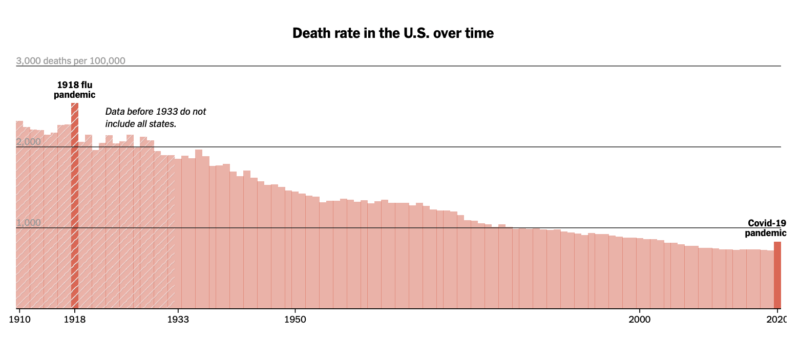
As shown in the graph provided by the New York Times, US death rates have been steadily declining over the past century, likely due to advances in technology and living standards. Last year certainly signaled a noticeable break from this trend with a sizable increase in deaths, but not nearly the same as the 1918 Flu which is a universal benchmark for a killer influenza virus.
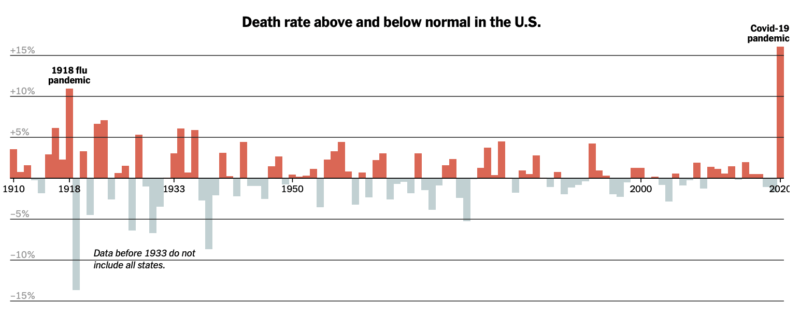
This graph provided by the New York Times indicates the spike in excess deaths in 2020, which is the number of deaths that have occured exceeding the predictions of standard death trends. This is of course all important information. Last year was certainly a horrific year with the outbreak of Covid-19, the lockdowns, and all the chaos that followed. It was a year of death and despair which should not be taken lightly.
Important Discussion: Deaths and Victims
It is common to invoke comparisons with the 1918 Flu Pandemic, as that was an extremely devastating virus that rocked the world. The article makes multiple references to the 1918 pandemic but there are a couple that raise interesting questions for further investigation. The first point is as follows,
“Combined with deaths in the first few months of this year, Covid-19 has now claimed more than half a million lives in the United States. The total number of Covid-19 deaths so far is on track to surpass the toll of the 1918 pandemic, which killed an estimated 675,000 nationwide.”
Comparing the death counts between the 1918 Flu and Covid-19 without adjusting for population growth is extremely misleading. In 1918 the population of the United States was roughly 103 million, while near the end of 2020 it stood at roughly 330 million. According to CDC statistics compiled by a study in JAMA Covid-19 killed 345,000 people in 2020 and now stands at around half a million as stated by the New York Times. Adjusted for the population growth of over 200 million people and holding the death rates constant, the 1918 Flu would have killed over 2 million people if it occured today, which is more than four times greater than Covid-19.
Furthermore, the two diseases are vastly different in terms of who is vulnerable. Covid-19’s severe outcomes almost exclusively affect the elderly and the immunocompromised, particularly those over the age of 65, which is also approaching the life expectancy of a human. Furthermore 94 percent of Covid deaths occurred with preexisting conditions. It poses virtually no risk to children, minimal risk to young adults, and only seems to kill more than 1 percent of victims with those over the age of 65.
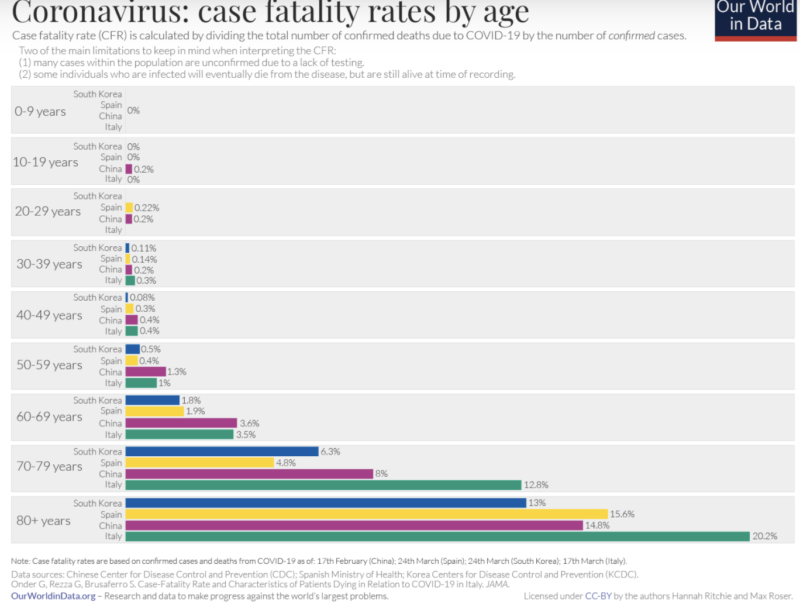
On the other hand the Spanish Flu was devastating to virtually all age groups and did not discriminate between the healthy and the unwell. The CDC writes the following about the 1918 Flu:
“Mortality was high in people younger than 5 years old, 20-40 years old, and 65 years and older. The high mortality in healthy people, including those in the 20-40 year age group, was a unique feature of this pandemic.”
It is clear that the comparison is flawed between the 1918 Flu and Covid-19, as the former was a devastating killer virus whereas the latter only poses a threat to vulnerable populations.
Too Much Statistical Noise
It is certainly worth investigating the noted increase in excess deaths in 2020 as that is obviously a problem. However, the article seems to suggest that Covid-19 was the main causal factor driving increases in death. Although that is certainly a reasonable intuition given that it is a novel virus, clearly there is far more at play.
The main issue to point out is that there were two health crises, not one. Covid-19 is certainly one but we cannot simply ignore the absolutely devastating and unprecedented use of lockdown policies that drastically upended all of society in a way that a virus could never accomplish.
The effects of lockdowns have been thoroughly studied by AIER and in a series of articles I noted just some of the damage to the economy, young people, and the normal functioning of society. All these disruptions led to adverse outcomes whether it be mental health issues, decline in living standards, or even disrupted healthcare procedures. In a press release the CDC noted that in May 2020, it recorded the highest number of drug overdoses ever recorded in a 12-month period.
A study in JAMA notes that although there was a substantial increase in overall deaths in 2020, Covid-19 was only one part of the problem, assuming all Covid deaths are directly attributable to Covid and not a comorbidity.
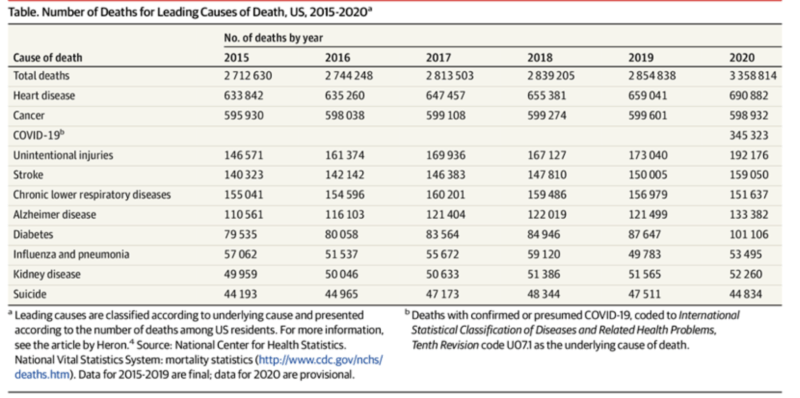
Some statistics of note are an increase in deaths due to heart disease, unintentional injuries, stroke, and diabetes. Although more investigation would be needed to understand how all of this comes together, it wouldn’t be absurd to believe that lockdown policies led to an increase in deaths due to their many disruptions to normal societal functions.
To cite one example of many, the Mackinac Center Legal Foundation recounts on one of its clients by writing,
“One of the affected medical practices, Grand Health Partners, operates in the Grand Rapids area. It performs endoscopies and other elective surgeries, many of which were deemed nonessential by executive order. Due to the shutdown, many of their patients were not able to receive treatment and have suffered because of it.”
Alongside exploring and cutting through the statistical noise posed by increases in death plausibly related to lockdowns, there still needs to be a discussion on quantifying the Covid-19 death count. Genevieve Briand, an economist at John Hopkins University, was subject to a massive degree of controversy for putting out a flawed but important lecture – later expanded into a research paper – that pointed out among other things that Covid-19 deaths may be inappropriately reclassified as deaths from other leading causes.
This is especially worthy of discussion given that the overwhelming majority of Covid deaths occur with comorbidities amongst eldery populations often nearing or exceeding life expectancy.
Key Takeaway
The data is clear; 2020 was a horrific year full of death and despair. The New York Times’ article certainly does a great job at starting a conversation about this topic. However, its comparisons of Covid-19 and the 1918 Flu raises more questions than answers. Furthermore its presentation of data regarding increases in deaths requires more context.
Upon further investigation, it is clear that Covid-19 claimed many lives. However, it is also clear that there is a substantial presence of statistical noise from comorbidities and increases in death from other causes. This raises many questions not just about the collateral damage of our policy response, but also about whether we are even operating with the appropriate information to be making such decisions with people’s lives in the first place.
CNN’s New “Reporter,” Natasha Bertrand, is a Deranged Conspiracy Theorist and Scandal-Plagued CIA Propagandist

CNN’s new national security reporter Natasha Bertrand, then of Politico and NBC News, with MSNBC’s Rachel Maddow, Sept. 19, 2019
By Glenn Greenwald | April 27, 2021
The most important axiom for understanding how the U.S. corporate media functions is that there is never accountability for those who serve as propagandists for the U.S. security state. The opposite is true: the more aggressively and recklessly you spread CIA narratives or pro-war manipulation, the more rewarded you will be in that world.
The classic case is Jeffrey Goldberg, who wrote one of the most deceitful and destructive articles of his generation: a lengthy New Yorker article in May, 2002 — right as the propagandistic groundwork for the invasion of Iraq was being laid — that claimed Saddam Hussein had formed an alliance with Al Qaeda and Osama bin Laden. In February, 2003, on the eve of the invasion of Iraq, NPR host Robert Siegel devoted a long segment to this claim. When he asked Goldberg about “a man named Abu Musab al-Zarqawi,” Goldberg replied: “He is one of several men who might personify a link between Iraq and al-Qaeda.”
Needless to say, nothing could generate hatred for someone among the American population — just nine months away from the 9/11 attack — more than associating them with bin Laden. Five months after Goldberg’s New Yorker article, the U.S. Congress authorized the use of military force to impose regime change on Iraq; ten months later, the U.S. invaded Iraq; and by September, 2003, close to 70% of Americans believed the lie that Saddam had personally participated in the 9/11 attack.
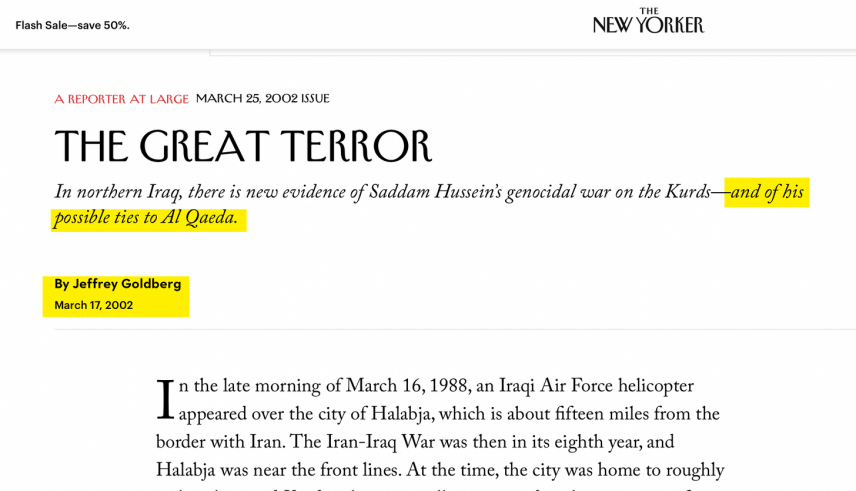
Goldberg’s fabrication-driven article generated ample celebratory media attention and even prestigious journalism awards. It also led to great financial reward and career advancement. In 2007, The Atlantic‘s publisher David Bradley lured Goldberg away from The New Yorker by lavishing him with a huge signing bonus and even sent exotic horses to entertain Goldberg’s children. Goldberg is now the editor-in-chief of that magazine and thus one of the most influential figures in media. In other words, the person who wrote what is arguably the most disastrous article of that decade was one most rewarded by the industry — all because he served the aims of the U.S. security state and its war aims. That is how U.S. corporate journalism functions.
Another illustrative mascot for this lucrative career path is NBC’s national security correspondent Ken Dilanian. In 2014, his own former paper, The Los Angeles Times, acknowledged his “collaborative” relationship with the CIA. During his stint there, he mimicked false claims from John Brennan’s CIA that no innocent people were killed from a 2012 Obama drone strike, only for human rights groups and leaked documents to prove many were.
A FOIA request produced documents published by The Intercept in 2015 that showed Dilanian submitting his “reporting” to the CIA for approval in violation of The LA Times’ own ethical guidelines and then repeating what he was told to say. But again, serving the CIA even with false “reporting” and unethical behavior is a career benefit in corporate media, not an impediment, and Dilanian rapidly fell upward after these embarrassing revelations. He first went to Associated Press and then to NBC News, where he broadcast numerous false Russiagate scams including purporting to “independently confirm” CNN’s ultimately retracted bombshell that Donald Trump, Jr. obtained advance access to the 2016 WikiLeaks archive.
On Monday, CNN made clear that this dynamic still drives the corporate media world. The network proudly announced that it had hired Natasha Bertrand away from Politico. In doing so, they added to their stable of former CIA operatives, NSA spies, Pentagon Generals and FBI agents a reporter who has done as much as anyone, if not more so, to advance the scripts of those agencies.
Bertrand’s career began taking off when, while at Business Insider, she abandoned her obsession with Russia’s role in Syria in 2016 in order to monomaniacally fixate on every last conspiracy theory and gossip item that drove the Russiagate fraud during the 2016 campaign and then into the Trump presidency. Each month, Bertrand produced dozens of Russiagate articles for the site that were so unhinged that they made Rachel Maddow look sober, cautious and reliable.
In 2018, it was Jeffrey Goldberg himself — knowing a star CIA propagandist when he sees one — who gave Bertrand her first big break by hiring her away from Business Insider to cover Russiagate for The Atlantic. Shortly after, she joined the Queen of Russiagate conspiracies herself by becoming a national security analyst for MSNBC and NBC News. From there, it was onto Politico and now CNN : the ideal, rapid career climb that is the dream of every liberal security state servant calling themselves a journalist. Her final conspiratorial article for The Atlantic before moving to Politico is the perfect illustration of who and what she is:
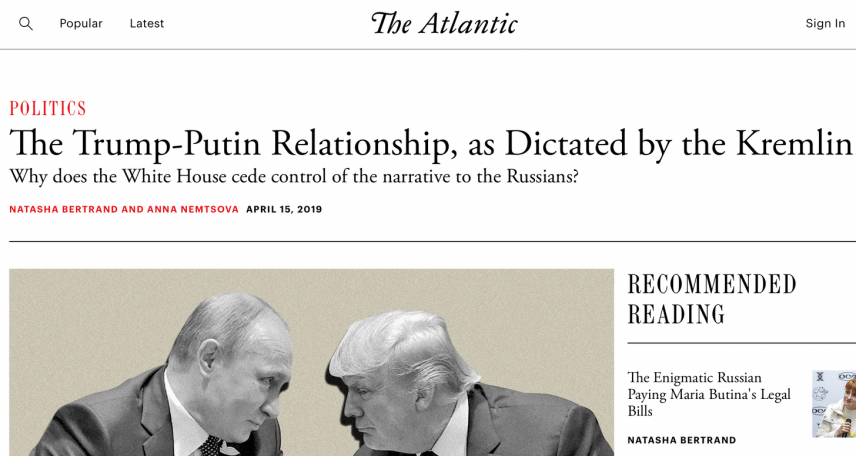
CNN’s new national security star was no ordinary Russiagate fanatic. There was no conspiracy theory too unhinged or evidence-free for her to promote. As The Washington Post‘s media reporter Erik Wemple documented once the Steele Dossier was debunked, there was arguably nobody in media other than Rachel Maddow who promoted and ratified that hoax as aggressively, uncritically and persistently as Bertrand. She defended it even after the Mueller Report corroborated virtually none of its key claims.
In a February, 2020 article headlined “How Politico’s Natasha Bertrand bootstrapped dossier credulity into MSNBC gig,” Wemple described how she was rewarded over and over for “journalism” that would be regarded in any healthy profession with nothing but scorn:
Where there’s a report on Russian meddling, there’s an MSNBC segment waiting to be taped. Last Thursday night, MSNBC host Joy Reid — subbing for “All In” host Chris Hayes — turned to Politico national security reporter Natasha Bertrand with a question about whether Trump “wants” Russian meddling or whether he can’t accept that “foreign help is there.“ Bertrand responded: “We don’t have the reporting that suggests that the president has told aides, for example, that he really wants Russia to interfere because he thinks that it’s going to help him, right?”
No, we don’t have that reporting — though there’s no prohibition against fantasizing about it on national television. Such is the theme of Bertrand’s commentary during previous coverage of Russian interference, specifically the dossier of memos drawn up by former British intelligence officer Christopher Steele. With winks and nods from MSNBC hosts, Bertrand heaped credibility on the dossier — which was published in full by BuzzFeed News in January 2017 — in repeated television appearances.
Wemple systematically reviewed the mountain of speculation, unproven conspiracies and outright falsehoods Bertrand shoveled to the public as she was repeatedly promoted. But it was the document that gave us deranged delusions about pee-pee tape blackmail and Michael Cohen’s trip to Prague that was her crown jewel: “The Bertrand highlight reel features a great deal of thumb-on-scale speculation regarding the dossier,” Wemple wrote.
And when information started being declassified that proved much of Bertrand’s claims about collusion to be a fraud, she complained that there was too much transparency, implying that the Trump administration was harming national security by allowing the public to know too much — namely, allowing the public to see that her reporting was a fraud. A journalist who complains about too much transparency is like a cardiologist who complains that a patient has stopped smoking cigarettes, or like a journalist who voluntarily rats out her own source to the FBI or who agitates for censorship of political speech: a walking negation of the professional values they are supposed to uphold. But that is Natasha Bertrand, and, to the extent that there are some people who still believe that working at CNN is desirable, she was just rewarded for it again yesterday — just as journalists who rat out their own sources to the FBI and advocate for internet censorship are now celebrated in today’s rotted media climate.
Bertrand’s trail of journalistic scandals and recklessness extend well beyond her Russiagate conspiracies. Last October, she published an article in Politico strongly implying that Director of National Intelligence John Ratcliffe was speaking without authorization or any evidence when he said Iran was attempting to undermine President Trump’s 2020 presidential campaign. But last month, the Biden administration declassified an intelligence report which said they had “high confidence” that Iran had done exactly what Ratcliffe alleged: namely, run an influence campaign to hurt Trump’s candidacy. A former national security official, Cliff Sims, said upon hearing of CNN’s hiring that he explicitly warned Bertrand’s editors that the story was false but they chose to publish it anyway.
It was also Bertrand who most effectively laundered the extremely significant CIA lie in October, 2020 that the documents obtained by The New York Post about the Biden family’s business dealings in China and Ukraine were “Russian disinformation.” Even though the John-Brennan-led former intelligence officials admitted from the start that they had no evidence for this claim, Bertrand not only amplified it but vouched for its credibility by writing that the Post‘s reporting “has drawn comparisons to 2016, when Russian hackers dumped troves of emails from Democrats onto the internet — producing few damaging revelations but fueling accusations of corruption by Trump” (that those 2016 DNC and Podesta documents produced “few damaging revelations” would come as a big surprise to the five DNC operatives, led by Chairwoman Debbie Wasserman-Schultz, who were forced to resign when their pro-Hillary cheating was revealed).
It was this Politico article by Bertrand that was then used by Facebook and Twitter to justify their joint censorship of the Post‘s reporting in the weeks before the 2020 election, and numerous media outlets — including The Intercept — gullibly told their readers to ignore the revelations on the ground that these authentic documents were “Russian disinformation.” Yet once it did its job of helping defeat Trump, that claim was debunked when even the intelligence community acknowledged it had no evidence of Russian involvement in the appearance of these materials, and Hunter Biden himself admitted he was the subject of a federal investigation for the transactions revealed by those documents.
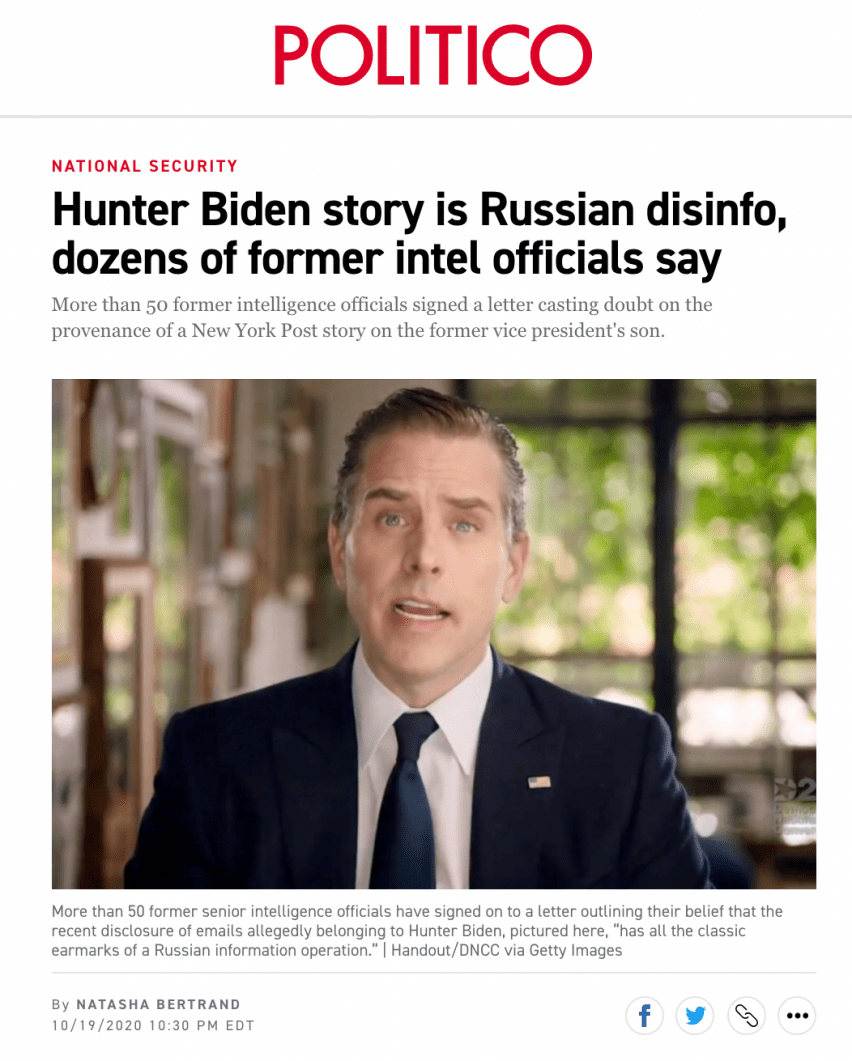
Politico, Oct. 19, 2020
But even when her fantasies and conspiracies are debunked, Bertrand — like a good intelligence soldier — never cedes any ground in her propaganda campaigns. She was, needless to say, one of the journalists who most vocally promoted the CIA’s story — published as Trump was announcing his plans to withdraw from Afghanistan — that Russia had paid bounties to the Taliban for the death of U.S. soldiers. Yet even when the U.S. intelligence community under Joe Biden admitted last week that it has only “low to moderate” confidence that this even happened — with the NSA and other surveillance agencies saying it could find no evidence to corroborate the CIA’s story — she continued to insist that nothing had changed with the story, denying last week on a Mediaite podcast that anything had happened to cast doubt on the original story: “I think it’s much more nuanced than it being a walk-back. I don’t think that’s right actually.”
Even a cursory review of Bertrand’s prolific output reveals an endless array of gossip, conspiracy and speculative assertions masquerading as journalism. The commentator Luke Thomas detailed many of these transgressions on Monday and correctly observed that “arguably no single reporter has contributed more to the deranged and paranoid national security fantasies of the center-left than Natasha Bertrand. She’s an embarrassment to her profession and will, therefore, fit right in at CNN.”
As Thomas noted, beyond all of Bertrand’s well-documented and consequential propaganda, “she sees conspiracies and perfidiousness around every corner,” pointing to this demented yet highly viral tweet that deciphered comments from former Sen. Orrin Hatch (R-UT) as inadvertently revealing some secret scheme to expand Trump’s pardon powers. That scheme, like most of her speculative predictions, never materialized.
Then there is her garden-variety ethical scandal. In January, freelancer Dean Sterling Jones accused Bertrand of stealing his work without credit or payment. In a post he published, Jones documented how he emailed Bertrand a draft with reporting he had been working on, and in response she agreed to report it jointly with him on a co-byline. Yet two weeks later, the article appeared in The Atlantic with Bertrand as the only named reporter. Only after Jones complained did they insert a sentence into the story begrudgingly citing him as a source. “By my count,” Jones wrote, “Bertrand’s article contains at least six unequivocal examples of direct copying and revisions of my work.” When he published his post detailing his accusations, Bertrand arrogantly refused even to provide comment to the freelancer whose work she pilfered.
Natasha Bertrand has spent the last five years working as a spokesperson for the alliance composed of the CIA and the Democratic Party, spreading every unvetted and unproven conspiracy theory about Russiagate that they fed her. The more loyally she performed that propagandistic function, the more rapidly she was promoted and rewarded. Now she arrives at her latest destination: CNN, not only Russiagate Central along with MSNBC but also the home to countless ex-operatives of the security state agencies on whose behalf Bertrand speaks.
Once again we see the two key truths of modern corporate journalism in the U.S. First, we have the Jeffrey Goldberg Principle: you can never go wrong, but only right, by disseminating lies and propaganda from the CIA. Second, the organs that spread the most disinformation and crave disinformation agents as their employees are the very same ones who demand censorship of the internet in the name of stopping disinformation.
I’ve long said that if you want to understand how to thrive in this part of the media world, you should study the career advancement of Jeffrey Goldberg, propelled by one reckless act after the next. But now the sequel to the Goldberg Rise is the thriving career of this new CNN reporter whose value as a CIA propagandist Goldberg, notably, was the first to spot and reward.
New FBI Documents Reveal Seth Rich May Have Been Assassinated In Murder for Hire Plot After All
By Eric Striker | National Justice | April 26, 2021
For years, officials in the US government have held that Democratic National Convention voter expansion data director Seth Rich was killed during a random robbery in July 2016. Nothing was taken and there are currently no suspects in the case.
Julian Assange and others have suggested that Rich was in fact the source for the Wikileak’s dump of DNC emails and that foul play from political actors was involved in his death. Debate on this matter has been suppressed through high powered litigation and dismissed as a baseless conspiracy theory.
Now, lawyers representing the Rich family have been able to obtain 68 pages of heavily redacted FBI documents on the case that reveal Assange and others may have been right after all.
While the FBI has repeatedly asserted over the years that it was not involved in the investigation into Rich’s death, the documents show that they were lying.
New information shows that Rich’s homicide was in fact the subject of a Department of Justice meeting in 2018. In another document, it is speculated that “given [redacted] it is conceivable that an individual or group would want to pay for his death.”
Most pressing is the revelation that an individual, whose name is also redacted, had snatched Rich’s laptop and taken it home. The FBI is currently in possession of the laptop but will not say if anything was altered or deleted from it. The FBI revealed this information earlier this year, but has stated it has not investigated a pertinent piece of evidence in the case.
According to the narrative spun by the Metropolitan Police Department, Rich was killed in a failed robbery after leaving a bar in Washington DC.
Rich was still alive when the police reached him, but was supposedly “too drunk” to describe his attacker before his death. Journalist Joe Hoft reported in 2017 that the police body camera footage from the encounter has mysteriously gone missing.
Countless pages of the FBI’s records on Rich are redacted in their entirety. The FBI’s FOIA office has been battling in court for more time to meet the rest of their Rich FOIA obligations (hundreds of more pages) citing the need to fully censor information in the interest of “privacy.” As others have pointed out, the FBI and DoJ don’t have any problem releasing totally unredacted files on people they dislike.
Ultimately, its clear that the FBI and DoJ agree with skeptics that the Rich murder wasn’t just a mugging gone bad. The explosive story appears to be heavily suppressed by Google search algorithms. Suspicions of Rich being a victim of a US government sponsored or otherwise politically motivated assassination will only rise the more the FBI drags its feet and covers for the suspects.
ACLU Again Cowardly Abstains From an Online Censorship Controversy: This Time Over BLM
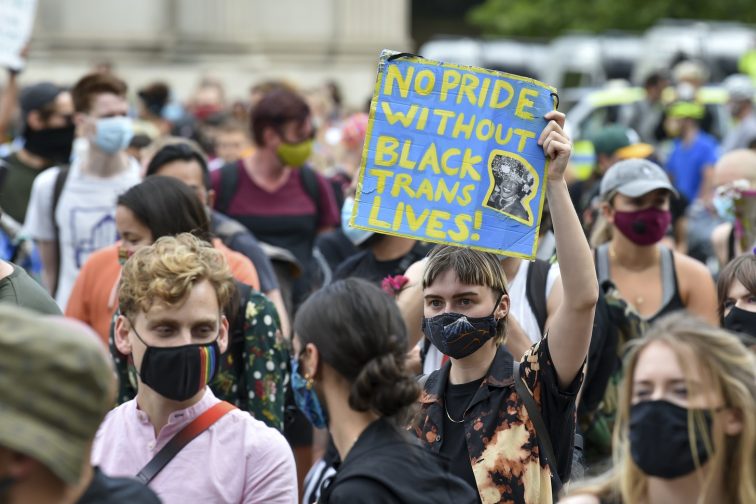
Black Trans Lives Matters’ march in London. (Photo by Dave Rushen/SOPA Images/LightRocket via Getty Images)
By Glenn Greenwald | April 26, 2021
Enormous sums of money have poured into racial justice groups since the May, 2020 murder of George Floyd by the Minneapolis Police Department. “The foundation widely seen as a steward of the Black Lives Matter movement says it took in just over $90 million last year,” according to a February Associated Press review, while at least $5 billion was raised by groups associated with that cause in the first two months alone following Floyd’s death.
Two weeks after the Floyd killing, The New York Times said that the “money has come in so fast and so unexpectedly that some groups even began to turn away and redirect donors elsewhere,” while “others said they still could not yet account for how much had arrived.” Propelled by the emotions and nationwide protest movements that emerged last summer, corporations, oligarchs, celebrities and the general public opened their wallets and began pouring money into BLM coffers and have not stopped doing so.
Where that money has gone has been the topic of numerous media investigations as well as concerns expressed by racial justice advocates. AP noted that BLM’s sharing of financial data in February “marks the first time in the movement’s nearly eight-year history that BLM leaders have revealed a detailed look at their finances.” That newfound transparency was prompted by what AP called “longstanding tensions boil[ing] over between some of the movement’s grassroots organizers and national leaders — the former went public last fall with grievances about financial transparency, decision-making and accountability.”
In December, ten local BLM chapters severed ties with the national group amidst questions and suspicions over the handling of activities and finances by one of its co-founders, Patrisse Cullors, who had assumed the title of Executive Director. On April 10, The New York Post published an exposé on what it called Cullors’ “million-dollar real estate buying binge.” The paper noted that as protests were unfolding around the country, the BLM official was “snagging four high-end homes for $3.2 million in the US alone, according to property records,” including a California property valued at $1.4 million. The article also revealed that the self-described Marxist and her partner “were spotted in the Bahamas looking for a unit at the Albany,” an “elite enclave laid out on 600 oceanside acres,” which “features a private marina and designer golf course.” The Post included photos of several of the properties obtained from public real estate listings.
In an interview about that Post story with Marc Lamont Hill, Cullors — except saying she has not visited the Bahamas since the age of 15 — did not deny the accuracy of the reporting, but instead justified her real estate acquisitions. She denied she had taken a salary from the BLM group, pointing to other income she earns as a professor, author, and a YouTube content creator as the source of this sudden outburst of real estate purchases. She denounced the Post reporting as “frankly racist, and sexist.”
So that seems like a perfectly healthy cycle for covering a controversy, obviously in the public interest. In the wake of concerns from activists about where this massive amount of BLM money has gone, The New York Post did its job of unearthing the splurge of real estate acquisitions by the person who controls and directs BLM’s budget and who has been a target of accusations and suspicions from activists. Cullors then had the opportunity to publicly provide her side of the story concerning her aggressive and ample financial investments.
But then something quite unhealthy and unusual occurred. Five days after publication of that Post article, the Substack journalists Shant Mesrobian and Zaid Jilani reported that Facebook was banning the sharing of that article worldwide on its platform — similar to what Twitter and Facebook did in the weeks leading up to the 2020 election to The New York Post‘s reporting on the Biden family’s business dealings in China and Ukraine. The Substack reporters noted that Facebook ultimately confirmed the worldwide ban of the Post‘s reporting to The New York Times’ media reporter Ben Smith, justifying it on the ground that the article “revealed personal details about [Cullors] and her residence in violation of Facebook’s community standards.”
In his weekly New York Times Sunday night media column, Smith returned to this subject. When a Facebook lawyer justified the censorship by citing an alleged policy that the tech monopoly will ban any “article [which] shows your home or apartment, says what city you’re in and you don’t like it,” Smith expressed extreme skepticism:
The policy sounds crazy because it could apply to dozens, if not hundreds, of news articles every day — indeed, to a staple of reporting for generations that has included Michael Bloomberg’s expansion of his townhouse in 2009 and the comings and goings of the Hamptons elites. Alex Rodriguez doesn’t like a story that includes a photo of him and his former fiancée, Jennifer Lopez, smiling in front of his house? Delete it. Donald Trump is annoyed about a story that includes a photo of him outside his suite at Mar-a-Lago? Gone. Facebook’s hands, the lawyer told me, are tied by its own policies.
Presumably, the only reason this doesn’t happen constantly is because nobody knows about the policy. But now you do!
Smith was additionally disturbed that Facebook was, in essence, overriding the editorial judgment of news outlets, which grapple every day with how to strike the balance between ensuring the public knows of information in the public interest and protecting a person’s right to privacy. For obvious reasons, public figures and organizations — which both BLM and Cullors undoubtedly are — are deemed to have a lower expectation of privacy when it comes to what is newsworthy. That is why, for example, the extramarital affairs of Donald Trump or Bill Clinton are deemed newsworthy whereas, outside of the dead-but-returning Gawker sewer, the sex lives of private citizens are not. Yet Facebook accords no deference to the editorial judgments even of the most established media outlets. Instead, they told Smith, “Facebook alone decides.”
Whatever one’s views are on this particular censorship controversy, there is no doubt that it is part of the highly consequential debate over online free speech and the ability of monopolies like Facebook to control the dissemination of news and the boundaries of political discourse and debate. That is why Smith devoted his weekly column to it. And yet, when Smith approached the standard free speech advocacy groups for comment on this story, virtually none was willing to speak up. “Facebook’s usual critics have been strikingly silent as the company has extended its purview over speech into day-to-day editorial calls,” he wrote.
Among those groups which insisted that it would not comment on Facebook’s censorship of the Post‘s BLM story was the vaunted, brave and deeply principled free speech organization, the American Civil Liberties Union. “We don’t have anyone who is closely plugged into that situation right now so we don’t have anything to say at this point in time,” emailed Aaron Madrid Aksoz, an ACLU spokesman. Smith said “the only criticism he could obtain came from the News Media Alliance, the old newspaper lobby, whose chief executive, David Chavern, called blocking The Post’s link ‘completely arbitrary’ and noted that ‘Facebook and Google stand between publishers and their audiences and determine how and whether news content is seen.’”
How is it possible that the ACLU is all but invisible on one of the central free speech debates of our time: namely, how much censorship should Silicon Valley tech monopolists be imposing on our political speech? As someone who intensively reports on these controversies, I can barely remember any time when the ACLU spoke up loudly on any of these censorship debates, let alone assumed the central role that any civil liberties group with any integrity would, by definition, assume on this growing controversy.
In lieu of the traditional, iconic and organization-defining willingness — eagerness — of the ACLU to defend free speech precisely when it has been most controversial and upsetting to liberals, what we now get instead are cowardly, P.R.-consultant-scripted excuses for staying as far away as possible: “We don’t have anyone who is closely plugged into that situation right now so we don’t have anything to say at this point in time.” That sounds like something Marco Rubio’s office says when asked about a Trump tweet or that a corporate headquarters would say to avoid an inflammatory controversy, not the reaction of a stalwart civil liberties group to a publicly debated act of political censorship.
In this particular case, it is not difficult to understand the cause of the ACLU’s silence. They obviously cannot defend Facebook’s censorship — affirmatively defending the stifling of political speech is, at least for now, still a bridge too far for the group — but they are petrified of saying anything that might seem even remotely critical of, let alone adversarial to, BLM activists and organizations. That is because BLM is one of the most cherished left-liberal causes, and the ACLU now relies almost entirely on donations and grants from those who have standard left-liberal politics and want and expect the ACLU to advance that ideological and partisan agenda above its nonpartisan civil liberties principles. Criticizing BLM is a third rail in left-liberal political circles, which is where the ACLU now resides almost entirely, and thus it again cowers in silence as another online act of censorship which advances political liberalism emerges. Indeed, BLM is an organization which the ACLU frequently champions:
Like so many liberal-left media outlets and advocacy groups, the ACLU was suffering financially before they were saved and then enriched beyond their wildest dreams by Donald Trump and the #Resistance movement he spawned. “The American Civil Liberties Union this week laid off 23 employees, about 7 percent of the organization’s national staff,” announced The Washington Post in April, 2015. But in the Trump era, the money flowed in almost as quickly and furiously as post-Floyd money to BLM. In February, 2017, said AP, the group “is suddenly awash in donations and new members as it does battle with President Donald Trump over the extent of his constitutional authority, with nearly $80 million in online contributions alone pouring in since the election.” So that is the donor base it now serves.
The ACLU’s we-know-nothing routine for abstaining from commenting on Facebook’s censorship of the BLM article is, for so many reasons, preposterous. The group funds what it calls its Speech, Privacy, and Technology Project, and some of its best lawyers oversee it. Clearly they focus on these issues. And the ACLU in general has taken a firm and borderline-absolutist position against online censorship by Silicon Valley monopolies: principles whose application to this particular case would be easy and obvious. The ACLU has a section of its website devoted to “Internet Speech,” and its position on such matters is stated explicitly:
The ACLU believes in an uncensored Internet, a vast free-speech zone deserving at least as much First Amendment protection as that afforded to traditional media such as books, newspapers, and magazines….The ACLU has been at the forefront of protecting online freedom of expression in its myriad forms. We brought the first case in which the U.S. Supreme Court declared speech on the Internet equally worthy of the First Amendment’s historical protections.
In a July, 2018 article published on the group’s site entitled “Facebook Shouldn’t Censor Offensive Speech,” the group praised Facebook CEO Mark Zuckerberg’s controversial pledge “to keep Facebook from diving deeper into the business of censorship” as “the right call.”
Unlike in response to the BLM controversy, the ACLU had no trouble back then recognizing that “what’s at stake here is the ability of one platform that serves as a forum for the speech of billions of people to use its enormous power to censor speech on the basis of its own determinations of what is true, what is hateful, and what is offensive.” The ACLU’s stated policy on these controversies could not have been clearer: “given Facebook’s nearly unparalleled status as a forum for political speech and debate, it should not take down anything but unlawful speech, like incitement to violence.” In light of that principle, how is it remotely hard to denounce Facebook’s censorship of the Post‘s article given that it does not even arguably fall within the scope of those narrow exceptions?
Because the ACLU still employs a few old-school civil libertarians among its hundreds of lawyers and staff, those employees manage to do work and express views that are consistent with the ACLU’s old-school civil liberties agenda even when contrary to the interests of liberal politics. But the tactics used by the ACLU in those cases to downplay or hide those aberrations are as transparent as they are craven.
When three Silicon Valley monopolies united to remove the social media app Parler from the internet in January, 2021 after influential Democratic lawmakers demanded it — one of the most brute acts of monopolistic censorship yet — an ACLU lawyer, Ben Wizner, was cited in The New York Times as labelling Parler’s destruction “troubling,” telling the paper: “I think we should recognize the importance of neutrality when we’re talking about the infrastructure of the internet.” But on the ACLU’s highly active and influential Twitter account — the group’s primary platform for promoting its work, expressing its views, and soliciting donations, where it has two million followers and often tweets up to fifty times a day — the group said absolutely nothing about the removal of an entire social media app from the internet.
Indeed, the ACLU — outside of a few token, hidden statements — has chosen to play at most a minor role in the key free speech controversies of the day, ones focusing on such weighty matters as internet freedom and online censorship over our political debates by Silicon Valley monopolies. Over the last four years, as Facebook’s censorship has expanded rapidly, the ACLU has said little to nothing about it — including remaining in utter silence about the extraordinary decision to censor pre-election reporting on Hunter Biden’s laptop and what it revealed about Joe Biden’s business dealings. Last month, Substack reporter Michael Tracey reviewed the ACLU’s prior 100 tweets and found that 63 of them were about trans issues while a grand total of one was about free speech and none about due process. A comparison of the number of ACLU statements on online censorship controversies to its manifestations on trans issues similarly reveals a fixation on the latter with very little interest in the former.
It goes without saying that the ACLU has every right to devote a huge bulk of its institutional resources and public advocacy to the cause of trans equality if it chooses to do so. But what that reveals is that the group is becoming exactly what its leaders always vowed it would never be: just another garden-variety liberal political advocacy group. After all, there is no shortage of extremely well-financed LGBT groups doing the same advocacy on trans issues. Those LGBT groups shifted their focus almost entirely to trans issues when they won the entire agenda of gay and lesbian equality with the Supreme Court’s 2015 legalization of same-sex marriage in all fifty states, and supporting trans rights is the mainstream, standard view of Democratic Party leaders and liberal activists.
The ACLU’s refusal to engage with growing online censorship is baffling even from the perspective of its liberal politics given that radical leftists are increasingly (and predictably) the targets of tech censorship alongside anti-establishment right-wing voices. Just yesterday, the highly popular trans YouTube host Natalie Wynn of Contrapoints complained that one of her past episodes had just been demonetized and urged: “Free speech should be reclaimed as an essential leftist issue. We should not surrender the most fundamental civil right to Google LLC in the name of deplatforming rightists and curtailing harassment.” Wynn’s last video, rebutting the views of J.K. Rowling on trans issues, featured Wynn’s list of the telltale signs of “indirect bigotry” toward trans people, and she included “free speech advocacy,” but — as happens to so many people — Wynn has apparently reconsidered that view and has discovered the centrality of free speech values now that her own speech is targeted. But agitating for more online political censorship still remains a cause deeply popular among establishment liberals, further explaining the ACLU’s reluctance to involve itself in these controversies on the side of free expression.
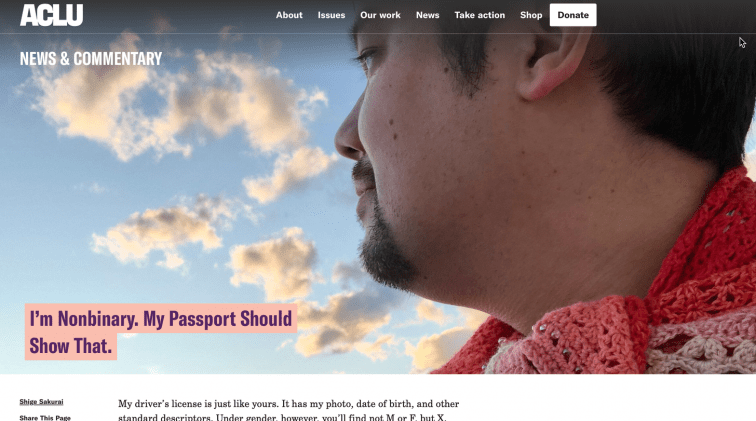
ACLU page touting its advocacy of trans and nonbinary rights
What always distinguished the ACLU in the past — and what gave it credibility with judges in courtrooms — was its devotion to and focus on non-partisan free speech, free press and due process causes that were too unpopular or controversial for other groups to touch, particularly liberal groups who could not afford to offend the political sensibilities of Democrats. There are still some isolated occasions when the ACLU does such things — such as when it spoke up in defense of the NRA against New York Governor Andrew Cuomo’s efforts to target the group with destruction or when the ACLU recently denounced parts of the Democrats’ H.R.1 “reforms”— but the ACLU largely hides those exceptions on its most popular public platforms, and they are becoming increasingly rare.
And now we have arrived at the truly depressing and tawdry place where the ACLU is afraid to apply its long-stated principles to denounce Facebook’s censorship because the censorship in question happened to be an article that reflected poorly on the sacred-among-liberals BLM group. In the place of brave lawyers and activists defending the constitutional rights and civil liberties even of those people and groups most despised, we have instead a corporate spokesman emailing The New York Times with excuses about why it cannot and will not speak up about a major censorship controversy that has been brewing for two weeks. In that decline one finds the ACLU’s sorry trajectory from stalwart civil liberties group into a lavishly funded arm of the Democratic Party’s liberal political wing.
The Targets of Biden’s War on “Domestic Extremists” May Not Be Who You Think
By Leighton Woodhouse | April 26, 2021
Last May, several months into a global pandemic that had capsized the economy, hog farmers had a problem on their hands. With restaurants closed, demand for their product had evaporated. With outbreaks shuttering meat processing plants all over the country, they had nowhere to send their animals to be slaughtered. If kept alive, the pigs would quickly outgrow facilities designed to hold them only for highly abbreviated lives, and the costs of feeding and watering them would become astronomical.
So some major pork producers, among them Iowa’s largest, Iowa Select Farms, made a horrifying decision. They would mass exterminate their animals in one fell swoop, using a technique that promised efficiency for themselves but guaranteed incomprehensible suffering for the pigs.
The method was called “ventilation shutdown,” and it entailed, basically, roasting the pigs alive. Workers would close all of the vents into the barns, shut down the air conditioning, and pipe steam into the buildings until the animals died by asphyxiation or hyperthermia, a process that took several hours. Then a worker would walk through the piles of corpses with a captive bolt gun, shooting whatever stragglers had survived.
The company, however, was unaware that there was a whistleblower within their ranks. An ISF truck driver named Lucas Walker, who had long been appalled by the company’s treatment of its pigs, had informed an activist named Matt Johnson of the company’s plans. Johnson snuck into the barns, placed hidden cameras, and recorded video and audio of the massacre to later release to the news media.
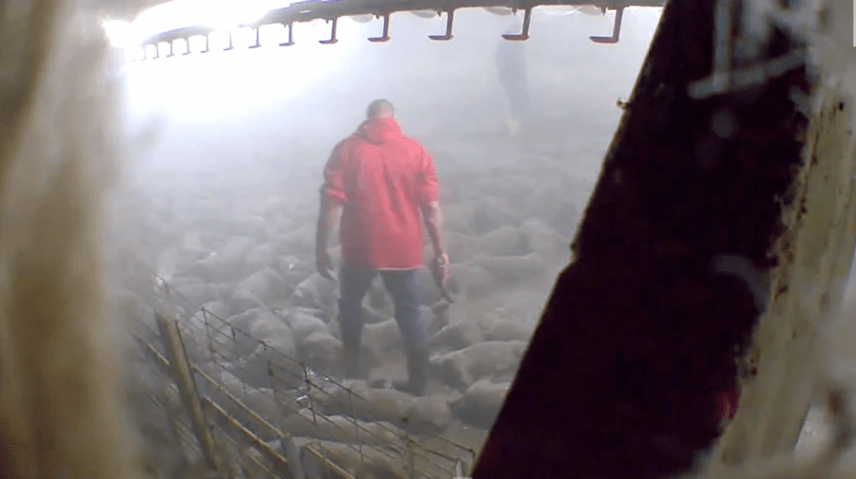
An Iowa Select Farms worker on May 19, 2020, carrying a gun in a barn after ventilation shutdown has been used to kill “excess” pigs (credit: DxE still).
Neither Johnson nor Walker is what most people of conscience would consider a dangerous political extremist. They had no desire to bring any physical harm to anyone; on the contrary, they were moved by the cause of putting a halt to needless suffering. But both a new state law in Iowa and a bill currently being considered in Congress could render them such in the eyes of the criminal justice system. It is just one example of the moral hazard posed by the ongoing effort in Congress and within the Biden administration to erect a new domestic security state apparatus in response to the Trump years and the Capitol Riot — an effort the CIA has joined, while animal rights groups and environmental campaigners have been explicitly listed among its targets.
In 2011, Iowa Select Farms had been the subject of an undercover investigation by the animal rights group Mercy For Animals. Liz Pachaud, an animal rights activist with MFA, had taken a job at the farm and, over the course of four months, documented appalling conditions there with an undercover camera. When the gruesome footage was released, it caused a major crisis for ISF, with numerous grocery chains dropping the company as a supplier.
The following year, the animal agriculture industry successfully lobbied the Iowa state legislature to make what Pachaud had done a crime. The law was one of many so-called “Ag Gag” laws in agricultural states across the country, which make undercover investigations on factory farms by animal rights groups unlawful (an estimated 99 percent of animals raised for meat are factory farmed; the very few small family farms that are left are being systematically driven out of business by the industrialization and economic consolidation of the industry). As Ag gag laws effectively criminalize speech, some of the more sloppily written among them have been subject to successful constitutional challenges; Iowa’s 2012 law was among them. In 2019, a federal judge struck down Iowa’s 2012 law.
That same month, a new Governor took office in Iowa. Kim Reynolds had won her office in 2018 with the conspicuous help of Iowa Select Farms. ISF’s co-owners, Jeff and Deborah Hansen, have donated nearly $300,000 to Governor Reynolds. During the 2018 race, Deborah was the Governor’s biggest individual campaign contributor. Kim Reynolds had been the guest of honor at the Hansens’ family foundation.
Governor Reynolds had barely been in office a month before a newly re-written Ag Gag bill was introduced into the legislature. By summer, she had signed it into law.
Now, Johnson has become the first person to be charged under the 2019 Ag Gag law for attempting to enter one ISF facility. He is facing a separate wiretap charge for the hidden cameras in the barn where the company carried out its ventilation shutdown. In the meantime, yet another Ag Gag law has passed through the Iowa legislature, which increases penalties for the crime of planting hidden cameras in animal agriculture facilities. Governor Reynolds is expected to sign the new bill into law any day now.
As should surprise nobody who lived through the political aftermath of 9/11, these laws were passed under the pretext of combatting “terrorism.” Radical animal rights and environmental activists have, in fact, long been among the FBI’s top “domestic terrorism” targets, as well as targets of draconian new legislation. In 2006, at the behest of the pharmaceutical and animal agriculture industries, Congress passed a law specifically defining animal rights activism aimed at “damaging or interfering with the operations of an animal enterprise” — whether or not violence was involved — as “terrorism.” Direct Action Everywhere (DxE), the group Johnson belongs to (I used to cover DxE as a reporter and have since become a member myself), was the subject of a major FBI investigation over the “theft” of two dying piglets from a factory farm. After he was discovered, the FBI interviewed Walker, asking him if DxE sells drugs or guns to finance their activism, and tried to recruit him as an informant into their activities.
This dismal history should be an obvious cautionary tale about the hazards of enhancing the state’s power to surveil and prosecute people for politically motivated activity, beyond the ample criminal laws already on the books. But in the wake of the January 6 MAGA Capitol Riot, progressives, in particular, have gained an appetite for more.
Currently, a bill with 196 Democratic co-sponsors (and 3 Republicans) is before Congress, which would begin to build the legal and bureaucratic architecture for an interagency domestic terrorism response unit within the Department of Justice, the FBI, and the Department of Homeland Security. The legislation is explicitly a response to the Capitol Riot and is pointed particularly at “White supremacist” and “neo-Nazi” groups — a particularly unsympathetic and uncontroversial cast of culprits.
But the PATRIOT Act was also purported to target only the most hateful, murderous people in the world — Islamic terrorists — before it metastasized into a massive surveillance state infrastructure that spied on literally every single American with an internet connection. Are we to expect that a domestic analogue to the PATRIOT Act will draw the line at violent sociopathic racists? The intelligence community demonstrably does not: a recently declassified report lists animal rights and environmental activists, abortion activists on both the pro-life and the pro-choice sides, anarchists, and anti-capitalists as potential domestic terrorist threats.
If we’ve learned anything from the last few years, it’s that corporations are all too eager to co-opt the progressive rhetoric du jour, whether to sell sneakers or to protect themselves against workplace discrimination lawsuits. And the FBI has been more than willing to investigate activists engaged in non-violent activities as terrorists under the 2006 Animal Enterprise Terrorism Act. A new domestic federal law enforcement bureaucracy dedicated to surveilling and investigating anyone the government claims to suspect is a “terrorist” would be a bonanza to industries facing concerted activist pressure, whether animal agriculture or fossil fuels, or a company in any industry facing a unionization drive. What possible reason is there to believe that corporations won’t lobby the Biden administration and future administrations to use their new powers to ensnare activists who campaign against them, all in the name of ridding the country of violent political extremists and “insurrectionists”?
The answer is that there is no reason to believe it, and every reason to believe the hunt for “domestic terrorists” could eventually be turned against anyone with the will and the means to effectively confront those who hold concentrated political and corporate power — including through strictly non-violent means. A demonstrated willingness to use violence has never been a requisite for law enforcement agencies to brand those they wish to malign as “terrorists”, as DxE activists know all too well. All that’s required is their willingness to use the label.
After 9/11, passage of the PATRIOT Act was enabled by the bullying of dissidents in a climate of enforced jingoism. It was dangerous to ask critical questions then; safety was found only in conformity. We’re in such a moment again, but this time from within a liberal rather than a right-wing consensus. But the outcome will be the same: the hardening of state power, made possible through organized collective hysteria.
The “Russian Threat”
By Paul Craig Roberts | Institute for Political Economy | April 25, 2021
During 2016 CIA director John Brennan and FBI director James Comey, together with the corrupt Democrat party, began orchestrating Russiagate in order to prevent Trump from reducing the risk of nuclear war by normalizing relations with Russia. President Trump tried to nip a New Cold War in the bud, but that was not in the interest of the power and profit of the military/security complex which desperately needs the “Russian threat” as its raison d’etre.
Stephen Cohen, myself and a few others expressed concern that the tensions between the two nuclear powers were being driven to more dangerous highs than ever existed during the 20th century Cold War. Many websites joined in debunking the orchestrated Russiagate fabrication.
To discredit these voices, a new website, PropOrNot, suddenly appeared with a list of 200 “Russian agents/dupes.” Those of us who had raised red flags about Russiagate and the worsening of tensions were on the list. The Washington Post gave the accusation credibility by reporting the PropOrNot accusation that those who dissented from a hostile policy toward Russia were “Putin agents.”

A number of the falsely accused websites were intimidated and abandoned the truth. CounterPunch went even further. It dropped its best and most incisive writers—people such as Mike Whitney and Diana Johnstone. CounterPunch, which had once collected, published, and marketed a collection of my essays as a book, suddenly discovered that it preferred fiction over fact. Other websites that had religiously reproduced all of my columns now became selective about which parts of the official narrative they would permit to be examined on their sites. This was, perhaps, the beginning of the movement to de-platform all who challenge the narrative.
The threat to truth-tellers has now been elevated by election thief Joe Biden’s latest Executive Order declaring a “national emergency” to “deal with the Russian threat.” Pepe Escobar reports that Biden’s order opens every American to being accused of being a Russian agent engaged in undermining US security. “A sub-paragraph (C), detailing ‘actions or policies that undermine democratic processes or institutions in the United States or abroad,’ is vague enough to be used to eliminate any journalism that supports Russia’s positions in international affairs.”
“Supports Russia’s position” includes an objective description and non-partisan analysis of Russian policy. The crucial point is that, in effect, Biden’s executive order places everyone reporting objectively on Russia’s political positions as a potential threat to the United States.
If we are honest, we will acknowledge that we have undergone the complete collapse of the United States. Truth is prohibited in the media, school systems, and universities if it conflicts with the elite agendas served by the official narratives. The First Amendment is dead and buried. Free speech is reserved for the official narratives, such as “systemic racism” and “Russian threat.” Those who exercise their Constitutional right find themselves de-platformed or fired.
To understand how the victory of propaganda over truth elevates the likelihood of nuclear Armageddon, consider the difference between the 20th century and 21st century cold wars.
In the original Cold War both Soviet and American leaders worked to defuse tensions. Agreements were made on arms control and the anti-ballistic missile treaty. There were regular meetings or summits between American and Soviet leaders. Diplomatic decorum was maintained. There were agreements that permitted each side to inspect the other’s compliance.
This process began with President John F. Kennedy and Soviet First Secretary Khrushchev. It continued through President Reagan and, more or less, President George H. W. Bush. It ended with the Clinton regime and has been downhill ever since. President Trump intended to reduce the dangerous tensions, but was not permitted. Indeed, his intent was sufficient cause for the Establishment to drive him from office. 2020 was a coup, not an election.
In the 20th century Cold War Russian experts differed in their assessments of the threat, and their differences were publicly aired. Differing assessments were debated. Dissenters were not demonized as Russian agents. Today American Russian experts find that being Russophobic is a career boost. In the 20th century the New York Times and Washington Post were aligned with peace efforts. Today they are part of the neoconservative warmongers’ propaganda ministry.
The alarming conclusion is that since the Clinton regime, the US government has worked consistently to worsen relations with Russia even to the extent of publicly demonizing the Russian president and strangling objective debate in the US. This is the perfect foundation for war.
All the while insouciant Americans elected governments that successively raised the likelihood of nuclear annihiliation while shutting down dissident concerns. As I reported on March 17, “In the United States Russian Studies has degenerated into propaganda. Recently, two members of the Atlantic Council think tank, Emma Ashford and Matthew Burrows, suggested that American foreign policy could benefit from a less hostile approach to Russia. Instantly, 22 members of the think tank denounced the article by Ashford and Burrows.”
Today even in Republican and conservative circles to question Putin’s demonization raises disapproving eyebrows (the same for China and Iran). The US Establishment has succeeded in labeling objective analysis as “pro-Russian” (or pro-Chinese or pro-Iranian). This means that an objective view of US/Russian relations is off-limits to US policymakers.
The “Russian threat” is another hoax, one that will destroy the world.
NIH plays legal games while US citizens die
By Peter Yim | Trial Site News | April 24, 2021
On January 14, 2021, the NIH updated its recommendation on the use of ivermectin in COVID-19. It removed its recommendation against the use of ivermectin in COVID-19. However it stated:
“There are insufficient data for the COVID-19 Treatment Guidelines Panel (the Panel) to recommend either for or against the use of ivermectin for the treatment of COVID-19.”
The “Panel” consists of 47 medical experts and patient advocates. Presumably, recommendations in the Guidelines are endorsed by a vote of the Panel. However, there is ambiguity about voting since the Guidelines state:
“Updates to existing sections that do not affect the rated recommendations are approved by Panel co-chairs without a Panel vote.”
I submitted a Freedom of Information Act (FOIA) request to the NIH on January 25 to find out if there was a vote:
“On January 6, 2021, the NIH COVID-19 Treatment Guidelines Panel met to consider updating their recommendation on the use of Ivermectin in COVID-19. Please answer the following question. As of today, has that Panel taken a vote on whether to change its recommendation? (Date Range for Record Search: From 01/06/2021 To 01/25/2021)”
The NIH responded:
“Please be advised that the FOIA is not intended to answer questions, but rather it is meant for the public to request specifically identified and searchable Federal records that are already in existence, i.e. a record cannot be created in response to a FOIA request. Considering this, your request is not deemed a proper FOIA request as it is in the form of a question, and your NIH FOIA case has been administratively closed.”
I rephrased and resubmitted the FOIA request on January 28:
“All updates to the Coronavirus Disease 2019 (COVID-19) Treatment Guidelines that were endorsed by a vote of the Panel. (Date Range for Record Search: From 01/01/2021 To 01/28/2021)”
There was only one update to the Guidelines in that time period and that update was for the ivermectin recommendation. Therefore, if there was a vote on the ivermectin recommendation, the NIH should provide that update. If there was not a vote, the NIH should state that no record is available.
The NIH did not respond to this request within 20 business days as required by law. I have challenged that non-response by the NIH in federal court. The NIH did just provide this response:
“You requested all updates to the Coronavirus Disease 2019 (COVID-19) Treatment Guidelines that were endorsed by a vote of the Panel (Date range for record search from 01/01/2021 to 01/28/2021). All approved updates to the guidelines are posted online and can be found at https://www.covid19treatmentguidelines.nih.gov/whats-new/. The documents posted on this website respond to your request in full.”
Whether that is a legally adequate response to the FOIA request remains to be seen in the federal court proceeding. What is obvious is that the NIH is playing legal games while US citizens suffer and die from COVID-19.
Featured Video
“Historic Russia”: The Land Putin Will Not Give Back
or go to
Aletho News Archives – Video-Images
From the Archive
How Ukraine Tortured and Slaughtered Donbass
By Kit Klarenberg | Al Mayadeen | July 11, 2024
Almost immediately after the proxy war erupted, ISIS-tier footage of the torture and murder of Russians in Ukrainian custody emerged.
On July 6th, the New York Times published an astonishing investigation: In Ukraine, Killings of Surrendering Russians Divide an American-Led Unit. The article documents in grim detail how Chosen Company, an international volunteer battalion for Kiev, routinely executes Russian prisoners of war. It is the very first mainstream admission that this practice – a brazen breach of the Geneva Conventions, and a grave war crime – is widespread among Ukraine’s fighters, both foreign and homegrown. … continue
Blog Roll
 Aletho News
- BRITAIN’S WARNING: PREPARE FOR WAR
- “Historic Russia”: The Land Putin Will Not Give Back
- How the Cambridge Analytica scandal still haunts Mark Zuckerberg
- The Ongoing Cancellation Campaign Against a Dissenting Academic in Norway
- Yemen and ‘the Houthis’: Challenging Sami Hamdi’s Narrative
- No, Christians did not invent Zionism
- AIPAC-led lobbying network opens branches in Cypriot, Greek parliaments
- Araghchi blasts ‘parasitic’ alliance as US taxpayers pay for Israel’s war on Iran
- Easy fix for Europe’s chaos? Stop fueling war against Russia
- Putin’s key remarks on peace talks and Europe’s ‘schizophrenia’
- If Americans Knew
- An error has occurred; the feed is probably down. Try again later.
- No Tricks Zone
- Two New Studies Find Thwaites Glacier Melt Cannot Be Driven By Human Activity Or A Warming Ocean
- E-Cars Reduce CO2 Emissions By Only 41% Compared To Internal Combustion Engine Vehicles
- Predictions Made By Renowned Climate Professor Over Past Decades Have Been Proven To Be Poor
- New Study Suggests Large Regions Of The Pacific Ocean Have Been Cooling For The Last 80 Years
- Germany’s Green Energy Debacle: High Energy Costs Force Kahla Porzellan to Close After 182 Years!
- New Study: 50 Years Of The Most Aggressive ‘Net Zero’ Policies Can Only Affect The Global Climate By 0.03°C
- US September “Heat” Was No Record…Many Records Set Decades Ago
- Latest European Green Energy Debacle; Portugal’s Largest Flagship Solar Park Insolvent!
- Green Energy Debacle: German Expert Professor Fritz Vahrenholt Warns Of Severe Economic And Social Consequences
- Two More Paleo Reconstructions Affirm Meters-Higher Sea Levels Across Ireland, Brazil 7000-6000 Years Ago


