6 Warning Signs from Biden’s First Week in Office
By Kit Knightly | OffGuardian | January 27, 2021
It’s been a busy first week for the 46th President [sic] of the United States, there are the 20,000 troops occupying the capitol city to organise, as well as the totally unprecedented show-trial of his immediate predecessor.
You know, usual democracy type stuff.
On top of that, Biden has now signed at least 37 executive orders in his first week. The record for any President, and more than the previous four presidents combined.
What do these orders, or any of his other moves, tell us about the future plans of the recently “elected” administration? Nothing good, unfortunately.
1. VACCINATION PASSPORTS
I still remember people claiming the introduction of vaccination passports (or immunity passes or the like) was just a “conspiracy theory”, the paranoid fantasy of fringe “covidiots”. All the way back in December, when they were getting fact-checked by tabloid journalists who can’t do basic maths.
These days they are rebranded as “freedom certificates” which are “divisive, politically tricky and probably inevitable”.
Many countries are already preparing to roll it out, including Iceland the UK and South Africa. Biden’s “Executive Order on Promoting COVID-19 Safety in Domestic and International Travel” adds the US to this list:
International Certificates of Vaccination or Prophylaxis. Consistent with applicable law, the Secretary of State, the Secretary of HHS, and the Secretary of Homeland Security (including through the Administrator of the TSA), in coordination with any relevant international organizations, shall assess the feasibility of linking COVID-19 vaccination to International Certificates of Vaccination or Prophylaxis (ICVP) and producing electronic versions of ICVPs.
2. CABINET APPOINTMENTS
Biden’s cabinet is praised as the “most diverse” in history, but will hiring a few non-white people really change the decades-old policies of US Imperialism? It certainly doesn’t look like it.
His pick for Under Secretary of State is Victoria Nuland, a neocon warmonger and one of the masterminds of the Maidan coup in Ukraine in 2014. She is married to Robert Kagan, another neocon warmonger, co-founder of the Project for a New American Century and senior fellow at the Brookings Institute and one of the masterminds behind the 2003 invasion of Iraq.
The incoming Secretary of State, Antony Blinken, is also an inveterate US Imperialist, arguing for every US military intervention since the 1990s, and criticised Trump’s decision to withdraw from Syria.
Biden’s pick for Defence Secretary is the first African-American ever appointed to this role, but former General Lloyd Austin is hardly going be some kind of “progressive” voice in his cabinet. He’s a career soldier who retired from the military in 2016 to join the board of Raytheon Technologies, an arms manufacturer and military contractor.
As “diverse” as this cabinet may be in skin colour or gender… there is most certainly no “diversity” of opinion or policy. There are very few new faces and no new thoughts.
So, it looks like we can expect more of the same in terms of foreign policy. A fact that’s already been displayed in…
3. IRAQ…
Despite heavy resistance from the military and Deep State, Donald Trump wanted to end the war in Iraq and pledged to pull American troops out of the country. This was one of Trump’s more popular policies, and during the campaign Biden made no mention of intending to reverse that decision.
Then, on the very day of Biden’s inauguration, ISIS conducted their deadliest suicide bombing for over three years, and suddenly the situation was too unstable for the US to leave, and Biden is being forced to “review” Trump’s planned withdrawal.
The Iraqi parliament has made it clear it wants the US to take its military off their soil, so any American forces on Iraqi land are technically there illegally in contravention of international law. But that never bothered them before.
4. … AFGHANISTAN…
Turns out the US can’t withdraw from Afghanistan either. Last February Trump signed a deal with the Taliban that all US personnel would leave Afghanistan by May 2021.
Joe Biden has already committed to “reviewing” this deal. Sec. Blinken was quoted as saying that Biden’s admin wanted:
“to end this so-called forever war [but also] retain some capacity to deal with any resurgence of terrorism, which is what brought us there in the first place”.
As a great man once said, nothing someone says before the word “but” really counts. The US will not be withdrawing from Afghanistan, and if there is any public pressure to do so, the government will simply claim the Taliban broke their side of the deal first, or stage a few terrorist attacks.
5. … AND SYRIA
Far from simply continuing the on-going wars, there are already signs Biden’s “diverse” team will look to escalate, or even start, other conflicts.
Syria was another theatre of war from which Donald Trump wanted to extricate the United States, unilaterally ordering all US troops from the country in late 2019.
We now know the Pentagon ignored those orders. They lied to the President, telling Trump they had followed his orders… but not withdrawing a single man. This organized mutiny against the Commander-in-Chief of the US Armed Forces was played for a joke in the media when it was finally revealed.
There will be no need for any such duplicity now that Biden is in the Oval Office, he was a vocal critic of the decision to withdraw, claiming it gave ISIS a “new lease of life”. Indeed, within two days of his being sworn in a column of American military vehicles was seen entering Syria from Iraq.
6. DOMESTIC TERRORISM
We called this before the inauguration. They made it just too obvious. Before the dirty footprints had been cleaned from Nancy Pelosi’s desk it was clear where it was all going.
Within 24 hours of being sworn in as president, Biden had ordered a “review of the threat posed by domestic terrorism”.
As usual, the press are laying down the covering fire for this. Talking heads have been busily comparing MAGA voters to al Qaida in television interviews. The Washington Post and New Yorker journal have cut-and-paste pieces about this supposed threat. Politico published an article titled “Biden vowed to defeat domestic terrorism. The how is the hard part”, which outlines what Biden could do:
Direct the Justice Department, FBI and National Security Council to execute a top-down approach prioritizing domestic terrorism; pass new domestic terrorism legislation; or do a bit of both as Democrats propose a crack down on social media giants like Facebook for algorithms that promote conspiracy laden posts.
That last part is key. The “crack down on social media” part, because the anti-Domestic Terrorism legislation will likely be very focused on communication and so-called “misinformation”.
Alexandra Ocasio-Cortez has publicly called for a congressional panel to “rein in” the media:
We’re going to have to figure out how we rein in our media environment so you can’t just spew disinformation and misinformation,”
And who will be the target of these crack downs and new legislations? Well, according John Brennan (ex-head of the CIA and accomplished war criminal), practically anybody:
They’re casting a wide net. Expect “extremist”, “bigot” and “racist” to be just a few of the words which have their meanings totally revised in the next few months. “Conspiracy theorist” will be used a lot, too.
Further, they are moving closer and closer toward the “anyone who disagrees with us is literally insane” model. With many articles actually talking about “de-programming” Trump voters. The Atlantic suggests “mental hygiene” would cure the MAGA problem.
Again AOC is on point here, clearly auditioning for the role of High Inquisitor, claiming that the new Biden government needs to fund programs that “de-radicalise” “conspiracy theorists” who are on the “spectrum of radicalisation”.
*
As I said at the beginning, it’s been a busy week for Joe Biden, but you can sum up his biggest policy plans in one short sentence: More violence overseas, less tolerance of dissent and strict clampdowns on “misinformation”.
How progressive.
Proud Boys Leader Was ‘Prolific’ FBI Snitch: Court Docs
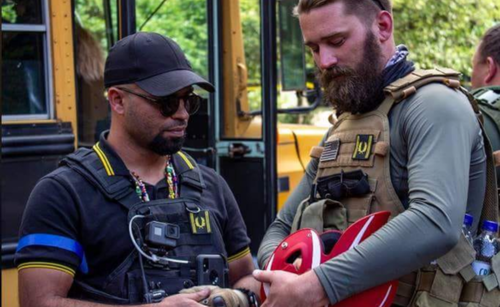
Enrique Tarrio (left)
By Tyler Durden | Zero Hedge | January 27, 2021
While US officials claim that ‘far-right extremism’ is one of the largest threats facing America, the leader of the group most commonly singled out as an example – the Proud Boys – was a ‘prolific’ informant for federal and local law enforcement, according to Reuters, citing a 2014 federal court proceeding.
Enrique Tarrio repeatedly worked undercover for investigators following a 2012 arrest, court documents reveal.
Curiously, Tarrio was ordered to stay away from Washington D.C. one day before the January 6 Capitol riot after he was arrested on vandalism and weapons charges – upon a request by government prosecutors that he be prohibited from attending. At least five Proud Boys members were charged as part of the riot.
In the 2014 hearing, a federal prosecutor, an FBI agent and Tarrio’s attorney describe his undercover work – noting that the Proud Boys leader helped authorities prosecute over a dozen people in various cases involving drugs, gambling and human smuggling, according to Reuters.
In a Tuesday interview with Reuters, Tarrio denied working undercover or cooperating in cases.
“I don’t know any of this,” he said, adding “I don’t recall any of this.”
Law-enforcement officials and the court transcript contradict Tarrio’s denial. In a statement to Reuters, the former federal prosecutor in Tarrio’s case, Vanessa Singh Johannes, confirmed that “he cooperated with local and federal law enforcement, to aid in the prosecution of those running other, separate criminal enterprises, ranging from running marijuana grow houses in Miami to operating pharmaceutical fraud schemes.”
Tarrio, 36, is a high-profile figure who organizes and leads the right-wing Proud Boys in their confrontations with those they believe to be Antifa, short for “anti-fascism,” an amorphous and often violent leftist movement. The Proud Boys were involved in the deadly insurrection at the Capitol January 6.
The records uncovered by Reuters are startling because they show that a leader of a far-right group now under intense scrutiny by law enforcement was previously an active collaborator with criminal investigators. – Reuters
During Tarrio’s 2014 hearing, both the prosecutor and Tarrio’s defense attorney asked for a reduced prison sentence after pleading guilty in a fraud case related to the relabeling and sale of stolen diabetes test kits. In requesting leniency for Tarrio and two co-defendants, the prosecutor noted that Tarrio’s information had resulted in the prosecution of 13 people on federal charges in two separate cases, and helped local authorities investigate a gambling ring.
Tarrio’s former attorney, Jeffrey Feiler, noted that his client worked undercover several times – one involving “wholesale prescription narcotics,” another involving the sale of anabolic steroids, and a third involving human smuggling. Tarrio also helped police uncover three marijuana grow houses, and was a “prolific” cooperator, according to the report.
In the smuggling case, Tarrio, “at his own risk, in an undercover role met and negotiated to pay $11,000 to members of that ring to bring in fictitious family members of his from another country,” the lawyer said in court.
In an interview, Feiler said he did not recall details about the case but added, “The information I provided to the court was based on information provided to me by law enforcement and the prosecutor.”
An FBI agent at the hearing called Tarrio a “key component” in local police investigations involving marijuana, cocaine and MDMA, or ecstasy. The Miami FBI office declined comment. –Reuters
Reuters notes that there is no evidence Tarrio has cooperated with authorities since his previous involvement, however he admitted to notifying local law enforcement prior to Proud Boys rallies in various cities – letting police know of the group’s plans. Tarrio said he stopped this coordination after December 12 due to the DC police cracking down on the group.
Tarrio’s involvement with law enforcement will no doubt fuel speculation over just how ‘organic’ the threat of ‘far-right extremism’ is, particularly when the vast majority of violence observed over 2020 was committed by far-left groups rioting in the name of racial justice.
Signal, the ‘encrypted messenger of the future,’ has shady links to US national security interests
By Kit Klarenberg | RT | January 27, 2021
If the sudden popularity of the encrypted messenger Signal has seemed suspicious to you, you may be onto something – the app is at least partially funded through American foreign influence cutouts.
On January 4, WhatsApp announced sweeping changes to its privacy policies, affecting the vast bulk of its approximately two billion users globally.
The poorly explained rules were interpreted by many as proof that the messaging service was about to commence sharing users’ private data, including their conversations, with parent company Facebook, and in response millions the world over began flocking to alternative messaging services that offered end-to-end encryption.
The most common destinations for WhatsApp exiles were, and remain, Signal and Telegram. For reasons unclear, while available figures suggest the latter has to date received many orders of magnitude more fresh arrivals than the former, corporate news outlets have overwhelmingly focused on Signal’s surging intake.
Much of this coverage has been highly approving – for instance, The Guardian published a lengthy explainer on January 24 titled “Is it time to leave WhatsApp, and is Signal the answer?” The headline was answered very much in the affirmative, to the extent that readers were offered advice on persuading their contacts to likewise make the switch.
The media’s damascene conversion to the cause of encrypted communication is rather incongruous. With a few notable exceptions, mainstream reporting on encryption is typically neutral, if not outright condemnatory, the capability frequently framed as purposefully offering sanctuary to philanderers, drug dealers, paedophiles, assassins, and anyone with something sinister to hide in general.
Such perspectives strongly reflect the public positions of governments and security services worldwide, to which end-to-end encryption is by definition an extreme detriment, significantly curtailing the monitoring and collection of citizens’ communications. Privacy advocates contend authorities’ oft-expressed anxieties about encryption providing a “safe space” for criminals and the like are a cynical smokescreen to justify crackdowns on their usage and availability.
Whatever the truth of the matter, efforts to restrict access to end-to-end encryption are demonstrably ongoing, but have predominantly gone largely uncriticized if not outright unremarked upon. Now though, news outlets seem widely gripped by encryption fever.
In a palpable illustration of this abrupt paradigm shift, a mere three days before it effectively urged its readers to install Signal, The Guardian lambasted Facebook’s plans to implement end-to-end encryption across all its messaging platforms, on the basis that the move could harm efforts to reduce child exploitation.
‘At no cost around the globe’
Serious discussion of Signal’s history, and funding sources, has been entirely absent from the deluge of puff pieces on the platform to circulate far and wide in recent weeks – an omission perhaps predictable given the centrality of the US national security state to the app’s financing, creation and promotion.
Signal was launched by now-defunct Open Whisper Systems (OWS) in 2013, brainchild of shadowy tech guru ‘Moxie Marlinspike’ – real name Matthew Rosenfeld. In February 2018, responsibility for managing the app passed to the nonprofit Signal Foundation, launched with $50 million in startup capital provided by billionaire former Facebook higher-up Brian Acton, the Foundation’s executive chair.
OWS never published financial statements or disclosed the identities of its funders at any point during its operation, although the sums involved in launching and maintaining a messaging platform used by a vast number of people internationally over several years were surely significant.
Rosenfeld alleges the app “never [took] VC funding or sought investment” at any point during that time, and quite how much money was involved in total is a mystery. It’s clear though that at least $2,955,000 was provided by the Open Technology Fund (OTF) 2013-2016, and the organization’s website refers to Signal being “originally developed with OTF funding.”
The site is also home to a dedicated OWS profile, which boasts of how the OTF “enabled the OWS team to continue providing Signal at no cost around the globe and adapt their operations for a growing user base.”
Propaganda radio rabbit hole
The OTF was created in 2012 as a pilot program of Radio Free Asia (RFA), an asset of US Agency for Global Media (USAGM), which is in turn funded by US Congress to the tune of $637 million annually – in August 2018, its then-CEO acknowledged the outlet’s priorities “reflect US national security interests.”
RFA’s own origins harken back to 1948, when National Security Council Directive 10/2 officially authorized the then-newly created Central Intelligence Agency to engage in operations targeted at communist states, including propaganda, economic warfare, sabotage, subversion, and “assistance to underground resistance movements.”
After the CIA’s role was made public in the 1970s, Congress took over running and funding the stations, before in 1999 they were grouped along with other state-run media entities under the umbrella of the Broadcasting Board of Governors, USAGM’s forerunner.
The station formed a key part of this effort, along with Radio Free Europe and Radio Liberation From Bolshevism, later Radio Liberty – it broadcast unrelenting propaganda in China, North Korea, Vietnam and elsewhere. In 2007, the CIA’s official website stated these “psychological warfare” initiatives were among “the longest-running and successful covert action campaigns” the US ever mounted.
‘Shadow internet systems’
The launch of the OTF followed the US State Department, then led by Hillary Clinton, pursuing an “Internet Freedom” policy, ostensibly an effort to develop tools to subvert restrictive internet policies.
However, an extensive June 2011 New York Times investigation pointed to a far darker raison d’etre, concluding that the endeavor was in fact an effort “to deploy ‘shadow’ internet and mobile phone systems dissidents can use to undermine repressive governments.”
Among these assets were State Department-funded “stealth wireless networks,” which would enable activists “to communicate outside the reach of governments in countries like Iran, Syria and Libya.”
Reinforcing this conclusion, in February 2015 Jillian York, director of the International Freedom of Expression at the Electronic Frontier Foundation and an OTF advisory board member, stated that she “fundamentally” believed Internet Freedom was “at heart an agenda of regime change.”
It may be no coincidence that Signal founder Rosenfeld previously created encrypted communications programs TextSecure and RedPhone, both featured in a March 2013 Gizmodo guide, “Which Encryption Apps Are Strong Enough to Help You Take Down a Government?”
USAGM is moreover evidently extremely proud of Signal, an official factsheet published November 2019 giving the app top-billing in a list of “tools supported by OTF.” The agency might be, given how popular it has become with dissidents overseas, including those in countries and regions of intense interest to Washington.
For example, Signal became the messaging platform of choice for protesters in Hong Kong after its launch, just as the National Endowment for Democracy, the US government regime-change arm, greatly increased its direct and indirect support and promotion of activists and activist groups there.
In an unexpected twist, in June 2020 funding for a number of USAGM projects was unexpectedly frozen, including OTF plans to directly aid protesters in Hong Kong, just as the administrative region prepared to implement a highly controversial and much-contested national security law.
One was the creation of cybersecurity incident response teams to analyze Chinese surveillance techniques in real-time during demonstration, and share relevant information directly with developers of secure communications apps, in order to circumvent crackdowns and restrictions. Another shelved initiative was a $500,000 rapid response fund in support of anyone subject to “digital attack” by authorities.
Still, the next month Signal became the most-downloaded app in Hong Kong, the app’s official Twitter account resultantly boasting that unlike competitor Telegram, which had just announced it would cease cooperating with authorities’ requests for user data, “we never started turning over user data to HK police.”
Devil on your shoulder
There’s no suggestion whatsoever that any US security agency had a direct hand in crafting the app’s now world-standard encryption system, or plays a day-to-day role running the company. However, the same can’t be said of popular internet anonymity browser Tor, which is frequently recommended by privacy advocates in the same breath as Signal.
First developed by US Naval Research Laboratory employees in the mid-1990s, Tor quickly caught the attention of the Defense and Research Projects Agency (DARPA), and since then has been almost entirely funded by US government entities, including the Pentagon, to the tune of tens of millions.
Its original purpose was to shield clandestine government operatives from detection in the field, by insulating them from the inherently open nature of the internet, although the potential of Tor’s anonymizing powers to enable regime change in enemy countries wasn’t lost on its funders. Perhaps unsurprisingly, it’s also supported by the OTF, and features alongside Signal in the aforementioned USAGM factsheet.
In March 2011, Tor developer Mike Perry conceded the browser may “unfortunately” not provide effective sanctuary from prying governmental eyes.
“Extremely well-funded adversaries that are able to observe large portions of the internet can probably break aspects of Tor and may be able to deanonymize users,” he said. “Though I personally don’t believe any adversary can reliably deanonymize all Tor users… attacks on anonymity are subtle and cumulative in nature.”
Among the most well-funded “adversaries” of internet privacy are of course the NSA and GCHQ, and classified documents leaked by Edward Snowden in 2013 revealed the partner agencies devote considerable time and resources to attacking and undermining the service and its users.
However, the papers also indicated the pair were keen not to discourage citizens from using Tor. After all, given that it congregates anyone and everyone with something or other to hide on a single network, surveilling their activities is made all the easier. So does Signal – and therein lies the rub.
Kit Klarenberg, an investigative journalist exploring the role of intelligence services in shaping politics and perceptions.
Iraqi MPs outraged by US decision to review troop drawdown
Press TV – January 27, 2021
Iraqi parliamentarians have given fiery responses to a decision coming out of Washington to review the previous US administration’s plan to draw down the number of American forces in the Arab country.
Iraq’s Arabic-language Baghdad Today news agency reported the reactions that were issued by MPs Hassan Shaker al-Ka’abi, head of the Badr parliamentary bloc, and Mukhtar al-Mousavi, representative of the Fateh Alliance, to which Badr is affiliated, on Wednesday.
The US’s new Defense Secretary Lloyd Austin said during his confirmation hearing last week that he was to reexamine the plan announced by the administration of former president Donald Trump for reducing the number of troops in Iraq and Afghanistan each to 2,500.
Aside from throwing hopes of the drawdown into question, Austin’s remarks also flew in the face of a decision by the Iraqi parliament last January for all the US-led troops to leave the Iraqi soil. The legislature passed the law following the US’s assassination of top Iranian and Iraqi anti-terror commanders, Lieutenant General Qassem Soleimani and Abu Mahdi al-Muhandis, in a drone strike in Baghdad.
The Iraqi lawmakers insisted that the parliamentary ratification had to be implemented at the end of the day.
Ka’abi said the legislative body had made its final decision in this regard, and referred to the Iraqis’ millions-strong rallies in the aftermath of the assassinations to protest Washington’s gall to resort to such barbaric atrocity in violation of the Arab country’s sovereignty and the international law.
Mousavi said the parliamentary law was definitive and the Biden administration had to understand this.
Iraq does not need American or any other foreign forces on its soil, he said, urging Iraqi Prime Minister Mustafa al-Kadhimi’s government to act on the law regardless of the Biden administration’s position.
Austin’s spokesman John Kirby, however, defended Washington’s revisiting of the troop level decision, saying, “It stands to reason that the incoming administration will want to better understand the status of operations in both places and the resources being applied to those missions.”
He also cast serious doubt on any speculations that Washington had finally begun to listen to those protesting its motto of trying to “defend America” by deploying troops thousands of miles away from America’s own borders.
“Nothing has changed about our desire to defend the American people from the threat of terrorism, while also making sure we are appropriately resourcing our strategy,” Kirby added.
Ka’abi warned likewise that Joe Biden’s succession after Trump did not mean that Washington had either stopped wishing the Arab country and its resources ill or shuttered its regional projects, including providing support for the Israeli regime.
“The US is hopeful of and has set its eyes on sustaining its presence in Iraq,” he said.
The lawmaker, meanwhile, expressed regret that “Iraq’s troubles and Daesh elements’ movements [there] are the result of the US presence.”
“We are certain that Daesh is America’s creation and functions at its behest in this country,” he added.
The Takfiri terror group of Daesh started its attacks in Iraq in 2014, creating an excuse for the US and scores of its allies to significantly ramp up the Western-led military presence in the country.
The Western states retain their presence there, although, Baghdad and its allies defeated Daesh in late 2017.
#TheGreatReopening – #SolutionsWatch
Corbett • 01/27/2021
Podcast: Play in new window | Download | Embed
Yes, #TheGreatReopening is happening as we speak. No, it will not be televised (or even YouTubed). Find out the details as James highlights the resistance movements that are rising up around the world on this week’s edition of #SolutionsWatch.
Watch on Archive / BitChute / LBRY / Minds / YouTube or Download the mp4
SHOW NOTES
The Uprising Has Begun (New World Next Week)
30,000 Italian Restaurants Defy Lockdown Rules / Hugo talks #lockdown
100’s Of Polish Business’s To DEFY Lockdown / Hugo Talks #lockdown
“BURN IT DOWN!” – Anti-Lockdown RIOTS Lead To Covid Testing Facility Being TORCHED In Netherlands!
Ontario barbershop reopens despite provincial lockdown using loophole
Unmasked COVID protesters try, fail to place Canadian mayor under citizen’s arrest
What You Need to Know About Making a Citizen’s Arrest
Taking a Stand: Sheriffs, Local Officials, and Rule of Law VS. Covid Dictators
Left, Khaps, Gender, Caste: The solidarities propping up the farmers’ protest
Freedom Airway – #SolutionsWatch
Fact check: PCR testing and viral genetic sequencing serve different purposes
Biden regime’s coercive Iran policy threatens serious new regional crisis
BY GARETH PORTER · THE GRAYZONE · JANUARY 25, 2021
A close analysis of recent statements by members of President Joseph Biden’s foreign policy team indicates his administration has already signaled its intention to treat negotiations with Iran as an exercise in diplomatic coercion aimed at forcing major new concessions extending well beyond the 2015 nuclear agreement. The policy could trigger a renewed US-Iran crisis as serious as any provocation engineered by the Trump administration.
Although the Biden team is claiming that it is ready to bring the United States back into the Joint Comprehensive Plan of Action (JCPOA) if Iran comes into full compliance first, it is actually planning to demand that Iran give up its main source of political leverage. Thus, it will require Iran to cease its uranium enrichment to 20 percent and give up its accumulated stockpile of uranium already enriched to that level before the United States has withdrawn the economic sanctions that are now illegal under the JCPOA deal.
Meanwhile, the Biden team is planning to hold on to what it apparently sees as its “Trump card”— the Trump administration’s sanctions against Iran oil exports that have gutted the Iranian economy.
But the Biden strategy faces a serious problem: Iran has already demanded all sanctions imposed after the JCPOA took effect must be ended before Iran would return to compliance. Iran expects the United States, as the party which initially broke the agreement, to come into compliance first.
The new Biden coercive strategy
The Biden administration is banking on a scenario in which Iran agrees to cease its enrichment to 20% and reverse other major concessions Iran made as part of the 2015 agreement.
The Biden team then states it would start a new set of negotiations with Iran, in which the United States would use its leverage to pressure Iran into extending the timeline of its major commitments under the deal. Further, Tehran will be required to accept a modification in its missile program, as European allies have urged.
The Biden team’s Iran strategy was not hastily cobbled together just before inauguration. National Security Adviser Jake Sullivan outlined it in an interview last June with Jon Alterman, the Middle East program direct at the Center for Strategic and International Studies. “You can get some early wins on the nuclear program but tie long-term sanctions relief to progress on both [nuclear and other issues] files,” Sullivan explained.
Sullivan made it clear the primary goal of his proposed strategy was to constrain Iran by imposing extended restraints on its nuclear program. The idea, he explained, was “to see, is it possible to get a short term win on the nuclear file to basically get Iran back into compliance with the JCPOA and to then put the longer term disposition of Iran’s nuclear program on a negotiating track.”
Biden’s future NSC director implied that US sanctions would be exploited to draw Iran into talks with Israel and Saudi Arabia on missiles and other issues, but not at the expense of U.S. aims on the nuclear issue. The assumption that the US would maintain its coercive leverage on Iran is at the center of the policy. As Sullivan said, summarizing an article he co-authored for Foreign Affairs, “the U.S. should say, ‘We are going to be here applying various forms of leverage, including economic leverage as well as military dimensions, apart from whether we have 20,000 more troops or 10,000 less troops there’.”
At the heart of Biden’s strategy is the demand for Iran to return immediately to full compliance with the nuclear agreement. Before Iran rejoins the pact, the new administration expects it to reverse the moves it made to increase the level and the speed of enrichment in response to Trump’s withdrawal.
The Biden administration’s demand ignores the fact Iran scrupulously observed all of the JCPOA’s provisions for two years after the Trump administration had withdrawn from the agreement. It was only after the Trump administration reintroduced old sanctions outlawed by the agreement and introduced crushing new sanctions aimed at preventing Iran from exporting oil that Iran began enriching uranium at higher levels.
By piling up onerous demands while offering few concessions of its own, the new administration conveys the clear message that it is in no hurry to return to the JCPOA. Secretary of State of Tony Blinken stated in his confirmation testimony that the Biden administration was “a long way” from returning to the deal and said nothing about reversing any of the sanctions that were introduced or reintroduced by the Trump administration after it quit the agreement.
Robert J. Einhorn, a key Obama policymaker on the Iran nuclear issue as State Department Special Adviser on Arms Control and Proliferation who has maintained contacts with Biden insiders, has provided an explanation for that ambiguous message. He suggested that the Biden administration aims to press Iran for a deal falling well short of full restoration of the JCPOA — an “interim agreement” involving “rollback” of part of Iran’s current enrichment activities and going beyond the JCPOA in return for “partial sanctions relief.”
That relief would include “some” of the revenues from oil sales that have been blocked in foreign bank accounts. Einhorn appeared to confirm that the new Biden strategy would be based in holding on to the leverage conferred by Trump sanctions against Iran’s oil and banking sectors, which have crippled the country’s economy.
Learning the wrong lesson from Obama’s coercive diplomacy
Biden’s foreign policy team is comprised largely of Obama administration officials who either initiated nuclear deal talks in 2012-2013 or who were involved in the later stages of the negotiations. NSC Director Sullivan and CIA Director William Burns were key figures in the early talks with Iran; Blinken oversaw the later phase of the negotiations as Deputy Secretary of State, and Undersecretary of State Wendy Sherman was in charge of day-to-day negotiations with Iran on the JCPOA until the final round in Vienna in 2015.
So it should be no surprise that the Biden team is pursuing an Iran strategy similar to the one that the Obama administration followed in its negotiations with Iran on the JCPOA itself. The Obama administration proudly claimed success in increasing Iran’s “breakout time” for obtaining enough enriched uranium for a single bomb from two or three months to a year through the pressure of heavy sanctions. It believed it had secured a winning diplomatic hand in 2012 when it got European allies to buy into its coercive strategy of oil and banking sanctions that would cut deeply into Iran’s foreign currency earnings.
But Iran’s enrichment efforts before negotiations on the nuclear deal began in 2012 tell a very different story. As the IAEA reported at the time, between late 2011 and February 2013, Iran enriched 280 kg of uranium to 20 percent, which would have placed it well over the level regarded as sufficient for “breakout” to a bomb. Meanwhile, Iran roughly doubled the number of centrifuges capable of 20 percent enrichment at its Fordow enrichment facility.
Instead of storing the total amount of uranium enriched to 20 percent for a possible bomb, however, Iran did exactly the opposite: it immediately converted 40 percent of its total capacity of enriched uranium to power Iran’s reactor. What’s more, it did not take steps to make the new centrifuges at Fordow capable of enrichment.
Iran was clearly amassing its stockpile and enrichment capability as bargaining chips for future negotiations. During a September 2012 meeting with EU officials in Istanbul, Iran confirmed the strategy by offering to suspend its 20 percent enrichment in return for significant easing of Western sanctions.
The Obama administration believed its sanctions weapon would prevail over Iran’s diplomatic chips. But Iran persisted in asserting its right to more than a token enrichment program. In the very last days of the negotiations in 2015, Secretary of State John Kerry sought to retain language that would allow the United States to reimpose sanctions deep into the implementation of the agreement, as an Iranian official told this writer in Vienna. But Iran held fast, and Obama needed to get an agreement. Kerry ultimately gave up his demand.
Blinken, Sullivan and the other Biden administration officials who worked on Iran during the Obama administration seem to have forgotten how Iran used 20 percent enrichment to get the United States to drop its sanctions. In any case, they are so enamored with the Trump sanctions and their role in stifling Iranian oil sales that they believe they will have the upper hand this time around.
In its bid to coerce a state that is fighting for its most basic national rights into submission, the Biden administration has exhibited a stubborn refusal to acknowledge the limits of U.S. power. The Trump administration’s “maximum pressure” campaign has already prompted Iran to establish military capabilities that it previously lacked.
If the Biden administration refuses to relent on its coercive diplomacy and provokes a crisis, Iran can now inflict serious costs on the United States and its allies in the region. Yet Biden’s foreign policy team appears so far to be oblivious to the serious risks inherent in its current path.
Gareth Porter is an independent investigative journalist who has covered national security policy since 2005 and was the recipient of Gellhorn Prize for Journalism in 2012. His most recent book is The CIA Insider’s Guide to the Iran Crisis co-authored with John Kiriakou.
The US and Israel Playing their Cards in the Middle East
By Viktor Mikhin – New Eastern Outlook – 26.01.2021
Former US Secretary of State Henry Kissinger, now 97 years old and having long lost his sense of the reality of international affairs, recently unleashed a new idea, menacingly declaring that a return to the “spirit” of the 2015 Iran nuclear deal would lead to weapons spread throughout the Middle East. These comments came during an interview with Dennis Ross, who has advised several US presidents on the Middle East, at an online event hosted by the Jewish People Policy Institute.
In this regard, the former US Secretary of State may be reminded, if he has forgotten, that it is not Iran but Israel that has long brought the entire region to the brink of nuclear catastrophe, with the obvious guidance and assistance of the West in possessing nuclear weapons and their means of delivery. Iranian Foreign Minister Javad Zarif called Israel the only regime in the region with a secret and undeclared nuclear weapons program that includes an actual nuclear arsenal, and called on Tel Aviv not only to recognize this fact, but also to abandon the deadly weapons that threaten all the peoples of the Middle East.
The possession of nuclear weapons gives the Israelis a phantom sense of military superiority in the Persian Gulf region and the entire Middle East, which allows them to carry out terrorist acts against Arab countries and Iran. Suffice it to recall the brazen assassinations of Iranian scientists and military leaders planned and carried out jointly by the United States and Israel in violation of all international laws.
And they still continue to engage in their filthy terrorist activities, without regard for the interests of other nations. The world has just learned of intense Israeli airstrikes on targets in eastern Syria in the areas of Deir ez-Zor and Albu Kamal. They were the latest in a long series of reports of Israeli attacks aimed at thwarting the Islamic Republic’s attempts to build a war machine in Syria. The airstrikes, however, stood out in light of extraordinary comments made by a senior US intelligence official, who told the Associated Press that the successful raids were due to intelligence provided to Israel by the United States. There seems to be no reason to doubt this version of events, noting the seemingly unusual recognition of the close level of cooperation between US and Israeli defense agencies in combating the Iranian presence in Syria.
The second reason these strikes stand out is an unconfirmed report by the Syrian opposition war monitoring group that at least 57 military personnel were killed, including 14 Syrian regime soldiers, in addition to Iran-backed militias, as well as dozens more wounded. Although this claim is unconfirmed, it represents a much higher number of casualties than those that usually follow such strikes.
The attack is part of an unmistakable increase in airstrikes against Iranian targets throughout Syria, the fourth known such incident in the past three weeks. These incidents include reports of a missile attack on the Syrian Research Center, also known by the French acronym CERS, north of Damascus. This center was also subject to bombing in 2018 and 2019.
In such a complex environment of this highly turbulent region, the question of establishing a nuclear-weapon-free zone in the Middle East is increasingly being raised, which is naturally a daunting task, and success will be impossible without the goodwill of all states in the region. Experts note that one of the main obstacles to the establishment of a zone free of weapons of mass destruction in the Middle East is the position of Israel – the country refuses to sign the Nuclear Non-Proliferation Treaty, citing threats from Iran and other Middle Eastern countries. Tel Aviv believes that many threats come from a variety of countries in the region, so if it does not possess nuclear weapons, according to Israeli politicians, this would threaten the very existence of the state. Israel has unconditional US support on this issue, and accordingly, their positions will be united. In other words, both of these states will do everything they can to ensure that Tel Aviv, with its nuclear weapons, dominates the military field of the region.
As an example, in the past, Israel has destroyed nuclear facilities in the Middle East with targeted airstrikes, assuming that they would be used for weapons production, such as the Osirak nuclear reactor in Iraq, destroyed by the Israeli Air Force in 1981. The Israeli military also claims to have destroyed a suspected nuclear reactor in the Syrian province of Deir ez-Zor in an air raid in 2007. It is the aggressive stance of Israel, which is invariably supported by the United States — quite often to the detriment of its national interests — that makes other countries in the region, such as Iran, unwilling to give up their nuclear programs in order to somehow defend their freedom and independence and their ability to pursue their national course.
In one of his last acts, on the eve of the end of his term, President Donald Trump ordered Israel to be included in CENTCOM, the US military’s central command in the Middle East, The Wall Street Journal reported. The expansion of US CENTCOM to include Israel is the latest reorganization initiated by pro-Israel supporters to encourage strategic cooperation against Iran, US officials told the newspaper. For decades, Israel has been part of the European Command of the US Armed Forces, mainly because of historical friction between Israel and Arab countries, which are also American allies in the region covered by CENTCOM.
The move is the latest in a series of policy changes by the Trump administration before Joe Biden took office, which include increasing sanctions against Iran and declaring the Iran-backed rebel forces in Yemen a terrorist organization. A former CENTCOM commander said there is good reason to move Israel into its military command, where it becomes the 21st country in the sphere of activity, along with Qatar, Bahrain, the UAE, Saudi Arabia, Kuwait, Oman, Jordan and Egypt.
But the new Joe Biden administration will also, by all appearances, take a strongly pro-Israel stance. There’s rumours that the Biden team is going to consult with Tel-Aviv before any strategy on the Iran nuclear deal is formulated. Israel’s Channel 12 lifted the veil on the fact that the new administration has already begun informal talks with Iran and is keeping Israel informed of these discussions. The new president, this source confirmed, is seeking an agreement that would prevent the Islamic Republic from producing nuclear weapons. But the question is whether it will agree to Iran’s demand to return to the original 2015 agreement, which includes lifting most restrictions on uranium enrichment by 2030.
Thus, it appears that even though Israel will not officially participate in the talks with Iran, it will determine the future agenda and the course of the discussions. On this basis, negotiations will focus entirely on the Iranian position, and Israel’s possession of nuclear weapons, on which the future of the Middle East depends, will not even be brought up. This, in turn, means that peace and tranquility is unlikely to return to the region, thanks to the aggressive and selfish policies of the West, and it will be a long time before the turbulence in the countries of the area subsides.
Biden’s Interventionist Agenda
By Stephen Lendman | January 26, 2021
Biden/Harris regime interventionist dirty tricks began straightaway in office.
Russia was targeted last weekend by made-in-the-USA rent-a-mobs in Moscow, St. Petersburg and other cities — more of the same likely ahead.
Instead of extending an olive branch for improved bilateral relation, dirty business as usual took precedence.
Much the same in various forms is likely against China, Iran, Venezuela, and other nations free from US control.
That’s how the scourge of US imperialism operates. No one is safe from its war on humanity anywhere worldwide.
Days before Biden/Harris replaced Trump, a large US military convoy entered Syria from Iraq.
Reportedly, it was to reinforce illegally established Pentagon bases east of the Euphrates River.
Instead of withdrawing US forces from the country as Trump once promised but never followed through on, is the Pentagon’s presence in Syria being expanded?
On day one of Biden’s term in office began, another large-scale US military convoy entered Syria from Iraq.
Syrian state media reported that a major Pentagon buildup is underway, adding:
“(A) convoy… of 40 trucks loaded with weapons and logistical materials, affiliated to the so-called international coalition have entered in Hasaka countryside via al-Walid illegitimate border crossing with north of Iraq, to reinforce illegitimate bases in the area.”
“Over the past few days, helicopters affiliated to the so-called international coalition have transported logistical equipment and heavy military vehicles to Conoco oil field in northeastern Deir Ezzor countryside, after turning it into military base to reinforce its presence and loot the Syrian resources.”
The Biden/Harris regime is infested with some of the same hawks responsible for launching aggression against Syria and Libya in 2011.
Is what’s ongoing prelude for escalating war in Syria instead of ending what’s gone on for the past decade that’s been responsible for mass slaughter and destruction?
At a Security Council Session last week, Syria’s UN envoy Bashar al-Jaafari said the following:
“The new US (regime) must stop acts of aggression and occupation, plundering the wealth of my country, (and) withdraw its occupying forces, and stop supporting (ISIS and other jihadists), illegal entities, and attempts to threaten Syria’s sovereignty, unity and territorial integrity.”
“The American occupation forces continue to plunder Syria’s wealth of oil, gas and agricultural crops, burning and destroying what it cannot steal.”
The above remarks and similar ones when made fall on deaf ears in Washington.
US aggression in Syria continues with no end of it in prospect, the same true for Afghanistan, Yemen, and numerous other nations by illegal sanctions and other dirty tricks.
Since the US launched war on Syria a decade ago, Biden falsely blamed President Assad for US high crimes committed against the country and its people, along with illegitimately calling for him to step down.
It remains to be seen how Biden’s agenda toward Syria unfolds ahead.
According to his campaign’s foreign policy statement:
“Biden would recommit to standing with civil society and pro-democracy partners on the ground (sic).”
“He will ensure the US is leading the global coalition to defeat ISIS (sic) and use what leverage we have in the region to help shape a political settlement to give more Syrians a voice (sic).”
The US is committed to eliminating democracy wherever it exists, prohibiting it at home.
Instead of waging peace, it prioritizes endless wars of aggression in multiple theaters
ISIS, al-Qaeda, and likeminded terrorists groups were created by the US for use as proxy fighters in Syria, Iraq and elsewhere.
In December, the UN accused the US of obstructing Syria’s ability to rebuild, along with enforcing illegal sanctions to suffocate its people into submission to Washington’s will.
According to the UN, the US is running “roughshod over human rights, including the Syrian people’s rights to housing, health, and an adequate standard of living and development.”
What Obama/Biden began and Trump continued, Biden/Harris are likely to pursue — an agenda of endless US war on Syria and its long-suffering people, perhaps intending to escalate things ahead.
In response to Biden/Harris interventionism in Russian cities last weekend, China’s Global Times accused the US of “hyping up the protests,” adding:
“Just as global analysts have predicted, the (Dems) now in majority political power (are) not a good thing for Russia” or any other nations free from US control.
What happened last weekend shows that Biden/Harris are committed to “interventionism.”
Dems “will not miss the opportunity to interfere in the internal affairs of Eurasia, or anywhere in the world.”
On Monday, China’s Foreign Ministry spokesman Zhao Lijian stressed Beijing’s “oppos(ition) (to) external interference in the internal affairs of a sovereign country.”
Biden’s press secretary Jennifer Psaki expressed support for unlawful interventionism against Russia, China, and other nations, saying:
“He’s committed to stopping… abuses on many fronts (sic), and the most effective way to do that is through working in concert with our allies and partners to do exactly that (sic).”
Under both wings of its war party, the US is committed to seek regime change in all nations unwilling to sell their souls to Washington.
Biden’s entire public career included pursuit of this diabolical agenda.
He and dark forces in charge of directing his domestic and geopolitical policies are virtually certain to continue US war on humanity without letup ahead.
Wisconsin Senate greenlights measure to kill governor’s statewide mask mandate & ALL Covid-related emergency orders
RT | January 27, 2021
Wisconsin’s Republican-controlled Senate has voted to end Governor Tony Evers’ face mask order, with lawmakers arguing the government overstepped its authority by extending emergency mandates without approval from the legislature.
The state Senate voted 18-13 to pass the joint resolution on Tuesday, deeming the Democratic governor’s emergency health orders “unlawful.” The bill applies not only to Evers’ most recent declaration last week, but to “all actions of the governor and all emergency orders” issued throughout the pandemic, including the statewide requirement for mask-wearing in public.
Wisconsin Republicans have blasted the emergency mandates as unconstitutional, with GOP state Senator Duey Stroebel arguing on Tuesday that “It is not ok or normal or inevitable or necessary to indefinitely suspend the lawmaking process.”
“There is no such thing as a perpetual emergency.”
Before it becomes law, the measure must also pass through Wisconsin’s State Assembly, where the GOP carries a 58-30 majority. The lower chamber is set to take up the bill on Thursday, which, if passed, would mark the first pandemic-related action taken by the legislature since April.
While Evers has insisted he has legal authority to issue multiple emergency declarations, arguing the threat of the virus changes over time, Republicans say he should have secured approval from lawmakers after his first mandate expired in May.
“Legislative oversight is rendered useless if the governor ignores the temporal limitations on the emergency powers by continuously reissuing emergency declarations for the same emergency,” the Senate resolution states, adding that Evers had “no authority” to impose mandates unilaterally after May 11, 2020.
Under Wisconsin law, legislators can halt a governor’s health emergency through a majority vote, which cannot be vetoed.
“Are we going to start saying that seatbelts, taking off your seatbelt, is a sign of independence? And therefore flying through a windshield when you get in an accident is the utmost way to exercise your liberty?” Larson said.
Democratic lawmakers have denounced the GOP-led effort to kill the mask order, which Milwaukee Senator Chris Larson called a “basic test of what government is supposed to do.”
Two Republican Senators, Rob Cowles and Dale Kooyenga, joined Democrats across the aisle in opposing the measure, with Kooyenga arguing that while he agrees Evers has exceeded his legal authority, he believes the resolution would prolong school closures. Cowles, meanwhile, said he is concerned the bill will send the “wrong message” about masks.
“I’m coming from the science point of view and from the healthcare point of view and I can’t imagine making it worse for the people who have worked their butts off to try to make this better in the healthcare community,” he said.
The new Senate resolution comes after Wisconsin’s highest court shot down Evers’ stay-at-home order in May, deeming it “unlawful, invalid, and unenforceable,” however the governor has nonetheless continued to renew other emergency measures since.
The Republican drive to end Evers’ sweeping health mandates mirrors similar efforts in other states, such as in Michigan, where the state Supreme Court ruled that Governor Gretchen Whitmer had no authority to extend emergency orders beyond April 30, when the state’s first mandate expired. Similar to arguments by the Wisconsin GOP, Michigan’s Republicans also insisted any further orders would need approval from the state house.
How the FBI Created Domestic Terrorism: 80 Years of Psychological Warfare Revealed
By Matthew Ehret | Strategic Culture Foundation | January 25, 2021
Since it has become increasingly evident that a vast extension of the Patriot Act will soon be unveiled that threatens to re-define “the war on terror” to include essentially anyone who disagrees with the governing neoliberal agenda, it is probably a good time to evaluate how and why terrorism – domestic or otherwise – has tended to arise over the past century.
If, in the course of conducting this evaluation, we find that terrorism is truly a “naturally occurring phenomenon”, then perhaps we might conclude alongside many eminent figures of the intelligence community and Big Tech, that new pre-emptive legislation targeting the rise of a new conservative-minded domestic terrorist movement is somehow necessary. Maybe the censoring of free speech, and the surveillance of millions of Americans by the Five Eyes is a necessary evil for the sake of the greater good.
However, if it is revealed that the thing we call “terrorism”, is something other than a naturally occurring, self-organized phenomenon, but rather something which only exists due to vast support from western political agencies, then a very different conclusion must be arrived at which may be disturbing for some.
But how to proceed?
Before it was revealed that ISIS was being supported by a network of Anglo-American intelligence agencies and their allies in a failed effort to overthrow Bashar al Assad, an exhaustive 2012 study was conducted by the Center on National Security at Fordham Law School. This study provides a convenient entry point to our inquiry.
In this course of its investigation, researchers at Fordham discovered that EVERY SINGLE ONE of the 138 terrorist incidents recorded in the USA between 2001-2012 involved FBI informants who played leading roles in planning out, supplying weapons, instructions and even recruiting Islamic terrorists to carry out terrorist acts on U.S. soil. Reporting on the Fordham study, The Nation reported on this scandal stating:
“Nearly every major post-9/11 terrorism-related prosecution has involved a sting operation, at the center of which is a government informant. In these cases, the informants—who work for money or are seeking leniency on criminal charges of their own—have crossed the line from merely observing potential criminal behavior to encouraging and assisting people to participate in plots that are largely scripted by the FBI itself. Under the FBI’s guiding hand, the informants provide the weapons, suggest the targets and even initiate the inflammatory political rhetoric that later elevates the charges to the level of terrorism.”
Of course, this trend preceded 9/11 itself as we see in the case of FBI informant Emad Salem (formerly associated with the Egyptian Military) who recorded hundreds of hours of conversation between himself and his FBI handlers which were reported publicly by the New York Times on October 28, 1993. Why is this important? Because Emad Salem was the figure who rented the van, hotel rooms, provided bomb-making instruction, tested out explosives on behalf of Mohammed Salamah and 15 other terrorists who carried out the February 1993 World Trade Center bombing which injured 1000 and killed 6 people.
Even though several large-scale military war game scenarios were conducted between October 2000 and July 2001 featuring planes flying into both the World Trade Center buildings and Pentagon, the incoming Neocon administration were somehow caught with their pants down when the events of 9/11 finally took place (conveniently at a moment that NORAD had suffered a total breakdown of their continental warning and response systems). When all flights were grounded over the coming several days, Cheney and his PNAC cohorts ensured that the only flights permitted to leave the USA was crammed with high level Saudi royals- including the Bin Laden family.
Why was this done?
As the declassified 28 pages from the 9/11 Commission report went far to demonstrate, the Saudis- largely coordinated by Prince Bandar Bin Sultan (Saudi Ambassador to the USA from 1983-2005 and Bush family insider) had provided the foundation for a cover story that was carefully scripted to justify the 9/11 incident.
Whether the plot was hatched by CIA-Saudi sponsored terrorists as some assume, or whether it was a controlled demolition as hundreds of architects and engineers have testified to (or whether it was a combination of both stories), one thing is certain: The official narrative is a lie and no matter how you try to explain it, two airplanes cannot cause the collapse of three WTC buildings.
Another thing is certain: Biden was happy.
Not only did Joe Biden act as one of the most aggressive voices for the invasion of Iraq in the days following 9/11, but he even bragged publicly that John Ashcroft’s 2001 Patriot Act was modelled nearly verbatim on his own failed 1994 Omnibus domestic surveillance legislation drafted in response to the first 9/11 attack and 1994 Oklahoma City bombing.
Another important outcome of 9/11 involved the re-organization of the FBI with a focus on domestic terrorist surveillance, prevention, disruption and entrapment.
In 2001, MI5’s Chief came to the USA where then-FBI director Robert Mueller was assigned the task of carrying out this new remix of U.S. intelligence that involved re-activating many of the worst characteristics of the FBI’s earlier COINTEL PRO operations that were made public during the 1974 Church Committee hearings.
A Christian Science Monitor report from May 19, 2004 cited the changes in the following terms:
“They have done a number of things to move them in the direction of an MI5,” says a person close to the changes. “They’ve created agents who are trained to have an intelligence function. They’re monitoring organizations within the U.S. that pose threats to national security … not with an eye toward prosecuting, but toward collecting and analyzing that information.”
An incredible report by investigative Journalist Edward Spannaus included a short list of some of the most extreme cases of FBI entrapment between 2001-2013 in the USA:
“One of the most egregious of these cases is the so-called “Newburgh Four” in New York State, in which an informant in 2008-09 offered the defendants $250,000, as well as weapons, to carry out a terrorist plot. The New York University Center for Human Rights and Justice reviewed this case and two others, and concluded: “The government’s informants introduced and aggressively pushed ideas about violent jihad and, moreover, actually encouraged the defendants to believe it was their duty to take action against the United States.”
The Federal judge presiding over the Newburgh case, Colleen McMahon, declared that it was “beyond question that the government created the crime here,” and criticized the Bureau for sending informants “trolling among the citizens of a troubled community, offering very poor people money if they will play some role—any role—in criminal activity.”
In Portland, Ore., it was disclosed during the trial of the “Christmas Tree bomber” earlier this year, that the FBI had actually produced its own terrorist training video, which was shown to the defendant, depicting men with covered faces shooting guns and setting off bombs using a cell phone as a detonator. The FBI operative also traveled with the target to a remote location where they detonated an actual bomb concealed in a backpack as a trial run for the planned attack.
In Brooklyn, N.Y., in 2012, an FBI agent posing as an al-Qaeda operative supplied a target with fake explosives for a 1,000-pound bomb, which the FBI’s victim then attempted to detonate outside the Federal Reserve building in Manhattan.
In Irvine, Calif., in 2007, an FBI informant was so blatant in attempting to entrap members of the local Islamic Center into violent jihadi actions, that the mosque went to court and got a restraining order against the informant.
In Pittsburgh, Khalifa Ali al-Akili became so suspicious of two “jihadi” FBI informants who were trying to recruit him to buy a gun and to go to Pakistan for training, that he contacted both the London Guardian and the Washington-based National Coalition to Protect Civil Freedoms, and told them that he feared the FBI was trying to entrap him. The National Coalition scheduled a press conference for March 16, 2012, at which al-Akili was to speak and identify the informants, but the day before the scheduled press conference, the FBI arrested al-Akili, charging him not with terrorism, but with illegal possession of a firearm.
The chief informant trying to entrap al-Akili turned out to be Shaden Hussain, a longtime FBI informant who had set up two earlier terrorism cases: the above-cited Newburgh, N.Y., case for which he was paid $100,000, and another in Albany, N.Y., for which his payments are not known.”
Not Only the USA
This post 9/11 practice was not isolated to the USA, as a Canadian appeals court overruled guilty sentences handed down to an idiotic couple who were caught by the RCMP before their July 2016 jihadi plot to bomb a public venue on Canada Day could occur. Why did the appeals judge overrule their sentence? Because it became clear that every single member of the operation which radicalized the young couple, trained them to make bombs and even scripted their attack were RCMP informants!
Earlier cases of controlled domestic terrorist movements in Canada saw CSIS (Canada’s Security and Intelligence Service) erase thousands of hours of wiretaps of Sikh terrorists that detonated bombs in 1984 which lead to 329 dead in the worst act of aviation terrorism until 9/11. Despite this destruction of evidence, CSIS was absolved of its sins in 2005 by the Security Intelligence Review Committee (SIRC). It was also this same organization that was revealed to have co-founded the white supremacist Heritage Front in 1988, and continued to finance it with tax payer funds using CSIS agent Grant Bristol as the conduit and Heritage Front controller until at least 1994.
Anglo-Canadian intelligence controls of domestic terrorism actually go as far back as the bomb-loving Front de Liberation Quebec (FLQ) of the 1960s that set dozens of mailbox bombs across the province. Not only did the RCMP Security Services get caught red handed managing FLQ cells, spreading FLQ graffiti on buildings and even supplying explosives to the group itself, but the FLQ’s “intellectual leader” (Pierre Vallieres) was also the Editor-in-Chief of the very same magazine (Cite Libre) which was run for a decade by none other than Canada’s Prime Minister Pierre Elliot Trudeau!

When major press agencies blew the whistle on the federal intelligence agencies behind the FLQ which justified months of Martial Law in Quebec in 1970, Trudeau’s right hand man (and fellow Cite Libre writer) Michael Pitfield created a new organization called the Canadian Security Intelligence Service (CSIS) in 1983 as a branch of the Privy Council Office in order to continue psychological operations going under a new name.
If anyone wishes to look through the voluminous RCMP/CSIS files accumulated on Pierre Trudeau’s strange connections with the FLQ and broader Fabian Society networks during the Cold War, they would be out of luck as historians were informed in 2019 that the entire Trudeau record archive were secretly destroyed by CSIS in 1989 simply because they “weren’t interesting”.
It is important to keep in mind that the RCMP’s techniques were not specifically Canadian, but were innovated by the FBI’s Counter-intelligence Program (COINTEL PRO) which J. Edgar Hoover launched in 1956 in order to subvert “dangerous civil rights groups” then emerging under the leadership of Paul Robeson and Martin Luther King Jr. From the program’s inception until its nominal death in 1975, not only did the FBI infiltrate every anti-establishment grouping from the U.S. Communist Party (CPUSA), to the Southern Christian Leadership Conference (SCLC), NAACP to the Black nationalist movements throughout the 1960s, but ensured that its informants played leading roles in instilling internal conflict, radicalized groups towards violence and even set up leaders like Fred Hampton for assassination.
The strange case of Bernadine Dohrn and Bill Ayers who enjoyed vast institutional support and protection after their time running domestic terrorism as leaders of the Weather Underground is something that should also be investigated. The fact that both domestic terrorists not only became affluent Soros-tied education reformers, and early sponsors of Barack Obama’s political career is more than just a tiny anomaly which can simply be dismissed. (1)
Where did Hoover’s FBI generate COINTEL PRO tactics?
To answer this question, we need to look further back to British Intelligence’s Camp X, established in December 1941 in Canada with the mandate to train American and Canadian spies under the control of spymaster William Stephenson (station chief for Britain’s Secret Intelligence Service (SIS) in New York).
The motive for Camp X had two interconnected components:
1) Prepare the groundwork for a deeper integration of U.S.-British Intelligence in preparation for the purge of patriotic U.S. intelligence officers allied to FDR’s vision of the post-war age, and
2) Train U.S. spies in the art of “secret warfare” which included counterfeiting, psychological warfare, propaganda, counter insurgency, assassination, and infiltration of target groups.
The integration of “full spectrum” alternative warfare tactics such as MK Ultra (modelled and steered by Britain’s earlier Tavis stock clinic), media propaganda (see: Project Mockingbird) and cultural war (see: the rise of modern art and atonalism promoted by the Congress For Cultural Freedom) were but a few of the tactics that were integrated during this process, and which continue virulently to this day.
Under Stephenson’s direction and staffed with Canadian RCMP operatives, the first generation of OSS spymasters were trained; including leading figures of the FBI’s Division 5 who went onto reformulate their WWII Camp X training in the form of assassination operations such as Permindex (operated by Camp X’s Major General Louis Mortimer Bloomfield).
In Conclusion
While I could have said more about the origins of America’s Secret Police which arose under Presidents Teddy Roosevelt and Woodrow Wilson, or the earlier deployment of domestic terrorism by Freemasonic lodges affiliated with Albert Pike (founder of the Ku Klux Klan) in an effort to undo Lincoln’s vision for industrial restoration of the South, these stories will have to be left for another time.
For now, it is enough to state that the “war on terror” set into motion by the World Trade Center attacks of 1993 and 2001, is now expanding to target a broad spectrum of the American population who would be morally resistant to the sorts of anti-human policies demanded by Great Reset Technocrats. This dishonest effort must be exposed and rejected before those actual controllers of terrorism attain their objectives: The destruction of nation states, the imposition of a new ethical paradigm premised on depopulation and entropy.
Reflecting the Authoritarian Climate, Washington Will Remain Militarized Until At Least March
The idea of troops in US streets for an extended period of time – an extreme measure even when temporary – has now become close to a sacred consensus
By Glenn Greenwald | January 26, 2021
Washington, DC has been continuously militarized beginning the week leading up to Joe Biden’s inauguration, when 20,000 National Guard troops were deployed onto the streets of the nation’s capital. The original justification was that this show of massive force was necessary to secure the inauguration in light of the January 6 riot at the Capitol.
But with the inauguration over and done, those troops remain and are not going anywhere any time soon. Working with federal law enforcement agencies, the National Guard Bureau announced on Monday that between 5,000 and 7,000 troops will remain in Washington until at least mid-March.
The rationale for this extraordinary, sustained domestic military presence has shifted several times, typically from anonymous U.S. law enforcement officials. The original justification — the need to secure the inaugural festivities — is obviously no longer operative.
So the new claim became that the impeachment trial of former President Trump that will take place in the Senate in February necessitated military reinforcements. On Sunday, Politico quoted “four people familiar with the matter” to claim that “Trump’s upcoming Senate impeachment trial poses a security concern that federal law enforcement officials told lawmakers last week requires as many as 5,000 National Guard troops to remain in Washington through mid-March.”
The next day, AP, citing “a U.S. official,” said the ongoing troop deployment was needed due to “ominous chatter about killing legislators or attacking them outside of the U.S. Capitol.” But the anonymous official acknowledged that “the threats that law enforcement agents are tracking vary in specificity and credibility.” Even National Guard troops complained that they “have so far been given no official justifications, threat reports or any explanation for the extended mission — nor have they seen any violence thus far.”
It is hard to overstate what an extreme state of affairs it is to have a sustained military presence in American streets. Prior deployments have been rare, and usually were approved for a limited period and/or in order to quell a very specific, ongoing uprising — to ensure the peaceful [de-]segregation of public schools in the South, to respond to the unrest in Detroit and Chicago in the 1960s, or to quell the 1991 Los Angeles riots that erupted after the Rodney King trial.
Deploying National Guard or military troops for domestic law enforcement purposes is so dangerous that laws in place from the country’s founding strictly limit its use. It is meant only as a last resort, when concrete, specific threats are so overwhelming that they cannot be quelled by regular law enforcement absent military reinforcements. Deploying active military troops is an even graver step than putting National Guard soldiers on the streets, but they both present dangers. As Trump’s Defense Secretary said in response to calls from some over the summer to deploy troops in response to the Black Lives Matter and Antifa protests: “The option to use active duty forces in a law enforcement role should only be used as a matter of last resort, and only in the most urgent and dire of situations.”
Are we even remotely at such an extreme state where ordinary law enforcement is insufficient? The January 6 riot at the Capitol would have been easily repelled with just a couple hundred more police officers. The U.S. is the most militarized country in the world, and has the most para-militarized police force on the planet. Earlier today, the Acting Chief of the Capitol Police acknowledged that they had advanced knowledge of what was planned but failed to take necessary steps to police it.
Future violent acts in the name of right-wing extremism, as well as other causes, is highly likely if not inevitable. But the idea that the country faces some sort of existential armed insurrection that only the military can suppress is laughable on its face.
Recall that ABC News, on January 11, citing “an internal FBI bulletin obtained by ABC News,” claimed that “starting this week and running through at least Inauguration Day, armed protests are being planned at all 50 state capitols and at the U.S. Capitol.” The news outlet added in highly dramatic and alarming tones:
The FBI has also received information in recent days on a group calling for “storming” state, local and federal government courthouses and administrative buildings in the event President Donald Trump is removed from office prior to Inauguration Day. The group is also planning to “storm” government offices in every state the day President-elect Joe Biden will be inaugurated, regardless of whether the states certified electoral votes for Biden or Trump.
None of that happened. There was virtually no unrest or violence during inauguration week — except for some anti-Biden protests held by leftist and anarchist protesters that resulted in a few smashed windows at the Oregon Democratic Party and some vandalism at a Starbucks in Seattle. “Trump supporters threatened state Capitols but failed to show on Inauguration Day,” was the headline NBC News chose to try to justify this gap between media claims and reality.
This threat seems wildly overblown by the combination of media outlets looking for ratings, law enforcement agencies searching for power, and Democratic Party operatives eager to exploit the climate of fear for a new War on Terror.
But now is not a moment when there is much space for questioning anything, especially not measures ostensibly undertaken in the name of combatting white-supremacist right-wing extremism — just as no questioning of supposed security measures was tolerated in the wake of the 9/11 attack. And so the scenes of soldiers on the streets of the nation’s capital, there in the thousands and for an indefinite period of time, is provoking little to no concern.
What makes this all the more remarkable is that a mere seven months ago, a major controversy erupted when The New York Times published an op-ed by Sen. Tom Cotton (R-AR) which, at its core, advocated the deployment of military troops to quell the social unrest, protests and riots that erupted over the summer after the killing in Minneapolis of George Floyd. To justify the deployment of National Guard and active duty military forces, Cotton emphasized how many people, including police officers, had been seriously maimed or even killed as part of that unrest:
Outnumbered police officers, encumbered by feckless politicians, bore the brunt of the violence. In New York State, rioters ran over officers with cars on at least three occasions. In Las Vegas, an officer is in “grave” condition after being shot in the head by a rioter. In St. Louis, four police officers were shot as they attempted to disperse a mob throwing bricks and dumping gasoline; in a separate incident, a 77-year-old retired police captain was shot to death as he tried to stop looters from ransacking a pawnshop. This is “somebody’s granddaddy,” a bystander screamed at the scene.
(Cotton’s claim that police officers “bore the brunt of the violence” was questionable, given how many protesters were also killed or maimed, but it is true that numerous police officers were attacked, including fatally).
Cotton acknowledged that the central cause of the protests was a just one, noting they were provoked by “the wrongful death of George Floyd.” He also strongly affirmed the right of people to peacefully protest in support of that cause, accusing those justifying the violence of “a revolting moral equivalence of rioters and looters to peaceful, law-abiding protesters,” adding: “A majority who seek to protest peacefully shouldn’t be confused with bands of miscreants.”
But he insisted that, absent military reinforcements, innocent people, principally ones in poor communities, will suffer. “These rioters, if not subdued, not only will destroy the livelihoods of law-abiding citizens but will also take more innocent lives,” Cotton wrote, adding: “Many poor communities that still bear scars from past upheavals will be set back still further.”
The backlash to the publication of this op-ed was immediate, intense, and, at least in my memory, unprecedented. Very few people were interested in engaging the merits of Cotton’s call for a deployment of troops in order to prove the argument was misguided.
Their view was not that Cotton’s plea for soldiers in the streets was misguided, but that advocacy for it was so obscene, so extremist, so dangerous and repugnant, that the mere publication of the op-ed by The Paper of Record was an act of grave immorality.
“I’ll probably get in trouble for this, but to not say something would be immoral. As a black woman, as a journalist, I am deeply ashamed that we ran this,” pronounced the paper’s Nikole Hannah-Jones in a now-deleted tweet. The New York Times Magazine writer Taffy Brodesser-Akner posted a multi-tweet denunciation that compared Cotton to an anti-Semite who “says, ‘The Jew is a pig,’” argued that “hatred dressed up as opinion is not something I have to withstand,” and concluded with this flourish: “I love working at the Times and most days of the week I’m very proud to be part of its mission. But tonight, I understand the people who treat me like I work at a tobacco company.”
Former NYT editor and Huffington Post editor-in-chief Lydia Polgreen announced, also in a now-deleted tweet: “I spent some of the happiest and most productive years of my life working for the New York Times. So it is with love and sadness that I say: running this puts Black @nytimes staff – and many, many others – in danger.” That publication of the Cotton op-ed “puts Black New York Times staff in danger” became a mantra recited by more journalists than one can list.
Two editors — including the paper’s Editorial Page editor James Benett and a young assistant editor Adam Rubenstein — were forced out of their jobs, in the middle of a pandemic, for the crime not of endorsing Cotton’s argument but merely airing it. Media reports attributed their departure to a “staff revolt.” The paper itself appended a major editor’s note: “We have concluded that the essay fell short of our standards and should not have been published.” In addition to alleged flaws in the editorial process, the paper also said “the tone of the essay in places is needlessly harsh and falls short of the thoughtful approach that advances useful debate.”
There is a meaningful difference between deploying National Guard troops and active duty soldiers on American streets. But both measures are extraordinary, create a climate of militarization, have a history of resulting in excessive force against citizens engaged in peaceful protest and constitutionally protected dissent, and present threats and dangers to civil liberties far beyond ordinary use of law enforcement.
Why was the idea of troops in American streets so grotesque and offensive in June, 2020 but so normalized now? Why were these troops likely to indiscriminately arrest and murder black reporters and other journalists over the summer but are now trusted to protect them? And what does it say about the current climate, and the serious dangers it poses, that the public is being trained so easily to acquiesce to extreme measures in the name of domestic security?
We are witnessing the media and their public treat what ought to be regarded with great suspicion as not only normal but desirable, all through the manipulation of fears and inflation of threats. That does not bode well for those who seek to impede the imminent attempt to begin a new domestic War on Terror.
Featured Video
Racist Seinfeld Dances for Joy as Bibi Unveils His New Map
or go to
Aletho News Archives – Video-Images
TV Drama Review
Japanese drama projects Japan’s wartime atrocities onto Chinese characters

Global Times | October 25, 2026
By portraying Chinese characters as perpetrators of ruthless violence while casting Japanese Self-Defense Forces (SDF) intelligence operatives as defenders, the season 2 of the Japanese drama Vivant has recently drawn criticism from Chinese netizens, who argue that its depiction turns historical reality on its head while ignoring Japan’s wartime atrocities.
The TBS drama series – a spy suspense story in which an alleged unofficial intelligence unit of the SDF operates across the globe — has attracted a passionate fanbase. Its currently airing season 2 opened with a household rating of 18.8 percent, the highest for a TV drama this year, according toa commentary article by Japanese media Toyo Keizai.
What draws attention is the portrayal of the enemies in the series, the article noted. Scenes in which the Chinese organization subjects kidnapped members of the SDF unit to brutal torture are repeated with unrelenting intensity.
It is rare for Japanese TV dramas to explicitly portray a real-life country as the enemy, the article noted.
Japanese Prime Minister Sanae Takaichi also made a reference to the drama, saying that she has been recording Vivant and hopes to binge-watch it over the year-end and New Year holidays, according to Japanese media outlets.
China’s CCTV News report on Sunday revealed that the drama features scenes in which Chinese personnel cut off the fingers of and stab Japanese intelligence operatives in the abdomen. Such acts bear striking similarities to the torture inflicted on Chinese nationals by invading Japanese troops during the World War II.
The drama distorts the truth by attributing these atrocities to modern Chinese characters. Beneath the surface, it subtly glorifies Japan’s cross-border overseas operations, blurs the functional boundaries of the SDF and implicitly promotes an expansionist narrative, per CCTV News. … continue
Blog Roll
 Aletho News
- EU facing trillion-euro debt hole while seeking more cash for Kiev
- How US, Europe, Persian Gulf states exhausted missile stockpiles, splurged billions to defend Israel
- Up in arms… Koreans reject U.S. empire’s plan to make South Korea the next Ukraine
- Iran, Turkey, Pakistan, Saudi Arabia could advance region-led security framework in Tehran: FM spox
- Netizens condemn Japanese drama for projecting Japan’s wartime atrocities onto Chinese characters
- Racist Seinfeld Dances for Joy as Bibi Unveils His New Map
- A West Bank War for Netanyahu’s Election Campaign, Could It Backfire?
- Yemen denounces European Parliament’s ‘hypocritical’ push to blacklist Ansarullah
- Qalibaf: UAE’s UN bid aims to ‘clear the runway’ for ‘Greater Israel’, whitewash genocide
- Pakistan reopens Iran border after boosting security: Report
- If Americans Knew
- An error has occurred; the feed is probably down. Try again later.
- No Tricks Zone
- Sudden Stratospheric Warming, Powerful El Niño Combination May Lead To Extreme Europe Cold, Energy Crisis!
- Two New Studies Find Thwaites Glacier Melt Cannot Be Driven By Human Activity Or A Warming Ocean
- E-Cars Reduce CO2 Emissions By Only 41% Compared To Internal Combustion Engine Vehicles
- Predictions Made By Renowned Climate Professor Over Past Decades Have Been Proven To Be Poor
- New Study Suggests Large Regions Of The Pacific Ocean Have Been Cooling For The Last 80 Years
- Germany’s Green Energy Debacle: High Energy Costs Force Kahla Porzellan to Close After 182 Years!
- New Study: 50 Years Of The Most Aggressive ‘Net Zero’ Policies Can Only Affect The Global Climate By 0.03°C
- US September “Heat” Was No Record…Many Records Set Decades Ago
- Latest European Green Energy Debacle; Portugal’s Largest Flagship Solar Park Insolvent!
- Green Energy Debacle: German Expert Professor Fritz Vahrenholt Warns Of Severe Economic And Social Consequences

