Hydroxychloroquine (HCQ) has been an FDA approved drug for over 65 years. It has been on the World Health Organization’s list of essential medicines since the list began in 1977. People have been safely treated with HCQ billions of times for malaria, lupus, HIV and rheumatoid arthritis. HCQ exerts both anti-inflammatory and antiviral effects.
Nevertheless, the FDA has caused many states to ban the use of HCQ to treat COVID-19 and made it very difficult to obtain a prescription elsewhere in the U.S. by foisting studies that greatly exaggerate a potential heart rhythm problem. In contrast, the CDC website says this about HCQ:
“With frequent dosing, rarely reported adverse events include cardiac arrhythmias in those with liver or kidney dysfunction … CDC has no limits on the use of hydroxychloroquine for the prevention of malaria … It can also be safely taken by pregnant women and nursing mothers … and children of all ages.”
On Nov. 19, Dr. George Fareed from California testified before the Senate Homeland Security Committee about successfully treating over 1000 COVID patients with HCQ. On Dec. 10, Fareed responded as follows to follow-up questions from Senator Josh Hawley:
“The earlier the treatment can be started after the start of the infection, the better … Sadly, many infected people and primary care doctors and doctors in ERs follow the NIH and Dr. Fauci stipulations with no effective treatments offered. We need to have the NIH/FDA/CDC formally acknowledge the importance of early treatment with moderately acting, safe anti-virals [like HCQ] so readily available. When (if ever) that happens, everything would improve dramatically.”
At c19study.com is an up-to-date list of the countries successfully treating COVID with HCQ, mostly in combination with zinc and an anti-biotic (azithromycin or doxycycline): India, South Korea, Indonesia, China, Greece, Russia, U.A.E., Turkey and countries throughout Africa, South America and Central America.
Suppression of HCQ is a central factor in why the U.S. has among the very worst rates of illness and death from COVID-19.
For example, BBC News published an article titled “How Turkey took control of Covid-19 emergency”: “Chief doctor Nurettin Yiyit says it’s key to use hydroxychloroquine early. ‘We have no hesitation about this drug. We believe it’s effective because we get the results.’”
A study in India, where HCQ is being widely used as a prophylaxis (preventative medication), concluded that:
“The pivotal finding of our study was the noteworthy benefits of HCQ prophylaxis … [T]he National Task Force for COVID-19 in India recommended once a week maintenance dose for seven weeks …”
Harvey Risch, M.D., Ph.D., is a renowned Professor of Epidemiology at Yale School of Public Health, author of over 300 peer-reviewed publications. This is how he describes the situation:
“There’s been a massive disinformation campaign that stretches from government to the media … The evidence in favor of hydroxychloroquine benefit in high-risk patients treated early as outpatients is stronger than anything else I’ve ever studied … The F.D.A. has relied on Dr. Fauci and his N.I.H. advisory groups to make a statement saying that there is no benefit of using hydroxychloroquine in outpatients … That’s led to the deaths of hundreds of thousands of Americans who could have been saved by usage of this drug … People need to be writing or calling their congressmen and senators … [The] bureaucracy is in bed with other forces causing [it] to make decisions not based on the science …” (emphasis added)
HCQ is generic and costs a few dollars for an entire course.
As of the end May, there were over 150 million doses of HCQ in the Strategic National Stockpile (SNS). This stockpile is currently wasting away in government warehouses. On June 22, the Association of American Physicians & Surgeons (AAPS) filed suit for an injunction against the March 28 order of the FDA that prohibits the use of this stockpile except for already-hospitalized COVID patients for whom it is too late. See aapsonline.org/hcqsuit
The only drug approved by the FDA for the outpatient treatment of COVID-19 is Remdesivir, a largely ineffective medicine manufactured by pharmaceutical giant Gilead, that costs over $3000 for a course.
The immensely wealthy pharmaceutical industry which cannot profit from a cheap and available remedy like HCQ is largely responsible for its suppression through its influence upon government agencies and the media.
An illustration of how the system works is described by the editors-in-chief of the two most prestigious medical journals in the world, namely The Lancet and the New England Journal of Medicine, who cite the “criminal” pressures put on them by pharmaceutical companies, thus explaining how a series of negative HCQ studies got published. In the words of the editor of The Lancet, Dr. Richard Horton:
“If this continues, we are not going to be able to publish any more clinical research data because pharmaceutical companies are so financially powerful … Journals have devolved into information laundering operations for the pharmaceutical industry.”
“Medical journals are an extension of the marketing arm of pharmaceutical companies,” wrote Richard Smith, former editor-in-chief of the British Medical Journal (BMJ).
Sri Lanka has become the scene of a new battle in the trade war between China and the US. The growth of the Chinese presence in the country has led Washington to a strong concern, materialized in Mike Pompeo’s visit to Colombo in October. But even the strong American pressure was not enough to prevent the advance of Chinese investments and this is taking the American government to a drastic measure: to cancel the development aid that it had promised to Sri Lanka.
The official statement about the end of the aid program came through the US Embassy in Colombo on Thursday, December 17. The Embassy confirmed that the Millennium Challenge Corporation (MCC) fund that had been approved for aid to Sri Lanka will now be redirected to other strategic partners. According to Washington, Sri Lanka showed a lack of involvement and interest in the alliance – which is due to the fact that it continued to cooperate economically with China, in parallel with the US.
This agreement was part of a cooperation program between the US and Sri Lanka established during the previous government of Ranil Wickremesinghe in the last year of his term. At the time, Wickremesinghe faced strong resistance at the congress due to the lack of transparency about the nature of the agreement. Its critics say the terms are unclear and claim that the program could simply be an excuse to guarantee American military advance in the region. The MCC, however, says it is a cooperation program whose sole purpose is to help reduce poverty in the Asian country, without any political or military interest related to it. Currently, MCC has partnerships of this type with approximately 30 countries in different regions of the planet, totaling more than 13 billion dollars invested in these programs. In the case of Sri Lanka, the agreement provided for an investment of 480 million dollars.
Although Washington denies the political nature of the agreement, it is clear that it is a financial aid in exchange for political support and international alignment. The very end of the agreement proves this: simply because Sri Lanka has ties with China, Washington canceled the agreement. As we can see, the interest in “alleviating poverty” seems quite secondary to the interest in isolating China economically in the global trade war.
Relations between the US and Sri Lanka have deteriorated greatly over the past few months. Gotabaya Rajapaksa’s government has been characterized by a moderately pro-Chinese stance, which was enough to irritate Americans. The Trump Administration went to the extreme of banning the entry of Sri Lankan Army Chief, General Shavendra Silva, into American territory. Shavendra Silva is considered a national hero in his country but has entered the Washington blacklist due to alleged human rights violations that would have been committed on the battlefield during the civil war. Obviously, it is fair to punish someone for violating human rights, but strangely this denunciation by Washington only appeared after the beginning of the deterioration of relations between the two countries.
The definitive point of tensions occurred in October, when Washington tried to “recover” Sri Lanka by sending Secretary of State Mike Pompeo to Colombo. During a 12-hour visit, Pompeo met with local authorities and made several public statements attacking China, saying that the only way for Sri Lanka to become a strong and sovereign country is through strategic cooperation with the US. On the same occasion, Pompeo said that Chinese behavior is “predatory”.
Also in October, US Principal Deputy Assistant Secretary Dean Thompson said that Sri Lanka needs to make some choices that would be necessary, albeit difficult – and said that such choices would be the only way to guarantee the country’s economic development. In other words, Thompson said that Sri Lanka needs to abdicate from relations with China in order to develop, which is absolutely unrelated to reality. China has already invested nearly 8 billion dollars in infrastructure projects in Sri Lanka. Colombo Port City and Hambantota Port are Chinese developments. Still, Beijing has been providing billionaire loans to Sri Lanka since 2005, with long repayment terms and even forgiving some debts. This is not the typical “predatory” behavior, much less seems that Sri Lanka’s abdication from ties with Beijing is a condition for development.
What happens, however, is that Washington continues to act with a war mentality. Sri Lanka accepts cooperation agreements with Washington and Beijing simply because it is a sovereign country with its own interests and does not want to take part in a trade conflict that does not concern it. Sri Lanka’s stance is sovereign and not aligned and the country will continue to make deals with any power that helps to deal with its main social problems. Washington will certainly put Sri Lanka on its blacklist from now on and impose sanctions and blockades, but it is the Americans who have the most to lose from it. Without American help, Colombo will seek even more Chinese support and Beijing will have a geographically strategic ally on its side, further reducing the American presence in Asia.
Lucas Leiroz is a research fellow in international law at the Federal University of Rio de Janeiro.
Civil forfeiture is a massive unjustified threat to property and due process rights. As the third edition of Policing for Profit: The Abuse of Civil Asset Forfeiture shows, most state laws still stack the deck against property owners and give law enforcement perverse financial incentives to pursue property over justice.
Proponents claim forfeiture is an important crime-fighting tool, but new research finds otherwise: There was no increase in crime after New Mexico abolished civil forfeiture and the profit incentive in 2015. Strong forfeiture reform does not sacrifice public safety.
As states and Congress look for ways to create a fairer criminal justice system, one reform everyone should be able to agree on is ending civil forfeiture and the perverse profit incentive that fuels it.
By Jacob Sullum | From the January 2021 issue of reason
When cops invaded Ginnifer Hency’s home in Smiths Creek, Michigan, they seized TV sets, ladders, her children’s cellphones and iPads, even her vibrator. “They took everything,” she told state legislators a year later. The July 2014 raid turned up six ounces of marijuana.
Hency, a mother of four with multiple sclerosis, was using marijuana for pain relief based on her neurologist’s recommendation, as allowed by Michigan law at the time. … continue
Reps. Thomas Massie (R-Ky.) and Tulsi Gabbard (D-Hawaii) have teamed up to introduce a bill designed to repeal the Patriot Act.
The two House members are proposing bipartisan legislation designed to limit government surveillance of people without warrants and probable cause.
The Protect Our Civil Liberties Act would repeal both the Patriot Act and the FISA Amendments Act that permitted government agencies to collect mass telephone and email data. Gabbard and Massie argue that this surveillance violates Americans’ right to privacy and their civil liberties.
In a video announcement Wednesday, Gabbard said the bill would make sure that Congress “reexamines how best to strike this balance of protecting our national security interests while also ensuring that the constitutional rights of every single American is preserved.”
“Protection of our civil liberties is essential,” she later said. “Join us in making sure that our constitutional rights are upheld.”
The Hawaii Democrat also called out the intelligence community, saying it “has not been transparent or honest with the American people or even Congress about what they’ve been doing.”
The bill would also make retaliation against any federal national security whistleblowers, such as Edward Snowden, illegal and require that the Government Accountability Office “regularly monitor domestic surveillance programs.”
It would also ban “government-mandated back doors” built into electronics and software that allows the government to get past any privacy technology, Gabbard said.
Massie retweeted Gabbard’s video and said he is “honored to cosponsor a bill to repeal the Patriot Act with my friend across the aisle @TulsiGabbard.”
In a statement, Massie said the Patriot Act violates the Fourth Amendment and has expanded domestic surveillance in the country.
“Our Founding Fathers fought and died to stop the kind of warrantless spying and searches that the Patriot Act and the FISA Amendments Act authorize,” he said. “It is long past time to repeal the Patriot Act and reassert the constitutional rights of all Americans.”
H.R.8970, the Protect Our Civil Liberties Act, a bipartisan bill, would repeal the USA PATRIOT Act as well as amend the Foreign Intelligence Surveillance Act (FISA) to address dangerous changes made to it in the years following the 9/11 attacks. and which were not addressed by subsequent FISA amendments made by Congress. The USA PATRIOT Act along with changes to FISA have been used to undermine Americans’ civil liberties, particularly Fourth Amendment protections.
The Protect Our Civil Liberties Act would:
Repeal the PATRIOT Act (which contains provisions allowing for mass telephone metadata collection)
Repeal the FISA Amendments Act (which contains provisions allowing for mass email collection), except for provisions regarding FISA court reporting and WMD intelligence collection.
Makes retaliation against federal national security whistleblowers illegal and provides for the termination of individuals who engage in such retaliation.
Ensure that any FISA collection against a U.S. person can only occur with a valid warrant based on probable cause (which was the original FISA standard from 1978 to 2001).
Retain the ability for government surveillance capabilities to be targeted against a specific non-U.S. person, regardless of the type of communications method(s) or device(s) being used by the subject of the surveillance.
Retain provisions in current law dealing with the acquisition of intelligence information involving weapons of mass destruction from entities not composed primarily of U.S. persons.
Prohibit government-mandated “back doors” in electric devices or software that allow the government to bypass encryption or other privacy technology built into said hardware and/or software.
Increase the terms of judges on the Foreign Intelligence Surveillance Court (FISC) from seven to ten years and allow their reappointment.
Mandate that the FISC utilize technologically competent technical and legal experts (Special Masters) to help determine the veracity of government claims about privacy, minimization and collection capabilities employed by the U.S. government in FISA applications.
Mandate that the Government Accountability Office (GAO) regularly monitor such domestic surveillance programs for compliance with the law, including responding to Member requests for investigations and whistleblower complaints of wrongdoing.
Explicitly ban the use of Executive Order 12333 as a way of conducting surveillance on U.S. persons or mass collection of information
German-Russian friendship is over with ‘Ostpolitik’ dead and buried. Future relations will largely be based on confrontation, as Moscow no longer cares what Berlin thinks and Germany has lost its unique leverage with Russia.
Many observers believe the United Nations Security Council (UNSC) needs an overhaul. With countries such as Brazil, Germany, India and even Japan suggested as potential permanent members. Reaction to Berlin’s recent two-year stint on the body suggests the present five (China, France, Russia, the UK and the US) will be keeping the gate locked for a while.
Instead of the customary pleasantries and recognition for Germany’s contributions on its way out, Russia and China scolded the German Permanent Representative to the United Nations Christoph Heusgen. Russian Deputy Permanent Representative Dmitri Polyansky lambasted Germany’s “hypocritical behavior” and in no uncertain terms stated that “we will not miss you.” China also denounced Germany for its behavior and asserted Germany’s path toward a permanent seat at the UNSC “will be difficult.”
Disputes over Syria
The heated rhetoric derived primarily from Germany’s criticism of Russia and China over developments in Syria. For Heusgen, the fault for the crisis in Syria was simple: “Russia has been undermining the OPCW” by questioning its findings and supporting the Syrian government. Complex geopolitical rivalries in a strategic region are clothed in the language of values as liberal democracies versus authoritarians.
Since 2006, it has been widely reported and confirmed that the US has been preparing proxies in Syria for regime change. Since the fighting erupted in 2011, Western states have violated international law by funding and training militant groups and directly attacking Syrian targets.
Leaks from the Organization for the Prohibition of Chemical Weapons (OPCW) indicate that findings were deliberately misrepresented, and the chief of cabinet at the OPCW ordered officials to “remove all traces” of documents that found the gas cylinders in Douma had been planted there. The US, UK and France, blocked the testimony of Jose Bustani, the first director-general of the OPCW, who accused Washington of high-jacking the institution to control the narrative.
Russia’s denunciation of Germany’s role in the UNSC represents a wider rejection of Berlin’s self-professed moral authority. The post-Cold War era of liberal hegemony is increasingly seen by Moscow as an era of political radicalism. The West professed that its global hegemony would advance liberal values, yet Moscow perceives that liberal values have been used to assert global hegemony.
The West is accused of developing security strategies based on dominance rather than multilateralism, while relentlessly expanding a military bloc, invading and destroying other countries with increasing frequency, and pursuing coups – all the while claiming moral authority as defenders of human rights, democracy and peace.
The German-Russian split: Redefining Ostpolitik
The German-Russian relationship has historically swung between partnership and competition. In 1917, James Fairgrieve described Eastern Europe as a “crush zone” due to the power competition between Germany and Russia. Third parties such as the UK and US have historically defined their security interest as maintaining this division in Europe, as a German-Russian partnership would shift the balance of power on the continent and possibly become a threat.
Even today, the likes of ‘Stratfor’ founder George Friedman assert that the primary foreign policy goal of the US is to prevent any sort of alliance between Moscow and Berlin, because of the fear that it would offer a desirable alternative to US hegemony.
Willy Brandt’s Ostpolitik during the Cold War sought to normalize relations with the Soviet Union and its East European satellites. Moscow interpreted this as a German effort to resolve the historical zero-sum rivalry in Eastern Europe as opposed to merely regaining a foothold in Soviet satellite states. From Gorbachev’s aspiration of a Common European Home to the post-Cold War aspirations of a Greater Europe, Moscow recognized a partnership with Germany was necessary to unify the continent.
Today, Germany interprets Ostpolitik as leadership in Eastern Europe, which depends on pushing Russia out of Europe. German Foreign Minister Heiko Maas announced this month the legacy of Ostpolitik: “Unlike Brandt, we no longer have to go via Moscow to talk to our eastern neighbours nowadays. Many partners in Eastern and Central Europe now view Russia very critically – and German foreign policy must take our neighbours’ concerns seriously. In addition to offers of dialogue, clear German positions vis-à-vis Moscow are therefore important for maintaining trust in Eastern Europe.”
Fairgrieve’s “crush zone” description of German-Russian relations remains, although expressed in Berlin’s value-based “Euro-speak.”
From Greater Europe to Greater Eurasia
Berlin’s efforts to create a Europe without Russia unavoidably became a Europe against Russia. The German-supported unconstitutional coup against Ukraine’s democratically elected government in 2014, or “democratic revolution” as Berlin frames it, resulted in the death of Moscow’s Greater Europe initiative.
While the West condemned Russia for how it reacted to the Maidan, less focus was devoted to the sense of betrayal in Moscow. The remaining Russian illusions of gradual integration into a Greater Europe collapsed as the EU compelled Ukraine to choose between East and West. Subsequently, the nature and utility of the special partnership with Germany also ended.
The German-Russian partnership for Greater Europe was replaced with the Chinese-Russian partnership for Greater Eurasia. Russia has been busy the past years diversifying its economy away from Germany and toward China and Asia. The growing success of the Greater Eurasia initiative is largely the result of Russian-Chinese efforts to harmonise interests in their shared regions, which is contrasted with German efforts to “peel away” Russia’s neighbours – or “European integration” as Berlin frames it.
German-Russian relations in the age of Greater Eurasia
Under the Greater Europe initiative, Russia implicitly accepted German interference in its domestic affairs. As the eternal aspirant aiming to be included in Europe based on common values manifested itself in a subject-object or teacher-student organization of relations, Berlin was bestowed with the assumed moral authority to socialize or civilize Moscow in domestic and international affairs.
In the age of Greater Eurasia, relations between Russia and Germany are changing rapidly.
The emergence of a multipolar world implies pluralism of morals and values. Moscow is charting a distinctive conservative path and will no longer accept that liberal democratic universalism legitimizes sovereign inequality. Moscow subsequently rejects that its domestic politics is an issue for international discussion, and likewise dismisses Berlin’s effort to frame competing national interests in a Manichean prism as good versus bad values.
The unfriendly farewell by Moscow and Beijing as Germany exits the Security Council is a manifestation of a recalibrating relationship. Rather than attempting to reset relations, Moscow and Berlin should organize an amicable divorce and establish clear expectations toward each other.
Glenn Diesen is an Associate Professor at the University of South-Eastern Norway and an editor at the Russia in Global Affairs journal. Follow him on Twitter @glenndiesen
The Washington Post has published another article warning its readers that the Russians are “hacking our minds”, this one authored by CNN’s Fareed Zakaria.
“Russia hasn’t just hacked our computer systems. It’s hacked our minds.” blares the ridiculous, propagandistic headline for an article about “the Russian model” of propaganda which “rests on the principle that people get convinced when they hear the same message many times from a variety of sources, no matter how biased.”
Which is funny, since this is not the first time WaPo itself has repeated this cartoonish narrative about Russian mind-hackers.
The paranoid screed unironically argued that Russia is using its super powerful propaganda engine to make people paranoid and doubtful of US electoral systems, which could actually have an adverse effect on the US election. As though telling people their mental and perceptual faculties are being hacked by a hostile foreign enemy with the goal of influencing the election would not make them paranoid and doubtful of US electoral systems.
Zakaria’s piece builds on this already established theme by parroting the still completely evidence-free claim that Russia was responsible for the far-reaching cyber intrusion into the IT company SolarWinds, whose cybersecurity we recently learned was left so unprotected that its update server’s password was literally “solarwinds123”.
“But what about the perhaps more insidious Russian efforts at disinformation, which have helped to reshape the information environment worldwide?” Zakaria asks. He then does a few mental gymnastics to tie Russia’s propaganda campaign to Donald Trump, because of course he does, and leaves the reader with the closing line, “The problem is not just that Russia has hacked America’s computer systems. It seems to have hacked our minds.”
WaPo keeps hammering this narrative about powerful Russian mind-hackers as though Russia is the only nation with an existing propaganda campaign on the world stage and not one of the weaker ones doing so. The US government itself openly uses propaganda on foreigners with programs like Radio Free Europe, Radio Free Asia and Voice of America, which actually serve the more important function of presenting the illusion that those are the only form of US government propaganda.
Among some very stiff competition, one of the dumbest recurring themes in western imperialist media is the idea that world affairs, entire electoral and governmental systems, and even our very minds, are being controlled by a nation with the same GDP as South Korea. Russia does not have an especially strong sway over the world stage, it just happens to be one of the few remaining power structures which have resisted absorption into the US-centralized empire and is being targeted with a propaganda campaign aimed at changing that.
Russia is not hacking your mind. If anyone is hacking your mind, it’s the vast globe-spanning power structure loosely centralized around the United States which has been aggressively propagandizing you into supporting the continuation of status quo politics since you were born.
The dawn of political insight comes when you realize that propaganda is not just something that is done by other nations to other people. It is done by your own rulers, in your own nation, and it is being done to you.
A video of a confrontation between Ventura County, California health officials and restaurant owner Anton Van Happen has gone viral. The health officials were ordering Mr. Van Happen to close his business because he allegedly violated California’s ban on outdoor dining. Mr. Van Happen asked the health officials if the government will pay his employees and his rent while his business is indefinitely closed.
Mr. Van Happen is hardly the only small business owner worried about how to pay bills during the lockdowns. Many small businesses operate on a narrow profit margin, so being forced to “temporarily” shut down or limit the number of customers they can serve is a virtual death sentence.
The lockdowns have already caused as many as 200,000 small businesses to permanently close. Lockdowns, by shrinking the number of employers, lead to long-term unemployment or lower wages for many workers.
While governments have terrorized small businesses, they have typically deemed the big chain stores “essential businesses” so they can remain open. The lockdowns are thus another government policy that gives big businesses a competitive advantage over their smaller competitors.
The benefits big businesses get from the lockdowns — including fewer competitors, more customers, and a job market with more workers competing for fewer jobs — may explain why many big businesses are not fighting the lockdowns. Instead, most big retail chains are requiring their workers and customers to wear masks. Many big businesses may soon deny service to those who refuse to receive a Covid vaccine.
One would think that progressives who claim to oppose policies that benefit big corporations like WalMart, Target, and Amazon would oppose the lockdowns. Sadly, even many progressives are unquestioningly parroting the Covid propaganda and demonizing those who dissent.
By slowing down the development of herd immunity among the population, the lockdowns could put those truly at risk in greater danger. Lockdowns have also had negative effects such as increases in drug and alcohol abuse and increases in domestic violence. Meanwhile, many schoolchildren are deprived of the opportunity to interact with their teachers and their peers. Instead, these children are subjected to the fraud of “virtual learning.”
Resistance to Covid tyranny is growing as more people figure out that lockdowns and mandates are both unnecessary and harmful. This resistance was largely started by small business owners faced with a choice between obeying the government or making sure they, and their employees, can feed their families. Small business owners have been leaders in recent anti-lockdown protests across America.
Eventually the resistance will grow to the point where the politicians will be forced to either double down on authoritarianism or admit the lockdowns were a mistake. Either way, those of us who know the truth must resist the Covid tyranny until government officials no longer terrorize small businesses for the crime of serving willing consumers.
The U.S., via its Space Policy Directive-6 (SPD-6), announced plans to set up a nuclear power plant on the Moon by 2027. The SPD-6 states that the Moon will be installed with a fission power system that will have a power range of 40 kilowatt-electric (kWe) and higher so that the celestial body can support a sustained lunar presence and allow Mars to be more easily explored.
China’s Global Times reported that the U.S.’ ambitions will lead to future lunar military projects as it seeks space supremacy. According to Song Zhongping, a Chinese military expert, the moon is rich in helium-3, which can be used to produce energy by nuclear fusion. Song warned that by setting up a nuclear power plant, the Americans can theoretically turn the Moon “into a production site of nuclear weapons”.
U.S. President Donald Trump, as Eurasian Times reported, issued the SPD-6, which lays out a national strategy for the responsible and effective use of space nuclear power and propulsion (SNPP) systems.
Li Haidong, a professor at the Institute of International Relations of the China Foreign Affairs University highlighted that the use of SNPP is in the attempt to establish “American unilateralism” over space. As per the Moon Treaty, adopted by the United Nations General Assembly in 1979, celestial bodies and the Moon are “not subject to national appropriation by claim of sovereignty, by means of use or occupation, or by any other means”. Washington has generally adhered to the Moon Treaty, but never formally signed or ratified it.
Earlier this year, Trump attempted to challenge this Treaty by proposing new rules, dubbed the “Artemis Accord”, which would change the status quo. The Artemis Accord would allow for the exploitation of lunar resources for commercial gain and focus on establishing so-called safety zones around landing sites. This could be interpreted as de facto ownership of areas of the moon, forbidden by the Outer Space Treaty that provides a basic framework for international space law.
In addition, on April 6, Trump passed a decree that allows the U.S. to extract mineral resources from outer space. The document, states: “Americans should have the right to engage in commercial exploration, recovery, and use of resources in outer space, consistent with applicable law. Outer space is a legally and physically unique domain of human activity, and the United States does not view it as a global commons”.
It adds: “the United States does not consider the Moon Agreement to be an effective or necessary instrument to guide nation states regarding the promotion of commercial participation in the long-term exploration, scientific discovery, and use of the Moon, Mars, or other celestial bodies”. Finally, the document emphasizes that the U.S. will challenge any attempt by another state or international organization that wants to treat the Moon Agreement as customary international law.
With the U.S. planning to violate international treaties to unilaterally exploit the resources of space and construct a nuclear plant on the Moon, it is understood why Trump established the United States Space Force (USSF), the space service branch of the U.S. Armed Forces. Russia, India and China all have interests on the Moon too, and the USSF was established to ensure U.S. dominance over space rivals.
India in 2019 launched the Chandrayaan 2 mission with the aim to land on the south pole of the Moon to search for water and minerals. No other landing craft has reached this part of the moon before. Unfortunately for India, the landing failed because of a software glitch. This has not deterred Indian ambitions though and Chandrayaan-3 is scheduled to land on the Moon in the second quarter of 2021.
Meanwhile, China launched the Chang’e 5 robotic Moon mission on November 23 from the Wenchang Spacecraft Launch Site and landed on the Moon on December 1. By December 16 it returned to Earth with lunar soil and rock samples. It was China’s first sample-return mission, making it the third country after the U.S. and the Soviet Union to successfully obtain samples returned from the Moon.
Russia will be returning to the Moon after 45 years of inactivity. Vladimir Kolmykov, head of the Lavochkin Scientific and Production Association at the Russian space agency Roscosmos, told Russian President President Vladimir Putin on April 10 that: “The Luna-25 spacecraft is currently in the assembly and first trial stages. Yes, there are some cooperation problems but we are working on them. I hope that the 2021 goal of launching Luna-25 will be achieved.”
With the world’s Great Powers (the U.S., Russia and China), and emerging Great Power, India, all having vested interests in space and the Moon, the construction of a nuclear plant on the celestial body is a major challenge as it will propel a race for its resources and weaponization. All countries will try and claim parts of the moon for mining, resembling something akin to Western Europe’s Scramble for Africa or the race to claim large swathes of Antarctica. The U.S. is trying to dominate space policies from a very narrow U.S.-centric view when space should be viewed as a Common Heritage to Mankind. Russia, China and India could also claim large swathes of the moon in reaction to U.S. unilateral activities, thus kicking off another, more fundamental “Scramble for the Moon.”
Paul Antonopoulos is an independent geopolitical analyst.
Rep. Adam Schiff (D-Calif.) has joined Secretary of State Mike Pompeo in blaming Russia for a recent massive cyber attack. He also slammed President Donald Trump for the inconvenient suggestion China could have been the culprit.
“Based on what I’ve seen, I don’t think there’s any question that it was Russia,” Schiff, who is the Chairman of the House Intelligence Committee, told MSNBC on Sunday, commenting on the hack.
The hacking operation in question targeted the SolarWinds Orion Platform, a network monitoring tool used by US government agencies and numerous corporations. There has been no evidence presented that Russia was behind the hack, but Pompeo alleged otherwise in a recent interview.
The president broke with his secretary of state on Saturday and called out “fake news media” for their anonymous reports pinning the hack on Russia. He also suggested China may have been behind the hack, tying it to his ongoing allegations of voter fraud in key swing states during November’s election.
Schiff, one of the president’s most vocal critics in the House and a supporter of evidence-free claims Russia colluded to influence the 2016 presidential election, called Trump’s tweets “uniformly destructive and deceitful and injurious” to the country’s “national security.”
In a previous tweet, Schiff called the president’s China accusation “another scandalous betrayal of our national security.”
Sen. Mitt Romney (R-Utah) also pushed back against the president on Sunday, accusing him of having a “blind spot” when it comes to Russia.
“What Russia has done is put in place a capacity to potentially cripple us in terms of our electricity, our water, our communications,” the senator told CNN’s Jake Tapper.
The Republican called for the cyber attack to be “met with a very strong response, not just rhetorical, important as that is, but also with a cyber response of like magnitude or greater.”
Similarly to 2016, the claim of a major Russian cyber attack on the US comes amid the expected transition of power at the White House – although President Trump continues his legal efforts disputing the election result over the alleged mass-scale voter fraud. When Trump assumed his post in January 2017, the stage had already been set for the worsening of relations with Moscow, which included dozens of Russian diplomats getting expelled by the Obama administration over the allegations of meddling in US affairs and over “hacking” of the election. As Trump’s term progressed, overshadowed by the failed ‘Russiagate’ investigation, initial hopes of a detente with Moscow have all but faded.
As the American media continues to claim that no evidence for widespread voter fraud exists, many independent forensic data analysts, who have analyzed data scrapes from Edison Research found quite the opposite.
Since November 4th, there have been dozens of statistical analyses completed by data scientists, showing statistical impossibilities in hundreds of counties across the country.
One thorough scientific analysis published calls into question the legitimacy of Biden victories in Michigan, Wisconsin, and Georgia.
This analysis was a through review of 8,954 vote updates and highlighted four decisive updates, which were the most anomalous updates in the entire data set. The experts found that each of the vote updates do not follow the generally observed pattern, and the anomalous behavior of those updates is particularly extreme.
Another scientific analysis by data scientists revealed How Pennsylvania Democrats Used Fake Voter Registration “Birthdays” to Commit Voter Fraud.
The analysts constructed a new metric of potential voter fraud using suspicious distributions of birthdays in Pennsylvania voter registration data. Under this metric, a number of counties in Pennsylvania have extremely unlikely distributions of voter birthdays. Seven counties representing almost 1.4 million votes total (Northumberland, Delaware, Montgomery, Lawrence, Dauphin, LeHigh, and Luzerne) have suspicious birthdays above the 99.5th percentile of plausible distributions, even when using conservative assumptions about what these distributions should look like.
Another statistical analyst recently revealed a scenario of how Democrats pulled off massive fraud in Montgomery county, Pennsylvania with ballot harvesting on a massive scale.
Another scientific analysis looked at the shift in voting patterns that occurred between the 2016 and 2020 elections to identify suspicious counties. The two with the largest shifts were Oakland and Wayne in Michigan.
Experts analyzed the election data from the two Michigan counties, and concluded that there are major statistical aberrations that are extremely unlikely to occur naturally. Using more conventional statistical analyses, they identified nine total different counties in Michigan alone with abnormal results.
Their expert recommendation was that those Michigan counties should have an audited recount for every ballot and signature.
According to another analysis by William M Briggs, PhD, approximately 154,000 votes have gone missing across several states. In Pennsylvania alone, there were around 30,000 Republican ballots not accounted for.
According to yet another expert analysis by Dr. Kershavarz-Nia who has a B.A., M.A., and Ph.D in various areas of computer engineering, Dominion memory cards with cryptographic key access to the systems were stolen in 2019.
Kershavarz-Nia has also trained with the CIA, NSA, and DHS office of Intelligence & Analysis. He is arguably the best and most experienced cyber security expert in the world. His technical expertise was touted by the New York Times and he has been described as a hero in the Washington Monthly. The findings in his nine-page affidavit is summed up as follows:
“I conclude with high confidence that the election 2020 data were altered in all battleground states resulting in hundreds of thousands of votes that were cast for President Trump to be transferred to Vice President Biden. These alterations were the result of systemic and widespread exploitable vulnerabilities in DVS, Scytl/SOE Software and Smartmatic systems that enabled operators to achieve the desired results. In my view, the evidence is overwhelming and incontrovertible.”
With many of the swing states ending in razor thin margins, many republicans have called for an audit to determine exactly how many non-citizens voted in the election. In an election where the difference in results is within 1% in key states, this is a legitimate concern considering their turnout has been confirmed to swing elections in the past.
One scientific study from 2014 concluded that participation in US election by non-citizens has been large enough to change meaningful election outcomes including Electoral College votes, and Congressional elections.
Despite the media consistently claiming that there is no evidence, endless scientific analyses, countless anomalies, and hundreds of affidavits exist that say otherwise.
Scientifically Analyzing Vote Spikes
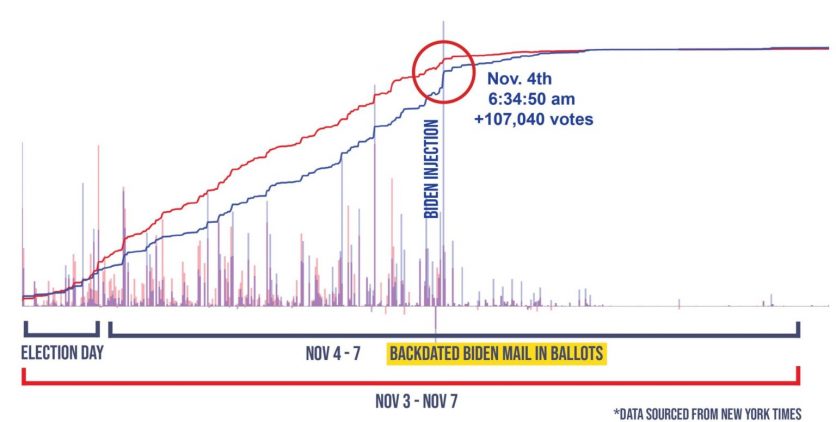
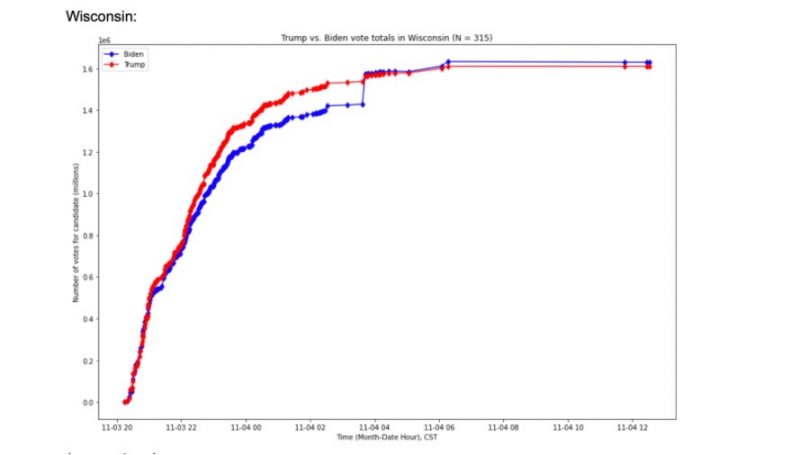
In the early hours of November 4th, 2020, Democratic candidate Joe Biden received several major vote spikes that substantially and decisively improved his electoral position in Michigan, Wisconsin, and Georgia.
Much skepticism and uncertainty in the scientific community surrounds these vote spikes. Suspicious vote counting practices, extreme differences between the two major candidates’ vote counts, and the timing of the vote updates, among other factors, casts doubt on the legitimacy the spikes.
Pennsylvania
In Pennsylvania, there were multiple very questionable vote spikes. In the early morning hours of November 4th, one particular vote spike of 337,000 votes, almost all for Joe Biden appears in the data. Approximately only 3,000 of those votes were for President Trump.
There was also a major vote spike in Georgia of approximately 107,000 votes for Joe Biden, while only a few thousand votes in the batch went for for President Trump. There were numerous other similar vote spikes in Michigan and Wisconsin, at similar times and dates, with similar results.
No forensic data scientist can provide an explanation for this phenomenon, other than potential illegal ballot harvesting and other forms of fraud at a massive scale. The likelihood of these early morning vote spikes in mail-in ballots legitimately breaking for Joe Biden at the margin they did, is statistically 0% in these states.
Georgia
Michigan:
Wisconsin:
The Red Mirage?
Many point to the ‘red mirage’ hypothesis to explain why these vote spikes favored Joe Joe Biden in key swing states. The red mirage scenario predicted that at the end of election day, it would erroneously appear that President Trump won the election because most states would count the ballots cast in-person on election day first. The hypothesis concluded that after tallying the mail-in ballots, Joe Biden would pull ahead because mail-in ballots tend to favor the democrats more than the republicans.
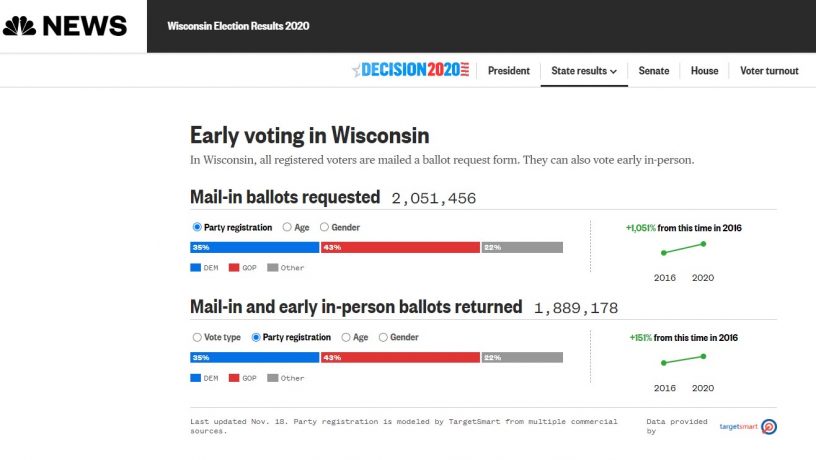
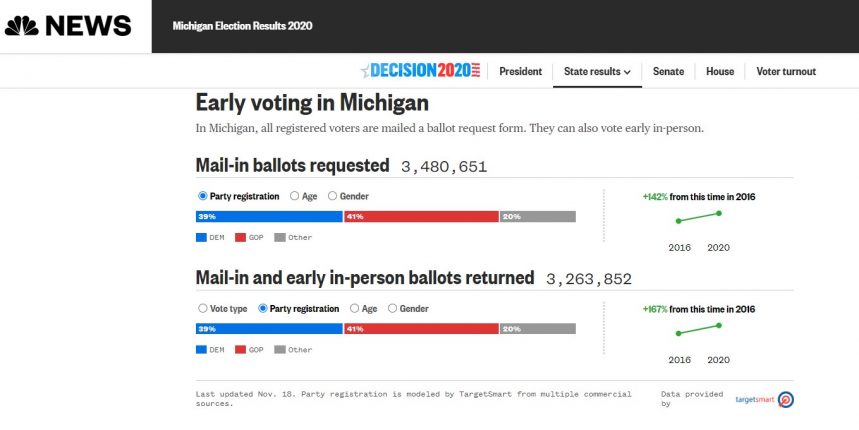
Outside of the impossibility that these vote spikes favored Joe Biden at margins they did – some as high as 99% – this explanation is particularly impossible considering republicans led in mail-in ballots requested and mail-in and early in-person ballots returned.
According to NBC News on election day, in Michigan Republicans led 41% to 39% in mail-in ballots requested. Republicans also led 42% to 39% with mail-in and early in-person ballots returned.
In Wisconsin on election day , Republicans led in mail-in ballots requested 43% to 35%, and mail-in and early in-person ballots returned 43% to 35%.
Historic Low Mail-in Ballot Rejection Rate
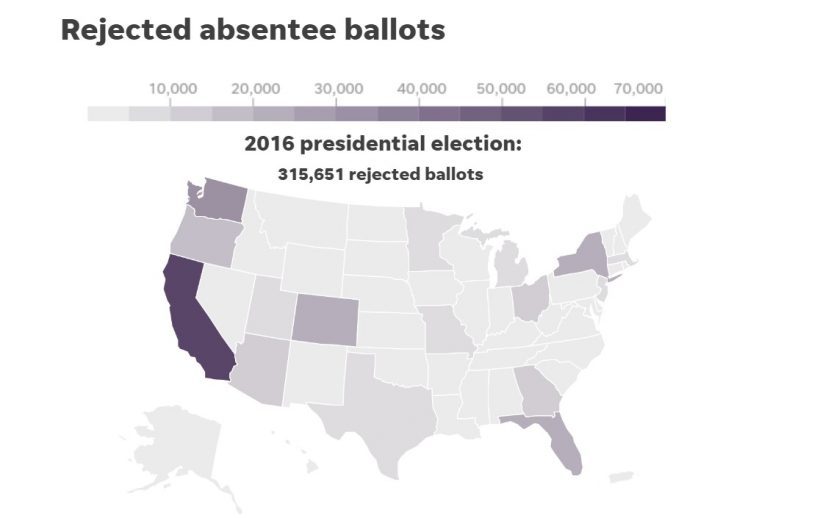
In a normal election year in any given state, hundreds or even thousands of mail-in ballots get tossed out for everything from late postmarks to open envelopes.
North Carolina rejected 546 ballots for just missing witness signatures in the 2012 presidential race. Virginia tossed 216 ballots in the 2018 midterms because they arrived in an unofficial envelope. Arizona discarded 1,516 ballots for non-matching signatures the same year.
In October, USA Today predicted that absentee ballot rejection totals would reach historic levels.
“At least 1.03 million absentee ballots could be tossed if half of the nation votes by mail. Discarded votes jump to 1.55 million if 75% of the country votes absentee. In the latter scenario, more than 185,000 votes could be lost in Florida, North Carolina, Pennsylvania, and Wisconsin – states considered key to capturing the White House.”
In Georgia alone, it was predicted that over 100,000 absentee ballots would be rejected based on the normal percentage that are rejected in an average year.
That’s not what happened.
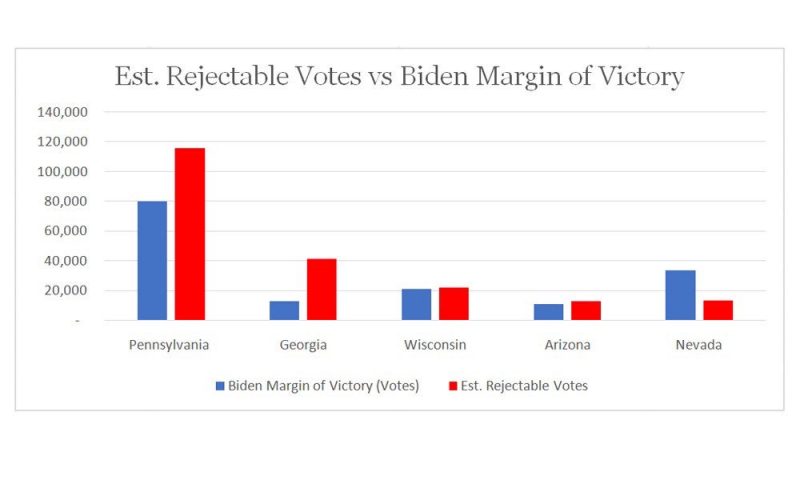
Mail-in ballots in Pennsylvania specifically have been accepted at almost 30times the rate compared to historical norms. This raises serious questions in a swing state in which Democratic challenger Joe Biden is the projected to be the winner.
Reports about the rejection rate for mail-in ballots in the general election suggest that it was a fraction of a percent, which is up to 30 times lower than absentee ballots in an election without mass vote-by-mail.
The below graph shows the estimated rejectable votes vs the Biden margin of victory in key swing states.
Pennsylvania Impossibilities
In Pennsylvania since 2016, Democrats have lost over 50,000 registered voters. During the same time period, Republicans have gained over 150,000 registered voters statewide.
Not only did President Trump lose this state after leading by almost 800,000 votes on election day, but Joe Biden also annihilated Barack Obama’s 2012 numbers, as well as Hillary Clinton’s 2016 totals by 500,000 each.
While President Trump dominated in Ohio, Indiana, and Florida – flipping blue counties that haven’t been red for decades – he also lost in several demographically identical counties in Pennsylvania and Georgia, and is projected to lose those states.
The below graph depicts these highly questionable results.
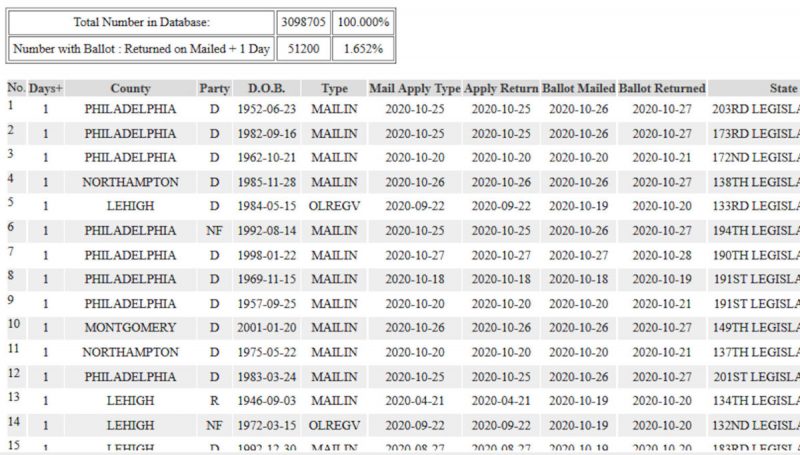
According to data scientists, there were also over 200,000 ballots either returned a day before they were mailed out, returned on the same day, or one day
More than 20,000 absentee ballots in Pennsylvania have impossible return dates and more than 80,000 have marked return dates that raise questions, according to a researcher’s analysis of the state’s voter database.
“Over 51,000 ballots were marked as returned just one day after they were sent out, while nearly 35,000 were marked returned on the same day that they were mailed out.”
Another more than 23,000 have a return date earlier than the sent date. More than 9,000 have no sent date.
A screenshot of publicly available mail ballot data in Pennsylvania showing the date when ballots were sent out (3rd column from right) and received (2nd column from right) only one day apart. (Data source: Pennsylvania Secretary of State)
According to Politico, it was the ballots found in postal facilities that put Biden over the top in Pennsylvania. Postal workers found thousands of ballots in Philadelphia and Pittsburgh facilities Thursday after election day.
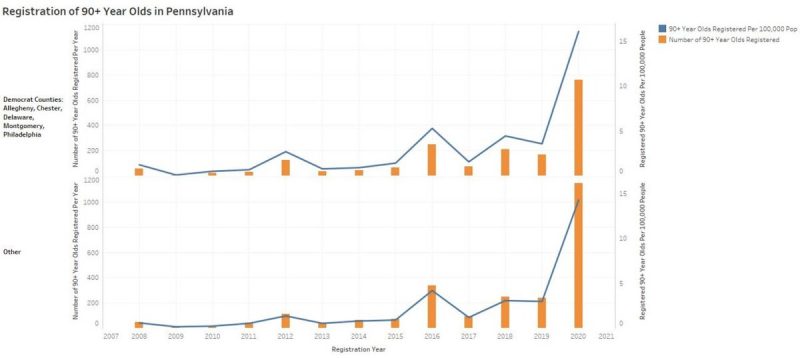
There also happens to be a record number of 90-year-olds registered to vote – in one year – than at any point in Pennsylvania history.
Another analysis of voting data in Pennsylvania shows that even if Joe Biden won 95% of returned Democrat mail-in votes, 21% of returned Republican votes, and 80% of returned independent votes, he would still have come up short of his margin of victory reported in the unofficial tally.
Exit polls showed Biden getting just 8% of the GOP vote overall. While the 95% number for Democrat mail-ins is closer (exits showed him getting 92%), the notion that 80% of mail-in ballots from independents went to Joe Biden is impossible. Exit polls showed Joe Biden winning around 52% of the independents vote overall.
Arizona Impossibilities
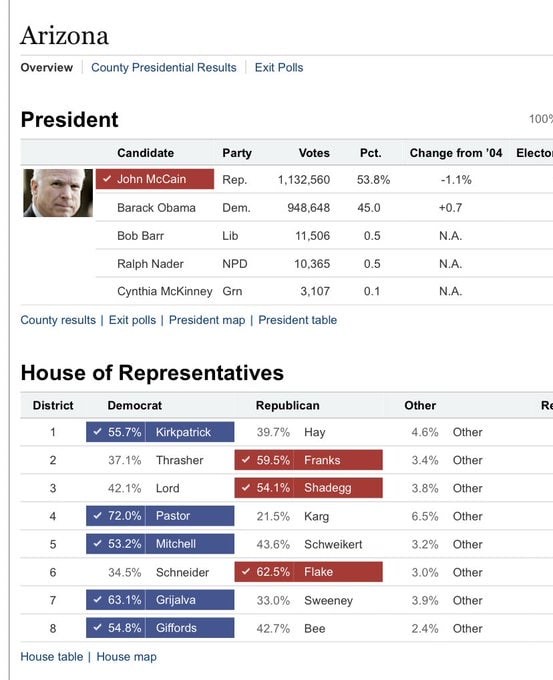
In Arizona, Joe Biden completely blew Barack Obama’s 2008 totals out of the water by approximately 700,000 votes. This is despite the fact that republicans gained 30,000 more registered voters than democrats this year in the state. Republicans also led in registered voters by over 100,000 voters in Arizona.
Even after adjusting for the voter registration increase – which republicans led in by a wide margin – a massive gap of hundreds of thousands of votes remains.
Nevada Impossibilities
A recent analysis of Nevada vote tallies uncovered an unprecedented jump in ‘problem voter’ registrations, which will likely prove the Trump legal team with another avenue to challenge Joe Biden’s victory in another state.
In an affidavit filed in the state, a data scientist found a questionable surge of incomplete voter registrations, and those giving casinos and temporary RV parks as “their home or mailing addresses.”
The expert, Dorothy Morgan, said that her initial study of the records showed a ‘historically strange’ jump in voter registrations missing the sex and age of the voter, making any confirmation by poll workers impossible.
She found that in the presidential election of 2016, there were 68 voter registrations missing this particular critical data. In the 2020 election, it was 13,372.
Additionally, over 70% of the incomplete registrations took place between July and September of this year.
In her two-page affidavit, Morgan wrote, “This investigation found over 13K voters whose voter registration information revealed no sex or date of birth. Not only does this mean we cannot verify whether these voters are old enough to vote, it is also historically strange: While one does not expect voter registration information to be perfect, it is very strange that there were very, very few of these kinds of imperfect records with missing or invalid information until this year – when there are 13,372 of them.”
Several addresses were odd too, she wrote.
Sworn Affidavits and Testimonies of Fraud
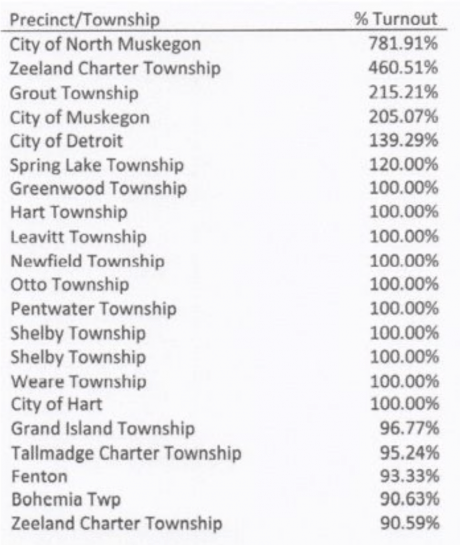
According to an affidavit in one Michigan lawsuit, one one particular township in the state had a voter turnout of 781.91%
According to the lawsuit, the townships of Zeeland Charter and Grout had 215% and 460% respectively, while ten others had 100% turnout.
In 3,000 precincts in Michigan voter turnout was reported at anywhere between 90% and over 700%.
Another election lawsuit filed in Michigan alleges there was massive voter fraud in vote-counting procedures in Wayne County, a Democratic stronghold and home to the city of Detroit.
Witnesses filing sworn affidavits under oath allege that Wayne County elections officials encouraged fraud, including changing legal names and dates on ballots, ballot-harvesting, voter intimidation, and preventing poll watchers from challenging irregularities in the vote-counting process.
“This type of widespread fraud in the counting and processing of voter ballots cannot be allowed to stand. Michigan citizens are entitled to know that their elections are conducted in a fair and legal manner and that every legal vote is properly counted,” said David A. Kallman, an attorney with the Great Lakes Justice Center.
Read this sworn affidavit from GOP poll challenger, and former Assistant AG for Michigan, Zachary Larsen, on the alleged fraud he observed in Detroit. This is Third World stuff, and every American should be outraged if these allegations are true https://t.co/63nLXJxAZFpic.twitter.com/9WbamMw4Yc
Another sworn statement from Detroit indicates that several boxes of ballots were brought in through the back door of the TCF center at 9pm on Wednesday. Election rules state that all ballots needed to be inputted into the system by 9pm on Tuesday, November 3rd.
Election workers inputted the entire batch into the QVF system and manually added each voter to the list after 9pm.
Here's some more of the shenanigans detailed in a lawsuit coming out of Detroit on raft of alleged fraudulent actions observed during election night count. What does Joe Biden have to say about these allegations? Are these witnesses Russian traitors too? https://t.co/JPrGh4uNo6pic.twitter.com/5tk8feDD54
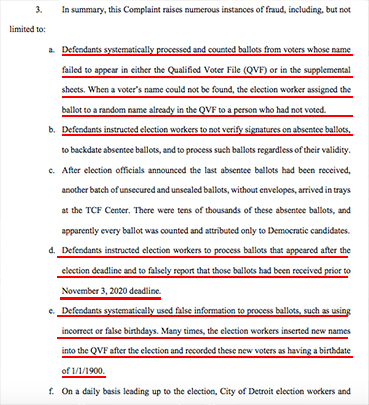
Another part of the statement claims election workers assigned ballots to random names already in the Qualified Voter File to people who haven’t voted in the 2020 election. The sworn statement alleges that election workers systematically used false information in order to be able to process the absentee ballots, such as false birthdays.
“Election workers assigned ballots to random names already in the QVF to a person who had not voted. Defendants systematically used false information to process absentee ballots, such as using incorrect of false birthdays. Many times the election workers inserted new names into the QVF after the election and recorded these new voters as having a birthdate of 1/1/1900”
Outperforming Election Norms
Biden underperformed Hillary Clinton’s 2016 totals in every urban county in the United States, yet he outperformed her in only the metropolitan counties of Georgia, Michigan, Wisconsin, and Pennsylvania.
Biden is set to become the first president in six decades to lose Ohio and Florida, yet win the presidential election. For over 100 years, these states have consistently predicted the national outcome of the election.
Joe Biden lost almost every historic bellwether county across the country, yet is on his way to becoming the 46th president of the United States. The Wall Street Journal recently analyzed the results of 19 counties around the United States that have almost perfect presidential voting prediction records over the last four decades. President Trump won every single county, except Clallam County in Washington state.
Additionally, Joe Biden received more votes than any other candidate in history, despite Democrats’ massive and widespread losses in the House of Representatives.
Donald Trump was the only incumbent president in U.S. history to lose his re-election while his own party gained seats in the House of Representatives.
Confirmed Errors
On and after election day, there were several confirmed reporting errors that were fixed upon being revealed by journalists as they watched the numbers roll in.
• Arizona
In Arizona according to Politico, an error found in Edison Research data that was identified by a journalist showed that 98% of the vote had been counted on November 4th in Arizona when in fact only 84% of the vote had been counted. Officials corrected this mistake when it was pointed out.
• Georgia
In Georgia, Voters were unable to cast machine ballots for a couple of hours in Morgan and Spalding counties after the electronic devices crashed, state officials said.
The companies “uploaded something last night, which is not normal, and it caused a glitch,” said Marcia Ridley, elections supervisor at Spalding County Board of Election. That glitch prevented poll workers from using the pollbooks to program smart cards that the voters insert into the voting machines.
“That is something that they don’t ever do. I’ve never seen them update anything the day before the election,” Ridley said. Ridley said she did not know what the upload contained.
Additionally in four Georgia counties, there were misplaced memory cards with votes that officials forgot to upload and tally. When the memory cards were discovered, the uncounted voted decreased the margin in the state by a few thousand votes.
• Michigan
There was also something suspicious about the vote reporting in Antrim County, Michigan, where Trump beat Hillary Clinton by 30 points in 2016. Initial vote totals there showed Biden ahead of Trump by 29 points, a result that can’t possibly be accurate, as plenty of journalists noted.
When NY Times journalist Ben Rothenberg pointed this out on Twitter, they corrected the totals and called this an ‘error.’
According to the Detroit Free Press, a USA Today affiliate, officials further investigated the wonky election results in Antrim County.
Antrim County Clerk Sheryl Guy said results on electronic tapes and a computer were somehow scrambled after the cards were transported in sealed bags from township precincts to county offices and uploaded onto a computer.
In 2016, Trump won Antrim County with about 62% of the vote, compared with about 33% for Democrat Hillary Clinton. Trump beat Clinton by about 4,000 votes.
The day after election day, Antrim results showed Democrat Joe Biden leading Trump by slightly more than 3,000 votes, with 98% of precincts reporting.
These results were of course reversed.
In Oakland County’s 15th county commission district, a fixed computer glitch turned a losing Republican into a winner. A computer error led election officials in Oakland County to hand an upset victory Wednesday to a Democrat, only to switch the win back to an incumbent Republican a day later. The incumbent, Adam Kochenderfer appeared to lose by a few hundred votes, an outcome that seemed odd to many in his campaign. After the apparent computer error was found and fixed, Kochenderfer ended up winning by over 1,000 votes.
There were many other confirmed errors, including in Virginia where 100,000 extra votes were tallied for Joe Biden, and more may be revealed as the weeks go on.
Georgia Chaos
In just three counties, Joe Biden’s campaign was able to surpass Barack Obama’s historic 2008 performance by a combined 302,576 votes.
This is nearly 24 times more than the current margin of 12,670 votes, in a state Trump won in 2016. The results defy reason.
There were also many processing delays, specifically in Fulton county Georgia where a pipe suddenly ‘burst’ in the processing center.
On November 4th, at approximately 6:07 a.m., the staff at State Farm Arena notified Fulton County Registration and Elections of a burst pipe affecting the room where absentee ballots were being tabulated.
As of 7 p.m. on Wednesday Fulton County Elections officials said 30,000 absentee ballots were not processed due to a pipe burst. Officials reassured voters that none of the ballots were damaged and the water was quickly cleaned up.
But the emergency delayed officials from processing ballots between 5:30 a.m. and 9:30 a.m.
Officials in Georgia have not been able to produce any invoices or work orders related to a “burst pipe” at Atlanta’s State Farm Arena that was blamed for an abrupt pause in vote counting on election night.
According to Georgia GOP Chairman David Shafer, a third county in Georgia discovered a memory card with uncounted votes, a majority of which were cast for President Donald Trump.
“Our monitors tell us that Walton County election officials have found a memory card that was apparently not uploaded. The number of uncounted votes is not as large as in Floyd or Fayette but the President will pick up votes,” Shafer said on Twitter.
Previously, in Georgia’s Floyd and Fayette Counties, memory cards were also discovered with uncounted votes, mostly for President Trump. Of the roughly over 5,000 total votes discovered, approximately two thirds of those votes were for President Donald Trump.
The memory cards unearthed in the three counties add up to over 1,400 net votes for Trump, closing his gap with Biden from 14,156 minus 12,753.
Georgia’s Secretary of State Brad Raffensperger blamed the problem on Floyd County election officials failing to upload votes from a memory card in a ballot-scanning machine.
Former Data Chief and Strategist for Trump for President, Matt Braynard also recently discovered an alarming trend happening in Georgia.
Postal facilities like UPS and FedEx were apparently used to cast votes, with their addresses disguised as apartments.
Update:
– Sample of the postal facilities (USPS, FedEx, UPS) addresses disguised as apartments, etc. in Georgia.
I will release the full dataset for GA and PA with the package that includes the survey toplines, etc. pic.twitter.com/ifXe0SPKBk
According to Braynard, in Georgia nearly 100% of the voters who disguised a postal facility as their residential address voted absentee, with nearly zero voting on Election Day.
Under federal law, it is illegal to use a post office mailing address to cast your ballot. According to section 2 of this federal document, you cannot use a post office box mailing address.
Even if it was legally allowed under federal law to use a PO box as a residential address for your ballot, most of the postal facilities found in the data do not even have post office boxes at their facilities.
Thus far, Braynard and his team have discovered nearly 1400 early and absentee voters who have registered their residential addresses to postal facilities.
Massive Enthusiasm Gap:
Joe Biden with almost record low enthusiasm, underperformed across many major cities compared to Hillary Clinton in 2016.
In New York City, Chicago, and Miami, he was down 201,408, 260,835, and 6,945 respectively.
However, in the states Biden needed to overtake Trump in 2020, he gained massively. According to the Associated Press vote total data, in Atlanta, Milwaukee, and Pittsburg, he was up 76,518, 67,630, and 29,150 respectively.
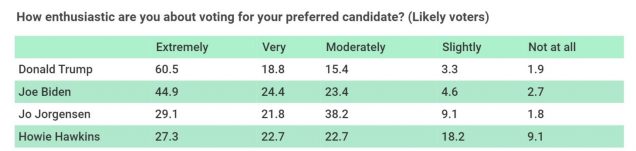
According to polling, The difference in enthusiasm for the candidates is significant. Trump leads 52.9 percent to 45 percent among the 51.2 percent of registered Rust Belt voters who say they are “Extremely Enthusiastic” about voting for their preferred candidate. Among likely voters who are extremely enthusiastic, the president enjoys a double-digit advantage—60.5 percent to 44.9 percent.
Less than half of the supporters of former vice president Joe Biden, (46.9 percent) said they were voting for Joe Biden because they like the candidate. Approximately 8 in 10 voted for President Trump because they wanted his as President.
As Russia moves to liberalize its Visa system for most Western visitors, the US has said it will close its last consulates outside Moscow. This step is certain to reduce person-to-person contacts between Americans and Russians.
The decision, which has echoes of the Cold War, albeit with roles reversed in terms of the paranoia at play, will see diplomatic offices close in the Far Eastern capital Vladivostok, and in Ekaterinburg, Russia’s fourth largest city, located east of the Ural Mountains. President Donald Trump’s administration notified Congress of the plans over a week ago, but the news received little coverage until Saturday.
While the exact timings of the closures have not yet been made clear, it is understood that American officials will be transferred to the country’s embassy in Moscow, while local Russian support staff will be laid off. In news that will satisfy Washington’s deficit hawks, the State Department predicts that the move, if made permanent, would save $3.2 million each year.
In a written communiqué, the administration claims that its actions are “in response to ongoing staffing challenges of the US Mission in Russia in the wake of the 2017 Russian-imposed personnel cap on the US Mission and resultant impasse with Russia over diplomatic visas.” The presence of state representatives first became an issue in 2016, when Washington expelled 35 of Moscow’s diplomats, limiting its mission’s numbers, over alleged attempts to interfere with that year’s Presidential elections, which Russia strenuously denies.
The decision leaves the US without formal representation anywhere apart from the capital, in a country that bridges two continents. As well as providing consular services to the more than a quarter of a million Americans who visit Russia each year, the offices are charged with issuing visas to Russians wishing to travel stateside.
Residents of Russia’s Far East who wish to visit the US will now have to fly for up to nine hours to Moscow for a Visa, with no guarantees that their application will be approved. Likewise, Americans needing to access consular services will face days of travel if they need support in Siberia or the Far East. The move, and the restrictive Visa regime, flies in the face of Russia’s recent policy towards liberalizing the process, with the introduction of a digital system offering tourists stays of up to 16-days for no more than $50 to be rolled out in January 2021. Americans are excluded from the scheme, but citizens of most NATO states are eligible.
Many analysts took to Twitter to criticize the American decision, even those usually supportive of a more confrontational approach to relations with Russia. One-time US Ambassador Michael McFaul, who has frequently become the target of ridicule over his bellicose and often inaccurate claims about the country, said that he was “saddened” by the decision, adding that “the US should be seeking ways to engage more directly with Russian society.”
A senior national security adviser to the University of Denver’s Biden Institute, Sam Vinograd, was similarly concerned over the impact of the closures, adding that “there’s a reason we have embassies and consulates in countries. Closing consulates could harm Americans and our interests.”
While ties between Moscow and Washington have been consistently under strain over a number of issues in recent months, it is unclear how the decision to shutter diplomatic offices is expected to relieve tensions. In most cases, consulates fulfil a purely administrative role, but they often also act as hubs for cultural and political exchanges, hosting events and enabling diplomats to get a better understanding of a country beyond its capital. Shuttering them also deprives the US of a useful vantage point in Vladivostok, in close range of China, North Korea and Japan.
In 2018, US officials forced Moscow to shut its consulate in Seattle, leaving it without any representation on America’s West Coast. In retaliation, the Kremlin told Washington to shut down its equivalent operations in the city of St Petersburg, one of Russia’s most popular tourist destinations. The spat saw around 60 diplomats expelled from the country, with Deputy Foreign Minister Sergey Ryabkov saying at the time that they had been ”declared ‘persona non grata’ for activities incompatible with diplomatic status.”
These decisions have widely been interpreted as attempts to restrict the kind of human-to-human contact that helps challenge established narratives about countries. In the Soviet-era, access to the country for foreign visitors was tightly restricted. But now, it would appear that the situation has reversed and, if a new Cold War is indeed underway, the US has chosen to close its doors to many Russians.
United Airlines announced on Friday that the Boeing 737 MAX 8 would be returning to the skies beginning February 11, 2021. The aircraft was grounded worldwide in March 2019 following the twin crashes of Lion Air Flight 610 and Ethiopian Airlines Flight 302.
A 18 December report published by the Senate Committee on Commerce, Science, and Transportation revealed that employees of both Boeing and the Federal Aviation Administration (FAA) worked together to manipulate recertification tests of the Boeing 737 MAX 8 following two fatal crashes that together killed a 346.
The 102-page report, which comes some 20 months after the aircraft was grounded, detailed that Boeing “inappropriately influenced FAA human factor simulator testing of pilot reaction times involving a Maneuvering Characteristics Augmentation System (MCAS) failure.”
“Twenty months ago, the Commerce Committee launched an investigation into FAA safety oversight. We have received disclosures from more than 50 whistleblowers, conducted numerous FAA staff interviews, and reviewed over 15,000 pages of relevant documents,” Rep. Roger Wicker (R-MS), chairman of the Senate Committee on Commerce, Science, and Transportation, wrote in his news release.
“Our findings are troubling. The report details a number of significant examples of lapses in aviation safety oversight and failed leadership in the FAA. It is clear that the agency requires consistent oversight to ensure their work to protect the flying public is executed fully and correctly.”
The Senate committee also alleged that senior FAA managers have yet to be appropriately reprimanded or held accountable for the “failure to develop and deliver adequate training in flight standards, despite repeated findings of deficiencies over several decades.”
In addition, senior FAA leadership may have obstructed a review of the 737 MAX 8 crashes initiated by Department of Transportation Office of Inspector General.
“FAA and Boeing were attempting to cover up important information that may have contributed to the 737 MAX tragedies,” the report alleges.
On Friday, it was reported by United Airlines that the Boeing 737 MAX 8 will resume flights out of its Denver, Colorado, and Houston, Texas, facilities. Other aircraft will reportedly be made available for those travelers uneasy about boarding the ill-starred aircraft.
“We will be fully transparent with our customers and will communicate in advance when they are booked to fly on a Max aircraft,” United Airlines wrote in a Friday news release.
Slava Zilber: Sam, three years ago, you appeared on Talk Nation Radio with David Swanson and spoke about the case of the GCHQ whistleblower Katharine Gun. You pointed out that the people involved in the spying on the UN and the people authorizing the Iraq War were not held accountable:
“Virtually everybody who went along with the war, whether it is Kerry or Clinton, of course, the Bush administration themselves has falsified their own records in terms of why, what they did, when they did, why they did it, to the extent that they’ve been scrutinised at all.”
You also address it in a recent article. And recently, Joe Biden has been lying about his position on the Iraq War. How can such an important issue escape meaningful scrutiny? … continue
This site is provided as a research and reference tool. Although we make every reasonable effort to ensure that the information and data provided at this site are useful, accurate, and current, we cannot guarantee that the information and data provided here will be error-free. By using this site, you assume all responsibility for and risk arising from your use of and reliance upon the contents of this site.
This site and the information available through it do not, and are not intended to constitute legal advice. Should you require legal advice, you should consult your own attorney.
Nothing within this site or linked to by this site constitutes investment advice or medical advice.
Materials accessible from or added to this site by third parties, such as comments posted, are strictly the responsibility of the third party who added such materials or made them accessible and we neither endorse nor undertake to control, monitor, edit or assume responsibility for any such third-party material.
The posting of stories, commentaries, reports, documents and links (embedded or otherwise) on this site does not in any way, shape or form, implied or otherwise, necessarily express or suggest endorsement or support of any of such posted material or parts therein.
The word “alleged” is deemed to occur before the word “fraud.” Since the rule of law still applies. To peasants, at least.
Fair Use
This site contains copyrighted material the use of which has not always been specifically authorized by the copyright owner. We are making such material available in our efforts to advance understanding of environmental, political, human rights, economic, democracy, scientific, and social justice issues, etc. We believe this constitutes a ‘fair use’ of any such copyrighted material as provided for in section 107 of the US Copyright Law. In accordance with Title 17 U.S.C. Section 107, the material on this site is distributed without profit to those who have expressed a prior interest in receiving the included information for research and educational purposes. For more info go to: http://www.law.cornell.edu/uscode/17/107.shtml. If you wish to use copyrighted material from this site for purposes of your own that go beyond ‘fair use’, you must obtain permission from the copyright owner.
DMCA Contact
This is information for anyone that wishes to challenge our “fair use” of copyrighted material.
If you are a legal copyright holder or a designated agent for such and you believe that content residing on or accessible through our website infringes a copyright and falls outside the boundaries of “Fair Use”, please send a notice of infringement by contacting atheonews@gmail.com.
We will respond and take necessary action immediately.
If notice is given of an alleged copyright violation we will act expeditiously to remove or disable access to the material(s) in question.
All 3rd party material posted on this website is copyright the respective owners / authors. Aletho News makes no claim of copyright on such material.