China to strengthen military coordination with Russia
By M. K. BHADRAKUMAR | Indian Punchline | December 24, 2020
The joint aerial strategic patrol held by the air forces of Russia and China on December 22 over the Sea of Japan and the East China Sea makes a big statement in the geopolitics of the Asia-Pacific region. Chinese experts have hinted that such events could become “routine” in future.
The Chinese and Russian defence ministries made a joint announcement on the occasion Tuesday. China sent four nuclear-capable H-6K strategic bombers “to form a joint formation” with two of Russia’s famous Tu-95 bombers (NATO reporting name: “Bear”) to conduct the joint patrol as “part of annual military cooperation plan” between the two countries.
The announcement said the joint patrol “aims to further develop the China-Russia comprehensive strategic partnership of coordination in the new era, and enhance the level of the two militaries’ strategic coordination and joint operational capability to jointly safeguard global strategic stability.”
Curiously, only a month ago, on November 6, two Tupolev Tu-95MS strategic missile-carrying bombers of Russia’s Aerospace Force had performed a scheduled 8-hour flight over the neutral waters of the Sea of Japan and the north-western Pacific. Russia’s Defense Ministry said “At some sections of the route, the strategic missile-carrying bombers were escorted by Su-35S fighters.”

Russia’s Tu-95MS Strategic Bomber (Filephoto)
Clearly, the joint patrol with China was not an absolute must from the perspective of Russia’s national defence. But its optics and messaging mattered. This has everything to do with the regional setting with the US and its partners stepping up.
On Dec. 19, USS Mustin conducted a transit through the Taiwan Strait; on Dec. 20, Taiwan conducted a live-fire drill in the Pratas Islands (approx. 300 kms from mainland China) and plans to conduct another on Dec. 27. Pratas Islands are strategically located near the gateway to the South China Sea and are a waypoint for oil tankers and Chinese vessels en route to the Pacific Ocean.
Last week, Taiwan launched its first missile corvette, which the Taiwanese press described as an “aircraft carrier killer”, even as PLA Navy’s first Chinese-made aircraft carrier, the Shandong, completed its third sea trial in a 23-day transit in the Bohai Sea.
Also this month, a US Navy Amphibious Ready Group (ARG) consisting of the USS Makin Island and USS Somerset (LPD 25) patrolled the South China Sea and conducted “unscripted” live-fire drills. The Chinese state-run newspaper Global Times angrily called the ARG “US muscle-flexing actions” that “could damage regional stability,” and commented that “China should be prepared to confront the US in the South China Sea and the Taiwan Straits no matter who sits in the White House.”
Japan has bestirred itself lately, inviting like-minded Western countries to send military units to the Far East signalling that they are united in seeking a free and open Indo-Pacific region. The US, French and Japanese navies conducted integrated exercises in the Philippine Sea in December focusing on anti-submarine warfare; another joint military exercise is planned for May on an outlying Japanese island; the UK plans to send an aircraft carrier strike group to conduct joint exercises with the US Navy and Japanese Maritime Self-Defense Force (JMSDF) early next year.
The Japanese Defense Minister Nobuo Kishi held talks last week with his German counterpart Annegret Kramp-Karrenbauer where he “expressed hope that a German vessel” would join exercises with the JMSDF in 2021 and “suggested it would assist the international community’s efforts to ensure the right of passage of vessels through the South China Sea if the German warship would traverse waters” over which Beijing claims jurisdiction.

Taiwan Navy’s first stealth ‘carrier killer’ corvette Tuo Jiang
Amidst all this, the US’ Naval Service released an integrated maritime strategy designed to take a “more assertive (approach) to prevail in day-to-day competition (with China) as we uphold the rules-based order and deter our competitors from pursuing armed aggression.” Also, the US secretary of the Navy has called for the reestablishment of the 1st Fleet, a numbered Navy fleet, “in the crossroads between the Indian and the Pacific oceans.”
On Dec. 18, the US began building on the second Quad Foreign Ministers’ Meeting in October by organising a virtual “Quad” meeting of senior diplomatic officials from the US, Australia, India and Japan. The US State Department readout said the four countries discussed “practical ways … to coordinate efforts to support countries vulnerable to malign and coercive economic actions in the Indo-Pacific region.”
There is much speculation about how the [prospective] Biden administration will approach the Indo-Pacific. So far, Biden has not mentioned Quad, but he uses the phrase “Indo-Pacific.” But instead of discussing a “free and open” Indo-Pacific (as Trump does), Biden uses the phrase “secure and prosperous.”
To be sure, given the high stakes involved, China and Russia will not take chances. Their joint aerial patrol Tuesday reflects common concern over the region’s strategic stability. Both countries take note of growing interference by extra-regional powers inciting frictions, potentially posing a major threat to regional peace. Meanwhile, the US is deploying anti-missile systems and keeps talking about a NATO-like military alliance in Asia.
In sum, the joint patrol signals that China and Russia are “the linchpins of peace and stability in the Asia-Pacific region and Eurasia. They have no intention to challenge the regional order. They are propelled to respond to external powers which threaten regional security”, as a prominent think tanker at the Institute of Russian, Eastern European and Central Asian Studies under the Chinese Academy of Social Sciences, Yang Jin, put it.
Chinese pundits have discussed the pros and cons of a Sino-Russian military alliance, the consensus opinion being that in the prevailing security environment, the existing format of strategic partnership serves the purpose of meeting common challenges while giving flexibility to serve the self-interests each side. Having said that, military alliance also remains “a last option for the worst situation – when the US or another country launches a war that forces China and Russia to fight side by side” — to quote Yang.
An editorial in the Chinese Communist Party daily Global Times noted, “China and Russia have no intention of forming a military alliance because it cannot resolve the comprehensive challenges the two countries have to face” but the pressure from the US and its allies have “provided an important external impetus” to the strengthening of the comprehensive strategic cooperation as such, including military cooperation.
“As long as they cooperate strategically and jointly deal with challenges, they can generate effective deterrent, form a joint force to deal with specific problems, resist the attempts to suppress the two countries and curb the US’ international misconduct,” the editorial said.
The US-Russia-China triangle is sure to transform under the [prospective] Biden presidency if Washington sets sights on Moscow as the biggest threat to the US national security. Unsurprisingly, Beijing is signalling that the China-Russia strategic partnership should remain close and continue to be strengthened to handle increasing pressure from the US, even if Biden might ease tensions with Beijing.
This strategic emphasis is the leitmotif of an unusually lengthy report by Xinhua in the People’s Daily on the phone conversation between the State Councilor and Foreign minister Wang Yi with his Russian counterpart Sergey Lavrov on December 22.
Democracies Don’t Start Wars. But Democrats Do
By Philip Giraldi | Strategic Culture Foundation | December 24, 2020
It may have been President Bill Clinton who once justified his wrecking of the Balkans by observing that liberal interventionism to bring about regime change is a good thing because “Democracies don’t start wars with other democracies.” Or it might have been George W. Bush talking about Iraq or even Barack Obama justifying his destruction of Libya or his interventions relating to Syria and Ukraine. The principle is the same when the world’s only superpower decides to throw its weight around.
The idea that pluralistic democracies are somehow less inclined to go to war has in fact been around for a couple of hundred years and was first elaborated by Immanuel Kant in an essay entitled “Perpetual Peace” that was published in 1795. Kant may have been engaging in some tongue in cheek as the French relatively liberal republic, the “Directory,” was at that time preparing to invade Italy to spread the revolution. The presumption that “democracies” are somehow more pacific than other forms of government is based on the principle that it is in theory more difficult to convince an entire nation of the desirability of initiating armed conflict compared to what happens in a monarchy where only one man or woman has to be persuaded.
The American Revolution, which preceded Kant, was clearly not fought on the principle that kings are prone to start wars while republics are not, and, indeed, the “republican” United States has nearly always been engaged in what most observers would consider to be wars throughout its history. And a review of the history of the European wars of the past two hundred years suggests that it is also overly simple to suggest that democracies eschew fighting each other. There are, after all, many different kinds of governments, most with constitutions, many of which are quite politically liberal even if they are headed by a monarch or oligarchy. They have found themselves on different sides in the conflicts that have troubled Europe since the time of Napoleon.
And wars are often popular, witness the lines of enthusiastic young men lining up to enlist when the Triple Entente took on the Germans and Austrians to begin the First World War. So, war might be less likely among established democracies, but it should be conceded that the same national interests that drive a dictatorship can equally impact on a more pluralistic form of government, particularly if the media “the territory of lies” is in on the game. One recalls how the Hearst newspaper chain created the false narrative that resulted in the U.S.’s first great overseas imperial venture, the Spanish-American War. More recently, the mainstream media in the United States has supported the disastrous invasion of Iraq, the destabilization of Syria, and the regime change in Ukraine, Afghanistan and Libya.
So now we Americans have the ultimate liberal democratic regime about to resume power, possibly with a majority in both houses of Congress to back up the presidency. But something is missing in that the campaigning Democrats never talked about a peace dividend, and now that they are returning the airwaves are notable for Senators like Mark Warner asking if the alleged Russian hacking of U.S. computers is an “act of war?” Senator Dick Durbin has no doubts on the issue, having declared it “virtually a declaration of war.” And Joe Biden appears to be on board, considering punishment for Moscow. Are we about to experience Russiagate all over? In fact, belligerency is not unique to Donald Trump and Mike Pompeo. War is in the air, and large majority of the Democratic Party recently voted for the pork-bloated National Defense Authorization Act (NDAA), endorsing a policy of U.S. global military dominance for the foreseeable future. If you are an American who would like to see national health insurance, a large majority among Democrats, forget about it!
But more to the point, the Democrats have a worse track record than do the Republicans when it comes to starting unnecessary wars. Donald Trump made the point of denouncing “stupid wars” when he was running for office and has returned to that theme also in the past several weeks, though he did little enough to practice what he preached until it was too late and too little. Clinton notoriously intervened in the Balkans and bombed a pharmaceuticals factory in Sudan and a cluster of tents in Afghanistan to draw attention away from his affair with Monica Lewinsky. His secretary of State Madeleine Albright thought the death of 500,000 Iraqi children due to U.S. sanctions was “worth it.” Barack Obama tried to destroy Syria, interfered in Ukraine and succeeded in turning Libya into an ungovernable mess while compiling a “kill list” and assassinating U.S. citizens overseas using drones.
If you want to go back farther, Woodrow Wilson involved the U.S. in World War One while Franklin D. Roosevelt connived at America’s entry into the Second World War. FDR’s successor Harry Truman dropped two atomic bombs on civilian targets in Japan, killing as many as 200,000. Japan was preparing to surrender, which was known to the White House and Pentagon, making the first use of nuclear weapons completely unnecessary and one might call it a “war crime.” Truman also got involved in Korea and John F. Kennedy started the intervention in Vietnam, though there are indications that he was planning to withdraw from it when he was killed. The only Democratic president who failed to start one or more wars was the much-denigrated Jimmy Carter.
So, it is Joe Biden’s turn at the wheel. One has to question the philosophy of government that he brings with him as he has never found a war that he didn’t support and several of his cabinet choices are undeniably hardliners on what they refer to as national security. The lobbies are also putting pressure on Biden to do the “right thing,” which for them is to continue an interventionist foreign policy. The Israeli connected Foundation for the Defense Democracies (FDD) has not surprisingly issued a collection of essays that carries the title “Defending Forward: Securing America by Projecting Military Power Abroad.” If one had to bet at this point “defending forward” will be what the Biden Administration is all about. And oh, by the way, as democracies don’t go to war with democracies, it will only be the designated bad guys who will be on the receiving end of America’s military might. Or at least that is how the tale will be told.
Philip Giraldi, Ph.D. is Executive Director of the Council for the National Interest.
For 55 Percent Of Americans, 2020 Has Been “A Personal Financial Disaster”
By Michael Snyder | Activist Post | December 24, 2020
One of the big reasons why so many Americans are angry about the size of the “stimulus payments” in the COVID relief bill that Congress just passed is because this year has truly been a “financial disaster” for millions upon millions of people.
More Americans than ever before are just barely scraping by from month to month, and $600 is just not going to go very far. In 2020, small businesses have been getting slaughtered by the thousands, millions of Americans are in imminent danger of being evicted from their homes, and more than 70 million new claims for unemployment benefits have been filed since the COVID pandemic first started. The U.S. has plunged into a brutal economic depression, and most of the country is desperately hoping that the federal government will do more to bail them out.
Of course the truth is that we can’t actually afford another 900 billion dollar “stimulus package” on top of all the other “stimulus packages” that were already passed this year.
We are already 27.5 trillion dollars in debt, and all of this reckless spending is putting us on a highway to hyperinflation.
But most Americans don’t really care that we are literally destroying our national finances. Most people are in desperate need of money, and the vast majority of them want checks from the government as soon as possible.
A OnePoll survey that was just released asked Americans about the current state of their finances, and that survey discovered that a whopping 55 percent of us consider this year to be “a personal financial disaster”…
While there is no question 2020 has been an unparalleled health challenge, many are not losing sight of how devastating the year was for their wallets as well. A new survey finds over half of Americans (55%) consider 2020 a personal financial disaster.
That is over half the country!
And for those that are employed, that same survey found that 62 percent are planning to take on a second job in 2021 in an attempt to make ends meet…
Among employed respondents (59% in total), seven in 10 say they need a raise at their job in order to make ends meet. Sixty-two percent plan on taking on a second job in 2021 to meet their financial goals next year.
That number can’t possibly be correct, can it?
Of course there aren’t that many jobs to go around. Already, there are millions upon millions of Americans that can’t find a “first job”. As I discussed the other day, we have got unemployed workers sleeping in lawn chairs or sleeping in their own vehicles because that is all they can afford at this point.
We haven’t seen anything like this since the Great Depression of the 1930s, and this latest wave of lockdowns is making things even worse.
With so many Americans financially hurting, it shouldn’t be a surprise that millions of households are getting behind on their rent and mortgage payments…
One-in-seven renters with family incomes from $35,000 to $100,000 were not current on their rent in November. The overwhelming majority of these renters – 79.9% — expected to face eviction within two months. Similarly, 9.6% of homeowners with a mortgage were not current on their mortgage in November. And 56.1% of those homeowners expected they will be foreclosed on in the subsequent two months.
Congress keeps extending moratoriums on rent and mortgage payments, and that has been financially devastating landlords and mortgage holders.
At some point the moratoriums must end, and when that happens we are going to see a tsunami of evictions that will be absolutely unprecedented in U.S. history.
Meanwhile, many Americans are going very deep into debt in a desperate attempt to keep themselves afloat financially…
More than one-third of households with incomes between $35,000 and $100,000 borrowed from credit cards, other loans as well as from friends and family to pay for their current expenses in November. Soon, debt payments will come due, burdening families that still suffer from long-term unemployment and added health care costs. This could mean rising credit default rates as well as spillovers of economic pain to other households, from who people borrowed to pay their bills.
If economic conditions were to “return to normal” in 2021, most Americans would be able to weather this financial storm just like they did in 2008 and 2009.
But things are not going to return to normal next year.
Instead, this new wave of lockdowns is going to cause thousands of more businesses to close and will force millions more Americans on to the unemployment rolls.
What we are doing to our small businesses is absolutely criminal. At this point, small business revenues are down more than 32 percent nationwide since the month of January…
Small business revenues have also taken a hit nationwide. The national average is a decrease of 32.1 percent in small business revenue since January. Washington D.C. had the worst loss in the nation at 61.6 percent. Oregon small businesses lost 16.3 percent. Illinois small businesses saw 39.2 percent decline in revenue since January.
Every day, more small businesses are closing up shop permanently.
Millions of hopes and dreams have been brutally crushed, and there is nothing that our politicians can say or do that will bring those businesses back to life.
If you have lost a business or a job this year, then that would definitely qualify as one of the “personal financial disasters” of 2020.
And as you have seen in this article, you are far from alone.
Most of the nation is deeply hurting, and the road ahead is only going to get more challenging.
In the short term, “stimulus payments” from the federal government will definitely help tens of millions of suffering Americans.
But of course every additional dollar that our government borrows and spends just makes our long-term problems even worse.
A national economic meltdown has begun, and our politicians will try lots of things to mitigate the damage, but all of their “solutions” will only help temporarily.
This is going to be an exceedingly dark chapter for America, but most Americans still do not understand the true nature of the crisis that is now unfolding all around us.
Michael’s new book entitled “Lost Prophecies Of The Future Of America” is now available in paperback and for the Kindle on Amazon.
US official: Indonesia could get billions in funding in return for normalisation

Indonesian Muslims protest outside the US ambassador’s office in Indonesia against US recognition of Jerusalem as the capital of Israel, in Jakarta on December, 8, 2017 [Dasril Roszandi / Anadolu Agency]
MEMO | December 23, 2020
Indonesia could see billions of dollars in additional funding from the US if it agreed to normalise ties with Israel, a US official has said.
Bloomberg quoted Chief Executive of the United States Agency for International Development (USAID), Adam Buehler, as saying that the agency could double its investments in Indonesia, which currently amount to about $1 billion, if Jakarta establishes diplomatic relations with Israel.
“We are talking to Indonesia about this … if they are ready for it, we will be happy to provide them with financial support that is greater than what we actually offer now.”
The US official said he would not be surprised if the aid provided by the agency to Indonesia, the most populous Muslim country, increases by one or two billion dollars if Jakarta establishes diplomatic relations with Israel.
US and Israeli leaders say that they expect more countries to join the wave of normalisation which began in August with the announcement that the UAE had agreed to sign a peace deal with the occupation state. This was quickly followed by Bahrain, Sudan and Morocco.
The United States hopes that Oman and Saudi Arabia will sign similar deals in the future, although Buehler said it is not likely that USAID will provide assistance to the two countries because the rules do not allow the agency to invest in high-income countries.
Late last month Indonesia reaffirmed its firm support for Palestinian independence.
A non-permanent member of the UN Security Council, Indonesia presents one of its main goals on the council as dealing with the Palestinian question. It has had no formal relations with the occupation state of Israel since it was formed on Palestinian land in 1948. In support of Palestine, Jakarta issued a tax exemption on Palestinian imports.
In turn, Israel has taken soft measures against Indonesia such as banning tourists from the country but has made overtures towards it in recent years in order to influence the process of normalisation.
With Biden’s New Threats, the Russia Discourse is More Reckless and Dangerous Than Ever
The U.S. media demands inflammatory claims be accepted with no evidence, while hacking behavior routinely engaged in by the U.S. is depicted as aberrational.
By Glenn Greenwald | December 23, 2020
To justify Hillary Clinton’s 2016 loss to Donald Trump, leading Democrats and their key media allies for years competed with one another to depict what they called “Russia’s interference in our elections” in the most apocalyptic terms possible. They fanatically rejected the view of the Russian Federation repeatedly expressed by President Obama — that it is a weak regional power with an economy smaller than Italy’s capable of only threatening its neighbors but not the U.S. — and instead cast Moscow as a grave, even existential, threat to U.S. democracy, with its actions tantamount to the worst security breaches in U.S. history.
This post-2016 mania culminated with prominent liberal politicians and journalists (as well as John McCain) declaring Russia’s activities surrounding the 2016 [election] to be an “act of war” which, many of them insisted, was comparable to Pearl Harbor and the 9/11 attack — the two most traumatic attacks in modern U.S. history which both spawned years of savage and destructive war, among other things.
Sen. Jeanne Shaheen (D-NH) repeatedly demanded that Russia’s 2016 “interference” be treated as “an act of war.” Hillary Clinton described Russian hacking as “a cyber 9/11.” And Rep. Jerry Nadler (D-NY) on MSNBC in early February, 2018, pronounced Russia “a hostile foreign power” whose 2016 meddling was the “equivalent” of Pearl Harbor, “very much on par” with the “seriousness” of the 1941 attack in Hawaii that helped prompt four years of U.S. involvement in a world war.
With the Democrats, under Joe Biden, [presumably] just weeks away from assuming control of the White House and the U.S. military and foreign policy that goes along with it, the discourse from them and their media allies about Russia is becoming even more unhinged and dangerous. Moscow’s alleged responsibility for the recently revealed, multi-pronged hack of U.S. Government agencies and various corporate servers is asserted — despite not a shred of evidence, literally, having yet been presented — as not merely proven fact, but as so obviously true that it is off-limits from doubt or questioning.
Any questioning of this claim will be instantly vilified by the Democrats’ extremely militaristic media spokespeople as virtual treason. “Now the president is not just silent on Russia and the hack. He is deliberately running defense for the Kremlin by contradicting his own Secretary of State on Russian responsibility,” pronounced CNN’s national security reporter Jim Sciutto, who last week depicted Trump’s attempted troop withdrawal from Syria and Germany as “ceding territory” and furnishing “gifts” to Putin. More alarmingly, both the rhetoric to describe the hack and the retaliation being threatened are rapidly spiraling out of control.
Democrats (along with some Republicans long obsessed with The Russian Threat, such as Mitt Romney) are casting the latest alleged hack by Moscow in the most melodramatic terms possible, ensuring that Biden will enter the White House with tensions sky-high with Russia and facing heavy pressure to retaliate aggressively. Biden’s top national security advisers and now Biden himself have, with no evidence shown to the public, repeatedly threatened aggressive retaliation against the country with the world’s second-largest nuclear stockpile.
Congressman Jason Crow (D-CO) — one of the pro-war Democrats on the House Armed Services Committee who earlier this year joined with Rep. Liz Cheney (R-WY) to block Trump’s plan to withdraw troops from Afghanistan — announced: “this could be our modern day, cyber equivalent of Pearl Harbor,” adding: “Our nation is under assault.” The second-ranking Senate Democrat, Dick Durbin (D-IL), pronounced: “This is virtually a declaration of war by Russia.”
Meanwhile, Sen. Mitt Romney (R-UT), who has for years been casting Russia as a grave threat to the U.S. while Democrats mocked him as a relic of the Cold War (before they copied and then surpassed him), described the latest hack as “the equivalent of Russian bombers flying undetected over the entire country.” The GOP’s 2012 presidential nominee also blasted Trump for his failure to be “aggressively speaking out and protesting and taking punitive action,” though — like virtually every prominent figure demanding tough “retaliation” — Romney failed to specify what he had in mind that would be sufficient retaliation for “the equivalent of Russian bombers flying undetected over the entire country.”
For those keeping track at home: that’s two separate “Pearl Harbors” in less than four years from Moscow (or, if you prefer, one Pearl Harbor and one 9/11). If Democrats actually believe that, it stands to reason that they will be eager to embrace a policy of belligerence and aggression toward Russia. Many of them are demanding this outright, mocking Trump for failing to attack Russia — despite no evidence that they were responsible — while their well-trained liberal flock is suggesting that the non-response constitutes some form of “high treason.”
Indeed, the Biden team has been signalling that they intend to quickly fulfill demands for aggressive retaliation. The New York Times reported on Tuesday that Biden “accused President Trump [] of ‘irrational downplaying’” of the hack while “warning Russia that he would not allow the intrusion to ‘go unanswered’ after he takes office.” Biden emphasized that once the intelligence assessment is complete, “we will respond, and probably respond in kind.”
Threats and retaliation between the U.S. and Russia are always dangerous, but particularly so now. One of the key nuclear arms agreements between the two nuclear-armed nations, the New START treaty, will expire in February unless Putin and Biden can successfully negotiate a renewal: sixteen days after Biden is [tentatively] scheduled to take office. “That will force Mr. Biden to strike a deal to prevent one threat — a nuclear arms race — while simultaneously threatening retaliation on another,” observed the Times.
This escalating rhetoric from Washington about Russia, and the resulting climate of heightened tensions, are dangerous in the extreme. They are also based in numerous myths, deceits and falsehoods:
First, absolutely no evidence of any kind has been presented to suggest, let alone prove, that Russia is responsible for these hacks. It goes without saying that it is perfectly plausible that Russia could have done this: it’s the sort of thing that every large power from China and Iran to the U.S. and Russia have the capability to do and wield against virtually every other country including one another.
But if we learned nothing else over the last several decades, we should know that accepting claims that emanate from the U.S. intelligence community about adversaries without a shred of evidence is madness of the highest order. We just had a glaring reminder of the importance of this rule: just weeks before the election, countless mainstream media outlets laundered and endorsed the utterly false claim that the documents from Hunter Biden’s laptop were “Russian disinformation,” only for officials to acknowledge once the harm was done that there was no evidence — zero — of Russian involvement.
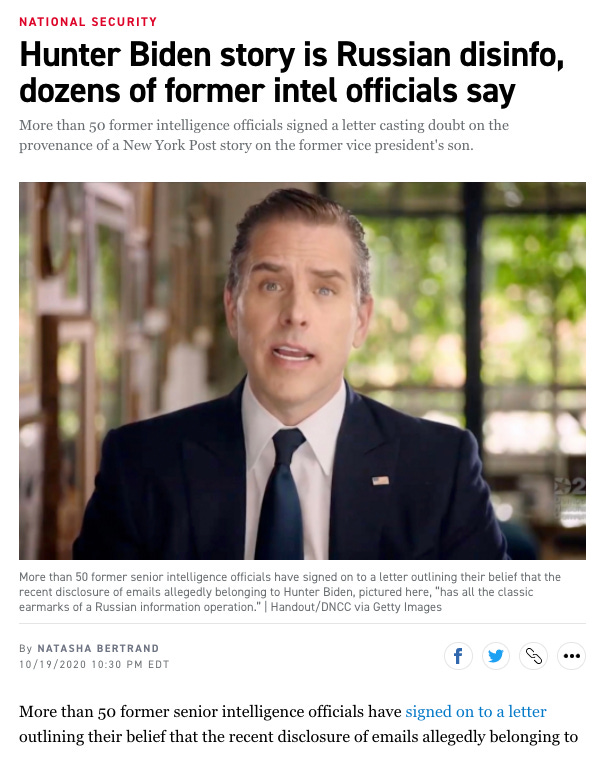
Yet that is exactly what the overwhelming bulk of media outlets are doing again: asserting that Russia is behind these hacks despite having no evidence of its truth. The New York Times’ Michael Barbaro, host of the paper’s popular The Daily podcast, asked his colleague, national security reporter David Sanger, what evidence exists to assert that Russia did this. As Barbaro put it, even Sanger is “allowing that early conclusions could all be wrong, but that it’s doubtful.” Indeed, Sanger acknowledged to Barbaro that they have no proof, asserting instead that the basis on which he is relying is that Russia possesses the sophistication to carry out such a hack (as do several other nation-states), along with claiming that the hack has what he calls the “markings” of Russian hackers.
But this tactic was exactly the same one used by former intelligence officials, echoed by these same media outlets, to circulate the false pre-election claim that the documents from Hunter Biden’s laptop were “Russian disinformation”: namely, they pronounced in lockstep, the material from Hunter’s laptop “has all the classic earmarks of a Russian information.” This was also exactly the same tactic used by the U.S. intelligence community in 2001 to falsely blame Iraq for the anthrax attacks, claiming that their chemical analysis revealed a substance that was “a trademark of the Iraqi biological weapons program.”
These media outlets will, if pressed, acknowledge their lack of proof that Russia did this. Despite this admitted lack of proof, media outlets are repeatedly stating Russian responsibility as proven fact.
“Scope of Russian Hacking Becomes Clear: Multiple U.S. Agencies Were Hit,” one New York Times headline proclaimed, and the first line of that article, co-written by Sanger, stated definitively: “The scope of a hacking engineered by one of Russia’s premier intelligence agencies became clearer on Monday.” The Washington Post deluged the public with identically certain headlines.
Nobody in the government has been as definitive in asserting Russian responsibility as corporate media outlets. Even Trump’s hawkish Secretary of State, Mike Pompeo, crafted his accusation against Moscow with caveats and uncertainty: “I think it’s the case that now we can say pretty clearly that it was the Russians that engaged in this activity.”
If actual evidence ultimately emerges demonstrating Russian responsibility, it would not alter how dangerous it is that — less than twenty years after the Iraq WMD debacle and less than a couple of years after media endorsement of endless Russiagate falsehoods — the most influential media outlets continue to mindlessly peddle as Truth whatever the intelligence community feeds them, without the need to see any evidence that what they’re claiming is actually true. Even more alarmingly, large sectors of the public that venerate these outlets continue to believe that what they hear from them must be true, no matter how many times they betray that trust. The ease with which the CIA can disseminate whatever messaging it wants through friendly media outlets is stunning.
Second, the very idea that this hack could be compared to rogue and wildly aberrational events such as Pearl Harbor or the 9/11 attack is utterly laughable on its face. One has to be drowning in endless amounts of jingoistic self-delusion to believe that this hack — or, for that matter, the 2016 “election interference” — is a radical departure from international norms as opposed to a perfect reflection of them.
Just as was true of 2016 fake Facebook pages and Twitter bots, it is not an exaggeration to say that the U.S. Government engages in hacking attacks of this sort, and ones far more invasive, against virtually every country on the planet, including Russia, on a weekly basis. That does not mean that this kind of hacking is either justified or unjustified. It does mean, however, that depicting it as some particularly dastardly and incomparably immoral act that requires massive retaliation requires a degree of irrationality and gullibility that is bewildering to behold.
The NSA reporting enabled by Edward Snowden by itself proved that the NSA spies on virtually anyone it can. Indeed, after reviewing the archive back in 2013, I made the decision that I would not report on U.S. hacks of large adversary countries such as China and Russia because it was so commonplace for all of these countries to hack one another as aggressively and intrusively as they could that it was hardly newsworthy to report on this (the only exception was when there was a substantial reason to view such spying as independently newsworthy, such as Sweden’s partnering with NSA to spy on Russia in direct violation of the denials Swedish officials voiced to their public).
Other news outlets who had access to Snowden documents, particularly The New York Times, were not nearly as circumspect in exposing U.S. spying on large nation-state adversaries. As a result, there is ample proof published by those outlets (sometimes provoking Snowden’s strong objections) that the U.S. does exactly what Russia is alleged to have done here — and far worse.
“Even as the United States made a public case about the dangers of buying from [China’s] Huawei, classified documents show that the National Security Agency was creating its own back doors — directly into Huawei’s networks,” reported The New York Times’ David Sanger and Nicole Perlroth in 2013, adding that “the agency pried its way into the servers in Huawei’s sealed headquarters in Shenzhen, China’s industrial heart.”
In 2013, the Guardian revealed “an NSA attempt to eavesdrop on the Russian leader, Dmitry Medvedev, as his phone calls passed through satellite links to Moscow,” and added: “foreign politicians and officials who took part in two G20 summit meetings in London in 2009 had their computers monitored and their phone calls intercepted on the instructions of their British government hosts.” Meanwhile, “Sweden has been a key partner for the United States in spying on Russia and its leadership, Swedish television said on Thursday,” noted Reuters, citing what one NSA document described as “a unique collection on high-priority Russian targets, such as leadership, internal politics.”

Other reports revealed that the U.S. had hacked into the Brazilian telecommunications system to collect data on the whole population, and was spying on Brazil’s key leaders (including then-President Dilma Rousseff) as well as its most important companies such as its oil giant Petrobras and its Ministry of Mines and Energy. The Washington Post reported: “The National Security Agency is gathering nearly 5 billion records a day on the whereabouts of cellphones around the world, according to top-secret documents and interviews with U.S. intelligence officials, enabling the agency to track the movements of individuals — and map their relationships — in ways that would have been previously unimaginable.” And on and on.
[One amazing though under-appreciated episode related to all this: the same New York Times reporter who revealed the details about massive NSA hacking of Chinese government and industry, Nicole Perlroth, subsequently urged (in tweets she has now deleted) that Snowden not be pardoned on the ground that, according to her, he revealed legitimate NSA spying on U.S. adversaries. In reality, it was actually she, Perlorth, not Snowden, who chose to expose NSA spying on China, provoking Snowden’s angry objections when she did so based on his view this was a violation of the framework he created for what should and should not be revealed; in other words, not only did Perlroth urge the criminal prosecution of a source on which she herself relied, an absolutely astonishing thing for any reporter to do, but so much worse, she did so by falsely accusing that source of doing something that she, Perlroth, had done herself: namely, reveal extensive U.S. hacking of China].
What all of this makes demonstrably clear is that only the most deluded and uninformed person could believe that Russian hacking of U.S. agencies and corporations — if it happened — is anything other than totally normal and common behavior between these countries. Harvard Law Professor and former Bush DOJ official Jack Goldsmith, reviewing growing demands for retaliation, wrote in an excellent article last week entitled “Self-Delusion on the Russia Hack: The U.S. regularly hacks foreign governmental computer systems on a massive scale”:
The lack of self-awareness in these and similar reactions to the Russia breach is astounding. The U.S. government has no principled basis to complain about the Russia hack, much less retaliate for it with military means, since the U.S. government hacks foreign government networks on a huge scale every day. Indeed, a military response to the Russian hack would violate international law . . . .
As the revelations from leaks of information from Edward Snowden made plain, the United States regularly penetrates foreign governmental computer systems on a massive scale, often (as in the Russia hack) with the unwitting assistance of the private sector, for purposes of spying. It is almost certainly the world’s leader in this practice, probably by a lot. The Snowden documents suggested as much, as does the NSA’s probable budget. In 2016, after noting “problems with cyber intrusions from Russia,” Obama boasted that the United States has “more capacity than anybody … offensively” . . . .
Because of its own practices, the U.S. government has traditionally accepted the legitimacy of foreign governmental electronic spying in U.S. government networks. After the notorious Chinese hack of the Office of Personnel Management database, then-Director of National Intelligence James Clapper said: “You have to kind of salute the Chinese for what they did. If we had the opportunity to do that, I don’t think we’d hesitate for a minute.” The same Russian agency that appears to have carried out the hack revealed this week also hacked into unclassified emails in the White House and Defense and State Departments in 2014-2015. The Obama administration deemed it traditional espionage and did not retaliate. “It was information collection, which is what nation states—including the United States—do,” said Obama administration cybersecurity coordinator Michael Daniel this week.
But over the last four years, Americans, particularly those who feed on liberal media outlets, have been drowned in so much mythology about the U.S. and Russia that they have no capacity to critically assess the claims being made, and — just as they were led to believe about “Russia’s 2016 interference in Our Sacred Elections” — are easily convinced that what Russia did is some shocking and extreme crime the likes of which are rarely seen in international relations. In reality, their own government is the undisputed world champion in perpetrating these acts, and has been for years if not decades.
Third, these demands for “retaliation” are so reckless because they are almost always unaccompanied by any specifics. Even if Moscow’s responsibility is demonstrated, what is the U.S. supposed to do in response? If your answer is that they should hack Russia back, rest assured the NSA and CIA are always trying to hack Russia as much as it possibly can, long before this event.
If the answer is more sanctions, that would be just performative and pointless, aside from wildly hypocritical. Any reprisals more severe than that would be beyond reckless, particularly with the need to renew nuclear arms control agreements looming. And if you are someone demanding retaliation, do you believe that Russia, China, Brazil and all the other countries invaded by NSA hackers have the same right of retaliation against the U.S., or does the U.S. occupy a special place with special entitlements that all other countries lack?
What we have here, yet again, is the classic operation of the intelligence community feeding serious accusations about a nuclear-armed power to an eagerly gullible corporate media, with the media mindlessly disseminating it without evidence, all toward ratcheting up tensions between these two nuclear-armed powers and fortifying a mythology of the U.S. as grand victim but never perpetrator.
If you ever find yourself wondering how massive military budgets and a posture of Endless War are seemingly invulnerable to challenge, this pathological behavior — from a now-enduring union of the intelligence community, corporate media outlets, and the Democratic Party — provides one key piece of the puzzle.
Covid-19 relief package asks Americans to fund their own oppression while stuffing the pockets of the powerful
By Helen Buyniski | RT | December 22, 2020
The massive ‘Covid-19 relief plus’ bill passed by Congress is a slap in the face to Americans from politicians whose backhands never seem to tire. Is a single $600 payment the going price of a human soul these days?
At over 5,500 pages (around twice the length of the previous longest bill, passed in 1986), the bill has passed both House and Senate without being read by the vast majority of those voting in favor. Congressional leaders took the must-pass nature of the $900 billion package of long-overdue Covid-19 assistance as a green light to lard the attached $1.4 trillion ‘omnibus’ bill with controversial legislation that would never pass otherwise. Some of this has already been revealed, to the horror of the American people.
The spurious add-ons aren’t the typical harmless-yet-ridiculous pork one finds in some mega-bills, either. One disturbing section dramatically expands copyright law to the point that anyone caught in “unauthorized streaming” of copyrighted content more than once could face 10 years in prison – even if they didn’t know the content was protected.
In an unconscionable giveaway to major entertainment conglomerates, the bill creates a new “copyright claims court” to further skew copyright law against independent content creators, who already face frequent content takedowns on YouTube and other platforms for what is technically (and legally) “fair use.” This court will be staffed with taxpayer-funded attorneys, who – the bill specifies – can only be paid as much as the highest-paid senior federal employee. That’s a relief!
Coupled with last year’s dramatic expansion of what counts as ‘copyrighted material’ in Europe, which could potentially criminalize even reaction GIFs and memes, the move is an assault on artists and ordinary internet users alike at a time when people have been presented with no choice but to live their lives online.
Adding insult to injury, the bloated aid package will lavish Israel with a whopping $3.8 billion in grants and foreign aid – much of it earmarked for purchasing weapons frequently used to violate international law – and dump hundreds of millions more on such paragons of human rights as Egypt and Sudan.
Americans, meanwhile, get a pitiful $600 each as many states remain economically shut down with no end to the ‘new normal’ in sight. The eviction moratorium that was set to expire at the end of the month has been extended to the end of January, staving off the flood of destitute Americans into the streets for another month. While $25 billion has been set aside for rental assistance, that’s just over a third of what Americans owe, and the procedure for accessing that money is (perhaps deliberately) complex.
The porkstravaganza isn’t entirely evil, of course. Many of the provisions merely represent garden-variety greed and venality ($193.4 million for HIV/AIDS relief workers to buy and insure “official motor vehicles,” the foundation of a ‘Horseracing Integrity and Safety Authority’) while others are just baffling (the creation of an educational campaign warning people not to store portable fuel containers near an open flame). There’s $325 billion in small business aid – for those businesses that haven’t closed their doors for good yet – and $15 billion for those cultural venues that have been lucky enough to hang on. But the overall tenor of the legislation is, as the hive-mind of Twitter put it earlier this week, “let them eat cake” – and the cake has already been left out in the sun for a few days.
Nevertheless, many Americans, driven to desperation by nearly 10 months of grinding government-enforced poverty, are willing to embrace the bill solely because of the blink-and-you’ll-miss-it $600 payment. Worse, they’re attacking those few members of Congress who had the spine to vote against this phone-book-sized insult masquerading as a relief bill. Congress is supposed to have 72 hours to read any proposed legislation, a rule which was unsurprisingly waived as if the relief measures would simply evaporate if they weren’t passed immediately.
Americans – and the politicians who are supposed to represent them – shouldn’t be forced to choose between groveling for crumbs from the ruling class table and getting nothing at all. If the government and its corporate masters insist on keeping the economy shut down, it’s their responsibility to pay the people to sit on their hands, that is, unless they want those hands picking up pitchforks and torches instead.
Helen Buyniski is an American journalist and political commentator at RT. Follow her on Twitter @velocirapture23
Bezos set to shower Greens with $billions
By Bonner Cohen, Ph. D. | CFACT | December 22nd, 2020
“We’re in the Money” was a popular tune that caught the spirit of the last century’s Roaring Twenties. Now, one hundred years later, environmental groups can sing the same song — thanks to Jeff Bezos, the richest man in the world.
Bezos, the founder and CEO of Amazon and owner of the Washington Post, has announced that he is giving $793 million to 16 environmental groups to fight climate change and undertake other activities to save the planet. The largess comes from Bezos’s Earth Fund and is, he says, “just the beginning of my $10 billion commitment to fund scientists, activists, NGOs, and others.”
More than half of the donations are going to established, already well-funded green groups, with $100 million grants each going to the Environmental Defense Fund (EDF), the National Resources Defense Council (NRDC), the Nature Conservancy (TNC), the World Resources Institute (WRI), and the World Wildlife Fund (WWF).
Groups purporting to be battling climate change aren’t the only ones getting the loot. Bezos is also turning his attention to “environmental justice,” and groups cashing in include the lesser-known Dream Corps’ Green for All, the Hive Fund for Climate and Gender and Justice, and the Solutions Project.
With natural gas having displaced coal as America’s leading source of electricity, environmentalists now plan to join hands with the incoming Biden administration to go after the fossil fuel, citing its alleged effect on the climate. And Bezos’s money will be used in a variety of projects to demonize natural gas. Manhattan-based EDF, whose annual budget is a stately $230 million, will pocket an additional $100 million from Bezos over the next three years. Most of that money will fund a satellite EDF plans to have put in orbit to monitor methane emissions.
“Thanks to this and other funding, we will cut methane pollution from the oil and gas industry by 45 percent by 2025, which will be the same 20-year benefit of closing a third of the world’s power plants,” longtime EDF head Fred Krupp assured the Washington Post (Nov.17). “Solving the climate crisis involves investments in a wide segment of solutions,” Krupp, whose organization would be a recipient of such investments, went on. “The obstacle isn’t finding solutions; it is securing the funding to scale solutions quickly. Our hope is that this gift encourages other philanthropists to support climate solutions on the scale needed.”
Washington, D.C.-based WWI is also getting into the satellite business. It plans to use its $100 million from Bezos to develop a satellite-powered land-use and carbon-emissions monitoring system that will focus on emissions’ impact on forests, grasslands, wetlands, and agriculture. WWI also wants to use some of the money to convert 450,000 school buses to all-electric power systems by 2030.
WWF, whose U.S. affiliate has an annual budget of about $300 million and whose global budget comes to $900 million a year, wants to use the Bezos cash to—raise more money. It plans to leverage its $100 million grant from Bezos to extract another $850 million from its “global partners,” including investors, foundations, and governments.
The Colorado-based Rocky Mountain Institute, which will have to make do with a paltry $10 million, will use the money for a project to decarbonize buildings, with the goal of stopping the burning of natural gas in heaters, stoves, and boilers.
Other beneficiaries of Bezos’s Earth Fund include, according to the Post, the Climate and Clean Energy Equity Fund, $43 million; ClimateWorks Foundation, $50 million; Eden Reforestation Projects, $5 million; Energy Foundation, $30 million; the Hive Fund for Climate and Gender Justice, $43 million; NDN Collective, $12 million; Salk Institute for Biological Studies, $30 million; the Solutions Project, $43 million; and the Union of Concerned Scientists, $15 million.
“We’ve Only Just Begun”
And remember: This is just the first tranche of Bezos’s donations to the greens. He has another $9.2 billion to pass out. With his fabulous wealth, Bezos has far eclipsed earlier celebrity benefactors of environmental causes such as CNN founder Ted Turner – once lovingly referred to by environmentalists as “Daddy Greenbucks” – and the late actor Paul Newman.
Many of the groups receiving Bezos’s money are little more than fronts for powerful corporate interests intent on profiting from the transformation from fossil-fuel-based energy to renewable energy. The Biden administration will use the climate to justify regulations on any activity deemed out of step with green orthodoxy. Flush with Bezos’s cash, environmental activists will make common cause with the Biden White House by launching lawsuits and disseminating propaganda to their hearts’ content.
Bonner R. Cohen, Ph. D., is a senior policy analyst with CFACT, where he focuses on natural resources, energy, property rights, and geopolitical developments. Articles by Dr. Cohen have appeared in The Wall Street Journal, Forbes, Investor’s Busines Daily, The New York Post, The Washington Examiner, The Washington Times, The Hill, The Epoch Times, The Philadelphia Inquirer, The Atlanta Journal-Constitution, The Miami Herald, and dozens of other newspapers around the country. He has been interviewed on Fox News, Fox Business Network, CNN, NBC News, NPR, BBC, BBC Worldwide Television, N24 (German-language news network), and scores of radio stations in the U.S. and Canada. He has testified before the U.S. Senate Energy and Natural Resources Committee, the U.S. Senate Environment and Public Works Committee, the U.S. House Judiciary Committee, and the U.S. House Natural Resources Committee. Dr. Cohen has addressed conferences in the United States, United Kingdom, Germany, and Bangladesh. He has a B.A. from the University of Georgia and a Ph. D. – summa cum laude – from the University of Munich.
US provides $500m to Israel under national covid relief bill
MEMO | December 22, 2020
The United States has passed a $900 billion COVID-19 relief bill to support industries and workers affected by the ongoing pandemic, of which hundreds of millions of dollars have been granted to Israel and its defence.
In the bill passed by US Congress yesterday – part of an overall $2.3 trillion package – the act under the heading of “Procurement, Defense-Wide” detailed a total of $500 million for the “Israeli Cooperative Programs”.
Of that amount, “$73,000,000 shall be for the Secretary of Defense to provide to the Government of Israel for the procurement of the Iron Dome defense system to counter short-range rocket threats.”
In addition to that, a further “$177,000,000 shall be for the Short Range Ballistic Missile Defense (SRBMD) program, including cruise missile defense research and development under the SRBMD program, of which $50,000,000 shall be for co-production activities of SRBMD systems in the United States and in Israel to meet Israel’s defense requirements consistent with each nation’s laws, regulations, and procedures.”
Meanwhile, the rest of the relief package deals with matters such as tax breaks, the selection of the next Dalai Lama, and providing businesses and the unemployed with benefits to ease their ordeal during the coronavirus pandemic.
In the announcement of the agreement, Senate Majority Leader Mitch McConnell stated that the bill is “another major rescue package for the American people,” referring to the first relief package made in March this year. He promised that the 5,593-page-long bill “is packed with targeted policies to help struggling Americans who have already waited too long.”
Even those policies which help the citizens and unemployed are severely limited, however, with the agreed $300 per week bonus jobless benefit reportedly being half of the federal unemployment benefit given in the previous package. That payment runs for 11 weeks in comparison to the 16 in the last package. To add to that, the direct stimulus payment of $600 to many people is also half of that given in March.
The disparity in relief payments leads to questions relating to the prioritisation of the US defence industry, its affiliated companies, and the Pentagon – which reportedly received $696 billion in the package – as well as the defence industry of a foreign nation such as Israel.
Congress’ justification for the limit in spending on the unemployed and businesses is that billions were allegedly also needed for other essential resources and unfinished business such as water provision and flood control in the country. The defence companies and military sectors which are provided money in the bill were also said to be heavily hit by the pandemic.
What’s actually IN the US “Covid Stimulus Bill”?
The answer to that is nothing like as simple as you’d expect, given the name.
OffGuardian | December 22, 2020
The US congress just passed their Covid stimulus bill, or the “Consolidated Appropriations Act, 2021” to give its official title. So what’s actually inside it? What has just been passed into law?
The answers to that is “nobody really knows”, least of all the members of congress, who passed the law without reading it, as they so often do. It’s the longest bill in US history, at over 5500 pages and it sailed through the voting mostly sight unseen.
We’ve downloaded a copy of the full document and will embed it for those of you patient or masochistic enough to tackle the whole thing. We’ve read some already, and will point out the highlights:
- “Foreign aid” is a big winner. Egypt is getting $1.3 billion, Sudan, Israel and Ukraine get over 500 million each, and many other countries around the world sizeable contributions, much of which will be spent on “defense”. Which is to say sent straight back to America via massive arms purchases.
- Not all the money being sent overseas is for buying weapons, some is for backing coups. Venezuela and Belarus get special mention here, each getting their own section of the bill detailing how terrible their “illegal regimes” are. There’s also a large section on “combating Chinese influence”.
- For some reason there’s another section on copyright law, which makes illegal streaming copyrighted content a federal crime, punishable by up to three years in prison.
- Nearly 300 million is put aside to develop influenza vaccines and prevent a future influenza pandemic.
- 4 BILLION dollars for the Gates-funded GAVI, the Vaccine Alliance.
- Vaccine “misinformation” is also a concern, and the bill provides for a pro-vaccine propaganda campaign – or rather a “PUBLIC AWARENESS CAMPAIGN ON THE IMPORTANCE OF VACCINATIONS”
So – huge amounts of foreign aid, support for various coups, totally irrelevant copyright laws, provisions for pro-vaccine propaganda campaigns… it’s not your typical “stimulus bill” so far, is it?
Featured Video

Russia Helping Build a New Middle East /Trita Parsi
or go to
Aletho News Archives – Video-Images
From the Archives
Sam Husseini: The entire US establishment helped lie their way into the Iraq war
By Slava Zilber | American Herald Tribune | October 14, 2019
Sam Husseini is a senior analyst with the Institute for Public Accuracy, independent journalist and contributor to The Nation and FAIR.
Slava Zilber: Sam, three years ago, you appeared on Talk Nation Radio with David Swanson and spoke about the case of the GCHQ whistleblower Katharine Gun. You pointed out that the people involved in the spying on the UN and the people authorizing the Iraq War were not held accountable:
“Virtually everybody who went along with the war, whether it is Kerry or Clinton, of course, the Bush administration themselves has falsified their own records in terms of why, what they did, when they did, why they did it, to the extent that they’ve been scrutinised at all.”
You also address it in a recent article. And recently, Joe Biden has been lying about his position on the Iraq War. How can such an important issue escape meaningful scrutiny? … continue
Blog Roll
 Aletho News
- Russia Helping Build a New Middle East /Trita Parsi
- Barghouti: ‘Netanyahu has fallen,’ era of Smotrich, Ben-Gvir over
- China slams US policy on Iran as Russia rejects legality of nuclear meeting at UN
- The Mecca Pact Courts Iran: Containment Comes Full Circle
- Oman FM: Persian Gulf states, Iran, Iraq should form security pact excluding US
- Trump peddles fresh falsehoods, claims Iran ‘started the war’ as US aggression drags on
- Ukraine quagmire? Yes, but it’s for NATO, not Russia
- US intelligence hypes Chinese, Russian space threats while accelerating its own military buildup in orbit
- Iran FM Araghchi: “Hormuz Will No Longer Be the Same”
- EU facing trillion-euro debt hole while seeking more cash for Kiev
- If Americans Knew
- An error has occurred; the feed is probably down. Try again later.
- No Tricks Zone
- Sudden Stratospheric Warming, Powerful El Niño Combination May Lead To Extreme Europe Cold, Energy Crisis!
- Two New Studies Find Thwaites Glacier Melt Cannot Be Driven By Human Activity Or A Warming Ocean
- E-Cars Reduce CO2 Emissions By Only 41% Compared To Internal Combustion Engine Vehicles
- Predictions Made By Renowned Climate Professor Over Past Decades Have Been Proven To Be Poor
- New Study Suggests Large Regions Of The Pacific Ocean Have Been Cooling For The Last 80 Years
- Germany’s Green Energy Debacle: High Energy Costs Force Kahla Porzellan to Close After 182 Years!
- New Study: 50 Years Of The Most Aggressive ‘Net Zero’ Policies Can Only Affect The Global Climate By 0.03°C
- US September “Heat” Was No Record…Many Records Set Decades Ago
- Latest European Green Energy Debacle; Portugal’s Largest Flagship Solar Park Insolvent!
- Green Energy Debacle: German Expert Professor Fritz Vahrenholt Warns Of Severe Economic And Social Consequences

