Leaked papers: UK ran secret training & PR op for Syrian militants costing millions, despite knowing risks
By Kit Klarenberg | RT | October 27, 2020
A swath of what appear to be secret Foreign & Commonwealth Office documents outline a multimillion-pound British effort to train rebel fighters in Syria via private companies, knowing but brushing off the risk of jihadist hijack.
The documents released by the hacktivist collective Anonymous appear to expose a variety of covert actions undertaken by the UK government against the Syrian state over many years.
The overriding objective behind them all, the papers suggest, was to destabilise the government of Bashar Assad, convince Syrians, Western citizens, foreign governments, and international bodies that the Free Syrian Army (FSA) was a legitimate alternative, and flood media the world over with pro-opposition propaganda.
The dimensions of the assorted information warfare operations implied in the papers, some of which have been detailed by the Grayzone Project, were vast. In a representative example, “social enterprise” firm ARK, founded by veteran Foreign & Commonwealth Office (FCO) operative Alistair Harris, “rebranded” the Syrian Military Council, “softening the Free Syrian Army’s image” in order to “distinguish it from extremist armed opposition groups and establish the image of a functioning, inclusive, disciplined and professional military body.”
Training ‘credible and effective’ militants
At least one cog in this cloak and dagger connivance was overtly militant in nature. From August 2016, a consortium of private contractors ran a programme for the FCO, through which “training, equipment, and other forms of support” was provided to the FSA’s ‘Southern Front’ coalition, to “foster a negotiated political transition, support moderate structures and groups in opposition held areas of Syria, counter violent extremism and prevent the establishment of a terrorist safe-haven.”
Under its clandestine auspices, up to 600 belligerents were trained every year the operation ran, an indeterminate total – the endeavour was dubbed MAO B-FOR (Moderate Armed Opposition Border Force Capability Project), and forecast to cost the FCO £15,767,599.
B-FOR’s ‘statement of requirements’ document sets out in succinct detail Whitehall’s objectives in pursuing the project.
“The aim… is to generate pressure on the Assad regime and on extremists, in the south the country… If MAO border groups are better able to secure and maintain control of specific areas of responsibility across liberated near-border communities along Syria’s southern border with Jordan… the MAO will demonstrate its tangible value to the local and international community as an effective security actor… This will reinforce perceptions that there is a credible and effective moderate opposition able to provide support for an alternative pathway to political transition,” the project tender states.
In practical terms, fighters in “international borders under MAO control” and “areas bordering MAO control under the control of another entity or under no control” – the Jordan-Syria border being the FCO’s “current priority area” – were intended to be “better able to control their AOR [areas of responsibility] through effective use of relevant tactics, operations, equipment, infrastructure, and ability to react to a changing tactical situation.”
To this end, the UK government provided a “dedicated training site” in Jordan “at no cost” to project contractors. The site is situated 45 minutes from the Jordanian capital, Amman, according to an annotated Google Earth snapshot found among the leaked papers. The 600-acre expanse comprised “accommodation, ablution, dining, classrooms, driving track, outside rural environment areas, and open space for equipment storage solutions.” In particular, trainees were to be tutored in the effective use of AK-47s, PK machine guns, and pistols, with 175 fighters able to be accommodated on-site at a time, four weeks the maximum period they could be tutored there continuously.
Contractors were also asked to ensure the project took into account, among other things, Whitehall’s “policy toward gender” – a reflection, just like the tender’s references to “reinforcing perceptions,” of B-FOR’s strong psychological component.
‘Kill, Burn and Loot’
In response, global advisory firm Adam Smith International (ASI) apparently submitted an extensive proposal to the department, offering to head a consortium of contractors, comprised of Pilgrims Group, Kellogg Brown & Root (KBR), Oakas, and GlenGulf.
We have reached out to the companies for comment.
In terms of project roles, ASI – which according to the proposal had been operating in Syria since early 2013, and boasted “well over” 100 field staff in the country – was to provide “strategic stakeholder engagement, project management, project leadership positions, conflict research and analysis and monitoring and evaluation functions.” Pilgrims Group – said to have “supported a large number of media organisations operating in Ukraine” – was tasked with “training delivery, initial military skills assessment, training programme design.”
KBR – which has reaped untold millions from a variety of US conflicts, been embroiled in numerous high-profile scandals, and was reportedly nicknamed “Kill, Burn & Loot” by US marines during the Iraq War – had responsibility for “manning procurement and logistics functions,” including providing the facility’s “quartermaster, storemen and a liaison officer at the key port of entry for imported goods.” Oakas was to offer “bespoke training for MAO command elements (‘battle staffs’) on decision making and planning,” and GlenGulf the “provision of training to officers and commanders on human intelligence gathering and management.”
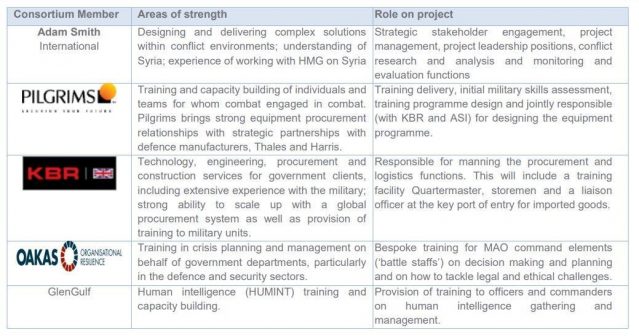
Excerpt from alleged ASI document
Accompanying project staff CVs reveal many individuals involved in B-FOR were senior UK military veterans, who all received sizeable three-figure per diem fees for their participation. For instance, its ranks included a former senior British military advisor to US Central Command, experience ASI claims granted him “in-depth knowledge” of the Syrian “context.”
US-backed rebel front collapses
Part of that context at the time would’ve been the virtual collapse of Southern Front as a serious fighting force. Formed in February 2014 at the behest of the US Military Operations Command (MOC) in Jordan, the Front was a coalition of 50-60 rebel groups. As ASI’s proposal notes, its constituent factions were “given various types of support from the MOC,” including “small arms, artillery, anti-tank guided missiles, ammunition, vehicles, communications equipment, and uniforms,” the Command also paying fighters’ salaries.
Washington’s largesse was fundamental in the Front scoring a series of victories over government forces throughout 2014 and the first half of the next year. In the process, it became the largest rebel umbrella organization in southern Syria, comprising 25-30,000 fighters, and challenging the political and military dominance of Salafist Al-Nusra, the region’s then-largest jihadist group. The mainstream media widely promoted the Front as Western leaders’ best hope of achieving a “moderate” Syrian “revolution” – despite many of its units frequently cooperating and collaborating with Al-Nusra.
However, an over-ambitious attempt by the Front to wrest the city of Deraa’s northern and eastern districts from government control in June 2015 ended in embarrassing failure. The cataclysm led to almost total cessation of MOC support, which in turn meant the Front lost much of its operational capabilities and many of its fighters, who defected in droves to other rebel groups offering salaries. Saudi Arabia subsequently stepped in to provide weapons and fresh funding to the ailing force – B-FOR represented London’s illicit contribution to keeping it functional, and ASI’s proposal makes clear the consortium well-understood the many risks attached to the project.
Risks known, responsibility offloaded
A lengthy section of ASI’s proposal – ‘oversight and management of threats and risks’ – details some of these myriad hazards, along with their likelihood and impact. It was considered highly probable, for instance, groups such as Al-Nusra and ISIS would interfere in the program, “due to perceptions of an ‘international political agenda’” – as a result, extremists “may seek to prevent trainees from joining or inhibit them from fulfilling their functions once trained via kidnap, assault and theft of equipment.”
The possibility that the consortium’s curated fighters may choose or be forced to join other, non-border force Southern Front operations, in turn “[leading] to a weakening of the border capability and perception of UK support to active military operations,” was rated as “medium.” Border force trainees collaborating with extremist actors and/or committing human rights abuses, in the process compromising “the legal and reputational viability of the programme,” was likewise considered of “medium” likelihood and impact.
ASI’s proposed method of dealing with these and other dangers was almost invariably to simply “transfer” responsibility for “owning and managing” the problem to the FCO itself, even suggesting the UK government must simply “tolerate” failings such as the loss of equipment “to a reasonable degree.”
It seems the FCO either acquiesced to shouldering the inherent burdens, or was intensely relaxed about such issues, for the consortium was duly awarded the B-FOR contract, judging by other papers found in the leak.
Non-Disclosure Agreements signed June 10, 2016 by the firms involved indicate they were obliged to adhere to the stringent confidentiality requirements of the 1911 and 1989 Official Secrets Acts, forbidding them from “disseminating any information related to the project to any third party.” Meticulous instructions for disposing of ‘secret’, ‘restricted’, and ‘confidential’ FCO communications were also included.
‘Jihadis You Pay For’
It’s uncertain how many years, or perhaps months, B-FOR endured. Its ‘statement of requirements’ forecast the project would “cover a period until 31st March 2019 with a clause for a breakpoint at the end of each financial year.”
However, in February 2017, a report by Parliament’s international development committee found ASI staff had submitted fake testimonials from aid recipients to a House of Commons inquiry into its activities, set up in response to allegations the firm had been seeking improper financial benefit from UK aid spending.
In response, DfID blocked the company from bidding on future government contracts, and the next month, ASI’s three founding executives resigned. Even more damningly, in December that year, a BBC Panorama documentary (Jihadis You Pay For) exposed how FCO cash ASI distributed in Syria had ended up in extremists’ pockets.
The investigation focused on the FCO’s Access to Justice and Community Security (AJACS) program, under which ASI funded and trained the Free Syria Police, an unarmed civilian force set up to re-establish law and order in opposition-controlled areas.
It found ASI had identified links between several FSP stations and sharia courts run by Al-Nusra and not ended its funding of the stations, or compelled them to sever all connections with the courts – FSP officers in theoretical receipt of FCO funds via ASI had also been present when women were stoned to death. Troublingly, ASI’s B-FOR pitch states its “experience and knowledge” of running AJACS will be “leveraged” to ensure optimal delivery of the border project.
Whether B-FOR was quietly shelved or simply handed over to other contractors in response to these damaging exposures is unknown. In any event, in July 2018, the Front was comprehensively crushed by pro-government forces, its surrendering fighters either agreeing to reconciliation deals or fleeing to Idlib.
It’s also unknown how many fighters trained via the program went on to join jihadist groups, and how much equipment was “lost” over the course of its operation, ending up in the hands of extremists and used to slaughter and maim innocent civilians. The companies running the operation, much less the UK government, certainly weren’t keeping count.
Kit Klarenberg is an investigative journalist exploring the role of intelligence services in shaping politics and perceptions. Follow Kit on Twitter @KitKlarenberg
Will US continue to further implement RAND Corporation’s strategy in relation to Russia?
By Lucas Leiroz | October 27, 2020
The recent conflicts in the Russian zone of influence have attracted attention around the world. But little has been said about the possibility that such conflicts are part of a single common plan, designed to geopolitically destabilize Russia. This possibility is what we can deduce when we recall some recent writings of the renowned think tank RAND Corporation, which, in 2019, openly defended the adoption of a series of measures to weaken Moscow, exploiting its vulnerabilities. Among such measures in the economic sphere the document proposed the manipulation of oil and gas prices that affect the Russian defense budget, as well as the imposition of increasingly rigid sanctions and in the political sphere – the spread of regional conflicts in its “periphery” which could perfectly include Nagorno-Karabakh, Kyrgyzstan and others.
Several of the points highlighted in the RAND’s document entitled “Overextending and Unbalancing Russia”, in its more than 350 pages, have been implemented so far, especially in the “immediate periphery”. The recent Belarusian political crisis itself, for example, highlights the role of external agents interested in the destabilization of this historic Russian ally – something that is openly defended in such a document which proposes a colorful revolution in Belarus. In addition, the incitement of conflicts in the Caucasus and Central Asia, the deterioration of the Syrian and Ukrainian situations, among others, are also strategic points raised by the dossier.
RAND’s goal is to define the areas where the US can compete most effectively, providing reports and proposals based on concrete data. Such reports must accurately define the vulnerabilities in the economic and military spheres of each nation against which the United States is competing, helping Washington to create its strategies. Several of the policies adopted by the US are the result of advices from RAND’s analysts. In this sense, RAND’s analysis about Russia and its draft strategy for a competition between the US and Russia today proposes that the best way to weaken Moscow is through a siege of conflicts in its territorial proximities. Obviously, it is not proposed to attack Russia, but to create wars along its entire border, destabilizing international security in the region – a scenario from which many other possibilities arise.
Despite all the complex political and military strategy, in the RAND document it is highlighted that the biggest Russian weakness in a dispute with the US is the economic issue. The think tank’s proposal focuses on heavy investment in energy production, mainly renewable energy, as well as encouraging domestic production of such energy sources in countries allied to the US, with the aim of reducing Russian exports – which would strongly affect Russian defense budgets. The central role of the US in the boycott against the construction of the Nord Stream 2 pipeline is a clear example of how such strategies are being put into practice.
Another type of measures that RAND recommends is in the ideological and informational spheres. The Corporation advises a vigorous pro-Western information campaign aimed at highlighting aspects allegedly present in the Russian regime, such as endemic corruption. In any case, RAND considers this disinformation strategy to be “risky”, as it would encourage Moscow to highlight the weaknesses of Western democracies, leading to a new ideological war through disinformation campaigns.
Interestingly, Russia is constantly accused of interfering in the American electoral process through campaigns of disinformation and cyber war since the rise of Donald Trump four years ago. Now, with the new elections, the tendency is for such accusations to grow exponentially, showing a strategy of mass disinformation meticulously planned by strategists with clear goals.
In fact, there is no doubt about the power of influence of RAND Corporation’s analysis in the construction of US foreign policy strategies. The siege that is being proposed in the document gradually materializes, with strategies of economic suffocation, disinformation and inciting regional conflicts, but it remains to be seen what the consequences for the US domestic scenario will be. The RAND report had no way of predicting the emergence of a global tragedy such as the new coronavirus pandemic. In the context of more than 220,000 deaths due to the virus in the US, popular rebellions and inflamed racial tensions across the country and in the midst of a decisive electoral process, will Washington be able to maintain such a siege strategy? Is it sustainable for the US to stir up conflict in the vicinity of Russia when its internal bases are crumbling?
Perhaps the strategies designed by RAND last year are absolutely useless today. The pandemic structurally changed the dynamics of world geopolitics and currently the idea of an American siege against Russia is not conceivable. The tendency is that all conflicts will diminish as no major military power will intervene. The situation in Nagorno-Karabakh shows how the tendency is for conflicts to gradually stabilize. On the contrary, within the US, everything just tends to get worse. Perhaps Washington is taking a step beyond its reach. Or perhaps the interests of strategists at RAND Corporation and the American Deep State do not exactly imply what is best for the US.
Lucas Leiroz is a research fellow in international law at the Federal University of Rio de Janeiro.
‘Pseudo-expert’: College dropout billionaire Bill Gates attacks Trump adviser Dr. Scott Atlas over Covid-19 stance
RT | October 26, 2020
Self-styled Covid-19 authority and Microsoft billionaire Bill Gates has weaponized media demands to “trust the science” to tear into Trump adviser (and actual medical doctor) Scott Atlas for not backing stricter Covid policies.
“We now have a pseudo-expert advising the president,” Gates snarled during an interview at Yahoo Finance’s All Markets Summit on Monday, denouncing Atlas – who, unlike the billionaire software tycoon, completed both college and medical school – as an “off the rails” bad influence on the Trump administration.
“The most malign thing is where you start to attack your own experts and suggest that maybe politicians know better than disease experts,” Gates continued. The billionaire is neither a politician nor a medical doctor, despite the vast sums he has spent through his Bill and Melinda Gates Foundation and its affiliates in an effort to vaccinate the developing world. Atlas, on the other hand, has a medical degree from the University of Chicago and has taught healthcare policy at Stanford University’s Hoover Institute.
While Gates’s words might seem to apply to his own denunciation of Atlas, the billionaire meant them as a condemnation of the Trump administration over its alleged line-by-line tweaks to health guidelines issued by the Centers for Disease Control and Prevention in May. He has bemoaned the “politicization” of both the CDC and the Food and Drug Administration (FDA) for months, blaming the White House for both their loss of public trust and unspecified yet “very unfortunate” setbacks to the rollout of a Covid-19 vaccine.
However, medical experts have insisted for years that both institutions were co-opted long ago by the pharmaceutical industry, of which Gates is both a significant funder and a well-remunerated beneficiary.
Yahoo (and other media organizations, many of which have received and avoided disclosing funding from Gates’ foundations) have almost universally backed the avuncular software tycoon in his dispute with Atlas, suggesting it is the trained medical expert who stepped out of his place in dissenting from prevailing orthodoxy. Forbes even called Atlas a “bad scientist” for not deferring to Gates’ favorite expert, US corona czar Dr. Anthony Fauci.
Atlas has long been seen as a thorn in the side of Gates and his ideological cheerleaders for his refusal to toe the lockdown line, however. A tweet “falsely” downplaying the effectiveness of masks and an article warning the US’ pandemic-related economic shutdowns will have lasting consequences far worse than the deaths thus far attributed to the virus have been held up as proof Atlas knows not of what he speaks – even as experts in other countries have echoed his economic concerns and the science remains far from settled on masks.
Since the beginning of the Covid-19 pandemic, Gates has been hailed by the media as a venerable expert on viral outbreaks for a 2015 Ted Talk in which he bemoaned the lack of epidemic preparedness among the world’s governments. However, Gates was far from the only person to predict a pandemic (or the societal upheaval it would trigger).
The Rockefeller Foundation, along with the Global Business Network, predicted in a 2010 “scenario” that a devastating viral outbreak would bring about an authoritarian crackdown, devastating entire industries while making totalitarianism palatable to the populations of previously democratic countries. And Fauci himself predicted in 2017 that Trump’s administration would be faced with a deadly pandemic it was unprepared for. The US military and private sector partners have also run several simulations of major pandemics, each time finding (yet never doing much to fix) that the government is woefully unprepared.
WHO Taps ‘Anti-Conspiracy’ Crusader to Sway Public Opinion on COVID Vaccine
By Jeremy Loffredo | Children’s Health Defense | October 23, 2020
An outspoken proponent of government-led tactics to influence public opinion on policy and to undermine the credibility of “conspiracy theorists” will lead the World Health Organization’s (WHO) efforts to encourage public acceptance of a COVID-19 vaccine, Children’s Health Defense has learned.
Last week, WHO’s general director, Dr. Tedros Ghebreyesus, tweeted that he was glad to speak with the organization’s Technical Advisory Group (TAG) on Behavioural Insights and Sciences for Health to “discuss vaccine acceptance and uptake in the context of COVID-19.”
In his next tweet Ghebreyesus announced that Cass Sunstein, founder and director of the Program on Behavioral Economics and Public Policy at Harvard Law School, will chair the advisory group, which was created in July.
Sunstein was former President Barack Obama’s head of Office of Information and Regulatory Affairs where he was responsible for overseeing policies relating to information quality.
In 2008, Sunstein wrote a paper proposing that governments employ teams of covert agents to “cognitively infiltrate” online dissident groups and websites which advocate “false conspiracy theories” about the government. In the paper, Sunstein and his co-authors wrote:
“Our principal claim here involves the potential value of cognitive infiltration of extremist groups, designed to introduce informational diversity into such groups and to expose indefensible conspiracy theories as such.”
The government-led operations described in Sunstein’s paper would work to increase faith in government policy and policymakers and undermine the credibility of “conspiracists” who question their motives. They would also maintain a vigorous “counter misinformation establishment” to counter “conspiracy” groups opposed to government policies that aim to protect the common good.
Some of this would be accomplished by sending undercover agents, or government-paid third parties, into “online social networks or even real space groups.”
Sunstein also advocated in 2008 that the government pay “independent experts” to publicly advocate on the government’s behalf, whether on television or social media. He says this is effective because people don’t trust the government as much as they trust people they believe are “independent.”
WHO has already contracted the public relations firm, Hill + Knowlton. The PR giant, best known for its role in manufacturing false testimonies in support of the Gulf War, was hired by WHO to “ensure the science and public health credibility of the WHO in order to ensure WHO’s advice and guidance is followed.”
WHO paid Hill + Knowlton $135,000 to identify micro-influencers, macro-influencers and “hidden heroes” who could covertly promote WHO’s advice and messaging on social media, and also protect and promote the organization’s image as a COVID-19 authority.
There’s no evidence that WHO has yet implemented any “cognitive infiltration” policies similar to what Sunstein advocated in 2008. If the organization were to adopt such a strategy, and use it to convince hesitant populations to take a COVID vaccine, it would raise questions of legality.
As put forward in a report by the Congressional Research Service, illegal “publicity or propaganda” is defined by the U.S. Government Accountability Office (GAO) to mean either (1) self-aggrandizement by public officials; (2) purely partisan activity; or (3) “covert propaganda.” By covert propaganda, GAO means information which originates from the government but is unattributed and made to appear as though it came from a third party.
Because WHO is a multinational organization and not a U.S. Government agency, covert “cognitive infiltration” policies could fall into a gray area, or even be considered legal.
Dr. Margaret Chan, former general-director of WHO, once stated that the organization’s policies are “driven by what [she called] donor interests.”
According to a 2012 article in Foreign Affairs, “few policy initiatives or normative standards set by the WHO are announced before they have been casually, unofficially vetted by Gates Foundation staff.” Or, as other sources told Politico in 2017, “Gates’ priorities have become the WHO’s.”
WHO’s current general director, Ghebreyesus, was previously on the board of two organizations that Gates founded, provided seed money for and continues to fund to this day: GAVI, the Vaccine Alliance, a public–private global health partnership focused on increased access to vaccines in poor countries, and the Global Fund, which says it aims to accelerate the “development, production and equitable global access to safe, quality, effective, and affordable COVID-19 diagnostics, therapeutics and vaccines.”
If, as Politico put it, “Gates priorities have become the WHO’s,” and if WHO’s policies are driven by “donor interests,” this raises questions as to what online groups, people and websites would be targeted by such covert programs.
The idea of government agents carrying out psychological operations on social media is not far fetched. Earlier this year the head of editorial for Twitter’s Middle East and Africa office was outed as an active officer in the British Army’s psychological warfare unit, known as the 77th brigade, which specializes in online behavioral change operations.
© 2016-2020 Children’s Health Defense® • All rights Reserved
Whoever wins the US presidency the pressure on Venezuela will continue: Scholar
Press TV | October 26, 2020
Whoever wins the presidency on November 3 election in the United States the pressure on Venezuela will continue, an American human rights expert and peace activist says.
Daniel Kovalik, who teaches international human rights at the University of Pittsburgh School of Law in the state of Pennsylvania, made the remarks in an interview with Press TV on Monday.
In Venezuela, many say US presidential candidates Donald Trump and Joe Biden represent the same threat against peace in the world, especially in Latin America. They believe whoever the winner is, the South American country will go on fighting against illegal US sanctions.
“In terms of Venezuela they’re certainly correct that whoever wins the presidency whether Joe Biden or Donald Trump the pressure on Venezuela will continue in the form of sanctions and other provocations,” Kovalik told Press TV on Monday.
“You have to remember in fact that it was Obama that began the sanctions regime against Venezuela when Joe Biden was Vice President,” he said.
“And in terms of resisting, it’s critical that Venezuela continue to resist this pressure and hold firm. I think it gives courage to other countries around the world like Iran, North Korea, Nicaragua, Cuba that are also under pressure by the US – pressure to change their governments,” he added.
“We see what happened in Bolivia recently with the election, which voted out the coup government after a year. And I think that’s given a lot of hope to people. So I, you know, Venezuela has to hold on tight, regardless of who wins the US election,” he concluded.
Venezuelans claim that US presidential election will not improve the foreign policy of the United States toward other nations, including those in Latin America, as this region is regarded by Washington as its political backyard.
Whether Republican Trump is re-elected or his Democratic rival Biden emerges victorious, Venezuelans affirm that the meddlesome and aggressive US policy against the Bolivarian Republic will not cease as both politicians belong to a political system that characterizes US imperialism. Venezuelans say Trump and Biden are the same in political terms.
Regarding the US sanctions, experts believe they won’t be lifted if Biden wins the Presidency. In spite of the US savage policies against Venezuela, people seem to be hopeful about a better future.
Observers say Democrats and Republicans in Washington have both led hostile policies against Latin American, Venezuelans say no matter who wins the US Presidency, the hostility will go on but Venezuelans won’t surrender.
Pompeo will not have his way in Sri Lanka
By P.K.Balachandran | Daily Express | October 25, 2020
Colombo – The US Secretary of State, Mike Pompeo, who will be here on October 28, is expected to ask Sri Lankan leaders, point blank, to review relations with China; consider the options US is offering; and accept American advice on domestic and foreign policy.
A top foreign ministry official told Daily Express on Sunday, that Lankan leaders, President Gotabaya Rajapaksa, Prime Minister Mahinda Rajapaksa and Foreign Minister Dinesh Gunawardena, will politely tell Pompeo that Sri Lanka’s decisions and policies will be guided by election mandates, the law and the constitution of the country, and its interests, while maintaining good relations with all countries in the region and the world.
“All the three leaders will tell the ranking US official politely that it is not for outsiders to tell Sri Lankans how to run their country,” the top Lankan official, who spoke on anonymity, said.
Pompeo is expected to press the government not to go in for Chinese-funded projects anymore but choose other countries and international organizations to fund projects mutually agreed upon.
The US Secretary of State will also press for the acceptance of the US$ 480 million Millennium Challenge Corporation Compact (MCC) which a Lankan Presidential Commission wanted to be either rejected in toto, or re-negotiated to accord with Lankan law, constitution and socio-political and economic realities.
The Lankan official said that the controversial issue of the Status of Forces Agreement (SOFA) will not come up for discussion because the government has made it clear that SOFA is against the Sri Lankan constitution and laws.
On the US bid to draw Sri Lanka into an anti-China alliance like Quad, the official said: “We would tell Pompeo that Sri Lanka, which has only recently emerged from a thirty-year war, does not want to be a theater of international conflict in any way. But it is interested in ensuring free navigation in the Indian and other oceans. Pompeo would be reminded that in 1971 Sri Lanka had pioneered the idea of turning the Indian Ocean into a Zone of Peace.”
On the American demand that Sri Lanka abjure Chinese investments, the leaders would say that Sri Lanka needs investments from all countries as it is keen on developing the country, especially in the infrastructure sector.
“All countries, including the US, are welcome to invest in Sri Lanka. If the US and others match China, their offers would be considered,” another foreign ministry official said.
However, given the fact that the US is primarily interested in geopolitical and military matters with a focus on isolating and weakening China in these spheres, it would not make any economic investment proposals. Pompeo would find it difficult to proceed further on this matter in his discussions here, it is felt.
“Debt Trap” Issue
“If he raises the debt trap issue, we have facts and figures to show that the debt to China is only 5.6 billion USD out of a total external debt of 55 billion USD (which is 10%). The US owes China much more – USD 1 trillion,” the official said.
Arm-Twisting
However, Pompeo could indulge in arm-twisting by threatening further sanctions against Chinese companies involved in Sri Lankan development projects. Some subsidiaries of the China Communications and Construction Company (one of which is executing the Colombo US$ 1.4 billion Colombo Port City) are already “listed” for alleged “predatory practices and lack of transparency”.
However, the Sri Lankans do not appear to be perturbed by such a possibility because listing has to be on solid grounds. And even if security issues are cited, it has to stand legal scrutiny in the US itself, the officials explained.
But the shoe might pinch if the US stops or lessens its imports of apparels from the island. The US buys about US$ 2.5 billion worth of Lankan apparels annually. This is 3% of the Lanka’s DGP and the US is the single largest market. But even stopping this is unlikely given the fact Lankan apparels enter the US market without GSP duty concessions.
Ethnic Reconciliation
As for Pompeo’s prescriptions on ethnic reconciliation, the Sri Lankan leaders will cite the mandates they got through the November 2019 Presidential and August 2020 parliamentary elections, which is that any solution to the ethnic question will have to be acceptable to the majority community in Sri Lanka and that reconciliation should be brought about by measures to develop the country economically in a way which benefits all communities equitably.
American Intentions Not A Secret
American intentions were made clear on October 22 by Dean Thompson, Principal Deputy Assistant Secretary of State for South and Central Asian Affairs at a press briefing. Thompson said that Pompeo will “encourage Sri Lanka to review the options we offer for transparent and sustainable economic development in contrast to discriminatory and opaque practices.”
“We urge Sri Lanka to make difficult but necessary decisions to secure its economic independence for long-term prosperity, and we stand ready to partner with Sri Lanka for its economic development and growth. The Secretary will also emphasize the ties between our people, our shared commitment to democracy, and the importance of our ongoing regional maritime security cooperation. We’ll continue to urge Sri Lanka to advance democratic governance, human rights, reconciliation, religious freedom, and justice, which promote the country’s long-term stability and prosperity and ensure the dignity and equality of all Sri Lanka’s diverse communities.”
With regard to China’s increasing influence in Sri Lanka, Thompson said: “I think we’re looking to frame a discussion with them about a more positive trajectory, as I mentioned in my opening remarks. So definitely we’ll be discussing where they’re headed and looking for ways to strengthen their commitment to human rights rule of law and democracy.”
Pompeo’s ‘Tokyo Kick’ Cannot Start the QUAD
By Salman Rafi Sheikh | New Eastern Outlook | October 26, 2020
Mike Pompeo lashed out at China in his latest visit to Tokyo where he met his counterparts from India, Australia and Japan as part of his efforts to revive the QUAD, a US-centered anti-China alliance of the four countries. Speaking to his counterparts, Pompeo said that there was an urgent need to counter China, adding that “As partners in this Quad, it is more critical now than ever that we collaborate to protect our people and partners from the CCP’s exploitation, corruption, and coercion.” In an interview given to a Japanese news outlet, Pompeo also said that the grouping was a “fabric” that could “counter the challenge that the Chinese Communist Party presents to all of us.” “Once we’ve institutionalized what we’re doing – the four of us together – we can begin to build out a true security framework”, he added further. Mike Pompeo, who was clearly on a mission to persuade his allies to join the military alliance, was obviously trying to make US allies sell the same anti-China discourse that the Trump administration has used at home to start a ‘trade war’ with China. The US, now aiming to expand the war, is recruiting allies; hence, Pompeo’s high-pitched speeches against China.
While Pompeo said what he had to say, prospects of the QUAD’s rise as a powerful military alliance or an ‘Asian NATO’ remain bleak. Its most important reason is the fact that none of the countries—India, Japan and Australia—are interested in picking a military fight with China, while the US has no real allies against China.
While there is no gainsaying that all of these countries—India, Japan and Australia—have tense and uneasy relations with China, they appear not in the least interested in formalizing a US led anti-China military alliance, thus making PRC their official enemy.
It explains why these countries have so far chosen to manage their relations with China on their own and continue to shy away from exacerbating the fault lines by joining the US bandwagon of a ‘global anti-China coalition.’
Consider this: while Japan has its economic ties with China and there is no will in Tokyo to ‘de-couple’, following the US in its footsteps, it, with an eye on China, still is increasing its military strength. Whereas it is already converting two of its existing ships into aircraft carriers, it is going to make a record increase in its defense spending as well. Japan’s Defence Ministry has asked for an 8.3 per cent increase in the defense budget, which is by far the country’s largest rise in last two decades. Interestingly enough, one crucial reason why Japan has decided to increase the budget is the pressure that the Trump administration has been putting on the Japanese to manage their own national security. If Japan is anyway going to spend more and more on defense, increasing its military capability to position itself better in the region, not requiring extensive US military support, and it still wants to continue to have strong economic ties with China, there is no reason why it would want to permanently destabilize its relations with China by joining the ‘Asian NATO.’ Although this was prime minister Abe’s dream, his absence from the government will leave a further dampening impact on the alliance’s future prospects and Japan’s standing therein.
Australia’s government has announced a raft of legislation to curb foreign influence that is clearly (though unofficially) targeted at China. And India is actively engaged in a high-altitude, high-stakes game of chicken with China in the Himalayas—a hot-and-cold conflict in which India is no longer acting passively.
The fact that all of these countries have their specific problems with China and yet they have not been able to fully activate the QUAD shows there is no active and strong desire for a US-led military alliance. As such, the QUAD summit failed yet again to issue a joint statement or a communique.
Notwithstanding the US belligerence, the main focus of Japan, Australia and India remains a politically, economically and militarily balanced relationship with China.
This is the crucial reason that explains why, despite Pompeo’s hype and upbeat assessment of the ‘China threat’, none of the countries’ mentioned China directly in their statements issued after the meeting.
Unlike Pompeo, Japan’s Foreign Minister Toshimitsu Motegi notably did not mention China in his remarks, and the Japanese government was quick to clarify that the talks were not directed at any one country. Indian Foreign Minister Subrahmanyam Jaishankar noted the fact that the meeting was happening at all, given the coronavirus pandemic, was “testimony to the importance” of the alliance. Accordingly, while India like Japan, did endorse the agenda of “free pacific region” and “rule-based system”, it did not mention China either. Certainly, Indian policy makers were not looking to further destabilize the situation in and around the Ladakh region. For Australian foreign minister, who also did not mention China, the essence of the QUAD was to “promote strategic balance” in the Indo-pacific (and not start an Indo-pacific military alliance).
Starting a military alliance against China does not make sense. If the US is these countries’ biggest military and security ally, China is by far one of the largest trading partners, which makes the summit more symbolic than substantive. Accordingly, while Pompeo was talking of creating a ‘security network’, Japanese officials confirmed to local media that the subject was not even raised in the meeting; for, such a venture is unlikely to gain traction in the wake of these countries’ main thrust for balanced ties with China.
In the absence of a clear will and desire for building up military pressure on China, the ‘Asian NATO’ will remain an engine-less rail car, one that even persistent kicks wouldn’t be able to ignite.
Salman Rafi Sheikh is a research-analyst of International Relations and Pakistan’s foreign and domestic affairs.
China’s new sanctions against American defence companies have the potential to cause major damage to the US military
By Tom Fowdy | RT | October 26, 2020
Beijing has fired a warning to the US over its arms sales to Taiwan with a new round of sanctions. The move is symbolic for now, but if China wants to get tough it really could hammer the supply chains of the impacted companies.
On Monday afternoon, China’s Ministry of Foreign Affairs announced that Beijing would be placing sanctions on a number of US firms and linked individuals over arms sales to Taiwan, with Washington having approved a record sale worth around $5 billion to the island the previous week.
The listed companies included Lockheed Martin, Boeing Defense and Raytheon, striking at the heart of what is often referred to as ‘America’s Military Industrial Complex’. However, what the specific measures mean, how they will be implemented and what their impact might be remains to be seen.
At first glance, these sanctions look symbolic; such military firms do not pursue business in China, and do not have market traction in America. One exception is Boeing’s civilian wing, which stated in an email it was still committed to the Chinese market.
On the other hand, this is not to say that such sanctions will not have strategic implications. First of all, China has an overwhelming dominance on the ‘rare earth’ materials required for US defence manufacturing, and should these sanctions really look to bite, they could have a major impact on the supply chain.
Secondly, even if the measures are only symbolic, it is nonetheless a warning shot from Beijing that it may retaliate further against US actions in the future.
What are ‘rare earths’? And why do they matter? The name refers to 17 elements which are used primarily in the manufacture of all kinds of items, including electronics, vehicles and of course military equipment.
Naturally, these resources form the bedrock of many supply chains around the world. China has a near total monopoly over this industry; a study found that the country “produced roughly 85 percent of the world’s rare earth oxides and approximately 90 percent of rare earth metals, alloys, and permanent magnets”. In 2018, up to 80 percent of America’s own rare earth imports came from China; Washington knows this and is scrambling for contingencies.
The strategic implications of this are quite clear; the US military relies deeply on materials imported from China to manufacture its equipment. If Beijing wanted, these sanctions could hammer the supply chains of the impacted firms.
However, whether Beijing will actually do that is a question of political will, given Washington would treat the move as a major escalation and retaliate harshly against Chinese firms such as Huawei. Such a move is clearly not a good idea, particularly in the run-up to an election, and would only be a last resort, perhaps in a war-like scenario. Given this, it may be more accurate to interpret the move as a ‘warning shot’ of what China may do – evidence that it is ready to get tougher on US firms.
A month ago, China released its own ‘entity list’ – an export blacklist which may prohibit exports or business with companies that are deemed a threat to national security, deliberately mirroring that used by the US Department of Commerce against Chinese companies. The aim is to leverage its own market against countries that discriminate against, or hurt the interests of, Chinese firms.
And this is where the blacklisting of Boeing Defense is significant. While the sanctions have carefully avoided the civilian branch of Boeing – which supplies commercial aircraft, and has huge business in China – it is nevertheless a clear red flag that the company isn’t untouchable. As Beijing seeks to develop its own commercial aircraft further, including the COMAC C919, it may become even more assertive.
Given all this, China’s sanctions against US defence firms are less a policy in practice as they are a pronouncement of things to come. While Beijing is not ready to take advantage of America’s dependency on rare earths yet, it is signalling clearly it is ready to take measures against US companies where it sees fit.
Taiwan, for one, is a huge red line for China’s government. As it illustrated with its military exercises, there has to be some demonstration of clear consequences for pushing against it, albeit without resorting to methods that could prove extremely destabilizing.
Beijing is developing a toolkit, and it wants us to know that it is ready to use it should it be absolutely necessary. These showcase sanctions have potential in multiple ways to have real teeth, and that’s what we need to be looking at.
Tom Fowdy is a British writer and analyst of politics and international relations with a primary focus on East Asia.
Break in Relations With the EU? – ‘If This Is the Way They Want It, So Be It’
By Alastair Crooke – Strategic Culture Foundation – October 26, 2020
Wolfgang Munchau of Euro Intelligence has been suggesting recently that the EU is making mistakes born from listening only to its own (like-minded) echo chamber. Munchau was referring to how – when Boris Johnson had sought for a deal “to be in sight” by this month’s EU summit, he was met with disdain. The Council said not only was there ‘no deal in sight’, but that there would be no acceleration of negotiations, and furthermore stuck rigidly to its three red-line, ‘non-negotiables’.
Macron haughtily afterwards stated that the UK had to “submit” to the bloc’s “conditions” – “We didn’t choose Brexit”.
To which Boris tartly retorted: ‘There’s no point then in talking’.
Munchau wryly noted that the biggest risk to any deal “is when you keep telling yourself that the other side needs ‘it’ more than you do”. Charles Michel, the President of the European Council, then made clear what the Council imagines ‘it’ to be: It is the EU’s majestic “huge and diversified markets”.
“The EU has a month to disabuse Emmanuel Macron of this intellectually lazy assertion. The EU should not base its negotiating strategy on [the]notion that Johnson will fold: Maybe he will, maybe not”, Munchau observed.
Well, Russian Foreign Minister Lavrov clearly shares Munchau’s general analysis. Speaking at Valdai last week, Lavrov said, “When the European Union is speaking as a superior, Russia wants to know, can we do business with Europe?”
“… Those people in the West who are responsible for foreign policy and do not understand the necessity of mutually respectable conversation – well, we must simply stop for a while to communicate with them. Especially since Ursula von der Leyen states that geopolitical partnership with current Russia’s leadership is impossible. If this is the way they want it, so be it”, [he concluded].
Notably however, it was not Boris Yeltsin who made the greatest efforts to achieve Russia’s integration into the European space, but President Putin, during his first term in the early 2000s, until at least 2006. What Lavrov indirectly was acknowledging is how bad things have become. In effect, he simply stated what everyone already knew; namely, that the old framework for Russian-EU relations no longer exists. What’s there to talk about?
This is no small matter. If Merkel and the EU have shifted to integrating the Union, as a higher priority than attending to its relations with Russia, then all the old anti-Russian prejudices of East Europe – principally those of Poland – must be assuaged. This is what is happening, and it means the solidifying of Europe as ‘up and against’ Russia, China and their strategic partners. And with Germany again aspiring to its earlier prominence in and over Europe, tensions with Russia ( and therefore with China), will grow. Europe will be self-defining as the middle between two antagonistic poles to the East and West – a ‘friend’ of neither.
And – coincidentally, or not – on 14 October (a day later), President Xi symbolically visited, a micro-chip factory, and said that China will win the tech war, and will lead the world in multilateralism. Secondly, on the same day, President Xi visited a Marine Base, calling on the Chinese military to “put all (their) minds and energy on preparing for war”. China does not want war, he emphasised, but has accepted that it may happen. And finally, at Shenzhen economic zone’s 40th anniversary, Xi indicated that global changes are afoot: The status quo cannot continue, and “sometimes one needs to speak forcefully for the West to listen”.
In his own more muted way, President Xi was simply echoing Lavrov – underlining that the earlier framework for China-western relations also no long exists. This was implicit too when he said that he wanted China’s new stance to be endorsed by the CCP Plenum at the end of October, so that no-one could impute to China some policy ‘play’ towards the incoming U.S. President.
It seems there is a very clear message here for the EU. But are they listening? Whilst Europe does have ‘cards’ to play, it is hubris to assume that all will ‘submit’ to European ‘conditions’ and values, just to avoid losing access to its markets. Yes, indeed there is a large European ‘market’, but it has some very obvious lacunae too – No cloud platforms; little investment in telecoms and 5G (particularly in Germany); no security of energy supply at an affordable cost; and has no social media platforms to rival either those of the U.S. or China. China has the money and the know-how which the U.S. cannot replace.
Europe does have pockets of expertise (such as in AI and aerospace), but no Big Tech. And in terms of spending on Tech R & D, the EU is a minnow. Europe badly needs Chinese (and Russian) collaboration in Tech to participate in the ‘New Economy’, yet the U.S. wants the EU to sever completely from Chinese and Russian technology.
This is the point: The U.S. currently is concerting a full-spectrum strategy to isolate and weaken China and Russia. This is nothing new. It is a reprise both of the long-running ‘Anglo’ vendetta against Russia, and an attempt to try to extend Pompeo’s anti-China ‘Clean Network’ and ‘Clean Path’ policies to Europe. The term ‘clean’, of course, means ‘lock out’ of all Chinese tech – complete exclusion. The U.S. is making a big ‘ask’ of Europe – living as it does under the shadow of recession. Nonetheless, it is likely that Europe will (mostly) comply.
But viewed from 180° – from the Russian and Chinese perspective – their limited and tense relationship with the U.S. is unlikely to improve, whomsoever wins next month in Washington. The U.S. animus against Russia will continue irrespective. And as for Beijing, were Biden to win (an old foe of Huawei), China expects little change, beyond revised tactics. Biden is thought by Beijing likely to use multilateralism more in order to rally U.S. allies to form a United Front against China, than as a genuine commitment to taking Europe’s views into consideration. Obama’s Victoria Newland neatly expressed her then-Administration’s view (in respect to Ukraine): “F**K the EU!”.
Is it realistic that Germany and Europe will resist U.S. pressures? Merkel still wants NordStream 2, sure. And Germany notably has failed to invest in telecoms – and needs Huawei. Other key Tech (and the finance to support it) is available only from China. There are no substitutes. Yet, the Euro-élites’ hatred and loathing for Trump, and their conviction of a forthcoming Biden victory, will likely spur them to try and recreate the multilateral order with Washington at its head, were the Democrats to win. This means pressures on Europe to adopt an anti-Russian and anti-China stance may grow and become irresistible. The paradox is that the U.S. nonetheless will probably still view Europe as an ‘access-limited’, regulated market and trade threat.
Is it surprising then that these states – Russia and China – have come to their ‘we have had enough’ moment? They have had it with Europeans’ moralising about their values, and believing that everyone will ‘fold’ in the face of the threat of exclusion from Europe’s market.
China is now the world’s biggest economy (in PPP terms). Russia and Central Asia are already compatible with Chinese technology. China has already established this as ‘facts on the ground’. Politics will follow in its wake. China and Russia are indeed likely to win the Tech war (sooner, rather than later). Can any trade block really afford the moral ‘superiority’ dividend of standing aloof and ‘above’ this other “huge and diversified” market?
Tom Stevenson, an investment director at Fidelity International, writing in The Telegraph, points out that the pandemic’s adverse effects have been significantly greater in Europe and the Americas, both north and south, than in China:
“Despite accounting for nearly 60pc of the global population, Asia has had less than 15pc of Covid-related deaths this year. Europe, with less than 10pc of the world’s people, accounts for nearly a third of all deaths. Same story in north America. Third quarter GDP figures from China will show how this materially better pandemic performance is showing up in economic data. First in, first out and a much steeper recovery path, too. Credit Suisse thinks that by the end of next year, China’s economic output will be 11pc above its pre-virus level, while the U.S., Europe and Japan will still be catching up.
“Coronavirus has caused some fundamental changes in the way that businesses and whole industries now operate. In particular, global supply chains are being replaced by a more regional approach, which has reduced Asia’s dependence on the health of Europe and the U.S. Today around 60pc of all trade in Asia happens within the region. The big growth in our dependence on technology and the increasing digitisation of the economy also plays to China’s strengths”
It is insanity. On the one hand, the EU doggedly is following the U.S. in applying sanctions on Russia (even when France and Germany know the U.S. allegations on which these are based –the alleged Navalny poisoning– are false); it is complicit in trying to unbalance the situation near Russia’s borders; and then further demands to impose Europe’s values on others’ trade with Europe.
And at the same time, they expect China and Russia to continue as if nothing is awry, and to save them from bankruptcy. Who needs whom the most? Is anyone listening?
‘Attempt to Inspire Hate’: Kremlin Regrets Biden’s Claim Russia is the ‘Biggest Threat to America’
By Sofia Chegodaeva – Sputnik – 26.10.2020
Moscow denies Joe Biden’s claims of a Russian threat, Russian presidential spokesman Dmitry Peskov said on Monday, adding that this “threat” is not true at all and is just an attempt to inspire hatred towards Russia.
“This is absolutely not true, we totally disagree with that. We can only regret the fact that this is how total hatred for the Russian Federation is being promoted, that our country is portrayed as an enemy. This is not true,” Peskov said.
This comes after the US Democratic presidential hopeful Joe Biden told CBS on Sunday that he viewed Russia as “the biggest threat to America right now” with regards to US security and the country’s alliances.
Last week, Biden and incumbent US President Donald Trump held their final debate ahead of the November 3 presidential election, during which Trump claimed that Biden had received $3.5 million from Russia through President Vladimir Putin. Biden rejected the allegation, adding that he had not ever taken a “penny” from foreign sources.
Russian President Vladimir Putin refused to comment on Trump’s claims. “No comment,” he said, as aired by the Rossiya 1 broadcaster on Sunday.
Meanwhile, commenting on the final presidential debate in the US on Friday, Dmitry Peskov said that Trump and Biden had been competing “for who dislikes Russia more.” Russia’s presidential spokesman repeatedly rejected all allegations that Moscow had attempted to interfere in US domestic policy.
Bolivian President Demands OAS Chief Resign Over His Part in 2019 Coup
By James Tweedie – Sputnik – 25.10.2020
Bolivia’s newly-elected president, Luis Arce, has demanded the head of the Organisation of American States (OAS) resign over his role in the 2019 coup d’etat.
Arce, Movement for Socialism (MAS) leader, said on Saturday OAS Secretary-General Luis Almagro should go for “moral and ethical reasons.”
“We do not agree that an important body should be in the hands of people who support a particular political party or political trend in the region, and that it interferes in the internal affairs of a country,” Arce said. “If it was able to do that in Bolivia, imagine, you could do it with any other country, and we can’t allow that.”
Almagro oversaw the OAS audit of last year’s presidential election that overturned president Evo Morales’ landslide victory in the first round. Morales, Latin America’s first fully-indigenous leader, reluctantly invited the OAS to validate the count after a wave of opposition rioting over alleged ballot fraud and violent attacks on MAS politicians.
That included the shocking attack on Patricia Arce Guzman, the mayoress of the town of Vinto. Opposition rioters dragged her from the municipal offices before setting them on fire, then cut her hair, painted her face red and forced her to walk barefoot through the town as they spat and urinated on her. Arce Guzman was elected a senator last week.
”There was no fraud, there was a whole preparation for a coup, of which the OAS was unfortunately a part,” Arce told La Razón in reference to the audit, adding that Almagro “interfered, violated Bolivian regulations, and those of any international body observing an electoral process; he interfered in internal affairs.”
Other Latin American government officials laid into Almagro this week.
Venezuelan UN envoy Samuel Moncada pointed out Almagro’s dishonesty in claiming at the OAS General Assembly in Washington this week: “We told Evo Morales not to quit”
“Almagro has no shame, he represents the ideological, political and moral ruin of the OAS on the continent.” Moncada wrote. “Never more will this kind of criminal be able to deceive our peoples!”
Mexican undersecretary of foreign affairs Maximiliano Reyes Zúñiga accused Almagro on Tuesday of making “factious” use of the OAS electoral observer mission in 2019 to legitimise the opposition fraud claims.
And on Wednesday the Puebla Group, whose members include former presidents of Bolivia, Brazil, Ecuador, Uruguay and Spain, published an open letter urging Almagro to resign.
Despite formerly serving as foreign minister of his native Uruguay under leftist president José Mujica, Almagro has led the charge against socialist governments in Latin America Since assuming leadership of the Washington-based OAS in 2015.
He has been a constant critic of Venezuelan President Nicolas Maduro and his government, even attacking the country’s National Electoral Council after the opposition failed to gather enough signatories for a presidential recall referendum. In 2016 he invoked the Inter-American Democratic Charter against Caracas, claiming there had been “an alteration of the constitutional order” there.
In 2018 Almagro led efforts to bring Maduro and other Venezuelan leaders to trial at the International Criminal Court in The Hague. In 2019 he revived the doctrine of “Responsibility to Protect” – previously used to justify the 2003 invasion of Iraq – to urge other states to intervene in Venezuela.
Nicaragua’s elected government has also been an occasional target for Almagro. In 2019 he sought to invoke the Democratic Charter against Daniel Ortega’s Sandinista government.
Just this week at the OAS meeting in Washington, the secretary-general warned Managua the bloc would not recognise the result of next November’s presidential election if it did not comply with a list of demands.
“Daniel Ortega will have to demonstrate how independent he is from the bad practices that Cuba and the Bolivarian regime [in Venezuela] instigate,” Almagro said.
A group of 14 OAS members, led by the US, voted to expel Cuba from the bloc in January 1962. In response, revolutionary leader Fidel Castro dubbed the organisation the “Yankee Ministry of Colonies and a military bloc against the peoples of Latin America.”
Even after the OAS voted to allow Cuba to re-join in 2009, the island nation has consistently refused to do so.
Featured Video
John Mearsheimer: Why Russia Gains By Hitting Ukraine Harder
or go to
Aletho News Archives – Video-Images
Book Excerpt
Measles and Mortality
Informed with Aaron Siri| November 19, 2026
Given the news coverage around measles and mortality, I decided to share the section of my book, Vaccines, Amen, that covers precisely this topic. Help me spread a bit of reality into the media hysteria around this issue. Here is that section of the book… continue
Blog Roll
 Aletho News
- A Climate Scientist Who Engages Skeptics
- John Mearsheimer: Why Russia Gains By Hitting Ukraine Harder
- Argentina’s Perito Moreno Glacier Joins Antarctica and Arctic In Defying Doomsday Melt Claims
- ‘Chinagate’ Is Here
- Iran, four other countries condemn US plans to deploy weapons in outer space
- US media brings back the Iraq war playbook and why it won’t work
- Zakharova schools German FM on history basics
- Germany to produce drones for Ukraine
- Merz takes a swipe at Merkel over Ukraine’s NATO bid
- Measles and Mortality
- If Americans Knew
- An error has occurred; the feed is probably down. Try again later.
- No Tricks Zone
- Alarmist Climatologists In Shock! 2026 Atlantic Hurricane Season Sees Lowest Count In 101 Years
- New Study: Modern Temps Are Among The Coldest Of The Last 10,000 Years In East Central Europe
- Germany’s Renewable Energies Lead to 1.4 Billion Euro Electric Power Trade Deficit
- Argentina’s Perito Moreno Glacier Joins Antarctica and Arctic In Defying Doomsday Melt Claims
- New Study: Barents Sea Temperatures Were Warmer And Sea Ice Less Extensive In The 1700s Than Today
- German Authorities Start Initiative To Evaluate Public Register For Climate “Disinformation” Spreaders!
- Zonal Asymmetry of Temperature Change in the Antarctic Circumpolar Current
- New Study: The Net Fossil Fuel Contribution To Rising Atmospheric CO2 Has Been Zero For 500 Years
- Germany’s Green Energy Transition Becoming Increasingly Expensive…Another 6 Trillion Euros!
- Sudden Stratospheric Warming, Powerful El Niño Combination May Lead To Extreme Europe Cold, Energy Crisis!

