Videos of Biden touching young girls flagged as ‘child sexual exploitation’ by Twitter despite being official public footage
 C-Span footage of Joe Biden interacting with girls flagged by Twitter for violating their Child Sexual Exploitation Policy after popping up in discussion on the politician’s character.
RT | September 14, 2020
The dispute on social media saw Texan progressive activist Johnny Graz seeking to make a case that the Democratic presidential nominee should be investigated for sexual assault.
Another commenter, who goes by the name ‘Jake Koenig,’ sought to support Graz’s argument by posting a video compilation of Biden touching various young girls during photo ops at their parents’ congressional swear-in ceremonies in 2015.
However, the commenter was unable to post the official public footage of the proceedings because “Twitter flagged [him] for trying to post images of child molestation.”
Koenig’s claim was easily verifiable, as Twitter does indeed very quickly identify the video as “prohibited” content that “violates [their] Child Sexual Exploitation Policy.” Moreover, the website bans the poster’s account until they’ve deleted the footage.
The infamous footage shows the former vice president touching US legislators’ daughters and granddaughters. At a various points, he appears to be holding some girls in place and closely leaning in to say something in their ears.
The discussion around Biden’s behavior has largely been fueled by a string of accusations by several women that he “inappropriately” touched them. Most notably, back in March, the former senator’s staffer Tara Reid publicly came forward saying he sexually assaulted her back in 1993.
The claims did not attract much media attention, even though they coincided with the rise of the highly publicized ‘MeToo’ movement, self-tasked with bringing powerful men to account for sexual misbehavior against women. The organization’s largest personalities did not seem to be interested in Reid’s case, which led to infighting and accusations of partisanship.
Biden himself denied the allegations, saying that “nothing like this ever, ever happened,” and even added that he doesn’t remember the woman.
The Sabra & Shatila Massacre
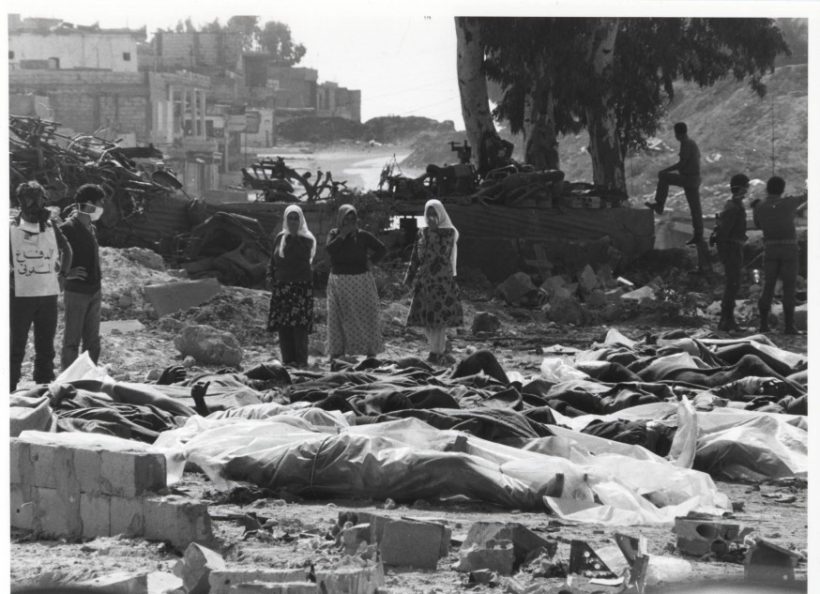
IMEU | September 17, 2012
On September 16, 1982, Christian Lebanese militiamen allied to Israel entered the Palestinian refugee camp of Shatila and the adjacent neighborhood of Sabra in Beirut under the watch of the Israeli army and began a slaughter that caused outrage around the world. Over the next day and a half, up to 3500 Palestinian and Lebanese civilians, mostly women, children, and the elderly, were murdered in one of the worst atrocities in modern Middle Eastern history. The New York Times recently published an op-ed containing new details of discussions held between Israeli and American officials before and during the massacre. They reveal how Israeli officials, led by then-Defense Minister Ariel Sharon, misled and bullied American diplomats, rebuffing their concerns about the safety of the inhabitants of Sabra and Shatila.
Lead Up
- On June 6, 1982, Israel launched a massive invasion of Lebanon. It had been long planned by Israeli Defense Minister Ariel Sharon, who wanted to destroy or severely diminish the Palestine Liberation Organization, which was based in Lebanon at the time. Sharon also planned to install a puppet government headed by Israel’s right-wing Lebanese Christian Maronite allies, the Phalangist Party.
- Israeli forces advanced all the way to the capital of Beirut, besieging and bombarding the western part of city, where the PLO was headquartered and the Palestinian refugee camp of Shatila and the adjacent neighborhood of Sabra are located.
- Israel’s bloody weeklong assault on West Beirut in August prompted harsh international criticism, including from the administration of US President Ronald Reagan, who many accused of giving a “green light” to Israel to launch the invasion. Under a US-brokered ceasefire agreement, PLO leaders and more than 14,000 fighters were to be evacuated from the country, with the US providing written assurances for the safety of hundreds of thousands of Palestinian civilians left behind. US Marines were deployed as part of a multinational force to oversee and provide security for the evacuation.
- On August 30, PLO Chairman Yasser Arafat left Beirut along with the remainder of the Palestinian fighters based in the city.
- On September 10, the Marines left Beirut. Four days later, on September 14, the leader of Israel’s Phalangist allies, Bashir Gemayel, was assassinated. Gemayel had just been elected president of Lebanon by the Lebanese parliament, under the supervision of the occupying Israeli army. His death was a severe blow to Israel’s designs for the country. The following day, Israeli forces violated the ceasefire agreement, moving into and occupying West Beirut.
The Massacre
- On Wednesday, September 15, the Israeli army surrounded the Palestinian refugee camp of Shatila and the adjacent neighborhood of Sabra in West Beirut. The next day, September 16, Israeli soldiers allowed about 150 Phalangist militiamen into Sabra and Shatila.
- The Phalange, known for their brutality and a history of atrocities against Palestinian civilians, were bitter enemies of the PLO and its leftist and Muslim Lebanese allies during the preceding years of Lebanon’s civil war. The enraged Phalangist militiamen believed, erroneously, that Phalange leader Gemayel had been assassinated by Palestinians. He was actually killed by a Syrian agent.
- Over the next day and a half, the Phalangists committed unspeakable atrocities, raping, mutilating, and murdering as many as 3500 Palestinian and Lebanese civilians, most of them women, children, and the elderly. Sharon would later claim that he could have had no way of knowing that the Phalange would harm civilians, however when US diplomats demanded to know why Israel had broken the ceasefire and entered West Beirut, Israeli army Chief of Staff Rafael Eitan justified the move saying it was “to prevent a Phalangist frenzy of revenge.” On September 15, the day before the massacre began, Israeli Prime Minister Menachem Begin told US envoy Morris Draper that the Israelis had to occupy West Beirut, “Otherwise, there could be pogroms.”
- Almost immediately after the killing started, Israeli soldiers surrounding Sabra and Shatila became aware that civilians were being murdered, but did nothing to stop it. Instead, Israeli forces fired flares into the night sky to illuminate the darkness for the Phalangists, allowed reinforcements to enter the area on the second day of the massacre, and provided bulldozers that were used to dispose of the bodies of many of the victims.
- On the second day, Friday, September 17, an Israeli journalist in Lebanon called Defense Minister Sharon to inform him of reports that a massacre was taking place in Sabra and Shatila. The journalist, Ron Ben-Yishai, later recalled:
‘I found [Sharon] at home sleeping. He woke up and I told him “Listen, there are stories about killings and massacres in the camps. A lot of our officers know about it and tell me about it, and if they know it, the whole world will know about it. You can still stop it.” I didn’t know that the massacre actually started 24 hours earlier. I thought it started only then and I said to him “Look, we still have time to stop it. Do something about it.” He didn’t react.”‘
- On Friday afternoon, almost 24 hours after the killing began, Eitan met with Phalangist representatives. According to notes taken by an Israeli intelligence officer present: “[Eitan] expressed his positive impression received from the statement by the Phalangist forces and their behavior in the field,” telling them to continue “mopping up the empty camps south of Fakahani until tomorrow at 5:00 a.m., at which time they must stop their action due to American pressure.”
- On Saturday, American Envoy Morris Draper, sent a furious message to Sharon stating:
‘You must stop the massacres. They are obscene. I have an officer in the camp counting the bodies. You ought to be ashamed. The situation is rotten and terrible. They are killing children. You are in absolute control of the area, and therefore responsible for the area.’
- The Phalangists finally left the area at around 8 o’clock Saturday morning, taking many of the surviving men with them for interrogation at a soccer stadium. The interrogations were carried out with Israeli intelligence agents, who handed many of the captives back to the Phalange. Some of the men returned to the Phalange were later found executed.
- About an hour after the Phalangists departed Sabra and Shatila, the first journalists arrived on the scene and the first reports of what transpired began to reach the outside world.
Casualty Figures
- Thirty years later, there is still no accurate total for the number of people killed in the massacre. Many of the victims were buried in mass graves by the Phalange and there has been no political will on the part of Lebanese authorities to investigate.
- An official Israeli investigation, the Kahan Commission, concluded that between 700 and 800 people were killed, based on the assessment of Israeli military intelligence.
- An investigation by Beirut-based British journalist Robert Fisk, who was one of the first people on the scene after the massacre ended, concluded that The Palestinian Red Crescent put the number of dead at more than 2000.
- In his book, Sabra & Shatila: Inquiry into a Massacre, Israeli journalist Amnon Kapeliouk reached a maximum figure of 3000 to 3500.
Aftermath
Israel
- Following international outrage, the Israeli government established a committee of inquiry, the Kahan Commission. Its investigation found that Defense Minister Sharon bore “personal responsibility” for the massacre, and recommended that he be removed from office. Although Prime Minister Begin removed him from his post as defense minister, Sharon remained in cabinet as a minister without portfolio. He would go on to hold numerous other cabinet positions in subsequent Israeli governments, including foreign minister during Prime Minister Benjamin Netanyahu’s first term in office. Nearly 20 years later, in March 2001, Sharon was elected prime minister of Israel.
- In June 2001, lawyers for 23 survivors of the massacre initiated legal proceedings against Sharon in a Belgian court, under a law allowing people to be prosecuted for war crimes committed anywhere in the world.
- In January 2002, Phalangist leader and chief liaison to Israel during the 1982 invasion, Elie Hobeika, was killed by a car bomb in Beirut. Hobeika led the Phalangist militiamen responsible for the massacre, and had announced that he was prepared to testify against Sharon, who was then prime minister of Israel, at a possible war crimes trial in Belgium. Hobeika’s killers were never found.
- In June 2002, a panel of Belgian judges dismissed war crimes charges against Sharon because he wasn’t present in the country to stand trial.
- In January 2006, Sharon suffered a massive stroke. He remains in a coma on life support.
The United States
- For the United States, which had guaranteed the safety of civilians left behind after the PLO departed, the massacre was a deep embarrassment, causing immense damage to its reputation in the region. The fact that US Secretary of State Alexander Haig was believed by many to have given Israel a “green light” to invade Lebanon compounded the damage.
- In the wake of the massacre, President Reagan sent the Marines back to Lebanon. Just over a year later, 241 American servicemen would be killed when two massive truck bombs destroyed their barracks in Beirut, leading Reagan to withdraw US forces for good.
The Palestinians
- For Palestinians, the Sabra and Shatila massacre was and remains a traumatic event, commemorated annually. Many survivors continue to live in Sabra and Shatila, struggling to eke out a living and haunted by their memories of the slaughter. To this day, no one has faced justice for the crimes that took place.
- For Palestinians, the Sabra and Shatila massacre serves as a powerful and tragic reminder of the vulnerable situation of millions of stateless Palestinians, and the dangers that they continue to face across the region, and around the world.
US Presidential Elections and the Korean Peninsula
By Konstantin Asmolov – New Eastern Outlook – 13.09.2020
In the United States, participants in the presidential election that will be held on November 3, have been determined. The Republican nominee is the White House’s current head, Donald Trump, and the Democratic nominee is former Vice President Joe Biden. In this context, the Ministry of Foreign Affairs of the Republic of Korea has launched a working group to forecast election results and analyze the promises and political positions of the two candidates as well as their possible impact on diplomacy, security, and the economy.
A reasonable step, since there are less than two months left until November 3, 2020, and, according to American experts, it is difficult to determine the clear winner. Still, this text will be about how the election results will affect the Korean Peninsula situation. To a lesser extent, the region as a whole.
Donald Trump intends to continue his current policy, the main principles of which are strengthening protectionism and creating new jobs. In his opinion, to be a global hegemon, the United States must first focus on internal problems and not waste forces and resources outside.
In this context, Trump intends to stop the endless and unprofitable from his point of view wars that the United States is waging: note that, despite the hostile rhetoric and aggressive Twitter, Trump so far, has turned out to be one of the few US presidents under whom the US military did not find another enemy.
On the other hand, Joe Biden intends to preserve the traditional model of US leadership in foreign policy, updating diplomatic ties and relations from which Trump pulled out as unprofitable. Biden wants to rejoin the world health organization and join the Paris Climate Agreement (UNFCCC), believing that Trump’s steps have led to a weakening of the US position in the world.
In terms of relationships, Trump is a more difficult partner for Seoul (South Korea) than Biden. If re-elected, he will further strengthen his “America first” policy, including the desire to “make allies pay their fair share.” According to experts of the Republic of Korea, having untied his hands for a second term, he will try to recall foreign military contingents to their homeland and force the allies to increase their share in joint defense spending with the United States.
While Washington and Seoul are still at an impasse over how much more burden South Korea should shoulder, Seoul offers a maximum of +13% of the previous amount. At the same time, Washington wants at least 50%. If re-elected, Trump will continue the pressure. Also, it is not known what Trump’s policy will be on maintaining the American contingent in the Republic of Korea in its current form. They may try to reduce it.
A similar situation applies to the Korea-US bilateral free trade agreement (FTA), which, according to Trump, created jobs only for South Korea: “We made a terrible deal with South Korea, remember? A particular case with Hillary Clinton. She said it would give 250,000 jobs, and she was right, except that, unfortunately, the jobs went to South Korea, not to us”.
Under Biden, such demands are likely to be curtailed, but one must remember that in general, Seoul’s economic and value dependence on Washington will not go anywhere.
The North Korean agenda of the two candidates differ more clearly. Donald Trump relies on friendly relations with Kim Jong-un (Supreme Leader of North Korea). He constantly gives reminders that another President would have brought the matter to war, which would have cost the United States “Very Dearly.” While the process “is paused,” each participant receives a minor victory: from Trump, the sanctions are working, and North Korean intercontinental Ballistic missiles (ICBMs) don’t fly; from the perspective of Kim, it is time to shift all their focus for a country’s economic development, overcoming the consequences of the pandemic and adjusting it to the next round of sanctions, that will allow him to continue to improve the standard of living of the population and to lead by carrot, not just by stick.
Nobody wants to make deals with a “lame duck”, but if Trump triumphs for a second term, we can expect a formal continuation of the dialogue, more precisely, a series of demonstration events designed to show that the discussion continues and there is no deadlock in it. Yes, significant counter steps will be expected from America. Still, for the sake of four years of calm in this direction, Trump may take a couple of steps towards it if his domestic political positions strengthen. So far, Trump has promised a “quick deal” if re-elected, but details remain in the shadows. The author expects a statement about ending the Korean war as a symbolic gesture, yet crucial for both sides.
From Biden & Co’s point of view, Trump is flirting with a tyrant without any result. The fact that North Korea does not launch intercontinental ballistic missiles (ICBM) or conducts nuclear tests does not mean that the North’s nuclear missile program has stalled. No, it continues, which means that the problem is not solved. Also, if for the Republicans, the number 1 problem related to North Korea is the Nuclear Programm for the Korean Peninsula, for the Democrats – it is an oppressive regime that violates human rights. Let’s not forget that the US Democratic party’s agenda mainly revolves around protecting specific oppressed categories and from the standpoint of human rights violations, “digging up the North” is very convenient.
Biden himself was a scathing critic of Trump’s policies and his meetings with Kim Jong-un, which led North Korean media to call him a rabid dog that should be beaten to death for insulting the country’s “highest dignity.”
Therefore, in the event of his victory, everything that Trump and Kim have achieved will be reset to zero. Reuters openly say that if Biden wins, “there will be no more exchange of love letters or a spectacular summit”. There will be an attempt at “coordinated efforts” to build a coalition against North Korea, strengthen its diplomatic isolation, and “draw attention to human rights violations in the country in a way that has been lacking in current US policy.” In doing so, he will rely on hawks like Victor Cha or Evans Revere, and to a greater extent, take into account the requirements of Japan. For example, start making a big fuss over its citizens abducted by North Korea.
Revere admits that “the American arms control community is likely to have a strong voice in the Biden administration and will argue it is time to accept that North Korea is now a nuclear power“. But the conclusion from this will be made not “With the new nuclear power, we must conduct dialogue as an equal” but “Crush it at any cost.”
Of course, action will generate opposition, and experts suggest that a Biden victory could push North Korea into hostile action. At the very least, new demonstrations of North Korean military power “within acceptable limits,” such as Submarine-Launched Ballistic Missile tests, and as a maximum, a break in the gentleman’s agreement on Intercontinental ballistic missiles or nuclear tests, which North Korea continues to observe, despite words that there is no longer a moratorium. However, according to Revere and his colleagues, such actions will only help to highlight the threat posed by the Kim regime, gaining more understanding from allies and justifying retaliatory measures.
Now about what will NOT change regardless of who takes the White House.
President Trump’s confrontation between Beijing and Washington continues, without prejudice of the President and his entourage, but with many complex reasons, both technical and ideological. China becomes a challenge in terms of having a successful alternative system of values, extremely dangerous for the US hegemony supported by a) the leading position it has held on the market of meanings and b) the idea that the liberal democracy the US embodies may have flaws, but by the sum of the factors it is still the best model.
Another thing is that if in the confrontation with China, Trump was more focused on direct pressure or methods of economic war, the Democrats will use more subtle ways. They are primarily attempting to brand Beijing as trampling on universal values. We may see increased support within Chinese dissidents and separatists, as well as a more effective fanning of hysteria around the fact that human rights are violated in China (up to the possible fabrication of witnesses or taking on faith outright fakes from the repertoire of the Falun Gong sect).
The sanctions loop will not weaken but strengthen. Although Trump criticized Obama’s policies, he continued Obama’s course of “strategic patience,” which consisted of refraining from risky and dangerous areas, gently rocking the boat, and waiting for North Korea to break in the ring of increasing sanctions. Moreover, he supplemented this with the concept of a secondary boycott, and most likely, Biden will continue this line.
But back to South Korea. Experts contacted by the Korea Times believe that the two candidates show both their good and bad sides for South Korean diplomacy and national security. On the one hand, the current problems with the Free Trade Agreement or the distribution of military spending, which make Trump the worse candidate. On the other hand, Moon Jae-In desires to promote the agenda of inter-Korean reconciliation, and here Biden is worse.
For North Korea, Trump is more acceptable: a bad peace is better than a good quarrel, and in the case of Biden, the probability of the latter increases. The author traditionally hopes for the best but is preparing to consider all options.
Konstantin Asmolov is a Candidate of Historical Sciences, leading science associate of the Center for Korean Studies of the Institute of the Far East of the RAS.
A Truly Poisonous Foreign Policy: A Ridiculous Proposal from The New York Times
By Philip Giraldi | American Herald tribune | September 13, 2020
If one had been reading America’s leading newspapers and magazines over the past several weeks the series of featured stories suggesting that Russia’s President Vladimir Putin is some kind of latter day Lucrezia Borgia would have been impossible to avoid. Putin, who was simultaneously being branded as some kind of totalitarian monster, apparently does not just go around chopping off heads. Instead, he prefers to slip military grade poison into people’s tea or wipes it onto their doorknobs. The case of the former Russian spy Sergei Skripal in England is being cited as evidence that poisoning is a routine way of cleaning out the closets, so to speak, together with that of Aleksandr Litvinenko, who died in England in 2006 under mysterious circumstances after reportedly drinking a radioactive isotope that had been placed into his cup of tea while dining at a sushi restaurant in London. Apparently the raw fish had nothing to do with it.
There are, of course, parts of the story that just don’t fit no matter how hard one tries. The Skripals, father and daughter, lived in Salisbury within walking distance of Britain’s chemical and biological weapons lab located at Porton Down, an option for poisoning that was never fully explored. And there was no real reason to kill them in 2018 as they no longer posed any threat to Russian interests, having escaped [in a spy swap] to England twelve years before. In fact, they did not die, which in itself seems odd since the lethal agent was eventually reported by the British to have been Novichok, which may have been smeared on their from door latch. Novichok is designed for battlefield use and reputedly kills instantly.
Poisoning is certainly a convenient short cut when one is unable or unwilling to persevere with the basic principle of politics among nations, often referred to as Diplomacy 101. The first rule in Diplomacy 101 is that you prioritize your interests so that you are not wasting your time and energy by pursuing objectives that are either essentially inconsequential or even meaningless at the expense of authentic vital national interests. By all accounts, Vladimir Putin is an astute politician who would recognize that killing political opponents is counter-productive. Far better to let them live to demonstrate that Russia is truly a country that allows dissent.
At the same time, if one wants to witness ignorance and hubris combined in news reporting, at its worst, it is only necessary to journey through the stories on Russia and Putin that comes out of the strange world inhabited by the punditry at newspapers like the New York Times and Washington Post.
Bret Stephens, a self-proclaimed conservative voice at the New York Times, makes no attempt to conceal his hostility to nations like Russia, China and Iran. His latest foray into the unknown is to advocate congressional legislation to punish Russian President Vladimir Putin. He calls it the “Navalny Act.” The eponymous Navalny is Alexei Navalny, a leading Russian dissident who is currently in Germany being treated for what has been described as a poisoning carried out by unknown persons using a somewhat unidentifiable poison for an unknown objective, which is presumed to be killing him as he is a critic of the Putin regime.
Stephens advocates a law by Congress that would empower the U.S. government to both initiate and increase sanctions while also placing travel bans on those individuals who might be implicated in the claimed poisoning of Navalny. It is, in effect, direct interference in a foreign government’s domestic activities, which might have the consequence of inviting foreign governments and the U.N. to start inquiring into just how the U.S. does business. Stephens goes beyond sanctions and travels by further advocating linking his Navalny Act to the Senate’s proposed Defending American Security From Kremlin Aggression Act, or DASKA, that is being promoted by none less than Lindsey Graham. It would require inter alia that intelligence agencies issue available to the public reports on Vladimir Putin’s personal wealth.
There are inevitably a number of problems with the blame Putin narrative. As Israel Shamir observed shortly after the fact, it was at first by no means completely clear if Navalny was actually poisoned at all. He fell ill while flying from Siberia to Moscow and was tested for poisons before it being determined that he might have suffered a diabetic attack. When in Germany for treatment, a mysterious water bottle was produced by his family that the Bundeswehr labs are now claiming had traces of Novichok on its surface. If Novichok truly were on the bottle Navalny, his family and the air crew would all be dead, as well as the Bundeswehr technicians.
If Putin was behind the poisoning of a prominent dissident, it would have served no purpose beyond freeing oneself up from a political nuisance, so there would have been little in the way of motive. Quite the contrary, as Russia is, in fact, in the final stages of setting up the Nord Stream 2 gas pipeline project with Germany, which with be highly profitable to both countries and is being strongly opposed by the Trump regime.
The White House has been trying hard to kill the project on “national security grounds” to benefit potential U.S. gas suppliers, so much for Trump being a tool of Putin. That rather suggests that the U.S. might have more motive than the Kremlin to poison Navalny, namely to create a cause celebre damning Putin. At the moment, German Chancellor Angela Merkel is in fact reported to be hesitant about completing the project due to the Navalny furor and pressure from Washington.
Interestingly, Stephens quotes his good friend Bill Browder, who was enthusiastic about the prospects for a new piece of legislation to beat Putin over the head with. Browder, the original darling of the war party who has described himself as Vladimir Putin’s “number one enemy,” was the driving force behind much of the original legislation to punish Russia, but his story has more holes in it than a Swiss cheese.
Browder is much loved by Congress as he embodies Russo-phobia. He is a major hedge fund figure who, inter alia, is an American by birth. He renounced his U.S. citizenship in 1997 in exchange for British citizenship to avoid paying federal taxes on his worldwide income. He is what used to be referred to as an oligarch, having set up shop in Russia in 1999 as Hermitage Capital Management Fund, a hedge fund registered in tax havens Guernsey and the Cayman Islands. It focused on “investing” in Russia, taking advantage initially of the loans-for-shares scheme under Russia’s drunkard President Boris Yeltsin, and then continuing to profit greatly during the early years of Vladimir Putin. By 2005 Hermitage was the largest foreign investor in Russia.
Similar to the proposed Navalny Act and central to the tale of what Browder really represents is the Magnitsky Act, which the U.S. Congress passed into law to sanction individual Kremlin officials for their treatment of alleged whistleblower Sergei Magnitsky, arrested and imprisoned in Russia. Browder has sold a narrative which basically says that he and his “lawyer” Sergei Magnitsky uncovered massive tax fraud and, when they attempted to report it, were punished by a corrupt police force and magistracy, which had actually stolen the money. Magnitsky was arrested and died in prison, allegedly murdered by the police to silence him.
The Magnitsky Act asserts American “rights” to punish crimes occurring anywhere in the world, a right that is claimed by no other nation. By it, the U.S. asserted its willingness to punish foreign governments for human rights abuses. The Act, initially limited to Russia, has now been expanded by virtue of 2016’s Global Magnitsky Act, which enabled U.S. sanctions worldwide. The proposed Navalny Act coupled with Lindsay Graham’s DASKA would together go well beyond even that bit of draconian legislation.
The basis for the Magnitsky Act was essentially fraudulent, just as might turn out to be the case with the Navalny story. Contrary narrative to that provided by Browder concedes that there was indeed a huge fraud related to as much as $230 million in unpaid Russian taxes, but that it was not carried out by corrupt officials. Instead, it was deliberately ordered and engineered by Browder with Magnitsky, who was actually an accountant, personally developing and implementing the scheme, using multiple companies and tax avoidance schemes to carry out the deception.
The pending legislation dreamed up by Stephens is undeniably driven by extreme hatred of Putin and of Russia, using contrived and evidence-free scenarios to condemn the Russian government for crimes that do not even make sense from a risk-gain perspective. The Magnitsky Myth alone has already done more even than the contrived Russiagate to launch and sustain a dangerous new Cold War between a nuclear-armed United States and a nuclear-armed Russia.
It would perhaps not be too off base to suggest that the Navalny poisoning has the smell of a possible false flag operation by the U.S. with the possible collusion of anti-Russian elements in Germany. Moscow had no real motive to kill Navalny while the White House is certainly keen on terminating Nord Stream 2. That the U.S. media also continues to be attracted to schemes like Stephens’ is symptomatic of just how far the Russia-phobia current in America and Europe has robbed people of their ability to see what important even when it is right in front of them. Good relations with Russia are more important than either getting involved in Moscow’s politics by validating Navalny or selling gas. To suggest that yet more foreign meddling as advocated by Brent Stephens of the New York Times could well lead to tragedy for all of us would be an understatement.
Russia blasts US’ Indo-Pacific strategy
By M. K. BHADRAKUMAR | Indian Punchline | September 12, 2020
The meeting between the Russian Foreign Minister Sergey Lavrov and his Chinese counterpart Wang Yi in Moscow on September 11 took place at a particularly delicate juncture in regional politics. Russia is carefully ploughing a neutral line in the India-China standoff while also drawing closer to China to push back at US pressure.
The US policies are prompting Russia and China to further enhance their “comprehensive strategic partnership of coordination for a new era.” Summing up his meeting with Wang, Lavrov said the talks were held in “an atmosphere of mutual respect and trust and were very substantial.” He added, “We discussed the key international problems and reaffirmed the closeness of our views on effective solutions to them…We agreed to carry on our close collaboration.”
Significantly, the most striking part of Lavrov’s remarks pertained to the Asia-Pacific region. Lavrov frontally attacked the US’ Indo-Pacific strategy: “We (Russia and China) noted the destructive character of Washington’s actions that undermine global strategic stability. They are fuelling tensions in various parts of the world, including along the Russian and Chinese borders. Of course, we are worried about this and object to these attempts to escalate artificial tensions. In this context, we stated that the so-called “Indo-Pacific strategy” as it was planned by the initiators, only leads to the separation of the region’s states, and is therefore fraught with serious consequences for peace, security and stability in the Asia-Pacific Region.
“We spoke in favour of the ASEAN-centric regional security architecture with a view to promoting the unifying agenda, and the preservation of the consensus style of work and consensus-based decision-making in these mechanisms, as it has always been done in the framework of ASEAN and the associated entities. We are seeing attempts to split the ranks of ASEAN members with the same aims: to abandon consensus-based methods of work and fuel confrontation in this region that is common for all of us.”
The Chinese state media highlighted Lavrov’s remarks. Wang said in response that China-Russia relations have become “key forces of stability in a turbulent world.” He stressed that the China-Russia alliance has shown “strong resilience” against the backdrop of the “profound changes unseen in a century” in world politics.
The Lavrov-Wang meeting took place in the backdrop of the turmoil in Belarus, for which Russia has blamed the US. On the eve of the meeting in Moscow, a senior Russian lawmaker openly alleged that the US has a master plan to create political tensions within Russia, where regional elections are due to take place on Sept 13. Social media and the Internet, once again, are playing a major role in orchestrating the protests in Belarus.
Interestingly, during the meeting with Lavrov, Wang also called for “further Russia-China cooperation in the area of international information security, against the backdrop that some countries are politicising information technology and cyber security and containing other countries under the pretext of safeguarding its own national security.”
Lavrov’s remarks on Indo-Pacific strategy coincided with the 53rd Association of Southeast Asian Nations (ASEAN) Foreign Ministers’ Meeting and related meetings (including the 10th East Asia Summit Foreign Ministers’ Meeting) in Hanoi on Sept 8-11. The ASEAN faces growing pressure from the US to join hands with it against China, but has refused to take sides. The joint communique adopted at the meeting in Hanoi reflects this stance.
Last week, Reuters quoted Indonesia’s foreign minister Retno Marsudi as saying that ASEAN must remain steadfastly neutral and united. “ASEAN, Indonesia, wants to show to all that we are ready to be a partner,” said Retno. “We don’t want to get trapped by this rivalry.” Indonesia’s stance becomes important at a time when the US is attempting to split the ASEAN consensus on neutrality by playing on the interests of individual member countries.
The US is pinning hopes that some ASEAN countries may be in a quandary about how to balance ties to get the best out of both of the big players, while some others may feel tempted to use the US-China rivalry as an opportunity to extract leverage for economic or military advantage. Retno alluded to it when she told Reuters, “(ASEAN has) a good culture, but we have to nurture it. We can’t take it for granted that these values will live forever.”
Significantly, Vietnam and Indonesia, two influential ASEAN countries, are also Russia’s major partners. Lavrov’s remarks, therefore, can be seen as signifying a new level of commitment in Russia’s engagement with the Asia-Pacific, while also reinforcing the partnership with China, and going beyond a mere reflexive response to events (principally, the current crisis in Russia’s relations with the West.)
It is interesting that Moscow is unequivocal in subscribing to the description “Asia-Pacific region” and has no truck with the concept of “Indo-Pacific”, which Lavrov derisively regarded as a politically loaded term. Arguably, Indo-Pacific would be somewhat misleading also in the context of Russian policy. Russia is far more interested in the Asia-Pacific than it is in the Indian Ocean or the Indian subcontinent — considering its engagement with not only China but also with Japan, the two Koreas, the US (as a Pacific power) and with the security of the Far East.
Of course, India figures in the larger geopolitical context, but in the Russian perception, India remains a supernumerary member of the Asia-Pacific community. Where Russia has a difference of opinion with India is in its perception of the American security presence in Asia-Pacific as of an extra-regional power who is intrusive and increasingly destabilising.
Fundamentally, Russia approaches the Asia-Pacific from a global perspective whereas India’s vision narrows down to concerns over rising China. From the Russian perspective, Asia-Pacific is a theatre central to the world order in the 21st century where intense geopolitical struggles are erupting, where a battle of ideas, norms and institutions is already under way. Being a resurgent global power, Russia is obliged to position itself at the centre stage in the region.
Indeed, Beijing is well aware of the shift in the ASEAN regional attitudes towards Russia in the recent years. Unlike in the Soviet era, no ASEAN country (Philippines included) tends to identify Russia as a threat or a malign actor anymore. On the other hand, Russia’s relations with nearly all ASEAN states are comfortable. Thus, a more active Russian involvement in Asia-Pacific affairs works well for China.
Simply put, it suits Moscow and Beijing to make common cause in the Asia-Pacific when their respective relations with the US are so difficult, and when both have come under heavy US pressure. It won’t come as a surprise to see a surge in Russian diplomatic efforts in the period ahead to expand relations across the ASEAN region.
FBI says reports of Antifa arson in Oregon are ‘Conspiracy Theories,’ but someone is starting fires
RT | September 12, 2020
As wildfires burn throughout Oregon and close in on Portland, a number of arrests and reports suggest that some of these fires may have been started intentionally. The FBI has dismissed reports of arson as “conspiracy theories.”
Multiple wildfires are ripping through Oregon, with local media reporting seven dead as of Friday. Governor Kate Brown has evacuated more than 40,000 people, and the state’s emergency management director, Andrew Phelps, said on Friday that authorities are preparing for a “mass fatality event.”
Phelps also warned that the fires are “knocking on the doorstep” of Portland. With the sky over the city blotted out by ash and smoke, Mayor Ted Wheeler declared a state of emergency on Thursday night.
Portland has been an epicenter of ‘Black Lives Matter’ and antifa riots since May, and rumors circulating online have accused some of these activists of starting the fires intentionally. The FBI attempted to squash these rumors on Friday, declaring them “conspiracy theories and misinformation,” and urging citizens to only share “validated information from official sources.”
However, reports of arson have not come solely from anonymous Twitter accounts and conspiracy cranks. Hours after the FBI’s tweet was posted, the Multnomah County Sheriff’s Office announced that deputies had discovered spent fireworks next to a bush fire in Corbett, a few minutes’ drive from Portland.
Multiple suspects have been arrested and charged with arson within the city itself, with the arrestees usually linked to the ongoing protests and riots. Previously, Molotov cocktails have been thrown at police officers, buildings set on fire, and powerful fireworks launched at federal agents protecting the city’s Justice Center and courthouse.
However, law enforcement officers have caught several arsonists outside Portland too. A man was charged on Friday with multiple counts of arson after allegedly setting a wildfire near Phoenix in southern Oregon on Tuesday. Officers arresting the man found him standing near a large blaze that was threatening several houses, and discovered two ounces of methamphetamine on his person. His political leanings are unknown.
In central Oregon, a 44-year-old man was arrested on Tuesday on suspicion of arson, with deputies accusing him of torching nearly 400 acres of land west of the city of Eugene.
While law enforcement officials say they’ve been flooded with false calls blaming the fires on Antifa arsonists, a fire that began in Ashland is under criminal investigation after human remains were found at its origin point. The fire quickly spread, and merged with the same blaze that the alleged Phoenix arsonist was arrested and charged for starting.
Further north in Washington state, a man was charged on Friday with starting a fire alongside a rural highway two days earlier. The suspect, identified as 36-year-old Jeffrey Acord, live-streamed his arrest on Facebook, but denied starting the fire. Acord had professed support for Black Lives Matter on Facebook, and had previously been arrested with a cache of weapons at a protest in Seattle in 2014.
It is not known, however, if his alleged fire-starting on Wednesday was politically motivated.
Israeli warplanes use US Tanf Zone to bomb Syria again
Al-Masdar News | September 11, 2020
BEIRUT, LEBANON – The U.S. Al-Tanf Zone in southeastern Homs has once again been used by the Israeli Defense Forces (IDF) to bomb an area in Syria, a source in the Syrian Arab Army (SAA) in Damascus told Al-Masdar News.
According to the source, missiles fired from the Al-Tanf area targeted the town of Al-Safira in southern Aleppo, resulting in a number of explosions and at least two deaths.
The source said a number of missiles targeted the Scientific Research Lab, with a few managing to hit the facility.
He would add that the building suffered damage, but it is believed to be minimal at this time.
The U.S.-led Coalition contends that they are using the Al-Tanf Zone to prevent the Islamic State (ISIS/ISIL/IS/Daesh) from returning; however, it is the Syrian Army that has solely faced ISIS in the Homs Governorate.
Thursday night’s attack by the Israeli Defense Forces marks the second time this month and the third time in the last two weeks that they have targeted a site inside of Syria.
The previous attacks targeted the T-4 Airbase in Homs and the Damascus International Airport area.
The attack last night hit the town that has the largest Iranian presence in northern Syria; it has been used by the Islamic Revolutionary Guard Corps (IRGC) to coordinate with its allied forces in Aleppo and the Idlib countrysides.
High Crimes Against Journalism and Decency: Jeffrey Goldberg’s Insane ‘Trump Called Troops Suckers’ Piece Is a New Low
By Ted Rall • Unz Review • September 12, 2020
Jeffrey Goldberg wrote an article for The Atlantic that could harm President Donald Trump’s chance to win reelection. Setting aside the controversial content of the remarks attributed to the president, it is important to note that this is an atrocious example of journalism.
You could almost call it “fake news.”
And corporate media is taking it at face value.
You may think Trump is a turd — I do. You may want him to lose the election — I do. (I also want Joe Biden to lose, but that’s another column.) You may believe that Trump probably said what Goldberg reports — I think there’s a good chance. But everyone who cares about journalism ought to be deeply disturbed by the nonexistent sourcing for this story and its widespread acceptance by media organizations that ought to know better.
It’s easy to see why Democratic-leaning media corporations jumped all over Goldberg’s piece: It hurts the president, and it reinforces militarism. But they’re degrading journalistic standards to manipulate an election.
According to Goldberg, four anonymous sources told him that Trump called American Marines who died in World War I “losers” and repeatedly questioned why anyone smart would join the military or be willing to risk their life by fighting in one of America’s wars.
Anonymous sources have their place. I have used them. But basing a news story entirely on accounts of people who are unwilling to go on the record is journalistically perilous and ethically dubious. There are exceptions, as when a Mafia source fears physical retribution.
There is no such claim here. Most media organizations’ ethical guidelines are clear: News without attribution is not news. It is gossip.
The Los Angeles Times, a publication my readers know I hold in low regard, nevertheless takes a stance against anonymous sources. “When we use anonymous sources, it should be to convey important information to our readers. We should not use such sources to publish material that is trivial, obvious or self-serving,” the paper’s ethical standards say. “An unnamed source should have a compelling reason for insisting on anonymity, such as fear of retaliation, and we should state those reasons when they are relevant to what we publish.”
The Atlantic piece falls way short.
Likewise, writing that strips statements of necessary context and is anti-ethical. Trump, writes Goldberg, “expressed contempt for the war record of the late Senator John McCain, who spent more than five years as a prisoner of the North Vietnamese. ‘He’s not a war hero,’ Trump said in 2015 while running for the Republican nomination for president. ‘I like people who weren’t captured.’” He goes on to note that Trump wanted to deny McCain the honor of lowering flags to half-mast after McCain died.
Goldberg frames Trump’s comments as part of a general bias against the military and portrays his attacks as unprovoked. Truth is, long before Trump made those comments, he had been engaged in a well-documented, long-running feud with the Arizona senator. McCain based his political career on his military service and the five years he spent as a POW in Vietnam. McCain was Trump’s enemy, and there is considerable evidence that McCain — known for a sharp tongue — started the war of words. Trump gave back in kind.
“Nor did he set his campaign back by attacking the parents of Humayun Khan, an Army captain who was killed in Iraq in 2004,” Goldberg continues in another context-free passage. Khan’s father famously spoke against Trump at the 2016 Democratic National Convention. “You have sacrificed nothing and no one,” Khan said. In Trumpian terms, Khan started it. But Goldberg’s omission makes it look like Trump attacked a fallen soldier out of the blue.
Goldberg does this a third time: “When lashing out at critics, Trump often reaches for illogical and corrosive insults, and members of the Bush family have publicly opposed him.” Both sides have insulted each other; as far as the record shows, Trump is usually running offense, not defense — but Goldberg falsely portrays the enmity as a one-way street.
One of the praiseworthy aspects of this president is his relatively restrained approach to military interventionism, coupled with his willingness to directly engage adversaries like North Korea and the Taliban in Afghanistan, the latter of which recently signed a peace agreement with the United States. It is logical for Trump, who is skeptical of illegal wars of choice like those in Afghanistan and Iraq, to question why people would volunteer to fight and possibly die in such a pointless conflict. For Goldberg, militarism is a state religion. Questioning it is intolerable.
Goldberg’s piece, the tone of which reads like the pro-war hysteria following 9/11, reflects the aggressively militaristic neoliberalism of the Democratic Party in 2020.
Goldberg references Trump’s 2017 visit to Arlington National Cemetery with then-Secretary of Homeland Security John Kelly. Regarding Kelly’s son Robert Kelly, Goldberg wrote: “A first lieutenant in the Marine Corps, Robert Kelly was killed in 2010 in Afghanistan … Trump, while standing by Robert Kelly’s grave, turned directly to his father and said, ‘I don’t get it. What was in it for them?’ Kelly (who declined to comment for this story) initially believed, people close to him said, that Trump was making a ham-handed reference to the selflessness of America’s all-volunteer force. But later he came to realize that Trump simply does not understand non-transactional life choices.”
Joining the military, of course, is hardly a non-transactional decision. Soldiers get paid. They get medals. They get free college. They are revered and thanked for their service. Military service gives you a leg up when you run for political office.
Moreover, Trump’s question is one Americans should be asking more often. Why would a 29-year-old man volunteer to travel to Afghanistan in order to kill the locals? No one in that country threatened the United States. No one there did us any harm. Afghans don’t want us there. Why did Robert Kelly go?
Goldberg seems obsessed with Trump’s description of fallen soldiers as suckers. “His capacious definition of sucker includes those who lose their lives in service to their country, as well as those who are taken prisoner, or are wounded in battle,” Goldberg writes. But is he wrong?
Former President Lyndon Johnson suckered us into Vietnam with the Tonkin Gulf incident, which historians of all stripes accept was a lie.
Former President George H.W. Bush suckered us into the first Gulf War with a tale of Iraqi soldiers rampaging through a Kuwaiti hospital and pulling babies out of incubators. Another lie.
After 9/11, then-President George W. Bush suckered us into Afghanistan by saying Osama bin Laden was there. He was not.
Of course, Bush lied about Iraq having weapons of mass destruction. More suckering. (At the time, Goldberg spread the lie that Saddam Hussein was allied with his enemy Al Qaida.)
Assuming that anything in Goldberg’s piece was true, Trump was right.
Former JAG Officer Richard Black Warns of Potential Military Coup
Sarah Westall | September 10, 2020
In this extremely important video from the Schiller Institute conference which concluded September 6th, former Virginia State Senator and Judge Advocate General Richard Black finds that those retired generals, now active against Donald Trump are in violation of Section 88 of the Uniform Code of Military Justice. He names the names and says what the President should order Secretary of Defense Mark Esper to do if Esper doesn’t do it himself. The Defense One publication being used by the insurrectionists is owned now by the Atlantic Media, principally Laurene Powell Jobs, who has been a key financial angel supporting Kamala Harris. Atlantic Media also publishes the Atlantic which is pushing the current fake narrative about the president disparaging the military.
The full panel of which Senator Black’s remarks were a part can be viewed here.
US ‘Pressing’ Lebanon to Sign Unfavourable Deal With Israel, Analysts Suggest
Sputnik – 11.09.2020
A number of Lebanese politicians expressed concern that the United States is pressuring Lebanon, pushing it to sign a border demarcation agreement that would jeopardise Beirut’s plans to develop gas fields on the Mediterranean shelf.
Sputnik spoke to Lebanese experts to find out whether Israel and the United States are thus trying to take advantage of Lebanon’s current economic and political weakness and force it to agree to all the conditions which are favourable to them, as well as whether Lebanon will be able to resist them.
According to US Assistant Secretary of State for Near Eastern Affairs David Schenker, the maritime border demarcation negotiations between Beirut and Tel Aviv are gradually advancing.
“I hope I will soon come back to Lebanon to sign a framework agreement with Israel,” he said during a telephone press conference with Lebanese journalists.
Schenker refused to talk about the existing obstacles to signing the agreement and the disagreements between the parties.
US Pressure
In turn, Lebanese political scientist Osama Wahby sees direct US pressure on extremely weak Lebanese political elites, which complicates the internal crisis with external issues.
“I’d like to point out that absolutely everyone is pressuring Lebanese politicians for any reason today: government formation, Beirut restoration, receiving money from the IMF and, of course, maritime border demarcation with Israel. While France is pressing Lebanon to solve domestic policy issues, the US is pressing to solve foreign affairs. They are interested in border demarcation and find it interesting for Israel. Undoubtedly, Washington will promise the government financial assistance in exchange for a good deal: they understand very well that Lebanon has no funds to rebuild Beirut after the explosion. There is a danger that Beirut will not receive any international assistance until it concedes to American and Israeli interests,” he said.
“Washington is pressuring individual movements and parties through sanctions. For example, two ministers of the current government have been sanctioned. And this is one of the key indicators of how much the United States expects Lebanon to do what it needs,” he added, speaking about US pressure on Lebanese politicians.
The Streets are Against?
However, Lebanese political scientist Riyad Isa believes that if the government is engaged in such negotiations, the Lebanese public will strongly oppose a framework agreement with Israel, and won’t allow it to be adopted.
“It’s surprising that the United States is speaking of some kind of negotiations between Israel and Lebanon, while Beirut is negotiating border demarcation exclusively with Washington. Such details will face serious consequences in Lebanon. It’s important to understand that the public doesn’t trust the current government and its actions. If they really do sign any kind of agreement with Israel, people will take to the streets. No one will recognise it [the agreement] as valid,” he said.
According to the expert, the US is ready to take advantage of any Lebanese weakness to fulfil its own desires and interests in the region. Nobody will wonder about Lebanon’s interests. If the country were in a better position, it could show some resistance, but not now.
Lebanon rejects Israeli claims to offshore block 9 in the Mediterranean, which is believed to have large hydrocarbon reserves. It is a plot of 856 sq. km, which each party considers a part of its exclusive economic zone. Beirut also shows its discontent with the land border line at 13 points, including the port of Naqoura and Adaisseh, where the Israelis have built a barrier.
MSM’s attempts to spin Trump’s attacks on senseless wars as disrespect for military at large are a dismal distortion of reality
By Tony Cox | RT | September 11, 2020
The New York Times and CNN are desperate to paint Donald Trump as an enemy of the military, due to his desire not to get involved in pointless wars. But this is simply not true, and Trump has the backing of many soldiers.
Someone should tell the New York Times, CNN and other mainstream media outlets that soldiers don’t actually like getting killed or maimed for no good reason. Nor do they like generals and presidents who spill their blood in vain.
Alas, ignorance of these obvious truths probably isn’t the issue. This is likely just another case of the biggest names in news pretending to not get the point so they can take the rest of us along for a ride in their confidence game of alternative reality.
The latest example is the New York Times spinning President Donald Trump’s critique this week of Pentagon leadership and the military industrial complex as disrespect for the military at large. “Trump has lost the right and authority to be commander in chief,” the Times quoted retired US Marines General Anthony Zinni as saying. Zinni cited Trump’s alleged “despicable comments” about the nation’s war dead – reported last week by The Atlantic, citing anonymous sources – as one of the reasons Trump “must go.”
Never mind that Trump and all on-the-record administration sources denied The Atlantic’s report. The Times couldn’t resist when the pieces seemed to fit so well together for the military’s latest propaganda campaign against Trump. First the president disses the troops, calling them “losers” and “suckers,” then he has the temerity to say Pentagon leaders want to fight wars to keep defense contractors happy.
Except the pieces don’t fit. The many people who occupy so-called boots on the ground don’t have the same interests as the few people who send them to war. In fact, combat troops are given reason to hate the generals who send them to die when there’s not a legitimate national security reason for the war they’re fighting. And the US has fought a long line of wars that didn’t serve the nation’s national security interests. Even when a war is justified, the interests of top brass and front-line soldiers often clash.
Remember that great 1967 war movie, ‘The Dirty Dozen’? A group of 12 soldiers who were condemned to long prison sentences or execution in military prison for their crimes were sent on a 1944 suicide mission to kill high-ranking German officers at a heavily defended chateau far behind enemy lines. After succeeding in the mission and escaping the Germans, the lone surviving convict, played by tough-guy actor Charles Bronson, told the mission leader, “Killing generals could get to be a habit with me.”
So no, New York Times, speaking out against ill-advised wars does not equal bashing the military. And sorry, General Zinni, but generals, defense contractors and their media mouthpieces don’t get to decide who has the “right and authority” to be commander in chief. The voters decided that already, and they expressed clearly that they don’t want senseless and endless wars and foreign interventions.
The Times cited General James McConville, the Army’s chief of staff, as saying Pentagon leaders would only recommend sending troops to combat “when it’s required for national security and a last resort.” And no, it wasn’t a comedy skit. What’s the last US war or combat intervention that measured up to that standard? […]
CNN tried a similar ploy on Sunday, while trying to sell the “losers” and “suckers” story in an interview with US Veterans Affairs Secretary Robert Wilkie. Host Dana Bash said the allegations fit a “pattern of public statements” by the president because Trump called US Senator John McCain a “loser” in 2015 and said McCain shouldn’t be considered a hero for being captured in the Vietnam War. She repeatedly suggested to Wilkie, who didn’t take the bait, that Trump’s attacks on McCain, who died in 2018, showed disrespect for the troops.
Apparently, this follows the same line of propagandist thought which told us that saying there are rapists among the illegal aliens entering the US from Mexico – which is undeniably true – equals saying all Mexicans are rapists. In CNN land, a bad word about McCain is a bad word about all soldiers.
McCain was a warmonger who didn’t mind getting US troops killed or backing terrorist groups in Syria. If he had his way, many more GIs would be dead or disabled, because the intervention in Syria would have been escalated and the US might be at war with Iran. Soldiers wouldn’t want their lives wasted in such conflicts.
All wars are hard on the people who have to fight them, but senseless wars are spirit-crushing. An average of about 17 veterans commit suicide each day in the US, according to Veterans Administration data. Veterans account for 11 percent of the US adult population but more than 18 percent of suicides.
The media’s deceiving technique of trying to pretend that ruling-class chieftains and front-line grunts are in the same boat reflects a broader campaign of top-down revolution against populism. The military is just one of several pro-Trump segments of the population that must be turned against the president. Other pro-Trump segments, such as police, are demonized and attacked.
Trump has managed to keep the US out of new wars and has drawn down deployments to Iraq, Syria and Afghanistan – despite Pentagon opposition. His rival, Democrat presidential nominee Joe Biden, can be expected to rev up the war machine if he takes charge. His foreign policy adviser, Antony Blinken, lamented in a May interview with CBS News that Trump had given up US “leverage” in Syria.
Trump also has turned around the VA hospital system, ending decades of neglect that left many veterans to die on waiting lists.
Like past campaigns to oust Trump, the notion that he’s not sufficiently devoted to the troops might be a tough sell. No matter how good their words may sound, the people who promote endless wars without clear objectives aren’t true supporters of the rank and file.
Tony Cox is a US journalist who has written or edited for Bloomberg and several major daily newspapers.
Featured Video
Matt Bracken: Hezbollah Re-Arming With Massive Help From Iran
or go to
Aletho News Archives – Video-Images
From the Archives
Examples of hate speech by Israel against Palestine
1. “There is a huge gap between us (Jews) and our enemies, not just in ability but in morality, culture, sanctity of life, and conscience. They are our neighbors here, but it seems as if at a distance of a few hundred meters away, there are people who do not belong to our continent, to our world, but actually belong to a different galaxy.” Israeli president Moshe Katsav. The Jerusalem Post, May 10, 2001
2. “The Palestinians are like crocodiles, the more you give them meat, they want more”…. Ehud Barak, Prime Minister of Israel at the time – August 28, 2000. Reported in the Jerusalem Post, August 30, 2000
3. ” [The Palestinians are] beasts walking on two legs.” Menahim Begin, speech to the Knesset, quoted in Amnon Kapeliouk, “Begin and the Beasts”. New Statesman, 25 June 1982.
4. “The Palestinians” would be crushed like grasshoppers … heads smashed against the boulders and walls.” Isreali Prime Minister (at the time) in a speech to Jewish settlers New York Times April 1, 1988
5. “When we have settled the land, all the Arabs will be able to do about it will be to scurry around like drugged cockroaches in a bottle.” Raphael Eitan, Chief of Staff of the Israeli Defence Forces, New York Times, 14 April 1983.
6. “How can we return the occupied territories? There is nobody to return them to.” Golda Maier, March 8, 1969.
… Continue
Blog Roll
 Aletho News
- Voters Don’t Want the Old GOP
- Former US officials who resigned over Gaza urge 2028 presidential candidates to reject architects of Biden-era policy
- Wired for War Crimes: Israeli spy-tech firm targeted Starlink users – researchers
- There is cautious optimism about ending the Ukraine war
- Here are the Bills Pushing Forward Authoritarian Control in Canada
- The accession of Ukraine could signal the collapse of the EU
- Italy puts Ukraine weapons package on hold – media
- US kills 5 in Pacific as unproven drug smuggling claims persist
- Iran Respects International Law, US & Israel are Rogue States
- Russia Helping Build a New Middle East /Trita Parsi
- If Americans Knew
- An error has occurred; the feed is probably down. Try again later.
- No Tricks Zone
- Germany’s Green Energy Transition Becoming Increasingly Expensive…Another 6 Trillion Euros!
- Sudden Stratospheric Warming, Powerful El Niño Combination May Lead To Extreme Europe Cold, Energy Crisis!
- Two New Studies Find Thwaites Glacier Melt Cannot Be Driven By Human Activity Or A Warming Ocean
- E-Cars Reduce CO2 Emissions By Only 41% Compared To Internal Combustion Engine Vehicles
- Predictions Made By Renowned Climate Professor Over Past Decades Have Been Proven To Be Poor
- New Study Suggests Large Regions Of The Pacific Ocean Have Been Cooling For The Last 80 Years
- Germany’s Green Energy Debacle: High Energy Costs Force Kahla Porzellan to Close After 182 Years!
- New Study: 50 Years Of The Most Aggressive ‘Net Zero’ Policies Can Only Affect The Global Climate By 0.03°C
- US September “Heat” Was No Record…Many Records Set Decades Ago
- Latest European Green Energy Debacle; Portugal’s Largest Flagship Solar Park Insolvent!

