DNI says ‘No Evidence’ of Russian interference in Hunter Biden scandal, accuses Schiff of ‘politicizing intelligence’
RT | October 19, 2020
US Director of National Intelligence John Ratcliffe has refuted claims that alleged emails detailing Hunter Biden’s business dealings in Ukraine and China when his father was VP are part of a Russian election interference effort.
“Hunter Biden’s laptop is not part of some Russian disinformation campaign,” Ratcliffe said during a Monday interview on Fox Business. “The intelligence community doesn’t believe that because there is no intelligence that supports that,” he added.
The director’s comments were a direct rebuttal of Congressman Adam Schiff, who claimed on Saturday, without any evidence, that the story about the Democratic presidential candidate’s son was coming “from the Kremlin.”
Ratcliffe addressed Schiff’s words directly, saying, “It’s funny that some of the people who complain the most about intelligence being politicized are the ones politicizing the intelligence.”
The official went on to say that while he couldn’t reveal any details of the ongoing investigation, he was free to clarify that it “doesn’t center around Russian disinformation.”
The speculation on foreign involvement began last Wednesday just as the New York Post published a series of alleged leaked emails, implying that Biden Jr. might have involved his then-vice president father in personal business dealings abroad.
Twitter Refuses To Unlock NYPost Account Unless Paper Deletes Tweets About Hunter Biden
By Tyler Durden – Zero Hedge – 10/17/2020
 By immediately condemning the Hunter Biden emails and photos published by the New York Post as the work of Russian hackers colluding with Rudy Giuliani, the MSM destroyed any credibility it might have had. As we pointed out earlier, more evidence has emerged to support Giuliani’s version of events – namely, that he was given a copy of the laptop’s hard drive and all of its contents by the owner of a Delaware computer-repair shop.
But despite apologizing and acknowledging “straight up blocking of URLs was wrong“, Twitter CEO Jack Dorsey has apparently not finished punishing the New York Post, because three days after the account was initially frozen, the New York Post hasn’t been able to tweet, and according to a NY Post report, Twitter has frozen the New York Post’s account until the paper’s social media managers agree to delete six tweets about Hunter Biden.
“Anyone who looks at The Post’s Twitter feed can’t even see the tweets about the Biden stories, which have been replaced by messages saying, ‘This Tweet is no longer available,'” the Post wrote on Friday.
Twitter previously said the Post’s Hunter Biden stories violated the website’s Hacked Media Policy which prohibits the display of “hacked” information, an allegation that the Post called “baseless.” However, on Friday, Twitter updated that policy, saying it will start labeling content that violates its rules rather than remove it altogether “unless it is directly shared by hackers or those acting in concert with them.”
Confusingly, though, the company said that these changes wouldn’t apply retroactively, meaning that the NYP still must delete the tweets if it wants to use its account again, even though readers can’t even see them.
Twitter confirmed in an interview with Fox Business that the NY Post “has been informed what is necessary to unlock their account.”
Facebook, meanwhile, is temporarily restricting circulation of the story until an independent team of fact checkers has had time to investigate the claims, and certify they are real.
While social media has been rife with speculation, in the days since the first NYP story was published, nobody has offered anything in the way of evidence – however circumstantial or unconvincing – that the materials were stolen by hackers. Beyond James Clapper’s ‘professional opinion‘, the MSM has nothing to support these claims.
Twitter rolls out ‘DISPUTED’ warnings for users trying to post ‘misleading’ content after backlash over Biden emails censorship

RT | October 16, 2020
Twitter is cracking down on the spread of “misleading” content ahead of the US election, as users attempting to retweet anything similar to the NYPost’s Hunter Biden leaks will now get a warning the material is “disputed.”
Attempting to retweet offending content will trigger a prompt warning the user that the material they’re trying to post is “disputed,” Twitter revealed on Friday, posting an image of the new warning screen.
The user will be able to click a button to “find out more” about why Twitter doesn’t want the material shared, and then presumably post it anyway.
The new feature arrives in the aftermath of a major controversy arising from Twitter’s censorship of a series of stories critical of Democratic presidential candidate Joe Biden, published by the New York Post based on emails supposedly extracted from his son Hunter’s laptop.
Conservative politicians, lawmakers and press have slammed Twitter for prohibiting users from even linking to the story, and some users who shared details of the stories found themselves locked out of their account for reasons that ranged from sharing “hacked material” to posting “personal information” without permission.
The social media giant’s guidelines for what is considered “misleading” are themselves somewhat nebulous, having grown since the start of the Covid-19 pandemic to encompass not just “disinformation” but also “disputed” content, a vague descriptor that could apply to most of what users post on the platform.
The Republican National Committee on Friday filed a complaint with the Federal Election Commission charging Twitter had illegally meddled on behalf of the Biden campaign when it squelched the spread of the Biden-laptop stories. The platform had even briefly blocked a link to the US Congress website, when Republicans on the House Judiciary Committee attempted to skirt Twitter’s censorship by reposting one of the banned articles on their official .gov page.
Twitter also apologized to its users for a prolonged outage on Thursday night, which left many speculating about whether the platform was testing an intensified form of censorship ahead of November’s elections. The site blamed a “system change initiated earlier than planned” that had “affect[ed] most of our servers” – an explanation which likely did little to put conspiracy theories to rest.
Facebook subsidiary Instagram rolled out a feature similar to Twitter’s ‘wrongthink warning’ last year, which alerts users when they are about to post something “potentially offensive.” In April, Facebook began alerting users as to whether they’d shared, replied to, or otherwise interacted with posts that were later deemed to be “misinformation,” specifically content concerning the novel coronavirus that had been “debunked” by the World Health Organization.
In June, the platform further expanded its wrongthink-alert system, warning users when they attempted to share articles that were over 90 days old – regardless of whether they were true or not.
Facebook has also resorted to somewhat more subtle tactics of “shadowbanning” – which on Wednesday was once again confirmed by its communications chief Andy Stone, a former Democratic Party staffer. He tweeted that the platform was restricting the spread of the New York Post’s story until the platform’s fact-checkers could stamp their own judgment on the material.
US Army Wants To Make COVID Social Distancing ‘Permanent’ Even After Pandemic Ends
By Tyler Durden – Zero Hedge – 10/14/2020
For the majority of Americans wondering when this socially distanced dystopian nightmare of ‘6 feet apart’ and ‘wear a mask!’ and ‘mandatory hand sanitizer’ will finally be over, the Pentagon has just given serious cause for concern. When will it all end?
Perhaps leading the way as an example of where we all might be headed as a country, the United States Army has strongly hinted that it’s looking to make its coronavirus protective measures permanent.
This according to alarming statements reported by the military site Defense News :
In the wake of the COVID-19 pandemic, the defense industry began adjusting its facilities to avoid major outbreaks that could shut down production lines for days or weeks at a time. And now that those changes are in place, the U.S. Army’s top acquisition official thinks they should remain so for good.
Speaking to reporters during the Association of the U.S. Army’s annual conference, Bruce Jette, assistant secretary of the Army for acquisition, logistics and technology, said he sees long-term benefits from maintaining the kind of social distancing protective measures put in place across industry.

US Army combat medics maintaining social distancing, via U.S. Army Medical Center of Excellence
The DoD has observed a significant drop in cases of the common cold, viral infections, and the flu – and expects this will last so long as troops practice a distancing regimen.
Jette’s comments and predictions of what might come sound downright dystopian and inhuman in terms of the holistic well-being of American troops.
“I don’t know that I would ever say it’s totally back to normal,” Jette was quoted as saying. “I don’t see us backing off of using these same techniques on a contouring basis, even as the vaccine continues to mature.”
This senior Army official is essentially saying that even if an effective vaccine is developed there’s no returning to normal.
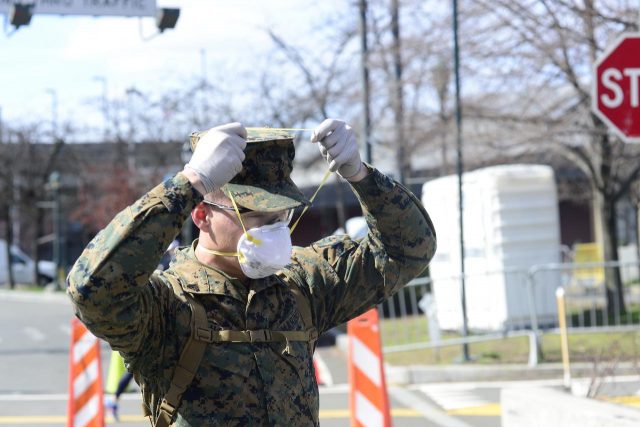
Image via U.S. Navy
“I would say we don’t back off of the COVID-19 standards because it will also reduce the impact of flu and other illnesses,” he added. “We think continuing to apply these same techniques would be further beneficial to the people and to the Army overall.”
Consider this: should the Army and eventually the entire DoD implement “permanent” social distancing measures, which would at the very least mean for years to come, that would put the entirety of American society a mere stone’s throw away from being forced to do the same.
In a sense, US armed forces might be the ‘canary in the coal mine’ in this case, revealing where we’re all headed and what might be forced on the already weary American people, who overwhelmingly are ready to truly return to normal.
Climate science and the Supreme Court
By Judith Curry | Climate Etc. | October 16, 2020
An alternative assessment of U.S. Supreme Court Justice nominee Amy Coney Barrett’s statements on climate change.
For those of you not in the U.S., confirmation hearings on the nomination of Amy Coney Barrett for the Supreme Court are currently underway. There are many very political issues surrounding this nomination and its timing. Lets put all that aside for the moment, and consider her statements on climate change.
Barrett’s statements [link]:
“I will not express a view on a matter of public policy, especially one that is politically controversial.”
“I don’t think my views on climate change or global warming are relevant to the job I would do as a judge. Nor do I feel like I have views that are informed enough.”
“I’m certainly not a scientist,” she said when asked by Sen. John Kennedy (R-La.) whether she had a personal opinion on the issue. “I mean, I’ve read things about climate change. I would not say I have firm views on it.”
“I don’t think I’m competent to opine on what causes global warming or not.”
The twitterati are hysterical over these statements. From a Washington Post article:
“The judge’s exchange on climate change was short, but her critics say it is disqualifying”
“It is a requirement that a Supreme Court Justice be able to review evidence to make a decision,” he said. “The scientific evidence of climate change is beyond reasonable doubt or debate, yet Amy Coney Barrett refused to acknowledge reality.”
“A climate change case is already on the Supreme Court’s docket next year. It will hear a case involving several oil companies, including Dutch Royal Shell, being sued by the city of Baltimore, which is seeking to hold them financially responsible for their greenhouse gas contributions. Barrett’s father spent much of his own career as a lawyer for Shell.”
An article in the Esquire is entitled: Amy Coney Barrett’s answer on this climate change question is completely disqualifying.
“Put simply, this is just totally disqualifying for any official holding public office in the year 2020. This isn’t even an up-to-date Republican bullshit line on the topic. “I’m not a scientist” is so 2014, maybe because even the Elite Political Media—pockets of which are just today allowing themselves to be hoodwinked by another Emails caper—caught on to how dumb it is. Does Judge Amy Coney Barrett accept the scientific consensus that gravity is keeping her in that chair? If so, why? She’s not a scientist, so how could she possibly know?”
There are two issues here that deserve discussion:
- Whether ‘belief’ in climate change actually means anything when spouted by politicians and other non-scientists
- What judges should be expected to know about climate science.
“I believe in climate science”
I think that Amy Coney Barrett’s answers to the climate question was admirable. She wanted to stay out of a contentious political debate. But more importantly she wasn’t going to pass a judgement on something for which she had not carefully evaluated the evidence and did not find herself qualified to make a judgement on. I thought her stance on this showed wisdom and humility.
In the 2016 presidential debates, Hillary Clinton said: “And I believe in science”, with specific reference to climate change.
In the political debate on climate change, ‘I believe in climate science’ is a statement generally made by people who don’t understand much about it. They use such statements as a way of declaring belief in a scientific proposition that is outside their knowledge and understanding. The belief of individuals making such a statement is often more akin to believing in Santa Claus than relating to actual understanding of science. In the case of Hillary Clinton’s acceptance speech at the U.S. Democratic National Convention, Clinton’s appeal to science was a partisan rallying cry that was coupled to the mockery of Donald Trump and his supporters as ‘anti-science.’
In the context of the climate change, ‘I believe in science’ uses the overall reputation of science to give authority to the climate change ‘consensus’, shielding it from questioning and skepticism. ‘I believe in climate science’ is a signifier of social group identity that supports one particular solution: massive government legislation to limit or ban fossil fuels. ‘Belief in climate science’ makes it look as though disagreement on this solution is equivalent to a rejection of the scientific method and worldview. When exposed to science that challenges their political biases, these same ‘believers’ are quick to claim ‘pseudo-science,’ without considering (or even understanding) the actual evidence or arguments. An excellent summary of all this is provided in a previous blog post discussing an article by Robert Tracinski.
In my albeit limited experience, very few politicians have made a serious attempt to understand climate science, beyond being able to parrot talking points provided to them by advocacy groups.
Here is what we are left with: One side attacks science and the other side uses science for political attacks. Neither side actually cares about or understands the science.
Kudos to Amy Coney Barrett for providing an appropriate answer to the climate change questions.
Supreme Court
A New York Times article discusses why judge’s ‘opinions’ on climate change are relevant to the Supreme Court. The EPA endangerment finding may be facing a challenge in a future Republican administration. There are also lawsuits against the U.S. government and oil companies that could make it the Supreme Court.
The Wikipedia has a good overview on the Juliana case against the U.S. government as well as previous cases. Apart from procedural issues, I don’t see what kind of ruling by the Supreme Court on climate change that would hinge on the Justices’ understanding or ruling on details of the science.
The Dutch Urgenda ruling accepted the authority of the IPCC assessment reports. This was an unusual ruling based upon the U.S. court system, which leaves matters of policy to the legislative and executive branches.
Australia Faces Challenging Times Caused by Deteriorating Relations with China
By James ONeill – New Eastern Outlook – 16.10.2020
A recent article published in Russia Today on 13 October 2020 by Tom Fowdy raised some very important issues affecting Australia’s economic well-being. That economic position is rapidly deteriorating as the country’s crucial economic relationship with China disintegrates at an accelerating rate. Australia’s export structure has had several distinctive features over the 250 or so years since it was first colonised by the British in the late 18th century.
Its initial role was to serve as a penal colony for people from Britain who had committed crimes, but not severe enough to warrant execution. The rights of Australia’s indigenous population who had inhabited the country for more than 100,000 years did not enter the equation. Indeed, they were not officially regarded even as human beings, that status only being assigned in the 1960s. Before then the aboriginal people had the same legal status as flora and fauna.
The defeat of the British in Singapore by the Japanese army in 1941 lead to the beginning of a move from reliance on the British for the country’s security to reliance upon the Americans. The latter’s troops arrived in 1942 and they have been there ever since.
Australia’s trading patterns showed a similar reliance upon the British until the latter’s joining the European Common Market on 1 January 1973 forced a reappraisal of that economic relationship. Thereafter, Australia’s trade shifted progressively to its Asian neighbours, a trend that accelerated in every year since the 1970s. Today, Asian nations account for the vast bulk of Australia’s trade with the world.
China, which accounted in 2019 for more than one third of the total Australian exports, was easily the biggest trading partner, accounting for nearly twice the amount of trade than that with Japan, the second most important trading partner.
Despite its geography, being a landmass immediately South of its major trading partners, the Australian political psyche has remained firmly fixed to the Anglo-United States worldview. Since the end of World War II in 1945, Australia has joined the United States in at least four major military conflicts; Korea, Vietnam, Afghanistan and Iraq, that are not only geographically remote from Australia, but also involved no discernible vital Australian strategic interest.
The fact that all four wars were based on false justifications did nothing to enhance their legitimacy. The Korean War was manifestly aimed at the overthrow of the then newly installed Communist Party in China. This was readily discernible from the actions of the Allied troops that clearly violated the terms of the United Nations Security Council resolution authorising military action (in the absence of Russia and with China’s seat still held by the Nationalists.)
The lies told about Iraq’s “weapons of mass destruction” or Afghanistan’s alleged role in sheltering the falsely accused Osama bin Laden for his alleged role in the events of 11 September 2001 are too well known to bear repetition here. What is important for present purposes is that the falsehoods and ulterior motives for the invasion and occupation of Afghanistan and Iraq did not deter Australia from either its initial involvement or its continuing role as an occupying power.
Australia similarly joined in the United States manufactured war in Vietnam, again for no discernible strategic or military interest to Australia. It was the experience of the 1972 –1975 Whitlam Labor government in Australia in response to that war that cemented the subservience to United States interests.
Whitlam had removed Australian troops from Vietnam and recognised the PRC as China’s legitimate government. Both moves met with bitter opposition by the Liberal Opposition party. What sealed the Whitlam government’s fate however, was its decision to close the American run spy base at Pine Gap in Australia’s Northern Territory. The Whitlam government was dismissed by the country’s Governor General John Kerr the day before Whitlam was to announce Pine Gap’s closure to the Australian parliament. That the base is still open (one of at least eight United States military bases in Australia) speaks volumes about the geopolitical consequences of the Whitlam dismissal.
Through these tumultuous years trade with China continued to flourish. China also became the largest source of foreign students, the largest source of foreign tourists, and the third largest source of foreign investment. In 2020 all this changed. Clearly acting as a mouthpiece for the American administration, Australia demanded an “explanation” from China at the beginning of this year for the outbreak of the Corona virus.
The accusatory tone of the Australian demand was not well received in Beijing. This began a series of economic countermeasures by China. The initially relatively small economic impact of banning wine imports was clearly intended to send a signal.
That signal fell on deaf ears. Australia’s anti-China rhetoric progressively escalated through 2020. The Chinese response was to increase the banning of Australian imports. The latest (early October 2020) was to ban coal imports from Australia. This is a market worth $US13 billion to the Australian economy. It will not be the last item to be banned or greatly restricted, with iron ore (more than US$100 billion) probably being the next commodity banned, already falling 17% each month since July.
The Covid crisis has also resulted in an almost complete cessation of Chinese student arrivals (again the largest foreign source) and an industry worth billions of dollars and thousands of jobs to the Australian economy. It would be naïve to expect those numbers to recover in the foreseeable future. The same is true with Chinese tourists, a vanishing species and again unlikely to return to anywhere near previous levels. Again, tens of thousands of jobs are lost.
The rational response by an Australian government would be to review both its policies and its rhetoric. Not only has the Morrison government shown no such inclination, it is difficult to see how it could feasibly do so without adversely affecting its close and continuing (subservient) relationship with the United States.
The memory of the fate of the 1975 Whitlam government which dared to pursue policies contrary to United States wishes continues to cast a very long shadow over Australian politics.
Fowdy suggests that Australia’s situation “might be described as the most clear and explicit reaction yet of the discomfort in the Anglo-sphere world caused by the rise of China.” I respectfully agree. The solution however, is not to try and maintain the dominance of the Western world as it has been for the past 300 years.
Instead there needs to be a recognition that the Anglo-Saxon dominance was an historical anomaly, and that the old order is resetting itself. In Australia’s case that will require some major mental adjustments.
The country has flourished in recent decades precisely because of its geography and growing trade and other links with what Australians call “the near North.” What has been manifestly lacking is the political attitudes and conduct that match the geopolitical and trade realities. Unfortunately, that adjustment may be a bridge too far for the Australian psyche. It has only itself to blame.
James O’Neill is an Australian-based former Barrister at Law.
Russia weighs military cooperation with Iran after arms embargo expiration: Foreign Ministry
Press TV – October 16, 2020
The Russian Foreign Ministry spokeswoman says Moscow will consider military technical cooperation with Iran in line with mutual interests after the expiration of a United Nations arms embargo on Tehran.
“We are convinced that all possibilities stemming from the expiration of the provisions of United Nations Security Council Resolution 2231 that are linked with military technical cooperation with Iran will be duly taken into account and used on the basis of mutual benefit and in the interests of the peoples of our two states,” Maria Zakharova said on Thursday.
She was referring to the resolution that endorsed a multilateral 2015 nuclear deal between Iran and major world powers, including Russia.
All the parties to the talks about Iran’s nuclear program were aware from the very beginning that there is no link between restrictions on weapons supplies to Tehran and the settlement of issues pertaining to its nuclear program, added Zakharova.
She emphasized that the United Nations Security Council did not impose a weapons embargo on Iran in 2015, but the country “voluntarily undertook a number of restrictions.”
“It was done in the interests of the soonest successful outcome of the talks on the Joint Comprehensive Plan of Action (JCPOA) to settle the situation around the Iranian nuclear program,” the Russian diplomat said.
She noted that the term of the corresponding provisions has expired.
Zakharova stressed that Iran was a “reliable partner” for Russia in many areas of cooperation.
On August 14, the UN Security Council almost unanimously refused to support a US-sponsored draft resolution on extending the arms embargo against Iran, which is due to expire on October 18 under the JCPOA.
During the 15-member Security Council vote, the US received support only from the Dominican Republic for its anti-Iran resolution, leaving it far short of the minimum nine ‘yes’ votes required for adoption.
The following month, Washington suffered another embarrassing loss as it failed to trigger the so-called snapback provision in the JCPOA aimed at re-imposing all UN sanctions against Iran.
The UN Security Council member states challenged the US’s rationale that it was still a participant state to the nuclear accord, citing its unilateral withdrawal in May 2018.
Speaking during a cabinet meeting on Wednesday, Iranian President Hassan Rouhani said the country will be free to trade weapons as of Sunday after the United States failed in its attempts to secure an extension of the embargo.
Moscow had earlier said “new opportunities” will emerge in cooperation with Iran the UN embargo expires, and that any agreements with Tehran will have “nothing to do with the unlawful and illegal actions of the US administration, which is trying to intimidate the entire world.”
Russia’s Foreign Minister Sergei Lavrov said late last month that Moscow and Tehran roundly reject efforts by the US to permanently extend an arms embargo against the Islamic Republic.
Speaking at a joint press conference that followed a meeting with his visiting Iranian counterpart Mohammad Javad Zarif in Moscow, Lavrov added, “We stressed that Moscow and Tehran, like the entire international community, categorically reject US ambitions to impose some kind of indefinite arms embargo.”
Press TV’s website can also be accessed at the following alternate addresses:
Will the Mediterranean Sea save Lebanon from drowning in debt?
Steven Sahiounie | Mideast Discourse | October 16, 2020
The Lebanese population faces between six to twelve hours of electricity cuts per day, and in some rural areas, there is simply no electricity provided by the government grid. Amid the backdrop of decrepit infrastructure, government corruption, devalued currency, and widespread poverty, Lebanon began talks with Israel concerning their maritime borders in the gas-rich Mediterranean Sea on Wednesday at the UNIFIL headquarters at Naquora.
The UN peacekeeping force UNIFIL has been monitoring the disputed land boundary since Israel’s’ military withdrawal from south Lebanon in 2000, ending a 22-year occupation. The two sides met together in the same room but directed their communications through a US mediator.
The US is the mediator between the two countries which remain technically ‘at war’ while hoping to end a long-running dispute which could eventually see Lebanon producing gas to convert to domestic electricity, as well as a potential revenue producer which could pay off Lebanon’s huge debts. Lebanon’s currency has lost 80 percent of its value against the dollar over the last year, and its debt-to-G.D.P. ratio is one of the world’s highest.
Lebanon and Israel are struggling to deal with high COVID-19 infection rates, while Netanyahu is slipping in the polls due to abuse of power charges, and the Lebanese government is in limbo after being labeled as corrupt and inept, while desperate for cash from foreign donors as it faces the worst economic crisis since its 1975-1990 civil war. The financial collapse was compounded by an explosion at the Port of Beirut in August, killing nearly 200 people.
Israel is already pumping gas from huge offshore fields, and this meeting will allow both sides to proceed further within the safety of an understanding of the maritime borders.
US pressure
The talks follow years of diplomacy by Washington, and the Trump Administration had hoped to use the Naquora meeting as a dramatic media show less than a month after landmark US-sponsored normalization agreements between Israel and the United Arab Emirates and Bahrain; however, this showy plan was aborted.
The US envoy David Schenker explained that these talks “have nothing to do with the establishment of diplomatic relations or normalization.” However, it was last month that the US turned up the pressure on Lebanon to start the talks with a deadline for the agreement before the US election on November 3, while the second round of talks is scheduled for October 28.
The Naquora meeting
President Michel Aoun is the key person managing the off-shore energy resources portfolio, and he placed a representative from the Lebanese Petroleum Administration (LPA) on the negotiating team as a nod to pressure from Washington who had insisted on civilian presentation, whereas Hezbollah requested only military and technical delegates.
There are four points on the agenda of the Naqoura talks: setting the land reference point from which to depart toward the sea; defining the southern maritime border where the disputed area is located; agreeing on the land border demarcation after the completion of the maritime demarcation, and exchanging documents and handing over copies to the United Nations.
The Lebanese Negotiating team
Brigadier General Bassam Yacine is the lead negotiator, Marine Colonel Mazen Basbous is the head of operations in the Lebanese military, Najib Masihi is a Lebanese American expert in maritime and territorial boundaries, and Wissam Shbat is a board member of LPA and head of its geology and geophysics unit.
Lebanon’s offshore possibilities
In 2017, Lebanon’s information minister announced the Cabinet had approved licenses for Italy’s Eni, Frances’s Total, and Russia’s Novatek to carry out exploratory drilling off the Lebanese coast in two of Lebanon’s 10 offshore blocks to determine whether oil and gas exist in the area.
Analyst Diana Kaissy, who heads the Lebanese Oil and Gas Initiative think-tank, said it was “impossible to know” the extent of the accessible reserves before exploration operations begin, but she said, “preliminary evaluations” showed the five blocks offered by the government were the “most promising,” with block nine bordering a sector disputed by Israel.
At issue is more than 330 square miles in the Mediterranean that Israel and Lebanon both claim is in their exclusive economic zone. The pressure to resolve the dispute has mounted as Israel and Cyprus have begun exploiting offshore gas.
Lebanon estimates it has 96 trillion cubic feet of natural gas reserves and 865 million barrels of oil offshore. Israel is aiming to get a percentage of a contested area of 860 square kilometers that Lebanon is claiming.
The 1982 UN Convention on the Law of the Sea (UNCLOS) stipulates that coastal states have sovereign rights in a 200-nautical-mile exclusive economic zone (EEZ) concerning natural resources; however, the maritime dispute does not fall within the UNIFIL’s current mandate, and Israel is not a party to UNCLOS.
Lebanon reached a maritime border agreement with Cyprus in January 2007. This prompted Beirut, in July and October 2010, to deposit with the United Nations the geographical coordinates of the southern and southwestern maritime borders of that EEZ. Cyprus went ahead and signed an EEZ delimitation accord with Israel in December 2010.
Lebanon and Israel could share in the disputed 860 square kilometers, which covers Lebanon’s offshore gas Blocks 8, 9, and 10. The “Hoff line” proposal gave Lebanon 550 square kilometers, which was rejected as Beirut insists on full rights in this disputed area. Lebanon has refused to join the Eastern Mediterranean Gas Forum or any other regional mechanism that includes Israel; therefore, it has been more or less isolated in the eastern Mediterranean gas process given the emerging alliance between Israel, Egypt, Cyprus, and Greece.
France’s Total energy company is set to begin gas exploration in Block 9 by the end of the year, while Israel approved in June oil, gas exploration in Block 72, close to Lebanon’s Block 9 where exploration will soon start.
Hezbollah and Amal
Hezbollah’s Secretary-General Hassan Nasrallah in a joint statement with Amal, the country’s other main party of resistance, released hours before the talks were due to start, called for the negotiating team to be revised to include only members of the military.
The Lebanese preconditions included having military and technical delegates, instead of diplomatic delegates, and setting no timeline to reach a deal, to avoid US pressure on the negotiations.
Last month the US placed sanctions on the top aide to Nabih Berri, the leader of Amal, for corruption and financially enabling Hezbollah.
Hunter Biden Sought ‘Lucrative’ Deal for Himself, His ‘Family’ With Chinese Firm, New Emails Suggest
By Tim Korso – Sputnik – 15.10.2020
Bombshell emails obtained by the New York Post made headlines on 14 October, as they suggested that Joe Biden was involved in his son’s overseas business affairs after all. The rapid spread of the story was, however, impeded by Facebook and Twitter, both of which limited users from sharing it under various pretexts.
Hunter Biden, son of former Vice President and current Democratic presidential candidate Joe Biden, previously pursued an agreement with a Chinese energy giant that would be “interesting” to him and his “family”, a new trove of emails published by the New York Post suggests.
The emails come from the same MacBook Pro laptop that contained the purported correspondence of Biden that rocked media outlets and social media on 14 October. The computer, which had a Beau Biden Foundation sticker on it, was dropped off at a repair shop in the state of Delaware in April 2019, but was never collected. The shop’s owner handed it over to the FBI, but not before copying its contents and sending it to former Mayor Rudy Giuliani, who, in turn, provided the material to the NYP.
Sputnik could not independently verify the authenticity of the emails.
Twenty Percent for H[unter] and Ten More for ‘Big Guy’?
The newly released emails from the alleged correspondence of Hunter Biden suggest that the latter was engaged in negotiations involving the company CEFC China Energy, a former top 10 firm in China, and continued between May and September 2017. The first piece from the new trove of emails, dated 13 May 2017, concerned Hunter becoming either the chair or vice-chair of an unnamed company with a “remuneration package” worth “850”, when he already had a paid position on the board of Ukrainian gas company Burisma.
In addition, the same letter suggested that the shares in the company would be divided between six people, identified mostly by their initials. At least three sets of initials refer to the author and the recipients of the email, James Gilliar, Rob Walker, and Tony Bobulinski. The remaining names on the list are “Jim” and “H”, the latter of which may stand for Hunter Biden, another alleged recipient of the mail. “H” was supposed to get 20% of the shares for himself and hold 10% more “for the big guy”. Who the “big guy” is remains unclear from either the alleged email or the New York Post report.
Alleged ‘Lucrative Arrangement’ for Biden ‘Family’
The next piece of correspondence unearthed by the NYP was purportedly sent by Hunter Biden to Gongwen Dong, a Chinese citizen who allegedly had ties to his country’s authorities and was an associate of the now-arrested chairman of the CEFC, which went bankrupt in 2020 after a series of scandals involving fake deals and inflated financial results, Ye Jianming. In the alleged email, dated 2 August 2017, Hunter purportedly reveals that a person, whom he only refers to as “chairman”, had at first offered him a payment of $10 million per year in “consulting fees” for three years, but later made a “much more lasting and lucrative arrangement” where he would receive 50% of the shares in an unnamed holding company.
In the mail, Hunter allegedly indicates that the offer of getting a 50% share in the joint venture was “so much more interesting to me and my family”. The remaining 50% were supposed to be held by the chairman, which may refer to CEFC Chairman Ye Jianming, who was arrested by the Chinese authorities back in 2018.
A photo, taken a day prior to the alleged email regarding the “lucrative arrangement” and which was also found on the MacBook laptop, purportedly shows the proposed structure of a company called Hudsonwest, which would be jointly owned by Hunter Biden and the “chairman” in equal parts. A company with a similar name, Hudson West III LLC, was mentioned in reports presented by two US Senate committees – on Homeland Security and Governmental Affairs, and on Finance – in regards to Hunter Biden’s business affairs in China, Russia, and Ukraine.
According to these reports, Hudson West III had a credit line with Cathay Bank that was opened by Hunter Biden and Gongwen Dong in September 2017. With this line of credit, the company issued several credit cards with collateral of $99,000. These cards were authorised to be used by Hunter Biden, his uncle James Biden, and the latter’s wife, Sara Biden. The Senate reports state that these cards were used to buy $101,291 worth of goods and services, including airline tickets, hotel bookings, as well as purchases made at pharmacies and Apple Stores. The company Hudson West III has since been dissolved, the Senate reports say.
Leak of Scandalous Laptop Emails
The new revelations come a day after a bombshell report by the NYP that suggested Hunter Biden had arranged a meeting between an adviser to the board of the Ukrainian gas firm Burisma, Vadym Pozharskyi, and his father, Joe Biden, in 2015 – when the latter was still serving as vice president. Almost a year after the purported meeting, Joe Biden convinced Ukrainian authorities to sack Prosecutor-General Viktor Shokin, who was allegedly investigating crimes by Burisma, by threatening to withhold a $1 billion US loan to Kiev.
Joe Biden has repeatedly claimed he did not discuss Hunter’s overseas business affairs with his son and insists he did not pressure Kiev into sacking Shokin, despite openly boasting of playing a role in getting him fired at the Council on Foreign Relations in 2018. The Biden campaign denies that the 2015 meeting between Pozharskyi and the former vice president took place, while Hunter Biden’s lawyer has refused to comment on the NYP report. The lawyer insisted that information received from Rudy Giuliani cannot be trusted and thus doesn’t deserve to be commented on.
Social Media Platforms Under Fire for Taking Down Hunter Biden Email Story
The bombshell NYP story about Joe Biden’s alleged meeting with Pozharskyi gained so much traction online that two social media platforms, Facebook and Twitter, limited its spread by forbidding users from sharing it. Apart from this, Twitter took the original post down for good and blocked several accounts that had reposted it, including those of the New York Post and White House Press Secretary Kayleigh McEnany. The decision met with furious reactions from both netizens and Republican politicians, who accused the social media platforms of censoring the information, which is potentially damning to the Democratic presidential candidate that the platforms allegedly favour.
The move against the NY Post’s story was not immediately followed by an explanation from the two platforms, which only added to the outrage of netizens. Facebook later clarified that the spread of the story would be limited until third-party fact-checkers confirm its veracity. Twitter, in turn, justified its action by stating that the article violates its rules, as it contains personal data of the people involved in the story, as well as “hacked materials” – although all the information had been obtained without the need to bypass the security barriers on the laptop.
Iraq Forms Committee to Develop Timeline for Withdrawal of US Troops
Sputnik – 15.10.2020
The Iraqi authorities have formed a committee that will coordinate with the United States to develop the timeline for the withdrawal of US troops from the Middle Eastern country, the Iraqi Foreign Ministry said on Thursday.
“The meeting took place at the Foreign Ministry headquarters today, Thursday, October 15, 2020, in which a technical committee emerged to undertake the task of coordinating with the US side to schedule the redeployment of US forces outside Iraq,” the Iraqi Foreign Ministry wrote in a press release.
The decision was taken during a meeting involving Iraqi Foreign Minister Fuad Hussein, National Security Adviser Qassem Al-Araji, and a range of other security officials.
The establishment of the committee follows a series of meetings between US and Iraqi officials over the summer. In August, Prime Minister Mustafa al-Kadhmi travelled to Washington for talks with US President Donald Trump, and a three-year timeline was established for the US withdrawal.
In early January, the Iraqi parliament voted to expel all foreign forces from the country following the US decision to launch a drone attack near Baghdad International Airport that killed top Iranian commander Qasem Soleimani.
Featured Video

John Mearsheimer: Why Russia Gains By Hitting Ukraine Harder
or go to
Aletho News Archives – Video-Images
Book Excerpt
Measles and Mortality
Informed with Aaron Siri| November 19, 2026
Given the news coverage around measles and mortality, I decided to share the section of my book, Vaccines, Amen, that covers precisely this topic. Help me spread a bit of reality into the media hysteria around this issue. Here is that section of the book… continue
Blog Roll
 Aletho News
- A Climate Scientist Who Engages Skeptics
- John Mearsheimer: Why Russia Gains By Hitting Ukraine Harder
- Argentina’s Perito Moreno Glacier Joins Antarctica and Arctic In Defying Doomsday Melt Claims
- ‘Chinagate’ Is Here
- Iran, four other countries condemn US plans to deploy weapons in outer space
- US media brings back the Iraq war playbook and why it won’t work
- Zakharova schools German FM on history basics
- Germany to produce drones for Ukraine
- Merz takes a swipe at Merkel over Ukraine’s NATO bid
- Measles and Mortality
- If Americans Knew
- The revolution against Israeli control of America is HERE! (Video)
- Why Iran Hawks Are Now Hyping ‘Radical Shiite’ Threats
- Israel is still displacing Palestinians in Gaza, expanding its ‘yellow line’ deeper into the strip every day
- DAILY UPDATE: Latest essential news on Palestine, Israel, & region
- US Military Airlift to Israel continues
- “Israel Should Exist” Is An Extremist Position
- Israel Is Using All-Expenses-Paid Trips to Turn U.S. Americans Into Israel advocates
- Oxfam: Israel has turned Gaza into a toxic wasteland, threatening human survival
- Is environmental destruction part of Israel’s displacement playbook in the West Bank and Lebanon?
- Trump’s Cyber Director Pick Has Deep Ties To Israeli Intelligence
- No Tricks Zone
- Alarmist Climatologists In Shock! 2026 Atlantic Hurricane Season Sees Lowest Count In 101 Years
- New Study: Modern Temps Are Among The Coldest Of The Last 10,000 Years In East Central Europe
- Germany’s Renewable Energies Lead to 1.4 Billion Euro Electric Power Trade Deficit
- Argentina’s Perito Moreno Glacier Joins Antarctica and Arctic In Defying Doomsday Melt Claims
- New Study: Barents Sea Temperatures Were Warmer And Sea Ice Less Extensive In The 1700s Than Today
- German Authorities Start Initiative To Evaluate Public Register For Climate “Disinformation” Spreaders!
- Zonal Asymmetry of Temperature Change in the Antarctic Circumpolar Current
- New Study: The Net Fossil Fuel Contribution To Rising Atmospheric CO2 Has Been Zero For 500 Years
- Germany’s Green Energy Transition Becoming Increasingly Expensive…Another 6 Trillion Euros!
- Sudden Stratospheric Warming, Powerful El Niño Combination May Lead To Extreme Europe Cold, Energy Crisis!

