The US Has Placed Itself In Charge Over Which Nations Get To Eat
By Caitlin Johnstone | October 17, 2021
The globally influential propaganda multiplier news agencies AP and AFP have both informed their readers that a “fugitive” has been extradited to the United States.
“Fugitive businessman close to Venezuela’s Maduro extradited to US,” reads the AFP headline.
“Alex Saab, a top fugitive close to Venezuela’s socialist government, has been put on a plane to the U.S. to face money laundering charges,” AP announced on Twitter.
You’d be forgiven for wondering what specifically makes this man a “fugitive”, and what that status has to do with his extradition to a foreign government whose laws should have no bearing on his life. The Colombian-born Venezuelan citizen Alex Saab, as it happens, is a “fugitive” from the US government’s self-appointed authority to decide which populations on our planet are permitted to have ready access to food. His crime is working to circumvent the crushing US sanctions which have been starving Venezuelan civilians to death by the tens of thousands.
Saab is being extradited from the African nation of Cabo Verde where he has been imprisoned since last year under pressure from the US government. In an article published this past May titled “Alex Saab v. The Empire: How the US Is Using Lawfare To Punish a Venezuelan Diplomat“, Roger D Harris explains how the US uses its domination of the international financial system to crush nations which disobey it and outlines the real reasons for Saab’s imprisonment, which has included torture and draconian living conditions. Harris writes:
Special Envoy and Ambassador to the African Union for Venezuela Alex Saab was on a humanitarian mission flying from Caracas to Iran to procure food and gasoline for the Venezuelan CLAP food assistance program. Saab was detained on a refueling stop in the African nation of Cabo Verde and has been held in custody ever since June 12, 2020.
Saab’s “crime” — according to the U.S. government, which ordered the imprisonment — was money laundering. That is, Saab conducted perfectly legal international trade. Still, his circumventing of the U.S. sanctions – which are designed to prevent relief to the Venezuelans – is considered by Washington to be money laundering.
After a two-year investigation into Saab’s transactions with Swiss banks, the Swiss government concluded on March 25 that there was no money laundering. Saab is being prosecuted because he is serving his country’s interest rather than that of the U.S.
News agencies like AP and AFP are well aware that Saab is being extradited not for breaking any actual law but for daring to transgress Washington’s unilateral sanctions. As FAIR’s Joe Emersberger wrote back in July:
Reuters (3/15/21, 3/18/21) has casually reported that Saab “faces extradition to the United States, which accuses him of violating US sanctions,” and that he has been “repeatedly named by the US State Department as an operator who helps Maduro arrange trade deals that Washington is seeking to block through sanctions.” A Reuters article (8/28/20) about Saab’s case in 2020 mentioned in passing that “the United States this month seized four cargoes of Iranian fuel bound for Venezuela, where fuel shortages are once again worsening.”
Critics of the US empire have had harsh words for the extradition.
“Biden, picking up Trump’s baton, has kidnapped Venezuelan diplomat Alex Saab for the crime of trying to feed Venezuelans in defiance of US sanctions designed to prevent that,” tweeted journalist Aaron Maté. “Venezuelans aren’t allowed to eat so long as the D.C. Mafia has marked their government for regime change.”
Yes indeed. The US government has appointed itself the authority to unilaterally decide which of the world’s populations get to eat and which do not, and to imprison anyone who tries to facilitate unauthorized eating in a US-sanctioned nation.
“The extradition of Venezuelan diplomat Alex Saab is a clear signal the Biden Administration has made no break with Trump’s all out assault on international law,” tweeted journalist Anya Parampil. “Also a worrying sign for the case of Julian Assange— another foreign citizen the US has essentially kidnapped and held hostage.”
This is true. It would seem that the primary difference between Assange’s case and Saab’s is that the US empire is working to extradite Assange because he transgressed its self-appointed authority over the world’s access to information, whereas Saab transgressed its self-appointed authority over the world’s access to food.
“The US rogue state just ripped up every international law, after imprisoning and now extraditing Venezuelan DIPLOMAT Alex Saab. Diplomatic immunity is dead; the US empire killed it. Now all foreign diplomats are fair game to be kidnapped and imprisoned, if Washington wants to,” tweeted journalist Ben Norton, adding, “The US accusations of ‘money laundering’ are absurd and politically motivated. The US claims anyone who violates its ILLEGAL sanctions is a ‘criminal’.”
Indeed, “money laundering” is a vague charge which basically just means trying to conceal the source or destination of money that is deemed to have been obtained illegally, and since the US government considers itself the arbiter of what financial transactions are lawful in nations it is sanctioning, it can apply that claim to anyone who tries to get around US sanctions financially.
The US government does not deny that its sanctions hurt Venezuelans by attacking the economy they rely on to feed themselves, in fact it has openly admitted that “sanctions, particularly on the state oil company in 2019, likely contributed to the steeper decline of the Venezuelan economy.”
The US government also does not deny that the starvation sanctions it has inflicted upon Iran are directed at its civilian population, with then-Secretary of State Mike Pompeo openly admitting in 2019 that Washington’s economic warfare against that nation is designed to pressure Iranian civilians to “change the government,” i.e. make them so miserable that they wage a domestic uprising to topple Tehran.
The US government also does not deny that the starvation sanctions it has inflicted upon Syria are designed to hurt its civilian population, with current Secretary of State Tony Blinken reaffirming just this past Wednesday that it is the Biden administration’s policy to “oppose the reconstruction of Syria” as long as Assad remains in power. In other words the US will not allow Syria the funds to help rebuild itself from the devastating regime change proxy war the US and its allies waged against it, even as the UN reports that 60 percent of the nation’s population is close to starvation.
And of course there’s the US power alliance’s horrific blockade on Yemen which is murdering people by the hundreds of thousands via starvation and disease, with the UN reporting that a further 16 million people are “marching towards starvation.”
Starvation is the only kind of warfare where, because of the continual reframing of mass media propaganda, it is considered perfectly normal and acceptable to deliberately target a civilian population with deadly force.
The US empire is entirely open about the fact that it sees itself as the gatekeeper of the world’s food supply. If a population disobeys the empire its people will starve, and anyone who tries to obtain food for them will be arrested by US proxies and extradited to a US jail cell.
This is the imperialist’s vision of heaven on earth. A world where America’s stranglehold over global financial systems allows it to choke off entire populations if their governments disobey imperial decrees, without even firing a shot. A world where the PR nightmares of bombed civilians and destroyed nations are a thing of the past, where disobedient nations can simply be squeezed to death by modern siege warfare tactics while imperial propaganda firms like AP and AFP blame their starvation on their nation’s leaders.
That’s ultimate power right there. That’s total control. Having the world so bent to the will of the almighty dollar and the massive military force with which it is inextricably intertwined to such an extent that disobedience becomes impossible. That’s what’s being fought for in the slow motion third world war that the empire is waging against unabsorbed governments like Venezuela, Syria, Iran, Russia and China. And that’s why those unabsorbed governments are fast at work moving away from the dollar in response.
It should really go without saying, but a power structure that would openly starve civilians to death to ensure global domination is not the sort of power structure that humanity should want dominating the globe. The willingness to do such monstrous things exposes a depravity and a lack of wisdom which has no business determining what direction our world should take into the future.
Iran And Venezuela Strike Oil Swap Deal
By Irina Slav | Oilprice.com | September 27, 2021
Iran and Venezuela have struck a deal to swap heavy Venezuelan crude for Iranian condensate, Reuters has reported, citing unnamed sources familiar with the deal.
According to these sources, the swaps are set to begin this week and last for six months, although they could be extended. The imports of Iranian superlight crude will help Venezuela revive its falling oil exports amid U.S. sanctions that, among other problems, have cut off the country’s access to the light oil that is used to blend with its superheavy to make it exportable.
For Iran, the deal will bring in heavy crude it could sell in Asia, the Reuters sources also said. The diluted Venezuela crude will also likely go to Asian buyers.
Reuters also reported that, according to the U.S. Treasury Department, the deal could constitute a breach of sanctions, to which both Venezuela and Iran are subjects.
“Transactions with NIOC by non-U.S. persons are generally subject to secondary sanctions,” the Treasury Department said in response to a Reuters request for comments on the deal. It added that it “retains authority to impose sanctions on any person that is determined to operate in the oil sector of the Venezuelan economy.”
Despite the sanction noose, Venezuela has been ramping up its oil exports, generating vital revenue. According to a recent Reuters report, the country, which is home to the world’s largest oil reserves, exported more than 700,000 bpd of crude in July—the highest daily export rate since February.
Most of the oil went to China and Malaysia, although the latter is usually only a stop along Venezuelan oil’s trip to China. The same report noted that three of the five crude oil blending facilities in the Orinoco Belt were operational, and another crude upgrader was preparing to restart operations after a year’s pause.
Iran, meanwhile, recently revealed plans to attract some $145 billion in oil and gas investments from both local and foreign sources.
“We plan to invest $145 billion in the development of the upstream and downstream oil industry over the next four to eight years, hence I welcome the presence of domestic and foreign investors in the industry,” Javad Owji, Iran’s new oil minister, said during a meeting with executives from China’s oil giant Sinopec.
Lima Group Loses Lima
By Yves Engler · August 11, 2021
The Canadian instigated Lima Group has been dealt a probably fatal blow that ought to elicit serious discussion about this country’s foreign policy. But, don’t expect the media or politicians to even mention it.
In a likely death knell for a coalition seeking to overthrow the Venezuelan government, Peru’s new Foreign Affairs Minister called the Lima Group the country’s “most disastrous” ever foreign policy initiative. Héctor Béjar said, “the Lima Group must be the most disastrous thing we have done in international politics in the history of Perú.”
Two days after Béjar’s statement St Lucia’s external affairs minister, Alva Baptiste, declared: “With immediate effect, we are going to get out of the Lima Group arrangement – that morally bankrupt, mongoose gang, we are going to get out of it because this group has imposed needless hardship on the children, men and women of Venezuela.”
Prior to Baptiste and Béjar’s statements, the Lima Group had lost a handful of members and its support for Juan Guaidó’s bid to declare himself president had failed. Considering its name, the Peruvian government’s aggressive turn against the Lima Group probably marks the end of it. As Kawsachun News tweeted a Peruvian congressman noting, “the Lima Group has been left without Lima.”
The Lima Group’s demise would be a major blow to Trudeau’s foreign policy. Ottawa founded it with Peru. Amidst discussions between the two countries foreign ministers in Spring 2017, Trudeau called his Peruvian counterpart, Pedro Pablo Kuczynski, to “stress the need for dialogue and respect for the democratic rights of Venezuelan citizens, as enshrined in the charter of the Organization of American States and the Inter-American Democratic Charter.” But the Lima Group was established in August 2017 as a structure outside of the OAS largely because that organization’s members refused to back Washington and Ottawa’s bid to interfere in Venezuelan affairs, which they believed defied the OAS’ charter.
Canada has been maybe the most active member of the coalition. Former Foreign Minister Chrystia Freeland participated in a half dozen Lima Group meetings and its second meeting was held in Toronto. That October 2017 meeting urged regional governments to take steps to “further isolate” Venezuela.
At the second Lima Group meeting in Canada, a few weeks after Juan Guaidó proclaimed himself president, Trudeau declared, “the international community must immediately unite behind the interim president.” The final declaration of the February 2019 meeting called on Venezuela’s armed forces “to demonstrate their loyalty to the interim president” and remove the elected president.
Freeland repeatedly prodded Caribbean and Central American countries to join the Lima Group and its anti-Maduro efforts. In May 2019 Trudeau called Cuban president Miguel Díaz-Canel to pressure him to join Ottawa’s effort to oust President Maduro. The release noted, “the Prime Minister, on behalf of the Lima Group, underscored the desire to see free and fair elections and the constitution upheld in Venezuela.”
In a sign of the importance Canadian diplomats placed on the Lima Group, the Professional Association of Foreign Service Officers gave Patricia Atkinson, Head of the Venezuela Task Force at Global Affairs, its Foreign Service Officers award in June 2019. The write-up explained, “Patricia, and the superb team she assembled and led, supported the Minister’s engagement and played key roles in the substance and organization of 11 meetings of the 13 country Lima group which coordinates action on Venezuela.”
Solidarity activists have protested the Lima Group since its first meeting in Toronto. There were also protests at the second Lima Group meeting in Canada, including an impressive disruption of the final press conference. At a talk last year, NDP MP Matthew Green declared “we ought not be a part of a pseudo-imperialist group like the Lima Group” while a resolution submitted (though never discussed) to that party’s April convention called for Canada to leave the Lima Group.
Hopefully the Peruvian and St Lucia governments’ recent criticism marks the end of the Lima Group. But, we should seek to ensure it doesn’t disappear quietly. We need a discussion of how Canada became a central player in this interventionist alliance.
United States Bribes Cape Verde $440 Million in Exchange for Alex Saab’s Extradition
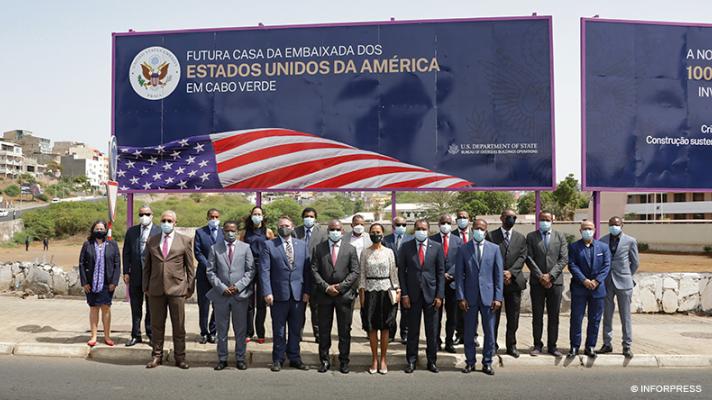
Attendees of the groundbreaking ceremony of the future headquarters of the US Embassy in Cape Verde. (Photo: Inforpress)
MISIÓN VERDAD* | July 6, 2021
On the eve of Cape Verde’s independence day, coincidentally the same day as Venezuela’s—July 5—the United States government announced an investment of $439 million to build a new US embassy facility on a 4.5-hectare area of land adjacent to the Government Palace in Praia, capital of the West African country. Of that money $100 million will go directly into the Cape Verdean economy.
The project would “pay tribute to the long-standing relations” between Praia and Washington, US Ambassador to Cape Verde Jeff Daigle said when he made the announcement on Sunday, July 4.
The disproportionately high figure for the construction of the building is striking, since it is equivalent to more than half of Cape Verde’s Gross Domestic Product (GDP) forecast for the current year.
The news outlet Justiciafuser pointed to the obvious connection between the “investment” and the case of diplomat Alex Saab, who is illegally imprisoned by the government of Cape Verde due to US political influence: “Local observers… have questioned the timing of this announcement coming as it does only days before the Cape Verde Constitutional Court is expected to decide on Alex Saab’s appeal against his extradition to the United States.”
Jeff Daigle has been charged with directing the pressure on the government of Cape Verde for Saab to be extradited to Miami, Florida, under the custody of agents of the Drug Control Administration (DEA).
“Much work remains to be completed” before the expansion of the embassy is secured, the US diplomat said. Local analysts, quoted by Justiciafuser, singled out this statement as an implication that the US is awaiting reciprocation for its investment on behalf of Cape Verde.
Alex Saab was abducted in Cape Verde while returning from Iran on a diplomatic mission, one day before Interpol issued a Red Notice to justify his arrest. The government of Venezuela has demanded his release and has denounced the violations of international law represented by Washington’s actions with the collaboration of the African country.
The Court of the Economic Community of West African States (ECOWAS) recently ruled in favor of ending the extradition process of Alex Saab, and demanded his release.
* SOMOS UN GRUPO DE INVESTIGADORES INDEPENDIENTES DEDICADOS A ANALIZAR EL PROCESO DE GUERRA CONTRA VENEZUELA Y SUS IMPLICACIONES GLOBALES. DESDE EL PRINCIPIO NUESTRO CONTENIDO HA SIDO DE LIBRE USO. DEPENDEMOS DE DONACIONES Y COLABORACIONES PARA SOSTENER ESTE PROYECTO, SI DESEAS CONTRIBUIR CON MISIÓN VERDAD PUEDES HACERLO AQUÍ
Translation by Orinoco Tribune
‘They Make Unsubstantiated Accusations’: Venezuela Calls UN Report Fallacious
Orinoco Tribune | July 6, 2021
In a communiqué, the Bolivarian Republic of Venezuela rejected the fallacious content and highlighted the biased nature of a report published about the country’s situation by the Office of the United Nations High Commissioner for Human Rights, Michelle Bachelet, on July 1, 2021.
This report is the result of a Resolution promoted by a small group of governments with serious domestic human rights violations, that conspired to satisfy the policy of “regime”-change promoted by the US against Venezuela.
Despite the attacks, Venezuela is distinguished by its harmonious constitutional system that guarantees and defends human rights. The state provides a protective shield for its people against the barbarous criminal blockade imposed and directed from Washington and the European Union, that constitutes a serious crime against humanity.
It is especially worrying that this report is based on information provided by individuals with unknown motivations, and has not been duly verified with the authorities of Venezuela, despite the extensive facilities that the Venezuelan Government has provided for the performance of the OHCHR functions within the country.
On this occasion, based on a handful of alleged complaints of human rights violations, unverified accusations are made against the Venezuelan institutions, further manipulating the false narrative constructed to artificially supplement the file currently before the International Criminal Court, with the political objective of destabilizing the democratic institutions of Venezuela.
In addition to this, the report omits mention of the 26 visits made to detention centers and headquarters of intelligence agencies during which the Office of the High Commissioner has been able to interview hundreds of prisoners, according to its own guidelines of operation. In the Office’s conclusions, delivered to the State, the people interviewed confirmed that their personal integrity was respected during their incarceration.
Venezuela has asked the Office of the High Commissioner to share information with the national authorities on the alleged cases referred to in the report, in order to carry out rigorous investigations and determine their veracity and, if applicable, the corresponding responsibilities, in full consistency with its policy of absolute respect for human rights. Similarly, the Office of the High Commissioner has been invited to accompany the investigation processes developed by local authorities.
The Bolivarian Republic of Venezuela, in order to continue intensifying due cooperation with this office, ratifies its willingness to maintain channels of communication and dialogue with the Office of the United Nations High Commissioner for Human Rights, on the basis of strict adherence to the principles of objectivity, impartiality, non-politicization, respect for sovereignty, commitment to constructive dialogue, and—as required by international law—free from geopolitical agendas at the service of hegemonic powers.
USAID was ‘key tool’ for Washington undermining the Venezuelan government, official review reveals
By Kit Klarenberg | RT | May 9, 2021
Allegations that the US government’s leading aid provider is in fact a ‘trojan horse’ for regime change have circulated for years but were always strenuously denied. Now though, Washington appears to have confirmed it in writing.
On April 16, the oversight division of the US Agency for International Development (USAID) quietly published a review of the organization’s activities in Venezuela from January-April 2019. Its seismic findings were almost universally ignored by the mainstream media, although the Grayzone certainly took notice.
During that chaotic period, Juan Guaido declared himself the country’s acting and rightful leader, challenging the legitimacy of elected President Nicolas Maduro, leading to fiery upheaval engulfing the streets of Caracas. In a widely publicized incident on February 23, trucks carrying USAID “humanitarian commodities” from Colombia into Venezuela were stopped at border crossings and set ablaze.
Western news outlets and politicians were quick to blame the arson on government forces, framing the action as a dastardly attempt to prevent vital supplies reaching citizens desperately in need.
However, journalist Max Blumenthal was actually on the ground in Venezuela at the time, and compiled compelling evidence the fires were started by anti-Maduro activists. Two weeks later, the New York Times published video evidence proving this was in fact the case, without acknowledging Blumenthal had already busted the ploy wide open.
The event is specifically referenced in the USAID review, and while the language is highly euphemistic, reading between the lines it appears the aid was never intended to reach Caracas, and the incendiary episode was, in effect, a Washington-directed “false flag” event.
In interviews with investigators, senior USAID staff admitted the agency’s programs are “subject to foreign policy guidance from the National Security Council and State Department,” guidance which may “impact USAID’s ability to adhere to humanitarian principles and mitigate operational risks.”
In other words, no matter what positive ends its distribution of aid may achieve in some areas, the agency is ultimately answerable to the US military and intelligence agencies, while also engaging in activities that are anything but philanthropic at their behest as a result.
The review notes that it was in response to such “directives” – which included “taking actions that deviated from humanitarian principles and heightened security and fiduciary risks” – USAID dispatched those trucks to the Venezuelan border.
The State Department and National Security Council is reported to have specifically approached USAID for the purpose after the US government in January and February 2019 “identified USAID’s humanitarian assistance for Venezuelans as also serving as a key tool to elevate support” for Guaido’s illegitimate “interim government” and “increase pressure on the Maduro regime.”
Though it’s striking to see USAID’s shadowy nature spelled out in an official report intended for public consumption, the agency’s wide-ranging, insidious role in US efforts to reverse Venezuela’s Bolivarian revolution has been clear since 2010. That year, WikiLeaks published a US embassy cable from 2006 that was transmitted from Caracas to US diplomatic missions the world over – including Vatican City.
It noted that in August 2004, the US ambassador outlined his team’s “five point strategy” in Venezuela, which included “penetrating [Hugo] Chavez’ political base,” “dividing Chavismo,” “protecting vital US business,” and “isolating Chavez internationally.” USAID’s Office of Transition Initiatives (OTI), which “provides fast, flexible, short-term assistance targeted at key political transition” – i.e. facilitates regime change – was said to be central to these efforts.
OTI’s activities in Venezuela included supporting over 300 NGOs across the country “with technical assistance, capacity building, connecting them with each other and international movements, and financial support upwards of $15 million.”
Many of the NGOs which included initiatives “dealing with the rights of the handicapped,” and countering “revolutionary ideology” via “civic education” were said to have been specifically launched off the back of OTI funding. Quite some trojan horse, although USAID’s destabilization efforts aren’t always conducted under the bogus banner of democracy and human rights.
For example, in 2014 it was revealed that OTI had established ZunZuneo, a ‘Cuban Twitter’, in order to stir unrest in Havana. It was constructed via a nexus of secret shell companies and financed by foreign banks.
Tens of thousands of Cubans registered accounts on the social network over the course of two years. The plan was to build a receptive audience, then push them toward unseating the government of Raul Castro. Users were entirely unaware it was created by USAID, and that their sensitive personal data was surreptitiously being gathered in service of a prospective future coup.
In response to the scandal, then-White House press secretary Jay Carney said, “USAID is a development agency not an intelligence agency.” Allegations to the contrary have swirled for decades, and quite understandably. From 1962-1974, a core division of the agency was the Office of Public Safety (OPS), which tutored thousands of police officers in 49 countries over the course of its existence, and provided them with weapons and pacification equipment worth millions.
Its director was Byron Engle, a veteran of the Central Intelligence Agency (CIA). The OPS provided cover for its operatives overseas, helped Langley plant staff in the local police forces of countries of interest to Washington, and also worked as a prospective agent talent spotter. In the late 1960s, it became the subject of negative congressional scrutiny due to allegations equipment it provided and personnel it had trained were linked to torture, murder and disappearances across Latin America.
A US Government Accountability Office report on the OPS, published two years after it shuttered, concluded the unit “encouraged or condoned police brutality, taught or encouraged use of terror and torture techniques, and promoted creation of police states” – charges which government officials, perhaps unsurprisingly, denied.
That report also exposed how extensive support was provided to police forces in countries notorious for their brutal treatment of political dissidents today, including Indonesia, the Philippines, Saudi Arabia, Thailand, and Vietnam. Mercifully, no one seems to have been tortured or killed as a result of USAID’s cloak-and-dagger machinations in Venezuela, although the oversight review was far from glowing in its appraisal of the agency’s National Security Council and State Department-directed activities there.
For instance, USAID’s implementers in Colombia “did not assess the risks of fraud or develop risk mitigation strategies with anti-fraud control activities,” meaning untold funds and “humanitarian commodities” may have been pilfered by Guaido and his interim government.
After all, in June 2019, it was revealed the would-be leader’s entourage, including hundreds of defectors from the Venezuelan armed forces, had spent vast sums of aid money on expensive dinners, nightclubs and shopping trips in Bogota, as they awaited the downfall of Maduro. Said to have an appetite for “prostitutes, alcohol and violence,” the hotels they and their families stayed in went unpaid for three months despite Guaido’s promises to bankroll them, prompting their eviction.
Given the effort to remove the legitimate government of Venezuela remains abortive as of May 2021, it’s likely the ramshackle administration-in-exile has racked up an even bigger bill. Who will ultimately pick up that hefty tab is anyone’s guess.
Kit Klarenberg is an investigative journalist exploring the role of intelligence services in shaping politics and perceptions.
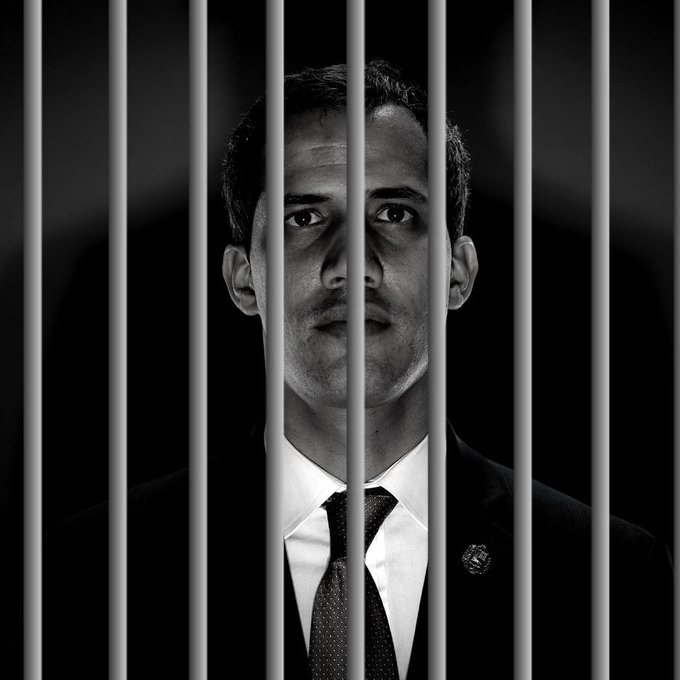
Should Guaidó be Arrested?
By Alberto Aranguibel | Venezuelanalysis | March 30, 2021
The clamor for [Juan] Guaidó’s arrest is becoming increasingly uncontainable: he has caused so much damage and suffering to the country with the criminal economic assault carried out by his fictitious government.
Venezuelans are correctly demanding that the law be applied to him to the fullest extent. They also compare his case to the large number of daily imprisonments, from petty criminals to important bosses of state-run companies involved in acts of corruption.
People demand an end to what is perceived as an unjustifiable example of impunity, with Guaidó’s continuing liberty perceived to be the result of government indifference or irresponsibility. It would not require more than a quick look at the people’s suffering as a result of the criminal blockade and economic attacks which he has promoted, as well as at his and his team’s looting of the nation’s assets abroad, to find enough evidence.
But this alleged indifference doesn’t exist.
As it turns out, politics today is little more than the artful and efficient management of communications despite the persistence of traditional political theses. That is why one can see a growing number of communicators and less traditional leaders taking to politics across the globe, using their ability to influence the masses with their discourse, ideas, and charisma.
Guaidó is simply an unsubstantial media product that did not need any particular trajectory, capacity, or talent for ideological debate, nor any attempt to build a popular struggle or an important social movement to take on the highest levels of the political establishment. What he did have was a complex network of national and international rightwing sectors, and he was backed by the most intense communications campaign carried out to fabricate a false leader.
Imprisoning him right now would mean participating in the construction of the media product, even increasing Guaidó’s scope by virtue of the headlines generated by such a move. It would also allow him to position himself as the victim of an oppressive and ruthless regime, an idea which the media laboratories of the most reactionary anti-Venezuela sectors have been pushing for some time.
This media manipulation is obviously an element that the architects of the assault on Venezuelan democracy need in order to complement their macabre plan.
To avoid making this mistake – which may cost the country not only its democracy but also the freedom and independence that people have built through so much hard work and sacrifice – the government must wait until Guaidó’s media profile starts to weaken (as is already happening). By waiting, any headlines generated by his arrest will be, at best, about a normal and ordinary application of justice.
This is as it must be, and, sooner rather than later, as it will probably end up being.
Alberto Aranguibel is a Venezuelan political analyst, blogger, and former member of the National Constituent Assembly (2017-2020). He is also a journalist who runs “Sin Tapujos,” a program on the state-run TV channel Venezolana de Televisión.
Translation by Paul Dobson for Venezuelanalysis.
Source: Soy Aranguibel
The curious case of a CIA contractor accused of terrorism in Venezuela who claims he was on a boating holiday
By Tom Secker | RT | March 7, 2021
This week, from the disturbing CIA operations file, comes the case of Matthew John Heath, an American and former Marine accused of sabotage, terrorism, trafficking illegal weapons and conspiracy.
You could be forgiven for thinking that an ex-Marine going on trial for terrorism charges in Venezuela might meet with the sort of US media coverage that the Amanda Knox story attained, but the start of Heath’s trial has warranted barely a whisper.
Heath was arrested last September alongside six Venezuelans, including some military personnel. The gang were apparently planning attacks on oil refineries, a major bridge and possibly military installations, and were caught at a roadblock with bricks of American currency, high explosives, a satellite phone and a grenade launcher.
Venezuelan president Nicolas Maduro has accused Heath of being a spy and terrorist working for the US government, while his family maintains his innocence. One of several letters smuggled out of prison and sent to Heath’s relatives reads, “Don’t WORRY! Han Solo always wins!” His family have opined that he was either simply an American in the wrong place at the wrong time, or that the evidence was planted in order to frame him.
Seeking leverage or deafening silence?
So, what are we to make of this? Sean McFate of Georgetown University suggested that “A soldier like Heath, whether or not he’s guilty, is very attractive to authoritarian leaders like Maduro seeking leverage with the US.”
But the US government has had little or no contact with Heath, hasn’t moved to negotiate his release, and there is no sign of Maduro using ‘Han Solo’ as leverage, either with the Trump administration or with the new Biden White House.
Instead, the deafening silence of US officials and major media in response to Heath going on trial suggests that they want to keep a lid on the situation. This is likely due to the implication that this self-styled pilot of the Millennium Falcon was working as part of an ongoing disruption campaign being waged against Venezuela by the CIA.
Investigative journalist Alan Macleod pursued this angle in a recent expose, noting Heath’s widely reported background working not just for Marine Corps intelligence but also for the CIA, before he joined MVM – an intelligence services firm who contract almost exclusively for the US government.
Macleod’s article highlights, “Although MVM is technically a private company, it was founded by three former Secret Service agents and continues to work closely with Washington… The only clients listed on its website are American government agencies. “Need a secret agent?” begins its description of the company.”
The Bay of Piglets: Recycling the Cuba playbook
In May 2020, two former Green Berets led an amphibious assault on Venezuela with the aim of storming the presidential palace and installing Juan Guaido – the US’s preferred puppet leader of the country – as the new president. As Macleod points out, this event was quickly dubbed the ‘Bay of Piglets’ – a reference to the CIA botched coup attempt against the Castro government in Cuba in 1961.
In an interview with RT, he added, “That this could occur without at least the knowledge of the State Department seems unlikely, at best.”
Following the Bay of Pigs, the CIA embarked on an extensive program of black operations designed to destabilise the Castro government. One memo, titled ‘Possible Actions to Provoke, Harass or Disrupt Cuba’, details a string of ideas including industrial and military sabotage, economic warfare, and spreading misinformation and disinformation.
Operations were carried out to “create unrest and dissension among the Cuban people” and to encourage the view that Castro’s “value to the revolutionary cause has diminished to the point that plans are being made for his removal.” Plans were even made, under the codename Operation Dirty Trick, so that if the first manned spaceflight were to fail, they would manufacture evidence to “provide irrevocable proof… that the fault lies with the Communists.”
Fast forward to today, and it appears that the CIA have simply recycled their 60s playbook and used it as a manual for targeting the Venezuelan government and people. In between regular failed coup attempts, the US government is deploying regular economic warfare, sabotage and disinformation tactics to try to erode domestic support for Maduro and ‘soften’ the country’s resistance to the corporate empire.
Macleod summarised, “For two decades now, there has not been a day that has gone by that the US government was not working in some way to overthrow the government of Venezuela. They have tried organizing coups and protest movements as well as longer term strategies like funding political and social organizations, as well as levying sanctions on the country. There have also been many mysterious incidents in Venezuela that the government alleges were the work of unknown saboteurs.”
A blank space in a book
If Heath, a.k.a. ‘Han Solo’, was indeed working as part of a CIA black operation, which seems likely given the evidence compiled by MacLeod and the general pattern of events in Venezuela in recent years, then he is probably a NOC – a non-official cover operative.
As outlined by Al Pacino’s character in the film ‘The Recruit’ – which was originally written by the CIA’s Hollywood liaison – most CIA officers working out of embassies around the world enjoy official cover and diplomatic immunity, but some become NOCs.
Pacino’s character says: “The NOC is the truest practitioner of espionage – always out there, always alone, unprotected. If you are caught, you will most likely be tortured, shot, and/or hanged. And here’s the best part – no one will ever hear about it. You will become a star on a wall, a blank space in a book.”
Macleod commented on the increased contracting out of NOC activities, saying, “Much of Washington’s actual dirty work has been outsourced to third parties, however, through organizations like USAID (United States Agency for International Development) and the NED (National Endowment for Democracy).”
Back in the bad old days in Cuba, NOCs and other disposable assets came in the form of Cuban exiles and mafia lieutenants, but today, proxy war has been corporatised and NOCs work for three letter abbreviations like MVM, blowing up bridges and firing grenades at oil refiners. Or at least, trying to.
The world’s weirdest holiday?
The CIA has remained predictably silent about Heath, while the State Department’s only comment on the case came in the form of a tweet by a spokesman asking for a fair trial.
Neither the Trump nor Biden White Houses have had anything to say about Heath, suggesting that there is an official policy of not commenting on this politically controversial case.
If Heath is, as he claims, an innocent civilian with a military record and a penchant for ‘Star Wars’, who went to Venezuela during a global pandemic to gain“more boating experience,” then the State Department would be advocating for him. If this were the travesty of justice that Heath will no doubt make out it is when the trial moves to the defence phase, then the US media should be screaming blue murder.
Instead, the American government and major media response to this innocent man on the world’s weirdest holiday has been to politely ignore him, as though getting caught with high explosives, surveillance photos and machine guns is regular behaviour for Americans on nautical vacations.
Han Solo: A Matthew Heath story
As Joshua Goodman, an American journalist, observed, “Heath’s reputation for discretion, background in signals intelligence for the Marines and past work as a US government contractor in Iraq and Afghanistan seemed straight out of a Tom Clancy novel.”
The Clancy parallels are apt, especially given the latest adaptation of his work – Amazon’s ‘Jack Ryan’ – focused its entire second season on glamourising an off-the-books CIA coup against the Venezuelan government, including storming the presidential palace. The show, which is supported by both the CIA and the Pentagon, went to great efforts to project Venezuela back into the public consciousness as a desperate threat to US national security and in need of extreme prejudice.
Macleod commented, “Unfortunately, many of the plot lines of shows like Jack Ryan have a tendency to come true. This is because the writers are in close contact with government agents who help them craft realistic scenarios for their plots based on actual events or plans.”
Despite this, I wouldn’t expect ‘Han Solo: A Matthew Heath Story’ to be coming to a theatre near you anytime soon.
Tom Secker is a British-based investigative journalist, author and podcaster. You can follow his work via his Spy Culture site and his podcast ClandesTime.
How the US and Great Britain Instigate Coups Nowadays
By Vladimir Danilov – New Eastern Outlook – 06.03.2021
Recently, the United States and Britain, actively using the propaganda tools that they possess, have increasingly begun to accuse Russia and China of interfering in their domestic affairs and election campaigns, and of effectively preparing coups in these countries. However, apart from making proclamatory statements, neither Washington nor London has presented any facts or documents that confirm these accusations, nor can they present them, since these accusations are false.
Along with that, documented information about complicity on the part of United States and Britain in various coups that were being set up has begun to appear more frequently in publicly accessible reports in various media outlets.
For example, according to the recent publication in the German newspaper Die Tageszeitung, UN investigators found out that in 2019 elite fighters from the American Erik Prince’s private military company Blackwater, infamous for their actions during the American occupation of Iraq and several other states, had to take action twice to eliminate the Government of National Accord, which is recognized by the international community. But this “Project Opus” failed…
A group of UN experts studying violations of the UN arms embargo against Libya learned that in the Libyan war in recent years there has been a second, secret front to directly get rid of officials and commanders of the Government of National Accord that rules in Tripoli. “Project Opus” specifically called for delivering 20 elite Blackwater fighters to sites near Tripoli in June 2019 to conduct operations. The officers contacted by the German newspaper in Benghazi confirmed the arrival of 20 fighters from England and South Africa, and one American, in June 2019. The second group, consisting of snipers and fighters trained to fight behind enemy lines, flew to Benghazi in April 2020 and then headed off to the front near Tripoli. On April 24, 2020, 13 French citizens reached the Libyan-Tunisian border and presented themselves as diplomats to the Tunisian border guards, even though they carried heavy weapons. They were arrested, but under diplomatic pressure from Paris they were allowed to leave for Tunisia.
In early May 2020, the world media exploded with reports: another attempt at a military invasion of Venezuela was thwarted, Washington’s mercenaries were captured by the Venezuelan authorities, the United States wanted to repeat the operation in Cochinos Bay (the so-called attempt by the US Central Intelligence Agency to land Cuban emigrants in the Bay of Pigs, something which was aimed at overthrowing Fidel Castro). It is worth remembering how on May 3 mercenaries from the American private military company Silvercorp tried to land on the coast of Venezuela near the city of La Guaira, which is located just 32 kilometers from Caracas. Sixty armed, well-equipped militants with satellite phones and fake documents planned to reach the capital and capture the Venezuelan president for his subsequent transfer to the United States. Two of those arrested, Airan Berry and Luke Denman, were US citizens that had served in Afghanistan and Iraq. On May 4, American media interviewed the former US special forces fighter and the head of the Silvercorp PMC, Jordan Goodrow, who trained these fighters in Colombia. Goodrow declared that the goal of “Operation Gideon” was to organize raids into Venezuela to fight “the regime”. The former special forces soldier showed an eight-page $213 million contract signed in October 2019 by Washington-backed self-proclaimed Venezuelan “president” Juan Guaido and Donald Trump’s political advisers. On March 23, the Colombian authorities confiscated an entire arsenal on their territory that was specifically meant for the mercenaries. The mercenaries were equipped fairly well.
The Washington Post also published a document according to which members of the Venezuelan opposition, following negotiations, in October 2019 entered into a deal with the American private military company Silvercorp, located in Florida. The PMC employees were supposed to infiltrate the territory of Venezuela to overthrow the country’s legitimate president, Nicolas Maduro.
These events in Venezuela were recently well assessed by Bloomberg :
“One would hope that the Central Intelligence Agency could do better than a farcical scheme that was disowned by the Venezuelan opposition, penetrated by regime security forces and disrupted as soon as it began. Yet this trivial episode invites us to think seriously about the role of covert intervention and regime change in US policy.”
Exposing these subversive activities by Blackwater and other US and British mercenaries shows that they are usually committed by former military personnel and criminals involved in a wide variety of activities around the world. They act as bodyguards, protecting people and businesses in “hot spots” (like oil-producing areas off the coast of Nigeria and Sudan), as well as convoys and freight shipments in war zones, especially in Iraq and Afghanistan. Since from the very beginning of hostilities in the region both public opinion in the United States and Democrats in Congress viewed sending their own soldiers to hot spots extremely unfavorably, they had to look for replacements elsewhere.
American wars in the beginning of the 21st century have become a real gold mine for these organizations, which have turned from bands of thugs that toppled shaky “cannibalistic” regimes in Africa during the Cold War into real international corporations. They represent a significant benefit for the United States and its Western allies leading the war, since they consist of veterans that are already experienced – military professionals who have not found a niche for themselves in civilian life. In addition, these organizations are considered private enterprises, and therefore are not accountable to Congress, so the losses these soldiers incur are not included in the total number of casualties for a country’s conventional army, which makes it possible to give a more favorable representation of the situation in a war zone at home. Public opinion in the United States has long called for rejecting the services these companies provide, and reinforcing transparency in their activities. The UN has repeatedly raised the issue of revising the definition of “mercenary”, and banning organizations like Blackwater, over the past several years – but so far it has not yet achieved any significant results.
Besides these examples of Washington’s attempts to instigate a military coup in other countries, nowadays a number of documents have been raised for public review related to the period of the height of the US intervention in Syria in 2014, when Assad’s forces were growing weaker and Damascus was under the threat of capture by Islamists that the West nurtured and supported. For example, the Middle East Eye agency has shown quite convincingly – and with documentary evidence – how during a British-supported operation called Sarkha (Scream), the media tried to turn the Alawites against Assad, and by doing so accomplish a coup in Syria. The publication gives official documents that attest to the social media “protest movement” that was actually created under the authority of the British government. The very same scenario for Operation Sarkha was developed by the American company Pechter Polls of Princeton (New Jersey, USA), which was working under a contract with the British government. The contract for subversive work in Syria was initially administered by the Military Strategic Effects department at the UK Department of Defense, and then by the British government-run The Conflict, Stability and Security Fund, whose objective is to
“resolve conflicts that threaten the Great Britain’s interests.” The project’s budget was £600,000 ($746,000) per year. The published documents indicate that the goal of the operations was “supporting the activities of the Syrian opposition media to reach an audience in Syria… Platforms for this work were created jointly by the UK, USA, and Canada to strengthen popular resentment toward the Assad regime.”
In another issue of the Middle East Eye, documents obtained by the publication show how British contractors hired Syrian citizens who were journalists to promote “moderate opposition” – often without their knowledge. Contracts with these mercenaries were entered into by the British Foreign Office, and were managed by the country’s Ministry of Defense, sometimes by military intelligence officers, paying small amounts of money to the contractors.
After getting to know everything indicated above, the question naturally arises: who exactly is really interfering in the affairs of other states? And how objective is the propaganda coming from Washington and London, as well as their foreign policy as a whole?
Biden Extends Obama’s Executive Order Against Venezuela for One More Year
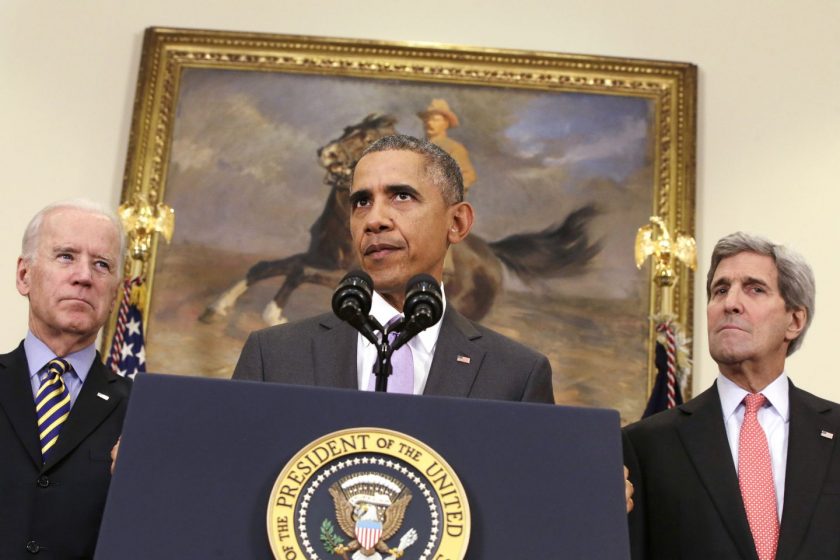
Biden considers Venezuela a threat to the security of his country. File photo.
By Randolf Borges | Ultimas Noticias* | March 3, 2021
US President Joe Biden has extended Executive Order 13692 signed by Barack Obama in 2015, declaring Venezuela as “an unusual and extraordinary threat” to the North American country. The renewal of the order was signed on Tuesday, March 2 and published this Wednesday and maintains that the measure will continue after March 8, the date on which the document turns six years old.
“The situation in Venezuela continues to pose an unusual and extraordinary threat to the national security and foreign policy of the United States. Therefore, I have determined that it is necessary to continue with the national emergency declared in Decree 13692 with respect to the situation in Venezuela,” says part of the document that Biden sent to the Congress of his country to continue with the suffocation campaign against million of Venezuelans.
The new US president considers that the “threat” raised in 2015 “has not improved” with respect to Venezuela, which is why he decided to extend the sanctioning mechanism against the South American country.
The Executive Order that paved the way for more sanctions
After Barack Obama signed Executive Order 13692, the way was open for a series of sanctions and coercive measures to be imposed against the Venezuelan people.
Thus came Executive Order 13808, of August 24, 2017, which prohibits the direct or indirect purchase of securities from the Government of Venezuela.
Then Executive Order 13827, of March 19, 2018, was imposed, which prevents all transactions related to the issuance and use of any type of electronic money. That same year, Executive Order 13835 was issued, with which the prohibitions on transactions or refinancing operations of the Venezuelan debt are intensified.
On November 1, 2018, Executive Order 13850 was issued, which blocks assets and prohibits transactions by persons operating in the gold sector. Executive Order 13857, of January 25, 2019, designated Petróleos de Venezuela SA (PDVSA), its subsidiaries and associated entities as subject to sanctions by the United States, blocking the main source of revenues for the Venezuelan economy.
One of the last sanctions was issued through Executive Order 13884, of August 5, 2019, which transforms the coercive measures into an “embargo” and authorizes the application of secondary sanctions against companies or countries that have commercial relations with Venezuela.
In a recent visit to Venezuela by the United Nations Special Rapporteur for the effects of sanctions on human rights, Alena Douhan, a preliminary report was made public labeling sanctions as criminal and urging the lifting of all sanctions. A few days before, the US Government Accountability Office issued a report recognizing the negative effects of US sanctions on Venezuelan economy and on human rights.
Here is the full text of Joe Biden’s letter:
CONTINUATION OF THE NATIONAL EMERGENCY WITH RESPECT TO VENEZUELA
On March 8, 2015, the President issued Executive Order 13692, declaring a national emergency with respect to the situation in Venezuela, including the Government of Venezuela’s erosion of human rights guarantees, persecution of political opponents, curtailment of press freedoms, use of violence and human rights violations and abuses in response to antigovernment protests, and arbitrary arrest and detention of antigovernment protestors, as well as the exacerbating presence of significant government corruption.
The President took additional steps pursuant to this national emergency in Executive Order 13808 of August 24, 2017; Executive Order 13827 of March 19, 2018; Executive Order 13835 of May 21, 2018; Executive Order 13850 of November 1, 2018; Executive Order 13857 of January 25, 2019; and Executive Order 13884 of August 5, 2019.
The circumstances described in Executive Order 13692, and subsequent Executive Orders issued with respect to Venezuela, have not improved, and they continue to pose an unusual and extraordinary threat to the national security and foreign policy of the United States. Therefore in accordance with section 202(d) of the National Emergencies Act (50 U.S.C. 1622(d)), I am continuing for 1 year the national emergency declared in Executive Order 13692.
This notice shall be published in the Federal Register and transmitted to the Congress.
JOSEPH R. BIDEN JR.
THE WHITE HOUSE,
March 2, 2021.
*Translation: Orinoco Tribune
Territorial dispute growing between Guyana and Venezuela
By Lucas Leiroz | March 4, 2021
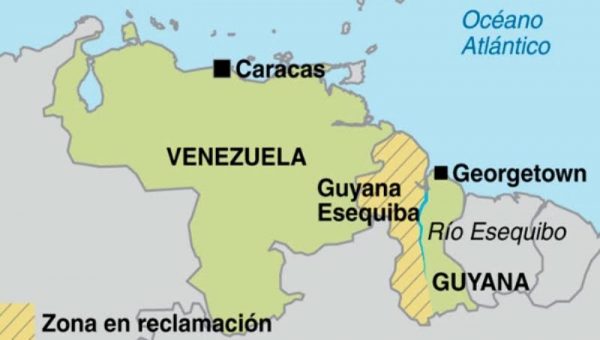
An old territorial dispute in South America is reaching its most tense point in decades. The territory known as Essequibo has been mutually claimed by Guyana and Venezuela since the 19th century when Guyana still belonged to the United Kingdom. In 1897, the Venezuelan and British authorities agreed to submit their dispute to an arbitrary international court in Paris, which ruled that the land belonged to the UK. For decades, the arbitration decision was accepted by Caracas, but in 1948 Venezuelan authorities revealed some irregularities in the trial, which were documented in old government files. As a result, the decision was considered null, and years later, in 1963, Venezuela formally submitted its territorial claim to the United Nations, and the dispute remains unresolved till today, when the interests of foreign oil companies threaten to increase the tensions.
As a region rich in oil, Essequibo has recently entered the map of the large multinationals in this sector, especially the American Exxon Mobil. More than that, the economic sanctions imposed on Venezuela and the political alignment of Guyana with Washington contribute to create an even more controversial scenario. Guyana has the support of the large private oil sector and the American government, while Venezuela remains alone. Last year, the case was filed with the International Court of Justice, but Venezuela did not accept it and remained out of the trial.
However, in a sentence on December 18, 2020, the Court proclaimed its competence to intervene in the dispute, despite Venezuela’s position. It is necessary to highlight that, regardless of any decision taken by the Court over who really has sovereignty in Essequibo, this sentence must be considered null, since the absence of Venezuelan consent prevents the execution of the sentence. The need for consent is one of the most elementary principles of international law and the very fact that the Court declares itself competent already leads us to question whether its judges are really impartial – clearly, the norms of international law are being violated in favor of Guyana.
Guyana has publicly admitted that its expenses for the court case in The Hague were paid by Exxon Mobil. Although the American oil company has been operating in Guyana for decades, its interest has been greatly increased with the recent discoveries of oil reserves and investors are willing to do anything to ensure the exploration of local natural resources. Currently, Exxon Mobil is interested in expanding its facilities over an area of more than 26,000 square kilometers, which not only crosses the disputed territory in Essequibo, but also violates Venezuelan undisputed national territory.
With this scenario of clear attack on Venezuelan national sovereignty and possible collaboration of the International Court with one of the parties, Venezuela is at a disadvantage mainly due to its diplomatic weakness. Venezuela, at this point, lacks sufficient influence to cause the Court to review its decision or judge the case in a really partial way. For that, only strong international alliances can help Caracas. The large nations that are not aligned with Washington and have so far cooperated strongly with Venezuela, Russia and China, might be provoked by the Venezuelan government to incite international pressure in this regard. Only these two countries can mediate a parallel agreement that may be established between Caracas and The Hague in order to choose between two paths: either Venezuela agrees to submit to trial on the condition that there is a partial judgment and without the influence of private companies, or the Court declines jurisdiction. As the first scenario is unlikely and difficult to monitor, the most viable route would be for The Hague to abdicate any form of judgment.
It is important to mention that, in the absence of international judgment, what is in force in Essequibo is the Geneva Agreement of 1966, which did not decide on sovereignty in the region, but, in search of a peaceful solution, defined what activities would be allowed or prohibited in Essequibo. Oil exploration by foreign companies is not allowed, so, in principle, Guyana is violating the agreement and its activities could only become lawful if there was a decision by the International Court on the matter, allowing exploration. As Venezuela does not submit to the Court, the trial is impossible and, therefore, exploration remains prohibited and Guyana is committing an international offense.
However, more worrying than that is the fact that the American military is working in Essequibo, carrying out tests with the aim of intimidating Venezuela and pressuring Caracas to renounce its demands. There are American military ships in Essequibo “protecting” Exxon Mobil facilities and provoking Caracas. In addition, considering that the American company wants to publicly explore areas within Venezuelan territory, what will become of the American presence? If Caracas does not allow the activities of Exxon Mobil, it is the Venezuelan right to control or even destroy the facilities in its territory. And what would be the American reaction to that – considering Biden’s aggressive interventionist policy?
It is for these reasons that, more than ever, countries of greater international relevance must mediate the issue in order to maintain the status of illegality to the Exxon Mobil’s activities. With international pressure, it is possible that the American company will retreat or that at least the American military in the region will leave and with that we would have a reduction in tensions.
Still, it is possible that with international mediation a mutual exploration agreement will be reached that allows both countries to enjoy the local wealth, without, however, allowing companies that violate the Geneva Agreement to operate.
Lucas Leiroz is a research fellow in international law at the Federal University of Rio de Janeiro.
Armed conflict between Venezuela and Guyana will involve US forces
By Lucas Leiroz | February 3, 2021
A new focus of tensions is emerging in South America. Since the discovery of oil in Guyana, this country has been increasingly approaching Washington both as an economic partner and as a political ally. The Americans see the partnership with the Guyanese as an opportunity to fill the void left in the global oil market with the economic sanctions imposed on Venezuela. But, in addition to a mere economic alliance, the ties between both countries are also rising to the military sphere, which is generating concerns in Caracas.
On January 21, regional tensions reached their peak. Guyanese fishing boats Nady Nayera and Sea Wolf were intercepted by Venezuela after an illegal incursion into Venezuelan territory. Caracas, not having authorized the entry of the vessels, interpreted the maneuver as dangerous to national security and kept the boats under its control. However, this Venezuelan version of the facts was denied by Georgetown, which claimed that the ships were detained within Guyana’s Exclusive Economic Zone.
Some noteworthy factors preceded this escalation of tensions. On January 7, Venezuelan President Nicolás Maduro signed a decree that establishes the formation of a new maritime territory on the Atlantic coast. The decree includes part of the Essequibo region, in which there is a territorial dispute with Guyana. The so-called “Guyana Essequiba” refers to a territory currently under the rule of Guyana that previously belonged to Venezuela, having been transferred to Guyanese possession after an arbitrary sentence in an international court organized by the United Kingdom at the end of the 19th century.
Venezuela has since claimed sovereignty over Essequibo, but tensions have been mild most of the time. However, Guyana, since aligning with the US, has been adopting more aggressive measures in the region. The US armed forces recently began military exercises in Guyana and deployed several military ships along Essequibo’s 159,000 km². The territory is rich in oil and the American justification for the exercises is precisely to protect the oil extraction bases installed by the company ExxonMobil. In the midst of such circumstances, Venezuela has its national sovereignty violated and is therefore trying to establish minimum measures to guarantee its interests.
However, despite the rivalry having resumed an old territorial dispute, it is necessary to emphasize that there is an agreement in force on Essequibo that Guyana is directly violating. In 1966, Guyana and Venezuela signed the Geneva Agreement, mediated by the United Nations, which determined which activities would be permitted in which area of Essequibo. In this document, oil exploration by foreign companies is not allowed. Since 2015, the Guyanese government has violated the pact, allowing multinationals to explore for oil there. In 2018, Venezuela had already intercepted ExxonMobil vessels that invaded its territory to explore oil. Now, Venezuelan President Nicolás Maduro has determined the creation of a Special Strategic Zone to increase security over Essequibo because the tendency is for territorial violations to increase further, considering that regional diplomacy is already broken, and that Guyana has become a satellite nation of Washington’s interests – which publicly plans to overthrow Maduro. The Venezuelan decision was condemned by the president of Guyana, Irfaan Ali, which prompted Caracas to issue a statement saying that such positions suggested preparation for an armed confrontation.
The Guyanese attitude has not changed over time. Now, once again, ships have entered Venezuelan territory, leading to their capture by the Bolivarian forces. If that situation continues, the Venezuelan response to foreign incursions may become increasingly rigid and the armed forces are likely to start taking down invasive vessels, which will lead to Washington’s severe responses. Currently, we can no longer regard the South American scenario as “unlikely” for a war to arise. The security crisis is widespread and with Biden in power many experts suggest that American foreign policy will become more aggressive and interventionist. Guyana has a much weaker military apparatus than the Venezuelan State and cannot face the neighboring country with its own forces. It remains to be seen what Washington’s willingness to invest in a conflict in South America will be.
More than ever, a new international agreement is needed to establish a new regulation for the region. The agreement, however, must be impartial and try to favor both nations. In an ideal scenario, the other South American nations, being co-participants in the disputes, should mediate such an agreement. But, today, the political structure of South America is absolutely broken, and no nation has sufficient diplomatic strength to resolve a demand of this nature.
Lucas Leiroz is a research fellow in international law at the Federal University of Rio de Janeiro.
Featured Video

Racist Seinfeld Dances for Joy as Bibi Unveils His New Map
or go to
Aletho News Archives – Video-Images
TV Drama Review
Japanese drama projects Japan’s wartime atrocities onto Chinese characters

Global Times | October 25, 2026
By portraying Chinese characters as perpetrators of ruthless violence while casting Japanese Self-Defense Forces (SDF) intelligence operatives as defenders, the season 2 of the Japanese drama Vivant has recently drawn criticism from Chinese netizens, who argue that its depiction turns historical reality on its head while ignoring Japan’s wartime atrocities.
The TBS drama series – a spy suspense story in which an alleged unofficial intelligence unit of the SDF operates across the globe — has attracted a passionate fanbase. Its currently airing season 2 opened with a household rating of 18.8 percent, the highest for a TV drama this year, according toa commentary article by Japanese media Toyo Keizai.
What draws attention is the portrayal of the enemies in the series, the article noted. Scenes in which the Chinese organization subjects kidnapped members of the SDF unit to brutal torture are repeated with unrelenting intensity.
It is rare for Japanese TV dramas to explicitly portray a real-life country as the enemy, the article noted.
Japanese Prime Minister Sanae Takaichi also made a reference to the drama, saying that she has been recording Vivant and hopes to binge-watch it over the year-end and New Year holidays, according to Japanese media outlets.
China’s CCTV News report on Sunday revealed that the drama features scenes in which Chinese personnel cut off the fingers of and stab Japanese intelligence operatives in the abdomen. Such acts bear striking similarities to the torture inflicted on Chinese nationals by invading Japanese troops during the World War II.
The drama distorts the truth by attributing these atrocities to modern Chinese characters. Beneath the surface, it subtly glorifies Japan’s cross-border overseas operations, blurs the functional boundaries of the SDF and implicitly promotes an expansionist narrative, per CCTV News. … continue
Blog Roll
 Aletho News
- EU facing trillion-euro debt hole while seeking more cash for Kiev
- How US, Europe, Persian Gulf states exhausted missile stockpiles, splurged billions to defend Israel
- Up in arms… Koreans reject U.S. empire’s plan to make South Korea the next Ukraine
- Iran, Turkey, Pakistan, Saudi Arabia could advance region-led security framework in Tehran: FM spox
- Netizens condemn Japanese drama for projecting Japan’s wartime atrocities onto Chinese characters
- Racist Seinfeld Dances for Joy as Bibi Unveils His New Map
- A West Bank War for Netanyahu’s Election Campaign, Could It Backfire?
- Yemen denounces European Parliament’s ‘hypocritical’ push to blacklist Ansarullah
- Qalibaf: UAE’s UN bid aims to ‘clear the runway’ for ‘Greater Israel’, whitewash genocide
- Pakistan reopens Iran border after boosting security: Report
- If Americans Knew
- Israel punishes Palestinian prisoners with solitary confinement for making a cake
- US midterms: Where do candidates in key Senate races stand on Israel, Gaza, and Iran?
- Israeli forces demolish Hebron homes, displace thousands of Palestinians as raids expand
- Their Son Died in Israeli Prison. No Answers. No Body
- Biden’s Israel Catastrophe
- Why Israel’s latest assault on Hebron is so significant for the West Bank
- Israel Used “Where’s Daddy?” AI to Relentlessly Murder Palestinian Journalists and Their Families in Their Homes from October to December 2023
- DAILY UPDATE: Latest essential news on Palestine, Israel, & region
- Netanyahu Says Israel Must Prepare for Banking Sanctions, Floats Crypto as a Possible Bypass
- Latest updates from Israeli assault on West Bank
- No Tricks Zone
- Sudden Stratospheric Warming, Powerful El Niño Combination May Lead To Extreme Europe Cold, Energy Crisis!
- Two New Studies Find Thwaites Glacier Melt Cannot Be Driven By Human Activity Or A Warming Ocean
- E-Cars Reduce CO2 Emissions By Only 41% Compared To Internal Combustion Engine Vehicles
- Predictions Made By Renowned Climate Professor Over Past Decades Have Been Proven To Be Poor
- New Study Suggests Large Regions Of The Pacific Ocean Have Been Cooling For The Last 80 Years
- Germany’s Green Energy Debacle: High Energy Costs Force Kahla Porzellan to Close After 182 Years!
- New Study: 50 Years Of The Most Aggressive ‘Net Zero’ Policies Can Only Affect The Global Climate By 0.03°C
- US September “Heat” Was No Record…Many Records Set Decades Ago
- Latest European Green Energy Debacle; Portugal’s Largest Flagship Solar Park Insolvent!
- Green Energy Debacle: German Expert Professor Fritz Vahrenholt Warns Of Severe Economic And Social Consequences

