Biden To Keep Up Trump’s Venezuela Regime-Change Policy
By Tyler Durden | Zero Hedge | January 20, 2021
The Biden administration has said it will continue to formally recognize Venezuelan opposition leader Juan Guaido as president of Venezuela, despite Nicolás Maduro clearly being the actual leader of the socialist country.
Biden’s nominee for secretary of state Anthony Blinken told Senators on Tuesday that Guaido will be the recognized leader, a policy which began in January 2019 when the opposition leader dubbed himself ‘Interim President’ and also ‘Acting President’ at the encouragement of Washington during Trump admin attempts to foment a military and popular uprising against Maduro.
During his remarks Blinken also indicated the new administration will keep up the sanctions. “We need an effective policy that can restore Venezuela to democracy, starting with free and fair elections,” he said.
He said Biden will seek “more effectively target” economic punitive measures in efforts to make Maduro step aside and allow Juan Guaido to take up position, according to Reuters.
Blinkin further said he believes the US should not enter into negotiations with Maduro for the end of sanctions or some kind of relief, but instead vowed that Caracas must “really feel the pain”.
Currently the OPEC nation is gaining help from Iran and Russia in circumventing a US oil and fuel blockade. US sanctions aim to prevent crude being exported out and gasoline being imported for domestic use (Venezuela’s derelict refineries have been incapable of processing enough fuel to keep up domestic demand).
While Guaido is also recognized as president by over a dozen US allies, the majority of countries – including powerful Russia and China – do not.
Revealed: UK Sets Up Media Influencing Project in Venezuela
By Matt Kennard and John McEvoy | Declassified UK | January 6, 2021
The UK government has established a journalism project to ‘influence’ Venezuela’s ‘media agenda’ while a Foreign Office-funded foundation is spending £750,000 on a secretive ‘democracy-promotion’ programme in the country, as Britain appears to deepen efforts to remove the Maduro government.
- UK government has allocated £250,000 from its aid budget to ‘influence’ local and national ‘media agendas’
- British funding for journalism should not be ‘referred or linked to’, government says
- Westminster Foundation for Democracy has spent over £750,000 in Venezuela since 2016
- It refuses to tell Declassified details about its partners in Venezuela
- Foundation’s country representative sympathised with armed coup attempt in the country
As Venezuela’s political crisis continues, the UK government has initiated a new project promoting investigative journalism in Latin America which furtively covers Venezuela.
The project, launched last summer and intended to “influence” the media agenda in the country, follows a long history of the British government using journalism as an influencing tool. It raises suspicions that it aims to help remove the leftist government of Venezuela president Nicolás Maduro.
In a separate programme, the Westminster Foundation for Democracy (WFD), a majority UK-government funded organisation, has spent over £750,000 to “strengthen democracy” in Venezuela since 2016, according to documents obtained by Declassified.
The WFD’s programmes in the country are shrouded in secrecy due to apparent concerns about the security of its staff, although its country representative advertises his affiliation to the organisation online.
The British government controversially recognises Venezuelan opposition figure Juan Guaidó as president and is running a number of anti-government programmes in the country using the Conflict, Stability and Security Fund (CSSF) which supports projects designed “to tackle instability and to prevent conflicts that threaten UK interests”.
The aim of the fund’s new journalism project is stated to be the creation of a “new platform that strengthens media organisation [sic] throughout the region and provides journalists with a platform in which they can collaborate and build regional stories”.
Programme literature notes that successful applicants should display “a capacity to link into – and ultimately influence – local and national media agendas”.
But they are warned that “the British government — and its resourcing of the project — should not be expressly referred or linked to the individual outputs of the project (i.e. individual articles, events etc).”
Run by the British embassy in Bogotá, Colombia, the call for applications noted that successful bids would start in August 2020. There has been no public update since, although the Foreign Office told Declassified there had been delays due to the coronavirus pandemic.
On the public advert, applicants are advised to budget up to £250,000 for their projects, but the Foreign Office told Declassified : “it is not currently possible to confirm what budget will be available for this project.”
Declassified’s repeated questions about the project to its two coordinators in Bogotá went unanswered. However, a Foreign Office spokesperson told Declassified: “It is inaccurate to conflate this call for bids with the UK position on Venezuela, which has not changed. We want to see a democratic transition with free and fair elections take place in Venezuela.”
The CSSF put out a public call in June last year for applications from journalists seeking to cover crime and corruption in Colombia, Peru and Panama, adding there was the “potential to cover linked events in other neighbouring countries”. The word Venezuela did not appear.
However, CSSF documentation published three days before the advert outlined the same programme with the addition of Venezuela in its title. The furtive inclusion of the country appears to reflect Foreign Office reticence to publicise its increased involvement in Venezuela.
The summary of another CSSF programme, again in Colombia for the year ending March 2020, includes the recommendation to “engage” Foreign Office officials “about options to develop CSSF programmes in Venezuela”.
A September 2019 job advert for a CSSF programme manager in Lima, Peru, notes that the successful applicant will work “with colleagues in Colombia, Panama and, potentially, Venezuela”.
Declassified recently revealed that the CSSF has spent £450,000 setting up an anti-government coalition in Venezuela, again by furtively adding the project to an existing programme focused on Colombia and beginning in 2019.
Journalism as information war
The UK government has long used the media to undermine foreign leaders and political movements it perceives as a threat to British business interests.
Declassified recently revealed that a secretive Cold War propaganda unit, named the Information Research Department (IRD), tried to prevent Chilean socialist Salvador Allende from winning presidential elections in 1964 and 1970.
Declassified files also reveal that during the Brazilian dictatorship of 1964-1985, the IRD “assiduously cultivated” one of Brazil’s leading left-wing publishers, Samuel Wainer.
Though the unit was shut down in 1977, Britain has continued to sponsor journalistic ventures in Latin America. In response to a freedom of information request, the Foreign Office revealed that, between January 2016 and September 2018, it funded Venezuelan news outlet Fundación Efecto Cocuyo, as well as the Instituto Radiofónico Fe y Alegría and Sindicato Nacional de Trabajadores de la Prensa.
While receiving funds from the British government, Efecto Cocuyo teamed up with two British organisations — Bellingcat and Forensic Architecture — to “call for more evidence” regarding the killing of Óscar Pérez at the hands of Venezuelan police. Pérez, a police officer, had hijacked a police helicopter and, on 27 June 2017, used it to attack a number of government buildings in central Caracas.
In July 2019, Efecto Cocuyo’s editor, Luz Mely Reyes, spoke at the UK government’s “Global Conference for Media Freedom” event in London. Then foreign secretary Jeremy Hunt, addressing the conference, said Reyes “has defied the Maduro regime by co-founding an independent news website, Efecto Cocuyo”, without mentioning the website’s links to the British government.
London’s support for media projects in Venezuela appears to mirror that of the US National Endowment for Democracy (NED). According to its accounts, the NED has funded “freedom of information” projects in Venezuela aimed at fostering a “greater understanding of the spillover effects of Venezuelan corruption and criminal activity” by working with “investigative journalists and partner organisations”.
A 2017 NED project, with a budget of over $60,000, aims to “increase transparency and accountability in the Venezuelan government procurement processes. And to foster collaboration with journalists across the region”.
Media freedom group, Reporters Without Borders, which is also funded by the NED, notes: “Venezuela’s president since 2013, Nicolás Maduro persists in trying to silence independent media outlets and keep news coverage under constant control.”
It adds: “The climate for journalists has been extremely tense since the onset of a political and economic crisis in 2016, and is exacerbated by Maduro’s frequent references to ‘media warfare’ in an attempt to discredit national and international media criticism of his administration.”
The embassy in Bogotá
One of the two Foreign Office points of contact for the project at the British embassy in Bogotá is Claudia Castilla, a Colombian national who was a UK government-funded Chevening Scholar in London from 2017-18.
Castilla appears to be a strong supporter of the Venezuelan opposition, writing in February 2014 “I think I fell in love with Leopoldo López”, referring to a leading opposition figure. At the time US-educated López was promoting street protests in a strategy known as “The Exit”, after Maduro won presidential elections in April 2013.
From 2014-15, Castilla worked as a research assistant for the Colombian chapter of Transparency International, where she “formulated public policy recommendations”. Declassified recently revealed the UK government funded Transparency International’s Venezuelan chapter to set up an “anti-corruption” coalition in the country.
From 2012 to 2013, Castilla worked for the Cerrejón Foundation, the charitable arm of the controversial Cerrejón coal mine in Colombia which is run by three London-listed mining multinationals. For the latter period of her employment, Castilla was the foundation’s “social control advisor”.
‘Democracy promotion’
Documents obtained by Declassified also show that the Westminster Foundation for Democracy — Britain’s “democracy promotion” arm — has been running expensive programmes in Venezuela.
The WFD claims to be “the most effective organisation sharing the UK democratic experience”, but its operations are shrouded in secrecy.
Venezuela hosts the WFD’s only full-scale programme and permanent office in Latin America as part of a project which began in 2016. Since then the WFD has spent £760,680, according to figures obtained by Declassified.
The largest outlay was £248,725 in 2017-2018, as the EU announced a sanctions regime against Venezuela and British officials intensified calls for “different people at the helm” of the Venezuelan government.
Alan Duncan, then minister of state for the Americas, said in 2018: “Maduro’s double crime is that his destruction of the economy has been followed by the systemic undermining of democracy.” He added: “The revival of the oil industry [in Venezuela] will be an essential element in any recovery, and I can imagine that British companies like Shell and BP, will want to be part of it.”
Last year, the WFD spent £113,193 on its Venezuela operations, while Declassified understands a bid for funding of just over £27,500 for next year is awaiting approval. The WFD has two full-time staff in Venezuela.
In December, UN human rights experts found that “since November 2020 Venezuela has systematically stigmatised and persecuted civil society organisations, dissenting voices and human rights defenders”.
The WFD has no similar programmes in UK government-allied dictatorships such as Saudi Arabia, Oman, Bahrain, or the United Arab Emirates.
The Foundation told Declassified: “WFD works to strengthen democracy around the world. We are funded by the UK as well as other governments (including Canada, Germany, Norway and Switzerland) and international organisations (such as the United Nations Development Programme) and are operationally independent.”
But the vast majority of the WFD’s funding comes from the British government. In the year to March 2020, it provided £11.4-million to the Foundation, while all other sources of income added up to £1.5-million.
The WFD said that in Venezuela it works “with a range of MPs, National Assembly staff, civil society, and academics” but it refused to disclose to Declassified information about who those partners are. It said this was “to avoid endangering the physical health or safety of those partners”.
However, the WFD’s country representative in Venezuela advertises his position on his public Linkedin page, and his email and phone number are available through WFD job adverts.
As its Venezuela programme began in 2016, the WFD published an article on the independent news site openDemocracy in association with Daniel Fermín, a Venezuelan researcher.
The article asked: “Can Venezuela’s president [Nicolás Maduro] be unseated peacefully?”. In the following two years, openDemocracy was awarded $99,661 (£74,131) by the US analogue of the WFD, the National Endowment for Democracy.
According to a 2018 WFD posting for a job in Venezuela’s capital, Caracas, its country representative is expected to work with the British embassy and must “contribute to development of future business opportunities in Venezuela”.
When asked why it focused on Venezuela, the foundation told Declassified: “WFD programmes have been active in other countries across Latin America. We stand ready to launch new programmes and country offices when the opportunity arises.”
Neutrality
The WFD says that it “works on a cross-party basis” in Venezuela, “seeking to engage all sides of the political divide while supporting democratic institutions in the country”.
In January 2019, shortly after Guaidó proclaimed himself president, the WFD’s country representative wrote that “last years elections [sic] were a sham and therefore Maduro is an usurper”.
The next month — after trucks of the United States Agency for International Development (USAID) attempted to enter Venezuelan territory — he said: “Non-intervention cannot be an absolute principle that doesn’t consider other factors”.
On 30 April, when Guaidó launched an armed coup attempt in Caracas, the WFD’s representative announced that Guaidó’s actions were “not an assault on democracy but the other way round”. Elsewhere, he has described Chavismo — referring to former president Hugo Chávez — as a “plague”.
UK parliamentarians overseeing WFD’s operations have also disparaged the Venezuelan government. Conservative MP Richard Graham, the chair of WFD’s board of governors for the duration of its Venezuela project, said in December 2019 that “Islington Corbynsistas [sic] don’t get that extreme left ideas never work, whether in 2019 Venezuela or 80s Liverpool”.
The WFD’s board is appointed by the UK foreign secretary and is modelled on the NED, which has been described by the Washington Post as the “sugar daddy of overt [US] operations”. Since Chávez’s election in 1998, the NED has been the guiding hand behind a number of efforts to overthrow the government in Venezuela.
While the NED’s operations abroad have received some independent scrutiny, the WFD – has largely operated under media silence.
Matt Kennard is head of investigations at Declassified UK. John McEvoy is an independent journalist who has written for International History Review, The Canary, Tribune Magazine, Jacobin, Revista Forum, and Brasil Wire.
Declassified UK is an investigative journalism organisation that covers the UK’s role in the world. Follow Declassified on Twitter, Facebook and YouTube. Sign up to receive Declassified’s monthly newsletter here.
Venezuela Rejects ICJ Ruling, Reaffirms Claim Over Essequibo Strip
By Ricardo Vaz | Venezuelanalysis | January 8, 2021
Mérida – The Venezuelan government has taken actions to defend its claim over the disputed Essequibo region.
President Nicolas Maduro held a meeting with the country’s National Defense Council and State Council on Thursday to address the territorial dispute between Venezuela and neighboring Guyana.
The Venezuelan government rejects a recent decision by the United Nations’ International Court of Justice (ICJ). On December 18, with a 12-4 majority, the ICJ judges ruled that the court has jurisdiction to settle a claim brought forward by the Guyanese government arguing that the border was established by a controversial 1899 arbitration agreement in which no Venezuelan negotiators were present.
In response, the Maduro government reaffirmed its rejection of the 1899 ruling and its adherence to the UN-brokered Geneva Agreement signed by all parties in 1966 as the only binding international framework.
“This is a cause uniting an entire nation to fight against the dispossession of a territory that always belonged to Venezuela,” the Venezuelan president said in the televised meeting.
Maduro added that the Geneva Agreement stipulates that the border dispute must be settled by direct negotiations between the two countries and that his administration would send a letter to UN Secretary General Antonio Guterres to defend Caracas’ claim over the Essequibo.
“We believe your good will and efforts are more needed than ever to restart direct talks between Guyana and Venezuela in order to achieve a peaceful and mutually beneficial agreement,” the letter reads.
The Venezuelan government will likewise address a letter to ICJ President Abdulqawi Ahmed Yusuf, arguing that the Hague-based court has no jurisdiction to rule on a unilateral Guyanese suit and demanding that Venezuela be allowed to defend its territorial claim. Maduro went on to denounce “suspicious” efforts to rush the hearings, which are set for January 25 after the Caribbean nation allegedly objected to the original January 15 date.
Earlier on Thursday, the newly-seated National Assembly (AN) unanimously approved a nine-point motion rejecting the ICJ ruling and defending the 1966 Geneva Agreement.
The AN document endorsed the government’s diplomatic efforts and the reopening of direct talks with Venezuela’s eastern neighbor. The legislative body also formed a special commission, headed by lawyer Hermann Escarra, to focus on the Essequibo claim.
The diplomatic quarrel over the 160,000 square kilometer, sparsely populated strip of land, which was taken by the British colonial regime in the late 19th century, recently came to the fore following the discovery of an estimated 15 billion barrels of oil in the Essequibo’s maritime waters.
Caracas has repeatedly voiced its opposition to Guyana’s decision to allow US multinational Exxon Mobil to drill in the disputed area, claiming that it violates the 1966 accords. For its part, Washington has backed Georgetown’s claim to the strip and pledged to execute joint military drills.
Who To Believe About Venezuela’s Election? Firsthand Observation or PBS Newshour?
By Rick Sterling | Venezuelanalysis | January 5, 2021
In early December I traveled to Venezuela to be an election observer at their national assembly election. I was part of a group of eight persons from Canada and US organized by CodePink. There were about two hundred international observers in total, including the Latin American Council of Electoral Experts. I have previously been an official election observer in Honduras and was an unofficial observer at the 2015 Venezuela national assembly election.
Meeting Opposition Leaders
Before the election, our small group met eight leaders of the Democratic Alliance. This is the major opposition coalition. Pedro Jose Rojas of Accion Democratica said the US sanctions are not doing what is claimed; they are hurting average citizens. Bruno Gallo of Avanca Progressista said Venezuela needs negotiation not confrontation. Juan Carlos Alvarado of the Christian Democratic Party said Venezuelans have been “victims of politics” and that dialogue and flexibility are needed. Several leaders spoke about the importance of the national assembly and the road to change is through voting not violence. Several leaders expressed the wish for better relations with the US; another one said Venezuelan sovereignty needs to be respected. The common request was to end US sanctions and interference in Venezuelan politics.
We visited the factory where voting machines were assembled, tested and certified. The staff was openly proud of their work. In March this year, nearly all the pre-existing voting computers were destroyed in a massive fire at the main election warehouse. There were calls to delay the December election. But in six months, forty thousand new computers were ordered, built, assembled, tested and certified for the December election.
The Election Process
On election day, Sunday December 6, we visited many different elections sites. Typically, the election voting takes place at a school, with five or ten classrooms designated as “mesas”. Each voter goes to his or her designated classroom / “mesa”.
The voting process was quick and efficient, with bio-safety sanitation at each step. The first step is to show your identity card and prove your identity with fingerprint recognition. Step 2 was to make your voting choices at the touchscreen computer and receive a paper receipt. Step 3 is to verify the receipt matches your voting choice and deposit the receipt in a ballot box. The fourth and final step is to sign and put your fingerprint on the voting registry. The entire voting process took about 3 minutes.
At the end of the voting day, we observed the process of tabulating the votes. At each “mesa”, with observers from other parties present, the paper receipts were recorded one by one. At the end, the results were compared to the digital count. Voting results were then transmitted to the headquarters for overall tabulation.
Election results were announced by the Council for National Election (CNE) which manages the entire process. CNE leaders are not permitted to be members of any party and the CNE leadership was recently changed at the request of the opposition. In our discussion with leading opposition members, they complained about incumbent party advantages but acknowledged the election process is free, fair and honest.
PBS Newshour Special
With this firsthand experience, on December 29 I watched a PBS Newshour segment about the Venezuela election and overall situation. PBS reporter Marcia Biggs said, “Maduro’s party essentially ran unopposed in this month’s election.” As noted above, this is untrue.
In fact, there were 107 parties and over 14,000 individuals competing in the December 6 election for 277 national assembly seats. While 8 parties were in alliance with the governing United Socialist Party of Venezuela (PSUV), there were over 90 opposition parties. The strongest opposition coalition was the Democratic Alliance comprising 7 opposition parties. The Democratic Alliance won 1.1 million votes or 18% of the vote. The LEFT opposition to the PSUV, under the banner of the Communist Party of Venezuela, received 168 thousand votes.
Reporter Marcia Biggs claimed that “politics permeates everything in Venezuela and can determine whether you support Maduro and eat or go hungry.” This claim is based on a campaign statement by PSUV Vice President Diosdado Cabello encouraging people to vote. He jokingly said that women are in the forefront and can say to their family, “No vote, no food.” Video of him making the statement is here. This statement has been distorted out of all meaning and context.
The PBS story showed a fistfight in the national assembly, implying that it was the Venezuelan government. But, as reported in the “Juan Guaido surreal regime change reality show”, the fight was between competing factions of the Venezuelan opposition.
When they showed Juan Guaido climbing over a fence, that was a publicity stunt to distract from the important news that Luis Parra was elected Speaker of the national assembly one year ago. That was embarrassing because Guaido’s claim to be “interim president” was based on his being Speaker.
Election turnout was lower than usual at 31% but one needs to account for the election taking place despite covid19 with no mail-in voting. Also, millions of registered voters have had to leave the country due to economic hardship. Also, transportation is difficult due to gasoline scarcity. This was a national assembly election, equivalent to a US mid-term election, which gets lower turnout. Note that 95% of voting eligible Venezuelans are registered voters compared to just 67% in the USA. Thus a turnout of 50% registered voters in the US equates to 33% of eligible voters.
US Meddling in Venezuela
The star of the 7-minute PBS story is Roberto Patino, the Venezuelan director of a food distribution charity. The report neglects to mention that Patino is associated with a major US foreign policy institution. He is a Millennium Leadership fellow and “expert” at the neoliberal Atlantic Council where the “regime change” goals against Venezuela are clear. His food charity “Alimenta la Solidaridad” is allied with the “Rescue Venezuela” funded by the US with the apparent goal of undermining the Venezuelan government and promoting “interim president Juan Guaido”.
Roberto Patino says the Venezuelan government is “very paranoid and they see conspiracies all over.” Paranoia is a mental condition where there is fear of imaginary threats. But US threats and aggression against Venezuela are not imaginary; they are very real:
In 2002 the US supported the kidnapping and coup against the popular and elected President Hugo Chavez. The years have gone by but US hostility persists.
- In August 2018 there was a drone assassination attempt on the Venezuelan President.
- In January 2019 the US declared that it would not recognize the elected President Maduro and instead recognized Juan Guaido as “interim president”. His background is described in the article “The Making of Juan Guaido: How the US regime change laboratory created Venezuela’s coup leader”
- In February 2019 President Trump threatened military intervention against Venezuela.
- In March 2019, there was massive power blackout caused by sabotage of the electrical grid, with probable US involvement.
- In May 2020, two former US Special Forces soldiers and other mercenaries were arrested in a failed attempt to overthrow President Maduro.
- In June 2020, the US Navy warship Nitze began provocative “freedom of navigation” patrols along the Venezuelan coast.
- In August 2020, the US seized four ships carrying much needed gasoline to Venezuela.
- In September 2020, in a attempt to undermine the Venezuelan election, the US imposed sanctions on political leaders who planned to participate.
- The US 2021 stimulus bill includes $33 Million for “democracy programs for Venezuela”.
Based on the past twenty years, Venezuela’s government has good reason to be on guard against US threats, meddling and intervention. The PBS program ignores this history.
Another hero of the show is the exiled politician Leopoldo Lopez. He was imprisoned in 2014 for instigating street violence known as “guarimbas” which led to the deaths of 43 people.
Like Patino, Lopez is from the Venezuelan elite, studied in the US and has major public relations support in the US. Like Guaido, Leopoldo Lopez is more popular in Washington than his home country.
Will the US respect Venezuelan sovereignty?
If the PBS Newshour reporters had not been so biased, they would have interviewed members of the moderate opposition in Venezuela. Viewers could have heard Democratic Alliance leaders explain why they participated in the election, why they are critical of US economic sanctions and US interference in their domestic affairs. That would have been educational for viewers.
On January 5, the newly elected national assembly will commence in Venezuela. The fig leaf pretense of Juan Guaido as “interim president” of Venezuela will be removed because he is no longer in the national assembly. In fact, he was removed as speaker of the national assembly one year ago.
But viewers of the PBS special did not learn this. Instead, they received a biased report ignoring the moderate opposition and promoting a few US supported elites. The report ignores or denigrates the efforts of millions of Venezuelans who carried out and participated in an election which compares favorably with the election process in the US. You would never know it from PBS, and you might not believe it, unless you saw it with your own eyes.
Rick Sterling is an investigate journalist based in the SF Bay Area of California. He can be contacted at rsterling1@protonmail.com.
Former Presidential Candidate Capriles Calls on US to End ‘Interim Presidency’
By Ricardo Vaz – Venezuelanalysis – December 11, 2020
Mérida – Former two-time presidential candidate Henrique Capriles has demanded a change of strategy for the Venezuelan opposition.
In an interview with the BBC, Capriles argued for a “reconstruction” of the opposition following last Sunday’s government victory in National Assembly (AN) elections. He claimed that the current plan led by US-backed Juan Guaido is “finished” and stressed that Washington’s stance will be “crucial.”
“The new [Prospective] administration has to understand that this plan has run its course and it cannot keep the status quo: the [Guaido] ‘interim presidency’,” Capriles said, adding that the opposition could “disappear as an alternative” if there is no change of course.
The December 6 elections delivered an overwhelming parliamentary majority for the ruling United Socialist Party (PSUV) and allies for the 2021-2025 term, but turnout stood only at 30.5 percent of the electoral roll after mainstream opposition parties boycotted the vote. The results were endorsed by an international observation mission.
Capriles, who served two terms as Miranda State governor, argued that the low turnout reflected the Venezuelan population’s “weariness” towards politicians and claimed the international community would not see the process as “legitimate.”
The veteran leader and allied figures had previously caused a rift within the opposition when they held talks with international brokers with a view towards taking part in the elections, but ultimately decided against it. However, the Justice First party founder insisted on the need to “align” the international community towards an “electoral calendar” featuring both presidential and parliamentary contests.
The former presidential candidate also voiced severe criticisms at former AN President Juan Guaido, though stressing it was “nothing personal.”
“When Guaido was the main figure, I backed him, but we can’t turn a blind eye to mistakes. Attempting to overthrow the government from the Altamira overpass, please!” he said in reference to the April 30, 2019 failed military putsch.
Opposition lawmaker Guaido proclaimed himself “interim president” in January 2019 and led several attempts to oust the government by force. In May 2020 he was alleged to have backed a failed paramilitary incursion featuring US mercenaries. His popularity and standing within the anti-government forces quickly eroded following a string of scandals.
Guaido and his associates rejected the recent parliamentary elections and vowed to “extend” the term of the outgoing National Assembly, with the newly elected one constitutionally mandated to take office on January 5, 2021.
The hardline opposition sectors have instead organized a “popular consultation,” asking backers whether they reject the recent elections, demanding an end to President Maduro’s “usurpation” and calling for action from the international community to oust the government.
The consultation has taken place via digital apps such as Telegram, with an in-person component scheduled for Saturday. Nevertheless, no details on audits or oversight surrounding the process have been detailed, while social media users have shown it is possible to vote from abroad or using Venezuelan identity cards found online.
Venezuelan Government Denounces ‘Terrorist Attack’ Against Refinery
By Manuela Solé | Venezuelanalysis | October 29, 2020
Mérida – Venezuelan President Nicolas Maduro condemned a ‘terrorist attack’ against the country’s largest refinery.
During an international press conference in Miraflores Palace on Wednesday, Maduro detailed that “high potency weaponry” was used to blow up a tower in the Amuay refinery, in Falcon State, the day before.
He added that Venezuela faces permanent plots against its refineries and infrastructure “backed, financed and promoted by the US government.”
On Thursday, Oil Minister Tareck El Aissami reported that preliminary findings pointed towards a missile fired from a drone or a ship. He added that a commission was set up to further investigate.
“Investigations have determined a very strong explosion caused by a missile. We are investigating the source of this terrorist attack,” he told reporters. El Aissami denounced repeated attacks against the oil industry as well as electricity infrastructure in Falcon State.
Although the explosion caused no injuries it means yet another setback to the distillation unit which is currently inactive whilst workers try to restart output. Preliminary reports revealed that the exploded tower may be unrecoverable and may have to be completely rebuilt.
Amuay has a 645,000 barrel per day (bpd) processing capacity, and together with the 310,000 bpd Cardon refinery forms the Paraguana Refining Complex, the second largest in the world.
The South American nation has faced severe gasoline shortages in recent months and been forced to import fuel from Iran. With sanctions heavily affecting Venezuela’s oil sector, Tehran has also assisted Caracas in reactivating the refining industry. The El Palito and Cardon refineries have been working intermittently in recent months, with technical problems forcing repeated stoppages.
The Venezuelan president also informed that on October 26 two foreign men were apprehended in Zulia state. He claimed that they had links to “extremist groups” and “planned to kill leaders of the Bolivarian Revolution.” No further details, including their names, were revealed..
Maduro likewise recalled that in September Venezuelan security forces arrested Matthew John Heath, a former US marine, near the Paraguana Refining Complex, Heath and three Venezuelan men were captured with weapons and large amounts of US dollars.
Edited and with additional reporting by Ricardo Vaz from Merida.
Maduro Accuses Facebook of Censoring Publications on COVID-19 Medicine
Sputnik – 30.10.2020
CARACAS – Venezuelan President Nicolas Maduro has criticised Facebook for censoring several publications concerning the DR10 molecule which, according to Venezuelan scientists, eliminates the effects of COVID-19.
“I want to say that today (29 October) my account was censored on Facebook, they deleted three publications from my Facebook account, they deleted the complete transmission of Sunday’s programme where I scientifically explained this step that Venezuela has taken and two more publications about DR10”, Maduro said in a statement published by the channel Venezuela de Television.
According to Venezuelan Minister of Sciences and Technologies Gabriela Jimenez, the molecule DR10 was isolated from a medicinal plant that eliminates the COVID-19 virus with 100 percent efficacy without affecting healthy cells. This molecule can be used to produce medicines that will help to combat the coronavirus infection.
Earlier in October, the Venezuelan government reported that they had presented their research to both the World Health Organisation (WHO) and the Pan American Health Organisation (PAHO).
The government also expressed its intention to produce the medicine in collaboration with such countries as China, Cuba, Russia, and India after approval from the WHO. The drug is seen by authorities as a potentially complementary medicine to treat diseases caused by COVID-19.
Venezuela has registered over 90,000 positive cases since the beginning of the pandemic. More than 85,000 patients have recovered and 789 people have died from the virus in the Latin American nation.
Maduro Says Venezuela Found 100% Effective Medicine Against COVID-19
Sputnik – 26.10.2020
CARACAS – The Venezuelan Scientific Research Institute (IVIC) discovered a medicine that contains molecule DR10 to combat COVID-19, Venezuela’s President Nicolas Maduro said on national channel Venezolana de Television, stating that the medicine can eliminate 100 percent of the coronavirus infection.
“Venezuela has created a medicine that eliminates 100 percent of the coronavirus, as the six-month studies by the Venezuelan Scientific Research Institute have demonstrated, and this study has been consequently certified by the experts,” Maduro said on Sunday.
Maduro added that the molecule that eliminates COVID-19 is DR10, which is already used in the treatment of such diseases as hepatitis C, Ebola and human papilloma.
Maduro hopes that the World Health Organisation (WHO) will ratify the results obtained by the IVIC and Venezuela will be able to prepare the mass production of this molecule as a cure for COVID-19 and provide it worldwide with the necessary international collaboration.
Since the beginning of the pandemic, Venezuela has registered 89,565 positive cases, including 83,947 patients who have recovered and 773 people who died.
Whoever wins the US presidency the pressure on Venezuela will continue: Scholar
Press TV | October 26, 2020
Whoever wins the presidency on November 3 election in the United States the pressure on Venezuela will continue, an American human rights expert and peace activist says.
Daniel Kovalik, who teaches international human rights at the University of Pittsburgh School of Law in the state of Pennsylvania, made the remarks in an interview with Press TV on Monday.
In Venezuela, many say US presidential candidates Donald Trump and Joe Biden represent the same threat against peace in the world, especially in Latin America. They believe whoever the winner is, the South American country will go on fighting against illegal US sanctions.
“In terms of Venezuela they’re certainly correct that whoever wins the presidency whether Joe Biden or Donald Trump the pressure on Venezuela will continue in the form of sanctions and other provocations,” Kovalik told Press TV on Monday.
“You have to remember in fact that it was Obama that began the sanctions regime against Venezuela when Joe Biden was Vice President,” he said.
“And in terms of resisting, it’s critical that Venezuela continue to resist this pressure and hold firm. I think it gives courage to other countries around the world like Iran, North Korea, Nicaragua, Cuba that are also under pressure by the US – pressure to change their governments,” he added.
“We see what happened in Bolivia recently with the election, which voted out the coup government after a year. And I think that’s given a lot of hope to people. So I, you know, Venezuela has to hold on tight, regardless of who wins the US election,” he concluded.
Venezuelans claim that US presidential election will not improve the foreign policy of the United States toward other nations, including those in Latin America, as this region is regarded by Washington as its political backyard.
Whether Republican Trump is re-elected or his Democratic rival Biden emerges victorious, Venezuelans affirm that the meddlesome and aggressive US policy against the Bolivarian Republic will not cease as both politicians belong to a political system that characterizes US imperialism. Venezuelans say Trump and Biden are the same in political terms.
Regarding the US sanctions, experts believe they won’t be lifted if Biden wins the Presidency. In spite of the US savage policies against Venezuela, people seem to be hopeful about a better future.
Observers say Democrats and Republicans in Washington have both led hostile policies against Latin American, Venezuelans say no matter who wins the US Presidency, the hostility will go on but Venezuelans won’t surrender.
Bolivia election is a blow to Trudeau’s policy
By Yves Engler · October 21, 2020
 Massive support for Bolivia’s Movimiento al Socialismo at the polls is a rejection of last year’s Canadian-backed coup against Evo Morales. The vote was also a blow to Trudeau’s policy of seeking to overthrow left-wing governments in the region.
On Sunday Morales’ former finance minister, Luis Acre, won 55% of the vote for president. His MAS party also took a large majority in the Congress.
The unexpectedly large victory is a decisive rebuke of Ottawa’s support for the ouster of Bolivia’s first indigenous president. Hours after the military command forced Evo Morales to resign on November 10, then foreign affairs minister Chrystia Freeland released a celebratory statement declaring, “Canada stands with Bolivia and the democratic will of its people.”
Ottawa provided significant support for the Organization of American States’ effort to discredit Bolivia’s 2019 vote, which fueled opposition protests and justified the coup. Ottawa promoted and financed the OAS’ effort to discredit the presidential poll and two Canadian technical advisers were part of the audit mission to Bolivia. “Canada commends the invaluable work of the OAS audit mission in ensuring a fair and transparent process, which we supported financially and through our expertise”, noted Freeland at the time.
But, the OAS audit mission was designed to precipitate Morales ouster. A slew of academic and corporate media studies have demonstrated the partisan nature of the OAS audit mission and the weekend’s election results confirm it. Still, Global Affairs promoted the organization’s involvement in Bolivia’s elections. On Saturday their Canada in Bolivia account tweeted, “Canada is pleased to support the Organization of American States (OAS) electoral observation mission to Bolivia.”
For a year Ottawa stayed silent while the unelected Jeanine Anez regime ramped up repression and anti-indigenous measures as well as drastically shifted the country’s foreign policy. Worse than silence, on Bolivia’s national day in August Global Affairs claimed Canada and Bolivia’s “strong bilateral relationship is founded on our shared values of democracy, human rights and a celebration of diversity.”
Global Affairs ignored the ‘caretaker’ government’s repeated postponement of elections. Even worse, when the country’s social movements launched a general strike in August to protest the ‘caretaker’ government’s repeated postponement of elections Global Affairs echoed the coup government’s claims that the protests undermined the fight against the pandemic. Canada in Bolivia tweeted, “Canada calls for humanitarian aid to be allowed to circulate freely in Bolivia to fight #COVID19 & calls on all social actors to support the country’s democratic institutions and to use those mechanisms to resolve any disputes.” (Protesters let ambulances and other medical vehicles circulate with little disruption.)
Looking at a year of the Canada in Bolivia Twitter account I did not find a single criticism of the coup government. But, there were more than 15 posts critical of the Venezuelan government. On October 14 Canada in Bolivia tweeted, “the conditions needed for free and fair elections do not exist in Venezuela” and linked to a Lima Group statement declaring renewed “support of President Juan Guaidó.” (After usurping power Anez joined the Lima Group of countries seeking to oust Nicolas Maduro’s government.) Two months earlier the account called for “concerted international actions in support of a peaceful return to democracy in Venezuela” and linked to a Lima Group statement reiterating their “firm commitment to interim president Juan Guaidó.”
Contrasting the Trudeau government’s response to an unelected, anti-indigenous, elitist government in Bolivia to that of Venezuela’s elected, pro-poor president is telling. So is their silence on the election results in Bolivia. Nearly 72 hours after the polls closed Ottawa has yet to release a statement congratulating Arce or the MAS on their massive victory.
The election results in Bolivia are a major blow to Canadian policy in that country and Ottawa’s bid to wipe out the remnants of the leftist pink tied in Latin America.
Further, the victory of MAS shows Canada for what it has always (unfortunately) been: an imperialist power seeking to maintain the world’s massively unfair status quo.
Spain Rejects Extradition of Orlando Figuera’s Murderer – Black Chavista Burned Alive in 2017
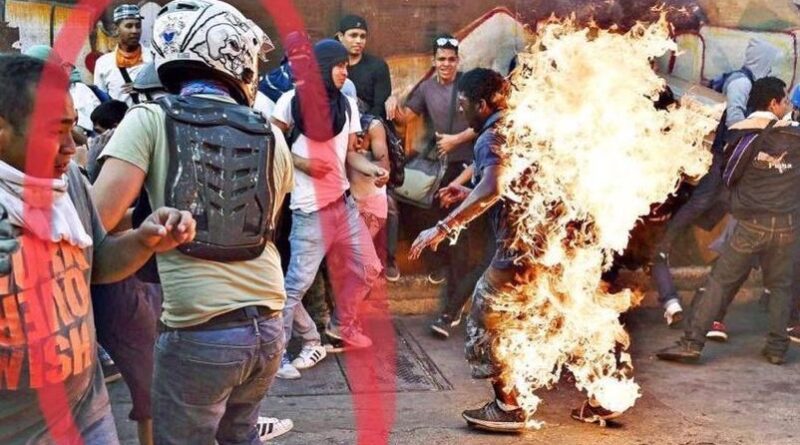
Enzo Franchini Oliveros inside the red circle. File photo.
Orinoco Tribune | October 2, 2020
A Spanish Justice on Wednesday rejected the extradition of the Venezuelan Enzo Franchini Oliveros, who is requested in Venezuela for his participation, during the 2017 guarimbas, in the criminal action, where a group of people stabbed and burned alive 22-year-old Orlando Figuera, under the accusation of “being Chavista.”
The ruling issued by the Spanish National Court revokes the sentence adopted in June that ordered the extradition of Franchini on whom audiovisual evidence weighs that points at him as the material author of this action that resulted in the death of Figuera as a consequence of a cardiopulmonary arrest due to the collapse that registered his body after being stabbed six times and suffering for several days second and third degree burns in 54% of his body.
According to the EFE news agency, this judicial overturn, promoted by three magistrates, arises under the argument of understanding “the rational fear” of the accused, who alleged that in Venezuela his “fundamental rights” could be affected.
Contrary to this assertion, in the same ruling the rapporteur judges acknowledge that “the seriousness of the crime that motivates the extradition request (a hate crime) is undoubtedly considered,” while accepting the “lack of political connotations” in the extradition request on the part of the Venezuelan authorities.
They also acknowledge the absence of evidence that indicates a possible political persecution against Franchini by pointing out “the lack of data that allow us to conceive a special significance of the accused as an opposition political leader of the current Venezuelan government.”
Prior to this ruling, the first section of the Criminal Court of the National High Court agreed to extradite Franchini considering that all the requirements were met and after ruling out a motive of political persecution by not “glimpsing any element”, it stressed the importance of guaranteeing the application of justice against Franchini given “the connotation of the crime.”
US Southern Command Chief Admits Plans Against Venezuela
teleSUR- October 7, 2020
Venezuela’s Foreign Affairs Minister Jorge Arreaza Monday denounced that the U.S. Southern Command Admiral Craig Faller openly admitted his country’s plans to violently overthrow President Nicolas Maduro.
On Monday, Faller commented at an online meeting organized by the business forum Council of the Americas that the international attempts to bring down Venezuela’s government have worked, although not quickly enough for the Venezuelan people.
He not only said that such efforts have not worked quick enough but also that it took an entire generation to get to this point and that it will take a while to unblock Venezuela’s democratic framework.
The Admiral also attributed certain external factors such as the help of Cuba, Russia, China and Iran to the alleged slow change within Venezuela.
Arreaza pointed out that this arrogant position of the members of the White House is unacceptable as they insist on violating the Charter of the United Nations and the most basic principles of international law through threats and blockades.
This statement shows Washington’s systematic and widespread attacks on Venezuela, which constitutes a crime against humanity.
Venezuela’s government will add Faller’s confessions to the criminal complaint it filed against the U.S. government on Feb. 13 before the Hague’s International Criminal Court.
In this complaint, President Maduro requests the White House to lift all coercive measures against his country since the U.S. government prevents Venezuela from acquiring food and medicines and from negotiating freely on the international market.
Featured Video

Racist Seinfeld Dances for Joy as Bibi Unveils His New Map
or go to
Aletho News Archives – Video-Images
TV Drama Review
Japanese drama projects Japan’s wartime atrocities onto Chinese characters

Global Times | October 25, 2026
By portraying Chinese characters as perpetrators of ruthless violence while casting Japanese Self-Defense Forces (SDF) intelligence operatives as defenders, the season 2 of the Japanese drama Vivant has recently drawn criticism from Chinese netizens, who argue that its depiction turns historical reality on its head while ignoring Japan’s wartime atrocities.
The TBS drama series – a spy suspense story in which an alleged unofficial intelligence unit of the SDF operates across the globe — has attracted a passionate fanbase. Its currently airing season 2 opened with a household rating of 18.8 percent, the highest for a TV drama this year, according toa commentary article by Japanese media Toyo Keizai.
What draws attention is the portrayal of the enemies in the series, the article noted. Scenes in which the Chinese organization subjects kidnapped members of the SDF unit to brutal torture are repeated with unrelenting intensity.
It is rare for Japanese TV dramas to explicitly portray a real-life country as the enemy, the article noted.
Japanese Prime Minister Sanae Takaichi also made a reference to the drama, saying that she has been recording Vivant and hopes to binge-watch it over the year-end and New Year holidays, according to Japanese media outlets.
China’s CCTV News report on Sunday revealed that the drama features scenes in which Chinese personnel cut off the fingers of and stab Japanese intelligence operatives in the abdomen. Such acts bear striking similarities to the torture inflicted on Chinese nationals by invading Japanese troops during the World War II.
The drama distorts the truth by attributing these atrocities to modern Chinese characters. Beneath the surface, it subtly glorifies Japan’s cross-border overseas operations, blurs the functional boundaries of the SDF and implicitly promotes an expansionist narrative, per CCTV News. … continue
Blog Roll
 Aletho News
- EU facing trillion-euro debt hole while seeking more cash for Kiev
- How US, Europe, Persian Gulf states exhausted missile stockpiles, splurged billions to defend Israel
- Up in arms… Koreans reject U.S. empire’s plan to make South Korea the next Ukraine
- Iran, Turkey, Pakistan, Saudi Arabia could advance region-led security framework in Tehran: FM spox
- Netizens condemn Japanese drama for projecting Japan’s wartime atrocities onto Chinese characters
- Racist Seinfeld Dances for Joy as Bibi Unveils His New Map
- A West Bank War for Netanyahu’s Election Campaign, Could It Backfire?
- Yemen denounces European Parliament’s ‘hypocritical’ push to blacklist Ansarullah
- Qalibaf: UAE’s UN bid aims to ‘clear the runway’ for ‘Greater Israel’, whitewash genocide
- Pakistan reopens Iran border after boosting security: Report
- If Americans Knew
- An error has occurred; the feed is probably down. Try again later.
- No Tricks Zone
- Sudden Stratospheric Warming, Powerful El Niño Combination May Lead To Extreme Europe Cold, Energy Crisis!
- Two New Studies Find Thwaites Glacier Melt Cannot Be Driven By Human Activity Or A Warming Ocean
- E-Cars Reduce CO2 Emissions By Only 41% Compared To Internal Combustion Engine Vehicles
- Predictions Made By Renowned Climate Professor Over Past Decades Have Been Proven To Be Poor
- New Study Suggests Large Regions Of The Pacific Ocean Have Been Cooling For The Last 80 Years
- Germany’s Green Energy Debacle: High Energy Costs Force Kahla Porzellan to Close After 182 Years!
- New Study: 50 Years Of The Most Aggressive ‘Net Zero’ Policies Can Only Affect The Global Climate By 0.03°C
- US September “Heat” Was No Record…Many Records Set Decades Ago
- Latest European Green Energy Debacle; Portugal’s Largest Flagship Solar Park Insolvent!
- Green Energy Debacle: German Expert Professor Fritz Vahrenholt Warns Of Severe Economic And Social Consequences

